Category Archives: Black Comedy

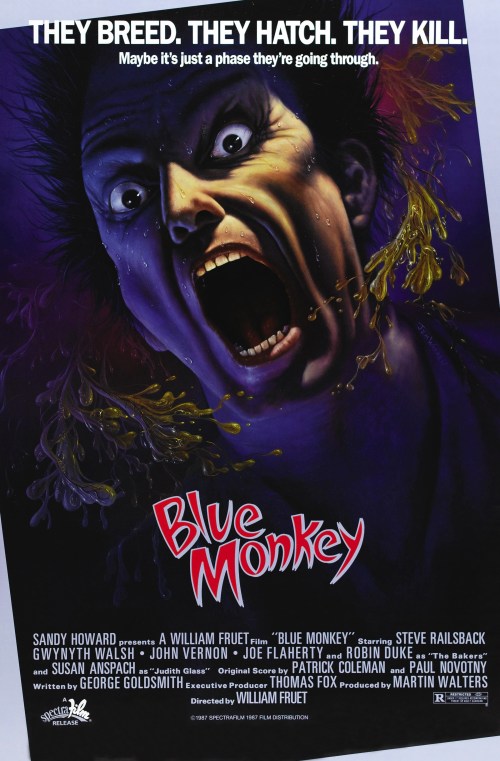
Blue Monkey (1987)

blue1

By Richard Winters

My Rating: 6 out of 10

4-Word Review: Giant insect invades hospital.

When an elderly man (Sandy Webster) gets his finger pricked by a foreign plant he’s immediately rushed to the hospital after he goes into shock. At the hospital he regurgitates an insect pupa, which is taken to the lab for observation. It is there that it gets fed a growth hormone by a group of children causing it to escape and take-over the hospital. Jim (Steve Railsback) is a police detective who was already in the hospital overseeing his partner who had gotten shot while on duty. Together with Rachel (Gwynyth Walsh), an on-call emergency room doctor, and Elliot (Don Lake), a entomologist, they go on the offence to trap the giant bug and kill it before it can reproduce.

I was initially not excited about watching this as it’s admittedly a rip-off of Alien and has many of the same shocks while being directed by Canadian horror maestro William Fruet whose other output I’ve found to be only so-so, but this one is surprisingly compelling. It also has some cool effects including seeing the characters running down a darkened hallway that’s lighted from one end with a bluish hue that gives it a surreal vibe. The shocks aren’t plentiful, but the few that they do have work.

This is also one movie where Railsback, who’s excellent playing psychos like Charles Manson and Ed Gein, is effective as a good guy. In other films where he was a protagonist like in Lifeforce he came-off as unintentionally creepy and it hurt his ability to get starring roles, but here his kindly interactions with a group of sickly children help subside that. I also enjoyed Susan Anspach, looking almost unrecognizable in her black-rimmed glasses, as one of the Dr.’s who takes matters into her own-hands without waiting for a male Dr. to tell her what to do. In fact there really aren’t too many men in white coats at the facility that seemed mainly run by females, which I found interesting.

What I didn’t like were the supporting comical characters. Helen Hughes and Joy Coghill as two drunken old ladies was not needed nor was SCTV alums Joe Flaherty and Robin Duke as a goofy couple having a baby. Sometimes in horror movies that are super intense a brief moment of levity is okay, but this movie wasn’t frightening enough for that and if anything needed to play-up the scares more instead of throwing in goofy scenes that makes it seem too much like a jokey-script instead of a scary one.

The actual bug, when seen in its giant proportion, isn’t the chilling sight you’d expect mainly because its made to look like a regular bug, but just bigger, which isn’t imaginative and more reminiscent of the tacky sci-fi ‘creature-features’ of the 50’s where insects suddenly become bigger and most people today find laughable. It also would’ve been nice during the lab scenes for the camera to have focused on the pupa under the glass instead of the scared faces of the people looking at it. We don’t need to see facial expressions to know if something is scary we just need to be shown the scary thing directly and when we don’t see it, it makes the film look cheap like it didn’t have enough money to create an elaborate effect, so it copped-out by doing it this way.

Even with some of these issues it’s still an entertaining ride. It won’t be for everyone’s tastes and it certainly isn’t going to win any awards nor was it intended to, but if you like giant bug movies this one should satisfy your appetite.  It was also filmed entirely in Canada though the setting is supposed to be the US.

My Rating: 6 out of 10

Release: September 25, 1987

Runtime: 1 Hour 36 Minutes

Rated R

Director: William Fruet

Studio: International Spectrafilm

Available: DVD, Blu-ray

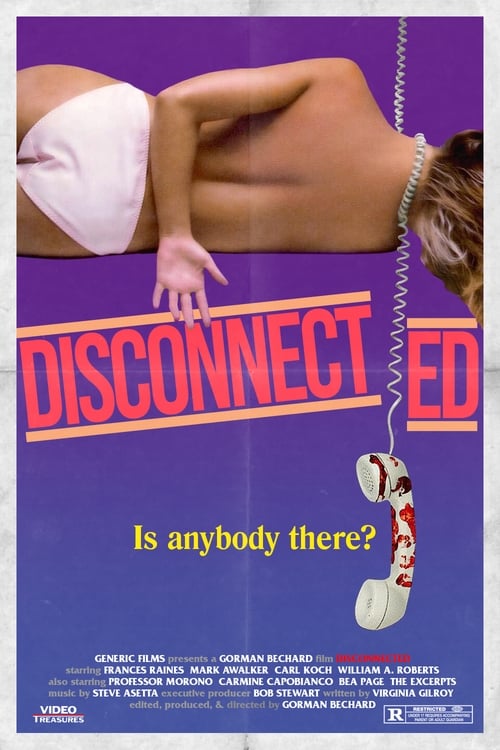
Disconnected (1984)

disconnected2

By Richard Winters

My Rating: 4 out of 10

4-Word Review: Receiving harassing phone calls.

Alicia (Frances Rains) is a young adult woman who brings an elderly man (William A. Roberts) up to her apartment one day so that he can use her phone to make a call. However, once he leaves she begins receiving odd calls at all times of the day and night where loud unexplained sounds emit from the receiver. She also gets a call where she overhears a conversation between her boyfriend Mike (Carl Koch) and twin sister Barbara-Ann, who are apparently are seeing each other behind-her-back. She then breaks up with Mike and begins dating Franklin (Mark Walker) whom she met while working at a video store. Franklin seems nice at first, but she’s unaware that he’s also the notorious serial killer who has been murdering young women in her area.

This horror oddity is the product of Gorman Bechard, who while still a film student decided to make a movie on his own with the low, low budget of only $40,000 and filming it almost entirely inside his tiny one-bedroom apartment. While it’s not a complete success it’s offbeat enough to hold your attention and guaranteed to keep you guessing to the very end.

The scenes inside the video store I enjoyed the most particularly Franklin’s complaints at how it didn’t have enough foreign films, or older movies, which was always the criticism I had of my local video stores too. The dark humor of Franklin hanging a crucifix over his bed where he commits the murders and the little prayer he does before he offs his victims I found amusing. Bechard’s odd camera shots including one segment done with black-and-white, freeze-frames is another asset that keeps it inventive.

The performance by Raines, who is beautiful, is excellent and I felt she would’ve had a long career ahead of her had she not giving up acting in order to raise a family. I was not as enamored though with the two guys playing the cops who lend a cartoonish flair that was not needed. I didn’t like too that one of them gets interviewed by someone sitting behind a camera that we don’t see and asking a bunch of questions almost like it’s a documentary, which begs the question as to who this person was and why does he just interview the cops, but no one else?

Spoiler Alert!

The film’s biggest problem though is that it gets rid of the Franklin too quickly without playing up that scenario as much as it could’ve. It also cuts away without ever showing how the cops are able to subdue him, or how Alicia is able to get away, which seems like a standard scene that a horror movie fan would want to see and not just have discussed later.

The weird calls ultimately become boring. It also takes Alicia too long to figure out that maybe a good way to stop them would be to unplug the phone from the wall, which she finally does at the very end, but most other people would’ve done it a hell of a lot sooner.

The twist ending where the old man that was seen at the start, but then disappears only to return and be shown walking out of her apartment makes no sense. Some viewers have speculated that maybe he was a ghost of some kind, but that’s not made clear. My personal feeling is that there was no meaning to it and it’s intentionally left vague, so the individual viewers can read into it whatever they want, but it’s not a satisfying way to end almost 90-minutes of viewing and in many ways, despite the interesting bits, makes it quite annoying. A better, more focused conclusion would’ve certainly helped.

My Rating: 4 out of 10

Released: July 17, 1984

Runtime: 1 Hour 24 Minutes

Rated R

Director: Gorman Bechard

Available: VHS, Tubi, Blu-ray (Limited Edition only 2,000 copies printed) 

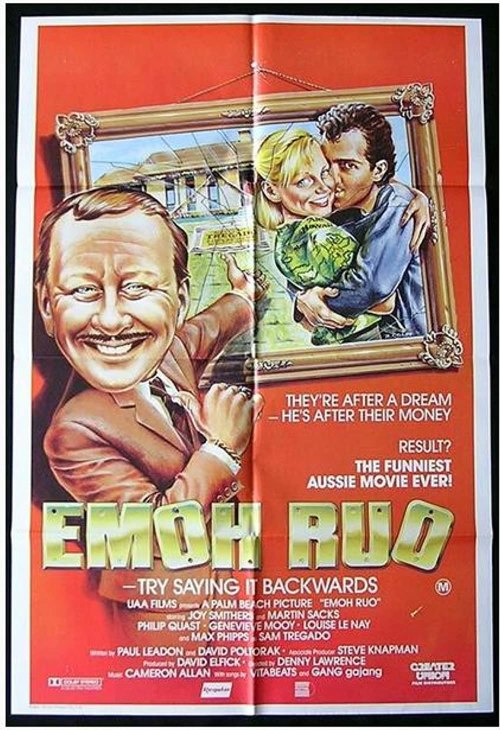
Emoh Ruo (1985)

emoh1

By Richard Winters

My Rating: 4 out of 10

4-Word Review: New house falls apart.

Terri (Joy Smithers) is tired of living in a trailer and begs her husband Des (Martin Sacks) to finally buy a house, so they can live in the burbs and be a part of the middle-class dream. After saving up enough money they put a down payment on a brand new home, but the home begins to have a lot of problems. Both Terri and Des are forced to work longer hours at their jobs in order to keep up with the bills. What seemed like a dream at first soon turns into a nightmare making living in a trailer, which they initially hated, now seem like a good idea.

This film has a lot of similarities to Steven Spielberg’s The Money Pit, which came out a year later, but this one is more amusing, at least at the beginning. Spielberg’s film, which was directed by Richard Benjamin, was too cartoonish and silly and failed to make any broader statement other than wild comical antics. This one takes more of a satirical approach and shows how suburban life may not be as great as advertised and in some ways just plain not worth it. One of the funnier moments is when Terri gets home from her overnight job and the second she walks through the door immediately falls to the floor in exhaustion while her tired husband, who’s getting ready to go to his second job, steps over her while going out the door without so much as giving her a greeting.

I did like too that this movie doesn’t immediately go over-the-top with the problems of the home repairs. The Money Pit, in my opinion, ruined things by having everything go wonky right from the start, which didn’t allow for any buildup while this one keeps the tension by showing things not working as they should and making you interested in seeing if it’s going to get worse. The nightmarish elements aren’t just isolated to the home either as their son Jack (Jack Ellis) must put up with bullies at his new school and the couple also deals with nosy, meddling neighbors.

I was surprised by the abundance of nudity, at least during the first act, which is something you’d never see in a Hollywood movie, where nudity is usually only shown in film’s aimed at adults, or with adult themes, instead of a movie like this that would otherwise be perfect for the general public. I’m not sure exactly why director Denny Lawrence decided to put it in as it doesn’t have anything to do with the plot and could’ve easily been left out, but I can only presume that because Australia is a more secular country they’re less uptight about showing skin and therefore don’t worry, or fear, that putting it into a movie, even one as otherwise innocuous as this, will be a problem, or get backlash.

What I didn’t like though was Joy Smithers as the mother. While she certainly looks beautiful, both with her clothes on and off, she was, at age 22, too young to be portraying a suburban mother of a 10-year-old child. Her acting was problematic too especially her scenes where she’s supposed to be upset that doesn’t convey the subtle comic element that a better actress could’ve brought out.

Spoiler Alert!

The third act, outside of seeing an outrageous looking BBQ pit built by the husband, fails to have much of a payoff. Many of the problems with the house never get properly addressed. For instance the shower knobs blow off the wall and spew streams of water everywhere, but the film cuts away without showing how they managed to get it under control. Having the entire house ultimately collapse isn’t impressive either as it looks too much like a prop house made of cardboard instead of brick and mortar.

I was disappointed too that the dark comical edge gets lost with a sitcom-styled wrap-up that seemed to lose complete sight of the main point, which ultimately makes the film as a whole quite transparent and forgettable.

My Rating: 4 out of 10

Released: September 12, 1985

Runtime: 1 Hour 33 Minutes

Not Rated

Director: Denny Lawrence

Studio: Palm Beach Pictures

Available: DVD (Region 4 Import)

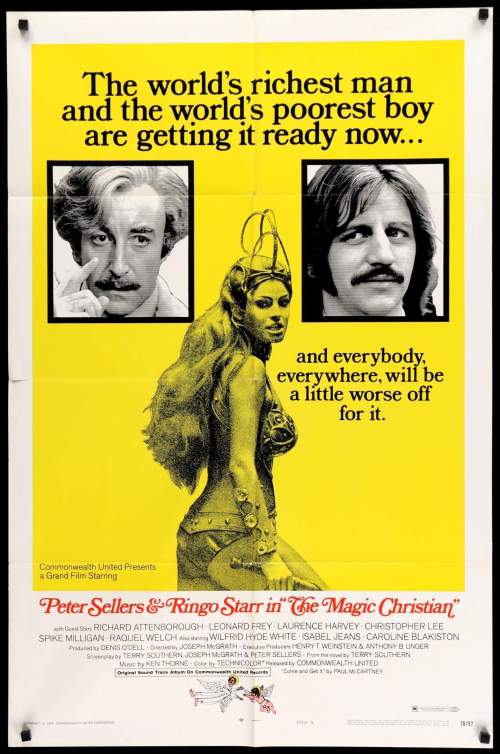
The Magic Christian (1969)

magic2

By Richard Winters

My Rating: 8 out of 10

4-Word Review: Everybody has a price.

Sir Guy Grand (Peter Sellers) is a billionaire with an eccentric side, who wants to prove the powerful influence money has over other people. He meets Youngman (Ringo Starr),a homeless man in a park, and decides to adopt him as his son. Together they proceed to play elaborate pranks on the public by watching how far they can push their theory and what humiliating lengths people will go to get their hands on some money.

The film is based on the 1959 novel of the same name written by Terry Southern, who also wrote the screenplay, and while the novel was considered a success the movie, at least when it was first released, wasn’t. My critics complained of the film’s heavy-handed satirical nature and unrelenting jabs at capitalism even though all the same pranks done in the movie were also in the book. The film also has the exact same satirical theme as O Lucky Man, which starred Malcom McDowell and came out just a few years later that also took numerous potshots at capitalism and yet many of the same critics adored that one, but came down hard on this one.

Fortunately through the years the film has managed to find a cult following. I supposed if one has more of a socialist bent they may enjoy it more, but it has such a surreal, creative vibe to it that it’s fun to watch no matter if you agree with it’s message, which is kind of muddled anyways, or not. Some of my favorite bits included snotty, rich aristocrats boarding a ship cruise that puts them in increasingly more humorously challenging and bizarre situations. The final segment, which has the classic song ‘Something in the Air’ by Thunderclap Newman playing during it, features a giant outdoor vat filled with urine, blood, and animal feces and then having Grand throw money into it and challenging onlookers to jump into the mess in order to get at the money, which despite the awful stench they readily do.

There’s many cameo appearances by famous stars who agreed to take small roles as a favor to Sellers who at the time was a top star and friends with many of the big headliners of the day. Some of the best bits here include Laurence Harvey who does a striptease while onstage and in front of a packed house of onlookers while reciting ‘Hamlet’. Yul Bryner, looking almost unrecognizable in a female wig, is great as a transvestite who comes-onto a shy Roman Polanski while at a bar. Spike Milligan is hilarious as a traffic cop who agrees to eat his own traffic ticket for the right price as well as Raquel Welch as a slave commander with a whip, Wilfred Hyde-White as a drunken ship captain, and John Cleese as a perplexed auctioneer.

The problems that I had with the film dealt mainly with the relationship between Sellers and Starr. Sellers meets Starr one day in a park by chance and then begins to have a conversation with him, but there’s music playing over this, so we never hear what they’re saying, which is frustrating as the having a rich man suddenly offer a poor man the chance to be his adopted son seemed like dialogue that should be heard. Starr is also not given much to do and it seemed almost pointless for having even in the movie. In the novel there was only the Grand character creating the pranks, but it was decided for the movie to make it a two man show, but Ringo has so little to do that it didn’t seem worth it and this reportedly was due to Sellers’ insecurity of being upstaged and thus insisting that all the best lines had to go to him.

It’s also never clear why the Sellers’ character does what he does. What’s the motivation for why this rich man feels the need to expose other people’s foibles and vanities? Does he feel guilty about being so rich and therefore has decided to ‘take-it-to’ the others in his own social circle? None of this gets explained or analyzed at all, which on the character end makes the film quite superficial and confusing.

My Rating: 8 out of 10

Released: December 12, 1969

Runtime: 1 Hour 32 Minutes

Rated M

Director: Joseph McGrath

Studio: Commonwealth United Entertainment

Available: DVD, Blu-ray, Amazon Video

Last of the Red Hot Lovers (1972)

last1

By Richard Winters

My Rating: 4 out of 10

4-Word Review: Married man wants fling.

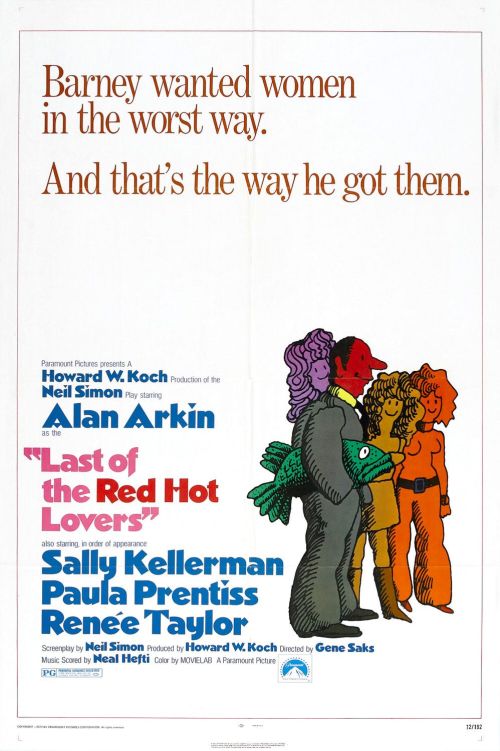
Barney (Alan Arkin) is a middle-aged man, who after 22-years of marriage, has decided he’d like to fool-around for the first time. He doesn’t want an actual affair, just a quickie sex fling with indiscriminate women while inside his elderly mother’s apartment, which he has access to during the day while she’s away. The problem is that while he’s able to get attractive women into the place he can’t quite get any action leaving him feeling more sexually frustrated than when it began.

The film is based on the Neil Simon play that opened on Broadway in 1969 and ran for 706 performances. The play starred James Coco in the pivotal role who I felt was much better suited for the part than Arkin. Arkin is okay, but his comedic style can be quite frantic in tone that can sometimes border on creepy. He also had a full head of hair at the time even though the role called for a balding man, so he shaved the top of his head to appear semi-bald, but it looks tacky. Coco on the other-hand had a lovable loser quality that made you want to like him even when he did naughty things and he was naturally bald, so his appearance wouldn’t have looked as fake as Arkin’s. I can only presume that because Arkin was at the time an established film star and Coco was still just considered a fledgling character actor that’s why he got the offer while Coco didn’t, but it’s one of the main reasons the story doesn’t translate as well on film as it did onstage.

The directing by Gene Saks isn’t bad particularly the opening sequence where we things entirely from the point-of-view of Barney as he wakes-up and gets out of bed and starts his daily routine, which I found rather inventive cinematically. In fact it’s these moments where we hear the thoughts going on inside Barney’s head as he tries to get the nerve to break-the-ice with other women that he meets, which are the funniest. Unfortunately the scenes done inside the apartment don’t work as well as the place is too cramped and appearing more like a jail cell, which becomes visually static.

The three rendezvous that Barney has with three different women aren’t as clever or creative as they could’ve been. The first segment has Sally Kellermen, who is excellent, playing an Italian women, who comes up to his place, but then just proceeds to argue with him before leaving. My main problem with this scene was the motivation as she spots Barney working inside his restaurant, which precipitates the meet-up, but why would this incredibly hot woman get turned-on by this dopey looking guy to the point that she’d want to have casual sex with him? There were plenty of other men in the place, so why does Barney excite her over the others? The conversation that the two have inside the restaurant is never shown, which I found to be a cop-out and hurt the character development. Had she been portrayed as being a prostitute then it would’ve made more sense, but this is never confirmed, which makes this whole first segment quite weak.

The second segment deals with Paula Prentis as a struggling actress who Barney meets in a park. She borrows some money from him and then agrees to pay him back later at the apartment. However, when she arrives she seems like a completely different person. At the park she came-off as quiet and shy, but at the apartment she’s a babbling idiot that seems to be on acid. The dialogue during this sequence in which the characters basically talk-over each other the whole time quickly becomes annoying. The scene fades-out with the two getting high off of marijuana, but it never shows her leaving the place, so we don’t know for sure if they ended-up having sex or not.

The third and final segment has Renee Taylor playing a middle-aged woman, who is also married, coming-up to Barney’s mother’s place, but immediately getting cold-feet, which kills the intrigue as we know right from the start how it’s going to go. This scene also has a rapey vibe to it as Barney, now feeling frustrated at having struck out twice before, behaves in a much more aggressive manner by blocking her from leaving and then while half-naked jumping on top of her and pinning her to the bed while she yells for him to get off, which is cringy and not funny.

Having a film deal with all the strike-outs a person may face when it comes to having sex with others is an interesting idea. Too many other movies just show the ones that work-out, but in reality, especially with average looking people, there can be more misses than hits, so I appreciated the story in that regard. However, random sex with strangers where the women goes to a strange man’s place without worry or concern has become a thing of the past in this day and age of stalkers and self-protection making the theme here quite dated and out-of-touch.

My Rating: 4 out of 10

Released: August 17, 1972

Runtime: 1 Hour 38 Minutes

Rated PG

Director: Gene Saks

Studio: Paramount

Available: DVD, Amazon Video, PlutoTV, YouTube

The Gang That Couldn’t Shoot Straight (1971)

gang1

By Richard Winters

My Rating: 4 out of 10

4-Word Review: Challenging a crime boss.

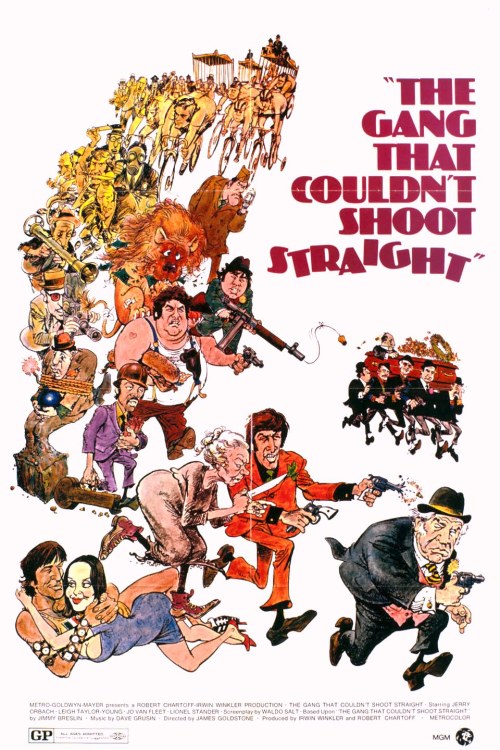
Kid Sally (Jerry Orbach), who works within a crime family where he’s in charge of a small group of crooks, becomes increasingly frustrated at what he feels is a lack of respect that he gets from mobster boss Baccala (Lionel Stander). When Kid is put in charge of supervising a bicycle race that does not go over well he gets demoted, which convinces him to take down Baccala and become the mob boss himself, but the men under him prove inept at every turn. Each time they try to kill-off Baccala the only ones who die are Kid Sally’s guys.

The film is based on the novel of the same name written by Jimmy Breslin and inspired by real-life mobster Joe Gallo who was also the inspiration for Crazy Joe that starred Peter Boyle. However, the Boyle film approached the material in a serious way and tried to keep things more closely tied-in with the actual events while this thing veers-off from what really happened and instead simply uses the situation as a springboard for a lot of zany, comical antics.

One of the main problems is the casting of Orbach who looks nothing like the real Gallo, Boyle was not a perfect match for him either, but he was at least in the same ballpark while Orbach appears too old and without any signs of the mental health issues that had afflicted Gallo who had been diagnosed with schizophrenia in his youth. There are also too many characters to keep track of and Orbach half the time is barely even seen becoming more like a supporting player in his own movie.

The film does have a few amusing moments including the gang’s attempts to bring in a lion, which they use to blackmail the client’s of their opposition. Van Fleet is also quite funny as Kid’s mother who looks and walks like she’s ready to die from old age, but speaks as if she’s a young tough guy. The location shooting isn’t bad either and seeing the entire group of men crammed into Joe’s mother’s apartment as they partake in their weekly spaghetti dinner brings the Italian ambience to a nice head, but director James Goldstone approaches the material in a haphazard fashion and it’s edited in a way that makes it seem more like a collection of vignettes than a story.

The only interesting element is seeing Robert De Niro, complete with long hair, as this young con who comes to New York straight from Italy. He speaks with an authentic accent, which he acquired by going to Italy for a week and recording the people around him and then playing back their voices while he rehearsed. He even prepared for his role as a thief by stealing 2 shirts from a Macy’s department store requiring producer Irwin Winkler to intervene in order to keep him out of jail. Leigh Taylor-Young is excellent as his love interest and her performance as the Kid’s younger more idealistic sister has an organic quality and a far cry from the psycho role that she played in The Big Bounce just 2 years earlier. The romance between her and De Niro and their attempts to forge a relationship while living in a cramped, rundown apartment is kind of touching and had the film focused on these two it would’ve worked better.

My Rating: 4 out of 10

Released: December 22, 1971

Runtime: 1 Hour 36 Minutes

Rated: PG

Director: James Goldstone

Studio: MGM

Available: DVD, Amazon Video, YouTube

Tulips (1981)

tulips1

By Richard Winters

My Rating: 1 out of 10

4-Word Review: Choosing love over suicide.

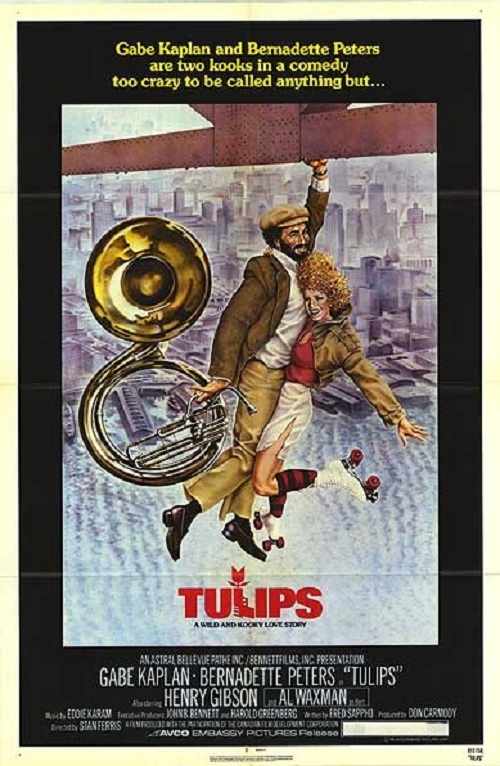
Leland (Gabe Kaplan) is a depressed man who has tried to kill himself several times, but been unsuccessful at it. He hires a hitman named Avocado (Henry Gibson) to shoot him, but Avocado isn’t so sure he wants to do it and advises him that once he decides he’ll leave an ad in the personals section of the newspaper with the word ‘tulips’ in it, which will be the code word for ‘yes’. While Leland awaits his fate he meets Rutanya (Bernadette Peters) who he saves from a burning car after she too tries to kill herself. Eventually they form a relationship, which blossoms into a romance and then marriage only to realize that Avocado has decided to go through with the hit forcing Leland and Rutanya to desperately try to stop him.

While I’ve never been a fan of Kaplan’s acting ability in the past I thought his performance here was alright although the combination of his thick beard and mustache makes him resemble a rabbi and a clean shaven look would’ve been preferred. It’s also a bit perplexing with his extremely bushy head of hair why he would require hair transplants as his character does here.

Peters is delightful, at least at the beginning, but when the two get together the whole thing bogs down into one long  talkfest with nothing much being said that’s funny. The way the two first meet gets botched as initially she bumps into him while roller skating down the road, while also grabbing onto her psychiatrist’s car, which knocks Leland over a bridge wall and he then clings desperately to it in order to avoid falling into the river, but the film then cuts away and we never see how he got out this predicament making it on par with a mindless Road Runner/Wiley E. Coyote cartoon where crazy antics occur without any after effect.

The hit man angle where the intended victim changes his mind had already been done in movies 6 times before this one and therefore wasn’t an original concept nor does it get played-out in a way that’s interesting. Gibson is a good character actor, but here his one-dimensional performance, due mainly to the poor writing, lacks amusement or charisma. There’s also never any action just endless talking, first with an extended bit where Leland contemplates whether he should or shouldn’t look in the newspaper to see if ‘tulips’ is in it, then more discussions about how they can try to stop him and eventually Rutanya sitting down with Acocado directly to try and talk him out of it, which cinematically is not entertaining especially with dialogue that lacks any bite.  The music score is bad too with a silly cartoon-like sound effects that you’d hear on a kiddie show.

Spoiler Alert!

However, it’s the twist ending that I found to be the most annoying as it features a bomb placed by Leland into a car with Avocado and Rutanya inside. First there’s no explanation for how Leland was able to build this bomb as it’s not something just anyone can do, so one has to wonder where he acquired the expertise, but no answer is given. The dumbest thing though is that Leland chases after the vehicle screaming at Rutanya to get out before it goes off and then watches as it explodes convinced she died only to have her reappear later telling him that both she and Avocado where able to get out ‘just in time’, but if that were the case then wouldn’t Leland have noticed since he was looking right at it when it blew up? Also, when the bomb goes off the car doors are shut though it’s hard to believe that Avocado and Rutanya, in their desperation to get out, would’ve made sure to close them when they jumped out.

My Rating: 1 out of 10

Released: September 25, 1981

Runtime: 1 Hour 32 Minutes

Rated PG

Director: Rex Bromfield, Al Waxman, Mark Warren

Studio: AVCO Embassy Pictures

Midnite Spares (1983)

midnite2

By Richard Winters

My Rating: 6 out of 10

4-Word Review: Searching for his father.

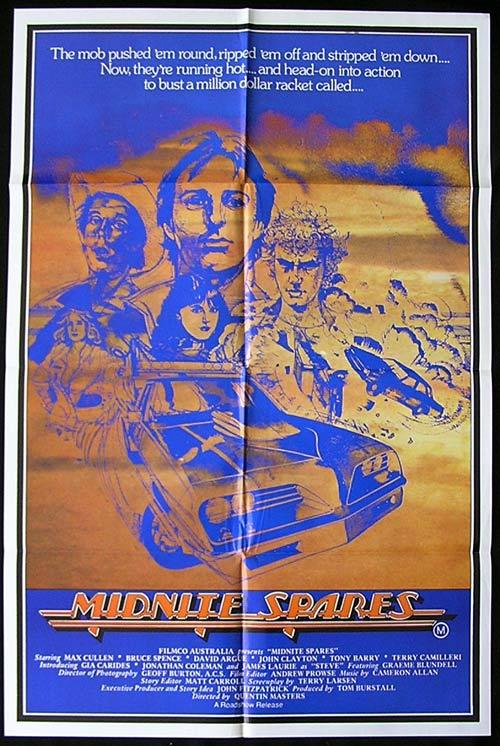
Steve (James Laurie) returns to his hometown of Sydney to team up with his dad to be a part of a sprintcar racing team. However, when he visits the towing company that his dad owned along with his business partner Tomas (Max Cullen) he cannot find him and is told that he mysteriously disappeared weeks ago without a trace. After further investigation he becomes convinced that it has something to do with a local car thief ring headed by corrupt cop Howard (Tony Barry) and uses the help of tow truck drivers Wimpy (Bruce Spence) and Rabbit (David Argue) to reel them in while also falling for a local girl named Ruth (Gia Carides) much to the chagrin of her conservative mother ( Tessa Mallos).

On the one hand this is a well set-up comedy with all the necessary ingredients to have been a top-notched funny movie. I really enjoyed the character actors who are in top form especially Bruce Spence, probably best known for his starring role in the cult film Storkwho plays a happy-go-lucky mechanic who always has greased caked-on his face no matter where he goes even when off the job and out in public. Tony Barry gives an interesting performance as well. Just a year before this film was shot he in starred in the New Zealand cult classic Goodbye Pork Pie that’s one of the best road movies ever made. In that film he played the nonconformist running from the cops while here plays the obnoxious oppressive authority figure and he’s able to play both types of roles quite convincingly. I also enjoyed the set pieces, which resembles very much the dingy, grimy look of a car repair shop as well as the distinctive score that has a creepy tone to it, which helps accentuate the late-night, underground vibe of the story.

There’s also a few very engaging moments as well including a segment where a guy hijacks a mobile hot dog stand and drives it around the track with the perplexed staff still inside while the sprintcar race is delayed due to an accident, which is pretty funny. I also loved the scene where the thieves steal a car, bring it into their shop and in a matter of literally seconds are able to completely dismantle it piece-by-piece until only its bare shell is left much like the famous scene in The French Connection where a car gets taken a part in the search for drugs, but here it’s done even more quickly and thoroughly.

What I didn’t like was the editing, which is done in too much of a choppy style. It’s very hard to get into the characters when their scenes and conversations are limited to only a couple of minutes and a few lines of dialogue before it quickly cuts away to another scene somewhere else. It would’ve worked better had it slowed the pace down a bit and allowed the elements to percolate instead of having this rushed feel. There’s also a some storylines that had potential, but aren’t followed through enough including the conservative mother of James’s girlfriend, which could’ve been ripe with far more confrontation than it ultimately does.

The action gets captured in too fleeting of a way and there isn’t as much of it as you’d expect despite its reputation as being an action movie. The climactic car chase showdown is too brief though it does feature some good camera angles that makes the viewer feel like their a part of it, but this also ended up taking the life of one of the cameramen, David Brostoff, who got too close to one of the cars and ended up getting run over. (The footage that he shot was left in while the movie is dedicated to his memory)

As crazy as it sounds it also would’ve been nice had it come with an English subtitle option. While the language is in English the Aussie accents are strong and it’s not always completely clear what they’re saying. I felt like I was missing a few words here and there especially with its quick pace where an actor would say a short line and then there’d be an immediate cut to something else.

My Rating: 6 out of 10

Released: February 17, 1983

Runtime: 1 Hour 27 Minutes

Not Rated

Director: Quentin Masters

Studio: Roadshow Films

Available: DVD-R (Domestic Import Region 0)

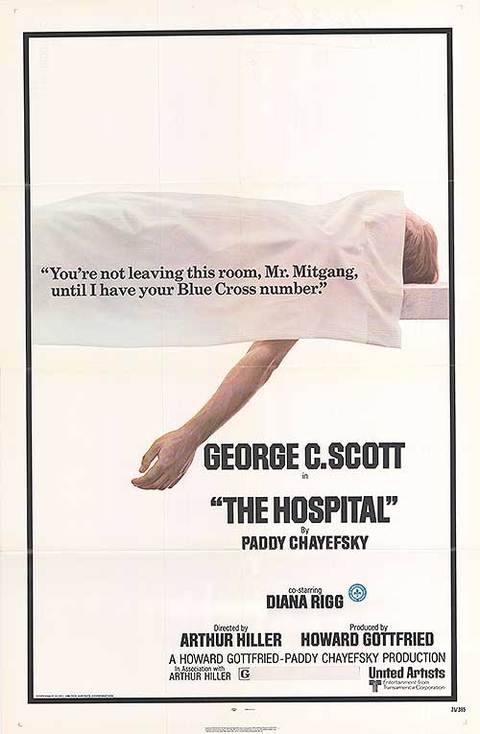
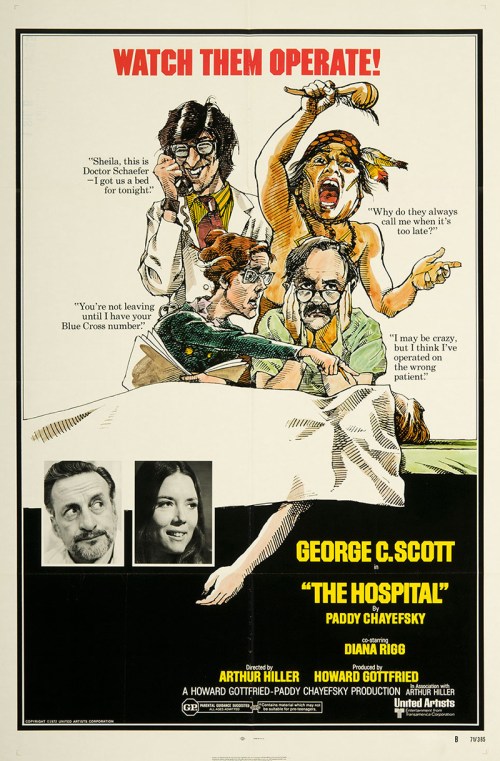
The Hospital (1971)

hospital1

By Richard Winters

My Rating: 8 out of 10

4-Word Review: An incompetently run hospital.

Dr. Herbert Bock (George C. Scott) is the chief of staff at a teaching hospital in New York where patients routinely die due to misdiagnosis and other blunderings. There’s also a protest by a group of tenants from a nearby apartment building that’s been annexed by the hospital to make room for a drug rehabilitation center. Bock not only must deal with these issues, but also his crumbling personal life which has turned him to both alcohol and thoughts of suicide. His only ray-of-light is meeting the beautiful Barbra (Diana Rigg) who has come to the hospital to seek treatment for her father (Barnard Hughes), but just as Bock starts to come out of his depression the place becomes terrorized by an unseen assailant who begins killing both the patients and staff.

In 1969 after his wife had received poor care at a local hospital Paddy Chayefsky set-out to write a script exposing what he felt was the corruption and incompetence going on inside the American medical institutions. He managed to get full control over his screenplay and final say over any proposed changes, which was a good thing since initially the studio felt it was filled with too much medical terminology that would go over many viewer’s heads. I’ll admit there’s an excessive amount of lingo, both with the dialogue between the doctors and staff as well as the opening voice-over narration by Chayefsky, that’s done at a rapid-fire pace and I really didn’t understand it, but I still kind of liked it. I have no medical background myself, so I and most viewers aren’t going to get the ‘medical speak’, but leaving it in helps make it sound more authentic. It also impresses the viewer with how much research was put into it and you basically trust what’s going on because it ‘sounds intelligent’.

Another complaint was the shift in tone where things start out in a darkly-humorous slap-dash fashion only to end up during the second act becoming quite serious. Normally this would’ve been a big problem, but I liked the shift here. I think the reason is because underneath the comedy there’s still life-and-death consequences going on and if you’re going to make a statement movie, which this is attempting to do, then at some point things have got to slow-down and get serious in order for that statement to get out, which this thing ends up successfully doing.

While I enjoyed the fluid pace that manages to encompass not only satire and drama, but even shades of horror without ever losing its realism I did find that it spends an inordinate amount of time telling us about all of the problems without bothering to give us any solutions. There’s no focus on what the underlying causes are nor any balance by showing an well-run hospital in comparison. One might start to believe that all hospitals are like this and become afraid to ever go into one even if they are really sick, which isn’t exactly a good thing. This may have been the reason why Chayefsky himself died at the relatively young age of 58 from cancer because he feared Dr.’s would “cut me up because of that movie I wrote about them” and thus refused surgery that might’ve saved his life.

Spoiler Alert!

There’s a few issues with the casting as well. Overall, I was impressed with the performances particular Scott who got his second Oscar nomination for his work here. Rigg is also quite good, in a part that seemed better suited for Jane Fonda, who was the studio’s choice, but Rigg’s British accent and terse style makes for an interesting dynamic. You can also glimpse young soon-to-be-stars in small bits including: Nancy Marchand and Robert Walden, who later went on to co-star with each other in the TV-show ‘Lou Grant’ as well as Stockard Channing, in her film debut, and Frances Sternhagen as an exasperated medical clerk. The main problem though comes with Barnard Hughes, who appears for some strange reason in two completely different roles. He is very funny as the surgeon who finds he’s been operating on the wrong person, but then later he reappears as Rigg’s father, which didn’t make much sense. Since the father turns out to be the mysterious killer many people thought the scene with Hughes as the surgeon was meant to be the father in disguise, but that was not the intention. Again, if there’s no specific/underlying purpose story-wise for an actor to play two different parts in the same movie then don’t do it. There’s no lack of actors out there clamoring for work, so one of the two parts could’ve easily have been filled by someone else and thus avoided confusing the audience for no good reason.

It’s possible that the reason Chayefsky had Hughes playing dual roles was to help explain how the killer was able to get away with his crimes for so long. While the killer is always shown off camera, so the viewer does not know the identity, the Dr.’s and nurses do seem to recognize him as being a colleague and are put at ease just before he kills them. Of course the odds of a patient entering a random hospital and looking similar to one of the staff is astronomically low, but if this was the underlying concept, and it very well may have been, then the film should’ve eventually made this clear by having a split screen scene where Hughes the surgeon bumps into Hughes the killer.

hospital3

My Rating: 8 out of 10

Released: December 14, 1971

Runtime: 1 Hour 43 Minutes

Rated GP

Director: Arthur Hiller

Studio: United Artists

Available: DVD, Blu-ray, Amazon Video, Tubi, YouTube

The Clinic (1982)

By Richard Winters

My Rating: 7 out of 10

4-Word Review: Helping those with V.D.

A day in the life of a clinic in Melbourne, Australia that specializes in treating people with venereal disease.  Both the doctors and the patients have many issues to deal with, but not all of them have anything to do with sexually transmitted diseases including Dr. Eric Linden (Chris Haywood) who after spending the day treating patients is more worried about meeting the mother of his gay partner for the first time. There’s also Dr. Hassad annoyed with the lamp on his office desk that he can’t get to work right no matter how many times he tries to fix it and three men visiting from China who think they’re at a health clinic, not a VD one, but nobody can translate to them that they’re in the wrong place.

For the most part this is a funny engaging ensemble comedy similar to Britannia Hospital, a satirical comedy done in the U.K., or The Hospital done here in the US and starring George C. Scott.  There’s also distant shades to the 80’s TV-show ‘St. Elsewhere’ that toed the line between being surreal and serious.  The editing is fast paced as it cuts back and forth between various scenarios happening at the same time throughout the different offices in the building.

There are also many characters and it’s hard to keep track of all them. They’re introduced at such a dizzying pace that the viewer isn’t allowed to get attached to any of them as you see them for only a couple of minutes and then it cuts away to someone else and never going back to the previous one until much later when you’ve almost forgotten about them, or their dilemma. Some may consider this the hallmark of bad filmmaking as in Hollywood the idea is to have, even in an assemble comedy such as this, one central character for the audience to connect with and then colorful people surrounding them, but here no one takes center stage. Director David Stevens admitted in interviews that he was pressured by producers to go more the conventional route, but he resisted and in many ways it succeeds better because it gives you a true day-in-the-life feel of the inter-workings of a clinic and the constant hustle-and-bustle of patients coming in and out that a story more focused on one person might not be able to convey as effectively.

The lack of music is another thing that is unusual. During the opening sequence all that is heard is traffic noise while the credits roll and it’s not until 1 hour 5 minutes that any type of soundtrack is heard in a rare moment that does not take place at the Hospital, but instead on a beach. There is a bouncy tune sung by Alistair Jones over the closing credits, but other than that there’s nothing, which again I found okay as it uses the ambience of the people walking around and talking as the film’s soundtrack, which helps heighten the realism. The nudity is different here too as it’s solely close-ups of male genitals, but none from females, which bothered some viewers, but I found alright. What I did question though was the males so obediently disrobing in front of a female Dr. as I felt some of them would be uncomfortable and even hesitant to do this.

The conversations and throwaway lines are quite funny, which is the film’s centerpiece as are the quirkiness of the characters who say one thing, but end up doing the complete opposite much like people in real-life. There’s also a few serious moments that brings up the stigma that people with V.D. had to deal with including one who loses his job, but these don’t come to satisfying conclusions and should’ve been explored more.

Overall it’s an enjoyable 90-minutes although by the final 15 it starts to exhaust itself. Had it been done with a smaller cast might’ve helped although technically it’s still quite fluid throughout though some may point to its poor box office showing where it managed to only recoup $414,000 profit from its $1 million budget as a sign that the unconventional narrative was a failure. This though is more likely because of distributors at the time being reluctant to show the film fearing public backlash at what was still considered a taboo subject.

My Rating: 7 out of 10

Released: September 17, 1982

Runtime: 1 Hour 28 Minutes

Not Rated

Director: David Stevens

Studio: Roadshow Films

Available: None at this time.