Category Archives: Black Comedy

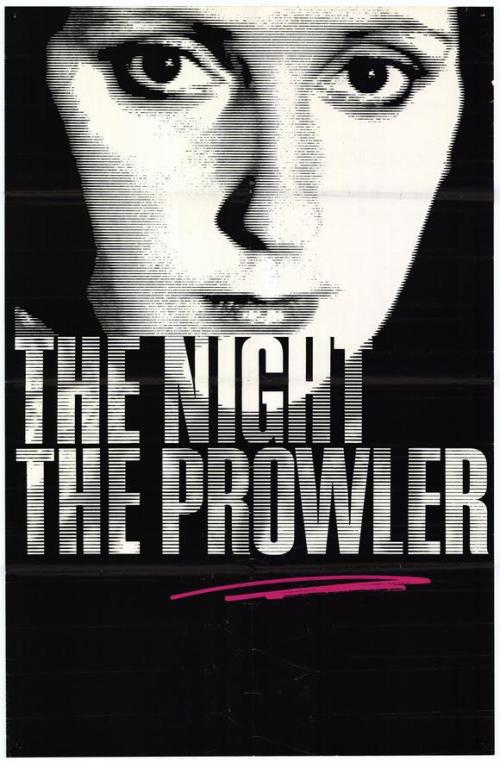
The Night, The Prowler (1978)

By Richard Winters

My Rating: 6 out of 10

4-Word Review: Victim turns into prowler.

Late one night Felicity (Kerry Walker), who is an adult woman still living at home with her parents (John Frawley, Ruth Cracknell), finds that a prowler (Terry Camilleri) has invaded her bedroom. After getting into a conversation with him she is surprised to learn that he’s a married man with kids, who enjoys prowling as a side gig to make up for the monotony and stresses of his home life. Felicity then realizes that the suburban lifestyle that her parents want her to live does not fully satisfy the individual and therefore decides she doesn’t want it. She breaks off her pending engagement with her fiancé (John Derum)  and turns into a prowler herself breaking into men’s homes late at night and learning to enjoy the underbelly of society by socializing with the homeless and other people that her parents always told her to stay away from. She soon finds a sense of empowerment by thumbing her nose at the elitists that make her her suburban community and doing all the forbidden things that her former cloistered lifestyle never allowed.

The film was directed by Jim Sharman best known for having done The Rocky Horror Picture Show. The basis for this project comes from his collaboration with playwright Patrick White and the many plays of his that he directed while doing experimental theater in Sydney during the 70’s. White wanted to expand one of his short stories into a screenplay and Sharman suggested this one had the best chance of working. The two had both grown up in the eastern suburbs of Sydney and wanted to create a film that showed their inner disdain for the arrogant, privileged people that populated the neighborhoods there and how the sterility of those environments may have been a comfort to the adults, but stifling and alienating to the teenagers.

To some level the film is interesting, but the fragmented narrative becomes an intrusive turn-off. Normally I like films that to get away from the mainstream approach and use different cinematic styles to tell a story, but the presentation here never allows you to get emotionally invested into the characters or their situations. There’s too much cutting back and forth between the present day, the past, and even some dream-like segments that ultimately makes the whole thing confusing and off-putting. That’s not to say that there aren’t some provocative moments as there are, but the non-linear approach never allows it to catch its stride, or feel like its progressing forward.

I did enjoy though the scenes with Felicity in the park late at night talking to the homeless while inadvertently scaring off a gang of young hoodlums by chasing after them and demanding that they assault her. When she breaks into a rich couple’s home and systematically destroys it and their subsequent over-the-top facial reactions when they come home to witness it is a hoot too. There are though some very disturbing moments too including Felicity’s conversation with a naked, starving homeless man (Harry Neilson) that she finds lying inside the filthy squalor of an abandoned building.

The one thing that holds it all together is the acting. Walker is perfectly cast in the lead as her plain looks and perpetually despondent expression visually signals her inner angst and alienation. Cracknell though completely steals it in a campy send-up of the suburban housewife/ mother that is at times both comically absurd and over-the-top funny. Her odd behavior keeps the interest going even as the story and direction at times lull and in fact it was enough to have nominated for the Best Actress Award by the Australian Film Institute.

My Rating: 6 out of 10

Released: June 2, 1978

Runtime: 1 Hour 25 Minutes

Not Rated

Director: Jim Sharman

Studio: New South Wales Film Corporation

Available: DVD, Amazon Video

Head Office (1985)

By Richard Winters

My Rating: 2 out of 10

4-Word Review: Climbing the corporate ladder.

Jack (Judge Reinhold) is a recent college graduate and business major who gets a job at a prestigious Chicago company named INC. Jack has very little ambition and more interested in making it with the women than climbing the corporate ladder, but despite his lack of effort he keeps getting promoted. He begins to realize that his ascension may not have anything to do with who he is and more with the fact that his father (George Coe) is a influential senator and the company’s CEO (Eddie Albert) wants to gain his favor in order to have a textile plant moved to a Latin American country that will allow them cheap labor and more profits.

The film, which was written and directed by Ken Finkleman, starts off with a bang and has many funny gags, but eventually wears out its welcome by relying too heavily on age-old clichés and caricatures.  Everyone knows the business world can be corrupt and filled with eager boot lickers driven by those with power-hungry career aspirations and willing to backstab anyone that might get in their way. Trying to fill 90-minutes with this same point-of-view that just gets repeated over and over is not amusing nor insightful and if anything becomes boringly predictable.

The characters lack distinction and are more like yes men robots than real people. I worked at several Fortune 500 companies during my lifetime and can attest that there are indeed the proverbial ass-kissers, but they’re plenty of people that have no interest in playing the company game and realize it’s sheer folly because the more you work up the ladder the more a pawn to the system you become. Some are simply satisfied to have a job and provide for their families and yet the film does not show these folks at all, which makes it one-dimensional and ultimately unrealistic.

Reinhold is weak in the lead, which is another reason it doesn’t work. This is a film that is in desperate need of a socialist or someone that is very anti-corporate and just there to openly thumb their  nose at the system and try to muck it up if they can and yet half the time it’s confusing what Reinhold’s position is. He’s too transparent and has no strong presence at all.  There’s also a scene where he gets shot at by a disgruntled ex-employee, which would’ve been enough to make most people never want to go back to that company again as no job is worth that and yet Reinhold returns like it somehow was no big deal.

The supporting cast is interesting and includes such familiar faces as Danny DeVito and Rich Moranis, but they die-off quickly. What’s the use of bringing in big-name stars if they’re going to be killed off right away? It’s fun seeing Jane Seymour playing against type as a power hungry boss. She made her mark in romantic roles for the most part, so it’s impressive seeing her doing a different type of part and doing it well and it’s just a shame she wasn’t in it more. Eddie Albert is good too and plays the violin in a convincing way, or at least is smart enough to know how to move his fingers so it looks realistic.

Spoiler Alert!

However, the gag involving Reinhold inadvertently destroying an expensive Stradivarius violin that gets handed to him by Albert gets ruined when it’s made known that it wasn’t authentic, but simply a prototype. That was the only moment in the film where I had laughed-out-loud, but leave to this dumb movie to botch even that.

My Rating: 2 out of 10

Released: December 29, 1985

Runtime: 1 Hour 30 Minutes

Rated PG-13

Director: Ken Finkleman

Studio: TriStar Pictures

Available: DVD

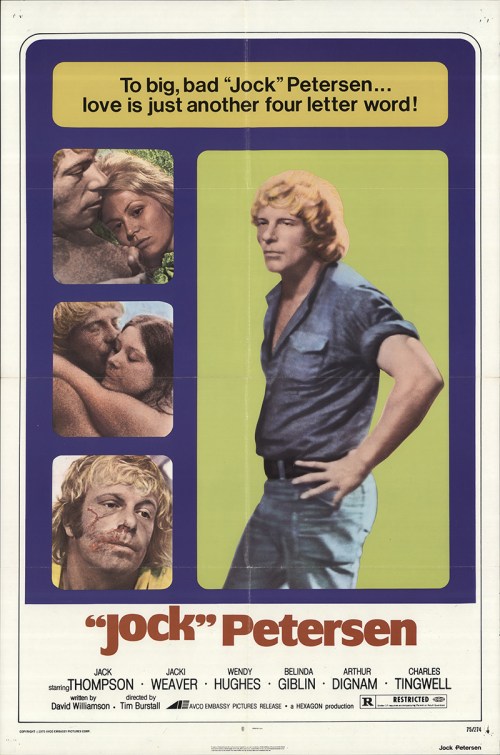
Petersen (1974)

petersen1

By Richard Winters

My Rating: 7 out of 10

4-Word Review: Going back to school.

Tony Petersen (Jack Thompson) is an electrician who decides to go back to school and major in English. He feels people look down on him because he works a blue collar job and hope that by returning to college to get a degree that will change, but instead he finds he’s still not getting the respect that he desires particularly from his stuffy professor (Arthur Dingnam), so he ends up having an affair with the man’s wife (Wendy Hughes),  but things don’t stop there. He has sex with the coeds too including right out in the open on the campus grounds for public display while hundreds of onlookers surround them.

The screenplay was written by acclaimed Australian playwright David Williamson, who’s best known for having penned the cult hit Don’s Party However, this film lacks the fluidity of that one and seems more like a selection of vignettes than a story. The leader character isn’t likable either and comes off as selfish while in Don’s Party we were able to understand the protagonists frustration with his marriage here the domestic situation doesn’t seem as bad and therefore watching him mess around isn’t cute, funny, or sexy and instead just tiring and off-putting.

The biggest problem though is that the film starts right away at the halfway point where Petersen has already been attending school and neck-deep in an affair instead of going back to where it all began. Showing Petersen’s frustrations with his job and income, instead of just being told about it through dialogue, would’ve helped the viewer empathize more with his situation and emotionally invested with his quandary instead of feeling lost and ambivalent in the jumbled narrative.

There are a few good scenes here-and-there including a very ugly moment where a group of obnoxious bikers crash an upscale party and make things quite tense for the guests who are seemingly unable to do anything about it. Later there’s a poignant segment involving a discussion that Petersen has with his father (Charles Tingwell), who works as a reverend at a church despite professing to having lost his faith. Petersen’s public sex act has great potential too and even though it does contain full frontal male nudity, which at the time was still considered shocking to see in a mainstream film, it doesn’t get played-up enough to really being as funny or irreverent as it should’ve been.

Spoiler Alert!

There’s also several moments though that needed more context, which is frustratingly lacking. One includes Petersen getting caught making-out with his friend’s wife by his own spouse (Jacki Weaver) who looks very disappointed in him, but we never get any follow-up almost  like the whole situation just gets forgotten by the next day. There’s another scene where Petersen rapes his lover inside her own office, but without showing any aftermath. Such a violent, disturbing act deserves some denouncement and not treated like a throwaway bit such as it is.

End of Spoiler Alert!

Overall if you stick with it the characters do have a way of growing on you, but the story needed to be more developed. Too much emphasis on being edgy and provocative, but filled with characters in desperate need of depth and better connecting pieces between scenes.

My Rating: 7 out of 10

Released: October 25, 1974

Runtime: 1 Hour 43 Minutes

Rated R

Director: Tim Burstall

Studio: Hexagon Productions

Available: DVD (Import Region 2)

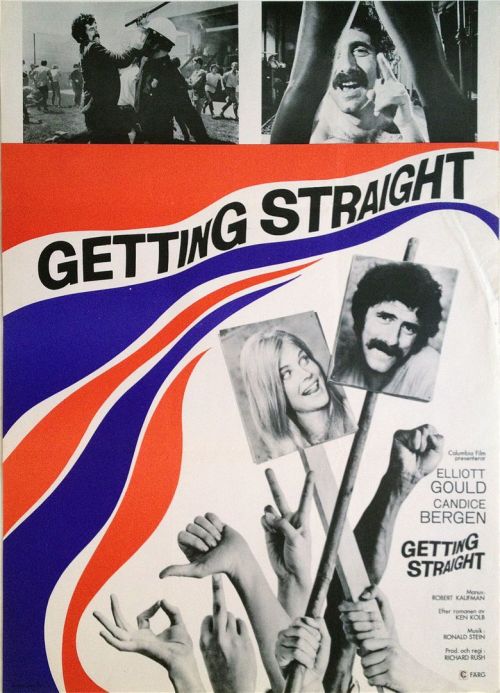
Getting Straight (1970)

getting straight1

By Richard Winters

My Rating: 5 out of 10

4-Word Review: Student unrest plagues campus.

Harry Bailey (Elliot Gould) was at one time a student radical, but after returning to campus from serving time in Vietnam his perspectives have changed. Now he simply aspires to get a teaching degree, but the other students want him to take part in their campus protests, which he resists. His girlfriend Jan (Candice Bergen), who is much younger, starts to get active in the student movement, which creates further pressure for Harry. He sees the absurdity on both sides, but as the protests become more violent and the response from school administrators more inept, Harry comes to the conclusion that he can no longer sit on the sidelines.

If there is one thing that really stands out it’s Gould’s performance in a part he was clearly born to play. In fact the studio refused to go ahead with the project unless Gould made a commitment to star in it. Had he decided not to take the part the studio would’ve shelved the project permanently as they felt there was no other actor that was right for the role and they were correct. Fortunately Gould did accept and his running, raucous, irreverent commentary is the most entertaining thing about it.

Unfortunately his presence is so powerful that he dominates Bergen who comes off as transparent and overwhelmed. She certainly looks quite beautiful and I particularly enjoyed her cowgirl look with two ponytails, but her presence is blah. Maybe the producers wanted a weaker performer to expose how unequal the character’s relationship was with each other, but the result makes the conversations that the two have dull and tepid because Bergen can simply not keep up with Gould’s rapid-fire delivery.

Their fights are a little more entertaining with some of the jabs Gould throws out being downright funny especially when he accuses Bergen of being ‘just a guy with a hole in the middle.’ Yet the fact that the two get back together after flinging out some very nasty insults made no sense. There are certain things that were said here that got personal and couldn’t just get written-off as having been said in a ‘fit of anger’ like they do here. In most real-life relationships it would’ve created a rift that would never have returned things to the way it was before.

The protests come-off looking too staged, which includes one scene where Gould and Bergen stand in the middle of all of the chaos and manage to somehow hold an extended conversation even as everyone around them is getting beat-up.  In the original novel by Ken Kolb there weren’t any student protests and were only added in by director Richard Rush to give the story a more topical feel, but there were too many other films with a similar theme that  were more effective. Even The Strawberry Statement starring Bruce Davison, which had its share of faults, still at least managed to make the student’s confrontations with the police look more authentic and intense.

Some of the arguments that Gould dishes out as he battles with administrators, and sometimes with the students too, are on-target and even funny like when he challenges the new curfew rule by pointing to one of the students (played by John Rubinstein) and stating: “At the start of the school year he just wanted to get laid. Now he wants to kill somebody…you should’ve just let him get laid.”

Gould’s angry confrontation with Jon Lormer who plays one of the school board members has a riveting quality and that’s where this movie should’ve ended. Having it continue to where Gould then later confronts Leonard Stone, who plays another school board member, gets too heavy-handed and ultimately kills the film’s best moments with a lot of talky bits that seem insightful, but really aren’t.

My Rating: 5 out of 10

Released: May 13, 1970

Runtime: 2 Hours 5 Minutes

Rated R

Director: Richard Rush

Studio: Columbia Pictures

Available: DVD, Amazon Video, Youtube

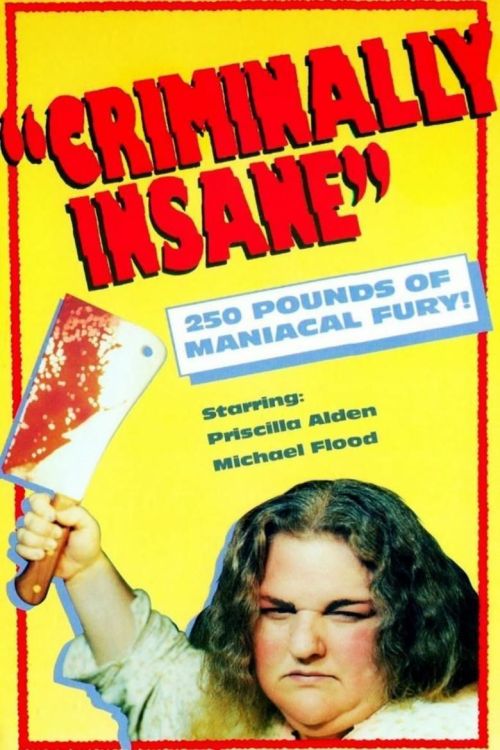
Criminally Insane (1975)

By Richard Winters

My Rating: 6 out of 10

4-Word Review: She has to eat.

Ethel (Priscilla Alden) suffers from a eating disorder that has caused her to gain a massive amount of weight. After being sent to a mental hospital she is eventually released into the care of her grandmother (Jane Lambert) with strict orders to keep Ethel away from food. However, her grandmother’s attempts to lock-up the food only gets Ethel hungrier to the point that she goes on the attack and kills her grandma with a knife and then hides her body in an upstairs room. Rosalie (Lisa Farros), Ethel’s sister, shows up and brings along her boyfriend (Michael Flood), but they start to smell the body decay and threaten to investigate what is causing it, so Ethel continues her murder spree in order to hide her secret and have the ability to eat as much as she wants.

These days if even just one person gets offended by something that they see in a movie the filmmakers are obligated to go down on their knees and beg forgiveness while in the 70’s director’s were scurrying to find the next taboo that they could topple. Not only were they unconcerned if they offended anyone, but actually relished the prospect and this movie in many ways goes even further with the shocks than the others. The result, despite the vulgarities, is quite funny and I found myself laughing-out-loud at more than a few places.

The gore is effective too. This was filmed in the Spring of 1973 long before the slasher genre was a thing making this into what’s called a prototype slasher, but the results are the same. In fact I’d say this thing is even gorier than the horror films that play-it straight and I liked the special effects showing the bodies decaying. The second-half also gets rather disturbing including scenes of one victim with a crushed skull still alive enough to try and crawl away while Ethel stands over him and laughs. She even sleeps with her victims, eats in front of them and ultimately does even worse. If you watch this thing for the sick, twisted content you should not be disappointed.

The extremely low budget does create issues though including way too much choppy editing that mainly occurs at the beginning as well as moments where the actors voice is not in sync with their lips. However, Alden’s excellent performance helps and I liked how everything gets filmed in this snazzy house in a nice, sunny neighborhood of San Francisco showing how behind-closed-doors bad things can happen anywhere even in the nice neighborhoods.

In 1987 writer/director Nick Millard and star Alden reteamed for a sequel titled Criminally Insane 2, but this reused a great deal of footage from the first film and was universally panned. Then in 2013 a new director did a remake of this film, titled Crazy Fat Ethel, with a new actress playing the part of Ethel since Alden had already died by that time. That film got shelved for many years when the producer inexplicably died during the production, but eventually it got released in 2016 to genuinely favorable reviews.

My Rating: 6 out of 10

Released: July 12, 1975

Runtime: 1 Hour 1 Minute

Rated R

Director: Nick Millard

Studio: I.R.M.I. Films

Available: DVD, Amazon Video

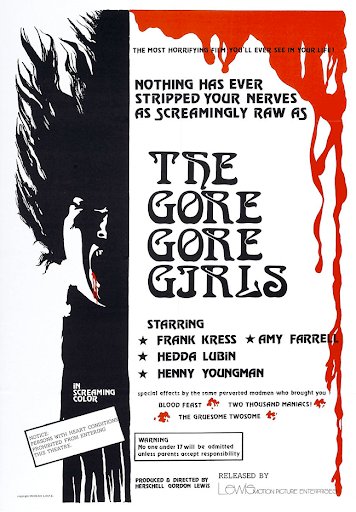
The Gore Gore Girls (1972)

By Richard Winters

My Rating: 1 out of 10

4-Word Review: Somebody’s killing the strippers.

Private investigator Abraham Gentry (Frank Kress) gets hired by Nancy (Amy Farrell), a reporter for The Globe newspaper, to investigate the murder of a stripper named Suzy Cream Puff (Jackie Kroeger). Abraham will get $25,000 to investigate the case and another $25,000 to solve it as long as he gives The Globe the exclusive story. Soon more strippers turn up dead and Abraham starts to have a long list of suspects including Grout (Ray Sager) a Vietnam veteran who enjoys smashing melons with faces drawn on them, similar to how the strippers got their heads smashed, in order to relieve his post traumatic stress disorder.

This was schlockmeister Herschell Gordon Lewis’ final film until 2002 and was meant to be a combination between the lighthearted nudies that he made in the early 60’s and the more graphic gore films that he did in the later part of the decade. The result though is a misguided mess where it seems more like a gag reel with tacky gore thrown in at certain intervals than a horror film.

The production values are really cheap even for a low budget production and contains basically just a few settings. One features the cramped living room of Abraham’s house that looks to be nothing more than a one bedroom apartment, which doesn’t quite make sense since the guy is a world famous detective you’d think he be living in a plush place especially with his elitist attitude. The other setting, which takes up the majority of the story, is the strip club that looks like it was filmed in the corner of somebody’s dingy basement.

The gory murders aren’t much fun and would be considered quite sick if they weren’t so tacky and fake. The jump cuts are the biggest problem as the bad guy kills the stripper one second and then in the next frame has seemingly been able to skin their heads completely and crushed their skulls, which is too quick. The ping pong ball sized eyeballs that the killer gouges from their heads are ridiculous looking too as eyes are actually oval shaped and not round as presented here.

The stripping routines take up too much of the runtime and seem put in simply to pad the anemic plotline. I’m not going to complain about watching beautiful women taking off their clothes, although to be honest the women here aren’t so hot, but I got real tired of hearing the same music played over and over again during each different set. Aren’t strippers allowed to come up with their own music and dance routines, or is that a new phenomenon that wasn’t a thing back in the 70’s?

I hate to psycho-analyze a film director and have never done it before, but the misogyny here is rampant. If there had been one strong, smart woman character present then it would’ve have been a issue, but instead females get portrayed here as being incredibly dumb and easily manipulated. The Nancy character is shown to be unable to take care of herself and needs a man present to look out for her particularly when she passes out on a city sidewalk after having only a couple of drinks. She faints and screams at the sight of a dead body too while the man remains stoic and shows no emotional reaction at all. Maybe this was supposed to be a part of the ‘comedy’, but it comes off as severely dated and out-of-touch with the times.

My Rating: 1 out of 10

Released: September 22, 1972

Runtime: 1 Hour 21 Minutes

Director: Herschell Gordon Lewis

Rated X

Studio: Lewis Motion Picture Enterprises

Available: DVD, Blu-ray, Amazon Video

High Anxiety (1977)

By Richard Winters

My Rating: 7 out of 10

4-Word Review: He’s afraid of heights.

Dr. Richard Thorndyke (Mel Brooks) is hired as the new resident psychiatrist at the Psycho-Neurotic Institute for the Very, Very, Nervous where he is to replace another Dr. who died under suspicious circumstances. While there he becomes aware of many odd things occurring making him believe that the people running the hospital, Dr. Charles Montague (Harvey Korman) and Nurse Diesel (Cloris Leachman), have a scheme going on where they take in rich patients and pretend their conditions are worse than they really are, so that they can keep the patients hospitalized for indefinite periods and thus bilk the patient’s rich families for large sums of money. Richard, together with Victoria (Madeline Kahn) who is the daughter of another patient that is being held there against his will, become determined to expose the scheme, but his adversaries use nefarious tactics to try and stop him by taking advantage of his extreme fear of heights.

Per an interview that Mel Brooks gave with NPR in 2013 he revealed that he wrote a letter to Hitchcock in 1976 telling him that he wanted to do a parody of his movies and was interested in getting his feedback. Hitch wrote back saying that they should get together in his office to go over ideas. In fact it was Hitch’s suggestion to have the scene involving the birds pooping on Brooks. When the film was completed he got his own private screening and afterwards he sent Brooks a case of expensive French wine with the note: “A small token of my pleasure, have no anxiety about this.”

Two of my favorite moments include a Psycho parody where a bellhop (played by a young and soon-to-be famous director in his own right, Barry Levinson) who stabs Brooks with a newspaper while he’s in the shower. The afore mentioned Birds parody is good too with the bird droppings made up of mayonnaise and chopped spinach, but because a helicopter was used during the segment it scared a lot of the pigeons causing real bird do-do to get mixed in with the fake stuff.

I enjoyed the bits involving a parody of the ‘gliding camera’ a technique used in many films where a camera shot begins on the outside of a building, but then somehow ‘glides through’ a wall and goes inside a place without any barrier. Here the camera shatters the glass as it tries to ‘glide through’ the window of the hospital, but Brooks almost ruins the moment by having the characters react by looking up to where the noise occurred, but then going back to their conversation, which makes no sense. If a camera operator has just crashed through a window, most people would get up from their seats and inspect the damage, which would’ve overplayed the joke, so they should’ve just had the characters not respond to the crashing noise at all. This same issue occurs at the end where the camera operators are heard talking just before they crash through a wall, but the scene would’ve played better without the banter.

The plot, as thin and goofy as it is, has some interesting moments. I especially enjoyed the segments done inside the lobby of the Hyatt Regency in San Francisco and the way it takes advantage of the glass elevators there. The scene involving actor Ron Carey blowing up a picture that he took there in order to solve a crime is cool because it goes back to the old way of developing film, which will be a good education for today’s younger viewers who are more used to digital.

The performances are first-rate with Brooks in an uncharacteristic straight part though he still gets in a few zany moments including a segment where he’s a baby who falls from his high-chair. Leachman though steals it in a brilliant send-up of Nurse Ratched from One Flew Over the Cuckoo’s Nest. In fact it’s her contorted face with no make-up and a faint mustache that leaves a lasting impression. She has stated that she disliked doing the role, but it’s so hilarious that I wished her part had been given a wider storyline.

My Rating: 7 out of 10

Released: December 25, 1977

Runtime: 1 Hour 34 Minutes

Rated PG

Director: Mel Brooks

Studio: 20th Century Fox

Available: DVD, Blu-ray, Amazon Video, YouTube

Cops and Robbers (1973)

By Richard Winters

My Rating: 8 out of 10

4-Word Review: Cops become the robbers.

Tom (Cliff Gorman) and Joe (Joseph Bologna) are two New York City policemen who are tired of their jobs and want to retire from the working world, but can’t because they need to support their families. They decide the only solution is to commit a heist by working with a local mob boss (John P. Ryan) to rob a Wall Street brokerage firm out of  bonds that cannot be traced. The two come up with an elaborate scheme  to pull it off during the day while the place is still open and they’re still in uniform. At first things go smoothly, but then two other cops show up forcing Tom and Joe to destroy the bonds they’ve just gotten their hands onto in order to avoid getting caught. While this helps them out of their immediate jam it still gets reported to the press that the place was robbed making the crime boss believe he has been taken advantage of and compelled to get revenge.

What stands out is how different this is from the conventional cop flick. Instead of having a loud, pounding score the music here is soft and tranquil like the breezy, warm climate of a tropical island, which is where both Tom and Joe wish they were. The cops aren’t portrayed as being authority figures either or compromised victims of a corrupt system, but just regular suburbanites trapped in a dead-end job like many people and looking for a way out.

The crime is done differently too. Usually, in most other cop flicks, once the robbery gets going you’ll see the pace speed up with fast edits, but here it gets played-out in real time, which actually makes it more intense. I enjoyed the camera cutting back and forth from showing things from Tom and Joe’s point-of-view as well as from the black-and-white monitor seen by the security guards. The authentic office atmosphere has many of the employees not even knowing a robbery is going on while the two main people who do realize what Tom and Joe are up to, well played by the elderly Shepperd Strudwick and a much younger African American actress named Ellen Holly, display odd reactions and facial expressions that doesn’t conform to the situation, but eventually gets explained by the big twist that comes later.

Gorman gives an awesome performance, which is made all the more impressive when you realize just 4 years earlier he was the highly effeminate gay character in The Boys in the Band, but here he’s a macho heterosexual. I kept waiting for him to reveal mannerisms of his past role, but instead he successfully pulls off being two diametrically different people with no connection to the other a feat not every actor, even some of the good ones, are able to do.

Bologna goes against type too. Usually he’s loud and brash, but here more quiet and nervous. In the Kino Lorber DVD bonus section he recounts a funny incident that happened to him during the production when he was forced to make a call home to his wife (actress Renee Taylor) in real-life. Since there were no such things as cellphones at the time he had to go to a nearby phone booth while still wearing the cop uniform of his character. It was there that he noticed a thug beating up a victim on the sidewalk and he shouted at the man to stop it. Since the man presumed Bologna was a cop it was enough to get him to run away, but then the other pedestrians started to harass Bologna for not chasing after the bad guy and arresting him. He tried to explain that he was just playing a policemen in a movie, but no one believed him.

The film’s final segment, which takes place in Central Park, is well choreographed and features a unique car chase.  It’s just a shame that Aram Avakian who burst onto the film scene with the provocative, ahead-of-its-time cult favorite End of the Roaddidn’t go on to direct more movies as he did only one more, 11 Harrowhouse, after this one before retiring to become the head of the film department at the State University of New York where he worked until his death in 1987. His approach here makes all the difference as he relies not on the typical cop formula action, but instead on the nuance.

My Rating: 8 out of 10

Released: August 15, 1973

Runtime: 1 Hour 29 Minutes

Rated PG

Director: Aram Avakian

Studio: United Artists

Available: DVD

Stroszek (1977)

By Richard Winters

My Rating: 8 out of 10

4-Word Review: Germans relocate to Wisconsin.

Bruno (Bruno S.) has recently been released from prison and while warned to stop drinking as a condition for his parole he immediately goes to a local bar. It is there that he meets Eve (Eva Mattes) a prostitute in an abusive relationship with her husband (Burkhard Driest). Bruno offers to allow her to move into his apartment, but this angers her husband and her pimp (Wilhelm von Homburg)  who break into the apartment and terrorize Eva and Bruno making them believe that the only way they can escape the harassment is by moving to America, which we they do along with their elderly neighbor Scheitz (Clemens Scheitz). They presume everyone is the USA is rich and life will be easy, but find that not to be the case.

The story was based loosely on the real-life experiences of its star and the script  written specifically for him by director Werner Herzog as a conciliation for not casting him in Woyzeck as originally intended. Since Bruno had already taken a leave of absence from his job at a steel mill to star in that one Herzog decided to make it up to him by writing this script in a matter of 4 days and then filming it on-location in Plainfield, Wisconsin because that was where the notorious serial killer Ed Gein had lived.

The story should’ve been a complete downer as it focuses on some very depressing realities, but instead, thanks to the genius of Herzog, one comes away from it feeling almost upbeat at all the quirky humor that gets incorporated in. The most memorable moment, which the rest of the crew found highly offensive and refused to film forcing Herzog to do it himself, happens near the end when Bruno travels to North Carolina and uses the last of his money to insert coins into arcade exhibits featuring chickens inside cages that dance and play the piano. The amusing element from this comes when the police finally arrive on the scene and are more concerned with getting the chicken to stop dancing than with the welfare of Bruno.

I also enjoyed the moment when an auto mechanic (Clayton Szalpinski) decides to do his own oral surgery by using the same pliers that he fixes cars with to remove a painful tooth in his mouth. While more blood was needed, as there should’v been streams of it coming out of his mouth, but isn’t, it’s still quite darkly funny and was ‘inspired’ by a true-life scene in the  1972 documentary Spend it All in which a Cajun in Louisiana does the same thing to his teeth, which amazed Herzog so much when he saw that movie that it compelled him to work the scene into one of his stories.

The jabs at America are expectedely negative and to some degree are on-target while at other points goes too far. Watching the trio become overly excited at seeing their new trailer home driven onto a vacant lot and acting like this was a sign that they had finally ‘made it big in America’ is certainly sardonically funny. Yet the scene with two farmers holding rifles as they plow a field in their tractors ready to shoot the other one if either dared touch a small strip of disputed land played too much into the stereotype that Europeans have of Americans and really wasn’t needed especially since it had nothing to do with the main story.

Bruno S.’s performance, who was never formally trained as an actor, is boring as he conveys the same facial expression all the way through where a more seasoned actor could’ve given the role more needed nuance. Scheitz was an amateur actor as well, but his short stature and overall goofy appearance made him a fun part of every scene he’s in while with Bruno that same quality doesn’t exist. If anything Eva has the widest character arc and the film should’ve evolved around her instead.

Herzog casts a lot of non actors in secondary roles as well. I’m not sure if this was done for budgetary reasons, or just played into his long-standing desire to be experimental, but the results aren’t completely effective. I did however enjoy Scott McKain, an auctioneer in real-life, who plays the part of a bank employee that comes to visit the trio in their trailer home to inform them of their delinquent payments and yet no matter how bad the news is that he must convey he always manages to remain upbeat and peppy when he says it.

The film, which has been rightly placed in Steven Schneider’s ‘1001 Movies You Must See Before You Die’ is original in so many ways that it deserves to be seen just for the oddity it is and I really have no complaints with its avant-garde style, which even today comes off as fresh and inventive, but I was confused about why the Glen Campbell song ‘By the Time I Get to Phoenix’ got played so much. The lyrics are never heard, but the melody is and yet there’s no connection to the city of Phoenix in the story, for awhile I thought that was where they’d ultimately end-up, but they never do, so hearing it played so much is out-of-place.

My Rating: 8 out of 10

Released: May 20, 1977

Runtime: 1 Hour 48 Minutes

Not Rated

Director: Werner Herzog

Studio: New Yorker Films

Available: DVD, Amazon Video, YouTube

Die Laughing (1980)

By Richard Winters

My Rating: 1 out of 10

4-Word Review: Cabbie accused of murder.

Pinsky (Robby Benson) works as a San Francisco cab driver during the day, but aspires to being a professional singer and attends numerous auditions, but to no avail. One day he picks up a passenger who gets shot and killed while in his cab and Pinsky is mistakenly tabbed as being the killer. Feeling he has no other options he takes the briefcase that the victim was carrying and hides out at his girlfriend Amy’s (Linda Grovenor) apartment. Inside the box they find a live monkey who has apparently memorized the secret formula for turning atomic waste into the plutonium bomb and it’s now their job to keep him away from Mueller (Bud Cort) and his cohorts who want to kidnap the monkey and use what he knows for nefarious purposes.

The film starts out with some potential as it uses Benson’s wide-eyed, deer-in-headlights persona to good comical use, at least initially. Unfortunately by the second half it pivots too much the other way and the minor laughs at the beginning get completely lost when he suddenly becomes this seasoned spy who can quickly think on his feet and outsmart the bad guys at every turn.

Again, this is just an ordinary Joe whose main drive is to make it into the music business, so why get so emotionally invested in a spy case that does nothing but get him deeper and deeper into a dangerous situation? Why not just give the bad guys what they want, hope it appeases them enough that they’ll set you free and then go to the authorities, who are much better positioned to handle this situation, and let them do the rest?

I also thought it was ridiculous that when the couple are tied up and thrown into some dark backroom that they do not respond to the predicament, like any normal person would, with fear and panic, but instead use the moment to become romantic! The fact that they manage to untie each other by biting down on the thick ropes that bind them is absurd as the only thing that would accomplish is a lot of broken-off teeth.

Benson’s musical interludes are a bore and he ends up singing the same damn song three different times. He also performs at a concert when just a little while earlier he was being surrounded by spies ready to push him off of a ship, which would be such a traumatic experience for most people that it’s doubtful he’d be able to emotional calm down enough to focus on singing, or do anything for a long time afterwards.

The story also suffers from having too many villains, Cort is the main one, but he’s seen only intermittently while a bunch of others busily chase Benson around until it becomes dizzying trying to keep track of them all. The plot itself is overblown, relies heavily on worn-out spy genre cliches making it come off like a cheesy parody of James Bond that will cause many viewers to be rolling-their-eyes almost immediately at the campy, strained gags.

My Rating: 1 out of 10

Released: May 23, 1980

Runtime: 1 Hour 48 Minutes

Rated PG

Director: Jeff Werner

Studio: Orion Pictures

Available: DVD-R (Warner Archive), Amazon Video, YouTube