Category Archives: 70’s Movies

Nickelodeon (1976)

By Richard Winters

My Rating: 4 out of 10

4-Word Review: Making a silent movie.

The year is 1913 and Leo Harrigan (Ryan O’Neal) is tired of being a lawyer and representing sleazy clients, so by chance he gets a job writing scripts for silent movie mogul H.H. Cobb (Brian Keith). Later on he’s sent to California to direct his first silent film, but he has no experience doing that and finds that he has a rough relationship with the film’s leading man Buck Greenway (Burt Reynolds).

When this film first came out Columbia Pictures was convinced that they had a big hit on their hands and to celebrate they allowed everyone attending the L.A. premiere to pay only 5 cents to get in, in order to correspond to the price of admission during the silent film era. Yet many of those who attended were not satisfied with the movie causing critic David Sheehan to claim “it wasn’t worth paying a nickel to see.”

It’s hard to know who to blame as both sides have differing accounts for what went wrong. David Begelman, the then head of Columbia Pictures, loved the script, which was written by W.D. Richter and had by all accounts a good dramatic edge to it, but when they gave it to Peter Bogdanovich to read he described it as a ‘piece of garbage’. Yet they decided to hire Bogdanovich to direct it anyways by promising him he could change the script any way he wanted as Begelman considered Bogdanovich to be a ‘cinematic genius’ and that ‘everything he touched turned to gold’. Bogdanovich on the other hand stated that he liked the script as it was, but was pressured by the studio to add in farcical elements as they were hoping to recreate the magic of his earlier film What’s Up Doc?.

In either case the attempted comedy doesn’t work and the gags, which come at a rapid-fire pace, ultimately become more mind numbing than anything. The only funny bit is the extended fistfight between O’Neal and Reynolds while everything else sinks into mundane silliness. Supposedly some of the story is based on the real-life remembrances  of film veterans Raoul Walsh and Allan Dwan, but with so much misguided zaniness thrown in it’s hard to know what if anything to take seriously.

The story desperately needed more of a focus. Having it about a small cast and crew trying to make their first silent film and the many challenges that it would entail could’ve been both amusing and revealing, but the story jumps ahead too much. We see the characters in one setting at one moment and then on a whim the film fast forwards to them in some completely different setting a year or more later, which never allows the viewer to connect emotionally with the people or what they’re going through.

O’ Neal is good playing a befuddled sort who simply reacts to the goofiness around him while Reynolds is excellent as the rough and tough good ole boy and their budding love/hate friendship should’ve been the film’s main focus. Supermodel Jane Hitchcock, in her one and only feature film appearance, is easy on the eyes, but her part was originally intended for Cybill Shepherd, who would’ve given the role more edge.

The cinematography by Laszlo Kovacs is pristine as is the period detail, but the story takes on too much especially the second hour, which just goes from one tangent to another.

My Rating: 4 out of 10

Released: December 21, 1976

Runtime: 2 Hours 2 Minutes

Rated PG

Director: Peter Bogdanovich

Studio: Columbia Pictures

Available: DVD, Amazon Video, YouTube
Slither (1973)

By Richard Winters

My Rating: 5 out of 10

4-Word Review: Searching for embezzled money.

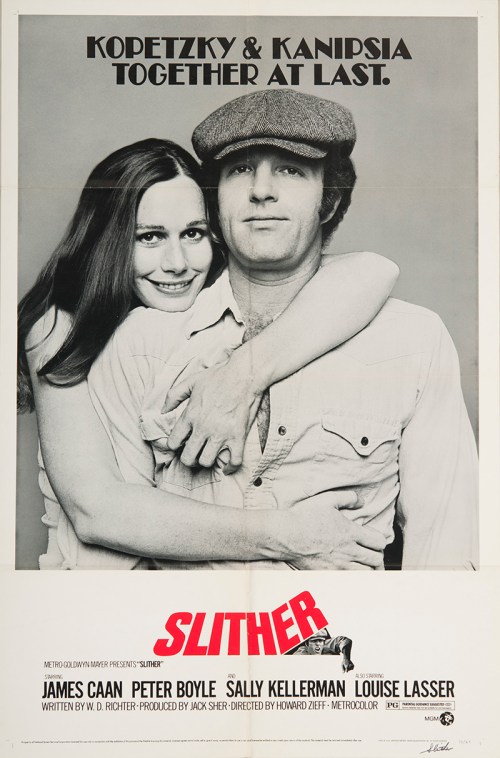
Dick Kanipsia (James Caan) is a former car thief who has just been released from jail and is now trying to go straight. While in prison he started up a friendship with Harry Moss (Richard B. Shull) and decides to go to his rural home for a visit. It is there that Harry suddenly gets shot by a mysterious gunmen, but just before he dies he informs Dick about a secret stash of stolen money that can only be retrieved by contacting his former partners in crime: Barry Faneka (Peter Boyle) and Vincent Palmer (Allen Garfield). Dick then goes on a road trip trying to find these two men while also coming into contact with a lot of oddball characters and situations along the way.

When I first saw this film over 20 years ago I really loved it and was impressed with W.D. Richter’s offbeat script that relies heavily on quirky scenarios and dryly humorous non sequiturs to help propel it. A theme he later polished to perfection in his most famous film the cult hit The Adventures of Buckaroo Banzai Across the 8th Dimension.  While I still enjoy the engaging set-up I’ve found that during subsequent viewings the unsatisfying ending ruins everything else that comes before it and ultimately hurts the movie as a whole, but first lets go over what I did like.

The chase element that gets incorporated into the story is cool and has a strong connection to the one in Duel. The idea of having these large black vans driven by a person we cannot see constantly chasing after our protagonist no matter where he goes is intriguing and helps create an interesting mystery angle. The unique design of the vans, which was a 1973 Dodge Rectrans Discover 25R,  featured no front doors, which coupled with its all-black exterior gives them a very threatening presence that is almost creepier than the truck used in Duel.

Caan’s detached persona helps separate him from all the nuttiness around him and makes him likable in the process. Boyle is amusing as his eventual cohort and Louise Lasser is surprisingly restrained as Boyle’s wife. You also get to see  film director Paul Thomas Anderson’s real-life mother, Edwina Gough, in a small role during a scene at a bingo tournament.

The only character though that I didn’t care for was Sally Kellerman’s who plays this semi-crazy lady that proceeds to just slow-up the pace of the film with every scene that she’s in. I admit the part where she robs a diner at gunpoint is kind of fun, but I’ve never been a fan of her breathless delivery and didn’t feel there was any need for her reappearing after her character was pretty much dropped from the story and forgotten and there’s never any explanation for how she was able to successfully track Caan down after he abandoned her.

Laszlo Kovac’s cinematography is good although it would’ve been nice had this been a genuine road movie where our main character would’ve been required to travel to highly varied settings/landscapes  in his quest to find the hidden money. I realize this would’ve upped the budget, but having to constantly stare at the dry, brown landscape of Stockton, California, where the majority of the shooting took place, is kind of depressing.

As I stated earlier it’s the ending that hurts the film more than anything. To sit through what is otherwise a creative plot only to find that it all just leads to nothing is a big letdown. I know that during the 70’s it was trendy to have anti-climactic movie finishes, but here there needed to be more of a payoff . Movies should also have the main character change in some way from what they were at the beginning, which doesn’t occur. Caan just quietly walks away from the chaos around him like everything he’s just went through was nothing more than a blip on his life’s radar and ultimately that’s the way the movie becomes with the viewer as well. Goofy enough to hold your attention, but never memorable enough to stay with you.

My Rating: 5 out of 10

Released: March 7, 1973

Runtime: 1 Hour 37 Minutes

Rated PG

Director: Howard Zieff

Studio: MGM

Available: DVD-R (Warner Archive), YouTube

Sunday in the Country (1974)

By Richard Winters

My Rating: 4 out of 10

4-Word Review: Farmer holds robbers hostage.

Adam Smith (Ernest Borgnine) is a Canadian farmer living in a rural home who becomes aware via the radio of reports of three bank robbers (Cec Linder, Louis Zorich, Michael J. Pollard) on the run in the area who’ve just killed a young man and his girlfriend who were his friends. He prepares for their arrival and when they come he shoots and kills one of them while taking the other two into his cellar where he hangs them on meat hooks. Smith’s granddaughter Lucy (Hollis McLaren) finds this treatment inhumane and wants to call the police, but Adam won’t let her and the two quarrel until he locks her in her room, but she escapes and runs for help, which enrages Adam even more.

The film almost gets ruined by an obnoxious musical score that is so heavily tinged with country twang that it seems almost like a parody of itself and makes the entire production come off as cheesy and amateurish. It would’ve been better without any music at all as it ends up taking you out of the action like having someone sitting beside you and rudely talking and not letting you concentrate on what’s happening on the screen.

As for the story it makes some good observations about just how thin the line can sometimes be between the good guy, or those that feel they’re morally justified to inflict whatever style justice they deem necessary, and the so-called bad guy. Unfortunately the character arch of the protagonist happens too quickly without much of a back story explaining why this otherwise law abiding farmer would deviate so quickly into an abuser. What makes him different from others who would’ve called the police? Just saying that he’s ‘old fashioned’ and ‘from a different era’ I didn’t feel was enough of an explanation.

With the exception of Pollard the robbers aren’t intimidating enough and it some ways came off as pathetic and not like professional crooks at all. This might’ve been intentional on the filmmaker’s part in an effort to make the viewer more sympathetic to their quandary once they are held hostage, but in the process it lessens the tension and makes them seem not as threatening.

Borgnine does a terrific job through his facial expressions of showing the character’s inner turmoil as well as constantly exposing his human side even as he forges ahead to doing some not-so-nice things. McLaren is also superb and her interactions with Borgnine are the most compelling aspect of the film.

Pollard is great here too and I was surprised as he’s not always able to find roles that match his unique talents and sometimes has been relegated to thankless and forgettable supporting parts, but here he’s viscous with a most creepy sounding laugh.

Unfortunately the eye-for-an-eye concept doesn’t get examined enough and the film could’ve gone a lot farther with it than it does. It still manages to bring out many interesting issues but the story should be remade and without the corny soundtrack.

Alternate Titles: Vengeance is Mine, Blood for Blood

My Rating: 4 out of 10

Released: November 22, 1974

Runtime: 1 Hour 33 Minutes

Rated R

Director: John Trent

Studio: Impact Films

Available: Amazon Video

Jackson County Jail (1975)

By Richard Winters

My Rating: 5 out of 10

4-Word Review: Deputy rapes his prisoner.

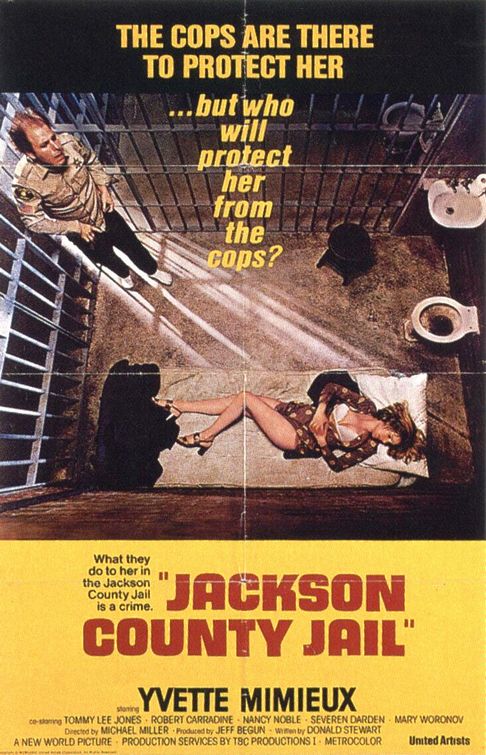
Nothing seems to be going right in Dinah’s (Yvette Mimieux) life. She quits her job as an advertising executive only to come home to find that her husband (Howard Hesseman) has been cheating on her. She decides to travel across the country and back to her old digs in New York. Along the way she picks up two hitch-hikers (Robert Carradine, Nancy Lee Noble) who end up robbing her at gunpoint and driving off with her car and money. When she walks to the nearest town she finds that no one is willing to help her since, without any identification, she can’t prove who she is. The sheriff (Severn Darden) throws her in jail temporarily until her identity can be confirmed. While there she gets raped by one of the deputies (Fredric Cook) and then goes on the run with Coley (Tommy Lee Jones)  a small-time crook and drifter.

This is yet another Roger Corman produced cheapie made to capitalize on the exploitative low budget drive-in fervor that was so popular during the early to mid 70’s. This one fares better than most as it manages to retain its gritty tone throughout without ever resorting to campiness. The car chase doesn’t have any of the cartoonish or humorous stunts as most others did during that time period, but instead like in Cannonball! shows more of the potential ugly side to them by having several of the vehicles crash and blow-up in flames and killing those that were inside them, which helps accentuate the realism.

The police aren’t quite as inept either although I did find it curious that the cops in the helicopter once they found where Mimieux and Jones’s hideout was didn’t continue to chase the two via the air as they tried to escape down the road in their pick-up. The part where the cop shoots at Jones who collides on foot into a marching band is absurd too as no policeman with half-a-brain would fire into an open crowd as it’s too dangerous and would almost assure innocent victims getting hit.

Mimieux is adequate and the funky 70’s style compact car she drives in with its roundish flying saucer body and oversized steering wheel is a laughable relic. However, for someone whose lived in L.A. she didn’t seem savvy especially when she decides to pick-up two hitch-hikers, which is just asking for trouble, or naively unaware that the obviously drunken, leering cafe owner (Britt Leach) is only being ‘helpful’ so he can have a chance to pounce on her.

Jones is excellent in support, but I found it odd that despite being considered a ‘good guy’ he makes no effort to stop her rape, which he witnesses by being in the adjoining cell, but then when she kills the rapist by beating him over the head with a stool he reaches through the bars and stops her.

The film’s most interesting performance is Fredric Cook’s who plays the rapist. His film career never really took off and he spent most of his life working as an acting teacher, but here in his film debut he really shines. I liked the way his character starts out as a redneck dope who seems put in for comic relief and then quietly becomes menacing as he serves Mimieux her food, explodes into a sudden massive rage, and then after the act is committed becomes guilt ridden and even ashamed, which creates a very interesting portal into the mindset of most male attackers.

The second half unfortunately slows up creating boring segments when the pace and tension should instead be revved up. The wide-open ending offers no conclusion to Mimieux’s ultimate fate and the film’s message is vague and transparent.

My Rating: 5 out of 10

Released: April 2, 1976

Runtime: 1 Hour 24 Minutes

Rated R

Director: Michael Miller

Studio: New World Pictures

Available: DVD, Amazon Video

Voyage of the Damned (1976)

By Richard Winters

My Rating: 4 out of 10

4-Word Review: This ship goes nowhere.

Based on the true story of the ill-fated voyage of 937 Jewish refugees who left the port of Hamburg, Germany in 1939 on the ocean liner St.Louis, which was supposed to arrive in Havana, Cuba where they hoped to start a new life free of the rising antisemitism that had plagued them in Europe. However, when the ship reaches Cuba they are not allowed to dock and when the ship’s Captain (Max Von Sydow) tries to take them to the US and Canada they are refused entry as well forcing them to return to Germany.

Given the high production values and riveting story-line I was expecting it to be far more compelling than it ends up being. It’s not like Stuart Rosenberg’s direction is poor either because it isn’t, but it never gains any dramatic traction and the more it goes on the more boring it gets. This is definitely one instance where cutting the runtime would’ve been advantageous. I know we live in an era where the ‘director’s cut’ is considered the gold standard, but sometimes there’s good reasons for why studios edit it and usually it’s because some of the footage just isn’t necessary. I watched the 158 version, but the theatrical cut was trimmed to 134 minutes and after watching this one I can only presume that version would’ve been an improvement and if anything could’ve gained a better pace, which is something that is seriously lacking here.

There also too many characters and it’s hard to keep track of all them or get emotionally invested in their quandary especially when by-and-large their all suffering from the same dilemma. The time span between when they show a character to when they return is so long that by the time you see them again you’ve pretty much forgotten all about them.

The large cast is full big names and familiar faces and a few of them do a terrific job. I felt Von Sydow’s performance as the beleaguered but stoic captain was right on-target and I also enjoyed Orson Welles as the glib Cuban politician. Kudos also should go to Lee Grant, who ended up getting nominated for a Best Supporting Oscar here, for her one shocking scene where she cuts her hair down to its scalp, but overall most of the talent gets wasted. This includes Denholm Elliot and Jose Ferrer who appear onscreen for only a few minutes and Katherine Ross who has only two scenes that come near the end, but still managed to somehow get a Golden Globe nomination for her efforts anyways.

Spoiler Alert!

The film ends on a supposed happy note when the ship’s captain informs the passengers that Belgium and France will accept them, but then the denouncement states that 600 of them ended up dying anyways during the German Occupation making the viewer feel much like the passengers that they’ve just spent almost 3-hours going in circles. Maybe that’s the point, but as an insightful drama it fails. I was almost hoping that the Captain would’ve gone through with his plan to have the ship crash off the shore of England and allowing the passengers to disembark as a safety precaution, but still trying to make it look like it was an accident and not intentional. Although this would’ve swayed from what really happened it could’ve been an interesting thing to see and brought some genuine action into the mix, which was otherwise missing.

My Rating: 4 out of 10

Released: December 22, 1976

Runtime: 2 Hours 38 Minutes

Rated PG

Director: Stuart Rosenberg

Studio: Embassy Pictures

Available: DVD, Blu-ray, Amazon Video

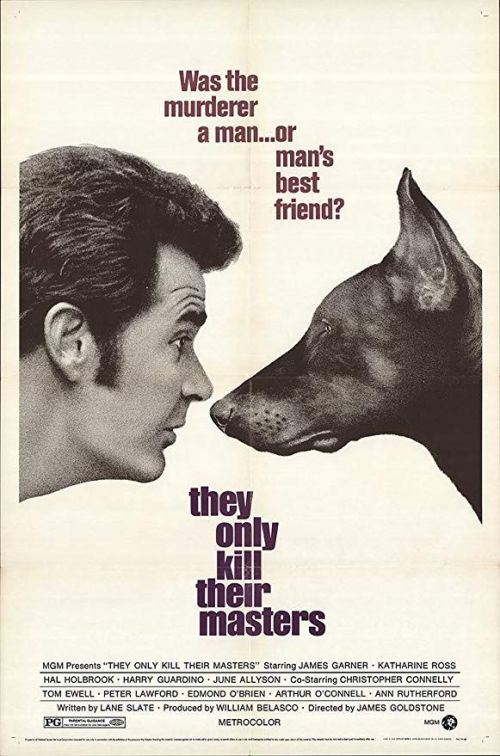
They Only Kill Their Masters (1972)

By Richard Winters

My Rating: 5 out of 10

4-Word Review: Dog turns on owner.

Abel Marsh (James Garner) is the police chief of a small west coast seaside town who’s put in charge of investigating a baffling case where a dog inexplicably turned on its owner and killer her. The clues though don’t match up convincing Abel that the dog is innocent and used simply as a ruse to cover-up an even more sinister crime.

This is the first of four films all written by Lane Slate to feature the character of Abel Marsh. All of the subsequent films featured the same small town setting and quirky themed murders, but where made for TV instead featuring Alan Alda in the role of Abel for Isn’t it Shocking and then Andy Griffith playing the part in The Girl in the Empty Grave and Deadly Game.

The mystery here has its share of intriguing elements and I liked the methodical pace, which is reminiscent of actual police work where the clues don’t just come easily and quickly. I also liked how the viewer remains just as in the dark about who did it as the investigator. The subplot involving the doberman is interesting as well and like in the film To Kill a Clown, which came out the same year, the dog ends up being the ultimate scene-stealer from his human counterparts.

Due to this being the last film made on MGM’s famous backlot many former stars from Hollywood’s golden age agreed to appear in small roles including Ann Rutherford in an amusing bit as a old-school secretary who can’t figure out how to work an electric type writer. The best bit though comes from June Allyson who doesn’t have any speaking lines until the very end where she gets a bravura-like finale similar to Betsy Palmer’s in Friday the 13th and even sports the same type of hairstyle as hers and sweater/pants, which makes it all the more ironic.

The thing though that I found annoying was the formulaic romance that starts almost immediately between Garner and Katherine Ross. For one thing the mystery could’ve worked just as well had Ross’ character not been in it at all, but if they did feel the need to throw in a romantic subplot it’s always more interesting when there’s some friction or resistance at first only to have it evolve into a relationship later versus making it a ‘love at first sight’ scenario, which is too quick and unrealistic especially when there’s a 15-year age difference between the two.

What gets even more aggravating is that after spending the night with her Garner then starts to suspect that she may know more about the crime than she lets on, so the next day he storms into her apartment and quite literally starts strangling her to get the info. Then when he realizes he may have jumped to the wrong conclusion he leaves her place in a huff without even bothering to apologize. Several hours later he sheepishly returns, but instead of slamming the door in his face she asks if he’s alright?!

Later near the end of the film she returns to his office and acts like somehow it was all her fault and seems to leave things open to rekindling the romance, but why? Unless she’s desperate (and she’s way too beautiful for that) or has extremely low self-esteem she should’ve ended things right when he attacked her because it was an obvious red flag and the fact that she doesn’t shows how dated and out-of-touch the film is in regards to modern day relationship dynamics.

The scenery is nice especially the Malibu location of the victim’s house and seeing it get burned quite literally to the ground is kind of cool too. However, the quirky elements don’t gel and overall the film ends up being transparent and flat.

My Rating: 5 out of 10

Released: November 22, 1972

Runtime: 1 Hour 37 Minutes

Rated PG

Director: James Goldstone

Studio: MGM

Available: DVD-R (Warner Archive), YouTube

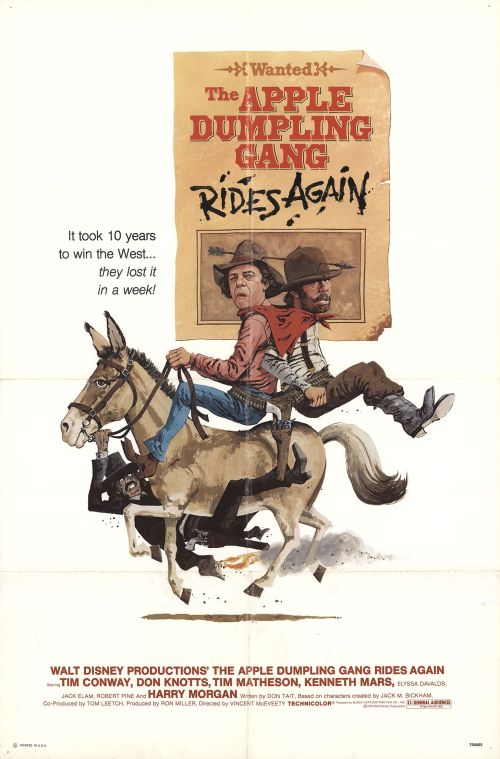
The Apple Dumpling Gang Rides Again (1979)

By Richard Winters

My Rating: 1 out of 10

4-Word Review: Bumbling buddies cause havoc.

Amos and Theodore (Tim Conway, Don Knotts) are two former members of an outlaw gang who are now trying to go straight, but as they enter the western boom town of Junction City they find their hopes of living life free of their old criminal ways to be dashed when they get mistakenly accused of robbing the town’s bank. They go on the run from the town’s relentless sheriff (Kenneth Mars) by enlisting in the United States Calvary, but accidentally cause a fire there that ends up burning the whole fort down and getting them into even more trouble.

This very weak sequel to  The Apple Dumpling Gang, has little to recommend and barely any connection to the first one. Besides Knotts and Conway no one from the original cast appears here except for Harry Morgan who plays an entirely different character. It was also the kids in the first film that were called the Apple Dumpling gang and not the two bumbling men, which just cements how unnecessary this film really is.

It’s not like any of the cast from the original film was all that memorable, but they at least helped balance the story from being just one long inane slapstick act, which is all you end up getting here. Knotts and Conway can be good comic relief in brief sporadic spurts, but trying to tie a whole movie around their bumbling act makes it quite one-dimensional.

The supporting cast isn’t any good either with Tim Matheson as bland and transparent as ever as a heroic officer and his romance with the feisty Elyssa Davalos is formulaic and cliched to the extreme. Mars goes overboard with the arrogant sheriff who goes crazy act until it becomes just as annoying and overdone as everything else in the film.

I’ll admit as a child I thought this movie was entertaining, but as an adult I got bored almost immediately despite finding the first installment to be genuinely enjoyable. Part of the problem is that the first one was based on a novel and had an actual story mixed in with the gags while this one is centered exclusively on extreme coincidences to help propel its thin plot along while throwing in slapstick bits that are predictable and unoriginal.

The only thing that surprised me at all was seeing Conway get top billing even though Knotts displayed a wider acting range while Conway merely stands around looking perpetually befuddled. Knotts also had the majority of lines and a little more dimension to his comedy while Conway just acts like a cross-eyed dope, which to me got boring real fast.

I understand that these films have a certain nostalgic appeal for those adults who remember watching it as a kid, but I honestly think that appeal will wear off quickly after about 5 minutes. If you’re under 10 you may like it better, but others should beware.

My Rating: 1 out of 10

Released: June 27, 1979

Runtime: 1 Hour 29 Minutes

Rated G

Director: Vincent McEveety

Studio: Buena Vista 

Available: DVD, Amazon Video, YouTube

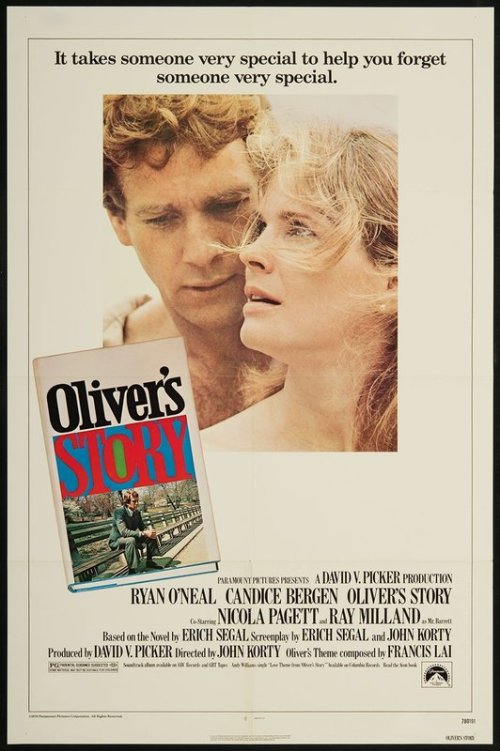
Oliver’s Story (1978)

By Richard Winters

My Rating: 3 out of 10

4-Word Review: Adjusting to wife’s death.

It’s been 6 years since Oliver (Ryan O’Neal) lost his wife to leukemia and he’s still having a hard time learning to move on from it. He hasn’t been in a serious relationship since and his friends including his step father (Edward Binns) are pressuring him to start dating. Finally by chance he meets Marci (Candice Bergen) while she is out jogging. She is secretly an heiress to a massive fortune, which allows the two to connect due to their similar well-to-do upbringings, but when things start to get serious Oliver finds himself  resisting unable to cut the ties from his past and move forward.

This is definitely a sequel that nobody asked for and in fact both O’Neal and Bergen initially had no interest doing it. The original film worked because it centered on the couple and when you take away one of them you have only half a movie. Oliver on his own is boring and watching him learn to adjust to life as a single person is not compelling and no different than the hundreds of other movies dealing with the dating scene.

John Marley, who played Jenny’s father in the first film, refused to appear in this one because he was unhappy with how his name was going to be placed in the credits, so he got replaced by Edward Binns who seems to be playing a completely different character. Here the father-in-law and Oliverhave acquired a chummy friendship and even hang out together despite this never having been established in the first film. Ray Milland reprises his role as Oliver’s father, but gets portrayed in a much more likable way while in the first one he came off more as a heavy.

The film’s only interesting aspect is seeing how much the social norms have changed. Here being single is considered like a disease and his pesky friends are emboldened enough to set Oliver up on dates and openly telling him that he needs to ‘get out more’ even though by today’s standards the single lifestyle is much more prevalent and accepted and doing these same types of actions now by well meaning friends would be considered intrusive and obnoxious.

Having one of the women that he meets at a dinner party invite him back to her place despite barely knowing him is something not likely to occur today either. The way though that Oliver meets Marcie is the most absurd as he quite literally chases her down while she is jogging, which would scare most women into thinking that they had a crazy stalker on their hands.

On the production end the film is competently made with the springtime scenery of New York as well as shots of the couple’s trip to Hong Kong being the only thing that I enjoyed. The story though lacks punch and drones on with too many side dramas. O’Neal’s performance is good, but his chemistry with Bergen is lacking, which ultimately makes this a production that had misfire written all over it before a single frame of it was even shot.

My Rating: 3 out of 10

Released: December 15, 1978

Runtime: 1 Hour 30 Minutes

Rated PG

Director: John Korty

Studio: Paramount

Available: DVD, Amazon Video,  YouTube
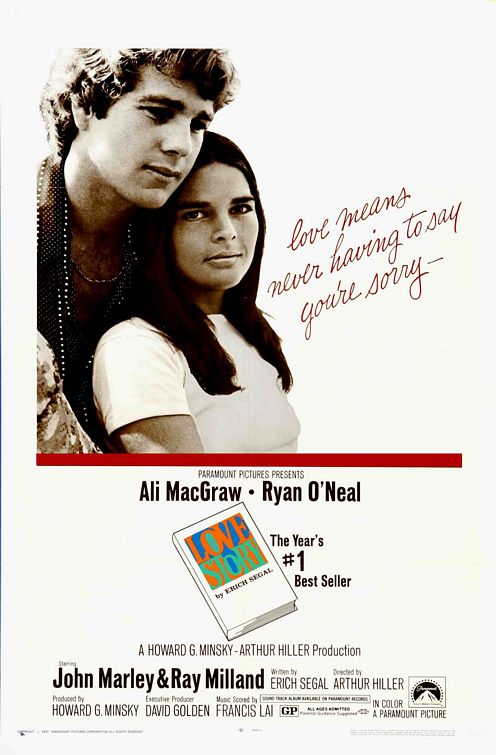
Love Story (1970)

By Richard Winters

My Rating: 5 out of 10

4-Word Review: Romance and then death.

Oliver (Ryan O’Neal) is attending Harvard Law School where he meets Jenny (Ali MacGraw) a student studying classical music. The two don’t hit-it-off at first, but eventually fall in love and marry despite the objections of Oliver’s father (Ray Milland). Just as things seem to be falling into place Jenny gets diagnosed with a fatal illness, which sends Oliver’s world spinning out-of-control.

Erich Segal’s script, which he later turned into a best-selling novel, is simplistic, but the on-location shooting done in and around Harvard is outstanding and helps give the film, along with some well done hockey footage, an added energy. This is one of only a few films to be allowed to shoot there and they were kicked out after only a week due to being too much of a distraction, but it was just enough to give the movie a good authentic college vibe. The snowy landscape plays a big part of it and there’s even a scene where the two play in it, but some shots feature a lot of it in the background only to have a few scenes spliced in where there is none of it on the ground, which makes it a bit visually jarring.

On the romantic side I liked the fact that Jenny is initially prickly towards Oliver and he has to work at getting her to soften up. Men actually do enjoy a challenge and having a woman just throw herself at a guy, or having the relationship start out seamlessly is just not as interesting or realistic. However, having Oliver profess that he ‘loves’ her after only the first date glosses over the courtship aspect too much and essentially ruins the intrigue in the process.

O’Neal is excellent here and he was picked over a lot of other big name stars simply for his ability to react to a situation in effective ways, which he ends up doing quite well. Yet I felt it would’ve worked better had he been the one from the poor-side-of-town as he’s more convincing as a rugged blue collar type instead of a studious student, or their contrasting economic backgrounds not been played-up at all since for me it didn’t really add much.

Spoiler Alert!

The film’s most notorious flaw though, and one that was parodied in a very funny send-up of the movie on ‘The Carol Burnett Show’, is the whole mystery illness thing (supposedly it’s leukemia, but never explicitly stated) that comes out of nowhere without Jenny ever showing an symptoms and having her die in a sudden car accident would’ve solved this issue and been more believable.

Personally though I was more shocked by the fact that the Dr. tells Oliver about Jenny’s diagnosis before he informs her. If she were a child that would be fine, but she’s an adult and deserves to know about her own health affairs before anyone else and if this had occurred today it would’ve gotten him into a lot of trouble.

The narrative also gets a bit askew as Oliver takes the news much harder than she does. Shot after shot shows him getting all misty-eyed almost like the viewer should feel worse for him, as he is now losing the object of his affections instead of her for losing her life.

End of Spoiler Alert!

The film is also famous for the line “Love means never having to say you’re sorry”, which to me never made any sense as relationships are dependent on the other party asking for forgiveness when they’ve done wrong and simply presuming they can get away with anything and expect unconditional acceptance doesn’t work. Two of my female friends agreed with me on this, which only proves how placid and shallow this film ultimately is.

My Rating: 5 out of 10

Released: December 16, 1970

Runtime: 1 Hour 40 Minutes

Rated GP

Director: Arthur Hiller

Studio: Paramount

Available: DVD, Blu-ray, Amazon Video, YouTube

To Kill a Clown (1972)

By Richard Winters

My Rating: 3 out of 10

4-Word Review: Couple harassed by veteran.

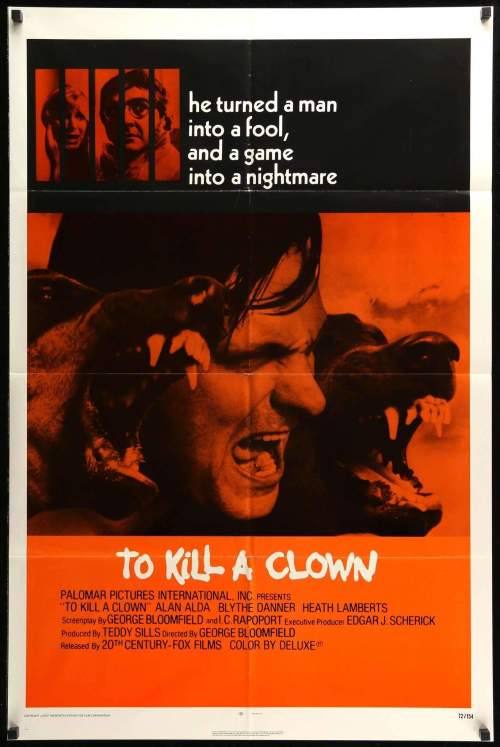
Timothy (Heath Lamberts) and Lily (Blythe Danner) are a couple suffering through a rocky marriage. In an attempt to try and save it they decide to rent a beach house for a summer where they hope the quiet seaside scenery can help mend the friction. Their landlord is Evelyn (Alan Alda) a crippled war veteran with two dobermans who resides in a large house next to theirs. Evelyn considers Timothy to be effeminate and ‘unfocused’ and decides to challenge him to a psychological game where he will put Timothy through the rigors of army training. Initially Timothy finds this challenge amusing, but the game becomes much harsher than he expected and when he tries to get out of it Evelyn won’t let him, which eventually leads to Timothy and Lily becoming hostages inside their own home where Evelyn’s two ferocious dogs guard them.

The film is based on the short story ‘The Master of the Hounds’ by Algis Budrys that appeared in the August 1966 edition of the Saturday Evening Post. The plot certainly has some intriguing qualities, but the pace is too laid-back and I spent much of the time rather bored with it. The tension comes in spurts and when it does get going it cuts away just as it gets interesting. The Timothy character is overly smug and to some extent I actually enjoyed some of the harassment that Evelyn gives him, which ultimately minimizes the ‘horror’ that the viewer is supposed to be feeling.

In the story the setting was supposed to be the Jersey shore and in the film it’s somewhere off the New England coast, but in actuality it was filmed in the Bahamas and in an attempt to mask the tropical surroundings they found one of the blandest looking beaches to film it on. The lack of scenery gives the film no visual flair and it ultimately comes off like something done on the cheap end by a director lacking talent of vision.

The only interesting aspect is seeing Alda, who was known throughout the 70’s and 80’s as being a very liberal, ‘sensitive’ male, playing someone who is the exact opposite and to a degree he does it well, but it could’ve and should’ve been played-up much more. Lamberts is good too, but it would’ve been better had the character been an actual army deserter, which would’ve then made the men’s contrasting personalities even more vivid.

Danner though, in her film debut,  comes off best by acting as a buffer between the two men. The dobermans though are the real stars and I wouldn’t have minded seeing more of them. In fact the film’s best moment involves one of them standing guard as it holds the frightened couple hostage in their living room and growling threateningly if one of them even moves their head in he slightest.

Unfortunately the action takes too long to get going and the whole thing gets misguidedly underplayed. I found the freeze-frame shots, which the film uses to transition from one scene to the next, distracting and overly artsy especially for a movie that is supposedly trying to be reality based.

My Rating: 3 out of 10

Released: August 23, 1972

Runtime: 1 Hour 44 Minutes (Reissued at 1 Hour 26 Minutes)

Rated R

Director: George Bloomfield

Studio: 20th Century Fox

Available: VHS