Category Archives: 70’s Movies

Lucky Lady (1975)

lucky lady

By Richard Winters

My Rating: 6 out of 10

4-Word Review: Three’s not a crowd.

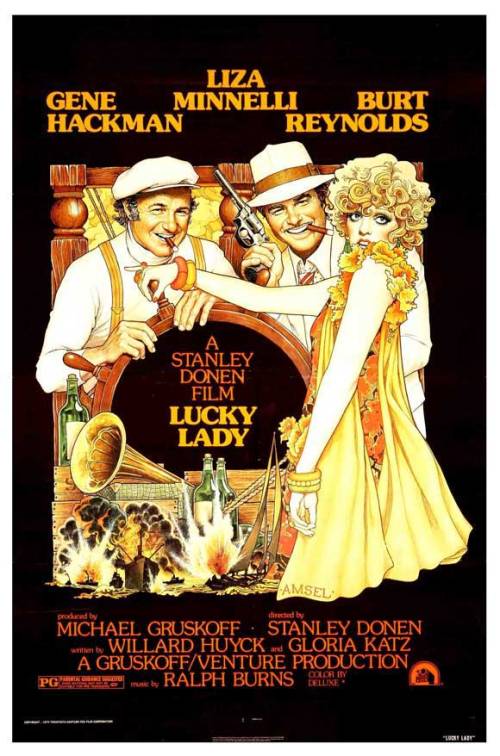
Walker (Burt Reynolds) and Claire (Liza Minnelli) make money by helping people illegally cross the Mexican border into the states, but when their third partner in the business dies and they almost get arrested they decide to get into an easier line of work. With the help of Kibby (Gene Hackman) they become rum-runners who transport liquor by boat under the cover of night during the prohibition era. As the three start to have some success and get to know each other they also form a love triangle and spend their evenings involved in a ménage-a-trois.

If you’re in the mood for non-think, grandiose style entertainment made in the same vein of classic movies from Hollywood’s golden era then you should find this more than satisfying. The plot moves along at a nice breezy pace with characters that are distinct and fun and full of snappy dialogue. The majority of the story takes place on water, but manages to remain quite exciting and ironically only becomes waterlogged when it goes on land. The lavish sets are splendid and the film could be enjoyed by simply taking in those alone.

The three leads are in top form and play against type. Minnelli, who actually looks sexy here in a flapper styled hairdo, is quite amusing with her acerbic one-liners. Reynolds is great as the klutzy member of the trio and Hackman is solid as always playing someone who seems meek at first, but eventually takes over things with his patented strong personality. Unfortunately John Hillerman, best known for playing Higgins in the ‘Magnum P.I.’ TV-series, is the only weak link of the cast playing a bad guy that never conveys enough menace to be truly threatening.

A young Robby Benson who was 18 at the time, but looks more like 14 is quite good in support. I was never all that impressed with the former teen heart throb, but here he is effective playing a shy kid who says little, but when he does say something it’s a gem. Geoffrey Lewis is also quite funny as an inept Captain of the Coast Guard. Mills Watson, who is best known for playing Deputy Perkins on the ‘The Misadventures of Sheriff Lobo’ TV-series can be spotted in a couple of scenes. IMDb does not have him listed here, but I recognized him and his name does come up on the closing credits as a character named Giff.

For lightweight entertainment the film does have quite a few action sequences that are surprisingly well choreographed and even quite bloody, but the climatic sequence becomes too cartoonish. I was also disappointed that the one unique element of the story, which is the three getting into a relationship, is only mildly touched upon and basically forgotten after the first hour. The film could’ve gone a lot farther with that and even made it the centerpiece of the plot, which would’ve helped make it more character driven and groundbreaking.

My Rating: 6 out of 10

Released: December 25, 1975

Runtime: 1Hour 58Minutes

Rated PG

Director: Stanley Donen

Studio: 20th Century Fox

Available: DVD
 

The Fortune (1975)

fortune

By Richard Winters

My Rating: 7 out of 10

4-Word Review: Trying to murder heiress.

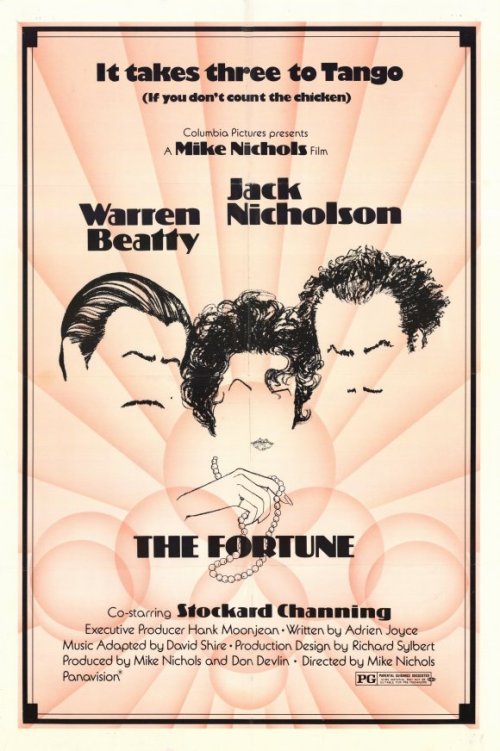
Oscar (Jack Nicholson) and Nicky (Warren Beatty) are two inept con men living in the 1920’s who think they’ve come up with the perfect plan for gaining a lot of money by having Oscar marry Fredericka (Stockard Channing) who is set to inherit millions from her father as she is the sole heiress to his fortune.  Unfortunately for them once the wedding is over Fredericka suddenly announces that she plans on donating her entire fortune to charity convincing the two that they must murder her before she does.

I found this to be a highly enjoyable movie and was laughing-out-loud in a lot of places, which is something that I don’t typically do. So it made me surprised to find that there were quite a few people on IMDB that were critical of it, or that it did so poorly at the box office when it was initially released. I admit that for the first hour the script meanders and things don’t really get going until the final 30 minutes when the two try to implement their hair-brained murder attempts, which they hope to make look like a suicide, but instead encounter one unexpected disaster after another.

Two of the funniest moments include the scene where Jack Nicholson walk out onto the wing of a flying airplane and scares Fredericka who is sitting as a passenger inside in a sort of comic spin of the famous ‘Twilight Zone’ episode that starred William Shatner. Another great scene is when Nicky and Oscar put Fredericka’s unconscious body inside a trunk and then try to throw if off a bridge only to inadvertently hold up a long procession of honking cars and angry drivers.

The three leads are in top form and play completely against type here. Beatty, who usually plays laid-back and detached characters, is more cantankerous and belligerent and Nicholson, with his hairstyle resembling that of singer Art Garfunkel’s is very funny as the dimwitted second-banana. Channing looks great in a flapper style hairdo and the segments detailing her desperate attempts at cooking are quite amusing. Florence Stanley is also good in support as the noisy landlord.

The film has the ingredients for a perfect comedy although it will appeal more to those who enjoy their humor on the dark side. The twist ending is kind of clever and the final camera shot that rotates to an almost complete turn is excellent.

My Rating: 7 out of 10

Released: October 16, 1975

Runtime: 1Hour 28Minutes

Rated PG

Director: Mike Nichols

Studio: Columbia Pictures

Available: DVD, Blu-ray, Amazon Instant Video

And Hope to Die (1972)

and hope to die

By Richard Winters

My Rating: 7 out of 10

4-Word Review: Kidnapping a dead girl.

Tony (Jean-Louis Trintignant) is on the run from a gypsy group out for revenge and as he is being chased by them he encounters another group of criminals headed by Charley (Robert Ryan) who after some conflict take him into their fold and gives him the nickname of Froggy. Their plan is to kidnap a teen girl who is set to be the star witness at a trial of a major head of a criminal organization. Unfortunately she commits suicide before they can get to her, so they pretend that she is still alive and go through the motions of the kidnapping so as to be able to collect the payout by the organization that hired them.

This is the second of director Rene Clement’s trilogy dealing with the theme of kidnapping. The first was The Deadly Trap and the third being Scar Tissue. Of the three this one is the best mainly because of its many offbeat touches. The wry sense of humor, which is deftly interwoven into an already intricate plot, is terrific and helps make the entire thing engaging from beginning to end. My favorite parts include a contest that Froggy plays with Charley where he can stand three cigarettes on end straight into the air, which he can do with ease while Charley can’t despite his repeated efforts. The eulogy that Charley gives during a makeshift burial of one of their cohorts is priceless and the action isn’t bad either including an exciting sequence in which the group walks across a thin ladder hundreds of feet in the air that connects one skyscraper to another.

The characterizations are well done and played to the hilt. Trintignant plays another one of his outsider-looking-in roles and the way he manages to mesh himself into the group that is initially reluctant to have him is quite amusing. Aldo Ray is a scene stealer playing the gang’s resident bonehead and Tisa Farrow, who is Mia’s younger sister and looks almost like she could be her twin, is appealing in her role as a volatile young lady who knows how to use a gun and not afraid to shoot it whenever she gets the least bit riled.

The actual kidnapping, which is based on the novel ‘Black Friday’ by David Goodis, doesn’t occur until the final thirty minutes with the first hour dealing exclusively with Froggy’s assimilation into the group, which may sound boring, but really isn’t. In fact there is very little about this movie that I didn’t like and my only complaint would be the lackluster ending that doesn’t offer much of a payoff. Otherwise I feel this is a great example of how to mix humor with action, but still managing to keep things believable, fresh and inventive.

My Rating: 7 out of 10

Released: September 15, 1972

Runtime: 1Hour 39Minutes

Rated PG

Director: Rene Clement

Studio: 20th Century Fox

Available: DVD (Region 2)

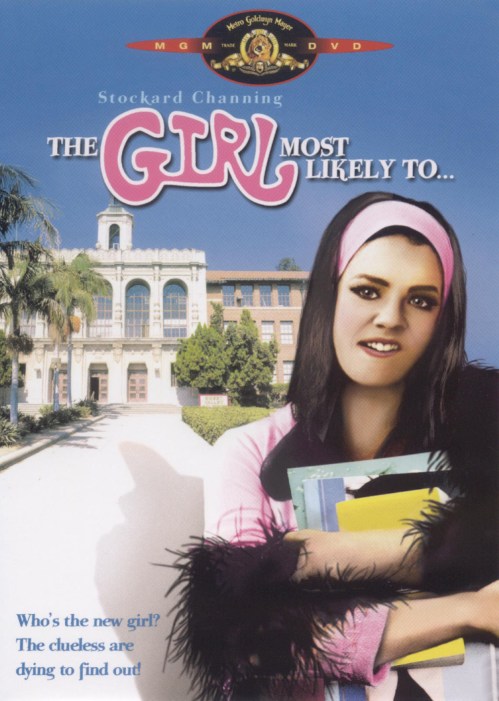
The Girl Most Likely to…(1973)

girl most likely 1

By Richard Winters

My Rating: 6 out of 10

4-Word Review: Ugly girl gets revenge.

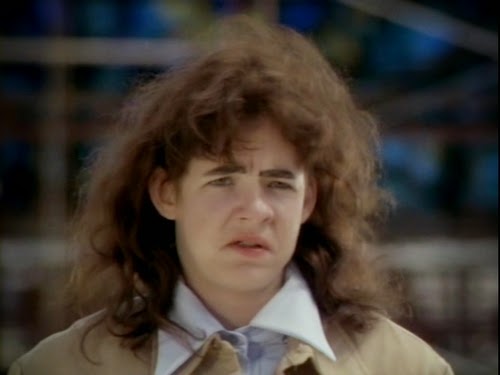
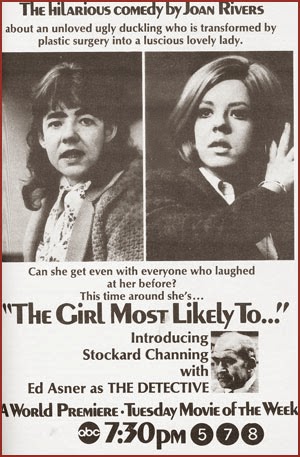
Miriam (Stockard Channing) is a homely student attending college who can’t seem to find a boyfriend or even any friends. Instead she is ostracized and rejected constantly in the cruelest ways possible. Upset by her depressing life she one day gets into her car and drives recklessly down the highway only to get into a crash, which forces surgeons to do major reconstructive surgery on her face that amazingly turns her into a beautiful woman. Now she can have any guy that she wants, but the bitterness of the way she was treated in the past eats away at her and she instead decides to get revenge by killing off all the people that rejected her using increasingly novel methods.

This made-for-TV film was written by Joan Rivers and it has the same humor that she used in her stand-up comedy act, which mainly focused on women’s deep seated insecurities involving their looks and the need to get married and please their husband. To some degree the whole thing is quite dated particularly the idea that a woman’s sole purpose in life is to use their looks to snare a rich husband who will then take care of them for the rest of their life. The humor and characters are also extremely clichéd and broad, but it still manages to have some funny bits.

Channing’s presence helps immensely and she manages to somehow carry off the role with dignity despite being degraded and humiliated at every turn. Her ugly makeover is impressive particularly the way they wadded up her nose to make her left nostril much larger than the right one, which had me reluctantly focused on it every time it came into view.

girl most likely 2

The supporting cast features many familiar faces in small, bit parts some of which are quite funny including Joe Flynn as a surgeon unable to find a patient’s appendix, Larry Wilcox as a dumb football player named Moose, Warren Berlinger as Miriam’s plumber fiancée and Susanne Zenor as the haughty roommate. This also marks the acting debut of Larry Manetti who can be spotted in a small role as a football player.

The murders themselves are what help stand this film apart from the others in what otherwise could be described as a Carrie precursor. The scene where Miriam kills off the Wilcox character while skydiving is impressively captured as is the segment where Berlinger drowns in a flood in his own bathroom. The only one that doesn’t quite make sense is when she tries to kill a pool player by having him hit the eight ball that is secretly a bomb. However, when it does finally go off, it explodes the entire pool hall, which would’ve easily killed Miriam along with the others had she not been inadvertently lead away at the last minute.

Fans of black humor should especially enjoy this and for a TV-movie it is far and away better than most. It also scores better than River’s theatrical feature Rabbit Test, which she did five years later and wasn’t funny at all.

girl most likely 3

My Rating: 6 out of 10

Released: November 6, 1973

Runtime: 1Hour 15Minutes

Not Rated

Director: Lee Phillips

Studio: ABC Circle Films

Available: DVD

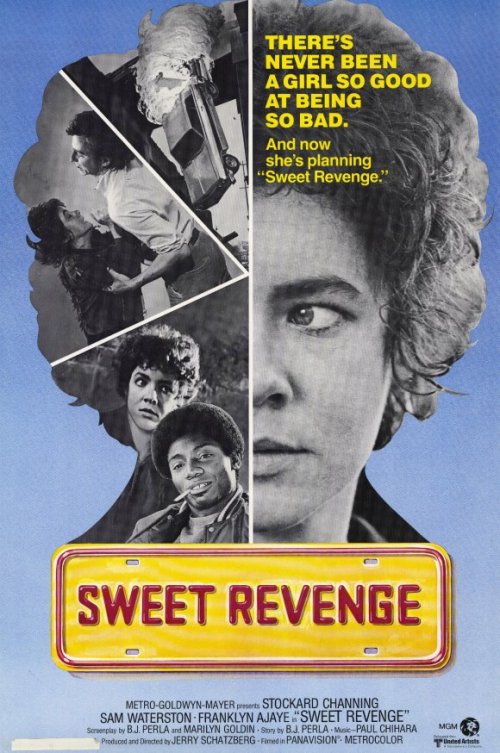
Sweet Revenge (1976)

sweet revenge

By Richard Winters

My Rating: 6 out of 10

4-Word Review: Pretty lady steals cars.

Despite squatting in an abandoned house, having no job, no money and virtually no life Vurrla (Stockard Channing) becomes obsessed with getting herself a brand new Dino Ferrari. She knows how to steal cars, so she decides to steal a Porsche, resell it to unsuspecting buyers and then a few days later steal the same car back and resell it again and continue this process until she has secured enough to pay for the Ferrari. The plan works smoothly, but public defender Le Clerq (Sam Waterston) has been following her and determined that she turn herself in before she gets herself into even deeper trouble.

As I watched this movie I found myself quite perplexed as to how Leonard Maltin in his Movie Guide could’ve given this thing a ‘bomb’ rating. This is certainly not a four-star flick, but it’s far from being bad one either. The plot moves along at a nice breezy pace with an engaging combination of drama, action and humor. The characters are believable and interact with each other in interesting ways. The on-location shooting of Seattle, which was done by renowned cinematographer Vilmos Zsigmond who died just this past New Year’s, is quite vivid and focuses on some of the city’s lesser known neighborhoods, which should be fun for those from the area as it is sure to bring back a flood of memories.

Channing is dynamic and especially enjoyable when she puts on different wigs and a variety of accents as she tries to sell the cars to different people and I wished these segments were played up more. Waterston’s character is much more controlled and practical making the two play off each other in revealing ways. Franklyn Ajaye lends great support as Vurrla’s streetwise friend and Richard Daughty is amusing as Vurrla’s dimwitted cohort and I was surprised that he seemingly disappeared off the face of the planet and never did a thing after this. This also marks the acting debut of Daryl Anderson who appears briefly getting out of his car and going inside only to have Vurrla sneak up and steal it a few minutes later.

On the negative side the film could’ve used a little more action. There is one car chase that occurs near the end, which turns inexplicably tragic and hurts the film’s otherwise lighthearted tone. The ending is frustratingly vague and outside of watching a Ferrari burn into a cinder offers no finality to the character’s eventual fate. There is also a segment where Channing and Daughty go shopping at a grocery store and for a brief couple of seconds the scene is shown through the lens of a black-and-white security camera making the viewer believe that the two are being monitored and will soon be arrested since they are shop lifting, but nothing ever happens, so why insert that shot if it serves no purpose?

My Rating: 6 out of 10

Released: June 16, 1976

Runtime: 1Hour 30Minutes

Rated PG

Director: Jerry Schatzberg

Studio: MGM

Available: DVD (Warner Archive)

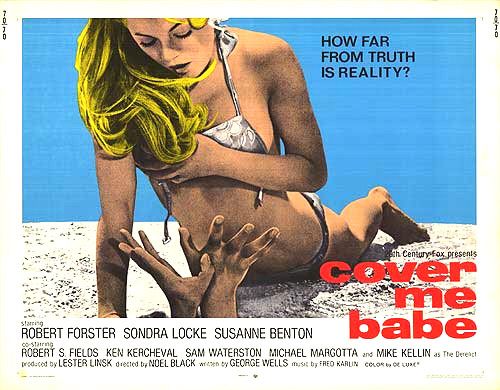
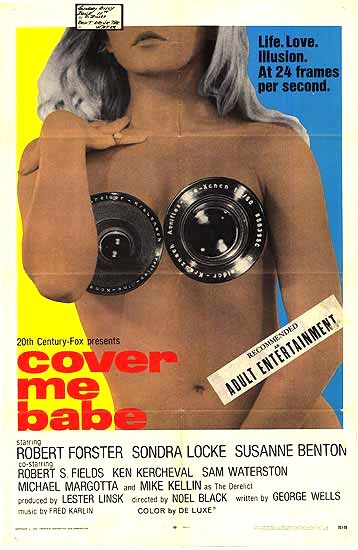
Cover Me Babe (1970)

cover me babe 3

By Richard Winters

My Rating: 3 out of 10

4-Word Review: Student filmmaker alienates everyone.

Tony Hall (Robert Forster) is a student filmmaker who feels he is a great director in the making and not afraid to let everyone know it. He becomes obsessed with capturing reality as it is and people’s emotional responses. He goads those around him including his own girlfriend (Sondra Locke) into doing things they are uncomfortable with simply so he can capture that uneasiness and the facial expressions that come with it. Some feel he is going too far, but the more they try to reel him in the more boundaries he pushes.

I’ve attended a film school in Chicago back in the early ‘90s, so for me I found this plot to be intriguing. In a lot of ways, at least at the beginning, I thought they captured the arrogance of these young would-be student directors who are convinced they are the next Kubrick or Scorsese in-the-making quite well. Their elitist attitude and willingness to compromise good taste and common sense simply to attain a shock effect to get attention are all very real.

Unfortunately the film goes overboard especially with the lead character who quickly becomes unlikable. I don’t mind a certain bit of cockiness or a say-it-like-it-is persona, but this guy is downright rude, smug, abrasive and even cruel. You spend the whole time hoping someone will punch him in his face, but it never happens and I believe this is the sole reason why this film failed at the box office as no one wants to sit through an entire movie watching a person whose behavior they can’t stand.

His excessively rude attitude towards a studio head (Jeff Corey) who wants to offer him an opportunity make a feature film is particularly confounding. It’s similar to Troy Duffy the real-life subject of Overnight and the director of The Boondock Saints who became quite arrogant to everyone once he got himself a Hollywood contract, but at least in Duffy’s case he had gotten his proverbial foot-in-the-door and therefore felt it was ‘safe’ to let his obnoxious side out, but the Forster character here doesn’t yet have one and you’re compelled to feel that the guy must be mentally ill to think he ever will by behaving in the outrageous way that he does.

Forster gives a solid performance, but the character seems too similar to one he just got done doing in Medium Cool and bordered almost on type casting. Locke is okay as the girlfriend and can be seen fully nude at the beginning, but why she would want to stick with such a jerk is hard to understand and makes her character annoying because of it. I realize some gals have the ‘bad-boy syndrome’, but it goes overboard with it here.

The film lacks a cinematic touch and its best part comes at the beginning where we watch a student film with a dream-like sequence in a Federico Fellini style that is actually pretty good. Another memorable bit comes near the end where Forster broadcasts to a group of students his own film, which features a scene showing a man jumping off a ledge and then panning over to reveal the shocked expressions of the people on the ground who witnessed it as well as the students watching it on film.

cover me babe 2

My Rating: 3 out of 10

Released: October 1, 1970

Runtime: 1Hour 25Minutes

Rated R

Director: Noel Black

Studio: 20th Century Fox

Available: None at this time.

Running (1979)

running 1

By Richard Winters

My Rating: 5 out of 10

4-Word Review: Life of a runner.

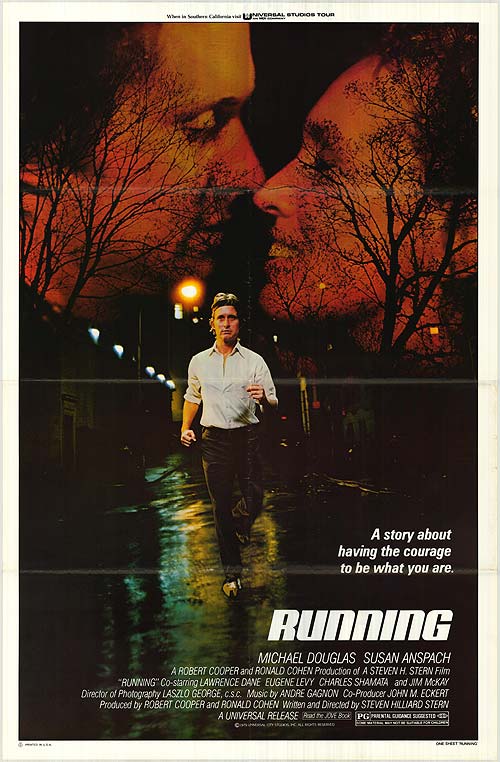
Michael (Michael Douglas) is suffering, at the age of 32, a midlife malaise. He goes from one dead end job to another and his marriage is crumbling. He runs to relieve the stress and finds that he has a major passion for it. When he qualifies for the Olympics he is initially excited, but it’s short lived because his former coach (Lawrence Dane) is on hand to constantly remind him how he has a tendency to ‘choke’ at the last minute and can never win a race when the pressure is on, which begins to wear on him psychologically.

The theme of a middle aged man having a passion for something that isn’t exactly ‘practical’ and resisting the pressures from the rest of world that tries to get him to conform to something that is, is highly relatable. I also liked the side-story dealing with the psychological element, which plays a far stronger factor in sports and amongst athletes than one might think. However, the majority of the screen time is spent with Michael trying to reconcile with his wife Janet (Susan Anspach) making it seem more like a romance and seemingly added in as ‘filler’ because the filmmakers believed that the running theme wouldn’t be enough to  carry it.

I also had a hard time understanding why the kids at high school, or at least his daughter’s friends, which gets played by Lesleh Donaldson in her film debut, would make fun of Michael simply because he was frequently seen around town running. I see joggers and runners every day and saw a lot of them back in the ‘70s too, so I don’t get why that would be a source of mockery and it seems like it was yet another manufactured dramatic element put in to give it more conflict. What’s even worse is when Michael finally qualifies for the Olympics then the kids do a full 180 degree turn and get excited about it and even run with him down the city streets, which gets corny to say the least.

Halfway in you realize this is just another variation of the Rocky formula and normally I would’ve found it annoying, but for some reason I actually got into it. I even liked the scene where he spots a giant cross standing on a hill and decides to run up the incline to reach it much like Rocky climbing the steps of the Philadelphia Museum of Art and to some degree it’s invigorating although it would’ve been nice had it shown him standing next to the cross once the climb was achieved. The final segment that takes place during the climactic Olympic race even has a twist to it that I didn’t see coming and to a degree it’s interesting though pushing plausibility. I won’t give it away I’ll just say that he doesn’t win the race, but he doesn’t exactly lose it either.

Douglas did all of his own running and to prepare for the role he would run many miles a day; IMDB states that he ran 50 to 60 miles a day, which I found hard to believe, so we’ll just say it was ‘many’. Anspach is good as the sympathetic wife particularly when the character has a conflict of emotions and breaks out in tears. Eugene Levy appears with a full afro in a rare serious turn as Michael’s attorney. Lawrence Dane is okay as the hardened coach who dispenses a lot of ‘tough love’, but little else.

My Rating: 5 out of 10

Released: November 2, 1979

Runtime: 1Hour 42Minutes

Rated PG

Director: Steven Hilliard Stern

Studio: Universal

Available: DVD (Italian Import Region 0)

Eraserhead (1977)

Eraserhead

By Richard Winters

My Rating: 6 out of 10

4-Word Review: Couple has deformed baby.

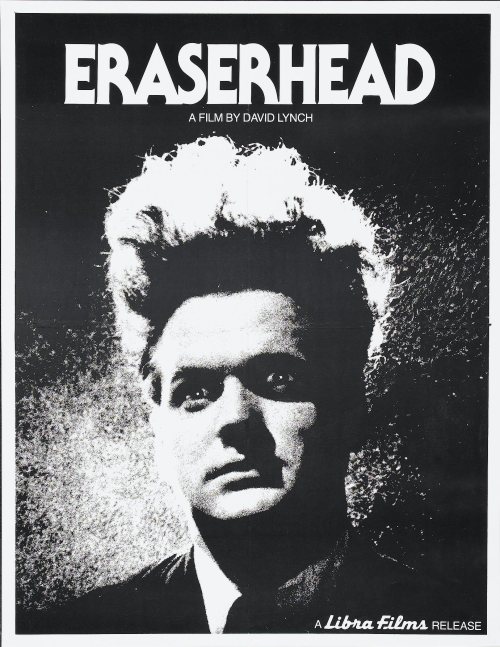
In David Lynch’s first feature length film, a movie that took almost 5 years to make and had a good deal of it financed by Sissy Spacek and her husband, we have a surreal almost cryptic-like tale detailing a lonely man named Henry (Jack Nance) and his ultimate descent into a madness as he is forced to take care of severely deformed child while also harboring the dark urge to kill it.

It is hard to say whether one can like or dislike this as it goes so far out of the conventional form of film narrative that it seemingly defies all genres and puts itself into a category all its own. On a sheer technical level it is quite impressive especially when you factor in its shoestring budget and array of production set-backs. Each scene is meticulously detailed with wild and unsettling imagery that on a purely visual level will be more than enough to leave an impact. Overall the film is cold, ugly and unyielding, but helped tremendously by Nance’s presence as a sort of detached everyman who seems as confused and aloof to his surroundings as the viewer.

To me the most jarring image is the baby, which is incredibly lifelike. Had it came off looking fake, or like some puppet or Claymation attempt the film would’ve been a failure, or deemed laughable, but this thing is freaky looking to the extreme and Lynch spares no expense in getting the camera close up to it, which could force some viewers to turn away. Supposedly it was made from the embalmed fetus of a calf, but no one knows for sure and the crew was forced to blind fold themselves when Lynch set it up, so the secret would never come out. Either way it is effective and it manages to move its eyes and mouth almost like it were real and coming off as far more authentic than any computerized effect.

Spoiler Alert!

Of course the most confounding thing about the film is its story and symbolism’s that can be interpreted in a million different ways depending on the viewer’s own perspective. For what it’s worth I’ll give you my interpretation, which isn’t that complicated. To me the deformed baby symbolizes Henry’s soul, which has been mangled by the soulless world that he lives in, which would explain why he is so extremely passive because he is simply a walking zombie. The scene where his head pops off and the ugly child’s head pops into its place only reinforces this. The lady that he sees in the radiator is an angel from heaven and the beautiful lady that lives across the hall from him is the devil who entices him with sex, but when she realizes he has no soul to take, just an ugly mangled remnant of one, which gets exposed to her when she sees him standing in the doorway, she quickly loses interest and moves onto someone else. When he finally kills the baby he is essentially killing himself, which then explains why he ends up in the final scene in heaven with the lady in the radiator.

The man in the planet that we see at the beginning represents Henry’s own subconscious as he quarrels within his mind at the thoughts of killing the child. The man could also represent the world at large and how it controls everyone with its levers, which when Henry finally kills himself they start to have sparks fly from them and the man struggles in containing them, which shows that Henry has now ‘broken free’ from the man and this world by taking his own life.

End of Spoiler Alert!

Some consider this a horror pic, but I found certain parts of it to be quite funny in a darkly humorous way particularly the segment where Henry goes to visit his girlfriend’s parents. To me the most horrifying thing about is the way it challenges the viewers to question their own morality by forcing them to face the difficult quandary or what they would do if put into the same situation as Henry and forced to care for a hideous looking baby that some would consider would be better off dead.

My Rating: 6 out of 10

Released: September 28, 1977

Runtime: 1Hour 29Minutes

Not Rated

Director: David Lynch

Studio: Libra Films International

Available: DVD (Criterion Collection), Amazon Instant Video

The Dove (1974)

dove

By Richard Winters

My Rating: 5 out of 10

4-Word Review: Sailing around the world.

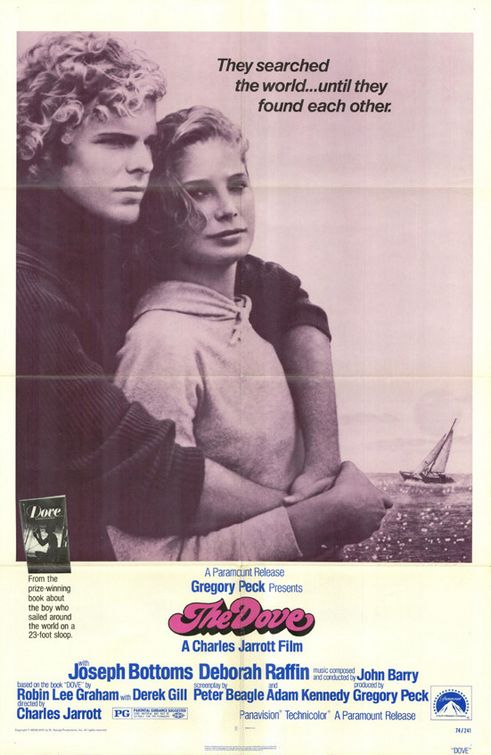
Based on a true story and produced by Gregory Peck this film examines the journey of Robin Lee Graham (Joseph Bottoms in his film debut) as he sails in his boat called The Dove around the world. When he starts out he is only 16, but through the course of his journey he goes through many adventures, meets a beautiful woman named Pattie (Deborah Raffin) who he eventually marries and returns home a full grown man.

The variety of exotic locales and stunning cinematography by Sven Nykvist are a chief asset, but the film starts off with absolutely no backstory. The viewer is hoisted onto the boat with the main character without having any idea who he is, his background, preparation, reason for doing this, or his relationship with his family. Bits and pieces of this come out later, but it would’ve been nice to have had some of this info from the start and would’ve allowed for more of an emotional connection to the character.

The first hour is spent more on land than at sea, which is another problem because it doesn’t get riveting until he is actually on the boat and fighting the many elements. The melodic mood music gets excessive and should’ve been toned down as well and the two songs sung by Lyn Martin, which could’ve been scrapped completely as the natural ambience of the sea is far more soothing.

Bottoms, who retired from acting in 1999 and now runs an art gallery, does quite well. His boyish face and variety of emotions that he goes through during his adventure ring quite true for someone of that age and help to make the character quite real. I also enjoyed how the character is astute in certain areas, but very awkward in others particularly with the way he tries to court Patti, which also leads to the film’s best line “I’m feelin’ romantic…in a horny kind of way.”

Raffin is stunningly beautiful and her acting is outstanding and I liked how the female character was portrayed as being older, wiser and more practical. The two share a great chemistry, but Robin’s relationship with his ornery pet cat Arvana is equally interesting even though its demise is unpleasant.

Familiar character actors pop up briefly playing pesky photographers from National Geographic magazine that carried the story through his trip. John Anderson has a funny bit here, but the best is Dabney Coleman who speaks with an Australian accent!

The actual journey began in September, 1965 and wasn’t completed until April of 1970 with many stops and starts in between, which the film does a good job of showing as at several points Robin abandons the mission only to finally start it back up several weeks or months later. Although the film gives the impression that he completed the full journey in reality he didn’t as he started it in Hawaii, but finished it in Long Beach, California also the boat that he used for his trip ending up getting destroyed in 1989 during Hurricane Hugo.

My Rating: 5 out of 10

Released: October 16, 1974

Runtime: 1Hour 45Minutes

Rated PG

Director: Charles Jarrott

Studio: Paramount

Available: VHS, Amazon Instant Video

The Crazy World of Julius Vrooder (1974)

crazy world 2

By Richard Winters

My Rating: 4 out of 10

4-Word Review: Pretending to be crazy.

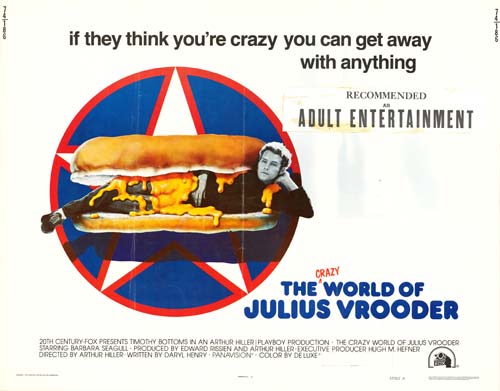
Vrooder (Timothy Bottoms) is a Vietnam Veteran who has returned from the war and is unable to cope with the stresses of everyday life, which eventually gets him checked into the psychiatric ward of a local VA Hospital. There he falls in love with Zanni (Barbara Hershey, but billed as Barbara Seagull) who works as a nurse there, but he is unhappy to find that she is already engaged to Dr. Passki (Lawrence Pressman). To escape his frustrations he hides out in an underground bunker that he has created near a local highway. The place comes complete with electricity and telephone service as well as an array of booby traps to tip him off if anyone comes near, but the heads of the local power and telephone companies’ start trying to track him down in an effort to stop his pilfering of their services, which could ultimately lead to an end to his days of freedom.

The film is cute, but a little too cute and was produced, believe it or not, by Hugh Hefner. It likens itself to being an offbeat comedy, but there really isn’t that much that is original about it and it comes off more like a tired anti-establishment flick with the proverbial authority figures portrayed in stale, one-dimensional ways. One could actually consider this as a weak cousin to One Flew Over the Cuckoo’s Nest with Vrooder being McMurphy, Passki being a toned-down male version of Nurse Ratched and the suicidal Alessini (Michael Cristofer) being like Billy Bibbit.

The only slightly diverting thing about this film, that otherwise suffers from having a limited budget and looks like it was shot initially on video and then later transferred onto film, are the scenes involving the heads of the power and telephone companies (Jack Murdock, Lou Frizzell) working together to track down the culprit who’s stealing their service. The climactic scene in which Jack Colvin plays an over-the-top Dirty Harry type cop obsessed with getting Vrooder and sending an entire armed police force into the forest to find him is amusing as is the mugshots shown of past felons who had stolen electrical and phone service, which were all made up of headshots from the film’s behind-the-scenes crew.

Bottoms is rather transparent, but Hershey, with her effervescent smile and naturally carefree persona, is far better as her simple presence naturally exudes the film’s hippie-like theme. This was the second of four films in which she was billed with the last name of Seagull and this was done as a personal tribute to seagull that she had accidentally killed while filming a scene in the movie Last Summer.

Albert Salmi, in a rare appearance without his mustache, is excellent in support as Vrooder’s good-natured, fun-loving friend Splint and I found it hard-to-believe that this same man who could play such a peaceful character so well would years later in real-life murder his wife before turning the gun onto himself. Elderly film director George Marshall also does well as the aging Corky and his performance should’ve merited supporting Oscar consideration.

This obscure movie also marks the film debuts of several performers, which includes not only Murdock’s and Cristofer’s, but Ron Glass’ as well who plays an hospital orderly and Dena Dietrich playing Vrooder’s mother who later became best known as Mother Nature in a series of commercials that ran during the ‘70s.

crazy world 1

My Rating: 4 out of 10

Released: October 18, 1974

Runtime: 1Hour 38Minutes

Rated PG

Director: Arthur Hiller

Studio: 20th Century Fox