Category Archives: Movies with Nudity

Rabid (1977)

By Richard Winters

My Rating: 5 out of 10

4-Word Review: Graft patient craves blood.

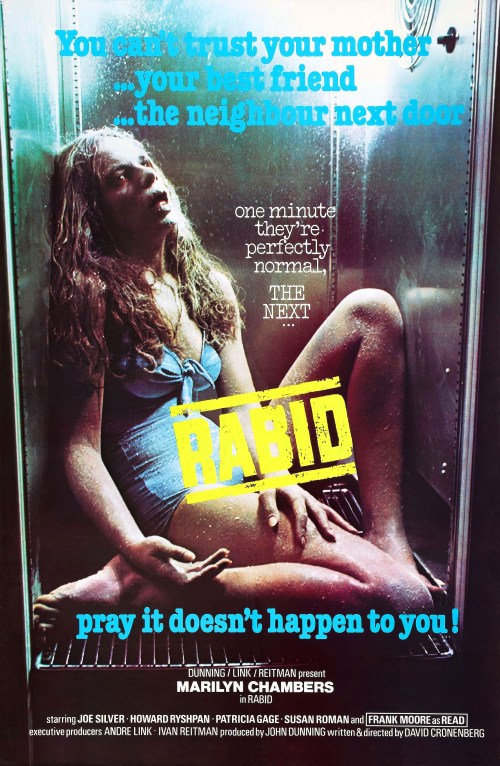
Rose (Marilyn Chambers) becomes the victim of a horrible accident when the motorcycle she goes riding on with her boyfriend (Frank Moore) crashes and she gets pinned underneath the burning wreckage. Fortunately for her the accident occurs near a clinic that specializes in plastic surgery. The head surgeon (Howard Ryshpan) is able to perform an experimental procedure on her that helps graft her burned skin back to normal, but in the process creates a strange orifice in her armpit that sucks blood from everyone she attacks. Her victims then become possessed by a rare form of rabies that sends the city of Montreal into a panic as the authorities try to control the outbreak while also trying to figure out the cause.

This marked director David Cronenberg’s third feature film and from a low budget standpoint the results are impressive. I was especially amazed by some of the car stunts including having an out-of-control vehicle jump a guard rail and crash onto a highway below where a large semi then rams into it. His ability to somehow hire an entire fleet of squad cars is admirable too as most budget-challenged films will make do with just one police car when having authorities investigate the scene of a crime/accident even though in reality there are usually many especially if the crime or accident is severe like here.

I also loved the way he captures the gray/bleak Canadian landscape, which helps supplement the film’s dark and moody tone as well as the bits of dark humor that gets implemented into the story that made me wish the whole thing had been approached as a black comedy from the start.

The horror though isn’t all that much and genuine scares are light including the scenes showing rabid people attacking others, which becomes both clichéd and redundant. The orifice itself looks like an asshole and similar to the giant one that Cronenberg created many years later for his equally provocative film Naked Lunch.

Unfortunately porn star Chambers doesn’t have the presence or talent for mainstream film work. She broke into the business years earlier with a bit part in the Barbra Streisand movie The Owl and the Pussycat, but to her surprise other film offers didn’t follow, which eventually forced her into the X-rated business, which included starring in the cult classic Behind the Green Door, but she always held out hope to one day breaking back into mainstream movies and finally got it here, but it never propelled her further.

Part of the issue is her voice which is abnormally high-pitched and at times sounds like that of a very young child’s. In certain scenes it’s worse than others, but I found listening to her speak to be disconcerting and distracting although she does still look great naked.

The somber, downbeat ending is unusual for a horror film and it might’ve had more impact had the main character been given more depth. The viewer though learns little about her and she fails to have a distinctive personality, which limits the film’s ability to be anything more than just a curio.

My Rating: 5 out of 10

Released: April 8, 1977

Runtime: 1Hour 31Minutes

Rated R

Director: David Cronenberg

Studio: Cinepix Film Properties

Available: DVD, Blu-ray, Amazon Video, YouTube

Blood Rage (1987)

By Richard Winters

My Rating: 3 out of 10

4-Word Review: Homicidal twin frames brother.

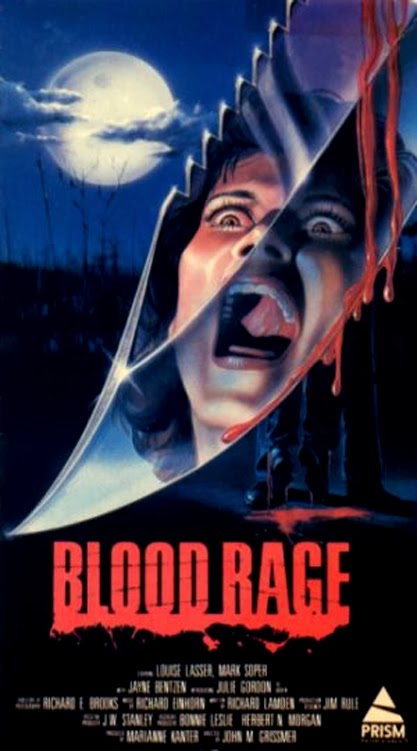
In the summer of 1974 while his mother (Louise Lasser) watches a movie with her new date at a drive-in 10-year-old Terry (Mark Soper) kills a young couple with a hatchet and then pins the murders on his brother Todd. Todd is sent away to an asylum while Terry goes on living with his mother. 10 years later Todd escapes from the mental hospital and Terry uses this as an excuse to murder people at the apartment complex that he and his mother live at while again trying to make it look as though Todd is the culprit.

The film was directed by John Grissmer who in the early 70’s produced The House that Cried Murder an interesting horror flick and a clip from that one gets shown here. He also later directed Scalpel and although that was not perfect it’s still better than this, which outside of some very gory special effects is about as routine and boring as a slasher film can get.

The identical twin/murder storyline, which has been done many times before, is a the biggest problem because even in the most extreme cases you can usually tell one twin from the other and therefore having a plot where people can easily mix the two up is just not realistic. What makes things worse is that one of the twins has curly hair while the other one’s hair is straight and combed back, so the fact that people can still somehow get the two confused is ridiculous.

The film also has too many unexplained plot holes like why is Terry so homicidal in the first place? Does mental illness run in his family, or is there something else that triggers it? And why does Todd so passively allow himself to put into an institution without protest and only after 10 years does he finally begin to profess his innocence?

The film was shot in Jacksonville, Florida, but the places used for the setting are deadly dull visually especially what was then known as the La Miranda apartment complex. This might’ve been done for budgetary reasons, but apartments are cramped places with unimaginative architecture so filming the majority of a movie inside one gives the film a flat, one-dimensional look and the exteriors, which were shot at the University of Northern Florida, were too limited and the action goes back several times to the same spots already used before like a nature bridge, which gives the film a redundant feel.

The acting is poor with the worst coming from Julie Gordon who plays Karen. I’ll admit the dialogue that she is given is pretty stupid anyways, but still watching her pathetic attempts at running or even screaming is so bad that you just wish the bad guy would kill her to put us the viewer out of our misery of having to watch her and the more she stays on the more unbearable the film gets.

The film’s only saving grace is Louise Lasser who helps bring some quirky depth into it. She’s unquestionably a unique talent that can sometimes give a brilliant performance if given the right material. Her neurotic persona and ad-libs add a terrific edge and just seeing her reactions is more fascinating than anything else in the movie. The film might’ve had a chance had she been in every scene and the stupid teen cast scrapped, but unfortunately she appears only sporadically, which just isn’t enough to mask the otherwise threadbare material.

My Rating: 3 out of 10

Alternate Title: Nightmare at Shadow Woods

Released: March 29, 1987 (Filmed in 1983)

Runtime: 1Hour 22Minutes

Rated R

Director: John Grissmer

Studio: Film Limited Partnership

Available: DVD, Blu-ray, Amazon Video, YouTube

Piranha (1978)

By Richard Winters

My Rating: 5 out of 10

4-Word Review: Mutant fish attack swimmers.

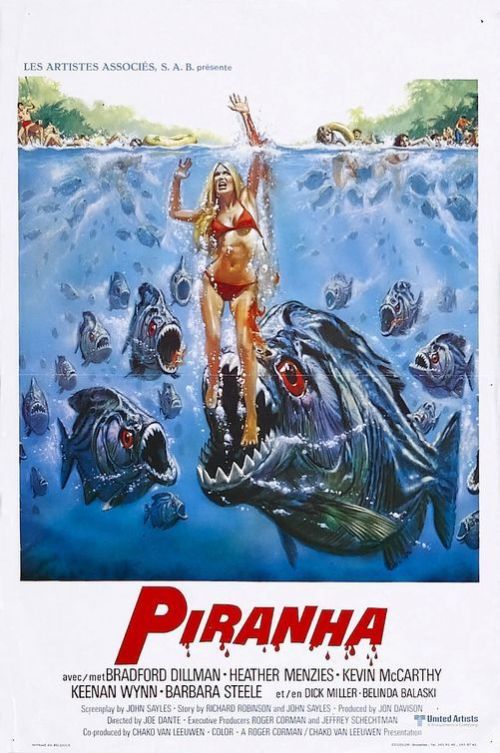
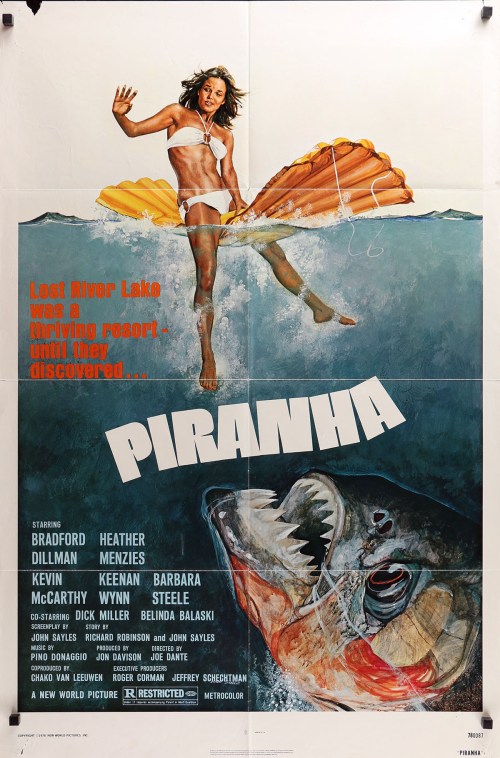
When two teenagers disappear late one night while swimming in a pool inside an abandoned military complex it’s up to Maggie (Heather Menzies) a professional skip tracer to find them. She recruits Paul (Bradford Dillman) a drunken backwoods loner to serve as her guide. As their investigation continues they learn that the swimmers were killed by some mutant fish that had been created by the government to be used as a weapon during the Vietnam War. Now that the war was over they were being kept inside a secret underwater tank, but when Maggie inadvertently drained the tank in order to search for the bodies she released the fish down the river where they are set to attack a children’s summer camp of which Paul’s daughter Suzie (Shannon Collins) is in attendance.

This is billed as a spoof of Jaws and supposedly according to Leonard Maltin’s review loaded with in-jokes, but to me I saw very little that was humorous and in many ways this film could work as a legitimate horror film on its own. The only amusing moments I found are when Maggie plays a Jaws video game near the beginning as well as a female beachgoer who is spotted reading ‘Moby Dick’, but otherwise the chuckles are light unless you count Dick Miller as an overzealous promoter who is indeed pretty funny.

The film starts out like I wants to be different from the typical horror film and initially I was intrigued particularly with the two protagonists. Normally the female/male leads in these types of films consist of good-looking teens/college aged kids, but here we get a guy who was near 50 and a female, who although being quite attractive has more of a take-charge attitude that is usually seen in a guy. Having the film play against gender stereotypes was for me the best thing it had going for it and I really liked the way the awkward relationship between Maggie and Paul initially developed.

Unfortunately it doesn’t stay that way and by the halfway mark Paul is the one taking control while Maggie is just tagging along, which I found disappointing. It also tries to sneak in a romance angle, which is ridiculous since the guy was clearly old enough to be her father. Paul is also seen continually drinking alcohol, but he never shows any signs of being inebriated and I realize alcoholics have a higher tolerance to the stuff, but still I doubt he would’ve been able to stay so sharp and heroic as he ends up being while still under the influence as he supposedly is.

The fish attacks become monotonous and consist of the same shot of rubber fish put on strings shown swimming towards their prey and the sound effects used for the fish when they start biting was performed by underwater dental drills, which to me sounded cheesy. There are a lot of pools of blood that form around the victim as he/she are being bitten, but not much else in the way of special effects. Only at the end does it get gorier and there’s even a shot of one of the fish coming straight towards the screen with its toothy mouth wide open, but I felt this should’ve been put in earlier.

The supporting cast of eclectic B-movie stars is interesting but underused and this also marks the final film appearance of Barry Brown who at the age of 27 killed himself just two months after the film wrapped shooting and was already dead by the time it was released to theaters. Overall though, the whole thing, which was remade in 2010, is watchable but disappointing. The humor and offbeat elements should’ve been played-up much more and the characters made to be more eccentric especially the two leads. In the end it becomes just another routine horror flick that’s no better or worse than the hundreds of others that are already out there.

My Rating: 5 out of 10

Released: August 3, 1978

Runtime: 1Hour 34Minutes

Rated R

Director: Joe Dante

Studio: New World Pictures

Available: DVD, Blu-ray, Amazon Video, YouTube

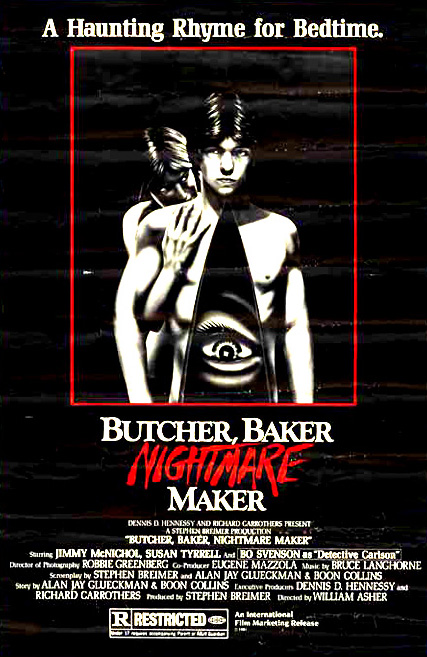
Night Warning (1982)

By Richard Winters

My Rating: 6 out of 10

4-Word Review: His aunt is crazy.

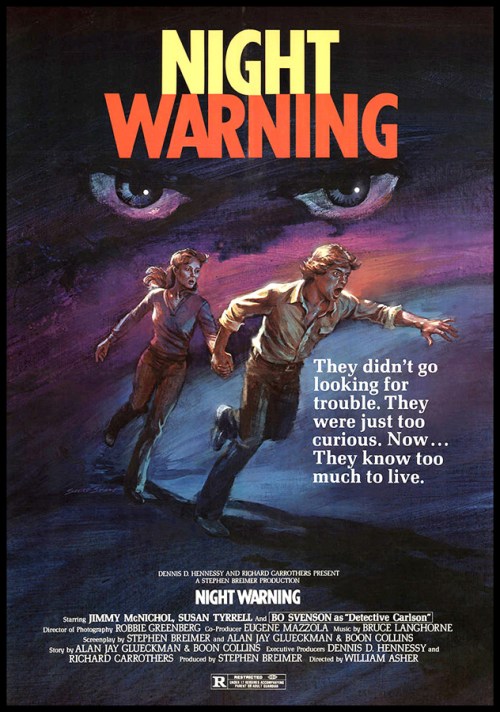
Billy (Jimmy McNichol) has been orphaned since age 3 ever since his parents died in a tragic car accident. For the past 14 years he’s been living with his neurotic aunt Cheryl (Susan Tyrrell), but now that he’s turning 17 he’s ready to move-out. Cheryl though doesn’t want Billy to leave her as she harbors dark incestuous feelings for him and will do anything, even kill in order to keep him with her.

The film was directed by William Asher, who mainly worked on family oriented material like the TV-show ‘Bewitched’ and the beach party movies from the 60’s, so doing this was a stretch for him, but results aren’t bad. Although there’s little gore the well-shot opening sequence in which the father gets decapitated by driving into a truck hauling wooden logs is impressive and more than makes up for it and it even gets shown twice.

The big payoff though is Susan Tyrrell’s performance, which gets completely off-the-charts. She had a love-hate relationship with her real-life mother and the two spent many years not talking to each other and I think this as well as some of the treatment that she received in Hollywood particularly with her working relationship with director John Huston while doing Fat City she used to channel the anger and rejection of her character and it really works. Watching her become more and more unhinged as the film progresses and her increasingly odd facial expressions and voice tones is a treat onto itself and makes catching this otherwise hard-to-find flick worth it.

McNichol’s acting unfortunately cannot match hers and I was shocked to see that he got top billing over her as his talent level, pedigree isn’t even close. His character though is even more annoying as I found it hard to believe that he wouldn’t have seen red flags to his aunt’s mental illness far sooner. The film makes it seem that he had no concerns about his aunt until he turned 17, but I would think living with her for 14 years there would be signs of it earlier. It’s also hard to feel for someone who is so painfully naïve and walks into his aunt’s devious traps when anyone else would’ve know better. It’s dubious too that the aunt would wait until the kid was 17 before making sexual overtures, but I suppose that’s a whole other issue.

Bo Svenson’s as a brash, unethical cop who is profoundly racist and homophobic becomes a strain too. I’m sure at the time this was considered simply ‘soft satire’ that lightly pokes fun at the bad cop stigma, but now it comes off as dated and unpleasant and probably the whole reason why the film hasn’t received a DVD/Blu-ray release.

Julia Duffy, best known for playing Stephanie on the TV-show ‘Newhart’ is on hand in support and although she was already 30 at the time plays Billy’s teen girlfriend and even appears topless, which may interest the voyeurs. However, any story that hinges on one of the characters being put on trial and then found not guilty by a jury due to temporary insanity I just can’t buy into and I don’t think has ever happened at least not in this country. There’s also too much ‘scary music’ that gets played particularly during scenes inside the house that just isn’t needed and almost becomes a distraction and I wish directors and producers would realize that the quiet/natural ambience can be far creepier than any soundtrack.


My Rating: 6 out of 10

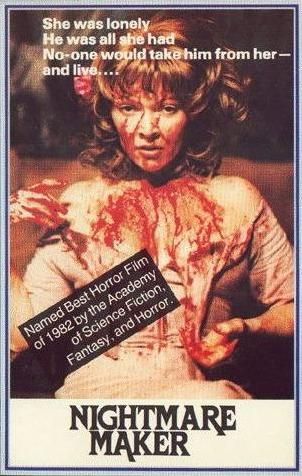
Alternate Title: Butcher, Baker, Nightmare Maker

Released: January 1, 1982

Runtime: 1Hour 36Minutes

Rated R

Director: William Asher

Studio: Royal American Pictures

Available: VHS

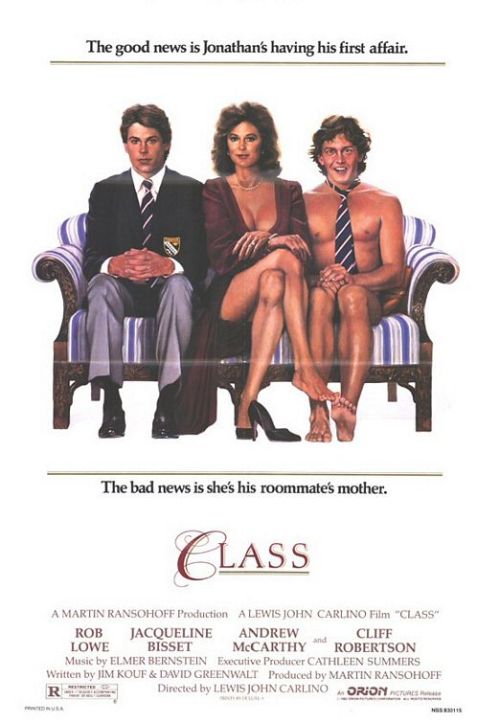
Class (1983)

By Richard Winters

My Rating: 3 out of 10

4-Word Review: Teen fucks friend’s mother.

Jonathan (Andrew McCarthy) is a new student at a prep school who rooms with Skip (Rob Lowe) and almost immediately gets mocked by the other students for being geeky. To help bolster Jonathan’s reputation Skip has him sent off to Chicago where he can meet-up with a woman, have sex with her, and then bring back her panties as a souvenir. Jonathan does that when he hooks-up with the beautiful middle-aged Ellen (Jacqueline Bisset) whom he meets at a bar and the two begin a relationship. The problem is that Ellen is also Skip’s mother.

The film was written and directed by Lewis John Carlino who had done several highly acclaimed films previously both as a writer and director so having him churn out what amounts to being just another crude ‘80s teen T&A flick is genuinely shocking. My belief is that Carlino wanted to do something that had a little more depth to it, but due to the success of movies like Porky’s the studio pressured him to incorporate raunchy humor, which creates an awkward narrative that jumps precariously from broad comedy to clumsy drama.

The film’s low point comes when Virginia Madsen, in her film debut, gets her blouse torn off and has her breast exposed that has nothing to do with the main plot and just a shameless excuse to throw in some nudity. Madsen has described her experience on this film as being unpleasant and if anything despite some ‘serious’ moments later on this scene really cements the movie as being mindless lowbrow tripe at its worst.

My biggest beef though was with Bisset’s character. It’s never explained why this sexy middle-aged woman would become attracted to a boyish guy that was young enough to be her son. Just saying she was in an unhappy marriage wasn’t enough. She could’ve attracted many eligible men that were her age, so why does she end up going to bed with a teenager that looks like he isn’t even old enough to shave?

Bisset complained in interviews that the film cut out many crucial scenes that would’ve given her character’s actions more subtext. One included having Lowe visit her after she checks herself into a hospital. This scene was needed as the film essentially has her ‘disappear’ and only mentions in passing where she’s gone while seeing a scene with Lowe visiting her would’ve given the characters and movie better closure.

I also thought it was weird that Lowe and McCarthy continue to room together even after the awful revelation of the affair comes to light. I would think that the awkwardness of the situation would have both boys clamoring to be transferred to a different dorm room. They also end up getting into a physical altercation, which gets pretty extended and one of the film’s best moments, but I sided with Lowe, which I’m not sure was the filmmaker’s intention, as I felt McCarthy deserved to get his ass kicked since he continued to have sex with Bisset even after he knew she was Lowe’s mother.

The film only works when Lowe and McCarthy are together and in fact Lowe’s engaging performance is a highlight, so a better scenario would’ve had both boys going to Chicago for a road trip and to get laid. At a bar they’d meet an attractive middle-aged woman and bring her back to a hotel room for a threesome. Afterwards both boys would compete for her affections only to later realize that she was the wife of the principal of their school. This situation would’ve allowed for more consistent comedy while not seeming like a poor rip-off of Summer of ’42 and The Graduate, which is essentially what this movie becomes.

The plot, as dumb as it is, can’t even sustain the film’s entire runtime as the third act consists of Stuart Margolin  investigating students cheating on their SAT’s that goes nowhere and put in solely as filler. Overall the film is a pointless excursion and worth seeing only if you’re into Bisset or for catching John Cusack, Lolita Davidovich, or Virginia Madsen in their film debuts.

My Rating: 3 out of 10

Released: July 22, 1983

Runtime: 1Hour 38Minutes

Rated R

Director: Lewis John Carlino

Studio: Orion Pictures

Available: DVD, Blu-ray, Amazon Video, YouTube

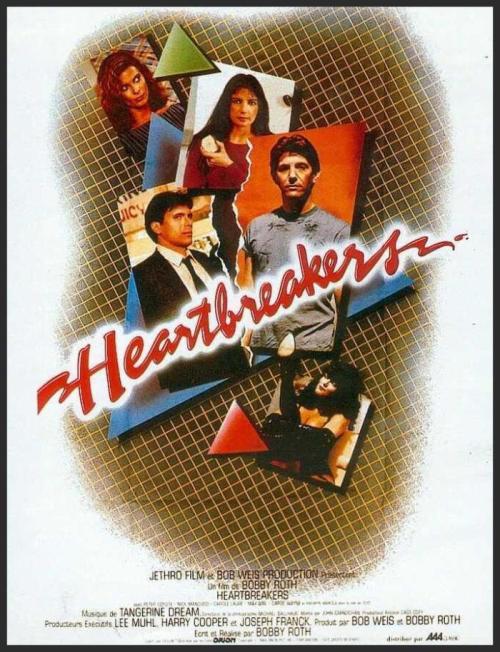
Heartbreakers (1984)

Heartbreakers Movie Poster (1984)

By Richard Winters

My Rating: 5 out of 10

4-Word Review: Fetish artist goes mainstream.

Arthur (Peter Coyote) is an artist who specializes in erotic portraits of women that he sells to men’s magazines, but he strives to have his work seen by more people. He gets his chance to have his artwork shown at a gallery and works with his fetish model Candy (Carol Wayne) to make enough new material for it. When his former girlfriend Cyd (Kathryn Harrold) moves in with his artistic rival King (Max Gail) he becomes attracted to Lilane (Carole Laure) the manager where his artwork will be displayed, but this puts him at odds with his friend Eli (Nick Mancuso) who also has an interest in her.

This independently produced film offers nothing spectacular, but remains strangely captivating. Sometimes it’s nice not to be bombarded with a heavy-duty plot and instead just focus on someone struggling to get through the challenges of day-to-day life, which makes the situations shown here highly relatable and where this movie succeeds.

Unfortunately Coyote was not the best person for the part. He was supposed to be this guy in his 30’s even though he was well over 40 and looking it. A younger guy in is 20’s would’ve been a better fit and created more of a connection to someone just starting out. It would also help explain the character’s moments of raw, unfiltered emotion, particularly his public display of anger at King, which is something seen more in younger adults while middle-aged folks have usually mellowed out, or better able to keep their feelings in check and only letting them come out when it’s more appropriate or strategic.

Coyote’s friendship with Mancuso doesn’t work either. The film is only captivating when it sticks with the main character and expanding it out just gives it a flat, generic feeling like it wants to create a soap opera scenario that is not needed. Guys’ fighting over the same girl has been done many times before and this thing adds nothing fresh to that perspective. Besides Carole Laure’s character is so emotionless and detached anyways, while also looking as pale as a ghost that she seemed hardly worth the effort and someone most guys would probably tire of pretty quickly.

The film’s main attraction is seeing Carol Wayne in her secomd-to-last movie. She came to Hollywood with her sister Nina in the mid-60’s having already attained some fame as Las Vegas showgirls. She almost immediately got guest starring roles in TV-shows and bit parts in movies before finally attaining her most famous part as the Matinee Lady on the ‘Tonight Show’, which she did for 13 years before dying under mysterious circumstances while on vacation in Mexico. Her part here proved to be one of her biggest and she even goes topless before hopping into bed with both Coyote and Mancuso for a threesome.

Harrold, who no longer works in the acting business, is solid as the former girlfriend, but she should’ve had more scenes. Walter Olkewicz, Jerry Hardin, and Jamie Rose can be seen in brief bits in a movie that’s not bad if you come into it with modest expectations although Tangerine Dream’s loud techno, 80’s fused score doesn’t help it.

My Rating: 5 out of 10

Released: September 28, 1984

Runtime: 1Hour 38Minutes

Rated R

Director: Bobby Roth

Studio: Orion Pictures

Available: VHS

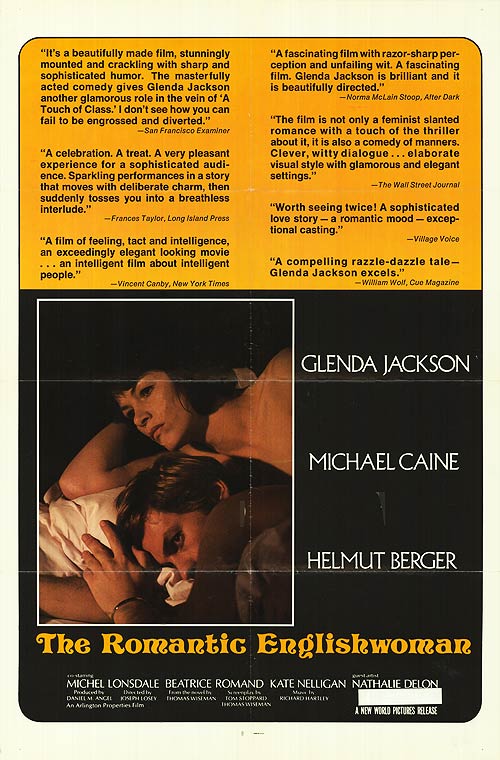
The Romantic Englishwoman (1975)

By Richard Winters

My Rating: 6 out of 10

4-Word Review: Writer suspects wife’s infidelity.

Unhappy in her marriage Elizabeth (Glenda Jackson) goes off to Baden-Baden, Germany for a little respite and there meets up with the dashing Thomas (Helmut Berger). Although quite charming Thomas is also caught up in the criminal underworld and being chased by gangsters. After the two share a brief tryst she returns home to her husband Lewis (Michael Caine). Lewis suspects that Elizabeth was unfaithful during her trip, but can’t prove it. He invites Thomas to stay at their place in order to help him finish a screenplay that he is working on and in the process the affair between Thomas and Elizabeth starts up again, but this time Lewis is determined to stop it.

The concept is intriguing, but the film gets ruined by playing its cards too early. A far more interesting scenario would’ve been to have Lewis not suspect Thomas at all or even his wife’s longing for him and instead simply invited Thomas over as a genuine writing partner and only slowly becoming aware of the tensions boiling beneath the surface. Unfortunately having Lewis almost immediately figure things out even before Thomas arrives makes for a very boring first hour with the couple arguing over the same staid, redundant infidelity talking points that have been done a million times before.

The story’s only interesting wrinkle has Thomas starting up a relationship with the nanny (Beatrice Romand), which made more sense as Elizabeth was way older than him and I failed to see why he would’ve been attracted to her to begin with. The nanny was young and cute and it was fun seeing Elizabeth seethe with the same type of jealousy as Lewis, but the film quickly kills this storyline by having the nanny forced to move out and everything goes back to the same formulaic love triangle.

Having Lewis recreating scenes in his screenplay that replicates what he is going through in real-life had potential as it nicely illustrates the thin line between fact and fiction that writers routinely do. Unfortunately the film treats these scenes in a campy/hooky manner and then drops it just as quickly as the romance scenario mentioned above.

The direction is static with a camera nailed to the ground and everything captured in a dingy, shadowy way. The opening bit detailing how Elizabeth first meets Thomas had a naturalistic quality, but the shot were she spots Thomas from across the room and her eyes remained locked on his and she never turns away is not believable. If two people are strangers and one catches the other one staring at them it’s sheer human reflex that the other one will divert their gaze as it’s rude, awkward and off-putting otherwise. Also, to have the word romantic in the title is absurd especially after the two proceed to have sex inside an elevator during their first meeting, which is pure animalistic lust and a more accurate title would’ve been ‘The Horny Englishwoman’.

Spoiler Alert!

The third act helps fill in the gaps in regards to Thomas’ secret past, but having Elizabeth run off with him makes her character seem exceedingly shallow as she essentially abandons her young child in the process. Earlier in the film she got very upset when she saw her child sitting out on a ledge and she fired her nanny for being irresponsible and not watching him more carefully only to then by running off with Thomas behave just as irresponsibly.

The film’s final shot features strange people inhabiting Lewis and Elizabeth’s home like they’re having a party without the owners there. Lewis then after having taken Elizabeth away from Thomas and back with him drives the car the two are in up to their house. Elizabeth looks shocked at seeing all the people inside, but Lewis has a jaded expression and seems to being enjoying watching Elizabeth’s discomfort, but then the film cuts to the credits and never explains what’s occurring and nothing is more frustrating than a film which ends just as it’s finally beginning to get interesting.

My Rating: 6 out of 10

Released: November 26, 1975

Runtime: 1Hour 56Minutes

Rated R

Director: Joseph Losey

Studio: New World Pictures

Available: DVD, Blu-ray, Amazon Video

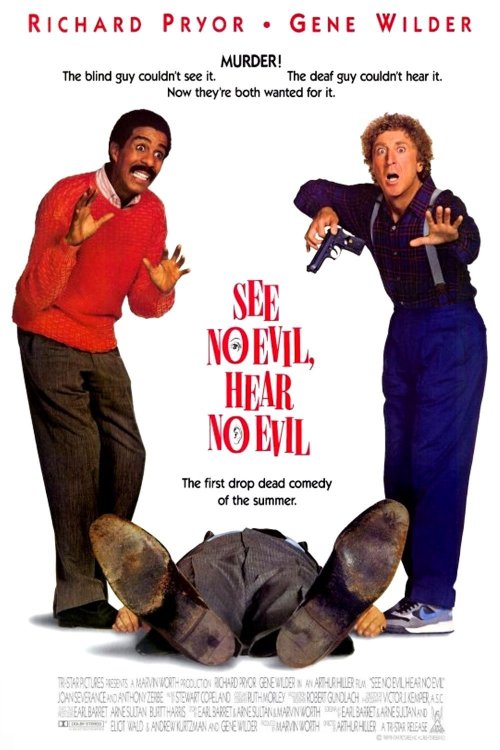
See No Evil, Hear No Evil (1989)

By Richard Winters

My Rating: 2 out of 10

4-Word Review: Handicapped men solve crime.

Wally (Ricard Pryor) is blind while Dave (Gene Wilder) is deaf. The two initially don’t get along, but find that they must work together after they witness a murder and the bad guys (Joan Severance, Kevin Spacey) come after them. The police are no help and threaten to jail Wally and Dave when they find them unreliable as witnesses so they figure out a way to escape and go on the run only to have their handicaps and personalities more of an obstacle than anything else.

This was the third teaming of Wilder and Pryor and it’s embarrassingly bad. The script is just a cheesy retooling of the mistaken identity scenarios of their first two films, Silver Streak and Stir Crazy with the handicap element thrown in to make it seem different, but it really isn’t. The laughs are definitely fleeting and in fact there are only two segments that even elicit a chuckle. One is an amusing barroom brawl while the other one features a gun showdown between the blind Pryor and the equally blind Anthony Zerbe.

Not only is the clichéd concept highly uninspired, but it depends on nonlogic to help propel it. For instance Wally, Dave and Wally’s sister Adele, played by Kirsten Childs, escape from the men chasing them by hiding inside a hotel room’s vent, but I’ve never come upon a vent in any hotel room that I’ve stayed at big enough to hold one person let alone three. Also, most vent screens must be screwed in from the outside, so how were these three people able to get the screen back on and fastened once they were inside the vent?

The chemistry between the stars is missing and their banter nothing more than strained babbling. The only moment where it shows slight potential is when the two men explained to each other how they came to have the afflictions that they do and how they learned to adjust to them making me believe this could’ve been a far better movie had it chucked the corny murder storyline and instead focused on the two trying to run a business or learning to rely on each to help them through the struggles of daily life.

Pryor, for what it’s worth, easily upstages Wilder who reportedly never liked the script and worked to rewrite it to make it less mocking to those with handicaps. There’s also a scene shot at night with the two talking on a park bench where it appears that some black object is trying to slide its way out of Wilder’s left nostril. I think it was simply the shadowy lighting, but I found it quite distracting and wondered why the cinematographer didn’t catch this while they were filming it and had the scene reshot at a different angle.

Alan North is engaging as the exasperated police sergeant and I wished that instead of him being an adversary to the two men he would’ve reluctantly helped them along. The two female cast members are generic, but Kevin Spacey, who speaks in an accent and has a large unexplained protrusion on his left check, is excellent and the best thing in this otherwise forgettable film.

My Rating: 2 out of 10

Released: May 12, 1989

Runtime: 1Hour 42Minutes

Rated R

Director: Arthur Hiller

Studio: TriStar Pictures

Available: DVD, Blu-ray, Amazon Video, YouTube

The Day of the Locust (1975)

By Richard Winters

My Rating: 8 out of 10

4-Word Review: Desperate people in Hollywood.

During the depression a young artist named Tod Hackett (William Atherton) comes to Hollywood to help design the set for a new movie. While there he meets a wide assortment of people, who seek fame and fortune, but find heartbreak and rejection instead. Tod falls for Faye (Karen Black) a woman striving to become the next big Hollywood starlet despite lacking any talent while her father Harry (Burgess Meredith) is on the opposite end of the spectrum. At one time he was a vaudeville comedian, but now with his failing health is relegated to selling health tonics door-to-door.

This film is the last great effort of director John Schlesinger whose films after this lacked the same visual style that made Midnight Cowboy and Far From the Madding Crowd cinematic masterpieces. From a visual standpoint it hits all the right chords and is filled with many memorable segments. The best ones include the scene where a group of bourgeoisie guests who come to Natalie Schafer’s home (she was best known for playing Mrs. Howell on ‘Gilligan’s Island’) to watch porn movies There’s also the scene where an entire film set comes crashing down and injuring the entire crew as well as the climactic moment where a large crowd waiting outside to see the premiere of The Buccaneer turn into a violent, bloodthirsty mob.

The acting is first-rate particularly Black who portrays her desperate character to a perfect tee. Meredith, who was nominated for a supporting Oscar, gives a vivid portrayal of her equally desperate father making his scenes quite entertaining. Donald Sutherland is also solid as a likable, but socially awkward outsider, which best suits his acting persona.

The script though by Waldo Salt, which is based on the 1939 novel of the same name by Nathanael West, misses out on a lot of the book’s subtext. In the movie Tod tries to rape Faye while at a party, but this eruption of his seems to come out of nowhere while in the book it gets better explained by showing how Tod continually harbors rape fantasies for Faye and makes these fantasies a running part of the story.

Donald Sutherland’s character, the aptly named Homer Simpson, which supposedly was the inspiration for Matt Groenig’s character in his famous comic strip, is a confusing enigma. In the book he is given a better backstory and revealed to be a man struggling with a lot of inner turmoil while here he’s seems more like a strange, naïve mope from another planet.

There’s also no explanation in the movie for why the word Locust is in the title, which is in reference to the Bible and the plague of locusts that descended onto the fields of Egypt. Tod symbolizes the locust in the novel’s version of the story while in the movie his character is more of an outsider observing the ugliness, but not having a hand at creating it

The biggest issue though is the film’s underperformance at the box office, which helped relegate both Black and Atherton, who at the time were considered up-and-coming stars, to supporting roles afterwards. I believe part of the reason for this is because none of the characters are likable. It’s fine showing humanity’s bad side as long as the audience doesn’t feel beaten-over-the-head with it, but the film wallows so much in the darkness that it overwhelms the viewer. Having a character that was slightly removed from the madness and not as flawed might’ve helped to balance things and make everything else that goes on more tolerable.

Overall though it’s a great film, but the statement it’s trying to make remains murky. Better efforts should’ve been made to tie it to the disillusionment of the American Dream, which is what the book does and not seemed so much like just a glimpse into a freak show of a bygone era like it ends up doing here.

My Rating: 8 out of 10

Released: May 7, 1975

Runtime: 2Hours 24Minutes

Rated R

Director: John Schlesinger

Studio: Paramount

Available: DVD, Blu-ray, Amazon Video, YouTube

The Unbearable Lightness of Being (1988)

By Richard Winters

My Rating: 6 out 10

4-Word Review: He fails at monogamy.

Tomas (Daniel Day-Lewis) is a successful surgeon living in Prague during the 1960’s who has a way with the ladies. He enjoys his robust sex life, but then falls for the awkward and plain Tereza (Juliette Binoche) and the two get married even as Tomas continues to see other women on the side. Tereza becomes upset by this and threatens to leave him only for the two to get swept up into the events of the Prague Spring where Soviet tanks invade their country. They escape to Switzerland but Tereza is unhappy there as well and moves back to Czechoslovakia with Tomas later following. Although their living conditions under communist rule are harsh they still find that their mutual love keeps them happy anyways.

Although masterfully directed by Philip Kaufman I still found the characters to be poorly etched. Tomas’ ability to get beautiful women to literally throw themselves at him never gets properly explained. Yes he is good-looking, but there are a lot of handsome guys who aren’t able to get women to shed their clothes for them at seemingly the snap-of-the-finger. Some clear social skill or persuasive ability had to be shown and clarified to make the women’s behavior more understandable, but this never effectively gets addressed. The scene where Tereza gets ‘overpowered’ by Tomas’ aura when all he is doing is sitting at a table in a café reading a book, but it’s enough to get her to run up to him and tell him she’s available is a big stretch and makes this supposedly profound movie look like it was built on a very superficial foundation.

There’s also the question as to why Tomas would want to marry Tereza to begin with. This is a guy who can literally get any beautiful woman he wants so why settle for the dowdy/shy Tereza? What is it about her, or about his inner mind that would want to make him commit to her and not the others?

His relationship with Sabina (Lena Olin), who is his independent- minded off-again-on-again lover is far more believable and kind of made me wonder why Tereza even needed to be in the mix at all. As much as I liked Sabina I did find the storyline dealing with her budding relationship with Franz (Derek de Lint) to be rather unengaging. However the friendship that blossoms between her and Tereza as well as the underlying lesbian subtext is interesting and yet the film introduces this in a very long, drawn-out segment inside Sabina’s apartment only to then drop it without ever exploring it to its satisfying and full conclusion.

On the technical side it’s a splendid production. I particularly liked the imagery of the tanks rolling into the city and how Tomas and Tereza’s presence gets cropped into actual footage of the real-life event and how seamlessly it goes between black-and-white and color. Sven Nykvist’s cinematography is a marvel. Initially I felt his talents were wasted as the camera only captures the bleak colorless surroundings of old-town Prague, but then when the couple returns to the city after their brief foray in Switzerland the decay and grayness becomes even more pronounced and helps convey visually the depressing feeling of the communist oppression.

The film, which is based on the novel of the same name by Milan Kundera, has an interesting message, but it failed to give me as a viewer any type emotional impact. I was never able to understand what made these characters tick. This might’ve gotten better addressed in the novel, which I didn’t read, but gets lost in translation here and ends up hurting the provocative imagery that to some degree gets a bit over-the-top anyways. This could also help explain why despite being on the set as an ‘advisor’ Kundera expressed displeasure with the film version and refused to help promote it.

My Rating: 6 out of 10

Released: February 5, 1988

Runtime: 2Hours 53Minutes

Rated R

Director: Philip Kaufman

Studio: Orion Pictures

Available: DVD, Amazon Video, YouTube