Category Archives: Movies Based on Novels

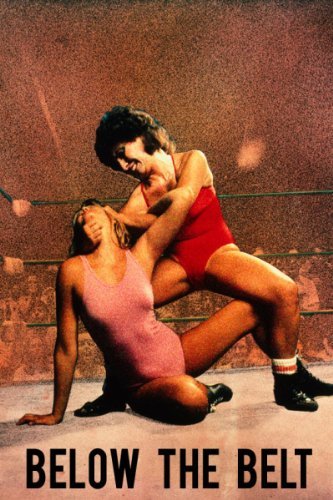
Below the Belt (1980)

below the belt 1

By Richard Winters

My Rating: 4 out of 10

4-Word Review: Waitress becomes a wrestler.

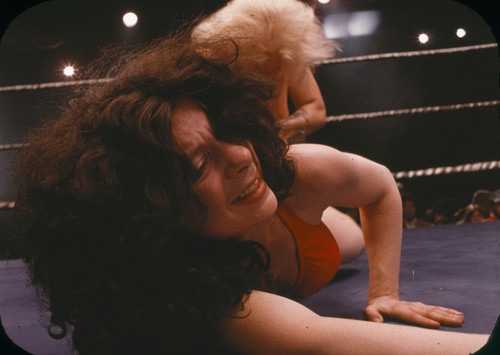
Rosa (Regina Baff) works as a waitress at a sports arena who one day catches the eye of wrestling promoter Bobby Fox (John C. Beecher) after she decks a guy who tries to get fresh with her. Fox is in need for a new wrestler to promote and feels she’d make a perfect fit despite her having no experience in the sport. Since she is bored with her job and low on funds she decides to take him up on his offer, but finds that life in the wrestling world can be quite lonely and grueling and the promises of fame and fortune are fleeting.

Unlike Grunt! The Wrestling Movie, which was reviewed last week, this movie does not take a fan’s perspective of the business nor does it get caught up in the colorful caricatures or silly storylines. Instead it reveals a rather bleak look at the hardships faced by those working the circuit and how emotionally and physically taxing it can be living on the road and going paycheck-to-paycheck. In fact there is more footage shown of them behind-the-scenes preparing for a bout than an actual match although the climax does feature Rosa, dubbed the Mexican Spitfire, taking on defending champion Terrible Tommy (played by real-life wrestler Jane O’Brien) who plays dirty, doesn’t have any front teeth and even beats up on the referee.

Comical moments get spread throughout, but they tend to get overplayed and don’t work. What grabbed me was the main character and how relatable her situation was particularly the way her life was unfocused and her inability to stick with any job for too long, which her boyfriend and father nag her about, but then when she tells them about her new found wrestling passion they scoff and show no support. I also liked how the film examines both side of the age spectrum including Thalia (K.C. Townsend) who lies about her age and pretends to be older than she is simply so she can escape her tedious small-town life and get into the wrestling circuit, which she considers her ‘big break’ while on the other end there’s Verne (Sierra Pecheur) who’s in her late 30’s and been in the business for many years and now feels trapped and unable to get out.

Baff, with her plain looks, is a good representation of the average young woman still struggling for direction, but her thin body made me think she wouldn’t be able to handle the rigor of the sport in real-life. Shirley Stoler is on the opposite end as she was quite overweight and humorously carries around a handgun with her to fight off all the would-be rapists that she feels are lurking in the shadows and ready to attack her at any minute. Dolph Sweet is also memorable as an aging wrestler who reluctantly realizes that the business and his passion for it have passed him by.

There’s a heavy dose of blues music that gets played frequently throughout. To some extent the soundtrack, with songs sung by Billy Preston, Jennifer Holliday and the Voices of Deliverance, lends flavor and distinction to the proceedings, but it also ends up becoming overdone and intrusive in a film that is alright, but tries a little too hard to make its point.

below the belt 2

My Rating: 4 out of 10

Released: December 10, 1980 (Filmed in 1974)

Runtime: 1Hour 34Minutes

Rated R

Director: Robert Fowler

Studio: Atlantic Releasing Corporation

Available: VHS

King Rat (1965)

king rat 1

By Richard Winters

My Rating: 6 out of 10

4-Word Review: An island prison camp.

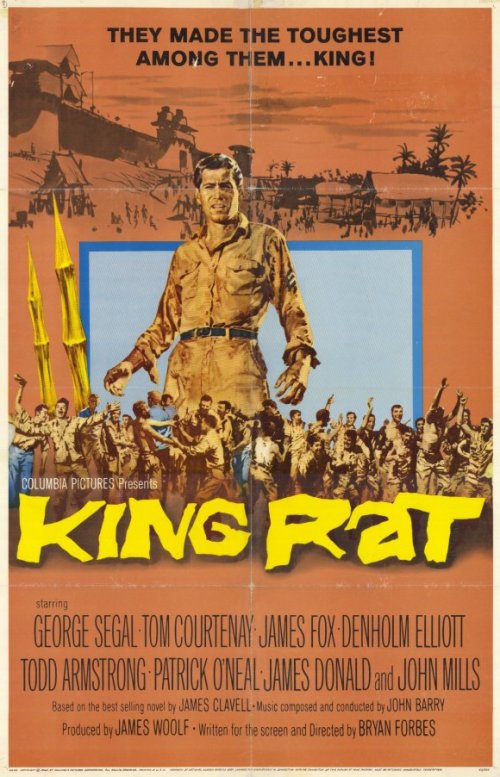
British and American POWs are held on an Island prison camp run by the Japanese during WW II. This camp is unlike the others as it does not have any walls, barbed wire fences, or prison guards. The men are allowed to roam freely while trapped on a tiny island with nowhere to go. Corporal King (George Segal) manages to wheel-and-deal his way to the top of the food chain by getting involved with the underground black market, which allows him to live the relative good-life while the other prisoners remain near starvation. He befriends Marlowe (James Fox) who can speak the Malaysian language, which he feels can come in handy as he gets involved with a diamond smuggling operation as well as selling deer meat, which unbeknownst to his customers is actually meat from rats who’ve feed off of the bodies of the other dead prisoners.

To some extent one can find some similarities to this and The Great Escape or Stalag 17 in that the prisoners have managed to create their own underground network without their captors being aware, but that is pretty much where the comparisons end. This film is darker and examines more the psychological deterioration that the men go through while realizing its themselves and each other that is more the enemy than the actual Japanese guards who are shown very little and have no presence at the camp or in the movie.

Segal gives a star making performance as a anti-hero who could easily be quite unlikable, but Segal’s engaging on-screen persona gives the character an added spark making him and his constant conniving more amusing than anything particularly with the way he barters with the Malaysian guards during their discussions on the price of the transfer of diamonds.

The supporting cast is outstanding as well especially Fox as the only sympathetic character and Tom Courtenay as the overzealous Grey and his never-ending crusade to take King and his cronies down. James Donald is also good as the no-nonsense Dr. with a very matter-of-fact bedside manner and a young Richard Dawson who gets the shock of his life when he comes in after the Japanese surrender to free the men of their enslavement only to find that they’re strangely reluctant to leave.

The film works in episodic fashion and while it maintains a gritty level it also has some lulls and few too many shifts in tone. There are though many unique and memorable moments including the ending where the men find themselves free to return home, but respond much differently than you’d expect. There is also a scene where the men kill a dog after it attacks some chickens and then later eat it as if it were a delicacy.

My Rating: 6 out of 10

Released: October 27, 1965

Runtime: 2Hours 14Minutes

Not Rated

Director: Bryan Forbes

Studio: Columbia Pictures

Available: DVD, Amazon Instant Video

The Dove (1974)

dove

By Richard Winters

My Rating: 5 out of 10

4-Word Review: Sailing around the world.

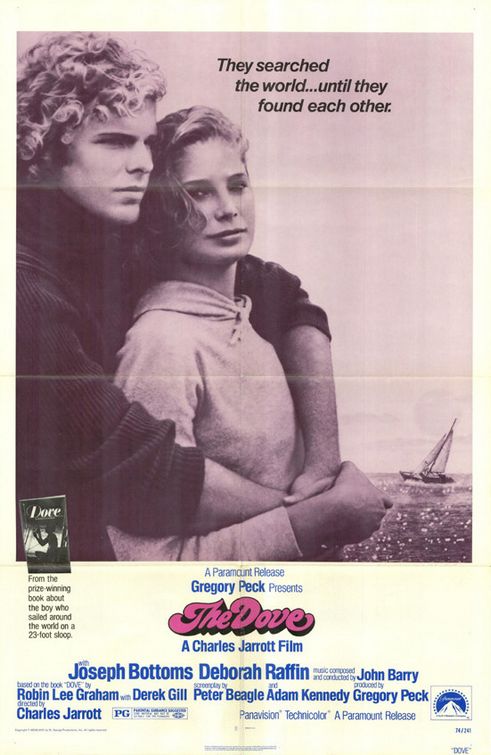
Based on a true story and produced by Gregory Peck this film examines the journey of Robin Lee Graham (Joseph Bottoms in his film debut) as he sails in his boat called The Dove around the world. When he starts out he is only 16, but through the course of his journey he goes through many adventures, meets a beautiful woman named Pattie (Deborah Raffin) who he eventually marries and returns home a full grown man.

The variety of exotic locales and stunning cinematography by Sven Nykvist are a chief asset, but the film starts off with absolutely no backstory. The viewer is hoisted onto the boat with the main character without having any idea who he is, his background, preparation, reason for doing this, or his relationship with his family. Bits and pieces of this come out later, but it would’ve been nice to have had some of this info from the start and would’ve allowed for more of an emotional connection to the character.

The first hour is spent more on land than at sea, which is another problem because it doesn’t get riveting until he is actually on the boat and fighting the many elements. The melodic mood music gets excessive and should’ve been toned down as well and the two songs sung by Lyn Martin, which could’ve been scrapped completely as the natural ambience of the sea is far more soothing.

Bottoms, who retired from acting in 1999 and now runs an art gallery, does quite well. His boyish face and variety of emotions that he goes through during his adventure ring quite true for someone of that age and help to make the character quite real. I also enjoyed how the character is astute in certain areas, but very awkward in others particularly with the way he tries to court Patti, which also leads to the film’s best line “I’m feelin’ romantic…in a horny kind of way.”

Raffin is stunningly beautiful and her acting is outstanding and I liked how the female character was portrayed as being older, wiser and more practical. The two share a great chemistry, but Robin’s relationship with his ornery pet cat Arvana is equally interesting even though its demise is unpleasant.

Familiar character actors pop up briefly playing pesky photographers from National Geographic magazine that carried the story through his trip. John Anderson has a funny bit here, but the best is Dabney Coleman who speaks with an Australian accent!

The actual journey began in September, 1965 and wasn’t completed until April of 1970 with many stops and starts in between, which the film does a good job of showing as at several points Robin abandons the mission only to finally start it back up several weeks or months later. Although the film gives the impression that he completed the full journey in reality he didn’t as he started it in Hawaii, but finished it in Long Beach, California also the boat that he used for his trip ending up getting destroyed in 1989 during Hurricane Hugo.

My Rating: 5 out of 10

Released: October 16, 1974

Runtime: 1Hour 45Minutes

Rated PG

Director: Charles Jarrott

Studio: Paramount

Available: VHS, Amazon Instant Video

Serpico (1973)

serpico

By Richard Winters

My Rating: 8 out of 10

4-Word Review: A cop fights corruption.

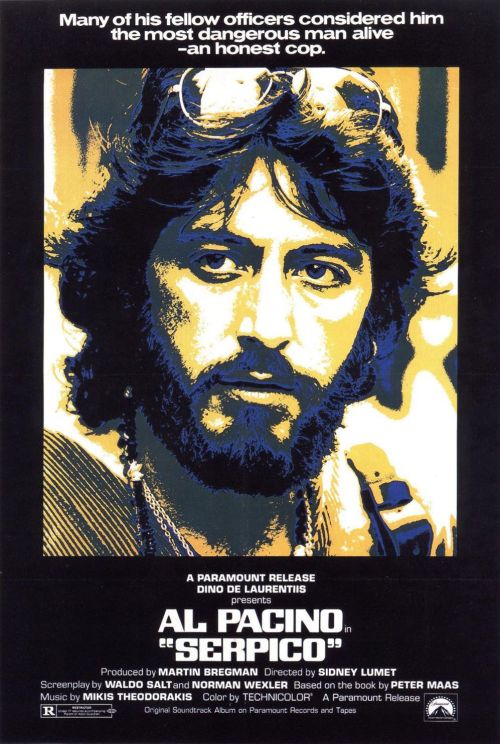
One of the followers of this blog has requested that I review this movie, so today we take a look at Frank Serpico (Al Pacino) a policeman who fought against corruption that plagued New York’s police department during the ‘60s. Even though many of his partners on the force would accept under-the-table payouts from criminal elements in exchange for ‘looking-the-other-way’ he wouldn’t and when he would tell his superiors about it nothing would get done. Instead they would transfer him to other precincts only for him to find the same problems there. It was only when he decided to report the issue to the New York Times that people started to take action, but in the process he also made himself a mark and vulnerable to having his unhappy comrades set him up to be shot while on-duty.

The film is based on the Peter Maas novel, which in turn recounts the life of the actual Frank Serpico and the events he went through while working on the force between the years of 1959 to 1972. Not only does he remain alive today, but according to recent reports is even considering, at the ripe old age of 79, a run at political office. Equally interesting is that he and Pacino roomed together during the summer that this was filmed and became close friends.

It’s been years since I’ve read the novel, but I felt this film sticks closely to what actually happened and the always reliable Sidney Lumet manages to keep things exciting and insightful. The dialogue is sharp and the on-location shooting, which was done in every borough of New York except Staten Island, gives the viewer an authentic feel of the city as well as the police environment.

The film also does a successful job at showing the drawbacks of accepting bribes without ever getting preachy or heavy-handed. One might think, like many of Serpico’s partners do, that taking some kickbacks isn’t that big of a deal, but then the film shows in one brief moment a policeman shoving another man’s head into a toilet when he doesn’t ‘pay up’, which hits home how the police become no better than organized crime who would notoriously demand ‘protection money’ from business owners.

The only thing I didn’t like was the music, which was too loud and jarring. Fortunately it’s put in only sparingly, but its melodic quality takes away from the grittiness and the film works far better by simply relying on the ambient sounds of the locations that the scenes are in. In fact this is one movie that could’ve done fine without any music at all.

Pacino is fantastic and I loved how the character starts out as this clean shaven, boyish looking fellow only to grow into a bearded, long haired guy as the story progresses, which symbolically connects with the way he becomes savvier to the system. The character also sports earrings long before it became vogue for males to wear them.

Tony Roberts does well as one of the few cops that sides with Serpico and tries to help him in his fight and F. Murray Abraham can be spotted near the end as a member of a vice squad who tries setting Serpico up to be killed. This movie also marks the film debuts of character actors Alan Rich and Kenneth McMillan. In my mind this is also the debut of Judd Hirsh. Some sources state that his first onscreen appearance is in Jump, which came out two years earlier, but I watched that film and couldn’t spot him anywhere, but her I was able to spot him right away.

My Rating: 8 out of 10

Released: December 5, 1973

Runtime: 2Hours 10Minutes

Rated R

Director: Sidney Lumet

Studio: Paramount

Available: VHS, DVD, Blu-ray, Amazon Instant Video, YouTube

Harrad Summer (1974)

harrad summer

By Richard Winters

My Rating: 6 out of 10

4-Word Review: Bringing sexual liberation home.

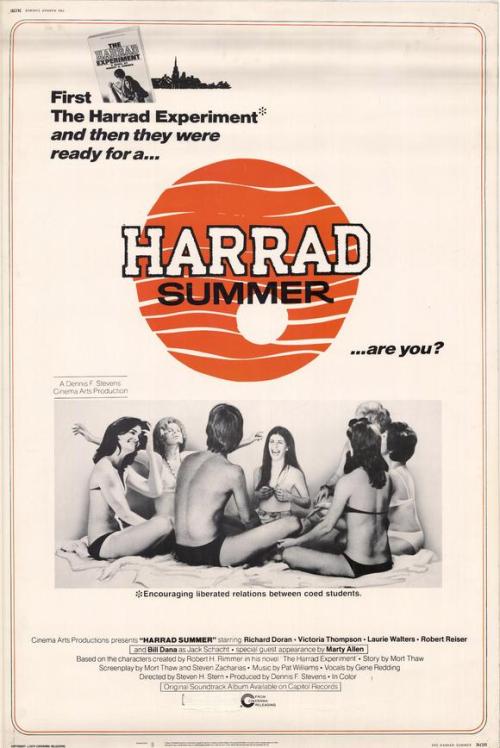
The school year is over and now the students of Harrad, which is the college that teaches and promotes open sexuality, go home for the summer and put what they’ve learned into action in their everyday lives. Like in the first film this sequel focuses on just four of the students who find that their parents and friends are not as broad minded as they are, which causes friction in not only their relations with them, but with each other as well.

This film for the most part works surprisingly well. Director Steven Hilliard Stern takes more of a playful approach to the material and mixes in some funny moments that overall are quite entertaining. The wide variety of locales elevates the stagnant feeling that the first one had and it also manages to address a wider variety of issues.

The story is broken up into three segments with each one focusing on the student’s home lives as they visit each of their parents for 2-weeks at a time as a group. The first part, which deals with Stanley’s (Robert Reiser) folks isn’t too interesting and is fortunately pretty brief. The visit to Harry’s (Richard Doran) is the most comical and the film’s highlight while Stanley’s conflicts with Sheila’s (Laurie Walters) father (Walter Brooke) during their visit to her folks seem contrived and pointless. The film never manages to get to Beth’s (Victoria Thompson) parents, which is probably just as well.

The film’s biggest drawback is that neither Don Johnson nor Bruno Kirby, who were so good in the first film, reprises their roles here and their absence is sorely missed as  Reiser and Doran don’t have the same acting talents and are quite weak in comparison. Thompson, who was blonde in the first film, now has, with no explanation, jet black hair, which makes her look exactly like her sister and fellow actress Hilary Thompson. Also, Emmaline Henry, who was best known for playing Mrs. Bellows in the ‘60s show ‘I Dream of Jeannie’ replaces Tippi Hedren who was unavailable for the sequel and James Whitmore’s role gets taken out completely.

The supporting cast is what gives the film its spark. Comedian Marty Allen, whose hair looks like the ultimate bird’s nest and usually gets more attention than his comic ability, is fun as a drunken party guest. However, Pearl Shear, who plays his wife, is the real scene stealer as an overweight middle-aged woman, who in Mrs. Roper-like fashion, eagerly wants to get involved with the kids and their new found sexual liberation and even takes part in a nudist session with them.

Bill Dana, famous for creating the Jose Jimenez character, is quite good as well playing Harry’s staunchly conservative father who can’t deal with the open sexuality of the younger generation only to surprisingly come around to it at the very end. He also gets the film’s best line when after denying to Harry that he ever had any affairs finally admits “Maybe I did a couple (women) in Vegas and a few in Cleveland, but what else is there to do in Cleveland.”

My Rating: 6 out of 10

Alternate Title: Love All Summer

Released: August 6, 1974

Runtime: 1Hour 43Minutes

Rated R

Director: Steven Hilliard Stern

Studio: Cinerama Releasing Corporation

Available: DVD

The Leather Boys (1964)

leather boys 1

By Richard Winters

My Rating: 6 out of 10

4-Word Review: Befriending a gay biker.

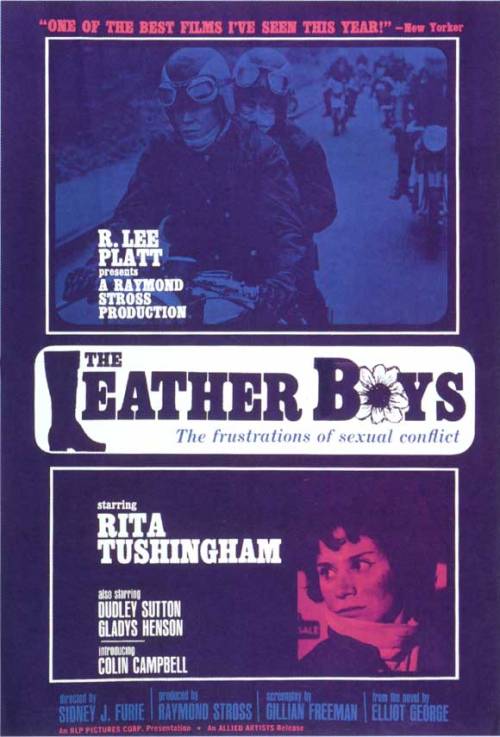
Reggie and Dot (Colin Campbell, Rita Tushingham) are young and in love, at least they think they are. They want to rush off and get married, but Reggie’s father (Lockwood West) feels that they ‘don’t know the meaning of the word’ and he gets proven right as immediately after they tie the knot they are at odds with each other. Reggie begins looking for companionship elsewhere and meets up with a fellow biker named Pete (Dudley Sutton). Pete and Reggie quickly become best friends and begin hanging out together, but Pete is secretly gay and has more of an interest in Reggie than just a friendship.

Director Sidney J. Furie, whose career has now spanned 6 decades, has done a lot of duds in his time, but this isn’t one of them. The stark black-and-white photography helps bring out the bleak working class existence of the characters and the variety of locales used including a nicely captured cross country motorbike race make the story captivating and believable.

The performances are outstanding. Tushingham is especially good at displaying a genuinely nasty side to her character at the most unexpected times. Gladys Henson, who plays the widowed grandmother, is also excellent and the scene where the others argue while right in front of her about how they consider her to be ‘an elderly inconvenience’ who needs to be sent away to a retirement home is downright heart wrenching. Sutton though is the most dynamic in a risky role that helped jettison him to stardom. His distinctive facial features galvanize the viewer’s attention and the ambivalent expressions that he makes particularly when in the presence of Dot are priceless.

Spoiler Alert!

The film though takes too long to get to its obvious conclusion as we have a pretty good idea from the beginning that Pete is gay, so having to wait until the very end for this to finally get revealed seems to be stretching the story out longer than necessary. Most likely Pete would’ve made some sort of pass at Reggie at some point earlier anyways especially since the men shared the same bed. The film also ends with Reggie walking away from Pete and essentially ‘abandoning’ him once he realizes that he is gay. The music that is played over the scene conveys the idea that this is the ‘right’ thing to do and parlays the conventional attitude of the time that there is something ‘wrong’ with Pete, which doesn’t make this as much of a landmark movie as it’s widely considered since its ultimate message is still entrenched with the biases and bigotry of that era.

End of Spoiler Alert!

My Rating: 6 out of 10

Released: March 8, 1964

Runtime: 1Hour 48Minutes

Not Rated

Director: Sidney J. Furie

Studio: Allied Artists

Available: DVD, Amazon Instant Video


The Harrad Experiment (1973)

the harrad experiment

By Richard Winters

My Rating: 6 out of 10

4-Word Review: College promotes sexual freedom.

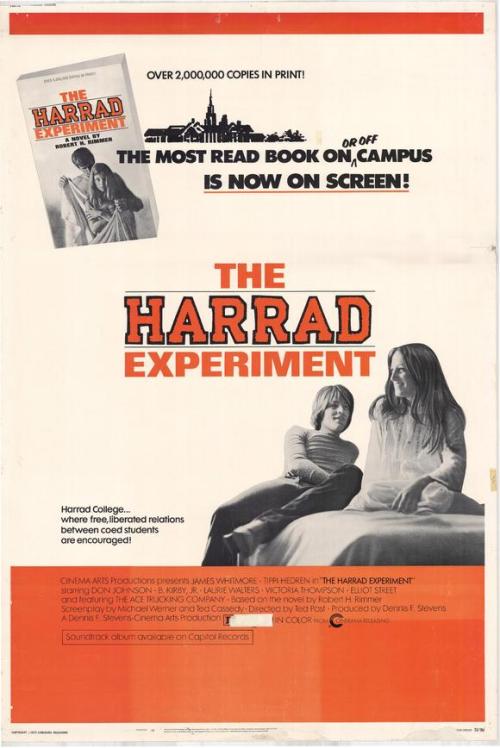
Based on the novel by Robert H. Rimmer the story centers on a group of students who attend a socially progressive college where sex between multiple partners is expected and promoted. The school is run by Phillip and Margaret (James Whitmore, Tippi Hedren) who feel conventional marriage is an unrealistic ideal that creates the idea of ‘ownership’ over someone else, which in turn causes jealousy. They hope to end these problems and change the cultural norms by having the next generation accept more of a group marriage mentality.

The film nicely avoids the smarmy T&A factor by portraying nudity in a natural non exploitative way while also having characters that are believable and a good representation of the young generation from that era. The different ways that the students respond to the unique environment and the realization that they aren’t quite as sexually liberated as they thought remains the story’s focal point of interest.

The film also allows for a great chance to see young stars in the making. Laurie Walters, who later went on to star in the TV-show ‘Eight is Enough’, gives a sensitive portrayal of a young woman who’s still shy about her body and not quite ready to enjoy sex outside of the bounds of romance as she had initially thought. Bruno Kirby is good as well playing a student who’s so filled with insecurities that it prevents him from having any sex at all. Don Johnson though gives the best performance as a cocky student who uses the program simply as a way to ‘score’ with women only to later learn that even he needs some emotional bonding too.

The always reliable Whitmore is solid as the stoic instructor and Hedren gets one of her best roles outside of her most famous one in The Birds with her titillating moment coming near the end when she strips off her clothes and tries to entice Johnson to make love to her right out in the open and in front of everyone. Actor Ted Cassidy, who co-wrote the script, can also be seen briefly sitting at the counter of the local café.

Although the film does manage to bring out a few provocative elements I still felt even without having read the novel that is was only skimming the surface. Having the story focus on only a few of the couples isn’t as captivating as it could’ve been had it instead taken a broader look at all of the students. The low budget gives the production a cheap look and a few too many sappy love songs get thrown in an attempt to turn it into a ‘70s romance instead of keeping it more of a psychological drama that it should’ve been.

A sequel called Harrad Summer, which follows these same students who take what they’ve learned and try to implement it into their adult lives, was released one year later and that will be reviewed later on this week.

My Rating: 6 out of 10

Released: May 11, 1973

Runtime: 1Hour 37Minutes

Rated R

Director: Ted Post

Studio: Cinerama Releasing Corporation

Available: VHS, DVD

Where Does It Hurt? (1972)

where does it hurt 1

By Richard Winters

My Rating: 4 out of 10

4-Word Review: Corruption at a hospital.

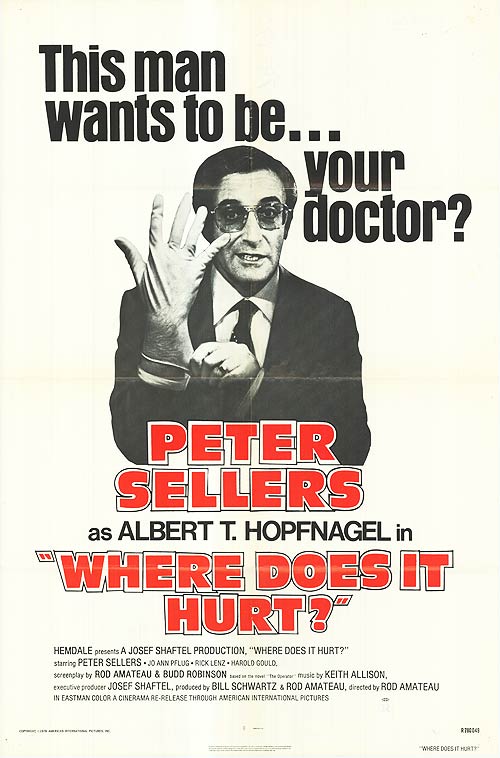
It’s funny how names like Ed Wood Jr. or Tommy Wiseau get mentioned in just about anyone’s list of bad movie director’s, but Rod Amateau’s never does, but should. Not only did he produce ‘My Mother the Car’ and ‘Supertrain’, which are considered two of the worst TV-series ever to be broadcast, but he also directed the notorious Garbage Pail Kids as well as Son of Hitler and The Statue, which featured a jealous David Niven going around the bathrooms and gay bathhouses of London looking for a man whose penis matches the one that his wife created for a life-sized statue that she says replicates her lovers.

While this film isn’t quite as bad as those it comes close. It stars Peter Sellers who was at a career nadir due to financial mismanagement and willing to take on any low budget job offer he was given. Here he plays the corrupt head of a hospital that uses an array of schemes to bilk patients and insurance companies out of thousands of dollars. Rick Lenz plays a patient who becomes aware of the shenanigans going on and tries to bring Sellers and his staff down, but finds that they seem to have a trick up their proverbial sleeves at every turn.

The film manages to have a few amusing moments, but comes off more like a gag reel than a story. The characters are exaggerated and unlikable. We are supposed to side with Lenz and his predicament, but he so stupidly allows the doctors to take advantage of him at the beginning that it becomes hard to. The whole thing gets sillier by the second until by the end it’s completely inane. It also makes light of some serious issues that were handled better in Paddy Chayefsky’s The Hospital, which came out just 8 months before this one.

To some degree it’s fun seeing Sellers, who was noted for his wide range of dialects, taking a stab at an American accent and he almost pulls it off except for a few moments including the one where he pronounces orifice as AW-ifice.

The supporting cast made up of lesser known talents proves to be game here. Pat Morita, still years away from his breakout role in The Karate Kid, is genuinely amusing as a lab tech with an inferiority complex and at one point even speaks in a British accent. Harold Gould is good as an incompetent Dr. and J. Edward McKinley, best known for his many appearances on ‘Bewitched’ as one of McMahon and Tate’s primary clients, is funny as the Hospital commissioner who relentlessly tries to nab Sellers and eventually after repeated missed opportunities is able to.

In better hands this might’ve had a chance, but the low budget, irritating country music soundtrack and cheap jokes pretty much sink this thing before it even has a chance to get started.

My Rating: 4 out of 10

Released: September 29, 1972

Runtime: 1Hour 28Minutes

Rated R

Director: Rod Amateau

Studio: Cinerama Releasing Corporation

Available: None at this time.

The Princess Bride (1987)

princess bride 1

By Richard Winters

My Rating: 7 out of 10

4-Word Review: Grandson likes bedtime story.

Based on the 1973 William Goldman novel, who also wrote the screenplay, a grandfather (Peter Falk) arrives to read to his sick grandson (Fred Savage) a fairytale. Initially the grandson is more interested in playing video games, but soon finds himself enraptured with the story despite his initial reluctance. The tale involves a country girl named Buttercup (Robin Wright) who falls in love with a farmhand named Westley (Cary Elwes). When Buttercup mistakenly thinks that Westley has been killed by some pirates she agrees to marry Prince Humperdinck (Chris Sarandon) only to end up getting kidnapped before her wedding and saved by Westley who was never dead to begin with. The two then must fight off the evil Prince who still insists on marry Buttercup and doing away with Westley.

The film, which was directed by Rob Reiner and produced by his former ‘All in the Family’ creator Norman Lear, is engaging from beginning to end and filled with endlessly funny dialogue and exciting adventures that remain pleasantly amusing throughout. My favorite moment is seeing a completely unrecognizable Billy Crystal hamming it up as an old man magician who tries to revive Westley while sounding like a comedian from vaudeville.

The special effects are impressive especially the shot showing Buttercup’s three kidnappers climbing a rope up a steep mountain while being followed close behind by Westley. To me though the best part is when Westley gets attacked by what appears to be a giant rodent that, with the exception of his fake looking fur, looks amazingly real and not like a stuntman in a body suit or a computerized image.

The performers are well cast with my favorite being former wrestler Andre the Giant who steals it despite having no acting experience and at times difficulty enunciating his words. The only negative is Christopher Guest as a six fingered man who supposedly attacked the Mandy Patinkin character when he was a child, but now that Patinkin has grown he faces Guest again even though Guest looks to be practically his same age and not someone who should be significantly older.

The story is basic and lacks the grandiose and dark quality that many of the classic Grimm fairytales possess. The banter between the grandson and Grandfather is fun and I wished it had cut back-and-forth between the two and the story more often than it does. The context is simple and straight forward and its ‘message’ of teaching kids to learn to enjoy reading is a bit too obvious, but overall as non-think escapism it scores a bullseye and through the years has managed to acquire a strong cult following.

My Rating: 7 out of 10

Released: September 25, 1987

Runtime: 1Hour 38Minutes

Rated PG

Director: Rob Reiner

Studio: 20th Century Fox

Available: VHS, DVD, Blu-ray, Amazon Instant Video, YouTube


Night of the Lepus (1972)

night of the lepus

By Richard Winters

My Rating: 1 out of 10

4-Word Review: Giant rabbits attack people.

Arizona rancher Cole Hillman (Rory Calhoun) has his property overrun with rabbits and looks to zoologist Roy Bennett (Stuart Whitman) for help. Roy along with his wife Gerry (Janet Leigh) decides to inject these rabbits with hormones that he hopes will throw off their breeding cycle, but instead one of them escapes from the testing lab and creates a whole new race of giant sized rabbits that begin terrorizing and destroying everyone and everything around.

If your thought is ‘what were they thinking’ as you read that plot synopsis then you are not alone as that was the question I kept asking as I viewed the film. What’s even funnier is that the studio feared this concept would be met with ridicule from the beginning and therefore created movie posters that carefully avoided showing the rabbits or explaining what the threatening presence was. The original title for the film, which was ‘Rabbits’ was also changed to Lepus, which in Latin means hare as another way to avoid giving away the plotline, but it all proves futile because once people view the film the secret would be out and the laughter not the scares would begin.

The special effects are the biggest issue as the rabbits never seem giant-sized and are simply photographed in extreme close-up to give the clumsy impression that they are large or shown amongst a miniaturized set. However, even when shown next to a small building it doesn’t work as they appear no bigger than a horse, which may make it big for that species, but still not giant sized. The sound effects used to represent the noise that they make comes off more like ancient tribal music that becomes increasingly annoying and overplayed.

night of the lepus 2

The shots showing the victims after an attack looks more like people lying on the ground smeared with red paint and without any bite marks or chewed flesh that you would expect. The film also doesn’t explain why these rabbits that are normally a docile type of creature would suddenly become so aggressive simply because they became bigger.

It’s fun to see some familiar faces like DeForest Kelley in one of his last non-‘Star Trek’ roles, but I’m surprised that any of these actors took part in this as I’m sure from reading the script that they knew it was ludicrous, but to their credit they perform it earnestly. Melanie Fullerton as the young girl who sets the whole thing in motion by allowing one of the rabbits to escape is the only one that got on my nerves and may win the prize for most annoying child ever to be put on the big screen.

Based on the novel ‘The Year of the Angry Rabbit’ by Russell Braddon the film never gets off the ground and is straddled from the very beginning by its absurd plot and cheesy effects. Even if it had been done as a parody I don’t see it doing any better, which brings us back to the first question ‘what were they thinking’ and my answer to that is that they clearly weren’t.

night of the lepus 4

My Rating: 1 out of 10

Released: October 4, 1972

Runtime: 1Hour 28Minutes

Rated PG

Director: William F. Claxton

Studio: MGM

Available: DVD, Amazon Instant Video