Category Archives: Movies Based on Novels

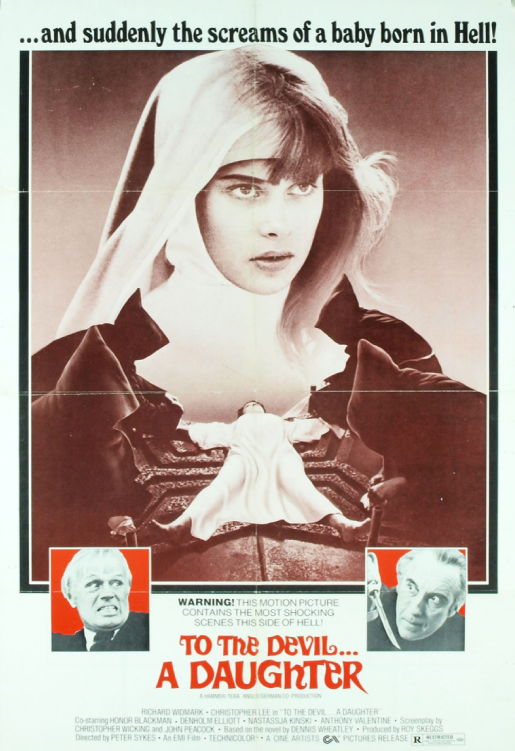
To the Devil a Daughter (1976)

to the devil a daughter 1

By Richard Winters

My Rating: 6 out of 10

4-Word Review: He sacrifices his daughter.

Father Michael (Christopher Lee) is an ex-communicated priest who runs an offshoot religion called Children of the Lord that seems connected to the Catholic Church on the outside, but underneath the façade it is actually a cover for a group of Satanists. Henry (Denholm Elliot) is the father who signs over his daughter Cathrine’s (Nastassja Kinski) soul at her birth which stipulates that on her 18th birthday she will become the devil’s representative here on earth. Yet as that date approaches Henry begins to have second thoughts and hires occult novelist John Verney (Richard Widmark) to steal Catherine away from her captors and take her away to his place to hide, but Father Michael uses the power of black magic to hypnotize Catherine and force her to return to him while John tries everything in his power to stop it.

One commenter on the IMDB message boards claims this is ‘one of the worst movie to come out in the 70’s’, which only proves that he must not have seen a lot of ‘70’s movies as there is far worse stuff from that decade than this. Although it is certainly no classic it’s still not bad on the technical end and even rather slick. I enjoyed the on-location shooting done in Europe particularly the scene showing a drawbridge that could be lowered and raised manually by one person. The gore and scares are skimpy, but the scene where Kinski dreams of having the devil fetus crawl up her body and she then proceeds to stuff it into her vagina is certainly worth a few points.

Kinski’s presence is the best thing about the movie and the film became notorious in its day for showing her in full frontal nudity even though she was only 14 at the time. However, what surprised me even more was how confident she looked when she did it without any of the expected nervousness or shyness. I felt that because she was the daughter of actor Klaus Kinski and had to learn to group up fast she had a higher level of maturity than most other teens her age and therefore the scene wasn’t as awkward for her as it might otherwise have been.

Lee’s great as always as the bad guy and I particularly enjoyed his facial expressions. However, Widmark  was miscast as he was too old and I didn’t understand why being only a friend of the family he would take such an invested interest in their daughter and such personal risks to get her out of the cult, which I felt would’ve been better suited to the role of the father and cutting out the Gurney character altogether.

This was the last horror film to be produced by Hammer and for the most part it plays like a cheesy rip-off of The Exorcist, but still has enough of a budget and a capable enough cast to keep it mildly enjoyable.

My Rating: 6 out of 10

Released: March 4, 1976

Runtime: 1Hour 28Minutes

Rated R

Director: Peter Sykes

Studio: Hammer Films

Available: DVD, Amazon Instant Video

Village of the Damned (1960)

village of the damned 2

By Richard Winters

My Rating: 6 out of 10

4-Word Review: The eyes have it.

Remade in 1995 and based on the John Wyndham novel ‘The Midwich Cuckoos’ the story centers on a small English village where one day everyone mysteriously falls asleep for several hours while under the spell of some invisible, odorless gas. When they awaken everything seems normal, but later on all the women become pregnant, even those that were not married or were still virgins. When the babies are born they are found to be different from their human counterparts as they have a higher intelligence, odd shaped heads and bright blonde hair. Later on these same children gain the ability to read other people’s minds and dispose of those that they don’t like penetrating them with the spell of their glowing eyes. As the rest of the village panics one man (George Sanders) feels that he may have the ability to stop them, but only if he can somehow control his own thoughts, so they won’t be able to tell what he is actually up to.

As a sci-fi thriller it’s not bad. The film’s short running time has a nice compact style to it with a story that evolves at a fast pace and continues to add new twists. The special effects for its day are realistic enough to be passable and the violence is surprisingly high. Sanders is effective in the lead and Martin Stephens as the leader of the children is quite creepy.

I found it a bit baffling though that the townspeople wouldn’t have quarantined the strange children from the start as it becomes quite obvious from the beginning that they aren’t normal. Instead they are allowed to roam freely even as they become increasingly more sinister. I would’ve also have thought that some of the mothers who gave birth to these strange beings would’ve disowned them and even refused to take care of them once their unnatural and frightening oddities became apparent.

The ending is frustrating as the film does not supply any answer as to who these kids where and what type of alien presence impregnated the women and why. The movie tells us that other places have been effected with these strange children as well, which leads one to believe that this is only a part of some other more sinister plot with far reaching consequences that never gets tackled. Instead we get left with a short film that acts like a small chapter to a fascinating idea with broad potential variables that unfortunately never gets followed through on.

My Rating: 6 out of 10

Released: July 5, 1960

Runtime: 1Hour 17Minutes

Not Rated

Director: Wolf Rilla

Studio: MGM

Available: DVD, Amazon Instant Video

Deadly Friend (1986)

deadly friend 1

By Richard Winters

My Rating: 1 out of 10

4-Word Review: He resurrects his girlfriend.

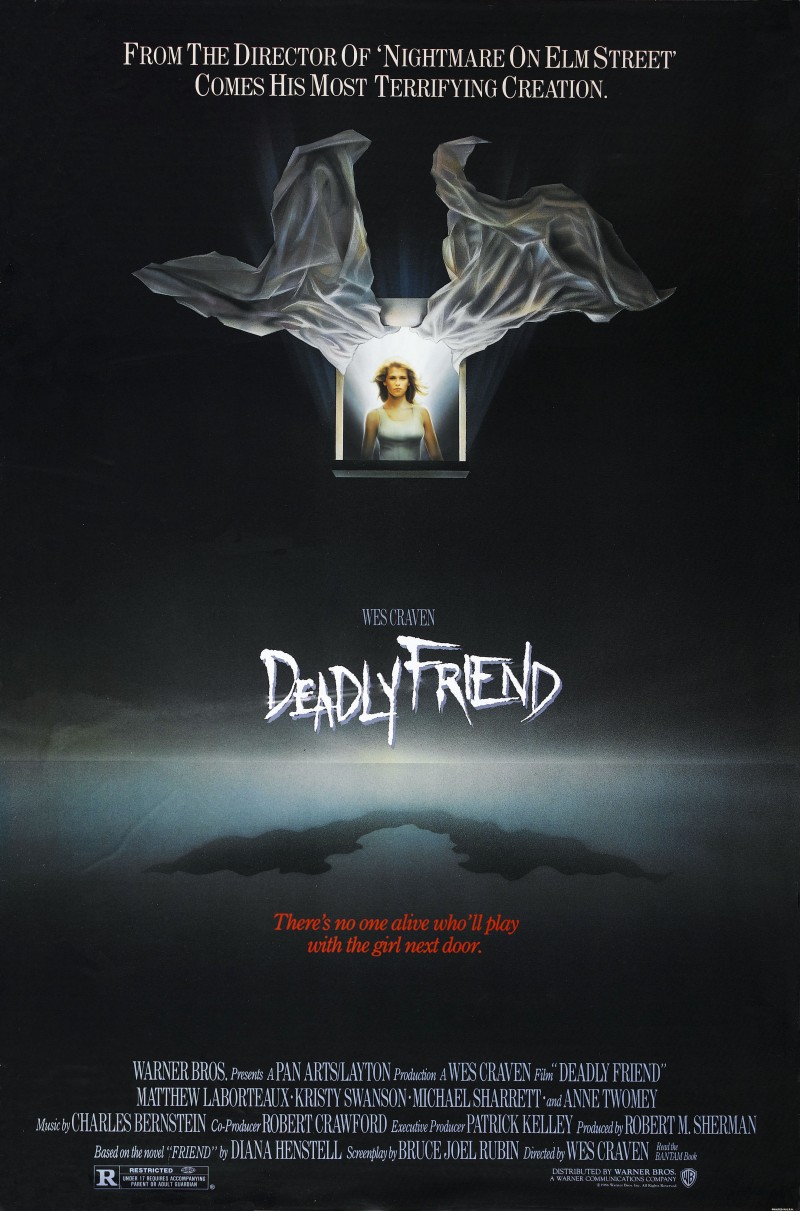
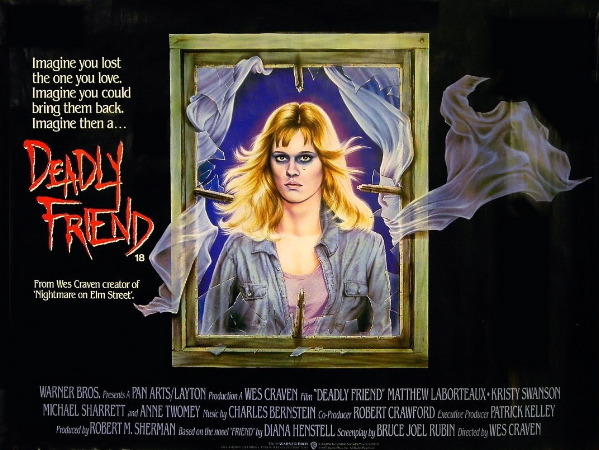
Paul (Matthew Labyorteaux) is a teen with a genius I.Q. who teaches classes on robotics at a local university. His next-door neighbor is Samantha (Kristy Swanson) a beautiful teen girl who is tormented and abused by her alcoholic father (Richard Marcus). When she becomes brain dead after falling down the stairs during one of her father’s rages Paul tries to bring her back to life by implementing the microchip from his robot’s brain into hers. However, instead of the pretty, sweet girl that she once was she is now a killing machine getting back at anyone who ever wronged her and Paul becomes unable to stop her.

The film suffers severely as a result of the studio having a different idea on the direction they wanted to take it versus what director Wes Craven or its screenwriter Bruce Joel Rubin had. Craven and Rubin wanted an offbeat love story while the producers pushed for the conventional ‘80s horror. The result is a mishmash of different genres that throws in everything from blood and gore to silly robots that do cutesy things and look better suited for a kid-friendly Disney movie.

The plot has a logic loophole as well as the reincarnated Samantha somehow gains super human strength, which makes no sense. She may have the robot’s brain, but it’s still her same body, so whatever strength the robot had would not transition to her since he was made from mechanical parts. The part where she lifts a biker dude over her head would probably have broken her back and I wasn’t sure what the dark circles around her eyes was so supposed to mean. Was this to represent that she was slowly dying and decaying? If so then her skin should be rotting and peeling off and not just looking like someone who went a little overboard with the eye shadow.

The misguided nightmare segments are another issue. The scene where Samantha dreams that she stabs her father in the stomach with a broken glass vase that causes blood to rush out of him appears more like an erect penis pissing out blood. The moment where Paul sees Samantha’s dead and burned father’s head popping out of his bed is too reminiscent of A Nightmare on Elm Street and comes off looking like Craven was going to the same well too often.

The characters are dull and poorly fleshed out. Paul is too clean cut and the fact that he is super smart at everything becomes annoying. Samantha seems overly passive and sheltered and her loathsome father becomes nothing more than a walking, talking cliché trucked straight in from Redneckville.

Spoiler Alert!

The ending is by far the worst part as it features Paul coming into the morgue after Samantha has been killed and then having her inexplicable and without explanation turn into a robot. Whether this was simply a dream or a misguided attempt to turn the plotline into some sort of sequel is unclear, but it helps cement this as a complete catastrophe despite its good production values and a perfect testament to what happens when the producer and director are not on the same page.

End of Spoiler Alert!

deadly friend 2

My Rating: 1 out of 10

Released: October 10, 1986

Runtime: 1Hour 31Minutes

Rated R

Director: Wes Craven

Studio: Warner Brothers

Available: VHS, DVD, Amazon Instant Video, YouTube 

Lovin’ Molly (1974)

lovin molly

By Richard Winters

My Rating: 4 out of 10

4-Word Review: Two men one woman.

Molly (Blythe Danner) is a free-spirited woman living in a small Texas town during the 1920’s. Gid (Anthony Perkins) and Johnny (Beau Bridges) are best friends who also both like her. Molly likes them as well, but can’t seem to decide which of the two she loves better, so to solve things she gets married to Eddie (Conard Fowkes). This doesn’t go over well with the other two, but as time goes by she continues to see them and even has children from both of them, which causes a stir in her small community. Not only does she become the product of the local gossip, but virtually ostracized as well. However, Molly is undeterred about what everyone else thinks and sticks to her independent ways.

Based on the Larry McMurtry novel the film was directed by the legendary Sidney Lumet, but you would hardly know it. The production looks cheap and rushed and lacks atmosphere or period detail. The scenes are flatly shot with very little visual design or imagination. The whole thing comes off as something that did not get any major studio backing and was forced to look to private investors for funding, which unfortunately was just not enough.

Filming it on location in Bastrop, Texas which is also the setting of the story helps a little as the town has many historical buildings, which heightens to some extent the period atmosphere, but I would’ve liked to have seen more of it. The dry Texas landscape is also nicely captured and makes the viewer feel like they are living in the state themselves with each and every shot. The one thing though that really impressed me was how realistically the characters aged as the story, which spans 40 years, progresses. In most films the actors are forced to wear a ton of makeup, which gets overdone, but here very little of it was used and it looked far better.

Danner, who these days is best known as the mother of Gwyneth Paltrow, is excellent in a rare turn as a leading lady and even appears fully nude from the front and back. Perkins is solid in support and I enjoyed seeing Bridges with a bowl haircut. The star though that really steals it is Edward Binns as Perkins’ father whose caustic and to-the-point remarks are gems.

Fred Hellerman’s flavorful bluegrass score is pleasing, but the film itself fails to elicit much emotion. The only times that it does become mildly interesting is when the characters do a voice-over narration by reading off of passages lifted directly from its source material making me believe that this should never have been filmed in the first place and left simply in its novel format.

My Rating: 4 out of 10

Released: April 14, 1974

Runtime: 1Hour 38Minutes

Rated R

Director: Sidney Lumet

Studio: Columbia Pictures

Available: DVD (Region 2), Amazon Instant Video

The Pursuit of Happiness (1971)


pursuit of happiness 2

By Richard Winters

My Rating: 5 out of 10

4-Word Review: Justice isn’t always fair.

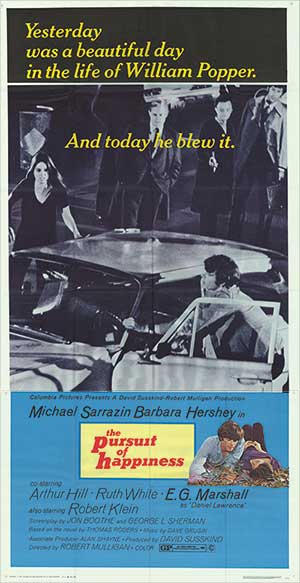
Everything seems to be going William Popper’s (Michael Sarrazin) way. He is a young college student with a great looking girlfriend (Barbara Hershey) and from a rich family. One night he takes a trip to the grocery store. It is raining and he accidently hits and kills a woman who walks out onto the street between two parked cars. Since William has several unpaid traffic tickets, is part of the anti-establishment movement and seems to have a generally belligerent manner he gets arrested for her death. His rich father (Arthur Hill) hires a successful lawyer (E.G. Marshall), but William is a major idealist who doesn’t want to compromise on anything and the more he fights for his ideals the deeper it gets him into trouble.

The film, which is based on a novel by Thomas Rogers, certainly makes some great points about our modern day American justice system where everything seems more based on the image that the defendant tries to present than the actual facts. Unfortunately most viewers today are already quite jaded by this and the message comes off as old and redundant.

The biggest problem is with Sarrazin. He has always had a bit of a transparent quality and I’ve defended him in some of his other roles, but here he helps to bring the whole thing down. He conveys no anger or emotion of any kind even though it’s supposedly his passion for the truth that causes him to behave the way he does. His comes off as limp and lifeless making me wonder how such a bland guy could attract a girlfriend at all let alone a really beautiful one. His character is also a bit too stubborn and strangely naïve to the point that the viewer isn’t completely empathetic with his cause as it becomes painfully obvious that he is only hurting himself by refusing to back down at all while most rational people would’ve likely buckled under just enough to get themselves out of the jam.

The script unfortunately is more intent on making a statement than telling a story as we are given no conclusion to the character’s plight. He escapes from jail and takes a flight to Mexico, but then it just ends leaving open a wide array of unanswered questions and making the viewer feel like they’ve seen only half a movie.

Ruth White, in her last film appearance, gives a strong performance as Walter’s Archie Bunker-like grandmother. It’s also great to see Marshall playing a more hard-lined version of the defense attorney role that he was famous for from ‘The Defenders’ TV-show. Robert Klein is engaging as Walter ‘60s radical college friend and David Doyle is good as Walter’s cellmate. Charles Durning, Ralph Waite and Rue McClanahan can be seen in small roles and this also marks William Devane’s film debut.

pursuit of happiness 3

My Rating: 5 out of 10

Released: February 23, 1971

Runtime: 1Hour 33Minutes

Rated GP

Director: Robert Mulligan

Studio: Columbia Pictures

Available: DVD, Amazon Instant Video

Kes (1969)

kes 1

By Richard Winters

My Rating: 6 out of 10

4-Word Review: Boy trains a kestrel.

Billy (David Bradly) is a poor working class youth living in Yorkshire who finds his existence to be bleak and pointless. He is bullied constantly by his older brother Jeb (Freddie Fletcher) and ignored by his burdened mother (Lynne Perrie) while also being picked on at school. As means of some solace he finds a nest of baby kestrels inside an abandoned building. He takes one of them and keeps it in his backyard shed where he trains it, which in return gives him a sense of purpose.

The film is based on the novel by Barry Hines who also wrote the screenplay and although the plot is basically the same it does vary in two major ways. The first one being that in the book everything takes place in one day and with a lot of use of flashbacks to explain the backstory, which I liked better, but here it’s given a linear narrative. The book also explains a bit more about the otherwise absentee father and even has one scene involving him while here the character is non-existent and never even mentioned.

On a purely cinematic level it is well made and nicely exposes Billy’s hopeless working class world without ever being heavy-handed. The drama is fresh and natural with each scene and character ringing true. The segments involving the training of the bird is the most engaging and I wished had been extended.

The children are fantastic without being too cute or precocious and respond to things in ways that are honest to their nature. The adult cast is good as well although not as likable. The teachers and school administrators, with their very old fashioned approach to discipline, come off as genuine jerks. At one point one of them even raps the open palms of the children’s hands with a cane, which makes their eyes well up with tears and is unpleasant to watch.

The worst is the segment involves Billy’s physical ed. teacher Mr. Sugden, which is played by Brian Glover who was an actual high school instructor at the time as well as a former wrestling. Here he plays a coach who brutally bullies his students in a scene that makes its point and then goes on too long with it. I also didn’t like that director Kenneth Loach superimposes the score of the soccer (football) game that the students are playing onto the screen, which wasn’t necessary as who wins the game was not important at all and hurt the film’s realism by distracting the viewer and taking them out of the story.

Some have complained about the thick dialect of the characters, which makes it hard at times to understand what they are saying. Certain American versions have been dubbed to make the lines uttered clearer although the version I watched, which was from the Criterion Collection, seemed to have the original accents intact, which I preferred as it kept it more authentic and for the most part I didn’t have any problem with it.

Spoiler Alert!

The only real issue that I had with the film is its downbeat ending. I realize that it is the same as the one in the book, but felt a bit frustrated that every time there is a movie dealing with a child taking care of an animal it always for some reason has to end in tragedy, which made it a bit formulaic. The kid never gets a break and having the falcon get killed at the end was like rubbing salt into the wound. The bird that actor Bradly buries apparently died of ‘natural causes’ but at the time he was under the belief that it had been killed simply to suit the purposes of the film and the angry reaction that you see on his face was very real.

End of Spoiler Alert!

kes 2

My Rating: 6 out of 10

Released: November 16, 1969

Runtime: 1Hour 50Minutes

Rated GP

Director: Kenneth Loach

Available: DVD, Blu-ray, Amazon Instant Video

Creator (1985)

creator

By Richard Winters

My Rating: 2 out of 10

4-Word Review: Cloning his dead wife.

Harry Wolper (Peter O’Toole) is an eccentric college professor obsessed with the idea of cloning his dead wife. With the help of an undergraduate assistant named Boris (Vincent Spano) he sets up a makeshift shed in his backyard and uses the university equipment for his experiments. He employs the services of Meli (Mariel Hemingway) a 19-year-old in desperate need of funds whose egg he uses as part of the cloning process. After a while she starts to fall in love with him and as the fetus of his dead wife takes shape she becomes jealous and feeling that he should be more concerned with the living than the dead.

O’Toole is engaging as ever in the type of role that most suits his talents. Had the film stayed centered on him it would have been a joy to watch, but unfortunately it enters in the generic Spano who looks like he was pulled straight off of the cover of a men’s modeling magazine. I presume this was because the studio felt a movie centered on a man over 50 wouldn’t attract the all-important 16-30 year-old demographic, but despite being an obvious chick-magnet he adds little and there was period in the middle where he isn’t seen for a long time to the point where I forgot about him and didn’t miss him at all.

Hemingway adds quirky energy as the free-spirit and her kooky romance with O’Toole adds genuine spark, but the film regresses by spending too more time focusing on Spano’s relationship with fellow coed Barbara (Virginia Madsen). This romance is very formulaic and makes the film seem like two movies in one while sucking all of its offbeat potential right out. If anything Spano should’ve fallen for his robot that is by far funniest thing in the movie.

Spoiler Alert!

David Ogden Stiers makes for a good antagonist and John Dehner, in his last theatrical film appearance, is solid as O’Toole’s loyal colleague, but the film’s biggest problem is when it shift gears and destroys the whole cloning angle completely. It then centers on a mysterious illness that befalls the Barbara character that like in Love Story never gets explained and comes out of nowhere. She goes into an immediate coma and is put on life support where her parents (Rance Howard, Ellen Geer) agrees much too quickly and without bothering to even get a second opinion to take her off of it and allow her to die. This then forces Spano to talk to her endlessly until just as the she is about to be disconnected she ‘miraculously’ comes back to life, which is too implausible, too contrived and too cute for even the most hopeless of romantics and helps ruin the engaging performances of its two lead stars, which is the only good thing about it.

End of Spoiler Alert!

My Rating: 2 out of 10

Released: September 20, 1985

Runtime: 1Hour 47Minutes

Rated R

Director: Ivan Passer

Studio: Universal

Available: VHS, DVD, Amazon Instant Video

The Strawberry Statement (1970)

strawberry statement 4

By Richard Winters

My Rating: 5 out of 10

4-Word Review: Students go on strike.

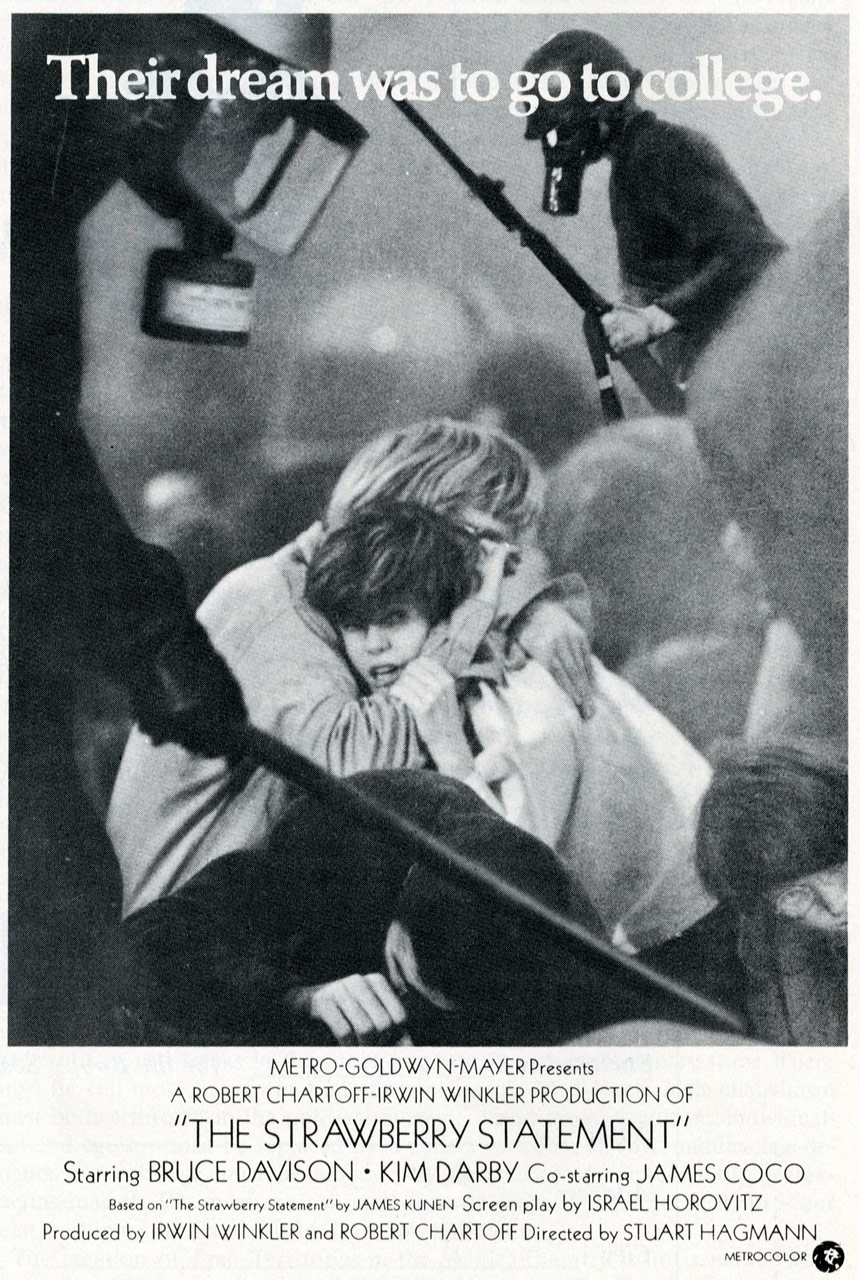
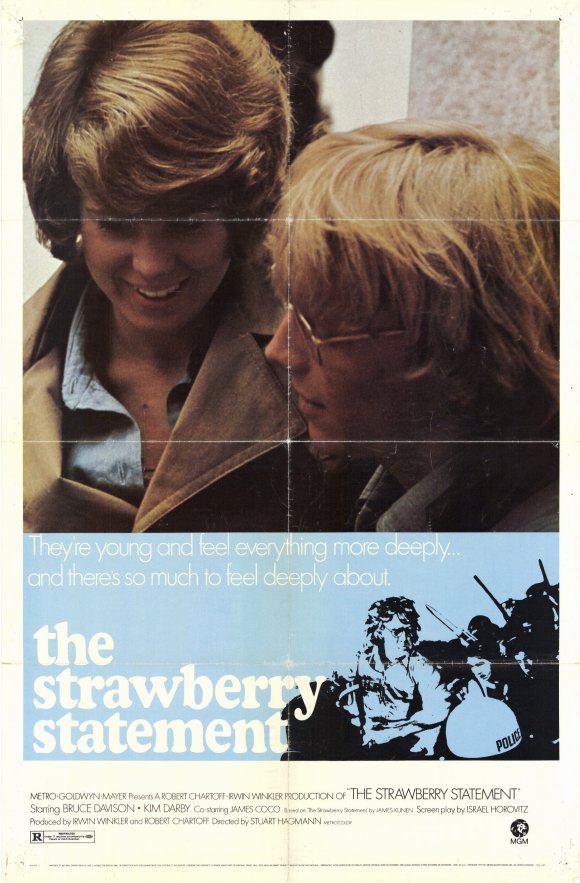
Simon (Bruce Davison) is a young college student attending a university simply as a means to get an education and find himself a good job. He has no real interest in the student revolt going on, but as a lark and a way to meet girls, he decides to passively get involved with students who have taken over the administrator’s building in protest of the school’s plan of building a gymnasium in an African American neighborhood. Slowly Simon finds himself taking up more of their cause and embracing their stance especially after meeting Linda (Kim Darby) who is much more of a student radical, but the two are ill-prepared for the brutal outcome when exasperated school officials have the police violently storm the building and haul the students out.

The film is based on the book ‘The Strawberry Statement: Notes of a College Revolutionary’ by James Kunen, which in turn is based on his experiences of being involved in a student sit-in that took place at Columbia University in April of 1968. The book’s narrative had more of an engagingly detached manner as it looked at the contradictions and hypocrisies of both sides while the screenplay by Israel Horovitz is nothing more than a commercialized effort to cash in on the counter-culture emotions of the time while glossing over or ignoring some of the book’s more perceptive points. The plot is too loosely structured and relies heavily on artsy camerawork and moody music to propel it until you get an hour into it and realize that nothing much has really happened. The whole thing would’ve been better focused had it been done with a voice-over narration by the main character.

strawberry statement 3

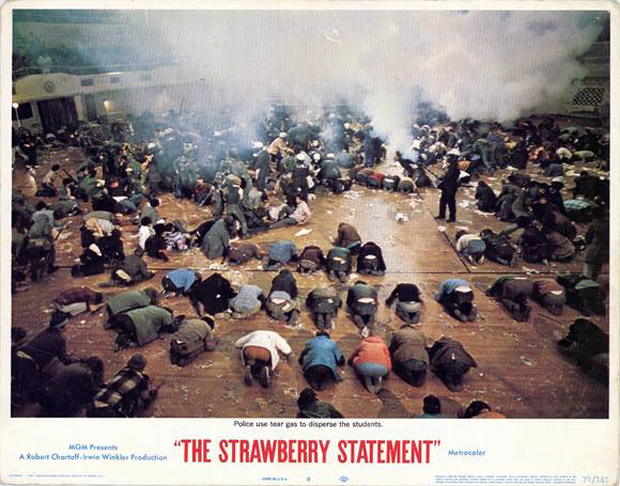
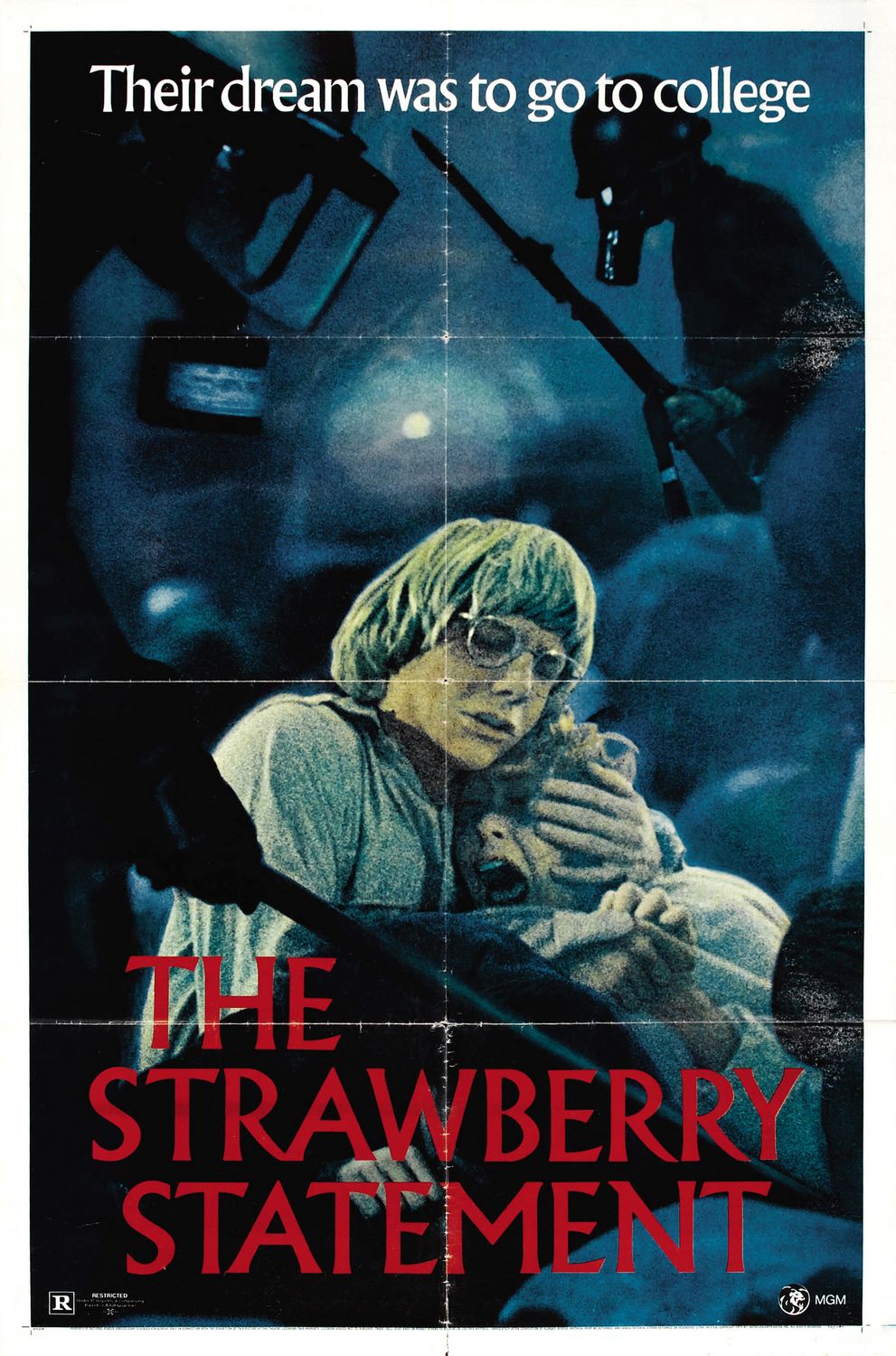
Although at times it borders on being pretentious I still found director Stuart Hagmann’s camerawork to be intoxicating especially the bird’s eye view of the students forming into several large circles as a way to block the police from entering and taking them out. Some of the scenes involving the demonstrations look staged and phony especially when compared to similar scenes of actual protests that were captured in Medium Cool that came out around the same time. However, the scene where the students grab a police officer, strip off his pants and force him down the slide and onto the swings at a children’s playground is downright amusing. The climatic sequence where the students are violently herded out of the building while sprayed with tear gas is well captured and by far the most startling and memorable thing about the movie.

Davison gives a solid performance and creates a middle-of-the-road character that is engaging enough to hold the thing together. It’s also great seeing Bud Cort playing an atypical role of an amorous girl-crazy coed who’s constantly looking to get laid. This film also marks the film debuts of David Dukes, Jeannie Berlin, Paul Willson, Andrew Parks, Kristina Holland and soap actress Jess Walton. You can also spot Horovitz and Kunen in brief cameo parts as well as character actor James Coco as a deli owner who’s all too willing to have his placed robbed simply so he can collect the insurance money.

Although they wanted to shoot the movie at Columbia where the incident actually occurred they were unable to get permission and were forced instead to do it at Berkeley, which in some ways helped it as the liberal, free-spirited look and mood of the region helped match the tone of the story. Ultimately though the film fails to ever really gel and comes off as being too placid and generic while failing to distinguish itself from the myriad of other student protest movies from that era.

strawberry statement 2

strawberry statement 1

My Rating: 5 out of 10

Released: June 15, 1970

Runtime: 1Hour 49Minutes

Rated R

Director: Stuart Hagmann

Studio: MGM

Available: DVD (Warner Archive), Amazon Instant Video

Private Lessons (1981)

private lessons

By Richard Winters

My Rating: 4 out of 10

4-Word Review: Housekeeper seduces a minor.

Mallow (Sylvia Kristel) is an English nanny working for a rich client named Fillmore (Ron Foster) who gets involved in a scheme with the family’s chauffer Lester (Howard Hesseman) to seduce Fillmore’s 15-year-old son Philly (Eric Brown). The idea is for her to fake having a heart attack during their lovemaking and convince Philly that he has killed her and then Lester will blackmail him to take $10,000 out of the family’s safe and give it to him has hush money for not reporting it to the police, but Philly is smarter than they think and not only catches onto their scheme, but has a double-cross in store for them as well.

The idea of having an adult making love to a minor most likely wouldn’t have gotten the green light today. To me it reeked of being a major double-standard. If the genders had been reversed and it had been a 15-year-old girl seduced by an older man this thing would’ve been considered obscene and banned, but because it involves a teen boy with ‘raging hormones’ instead that somehow makes it ‘okay’ and is approached as being nothing more than an innocuous sexual ‘coming-of-age’ flick, which I found to be both annoying and aggravating.

The scene involving the young Brown getting naked and hopping into the tub with the equally naked Kristel where they then fondle and kiss each other seemed like child erotica and will most likely make viewers today who are now much more sensitive on this topic feel uncomfortable to watch. The ending in which the two go to bed together in a very drawn-out sensual segment that is done under a romantic context is downright smarmy. Viewers wanting to watch this simply to catch Kristel naked will be disappointed to know that most of her nude scenes were done using a body double named Judy Helden.

The script was written by Dan Greenburg, who also appears briefly as a seedy hotel owner and based on his 1969 novel ‘Philly’. He is a noted humorist who eight years earlier wrote the script to the film with the quirky title of I Could Never Have Sex with any Man Who has Such Little Respect for My Husband. For the most part this film is rather bland, but manages to pick up a bit during the second half when the story twist kicks in that at the very least makes it better than most other teen sex comedies, which are usually devoid of any discernable plot at all.

The script though is full of holes. For one thing it is highly doubtful that a rich parent would give their child a combination to a safe that has tons of money in it and there is never any explanation of what was put into the body bag that is hoisted into the ground and buried when Lester was still tricking Philly into believing it was the dead Mallow. Obviously it wasn’t her, so what was used to make it seem like a dead body? The film never says, but should’ve. Also, I found it hard to believe that Mallow and Philly could go out to a fancy restaurant and make out with each other openly in a booth and not have it create a stir and distraction with the other patrons especially when it was clearly involving an adult and a minor.

Brown whose only other claim to fame was playing Ken Berry’s son in the first two seasons of ‘Mama’s Family’ gives an engaging performance, but I couldn’t help but wonder what his parents where feeling and thinking during the love scenes. It’s also interesting to see Hesseman who wears a wig and has his mustache dyed brown in a rare turn as a heavy. Begley Jr. gets a few kudos in his attempt to play a ‘tough guy’ cop and Dan Barrows makes the most of his small role as the family’s gardener.

The film has a surprisingly great soundtrack that feature a lot of hits from the day which include: ‘Hot Legs’, ‘Tonight’s the Night’ and ‘You’re in My Heart’ by Rod Stewart as well as ‘Just When I Needed You the Most’ by Randy Van Warmer, ‘I Need a Lover’ by John Cougar, ‘Fantasy’ by Earth, Wind and Fire, ‘Next Time You See Her’ by Eric Clapton and ‘Lost in Love’ by Air Supply. How such a low budget movie was able to pay for the rights to these songs is a mystery, but it definitely adds pizazz and helps give the film an extra point.

My Rating: 4 out of 10

Released: August 28, 1981

Runtime: 1Hour 27Minutes

Rated R

Director: Alan Myerson

Studio: Jensen Farley Pictures

Available: VHS, DVD, Amazon Instant Video, Hulu

Slapstick (Of Another Kind) (1982)

slapstick

By Richard Winters

My Rating: 2 out of 10

4-Word Review: These twins are extraterrestrials.

Based on the Kurt Vonnegut novel ‘Slapstick’ the story centers on a Caleb and Lutetia (Jerry Lewis, Madeline Kahn)  who are a rich and famous couple that give birth to deformed and ugly twins named Wilbur and Eliza (also played by Lewis and Kahn). The couple immediately disowns the children and has them put away into a home run by Sylvester (Marty Feldman) who acts as the children’s caretaker. Unbeknownst to anyone is the fact that twins are actually aliens implanted inside Lutetia by a race of super intelligent beings from a faraway planet as a way to help earthlings solve all of their problems. When the twins put their cone sized heads together they are super smart, but when they are separated they are dumb making everyone believe that they are mentally deficient and of no use to anyone.

The biggest problem with this disastrous attempt at a movie is the approach. Director Steven Paul who ironically made his acting debut in Happy Birthday, Wanda June, which was another Vonnegut book adaptation brought to the screen seems to have no idea what type of audience he is aiming for. The humor shifts wildly between child-like farce to satirical jabs with nothing in-between, which will alienate both adults and children alike. The grownups will find it incoherent and silly while the children will be frightened by the ugly visuals as well as the cold, callous nature of the characters and plot. There is also a strange side story that make no sense and deals with miniaturized Chinese men who are the size of a human thumb and fly around in a spaceship resembling an eggroll while trying to make contact with the twins in order for them the help make a deal on the sale of gravity?!!!!

Lewis and Kahn are relatively amusing as the snotty couple, but as the twins they are downright embarrassing. The scene where they have a food fight while yammering incessant baby talk is a degrading sight and a career low for both performers. I know Lewis has the reputation of doing some really silly, inane stuff, but even this should’ve been beneath him.

The eclectic supporting cast helps a little and the only reason that I’m giving it 2 points. Feldman is genuinely amusing and it’s great seeing Jim Backus in one of his last acting roles playing the President of the United States and hearing this predominantly kid-friendly performer utter the word shit…twice!

I have never read the novel from which this is based, but have heard that it is far superior, which isn’t a surprise. I’d be interested to know what Vonnegut, who apparently wrote the lyrics to a song sung by Kahn in the film, but then later cut, thought of this catastrophe. Some bad films are fun because you can make jokes about as it goes along, but this thing is so utterly bizarre from beginning to end that instead you sit in a stupor throughout and it becomes a surreal experience instead.

My Rating: 2 out of 10

Released: December 1, 1982

Runtime: 1Hour 22Minutes

Rated PG

Studio: International Film Marketing

Director: Steven Paul

Available: VHS, Amazon Instant Video