Category Archives: Movies Based on Novels

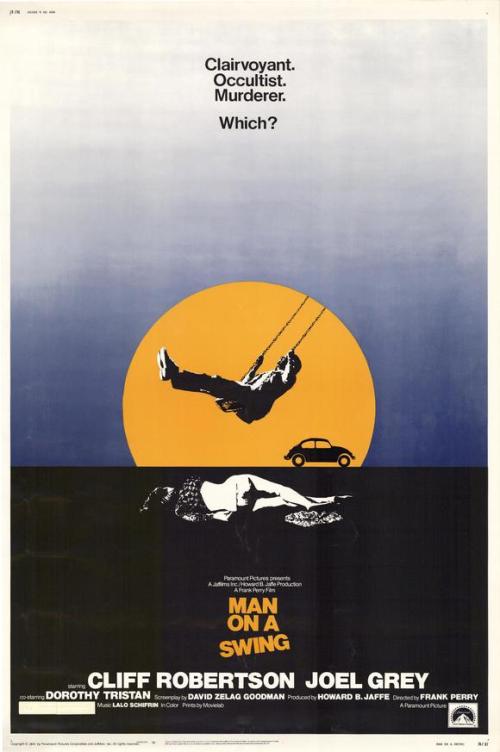
Man on a Swing (1974)

man-on-a-swing

By Richard Winters

My Rating: 6 out of 10

4-Word Review: Psychic knows too much.

On one sunny afternoon Maggie Dawson (Dianne Hull) goes out shopping and never returns. 24-hours later her strangled body is found on the floor of her car. Police detective Lee Tucker (Cliff Robertson) heads the case, but finds few clues. After all leads dry up they turn to Franklin Wills (Joel Grey) who purports to be a psychic who can help them find the culprit. Initially the police are quite impressed with his abilities, but Franklin begins to show too much knowledge about the crime and the victim making them believe that he may be the actual killer.

The film is based on the novel ‘The Girl on the Volkswagen Floor’ by William A. Clark, which itself is based on an actual incident that occurred on June 12, 1968 in Kettering, Ohio. In the real-life event a young 23-year-old school teacher by the name of Barbara Ann Butler went shopping at a discount store one day only to end up being found murdered later. Police were, like in the movie, baffled and eventually ended up using the services of a psychic named Bill Bosheers, who goes under the pseudonym of Norman Dodd in the book. Like in the film Bosheers seemed to know an extraordinarily high amount of unauthorized info about the case including the fact that the victim used prescription glasses for just one eye. Bosheers also predicted another similar crime would occur in the near future, which it did and police have long suspected that the two were done by the same person.

What makes this film interesting is the way it meticulously follows the police investigation and keeps everything at a real level including having them pursue what turns out to be a lot of false leads, which other Hollywood movies rarely tackle. Nothing gets overblown and in fact the film’s strength comes from keeping everything on a nice creepy, low-key level with the focus on Robertson’s interaction with Grey. I also liked that there is very little music and the only time that there is some is when Grey is onscreen and even then it’s quiet and nonobtrusive accentuating the creepiness without over doing it.

Although he gets stuck with a non-flamboyant part I felt Robertson does quite well and I enjoyed how his down-to-earth sensibilities continually clash with Grey’s more flighty ones although the scene where the Robertson’s character discusses the case with his wife (Dorothy Tristan) at home didn’t really mesh. The character is also seen drinking constantly to the point of being a full-fledged alcoholic and this should’ve been touched on, but isn’t.

Grey, who ironically starred in a TV-movie called Man on a String just before doing this one, is outstanding and the whole reason to watch the film as he commands every scene that he is in. The way he goes into his psychic ‘trances’ is riveting and the part where he makes his entire face turn dark red, without the use of any makeup, is genuinely startling as is his drooling after he passes out. The film is also littered with many familiar faces of up-and-coming stars too numerous to mention here, but worth spotting at seeing what they were doing before they were famous.

I enjoyed the on-location shooting done in Milford, Connecticut which takes full advantage of the small town locale and helps make the story seem even more vivid. There are several uniquely memorable moments including an exercise that Grey is forced to take to measure his psychic ability as well as his visit to a pair of psychiatrists, which is wonderfully played by Elizabeth Wilson. However, even with all these good elements the ending is a letdown as it leaves too many questions unanswered and plays like an intriguing mystery that ultimately goes nowhere.

My Rating: 6 out of 10

Released: February 27, 1974

Runtime: 1Hour 49Minutes

Rated PG

Director: Frank Perry

Studio: Paramount

Available: DVD, Blu-ray, Amazon Video

Soylent Green (1973)

soylent-green-1

By Richard Winters

My Rating: 6 out of 10

4-Word Review: People are the food.

This Review May Contain Spoilers.

The year is 2022 and the world is so overpopulated that people must sleep on stairwells and hallways and fight over getting their hands on the one and only food source called Soylent Green. Thorn (Charlton Heston) works as a police detective and assigned to a case involving the investigation of the murder of William Simonson (Joseph Cotten) who worked as a board member to Soylent industries. Thorn is convinced that there is more to the killing than simply an in-home robbery, but finds as he pursues the case that others are trying to prevent him from continuing on it, which makes him more determined to find the answers and connect-the-dots.

We’ll get the elephant out of the room right away by divulging that Soylent Green is made up of people who are killed to feed the rest of the population. Normally that would be considered a ‘spoiler’, but this film has become so well known for this ‘twist’ it that it seems almost absurd to avoid giving it away. If that ruins the film for you then I apologize, but the truth is I knew going into this how it was going to end, due to watching one of many parodies done on the movie particularly a SNL skit from years back involving Phil Hartman, and yet I came away enjoying it anyways. Mostly what I liked was the film’s neo-futuristic look that combines old buildings with a mod image and an opening sequence, which is the best part of the movie, used over the credits that was done by filmmaker Charles Braverman and shows visually through rapid-fire photographs how the world came into its bleak situation.

I was also really impressed with Heston’s performance. He is not an actor I’ve particularly enjoyed as I feel he is routinely too stiff and conveys his lines in an overly dramatic way that is quite stagey and even hammy and yet here he portrays a rough-around-the-edges man quite well and I consider this one of his best performances.

soylent-green-2

This also marks the final film of screen legend Edward G. Robinson who died only 20 days after production was completed. The scene where he and Heston eat fresh food, which is something the characters hadn’t done in a long time due to its scarcity, was completely improvised, but an excellent and memorable moment. I did feel though that there needed to be a backstory about why these two men, who had such contrasting differences in age, were living together and the fact that at one point both men say that they ‘love’ the other made me wonder if it was implied that they were gay.

The ending isn’t bad and I liked the way Thorn investigates the inner workings of the Soylent factory with the only noise coming from the plant’s machinery and no music, which makes it creepier. It is mentioned earlier though that this plant is ‘highly guarded’ and yet he is able to get into it rather easily and he walks through it for quite a bit before he is spotted by anyone and even then the men aren’t armed, which makes it seem like it isn’t too well guarded at all. Also, I didn’t get why Thorn, who is quite jaded for the most part, would get so noble and heroic once he found out the plant’s secret and feel the need to ‘warn’ others. The world they live in is quite bleak, so what is he ‘saving’ them from anyways as some may actually choose death over the squalor that they were stuck in.

The ultimate logic to this ‘clever’ twist ending doesn’t hold up too well either. For instance the idea that the company would just kill a few people here and there wouldn’t be enough to keep up with the demand and at one point does the overpopulation begin to go down? If so many are supposedly being killed to feed the others then the crowding should lessen, which again only reiterates the fact that the filmmakers hadn’t completely thought this thing through and if anything the film should’ve used Thorn’s discovery as springboard to a more complex and intricate plot instead simply relying on it as a ‘shock’ ending.

soylent-green-3

My Rating: 6 out of 10

Released: May 9, 1973

Runtime: 1Hour 37Minutes

Rated PG

Director: Richard Fleischer

Studio: MGM

Available: DVD, Blu-ray, Amazon Video, YouTube

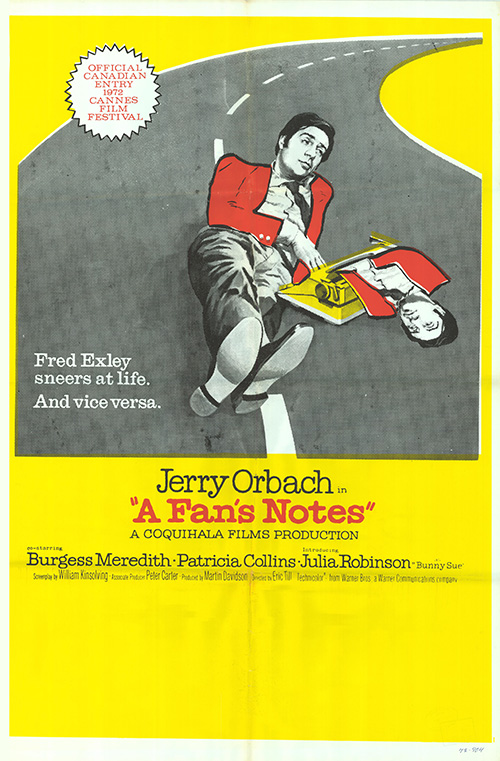
A Fan’s Notes (1972)

fan-notes

By Richard Winters

My Rating: 4 out of 10

4-Word Review: He writes about himself.

Exley (Jerry Orbach) is a loner residing in and out of mental institutions. He imagines having conversations with beautiful women, but is rarely able to approach them in real-life. He also obsesses over New York Giants running back Frank Gifford and wishes one day to achieve that same type of success, but fears that he’ll be a spectator in life just like he is in sports. He decides to begin writing about his nomadic existence in hopes that it will be a cathartic effort only to find that too harbors its own share of frustrations.

The film is based on the Frederick Exley novel of the same name, but despite the filmmaker’s best efforts it’s not able to achieve the book’s cult potential and in fact Exley himself stated that the movie “bore no relation to anything that I had written”. The idea of trying to somehow visualize a story that was never meant for the big screen is the film’s biggest issue and one that it cannot overcome no matter how hard it tries. The pacing is poor and tries awkwardly to make profound statements while at other points being zany and absurd, which is off-putting.

Orbach does well in the lead and helps hold it together. This also marks the official film debut of Julia Anne Robinson who appeared in only one other movie King of the Marvin Gardens before she tragically died in a house fire at the young age of 24. Like in that movie her acting is poor, but here it works in the positive because it makes her character seem transparent and accentuates the dream-like theme. The segment where she dresses up like a nun and then later as a street hooker, as part of Exley’s sexual fantasy, is fun as is his visit with her quirky parents (Conrad Bain, Rosemary Murphy).

Burgess Meredith appears only briefly, but practically steals it with his outrageousness. Watching him lie down on the floor in an effort to look up a blind woman’s skirt is a real hoot as is his ability to walk on his hands across the edge of a sofa.

Had the film stuck solely with the goofy comedy it might’ve worked and there are indeed a few memorable bits. The part where Exley punches an obnoxious woman (Elsa Raven) in slow motion is arresting and the segment where he imagines himself inside a scene of a his favorite soap opera where he directs the cast to strip off their clothes and have sex right in front of the camera is pretty funny too, but the best moment is the telephone conversation he has with a couple where he pretends to be a lawyer pleading with them to take-in the husband’s mentally unstable brother.

My Rating: 4 out of 10

Released: July 21, 1972

Runtime: 1Hour 32Minutes

Rated R

Director: Eric Till

Studio: Warner Brothers

Available: YouTube

All the President’s Men (1976)

all-the-presidents-men

By Richard Winters

My Rating: 6 out of 10

4-Word Review: They take down Nixon.

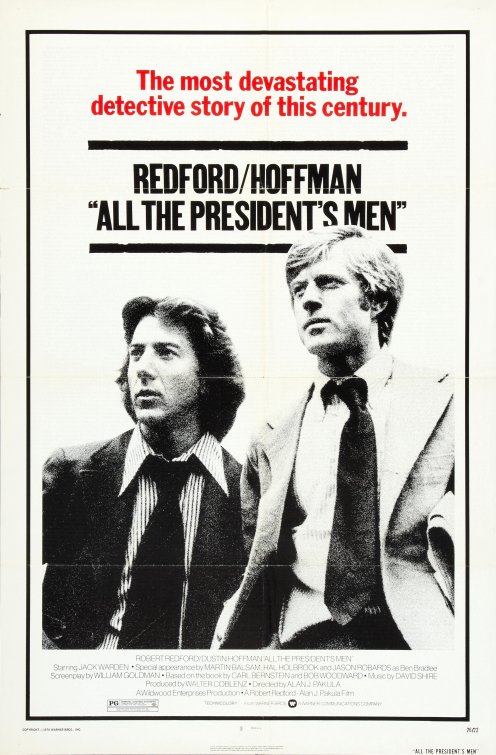
In the early morning hours of June 17, 1972 five men are found burglarizing the Democratic Headquarters at the Watergate Office complex in Washington D.C. The next day a young Washington Post reporter by the name of Bob Woodward (Robert Redford) is assigned to cover the case. Initially it was considered only a minor story, but as he digs further into the details he finds wider connections including links that lead directly to the White House. Together with Carl Bernstein (Dustin Hoffman),who is another reporter, the two men continue to research and end up battling one roadblock after another in their quest the uncover the truth.

If there is one area where this film really scores in it’s in the way that a journalist’s job gets portrayed. In fact many colleges show this film to their student who are majoring in the field in order to given them a realistic perspective of what the profession actually involves. For me I found it quite enlightening particularly the first hour. The many people and steps that a reporter has to go through just to get one solid lead is interesting as is the protocol system determining which story gets the front page and which don’t.

The layout of the newsroom was also fascinating as it all seemed very authentic and like they were working in an actual one. To my absolute shock I found out later that it had all been constructed on a film set, but so meticulously done that you couldn’t tell the difference. Initially several scenes were filmed in the real office using actual employees in the background, but the knowledge of being on camera made some behave in ways that they normally wouldn’t and this ultimately forced the filmmakers to decide to recreate it on a soundstage and use actors as the office crew.

The performances by the two leads are good, but neither of them resembles their real-life counterparts. Both Redford and Hoffman were already pushing 40 at the time and looking it while Woodward and Bernstein were still in their 20’s when this story occurred so the line that the Jack Warden’s character makes about these two being ‘young and hungry’ and looking for a good story to build their careers on doesn’t make as much sense.

The characters aren’t well fleshed out either. No time is spent on what these guys were like when not ardently following up leads, which is absolutely all we see them doing.  The original screenplay, which was written by Woodward and Bernstein, had a subplot involving the two trying to score with women, which would’ve helped add a comical touch and parts of that should’ve been kept in.

The second half lags as there are too many leads and names that get bantered about that don’t have faces connected to them making it seem like information overload that doesn’t help the viewer get as emotionally involved as they should. Having cutaways showing Nixon and/or is aides becoming increasingly more paranoid as the reporters closed in on them could’ve added that much needed extra dimension.

There is a stunning bird’s-eye shot of the inside of the Library of Congress, which is amazing and the fact that many of the scenes get filmed at the actual sites where the real-life instances occurred is both impressive and commendable. I also enjoyed the wide-array of recognizable faces that show up in bit parts including Valerie Curtain as a frightened source and Polly Holliday as an evasive secretary. They even cast Frank Wills the real-life security guard who broke the case wide open playing himself in the film’s opening scene, which is cool even though for me the film’s second half fails to be as entertaining as the first, which prevents it from being a classic.

My Rating: 6 out of 10

Released: April 4, 1976

Runtime: 2Hours 19Minutes

Rated PG

Director: Alan J. Pakula

Studio: Warner Brothers

Available: DVD, Blu-ray, Amazon Video, YouTube

Firestarter (1984)

firestarter

By Richard Winters

My Rating: 5 out of 10

4-Word Review: Girl has fire power.

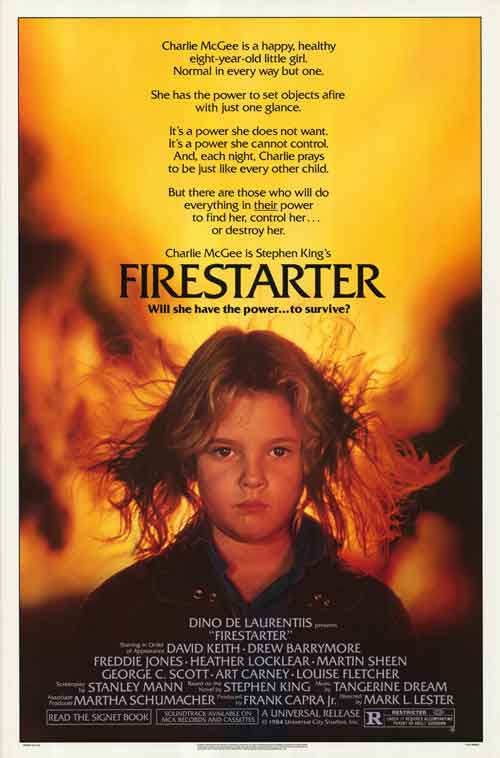
Andrew (David Keith) and Victoria (Heather Locklear) are two struggling college students who in an attempt to make some extra money decide to take part in medical study where they receive injections of a drug that give them telepathic abilities. They later get married and have a child named Charlene (Drew Barrymore) who has the same type of abilities except hers allows her to start fires using only her mind. Now a secret governmental agency known as The Shop seeks to kidnap Charlene so they can use her abilities for their own nefarious means, which sends Charlene and her father on a cross-country run to try and escape the agency’s clutches.

If there is one thing that really stands out in this movie and makes it worth the watch it’s Drew’s performance. She was only 8 at the time, but has a presence and acting awareness that was well beyond her years and she easily upstages her more seasoned co-stars. Her character isn’t completely fleshed-out and I’ll agree with Roger Ebert in his review that she was created more like a “plot gimmick”, than anything, but Drew still makes it engaging nonetheless. My only real complaint with her character is why, when she does get apprehended by the governmental agency, that she doesn’t she just use her fire ability to burn down the door of the room that she is trapped in to escape?

George C. Scott is an equally interesting as the bad guy even though he ends up being trapped into the same type of contrived character with motivations, particularly his reasons for befriending the girl, that seem quite nebulous and even illogical. However, his presence lends an added edge and I loved his ponytail as well as the contact lens put into his left eye that gives him an android-type appearance.

The rest of the cast though does not fare as well. Art Carney and Louise Fletcher, two Academy Award winners, get stuck in a small, almost insignificant roles as a father and daughter farm family who temporarily takes in Andrew and Charlene when they are on the run, which is okay, but the idea that this same couple would later happily take in Charlene again after they had witnessed her frightening ability first-hand and the burning deaths of several people that she helped create is ridiculous. In reality they would’ve seen her as some sort of ‘freak’ to be wary of and scared that she might do the same thing to them one day and thus want nothing to do with and certainly not welcomed back into their home.

As for the plot it’s okay, but it takes quite a while to get going and only becomes moderately gripping during the second-half. The script is based of course on a Stephen King novel and the scenes showing Charlene setting various people and things on fire seemed too much like an offshoot to King’s more famous Carrie character and thus the originality is lost. There’s also just so much objects/people being set on fire one can watch before it starts getting redundant, which makes the climactic finish boring, lame and even laughable.

I also wasn’t sure how Charlene was able to stop bullets from hitting her. This subject gets discussed in a thread on IMDb with some posters surmising that it was apparently a ‘heat shield’ that she was able to create through her pyrokinesis. However, if that was the case then it should’ve gotten explained earlier otherwise it comes off looking like the filmmakers were just making up the rules as they went whenever it was convenient for them.

My Rating: 5 out of 10

Released: May 11, 1984

Runtime: 1Hour 54Minutes

Rated R

Director: Mark L. Lester

Studio: Universal

Available: DVD, Amazon Video, YouTube
Scarface (1983)

scarface

By Richard Winters

My Rating: 6 out of 10

4-Word Review: Refugee becomes drug lord.

Tony Montana (Al Pacino) is a Cuban refugee arriving in Miami hoping to make it big in the land of opportunity. At first he is forced to do low paying jobs, but finally gets his break when he is hired to do a job for a rich drug dealer named Frank Garcia (Robert Loggia). Soon Tony becomes infatuated with Frank’s girlfriend Elvira (Michelle Pfeiffer) and the two begin a torrid affair. When Frank tries to assassinate Tony by ordering a hit on him at a nightclub Tony gets his revenge by killing Frank and becoming the top drug lord, which makes him quite wealthy, but the strain of constantly having to watch his back for whoever may be out to get him eventually wears on his personality.

This is a remake of the 1932 Howard Hawk’s classic that came about when Pacino watched the original film in a theater and felt compelled to make a modern day update with the drugs being the source of the criminal activity instead of alcohol. The result is only so-so, but it gets helped immensely by an incredible set design. Tony’s all-black office and a luxurious hot tub placed in the middle of his already kitschy living room are eye-popping as are the chic and lively interiors of the nightclubs, posh restaurants and exotic resorts. The graphic shootouts are equally arresting and keenly shot and edited for ultimate excitement.

Director Brian De Palma again digs into his bag of borrowed Hitchcock shots in order to tell his story, but here it works pretty well. My favorite one is when he uses the camera to track outside of a room where the action is occurring and onto a quiet street below. Hitchcock did the same thing in Frenzy where the bad guy strangles a woman inside her apartment, but instead of showing the violent act the camera moves out of the apartment and onto a busy street outside. Here the camera takes an equally fascinating journey from a man getting chopped up by a chainsaw to an idyllic afternoon day just a few feet away.

The supporting cast is strong particularly Pfeiffer as Tony’s bitchy girlfriend whose ongoing acerbic responses act as a good barometer to Tony’s ever changing social standing. I also enjoyed the transformation of Loggia’s character from intimidating kingpin to wilting coward. Harris Yulin is also memorable as a corrupt cop who ends up playing things a little too cool for his own good.

The thing I hated about the movie was Pacino’s over-the-top performance. Normally I’ve found him to be a great actor, but here the character comes off as too cartoonish and one-dimensional. He possesses no interesting character arch and is creepy and unlikable from the beginning and proceeds to only get worse as it goes along, which makes following his rise and fall quite boring and predictable.

The runtime is too long and encompasses a lot of lulls in between the action bits in a story that seems to telegraph where it’s going right from the start. The Cubans are also portrayed in a negative and stereotypical way with only a slight attempt to balance it. Had it not been for the excellent production values this thing would’ve been a real bore.

I was also confused as to why Charles Durning’s voice gets dubbed in during a scene involving Tony’s conversation with an immigration officer. If De Palma was unhappy with the original actor’s performance as the immigration officer then he should have re-filmed it with Durning present instead of just using his voice because his style of speaking is quite distinctive and I was thrown out of the scene completely due to wondering why I was hearing Durning’s voice, but not seeing him.

My Rating: 6 out of 10

Released: December 9, 1983

Runtime: 2Hours 50Minutes

Rated R

Director: Brian De Palma

Studio: Universal

Available: DVD, Blu-ray, Amazon Instant Video, YouTube

Peeper (1976)

peeper-4

By Richard Winters

My Rating: 6 out of 10

4-Word Review: Searching for client’s daughter.

Leslie C. Tucker (Michael Caine) is a British private eye working in L.A. who gets hired on by an eccentric client named Anglich (Michael Constantine) to find his long lost daughter that was born 24 years ago and now resides he believes somewhere in Hollywood. Tucker tries following the skimpy clues and this leads him to a beautiful woman named Ellen (Natalie Wood) who he believes just may be that daughter and not even know it, but the closer he gets to some answers the more questions he has to tackle as well as being chased by a pair of hoods (Timothy Carey, Don Calfa) who are out to stop him.

This film is based on a novel by Keith Laumer with a screenplay written by W.D. Richter and directed by Peter Hyams. With such talented people involved you’d think this would’ve been a winner, but it bombed at the box office and I’m not completely sure why. The ingredients are there, but the oversaturation of private eye parodies during the ‘70s could’ve gotten this one lost in the shuffle.

The film though is filled with snappy dialogue and some highly amusing voice-over narration by the Tucker character. There are also unique scenes including a car chase that takes place amidst a major traffic jam and a cool foot chase sequence down a long, winding spiral staircase. I also loved the scene where Tucker is trapped in a car with an angry dog outside only for him to miraculously turn-the-tables on the animal where he gets outside while the dog ends up stuck in the vehicle. The best moment though is at the beginning when actor Guy Marks does his impersonation of Humphrey Bogart while standing in a dark alley and reciting the opening credits instead of having them shown on screen.

As much as I love Michael Caine I found him to be wrong for this role. If you’re going to do a light parody of old school private eye films then you have to cast someone in the lead that would reflect to some degree Bogart. It certainly doesn’t have to be an impersonator, but someone that is from Brooklyn and has a New York mentality as opposed to a transplanted Englishman with a British accent.

Wood is equally miscast. This was her first theatrical feature in 7 years and she turned down a role in The Towering Inferno to do this one and I’m not sure why. The part is rather small and offers little range in either acting or character development and with everything else that goes on in the story she ends up getting forgotten though it does have a foreboding quality in that the final segment involves her on a boat and near water.

The mystery itself ends up being the worst thing. It’s too intricate and filled with so many rapidly paced twists that it becomes almost impossible to follow. The action is enough to keep it interesting, but as a compelling plot it fails. I also wasn’t too crazy about the title. The working title was ‘Fat Chance’, which I didn’t like either, but peeper is slang for a private eye who takes a lot of photographs, which this detective doesn’t do at all.

My Rating: 6 out of 10

Released: January 6, 1976

Runtime: 1Hour 27Minutes

Rated PG

Director: Peter Hyams

Studio: 20th Century Fox

Available: DVD, Amazon Instant Video

Pin (1988)

pin-1

By Richard Winters

My Rating: 5 out of 10

4-Word Review: He befriends a dummy.

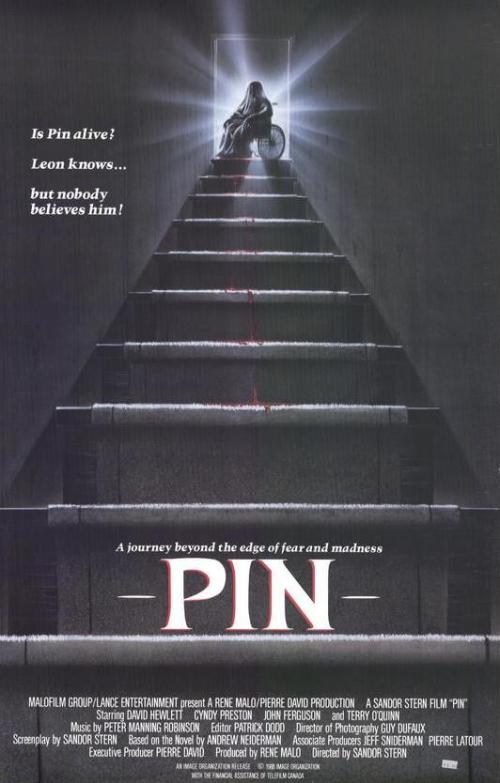
Leon (David Hewlett) and Ursula (Cynthia Preston) are brother and sister growing up in a large home run by their stern father (Terry O’ Quinn) who works as a doctor and has an anatomically correct dummy named Pin in his office. Sometimes to entertain the children he gets the dummy to talk, by throwing his voice to make it seem like it’s the dummies. As the children get older Leon remains convinced that the dummy can speak and begins to have an unhealthy fixation with him that concerns his sister. When the parents end up dying in a tragic car accident the sister and brother get the house all to themselves and Leon becomes even more possessive about Pin and anyone who dares make fun of him or Pin pays the ultimate price.

This intriguing film manages to be captivating throughout thanks mainly to an intelligent script and some excellent performances by its two leads. The casting is top-notch including the fact that the different actors who represent Leon and Ursula as they grow from children to young adults look very similar, which is a major achievement since many other movies aren’t as adept with this and cast child performers that do not effectively resemble their adult counterparts.

It’s also refreshing that Leon’s character is not a complete derelict, but instead quite cultured and educated, which makes his weird child-like fixation with the dummy all the more creepy. I also enjoyed O’Quinn as the father and the scene where he performs an abortion on his own daughter and tries to force his son to watch it is really twisted.

The scares though are lacking and there are only a couple of murders, which aren’t all that dramatic or impressive. Pin is also not frightening to look at and in fact becomes downright boring. Most horror films would’ve exaggerated some characteristic of the dummy to give him more of a creepy effect, which is what this one should’ve done. It also would’ve helped had there been a surreal moment where we saw things from Leon’s point-of-view and witnessed the doll actually speaking or even just moving.

Spoiler Alert!

The film’s ending though is the script’s weakest point. It involves Ursula attacking Leon with an ax after she realizes that he has just killed her boyfriend (John Pyper-Ferguson), but then the film cuts away making it confusing as to what happens. It then cuts to show Leon sitting in a wheelchair and having taken on the personality of Pin as apparently that’s who she cut up, but the film would’ve been more interesting had it shown the doll getting destroyed and even doing some of it in slow-motion especially since its devoid of much action otherwise.

The idea of a person taking the personality of an inanimate object that they earlier thought was real is nothing new. The same fate occurred to the Anthony Hopkins’ character in Magic where he played a ventriloquist who thought his dummy could talk as well as to another ventriloquist character in a classic episode of ‘The Twilight Zone’, which makes the twist here less interesting and almost predictable. A more surprising element would’ve been to have the dummy suddenly come to life when Ursula attacks it and then killing her.

It also seemed ridiculous that Leon would remain living in his large, stately home in a sort of vegetative state after being caught attempting to murder the boyfriend while apparently being cared for by a round-the-clock nurse is not believable as the cost of his medical care would dry up any funds that he had in his inheritance and making his continued stay at the home completely impractical. In reality the court appointed doctors would’ve deemed him mentally ill and a menace to society while also advising that he be sent away to a secure and monitored mental facility.

End of Spoiler Alert!

My Rating: 5 out of 10

Released: November 25, 1988

Runtime: 1Hour 43Minutes

Rated R

Director: Sandor Stern

Studio: New World Pictures

Available: DVD

The Beast Within (1982)

beast-within

By Richard Winters

My Rating: 3 out of 10

4-Word Review: Teen turns into monster.

On the night of their honeymoon Eli and Caroline (Ronny Cox, Bibi Besch) become stranded on the side of a road. Eli goes for help while Caroline remains in the car only to end up getting raped by a mysterious beast that escapes from a nearby farmhouse. 17 years later Michael (Paul Clemens), who became the product of that ugly incident, begins to show signs of erratic behavior that doctors are unable to find the cause to. Eli and Caroline decide to go back to Nioba, Mississippi where the assault took place in order to find out who it was that raped her and see if he or his family may have any genetic abnormalities that Michael may have inherited. However, before they can do anything Michael’s condition worsens and he changes into a monstrous, homicidal maniac that resembles the spirit of an abused child that had long ago been buried away by the townspeople.

One of the pluses to this film is its supporting cast that is filled with B-movie regulars who do their best to liven up the proceedings with their eccentric characterizations. Logan Ramsey is a lot fun as the town’s newspaper editor and in some ways proves even more entertaining as a corpse. R.G. Armstrong is good as the town’s physician and I especially liked his squeeze toy. Luke Askew has a few choice moments as an embalmer and Don Gordon, who wears a wig, has a solid bit near the end as a corrupt judge.  John Dennis Johnston as an overprotective father and L.Q. Jones as the sheriff help round it out.

Unfortunately the three leads are boring although I was amused at how much Besch resembles actress Eleanor Parker who was star Clemen’s mother in real-life. Clemens though as an actor is weak and looks too creepy from the beginning especially his eyes which make his transformation into a monster less dramatic and would’ve worked better had he had more of a clean-cut blonde, blue-eyed look.

Tom Holland’s script tries to cover every type of horror niche by treating the viewer to elements of southern gothic, ghost stories, possession, monsters, slashers and gore, which may sound interesting, but eventually becomes overplayed. There are also some loopholes to it that doesn’t quite make sense and the rape segment shouldn’t have been shown right away, but instead used as a flashback later on. Also, Michael is described by his father as being ‘normal kid’ who never showed any signs of odd behavior, but it would’ve been more vivid had we seen him as a regular teen instead of it starting out with him already acting strangely.

The transformation scene in which Michael turns into a grotesque looking creature might actually make you sick to your stomach, but it’s impressive. This was the first film to use air bladders, which were made up of condoms that were connected to air hoses that were put underneath the actor’s face casting and then inflated to give the appearance of the skin ‘bubbling’, which is pretty cool and worth checking out for this scene alone, which is by far the best moment in the movie.

My Rating: 3 out of 10

Released: February 12, 1982

Runtime: 1Hour 38Minutes

Rated R

Director: Phillippe Mora

Studio: United Artists

Available: DVD, Blu-ray, Amazon Instant Video, YouTube

The Walking Stick (1970)

walking-stick

By Richard Winters

My Rating: 4 out of 10

4-Word Review: Polio victim becomes pawn.

Deborah (Samantha Eggar) is a shy, lonely woman who suffered from polio as a young girl and now must rely on the use of a cane to get around. She still lives with her parents while suffering from claustrophobic tendencies due to being locked inside an iron lung as a child. She meets Leigh (David Hemmings) a struggling artist at a party and he asks her out. Initially she resists his advances, but eventually gives in. The two form a tight bound and even move in together, but her fairytale romance is short-lived once she realizes that she’s been pegged as a pawn and simply used by his gang for her inside knowledge of the auction house where she works to pull off a daring robbery.

The film, which is based on the novel by Winston Graham, is quite leisurely paced. To a degree I didn’t find this to be a problem as it still managed to hold my interest, but too much time is spent on the romance making it seem more like a drama.

The robbery and its planning doesn’t come into play until well over an hour in and seems like a whole different movie altogether. Certain hints should’ve been brought in from the beginning to make it clear to the viewer that despite all the romance this was still meant to be a thriller, which is just not obvious at all. The crime scenes do at least provide some action and quick edits, which normally would’ve made it exciting, but because it takes so long to get there it comes off as off-putting instead. The intended tension doesn’t work because we are less concerned if Leigh and his gang are going to get away with it and more upset at seeing Deborah being taken advantage of.

Eggar gives an outstanding performance and seeing this normally effervescent woman wearing a perpetual frown seemed almost startling, but she conveys her characters inner unhappiness quite well and mostly through her facial expressions alone. However, her character is also quite cold and acerbic. To a degree this is understandable as it’s clearly just a defense, but the viewer never sees enough of her softer side and therefore doesn’t emotional bond with her as they should.

Hemming’s more outgoing personality creates a nice contrast to Eggar’s introverted one, but his character is pretty benign. Dudley Sutton who plays his cohort would’ve made a better boyfriend as he is good at showing a dark side and would’ve kept the viewer more on edge.

The ending doesn’t provide any type of clear wrap-up and leaves a lot of loose ends hanging, which is a pity. The production values are decent and I liked the flashback scenes showing Debora being put into an iron lung, which is the film’s best cinematic moments, but the pace needed to be tighter with more emphasis placed on the story’s twists and turns.

My Rating: 4 out of 10

Released: April 15, 1970

Runtime: 1Hour 41Minutes

Rated GP

Director: Eric Till

Studio: MGM

Available: DVD-R (Warner Archive), Amazon Instant Video