Category Archives: Movies Based on Novels

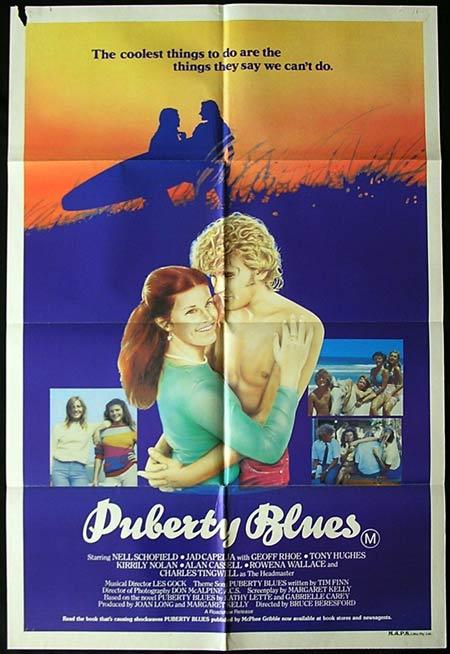
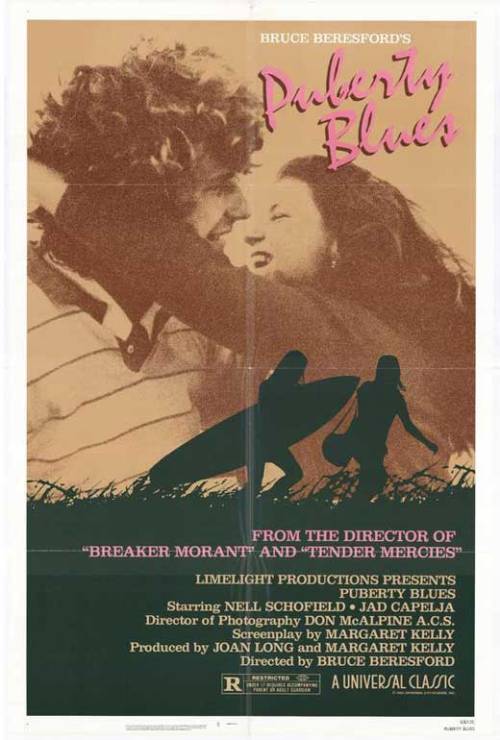
Puberty Blues (1981)

puberty-blues-2

By Richard Winters

My Rating: 6 out of 10

4-Word Review: Girls can surf too!

Debbie and Sue (Nell Schofield, Jad Capelja) are best friends attending high school in the south suburbs of Sydney. They desperately want to fit-in with the surfer group, but find that this means being pressured into having sex and experimenting with drugs and alcohol that starts to take its toll on both their grades and family life. When Debbie thinks she’s gotten pregnant by Gary (Geoff Rhoe) and he responds with indifference she realizes that the surfers aren’t as cool as she thought and pledges to become more independent by trying to do some surfing of her own, which she is told ‘girls can’t do’.

The film is based on the novel by Gabrielle Carey and Kathy Lette who became best friends at age 12 and at 16 began writing stories based on their high school experiences. While attending a writer’s workshop they met Margaret Kelly who worked as a writer in television and was impressed with the girl’s output. She got their stories optioned into a screenplay while the girls went on to write a weekly newspaper column under the byline of The Salami Sisters and their stories were eventually published into a novel. The big change between the movie and the novel is that in the book the girls were only 13 while in the movie it gets upped to 16 since that was Australia’s age of consent.

Director Bruce Beresford ends up tearing away the mystique from teen life in much the same way that he did to suburbia in Don’s Party, which leaves the viewer with a far more caustic take on the high school experience than the Hollywood version, which tends to play up the teen scene like it’s just one big raucous party. Here the cool kids are vapid, crass creatures who are unable to hold any type of interesting conversation. Their parties are lifeless affairs where they aimlessly sit around and get drunk because they have nothing better to do while the sex is shown to be an unpleasant experience for the girls who get pressured into doing it before they’re ready and leave feeling used afterwards.

This was more the way I remembered high school being and I was impressed with the film’s honesty, but the pace is too leisurely and not enough happens. There is some drama when Debbie thinks she is pregnant, but it takes an entire hour just to get there and a comical segment dealing with a goofy fight amongst the surfers, which was not in the book, is completely unnecessary.

The film though does have some funny bits including a scene where Debra brings her boyfriend Bruce (Jay Hackett) over to meet her parents (Kirrilly Nolan, Alan Cassell) as well as the shots showing the interior and exterior of Bruce’s van. This though gets coupled with an uncomfortable moment dealing with a homely girl (Tina Robinson Hansen) who gets tricked into getting into the guy’s van where she is forced into a gang bang before being coldly thrown onto the curb afterwards.

The best part is the ending where the girls grow in confidence and become unafraid at challenging the status quo. Seeing the shocked expressions  of the cool kids as they watch the girls get on surf boards for the first time and succeed at something they were told only guys could do is a treat and makes the rest of the film worth sitting through.

Many years later this movie spawned a TV-series as well as a special that aired in 2012 on Australian TV where Nell Schofield traveled back to the locations where the film was made. Unfortunately her costar Jad Capelja was not present as she had already killed herself in 2010 after spending years battling drug addiction and mental illness.

puberty-blues-1

My Rating: 6 out of 10

Released: December 10, 1981

Runtime: 1Hour 27Minutes

Rated R

Director: Bruce Beresford

Studio: Roadshow Film Distributors

Available: VHS, DVD (Pal Region 0), Blu-ray (Region B/2)

Picnic at Hanging Rock (1975)

picnic-at-hanging-rock-1

By Richard Winters

My Rating: 6 out of 10

4-Word Review: Where are the schoolgirls?

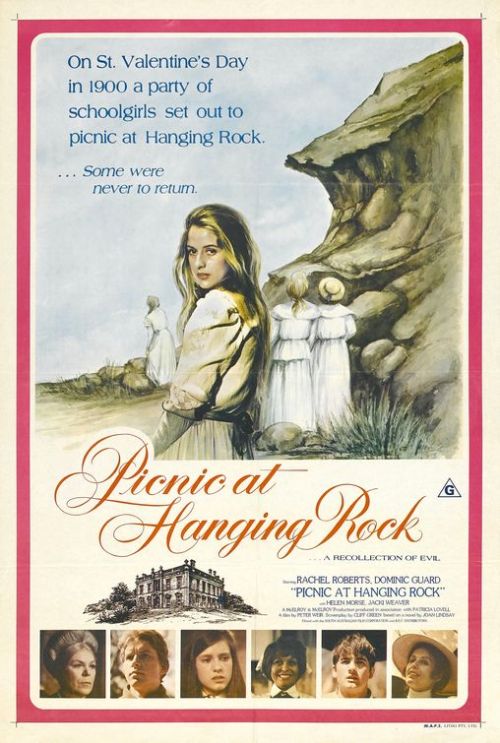
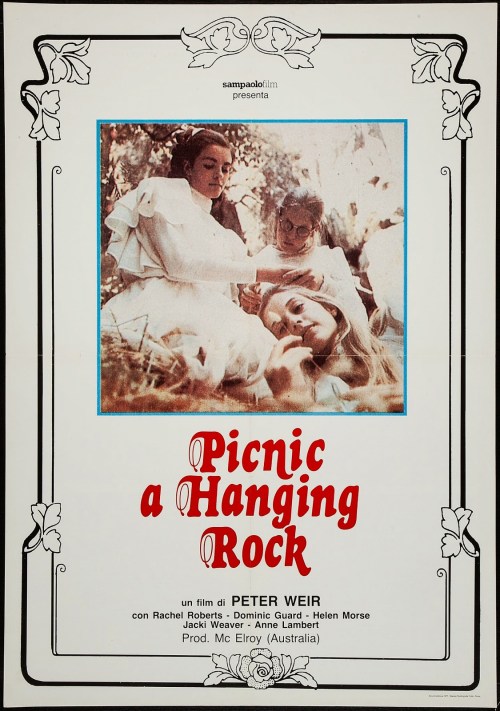
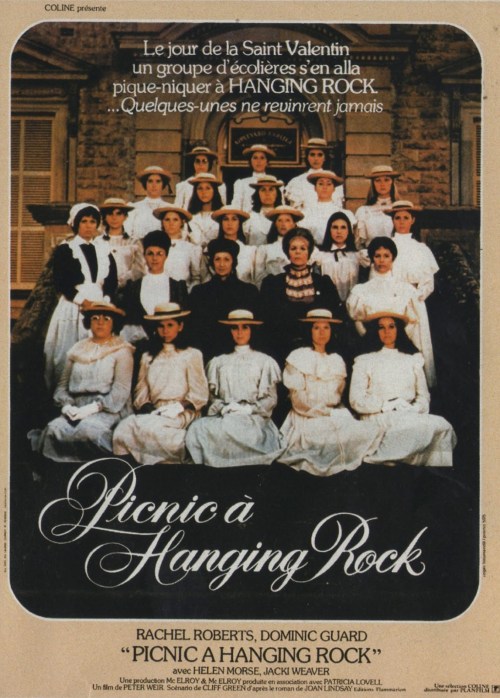
On Valentine’s Day in the year 1900 a group of Australian schoolgirls and two teachers (Vivean Gray, Helen Morse) set out to a rock formation known as Hanging Rock for a picnic. While there one of the girls named Miranda (Anne-Louise Lambert) decides to go exploring and three of the other girls follow. They proceed to climb the rocks, which frightens one of the girls (Christine Schuler) who runs back. By that evening the other three haven’t been located and a search party goes out by the local police to find them, which only leads to more questions than answers.

If one is in to mood pieces then this thing will be the perfect fit. The music and director Peter Weir’s ability to capture the rock formations in a way that makes them seem creepy and menacing is very well done. I found myself being strangely captivated most of the way while also impressed that the whole thing gets captured through a camera lens with a piece of bridal veil hung over it.

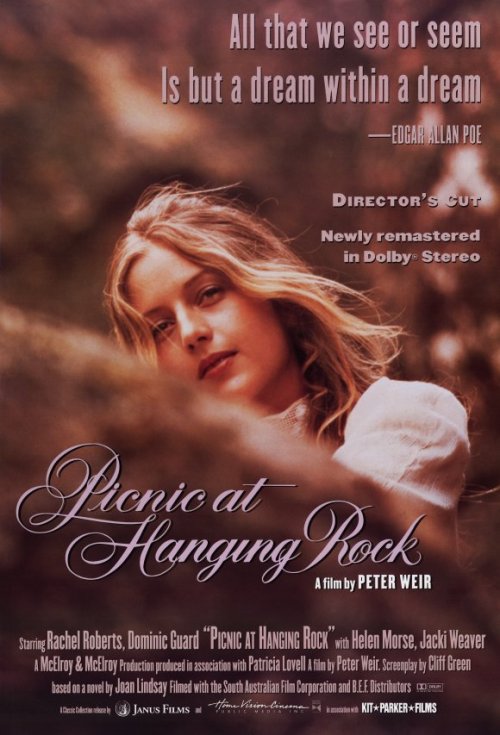
The story is based on the 1967 best-selling novel of the same name by Joan Lindsay. Despite many rumors to the effect and a follow-up novel called ‘The Murders at Hanging Rock’ this was not in any way based on a true story. Originally Lindsay wrote a resolution to the mystery that had the girls entering into some sort of time warp, but at the last minute that chapter was excised at the suggestion of her publisher, but then later published in 1987 as ‘The Secret of Hanging Rock’.

picnic-at-hanging-rock-2

The film on the other hand offers no resolution of any kind. Instead like in the book the main emphasis is on how the disappearance affects the people at the school and in the town. Rachel Roberts is a standout in this area playing the strict headmistress Mrs. Appleyard who initially comes off as quite composed and in control, but as the toll of the mystery continues her character unravels in increasingly more shocking ways, which is the film’s highlight.

Despite its cult following and the fact that it is included in the book ‘1001 Movies You Must See Before You Die’ I still came away frustrated and feeling like not enough happened to justify having to sit through two hours of viewing. On the technical end it is excellent and watching the different ways people cope and respond to the mystery is interesting, but this could’ve been played up a lot more.

Sometimes movies with vague endings are good as life doesn’t always give us nice and tidy wrap-ups, but this is one instance where it would’ve been better had there been more of a conclusion even if it had just thrown out some clues and then allowed the viewer to come to their own deductions. To some extent it does this as supernatural elements are introduced as well as the idea that it might’ve been a sexual crime, but even this is off-putting because it’s not connected to anything concrete or tangible and thus makes it all the more evasive.

Had this been based on an actual mystery, which for years is what a lot of people thought, then it would’ve been more acceptable and even fascinating, but the fact that it’s all made up hurts it and tears away the mystique that for a long time it relished under.

picnic-at-hanging-rock-3

picnic-at-hanging-rock-4

My Rating: 6 out of 10

Released: August 8, 1975

Runtime: 1Hour 47Minutes (Director’s Cut)

Rated PG

Director: Peter Weir

Studio: The Australian Film Commission

Available: DVD (Criterion Collection), Blu-ray (Region B/2), Amazon Instant Video, YouTube

picnic-5

This is a 2014 pic of Anne-Louise Lambert, who played Miranda in the film, sitting at the location of where the movie was filmed.

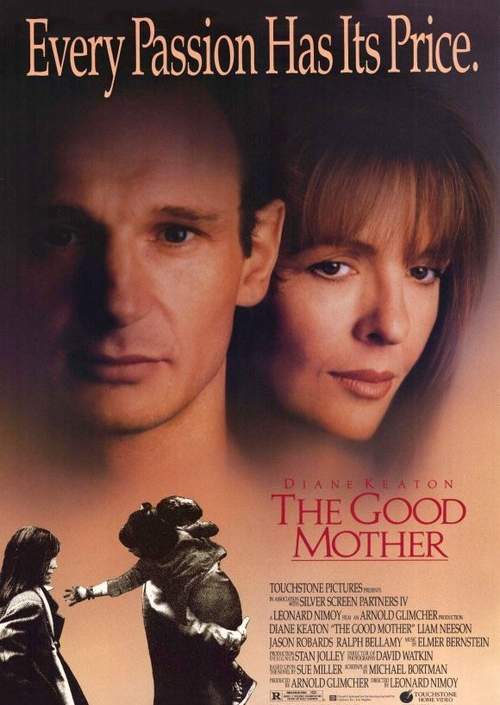
The Good Mother (1988)

good-mother

By Richard Winters

My Rating: 4 out of 10

4-Word Review: She losses her daughter.

Anna (Diane Keaton) is a frigid woman who divorces her husband Brian (James Naughton) of many years and gets joint custody of their 6-year-old daughter Molly (Asia Vieira). After spending some time being single she meets up with an artist named Leo (Liam Neeson) who opens her up to a whole new sexual awakening. Her new liberated lifestyle affects her daughter as well. When Molly catches Leo getting out of the shower naked she inquires if she can touch his penis, which he allows and then later she crawls into bed with the couple as they make love. When Brian hears about this he demands full custody, which pits Anna against Leo as she fights the system to keep her daughter.

Keaton’s performance is the best thing as she plays the mother role for the third time in a decade and the exact reverse predicament of the character that she portrayed just before doing this one where she got stuck with a child that she didn’t want while here she loses one. I enjoyed Neeson’s Irish accent and Vieira is cute while it’s great seeing old-timers Ralph Bellamy and Teresa Wright in supporting roles.

Leonard Nimoy’s direction is solid for the most part. He was just coming off tremendous success with his earlier hit 3 Men and a Baby, so it was nice to see him take a creative challenge by tackling a different genre.  The story’s sensitive subject matter  is handled well including most importantly the scene showing the girl in bed with the two adults although the various other moments showing Anna’s and Leo’s intimacy is a little uncomfortable, but still captured tastefully without ever feeling that it is being overtly erotic.

The film’s biggest failing is the story itself. Although based on the best-selling novel by Sue Miller it doesn’t have enough twists to be compelling or enough of a visual quality to be cinematic. Too much time is spent at the beginning dealing with Anna’s childhood experiences with her cousin Babe (Tracy Griffith) that only has a thin connection to the rest of the plot and could’ve easily been cut and simply alluded to instead. The courtroom scenes lack impact and offer no new interesting revelations. The film also doesn’t bother to show two of the story’s most dramatic moments, which is when Molly tells her father about her experiences with Leo, or when Anna confronts Leo about it later, which to me should’ve been a must.

The ending leaves little impact making me wonder what point the filmmakers where trying to convey, or why a viewer should sit through it especially since it’s not based on a true story and meanders too long just for it to come to a very vague resolution.

My Rating: 4 out of 10

Released: November 4, 1988

Runtime: 1Hour 43Minutes

Rated R

Director: Leonard Nimoy

Studio: Touchstone Pictures

Available: DVD, Amazon Instant Video, YouTube

Walkabout (1971)

walkabout 1

By Richard Winters

My Rating: 7 out of 10

4-Word Review: Lost in the outback.

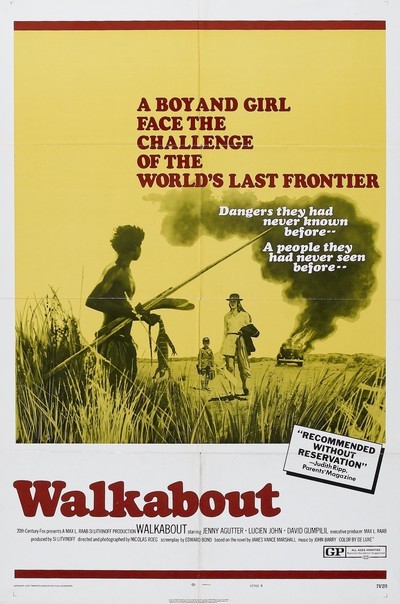
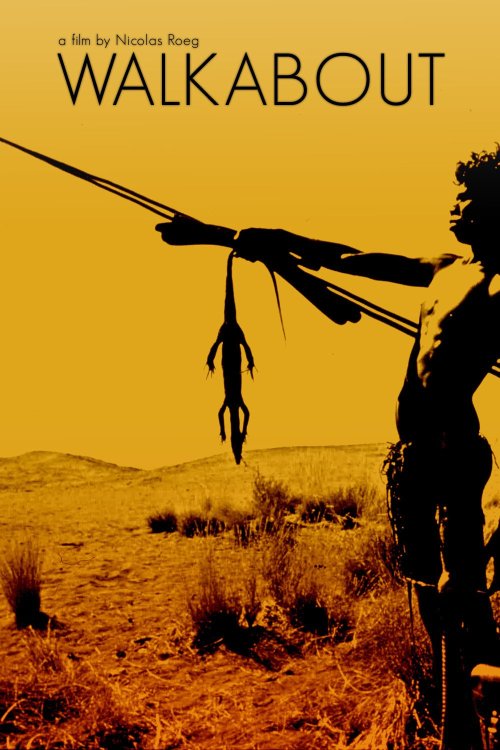
A teenage girl (Jenny Agutter) and her younger brother (Luc Roeg, but billed as Lucien John) find themselves trapped amidst the harsh climate of the Australian outback. After spending a couple of days walking in the heat they manage to come upon a watering hole, but find to their horror that it dries up overnight. Feeling almost ready to give up they spot an aborigine (David Gulpilil in his film debut) marauding through the desert as part of his walkabout where young men are cast off into the wilderness for several months as part of their journey to manhood. He helps find them water, food and shelter, but eventually the cultural differences between the three and their inability to effectively communicate become a problem.

The legendary Nicholas Roeg makes his directorial debut here and even casts his own son, who is excellent, as the 9-year-old boy.  The way the camera captures the desert by focusing on the different types of animal life and rock formations is impressive.  I also enjoyed the editing which cuts back and forth between the desert and modern civilization while examining how each are uniquely connected and commenting on how our advanced culture has made us regress and less able to survive the savage elements that our ancestors were able to.

There are also scenes of animal cruelty as the aborigine hunts a kangaroo by first injuring him and then, as the animal gives out a whimpering cry, he spears it. Later the viewer is shown scenes involving big game hunters who mow down water buffalo for sport while graphically slitting their throats.

The film was controversial for capturing Agutter, who was only 17 at the time that this was filmed, in the nude while swimming at a watering hole. The actress felt uncomfortable doing the scene and required only the minimum of the crew to be present while it was shot. To me the scene was unnecessary as it didn’t fit the character who was prim and proper and didn’t at all come off like the type of person who would suddenly become carefree and risk being spotted by the aborigine that she really didn’t know or the ‘embarrassment’ of being seen by her younger brother. The camera stays on her naked body far longer than needed and comes off like shameless voyeurism.

I had the same issue with the scene involving researchers at a weather station that resembles footage to a soft core porn flick instead as the men ogle the only woman in their group, become overtly aroused at glimpses of her bosom and in one truly absurd moment even has one of the them sucking on her finger. I realize scientists have sex drives too, but I would think they would be able to behave in a professional capacity when on the job and not act like they hadn’t gotten laid in years and like with the swimming sequence this scene has nothing to do with the main story and could’ve been cut out completely.

The presence of the radio weakens the story as well as supposedly they’re in the middle of nowhere and miles from civilization and yet somehow are able to pick up different radio stations that come in crystal clear without any static, which would mean that they must be much closer to a city than it seems and thus hurts the desolate feeling that the film otherwise tries hard to create.

Spoiler Alert!

The film is based on a 1959 novel of the same name that was written by Donald Gordon Payne under the pseudonym of James Vance Marshall. The script though differs from the book in two major ways, one of which I liked and the other I didn’t.

The first difference involves the reason for how the two children get stranded. In the book they are victims of a plane crash, but in the film it is because their father tries to kill them, which is offbeat and sends the message that this movie will be different from any you’ve seen before, which I liked. Normally I would’ve wanted an explanation for his behavior, but by keeping it a mystery it elevates the intrigue and if anything was a far more creative explanation for their predicament than the formulaic plane crash one.

However, the way the aborigine dies is ludicrous. In the book he is stricken with the flu virus that was inadvertently passed onto him by the boy, but in the movie he ends up killing himself when the girl does not respond to his attempts at courtship, which seemed excessively rash.

Rejection is a part of the human experience and transcends all cultures. Everyone will have to deal with it at some point in their lives. If everyone killed themselves the minute they are rebuffed by someone they were attracted to then virtually no one on would make it past adolescence. The idea that a normal, healthy and otherwise happy young man with no signs of mental illness, and the film does not show him as having any so we must assume that he doesn’t, would suddenly off himself over a girl he has just met and barely knew is absurd. In reality he probably would’ve just gotten frustrated and left them stranded while going back to his own tribe where I presume he’d meet other women who he’d bond better with due to being more culturally connected and most likely would’ve found more attractive anyways.

End of Spoiler Alert!

walkabout 2

My Rating: 7 out of 10

Released: July 1, 1971

Runtime: 1Hour 40Minutes

Rated R

Director: Nicholas Roeg

Studio: 20th Century Fox

Available: DVD, Blu-ray, Amazon Instant Video

The Sterile Cuckoo (1969)

sterile cuckoo 1

By Richard Winters

My Rating: 7 out of 10

4-Word Review: This relationship is doomed.

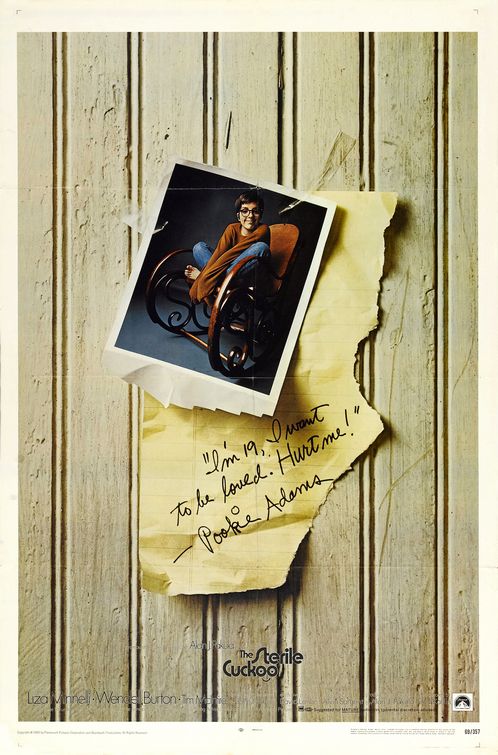
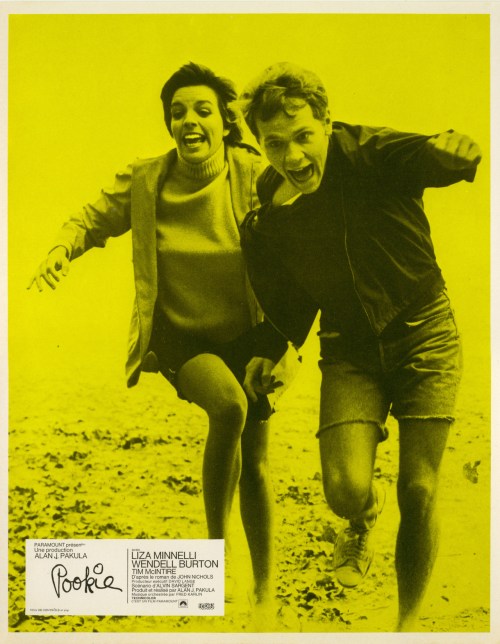
Mary Ann Adams (Liza Minnelli), who goes by the nickname of Pookie, is a complete social misfit who can’t fit-in anywhere.  As she waits at a bus stop to go off to college she meets Jerry (Wendell Burton) a shy and reserved young man who just happens to be attending the same school as she. Pookie immediately starts up a conversation with him and takes full advantage of his quiet nature to force herself into his life. The two soon begin to date, but Pookie’s inability to get along with others and her extreme insecurities make it almost impossible for the fledgling relationship to get off the ground.

This film marks the directorial debut of Alan J. Pakula and the result is nothing short of excellent. This is the type of movie that they don’t seem to make anymore where great sensitivity is taken to focus on a broken individual, but without ever making fun or demeaning them in anyway. The film’s pace is slow, but never boring and the emphasis is almost entirely on the nuances of its two leads. It also features one of the best and most memorable movie soundtracks to come out of the ‘60s.

The film is based on the novel of the same name that came out in 1965 and was written by John Nichols. It was even shot at Hamilton College in Clinton, New York where Nichols graduated in 1962. For the most part the script, by the prolific Alvin Sargent, stays quite faithful to the book with the only real big difference being that the story here encompasses only one year while in the book it was three. To me this revision was an improvement because the relationship was clearly doomed from the beginning and I couldn’t imagine it somehow lasting for three years let alone one to begin with.

Minnelli’s performance is Oscar worthy and the scene where she has a long talk on the phone with Jerry and the camera stays solely focused on her face is one the strongest moments in the movie and could only have been pulled off by a brilliant actress who somehow makes the viewer empathetic to this otherwise annoying character.

Burton, in his film debut, is equally strong and watching the two characters with such contrasting styles dealing with each other is the main catalyst that propels the story. Tim McIntire, as Jerry’s college roommate, is quite good as well playing the perfect composite of a partying college kid while also offering one of the film’s few moments of levity.

Some viewers have complained that the film lacks any wintertime shots even though the story takes place in Upstate New York where snow is inevitable and the story is supposedly spread over one full school year, but to me this is nitpicky. Clearly the film’s budget didn’t allow for shooting over an entire year and it wasn’t necessary anyways. The film captures the forestry region in such a vivid way that it almost becomes like a third character. It also in my mind made it more believable because I never felt this wacky, makeshift romance could last a full year and at best might’ve only existed for the fall semester before inevitably petering apart.

For me the only real criticism is the fact that we learn very little of about Pookie’s personal life. She mentions her relationship with her father quite a lot and we see him for a brief period at the beginning, but then that’s it even though it would’ve helped the viewer understand the character better had a backstory, or scenes involving her family life been shown.

The film is also incredibly sad to the point that it will make just about any viewer depressed after seeing it. On the technical end it’s flawless, but Pookie’s feelings of loneliness and the character’s extreme isolation eventually reaches out and sucks the viewer into it without any let up and it remains with them long after it’s over.

sterile cuckoo 2

My Rating: 7 out of 10

Released: October 22, 1969

Runtime: 1Hour 48Minutes

Rated M

Director: Alan J. Pakula

Studio: Paramount Pictures

Available: DVD, Blu-ray, Amazon Instant Video, YouTube
Demon Seed (1977)

demon seed 1

By Richard Winters

My Rating: 6 out of 10

4-Word Review: Computer impregnates a human.

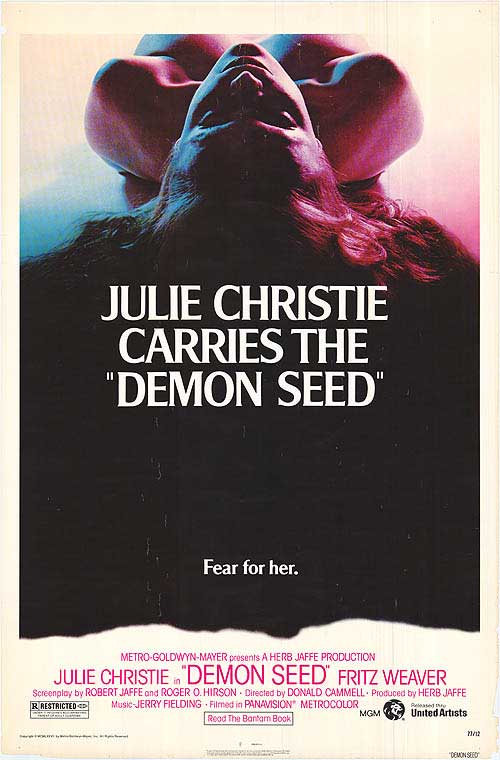
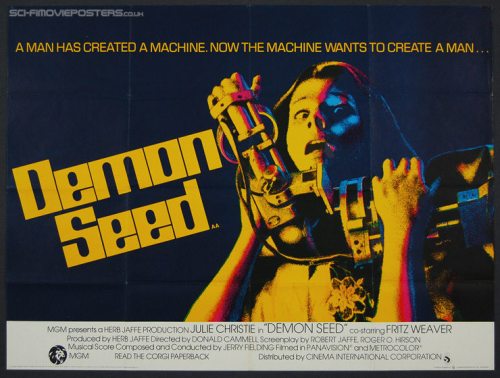
Based on an early Dean R. Koontz novel the story centers on Susan Harris (Julie Christie) who is married to Alex (Fritz Weaver) a man who has created a giant artificially intelligent computer named Proteus (voice of Robert Vaughn) as well as installing a computer inside their own home, which does all of their household chores and is fully automated via voice command.  Things seem to be going fine until Proteus starts to question the assignments that he has been given and his unhappiness with being ‘trapped inside a box’. To remedy the situation he decides to use the computer terminal inside the Harris’s home, so that he can overtake the house through his electronic commands and then impregnate Susan to have his child and therefore experience life as a person instead of a machine.

One of the things that got on my nerves right away was the way the film immediately telegraphs where it is going and reeks with ‘70s paranoia about computers ‘overtaking the world’, which was a prevalent fear during that era as computers were just in their infancy and their ultimate place in human society still not fully understood.

The Alex character is too ambivalent towards the warning signs and comes off like the clichéd super scientist with a child-like enthusiasm about his ‘creation’ and not the slightest concern for what might happen if things go wrong and the way he becomes so quickly shocked when the computer does start to behave in a way he had not considered seems almost laughable. Real-life scientists would most assuredly have considered these issues and had safeguards already put in place and the fact that the characters here don’t just doesn’t seem believable.

When the Proteus computer takes over Susan’s home I didn’t find it frightening, but more unintentionally funny for many of the same reasons. I don’t think that I myself could ever get used to a computer running everything for me and doing whatever I said at the sound of my voice. In the back of my mind, and in any sane person’s mind for that matter, I would be worrying about it malfunctioning and the consequences that it would entail, so when things finally do go wrong I found it laughable because anyone could have clearly seen it coming from the start. In fact the only thing that saves this thing from a being a complete dud is Christie’s brilliant performance and the fact that she gets you to see her character as a real human being and someone you care for and want to see rescued.

Spoiler Alert!

The script suffers from a myriad of other logical loopholes as well. One of them is the whole basic premise of how a computer can somehow manipulate human DNA in order to get supposedly his ‘genes’ into the child, so that it fully has his own traits and even his own voice. There is also no suitable explanation for how he was able to speed-up the gestation period from the 9 months to just 28 days. I was also surprised that the husband never bothers to call his wife during that 28-day period. Yes, I realize that they had just separated, but it was a very amicable one and I would still have thought he would’ve called-in at some point simply to check-in. There is also another character played by Gerrit Graham who comes into the house and tries to shut down the computer and is killed in the process making me believe that his disappearance would’ve caused suspicion and others would’ve come looking for him. There is also the issue of her mail, which I’m sure would’ve been piling up at her front door and causing both the mail carrier and neighbors to take notice.

End of Spoiler Alert!

The film is full of many colorful graphics and effects although they may no longer be considered as state-of-the-art as they once were. The idea is an intriguing one and Robert Vaughn gives the Proteus character a lot of menace with his voice, but he is still no HAL. The ending is really over-the-top, but in a wildly interesting sort of way even though it does nothing but create more questions than answers.

demon seed 3

My Rating: 6 out of 10

Released: April 8, 1977

Runtime: 1Hour 34Minutes

Rated R

Director: Donald Cammell

Studio: MGM

Available: DVD (Warner Archive)

Fletch (1985)

fletch 1

By Richard Winters

My Rating: 5 out of 10

4-Word Review: Reporter has many disguises.

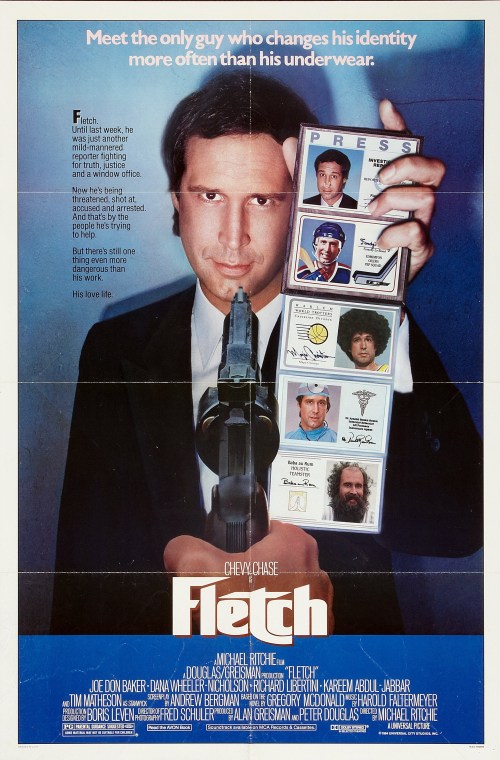
Irwin ‘Fletch’ Fletcher (Chevy Chase) works as a newspaper reporter writing articles under the byline of Jane Doe. While working on a story involving drug dealing at a nearby California beach he gets approached by Alan Stanwyck (Tim Matheson) who offers him a large sum of money to kill him. It seems that Mr. Stanwyck has been diagnosed with cancer and has only a short time to live. He wants Fletch to ‘put him out of his misery’ by entering his home at a certain day and time and offing him while making it look like it was just a random robbery gone bad. Initially Fletch agrees to do it, but then begins to do some research on Mr. Stanwyck and finds things just don’t add up.

Out of all the characters that Chase has played this one best suits his talents and personality. His deadpan delivery has always been his major selling point and this part takes full advantage of it while accentuating his smart-ass persona and minimizes the silly pratfalls, which were never funny anyways. The first half clicks nicely and it’s great to have a main character whose personal life is a realistic struggle as he lives alone in a depleted looking apartment complex and bitterly avoiding a divorce lawyer (George Wyner) representing his wife who cheated on him.

The plot is genuinely intriguing and had me hooked. Unfortunately the story takes on too much as it also continues to incorporate elements of the drug dealing at the beach story, which makes things too convoluted especially since the murder-for-hire scheme gets complex enough. The overblown idea to somehow tie both story threads together at the end is a misfire and an overreach. The ultimate explanation for why Stanwyck wanted Fletch to kill him is really lame and a big letdown.

The film is also too long and the humor loses its edge as it progresses. The idea that this reporter would so cleverly be able to infiltrate hospitals and businesses in order to get the information that he wanted is hard to believe and it would have come off better had his profession been a private investigator instead. Chases’s insubordinate behavior towards his boss (Richard Libertini) including at one point even giving him the one-finger-salute is pretty outrageous and would most assuredly get anyone else in the same circumstance fired and deservedly so. I was also unhappy with the portrayal of the cops as they are all shown to be corrupt, abusive and vulgar. Yes I realize there are bad cops out there, but there are also a lot of good ones too and this film makes no attempt to balance that.

Chase gets featured in every scene, so if you are not exactly a fan of his your tolerance will certainly be tested. The film does feature a plethora of familiar faces in minor roles many of whom are wasted although I did enjoy Geena Davis as Fletch’s faithful assistant.

My Rating: 5 out of 10

Released: May 31, 1985

Runtime: 1Hour 38Minutes

Rated PG

Director: Michael Ritchie

Studio: Universal

Available: DVD, Blu-ray, Amazon Instant Video, YouTube
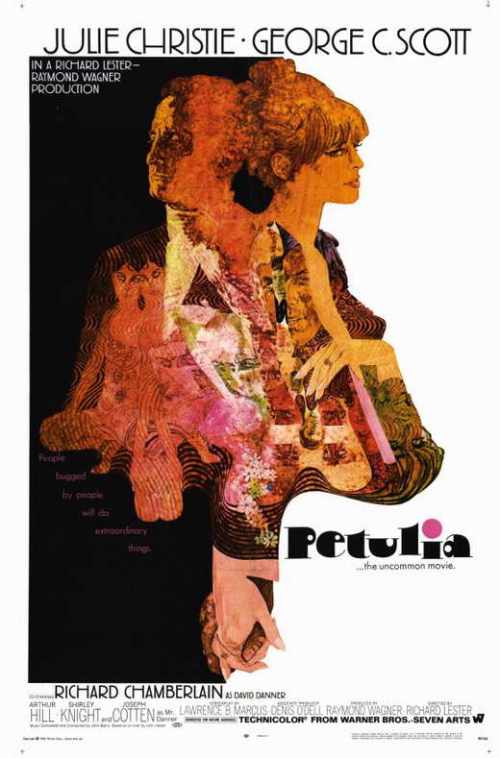
Petulia (1968)

petulia 2

By Richard Winters

My Rating: 9 out of 10

4-Word Review: A very brief affair.

While attending a medical fundraiser Petulia (Julie Christie) who is a married rich socialite, decides to come-on to Archie (George C. Scott), a doctor who performed a life-saving surgery on a young Hispanic boy (Vincent Arias) that she brought to him a few months earlier. Archie is still hurting from his recent divorce to his wife Polo (Shirley Knight) and not sure he wants to jump into another relationship so quickly especially with a woman that behaves in such an eccentric way. However, her kooky personality and good-looks get the better of him and the two spend the night together. In the days that follow Archie learns of her abusive relationship with her husband David (Richard Chamberlain), but when he makes an attempt to help her get out of it she resists, which causes him a great deal of frustration as he is unable to get a good grasp on why she behaves the way that she does.

The film is based on the novel ‘Me and My Arch Kook Petulia’, which was written by John Haase who worked as a dentist and wrote his stories between his appointments. What makes this plot stand out from the rest of the romances is that it focuses on the chance meeting between two people who share an immediate attraction, but are unable due to various extraneous circumstances to ever get it into a relationship stage. They become like two-ships-passing-in-the-night and go on with their lives and even other relationships while quietly longing for ‘the-one-that-got-away’. Most movies portray romances where everything falls into line and works out while blithely ignoring the ones that get shown in this film even though these are much more common.

Director Richard Lester, who is better known for his slapstick comedies, shows an astute eye for detail and his fragmented narrative works seamlessly. I enjoyed the quick edits and color detail as well as the subliminal symbolism including showing the David and Petulia characters wearing all-white to display their sterile marriage as well as capturing David’s father (Joseph Cotton) sitting in front of a giant window that looked like a cobweb to help illustrate how he had entangled Petulia into his own personal web. The film, which was shot on-location in San Francisco, features great shots of the Golden Gate Bridge and the world famous cable cars as well as an interesting scene at the Jack Tar Motel, which has now been demolished but was famous for its ability to check customers into their rooms without the use of a live clerk, but instead through close circuit TV and a room key that would light up when the person passed by their assigned room.

The two leads give strong performances particularly Scott who for a change doesn’t play a character with a forceful personality, but instead someone who inadvertently gets bowled over by a woman who has an even stronger one than he. Even Chamberlain does well. Normally I find him to be quite bland, but here he is surprisingly effective.

This movie also marks the film debuts of many performers who are seen in brief, but quirky bits including: Richard Dysart as a virtual hotel clerk, Howard Hesseman as a hippie, Rene Auberjonois as a seat cushion salesman and Austin Pendleton as a hospital orderly. Members of the Grateful Dead get some funny moments while inside a grocery store and Janis Joplin can be seen onstage singing during the opening party sequence.

Romance fans will like this, but so will those living in the Bay area during the ‘60s as the city gets captured well. However, fans of that decade will also like it as it expertly exudes the vibe from the period and making it seem very real to the viewer even if they weren’t alive during the time it was made. Also, John Barry’s haunting theme nicely reflects the character’s mood and evasive film style.

petulia 1

My Rating: 9 out of 10

Released: June 10, 1968

Runtime: 1Hour 45Minutes

Rated R

Director: Richard Lester

Studio: Warner Brothers

Available: DVD, Amazon Instant Video, YouTube
Excalibur (1981)

excalibur 1

By Richard Winters

My Rating: 8 out of 10

4-Word Review: The sword is magical.

The mystical sword named Excalibur gets cast into a stone by Uther (Gabriel Byrne) and the wizard Merlin (Nicol Williamson) proclaims that the next man to be able to remove it will become the King of England. Many try and fail, but years later it is Uther’s illegitimate son Arthur (Nigel Terry) who is able to do it.  Although very young he is able to create the Kingdom of Camelot with the help of Merlin. He also marries Guenevere (Cheri Lunghi) who has an affair with his most trusted knight Lancelot (Nicholas Clay) and then his half-sister Morgana (Helen Mirren) steals away Merlin’s powers and uses them to try and destroy the kingdom.

The story is based on the book by Thomas Malory who supposedly wrote it while he was incarcerated. Although this film is considered a classic now it was not as well received when it was first released. Critic Roger Ebert called it ‘a mess’ and the great Pauline Kael described the dialogue as being ‘atrocious’. For me I found it long, but enjoyable even though I’m not crazy for this type of genre.

One of the things that I didn’t particularly care for, or find all that exciting were the battle scenes. Watching men roll around in the mud with their swords doesn’t come off as too interesting when compared to gun battles. There were also too many of them and all seemed too similar to the others with the final one ruined by having it shrouded in fog. In reality the knight’s armor was also always made by either steel or iron, but for this film they created it out of aluminum, which made it appear too flimsy and clanky. It is also given a bright glow, which was intentional, but I didn’t care for it.

What I did enjoy was the atmosphere particularly when they go off to search for the grail. The scene where the men approach an area that has dead bodies hanging from the trees and a crow sitting on a branch biting off one of the corpses’ eyeballs, which apparently took several days of continuously rolling the camera before the bird did what they wanted, is in one of the best moments in the film. I also liked the magical glow given off by Camelot when it is seen from a distance, but I would’ve liked a shot of the magical kingdom seen up close, which never occurs and was probably due to budgetary restraints, but would’ve been cool.

The performances are all-around excellent. Terry does quite well in the lead playing Arthur at different stages of his life, but I was most impressed at the way he came off as convincingly being only 19 at the beginning even though he was really already 35. Clay, who plays Lancelot, also looks like he was barely over 20 when in reality he was 34. Williamson is amusing as Merlin and Mirren is effectively evil as the villainess. This is also a great chance to see Patrick Stewart and Liam Neeson in some early roles.

The movie moves along briskly and is overall entertaining although some the scene transitions and dramatic arcs were awkward. Those that are into medieval fantasy will clearly enjoy it more.

My Rating: 8 out of 10

Released: April 10, 1981

Runtime: 2Hours 20Minutes

Rated R

Director: John Boorman

Studio: Orion Pictures

Available: DVD, Blu-ray, Amazon Instant Video

Doctors’ Wives (1971)

doctors wives

By Richard Winters

My Rating: 4 out of 10

4-Word Review: His wife sleeps around.

Several wives of prominent surgeons at a prestigious hospital get together for a game of cards, but one of the women, the oversexed Lorrie Dellman (Dyan Cannon), gives them a shocking proposition. Seeing that they are not satisfied with their sex lives, she tells them that she will sleep with each of their husbands and then critique their ‘performances’, so as to enlightened them as to what they might be doing wrong. The women turn down her ‘friendly’ offer, but then panic when Lorrie tells them that she has slept with ’50 percent’ of them already.  They have no time to worry though because the next day Lorrie is shot dead by her brain surgeon husband (John Colicos) after she is found in bed with one of the physicians. Now the women must try to figure out which doctor it was while worrying if their husbands were also involved with Lorrie at some other point.

The film, which is based on a novel by Frank Slaughter, is just too trashy and soap opera-like to take seriously. The productions values are strong and director George Schaefer shows a flair for the visual, which makes it watchable, but the characters are one-dimensional and the dialogue seemingly stripped straight out of a potboiler paperback.

Cannon, who’s billed as being the star, is on-screen for less than five minutes, which has to set some sort of record. Who on earth would ever accept a part to be the film’s ‘star’ if they are going to only be in it for that short of a period, or why bill someone as being such if they ultimately will have that little to do? In some ways I wished the character had remained as she is so outwardly slutty that it becomes campy and her initial proposition would certainly have created a more interesting scenario than what ultimately gets played out. Besides any character whose first words out of their mouth is “God, I’m horny” can’t be all that bad.

The supporting cast, which is made up of many familiar faces, are essentially wasted especially Gene Hackman in what may be the dullest role of his otherwise illustrious career although the way he repeatedly slaps his wife (Rachel Roberts) across the face after she confides in him that she once had a lesbian affair does have a certain outrageous quality.

Colicos is competent as the heavy, but Anthony Costello steals it as a young intern who sleeps with the middle-aged wives of his superiors. In real-life he was gay and ended up dying of AIDS at the young age of 45, but here successfully comes off as a flaming heterosexual who brags of his conquests and acts like going to bed with married women is as common place as taking out the garbage. His best bit comes when he beds fellow intern Sybil (Kristina Holland) who is making a sex documentary and narrates a ‘play-by-play’ of her sexual intercourse with him as it happens.

The film’s most memorable moment, and it’s a doozy, is when it shows in incredibly graphic style the operation of taking a bullet out of a man’s heart. A real pumping human heart was used and the footage would rival that of any educational film. Not only do we see them tear off the organ’s outer membrane, but we also watch as the doctor sticks his finger into it and then in one truly ghoulish shot pop the bullet out of it. It’s all real and done in close-up making it far more explicit than any gore movie out there and one of the most stomach churning things ever to be put in a mainstream Hollywood movie.

My Rating: 4 out of 10

Released: February 3, 1971

Runtime: 1Hour 41Minutes

Rated R

Director: George Schaefer

Studio: Columbia Pictures

Available: DVD-R