Category Archives: 70’s Movies

Bless the Beasts and the Children (1971)

By Richard Winters

My Rating: 7 out of 10

4-Word Review: Kids free the buffalo.

Six adolescent boys (Barry Robins, Bill Mumy, Miles Chapin, Darel Glaser, Robert Jayson Kramer, Marc Vahanian) room together during summer camp and become known as the ‘bedwetters’. Through flashbacks we learn that the six children have difficult times at home with their individual parents and are routinely picked on by the other kids at the camp. Their camp counselor Wheaties (Ken Swofford) decides to take them to a buffalo corral where the boys witness to their horror the buffalo being shot by various hunters in an effort to ‘thin the herd’ from the weaker or more sickly ones. The boys decide to sneak off one night and free the herd from their corral, but various complications inevitably ensue.

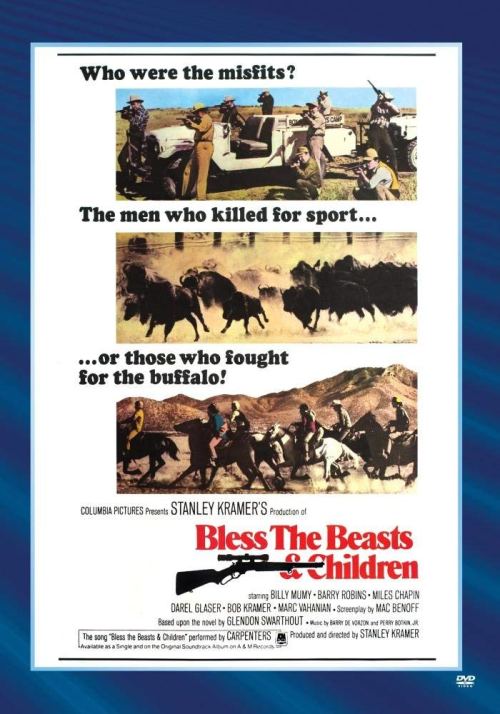
The film is based on the novel of the same name by Glendon Swarthout and one might expect from the movie’s poster, for another topical, preachy, dramatically charged production from director Stanley Kramer, but instead the film is amusing and breezy. If you went to summer camp as a child then this will be sure to bring back a flood of memories. Some of the pranks that the other kids play on our six protagonists are cruel, but there’s also fun moments that effectively recreate the carefree summer days of youth.

In a lot of ways this could be described as early version of The Bad News Bears as these ‘losers’ decided to show everyone who doubts them up and to a degree you could say this one does it better. In the bears film we never saw how the kids related to their parents and their family background, but here we do in a nice fragmented style, which allows the viewer to connect to the kids in a deeper and more emotional level, which makes us root even more for them to accomplish their mission.

The dialogue is banal and Sammy, played by Chapin, is annoying.  He’s supposed to be ‘funny’ with his lame impressions of famous celebrities, mostly those of a very bygone era that viewers today won’t even know, and the fact that he continues to do them throughout the movie made me think he should’ve been ostracized by the others just for that and it would’ve been justifiable. The on-location shooting though shot throughout Arizona helps, and Robins who plays Cotton their leader is a standout especially given the fact that he was 24 when this was filmed, but looked to be only about 14 like the other kids.

The only issue that I had with the movie is the music particularly the opening song sung by the Carpenters. Richard and Karen Carpenter were a terrific brother and sister duo, but they represented the conservative establishment. This is a movie about junior high boys and they most likely would never listen to the Carpenters or like their music. A film’s soundtrack should reflect the attitude and personality of its protagonists and the songs selected here really don’t as the boys represented rebellion while the Carpenters were all about conformity. It’s possible that director Kramer, who was nearing 60 at the time, didn’t know the difference. The Carpenters were getting chart toppers at the time, so from his generation’s perspective that made them ‘hip’ and the ‘in-thing’, which shows how out-of-touch he was to his subjects, which becomes a bit of a drawback.
My Rating: 7 out of 10

Released: August 1, 1971

Runtime: 1Hour 42Minutes

Rated GP

Director: Stanley Kramer

Studio: Columbia Pictures

Available: DVD-R, Amazon Video, YouTube

Jeanne Dielman, 23 Commerce Quay, 1080 Brussels (1975)


By Richard Winters

My Rating: 5 out of 10

4-Word Review: She performs daily chores.

This is a highly unusual film which analyzes in minute detail the monotonous tasks that a single mother performs throughout her day and was apparently inspired by writer/director Chantal Ackerman growing up with a mother who suffered from obsessive/compulsive disorder. The story centers on Jeanne (Delphine Seyrig) a woman raising a teenage son while living in a tiny one-bedroom apartment in Belgium. During the day she entertains various men with sexual services and uses the money that she receives for this to help maintain things for both herself and her teenage son Sylvain (Jan Decorte). When she is not working as a prostitute she is busily cooking and cleaning, but as each day passes her routine becomes sloppier, which is a subconscious signal that something is bothering her and only at the very end does the viewer find out what it is.

Some have hailed this as a masterpiece including being listed among the ‘1001 Movies You Must See Before You Die’ by Steven Schneider. Normally I enjoy films that buck the conventional narrative and trying to learn about a character through the way she performs her daily routine as opposed to doing it the standard way through dialogue and action is commendable, but the cinematic flair is missing making this seem more like ‘monotonous task porn’ than a movie.

For instance when we watch Jeanne wash her dishes the camera does it in a very static way from behind her instead of doing something flashy like a close-up of the water glistening of the dish, or from some other provocative angle. Akerman has stated that she took this approach in order to show respect to her character’s ‘personal space’, but this only ends up giving it a closed-circuit TV feel.

Nonetheless I still remained strangely intrigued, but I’m not sure if this was because of some reviews I read beforehand where I was told that about the ‘surprise/shocking ending’ that would somehow make what I was watching all seem worth it, or because of what I was actually going on. I’ll agree that seeing the way she prepares and cooks her various meals is fascinating, but it’s for all the wrong reasons as you become more caught up in the task itself than the character and to say that one’s mind doesn’t eventually begin to wander after 3 hours and 20 minutes of this would be an understatement.

The 3-day arch that she goes through from where she performs her tasks proficiently on the first day only to screw them up more and more by the third one needed to be much more apparent as her ‘screw-ups’, like dropping a newly washed spoon on the floor, are too subtle and not enough of a payoff. Cinema is still a visual and dramatic art form and yet this film runs away from that at every conceivable turn making it seem more like an assault on one’s stamina instead.

Spoiler Alert!

The only true cinematic moment comes at the very end when Jeanne kills one of her male clients, but there’s no reason given for why she does this or what the aftermath will be. To have to sit through all that comes before it just to walk away with unanswered questions is frustrating and almost like being told a joke where the punchline is not an equal payoff to the long, tangent-filled set-up that it took to get there. I like the concept, which is intriguing, but it could’ve been accomplished in half the runtime making this an interesting experiment that can be appreciated as an oddity, but nothing more than that.

My Rating: 5 out of 10

Released: May 14, 1975

Runtime: 3Hours 21Minutes

Not Rated

Director: Chantal Ackerman

Studio: Olympic Films

Available: DVD, Blu-ray (Criterion Collection), Amazon Video

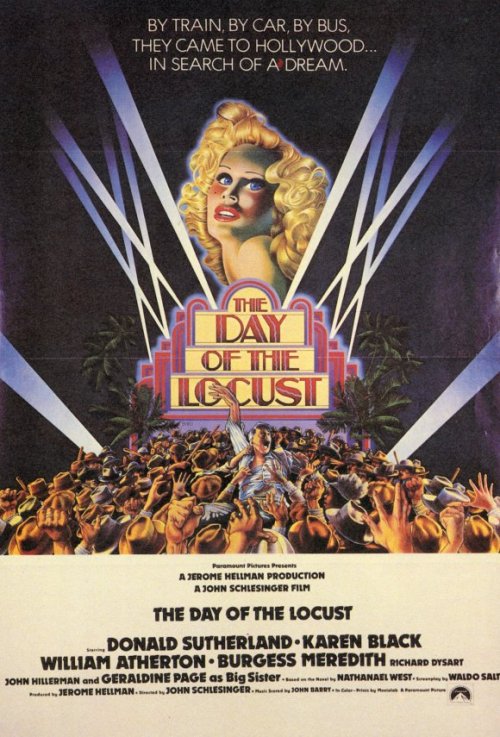
The Day of the Locust (1975)

By Richard Winters

My Rating: 8 out of 10

4-Word Review: Desperate people in Hollywood.

During the depression a young artist named Tod Hackett (William Atherton) comes to Hollywood to help design the set for a new movie. While there he meets a wide assortment of people, who seek fame and fortune, but find heartbreak and rejection instead. Tod falls for Faye (Karen Black) a woman striving to become the next big Hollywood starlet despite lacking any talent while her father Harry (Burgess Meredith) is on the opposite end of the spectrum. At one time he was a vaudeville comedian, but now with his failing health is relegated to selling health tonics door-to-door.

This film is the last great effort of director John Schlesinger whose films after this lacked the same visual style that made Midnight Cowboy and Far From the Madding Crowd cinematic masterpieces. From a visual standpoint it hits all the right chords and is filled with many memorable segments. The best ones include the scene where a group of bourgeoisie guests who come to Natalie Schafer’s home (she was best known for playing Mrs. Howell on ‘Gilligan’s Island’) to watch porn movies There’s also the scene where an entire film set comes crashing down and injuring the entire crew as well as the climactic moment where a large crowd waiting outside to see the premiere of The Buccaneer turn into a violent, bloodthirsty mob.

The acting is first-rate particularly Black who portrays her desperate character to a perfect tee. Meredith, who was nominated for a supporting Oscar, gives a vivid portrayal of her equally desperate father making his scenes quite entertaining. Donald Sutherland is also solid as a likable, but socially awkward outsider, which best suits his acting persona.

The script though by Waldo Salt, which is based on the 1939 novel of the same name by Nathanael West, misses out on a lot of the book’s subtext. In the movie Tod tries to rape Faye while at a party, but this eruption of his seems to come out of nowhere while in the book it gets better explained by showing how Tod continually harbors rape fantasies for Faye and makes these fantasies a running part of the story.

Donald Sutherland’s character, the aptly named Homer Simpson, which supposedly was the inspiration for Matt Groenig’s character in his famous comic strip, is a confusing enigma. In the book he is given a better backstory and revealed to be a man struggling with a lot of inner turmoil while here he’s seems more like a strange, naïve mope from another planet.

There’s also no explanation in the movie for why the word Locust is in the title, which is in reference to the Bible and the plague of locusts that descended onto the fields of Egypt. Tod symbolizes the locust in the novel’s version of the story while in the movie his character is more of an outsider observing the ugliness, but not having a hand at creating it

The biggest issue though is the film’s underperformance at the box office, which helped relegate both Black and Atherton, who at the time were considered up-and-coming stars, to supporting roles afterwards. I believe part of the reason for this is because none of the characters are likable. It’s fine showing humanity’s bad side as long as the audience doesn’t feel beaten-over-the-head with it, but the film wallows so much in the darkness that it overwhelms the viewer. Having a character that was slightly removed from the madness and not as flawed might’ve helped to balance things and make everything else that goes on more tolerable.

Overall though it’s a great film, but the statement it’s trying to make remains murky. Better efforts should’ve been made to tie it to the disillusionment of the American Dream, which is what the book does and not seemed so much like just a glimpse into a freak show of a bygone era like it ends up doing here.

My Rating: 8 out of 10

Released: May 7, 1975

Runtime: 2Hours 24Minutes

Rated R

Director: John Schlesinger

Studio: Paramount

Available: DVD, Blu-ray, Amazon Video, YouTube

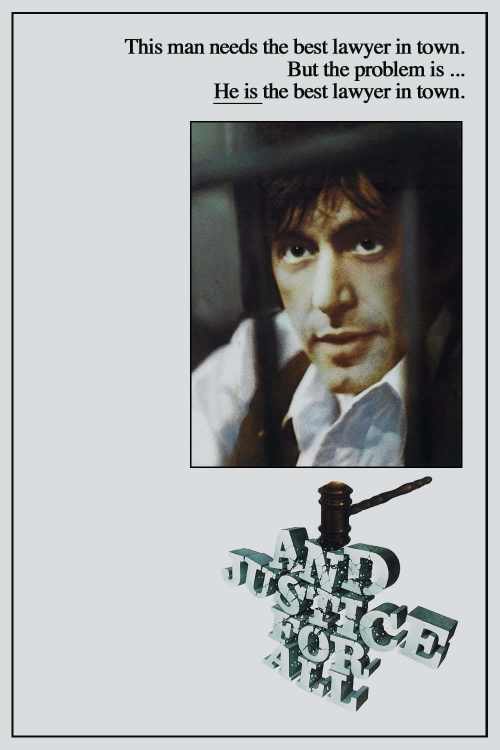
…and justice for all. (1979)

By Richard Winters

My Rating: 7 out of 10

4-Word Review: Lawyer fights the system.

Arthur (Al Pacino) is a defense attorney who becomes increasingly more frustrated and disillusioned with the court system. He’s fighting to get one of his clients, Jeff (Thomas Waites), out of jail as he’s been sitting behind bars for over a year simply because he was mistaken for somebody else while also being forced to defend Judge Fleming (John Forsythe), a man that he vehemently hates, from a rape allegation.

The script by the husband and wife team of Barry Levinson and Valerie Curtain is chockfull of great insights into the American legal system and how messed up and prone to corruption it can sometimes be. Defense lawyers have in the past been glamourized in TV-shows like ‘Perry Mason’, but here the viewer gets a more stark assessment of their profession as they watch them being forced to defend those that they know are actually guilty. Yet it also balances this by showing how public defenders can also be the lone voice to those who are truly innocent and have no one else to speak up for them.

The film has a weird comedy/drama mix that doesn’t work and ends up getting in the way. When I first saw this many decades back I liked the humorous undertones as it gave production a surreal, satirical edge, but upon second viewing I didn’t find it to be as amusing. The script makes good hard-hitting points and adding in the humor only diminishes this message and takes away from the seriousness of the subject matter.

The side-story dealing with the suicidal judge, played by Jack Warden, should’ve been excised. I’ll admit the images of him eating lunch while sitting out on a ledge of a tall building, or trying to kill himself with a rifle are memorable, but pointless and by coupling this judge character with Forsythe’s crooked one seems to imply that all judges are either bad or crazy, which isn’t fair.

The storyline dealing with Arthur visiting his senile grandfather, played by Lee Strasberg, should’ve been cut out as well as it has nothing to do with the main plot. It also brings up many unanswered questions like why is Arthur close to his grandfather and not to his own parents and why did his parents apparently ‘abandon’ him? This backstory never gets sufficiently addressed and seems like material for a whole different movie altogether.

Spoiler Alert!

The storyline involving Judge Fleming is the most intriguing and should’ve been made the film’s primary focus, but I was disappointed with the way the judge glibly admits to his crime, which takes away the mystery angle and I would’ve preferred the truth coming out in a more dramatic manner. The film also has a very old-fashioned take to his situation by saying that just because the character is involved with BDSM activities that somehow makes him ‘deviant’ and more prone to committing rape, which has been proven untrue as there are plenty of people who can enjoy kinky activities with consenting partners and still remain ethical.

End of Spoiler Alert!

Overall the film is worth catching and has many interesting moments including Pacino’s final speech that he gives to a packed courtroom, which is a gem. This also marks the film debuts of Christine Lahti and Jeffery Tambor as Pacino’s lawyer friend who slowly goes crazy.

My Rating: 7 out of 10

Released: October 16, 1979

Runtime: 1Hour 59Minutes

Director: Norman Jewison

Rated R

Studio: Columbia Pictures

Available: DVD, Blu-ray, Amazon Video, YouTube

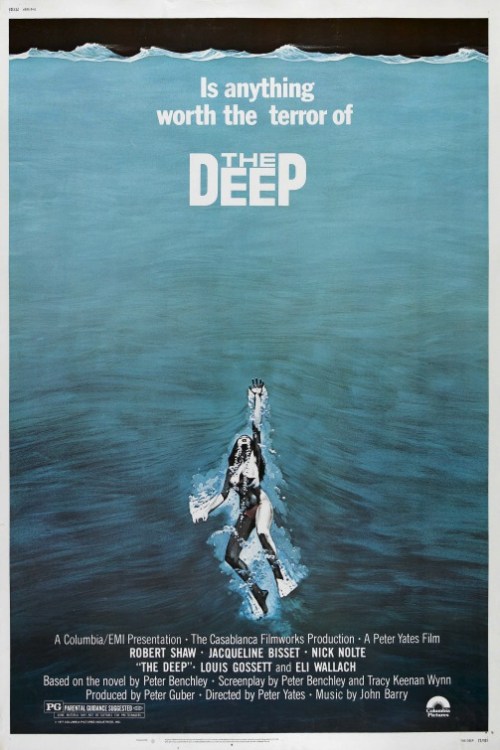
The Deep (1977)

By Richard Winters

My Rating: 3 out of 10

4-Word Review: Couple finds sunken treasure.

David (Nick Nolte) and Gail (Jacqueline Bisset) are a couple scuba diving off the Bermuda coast when they come upon a shipwreck and some artifacts left from it. They meet with treasure hunter Romer (Robert Shaw) who tells them it is a part of a Spanish treasure and works with them to try to unearth the rest of it. Problems arise when a shipwreck from World War II, the Goliath that had carried a cargo of medicinal morphine rests right next to it. To get at the Spanish shipwreck they must also go through the Goliath. Cloche (Louis Gossett Jr.), a local drug kingpin, wants to get his hands on the morphine, which could be worth a tidy sum of money and he tries to scare away Romer and the couple from continuing their diving activities, so Romer makes a deal with Cloche, but it backfires and turns the expedition into an intriguing game of underwater double-cross.

The film is based on the novel of the same name by Peter Benchley, who because of the success of his first novel Jaws, was given an almost immediate green light to turn this book into a movie. The inspiration for the story was based on the real-life shipwreck of the Constellation, which occurred off the coast of Bermuda in 1942. Great effort was put into the underwater footage, which lasted for 153 days and consisted of 8,895 dives.

Unfortunately despite the title and underwater storyline the film lacks depth where it counts, which is with the characters. The movie starts out immediately with the couple scuba diving and finding the treasure before we have any idea who these people are or why they are even there and no suitable backstory is ever given, which makes them come off as bland people lacking any real distinction and that you care little about. Character development is still an integral part of moviemaking and the main ingredient that gets the viewer hooked into a story and yet this film completely lacks it.

I’ll give credit to both Nolte and Bisset for doing their own diving and Nolte looks great with his bleach blonde hair almost like he’s a surfer dude, but his presence really wasn’t needed. Bisset, despite the extreme limitations of the weak script, still gives a far better performance and I felt she could’ve easily carried the film without him and I’m not just saying that because she looks great in her skimpy underwater gear, which was purportedly the whole reason why this film did well at the box office. Sure she’s beautiful, but she’s also quite talented.

Shaw should’ve added an extra boost in support, but he doesn’t. Normally his strong personality literally eats up the screen in any movie that he is in, but he’s stifled by the benign characterization and unable to rise above it. In retrospect he should’ve never have accepted the part until he had actually read the script, but because he was offered $625,000 plus a percentage of the profits, he took the role before the script was even written and hence the whole problem.

Gossett is weak as the bad guy and is not seen enough to create any genuine feeling of menace. The segment where he and his cronies try to ‘terrorize’ Bisset by performing some very clichéd type of black magic voodoo on her is almost laughable. The only actor that is actually good here is Eli Wallach and it is a testament to his superior thespian abilities that even though he was straddled with a pointless, bit role he was still able to own every scene that he is in anyways.

The film’s only interesting moment, which apparently took 1,080 hours to shoot, is when a pack of grey sharks converge for an eating frenzy and get tangled up in the air hoses of the crew, but even this becomes unintentionally funny because every time one of the sharks move an air hose the crew is forced to suddenly jump up in the water making them look quite literally like a puppet on a string.

The script desperately needed some added element as the concept is too basic and one-dimensional.  Watching one dull group of people trying to get at a treasure while another equally dull group of people try to stop them does not make for a riveting cinematic experience.

My Rating: 3 out of 10

Released: June 17, 1977

Runtime: 2Hours 4Minutes

Rated PG

Director: Peter Yates

Studio: Columbia Pictures

Available: DVD, Blu-ray, Amazon Video, YouTube

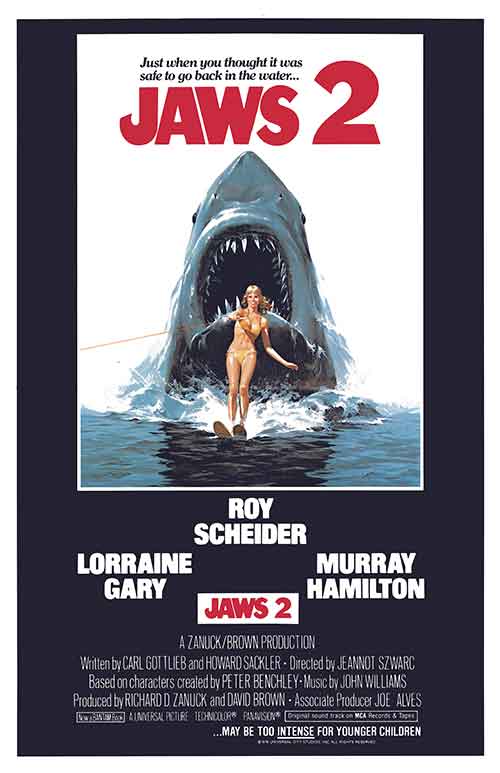
Jaws 2 (1978)

By Richard Winters

My Rating: 3 out of 10

4-Word Review: Another shark terrorizes Amity.

Chief Brody (Roy Scheider) fears that another shark is stalking the beaches of Amity when two divers disappear and then later a water skier and her speedboat driver are also killed. When Body goes to Mayor Larry Vaughn (Murray Hamilton) with his concerns the mayor and the rest of the council dismiss it and eventually fire Brody from his position when he continues to argue. His concerns are worsened when he finds that his two sons (Mark Gruner, Marc Gilpin) and their teen friends have snuck off onto a sailboat right were the shark attacks have been occurring.

Only four cast members return from the first one which includes the aforementioned Scheider and Hamilton as well as Lorraine Gary as Brody’s wife and Fritzi Jane Courtney as one of the council members. For me the biggest surprise was the return of Hamilton’s character as most likely he would’ve been voted out after making such egregious error in the first film and leaving the beaches open to further shark attacks after being told not to. I was also surprised that anyone would still want to come to the beach to swim anyways as the stigma of the area would most likely be quite strong.

Director John D. Hancock and his wife Dorothy Tristan who were first hired to direct the sequel had a much better, more believable plot idea. In their script Amity had become a ghost town and the economy in ruins. Mayor Vaughn and developer Len Peterson (Joseph Mascolo) build a resort on the island hoping to boost the tourism, but they use mob money to do it, which is why they end up resisting Brody’s dire warnings. Unfortunately the studio felt this concept was ‘too dark’ so Hancock and his wife were fired and replaced with a script by Howard Sackler and Carl Gottlieb that is basically just a bland rehashing of the storyline from the first one.

The first film was beautifully paced with each scene adding to the tension, but here there are a lot of lulls and the shark, which wasn’t seen much in the first one, doesn’t get shown enough here. The majority of time I kept feeling frustrated waiting for another shark attack to occur as any time the story is on land the film dies.

A good sequel should also always up-the-ante and having the plot built around just one shark doing all of the attacking just like in the first film doesn’t help to take the tension to the next level. Having a group of sharks attack at the same time would’ve helped add more shock appeal as people would now be battling sharks from multiple fronts and making the chances for survival all that more precarious.

Although it’s great seeing Keith Gordon and Donna Wilkes in their film debuts the rest of the teen cast is unlikable and the type of smart ass kids you wouldn’t mind seeing get eaten. There are also too damn many of them and the film would’ve been better served had it stuck to just Brody’s two sons on the boat and none of the others.

The way the shark ultimately dies is cool, but everything else falls flat. If you’ve seen the first one then there’s no reason to watch the sequel as it adds nothing to the theme and if you haven’t seen the first one then please skip this installment altogether and grab that one as it is far superior.

My Rating: 3 out of 10

Released: June 16, 1978

Runtime: 1Hour 57Minutes

Rated PG

Director: Jeannot Szwarc

Studio: Universal

Available: DVD, Blu-ray, Amazon Video, YouTube

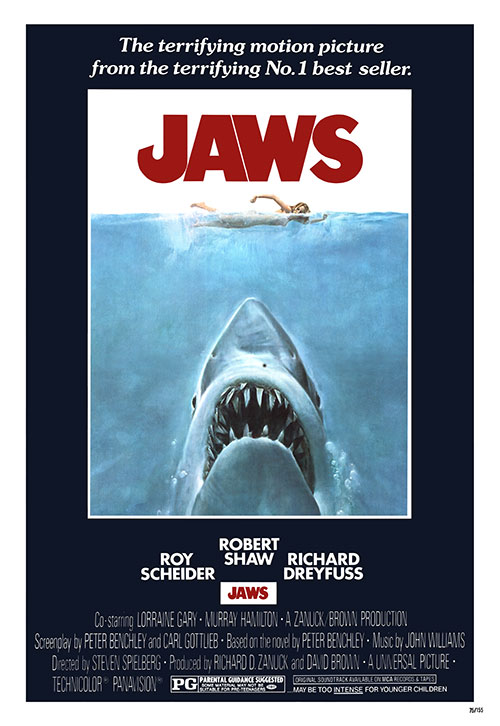
Jaws (1975)

By Richard Winters

My Rating: 10 out of 10

4-Word Review: Shark in the water.

A young woman (Susan Backlinie) goes out for a swim late one night only to have her severed hand wash up on shore the next day, which causes the Amity Police chief Martin Brody (Roy Scheider) to fear that her death may have been caused by a shark. Amity mayor Larry Vaughan (Murray Hamilton) doesn’t want his town to risk losing business, so he has his coroner deny that a shark was responsible and hence the beach remains open, but then more attacks occur. Eventually an eccentric shark hunter named Quint (Robert Shaw), Matt Hooper (Richard Dreyfuss) from the Oceanographic Institute and Brody head out on a small fishing vessel called Orca to locate the shark and then kill it, but they find the underwater beast to be far bigger and more cunning than they had ever imagined.

With its exceptional ability to slowly build tension and keep the viewer riveted from the first frame to the last easily makes this the quintessential thriller. John Williams’s legendary score adds to the murky ambience and in many ways is more memorable than the shark itself. Director Steven Spielberg wisely adds a secondary layer to the narrative by creating colorful and distinctive characters, most notably Quint, who gives the proceedings a flavorful nuance and makes the conversations and interactions that occur between the three inside the boat more interesting than what happens in the water.

The most amazing thing though is how little the shark is actually seen and in fact you don’t even get a glimpse of him until about an hour in. Part of this was due to the difficulty of getting the mechanical creation to perform properly in salt water, but in the end this became a blessing in disguise as it’s the mystery and allusion to its large size that makes it so riveting. The viewer feels as helpless and confused as the men on the boat, which makes the climactic sequence when the shark suddenly does jump onto the boat all that more impactful.

Spoiler Alert!

The film though does deviate heavily from the Peter Benchley source novel and a legitimate argument can be made as to which one presents the story better. In the book the tone is darker and the characters less likable. For me this makes it more intriguing from a psychological bent as it conveys the idea that humans are like the shark that they hunt as they both selfishly devour everything around them. Spielberg though didn’t care for this interpretation so the novel’s darker subtext gets erased, but it still made me intrigued, as much of a classic as this movie is, to see a reboot where the narrative stayed more faithful.

Some of the book’s subplots got too involved particularly the one dealing with the mayor’s connections to the criminal underworld, so I’m glad that one got toned down.  However I felt the one though dealing with Hooper’s affair with Brody’s wife (Lorraine Gary) should’ve been left in as it would’ve added extra tensions between the two while on the boat while also seeing how people can learn to work together even when they hate each other.

In the book Hooper dies when the shark attacks the cage that he is in while in the movie he is able to escape and somehow hide from the shark. This though seemed unrealistic as sharks have special sensing organs known as electroreceptors that allow them to detect the electromagnetic field emitted from a moving animal or at close range even the heartbeat of an immobile one, which means the shark most likely would’ve figured out where Hooper was hiding and gotten him.

In the book the shark dies from its many wounds just as it gets a few feet from Brody while in the movie it’s killed when the scuba tank that it has in its mouth explodes when hit by a bullet, but a 2003 episode of Mythbusters proves that in reality this wouldn’t have happened. My main beef though is that by having the shark literally blow-up into little pieces it denies the viewer the chance at seeing what the beast looked like as a whole. Supposedly this was one giant of a shark, so viewing it strung up at the end would’ve been a cool thing to have seen.

End of Spoiler Alert!

Despite these many differences the film still works splendidly and I don’t mean to imply that it doesn’t, but I would still suggest reading the book afterwards as it gives the story and characters an added dimension.

My Rating: 10 out of 10

Released: June 20, 1975

Runtime: 2Hours 4Minutes

Rated PG

Director: Steven Spielberg

Studio: Universal

Available: DVD, Blu-ray, Amazon Video, YouTube

Kid Blue (1973)

By Richard Winters

My Rating: 5 out of 10

4-Word Review: Bandit tries changing careers.

Bickford Wanner (Dennis Hopper) suddenly realizes that being a train robber is no longer worth the hassle, so he decides to go straight by moving into the town of Dime Box where he does a variety of menial labor jobs that he finds to be thankless. When his former girlfriend Janet (Janice Rule) shows up he gets a hankering to go back to his bandit days when he was nicknamed Kid Blue and acquired a legendary status throughout Texas.

There were a lot of revisionist westerns during the early 70’s and most of them made an impact, but this one got lost in shuffle. Personally I was impressed with the first 30 minutes where the small town residents are portrayed as being prickly, cold people whose personalities reflected the harsh, dry, desolate landscape that surrounded them. The way Bickford gets treated as an ‘outsider’ simply because he wasn’t originally born there is exactly the way anyone would’ve felt in the same situation and thus it creates an accurate and vivid setting environment.

The counter-culture movement of the late 60’s gets puts it into a western motif giving the viewer a firsthand feel how oppressive the establishment (in this case the town’s citizens) were and what a lonely, frustrating experience it is to somehow try to fit into a system that doesn’t want you to begin with. Having this theme captured outside of the modern trappings makes the message stronger and when Bickford finally does lose his cool you relate to his rage and enjoy seeing him lash out.

Unfortunately it loses focus by the second act as director James Frawley can’t seem to decide whether he wants to turn this into a comedy or gritty drama. Both Ralph Waite and Ben Johnson make for good antagonists, but there’s never a satisfying one-on-one moment where Hopper stands up to either of them in any cinematic way even though you sit through the whole thing hoping that at some point he will.

Hopper looks the part of a young man even though he was already 36 at the time, but the character’s motivations are confusing. This was a man who at one point was supposedly a successful train robber, so why does he put up with all the crap and not go back to his old ways sooner? He tolerates their abuse for far longer than any normal person would and for seemingly no reason. Having the character suffer from a physical ailment that wouldn’t allow him to return to his bandit lifestyle would’ve helped make his situation more understandable.

The ending in which Bickford robs the factory and the whole town gives him chase has strong, colorful potential, but the film doesn’t go far enough with it. It also introduces too much of a bouncy musical score that gives the action a lighthearted/slapstick quality that undermines the realism. The third act should’ve focused entirely on the chase while nixing an ill-advised story thread dealing with a love triangle that adds nothing and seemingly put in solely to pad the undernourished plot. Even though the setting is supposed to be Texas it was actually filmed in Mexico.

My Rating: 5 out of 10

Released: September 29, 1973

Runtime: 1Hour 40Minutes

Rated PG

Director: James Frawley

Studio: 20th Century Fox

Available: DVD-R, Amazon Video

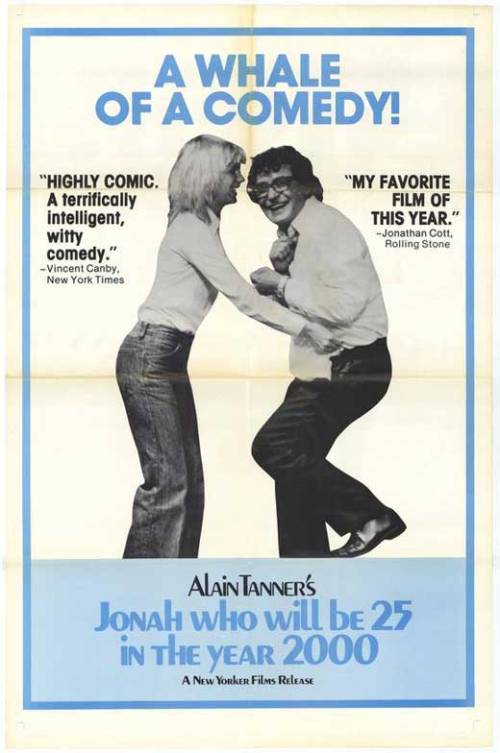
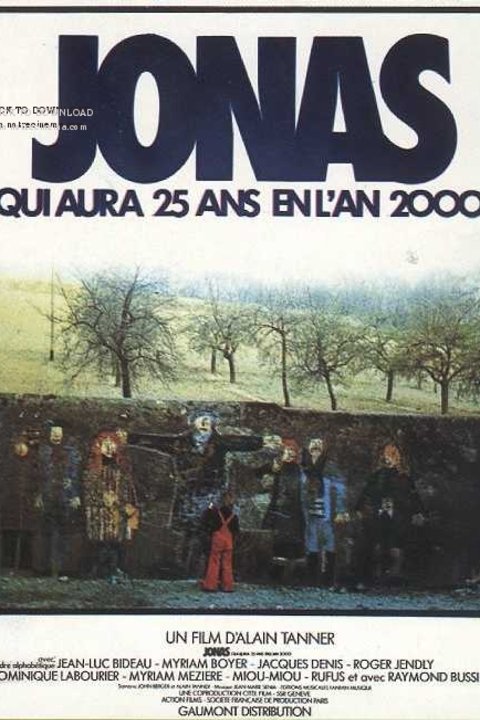
Jonah Who Will be 25 in the Year 2000 (1976)

By Richard Winters

My Rating: 6 out of 10

4-Word Review: Their lives lack purpose.

Eight individuals (Rufus, Miou-Miou, Dominic Labourier, Roger Jendly, Jacuqes Dendry, Myriam Boyer, Jean-Luc Bideau, Myriam Mezieres) who were a part of the French protests in May, 1968 now live on a communal farm where they find that their lives lack meaning due to being forced into jobs that do not inspire or interest them. Jonah is the baby of the one of the members who they hope will grow up into a better, more open world.

I usually prefer European films due to their leisurely pace that emphasizes nuance and doesn’t feel the need, like in most Hollywood flicks, to hit-you- over-the-head with a broad generalized message and yet this one took me quite a while to get into. The major hurdle is that it rotates between too many different characters making it hard to follow any of them as there are long gaps between when we see one individual until we see them again. I was also frustrated that we didn’t get to see what these characters were like back in 1968 as this period only gets briefly alluded to even though seeing firsthand how much they had changed would’ve been interesting.

Although billed as a comedy it is much more a dramedy with only fleeting moments that are funny. The best bits are done in black-and-white when the characters imagine themselves in some other situation outside of their dreary existence. My favorite of these are when the adults watch eight children playing on top of a muddy hill only to then have the adults imagining that they are the kids wallowing around in the mud themselves.

The characters do eventually grow on you once you get to know them making the ending far more impactful than the beginning. Miou-Miou, who just a year earlier played a prostitute with no discernable personality in the dark comedy Going Places is the life of the movie here as a supermarket cashier who doesn’t charge certain customers the full price of their groceries in her attempt to ‘rebel’ against what she feels is an unfair system and her visits with an elderly shut-in (Raymond Bussieres) inside his apartment are both amusing and touching.

The film’s message and its searing attacks on capitalism are something you’d never see any American movie, but thought provoking nonetheless placing this almost on the same level as O Lucky Man!. I also liked that you feel the pain and anguish of these characters without having it explained to you through dialogue, which is a sign of masterful filmmaking that I wish was more prevalent in movies that are done here.

My Rating: 6 out of 10

Release: December 1, 1976

Runtime: 1Hour 55Minutes

Not Rated

Director: Alain Tanner

Studio: Action Films

Available: DVD (Import all regions)

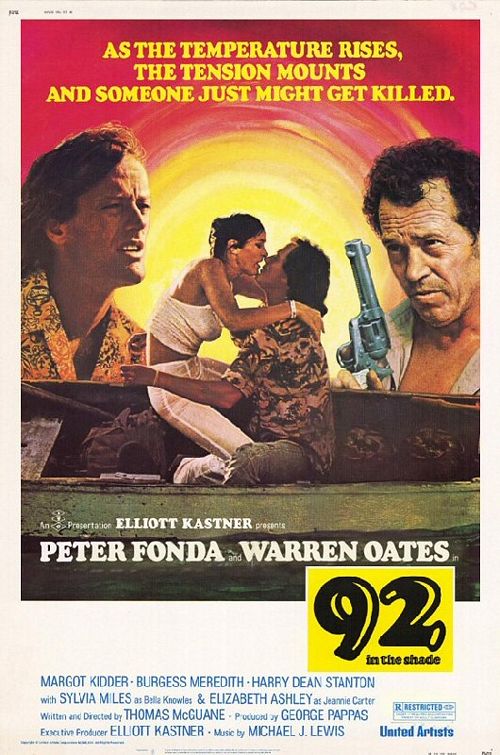
92 in the Shade (1975)

By Richard Winters

My Rating: 5 out of 10

4-Word Review: Rival fishing boat captains.

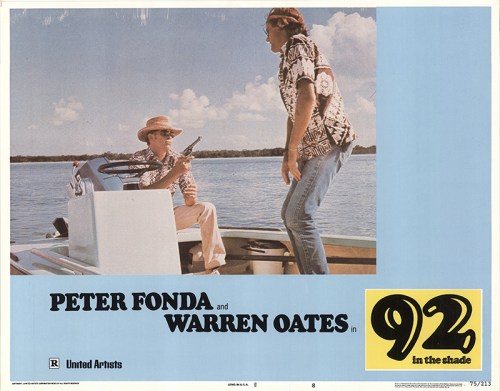
Tom (Peter Fonda), a lifelong drifter, moves back to his hometown of Key West, Florida where he hopes to start up his own charter boat business. However, Nick (Warren Oates) already owns one and not happy about having competition. He along with his friend Carter (Harry Dean Stanton) decide to play a cruel practical joke on Tom, who in an effort to get some revenge, destroys Nick’s boat, which sets off a warring rivalry.

Thomas McGuane was lucky enough to get to direct his own novel despite having no experience behind the camera yet frittered it all away with wild parties as well as an affair with the film’s co-star Elizabeth Ashley despite being engaged to Margo Kidder who was also cast in the movie and which set off quite a few fireworks behind-the-scenes. On a technical level I loved the way the working class/old town side of Key West gets captured along with the glowing gold sunshine of the region and Michael J. Lewis’ soothing banjo strumming soundtrack helps bring out the film’s laid-back ambiance, but outside of a few amusing moments that’s about it.

Initially the leisurely pace and quirky nuance is refreshing and I liked the contrasting personalities of the two leads, but not enough happens. By the second act you wonder what happened to the story as too many extraneous scenes and characters get thrown until it ends up being an abyss to nothingness.

The cast though is definitely game. The wacky dialogue between Burgess Meredith and Sylvia Miles, which I’m pretty sure was all ad-libbed, is quite amusing although the scene where she tries to shatter a glass by wailing out a high-pitched screech should’ve been extended. Joe Spinell, one of cult cinema’s great character actors, practically steals the whole thing with his few minutes of screen time. The scene where he is taught about the different kinds of fishes by having them displayed on top of a pool table is the funniest moment of the movie although the garish outfit that he wears when he goes out on the boat with Fonda comes in as a close second.

Spoiler Alert!

The ending, at least in this recent version I saw from Amazon Video, took me by complete surprise. I had seen this movie twice before and both of those times it ended with Oates confronting Fonda on his boat, but instead of attacking him they sit down and have a friendly chat. Here it ended with Oates shooting Fonda and then immediately freezing the frame and rolling in the credits.

For me this alternative ending was frustrating as it left open too many unanswered questions. Having a film drag on as it does with virtually nothing occurring during its second and third act only to abruptly end it when it finally gets interesting is like a slap-in-the-face to the viewer and helps to explain why this bombed so terribly at the box office.

My Rating: 5 out of 10

Released: August 22, 1975

Runtime: 1Hour 27Minutes (Alternative ending) 1Hour 33Minutes (Original ending).

Rated R

Director: Thomas McGuane

Studio: United Artists

Available: DVD, Amazon Video.