Category Archives: 70’s Movies

Rafferty and the Gold Dust Twins (1975)

By Richard Winters

My Rating: 5 out of 10

4-Word Review: Lost souls go traveling.

Rafferty (Alan Arkin) works as a driving instructor and is also an alcoholic. One day while relaxing at a park he meets him up with a kooky lesbian pair known as Frisbee (Mackenzie Phillips) and Mac (Sally Kellerman) who have both been recently released from prison. Initially the pair kidnap Rafferty at gunpoint and force him to take them to New Orleans, but Rafferty soon develops a bond with them as they go jaunting around the west looking for excitement and diversion from their otherwise boring lives.

This film works differently from the usual road movie as there’s no real structure to it at all. In some ways this is more realistic as the romanticism is erased and we’re left with nothing more than random events that leads to no conclusion other than dispelling the myth that hitting-the-road will somehow lead to some new self-awareness as these character’s lives remain just as directionless upon their return as it was when they left. Watching the petty crimes that they commit in order to survive ends up being the film’s only entertaining value in what is otherwise a meandering and flat story.

Phillips gives a good performance as a tough, street smart juvenile delinquent who I felt was channeling her own precarious upbringing as the daughter of singer John Phillips in order to have been able to play the part with such a vivid authenticity. If anything she gives the film a much needed edge and is the only real good thing about it.

Kellerman is okay and even sings a country tune, but what impressed me most was how young they made her appear as she was nearing 40 at the time, but she looked more to be in her early 20’s. Arkin surprisingly manages to stay restrained and never once goes into one of his patented hyper rants, but in the process comes off as too mellow and allows his two female co-stars to act circles around him.

The film also features some good supporting work by a cast full of faces who you’ve seen before, but don’t quite know what their names are. Alex Rocco is particularly engaging as a shyster that Arkin meets in a casino who clings to the trio as a hanger-on before getting inadvertently dumped, which was a shame as I liked his energy. Charles Martin Smith has an engaging bit as a naive soldier on a 15-day army leave who gets robbed by Phillips and then tries to relentlessly track her down.

Director Dick Richards won many accolades for his first flick The Culpepper Cattle Company and the realism it gave to the old west and he seems to be taking the same approach here by connecting the modern-day road movie to the rugged individualism of the bygone cowboy, but it doesn’t come off as effectively as it could’ve. A stronger cinematic approach that captured the western landscape would’ve made it more visually appealing as well as having a soundtrack that wasn’t so generic.

Spoiler Alert!

The ending is a bit perverse by today’s standards as Kellerman leaves them so Arkin then poses as Phillips’ father in order to get her out of the orphanage and allow the two to travel to Uruguay. The intent at the time may have seemed innocuous as Arkin was simply filling the role as her surrogate father, but these days many viewers will consider it ‘creepy’ and presume that the middle-aged man was trying to take advantage of this 15-year-old’s desperate situation in order to have a sexual relationship with her.

My Rating: 5 out of 10

Released: February 2, 1975

Runtime: 1 Hour 29 Minutes

Rated R

Director: Dick Richards

Studio: Warner Brothers

Available: VHS

The Brood (1979)

By Richard Winters

My Rating: 6 out of 10

4-Word Review: Wife creates dwarf murderers.

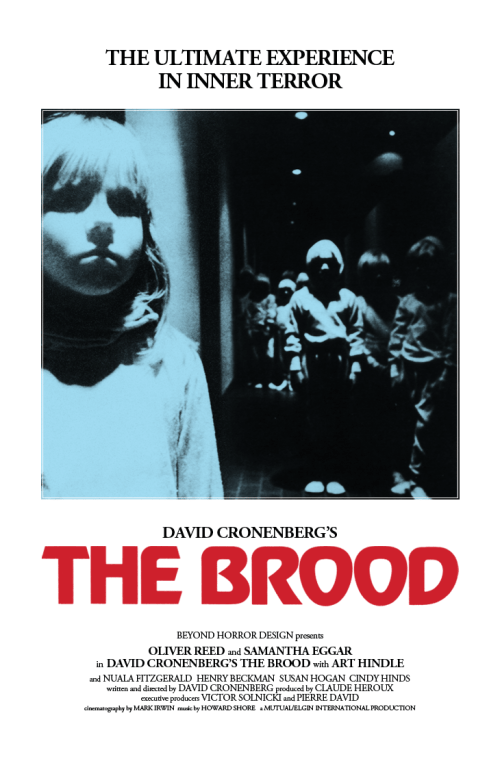
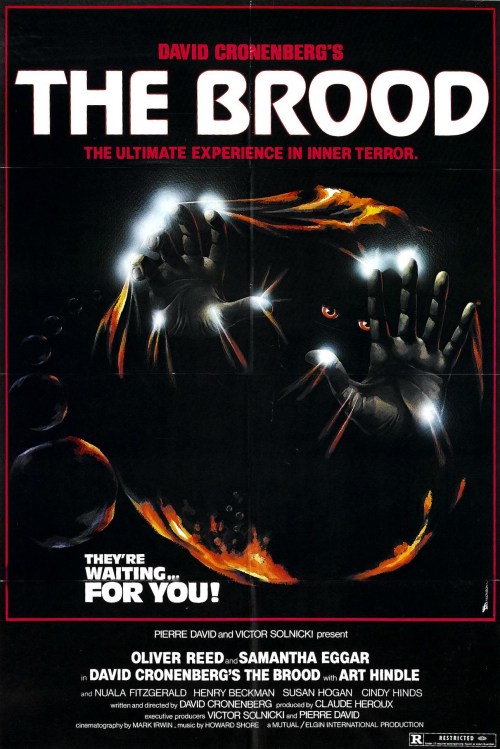
After suffering a mental breakdown Nola (Samantha Eggar) is sent away to a secluded clinic run by Dr. Hal Raglan (Oliver Reed) who uses unorthodox methods to heal his patients. Once she gets sent there strange murderers resembling dwarfs begin to terrorize her family members including her daughter Candice (Cindy Hinds) who they kidnap. Her husband Frank (Art Hindle) is convinced there’s some connection between these strange killers and the institute so he goes there to confront the Dr., but is ill prepared to the secret that awaits him.

Through the years this film has become a staple to director David Cronenberg’s work and is well filmed with shadowy lighting and fluid camerawork that help create an ongoing creepy feel as well as Howard Shore’s pounding score. The film’s ultimate moment though remains Eggar’s bizarre ‘birthing’ scene where she takes a blood drenched embryo and licks it, which apparently was something she improvised on-the-spot. It remains perversely disturbing even by today’s standards, but was cut from the release at the time and only now is intact with the Criterion Blu-ray in all its glory or gruesomeness depending on your point-of-view.

The story though isn’t as clever as the filmmakers think as I was able to figure it out almost immediately and having to watch a protagonist take 90-minutes to come to the same conclusion that took me only 10-minutes makes for a rather annoying and dull plotline. There’s also no explanation for why Nola is able to have the ability that she does. If it’s connect it to the experimental therapy she’s going through then fine, but others in that group should , or at least some of them, be able to do the same thing, but they’re not, so why is that?

There’s also a murder scene that comes in the middle of the movie that to me didn’t seem logical. It entails the dwarf murderers coming into the kindergarten class that Candice is attending and using toy hammers that they pick-up from a nearby table to bludgeon her teacher to death. Normally toy hammers are lightweight,  so no matter how hard or how long a person may swing it at their victim it’s highly unlikely that it would be able to crush their skull. I also thought all of the children who witnessed the crime would’ve run out of the room screaming instead of just one and having them then stand around the body quietly whimpering afterwards sounded forced and fake.

Reed’s dark and commanding presence always helps every movie that he is in although it’s a bit weird that he becomes the ultimate hero especially after the opening scene in which he is emotionally abusive. Eggar, whose eyes look strangely wider and more rounder here, has her acting meddle put to the test by portraying a person that I didn’t think she had the ability to do, but she proves quite qualified.

The young Hinds is surprisingly effective despite her extremely young age, but Hindle is transparent as the protagonist. I realize that he acts as a sort of buffer to the craziness, but he lacks an edge and unable to match the energy of his flamboyant co-stars.

Horror fans should find this thing adequate, but for me the story is too basic and predictable they’re needed to be some sort of secondary angle or side-story. Supposedly Cronenberg was inspired to write this after dealing with the custody battle he had with his own ex-wife, Margaret Hindson, who had worked with him on many of his earlier projects. According to him Eggar’s character reflected many of her same traits.

My Rating: 6 out of 10

Released: May 25, 1979

Runtime: 1Hour 32Minutes

Rated R

Director: David Cronenberg

Studio: Canadian Film Development Corporation

Available: DVD, Blu-ray (Criterion Collection), Amazon Video

The Driller Killer (1979)

By Richard Winters

My Rating: 6 out of 10

4-Word Review: Electric drill relieves stress.

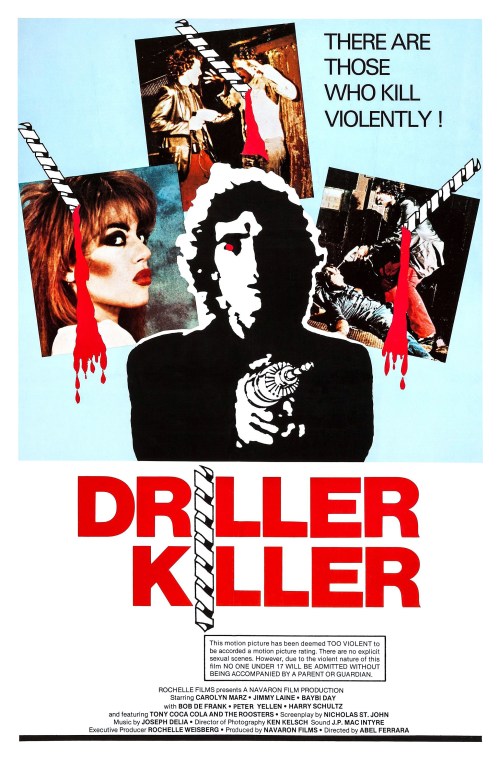
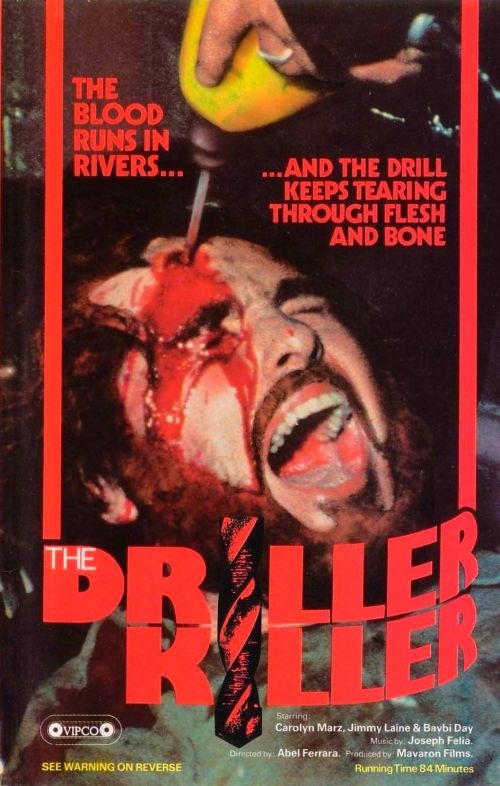
Reno (Abel Ferrara) is a New York apartment dweller who frets over his inability to pay his bills and the constant noise coming from a punk band next door who perform at all hours of the day and night and to which his landlord (Alan Wynroth) refuses to do anything about. The pressures to finish his latest painting, which he hopes to sell, become too much, so to alleviate the tension he takes a power drill out onto the streets and kills random homeless people with it late at night. For awhile this is enough but he eventually decides to use it on other people in his life who he feels have wronged him, which includes not only his girlfriend,but an art gallery owner (Harry Schultz) who refused to purchase his painting.

This is a definite step above the usual horror fare and seems in many ways like an arthouse film. It’s ability to capture New York’s dark urban underbelly gives the viewer a strong taste of what the main character is going through until you almost feel like you’re trapped there alongside him. The talky segments that come in-between the killings, which are usually the boring parts in most other horror films, are surprisingly captivating as they vividly convey all the reasons why Reno is so angry and give the viewer much the same feeling.

When the killings finally do start to happen it’s not so much the graphic violence that’s disturbing, but the fact that we relate to the man who’s doing it. We’ve understood his pent up rage by seeing how the unrelenting, impersonal urban system continually works against him making the murders act like a stress reliever not only to the killer, but the viewer as well as it breaks both us and him away from the never ending challenges of everyday life, which the film essentially portrays as being the real horror. Instead of being repelled by the bad guy we connect to him sending this movie into a far darker psychological realm than most.

While Ferrara shows a gifted ability as a director the film almost defeats it’s unique edge by dwelling too much on the urban hell hole theme as it makes its point and then drags it out by hitting-it-home again and again. The footage of the punk band becomes excessive too until it almost becomes more like a musical docu-drama. The killings aren’t very imaginative either as one quickly becomes like the other eventually making them seem like throwaway scenes that quickly lose their impact.

The film’s ending is particularly disappointing as it fades out before we know what happens to either the main character or his girlfriend (Carol Slaughter). A good horror film needs a strong finish and this one cops-out like it didn’t know how to end it, so it just leaves it up to the viewer to guess. While I commend its effort to take the genre into a more complex and unusual area I still felt it could’ve gone even further with its warped premise than it does.

My Rating: 6 out of 10

Released: June 15, 1979

Runtime: 1Hour 36Minutes

Not Rated

Director: Abel Ferrara

Studio: Navaron Films

Available: DVD, Blu-ray, Amazon Video, YouTube

It Lives Again (1978)

By Richard Winters

My Rating: 4 out of 10

4-Word Review: Three more monster babies.

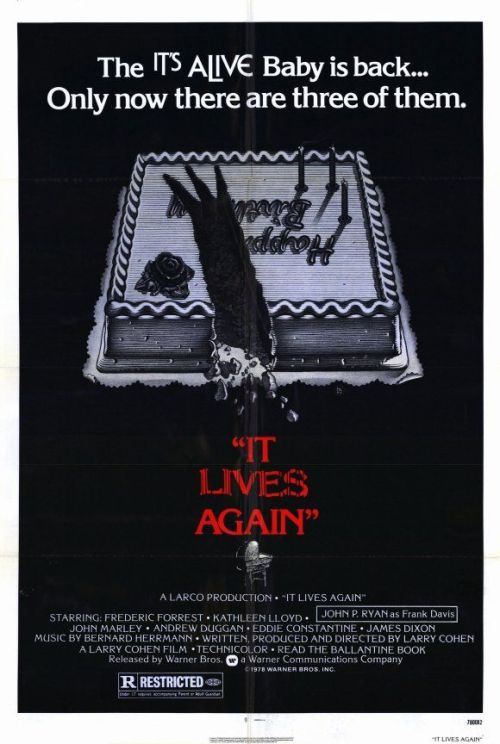
As Jody and Eugene (Kathleen Lloyd, Frederic Forrest) hold a baby shower in excited anticipation for their newborn they meet Frank (John Ryan) the father whose wife gave birth to the monster baby in the first film. He warns them that their baby may be the same way and advises them to give birth to it in the back of a semi-truck specially equipped to handle the mutant child. The couple initially resist, but then come into contact with Malory (John Marley) and a police force intent on killing it. Frank manages to get their baby to a secret underground home where two other mutant children are being held under the observation of Dr. Perry (Andrew Duggan) who wants to raise the monster babies and have them multiply in order to create a whole new race of people.

This sequel to the surprise cult hit starts out with potential despite neglecting to explain why these mutant births are occurring. In the first one it was intimated that contraceptive pills were the cause, but here that gets forgotten and never even mentioned. Keeping the babies in an underground facility bogs the action down and eventually turns this into a talky drag and the idea of having three killer babies isn’t all that impressive either as I would’ve imagine that by now, given that four years have passed from when the first story took place, there should’ve been hundreds if not thousands of them.

The film’s biggest drawback though is that we don’t see much of the babies and instead get treated to extended shots of the adults talking while only hearing the baby’s crying in the background, which is boring. If the budget didn’t allow for elaborate special effects, which forced them to keep the footage of the little monsters to a minimum, then this cheesy excuse for a horror film should never have been made at all because what’s the point of watching it otherwise?

Lloyd and Forrest are good, but their characters shift perspectives too quickly. In the first film Frank’s changing opinion of his newborn came about slowly and realistically, but here the parents see-saw from loving the baby one second to wanting to kill it the next. The jump cuts are also an issue, which makes the intended scares  hard to follow and the film’s message is a muddled mess too. The first one had a seemingly a pro-life point-of-view while here those who want to save the babies are portrayed as being fringy lunatics.

Alternate Title: It’s Alive II

My Rating: 4 out of 10

Released: May 10, 1978

Runtime: 1Hour 31Minutes

Rated R

Director: Larry Cohen

Studio: Warner Brothers

Available: DVD, Amazon Video, YouTube

It’s Alive (1974)

By Richard Winters

My Rating: 5 out of 10

4-Word Review: Newborn is a monster.

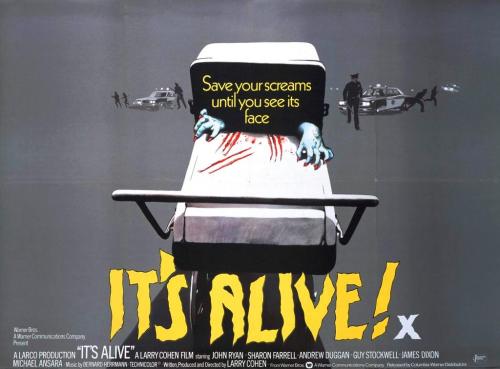
Frank (John Ryan) and Lenore (Sharon Farrell) are excited about the birth of their second child, but during the delivery they find to their horror that the newborn is a freakish monster who kills all the doctors in the delivery room and then escapes out onto the streets. The police try to track it down while Frank initially avows to kill it himself, but when his paternal instincts eventually set in he has second thoughts.

This is for the most part a fascinating, offbeat look at the abortion issue that seems to be a continuing theme with writer/director Larry Cohen who also co-scripted Daddy’s Gone-a-Hunting. In many ways it’s less of a horror film and more of a character study as the main focus is on Frank and the way his feelings on the baby change during the course of the story. In fact it’s Ryan’s intense performance that’s the film’s mainstay and what really propels it.

The baby itself offers intrigue and I liked how his appearance is kept mostly a mystery throughout, which helps build even more fear, but then we never end up getting to see it up close, which is a big letdown. Instead it’s just fleeting long distance shots and even then that doesn’t happen until the very end. The only reason to see a movie like this is to get a genuine look at the thing and when that only gets teased it’s a rip-off.

The baby’s super intelligence had me confused too. Supposedly it’s deformed due to the mother taking some contraceptive pills, but how does this make the child super smart to the point that he is able to find the school that Frank and Lenore’s child goes to, in crowded L.A. of all places and then eventually Frank and Lenore’s house? This thing is just a few days old, so how is it able to read street signs and find places and be ‘pre-programmed’ as it were to know which school/house to go to?

I was also confused at how the baby was able to attack people by biting into their necks. If it’s a crawling baby shouldn’t the feet and ankles of the victim be the place that suffers injury? And how was the baby able to kill all the doctors and nurses in the delivery room? If he was attacking one of them couldn’t the others have ganged up on the little guy and overpowered him or even just ran out of the room and yelled for help or did they all just stupidly stand there as if frozen while the baby jumped onto each Dr. and bit into them one-by-one?

Never getting a clear consistent view of the baby, nor properly explaining what the ‘logic rules’ were was a big turn-off for me when I first saw this decades ago and I came away considering it a Grade-B schlockfeast with little redeeming value. Upon second viewing I’ve softened on it a bit and appreciated Cohen’s efforts especially on such a limited budget, but the screwy loopholes and flimsy effects ultimately hurts it either way.

My Rating: 5 out of 10

Released: April 26, 1974

Runtime: 1Hour 30Minutes

Rated PG

Director: Larry Cohen

Studio: Warner Brothers

Available: DVD, Amazon Video, YouTube

The Haunting of Julia (1977)

By Richard Winters

My Rating: 2 out of 10

4-Word Review: Ghost child haunts home.

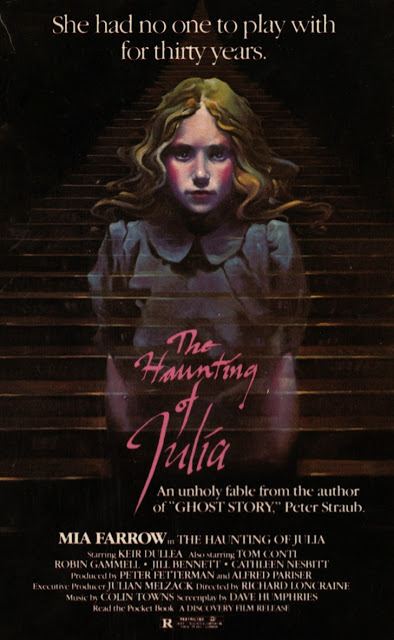
Julia (Mia Farrow) leaves her husband Magnus (Keir Dullea) after their child accidently chokes on some food and dies. She then moves into a large home, which also had a child die in it years before. After Julia begins living there for a while she notices the presence of a ghostly spirit and holds a séance run by Mrs. Flood (Anna Wing) where she learns that a child was murdered by a group of other children lead by the mischievous Olivia, who is now the one haunting her home.

The film is based on an early Peter Straub noveI, but seems all mixed up in what direction it wants to take and I couldn’t understand why the first part of the story dealing with her child dying was even needed as the second half goes into an entirely different direction.  It also introduces a solid nemesis in the form of her controlling ex-husband who dies off quickly, which again left me wondering why his character was even put into the story at all.

The choking aspect is another issue and I was genuinely shocked they showed it as it’s hard to effectively pull off without it looking unintentionally comical. Having the child get hit by a train, car, slipping off the side of a cliff, or even drowning is far more dramatic and could leave a lasting visual impact whereas this looks as clumsily staged as it sounds.

The séance should’ve been avoided too since that has been parodied so much in movies that it’s hard to take seriously. The film doesn’t approach it with any new interesting angle so it comes-off as tacky as every other séance you’ve seen in a movie, even the funny ones, and yet this one we’re supposed to take seriously even though any sane participant would be convinced that the woman leading it was simply overacting for affect, which is how it looks.

The backstory involving the female child who was able to somehow control the other boys in the neighborhood to do her bidding had an intriguing element, which made me think that’s what should’ve been played out while the ghost angle dropped completely. Instead it could’ve analyzed the psycho young girl while she was alive and examined how she got the way that she did and what methods she used to convince the other kids to do what she wanted, which is never explored, but would’ve been far scarier than what ultimately gets played out.

Farrow with her super short haircut looks too much like she did in Rosemary’s Baby and a different do was needed to avoid the resemblance. Dullea has potential as the heavy, but then disappears too soon. The only one that does shine is veteran actress Cathleen Nesbit who hams it up as the mother of the killer girl, but overall the rest of it is a big letdown including the non-eventful ending that completely fizzles making it no surprise why the studio left this one sitting on the shelf for 5 years before finally giving a limited release that netted it very little in return.

Alternate Title: Full Circle

My Rating: 2 out of 10

Released: May 29, 1981 (Filmed in 1976)

Runtime: 1Hour 38Minutes

Rated R

Director: Richard Loncraine

Studio: Discovery Films

Available: DVD (Out-of-Print), Amazon video, YouTube

Dominique (1979)

By Richard Winters

My Rating: 5 out of 10

4-Word Review: Dead wife haunts husband.

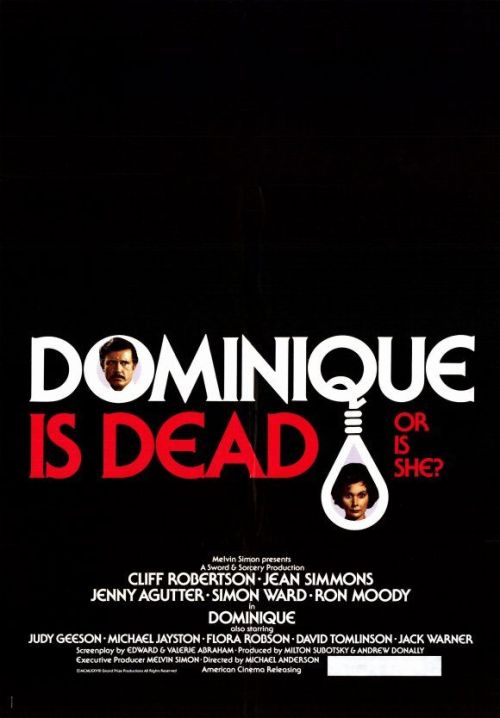
Dominque (Jean Simmons) is a woman suffering from a fragile mental state who is convinced that her husband David (Cliff Robertson) is trying to drive her insane. She eventually hangs herself and then her ghostly presence comes back to haunt him, which ends up driving him over the edge Dominique (Jean Simmons) is a woman with a fragile mental state who is convinced that her husband as well.

The film was directed by the talented Michael Anderson, but you’d hardly know it as the DVD transfer by Synergy, which is already known to produce some very low grade quality stuff and looks like somebody’s badly lighted, grainy home movie. Unfortunately this is the same transfer that gets streamed onto Amazon, so if you want to see this otherwise rare movie you’ll have to buckle-up and accept the substandard look.

As for the story, which is based on the novel ‘What Beckoning Ghost’ by Harold Lawlor, it’s not all that much better as the plot and characters come off as stiff and one-dimensional. There’s no backstory either, which I felt was needed to help explain why Robertson is an American living in England and what specific job does he do that allows him to be able to afford such a big mansion? There’s also passing mention of Dominique being in an earlier accident that might’ve helped explain her mental state, but it’s never talked about in detail, or better yet shown in flashback.

Initially it’s a mystery as to whether Robertson is trying to drive Simmons mad or if it is all just in her head. Finally towards the end he admits to it and supposedly it’s all just so he can get his hands onto her money, but wouldn’t it have been much easier to hire someone to kill her and make it look like an accident then trying to drive someone insane, which has no guarantee of working and could take years and years to accomplish? Also, if Dominique is already aware of what he is trying to do then why doesn’t she just leave him instead of turning to suicide?

The ghostly special effects consist of shots showing a piano playing by itself as well as a shadowy figure walking from a distance, which isn’t much and gets repeated at several different points, which becomes quite redundant. Both stars are wasted as well. Simmons is good, but she’s only in it at the start while Robertson much spends the entire second-half saying very little and instead relying on his almost constant shocked/scared expressions to help propel the plot along.

Despite all this it still manages to be moderately compelling and may appease those who are in to ghostly tales. The twist at the end is a definite surprise, but it also leaves open a lot of logic loopholes that makes the entire thing seem quite implausible.

My Rating: 5 out of 10

Released: March 5, 1979

Runtime: 1Hour 35Minutes

Rated PG

Director: Michael Anderson

Studio: Astral Films

Available: DVD-R, Amazon Video

All the Colors of the Dark (1972)

By Richard Winters

My Rating: 6 out of 10

4-Word Review: Haunted by her nightmares.

Jane (Edwige Fenech) is plagued by nightmares dealing with a blue-eyed man (Ivan Rassimov) chasing after her. She feels that the memories of the recent death of her child as well as the loss of her mother when she was younger may have something to do with it. Her sister Barbara (Susan Scott) has her see a psychiatrist (George Riguad) while her friend Mary (Marina Malfatti) suggests she attend a black mass, but neither helps and just makes things worse until she can no longer differentiate between her dreams and reality.

The film is a strong tie-in to Rosemary’s Baby and in many ways seems to be playing out the same essential plot, but doing it in a more vivid, graphic way. Instead of implying the horror like that one did this one goes straight to the stuff that was never shown or just briefly touched-on. For the most part I liked this approach as I always felt the Roman Polanski classic was too restrained and talky and could’ve gone farther cinematically with its intriguing premise than it did.

The visuals here are almost in-your-face particularly the surreal opening bit, which is the best moment in the movie. Director Sergio Martino keeps the viewer off-balance by constantly going back and forth between the present day and then to Jane’s nightmares until it becomes increasingly harder to tell the difference between them, which makes the viewer feel locked into Jane’s frightening dilemma right along with her.

Unfortunately rhe plot itself isn’t as creative and there were many times when I foresaw the twists long before they happened and could even predict when they’d come. The protagonist walks into too many traps that anyone else could’ve guessed was coming making her seem a bit dense while the cult-like mass segment had too many clichés making it campy while eroding from the rest of the film’s provocative style.

Fenech doesn’t look like the average housewife either, but more a magazine model and in fact all the women here have too much of that same appearance, which takes away from the authentic feel. Part of the reason why Rosemary’s Baby worked was because Mia Farrow came-off as fragile and vulnerable while Fenech has a detached look in her eyes that doesn’t allow her to emotionally connect with the viewer even though as the film progressed I softened on her more.

The on-going twisting of the dreams and reality eventually overstays their welcome becoming more annoying than intriguing particularly near the finish where too many false endings get played-out. Even though it never matches its first 10 minutes and isn’t as erotic as the film’s promotional poster suggests I was still glued to what was happening and it’s one of the more memorable Italian giallos of all-time.

My Rating: 6 out of 10

Released: February 28, 1972

Runtime: 1Hour 35Minutes

Rated R

Director: Sergio Martino

Studio: Interfilm

Available: DVD

Eyeball (1975)

By Richard Winters

My Rating: 6 out of 10

4-Word Review: Killer targets tour group.

A group of visiting Americans (at least they’re supposed to be American even though they sure don’t seem like it) traveling around Spain on a tour bus find themselves targeted by a killer in a red cape that gouges out the eyes of each of his victims. Suspicion soon centers on the culprit being one of the members of the tour group, but who could it be? Maybe it’s businessman Mark Burton (John Richardson) whose wife (Marta May) was suspected of a similar crime back home, or maybe it’s the elderly reverend (George Rigaud) who’s always spotted at the wrong place whenever the crimes are committed. Inspector Tudela (Andres Mejuto) has his hands full as the list of suspects keeps mounting almost as fast as the body count.

This film is a variation of If it’s Tuesday This must be Belgium, which involved a tour group from America going around Europe, but there it was played for laughs with no killings or mystery while here it tries for horror even though it would’ve worked better had some comedy been thrown as the dialogue gets very soap opera-like. The characters are a problem too as their reactions to the murders gets underplayed, which becomes unintentionally funny, and the way they blissfully continue on with the tour after each killing and acting like it’s no big deal makes them seem cold and inhuman.

The gore is cheesy particularly the fake looking gouged out eye sockets of the victims. In reality eyeballs are more oval shaped, but here they resemble ping-pong balls and the scene where the inspector takes out a small case in his office where he has collected each eyeball from each of the victims to show it to one of the witnesses comes off as being truly twisted.

On the positive end Bruno Nicolai’s bouncy musical score is distinctive and the sunny scenery, which was shot on-location in Barcelona, Spain, is scenic and helps add a visual appeal. The mystery at least on a minor level has intrigue and is full of all sorts of clues, which allows the viewer to play along and try to figure out who did it before the authorities do.

Usually I’m able to guess the identity of a killer long before anyone else does, but in this case I was honestly shocked, so in that regard it was fun even though the motivation for why the individual does it was over-the-top. If you’re looking for 90-minutes of a whodunit, which is ultimately all this thing really is, with just enough tacky gore thrown in for cheap laughs, then it might be worth considering.

My Rating: 6 out of 10

Released: January 24, 1975

Runtime: 1Hou 31Minutes

Rated R

Director: Umberto Lenzi

Studio: Estrela Films

Available: DVD-R (as The Secret Killer)

Rabid (1977)

By Richard Winters

My Rating: 5 out of 10

4-Word Review: Graft patient craves blood.

Rose (Marilyn Chambers) becomes the victim of a horrible accident when the motorcycle she goes riding on with her boyfriend (Frank Moore) crashes and she gets pinned underneath the burning wreckage. Fortunately for her the accident occurs near a clinic that specializes in plastic surgery. The head surgeon (Howard Ryshpan) is able to perform an experimental procedure on her that helps graft her burned skin back to normal, but in the process creates a strange orifice in her armpit that sucks blood from everyone she attacks. Her victims then become possessed by a rare form of rabies that sends the city of Montreal into a panic as the authorities try to control the outbreak while also trying to figure out the cause.

This marked director David Cronenberg’s third feature film and from a low budget standpoint the results are impressive. I was especially amazed by some of the car stunts including having an out-of-control vehicle jump a guard rail and crash onto a highway below where a large semi then rams into it. His ability to somehow hire an entire fleet of squad cars is admirable too as most budget-challenged films will make do with just one police car when having authorities investigate the scene of a crime/accident even though in reality there are usually many especially if the crime or accident is severe like here.

I also loved the way he captures the gray/bleak Canadian landscape, which helps supplement the film’s dark and moody tone as well as the bits of dark humor that gets implemented into the story that made me wish the whole thing had been approached as a black comedy from the start.

The horror though isn’t all that much and genuine scares are light including the scenes showing rabid people attacking others, which becomes both clichéd and redundant. The orifice itself looks like an asshole and similar to the giant one that Cronenberg created many years later for his equally provocative film Naked Lunch.

Unfortunately porn star Chambers doesn’t have the presence or talent for mainstream film work. She broke into the business years earlier with a bit part in the Barbra Streisand movie The Owl and the Pussycat, but to her surprise other film offers didn’t follow, which eventually forced her into the X-rated business, which included starring in the cult classic Behind the Green Door, but she always held out hope to one day breaking back into mainstream movies and finally got it here, but it never propelled her further.

Part of the issue is her voice which is abnormally high-pitched and at times sounds like that of a very young child’s. In certain scenes it’s worse than others, but I found listening to her speak to be disconcerting and distracting although she does still look great naked.

The somber, downbeat ending is unusual for a horror film and it might’ve had more impact had the main character been given more depth. The viewer though learns little about her and she fails to have a distinctive personality, which limits the film’s ability to be anything more than just a curio.

My Rating: 5 out of 10

Released: April 8, 1977

Runtime: 1Hour 31Minutes

Rated R

Director: David Cronenberg

Studio: Cinepix Film Properties

Available: DVD, Blu-ray, Amazon Video, YouTube