After Hours (1985)

By Richard Winters

My Rating: 8 out of 10

4-Word Review: Don’t stay out late.

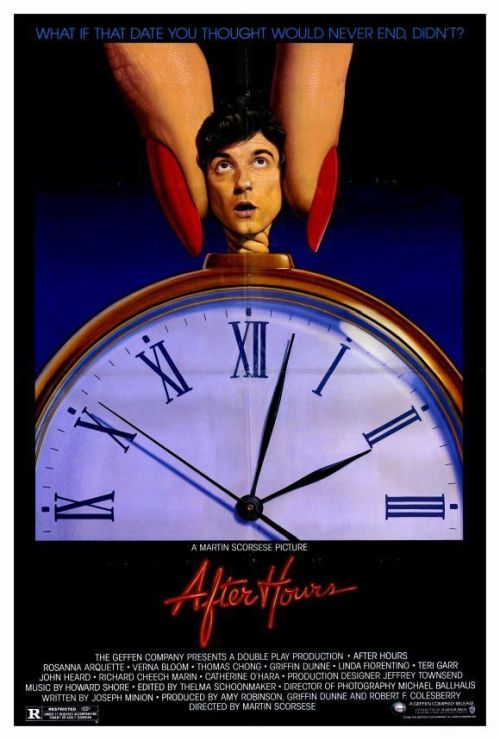
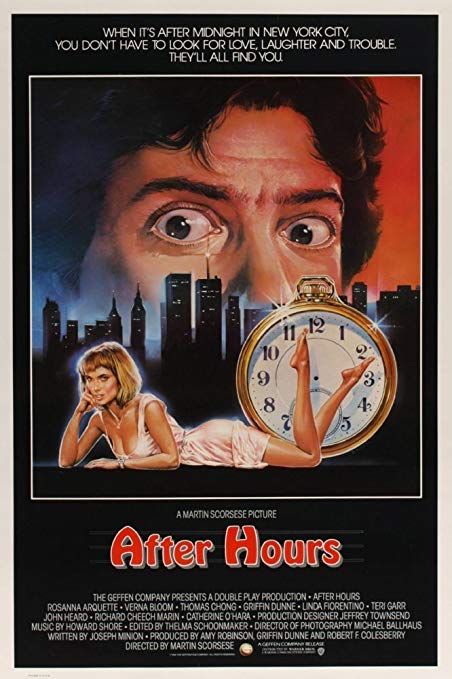
Paul (Griffin Dunne) is a single man living in New York, who’s bored with his job and looking to spend his Friday night on the town in hopes that he might hook-up with an attractive woman. While at a late night cafe he meets Marcy (Rosanna Arquette) who tells him that she lives with a sculptress who makes and sells paperweights. Paul decides to use the excuse that he wants to buy one as his ruse to go over to her apartment in hopes of ‘getting lucky’. Yet when he arrives things quickly become surreal where everybody he meets behave in strange ways making his night-on-the-town a nightmarish event.

The film is based on a screenplay by Joseph Minion, who has written two other produced screenplays 1999’s On the Run and 1991’s Motorama that play off the exact same theme, and was done for the screenwriting class that he was taking at Columbia University, which got the attention of Dunne who optioned it as a project he felt would be a perfect fit for his acting style. Unbeknownst to him though was that the first part of it was based on a 30 minute-monologue piece called ‘Lies’ written by Joe Frank and broadcast on NPR radio in 1982 and when the film came out the studio was forced to pay Frank an out of court settlement because of it.

Many have felt the film’s theme is Paul’s emasculation by all the women that he meets, and to an extent that’s probably true, but for me I found it more interesting to see how despite the film’s surreal quality it’s still not that far off from truth. It’s like going out on a first date with a really attractive person who your’e excited about only to find as you get to know them that they’re really screwed-up, or meeting a new group of people who you initially think you have something in common with only to learn as you talk to them that you really don’t. It also nicely satirizes the hip/happening patrons of the club scene who walk around with a perpetual arrogant attitude of coolness, but in reality are quite hollow.

The production was filmed at night, which forced the crew to work for 10-straight weeks from sundown to sun up and then catch-up with their sleep during the day, but the effort was worth it as it helps create this underworld feel with no connection to the ‘proper’ daytime one. I also loved how it tries to explore New York’s club scene and the artsy SoHo district with all the eccentric personalities that make up that subculture, which helps to make New York the unique place that it is and which gets criminally ignored in most other movies that take place there.

The acting is excellent with everyone perfectly cast although the scenes I enjoyed the most involved Dunne’s exchanges with some lesser known performers like Murray Moston as a subway attendant and Clarence Felder as a nightclub bouncer. Credit must also go to Dunne himself who plays the normal guy role perfectly. Had he been too over-the-edge with it, or too nerdy it wouldn’t have worked as the character had to be someone the viewer could relate to while behaving/reacting to things in plausible ways in order to feed off the paradox that the more rational he was the more irrational everything else around him  became.

Spoiler Alert!

The ending proved to be the toughest part for director Martin Scorsese to implement. Originally Dunne’s character was driven away in the van still trapped in a the plaster sculpture that Gail (Verna Bloom) had put him in, but this got a negative response from the test audience, so they then considered having Dunne crawl into Bloom’s womb to hide and then getting ‘reborn’ out on the highway, but that was too bizarre.

The one that they finally came up with, which was suggested by director Michael Powell who came on as a consultant, has Dunne ending up at the office where he worked, which has added irony since most offices are boring places that people usually can’t wait to get out of.  However, it never shows how these experiences changed him and a scene should’ve been added showing Dunne afraid to ever leave and continuing to work late in the night after everyone else had gone before finally getting dragged out by the security guards.

The film also fails to explain how Dunne ever got back into his apartment since the bartender (John Heard) had taken his keys to his place earlier. A good alternative ending would’ve had Dunne falling out of the van not at the office, but at his apartment instead where he would’ve then be let in by his landlord. He would fall asleep in his bed feeling safe only to awaken with everyone that had been chasing him earlier now standing around his bedside having been let in by the bartender with the keys.

Overall this is the type of film that you wished had gone on longer as it gets funnier the more it goes on. My only quibble is that Dunne should’ve been forced to get the Mohawk when he was at the club as seeing him with one would’ve accentuated his beaten down mindset and made his appearance when he returned to work even more absurd.

My Rating: 8 out of 10

Released: September 11, 1985

Runtime: 1 Hour 37 Minutes

Rated R

Director: Martin Scorsese

Studio: Warner Brothers

Available: DVD, YouTube

Love Story (1970)

By Richard Winters

My Rating: 5 out of 10

4-Word Review: Romance and then death.

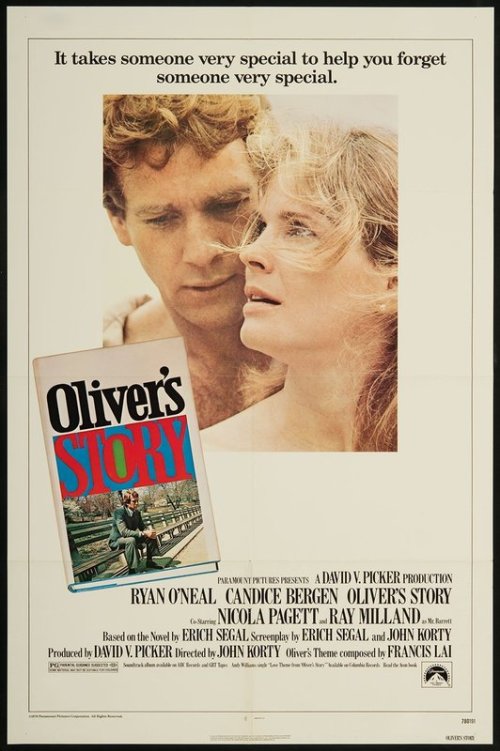
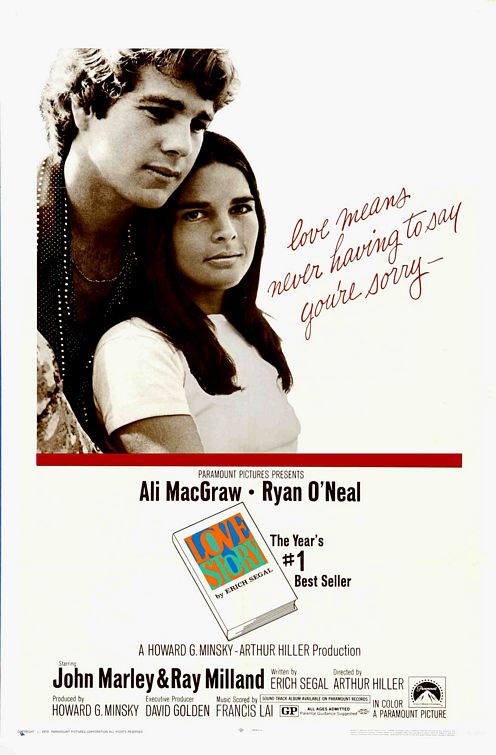
Oliver (Ryan O’Neal) is attending Harvard Law School where he meets Jenny (Ali MacGraw) a student studying classical music. The two don’t hit-it-off at first, but eventually fall in love and marry despite the objections of Oliver’s father (Ray Milland). Just as things seem to be falling into place Jenny gets diagnosed with a fatal illness, which sends Oliver’s world spinning out-of-control.

Erich Segal’s script, which he later turned into a best-selling novel, is simplistic, but the on-location shooting done in and around Harvard is outstanding and helps give the film, along with some well done hockey footage, an added energy. This is one of only a few films to be allowed to shoot there and they were kicked out after only a week due to being too much of a distraction, but it was just enough to give the movie a good authentic college vibe. The snowy landscape plays a big part of it and there’s even a scene where the two play in it, but some shots feature a lot of it in the background only to have a few scenes spliced in where there is none of it on the ground, which makes it a bit visually jarring.

On the romantic side I liked the fact that Jenny is initially prickly towards Oliver and he has to work at getting her to soften up. Men actually do enjoy a challenge and having a woman just throw herself at a guy, or having the relationship start out seamlessly is just not as interesting or realistic. However, having Oliver profess that he ‘loves’ her after only the first date glosses over the courtship aspect too much and essentially ruins the intrigue in the process.

O’Neal is excellent here and he was picked over a lot of other big name stars simply for his ability to react to a situation in effective ways, which he ends up doing quite well. Yet I felt it would’ve worked better had he been the one from the poor-side-of-town as he’s more convincing as a rugged blue collar type instead of a studious student, or their contrasting economic backgrounds not been played-up at all since for me it didn’t really add much.

Spoiler Alert!

The film’s most notorious flaw though, and one that was parodied in a very funny send-up of the movie on ‘The Carol Burnett Show’, is the whole mystery illness thing (supposedly it’s leukemia, but never explicitly stated) that comes out of nowhere without Jenny ever showing an symptoms and having her die in a sudden car accident would’ve solved this issue and been more believable.

Personally though I was more shocked by the fact that the Dr. tells Oliver about Jenny’s diagnosis before he informs her. If she were a child that would be fine, but she’s an adult and deserves to know about her own health affairs before anyone else and if this had occurred today it would’ve gotten him into a lot of trouble.

The narrative also gets a bit askew as Oliver takes the news much harder than she does. Shot after shot shows him getting all misty-eyed almost like the viewer should feel worse for him, as he is now losing the object of his affections instead of her for losing her life.

End of Spoiler Alert!

The film is also famous for the line “Love means never having to say you’re sorry”, which to me never made any sense as relationships are dependent on the other party asking for forgiveness when they’ve done wrong and simply presuming they can get away with anything and expect unconditional acceptance doesn’t work. Two of my female friends agreed with me on this, which only proves how placid and shallow this film ultimately is.

My Rating: 5 out of 10

Released: December 16, 1970

Runtime: 1 Hour 40 Minutes

Rated GP

Director: Arthur Hiller

Studio: Paramount

Available: DVD, Blu-ray, Amazon Video, YouTube

The Great Outdoors (1988)

By Richard Winters

My Rating: 3 out of 10

4-Word Review: Friends ruin their vacation.

Chet (John Candy) decides to take his wife (Stephanie Faracy) and two kids (Chris Young, Ian Michael Giatti) on a well deserved family outing up to a lake resort town in Wisconsin. Unfortunately their fun excursion  gets crashed by their obnoxious friend Roman (Dan Aykroyd) and his wife Kate (Annette Bening) who along with their two creepy twin daughters (Hilary Gordon, Rebecca Gordon) proceed to turn the pleasant vacation into a nightmare.

Calling this John Hughes script paper thin is an understatement and it reminded me of an interview I once read where Hughes bragged that he could write his screenplays in a matter of only a day or two although with this one I’m surprised it took even that long. Not only is the premise devoid of any original ideas, but it seemed more like material for the Griswold family and I was confused why it wasn’t just made as part of the Vacation series although I preferred Candy over Chevy Chase as he’s much more likable without the sneering sarcasm, and his presence here helps make it at least modestly enjoyable.

The comedy also avoids becoming too farcical or lewd, which was nice, and manages to keep things semi-believable to what might occur to a regular family in the woods including my favorite part where the two men try to kill a bat that has gotten into the cabin. The setting, which was filmed on-location in Lake Bass, California is scenic and the woodsy cabin, built specifically for the film on a studio backlot, is impressive because you would never know the difference.

However, the animosity between the two characters, which is supposedly the heart of the humor, is not played-up enough or as half as much as I was expecting. In many ways it seemed almost like it was Candy who was more the obnoxious one particularly when he tells a scary story that gets everyone upset. The scene where he puts a candy bar on the hood of his car to attract a bear makes him look really stupid, and something that should’ve been done instead by the supposedly dopey second-banana character like Aykroyd.

The kids, especially the twin girls who seemed spookier than the twins in The Shining, are annoying and I thought it was weird that they are played-off as creepy for the majority of the film only to then near the end have the viewer expected to suddenly start caring for them when they get trapped in a cave.  As for the two boys they’re dull and transparent and the scenes dealing with the romance that the oldest one has with one of the teen waitresses (Lucy Deakins) are extremely formulaic and unnecessary and almost like it were put in simply to pad the runtime.

The running gag dealing with the talking raccoons is childish and the one dealing with a man (Britt Leach) constantly getting struck by lightning is completely ridiculous.  The story is nothing more than a procession of gags that lacks momentum or pace. The laughs are sporadic and subside after the 45-minute mark making the final half a chore to sit through and that includes the climactic bear attack, which is forced and over-the-top.

My Rating: 3 out of 10

Released: June 17, 1988

Released: 1 Hour 31 Minutes

Rated PG

Director: Howard Deutch

Studio: Universal 

Available: DVD, Blu-ray, Amazon Video, YouTube

To Kill a Clown (1972)

By Richard Winters

My Rating: 3 out of 10

4-Word Review: Couple harassed by veteran.

Timothy (Heath Lamberts) and Lily (Blythe Danner) are a couple suffering through a rocky marriage. In an attempt to try and save it they decide to rent a beach house for a summer where they hope the quiet seaside scenery can help mend the friction. Their landlord is Evelyn (Alan Alda) a crippled war veteran with two dobermans who resides in a large house next to theirs. Evelyn considers Timothy to be effeminate and ‘unfocused’ and decides to challenge him to a psychological game where he will put Timothy through the rigors of army training. Initially Timothy finds this challenge amusing, but the game becomes much harsher than he expected and when he tries to get out of it Evelyn won’t let him, which eventually leads to Timothy and Lily becoming hostages inside their own home where Evelyn’s two ferocious dogs guard them.

The film is based on the short story ‘The Master of the Hounds’ by Algis Budrys that appeared in the August 1966 edition of the Saturday Evening Post. The plot certainly has some intriguing qualities, but the pace is too laid-back and I spent much of the time rather bored with it. The tension comes in spurts and when it does get going it cuts away just as it gets interesting. The Timothy character is overly smug and to some extent I actually enjoyed some of the harassment that Evelyn gives him, which ultimately minimizes the ‘horror’ that the viewer is supposed to be feeling.

In the story the setting was supposed to be the Jersey shore and in the film it’s somewhere off the New England coast, but in actuality it was filmed in the Bahamas and in an attempt to mask the tropical surroundings they found one of the blandest looking beaches to film it on. The lack of scenery gives the film no visual flair and it ultimately comes off like something done on the cheap end by a director lacking talent of vision.

The only interesting aspect is seeing Alda, who was known throughout the 70’s and 80’s as being a very liberal, ‘sensitive’ male, playing someone who is the exact opposite and to a degree he does it well, but it could’ve and should’ve been played-up much more. Lamberts is good too, but it would’ve been better had the character been an actual army deserter, which would’ve then made the men’s contrasting personalities even more vivid.

Danner though, in her film debut,  comes off best by acting as a buffer between the two men. The dobermans though are the real stars and I wouldn’t have minded seeing more of them. In fact the film’s best moment involves one of them standing guard as it holds the frightened couple hostage in their living room and growling threateningly if one of them even moves their head in he slightest.

Unfortunately the action takes too long to get going and the whole thing gets misguidedly underplayed. I found the freeze-frame shots, which the film uses to transition from one scene to the next, distracting and overly artsy especially for a movie that is supposedly trying to be reality based.

My Rating: 3 out of 10

Released: August 23, 1972

Runtime: 1 Hour 44 Minutes (Reissued at 1 Hour 26 Minutes)

Rated R

Director: George Bloomfield

Studio: 20th Century Fox

Available: VHS

American Hot Wax (1978)

By Richard Winters

My Rating: 3 out of 10

4-Word Review: DJ plays the hits.

The film centers on real-life disc jockey (Alan Freed) who was instrumental in bringing rock ‘n’ roll music to the airwaves during the late 50’s and even credited with coining the phrase. Unfortunately he also got wrapped up in a payola scandal in which record companies paid him under-the-table to play their records on the air, which destroyed his career and left him in virtual poverty before dying in 1965 at the young age of 43 from cirrhosis of the liver.

I’ll admit I never longed for the nostalgia of the late 50’s or early 60’s.  Everything from that period seemed silly and antiquated to me and yet this film nicely brings out the excitement that people living then had. There clearly was a feeling of change on the horizon particularly in the music scene and it’s fun seeing all the young people jumping in and trying to become a part of it. The recreation of that energy is great and the one thing that this movie does well. Unfortunately it quickly becomes one-note with an unending procession of different music groups clamoring to become the next big act. Watching people stop Freed on the street and giving him a impromptu audition is at first fun, but seeing that scenario get repeated continuously is tedious.

There are some famous fresh young faces in the cast including Jay Leno, Fran Drescher, and Laraine Newman, but their parts are small and their appearances erratic. The story desperately needed a central character for the viewer to latch onto and none gets forthcoming. The barrage of people that get thrown in and then just as quickly forgotten makes the film unfocused and lacking any type of real plot.

McIntire is excellent, but his character badly undernourished. There’s a hackneyed dramatic segment where we see him conversing with his father on the phone and are given the idea that he is on rough terms with him, but it never gets explored further and for the most part we learn nothing at all about his personal life including the fact that he was married three times and had four kids, which never even gets mentioned while the payola scandal is only briefly touched on. The film would’ve had more substance had they explored the man’s personality and life more, but instead he remains as a frustratingly distant figure.

Clearly the filmmakers were looking to cash-in on the success of American Graffiti and hence the similar title, but just recreating the look and music of a bygone era isn’t enough. Even the appearances of Chuck Berry and Jerry Lee Lewis fail to save a superficial effort that justifiably bombed badly at the box office.

My Rating: 3 out of 10

Released: March 17, 1978

Runtime: 1 Hour 31 Minutes

Rated PG

Director: Floyd Mutrux

Studio: Paramount

Available: None at the time.

Shaker Run (1985)

By Richard Winters

My Rating: 3 out of 10

4-Word Review: Transporting a deadly virus.

Judd (Cliff Robertson) is an aging stunt driver who along with his young protege Casey (Leif Garret) is finding it increasingly difficult to make ends meet. With barely any money on hand they decide to take up an offer from a mysterious woman (Lisa Harrow) who asks them to carry inside the trunk of their car a large container with a secret substance across New Zealand for undisclosed reasons. The desperate Judd reluctantly agrees only to later find that inside the container is a deadly virus sought after by the military who will stop at nothing to get their hands on it.

The wide-eyed plot mixes the genre of a cross-country road chase with that of an end-of-the-world sci-fi flick and the result is as cheesy as it sounds. It’s also hampered by cheap production values that makes it look more on par with a TV-movie than a theatrical one.

I didn’t care for the cold climate setting either. Filmed in July of 1984, which would be wintertime for the southern hemisphere, the New Zealand landscape looks quite bleak and brown with occasional pockets of snow and the  characters are all bundled up in heavy jackets. A good road movie should elicit inside the viewer the feeling of wanting to get out onto the open highway instead of longing to stay inside by a fireplace like it does here.

Robertson manages to add some life to the otherwise sterile material, which is nice to see as his film career nosedived in 1977 when he accused Columbia studio head David Begelman of forgery and was blacklisted as a result. When he was finally offered film roles again they were of the thankless supporting kind although here he gets the star treatment and it’s great seeing a guy in his 60’s handling the action as opposed to a young 20-something hunk like in most other films.

Leif Garrett, the androgynous teen hunk from the 70’s is adequate as his loyal young side-kick and has grown to be more filled-out and masculine looking. However, the remaining cast members are dull and this includes Shane Briant in a boring caricature of a cold, calculating villain as well Harrow who tags along with the two men on their drive, but comes-off more like unnecessary dead-weight.

Spoiler Alert!

The more the chase goes on the more contrived it gets and there’s an uneasy balance between realistic crashes to slapstick comedy. The resolution, in which Harrow ties a chain dangling from an overhead helicopter piloted by the CIA onto Robertson’s car so that they are whisked into the air while the evil government agents that had been chasing them drive off over a cliff, is not satisfying because the film made clear earlier that the CIA was just as deceitful as the other bad guys and couldn’t be trusted. Yet it never bothers to explain what ultimately happens to the virus, or whether it got into the right-hands and was destroyed.

My Rating: 3 out of 10

Released: August 15, 1985

Runtime: 1 Hour 33 Minutes

Not Rated

Director: Bruce Morrison

Studio: Mirage Films

Available: DVD, Amazon Video

Fortune and Men’s Eyes (1971)

By Richard Winters

My Rating: 6 out of 10

4-Word Review: His life in prison.

Smitty (Wendell Burton) is a young first-time offender who’s sent away to the Canadian penitentiary for six months. He gets assigned to a cell with three other men: Rocky (Zooey Hall), Mona (Danny Freedman), and Queenie (Michael Greer). Queenie is an openly gay drag queen while Mona is a soft-spoken young man who likes to write poetry. Rocky is the tough guy who offers Smitty ‘protection’ if Smitty agrees to become his subordinate and do anything he asks including sexual favors. To avoid the harassment that he sees others getting that don’t have the same ‘protection’ he agrees, but eventually he grows tired of Rocky’s dominance and decides to challenge it.

The film is based on  a play written by John Herbert who also wrote the screenplay. It is based on actual experiences that he received when he was arrested for dressing in drag in 1947 and taken to a reformatory at the age of 20. The play, which was written in 1967 initially had a hard time getting produced due to the subject matter, but was eventually put on the stage by Sal Mineo who directed and also played Rocky while Don Johnson played Smitty and Greer, like in the film, played Queenie.

The film version though makes many changes to the story some of which I’m not sure I liked. The one thing though that I thought was excellent is that it was shot inside an actual prison, which helps add authenticity. As opposed to most movies which shoots things from outside the cell looking in this one captures everything from inside the cell, which makes the viewer feel like they’re locked in the jail with the rest of the men and gives one a true feeling of the claustrophobic prison experience.

The shock element may not be as strong as it once was. The scene where Rocky rapes Smitty in the shower as the camera fixates on the running faucets and we hear only Smitty’s cries may be a bit too stylized and even kind of hokey by today’s standards. The segment though where Mona is grabbed from behind by a brute and taken into a dingy cell where he’s gang raped while the guards look away was to me far more potent. A later scene dealing with a prisoner being taken to a back room and beaten by the guards could’ve been stronger had it been extended.

For me personally the most shocking element is seeing Smitty’s transformation from naive man who we the viewer can mostly relate too, to someone who becomes almost as bad as Rocky. However, I found it annoying that it’s never made clear what he did that got him into prison in the first place and his character arch would’ve been stronger had the film started with him in the outside world committing the crime and subsequently getting arrested.

Burton’s acting abilities don’t seem quite on par with the demands of the role. His blank-eyed stare and monotone delivery make him seem like a one-dimensional actor and he was most likely given the role simply because of his babyface. Greer though in many ways steals it as the flamboyant drag queen and the outrageous performance that he puts on during the Christmas show at the prison is quite memorable.

Spoiler Alert!

The film remains compelling, but is hampered visually by being done almost entirely in one setting. The ending though leaves open too many questions. Does Smitty ever get out? How does he behave once he does and how has his experiences in prison changed him? None of these things get answered, which to me made the film incomplete and despite some good dramatic efforts here and there unsatisfying.

My Rating: 6 out of 10

Released: June 15, 1971

Runtime: 1 Hour 42 Minutes

Rated R

Director: Harvey Hart, Jules Schwerin (uncredited)

Studio: MGM

Available: VHS

The Apple Dumpling Gang (1975)

By Richard Winters

My Rating: 6 out of 10

4-Word Review: Orphaned kids strike gold.

Russell (Bill Bixby) is a slick gambler living in the old West who finds that he has unwittingly become the guardian to three orphaned children ( Clay O’Brien, Brad Savage, Stacy Manning). Initially he tries to pawn them off on other people, but eventually he takes a liking to them when he realizes that they’ve inherited a mine that has gold in it, which soon makes everyone else in town want to adopt them.

This Disney film, which was based on the 1971 Jack Bickham novel of the same name, fares better than most of their other films and in fact became its biggest money maker from the 70’s. It helps that the main character of Russell isn’t as squeaky clean as the typical Disney leading man as it’s strongly implied that he cheats at the poker games that he wins and the fact that he gradually softens towards the kids through time creates a nice character arch. Susan Clark, who’s the love interest, is good here too as she plays against type for a Disney leading lady by being more tom boyish and masculine despite the fact that apparently behind-the-scenes she was scared to death of horses and every scene that required her to ride one had her instead on a mechanical one although you could never tell.

The typical Disney comical trappings are given a unique spin here too, which also helps. Instead of having another boring barroom brawl, which is so common in many western comedies, we are treated to a funny lovers spat between Clark and Bixby inside the bar where props get thrown around between the two while everyone else sits frozen and unsure of what to do. There’s no cartoonish car chase at the end either, but instead a genuinely hair-raising battle between Bixby and Slim Pickens, who plays one of the bad guys, down the white rapids of a river. The shooting was also done on-location at Deschutes National Forest in Oregon, which improves the setting from the usual studio back lot.

Even the kids are tolerable without having their cuteness or innocence get overdone even though the running joke dealing with the young girl constantly having to go pee isn’t as funny as it seems when you think about it and most likely in reality would’ve been a warning sign of a very serious medical condition instead. Also, the scene showing the kids getting trapped in the mine after an earthquake should’ve also shown how they were able to get out instead of simply cutting to the next scene with them back in town of it without any explanation as to how they got there.

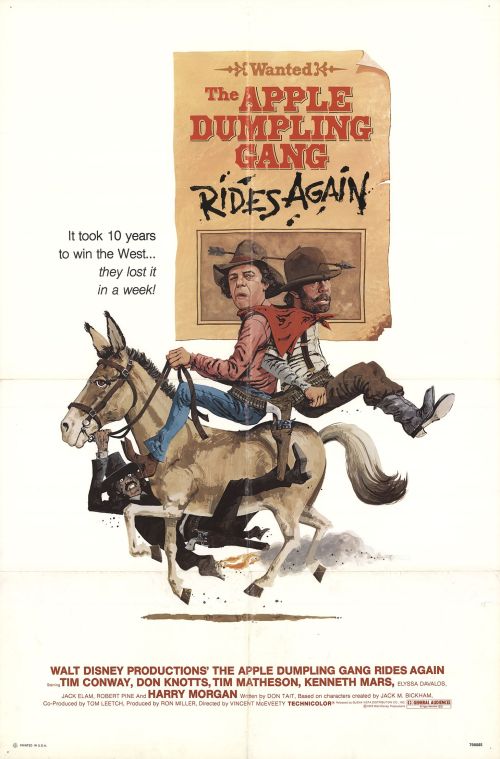
The real stars of the film though are Don Knotts and Tim Conway as the comically bumbling would-be crooks. This marked the first of five film appearances that the two did together and in many ways this is probably their best effort. I always liked seeing them together because it was a rare chance for Knotts to play the smarter of the two instead of always being the dope himself although some may find Conway’s extreme ineptness more annoying than funny. In either event they help enliven the proceedings and became the stars of the sequel The Apple Dumpling Gang Rides Again, which will be reviewed next week.

My Rating: 6 out of 10

Released: July 1, 1975

Runtime: 1 Hour 40 Minutes

Rated G

Director: Norman Tokar

Studio: Buena Vista

Available: DVD, Amazon Video, YouTube

The Lightship (1985)

By Richard Winters

My Rating: 7 out of 10

4-Word Review: Hostages on a boat.

Captain Miller (Klaus Maria Brandauer) manages a stationary lightship with a small crew in the Atlantic and allows his teenage son Alex (Michal Skolimowski, but billed as Michael Lyndon) to come on board for a visit. While his son is there they take on board three men (Robert Duvall, William Forsythe, Arliss Howard) who were stranded at sea on a small boat. Once they board the vessel they quickly take over and hold the rest of the crew hostage. Alex wants to fight back immediately, but his father cautions him to take a more measured approach, which he finds to be cowardly and doesn’t hesitate to let his dad know it.

The film is a real mixed-bag with some good elements and some not so good ones to the point that it seems almost surprising that it was directed by such a legendary talent as Jerzy Skolimowski. The isolation aspects are good as you feel this boat is completely by itself out in the middle of the gray cold sea, which helps elevate the atmosphere particularly when Skolimoski forces the actors to perform outside even as a storm rages. However, the cinematography looks like it was filmed on videotape  and then transferred to film later, which gives the thing a cheap, low budget feel.

The most disconcerting aspect though is the action, or the lack thereof. The criminals overtake the ship too easily and quickly without enough of a buildup or explanation as to why they are doing it. There’s also way too many situations where the bad guys could’ve easily been overtaken particularly when all three put down their guns and go dancing/partying in one of the vessel’s downstairs cabins. Why couldn’t the rest of the crew simply used this opportunity to lock them inside?

There’s also just too much standing around and talking making it one of the most civilized hostage taking scenarios ever recorded. The bad guys are also too dense particularly the Forsythe character who speaks and acts so dimwitted that he seemed better suited for a comedy. Instead of the film building-up the tension for the viewer you start to wonder why any of what we’re seeing is even happening.

Duvall’s performance is a bright spot as he plays against type by speaking in a wispy voice and wearing a pencil thin mustache until he looks almost exactly like film director John Waters. Brandauer is excellent as well and his stoic, measured presence helps to keep it compelling, but what surprised me the most was that apparently during rehearsals Duvall and Brandauer played the opposite part and then decided to switch-up once shooting began, which would’ve made seeing the behind-the-scenes footage all the more fascinating. Lyndon though as the son is quite weak and outside of his pretty boy face has very little to offer and was most likely only got the part because he was the son of the director while his voice-over narration, which was apparently thrown in at the last minute, is completely unnecessary and only helps to take the viewer out of the story every time it gets used.

The climax is genuinely exciting as it’s not clear until the very end whether the captain will come through and save the ship, or just cowardly slink away. As I said at the top of this review it’s a real mixed-bag with a couple of choice dramatic moments that makes it worth it, but only if you’re patient.

My Rating: 7 out of 10

Released: September 1, 1985

Runtime: 1 Hour 28 Minutes

Rated PG-13

Director: Jerzy Skolimowski

Studio: CBS Theatrical Films

Available: DVD

I Never Promised You a Rose Garden (1977)

By Richard Winters

My Rating: 7 out of 10

4-Word Review: She suffers from schizophrenia.

Based on the semi-autobiographical novel by Joanne Greenberg, which was written under the pen name of Hannah Green, the story focuses on Deborah (Kathleen Quinlan) a 16 year-old who is put into a mental institution during the 1950’s by her parents (Ben Piazza, Lorraine Gary). A pretend secret kingdom that used to be a childhood fantasy has now completely taken over her life and she is unable to deal with reality. At the institution she works with a sympathetic therapist named Dr. Fried (Bibi Andersson) who tries to get Deborah out of her fantasy world an back into the real one.

The film was produced by Roger Corman better known for his cheap, sleazy drive-in fare, so seeing him try to take the helm by producing a serious picture is a concern since exploitation always seemed to be his foray, but with the then recent success of One Flew Over the Cuckoo’s Nest he felt stories with a mental institution theme was a potential money-maker. The production values though right from the start look pretty cheap especially when compared to the Milos Foreman film making this a very weak cousin to the 1975 classic.

The producers made many changes from its source novel much to the consternation of the book’s author who was never consulted during the making of it and who ended up disliking this film version immensely. One of the biggest difference is that the film completely omits the antisemitism, which the filmmakers felt was too much of a ‘hot button topic’, that the main character in the book had to deal with and instead blames her mental health problems solely on her bout with cancer.

For me though the biggest issue centers more on the recreation of Deborah’s make-believe, mystical world which she calls The Kingdom of Yr. In the book the kingdom starts out as a beautiful magical place that slowly turns ugly and threatening while in the movie it’s portrayed as scary from the very beginning, which is confusing as there’s no explanation for how the whole thing started. The sound of the whispering voices going on inside Deborah’s head is creepy, but sight of the characters inside the kingdom, which was played by members of Oingo Boingo looks cheesy and like the singers from the Village People, which gives the film an unintended camp feeling. Instead the characters should’ve been captured from a distance where they were seen as ominous shadowy figures whose faces were never shown.

Despite these drawbacks I still found myself caught-up in much of the drama especially the cruelty that Deborah and her fellow patients received at the hands of an abusive orderly played by Reni Santoni. Unfortunately some of the scenes showing Deborah interacting with the other mentally-ill people in the hospital gets watered-down by having a lighthearted melody played during it, which gives off the idea that this is ‘lightly comical’ instead of the gritty no-holds-barred drama that it should be.

Quinlan gives a great performance, possibly the best of her career and I particularly enjoyed the way she uses her expressive blue eyes to convey her inner madness and turmoil. You also see her as a relatable human being who you want to see get well as opposed to being some sort of ‘freak’. Susan Tyrrell is great in support as one of the patients as well as Martine Bartlett who plays another troubled patient and who starred just a year earlier as the cruel mother in Sybil, which was a TV-movie with a similar theme. Casting Bibi Andersson though as the psychiatrist was for me a distraction since she also played one in Persona, which was her signature role and therefore I couldn’t separate her from that one.

In 2004 the novel was turned into a play under the full cooperation of Greenberg who acted as a consultant. The antisemitism from the book was incorporated into the play as well as several other things that had been omitted making me believe that a remake based on the play should be given a much needed green-light as this film unfortunately is adequate, but not great.

My Rating: 7 out of 10

Released: July 14, 1977

Runtime: 1 Hour 36 Minutes

Rated R

Director: Anthony Page

Studio: New World Pictures

Available: DVD, Amazon Video