Tag Archives: Jessica Harper

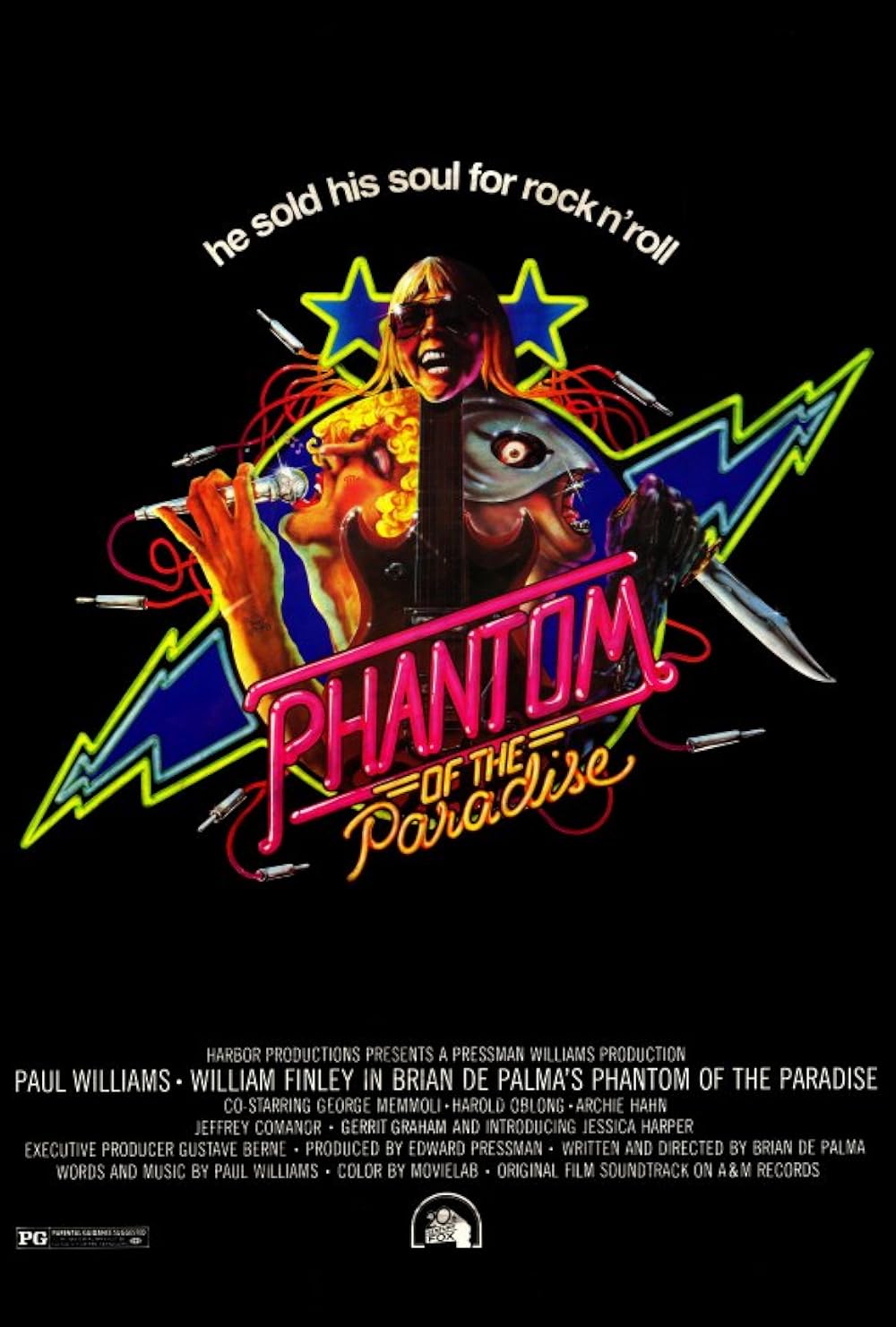
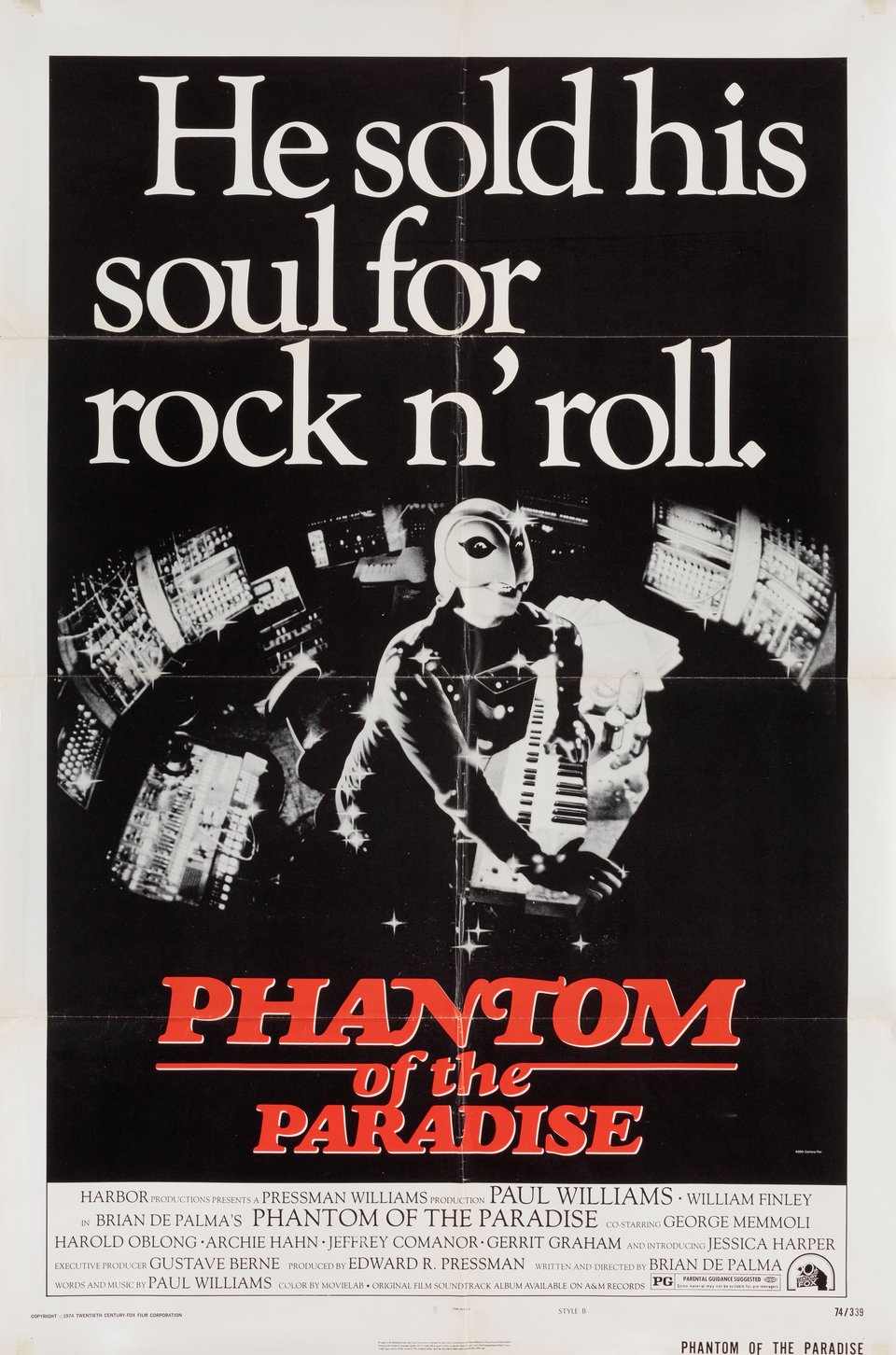
Phantom of the Paradise (1974)

By Richard Winters

My Rating: 7 out of 10

4-Word Review: Record producer exploits songwriter.

Winslow Leach (William Finley) is a talented, but unknown songwriter whose written a cantata based on the Faust legend. Famous record producer Swan (Paul Williams) overhears Winslow singing it and decides he’d like to use if for the grand opening of his new concert hall. Swan speaks with Winslow about the piece leading Winslow to believe he’s finally found his ‘big break’ but then doesn’t hear back from him for another month. Winslow then goes to Swan’s office but is kicked out when Swan refuses to see him. He then makes several other attempts to meet with him before Swan has him arrested on trumped up drug charges and sent to prison. It is there that Winslow realizes that Swan had his cantata stolen and now plans on using it to stage his own production while not giving Winslow any credit for having written it. This so enrages Winslow that he manages to escape from prison and storms the production headquarters only to accidentally fall into a record press machine that severely disfigures him. Now, while wearing a mask, Winslow continues to terrorize the place as ‘The Phantom’, which causes Swan to decide to make a deal with him. He asks Winslow to rewrite the cantata with beautiful new singer Phoenix (Jessica Harper) in mind to sing it. Since Winslow is secretly in love with her and also admires her immense talents, he agrees, but then Swan forces him to sign a contract in blood that has some very unusual clauses.

This was writer/director Brian De Palma’s attempt to mix horror with the irreverent quicky comedy of some of his earlier films from the late 60’s. The result is a mishmash of ideas with some of it mostly working. I really liked the visual style that has to be seen on the big screen, which I was fortunate enough to do at the Alamo Drafthouse recently, to fully appreciate it. I loved the over-the-top set pieces like Swan sitting in the center of his desk that’s made to look like a giant record. The outrageous costumes, garish music, quick edits, and his trademark split screens all help to make it highly entertaining on a visual scale.

Where it starts to have problems is with the humor. Like with De Palma’s earlier experimental films it has an engaging, offbeat quality that I liked and even found funny, but it gets a bit overboard and it ruins the tension. A good example of this is when Winslow goes to Swan’s office and gets kicked out, but in a very silly way that comes complete with cartoonish sound effects. This would’ve worked better had there been more of an attempt to make it a legitimate horror with only a little dark humor sneaked in versus an all-out camp feast that unfortunately hurts the story’s darker moments.

The acting though is quite engaging and does help save it even during its goofier moments. When I first saw this, years ago I felt Finley was miscast as the protagonist. With his thick glasses, bulging eyes, crooked teeth, and hair trigger temper, he actually comes off as scarier when he’s still looking ‘normal’ than after he gets disfigured, but in retrospect this helps create a more three-dimensional protagonist. A lot of people that are very talented in one area can also be quite dense in others, so the way Swan is able to con him so easily made sense. Also, if they spend a lot of time alone writing songs it would seem logical that they would be awkward socially, so his sometimes cringey behavior was a logical fit and thus the bespectled Finley, who would never be deemed a good-looking hunk like the conventional hero, was an astute casting choice.

Williams was another one that initially came off as wrong for the role. Originally De Palms wanted him to the play the part of Winslow especially since he is a real-life songwriter who wrote the entire soundtrack for this, but he wasn’t right physically for it, so asked if he could play the bad guy instead. Seeing such a short guy playing such an intimidating figure does come off as ironic, and Williams shows some surprising confidence in the role both with his terse delivery and facial expressions, but it would’ve been better had we not seen him right away. Instead, he could’ve been this voice we hear through the shadows and only had the big reveal occur during the second or third act, which then would’ve heightened the irony of his small stature even more.

Harper is fantastic in support. This gets labeled as being her official film debut and her angelic face, beautiful singing voice, and great dancing ability, solidify making her a joy to watch every time she’s on the screen. Gerrit Graham is hilarious as the bulky shock rocker Beef, who behind-the-scenes is quite effeminate, and the very rotund George Memmoli is great too as Swan’s no-nonsense henchman.

Spoiler Alert!

The way Swan makes a pact with the devil didn’t make sense and needed better elaboration. He apparently meets him while sitting in the bathtub contemplating suicide as he didn’t want to ever get old. The only question is why would the devil suddenly show up just because of that? There’re many people who contemplate killing themselves and some even do, but there’s no devil jumping in trying to make a deal with them, so why does he come into play here? A better idea would’ve had Swan, in an attempt to maintain his youthfulness, start dabbling in witchcraft and through this he would inadvertently summon the devil.
My Rating: 7 out of 10

Release: October 31, 1974

Runtime: 1 Hour 32 Minutes

Rated PG

Director: Brian De Palma

Studio: 20th Century Fox

Available: DVD, Blu-ray, Amazon Video, YouTube
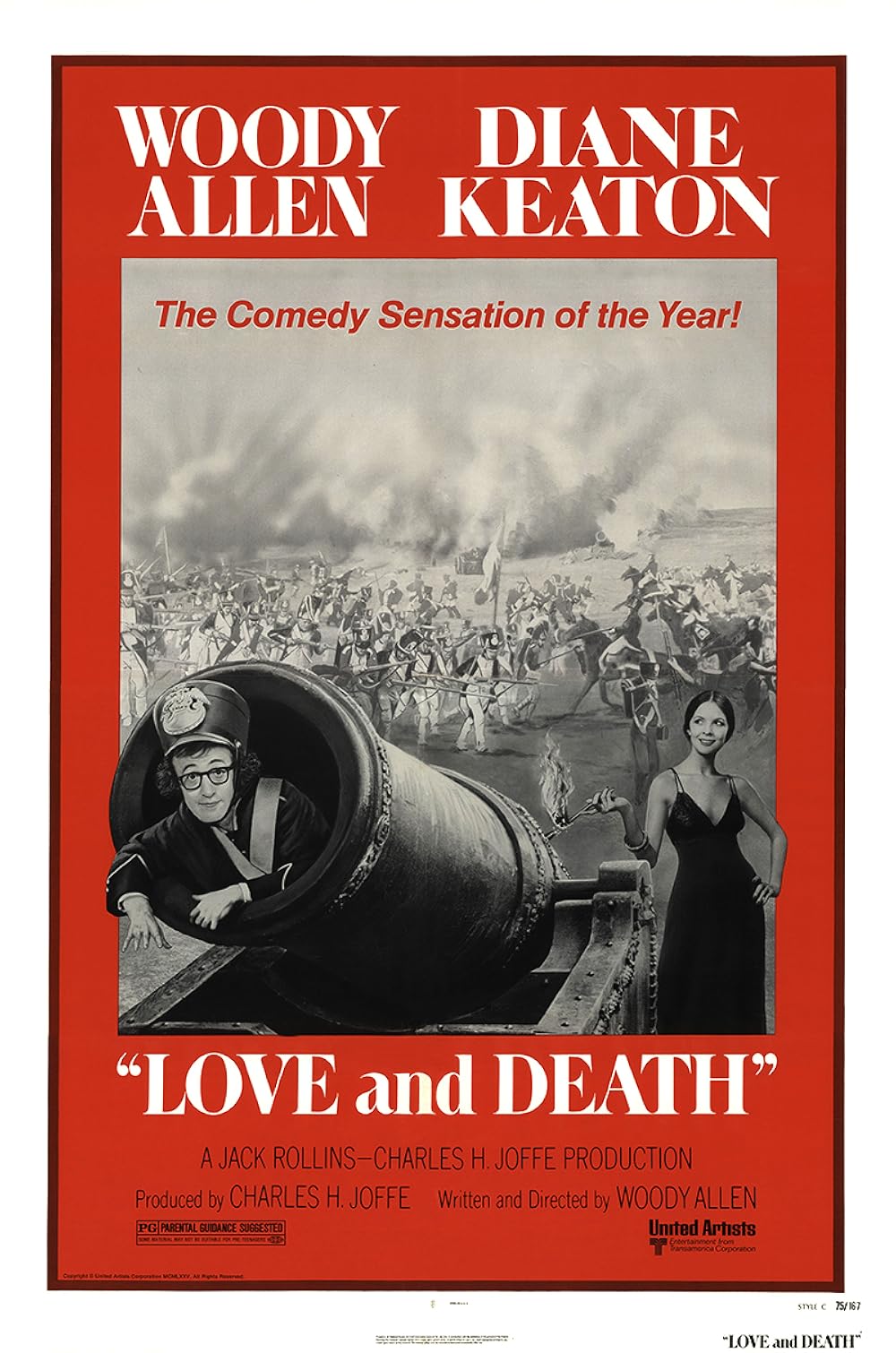
Love and Death (1975)

By Richard Winters

My Rating: 5 out of 10

4-Word Review: Attempting to assassinate Napolean.

Boris (Woody Allen) is a scrawny guy who gets overlooked by others as his three brothers tower over him. He’s secretly in love with Sonja (Diane Keaton) who he’s been friends with since childhood, yet she’s instead infatuated with Ivan, one of Boris’ brothers. However, none of his brothers are into her, so she marries someone else while Boris remains a bachelor who occasionally fools around with beautiful women like a Countess (Olga Georges-Picot), which causes her lover Anton (Harold Gould) to challenge Boris to a gun duel. Thinking Boris won’t be able to survive the dual Sonja agrees to marry him if he survives, which he miraculously does. Once married they then concoct a plan to assassinate Napolean (James Tolkan) unaware that who they’re really going after is actually an undercover double.

Allen was in the midst of writing a screenplay dealing with a New York couple who try to solve a murder, which became Manhattan Murder Mystery, but was going through a writer’s block, so he began reading a novel about Russian history, which then inspired him to write this script. Since it was nearing the deadline to have a script ready for production, he decided to submit this one, which immediately went into filming while the other one didn’t end up getting completed until 1993.

Many critics and fans at the time liked this one and it ended up making $9 million at the box office off of a $3 million budget with Gene Siskel especially enjoying it as he gave it 4 stars while commenting that he liked Allen’s return to a ‘gag driven dialogue’ versus ‘attempting to develop a story’, but personally for me I felt this was what was wrong with it. While it does start out funny as it parodies 18th Century Russian society and has one really great bit dealing with a ‘hygiene play’ warning soldiers about VD and condoms it does tend to meander quite a bit. The middle part is the most sluggish with many of the gags falling flat almost like he’d run out of ideas and was just trying to desperately throw anything in to keep it going making it come off more like an unending skit instead of a movie.

Allen’s presence while amusing most of the way becomes a bit of a detriment. Much of this can be blamed on the fact that he’s playing essentially the same character that he does in all of his movies. Case in point comes at the beginning before he officially says anything on screen and I thought to myself I bet he’s going to mention something about atheism and sure enough that’s exactly what he does talk about making it predictable and redundant. Would’ve been nice for irony’s sake had he played someone who had a deep belief in God only to lose his faith after he goes through the war, which would’ve created a nice character arc of which there really isn’t one.

There’s also the issue of him having no Russian accent nor making even a slight attempt at one. Granted Keaton doesn’t speak in an accent either though maybe you can chalk it up to her great acting that she still seems of the period anyways while Allen very much comes off like someone who doesn’t really belong there. He repeatedly makes anachronistic statements, which from time to time are amusing, but technically don’t fit within the setting. It actually would’ve made more sense to have Allen simply be a modern-day New Yorker who finds a time machine and gets zapped away into 18th Century Russia and then wanders around making comments about things, which wouldn’t have disrupted the film all that much and besides adding one little scene at the beginning showing him going into the time travel contraption there wouldn’t have needed to be anything else changed. It literally would’ve been the exact same movie and in some ways been a lot funnier, and perceptive, because of it.

It does end on a strong note as it pokes fun of Ingmar Bergman movies and even has Jessica Harper showing up. Yet I still felt most of the way it throws in whatever it can for a cheap laugh with much of the jokes, particularly in the middle, not really landing. Many fans didn’t like the way Allen crossed over to doing drama just a few years later, but after watching this I started to believe he had used up all of his comical concepts that by this time was just repeating itself and thus his foray into more serious subjects was inevitable.

My Rating: 5 out of 10

Released: June 10, 1975

Runtime: 1 Hour 25 Minutes

Rated PG

Director: Woody Allen

Studio: United Artists

Available: DVD, Blu-ray, Amazon Video, YouTube

Stardust Memories (1980)

stardust2

By Richard Winters

My Rating: 5 out of 10

4-Word Review: Director unhappy with career.

Sandy Bates (Woody Allen) is going through a lull in his career. While he’s had success in the past at making comedies he’d like to now move into more serious material that’s dramatic in nature though his many fans and studio heads insist he should stick with what made him famous and what the public wants. While attending a film retrospective of his movies at the Stardust Hotel he ponders about his life. He remembers a fling that he had with a beautiful actress named Dorrie (Charlotte Rampling) that didn’t work out due to her insecurities about herself and her career. He also meets up with a young woman named Daisy (Jessica Harper) whom he’s attracted to and openly flirts with even as his current lover Isobel (Marie-Christine Barrault) flies into town and announces that she’s left her husband and wishes to commence with a committed relationship with Sandy whom she expects will also help with raising her two children. As Sandy ponders what to do next he finds out that the studio has reshot a different ending to his latest movie, which further sours him on the business.

Many critics at the time gave this negative reviews feeling it was too self-indulgent and more like a personal diary than a movie. I did though like the black and white photography by Gordon Willis, which is so pristine that just watching the characters walking into an empty room with sunlight pouring through the windows looks dazzling. Allen’s comments on the film business are honest and relatable and it’s interesting to see that even when one becomes a proven commodity he can still be pressured by producers to change his films into something he’s not happy with simply for the sake of having more of a commercial appeal, which proves no matter how successful, or ‘big-name’ you get that’s one obstacle that seemingly will hamper everyone. Allen’s constant run-ins with his fans, which becomes the film’s running joke, and their odd requests as they pander to him in hopes of making it big in the business themselves are quite funny and true to form.

The story though is structured in such a fragmented way that it’s hard to get into. Sandy’s relationship with Dorrie is especially confusing. For one thing he comes onto her while she’s on a film set by telling her how beautiful she is, which seem to be the oldest and corniest come-on lines in the book and yet she’s fully taken aback with his compliments and this immediately turns into a relationship though in reality most women would likely give the guy the eye-roll and a quick rebuff. This though may be part of the joke by showing that because Sandy is a well-known director he’s able to get away with the corny lines that other guys wouldn’t, but even so these scenes are strained and annoying.

I felt Sandy’s conversations with Daisy was far more interesting and his budding relationship with her should’ve been explored much more, but isn’t, which wastes away a fabulous performance by Harper who plays the one character in the movie that I found relatable. Barrault is engaging as well particularly the scene where she does her facial exercises and having the story focus on his on-going relationship with her while also seeing Daisy on the side would’ve created the intriguing juxtaposition that was needed, but otherwise missing. Dorrie on the other hand comes-off like a caricature of just about every Hollywood starlet out there making her moments contrived and unnecessary.

While there are a few funny moments with the best one being Sandy’s close encounter with a group of space aliens it’s never enough to carry the picture. Having a more conventional storyline instead of the dream-like tone would’ve allowed the viewer to get more into what was going on emotionally versus sitting through what seems like an experimental movie that never quite catches its stride. Having Allen play somebody that wasn’t so much like himself would’ve helped too as it’s almost a joke to think he’s playing anyone else and should’ve just called himself Woody and made it more like a pseudo-documentary, which is what it ultimately is anyways.

I was though struck by the one part where Dorrie comes home furious with Woody for staring at her 13-year-old cousin the whole night they were at dinner and implying that he may have unhealthy feelings for her and thus essentially at least mentally ‘cheating on her’. Woody doesn’t really put up much of a defense, which I found even more amusing since 30 years later in real-life he got accused of improper behavior. Now, I wasn’t there and don’t know what happened and don’t want to make it sound like I’m trying to make conclusions, or taking sides. In the eyes of the law he’s innocent until proven guilty in a court of law, but I still couldn’t help seeing the irony. Maybe it was just a coincidence, or maybe he was subconsciously revealing through the Sandy character something he may harbor. Hard to say, but given the hindsight it’s difficult to walk away and not have that moment stand out.

My Rating: 5 out of 10

Released: September 26, 1980

Runtime: 1 Hour 28 Minutes

Rated PG

Director: Woody Allen

Studio: United Artists

Available: DVD, Blu-ray, Amazon Video

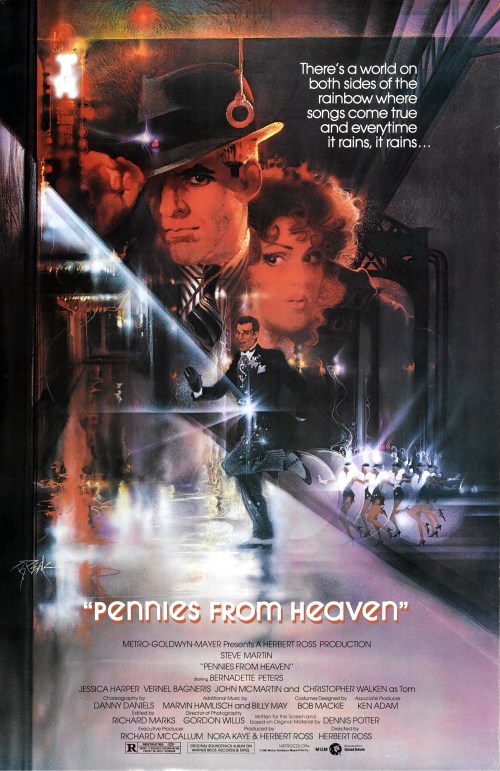
Pennies from Heaven (1981)

By Richard Winters

My Rating: 7 out of 10

4-Word Review: Escaping from the depression.

Arthur (Steve Martin) is a struggling sheet music salesmen during the depression, who’s looking to escape his dreary existence by becoming a songwriter, but finds that no one including his wife (Jessica Harper) cares about what his dreams, which leaves him feeling lost and alone. He then meets perky schoolteacher Eileen (Bernadette Peters) and the two begin an affair despite her not knowing that he is already married. When she gets pregnant and loses her job because of it Arthur is nowhere to be found and instead he gets unjustly tabbed for committing rape on a blind woman (Eliska Krupka) that he did not do.

The film is based on a 6-part miniseries that aired on the BBC in 1978 and starred Bob Hoskins. Martin saw it and was so enamored with the story that he became compelled to have it remade here and the studio even hired the same writer, Dennis Potter, to pen the script although the studio forced him to do 13 rewrites before they finally accepted it. Despite the extravagant musical numbers, which are pretty good, and positive critical reception, the filmed failed to achieve any success at the box office where it took in a paltry 2 million that barely made a dent in its 22 million budget.

A lot of the blame can be placed on the casting of Martin. While I admire him for not allowing himself to be typecast, and for dying his hair brown here, he still comes off as misplaced. You keep waiting for him to say something goofy and absurd like his character in The Jerk would and when he doesn’t you start feeling bored and frustrated. For his part he lashed out at those that didn’t like it calling them ‘ignorant scum’ while anyone who did enjoy the film he labeled ‘wise and intelligent’.

Yet his character is also a problem as he comes off as arrogant and selfish the whole way through. He constantly antagonizes his shy wife pressuring her to submit to his kinky sexual fantasies and when she doesn’t he threatens to walk out. He then lies about his marital status to Peters and is cold and ambivalent when she gets pregnant making him seem like a true jerk and not the funny kind in his earlier film.

Jessica Harper I enjoyed much more. I think she gives her finest performance here and I was genuinely surprised she wasn’t nominated for an Academy Award. Her interpretation of a shy, sheltered Midwestern wife from a more innocent era is completely on-target and I came to sympathize far more with her than Martin. The line that she utters when the police investigators come to her house, after Martin gets accused of rape, is the best moment in the movie. Peters is good too, but I felt her character got in the way and the film would’ve gelled better had it focused solely on the dysfunctional marriage.

The dance numbers are well choreographed with the best one being with Christopher Walken who does a bona fide striptease that took him over 2 months to rehearse. The bit in which Martin and Peters find themselves transported inside a film starring Fred Astaire and Ginger Rogers is quite cool too although Astaire himself tried blocking the footage from being used. He later commented that as a viewer ” I have never spent two more miserable hours in my life” and describing every scene in the film as being “cheap and vulgar.”

The story though starts out too slowly and for the first hour seems like there really isn’t any plot at all. It improves by the second half, but there needed to be more urgency at the beginning and many viewers may not be willing to stick with it.  Having the actors lip-sync the songs was a bad idea too. It gives the whole thing an amatuerish vibe making it seem like it was intended to be a campy comedy when it really wasn’t.

My Rating: 7 out of 10

Released: December 11, 1981

Runtime: 1 Hour 48 Minutes

Rated R

Director: Herbert Ross

Studio: MGM

Available: DVD, Amazon Video, YouTube

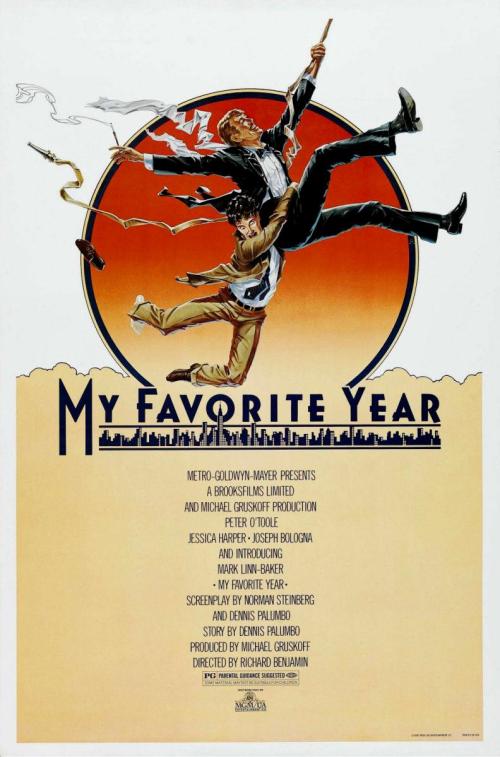
My Favorite Year (1982)

By Richard Winters

My Rating: 5 out of 10

4-Word Review: Babysitting an alcoholic actor.

The year is 1954 and Benjy (Mark Linn-Baker), who works as a junior writer at a top rated TV variety show, is put in charge of babysitting a famous matinee idol named Alan Swann (Peter O’Toole) who is set to guest star on an episode of the show. Alan is a well known alcoholic who usually finds a way to stay constantly inebriated and it’s Benjy’s job to keep him sober, which proves challenging.

The first 30 minutes of the film has some snappy dialogue and a fast, engaging pace. It’s loosely based on a real-life incident where Mel Brooks, then working as a young writer on the TV-show ‘Your Show of Shows’, was put in charge of watching Errol Flynn and making sure he stayed away from the bottle, which he apparently did making the comic situations that occur here highly fabricated.

Unfortunately by the middle half it starts to lose steam and never fully recovers. It works best during the scenes where Baker and O’Toole are together, which is where the story should’ve stayed. Instead it unwisely tries to work in a ridiculous romantic side-story between Baker and Jessica Harper, which isn’t interesting at all and even slightly creepy as Harper has clearly stated she’s not interested in getting into a relationship with him and yet he continues to pursue her and even gets jealous and acts like he ‘owns’ her when he sees her with another guy.

The film also doesn’t take enough advantage of Joseph Bologna who plays the narcissistic/ego-driven star of the show that was apparently based on Sid Caesar. Nobody can play a brash, arrogant, obnoxious guy quite like Bologna and still manage to somehow remain likable and engaging in the process, so when you got him in the cast and in top form you should use his skills to its full potential, which this film doesn’t.

The Swan character ultimately gets overblown. I didn’t have a problem with his extreme drunkenness at the start, but he begins to behave too much like some overgrown man-child like when he impulsively jumps onto a policemen’s horse and rides it for no particular reason almost like he’s from a completely different planet and no longer even slightly resembling an actual person who must deal with real consequences. Watching him meltdown without restraint when he realizes he’ll be put on live television makes him pathetic and lacking even a modicum of professionalism. Anyone as emotionally fragile as he is would never even have a chance in the real Hollywood where one must put up a tough front in order to survive in it.

Richard Benjamin’s directorial debut isn’t bad, but it does have two glaring flaws. One occurs when Baker and O’Toole are on the rooftop of a building and their images are matted over a green screen, which causes orbs to appear around their heads, which is distracting and amateurish looking.  Another one comes when at the end O’Toole saves Bologna, who’s getting beat up by some thugs on live TV, by slashing the bad guy’s clothes with his sword, which wouldn’t occur since stage props don’t actually use real blades.

The brief appearances by the raspy voiced Selma Diamond and Cameron Mitchell are gems and the film also manages to work in a few poignant moments, which is nice. Overall though the concept gets stretched too thin and becomes too cute for its own good.

My Rating: 5 out of 10

Released: October 8, 1982

Runtime: 1 Hour 32 Minutes

Rated PG

Director: Richard Benjamin

Studio: MGM

Available: DVD, YouTube

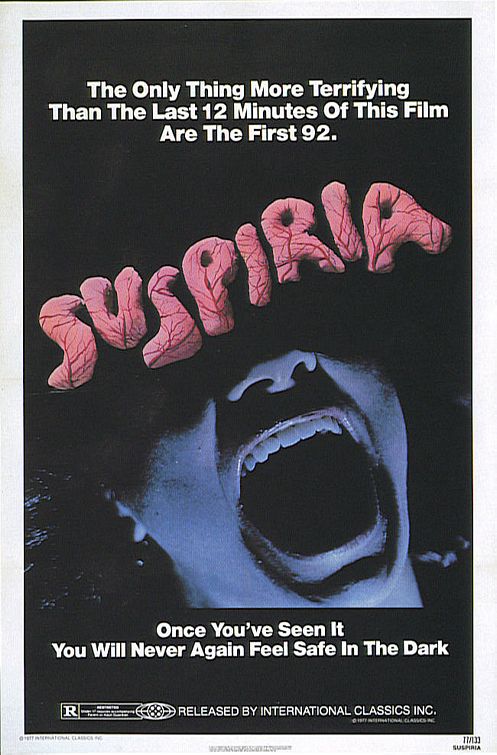
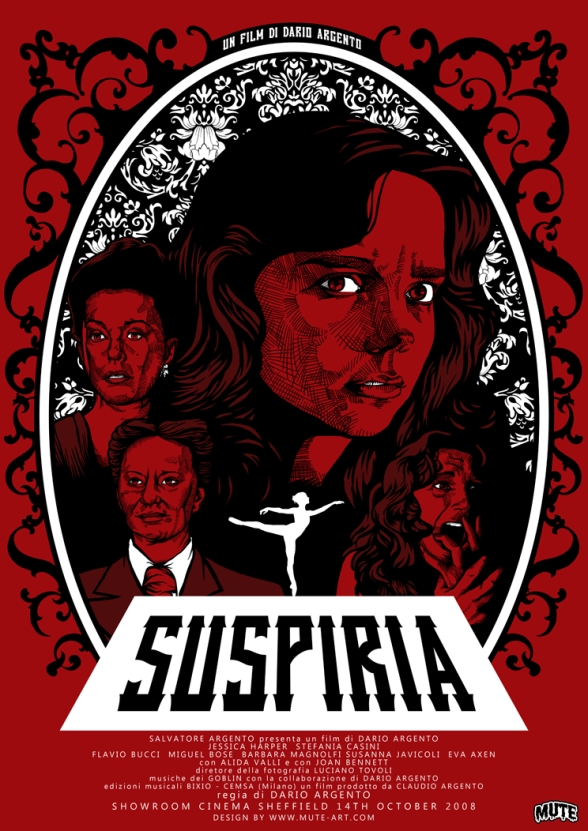
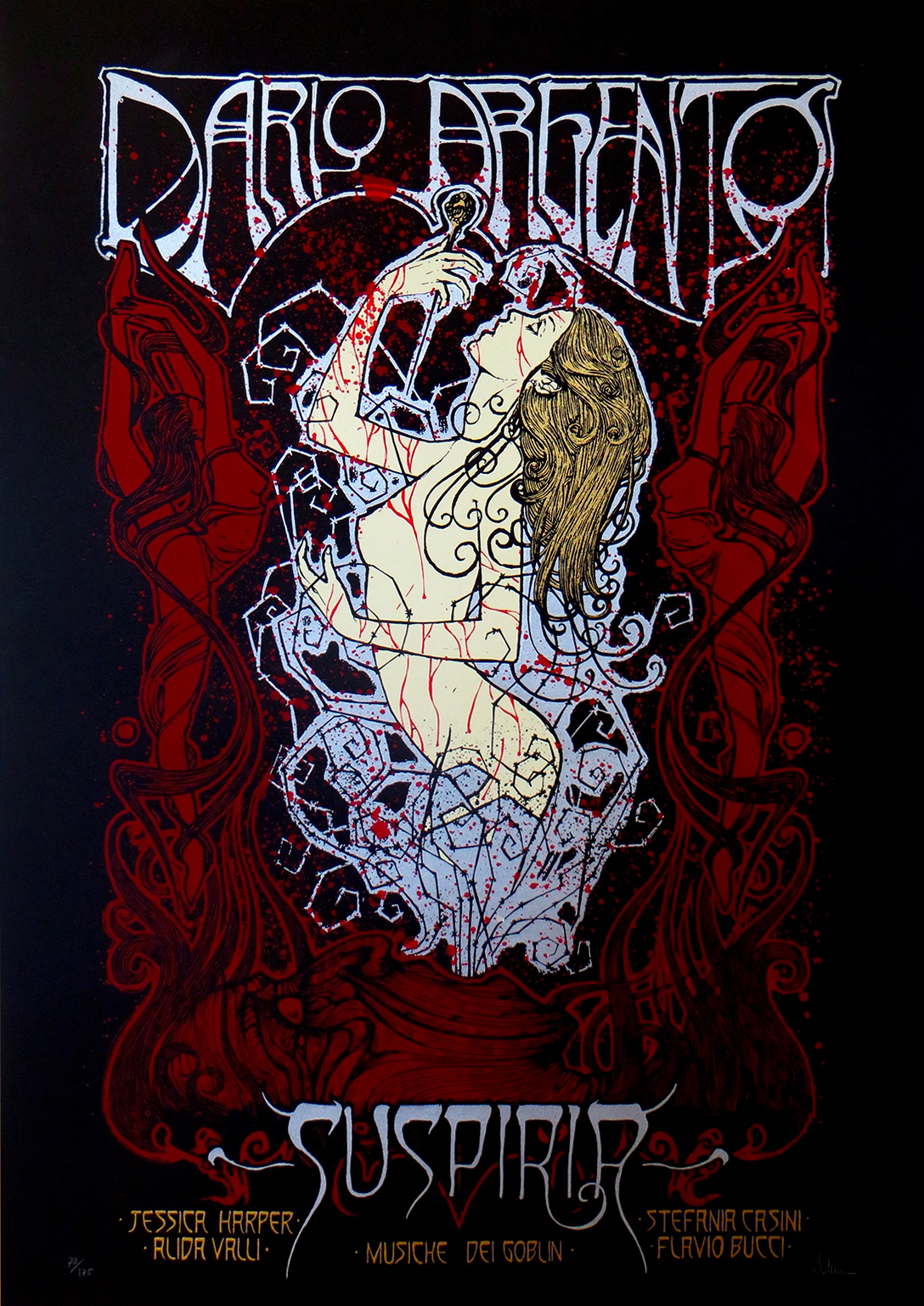
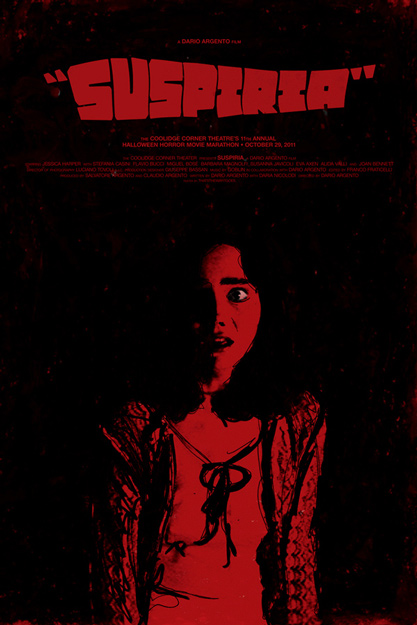
Suspiria (1977)

suspiria 2

By Richard Winters

My Rating: 4 out of 10

4-Word Review: Ballet dancer battles witches.

Suzy (Jessica Harper) is an American from New York who aspires to be a ballet dancer and travels to Freiburg, Germany to enroll at the dancer academy there. When she arrives she confronts another young lady who shouts something about a ‘blue iris flower’ before running out into the stormy night and then later turning up murdered. As the days progress strange events begin to occur convincing Suzy that the dance school may really be a cover for a coven of witches.

I first saw this film back in the late 80’s and it left me cold, but after reading a few other movie blogs where the critics insisted this was ‘brilliant’ I decided to give it another chance and approached it with a completely open mind only to end up liking it even less. The majority of the problem is Dario Argento’s over-direction. The sets and color schemes are wildly over-the-top bordering on camp. Had he pulled back even a little it might have been visually impressive, but instead gets obnoxious. The atmosphere, like everything else, is overdone creating a dream-like fantasy feel that has no connection to reality and therefore not very compelling.

The music, which was done by a group called Goblin, is interesting to some extent. I like the effect that to me sounded like hissing demons, but the other parts of it too closely resembled the ‘Tubular Bells’ music that was used in The Exorcist. It also gets overplayed and is too loud coming off like a spoiled child demanding your attention, which creates less tension and more distraction instead.

The special effects don’t live up to billing. When a man gets attacked and then eaten by his own dog is the only good part simply because it’s unexpected. Otherwise the blood and gore is average and even lacking. The majority of it is at the beginning where we see a young, frightened woman squirmy around on the floor while she gets stabbed and to a degree looks like some interpretive dance routine. The shot of a body coming out of a ceiling and then hung from a rope doesn’t work because it is clearly a mannequin and if you look real closely her face already has a strangled expression on it before the head goes through the noose.

suspiria3

Harper is a good protagonist and its fun seeing classic film star Joan Bennett in her last film role. I also really liked Alida Valli as Miss Tanner the dance instructor. During the 40’s and 50’s she was a stunningly beautiful leading lady, but here looks very witchy with the way her hair is cropped up into a tight bun as well as with her eyes and voice. The rest of the supporting cast have their voices dubbed, something that Italian productions during this period were notorious for and gives the already wooden dialogue a cheesy, amateurish sounding banter.

Spoiler Alert!

The climactic finish is a big letdown. For such an extravagant, garish build-up I was expecting much more of a bloody, drawn-out battle. Instead Harper just picks up a sharp object and stabs the head witch, who looks dead already, and it immediately kills her along with the others, but to me this didn’t make sense. This is supposedly some otherworldly demon, so the same laws of physics wouldn’t necessarily apply to her like it does to humans and a simple stab wound wouldn’t have the same effect like it would to regular people.

End of Spoiler Alert!

I was glad to see that other viewers on IMDB particularly those on the message board felt the same way about this ‘classic’ as I did. In my opinion the only way to enjoy it is for its excessive camp value and nothing more.

suspiria4

suspiria5

My Rating: 4 out of 10

Released: February 1, 1977

Runtime: 1Hour 38Minutes (Blue Underground 2-Disc Special Edition)

Rated R (Originally rated X)

Director: Dario Argento

Studio: International Classics (Dubbed Version)

Available: VHS, DVD, Blu-ray