Twice in a Lifetime (1985)

twice-in-a-lifetime

By Richard Winters

My Rating: 6 out of 10

4-Word Review: He has an affair.

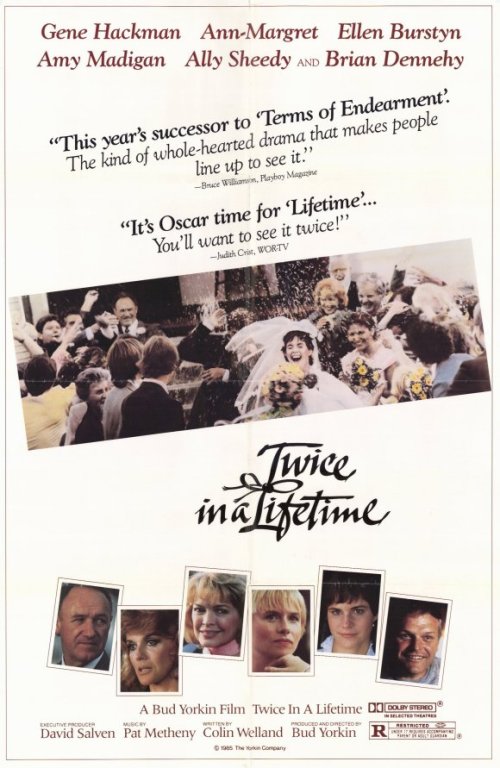
Harry MacKenzie (Gene Hackman) is a steel mill worker living in Seattle who has just turned 50. On the night of his birthday Kate (Ellen Burstyn), his wife of 30 years, tells him that he can go by himself to the local tavern to celebrate as she is not into the drinking. When he does he meets Audrey (Ann-Margret) who has just started working there. The two immediately hit-it-off and soon are in a relationship. When Harry finally tells his wife and family about it they are devastated, but learn to cope with it in unexpected ways.

The way Harry and Audrey’s relationship begins is too rushed as he simply spots her in a crowd and then quickly becomes entranced. If eyeing an attractive woman is all that it took then he should’ve been having a string of affairs way before this one. Making Audrey more of the instigator while Harry remained hesitant only to later realize how stale his marriage had gotten once the relationship started would’ve worked better. There is also no indication at the beginning that there was anything wrong with his marriage or that he was even bored with it.

It should’ve opened with Harry simply coming home one day and admitting to the affair and then focusing on everyone’s reactions, which would’ve been less contrived. I was also annoyed that two key scenes including when Kate first gets informed of the affair by a friend as well as Kate’s later confrontation with Harry are not shown. The film just cuts away before either of these conversations gets going, which to me was frustrating.

The second half is an improvement. I liked how the film sends the message that divorce isn’t always bad, but instead can act like a rebirth for both parties. I also enjoyed the on-location scenery of the Pacific Northwest and seeing Harry and Audrey sitting amongst a crowd at an actual Seattle Seahawks football game.

It was also great having Hackman playing a character that lacked confidence and at times was even socially awkward, but it’s Burstyn’s performance that really makes it special. Watching her shy character coming out-of- her-shell and learning to become independent is the film’s highlight. Unfortunately Amy Madigan as the eldest daughter is a turn-off as her angry outbursts come off as forced and overdone while the much quieter Ally Sheedy as the other daughter is far better.

Surprisingly no studio would agree to finance the picture even though the script was written by Colin Welland who had just won the Academy Award four years earlier for the film Chariots of Fire, so director Bud Yorkin was forced to put up his own money by using the earnings he had made through producing ‘All in the Family’, which helps explain why a clip from that show gets seen briefly. It could also be the reason why the production at times has a cheap look to it and like it had originally been shot of video and then later transferred to film. Paul McCartney, whom I’m a big fan of, does the closing tune, which unfortunately has to be the worst of his career.

My Rating: 6 out of 10

Released: November 8, 1985

Runtime: 1Hour 51Minutes

Rated R

Director: Bud Yorkin

Studio: Bud Yorkin Productions

Available: DVD, Amazon Video, YouTube
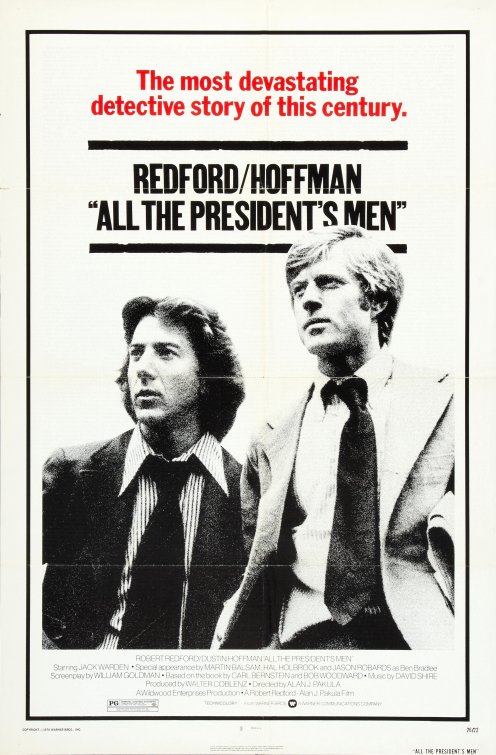
All the President’s Men (1976)

all-the-presidents-men

By Richard Winters

My Rating: 6 out of 10

4-Word Review: They take down Nixon.

In the early morning hours of June 17, 1972 five men are found burglarizing the Democratic Headquarters at the Watergate Office complex in Washington D.C. The next day a young Washington Post reporter by the name of Bob Woodward (Robert Redford) is assigned to cover the case. Initially it was considered only a minor story, but as he digs further into the details he finds wider connections including links that lead directly to the White House. Together with Carl Bernstein (Dustin Hoffman),who is another reporter, the two men continue to research and end up battling one roadblock after another in their quest the uncover the truth.

If there is one area where this film really scores in it’s in the way that a journalist’s job gets portrayed. In fact many colleges show this film to their student who are majoring in the field in order to given them a realistic perspective of what the profession actually involves. For me I found it quite enlightening particularly the first hour. The many people and steps that a reporter has to go through just to get one solid lead is interesting as is the protocol system determining which story gets the front page and which don’t.

The layout of the newsroom was also fascinating as it all seemed very authentic and like they were working in an actual one. To my absolute shock I found out later that it had all been constructed on a film set, but so meticulously done that you couldn’t tell the difference. Initially several scenes were filmed in the real office using actual employees in the background, but the knowledge of being on camera made some behave in ways that they normally wouldn’t and this ultimately forced the filmmakers to decide to recreate it on a soundstage and use actors as the office crew.

The performances by the two leads are good, but neither of them resembles their real-life counterparts. Both Redford and Hoffman were already pushing 40 at the time and looking it while Woodward and Bernstein were still in their 20’s when this story occurred so the line that the Jack Warden’s character makes about these two being ‘young and hungry’ and looking for a good story to build their careers on doesn’t make as much sense.

The characters aren’t well fleshed out either. No time is spent on what these guys were like when not ardently following up leads, which is absolutely all we see them doing.  The original screenplay, which was written by Woodward and Bernstein, had a subplot involving the two trying to score with women, which would’ve helped add a comical touch and parts of that should’ve been kept in.

The second half lags as there are too many leads and names that get bantered about that don’t have faces connected to them making it seem like information overload that doesn’t help the viewer get as emotionally involved as they should. Having cutaways showing Nixon and/or is aides becoming increasingly more paranoid as the reporters closed in on them could’ve added that much needed extra dimension.

There is a stunning bird’s-eye shot of the inside of the Library of Congress, which is amazing and the fact that many of the scenes get filmed at the actual sites where the real-life instances occurred is both impressive and commendable. I also enjoyed the wide-array of recognizable faces that show up in bit parts including Valerie Curtain as a frightened source and Polly Holliday as an evasive secretary. They even cast Frank Wills the real-life security guard who broke the case wide open playing himself in the film’s opening scene, which is cool even though for me the film’s second half fails to be as entertaining as the first, which prevents it from being a classic.

My Rating: 6 out of 10

Released: April 4, 1976

Runtime: 2Hours 19Minutes

Rated PG

Director: Alan J. Pakula

Studio: Warner Brothers

Available: DVD, Blu-ray, Amazon Video, YouTube

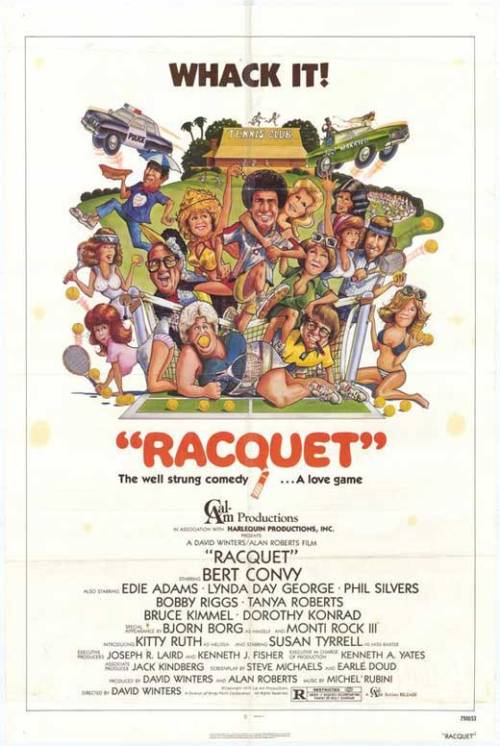
Racquet (1979)

racquet-1

By Richard Winters

My Rating: 0 out of 10

4-Word Review: Tennis champ gets old.

Tommy Everett (Bert Convy) is an aging tennis star who is learning to accept that he no longer has the skill that he once did. His life though is not in order and he needs money so that he can purchase his own tennis court and use it to give lessons to the rich clientele of Beverly Hills. Since he doesn’t have the capital for a down payment he sleeps with Leslie (Edie Adams) who is the wife of Arthur (Phil Silvers) a rich financier. During their lovemaking he asks her for the cash and she initially agrees even though she doesn’t intend to come through with it. In one last attempt to prove his virility he decides to take on tennis great Bjorn Bjorg in a televised match that he hopes will prove that he still has what it takes.

This so-called comedy is so frighteningly unfunny that you have to wonder why anyone would’ve been paid to write-it as its desperate attempts at humor are downright embarrassing. The script went through many rewrites and it shows as there is no cohesion and the action meanders badly until it all becomes quite pointless.

Supposedly this was an attempt to cash-in on the success of Shampoo, which was far better and so superior to this one it’s isn’t worth trying to compare except to say that was a classic and this isn’t. The jokes here are too strained and the innuendoes so juvenile that it makes sitting through not worth it on any level. The movie would’ve been improved had it stayed focused on the tennis angle, but instead it goes off on Convy’s romances and sexual conquests until you completely forget about the tennis part until it finally goes back to it at the very end.

Convy’s presence, especially in the lead, makes things even worse. He was a great game show host, but in the acting realm he was a hack to the point that he comes off looking like he never had even a day of acting training.

The supporting cast if filled with an array of familiar faces, but due to the script’s limitations end up being badly underused. Susan Tyrrell’s take of a snobby real estate agent should’ve been great, but isn’t. Tennis legend Bobby Riggs is fun, but not funny and Dorothy Konrad gets a few laughs, but it all comes at the expense of her obesity, which is tacky.

Phil Silvers is the only good thing in the movie and he even manages to elicit a few chuckles especially the part where he dresses and acts like a giant turkey. Yet even this, like with everything else in the film, is pretty sad and only proves to what pathetic extent it was willing to go to just to get a cheap laugh.

My Rating: 0 out of 10

Released: June 7, 1979

Runtime: 1Hour 29Minutes

Rated R

Director: David Winters

Studio: Cal-Am Productions

Available: None at this time

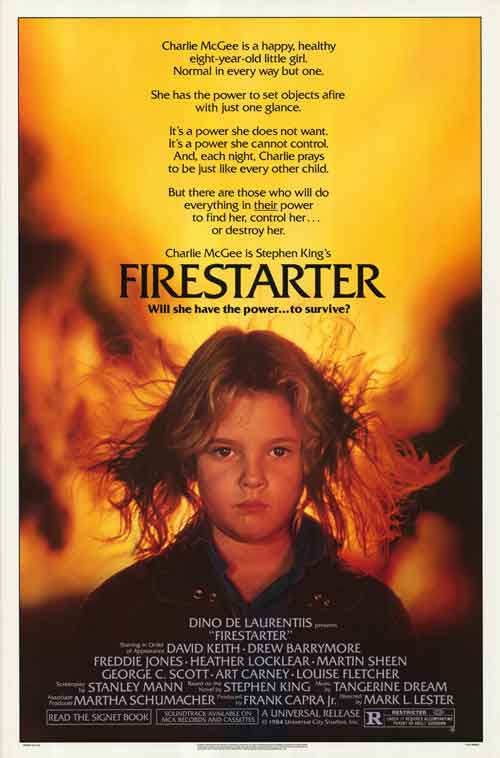
Firestarter (1984)

firestarter

By Richard Winters

My Rating: 5 out of 10

4-Word Review: Girl has fire power.

Andrew (David Keith) and Victoria (Heather Locklear) are two struggling college students who in an attempt to make some extra money decide to take part in medical study where they receive injections of a drug that give them telepathic abilities. They later get married and have a child named Charlene (Drew Barrymore) who has the same type of abilities except hers allows her to start fires using only her mind. Now a secret governmental agency known as The Shop seeks to kidnap Charlene so they can use her abilities for their own nefarious means, which sends Charlene and her father on a cross-country run to try and escape the agency’s clutches.

If there is one thing that really stands out in this movie and makes it worth the watch it’s Drew’s performance. She was only 8 at the time, but has a presence and acting awareness that was well beyond her years and she easily upstages her more seasoned co-stars. Her character isn’t completely fleshed-out and I’ll agree with Roger Ebert in his review that she was created more like a “plot gimmick”, than anything, but Drew still makes it engaging nonetheless. My only real complaint with her character is why, when she does get apprehended by the governmental agency, that she doesn’t she just use her fire ability to burn down the door of the room that she is trapped in to escape?

George C. Scott is an equally interesting as the bad guy even though he ends up being trapped into the same type of contrived character with motivations, particularly his reasons for befriending the girl, that seem quite nebulous and even illogical. However, his presence lends an added edge and I loved his ponytail as well as the contact lens put into his left eye that gives him an android-type appearance.

The rest of the cast though does not fare as well. Art Carney and Louise Fletcher, two Academy Award winners, get stuck in a small, almost insignificant roles as a father and daughter farm family who temporarily takes in Andrew and Charlene when they are on the run, which is okay, but the idea that this same couple would later happily take in Charlene again after they had witnessed her frightening ability first-hand and the burning deaths of several people that she helped create is ridiculous. In reality they would’ve seen her as some sort of ‘freak’ to be wary of and scared that she might do the same thing to them one day and thus want nothing to do with and certainly not welcomed back into their home.

As for the plot it’s okay, but it takes quite a while to get going and only becomes moderately gripping during the second-half. The script is based of course on a Stephen King novel and the scenes showing Charlene setting various people and things on fire seemed too much like an offshoot to King’s more famous Carrie character and thus the originality is lost. There’s also just so much objects/people being set on fire one can watch before it starts getting redundant, which makes the climactic finish boring, lame and even laughable.

I also wasn’t sure how Charlene was able to stop bullets from hitting her. This subject gets discussed in a thread on IMDb with some posters surmising that it was apparently a ‘heat shield’ that she was able to create through her pyrokinesis. However, if that was the case then it should’ve gotten explained earlier otherwise it comes off looking like the filmmakers were just making up the rules as they went whenever it was convenient for them.

My Rating: 5 out of 10

Released: May 11, 1984

Runtime: 1Hour 54Minutes

Rated R

Director: Mark L. Lester

Studio: Universal

Available: DVD, Amazon Video, YouTube
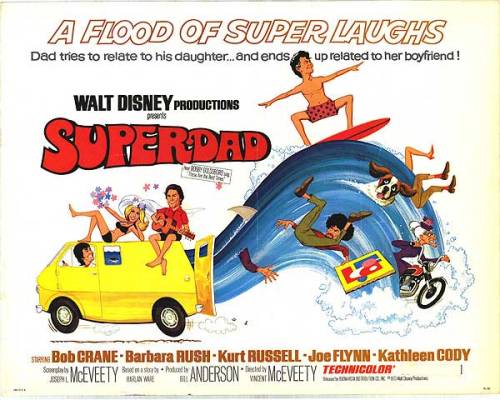
Superdad (1973)

superdad-1

By Richard Winters

My Rating: 0 out of 10

4-Word Review: This movie is awful.

Charlie McCready (Bob Crane) is worried that his daughter Wendy (Kathleen Cody) is hanging out with the ‘wrong crowd’ and dating a guy (Kurt Russell) that has no ambition. He tries spending more time with her and her friends in order to get her to appreciate his more conservative viewpoints, but finds that this doesn’t work. He then concocts a scheme to have her go to a different college than her boyfriend by pulling some strings and having someone on the board come up with a phony scholarship, but when she finds out about this she runs away in a rage and begins hanging out in a hippie commune run by a cult leader named Klutch (Joby Baker) who intends to force Wendy to marry him while Charlie tries his best to stop it.

This was Disney’s attempt at tackling the generation gap phenomenon, but the results are shallow with characters and issues that are too one-dimensional and generic to be considered relevant. There isn’t even any of that patented Disney slapstick, which could’ve at least allowed some diversion from the otherwise tedium. To top it off the music is excruciatingly sappy including an opening tune sung by Bobby Goldsboro, which could be enough to make most people want to turn it off before the film has even barely begun.

In hindsight having Crane cast as a character who preaches old-school values when in reality he was living such an excessively hedonistic lifestyle is the height of all irony. The way his character is so preoccupied with his daughter to the point that he even dreams about her is borderline creepy and makes it seem like he has some sort of latent incestuous obsession with her.

The worst thing though is his acting specifically with the way he would scream out whenever his character is in some sort of danger like when he goes water skiing. Larry Hagman always had the best yell especially as Tony Nelson in the TV-Show ‘I Dream of Jeannie’ as his shrieks sounded masculine while Crane’s sound more like a high pitched scream from a female and are disconcerting instead of funny.

The Wendy character is another weak point. First she has parents who have brown eyes and in Crane’s case jet black hair as well, so if the dark gene is always the dominant one then how where they able to produce a blonde, blue-eyed offspring? Her character is also too transparent and too subservient to adult authority and not like an actual teen at all. There is one brief moment where she rebels by becoming a hippie chick, which could’ve at least added an interesting dimension to the otherwise sterile role, but unfortunately the film drops this thread just as soon as it gets introduced.

The depiction of the cult-like hippie group that is run by a controlling leader who happens to also be a painter, which ironically gets played by actor Joby Baker who later quit his acting career to become a full-time painter, is like with everything else in this movie quite generic. Clearly it was based on the Manson cult, but I got the feeling that the filmmakers were trying to send a broader message by inferring a judgmental view that all hippies ended up this way, which just proves how out of touch they were with the younger generation as they clearly didn’t understand or appreciate their lifestyle at all, which ultimately proved they were unfit to make a movie dealing with the generation gap subject in the first place.

My Rating: 0 out of 10

Released: December 14, 1973

Runtime: 1Hour 35Minutes

Rated G

Director: Vincent McEveety

Studio: Walt Disney Productions

Available: DVD, Amazon Video, YouTube
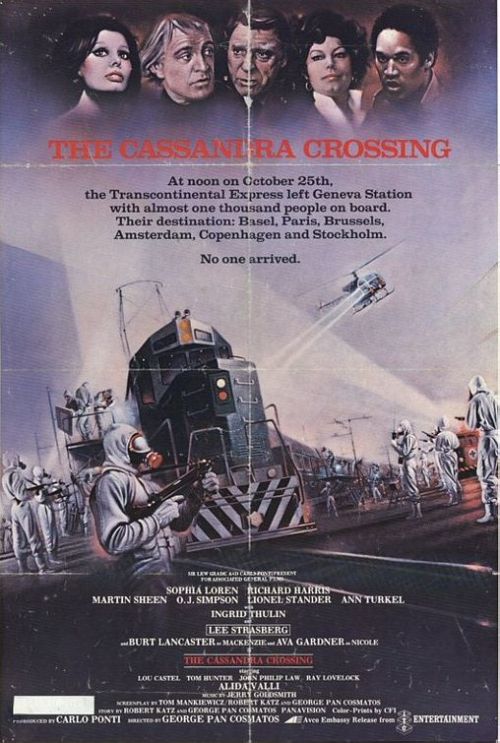
The Cassandra Crossing (1976)

cassandra-crossing-2

By Richard Winters

My Rating: 6 out of 10

4-Word Review: Virus on a train.

A terrorist (Lou Castel) who’s infected with the pneumonic plague sneaks onto a train in order to escape capture, but in the process infects the other passengers. U.S. Colonel MacKenzie (Burt Lancaster) devises a plan to have the train rerouted to a quarantine camp in Poland, but this will require the train to go over a bridge known as the Cassandra Crossing, which has not been used since 1948 and could be structurally unsound. When the passengers realize what the plan is they revolt and make an attempt to stop the train before it gets there, but will it be too late?

The way the bridge gets photographed is excellent and helps make it seem like a third character. An actual working bridge known as the Garabit Viaduct was used and is still in operation today, so the filmmaker’s ability to effectively make it look old and weakened is impressive. The climactic sequence showing the train going over the bridge is very exciting and well shot even if certain angles look conspicuously like a toy train instead of a real one it’s still a showstopper and well worth sitting through just to get to that point.

The film though fails on many other levels. For one thing the characters are not likable, or even all that interesting, so the viewer has little empathy as to whether they are able to make it through their quandary or not. The train is too ordinary looking with little pizazz or visual appeal and more attempts should’ve been made to have a luxury one used instead. The fact that the patients begin to miraculously recover from the disease during the second half makes sitting through the first part almost pointless.

The cast is filled with a lot of familiar faces. Ava Gardner is great in a role that allows her to show some key comic touches, but Sophia Loren, who was cast because her husband at the time was the producer, is completely wasted and forgettable. Lancaster is equally stymied in a role that has him virtually locked inside a control room with not much to do except look perpetually worried. Having his character decide to not panic the passengers by telling them about the virus, but instead he chooses to lie and inform them that the train is being rerouted to avoid bombs planted onto the railway line by terrorists ends up inadvertently getting the passengers just as upset to the point that it’s unintentionally funny.

Richard Harris who plays a doctor trying to treat the infected people while also working to prevent the train from driving into an impending disaster is the only cast member who gives the film any life. Like in the similarly themed Juggernaut his brash and irreverent approach that openly stands up to authority without hesitation helps to make his anti-hero persona seem genuine and refreshing, which in turn makes the film more gripping. His attractive real-life wife Ann Turkel, who plays a singer in a hippie band here, isn’t bad either, or at least not on the eyes.

My Rating: 6 out of 10

Released: December 18, 1976

Runtime: 2Hours 8Minutes

Rated R

Director: George P. Cosmatos

Studio: 20th Century Fox

Available: DVD

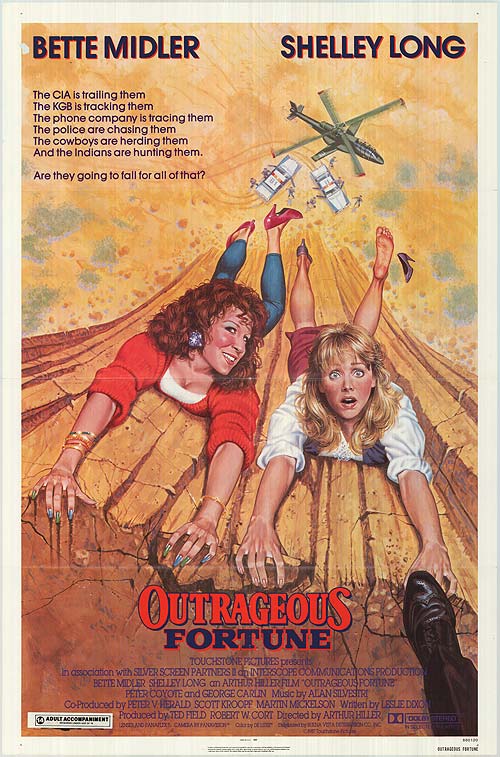
Outrageous Fortune (1987)

outrageous-fortune

By Richard Winters

My Rating: 6 out of 10

4-Word Review: Bitter rivals share lover.

Lauren (Shelley Long) and Sandy (Bette Midler) join an acting class and find themselves at immediate odds. Little does Sandy know that Michael (Peter Coyote) the new attractive man that she has just met is also seeing Sandy on-the-side. When Michael disappears they reluctantly work together to try and find him only to realize that he may have been using both of them for nefarious and potentially dangerous means.

This is mindless, fluffy entertainment for sure and it doesn’t mind selling itself as such, but despite a runtime that goes on too long and a plot that becomes increasingly more farfetched it still works mainly because it’s genuinely funny. In fact there are several moments where I found myself chuckling out loud with the best part in my opinion coming near the beginning when Lauren begs her parents to borrow money so that she can attend an acting class.

The two leads help a lot. I always felt that Long should’ve stayed on ‘Cheers’ and her film career was for the most part a dud, but this is one of her better movie roles that takes full advantage of her prissy persona. Midler is terrific too and I admired how she really got into her part by insisting on doing her own stunts and she even has an impromptu moment where she decided to lie down on the road, which was not in the script, while a truck came dangerously close to running her over.

Coyote is good as the duplicitous boyfriend and it was interesting seeing him in a bad guy role, which he doesn’t do often, but this was yet another movie instance where we have a character that walks with a noticeable limp one minute only to have it strangely go away the next. On the flip-side Robert Prosky’s Russian professor caricature is overdone and George Carlin may be a legendary comedian, but his acting parts are never very funny.

For amiable entertainment it’s fun as long as you’re not too demanding, but there was one part that I thought was just too implausible. It comes during a chase sequence where in effort to elude the people who are after them Lauren and Sandy decide to hide themselves in two separate clothes dryers while the machines remain running. For one thing it is impossible to close the doors from the inside as they are intentionally made this way so little children can’t accidently lock themselves in. A person from the outside would have to shut the door in order for it to latch, so even if one did this for the other there is no way that they both could’ve done it. Also once the door is closed you would need someone from the outside to open it back up in order to get out and the prospect of a grown adult body being put into a dryer while it is running would most likely disable it, which makes the scene unable to meet even the minimum requiements of logic and therefore should’ve been left out.

My Rating: 6 out of 10

Released: January 30, 1987

Runtime: 1Hour 39Minutes

Rated R

Director: Arthur Hiller

Studio: Buena Vista Pictures

Available: DVD, Amazon Video, YouTube
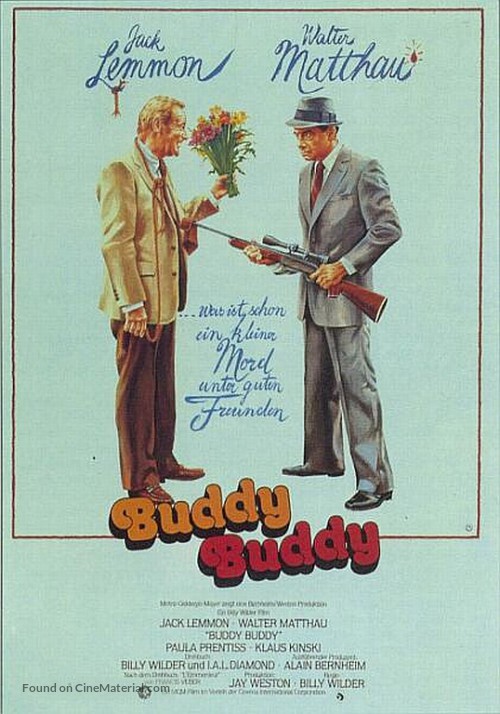
Buddy Buddy (1981)

buddy-buddy-2

By Richard Winters

My Rating: 7 out of 10

4-Word Review: Suicidal man hampers hit.

Trabucco (Walter Matthau) checks into a hotel intent on completing a hit by shooting a mob informant before he can testify at trial. He’s already killed the two other informants with relative ease, but now finds this one to be much more complicated due to having to deal with Victor (Jack Lemmon) who resides in the adjoining room. Victor is upset that his wife Celia (Paula Prentiss) has left him for a sex therapist (Klaus Kinski) and proceeds to try to hang himself by tying the noose around the water pipes in the bathroom, but all he succeeds at doing is busting the pipes and creating a flood. Trabucco decides to ‘befriend’ the man in order to keep an eye on him and prevent him from trying to kill himself again, which he feels will only lead to unwanted attention from the authorities. However, Jack causes more problems for him than the police ever could.

This was the last film directed by Billy Wilder who stated in more than a few interviews that he considers this movie to be his poorest effort and his least favorite. Matthau and Lemmon have pretty much said the same thing as well. The film was a critical flop and lost 3.5 million at the box office, which helped to prevent Wilder from ever helming another movie again.

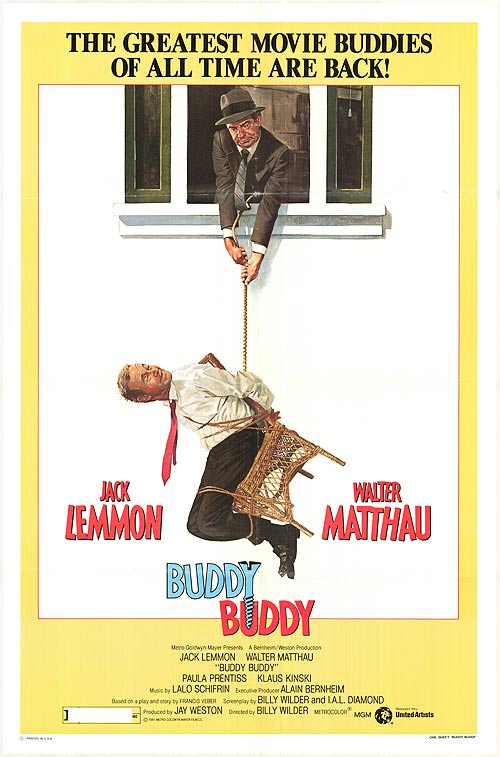
However, I was delightfully surprised at how funny I found this movie to be. It’s not exactly laugh-out-loud hilarity, but on a low-key level it works. The part where Lemmon gets tied to a chair and his mouth gagged while he screams at an ambivalent housekeeper (Bette Raya) to free him is quite good and the part where the two men going gliding down a clothes chute is fun too.

The whole thing is a remake of the French film A Pain in the A__, but it implements changes to the plot that improves it from the original. For one thing the dialogue is funnier, the two men have more genuine conversations and they even develop a bit of a bonding. The film adds more characters too like the beleaguered Captain Hubris played by Dana Elcar who tries in vain to protect the witnesses from Trubacco, but with little success. The distinctive musical score by Lalo Shifrin is also big improvement.

Lemmon is quite funny as he plays a sort-of hyped-up version of his Felix Unger character. Matthau seems a bit stymied in a role that allows for very little expression, but he still manages to make the most of it. My favorite performance though was that of Kinski who takes a rare comic turn and utters the movies best line: “Pre-ejaculation means always having to say you’re sorry.”

Having the two actually work together to complete the hit and then make an escape from the cops is good and something that did not occur in the original. The resolution, which takes place on a tropical island, is a bit of an improvement over the first one though it’s still not perfect. In either event it’s a relatively solid comedy that offers a few good laughs and deserves more attention especially for fans of Lemmon/Matthau.

buddy-buddy-1

buddy-buddy-3

My Rating: 7 out of 10

Released: December 11, 1981

Runtime: 1Hour 36Minutes

Rated R

Director: Billy Wilder

Studio: MGM

Available: VHS

A Pain in the A__ (1973)

pain-in-the-ass-1

By Richard Winters

My Rating: 6 out of 10

4-Word Review: Loser irritates hit man.

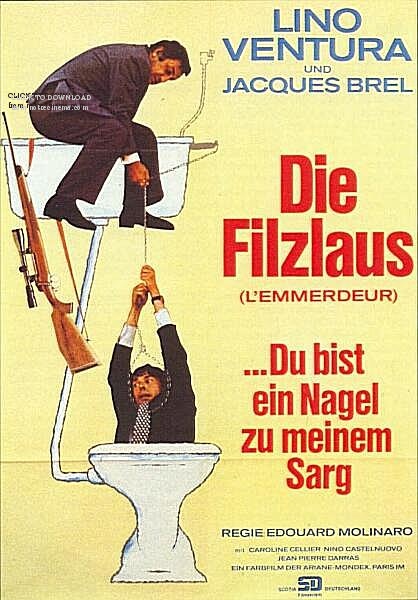
Ralf (Lino Ventura) works as a hit man and is hired to assassinate Louis Randoni (Xavier Depraz) who plans to testify against the mob. Ralf checks into a hotel room and plans to shoot Louis as he tries to enter the courthouse from his hotel window, which sits across the street from the court building. As he prepares for the hit he becomes distracted by Francois (Jacques Brel) in the neighboring room who attempts to kill himself after his wife leaves him. Ralf is concerned that Francois’s actions will elicit unwanted attention, so in an attempt to quiet him he ‘befriends’ him, which leads to many ironic scenarios.

The film was written by the prolific Francis Veber and based on his play. Ultimately it’s just a one-joke premise, but what makes it work are the two characters particularly the hit man who is portrayed in a serious way and never once betrays the essence of who he truly is, which is that of a cold blooded killer intent on doing his job and then moving on to his next. The comedy comes from his perturbed reactions at having to deal with a loser that despite his best intentions he can’t seem to ever get rid of.

Famous singer Brel does quite well as the clingy pest who is so wrapped up in his own personal quandaries that he fails to notice that his new ‘friend’ really isn’t his friend at all. Brel’s boyish looks plays well off of Ventura’s constantly stern expression and the plot becomes almost a constant play on errors as each one misreads the other.

The overall set design though is boring and the majority of action takes place solely inside the two hotel rooms, which eventually makes the proceedings quite static. It would’ve been nice to have had more of a conversation between the two as Brel does almost all of the talking while Ventura simply remains quiet while looking bored and angered, which is fun for a while, but more of a character arc could’ve been implemented.

The ending is a cop-out and not satisfying at all. I also felt Ventura was a bit too old and the character would’ve been more intimidating had it played by someone younger and more rugged although for the record Ventura plays the role perfectly especially when he gets injected with a drug that makes him tired and reluctantly  dependent on Brel’s guidance.

In 2008 Veber directed a remake of this film, which met with some success. Also in 1981 director Billy Wilder did an American version of this with Jack Lemmon and Walter Matthau playing the two leads. That film ended up adding a few changes and will be reviewed tomorrow.

pain-in-the-ass-2

My Rating: 6 out of 10

Released: September 20, 1973

Runtime: 1Hour 31Minutes

Rated PG

Director: Edouard Molinaro

Studio: Mondex Films

Available: VHS

Howard the Duck (1986)

howard-the-duck-1

By Richard Winters

My Rating: 1 out of 10

4-Word Review: A big budget disaster.

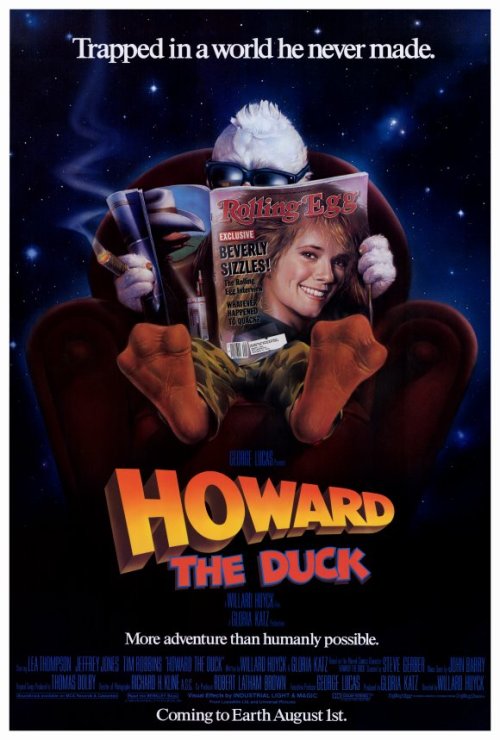
Howard (Chip Zien) is a duck living on another planet that is quite similar to earth except it’s run by ducks and not the ‘hairless apes’. One day while he is relaxing on his easy chair he gets sucked up into outer space by a laser beam that brings him to earth where meets up with Beverly (Lea Thompson) who is a lead singer for a punk band. She takes a liking to him and has him meet up with her geeky friend Phil (Tim Robbins). Phil in turn introduces Howard to Dr. Jennings (Jeffrey Jones) who offers to return him to his planet via a laser spectroscope, but as the procedure is performed it malfunctions and turns Jennings into a dark overlord out to destroy humanity.

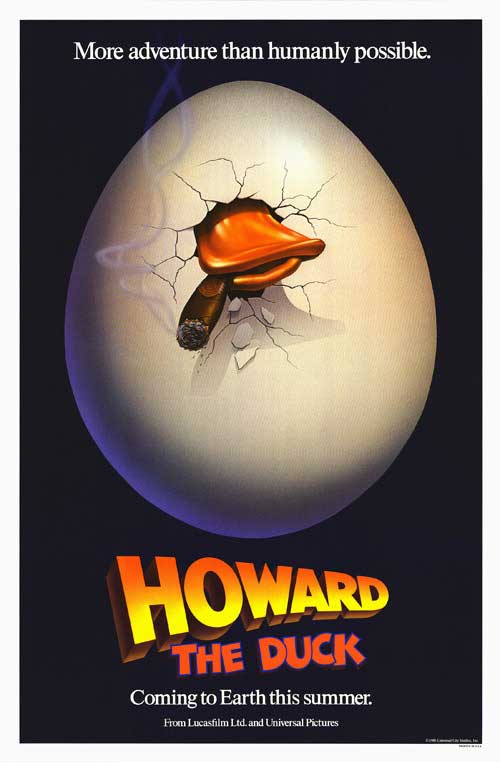
This was produced by George Lucas and based on a Marvel Comic book character created by Steve Gerber, which is where it should’ve stayed. I know this movie has been shredded by many other filmgoers and critics and I don’t mean to pour more fuel onto the fire, but it’s as bad as its reputation says and I tried valiantly to give it a chance. Right away though there are problems including the fact that the planet Howard lives on looks too similar to ours. In fact it looks exactly like ours except it has two moons otherwise it’s impossible to tell the difference on anything. Same type of buildings, cars even the money is the same as American dollars except for a picture of a duck on them instead of Washington. There’s also a barrage of visual gags that make light of the subtle differences between the duck’s world and ours which the filmmakers clearly think are quite clever, but instead they’re just annoying.

The appearance of the duck is a problem too. If it had been animated it might’ve worked, but here it looks like a dwarf in a duck costume and has so many human characteristics that you ultimately forget that he’s supposed to be a fowl at all. Although I do realize that the comic strip character is anthropomorphic as well I still would’ve liked a little more ‘duck logic’ put into it. What sense does it make to create a duck type character if it ends up sharing literally NO characteristics to the actual mammal including the fact that it can’t even swim! The scenes showing him becoming aroused by Thompson’s human body and even talking about one day getting married and having kids was downright creepy.

The second half is where the story really goes off the hinges. The story pivot involving the Jones character becoming possessed by a ‘dark overlord’ is about as generic as it gets and leads to a nonstop assault of special effects and car chases that is both mind numbing and pointless. I never read the comic of which this is based but in researching it I found that it had a lot of unique and interesting villains and those should’ve been implemented into the script.

Thompson gives a terrific performance, which is the only reason I’m giving this thing 1 point, but her character is a little too sweet and lacks the streetwise edge a singer in a punk band would most assuredly have. In the comic book version Beverly was a model and I’m not sure why her profession got changed, but it was a mistake. Robbins is engaging too and Jones has one funny bit during his exchange with a waitress inside a late night diner, but otherwise this thing fails at all levels and is too obnoxious to be enjoyed even in a so-bad-it’s-good category.

howard-the-duck-2

My Rating: 1 out of 10

Released: August 1, 1986

Runtime: 1Hour 50Minutes

Rated PG

Director: Willard Huyck

Studio: Universal

Available: DVD, Blu-ray, Amazon Video, YouTube