Category Archives: Mystery

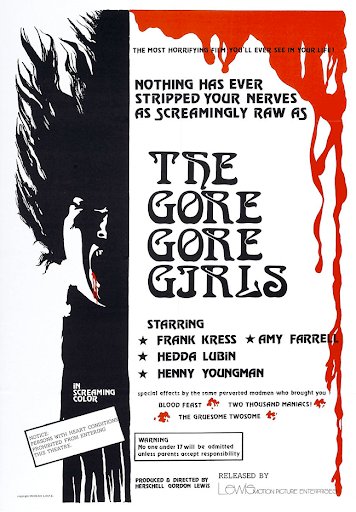
The Gore Gore Girls (1972)

By Richard Winters

My Rating: 1 out of 10

4-Word Review: Somebody’s killing the strippers.

Private investigator Abraham Gentry (Frank Kress) gets hired by Nancy (Amy Farrell), a reporter for The Globe newspaper, to investigate the murder of a stripper named Suzy Cream Puff (Jackie Kroeger). Abraham will get $25,000 to investigate the case and another $25,000 to solve it as long as he gives The Globe the exclusive story. Soon more strippers turn up dead and Abraham starts to have a long list of suspects including Grout (Ray Sager) a Vietnam veteran who enjoys smashing melons with faces drawn on them, similar to how the strippers got their heads smashed, in order to relieve his post traumatic stress disorder.

This was schlockmeister Herschell Gordon Lewis’ final film until 2002 and was meant to be a combination between the lighthearted nudies that he made in the early 60’s and the more graphic gore films that he did in the later part of the decade. The result though is a misguided mess where it seems more like a gag reel with tacky gore thrown in at certain intervals than a horror film.

The production values are really cheap even for a low budget production and contains basically just a few settings. One features the cramped living room of Abraham’s house that looks to be nothing more than a one bedroom apartment, which doesn’t quite make sense since the guy is a world famous detective you’d think he be living in a plush place especially with his elitist attitude. The other setting, which takes up the majority of the story, is the strip club that looks like it was filmed in the corner of somebody’s dingy basement.

The gory murders aren’t much fun and would be considered quite sick if they weren’t so tacky and fake. The jump cuts are the biggest problem as the bad guy kills the stripper one second and then in the next frame has seemingly been able to skin their heads completely and crushed their skulls, which is too quick. The ping pong ball sized eyeballs that the killer gouges from their heads are ridiculous looking too as eyes are actually oval shaped and not round as presented here.

The stripping routines take up too much of the runtime and seem put in simply to pad the anemic plotline. I’m not going to complain about watching beautiful women taking off their clothes, although to be honest the women here aren’t so hot, but I got real tired of hearing the same music played over and over again during each different set. Aren’t strippers allowed to come up with their own music and dance routines, or is that a new phenomenon that wasn’t a thing back in the 70’s?

I hate to psycho-analyze a film director and have never done it before, but the misogyny here is rampant. If there had been one strong, smart woman character present then it would’ve have been a issue, but instead females get portrayed here as being incredibly dumb and easily manipulated. The Nancy character is shown to be unable to take care of herself and needs a man present to look out for her particularly when she passes out on a city sidewalk after having only a couple of drinks. She faints and screams at the sight of a dead body too while the man remains stoic and shows no emotional reaction at all. Maybe this was supposed to be a part of the ‘comedy’, but it comes off as severely dated and out-of-touch with the times.

My Rating: 1 out of 10

Released: September 22, 1972

Runtime: 1 Hour 21 Minutes

Director: Herschell Gordon Lewis

Rated X

Studio: Lewis Motion Picture Enterprises

Available: DVD, Blu-ray, Amazon Video
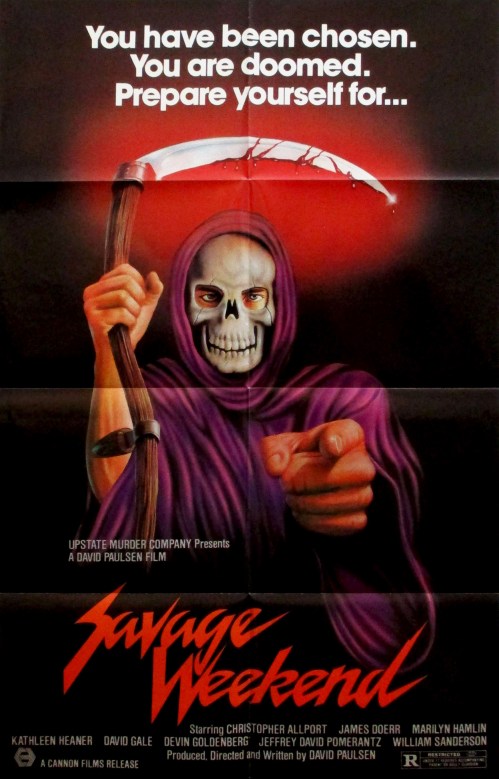
Savage Weekend (1980)

By Richard Winters

My Rating: 6 out of 10

4-Word Review: The first slasher movie.

Maria (Marilyn Hamlin), who has a very contentious relationship with her ex-husband Greg (Jeff Pomerantz), but who is now in a relationship with Robert (Jim Doerr) a successful businessman, decides to take a weekend trip with some friends to upstate New York. Robert is having a large boat built there and wants to see its progress. The quiet country atmosphere seems like the perfect spot to getaway until a masked killer shows up killing each of them one-by-one.

While Halloween typically gets credited as being the forerunner to the modern day slasher film it’s actually this one that was the first and don’t let the release date fool you. This was filmed in the summer of 1976, a full two years before Halloween came out, but was shelved by its distributors as they thought the concept of a mysterious masked killer was ‘too weird’ and wouldn’t catch on only to eventually release it to theaters once they saw the success of Halloween.

The concept for this came about completely by accident. Writer/director David Paulson was originally hired to write a screenplay for a completely different type of movie, but the investor then retracted the majority of the money he promised leaving Paulson with a mere $20,000 to work with. He decided with such little funds he’d be forced create a story that required a single setting and then came up a scenario that would make the characters stay there and thus the killer-on-the-loose idea was born.

The critics were originally not kind: TV Guide subscribed this as a ‘reprehensible exploitation film’ and ‘the gore effects are extremely gruesome’, which just isn’t true. At best the blood is quite minimal especially when compared to today’s slashers. In fact you’ll find more explicit gore in modern dark comedy films like Shaun of the Dead than you will here.

Critic Joe Baltake criticized the Nicky (Christopher Allport) the gay character stating that he ‘set gay rights activism back several decades’, which I totally disagree with. I actually liked Nicky and was impressed at the way he walked into a backwoods bar and when the rednecks tried to hassle him he single-handedly kicked their asses, which to me worked completely against the gay stereotype.

Through the years critics have become much kinder to this film and its attained a strong cult following and deservedly so. Despite being made 4 decades ago it actually comes off as fresh and inventive because it’s not stifled by the conventional ‘rules’ of the formula, which we’ve become so accustomed to now. I liked how the film opens with a point-of-view shots of our heroine running madly through the forest making the viewer feel they’re the ones being chased.

The fact that the majority of it takes place during the daytime actually makes it scarier especially with it’s weird yellowish tint that permeates every shot. I’m not sure if this was intentional or just a poor film transfer, but it helps to create a surreal look. I also really loved seeing the skeleton of the large boat that was being built inside an abandoned shed. I presume with the low budget this was not made for the story and instead simply worked into the script when the producers came upon it while scouting for locations, but the effect is cool especially when the cast walks around inside it.

The soundtrack is way different from the conventional horror film as well with a country tinged sound and at one point even a classical dance piece, but after watching soooo many scary movies with the same old Friday the 13th-like sound I was more than happy to hear something different. The characters are also multi-dimensional with distinctive personalities. Usually I more than happy to see a cardboard slasher film cast get hacked-up, but here I kind of wanted them to stay around as they were interesting. The murders also don’t work in a mechanical way, but instead start occurring suddenly to the shock of everyone else, which gives it more of a real-time feel.

The only real negative is that despite having a strong beginning and ending the middle part is slow. There’s still enough interactions between the characters to hold mild interest, but there’s no running tension. A good horror movie should be creepy to some degree from beginning to end, but the second act veers off too much making it at times seem more like a soft core porn flick, but overall for the horror connoisseur I’d still recommend this.

My Rating: 6 out of 10

Released: November 14, 1980

Runtime: 1 Hour 28 Minutes

Rated R

Director: David Paulsen

Studio: Cannon Group

Available: DVD, Blu-ray (Region 1), Amazon Video

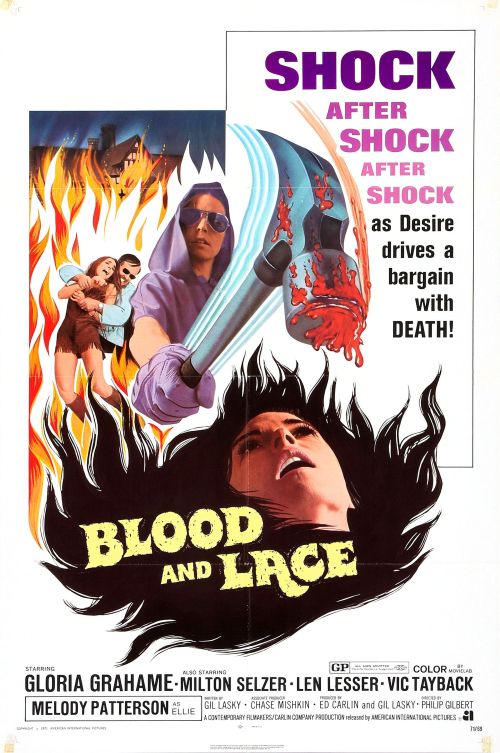
Blood and Lace (1971)

By Richard Winters

My Rating: 3 out of 10

4-Word Review: Trapped in an orphanage.

Ellie Masters (Melody Patterson) finds herself an orphan after her mother, who worked as a prostitute, is found in bed with a john both dead via bludgeoning by a hammer. Since she’s still a minor she’s required to move into an orphanage run by the corrupt Mrs. Deere (Gloria Grahame) who treats the children as slaves and when any one of them tries to escape they’re met with stern justice from resident handyman Kredge (Len Lesser) who’s in complete charge of all disciplinary functions.

The film was written by Gil Lansky who wrote some interesting cult film-like stuff in the early 70’s including The Night God Screamed, which had some offbeat touches and worth checking out. This one too has potential, but unfortunately the production values are so bad it gets virtually ruins before it even has a chance. The chief complaint is the music. Since it was produced on a budge of only $200,000 the producers decided, in an effort to save money, that they’d use music from the free library and thus the soundtrack sounds more like something out of an old monster movie from the 40’s and ends up giving the whole thing a very tacky quality. It also gets overplayed making me genuinely consider watching it with the sound turned down especially during the chase or action sequences. Had I been in charge of production I would’ve gladly spent the money to hire a composer who could’ve given it a more appropriately modern sound, which was much needed, and would’ve felt that any money spent to get it would’ve been worth it.

The scenes in the orphanage don’t elicit much tension either and this is mainly because it looks like it would be very easy to escape from it and not as much of a prison-like atmosphere as you’d expect. The kids are able to walk freely about and not locked in their rooms or chained to their beds, which would’ve made more sense. Kredge looks too middle-aged, Lesser was 48 when it was filmed, and not necessarily in good enough shape to physically bully the kids the way he does. There needed to be more guards present who had guns and knives to keep the kids in line. Grahame also looks to thin and frail and I felt Melody, who appears much older than 18, could’ve easily overpowered her and was quite frankly frustrated that she didn’t. Her character is sassy and worldly-wise for the most part, but then also a bit too pathetically complaint to Grahame’s authority when she really didn’t have to be.

I did though like Patterson’s performance overall, she’s best known for playing Wrangler Jane in the 60’s TV-show ‘F-Troop’, but here shows an edgier side and coupled with her cute face could’ve gone on acting in many more movies, but instead after filming this she married actor James MacArthur and put her career on hold in order to move to Hawaii to be closer to him and this ultimately ended up being the last movie she did. I was also impressed with Lesser. It’s always interesting to see which actors remain professional and put in a strong acting effort even when the production is of a low grade level and in that regard he deserves accolades. I was not however as impressed with Grahame as she comes off a bit too one-note and the part would’ve been better served had it been played by a bigger bodied actress such as Shelley Winters, who would’ve been better able to convey a more imposing presence.

The film has become most famous for its opening bit, which shows a mystery assailant holding a hammer and killing their victim’s with it, but all done from his point-of-view similar to the opening bit from Halloween, which came out 7 years later. For the most part I liked how it gets done here, it’s the best part of the whole movie, and in some ways enjoyed this version better. My only caveat would be that I wished it hadn’t shown the hammer striking the victims as too much stop action camera work and fake blood gets used, which makes it look amateurish. The camera should’ve simply focused solely on the hammer going up-and-down and only cutting briefly to the blood-soaked victims for a brief shot after they had already been dead.

My Rating: 3 out of 10

Released: March 17, 1971

Runtime: 1 Hour 27 Minutes

Rated GP

Director: Philip S. Gilbert

Studio: American International Pictures

Available: Amazon Video

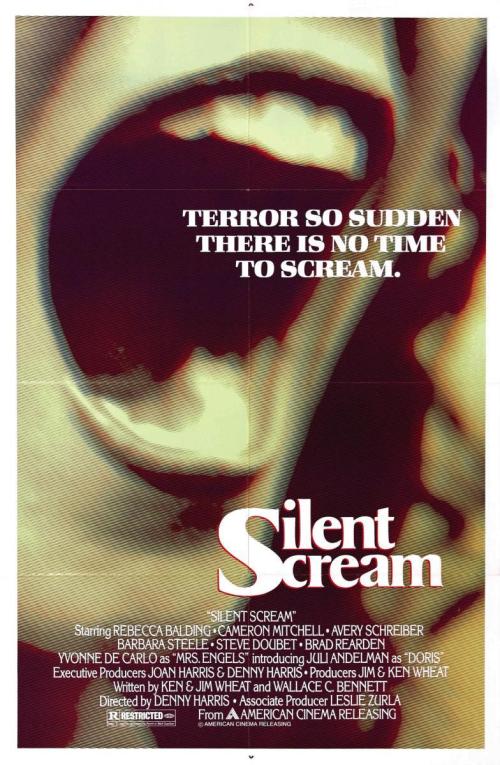
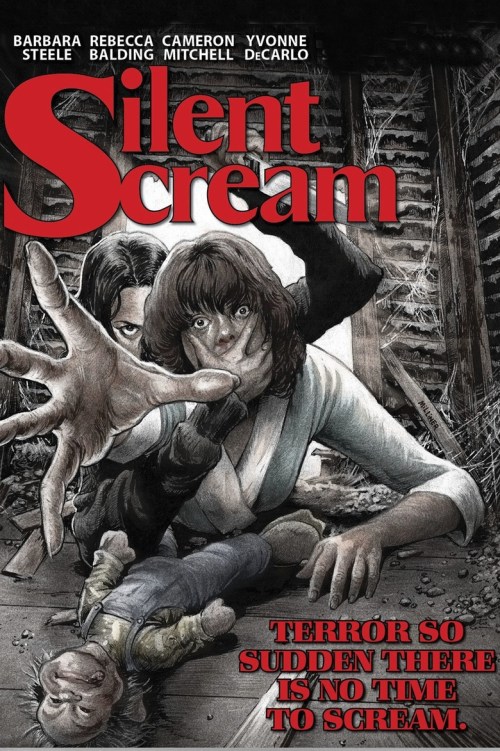
The Silent Scream (1979)

By Richard Winters

My Rating: 3 out of 10

4-Word Review: Family’s dark secret exposed.

Scotty (Rebecca Balding) is a student away at college who finds nearby housing at a large stately mansion owned by Mrs. Engels (Yvonne De Carlo) and her son Mason (Brad Reardon). When Scotty moves in she meets three other college students (Steve Doubet, Juli Andelman, John Widelock) who are also living there, but during the next couple of day those other students start turning up dead. Scotty fears she may be the next victim and suspects the killings may have something to do with the mysterious person that’s hiding in the attic.

In the summer of 1977 Denny Harris, who was at that time a successful commercial director who owned his own studio, decided to take a try at directing a horror movie and he put down $450,000 of his own money to do it. Unfortunately when production wrapped the footage shot was deemed unreleasable, so Jim and Ken Wheat, two brothers, were brought in to try and salvage it, but instead decided to completely rewrite the script and reshoot almost the entire film leaving only 12 minutes of the original footage in the final cut. This includes a scene where the Mason character watches what looks to be a soft core porn flick on his TV in his bedroom, but was actually a scene from the original version with Susan Backlinie, the lady who got attacked by the shark in the opening bit of Jaws, playing one of the characters.

It would be interesting if a Blu-ray could be issued that would show the version that Harris shot alongside the Wheat brother’s one because I suspect it might not have been any worse than what we end up getting here. For one thing the plot is too skimpy and the pacing slow. Too much extraneous footage of Scotty looking for an apartment and conversations she has at a bar with friends, and even her making love with Jack that doesn’t help build the tension at all and should’ve been cut out.

When the ‘scares’ do come they’re not all that great. The stabbing sequences are particularly annoying because the same Bernard Herrmann-like score that was used in Psycho gets played here making it all seem quite cliched. The blood is another issue as it conveniently collects on a hanging white sheet as the victim gets pummeled with a knife as well as a pool of it on the floor, which our protagonist somehow misses seeing when she goes to investigate. Yet I’ve watched enough true-life crime shows to know that blood splatter doesn’t work that way, but instead sprays out all over with droplets of it splattering on the walls, ceiling, and other appliances until it would be quite obvious to anyone entering a room that a murder had occurred there and unlike what happens here.

Spoiler Alert!

The flimsy plot gets played-out too quickly. In a matter of just two days of staying there the dark family secret and all the ugliness behind it gets completely revealed, which makes for an anti-climactic feeling when it’s over. The protagonists seem to be nothing more than dressing with have very little to do as they ultimately stand helplessly on the sidelines while the bad guys kill-off each other, which isn’t very gripping.

A better idea would’ve been to have the villainous family, which are far more interesting and better acted than any of the college kids, be the stars of the film. Then having the film show how they bring in tenants through the years to help defrays costs, but reluctantly forced to kill them when they get too noisy, only to ultimately meet their match with one of them similar to how What Ever Happened to Aunt Alice? was structured.

The only riveting moment in the movie comes when a young woman, played by Tina Tyler, tries to hang herself via a noose hung from a light fixture in her bedroom. Most of the time hangings in films are either shown from the waist up or down, but here we get a bird’s eye shot where her feet clearly leave the floor with the rope around her neck and nothing else to support her making it seem like she really is hanging herself especially as her body begins to struggle, which is impressively graphic.

My Rating: 3 out of 10

Released: November 16, 1979

Runtime: 1 Hour 27 Minutes

Rated R

Director: Denny Harris

Studio: American Cinema Releasing

Available: DVD, Blu-ray, Amazon Video
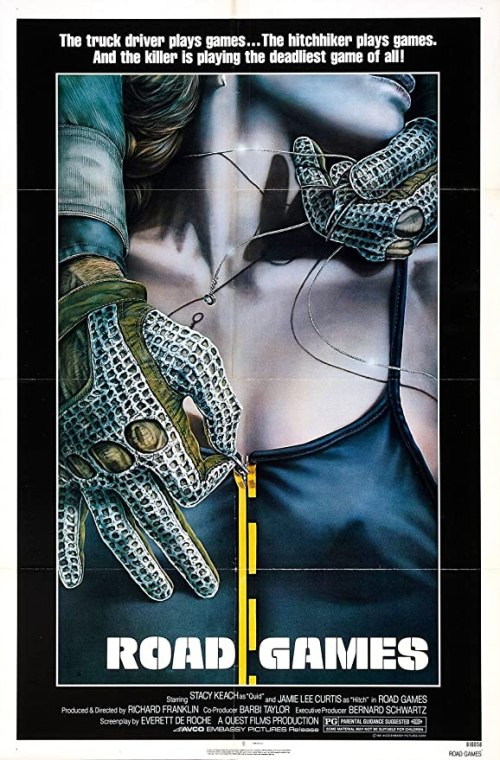
Road Games (1981)

road games 1

By Richard Winters

My Rating: 6 out of 10

4-Word Review: Truck driver pursues killer.

Quid (Stacy Keach) is an American working as a trucker in Australia and hauling a frozen shipment of pigs through the outback and into Perth. Along the way he becomes menaced by a strange man (Grant Page) driving a black van who has a penchant for picking-up prostitutes who then end up dying. Quid is convinced that the man is the serial killer that is being reported about on the news, but before he can go to the police he gets tabbed as the killer himself forcing him, with the help of Pamela (Jamie Lee Curtis) a hitch-hiker he picks up along the way, to find the real killer before he gets arrested for crimes that he did not do.

One of the coolest aspects of this film is its voyeuristic quality where visual clues are a requirement for the viewer to pick up on to figure out what’s going on.  Too many other movies don’t take enough advantage of this idea and usually sell-out by having everything explained through dialogue, but here director Richard Franklin, a major devotee of Alfred Hitchcock, who tried to model the story after Rear Window, keeps the viewer feeling like they’re an active participant.

The film’s drawback, and most likely one of the main reasons it didn’t do well at the box office, is that the tension  ebbs and flows. Too much labor gets put into dressing up the plot with a lot of quirky side stories. This includes having Quid  coming into contact with the same motorists through his travels, which I didn’t think was realistic that these same drivers would be taking the exact same route as him while maintaining the same speeds as he over a several day period, so that no matter where he went they were never far away. I have traveled extensively by car on long road trips similar to this one and have never kept passing the same motorists like Quid does here.

The film also lacks, with the exception of a surprise double ending that comes at the very end,  any type of actual scares. There is a running build-up making you believe that a shock is just around-the-corner, but ultimately it’s a letdown. People watch these things with the anticipation they’ll be jumping-out-of-their-seats at some point, but this is too tame and at certain points it’s almost more like a comedy.

The killer, who was played by a stuntmen and not a professional actor, lacks any type of presence to distinction. For things to get really intense, which it never does, the bad guy has to stand out and make the viewer feel on edge every time they see him, which this transparent guy is unable to do. It would have also been more interesting had his face not been shown until the very end instead of Quid seeing what he looks like early on when he spots him through his binoculars.

I was surprised why the two lead characters were played by Americans since the setting is the down-under and the story better served by performers who were native born. That’s not to say that Keach or Curtis don’t give engaging performances because they do, but I don’t believe there’s too many American truck drivers working in Australia, so there needed to be some explanation for why Keach was there and why, being that he was not from the region, he was so educated about the history of the area, as evidenced when the two camp-out overnight and he tells her the back story of an abandoned telegraph station that sits nearby.

The romantic undertones that are lightly introduced does nothing but sap away the tension. I also found it curious why Curtis would be trusting of Quid upfront as she’d have no idea whether the serial killer could’ve been him and therefore she should’ve been more guarded, which she isn’t.

The climactic sequence features a unique car chase where three vehicles follow each other around the back alleys of Perth late at night, but at very slow speeds, which surprisingly is effective. However, the script should’ve been tighter and the editing quicker. The film’s leisurely pace and colorful supporting characters works against it. There needed to be more shocks, more of a confrontation between Quid and the killer, and basically just more of a conventional thriller-like approach.

My Rating: 6 out of 10

Released: June 26, 1981

Runtime: 1 Hour 41 Minutes

Rated PG

Director: Richard Franklin

Studio: Embassy Pictures

Available: DVD, Blu-ray, Amazon Video
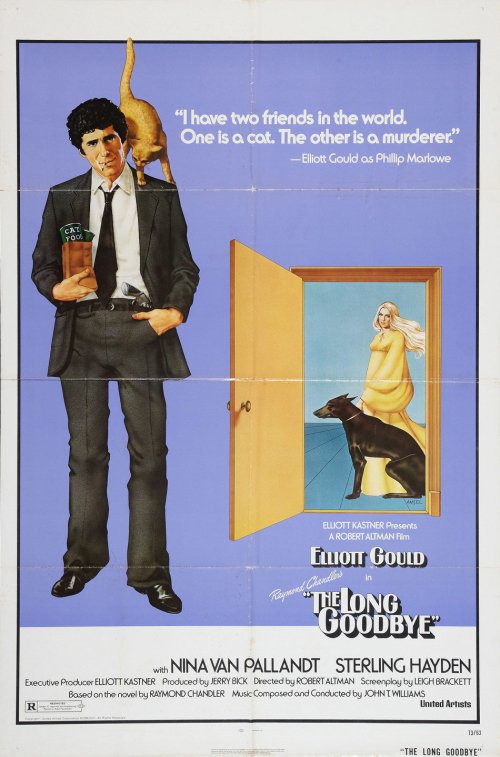
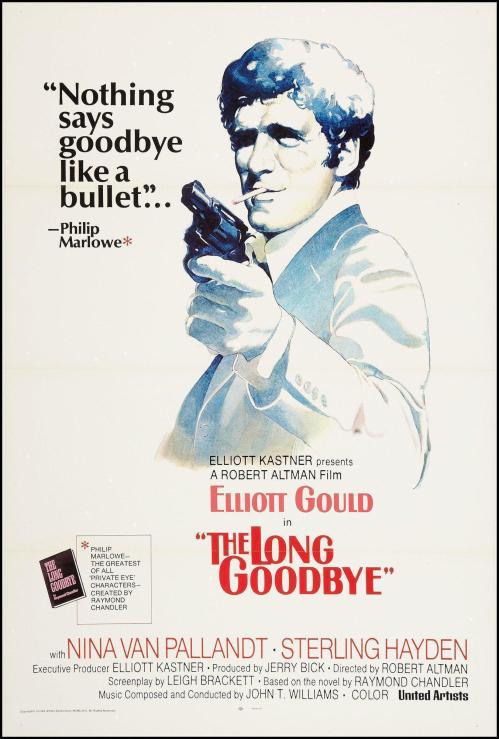
The Long Goodbye (1973)

By Richard Winters

My Rating: 7 out of 10

4-Word Review: His cat is hungry.

One night detective Phillip Marlowe (Elliot Gould) is visited in his home by his long time pal Terry Lennox (Jim Boulton), who informs Marlowe that he’s had a fight with his wife and asks him if he can have a ride to the Mexican border, which he obliges. When he returns home he is met by two cops (Jerry Jones, John S. Davies) who bring him into the station with questions about the whereabouts of Lennox whom they insist has just killed his wife. When Marlowe refuses to divulge anything he gets put into jail only to released 3-days later when it’s reported that Lennox has killed himself. Marlowe becomes suspicious about the suicide and determined to do his own investigation while also getting involved with Eileen Wade (Nina van Pallandt) and her alcoholic, writer husband Roger (Sterling Hayden) both of whom may hold the secret to Lennox and what really happened.

By the early 70’s only two of Raymond Chandler’s novels had yet to be filmed, this one and ‘Playback’. United Artists agreed to finance the film and commissioned Leigh Brackett, who had been the screenwriter for another Chandler novel turned into a movie 1946’s The Big Sleep, to write the screenplay for this one. Robert Altman was later approached to direct it and while he was not a fan of the Phillip Marlowe character, whom he labeled as being a ‘loser’, he agreed to take on the project due to the unexpected ending, which had not been in the novel, but that Brackett had added into the screenplay.

While Altman may have seemed an odd choice, he never even read the source novel of which the film is based, the eccentric little sidelights that he adds into the proceedings make it worth it. Some of the movies that he did towards the late 70’s became a bit too undisciplined where his films would go off on tangents with stuff that had very little to do with the main plot, but here the story is strong, so the little detours that Altman adds in helped to playfully accentuate the plot instead of drowning it out.

Some of my favorite Altmanisms included  Marlowe looking for food to feed his hungry cat, who I might add for an animal gives a spectacular performance, and how a stocker that he meets at the grocery store while searching for cat food he ends up meeting again at random at the police station. The next door female nudists, who are also into yoga and attract the attention of both the police and the bad guys who come to Marlowe’s place, are fun too.

There’s some marvelous framing by cinematographer Vilmos Zsigmond including capturing Roger and Eileen having an argument inside their home, which was filmed at Altman’s Malibu residence, through a glass patio door while at the same time in the reflection you see Gould walking along the beech. Later while Eileen and Marlowe are having a conversation by an open window you can see in a distance, which the other two are unaware of, Roger walking into the ocean in an attempt to kill himself.

Spoiler Alert!

The film also features what I feel is one of the most shocking and disturbing scenes that I’ve ever seen put into a movie and that’s a statement that I don’t use lightly. I’ve seen hundreds of gory horror films, but what happens here I’ve found far more unsettling. I think the reason is because it’s completely unexpected as it features the character played by film director Mark Rydell smashing a glass coke bottle onto the face of his girlfriend who just seconds earlier he had stated that he was deeply in-love with. Hearing her scream out in unending pain while cupping her hands over her face as blood spews out makes it come-off as very real. Even more amazing is that the part of the girlfriend was played by an amateur named Jo Ann Brody who never appeared in any other film and was a waitress that Altman and Brackett met when they went out to dinner while working on the script and who they asked on-the-spot if she’d like to be in their movie.

Altman admitted that he knew this violent scene, which had not been in the book, would upset some fans, but he felt it was important to bring the viewer back to the reality that these were violent characters at heart. This could also be seen as a foreshadowing to the surprise ending when Marlowe finds Lennox still alive in Mexico and then unexpectedly shoots him. In the novel Marlowe allows Lennox to walk away unharmed, but Altman liked the violent twist.

Personally I was ambivalent with the ending here and might actually have preferred the way it was done in the book. My main issue though with it is that Eileen spots Marlowe leaving the place where Lennox was just shot and since she was in a relationship with Lennox and also had strong criminal connections I’d think she’d end up, one way or another, going after Marlowe once she realized he had killed her lover causing the ending to leave open too many potentially interesting tangents that should’ve been followed through on.

My Rating: 7 out of 10

Released: March 7, 1973

Runtime: 1 Hour 52 Minutes

Rated R

Director: Robert Altman

Studio: United Artists

Available: DVD, Blu-ray, Amazon Video
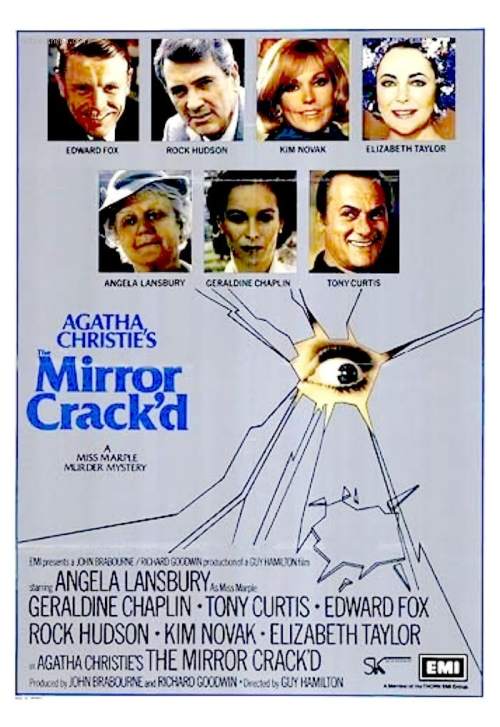
The Mirror Crack’d (1980)

By Richard Winters

My Rating: 7 out of 10

4-Word Review: Poison in her drink.

A Hollywood production company arrives in a small English village, where Miss Jane Marple (Angela Lansbury) resides, to film a costume drama. The film will star two actresses, Marina Rudd (Elizabeth Taylor) and Lola Brewster (Kim Novak), who are also bitter rivals. A reception is held to allow the villagers to meet the celebrities. During the reception Marina speaks with Heather Babcock (Maureen Bennett) a devoted fan who tells Marina about having met her years earlier backstage.  While she bores Marina with the details she also drinks a daiquiri cocktail that was laced with poison causing her to die and propelling Miss Marple, who is bedridden with an injured foot, and Inspector Craddock (Edward Fox) to investigate the case.

If there is one reason to checkout this otherwise so-so film it’s to see Taylor and Novak go at it as rival actresses. This was Taylor’s first feature film appearance in 4-years and, if you don’t count her cameo appearance in The Flintstones as well as 1987’s The Young Toscanini, which was never released in the US, the last one of her career. Her standout performance, which amounts to being a mixture of camp and poignant drama, more than makes it worth it and Novak is in top form as well playing-up the comic wickedness to a delicious level. Even Rock Hudson, who was reunited with Taylor 25 years after having done Giant together, does quite well as Marina’s exasperated husband.

Unfortunately Lansbury gets miscast as she was only in her mid-50’s while Marple was considered an elderly woman in her 70’s or 80’s. They dye her hair white in an attempt to make her appear older, but it still doesn’t quite work. It’s also a letdown not to have her in the majority of scenes like you’d expect. While I never read this Agatha Christie novel I have read some others as well as the movies that have been made from her works and all of them had the head detective taking an integral part in the investigation and not shackled up in her home doing nothing to propel the potentially engaging banter that she could have had with the suspects as she interviewed them. Ultimately the supporting cast gets more screen time than she, which was a waste.

The glossy cinematic element that was so apparent in other Agatha Christie movies like Murder on the Orient Express and Death on the Nile is totally lacking here. Some of the on-location shooting does take place in what would be considered large mansions, but the interiors resemble rooms seen in any old building and convey no flair or distinction. Director Guy Hamilton admitted to not liking Agatha Christie’s books nor thinking much of the script, which he openly stated to the producers during the interview and yet they decided to hire him anyways,  but the result, with the exception of the kitschy film-noir opening bit, is mechanical while relying solely on the veteran cast to keep it interesting.

My Rating: 7 out of 10

Released: December 19, 1980

Runtime: 1 Hour 45 Minutes

Rated PG

Director: Guy Hamilton

Studio: Associated Film Distribution (AFD)

Available: DVD, Blu-ray, Amazon Video, YouTube

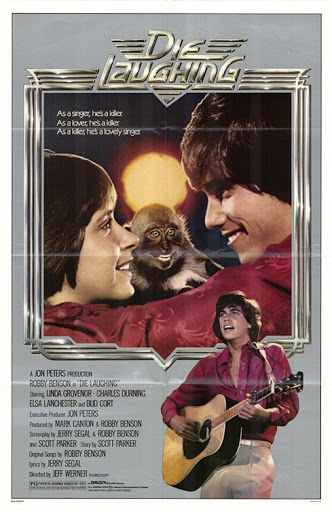
Die Laughing (1980)

By Richard Winters

My Rating: 1 out of 10

4-Word Review: Cabbie accused of murder.

Pinsky (Robby Benson) works as a San Francisco cab driver during the day, but aspires to being a professional singer and attends numerous auditions, but to no avail. One day he picks up a passenger who gets shot and killed while in his cab and Pinsky is mistakenly tabbed as being the killer. Feeling he has no other options he takes the briefcase that the victim was carrying and hides out at his girlfriend Amy’s (Linda Grovenor) apartment. Inside the box they find a live monkey who has apparently memorized the secret formula for turning atomic waste into the plutonium bomb and it’s now their job to keep him away from Mueller (Bud Cort) and his cohorts who want to kidnap the monkey and use what he knows for nefarious purposes.

The film starts out with some potential as it uses Benson’s wide-eyed, deer-in-headlights persona to good comical use, at least initially. Unfortunately by the second half it pivots too much the other way and the minor laughs at the beginning get completely lost when he suddenly becomes this seasoned spy who can quickly think on his feet and outsmart the bad guys at every turn.

Again, this is just an ordinary Joe whose main drive is to make it into the music business, so why get so emotionally invested in a spy case that does nothing but get him deeper and deeper into a dangerous situation? Why not just give the bad guys what they want, hope it appeases them enough that they’ll set you free and then go to the authorities, who are much better positioned to handle this situation, and let them do the rest?

I also thought it was ridiculous that when the couple are tied up and thrown into some dark backroom that they do not respond to the predicament, like any normal person would, with fear and panic, but instead use the moment to become romantic! The fact that they manage to untie each other by biting down on the thick ropes that bind them is absurd as the only thing that would accomplish is a lot of broken-off teeth.

Benson’s musical interludes are a bore and he ends up singing the same damn song three different times. He also performs at a concert when just a little while earlier he was being surrounded by spies ready to push him off of a ship, which would be such a traumatic experience for most people that it’s doubtful he’d be able to emotional calm down enough to focus on singing, or do anything for a long time afterwards.

The story also suffers from having too many villains, Cort is the main one, but he’s seen only intermittently while a bunch of others busily chase Benson around until it becomes dizzying trying to keep track of them all. The plot itself is overblown, relies heavily on worn-out spy genre cliches making it come off like a cheesy parody of James Bond that will cause many viewers to be rolling-their-eyes almost immediately at the campy, strained gags.

My Rating: 1 out of 10

Released: May 23, 1980

Runtime: 1 Hour 48 Minutes

Rated PG

Director: Jeff Werner

Studio: Orion Pictures

Available: DVD-R (Warner Archive), Amazon Video, YouTube

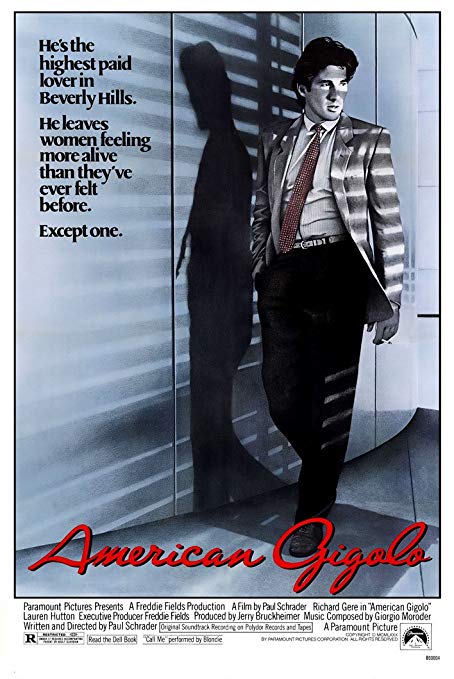
American Gigolo (1980)

By Richard Winters

My Rating: 5 out of 10

4-Word Review: Male escort gets framed.

Julian (Richard Gere) works as a male escort in the Los Angeles area servicing affluent female clients, which allows him to drive expensive cars and live in a luxury apartment. He even gets into a relationship with Michelle (Lauren Hutton) a senator’s wife, but just as everything seems to be going his way it comes crashing down when he gets accused of murder, which he didn’t commit. His only alibi is Michelle who he was in bed with that night, but she is reluctant to come forward fearing it will tarnish both her reputation and that of her politically ambitious husband (Brian Davies).

The film’s chief asset is Gere’s performance who puts a gritty edge in a film that is otherwise quite shallow. His character though is blah as we learn little about him, which I found frustrating. Male prostitution is not a profession most men get into, so why does Julian? Having a backstory dealing with his upbringing and showing his relationship with his family could’ve helped us better understand his motivations, but none is ever shown leaving us with a character that may look sexy, but is otherwise an empty shell that is neither interesting nor memorable.

The film offers no insights into the sex profession either. I kept wondering how he was always able to ‘get-up for the occasion’ with all of his clients especially when a lot of them were older women who were not all that attractive. Many male actors working in the adult film business will admit to taking Viagra or some other drug to guarantee an erection on cue. They also have women working behind-the-scenes as ‘fluffers’ who will give male performers a hand-job/oral sex, so when it’s time for his scene he’s erect, but Julian doesn’t have any of these things, so what’s his secret? The film makes it look like he can get-it-up on demand, which in reality I don’t think would always be the case.

I was also disappointed when Julian is told by the husband (Tom Stewart) of one of his clients to get rough with her by slapping her and Julian turns around with a shocked expression, but then the scene immediately cuts away without seeing what happened. I felt this was a crucial moment that needed to be played-out and it would’ve helped us understand Julian better by seeing how he responds to demands that he’s uncomfortable with. The film most likely cutaway because seeing him slap a woman would’ve made him unlikable to the viewer, but if he’s the type of person who will compromise his ethics to make money then we need to know this, or if he returns the money and walks away we need to see this as well.

Julian’s relationship with Michelle is ridiculous and unbelievable. Why would a guy who’s been to bed with hundreds of different women suddenly decide to fall-in-love with this one and why would a woman, who’s otherwise living a comfortable lifestyle, allow herself to fall for a man whose profession won’t allow him to be faithful to her? It doesn’t help either that Hutton gives a horribly wooden performance and it would’ve been far better had Julie Christie, who was the original choice for the role, played the part

The mystery angle is somewhat intriguing, but the wrap-up gets botched by suddenly instituting long pauses between scenes in which the screen goes completely black and silent for several seconds, which is jarring since this was not done at any earlier time and only helps to cement how over-the-top Paul Schrader’s directing is. Had more effort been put into character development instead of flashy lighting/camera angles we would’ve had a more interesting movie.

My Rating: 5 out of 10

Released: February 1, 1980

Runtime: 1 Hour 57 Minutes

Rated R

Director: Paul Schrader

Studio: Paramount

Available: DVD, Blu-ray, Amazon Video, YouTube

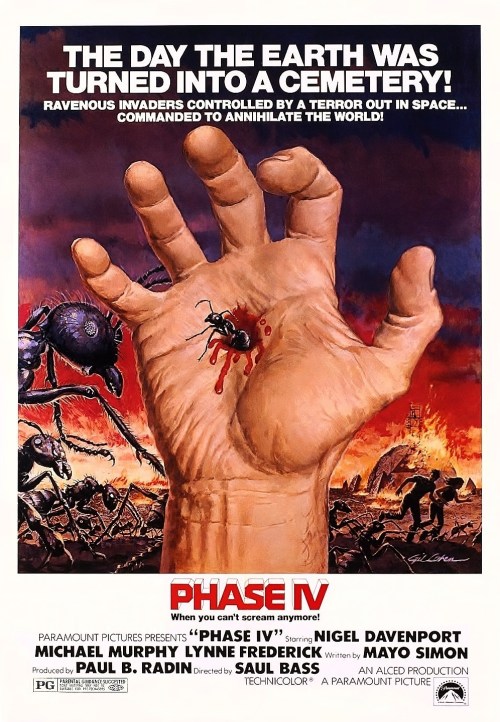
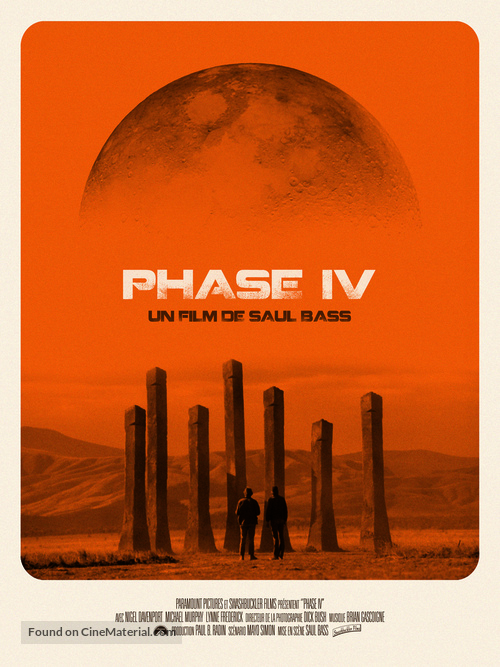
Phase IV (1974)

By Richard Winters

My Rating: 7 out of 10

4-Word Review: The ants take over.

Ants in a small isolated community in Arizona begin to behave strangely by building large towers and geometric designs in the crops. Dr. Hubbs (Nigel Davenport) and James Lesko (Michael Murphy) are two scientists hired to come-in and find out why the ants are behaving the way they are and try to put a stop to it. They construct a computerized lab in the middle of the desert and begin they’re research only to find that they’ve walked into the ant’s trap.

This was the first feature length movie directed by Saul Bass who was an award winning graphic designer who did title sequences and film posters for many famous movies from the 1950’s through the 1980’s. His great attention to detail pays off here in a film that is full of many intricate and stunning imagery including incredible micro photography of the insect life, but unfortunately the movie bombed badly at the box office, which never allowed him to direct another film again.

On the surface it’s easy to see why it didn’t go over well as a large amount of the runtime focuses on the ants and while this photography is impressive it also makes it seem more like a nature film, but without any voice-over narration explaining what the ants are doing. It’s not like you can’t figure it out, but it does require close attention and could still be confusing to some and not something mainstream audiences are used to, or expected to sit through.

When the humans are onscreen the acting isn’t bad and surprisingly there is some character development, which a lot of other high concept Sci-fi flicks sometimes don’t have. I enjoyed Davenport and his very matter-of-fact approach to the situation in which nothing ever gets to him emotionally no matter how grisly and his never ending obsession to usurp the ants no matter how ultimately bleak it gets.

Lynne Frederick is good too as a teen-aged girl who gets taken in by the scientists when the rest of her family are killed. Initially I didn’t like her presence as I was afraid it was going to lead to some annoying, manufactured side romance, but fortunately that didn’t occur and instead becomes more of the emotional, human side of the trio especially with the way her eyes gaze at the evil ants. I also really liked the segment that shows in close-up of an ant climbing on her foot and then up through her body, even going in and out of her bellybutton until finally arriving at her head all while she sleeps.

The ending though is a disappointment as it never explains the reason for the ant’s behavior. I actually did find the story intriguing for awhile and even kind of scary, but you can’t expect a viewer to sit through a near 90-minute film and not supply them with some answers. No conclusion is given either as to who ultimately wins the battle, man or ant, which was something better explained in the original director’s cut, which had a surreal, image-laden montage showing what life on the ‘new earth’ was like, but this got cut by Paramount and never shown in the film released to theaters. In 2012 a faded print of the original ending was found and after being digitally scanned was added to a new 35mm print that was played at several select art house theaters, but this version has never been released onto DVD/Blu-ray, which is a shame as the movie comes off as incomplete without it.

For those who are interested here is a faded print of the original ending:

My Rating: 7 out of 10

Released: September 6, 1974

Runtime: 1 Hour 24 Minutes (Studio version)

Rated PG

Director: Saul Bass

Studio: Paramount

Available: DVD, Blu-ray, Amazon Video, YouTube