Category Archives: Mystery

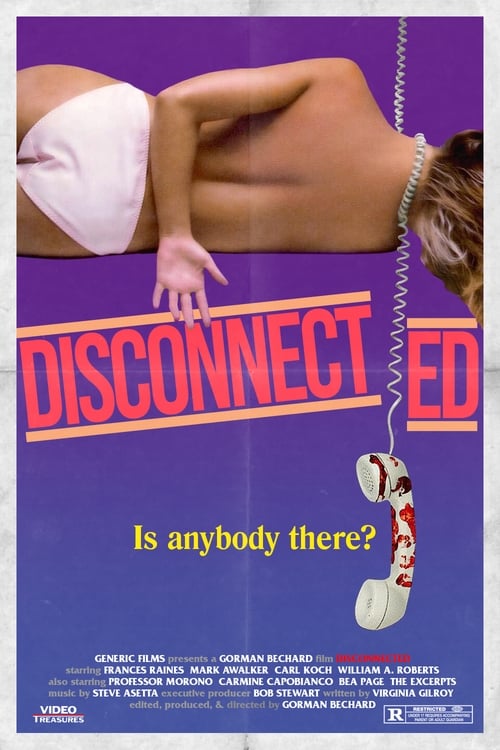
Disconnected (1984)

disconnected2

By Richard Winters

My Rating: 4 out of 10

4-Word Review: Receiving harassing phone calls.

Alicia (Frances Rains) is a young adult woman who brings an elderly man (William A. Roberts) up to her apartment one day so that he can use her phone to make a call. However, once he leaves she begins receiving odd calls at all times of the day and night where loud unexplained sounds emit from the receiver. She also gets a call where she overhears a conversation between her boyfriend Mike (Carl Koch) and twin sister Barbara-Ann, who are apparently are seeing each other behind-her-back. She then breaks up with Mike and begins dating Franklin (Mark Walker) whom she met while working at a video store. Franklin seems nice at first, but she’s unaware that he’s also the notorious serial killer who has been murdering young women in her area.

This horror oddity is the product of Gorman Bechard, who while still a film student decided to make a movie on his own with the low, low budget of only $40,000 and filming it almost entirely inside his tiny one-bedroom apartment. While it’s not a complete success it’s offbeat enough to hold your attention and guaranteed to keep you guessing to the very end.

The scenes inside the video store I enjoyed the most particularly Franklin’s complaints at how it didn’t have enough foreign films, or older movies, which was always the criticism I had of my local video stores too. The dark humor of Franklin hanging a crucifix over his bed where he commits the murders and the little prayer he does before he offs his victims I found amusing. Bechard’s odd camera shots including one segment done with black-and-white, freeze-frames is another asset that keeps it inventive.

The performance by Raines, who is beautiful, is excellent and I felt she would’ve had a long career ahead of her had she not giving up acting in order to raise a family. I was not as enamored though with the two guys playing the cops who lend a cartoonish flair that was not needed. I didn’t like too that one of them gets interviewed by someone sitting behind a camera that we don’t see and asking a bunch of questions almost like it’s a documentary, which begs the question as to who this person was and why does he just interview the cops, but no one else?

Spoiler Alert!

The film’s biggest problem though is that it gets rid of the Franklin too quickly without playing up that scenario as much as it could’ve. It also cuts away without ever showing how the cops are able to subdue him, or how Alicia is able to get away, which seems like a standard scene that a horror movie fan would want to see and not just have discussed later.

The weird calls ultimately become boring. It also takes Alicia too long to figure out that maybe a good way to stop them would be to unplug the phone from the wall, which she finally does at the very end, but most other people would’ve done it a hell of a lot sooner.

The twist ending where the old man that was seen at the start, but then disappears only to return and be shown walking out of her apartment makes no sense. Some viewers have speculated that maybe he was a ghost of some kind, but that’s not made clear. My personal feeling is that there was no meaning to it and it’s intentionally left vague, so the individual viewers can read into it whatever they want, but it’s not a satisfying way to end almost 90-minutes of viewing and in many ways, despite the interesting bits, makes it quite annoying. A better, more focused conclusion would’ve certainly helped.

My Rating: 4 out of 10

Released: July 17, 1984

Runtime: 1 Hour 24 Minutes

Rated R

Director: Gorman Bechard

Available: VHS, Tubi, Blu-ray (Limited Edition only 2,000 copies printed) 

Hustle (1975)

hustle2

By Richard Winters

My Rating: 6 out of 10

4-Word Review: Father searches for killer.

Phil (Burt Reynolds) is a police lieutenant who’s in love with a beautiful French prostitute named Nicole (Catherine Deneuve) and the two live together in Phil’s swanky hilltop Malibu home. Unfortunately Phil can’t handle that Nicole continues her business practice even as the two are in a relationship and this threatens their love affair. As this goes on Phil also gets embroiled in a police investigation when a group of school children find a dead body of a 20-year-old woman washed up on the beach. The victim’s father (Ben Johnson) insists it was murder even after the autopsy says it’s a suicide. Phil and his partner Louis (Paul Winfield) are ready to close the case, but when the father starts his own investigation the two  decide to pursue it further, which leads them to many unsettling conclusions including that the daughter starred in several porno films financed by the sleazy Leo Sellers (Eddie Albert) a rich older man who also happens to be a client of Nicole’s.

This film was the second collaboration between Reynolds and director Robert Aldrich as the two had just completed the highly successful The Longest Yard a year earlier. While that film met with critical acclaim this one received only a so-so reception. There were certain elements that I liked, but I did find Reynolds’ presence to be a detriment. His boyish looks where he doesn’t have the mustache or the wavy hair, which always made him look like he was wearing a wig, is a plus, but his character is too detached. It’s only after repeated cajoling by the father that he even agrees to look into the case more and the movie would’ve been more compelling had it revolved around the father from the very beginning.

Reynolds’ relationship with Deneuve is boring and the scenes between them aren’t sexy or provocative as intended. We should’ve seen how they became a couple from the start as their attachment brings out all sorts of questions that never get answered. For instance, where did they first meet? Was it during a sexual rendezvous where Burt paid for her services, or possibly a cop raid? Why did she fall for Burt as this woman had been with a lot of men, so what made him special over the others and why would a cop think getting serious with a woman who routinely sleeps with other men be a good idea, or even work?

The movie tries to be chic by creating a character who’s initially ‘open-minded’ about prostitution, but then contradicts itself by having him turn around and demand she must give it up. If this were truly a modern thinking guy he would’ve liked the fact that she was financially independent and slept with other men because she gave herself for free to him while she made the others pay. He might even get-off watching her having sex with others, as there are some husbands/boyfriends who do, and the fact that the film doesn’t think to go into this area makes it far less ‘hip’ than it thinks it is.

There’s also a very violent moment where Reynolds refuses to let her leave, physically slaps her, and even refers to her as a ‘bitch’ several times. He then pins her to the bed and forces himself onto her. While she initially resists he continues to do it until she finally gives-in and acts like she’s enjoying it. Today’s audiences will be rightly turned-off by this and it will make Reynolds, the intended ‘good guy’, look much more like an abuser. It also might allow some men to think that being violent with women is ‘okay’ as they’ll ultimately give in and ‘learn to enjoy it’, which is the wrong message to be sending.

As mentioned earlier Ben Johnson’s character is the only thing that keeps it interesting. The scene where his eyes tear-up after watching his daughter, played by real-life adult film actress Colleen Brennan, perform in a porn film is similar to the one in Hardcore, but far more impactful here. I was amused why he even took the part as he had complained about being in The Last Picture Show, which is the film he won the Oscar for as Best Supporting Actor, because of the ‘foul language’, but then he ends up swearing quite a bit in this one. In either case I’m glad he took it as his presence raises the storyline above its otherwise seedy level and even helps give it a few memorable bits.

My Rating: 6 out of 10

Released: December 25, 1975

Runtime: 2 Hours

Rated R

Director: Robert Aldrich

Studio: Paramount

Available: DVD, Amazon Video, YouTube

Weekend of Shadows (1978)

weekend1

By Richard Winters

My Rating: 6 out of 10

4-Word Review: Manhunt for murder suspect.

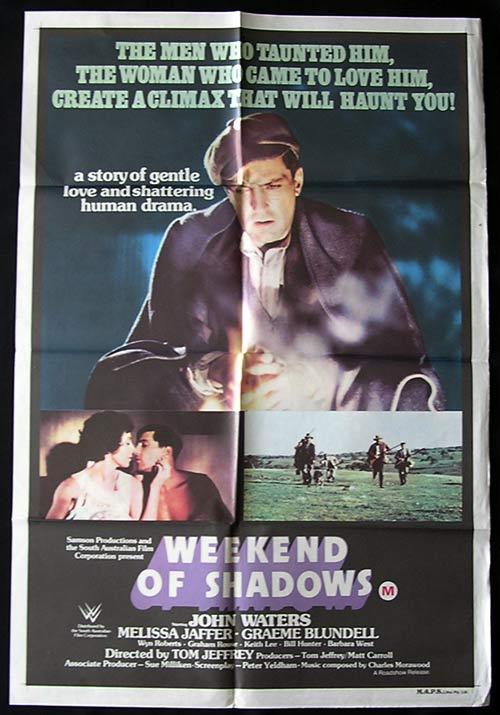
In rural Australia during the 1930’s a farmer’s wife is found murdered inside her home. Suspicions immediately fall on a Polish laborer who had always been deemed ‘peculiar’ by the locals and while there’s no other evidence pointing to his guilt it’s enough to get the men in the community together to form a posse. Sergeant Caxton (Wyn Roberts) hopes that if he can capture the suspect it will help mend his reputation, which had been tarnished while working in Sydney and got him demoted to the small town that both he and his wife (Barbara West) don’t like. Vi (Melissa Jaffer) feels this will be a perfect opportunity for her shy husband, Rabbit (John Waters) to bond with the other men by going along on the hunt, but he resists thinking that the whole thing is just a knee-jerk, mob reaction and wants nothing to do with it, but at the behest of his constantly prodding wife he eventually joins, but learns to regret it.

Out of all of the manhunt movies that are out there this one may be the most unusual in that it doesn’t focus on the suspect at all, in fact you barely ever see him, but instead on the various men in the group. Surprisingly though this manages to be quite effective and I found myself wrapped-up in the various personalities of the participants and how all of them clash with each other at various times. The budget though is quite low, screenwriter Peter Yeldham and director Tom Jeffrey were forced to make many concessions on the script just to get the necessary funding, and while the stark production values will initially be a turn-off, the overall drama, which is based on the novel ‘The Reckoning’ by Hugh Atkinson, will eventually compensate.

I didn’t though like the flashbacks showing Vi and Rabbit’s courtship, which I felt wasn’t necessary and bogged down the tension. The relationship between them is intriguing on a certain level as it shows how wives can have a strong influence over their husbands and get them to do things they wouldn’t otherwise, this same scenario also gets played-out between the constable and his wife, but the scenes showing their dating period offers no further insights and no effort is made to make the actors appear younger even though the courtship had been many years prior.

Spoiler Alert!

While the film was a hit with the critics it sank at the box office recouping only $61,000 of the $495,000 that had been put into it, which soured Jeffrey from directing movies and he helmed only one other, The Last of the Knucklemen, after this one. Ironically Hugh Atkinson was quite impressed with the finished product, which was odd since most of the time author’s of the book which the movie is based are usually not happy with the director’s interpretation of their work, but Atkinon felt Jeffrey ‘got it’ particularly with the ending, which he stated represented the crucifixion. Personally I didn’t see this connection, and neither did Jeffrey, who felt like I did that the story was more about how group dynamics can get out of hand, but Atkinson insisted the crucifixion element was the centerpiece. The ending will be a surprise to many and leaves open many questions, but what you ultimately make of it will be up to your own personal perspective.

My Rating: 6 out of 10

Released: April 12, 1978

Runtime: 1 Hour 25 Minutes

Not Rated

Director: Tom Jeffrey

Studio: The South Australian Film Commission

Available: VHS

Goodbye Paradise (1983)

goodbye1

By Richard Winters

My Rating: 6 out of 10

4-Word Review: Searching for Senator’s daughter.

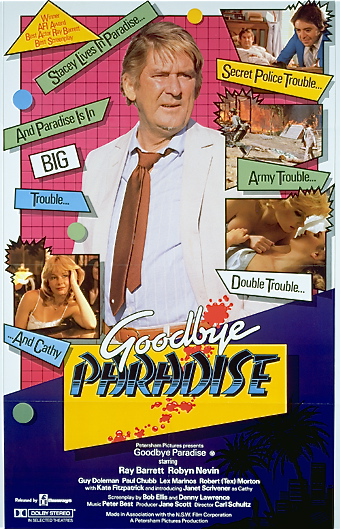
Michael Stacey (Ray Barrett) is a retired cop whose written a scathing exposé on the corruption of his former profession, which has gotten him many enemies and, along with his alcoholism, pushed to the very fringes of society. He now lives in a tiny, rundown apartment while playing chess with himself as his only means of companionship. One day he gets a call from a high-ranking Senator (Don Pascoe) who wants Michael to find his runaway daughter as he’s concerned that she’s gotten involved with an underground cult movement, which he fears could be detrimental to both her safety and to his own political career. Have no other means of income Michael takes-up the offer and soon gets immersed with an array of odd people and many twists that ultimately finds him in the middle of a military coup.

This offbeat movie starts out strong, but eventually goes overboard. The original idea by screenwriter Denny Lawrence was to have an ex-cop working as a private investigator who takes on a case of a runaway daughter who joined a religious cult run by a charismatic charlatan that eventually lead to the deaths of many of its members. However, after the Jonestown massacre, which was led by religious cult leader Jim Jones, this idea got nixed and the plot, with the help of co-scripter Bob Ellis who wanted a more political bent, got turned into a completely different direction, which doesn’t work as well.

The whole idea of a parent hiring a down-and-out, aging guy to find his long lost daughter doesn’t make much sense. The father’s a rich senator with lots of connections, so why not use the resources of the police, or a more polished detective to do the searching instead of an old bum more focused on when his next drink will be? Had Michael’s actual job, like in the original script, been as an private investigator then maybe, but in this version Michael was a struggling writer, so why pay someone to do something that they had no practice in doing, or if they did it had been a seriously long time and someone else could’ve been found to do it better?

The protagonist is a lovable loser, a sort of anti-hero who was meant to be a modern-day Philip Marlowe, and the main reason that get me hooked into the movie right away especially with Barrett’s perfect portrayal that is both raw and funny at the same time. However, the supporting characters are dull. The is especially evident with the Senator’s daughter, which due to a case of mistaken identity, he ends up dealing with two different young women, but both of them are stereotyped and cliched to the extreme. The dialogue and conversational exchanges that they have with Michael are flat making these scenes the most boring part of the movie. Nothing is worse than a film that does a excellent job of creating a multi-faceted person in one area, but then cuts-corners with the rest making the viewer like they’ve gotten stuck with only half a movie.

Spoiler Alert!

The climactic sequence, which involves an all-out military coup and lots of warfare-like action, is just too extreme and surreal especially for a story that starts out in a realistic vein. Much of the fault could be blamed on the two script writers with Lawrence wanting it to be a genre piece while Ellis preferring a more political take. The result is an imbalance that gets increasingly more wacky and implausible as it goes on until it becomes too cluttered to make much sense. Whatever statements the writers hoped to make here gets lost in the insanity and leaves the viewer feeling overwhelmed with all of the absurdity.

My Rating: 6 out of 10

Released: July 21, 1983

Runtime: 1 Hour 59 Minutes

Not Rated

Director: Carl Schultz

Studio: New South Wales Film Corporation

Available: DVD (Region 0 Import)

Dead Men Don’t Wear Plaid (1982)

dead1

By Richard Winters

My Rating: 3 out of 10

4-Word Review: Don’t say ‘cleaning woman’.

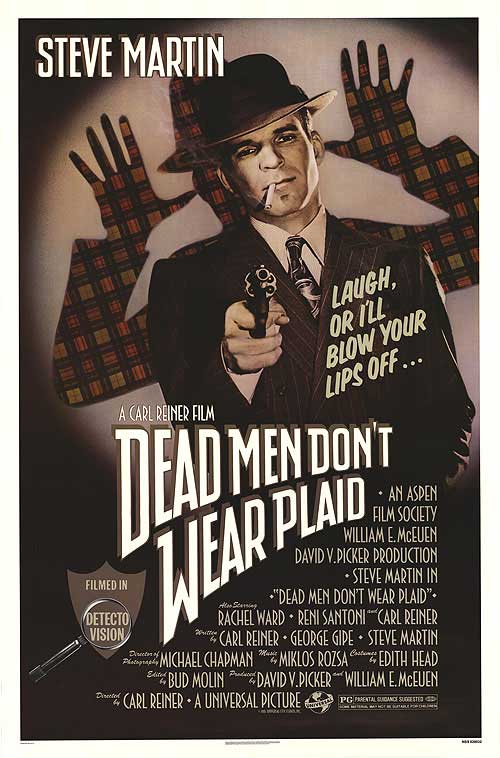
It’s the 1940’s and private investigator Rigby Reardon (Steve Martin) gets a visit from Juliet Forrest (Rachel Ward) who wants him to investigate the mysterious death of her father, which she believes to have been murder. Rigby’s investigation turns up two lists both showing names of people who were either friends or enemies of a person named Carlotta. As Rigby continues his research he becomes menaced by a man who shoots him and steals the lists forcing Rigby to interview a wide array of different people in order to get to the truth.

In the spring of 1980 Martin got together with Carl Reiner and screenwriter George Gipe to go over his next movie project idea. He had just gotten done starring in Pennies from Heaven, a 1930’s period musical, and wanted to do another film from that era, a comedy that was entitled ‘Depression’. While going over the plot he mentioned using a clip from an old movie and splicing it into his film and making it a part of the story. This gave Reiner the idea of doing an entire movie centered around old movie clips ultimately leading to them using footage from 19 vintage films from Hollywood’s golden era with most of them being dramas that were meant to be taken seriously, but with Martin’s character responding to the lines mentioned by the actors in the clips in such a way that it becomes funny.

Incorporating a plot completely around old movies is certainly an inspired idea, but the result is only so-so. On the technical end you can clearly tell when an old film is spliced into the scene because it’s footage is much grainier than when it shows Martin or Ward. Having it all filmed in black-and-white helps a little but the new footage is too pristine and intentional scratches should’ve been added to make it better match the old stuff.

As for the story, well, it works for awhile, but then starts to get downright boring by the third act. There are definitely some laugh-out-loud moments, but the concept wears itself out. Some have called this a one-joke movie, but I would describe it more as a joke that gets told over-and-over again until it’s predictable and redundant. Having old film clips put in during a certain part of the movie, but then focusing on other comedy angles during the rest of it would’ve worked better. Had it spliced-in only 1 or 2 other movies and with a smaller character count would’ve created less of a diluted effect as ultimately there’s just too many people to keep track of and the plot itself is too fabricated to hold much interest.

Martin is excellent and the fact that he didn’t watch any movies from the 40’s in order to prepare for the role as most other actors would’ve done, was a wise decision as he ends up creating his own style instead of coming-off like he’s imitating somebody else. Ward is good too and while she isn’t particularly funny she does make for a excellent straight-man, which is what a solid comedy needs by having a normal person play-off the other wackiness around them. Carl Reiner is engaging in a send-up of Erich Von Stroheim and it’s interesting seeing Reni Santoni appear here as he played a young Reiner 15 years earlier in the movie Enter Laughing. The characters though are flat and never evolve, which like with the other issues described above, make this movie a novelty experiment that never fully gels.

My Rating: 3 out of 10

Released: May 12, 1982

Runtime: 1 Hour 28 Minutes

Rated PG

Director: Carl Reiner

Studio: Universal

Available: DVD, Blu-ray, Amazon Video, YouTube

Summerfield (1977)

summerfield4

By Richard Winters

My Rating: 7 out of 10

4-Word Review: Island holds dark secret.

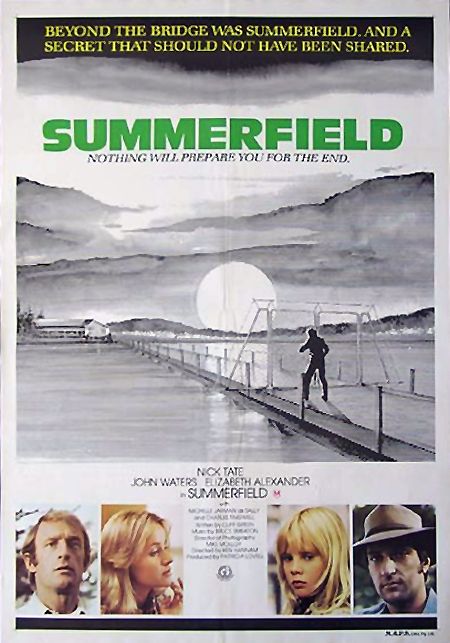
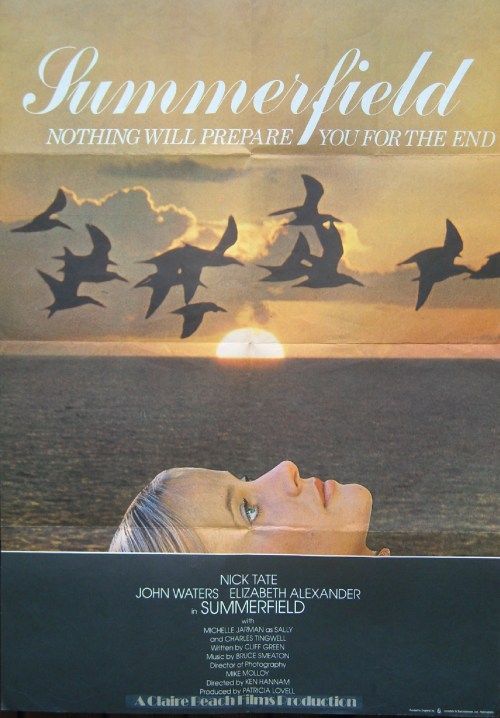
Simon (Nick Tate) is the new teacher at an elementary school in a seaside community. He soon makes the acquaintance of Sally (Michelle Jarman) who’s one of his pupils and she invites him out to the island of Summerfield where she lives with her mother Jenny (Elizabeth Alexander) and Jenny’s brother David (John Waters). While visiting he accidently hits Sally with his car causing her a broken leg and forcing Simon to visit the residence twice a week to give her personal tutoring. He soon starts up a relationship with Jenny and realizes to his surprise that his predecessor had also dated her, but has now disappeared without a trace. This along with finding out that Sally has a rare blood disorder causes him to do some investigating of his own, but the answers that he finds are both shocking and perplexing.

The story here, at least the main plot point where a new teacher comes in to replace an old one who’s disappeared, is quite similar to Unman, Wittering and Zigo , which was a British thriller that came out in the early 70’s however, this film approaches it in a much different way and has a far more unusual outcome. The pace though is slow and borders on being almost too slow with clues that trickled in too leisurely. The whole blood disorder thing doesn’t even get mentioned until well into the third act and yet for some reason I still found it quite intriguing and was never really bored. Much of the credit goes to the cinematography and the way it captures the picturesque beauty of the landscape, which was shot on-location at both Phillips and Churchill Island, which sit off the coast of Southern Australia.

While the film is for the most part atmospheric I did have a few issues with some of it although not enough to hurt my enjoyment. One problematic element has to do with Simon accidentally running over Sally, who can’t be much more than 10, with his car, but instead of her screaming out in pain and crying, she remains quite calm, which to me was unrealistic. I was also surprised how she continues to like Simon even after the incident and trusts that he didn’t intentionally do it on purpose even though she really hadn’t known him for that long and therefore should’ve been more suspicious and defensive with him than she is. Don’t get me wrong, Sally is one of the best things about the movie and I loved the way she gets played by the young actress Jarman, but I felt there could’ve been a better way that she gets injured, like having her running to meet Simon and accidently stepping into a hole that breaks her ankle/leg, which then would’ve avoided the other issues listed above.

The Simon character is a bit too transparent as he’s middle-aged, but single and with no children. Not that this has to be a problem, but for the viewer to become emotionally connected to him a backstory is generally useful, but here there isn’t any. Having the plumpy lady (Geraldine Turner), who works at the boarding house that he stays at suddenly one morning sneak into his room, disrobe, and then hop into bed with him as he sleeps is a bit weird as the two had never dated, or shown any overt interest in the other and yet Simon and her have instantaneous sex instead of him waking up shocked and disoriented, which is the reaction just about anyone else in that situation would’ve had.

Spoiler Alert!

The ending in which Simon finds that Jenny and David, who despite being brother and sister, are having sex together I didn’t find all that surprising as I’d pretty much had been expecting it almost from the beginning. What did surprise me is the way David has an immediate meltdown and kills not only Jenny and Sally, but also himself the minute he realizes they’ve been caught, which to me was too quick of a surrender. They’ve supposedly been doing this for years, so why cave so suddenly? Why not simply move away to another place where their secret isn’t known, or try to blackmail Simon in some way not to tell, or even just deny what Simon tells everyone as it would simply be his word against theirs. I thought David was going to make an attempt to run Simon over with his jeep in order to quiet him. There’s a tracking shot earlier in the film where see things from the vehicle’s perspective, which is driven by David, go into a parking lot where Simon is walking and it gets close to hitting him at that point, so I felt that was a foreshadowing, which is something many directors will do, to what was going to happen at the end. There’s a brief set-up, which makes it seem like David is going to hunt Simon down, which could’ve been exciting, but ultimately it fizzles out.

I was also confused why the former teacher suddenly reappears out of nowhere at the very end. I had presumed, like most viewers probably will, that he had been killed when he found out about Jenny’s and David’s relationship, but apparently that wasn’t the case. Yet having him suddenly get throw-in seemed to serve no real purpose.

summerfield1

My Rating: 7 out of 10

Released: September 30, 1977

Runtime: 1 Hour 32 Minutes

Not Rated

Director: Ken Hannam

Studio: Spectrum Films

Available: DVD (Region 0 Import)

The Hospital (1971)

hospital1

By Richard Winters

My Rating: 8 out of 10

4-Word Review: An incompetently run hospital.

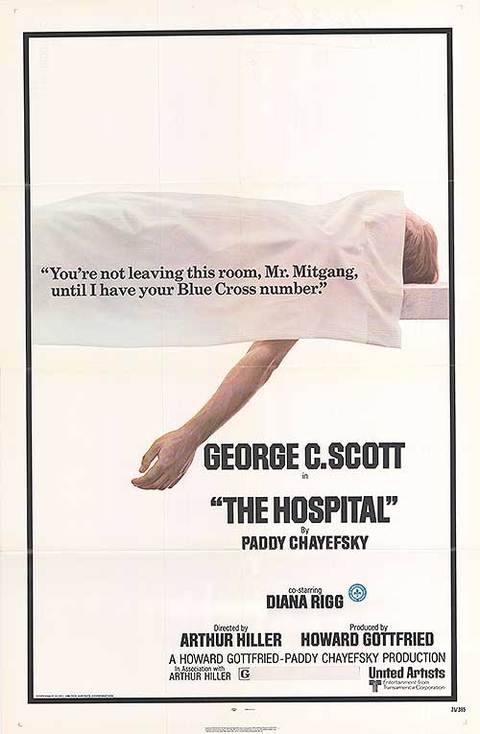
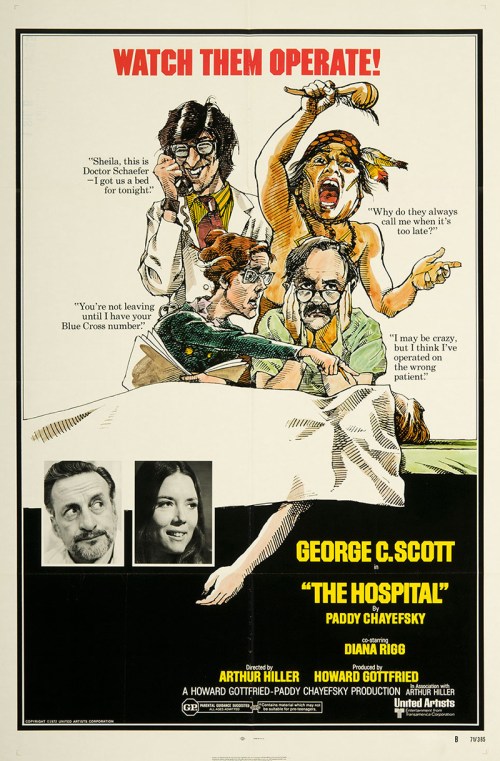
Dr. Herbert Bock (George C. Scott) is the chief of staff at a teaching hospital in New York where patients routinely die due to misdiagnosis and other blunderings. There’s also a protest by a group of tenants from a nearby apartment building that’s been annexed by the hospital to make room for a drug rehabilitation center. Bock not only must deal with these issues, but also his crumbling personal life which has turned him to both alcohol and thoughts of suicide. His only ray-of-light is meeting the beautiful Barbra (Diana Rigg) who has come to the hospital to seek treatment for her father (Barnard Hughes), but just as Bock starts to come out of his depression the place becomes terrorized by an unseen assailant who begins killing both the patients and staff.

In 1969 after his wife had received poor care at a local hospital Paddy Chayefsky set-out to write a script exposing what he felt was the corruption and incompetence going on inside the American medical institutions. He managed to get full control over his screenplay and final say over any proposed changes, which was a good thing since initially the studio felt it was filled with too much medical terminology that would go over many viewer’s heads. I’ll admit there’s an excessive amount of lingo, both with the dialogue between the doctors and staff as well as the opening voice-over narration by Chayefsky, that’s done at a rapid-fire pace and I really didn’t understand it, but I still kind of liked it. I have no medical background myself, so I and most viewers aren’t going to get the ‘medical speak’, but leaving it in helps make it sound more authentic. It also impresses the viewer with how much research was put into it and you basically trust what’s going on because it ‘sounds intelligent’.

Another complaint was the shift in tone where things start out in a darkly-humorous slap-dash fashion only to end up during the second act becoming quite serious. Normally this would’ve been a big problem, but I liked the shift here. I think the reason is because underneath the comedy there’s still life-and-death consequences going on and if you’re going to make a statement movie, which this is attempting to do, then at some point things have got to slow-down and get serious in order for that statement to get out, which this thing ends up successfully doing.

While I enjoyed the fluid pace that manages to encompass not only satire and drama, but even shades of horror without ever losing its realism I did find that it spends an inordinate amount of time telling us about all of the problems without bothering to give us any solutions. There’s no focus on what the underlying causes are nor any balance by showing an well-run hospital in comparison. One might start to believe that all hospitals are like this and become afraid to ever go into one even if they are really sick, which isn’t exactly a good thing. This may have been the reason why Chayefsky himself died at the relatively young age of 58 from cancer because he feared Dr.’s would “cut me up because of that movie I wrote about them” and thus refused surgery that might’ve saved his life.

Spoiler Alert!

There’s a few issues with the casting as well. Overall, I was impressed with the performances particular Scott who got his second Oscar nomination for his work here. Rigg is also quite good, in a part that seemed better suited for Jane Fonda, who was the studio’s choice, but Rigg’s British accent and terse style makes for an interesting dynamic. You can also glimpse young soon-to-be-stars in small bits including: Nancy Marchand and Robert Walden, who later went on to co-star with each other in the TV-show ‘Lou Grant’ as well as Stockard Channing, in her film debut, and Frances Sternhagen as an exasperated medical clerk. The main problem though comes with Barnard Hughes, who appears for some strange reason in two completely different roles. He is very funny as the surgeon who finds he’s been operating on the wrong person, but then later he reappears as Rigg’s father, which didn’t make much sense. Since the father turns out to be the mysterious killer many people thought the scene with Hughes as the surgeon was meant to be the father in disguise, but that was not the intention. Again, if there’s no specific/underlying purpose story-wise for an actor to play two different parts in the same movie then don’t do it. There’s no lack of actors out there clamoring for work, so one of the two parts could’ve easily have been filled by someone else and thus avoided confusing the audience for no good reason.

It’s possible that the reason Chayefsky had Hughes playing dual roles was to help explain how the killer was able to get away with his crimes for so long. While the killer is always shown off camera, so the viewer does not know the identity, the Dr.’s and nurses do seem to recognize him as being a colleague and are put at ease just before he kills them. Of course the odds of a patient entering a random hospital and looking similar to one of the staff is astronomically low, but if this was the underlying concept, and it very well may have been, then the film should’ve eventually made this clear by having a split screen scene where Hughes the surgeon bumps into Hughes the killer.

hospital3

My Rating: 8 out of 10

Released: December 14, 1971

Runtime: 1 Hour 43 Minutes

Rated GP

Director: Arthur Hiller

Studio: United Artists

Available: DVD, Blu-ray, Amazon Video, Tubi, YouTube

Stone (1974)

stone1

By Richard Winters

My Rating: 7 out of 10

4-Word Review: Somebody’s killing the bikers.

Toad (Hugh Keays-Byrne) is a member of the Grave Diggers biker gang who stops off one sunny day to hear a politician giving a speech at a park. He has just taken some acid and feeling the effects of it and so goes straying from the rest when he sees a shooter hiding inside a nearby building and when the gun goes off and kills the politician the bikers gets blamed for it. Soon members of their group start getting knocked-off in bizarre ways convincing them that somebody is after them for what they witnessed. Stone (Ken Shorter) is the long-haired police detective who infiltrates the group in order to find out who the killer is, but the bikers are initially unhappy with a ‘pig’ being a part of their organization, but eventually they form a friendship and work together to nab the bad guy before he kills more.

The story was originally meant as an episode for an Australian TV-show, but when that series got canceled before this episode could air, it was then reworked into a feature film. Real Australian bikers were used as supporting players with many of them being paid with free beer for their efforts. The film eventually did quite well at the box office and has garnered a cult status worldwide although the 99 minute length, which is what is widely available, was not the original cut, which was much longer at 130 minutes, but director Sandy Harbutt did not like this version, so this became a rare occasion where the director’s cut leaves out many scenes that was originally shown in the theaters.

As a film it’s not too bad and I particularly liked it’s moody opening that has a lot of weird camera angles and freeze-frames. The funeral procession showing hundreds of bikers careening down the highway leaves a memorable impression as well. The killings are cool too, including a dangerous stunt that required a driver to ride his bike off an 80-foor cliff and into the ocean.

On the drama ends there’s some interesting moments including Stone’s initiation, but when he’s off by himself it gets boring quick especially since Shorter’s mop-top hairstyle makes him look more like a lost singer to a ’70’s Glam band than a cop. The film only works when the bikers are in it and becomes nothing more than a tepid, pedestrian drama without them. The wrap-up isn’t as interesting as the opening and I kind of wondered if the mystery angle even needed to be put in as there are long segments where the investigation isn’t even talked about to the point that it almost seems forgotten.

The much ballyhooed violence isn’t all that impressive either with the fist-fights looking like poorly staged stunt work by amateurs. They’re also quite brief and don’t take up as much of the runtime as you’d expect. However, as a character study it has an appeal as I found the bikers themselves to be a fascinating bunch and wanted to get to know them better and the plot should’ve focused on them solely.

My Rating: 7 out of 10

Released: June 28, 1974

Runtime: 1 Hour 39 Minutes (Director’s Cut) 2 Hours 10 Minutes (Original Studio Version)

Not Rated

Director: Sandy Harbutt

Studio: British Empire Films Australia

Available: DVD


Games (1967)

By Richard Winters

My Rating: 5 out of 10

4-Word Review: Playing tricks on others.

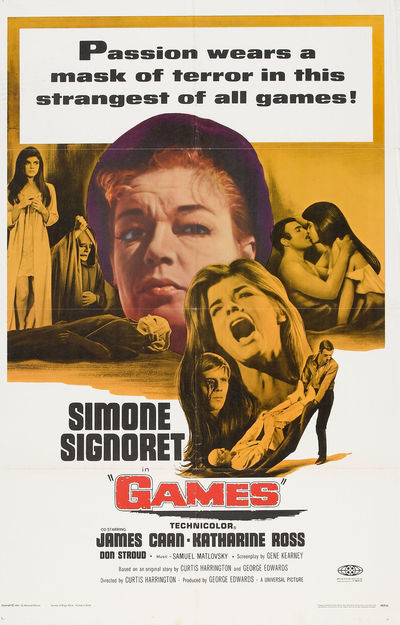
Paul (James Caan) and his wife Jennifer (Katharine Ross) are an affluent upper East Side couple who are into illusion/magic trick shows and entertain their friends at posh parties that they hold inside their spacious townhome. One day Lisa (Simone Signoret) arrives at their door selling cosmetics only to fall ill when she gets inside the home. A doctor (Ian Wolfe) comes over and finds her condition to be only temporary and says she’ll recover in a day if given plenty of rest, so they decide to let her stay the night, which then becomes an extended visit as Lisa and Jennifer begin to bond. The two then start playing tricks on Paul by pretending that Jennifer is having an affair with their delivery boy named Norman (Don Stroud). Eventually Paul realizes he’s been duped, but wants to get revenge by pretending to catch Norman coming onto Jennifer the next day. This time Paul accidently shoots and kills him forcing the couple to get rid of the body without Lisa becoming aware, which they’re able to do, until Jennifer begins seeing what she believes to be Norman’s ghostly presence.

The film has potential, but consistently misses-the-mark and ultimately becomes a misfire. The games the two play are amusing, but nothing special though it’s enough to hold interest particularly at the beginning during the party scenes with all of their pretentious friends. The townhouse the two live in is ritzy and I enjoyed the design, but if you’re going to have a story take place in Manhattan then you better film it there and not on a sound stage in Los Angeles as the ambience of the neighborhood is missing and having almost all of the action take place in one setting eventually becomes claustrophobic.

The real problem though is with the characters. Signoret is fantastic and her presence helps immensely, but the way she enters into the story is ridiculous. What kind of couple would let a strange woman stay overnight in their home? If she’s sick then let her spend it at a hospital. Turning her one night visit into an extended stay is equally farfetched and where exactly did she find this wardrobe to wear when she initially just came over to peddle perfumes?

Ross’s character is a big mess too and it’s no wonder that she has referred to this film as being ‘terrible’ and it’s not her fault either. She’s quite beautiful as always and if you need an actress to give off the perfect scared expression she’s tops, but I didn’t understand why her character allowed herself to be so taken in. This was a couple used to playing tricks not only on their friends, but on each other, so why didn’t she have a more jaded reaction and presume that her husband really didn’t kill Norman and it was all some elaborate game?

Spoiler Alert!

The twist ending is a complete letdown as it hinges on Paul meeting Lisa a year earlier by chance and then springing this idea on her of scaring Jennifer to death to the point that she inadvertently kills someone, so that he can get at her fortune and split it with Lisa, but how would he know that he could trust Lisa to keep this secret and not go to the authorities, or tell Jennifer? It might’ve worked better had the third person been a lifelong friend/family member to Paul, and not just someone he met at random, and therefore not likely to betray him.

A double-ending would’ve been more satisfying as Lisa poisons Paul and walks away with the money, but Paul should’ve been cunning enough to try and poison Lisa first, or through mutual mistrust they poison each other and no one gets the money. An even better idea would’ve had Jennifer only pretending to fall victim to the ruse, so when Lisa walks outside with the suitcase full of money, after having killed Paul, Jennifer and the police squad could’ve been there waiting for her.

My Rating: 5 out of 10

Released: September 17, 1967

Runtime: 1 Hour 40 Minutes

Not Rated

Director: Curtis Harrington

Studio: Universal

Available: DVD-R (Universal Vault Series), Blu-ray

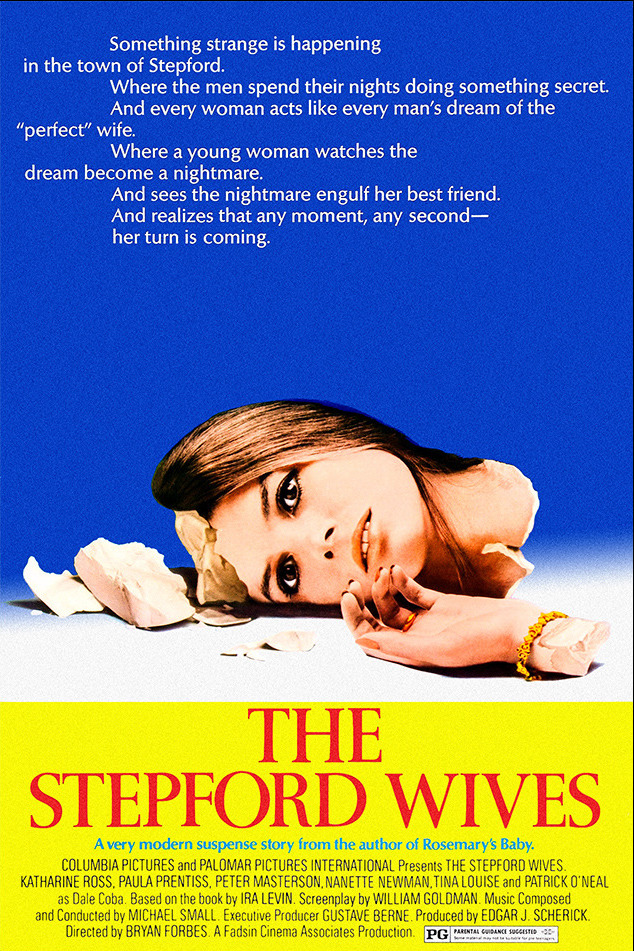
The Stepford Wives (1975)

By Richard Winters

My Rating: 7 out of 10

4-Word Review: Suburban wives become robots.

Joanne and Walter (Katharine Ross, Peter Masterson) decide to move with their two children (Mary Stuart Masterson, Ronny Sullivan) from the big city to the quiet suburb of Stepford, Connecticut. While Walter immediately starts to fit-in with the exclusive men’s club that they have there Joanne feels unable to connect with the other wives who all behave in a robotic fashion and more concerned with keeping their husbands happy and cleaning their homes than anything else. She manages to find one other woman named Bobbie (Paula Prentiss) who like her find the women’s behavior in the town to be a bit odd and they team up to investigate what the cause of it may be.

When this film was first released it was met with controversy particularly by feminists who felt the storyline was misogynistic and one protester even went as far as attacking director Bryan Forbes with her umbrella. When the movie was screened to a group of feminists they all hissed and groaned at it during the viewing while some other women, like screenwriter Eleanor Perry, came to the film’s defense calling it more of a sharp satire on men and their superficial views on women than on the women themselves.

I saw it more as a trenchant take on the suburbs, which can initially seem like a quiet, safe refuge, but ultimately can become a trap with a lot of hidden strings that you don’t initially see. While the Stepford wives do behave as overly conforming to domestic roles it’s really not all that much different than what you’d find in reality making you wonder if the rest of us suburbanites all slowly getting sucked into the Stepford trap too and just don’t realize it.

While the ill-advised 2004 remake tried to turn the concept into a comedic tale the story really works best as a horror film, which is what the 1972 Ira Levin novel, of which the film was based, intended and there are some good creepy moments. I particularly liked the moment when Joanne is talking to her therapist, played by Carol Eve Rossen, about how she feels the men in town are turning the women into robots and she fears she will be next. Her therapist advises her to grab her kids and leave town, but Joanne admits her other family members are dead and she has nowhere to go, which brought out what the truly frightening aspect of this story truly is, which is that women back then were completely dependent on their husbands for everything. Many of them weren’t in the job force and simply living off of their husband’s income. If the marriage went bad they were pretty much trapped in it, so even if a woman wasn’t getting turned into a robot like these women were they still weren’t really free either.

I also enjoyed the moment when Katharine Ross stabs Paula Prentiss, Ross had grown to like Prentiss so much during the production that she was nervous about doing this so director Forbes shaved the back of his hand and used it in place of Ross’ when the scene was shot. You may have seen many stabbing scenes in your film watching lifetime, but the one here is truly unique and quite memorable and voted as one of the 100 Scariest Film Moments by the Bravo Film Institute.

The film though still does have its share of faults. I liked how the viewer initially doesn’t know anything more than the main characters about what is going on, but ultimately the viewer starts to catch onto things more quickly than the protagonist, which proves frustrating. Joanne comes upon the creepy house where the exclusive men’s club meet, filmed at the historical Lockwood-Matthews Mansion in Norwalk, Connecticut, which looks quite ominous at night, at the film’s 60 minute mark, but then doesn’t go back to it until 50 minutes later. The viewer has already connected-the-dots that the bad things are happening inside that place, but instead of Joanne investigating the place more she goes on a wild-goose-chase with Bobbie about researching that town’s water supply, thinking that may have a chemical in it that is brainwashing the other women, which is clearly just a waste of time.

Spoiler Alert!

The film’s ending has a several issues as well. In the novel Joanne gets chased down by the town’s men, which should’ve been in the film as it would’ve allowed for some much needed action, but wasn’t. William Goldman’s script had originally called for Joanne to fight violently for her life when she gets attacked by her prototype robot, but Forbes decided to simply fade to black and not show the struggle, which makes it look like Joanne allowed herself to go down too easily.

When Joanne confronts the sinister Diz, played by Patrick O’Neal, he alludes to the idea that she wasn’t necessarily going to die, but would simply be ‘moving onto another phase’. He then describes to her about how nice it would be for a woman to be married to a husband who would adore her even when she grew ‘old and flabby’ making me think that Joanne was simply going to be taken away to another suburb somewhere else where the husbands would be the robots that the women controlled while the men remained in Stepford enjoying the wife robots. Seeing this scenario would’ve been a more interesting and unexpected twist and ultimately was later done in the 1986 TV-Movie The Stepford Husbands. 

My Rating: 7 out of 10

Released: February 12, 1975

Runtime: 1 Hour 55 Minutes

Rated PG

Director: Bryan Forbes

Studio: Columbia Pictures

Available: DVD, Amazon Video