Category Archives: Movies with Nudity

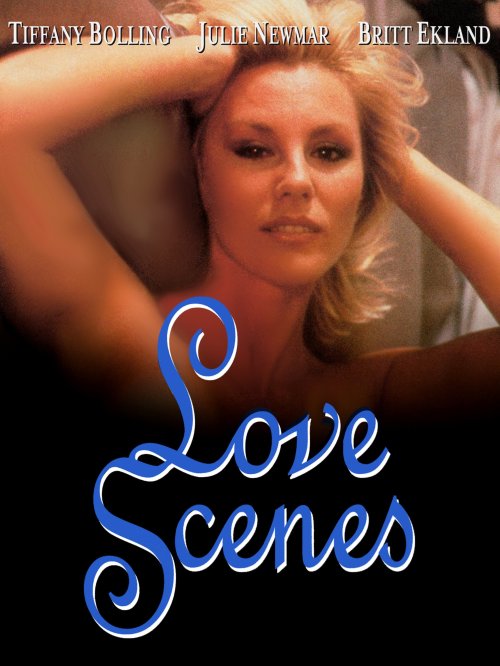
Love Scenes (1984)

love1

By Richard Winters

My Rating: 0 out of 10

4-Word Review: Aging actress does erotica.

Val (Tiffany Bolling) is an accomplished Hollywood actress who gets pressured by her husband Peter (Franc Luz) to perform the starring role in the latest movie that he’s directing. Peter’s producer Sidney (Jack Carter) wants Val to do a nude scene, which he feels will generate enough controversial attention that it will get people ‘lining-up around the block’ to see it. Val resists at first, but finally agrees. However, once the movie starts filming she finds she that she’s turned-on by her co-star Rick (Daniel Pilon) and instead of rebuffing him like the script calls for the two make-out. Peter likes the energy that the scene creates and decides to leave it in and then, much to the disappointment of screenwriter Belinda (Julie Newmar), rewrites the story to accommodate the clear attraction that the two stars have for each other. In the process it begins pushing Val and Rick more and more towards each other and the two start having an affair off-screen. By the time the self-absorbed Paul realizes this he fears it may be too late to save their marriage.

Incredibly sterile story, despite the saucy elements, that seems to be aimed at an audience from a bygone era that felt nudity onscreen was ‘shocking’ and having affairs, or even thinking of someone else besides one’s spouse in a lustful way to be ‘scandalous’. The film that they’re making, which is supposed to be ‘envelope pushing’ is benign soap opera stuff and the sex scenes, in comparison to all the raunchy teen comedies that came-out in that same decade, would barely excite or turn-on anyone.

My biggest beef was the unrealistic way it portrays the business. Instead of exposing the real ins-and-outs like it should’ve they focus on the way they think audiences presumed it works. Case-in-point is Belinda who gets offered $50,000, which would be $142,577 in today’s dollars, to write the script even though she has no experience. Later she becomes outraged when they require her to do rewrites and then irate, to the point of walking-off the set, when the actors ad-lib their lines instead of reading them verbatim despite the fact that these things are quite common during filming and since she used to be a movie actress before turning to screenwriting she would’ve known that.

While Bolling gives a  good performance I had a lot of issues with her character. She seems genuinely thrown-off when she becomes attracted to her co-star despite this happening more than you think and a great example of it would be Richard Burton and Elizabeth Taylor, so why is this supposedly veteran actress so naive about this phenomenon? If she’d been faking orgasms for 5 years with her husband as she admits to I would’ve thought her eyes would’ve been wandering a hell of a lot sooner than it does anyways. She also gets shocked when her friend, played by Britt Ekland, confesses to being into other women even though in Hollywood gay people have always been quite prevalent and this admission wouldn’t be anything wild to hear and yet she acts like it’s a ‘weird’ concept that she needs time to adjust to almost like she’d been living in a cave.

Jack Carter gives a funny performance as a cigar chomping producer, which of course is an extreme caricature, but at least he’s amusing. Had the film tried to be a satire the concept might’ve worked and maybe even been entertaining, but going the soap opera route makes it shallow and torturous to sit through.

My Rating: 0 out of 10

Released: September 10, 1984

Runtime: 1 Hour 28 Minutes

Rated R

Director: Bud Townsend

Studio: Playboy Productions

Available: DVD-R (dvdlady.com)

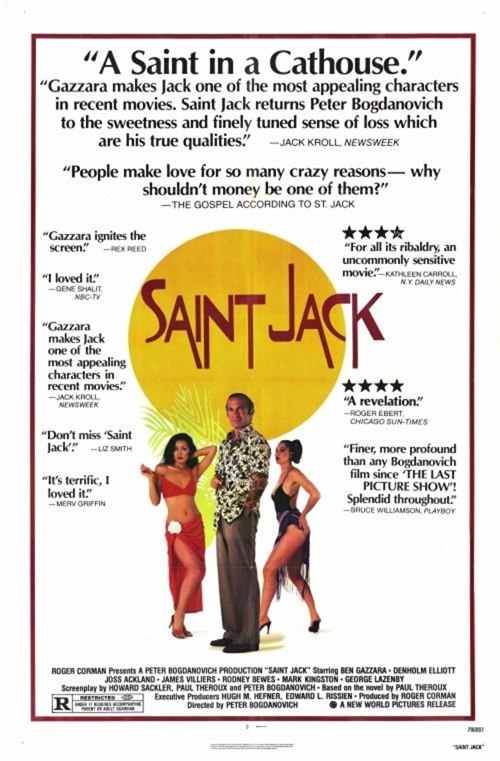
Saint Jack (1979)

saint1

By Richard Winters

My Rating: 7 out of 10

4-Word Review: American pimp in Singapore.

Based on the 1971 novel by Paul Theroux the story centers on Jack Flowers, an American who comes to Singapore in hopes of starting-up a profitable brothel and then moving back to the states a rich man. He finds the challenges more staggering than he initially thought and is constantly looking over his shoulder for the syndicate who would like to crush his business so it won’t compete with the other more established brothel’s in the region. In order to cover what he’s doing he works with a Chinese executive as a liaison for his clients. One such person is William (Denholm Elliot) a timid British accountant with a heart condition who has traveled to the area on an assignment. Jack enjoys William’s quiet demeanor and grows fond of him only to be heart-broken when he dies suddenly, which eventually changes Jack’s perspective on things specifically when he’s asked to take part in the blackmail scheme of a U.S. Senator (George Lazenby).

By the late 70’s director Peter Bogdanovich had fallen on hard times. He began the decade doing the acclaimed and award winning The Last Picture Show and followed it up with the equally impressive Paper Moon However, after the critically panned musical At Long Last Love his career began to tumble. He tried following this up with Daisy Miller, but it appealed to only a small audience. Nickelodeon was his attempt at returning to slapstick comedy that had won him success with What’s Up Doc, but it dived at the box office too making this once promising young talent feel fully washed-up. In an attempt for a revival he decided to go in a completely different direction by doing something with a gritty realism.

Cybill Shephard, whom Peter was in a relationship with at the time, had read the Theroux novel when it was given to her by Orson Welles in 1973. She had suggested he make it into a movie, but he had initially resisted. Then in 1978 when she sued Playboy for publishing unauthorized nude photos of her she got rights to turn the book into a movie as part of the settlement and Bogdanovich decided at that point he would do the project. Since Singapore officials were aware of the book, which had not portrayed their country in a positive light, he was forced to create a mock synopsis called ‘Jack of Hearts’, a benign love story that he used to convince the government that was the movie he was making so he could get the permission to film there, which was worth the effort as the unique ambiance of the setting is the main thing that propels the movie and could not have effectively been recreated had it been done inside a Hollywood studio lot.

Gazzara’s performance is another chief asset as he’s never at a loss for quick quips, or sarcastic replies. I loved the way he’s shown constantly moving, never sitting still in one place for too long, which nicely accentuated his situation of needing to ‘on the move’ in order to stay one-step ahead of the bad guys. Elliot is excellent as well in an atypical role. Usually he does well playing stern, jaded, and detached types, but here conveys a genuinely sensitive person who seems cut-off from the worldly ways. Lazenby, best known as the one-and-done James Bond from Her Majesty’s Secret Service, gets a small, but pivotal role as a closeted gay politician who takes a stroll in the middle of the night to hook-up with a male prostitute while Jack secretly follows him that has a great voyeuristic quality and the film’s most memorable moment.

Out of all of his movies Bogdanovich has stated that this one and They All Laughed were his two favorites. Some may not agree as the story has a fragmented style where things happen all of sudden and without forewarning. Yet for me this helped emphasize the reality of Jack’s shaky environment. While hailed by many as a great director’s least known work it deserves to be seen more and when compared to his other output clearly unique and original.

My Rating: 7 out of 10

Released: April 27, 1979

Runtime: 1 Hour 52 Minutes

Rated R

Director: Peter Bogdanovich

Studio: New World Pictures

Studio: DVD, Blu-ray, Fandor, Plex, Tubi, Amazon Video

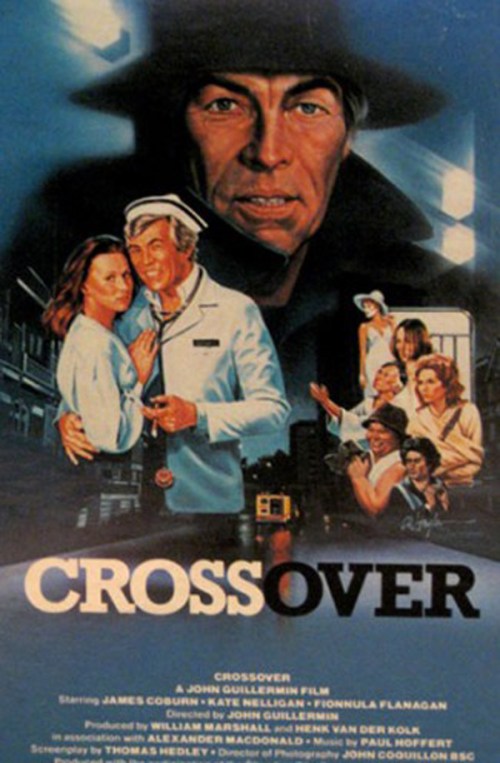
Crossover (1980)

patman1

By Richard Winters

My Rating: 3 out of 10

4-Word Review: He’s slipping into insanity.

Mr. Patman (James Coburn) works as a nurse at a psychiatric ward in Canada. While he enjoys his work and the patients respond well to his methods he’s put-off by some of the other doctors and administrators who he feels don’t really care about the people they’re supposedly trying to help. He’s also carrying on an affair with two women. One is Nurse Peobody (Kate Nelligan) who works at the same hospital he does and the other is Abadaba (Fionnula Flanagan) the wife of his landlord. While trying to juggle these two women and dealing with the pressures of his job he begins seeing strange visions and fears the he may be losing his mind.

This is quite similar to Beyond Reasonwhich starred Telly Savalas. This one though fared a bit better at least for the first 20 minutes. I liked the way the hospital and the patients are portrayed where their impulsive and unpredictable behavior gives it a certain creepy vibe and the staff needs to be high alert at all times, or face the consequences, which for me brought out the realistic stresses of doing a job like that. The bleak, gray, and rainy setting of Vancouver, shot there to take advantage of the Canadian tax concessions that were given to film production companies at the time, helps accentuate the grim elements.

The film though fails to take advantage of what could’ve been an intriguing plot. Not enough weird visions are seen and the few that are, are underwhelming. It should’ve been approached as a thriller and filled with all sorts of nightmarish and surreal imagery that could’ve helped build the tension, but instead it gets treated as a drama with long talky segments between Coburn and his two girlfriends that bogs the whole thing down until you don’t care what happens. John Guillermin, the director, had helmed many successful features before this one including: King Kong, Death on the Nile, and The Towering Inferno, but shows no panache here and seems to be giving the material only a half-hearted effort. It might’ve done better had John Huston, who was the original choice to direct, had been hired instead.

Coburn, who stated that he did the movie due to an interest in the character who decides he finds the crazy world inside the hospital more comforting than the outside one, but later admitted that had he read the script after its numerous rewrites instead of accepting the offer upfront, he most likely would’ve rejected it, is excellent and the only good thing about the movie. Nelligan, who described the film as being a ‘nightmare’ while working on it as well as calling it an embarrassment, is not as interesting and the entire supporting cast is blah though the young woman patient named Miss Montgomery, played by Tabitha Harrington, who enjoys walking around nude at least offers some diversion.

The script was written by Thomas Headly Jr. in 1971 who later went on to write Flashdancewhich storywise is quite different from this. There’s also a twist ending, though I figured it out long before it gets there and others most likely will too. I feel this was the type of concept where it started with the ending and then gotten written from there, but more side elements were needed instead of just relying on the twist to make it interesting, which for a 30-minute episode of ‘Twilight Zone’ might’ve worked, but as a feature film it gets stretched too thin.

Alternate Title: Mr. Patman

My Rating: 3 out of 10

Released: September 5, 1980

Runtime: 1 Hour 37 Minutes

Rated R

Director: John Guillermin

Studio: Film Consortium of Canada

Available: DVD-R (j4hi.com)

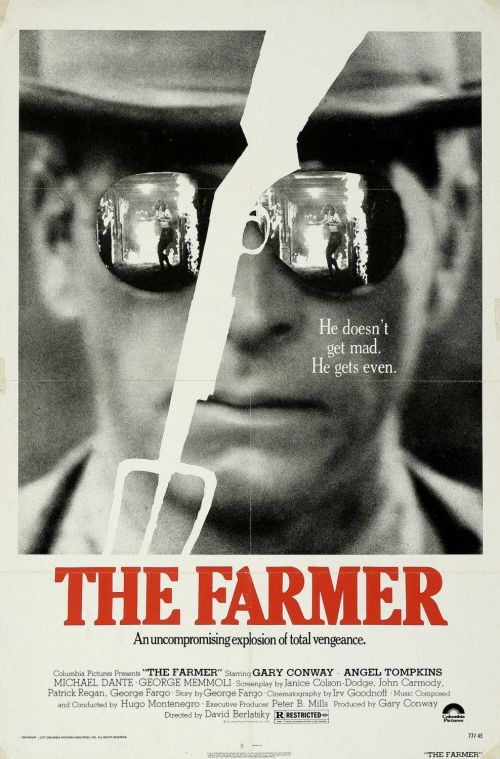
The Farmer (1977)

farmer1

By Richard Winters

My Rating: 7 out of 10

4-Word Review: Country man seeks vengeance.

Kyle (Gary Conway) returns from fighting in WWII a decorated hero, but finds when he gets back home that trying to run a profitable farm to be tough going and risks having it foreclosed on by the bank. One night while swerving to avoid an animal on the road professional gambler Johnny (Michael Dante) gets injured in a car accident near were Kyle lives. Kyle and his friend Gumshoe (Ken Renard) nurse Johnny back to health and for repayment Johnny gives Kyle $1,500, which is enough to help his farmstead survive for a little while longer. Johnny though soon gets into trouble with racketeer Passini (George Memmoli) who permanently blinds him by dumping acid on his face. Johnny wants revenge and hires Kyle, who’s farm continues to struggle, to do it by having him use his superior shooting skills to kill-off Passini and his men while using Johnny’s inside knowledge to track them down. At first Kyle resists, even after Johnny offers him $50,000, but when one of Passini’s men (Timothy Scott) burns down Kyle’s barn, kills Gumshoe, and rapes his new girlfriend (Angel Tompkins) he then decides to go on the warpath.

This has become, especially in the past decade, known as a ‘lost film’. It had never been shown on broadcast TV nor cable and had never received a DVD release, or Blu-ray, or even VHS. It became impossible to find even a bootleg copy and many had become convinced this was the obscure of the obscure. Code Red promised 10 years ago, much to the excitement of rare film collectors, to release it on DVD, but after some promotion the deal fell through, which frustrated many and gave this film even more of a cult status. Some had come to believe that maybe the movie was simply a ‘myth’ and really didn’t exist at all. Just when everything looked bleak Scorpion Rising gave it a Blu-ray release in February of this year and the print is excellent and the film itself isn’t bad either.

It’s noted for its graphic violence, which may have been the chief reason it never got shown on TV or cable. Some of it is quite cruel, particularly the acid scene and the rape is quite intense too. This tough does effectively get the viewer emotionally riled-up making them want to see Kyle get revenge and relishing the third act when he does. The revenge scenes are just as bloody, but I was disappointed that, as graphic as the movie is, the segment where Kyle shoves one of Passini’s men out a high-story window is not shown. The camera cuts away when Kyle pushes him instead of seeing the body drop down which might’ve been hard to film since a parade was going on below, but an effort should’ve been made.

Conway’s acting is only adequate though he does at least convey a stoic quality. Angel Tompkins does better and while some of her other B-movie roles weren’t so great this one is clearly her best and proves she could act versus just looking pretty. Memmoli is memorable as the slimy villain and he should’ve been in it more, but he got injured on the set while riding in a stunt car and was cooped-up in a hospital during most of the production, which also ultimately lead to his career downfall and death. The former comic who graduated into character actor roles had always struggled with weight, but had gotten himself down to 190 pounds when he was in this movie, but when the accident occurred and he was laid-up his weight ballooned out to as high as 490 and causing him to have to turn down subsequent film parts due to his physical limitations.

The review in Maltin’s book claims that there’s a lot of ‘anachronistic errors’ in the movie and having read the review beforehand I kept my eagle-eye out looking for them, but I really didn’t see any. Again I never lived in the 40’s and technically Maltin, who was born in 1950, didn’t either, but to me I felt it came-off okay. I liked the way it approaches the era in a gritty way versus a nostalgic one and the frequent use of the hand-held camera, which was ahead-of-its-time. The surprise twist at the end isn’t bad either.

My Rating: 7 out of 10

Released: March 9, 1977

Runtime: 1 Hour 37 Minutes

Rated R

Director: David Berlatsky

Studio: Columbia Pictures

Available: Blu-ray

Class of 1984 (1982)

class3

By Richard Winters

My Rating: 4 out of 10

4-Word Review: Teacher battles teen gang.

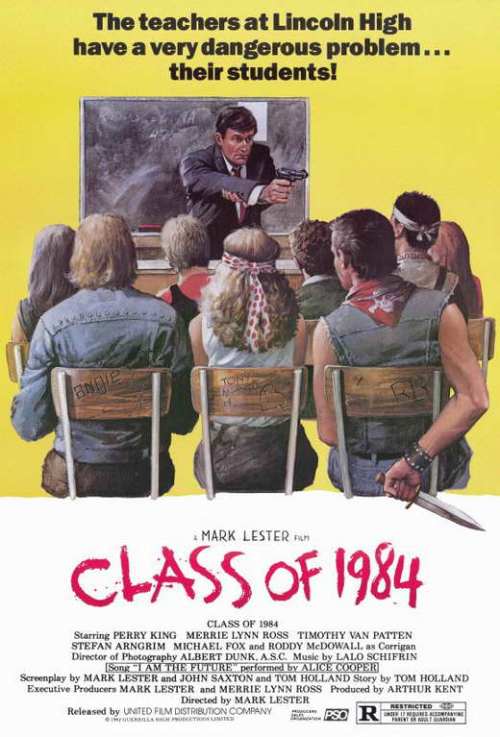
Andrew Norris (Perry King) is the new teacher at Lincoln High, which is an inner-city school prone to a lot of violence and drugs. He’s been hired to teach a music class while replacing another teacher who left suddenly. Almost immediately he’s at odds with Peter Stegman (Timothy Van Patten) the leader of a school gang that constantly disrupts his class. He eventually is able to kick him out, but Peter continues to harass Norris in the off-hours where they vandalize his car and attack his wife (Merrie Lynn Ross). Norris eventually decides he’s had enough especially after the principal (David Gardner) and even the police detective (Al Waxman) show him little support, so he takes matter into his own hands by violently confronting Peter and refusing to back down.

The film, which was directed by Mark L. Lester, who as a B-movie director has done some compact, quality stuff, has definite shades to Teacherswhich came out 2 years later, but with the same type of theme. This one though is harder edged, which makes it a bit better though it’s still weaker than Unman, Wittering, and Zigowhich it also has some similarities to, but without the intriguing mystery element. Lester has stated that he wanted to make an updated version of Blackboard Jungle, but with a grittier feel and while it may have succeeded in that respect it still comes-off as needing an updating. The school gangs dress in an over-the-top way and at times it’s hard to tell whether this wants to be taken seriously, or intended as camp. As violent as it sometimes gets it still doesn’t touch on school shootings, which was unheard of at the time, but would make a modern day high school movie that would deal with that subject more violent and scarier and making this stuff, as edgy as it tries to be, seem tame by comparison.

The ratio of black and white students doesn’t mesh. This was supposed to be an inner city school, so you’d think there would be more students of color than white, but instead it’s 98% white with only 1 or 2 black kids per class.  Norris’ roomy home in the plush suburbs seemed too nice for someone working off of a teacher’s salary, so unless his wife had a high income job, which is never confirmed, then the home he lives in wouldn’t be realistic. The reason for Stegman becoming a gang leader doesn’t make sense either. Normally kids get involved in gangs due to being stuck in poverty, but Stegman lives in the suburbs where gang life is quite rare. If he was from an abusive family then it might justify, but his mother (Linda Sorensen) takes his side on everything, so again his motivation for joining a gang isn’t believable and in a lot of ways quite absurd.

I did enjoy King n the lead. He’s played some creepy parts quite effectively in the past, so I wasn’t sure if he could pull-off a good-guy role, but he does it quite admirably. Roddy McDowall is great too in the last film he appeared in with brown hair as after this he began sporting an all gray look. The scene where he teaches a class while holding all the students at gunpoint is by far the best moment. It’s fun too seeing Michael J. Fox (billed without the ‘J’) as a high school student even though he was already 21 at the time of filming. He looks more pudgy and has a bowl haircut though ultimately other than getting stabbed doesn’t have much to do. The weakest link is Van Patten who’s not scuzzy enough to give the role the nastiness that it needed.

The table saw death deserves kudos and the gas fire one isn’t bad either. Having he teachers turn-the-tables on the students and violently fight back gives the movie a novel edge though I wished that King and McDowall had teamed-up together to take on the kids instead of doing it individually. The story though doesn’t get interesting until the violent third act. The theme has also been tackled many times before and this one doesn’t add anything unique to the mix and for the most part is painfully predictable.

My Rating: 4 out of 10

Released: August 20, 1982

Runtime: 1 Hour 38 Minutes

Rated R

Director: Mark L. Lester

Studio: United Film Distribution Company

Available: DVD, Blu-ray, Pluto, Tubi, Freevee, Amazon Video

Stigma (1972)

stigma1

By Richard Winters

My Rating: 4 out of 10

4-Word Review: Venereal disease on island.

Calvin (Phillip Michael Thomas) is a doctor recently released from prison who gets a job assisting Dr. Thor (David E. Durston) at his island clinic. When Calvin gets there he’s given a cold greeting by the islanders who do not like a man of color, nor does the town’s racist sheriff (Peter Clune). When he arrives at the clinic he finds that the doctor has already passed-away as well as a tape he left behind warning of an epidemic on the island, but not saying specifically what it is. While staying at the clinic he’s met late one night by Jeremy (William Magerman) an old man residing at the nearby lighthouse. He complains about being in a great deal of pain and upon further testing is found to have syphilis. Calvin tries to go on a crusade to warn the others while also searching for who else may have it, which ultimately leads him to the sheriff’s rebellious daughter D.D. (Josie Johnson).

It’s always interesting seeing how low budget films from a bygone era before the advent of computerized special effects could succeed or fail on the merit of story alone. This one, which was done by David E. Durston who had previously directed the cult-hit I Drink Your Blood just a year earlier, manages to for the most part, blemishes and all, to hold it together. The difficulties though of filming on a shoestring is still widely apparent especially at the beginning where there’s a lot of shaking camera movement and jump cuts. Where Calvin goes to hitch a ride is particularly amusing. Since they didn’t have money to get a permit, or hold-up traffic on a legitimate highway, the scene had to be done on an isolated dirt road that looked like it hadn’t been traveled on in 10 years and normally Calvin would’ve had to have stood there that long with his thumb out before he ever saw a car and yet here this non-descript road gets quite busy by using the film’s crew members driving by with their own vehicles in order to give it a well-trafficked look.

This is also one of those films were the genre is unclear. Some have listed it as a horror film while others label it a drama, or even a comedy. My guess is that it was intended as a drama with some side comedy thrown-in as ill-advised ‘comic relief’. The story though never gets tense enough to need a lighthearted moment and the funny bits are eye-rolling making the production seem even more amateurish than it already is. There’s also a surprisingly graphic moment where pictures of actual syphilis patients are shown including close-ups of their sores and deformed noses, which some could find genuinely stomach-churning.

Thomas is best known for his co-starring role in the 80’s cop drama ‘Miami Vice’, but I found him far more engaging here. Magerman is memorable playing a mute with no teeth, who never says a word, but does have an amusing giggle. Johnson is certainly beautiful, which makes up for her lack of acting, but Clune as the villainous sheriff is all-wrong. He may have looked the part of an aging bigot, but he never gives the role the necessary energy or panache. Lawrence Tierny was original choice for the part, but due this drinking problems was eventually passed over, which was ashame.

In recent years this film has gained notoriety due to it being directed by David E. Durston (1921-2010) and some movie podcasts connecting him to the mysterious deaths of both Diane Linkletter (Art Linkletter’s daughter) and actress Carol Wayne. Durston was with Diane the night she jumped to her death from her apartment window in 1969, which authorities deemed a suicide though some wondered if Durston may have pushed her out. Durston was also dating Carol Wayne in 1985 when the two had an argument while vacationing in Mexico and she left their hotel room only to be found drowned in a lake later on. Further research though has concluded that the man in question in both of these events was Edward Dale Durston, a Los Angeles car salesman born in 1942, and no connection with the film director.

My Rating: 4 out of 10

Released: August 18, 1972

Runtime: 1 Hour 33 Minutes

Rated R

Director: David E. Durston

Studio: Cinerama Releasing

Available: DVD-R (Code Red)

The Brutes (1970)

brutes1

By Richard Winters

My Rating: 6 out of 10

4-Word Review: Two men accost woman.

Werner (Klaus Lowitsch) and Michael (Arthur Brauss) are two friends from work who enjoy spending their weekends ‘cruising-for-chicks’. Their modus operandi is picking up prostitutes, or women at bars, and bringing them to one of their apartments where they either ‘share’ the woman, or partake in a threesome. One weekend they go go-cart racing and set their sights on attractive, young Alice (Helga Anders). They invite her into their car telling her that they want to take her for a swim at an isolated gravel pit. Once there Werner sexually assaults her. The next morning she threatens to go to the police, but the men talk her out of it only for the two to become adversaries when Michael wants to have sex with Alice, which Werner won’t allow.

While Savage Weekend is considered the very first slasher movie this film, which was shot in 1968, could be deemed the first rape/revenge movie. Like with that other film it was produced long before the ‘rules’ of the genre were established, so it takes many unique forays some of which are interesting and other ones aren’t.

It was the third of three films that actor-turned-director Roger Fritz directed with his wife Anders as the star. Anders was a model before she got int acting and he used her pretty looks for stories where her characters would engage in provocative lifestyles like group sex, or incest. This was the last in a trilogy meant to show the dark side of sexually liberated activities, but it doesn’t start to get interesting until they arrive at the gravel pit, which is more than 30-minutes in.

The two men are one dimensional and a turn-off. From the very first frame to the last they’re leering predators-at-large even in the presence of Michael’s mother. Had there been one random moment where they showed some surprising sensitivity towards something, or didn’t act in a predictable stalker way it might’ve had potential, but watching creeps behaving like non-stop creeps becomes boring and redundant.

The scenes at the gravel pit fare better simply because it’s atmospheric and the location becomes like a third character. There’s a few tense moments and the rape scene is surprisingly more graphic than I expected. The physical fight between the two is well choreographed and genuinely bloody though Michael gets hit on the head so much I thought he would’ve suffered serious head trauma and never able to get back-up like he does.

The three characters shift from being the victim at one point and the aggressor the next, which is intriguing. Michael’s long speech detailing the potentially degrading process that a female rape victim goes through when she decides to file a police report is on-target and ground-breaking since these same issues weren’t brought to the forefront until 1972 with the TV-Movies Cry Rape starring Andrea Marcovicci and two years later in A Case of Rape with Elizabeth Montgomery.

Spoiler Alert!

Ultimately though the ending stinks. The mod quality is cool especially its alternative soundtrack, but the scenario writes itself into a hole that it can’t get out of. Having the three go back to their normal lives and acting like what occurred was just a dark diversion, or even a lark with no long term ramifications doesn’t click. We needed to see how this experience changed them, which isn’t addressed and thus makes the whole concept placid and forgettable.

brutes2

brutes4

Alternative Title: Cry Rape

My Rating: 6 out of 10

Released: February 19, 1970

Runtime: 1 Hour 38 Minutes

Rated R

Director: Roger Fritz

Studio: Roger Fritz Film Productions

Available: DVD-R (German with English Subtitles) (j4hi.com)

Loose Shoes (1978)

loose1

By Richard Winters

My Rating: 3 out of 10

4-Word Review: Lame parody of movies.

In 1967 an improv group, which Chevy Chase was an early member, began that called themselves Channel One, who performed improvisational skits making fun of current events and TV-shows. Instead of doing them on stage in front of audience they filmed it and then played them on three different TV screens at a theater in Greenwich Village. When these proved successful the collection of filmed skits were then toured around the country at college campuses and got a favorable reaction, so the producer decided to turn it into a feature length film. At the time this was considered a novelty as the movie, which was called The Groove Tube, would have no plot and just be a collection of skits, but it proved popular enough that it gave others the same idea. From this came Tunnelvision, American Raspberry, and probably the most famous one Kentucky Fried Movie. 

In 1977 Ira Miller, who had worked with Mel Brooks on his projects and was a member of Second City during the 60’s, became inspired to do his own version of this. He financed it using most of his own money. The concept was for it to be a parody of recent movies and structured similar to movie previews one would see at theaters before the main feature would begin. The working title was Coming Attractions and to keep costs low he cast young, unknown talent like Bill Murray, who agreed to work for a small fee in order to get the exposure, or B-actors that he knew who as a favor would work at below scale for a day in order to help him out. Initially it got such a bad reaction from test audiences that it was shelved for several years, but then after Meatballs was released, which made Murray a star, it was re-released under its new title in order to capitalize on his fame.

The film suffers from production values that are so cheap I’ve seen high school projects that were done better and it doesn’t help that the DVD issue looks like it was copied straight off of a VHS tape. Both IMDb and Wikipedia list the original runtime as 84 minutes, which is incorrect as it was actually 74 minutes, but the DVD version only goes 69 minutes and cuts out several segments including ‘Jewish Star Wars’, which is alright as even with the abbreviated runtime it still felt like it was never going to end and adding in the stuff that was edited out would’ve just prolonged the agony. It would’ve helped had there been some consistent characters like a family going to the theater to see a feature and becoming increasingly annoyed at the ongoing previews. After each skit it could’ve cutback to their reaction, which would’ve given it some minimal structure and focus that otherwise is sorely lacking.

Some of the segments had potential like the ‘Invasion of the Penis Snatchers’, but Miller approaches the material too much like a gag writer where he’s more interested in the punchline instead of playing out a funny scenario. The skit that has Jaye P. Morgan doing a send-up of Nurse Ratched needed to be extended as she could’ve done it hilariously. The segment that spoofs the Woody Allen film Play it Again Sam isn’t exactly funny, but David Landsburg’s impression of Allen is so spot-on that it’s entertaining nonetheless. Murray’s segment where he plays a prisoner on death row is okay and you even get to see him at one point with his head shaved. I also liked the bit with Susan Tyrrell as a woman stuck in the boonies only here the hicks are open-minded and even features a virtually unrecognizable Ed Lauter as a free-spirited, cocaine sniffing, redneck sheriff.

The best moment ‘Dark Town After Dark’ comes at the very end and features a send-up of a Cab Calloway dance number with the song ‘Loose Shoes’ being sung. The lyrics of which came from a comment made by President Gerald Ford’s Secretary of Agriculture Earl Butz. He was on a plane flight to California with entertainers Sonny Bono and Pat Boone. Boone asked him why republicans weren’t able to attract more blacks. He responded by making a comment that forced him to resign once it got out: “I’ll tell you what coloreds want. It’s three things: first, a tight pussy, second, loose shoes, and third, a warm place to shit.”

My Rating: 3 out of 10

Released: September 1, 1978 as Coming Attractions. Re-released August 1, 1980 as Loose Shoes

Runtime: 1 Hour 14 Minutes (Original Cut). 1 Hour 9 Minutes (DVD Version).

Rated R

Director: Ira Miller

Studio: Cinema Finance Associates

Available: DVD, Amazon Video

Secret Admirer (1985)

secret1

By Richard Winters

My Rating: 4 out of 10

4-Word Review: Anonymous letter creates confusion.

Michael (C. Thomas Howell) is a teen secretly infatuated with Deborah (Kelly Preston), who’s considered the hottest babe in school. He wants to date her, but is too shy to approach her. He then receives an unsigned letter in his locker from someone stating that they’re in-love with him. Michael is convinced that it’s from Deborah. His friend Toni (Lori Laughlin) convinces him to write a letter to her, but his attempts to write something romantic prove futile, so Toni decides to do it for him, but still make it seem like it came from him. Once Deborah reads the letter she falls instantly in-love and the two go out on a date, but meanwhile Michael’s mother Connie (Dee Wallace) reads the letter and thinks it’s been written to her husband George (Cliff De Young) and that he’s been fooling around behind-her-back. George also reads the letter, but thinks it’s from Elizabeth (Leigh Taylor-Young) who’s teaching a evening class that George is taking and is also Deborah’s mother. George uses the opportunity to make a pass at her and the two agree to go out on a date while Connie gets with Lou (Fred Ward), Elizabeth’s husband and Deborah’s father, in an attempt to stop it, but find that they too have more in common than they thought and begin to contemplate an affair of their own.

An unusual and offbeat 80’s teen sex comedy that fares a bit better than most of the others. The dialogues between the teens seems more realistic and they aren’t extremes caricatures like what you usually get in this tired genre. I was even surprised that they at one point have a discussion of the film Doctor Zhivago and even know the actor’s names who are in it even though it was an old film even back then. There’s a segment where Michael and Deborah attempt to have sex and it turns into a painful and awkward experience for both, which I liked, because too many times these types of movies would portray sex, even if it was the first time for both partners, as being an exhilarating, fun time, which it isn’t always. The parents aren’t portrayed as being ‘out-of-it’ or overly authoritarian like in other teen comedies and cutting back-and-forth between the adult escapades and the teens is at least initially a refreshingly original concept.

The performances are engaging even Howell does well here particularly at the end when he tries frantically to chase down Toni. The adults though are a bit more engaging despite De Young looking too boyish to be playing the part of a father of a 17-year-old. Wallace and Ward are the scene-stealers especially Dee and the way she breaks-out crying when she gets really upset and Ward’s overly-protective father persona is funny too and the film should’ve just been centered around them.

Spoiler Alert!

The jumping back and forth though between the adults and the teens starts to seem like two different movies with the parent’s storyline being the better one. I didn’t like the way it got wrapped-up with the couples going back to their former spouses like everything was back to normal even though there seemed to be clear issues in both marriages for them to so easily consider affairs when they thought there was a chance. It would’ve worked better and even been more believable had it ended the other way where the couples swapped partners and thus became more compatible.

I didn’t understand why Michael saw Toni only as a friend, even tough she was clearly into him. I considered Toni to being better looking than Deborah, or at least certainly in the same league, so unless Michael had a fetish for blondes over brunettes it didn’t makes much sense why he’s so tirelessly chase after Deborah when he already had a good thing with Toni. For it to believable Toni needed to be less beautiful, even plain looking, then it would be understandable why Michael would overlook her, but eventually see her in a romantic way once he realized all the nice things she did for him. It would’ve also have sent a good message that a female didn’t have to be cover girl quality, which both Laughlin and Preston were, and could still be able to find love.

End of Spoiler Alert!

While this film sat for several decades in virtual obscurity it finally came to prominence in 2016 when it was part of a controversy dealing with the Puerto Rico movie Vasos De Paper, which was written and directed by Eduardo Ortiz. That film was a virtual scene-for-scene remake of this one despite the director insisting that it wasn’t. When the evidence became too much Ortiz finally broke down during a radio interview and admitted that he had ‘done a very bad thing’ and stole the idea without giving proper credit to the original writer and director. The cast of that film were unaware of this one and had no idea they were taking part in a plagiarized script. Once they did they apologized for their involvement and the movie was pulled from the theaters.

My Rating: 4 out of 10

Released: June 14, 1985

Runtime: 1 Hour 38 Minutes

Rated R

Director: David Greenwalt

Studio: Orion Pictures

Available: DVD, Blu-ray

The Heavenly Kid (1985)

heavenly3

By Richard Winters

My Rating: 1 out of 10

4-Word Review: Angel helps out geek.

During the early 60’s Bobby (Lewis Smith) dies in a fiery car crash after the vehicle he was driving goes over a cliff during a game of chicken that he was playing with Joe (Mark Metcalf). His spirit gets sent to purgatory otherwise known as ‘Mid-town’ where he meets Rafferty (Richard Mulligan) who tells him that to get to ‘Uptown’ (Heaven) he’d have to go back down to earth in angel form to help out a human in need. He gets assigned to Lenny (Jason Gedrick) a geeky teen who’s trying in vain to hit on high school hottie Sharon (Anne Sawyer), but to no avail. Bobby is put in charge to teach Lenny how to be ‘cool’ and be able to pick-up chicks, but in the process he learns that Lenny’s dad is Joe, the guy who he raced against before he died, and Lenny’s mother is Emily (Jane Kaczmarek), Bobby’s former girlfriend who he still has strong feelings for.

The movie starts-off with an ill-advised car race that looks like it was ripped straight-out of Rebel Without a Cause. What’s worse is they tack-on this blaring song by Joe Fiore ‘Over the Edge’ that gets played during the crash, which takes away from the drama of the imagery instead of enhancing it. Bobby’s trip to the heavenly way station, which he does via a subway, has comic potential and Richard Mulligan is certainly quite funny, but I didn’t get why there would be a cafeteria, or why they’d eat food. Again, even if they appear in human form they’re still technically spirits as their human body remains on earth after death and decomposes, so why would spirits need to eat and does this mean they’d still have the same digestive system where they poop out what was eaten?

While Gedrick gives a much better performance than his co-star I still felt he was too good looking for the role. A true geek should be scrawny, or overweight, and have bad acne. If he had suffered from those things than his attempted transformation to a ‘cool’ dude would’ve been funnier.

I also thought it was ridiculous that he already had this beautiful woman named Melissa (Nancy Valen) who was really into him, and I think most guys would actually agree better looking than the plastic barbie that he was after. If this doofus is too dumb to realize on his own the good thing that he already has and instead callously takes her for granted simply because he feels the other one is better looking, after all the only reason he’s ‘in-love’ with Sharon is because she’s ‘hot’ then he shouldn’t get ‘help’ from an angel and justifiably deserves to be a lonely loser. I also felt that Melissa should’ve been more geeky since she was into another geek and having her be so pretty didn’t make much sense as other guys would be hitting-on her and since Lenny was not picking-up on her clear signals she would easily move on with somebody else and not hold-out so long, or feel the need to, for Lenny to finally see-the-light.

Spoiler Alert!

The rehabbed car in which Bobby takes what is literally an a rusty, empty shell of an old vehicle and through his heavenly magic turns it into a retro sports car I had problems with. For one thing since it was built on Bobby’s magical powers I would think Bobby would need to be present for it to run instead of Lenny being able to drive it by himself. Also, where did this key come from that Lenny uses to put in the ignition to start the car? This was literally just an old car frame when it was spotted and it’d be doubtful there would be any key in it and if there was it’d be as rusted as the rest of it. If you want to argue that this key was also a part of Bobby’s divine magic then there needs to be a scene with him creating it using his powers and then handing it to Lenny because it comes-off as big logic loophole otherwise.

The shot where Joe wakes-up to see Emily floating up the stairs by herself doesn’t work either. The idea is that human’s can’t see Bobby, who’s the one carrying Emily up the stairs, because he’s an angel, but if a person is being carried their ascension would have more of a jostled appearance instead of looking like they’re riding up an escalator like it does here.

The big reveal, in which it’s found that Lenny is actually Bobby’s son, is problematic since Bobby’s car crash occurs during the early 60’s (1960-63) and the present day for the story is October, 1984, which is when it was filmed. A senior in high school would’ve been born in 1967, or at the very earliest late 1966, so unless Emily was carrying Lenny around in her womb for 3 full years before he finally came out this whole concept just doesn’t work.

The thing that I really couldn’t stand was Bobby who’s a walking-talking cliche. Smith plays the part in a one-dimensional way and he looked too old for a teenager and was in fact 28 when it was shot. His generic advice on how to pick-up women is simplistic to say the least and if he really believes just feeding a woman lines about ‘how nice her hair looks’ is enough to get her to go out with him, or any other guy, then maybe he’s the one that needs the teaching and wisdom instead of dispensing it.

I also couldn’t understand why Lenny’s situation was so ‘dire’ that he needed heavenly intervention. There’s lots of kids who get bullied in school and can’t get a date that don’t have guardian angels come down to help them out, so what makes Lenny so special? Even if you factor in that Bobby is Lenny’s dead father it still doesn’t work because there’s lots of kids out there whose parents die when they’re young who don’t come back to help them as angels, so the questions still remains; what makes Lenny so special and is he deserving of this ‘help’? There’s millions of people out there who are homeless and victims of horrible crimes and abuse, which is who Bobby should’ve been assigned to, not a dopey kid who’s living a comfortable suburban existence and whose only ‘pressing issue’ is that he can’t make it with a stuck-up superficial babe who’s way out of league anyways.

My Rating: 1 out of 10

Released: July 26, 1985

Runtime: 1 Hour 30 Minutes

Rated PG-13

Director: Cary Medoway

Studio: Orion Pictures

Available: DVD, Blu-ray