Category Archives: Foreign Films

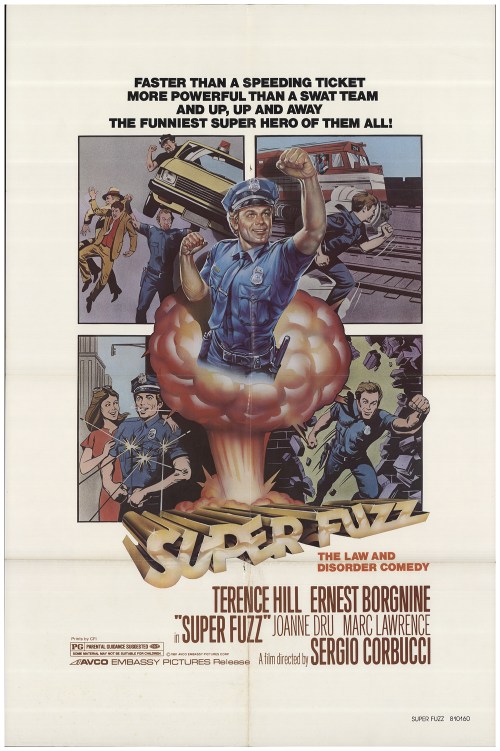
Super Fuzz (1980)

super fuzz1

By Richard Winters

My Rating: 2 out of 10

4-Word Review: Cop acquires super powers.

Dave (Terence Hill) is a newly hired policeman sent to do tasks non of the other officers want to do, which is why he’s given the assignment to deliver a speeding ticket to a remote Native American village deep within the Florida Everglades. Once he arrives he finds the place evacuated due to a secret nuclear missile test being done that he wasn’t aware of. When the bomb goes off and he becomes exposed to the radiation he begins to have various super powers including: super human strength, speed, telekinesis, psychic ability, and even hypnotism. He puts these new found abilities to use during his police work even though his partner, longtime cop Bill Dunlop (Ernest Borgnine), is skeptical about it at first. While the powers come in handy in their efforts to thwart a local counterfeit ring Dave soon realizes that there’s one hitch; if he sees the color red, which was the same color as the plutonium explosion, his powers will temporarily cease.

This was the third and final attempt to make Hill, who’s quite legendary in Italy especially in films where he teamed with Bud Spencer, into an American star. The first two attempts that he did here, Mr. Billion, March or Diewere flops and this effort, which was aimed solely at the kiddie crowd, wasn’t much better and its dismal failure both critically and financially sent Hill back to Europe permanently. Many adults who grow up in the 80’s will remember seeing it on Pay-TV where it was in heavy rotation. I recollect catching bits and pieces of it on Showtime, but the only thing that stood out for me was its cheesy soundtrack that had a chorus singing: ‘Super, Super, Sup-eee-rrr’ every time Dave did one of his tricks.

The film’s biggest downfall are the special effects that amounts to a lot of tacky, fast-action photography that can be seen in a wide assortment of other mindless low budget fare and is nothing special. There’s also just not enough trickery, too much dim witted dialogue, and lame humor in a plot that evolves too slowly to hold the interest of either a child or adult.

Having Dave acquire all these powers after being exposed to nuclear energy instead of getting terminal cancer like anyone else would makes no sense. The story would’ve been helped somewhat by reeling-in the powers aspect and giving him only one special ability instead of allowing him to do virtually anything making him almost like superman. Entering in more limitations than just the color red would’ve, if done right, brought in some tension and creativity, which is otherwise lacking.

While it’s sad in some ways to see a legendary, Academy Award winning star like Borgnine in such mindless tripe he is the best thing in it as he provides much needed energy, which help contrast Hill’s overly laid-back demeanor. Watching the tubby guy dance on top of a giant balloon, or try to dance with Joanne Dru is funny as are his overreactions, which would be considered cartoonish in any other movie, but here only helps to lift it up from its simplistic foundation. It’s also a great chance to see Dru, her first movie appearance in 15 years and also her last, ham it up as the villainous of which she’s pretty good.

The ending though, where Hill is somehow able from a tiny piece of gum to form this gigantic bubble is where the thing, which wasn’t floating too well to begin with, really sinks. How can Dave’s super powers get a piece of gum to expand far more than it should and since bubbles from bubble gum are very flimsy and can easily pop why doesn’t this one end up doing the same? You can also clearly see the seam of the sewn fabric on the bubble, which an actual bubble would never have.

While the movie was notoriously ridiculed by the critics at the time of its release, some critics today have taken more of a softer stance. Maybe it’s because they remember growing up watching it on TV, but feelings of nostalgia doesn’t make it any less stupid. This isn’t even good for kids who I believe are more discerning than adults think and will right away recognize the dated quality, tacky effects and won’t be impressed. 

Alternate Title: Super Snooper

My Rating: 2 out of 10

Released: September 18, 1980

Runtime: 1 Hour 37 Minutes

Rated PG

Director: Sergio Corbucci

Studio: AVCO Embassy Pictures

Available: DVD, Amazon Video
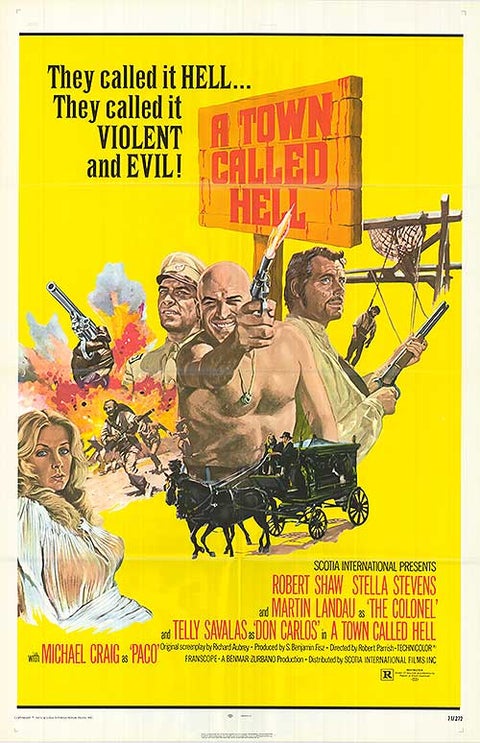
A Town Called Bastard (1971)

town

By Richard Winters

My Rating: 6 out of 10

4-Word Review: Where is rebel Aguila?

In 1895 a rebel leader named Aguila (Robert Shaw) massacres a small Mexican town. Ten years later he resides as a reformed priest in a town run by the corrupt Don Carlos (Telly Savalas). One day a beautiful widow named Alvira (Stella Stevens) arrives looking for the man who killed her husband during the massacre from 10 years earlier. Don Carlos agrees to help her despite having no idea who the killer is, or that it might have something to do with the priest. Things get more complicated when the army colonel also arrives determined to seek out justice by finding the elusive Aguila.

The film has many issues most of which is it comes off as a spaghetti western wannabe that has some of the entertaining elements of those films, but put together in a clumsy fashion. The town really doesn’t resemble an actual place, or a destination that people would live in since there only seems to be about 4 buildings, a church, a salon, and a couple of shops, making me wonder where all the townspeople that are seen milling about resided. There’s also an overuse of dubbing. Al Lettieri, who can be a spectacularly great villain especially in his unforgettable performance in The Gatewayand while he plays another bad guy here, but he gets wasted since his voice is dubbed with a high pitched one that takes away from his menacing quality. Even Robert Shaw has his voice dubbed from time-to-time, which is quite disconcerting.

The narrative is confusing as it jumps back and forth from the present to the past, but doesn’t make it clear that it is doing this, so you’ll see scenes with Shaw at the beginning as a rebel leader and then suddenly he’s a priest without explaining how the two are connected. The Fernando Rey character and the actor playing Alvira’s husband look too much alike making me think, especially since the story jumps between different time periods, that the characters were one and the same with one being slightly younger with the scenes done 10 years earlier though that ends up not being the case.

The cast does help particularly Savalas who seems to relish playing the bad guy and although he’s done this type of part a few too many times is still perfect, but his character gets killed-off too quickly and way too easily, which is a big letdown since his presence helps drive the movie. He gets replaced in essence with Landau, who plays a sociopath in the same over-the-top way, but a good film needs only one crazy not two men playing the same character in the same type of way until it becomes like a caricature.

Shaw is of course quite good though his character for the most part hangs back and doesn’t do much until near the end. The opening scene where he leads the attack on the village has energy, but the shot of a long line of spit oozing out of his mouth as he shouts orders left an icky lasting impression. Stevens is quite beautiful in a natural way without the help of make-up and this was the last film where she had a youthful look as she appeared increasingly more middle-aged after this one.

The nasty subtext was the one thing that makes it fun. There’s a lot of stuff shown here that they just couldn’t do today like the opening bit where the townspeople are viciously gunned down inside their church and the gunmen than laugh and celebrate while the dead, bloody bodies lay at their feet. The scene where a desperate man gleefully hangs his own, innocent wife in an attempt to save himself is memorable and it’s this type of element that keeps it interesting because you just don’t know what it’s going to show next and in the process reflects the ugly savagery of the true, old west.

Alternate Title: A Town Called Hell

Released: June 17, 1971

Runtime: 1 Hour 37 Minutes

Rated R

Director: Robert Parrish

Studio: Benmar Productions

Available: DVD, Blu-ray (Import Non-English), Amazon Video, Plex

Diamonds (1975)

diamonds2

By Richard Winters

My Rating: 3 out of 10

4-Word Review: Testing a security system.

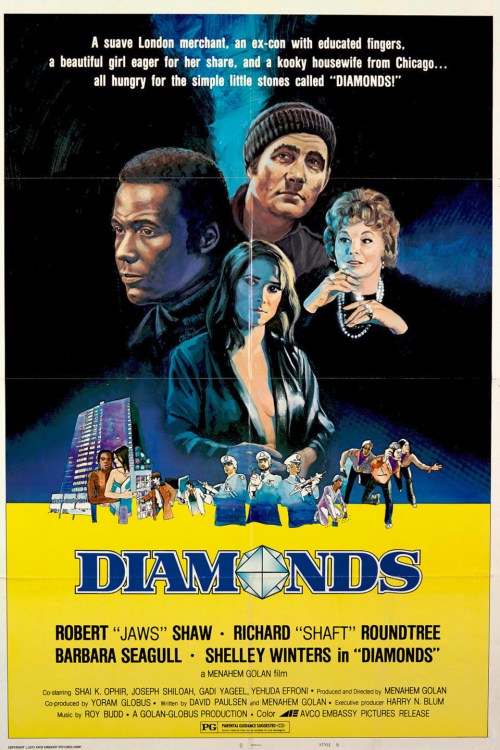
Charles and his twin brother Earl (both played by Robert Shaw) share an intense rivalry that comes-out during their judo karate contests. Charles wants to top his brother at everything including getting the better of him at his own expertise, which is that of security specialist who has created a vault in Tel Aviv that holds a cache of diamonds and is supposedly impenetrable. Charles is determined to rob it and uses the help of expert safe crackers Archie (Richard Roundtree) and Sally (Barbara Hershey).

While the film has some great location shooting of Israel making it seem almost like a travel log of the region and the final third where the three try to pull off the elaborate robbery does get a bit intense, though it’s nothing special, the movie on the whole falls flat. A major reason is that it was directed by Menahem Golan, who along with his cousin created the notorious film production company The Cannon Group, which produced a lot of cheesy, bubble gum action flicks during the 80’s. This film works very much like those with poor character development, in fact there’s really no development at all, and a plot that steals all sorts of elements from other and better heist movies.

Overall it’s pretty much the same storyline as $, Perfect Fridayand to a lesser extent Topkapibut all of the things that made those movies so much fun to watch goes missing here. The lack of interplay between the characters is the biggest issue. Shaw, Roundtree, and Hershey are all great actors, but they’re not given anything interesting to say. The twin brother concept does not get played-up enough and Charles’ twin is seen just a few times with the only difference being a shaggy wig that Earl wears as opposed to Charles crew-cut, but both brothers have the exact same mole on the left side of their mouths and while identical twins can have many similarities, skin blemishes isn’t one of them. Shelley Winters also pops-up sporadically as an American tourist, but her part is completely inconsequential and not needed at all.

The heist itself does involve some sophisticated maneuvers including having them walk on the ceiling by using a suction-cup type contraption, but the film fails to show any of the preparation. In the other heist films seeing how the crooks rehearsed the robbery and working through their disagreements and divergent personalities was half-the-fun, but that all goes missing here. How Shaw goes about meeting Roundtree and company is pretty flimsy too as he catches them during the middle of an attempted safe cracking and then hires them on-the-spot supposedly because he’s been monitoring them for 5 years and feels they’d be a perfect match for his scheme, but why should it take him so long to come to this conclusion and these safe crackers must not be as cunning as they seem if they’ve been watched closely for 5 years and not had any hint that it was going-on.

Spoiler Alert!

The crime itself gets pulled-off way too easily and there’s no moment where a crucial mistake gets made, or some sort of unexpected slip-up, so things never get as intense as it could’ve. There’s also an added character that gets thrown-in who kidnaps the son of the security guard in order to get the guard to give-out the combination to the safe, but no scenes are shown for how Shaw and company met this kidnapper, or what deal he made with him in order to get him to agree to along with their plans.

The finale has a very anti-climactic feel as Roundtree is able to retrieve the diamonds, but then Shaw forces him to put them all back, so they come away, after all that effort, empty-handed. Ultimately Shaw does hand him a $100,000 check, but this was paltry compared to the $10 million they would’ve gotten with the diamonds making the viewer feel like the film wasn’t worth sitting through if the characters just end up in the same situation that they were in when it began. While no movie that has Robert Shaw in it can be completely bad as his presence alone can elevate even the most inept material this one unfortunately does come close.

My Rating: 3 out of 10

Released: October 22, 1975

Runtime: 1 Hour 48 Minutes

Rated PG

Director: Menahem Golan

Studio: AVCO Embassy Pictures

Available: DVD-R

Double Deal (1983)

double1

By Richard Winters

My Rating: 6 out of 10

4-Word Review: Double crossing each other.

Christine (Angela Punch McGregor) is a young model married to Peter (Louis Jourdan) a much older man. While Peter is rich and they live in a big house their marriage lacks passion and Christine becomes bored with her existence while Peter continues to have a long-running affair with his secretary Miss Stevens (Diane Craig). One day while out shopping Christine meets a handsome young man (Warwick Comber) on a motorbike. Even though she doesn’t know his name she becomes entranced with his good looks and carefree demeanor. He’s the exact opposite of the stuffy and exacting Peter, so she decides to run-off with him. The two go on many quirky adventures including robbing a grocery store while in clown make-up not so much because they need the money, but just for the thrill of it. They then plot a scheme where the man will pretend to have kidnapped Christine and insist that Peter relinquish his prized opal gemstone in order to get her back. Peter complies, but in the process sets off an array of unexpected twists where nothing is as it seems.

Normally I like films with an offbeat slant and this one certainly has its moments, but the characters aren’t well fleshed-out, which makes for a placid experience. A good case-in-point is the way Christine comes upon the young man, which is while she’s in a shopping center parking lot. Having found that someone has double parked their car behind hers she patiently waits for the owner of the vehicle to come out and move it, but in the process the young man comes along, and noticing that the keys of the car are still in the ignition, jumps into the car and drives away with it while also following Christine home. Once there the two proceed to tear up the place before she packs her bags and runs off with him onto the open road without ever even learning what his first name is.

While as an actress McGregor is quite competent she doesn’t have the looks of a fashion model, which she herself admitted to, and her role and that of the secretary should’ve been reversed with Diane Craig looking far more the model type especially with her piercing blue eyes. Comber is a bit off as the handsome stranger as well. He certainly has a hunky build and chiseled face, but his droopy eyelids give him a odd, sad eye appearance. I also got tired of seeing him constantly wearing a silver bike riding suit that seemed to resembled more of an outfit worn by someone on a spaceship.

Jourdan’s presence helps a lot. This was at the twilight of his career where he was no longer getting leading man roles in his home country of France and therefore open to accepting offers abroad, which is what lead to him traveling to Australia to do this. The filmmakers wanted a big name star to help give the production stature and the movie definitely works better with him in it though the scene where he and McGregor are in bed together was reportedly quite awkward for the two stars given their wide age difference of almost 33 years and took many takes to film.

There are a few memorable moments with my favorite being the grocery store robbery, which occurs in a small outback town, where Christine accidentally releases the money they have just stolen into the air as she gets into the getaway car causing the store owners, who had just been robbed, to run out and busily try to recollect the money blowing in the wind. However, the story lacks soul. The twists get thrown in for the sake of being offbeat, but the characters never grow, or resemble real people in any way. The winding plot ultimately burns out and ends with a fizzle.

My Rating: 6 out of 10

Released: September 15, 1983

Runtime: 1 Hour 30 Minutes

Not Rated

Director: Brian Kavanagh

Studio: Roadshow Films

Available: dvdlady.com

Insignificance (1985)

insignificance2

By Richard Winters

My Rating: 8 out of 10

4-Word Review: Celebrities in a room.

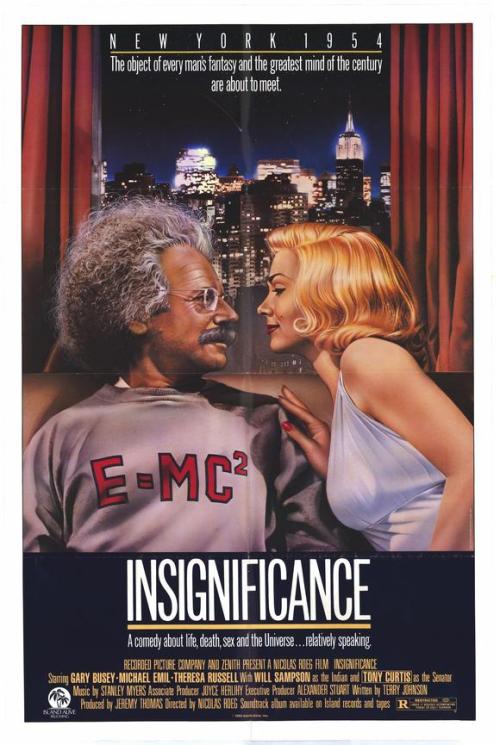
Inside a New York hotel room is a professor (Michael Emil) working on some calculations until he gets interrupted by The Senator (Tony Curtis) who tries to get him to appear before the committee trying to expose communists inside the U.S., which will be held the next day. The professor refuses and sends the Senator away, though the Senator says he’ll be back. Outside the hotel is a film shoot where the Actress (Theresa Russell) is performing a scene where a gush of wind blows up the white blouse she is wearing while standing over a street grate. After the shoot she has her chauffeur (Patrick Kilpatrick) take her to a toy store where she picks up some gadgets, which she takes to the hotel room for a visit she has with the professor where they discuss the theory of relativity. Later her husband the baseball player (Gary Busey) shows up and the two argue while the professor leaves. The next morning the senator returns to find the actress alone in bed, who he mistakenly thinks is a prostitute made-up to resemble Marilyn Monroe. When he threatens to seize the professor’s papers she agrees to have sex with him as a bribe, but the senator has a violent outburst just as the professor and the baseball player return to the room.

The film is based on the stageplay of the same name written by Terry Johnson that was performed onstage at the Royal Court Theater in London in 1982. The inspiration for the play came when Johnson found out that amongst Marilyn Monroe’s belongings that were retrieved after her death was a signed autograph picture of Albert Einstein and the idea of what the meeting between these two would’ve been like intrigued him enough to write a whole play around it. Director Nicholas Roeg saw the play and thought it would make for a great movie, but he wanted to expand it by entering in the character of Joe DiMaggio, who was Monroe’s husband at the time as well the senator, which represented Joe McCarthy.

Roeg’s superior use of visuals and non-linear, dream-like narrative is what keeps it interesting. I also liked the way Roeg had flashback scenes, which were not a part of the play, but added into the screenplay at Roeg’s request, showing traumatic moments in each character’s childhood that had an emotional impact on them and ended up defining who they ultimately became. These moments, as brief as they are, end up leaving the most lasting impression.

The acting is quite good particularly from Curtis whose career had waned considerably by this point, but his perpetual nervousness and the sweat that glistens off of his face is memorable. Busey is solid as a man who initially comes-off as a bully, but ultimately reveals a tender side. The lesser known Emil, who is the older brother of director Henry Jaglom and mostly only appeared in movies that were directed by him, completely disappears in his part until you can only see the Albert Einstein characterization and not the acting.

The only performance I had a problem with was Russell’s who goes way over-the-top with her put-upon impression of Monroe and comes-off like a campy caricature. Her breathless delivery sounds like she’s trying to hold in her breathe as she speaks and is quite annoying. Johnson had wanted Judy Davis, who had played the role in the stage version, to reprise the part for the movie, but Roeg, who was married to Russell at the time, insisted she be cast despite the fact that Russell really didn’t want to do it. While I never saw the stage play and have no idea if Davis would’ve been good I still feel anyone could’ve been better, or for that matter couldn’t have been any worse.

While the film does have its share of captivating elements it does fail to make the characters three-dimensional as they play too much into the personas that we already have of them while virtually revealing no surprises. It’s also a shame that the four are never in the room at the same time. There is one moment where the senator, the baseball player, and the professor meet in the front of the room, while the actress remains in the back behind the closed sliding glass doors, but this doesn’t count because she never interacts with the others during this segment, which is something that I had wanted to see. Overall though as an experimental, visual time capsule, it still works and the unexpected, provocative montage that occurs at the end makes it worthwhile.

My Rating: 8 out of 10

Released: May 11, 1985

Runtime: 1 Hour 49 Minutes

Rated R

Director: Nicholas Roeg

Studio: Island Alive

Available: DVD, Blu-ray (The Criterion Collection)

Wanted: Babysitter (1975)

babysitter1

By Richard Winters

My Rating: 6 out of 10

4-Word Review: A babysitter gets kidnapped.

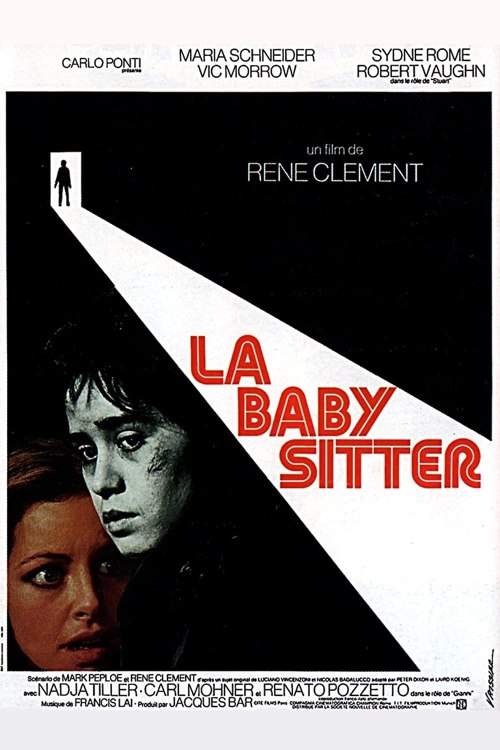
Michelle (Maria Schneider) is an artist who works part-time as a babysitter and is roommates with Ann (Sydne Rome) who’s an aspiring actress. Ann is upset that her career isn’t taking-off as quickly as she’d like and her frustrations cause her to get involved with her co-star Stuart (Robert Vaughan) who schemes to kidnap the 8-year-old son, Boots (John Whittington), of a wealthy food mogul (Carl Mohner) and then hold him for ransom. He hires Ann to disguise herself as Michelle while taking on a babysitting assignment of looking after Boots. She enters the place wearing a wig that resembles Michelle’s hairstyle and then forces Boots to drink something that will put him to sleep. He is then taken to another location where Lotte (Nadja Tiller), who is also in on the plan, pretends to be the boy’s mother and hires Michelle to babysit. When Michelle arrives at the alternative address she’s completely unaware of what’s going on, but soon finds herself trapped by the criminals forcing her to work with the distrustful boy to find a way out.

This was the final film directed by Rene Clement who did many acclaimed movies throughout his long career, but towards the end focused on kidnapping stories that had an offbeat touch like The Deadly Trap and And Hope to Die. This one is similar to those as it features in elaborate scheme that gets presented in fragmented style requiring the viewer to piece it all together. For the most part it works particularly with Clement’s use of eccentric characters and moody atmosphere though it’s not a complete success.

Although just few years removed from having done Last Tango in Paris Schneider looks much more mature here and I liked seeing her in such a different setting even if Leonard Maltin, in his review, complained about her acting, which he described as ‘abysmal’.  I didn’t find her performance to be as bad and in a lot of ways it works particularly her expressive eyes that helps convey an innocent pleading look in an environment where she’s surrounded by otherwise sordid types. Maltin also criticized the casting of Renato Pozzetto, who gained fame in Italy as a stand-up comedian. I found his presence interesting as his pudgy body type went against the chiseled features that most men who play a love interest in a movie have and his unpolished thespian skills meshed with his confused and dim-witted character.

Vic Morrow scores as the short-fused kidnapper though he’s played this type of role a bit too often. Vaughan is okay as the sinister mastermind and the kid, whose only acting role this has been, is quite endearing. Yet out of everyone it’s Rome, an American born in Akron, Ohio who came to Italy in the late 60’s to break into showbiz and never left, that’s the standout. She’s probably better known for her modeling, singing, and early 80’s aerobic videos, but here she’s quite diverting as a desperate young thing ravaged with insecurities and whose wide-eyed, breathless delivery hits the bullseye.

Spoiler Alert!

The plot is intriguing up to the scene where the ransom gets paid-out, but the wrap-up is unsatisfying. Michelle had gotten tricked into making it look like she was a part of the scheme, she really wasn’t, but to an outsider it would seem that she was, so the fact that she doesn’t get questioned by the police about it was confusing. Having her go back to her boyfriend’s art studio and then having him arrive with a locksmith while she’s inside wasn’t clear either. Was he going to change the locks on the door and trap her in there without knowing it? If so this should’ve been explicitly shown and not just eluded to.

Alternate Title: The Babysitter

My Rating: 6 out of 10

Released: October 15, 1975

Runtime: 1 Hour 50 Minutes

Director: Rene Clement

Studio: Cite Films

Available: DVD, Tubi

L’Immoralita (1978)

limmoralita1

By Richard Winters

My Rating: 4 out of 10

4-Word Review: Child falls for killer.

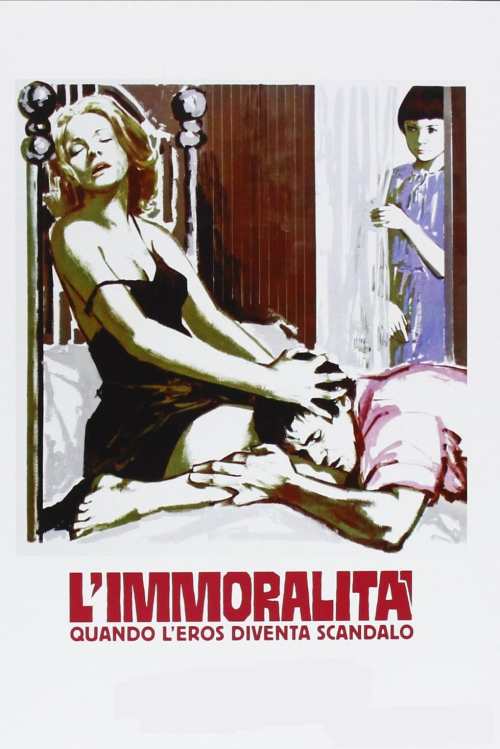
Simona (Karin Trentephol) is a lonely 12-year-old who lives with her mother (Lisa Gastoni) and her wheel chair bound step father (Mel Ferrer) in a secluded home on the Italian countryside. One day while walking through the forest that’s near her place she comes upon an injured man named Federico (Howard Ross), who has been shot in the arm by the police for being a dangerous child killer at-large. While he was able to escape the ambush the authorities continue their search, so Simona offers him sanctuary in a small coach house behind her home. It is here that she grows fond of him,but Simona’s mother finds out who she’s been hiding and tries to entice him to kill her invalid husband. Simona,who’s relationship with her mother is already strained, becomes upset that she can’t have Federico all to herself and plots a revenge on both of them.

This film is notorious for its depiction of child nudity and simulated sex. Back in the 70’s Italian filmmakers were on the front lines of shock cinema in their effort to push-the-envelope and attract curiosity seekers looking to see how far the next controversial film would go. This one, while dull and generic story-wise, definitely goes to the extreme at the one hour mark, when a naked Simona jumps out of the tub and then lies on the floor begging for Federico, who’s in the bathroom with her, to ‘make a baby’. While an adult stand-in was then used for the simulated sex it’s still an explicit moment that will disturb most viewers and likely will never get a DVD/Blu-ray release here though in Italy it has.

If you take out the controversial moment, which wasn’t needed and could’ve been implied, the film is otherwise quite sterile. There were a few things I did like including the subtle yet haunting score by the incomparable Ennio Morricone and the film’s faded color. I’m not sure if this was intentional, or just the print of the DVD, but the off-color nicely reflects the immoral characters who seem normal initially, but quickly reveal their twisted natures underneath. Trentephol, whose only film appearance this is, is outstanding. I don’t know where the producers found her, or quite frankly how they got her paent’s permission to play such a difficult role, but she lends an amazing presence particularly her piercing blue eyes that clearly conveys her character’s inner disdain for those around her.

Gastoni, who was quite prolific in Italian films during the 50’s and 70’s, but then went on a sabbatical after doing this one and didn’t appear in another movie until 2005, is good too as an aging, jaded woman where nothing it seems is too vile to upset her. The conversations she has with her daughter are truly warped, but still something you might hear in a family that was as dysfunctional as this one. Even the aging Ferrer, who at one time was a budding star, but relegated to finding work in overseas productions when Hollywood quit calling, gets an intense moment where he angrily points a rifle to his chest and then challenges his wife, who he knows wants him dead, to pull the trigger.

The story’s weakest element is Federico. While we see him dig the grave of one of his victims at the start, we never witness him killing anyone, which hurts the tension as he’s not volatile and threatening enough. Instead he’s overly passive while being lead around by both Simona and her mother. Maybe that was the point, to show how women ultimately control men even the dangerous ones, but it’s not handled in a way that’s interesting. Everything gets played-out in a heavy-handed fashion including a climax that offers little punch.

Alternate Title: Cock Crows at Eleven

My Rating: 4 out of 10

Released: November 20, 1978

Runtime: 1 Hour 49 Minutes

Not Rated

Director: Massimo Pirri

Studio: Una Cinecooperativa

Available: DVD (Import Region 2)

What the Peeper Saw (1972)

peeper1

By Richard Winters

My Rating: 4 out of 10

4-Word Review: Child could be killer.

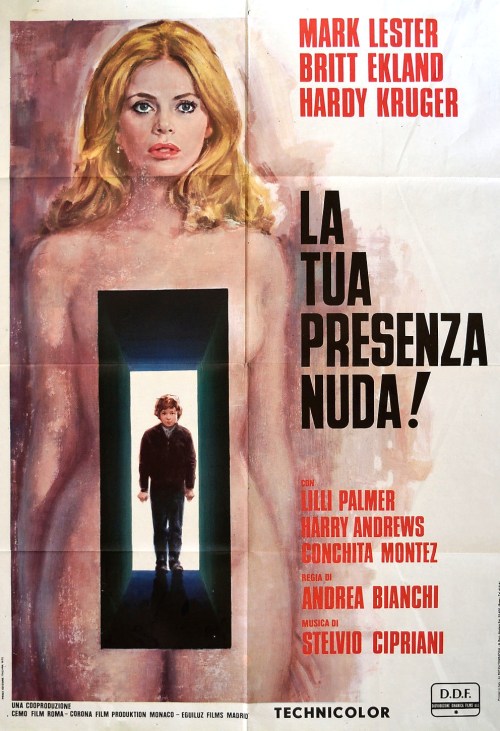
Elise (Britt Ekland) marries wealthy author Paul (Hardy Kruger) and then after the nuptials comes into contact with his 12-year-old son Marcus (Mark Lester) still grieving over the death of his mother 6 months earlier. Elise had the understanding that the mother, who died from drowning in her bathtub, was accidental, but as she gets to know Marcus she suspects that he may have had something to do with it. She then speaks to his school’s headmaster (Harry Andrews) and learns that Marcus has been having disciplinary issues including that of torturing and killing animals. When Elise tells Paul of her suspicions he refuses to believe it, which pits her against both the father and boy.

While the story may have intriguing elements, though it does sound too much like The Bad Seed, the execution is poor. It starts out right away with Elise meeting Marcus, no backstory scenes showing how Elise met Paul are shown, and right away he acts weird and creepy. There’s no nuance or layers to the story, just one long ‘is he a killer, or not’ scenario that ends up being highly talky with no real thrills. The producers, apparently realizing the proceedings needed some spicing up, hired Andrea Bianchi to come in and add some sexually tinged moments including a scene where a nude Lester, sitting in a bath tub, begins fondling Britt’s breasts, who is sitting outside the tub fully clothed. If that wasn’t shocking enough there’s another scene later where she strips fully naked in front of him, but neither of these moments, as sleazy as they are, makes this otherwise tired and placid plot any more intriguing.

The film’s only real selling point is to see child star Lester playing against type. He shot to fame in the starring role in Oliver!, but all of his roles after that couldn’t capitalize on his talents and like with this one were weak and pedestrian that didn’t give him much to do. Watching him play an evil kid, instead of the angelic lad like we’re used to seeing, is interesting to some extent and he does it surprisingly well, but he’s not in it enough.

As for Britt she’s quite beautiful and the camera focuses on her lovingly, and the male viewers certainly won’t mind her nude scenes of which there are plenty, but her character is poorly fleshed-out. It’s hard to understand why she married Paul as he treats her in a callous way and clearly favors the kid over her, so why stay in a relationship if she’s just going to be the spare tire especially with a psycho kid that’s just going to put her life more and more in danger? Any sensible person would pack-up and leave and the fact that she chooses to stay in such a bad and uncomfortable situation makes her seem as nutty as the rest.

Things pick-up during the final 10-minutes which gets filled with a lot of wild imagery though some of this should’ve been sprinkled though out the film, which is too cardboard otherwise. The final twist is a bit of a surprise, but the whole thing could’ve been better paced. Everything hinges too much on the provocative overtones while the characters are one-dimensional and fail to resonate and thus causing the viewer to remain pretty much detached emotionally from everything that goes on and the twists that do occur fail to deliver any punch.

My Rating: 4 out of 10

Released: October 14, 1972

Runtime: 1 Hour 35 Minutes

Rated R

Directors: James Kelley, Andrea Bianchi

Studio: 20th Century Fox

Available: DVD, Blu-ray

Spasms (1983)

spasms3

By Richard Winters

My Rating: 3 out of 10

4-Word Review: Giant snake uses telepathy.

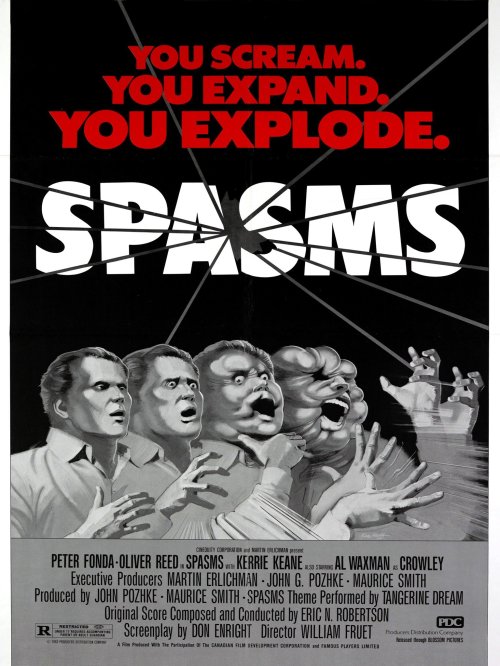
Years earlier millionaire philanthropist Jason Kincaid (Oliver Reed) got attacked by a giant serpent snake while on a trip in Micronesia. His brother, who went with him, died from the attack, but Jason survived and in the process began acquiring a telepathic connection to the snake. He pays some poachers to capture it and have it brought to his mansion. He also tries to use the services of Dr. Brasilian (Peter Fonda) who specializes in ESP research to help end the ongoing communication that the snake has with him.While Kincaid’s private lab is being constructed the snake is kept at the university lab run by Brasilian, but the reptile escapes and begins killing anyone it sees.

The film is based on the novel ‘Death Bite’ by Michael Marky and Brent Monahan, who wrote it in hopes of cashing in on the Jaws craze and having it made into a movie. The two were excited when a Canadian production company decided to produce it, but quickly became disillusioned with all the production delays and rewrites. When the original studio went bankrupt and the new one insisted on adding in a supernatural element the two writers to walk-off the set and disown the project.

Despite the film’s checkered history I found the production values to be quite impressive especially for a horror movie. The on-location shooting is varied and authentic, particularly the island setting and the main character played by Reed is less cardboard than in most other scary movies. Unfortunately the pacing is slow and not enough happens. I was expecting more scares and blood, but there really isn’t much of it.

The film’s biggest downfall is that you never get to see the snake. Initially during the attacks everything gets shown from the snake’s point-of-view by having a blue filter put over the camera lens, which doesn’t work because it’s done via a tracking shot making it look like the snake glides through the air instead of slithering like a real one would. Outside of a few seconds of seeing its head pop-up, which looks like a hand puppet, we’re never shown the beast in its entirety. Originally the idea was to use live snakes, which would’ve been great, and a 14-foot Indian Python was brought in, but this was found to be too costly and time-consuming, so it got scrapped. They then tried to use animatronics, but director William Fruet didn’t like the way it looked onscreen, so this was shelved too essentially making this a snake movie, but without any snake.

Despite being reportedly drunk most of the time during the production Reed adds a nice intensity though it made no sense at the end when he begins walking around without a cane even though he had being using one the whole time earlier. The special effects showing the victim’s arms and faces ballooning out after they’re bitten is pretty cool, but the ending is a letdown. It was supposed to feature a violent showdown between Reed and the snake, including having his arm swallowed by the beast, but director Fruet didn’t like the look of the special effects, so these scenes were cut and flashbacks showing things that had happened earlier got thrown-in simply to pad the runtime.

The big lesson here is that if you’re going to make a movie about a giant, monstrous snake then you need to at some point show it. Even if it means spending big on computer effects, or bringing in a real one, the effort has to be made. Trying to do one without actually showing the snake, as the snake here is probably seen a combined 10 seconds and never its full body, and expecting the audience to still go home satisfied afterwards is pretty absurd.

My Rating: 3 out of 10

Released: October 28, 1983

Runtime: 1 Hour 30 Minutes

Rated R

Director: William Fruet

Studio: Pan-Canadian Film Distributors

Available: VHS

The Corruption of Chris Miller (1973)

corruption

By Richard Winters

My Rating: 8 out of 10

4-Word Review: Is he the killer?

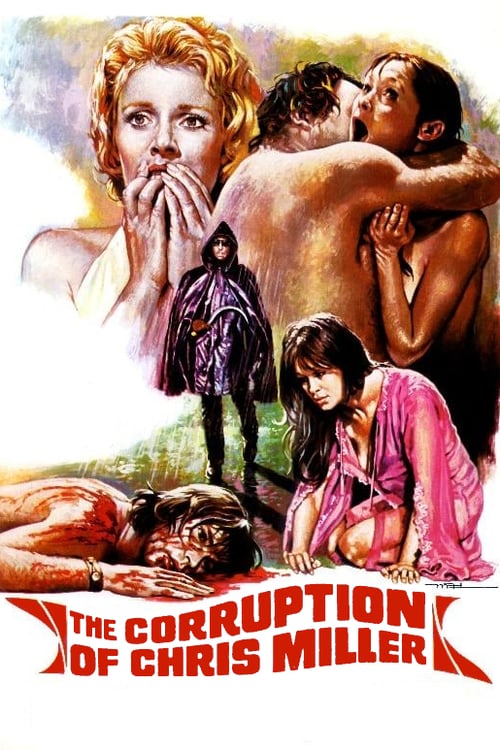
Ruth (Jean Seberg) has been abandoned by her husband leaving her alone in his large isolated estate with only his daughter Chris (Marisol) to keep her company. Chris has issues of her own as she was raped years earlier as a teen while in the girl’s shower at her school by a weightlifter and whenever it rains the sound of  falling water brings back the horrible memories, which cause her to lash out with a sharp object, as if defending herself, to anyone who comes near. Ruth has learned how to talk her down from these episodes, but she’s getting tired of dealing with it as well as the hateful comments that Chris gives her as she blames Ruth for her father leaving them. Barney (Barry Stokes) is the drifter who comes into their lives. Initially it was just for the night, but as he gets to know the two and their inner-dynamics he becomes intrigued as well as sexually attracted to Chris. He and Chris begin a romance, much to the displeasure of Ruth, who wants Barney to herself. Meanwhile there’s a rash of killings that are going-on in the nearby town and Ruth and Chris begin to believe that Barney may be the culprit. 

The film was helmed by renown Spanish director Juan Antonio Bardem and while differing some from the giallos released in Italy this is still considered in high regard by fans of the genre. Bardem’s use of mood and atmosphere are the main selling points. The house, both the one that Ruth and Chris reside in as well as the stately country manor that gets featured during the opening murder, are given strong foreboding presences and the non-stop pounding rain adds an eerie element. 

The gore isn’t quite up to the level of Italian horrors. There’s lots of blood, but the onscreen violence is minimal. There’s also a lot of soft-focused shots of horses galloping and of the beautiful Marisol riding on one until it almost seems like a non-horror film, but there’s enough underlying intrigue to keep it interesting through the slow spots. The climactic stabbing more than makes up for it as it features shots of the blade going directly into the naked flesh of the victim versus done over clothing where the prop knife can more easily be concealed. It also gets done in slow-motion, which makes it look even more horrifying, but in a visually striking sort of way. 

The acting is excellent and includes Seeberg, who was once the darling of the French New Wave during the early 60’s, but by this time had gracefully grown into middle-aged roles, of which she does well though her facial expressions are a bit overdone. Marisol, whose career began as a child singer, is terrific too and in some ways she upstages her co-star with her distinct eyes, which have an hypnotic effect that focuses your attention on her in every scene that she’s in.

Spoiler Alert! 

The twist ending is original though questionable. The reveal of the killer, played by Rudy Gaebel, is a bit mechanical as no explanation is given for what lead police to him, we just see him carted away in hand-cuffs, where having a smoking-gun reason that the viewer could understand would’ve been more satisfying. Having the townspeople celebrate his arrest seemed a bit precipitous as sometimes murderers can still have mistrials, or be deemed not guilty by a jury, so just having some guy nabbed by the authorities doesn’t end things it’s just the beginning especially since police can be known to sometimes arrest the wrong person.

Having pea sprouts grow through the cracks in the tar of the roadway, which causes the road crew to dig up that portion of the highway where they then discover the dead body of Barney, which Ruth and Chris buried there, is a problematic too. First I’m not sure pea sprouts would be a strong enough plant to create such cracks and it would take many years for that to happen. The police wouldn’t necessarily know who buried him as Chris was only seen in public with Barney once by a family that eventually got murdered, so there’s otherwise no direct link between him and the women. Therefore the discovery of  the corpse would not immediately lead to the women’s arrest, as the movie seems to want to imply, if ever. 

My Rating: 8 out of 10

Released: May 17, 1973

Runtime: 1 Hour 52 Minutes

Rated R

Director: Juan Antonio Bardem

Studio: Ibercine S.A.

Available: DVD, Blu-ray, Tubi