Category Archives: 70’s Movies

Russian Roulette (1975)

By Richard Winters

My Rating: 4 out of 10

4-Word Review: Trying to stop assassination.

When a Soviet leader decides to visit Vancouver the Russian Embassy puts the Canadian authorities on alert about Rudolf Henke (Val Avery) who moved to Canada many years back, but is reported to still hold grudges about the Soviet Union and could be a sniper threat. Timothy Shaver (George Segal) is then secretly hired to kidnap Henke while the Soviet leader is in town and then let him go once that leader has left. However, when Shaver gets to Henke’s apartment he finds out that he has already been abducted by somebody else, which leads him to believe that he is being made a pawn to an even bigger conspiracy and that he may become their next victim.

The story is based on the novel ‘Kosygin is Coming’ by Tom Ardies and the first 45 minutes of this are actually quite diverting. Director Lou Lombardo gave his actors the freedom to ad-lib and he instills some quirky humor, which made me believe this was going to be a new wave-like actioner that deftly mixes in the offbeat perspective with a story that had an intriguing mystery angle.

Unfortunately the second half devolves into cheesy action flick with all the usual formulaic trappings. The biggest problem is introducing the Russian bad guys who speak in inauthentic, corny accents that made them become like caricatures that lessens the tension instead of heightening it. The film would’ve been better served had it not shown the villains at all until the very end and kept things solely focused on Segal as he tries desperately to figure out what is going on while being chased by a mysterious group of people whose motives are unclear.

There are a couple of stupid moments as well.  One of them occurs when Segal and his girlfriend played by Cristina Rains return home. She immediately runs into the bathroom to take a pee, but then just as quickly comes back out wearing a strange expression. Segal then walks in to see a dead body of a murdered stranger sitting on the toilet. I know this may make me sound like a sexist to some, but the truth is women have a tendency to scream when they are startled and sometimes for a lot less than an unexpected sight of a corpse in their bathroom, so having her not instinctually scream here (hell even I would’ve probably let out a shrill yell at that point) is dumb.

Another part has Segal and Rains handcuffed and sitting in a backseat of a car that is being driven by one of the Russian bad guys. Segal, in an apparent attempt to escape, kicks the Russian guy in the back of his head, which sends the car reeling off the road and overturning into a ditch. However, this to me seemed dangerous because what guarantees that Segal and Rains wouldn’t be injured when that occurs. As it turns out the driver ends up conveniently dying in the crash, but miraculously the couple get out of the badly banged up car without even a single scratch, which is beating astronomical odds!

Segal wasn’t the best choice for the role. He spent the 70’s decade playing mostly in light comedies and romances, which he is more adept at, but presumably took the part to help stretch his acting resume and avoid being typecast. It doesn’t fully work and there were other actors who would’ve been better able to reflect the film’s gritty tone although watching Segal do mostly his own stunt work as he climbed out to the top of the roof of The Fairmont Hotel in downtown Vancouver does deserve kudos.

The supporting cast proves to be more interesting. I enjoyed seeing Louise Fletcher in her second movie after coming out of a 10-year hiatus. She has only a small role here, but she makes an impression nonetheless and it’s interesting seeing her play a person with such a sunny disposition when later that same year she portrayed the dour Nurse Ratched, which only proves what a talented actress she really is.

Val Avery is equally good in a part that has no lines of dialogue, by his own insistence, but still ends up being a scene stealer not only at the end when he stumbles into a scared crowd while wearing a bomb, but also in an earlier scene where he plays a cruel trick on a group of children playing roller blade hockey in the street.

Unfortunately the rest of the movie doesn’t have enough of a payoff. The action gets overplayed and the blaring music takes away the sophisticated feel and puts it more on the level of a bubblegum TV-show. Some good potential gets marred by an indecisive director who reportedly was suffering from drug addiction at the time and the effects show.

My Rating: 4 out of 10

Released: August 20, 1975

Runtime: 1 Hour 33 Minutes

Rated PG

Director: Lou Lombardo

Studio: AVCO Embassy Pictures

Available: DVD

The Internecine Project (1974)

By Richard Winters

My Rating: 6 out of 10

4-Word Review: Killing off his enemies.

Robert Elliot (James Coburn) is a former spy whose been given an offer as government advisor, but he must get rid of four people (Ian Hendry, Michael Jayston, Harry Andrews, Christiane Krueger) who hold secrets to his past before he can accept the position. To accomplish this he comes up with an ingenious plan, which consists of tricking these four to kill each other off all on the same night at around the same time while Robert sits comfortably at home and tracks their progress.

This is the type of intricate plot  that usually works best as a novel, but director Ken Hughes has things pretty well thought out. The first half isn’t too gripping, but once Robert’s scheme gets going it becomes quite intriguing. The plan certainly does border on being over-the-top and too dependent on the participants doing everything exactly as their instructed in order for it to be successful, but overall I felt it could’ve been possible, which is the main ingredient that makes it work as it manages to remain delicately within the realm of believability.

The supporting cast play their parts to the hilt complete with nervous ticks and flawed personalities, which helps add a fun dimension. Although clearly done on a modest budget the camera work and set design are creatively handled including one unique scene where the victim gets strangled by her killer through a shower curtain.

I also liked how one of the killers played by Christiane Kruger requires her instructions, which are given to her verbally by Coburn, to be repeated and written down as she is afraid she might forget them otherwise. I would respond in the exact same way even though most other movies in this genre will have the instructions spoken very quickly and only once, which would always make me wonder how they’re able to keep it all straight.

The only downside is the twist ending that seems like it was thrown in as a cutesy way to the end the film without much thought put into it. A really good twist should have some foreshadowing earlier that doesn’t seem all that important at the time and then when it’s all over allow the viewer to think back and go ‘A-ha, I should’ve seen that coming!’, but that’s not the case here.

If anything I would’ve had Lee Grant’s character more instrumental to the outcome as I could see no other purpose for her presence otherwise. I spent the whole film wondering why she was even in the movie and when it was over I was still asking that same question. She’s a beautiful lady, but her role is unfocused. One minute she’s feisty feminist and then the next she’s an emotionally needy wreck. She plays it well, but her efforts do nothing to propel the plot.

My Rating: 6 out of 10

Released: July 24, 1974

Runtime: 1 Hour 29 Minutes

Rated PG

Director: Ken Hughes

Studio: Allied Artists Pictures

Available: DVD, Blu-ray, Amazon Video

The Great Smokey Roadblock (1977)

By Richard Winters

My Rating: 4 out of 10

4-Word Review: Old man keeps truckin’.

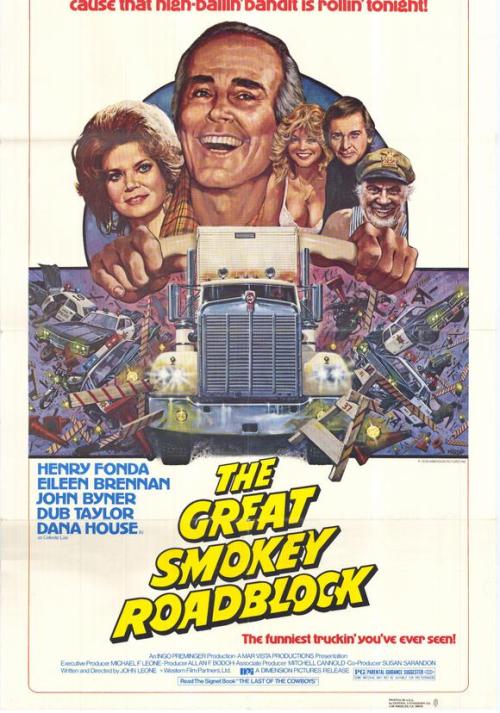
John Howard (Henry Fonda) is an aging truck driver laid up in a hospital while his rig is repossessed. Feeling that his life may soon be ending he decides to escape from the hospital, take back his rig, which he has named Eleanor after the First Lady Eleanor Roosevelt, and go for one last cross-country run. He picks up a spiritual hitch-hiker (Robert Englund) as well as a group of prostitutes who hide in the truck in an effort to escape the law, but the authorities are onto John’s plans and try to stop him before he can complete his trip.

If there is one reason to watch this otherwise flat and forgettable flick it is for the performance of Fonda, who despite his ailing health still had what it took and easily commands the screen from his other co-stars. In fact Fonda creates such a strong presence that many of the ‘colorful’ supporting characters could’ve been scrapped completely as the most enjoyable moments come with Fonda conversing with Englund who has a diametrically different personality and perspective, as the two drive down the highway.

Eileen Brennan lends good support in a rare dramatic role and it’s fun seeing Susan Sarandon, who also co-produced, playing a minor part as one of the prostitutes. She looks so young here and it was hard to believe that only a decade later she would have aged so much that she would be playing a prostitute again in Bull Durham albeit a much more mature one.

Dub Taylor is enjoyable as a crazy, hick, which he has done many, many times before and it should’ve gotten old by now, but he always exudes so much energy in his parts that its highly diverting anyways. However, the efforts by Austin Pendleton, John Byner, and Valerie Curtain aren’t as entertaining and the motivations of their characters so unclear that it would’ve been better had they not been in it at all.

The only action comes when John takes his truck and crashes it through a police barrier, which gets shown in slow-motion. Whether a truck would’ve actually been able to plow through several police cars and not cause any injuries or fatalities and no significant damage to the rig itself is highly dubious and only helps to prove how trite and whimsical this whole thing is.

There are moments when the film seems to be straining for something deeper, but it never gets there. There are so many other, far better road movies out there that this one doesn’t even deserve an honorable mention. Writer/director John Leone is clearly working over-his-head here and it’s no surprise that this was his only feature in a movie that amounts to being a passable time waster at best and nothing more.

Alternate Titles: The Last of the Cowboys, The Goodbye Run

My Rating: 4 out of 10

Released: September 7, 1977

Runtime: 1 Hour 44 Minutes

Rated PG

Director: John Leone

Studio: American Cinema Releasing

Available: DVD

Americathon (1979)

By Richard Winters

My Rating: 0 out of 10

4-Word Review: Time for a telethon.

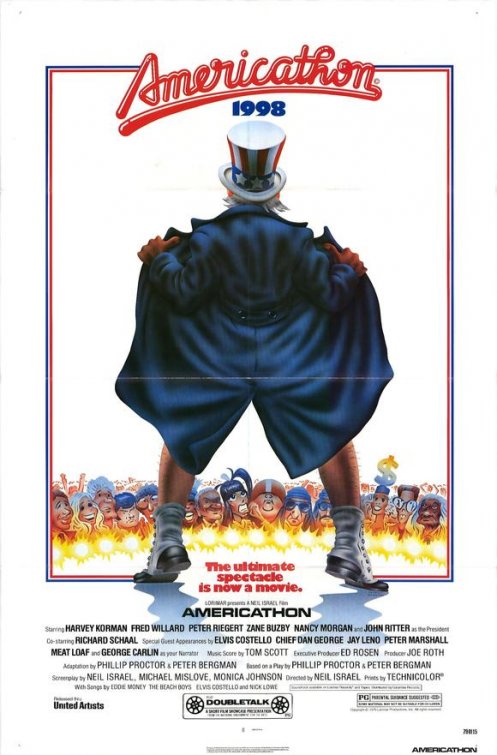
The year is 1998 and the nation is suffering from an oil shortage, which forces everyone to get around using bikes and roller skates while cars are now nothing more than immobile objects lived in by those with little money. Due to the energy crisis President Jimmy Carter and his administration are lynched by an angry mob and replaced by a young, new-wave type politician named Chet Roosevelt (John Ritter). Chet’s first order is finding a way to save the country from bankruptcy and he decides to do it by broadcasting a national telethon hosted by B-celebrity Monty Rushmore (Harvey Korman).

The film is based on a skit done by The Firesign Theatre, which was a popular satirical group that poked fun of the politics and issues of the day by performing live action stories with a stream of consciousness narrative. The group was made up of four men who wrote all of their material together and no line of dialogue, or joke was allowed to be included in their scripts unless all four of them agreed on it.

While much of what they did was original and cutting edge this movie fails to capitalize on it. I was confused as to what the intended focus of the parody was supposed to be on. It seemed to be aiming for light satire, but the references and potshots that it does take in connection to politics, television and celebrities are quite sterile and the film is in desperate need of more edginess.

The pacing is also quite poor. The characters are nothing more than broad caricatures and the plot too over-the-top to take seriously, so the emphasizes is clearly on the humor, but the jokes needed a rapid-fire delivery like in Airplane to work instead of gags that are so subtle and drawn out that you barely even notice them.

The casting is off too. John Ritter is an engaging actor, but here he displays no energy at all and comes off like he’s been tranquilized with some sort of drug. Harvey Korman is talented in a sketch comedy setting, but annoying as a lead. The film seems to be aiming for the college crowd and 20-somethings, so why cast someone like Korman, who was in his 50’s at the time, and considered completely out-of-touch with that generation?

I did like Peter Riegert, who is appealing simply because he plays the only normal person in the cast, which should’ve been enough reason to give him the most screen time, which he doesn’t get, in order to help offset the misplaced ‘zaniness’ around him. I was also confused why George Carlin narrates the film instead of Riegert since he seems to be speaking through Riegert’s character.

Out of the entire runtime there are only two segments that are actually semi-funny. One includes a bit where Meat Loaf takes on a driverless car and defeats it like a matador battling a bull. Jay Leno plays a fighter in another segment who takes part in a boxing match against his own mother who continually taunts him by calling him ‘poopy butt’. Unfortunately everything else falls flat and nothing is worse than a comedy that thinks it’s being ‘hip’ and ‘edgy’ when it really isn’t.

Strangely both IMDB and Wikipedia list Cybill Shepherd in an uncredited role as the ‘Gold Girl’, which is very brief. Although the woman playing the part certainly looks and sounds a bit like Cybill I’m convinced that it really wasn’t her.

My Rating: 0 out of 10

Released: August 10, 1979

Runtime: 1 Hour 24 Minutes

Rated PG

Director: Neil Israel

Studio: United Artists

Available: DVD (Warner Archive), Amazon Video, YouTube

Capricorn One (1978)

By Richard Winters

My Rating: 6 out of 10

4-Word Review: Mars landing is fake.

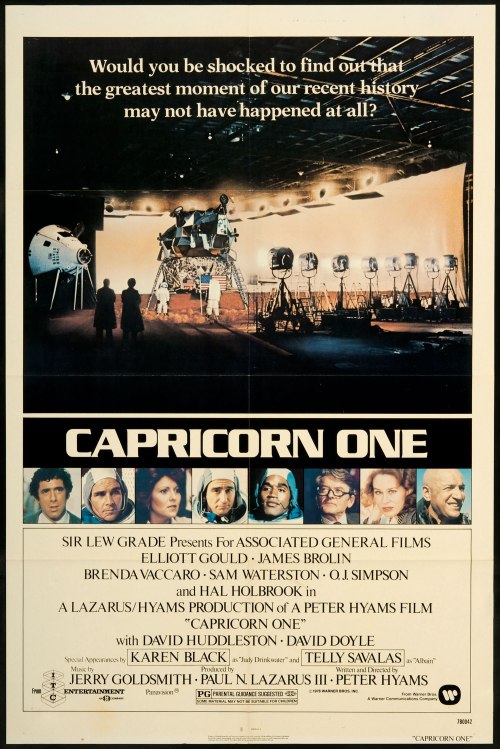
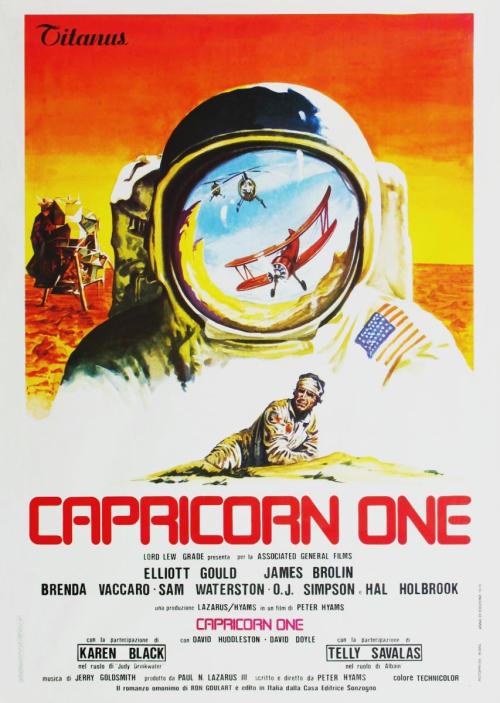
Due to finding out about having a faulty life support system James Kelloway (Hal Holbrook), who heads the NASA mars mission, decides to have the three astronauts (James Brolin, Sam Waterston, O. J. Simpson) removed from inside the rocket just before it is ready to blast off. He then allows the rocket to take off leaving everyone on the ground with the mistaken impression that the astronauts are still inside. The astronauts later walk onto a soundstage that is made to replicate the mars surface where they pretend to be walking on the planet live on television. As the rocket stays on mars the three astronauts remain trapped inside the NASA space center unable to let even their families in on their secret, but when the rocket returns to earth it gets accidently destroyed. Since the three men are still thought to be inside and since the government wouldn’t want to whole world to know it was a hoax the men are forced to make a daring escape across the hot desert in order to avoid being killed.

The script was originally written in 1969 and was an attempt by director Peter Hyams to take advantage of the moon landing conspiracy that was going on at the time, but no studio was willing to take it on, so it took 9 years and a change of planets before it finally got the green light. I’m not a big fan of conspiracy theories as I think a lot of them are too dependent on a great many people working together and being able to keep a secret in order for them to be pulled off. Since it’s hard for just two people to pull off a crime such as a murder without one eventually turning on the other, or breaking down under pressure, then it’s even harder to believe hundreds could keep quiet it in order to successfully pull off the so-called moon landing hoax, or that at some later time one of them wouldn’t have divulged the secret to a family member, friend, or even anonymously to the press.

In either case it’s an entertaining movie for the most part although the first hour is spotty and it only really gets gripping during second-half. To some degree I thought it would’ve been more interesting had the focus been on the people setting up the ruse and working to make the soundstage look like mars than on the astronauts. It also might’ve been more impactful to the viewer had they been given the idea that the landing was real and only when the men are seen walking on the mars surface does the camera pull back to show that it was all fake instead of revealing the conspiracy right from the start.

The problem that I had though was with Elliot Gould’s character. Don’t get me wrong I liked the way he plays the part as a sort-of disheveled, loser hero who strikes out with the ladies, but the fact that the government is on him so quickly and trying to kill him before he has even written one single report about the mars landing makes little sense. Later on he gets bailed out of jail by his boss, played by David Doyle, who openly admits to hating Gould and immediately fires him the second he pays his bail, but why spend company money on someone you don’t like and don’t want working for you?

Spoiler Alert!

The ending features a well photographed aerial chase through the skies that is very exciting, but the wrap-up in which James Brolin, who is the last surviving astronaut that manages to escape the deadly clutches of the government and appears to shock of everyone at his own funeral seems to ruin the premise. For conspiracy theories to hold their mystique there needs to be the idea that the bad guys were able to get away with it and that it is actually possible to successfully kill off all the possible leaks and manage to hold the rest to strict secrecy. By having someone survive only proves the point that I made earlier and thus makes all those other conspiracy theories that permeate modern culture seem dubious as well because mostly likely the same result would’ve ultimately happened with those that happened with this one.

End of Spoiler Alert!

My Rating: 6 out of 10

Released: June 2, 1978

Runtime: 2 Hours 3 Minutes

Rated PG

Director: Peter Hyams

Studio: Warner Brothers

Available: DVD, YouTube, Amazon Video, Blu-ray

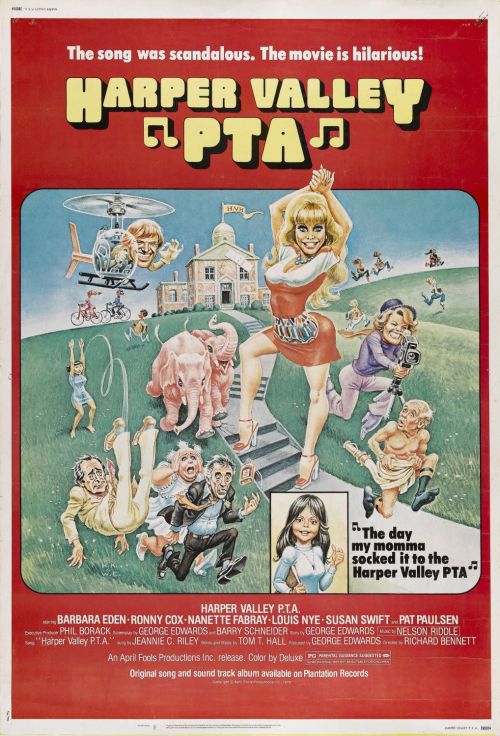
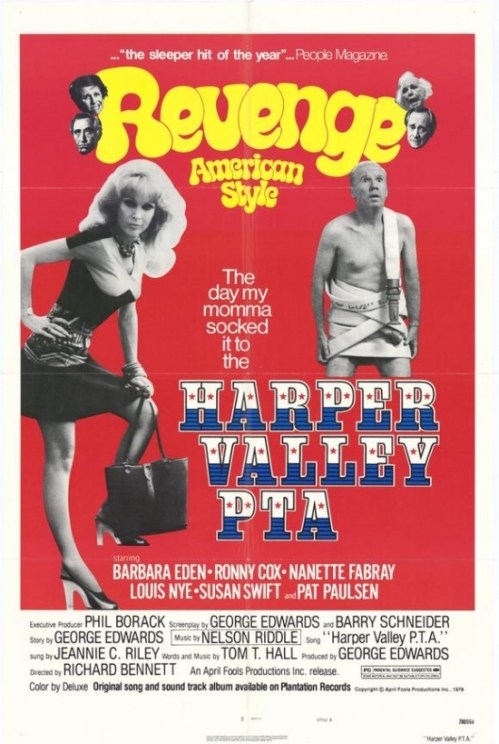
Harper Valley PTA (1978)

By Richard Winters

My Rating: 3 out of 10

4-Word Review: She gets her revenge.

Based on the hit 1968 song the story centers on Stella Johnson (Barbara Eden) whose liberated single life style and provocative way of dressing is considered ‘scandalous’ by the prudish members of her local school board. They give a letter  to her daughter Dee (Susan Swift) to be send home for Stella to read, which informs her that if she doesn’t ‘clean up her act’ they’ll have her daughter expelled. Stella then goes to the school board meeting and exposes all of their dirty secrets and then continues the harassment by playing dirty pranks on them one-by-one.

The song, which was written by Tom T. Hall and sung by Jeannie C. Riley, was a cute novelty ditty that encompassed the social rebellion of the late ‘60s through the scope of small town southern life. The film though ruins the song’s appeal by overplaying its theme and losing touch with its core issue.

The song had a very heavy country tinge to it making it seem that the setting should’ve been the Deep South, but for some reason the film takes place in Ohio instead. It also has the time period as being the present day, late ‘70s, which makes some of the lines in the song, which Stella reiterates pretty much word-for-word when she tells the board members off, seem dated and out-of-touch. Stuff like sock-it-to and ‘Peyton Place’ referred to hit TV-shows that by the late ‘70s had already been off the air for years, so the film should’ve either updated the script to make it more topical to the times, or had the time period be in the ‘60s, which like with the southern locale would’ve given the film a far stronger atmosphere.

Having Stella tell off the board members like in the song seemed sufficient, but having her continue her efforts by pulling elaborate pranks on them made it come off like overkill and in some cases borderline cruel and even criminal. The fact that other people in attendance at the board meeting clap and cheer when Stella humiliates the PTA board makes it seem that these people are on their way out and don’t have much of a hold over anything, so watching Stella continue to humiliate them further is not emotionally satisfying. They’re also so easily taken advantage of that the pranks cease to be either entertaining or funny.

The only segment that is genuinely fun is the one where a sex ed. film gets shown to the high school students. The film seems to be an actual product from the early ‘60s and features rather graphic animated illustrations. We unfortunately only get treated to a couple of minutes of it even though it was the funniest thing in the movie without ever actually trying to be.

Eden looks gorgeous and probably even hotter than she did in ‘I Dream of Jeannie’ minus the harem outfit. If you watch this for basic eye candy then you’ll be satisfied, but she speaks initially with a southern accent that she ends up losing by the second half.

John Fiedler gives good support by appearing fully nude in one segment despite not having the physique for it, so I commend his bravery. Audrey Christie shows equal regard by exposing herself with her head completely shaved, but overall the only character that I really liked was Susan Swift’s who seems the most relatable and like with the song her character should’ve been the central one and not Eden’s.

The threadbare premise gets stretched out far longer than it should. The story and the many pranks have a very redundant and mechanical quality to them that quickly becomes old. I’m not sure whose idea it was to try to turn the song into a movie, but it was one that should’ve been shot down quickly and never seen the light-of-day.

My Rating: 3 out of 10

Released: June 2, 1978

Runtime: 1 Hour 42 Minutes

Rated PG

Director: Richard C. Bennett

Studio: April Fools Productions

Available: DVD

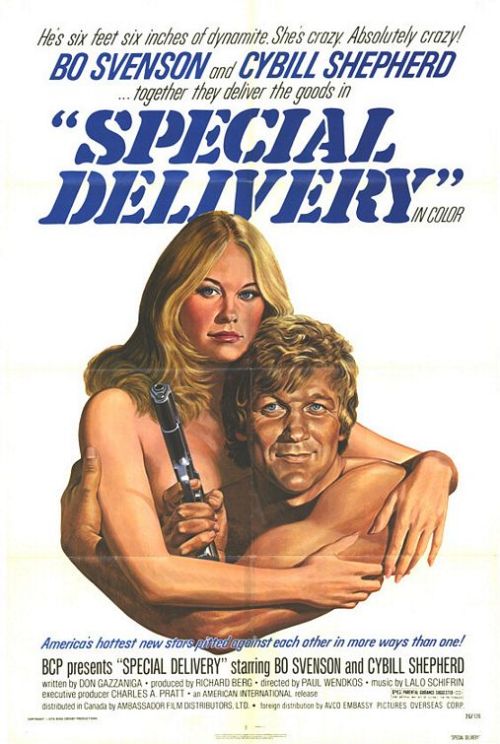
Special Delivery (1976)

By Richard Winters

My Rating: 6 out of 10

4-Word Review: Stolen loot in mailbox.

Jack Murdock (Bo Svenson) manages to pull off a daring bank robbery, but in an effort to elude the police he stashes the bag of money inside a mailbox and then waits for the late night mailman to open it up, so he can retrieve it. In the meantime he must deal with ditzy Mary Jane (Cybill Shepherd) who resides in an apartment just across the street from the mailbox and witnesses what Jack has done. She agrees to help him, but only if she can get a part of the take. They also must deal with a local bartender named Graff (Michael C. Gwynne) who is also aware of what Jack did and becomes determined to get at the cash before they do.

Although the film is labeled as a comedy it really isn’t. There are a few quirky conversations between Jack and Mary Jane, but it’s not much and most of the movie is quite gritty and tense. Watching the men trying to escape from the police by precariously climbing up the side of a building using nothing but a rope is realistically done and had me on the edge-of-my-seat. The scene where Mary Jane gets surrounded by a gang of bikers who try to rape her borders on being quite unpleasant and should’ve been excised as it adds nothing to the story, but in either case it solidifies this has being a hard-edged action flick that is anything but funny.

The plot is solid for the most part with my only complaint being that I’ve never seen, in any city that I’ve lived in, an outdoor mailbox with a late night mail pick-up of Midnight, or in this case 11:45 PM. Most mail boxes list 5 or 6 PM as the latest pick-up time and it would’ve worked better had it been earlier anyways as the darkness takes away a bit from the action. I also wanted the mailbox location to have been on an actual street corner and not a studio backlot as it would’ve given the film a more genuine atmosphere.

Svenson is amiable in the lead and seeing this really big, physical guy being so relatively soft-spoken creates a likable character. I also enjoyed the line he says to a group of bikers that he decides to single-handedly take on: “There’s one of me and only three of you.”

Shepherd is also quite good. I know I’ve bashed her in some of other film roles, but here her personality fits the part as she creates a kooky lady with a nice balance between being both eccentric and conniving.

Spoiler Alert!

The ending though is the one time that the film sells itself out as it features the two driving in a van that goes off a cliff and bursts into flames. The bad guys think Jack and Mary Jane were killed, but they managed to somehow escape it before it went over, but the film never shows us how this was done, which is a cop-out.

There is also a tacked-on twist that features the couple, having now successfully eluded both the bad guys and authorities, vacationing on a cruise ship where they catch the attention of two women, one of whom is the wife of the manager (Sorrell Booke) of the bank that Jack robbed. The women plot to make a play at Jack because they can tell from the outfit that Mary Jane is wearing that they are rich and therefore want to get at their money, but why reintroduce a character like the bank manager into the story when he was only seen briefly at the beginning and had very little to do with the main plot? And for that matter why should a wife of a bank manager plot to rob somebody else as she should be living an affluent lifestyle to begin with?

End of Spoiler Alert

Overall I found this to be a surprisingly fun movie that enters in just enough offbeat ingredients to make it original, but keeps the action consistently coming, which should be enough to please those that like excitement.

My Rating: 6 out of 10

Released: July 12, 1976

Runtime: 1 Hour 38 Minutes

Rated PG

Director: Paul Wendkos

Studio: American International Pictures

Available: VHS

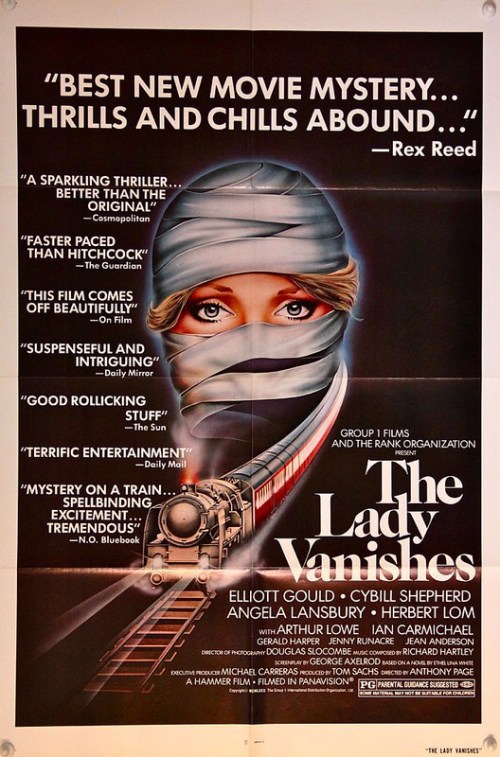
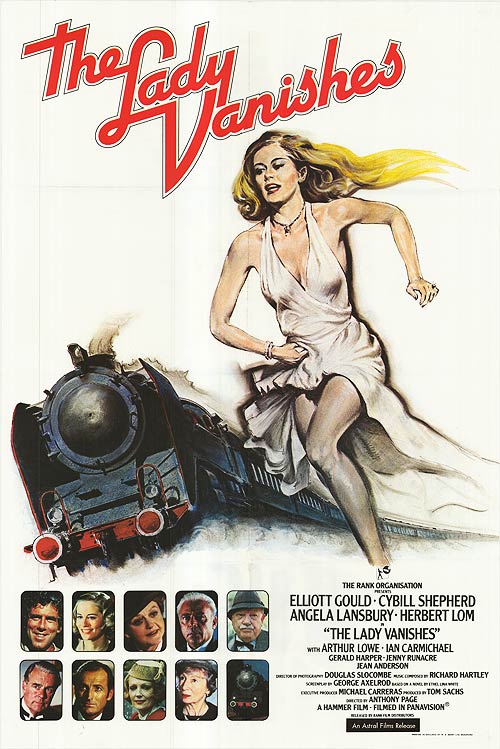
The Lady Vanishes (1979)

By Richard Winters

My Rating: 4 out of 10

4-Word Review: Where’s the old lady?

In 1939 while traveling by train from Bavaria to Switzerland American Heiress Amanda (Cybill Shepherd) befriends an English nanny named Miss Froy (Angela Lansbury). The two sit across from each other inside a train compartment. When Amanda awakens from a nap she notices that Miss Froy has disappeared and when she asks others where she went to everybody denies having even seen her. Amanda starts to question her own sanity and tries to use the assistance of American photographer Robert Condon (Elliot Gould) to help her figure out what is going on.

This film is a remake of the classic 1938 movie of the same name, which was directed by Alfred Hitchcock and based on the novel ‘The Wheel Spins’ by Ethel Lina White. I last saw the original over 30 years ago while attending college, so my memories of it are fuzzy and I’ll be unable to compare the two. However, I do remember enjoying it and feeling that this thing doesn’t quite reach the same level.

The biggest issue is the casting of Shepherd. I think she’s a gorgeous lady, I loved seeing her in the low cut white dress and at one point she even appears to bravely do her stunts by jumping off a moving train, but her acting is not up to par. She can be great as a bitchy, sarcastic woman or even as a kooky eccentric, but as someone we want to root for or sympathize with, no way. Some of her former co-stars including Bruce Willis and Christine Baranski have described her as being cold and competitive to deal with and that’s the exactly same vibe I get every time I see her. Her efforts to cover that up in an attempt to play a more likable character doesn’t work, so instead producers should cast her in parts that mesh with her personality while getting someone else more affable for this role.

Gould has the same problem. He looks bored and out-of-place and I don’t know why the nationalities of the two lead characters, which had been British in the original, were changed to American here, but it doesn’t help. Besides there is absolutely no chemistry between he and Shepherd, which makes the romantic angle come off as quite forced. He was also considerably older than her and they should’ve at the very least cast two people more in the same age range.

Even the great Angela Lansbury is all wrong here. She still gives the role a stellar performance with her best moment coming when her eyes well up with tears as the other passengers openly contemplate throwing her off the train and into the clutches of an SS officer standing outside, which proves that the truly great stars don’t need any speaking lines to convey just the right emotion.  However, she was only in her 50’s at the time and didn’t come off looking elderly. Dame May Whitty played the part in the original and was in her 70’s, which is what the age of the actress playing the part here should’ve been.

The basic premise is still entertaining enough to keep things passable, but I would’ve liked the mystery angle played up more by showing things only from Amanda’s perspective until the viewer started to question her sanity as well. The scene where Amanda sees the name Miss Froy written in the dust of a train window by the Lansbury character earlier and then having that name strangely disappear off the window after they go through a tunnel makes no sense. This was supposed to be a ‘realistic’ thriller and therefore surreal elements should not have been thrown in.

The climactic sequence is entertaining, Arthur Lowe is enjoyable in a supporting part, and the Austrian scenery is luscious, but the movie is marginal and only helps to make the viewer appreciate the original more than anything.

My Rating: 4 out of 10

Released: May 8, 1979

Runtime: 1 Hour 35 Minutes

Rated PG

Director: Anthony Page

Studio: Rank Film Distributors

Available: DVD, Amazon Video

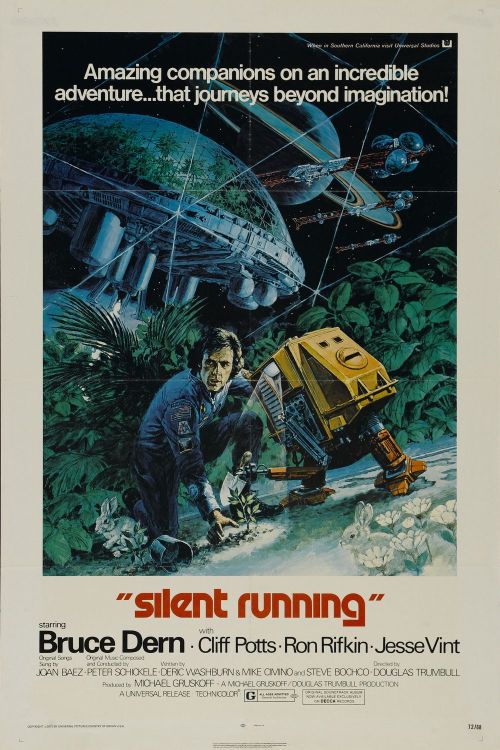
Silent Running (1972)

By Richard Winters

My Rating: 5 out of 10

4-Word Review: He saves the forest.

Freeman Lowell (Bruce Dern) is a member of a 4-man space crew residing on a shuttle called Valley Forge that house underneath giant glass domes plant and animal life that was made extinct back on earth. One day the crew is ordered to destroy these domes, but Freeman refuses and kills his fellow crew members when they attempt to. He then jettisons the craft further into space and uses robotic drones to help keep the forests alive, but is horrified to learn that the members of another space ship called the Berkshire have been able to locate him and now want to board his vessel where they’ll soon find out what he has done.

This film marks the directorial debut of special effects wiz Douglas Trumbull and much like with his ‘80s effort Brainstorm is strong on visual design, but lacking in story substance. The script never bothers to explain what caused the plant life on earth to die, or why they are suddenly forced to destroy the domes on the ship. It’s almost like the three screenwriters, which included Michael Cimino, were merely content to come up with a very basic concept with a lot of simplistic plot devices bundled together.

The way Freeman is able to trick his superiors on the other end of the radio relay into making himself look innocent is so pathetically easy that it is hardly entertaining to watch. I would’ve thought in such as technologically advanced age that there would be cameras installed on the ship, so others could monitor what happens and not simply rely on verbal feedback from the crew.

The story’s second and third acts are in desperate need of more conflict. Instead of wasting time showing cutesy, silly scenes of Freeman playing poker with the drones there should’ve been a bad guy nemesis on the ship trying to thwart Freeman’s attempts to save the forest. The way he is able to kill off the other crew members is too easy especially the Cliff Potts character as all Freeman has to do is lightly push down on Potts’ neck with the handle of a shovel and it’s enough to kill him even though I thought he had just been briefly knocked unconscious as Freeman never bothers to check the man’s pulse and this was the type of character who could’ve come back to life and hide out on the ship while creating trouble.

Attempts to add some intrigue by having the plants in the forest suddenly die off mysteriously is utterly lame. I immediately presumed that it was because of a lack of sunlight, but Freeman the so-called botanist takes several days and lots of research until he finally comes up with this same conclusion, which is pathetic.

The songs by Joan Baez are loud and shrill and having to listen to three of them simply to bulk up the runtime only proves how empty the script is. The numerous flashback sequences showing footage that the viewer has already seen earlier are equally unnecessary.

Dern is good and helps hold the thing together in a role that I felt was tailored made for his acting style and was surprised to learn that he was only given the part after 17 others had turned it down. I also liked the outer look of the space craft even though you could clearly tell that it was a miniature. Unfortunately there are not enough compelling elements in the story to keep it interesting and the long stretches where little happens will easily bore most viewers.

My Rating: 5 out of 10

Released: March 10, 1972

Runtime: 1 Hour 30 Minutes

Director: Douglas Trumbull

Rated G

Studio: Universal Pictures

Available: DVD, Blu-ray, Amazon Video, YouTube

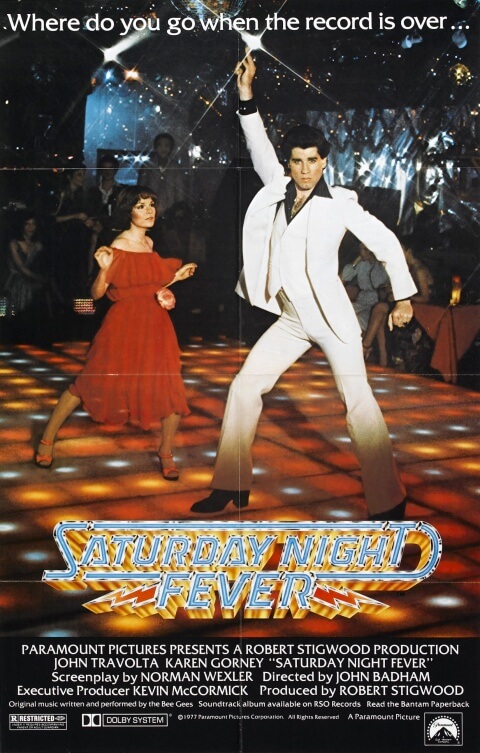
Saturday Night Fever (1977)

By Richard Winters

My Rating: 7 out of 10

4-Word Review: He’s a disco star.

This film is based on a 1976 story that was published in New York Magazine entitled “Tribal Rites of the New Saturday Night” by Nik Cohn, which for many years was considered a factual account of the disco trends of the young people at the time who frequented the disco 2001 Odyssey nightclub, but it later turned out, through the confession of its author, to have been totally fabricated. The story here centers on Tony (John Travolta) who still lives with his parents while working for low wages at a Brooklyn paint store, but longing for a more exciting existence. Despite being a ‘nobody’ during the week on Saturday nights he’s a star as he takes to the disco floor and has all the women flocking to him. Annette (Donna Pescow) is one of those women, but Tony finds her too unattractive and instead has eyes for Stephanie (Karen Lynn Gorney) who he wants as his dance partner in order to win a contest.

From the ads and promotions you’d think this was nothing more than a lightweight teeny bopper romance looking to take advantage of the current disco trend, but the film is much more than that. In fact the dance sequences are boring and thankfully director John Badham keeps these segments contained although I would’ve cut back on them even more. The real essence of the film is Tony’s relationship with his friends, family and world as a whole. The film works as a terrific composite of what life in Brooklyn during the ‘70s amongst the teens and young adults was really like as they try to forge their way into young adulthood while fighting to find their place in it.

Travolta gives an outstanding performance mainly because he’s one of those actors who isn’t afraid to expose the vulnerabilities of the characters that he plays as Tony isn’t a completely likable person and many times acts quite arrogant and callous, which leaves the viewer feeling like they’ve seen an unfiltered portrait of a real person with all the edges showing instead of just a manufactured image.

Pescow is great in support. The image of her holding out a hand full of condoms is the one thing I’ve remembered vividly from the movie from when I first saw it over twenty years ago and the scene of where she is assaulted in the back seat of a car by Tony’s friends is genuinely heart breaking.

My only quibble with her is the moment where Tony informs her that he is choosing a different dance partner for the contest and she immediately breaks down crying. My belief is that most people because of personal pride will not wear their emotional vulnerabilities that openly especially if they are downtrodden like her character. Instead I think she would’ve responded to the news in a sort of aloof/defiant way like saying ‘fine if you don’t want me then I don’t want you’ before walking away and then crying about it later in private.

Gorney’s performance was the one that I really didn’t like as her put-on Brooklyn accent is too affected. With Pescow you could tell it was the genuine thing as she was from the region originally, but Gorney was born in Beverly Hills and attended college in Pittsburgh, so her attempts at putting on an accent was not needed or warranted and made her character seem too much at Tony’s working class level when I thought the idea was to show that she wasn’t.

As for her relationship with Tony I liked the concept that these two were genuine opposites, but I wished the movie had played this up more. She’s initially cold towards Tony and rejects his advances and then a few days later without him having done anything differently she’s suddenly warmed up to him. I would’ve liked some situation created where she was forced to hook-up with Tony as a dance partner because her original partner took ill or something and then had the frostiness between them continue and melt away only when they are on the dance floor.

Spoiler Alert!

The ending is a bit limp. The fact that the two don’t end up getting into a long term romantic relationship, but instead agree to be ‘just friends’ is good as too many movies with this type of formula always seem to want to strive for the ideal love scenario, but in most real-world cases that just isn’t practical and these two had too much that was not in common and getting past those things would’ve proved futile.

However, the dance contest is a letdown as the film introduces a Puerto Rican couple who dance better than Tony and Stephanie, but Tony is still awarded the trophy supposedly because of racism, but why throw in this plot point so late? We’ve been following the trials and tribulations of Tony and Stephanie the entire way through not the Puerto Rican couple who we know nothing about. If the movie wanted to make a statement about racism at the club it should’ve been brought out much earlier and not at the very last minute when it becomes essentially pointless.

End of Spoiler Alert!

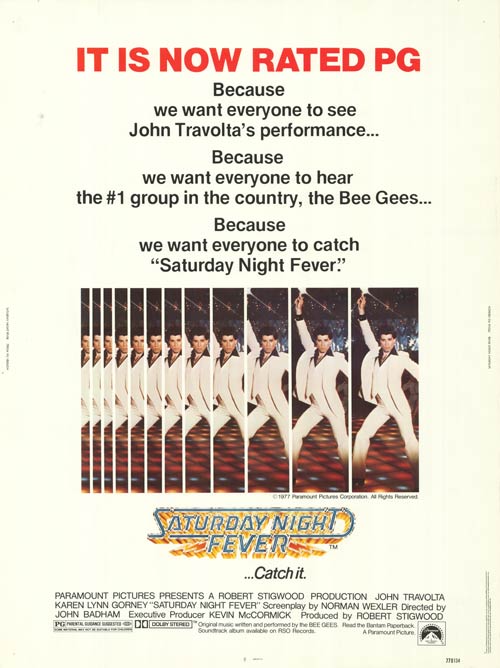
Overall though it’s a great movie that deserves its classic status as the characters and dialogue are richly textured and the film makes its message through subtle visual means without having to telegraph it. However, the PG-rated version, which was released two years later in an attempt to reel in the teen audience, sanitizes the story to the point that it takes out the heart of the film and should be avoided.

My Rating: 7 out of 10

Released: December 12, 1977

Runtime: 1 Hour 58 Minutes (R-rated version) 1 Hour 52 Minutes (PG-rated version) 2 Hours 2 Minutes (Director’s cut)

Director: John Badham

Studio: Paramount

Available: DVD, Blu-ray, Amazon Video, YouTube