Category Archives: 70’s Movies

Showdown (1973)

By Richard Winters

My Rating: 2 out of 10

4-Word Review: Friends go separate ways.

Chuck (Rock Hudson) and Billy (Dean Martin) were once close childhood friends, but as they grew older their lives drifted apart. Now Chuck is a sheriff while Billy has become a bank robber. When he and his gang rob a train it is up to Chuck to track him down and bring him to justice.

This flat and lifeless concoction was the last film directed by George Seaton who seemed to be slumming when he did this one as it’s derivative and formulaic to the extreme with nothing in it that is diverting or memorable. Part of the problem is the tone. It starts out as a potential western comedy with Billy riding on a train and pretending to be a sheriff. When the train gets attacked by the bandits he convinces everyone to put their valuables into a sack, so he can ‘protect’ them only to shock the people by absconding with them instead, which is kind of funny and had the film stayed at this level it still wouldn’t have been all that great, but at least more entertaining.

Unfortunately the rest of the story turns into one long, drawn-out drama that is both slow and pointless. The flashbacks showing the men when they were children are neither amusing nor insightful and could’ve easily been scrapped. I was also under the impression initially that the two men were brothers and the story might’ve had more impact had they been.

The film’s title seems to imply some big, climactic finish, which doesn’t really occur. Instead of waiting until the end for the two men to meet up with each other it actually occurs during the second act and when they do there’s no big confrontation or fireworks, which makes their interactions as flat and boring as the rest of the film. There is some mild tension involving Billy’s former gang members who want to track him down in order to inflict revenge on him for shooting another member of the gang, but this story angle doesn’t get played up enough and they’re given only moderate screen time.

Martin is engaging despite coming off looking washed-up and far older than the 57 years that he was with his hair looks dyed and buffed up by some Hollywood stylist. Hudson though is unable to match Martin’s charm making it seem like it would’ve been better had he not been in it at all and instead just solely focused on Martin trying to escape the clutches of the other gang members. Even Susan Clark, who is a great actress, gets wasted and miscast as Hudson’s wife as she looks too young to have been married to him and was in reality 18 years his junior making it more appropriate had she played his daughter.

My Rating: 2 out of 10

Released: June 20, 1973

Runtime: 1 Hour 39 Minutes

Rated PG

Director: George Seaton

Studio: Universal

Available: DVD-R (Universal Vault Series), Amazon Video, YouTube
Hardcore (1979)

By Richard Winters

My Rating: 6 out of 10

4-Word Review: His daughter does porn.

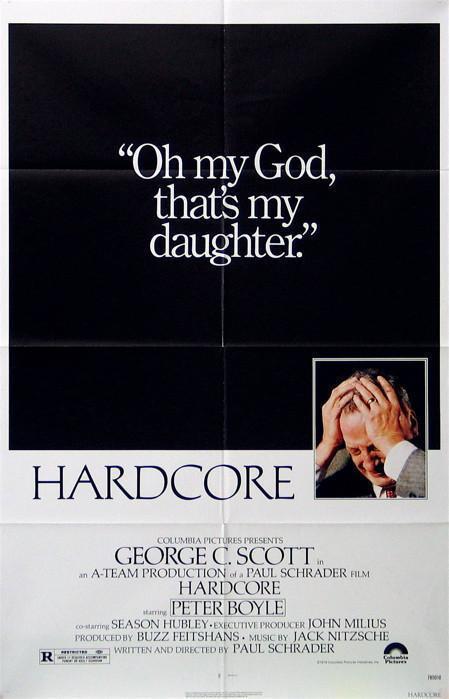
Jake (George C. Scott) is a conservative businessman living in Grand Rapids, Michigan, who is raising his teenage daughter Kristen (Ilah Davis) as a single parent only to have her disappear while on a church sponsored road trip to California. Jake then hires a detective (Peter Boyle) to track down her whereabouts and after some searching he finds that she’s entered the world of porn, which compels Jake to go to California and pose as a adult film producer in hopes that he can get information from those working in the business that will eventually lead him to Kristen.

While the storyline has some potentially interesting aspects it gets handled in too much of an over-the-top way, particularly at the beginning, to be fully effective. The opening song sung by Susan Raye is too heavily tinged with a country music sound and the religious aspects of the citizens, who debate Bible passages even during a holiday dinner, gets overplayed. Having a brief scene showing Jake leaving church after attending a service was all that was needed to convey that the character was on the conservative end without having to throw in all of the other heavy-handedness.

The segments dealing with the porn scene are equally botched. For one thing with the advent of the internet the adult film business has changed drastically making what we see here quite dated and irrelevant.  We also learn barely nothing about the daughter, or how exactly she got into doing porn. The film implies that she meets some man on her trip who apparently ‘tricked’ or ‘drugged’ or ‘kidnapped’ her into doing porn and that could be the only possible explanation for why anyone would ever do it, which I suppose at that time was the answer most mainstream audiences would accept. However, there are many famous female porn stars from that era who insist they choose to get into the business and weren’t forced.

The film would’ve been far stronger had writer/director Paul Schrader actually done some research into the people who worked in the business, which I felt he hadn’t done as the porn producers are portrayed in the same broad caricature way as the religious people at the beginning. Having the daughter choose to get into the business and then cutting back-and-forth between her dealings inside the adult movie world and her father’s search for her would’ve made the movie more insightful.

I did however enjoy seeing conservative/small-town Jake get plunged into a dark, seedy world that he wasn’t used to and the many adjustments that he makes, including buying a whole new wild wardrobe in order to fit in. His friendship with one of the female porn stars, which is convincingly played by Season Hubley, is quite fascinating especially their conversations and an aspect of the film that I wished had been played-up more.

Spoiler Alert!

The ending, which involves a big shoot-out on the streets of L.A. gets too Hollywood-like and should’ve been avoided. Having Jake finally meet-up with his daughter and their subsequent stilted conversation, was equally dumb and really hurts the movie as a whole. Originally the script had the daughter dying in a car accident before Jake was able to find her and since her character remains pretty much an enigma anyways, that’s the ending that they should’ve kept.

My Rating: 6 out of 10

Released: February 9, 1979

Runtime: 1 Hour 48 Minutes

Rated R

Director: Paul Schrader

Studio: Columbia Pictures

Available: DVD, Blu-ray (U.K. release) Amazon Video, YouTube

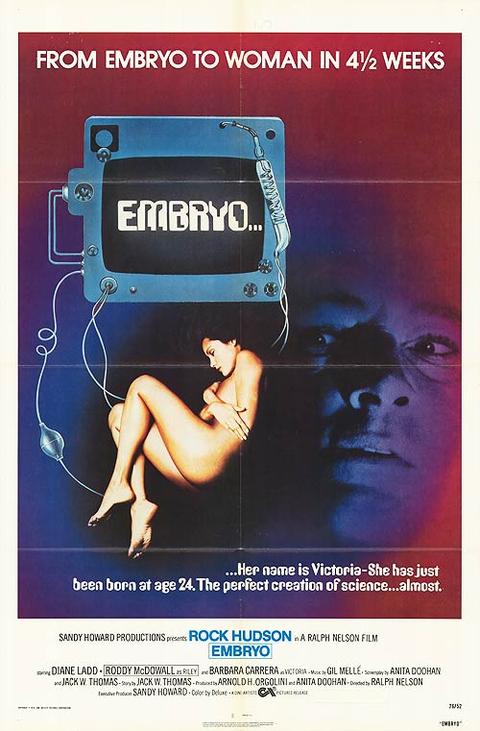
Embryo (1976)

By Richard Winters

My Rating: 6 out of 10

4-Word Review: Accelerating the growth cycle.

Late one night while driving home in raging thunderstorm Dr. Paul Holliston (Rock Hudson) accidentally hits a pregnant dog with his car. He takes the dog home to his lab and is able to save one of the embryos by placing it in an artificial uterus and then injecting it with an experimental hormone that speeds up its growth cycle. Paul is so excited about the results that he gets one of his colleagues (Jack Colvin) to agree to give him an unborn human baby from a mother who had committed suicide. Paul uses the drug on the fetus and finds that it grows at an even more accelerated rate, which leads to many unforeseen and horrifying scenarios.

For a grainy looking, low budget production (the DVD transfer is horrible) the plot isn’t too bad and had me guessing all the way up to the end at how it was going to turn out. The story has a lot of holes and most likely won’t be plausible to a science purist, but Ralph Nelson’s competent direction keeps the drama moving at a brisk pace, so you never dwell on the absurdities for too long and for the undemanding viewer it may come off as believable enough. The film also has a unintentionally funny moment that may not have floored audiences back in the 70’s as it did with me and features Barbra Carrera reading the Bible, which she finds ‘illogical’ only to have Hudson a supposed scientist tell her that it’s an ‘accurate account of how life began’, which blew me away as I’m sure there are few scientists who would say that today.

Carrera does surprisingly well in a difficult role, but her ability to retain knowledge and learn things happens a little too quickly and isn’t interesting. I realize she’s supposed to be super smart, which is fine, but even a smart person needs to be taught how to read and the meaning of words to communicate, which is something that the film just glosses right over.

I was glad that there was a big age difference between the two stars and that a romantic angle wasn’t forced into the proceedings that would’ve just bogged everything down, but having the two end up going to bed together was almost as bad. Hudson had taken a very paternal approach to Carrera almost like she were his daughter, so when she asks him to have sex with her, so she can feel what it’s like, I would’ve thought it would be too uncomfortable and too awkward a situation for him to go through with.

Roddy McDowall has a great cameo as an arrogant chauvinistic chess player. There’s also an interesting car chase, a neat twist ending, and some good aging make-up effects, but Carrera’s dilemma of suddenly going from being healthy and vibrant to on the brink of death is jarring. It’s almost like the writers wrote themselves into a hole and couldn’t think of any way out of it except to insert having the character die from some mysterious illness even though the dog, who went through the same treatment, is not affected, which is a shame as the premise is intriguing and works for most of the way.

My Rating: 6 out of 10

Released: May 21, 1976

Runtime: 1 Hour 44 Minutes

Rated PG

Director: Ralph Nelson

Studio: Cine Artists Pictures

Available: DVD-R, Amazon Video

Earthquake (1974)

By Richard Winters

My Rating: 4 out of 10

4-Word Review: Los Angeles really rocks.

A jolt from a massive earthquake shakes the Los Angeles metro area one morning, but researchers at the nearby seismological institute fear that there may be another one that will be far stronger and yet they hesitate about warning the public fearing that it may create ‘too much panic’. They agree instead to alert the National Guard about it, so they can prepare for the fallout when it happens, but in the meantime many innocent people go about their day including those working in skyscrapers ill-prepared for the tragedy that is about to befall them.

Due to the success of disaster flicks during the 70’s many studios clamored to get on board and while this concept may have sounded good in theory, it really leaves on lot to be desired. For one thing most earthquakes last on average for only 10 to 25 seconds, so the majority of the film deals with boring, soap-opera-like drama of a bunch of cardboard characters both before and after the quake while there’s probably less than 5-minutes of actual quake effects.

The special effects are, despite winning a Special Achievement Award at the Oscars, not very convincing and come off looking like shots of miniatures homes and buildings made of paper that could easily fall apart without much effort. The shot showing workers falling down while on the Mulholland Dam  appears more like they’re all dancing some sort of gig and then intentionally dropping themselves to the ground as part of the dance routine.

The film is also notorious for its elevator scene in which people get stuck inside an elevator as the quake occurs and then it goes plummeting down the shaft before eventually crashing and killing everyone inside. However, due to an inability to effectively spray stage blood onto the stunt people, director Mark Robson decided to have animated blood added in during post production, which looks as cartoonish as it sounds and puts an embarrassing, amateurish mark on the entire production.

The casting is out-of-whack as well and features Charlton Heston in the lead as a sort of hunk even though he was 50 and too old for that type of thing, but is still seen sweaty and shirtless in a couple of scenes nonetheless. Ava Gardner livens things up a bit as Heston’s clingy, bitchy wife, but having her portrayed as being Lorne Greene’s daughter, who in real-life was only 8 years older than her, was ridiculous.

I did enjoy Marjoe Gortner as the psycho grocery store manager, who after the quake occurs, puts on a wig and takes part as a member of the National Guard to control the looters only to become more of a nemesis than a help. Walter Matthau, who appears in a bit part wearing an Afro wig, is funny as a patron at a bar who’s so drunk he’s oblivious to the chaos.

Spoiler Alert!

The only part of the movie that I really liked was the end where Heston is helping people out of an underground tunnel that is filling up with water and instead of climbing up out of the hole to his lover, played by Genevieve Bujold, who is waiting for him with open arms, he jumps back down to save his bitchy wife only for them to both end up drowning, which I found interesting. Too many movies especially the ones made these days, always have the hero come out of these things unscathed, or making a full recovery after being temporarily injured, but in reality saving others in treacherous circumstances has its share of risks where not everyone will come out of it alive, so it’s nice to have a film share a realistic balance.

My Rating: 4 out of 10

Released: November 15, 1974

Runtime: 2 Hours 2 Minutes

Rated PG

Director: Mark Robson

Studio: Universal

Available: DVD, Blu-ray, Amazon Video, YouTube

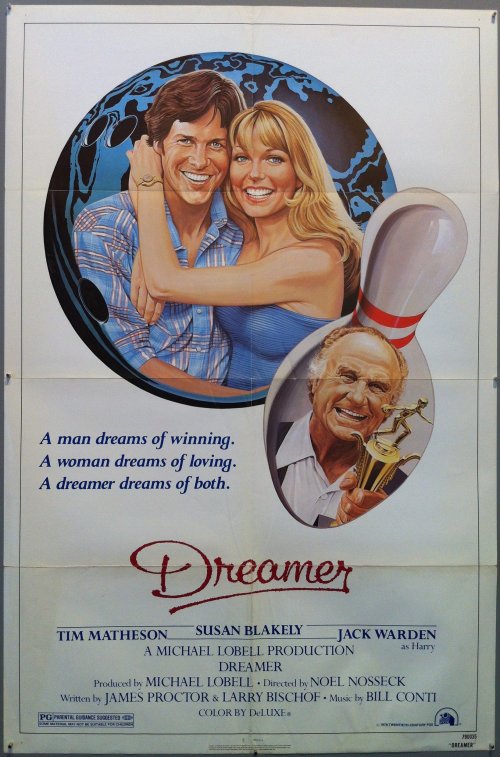
Dreamer (1979)

By Richard Winters

My Rating: 2 out of 10

4-Word Review: Bowling for a living.

Harold Nuttingham (Tim Matheson) who is nicknamed ‘Dreamer’ because of his lofty ambitions of becoming a big league bowler struggles with the demands of the sport and the amount of sacrifice and practice that it takes to be good along with the balancing act of having a relationship with Karen (Susan Blakely) and holding down a job. Eventually with the help of Harry (Jack Warden), who acts as his coach, he’s able to get accepted into a major tournament where he’ll take on the veteran champion Johnny Watkin (played by real-life champion bowler Dick Weber) and prove to a national audience that he truly deserves to be considered one of the best.

It’s truly hard-to-believe how a film like this could’ve been funded by a major studio, or how anyone would think a movie about bowling, a sport with no real cinematic quality to it at all, would be something that people would want to watch, or even take seriously. Sure, it replicates the same Rocky formula, which at the time was quite popular, but what’s next? A small town kid desiring to be the next great badminton champ? Ping Pong? Tiddlywinks?

There’s been other films made about bowling like Kingpin and The Big Lebowski, but those all had a sense of humor to it and some interesting camera shots, but this thing takes it all too seriously and is flatly photographed. Part of the charm of Rocky was seeing him train to become a good boxer, but this film glosses over the training/technique aspect and starts out right away with him already winning a bowling contest and receiving a big trophy, so what’s the point of seeing him receive one trophy after another? Besides the bowling alleys that he plays in all look blah and filled with the same unexciting people making it look like Dreamer really isn’t moving up, but instead perpetually stuck in the same drab small Midwestern town, or one’s just like it, that he came from.

The story needed of some sort of side-plot that could’ve created actual tension that is otherwise completely lacking. It may sound like a sport’s movie cliche, but Dreamer needed a psychological hurdle to overcome, like maybe he had a history of choking under pressure in big games, or possibly injuring his hand right before the contest, or maybe even losing his trusted bowling ball (or having it stolen) that would cast some doubt, and elicit some genuine intrigue from the viewer about whether Dreamer could pull through, but nothing like this ever gets presented.

Instead the majority of the drama centers around Dreamer’s on-again/off-again relationship with his girlfriend over benign issues that aren’t interesting and with a woman that looks way too beautiful to be wasting her life away working in some dumpy bowling alley, or going out with a bland stiff that doesn’t treat her right. There’s also a thread dealing with Harry and his inability to come to terms with not achieving as much as he could’ve during his younger years when he was a bowler on the circuit, but Harry is just a minor character, so his character history/arch isn’t compelling. It’s Dreamer’s that’s important, but his arch isn’t even apparent.

The film also has a cheesy scene featuring Harry bowling intensely all by himself in the dark after the place has already closed, which begs a really important question: If he’s bowling after everything’s been shut down, then who, or what is resetting the pins while he proceeds to continuously knock them down?

A bad guy, or jerk with the potential of throwing a monkey wrench into the proceedings needed introducing, but nothing materializes and everybody is too chummy with no tantalizing element simmering beneath the surface. To some degree this is the film’s one successful quality as it accurately recreates just how slow, dull, and uneventful small town living can be while putting the poor viewer to sleep in the process.

My Rating: 2 out of 10

Released: April 27, 1979

Runtime: 1 Hour 30 Minutes

Rated PG

Director: Noel Nosseck

Studio: 20th Century Fox

Available: None at this time.

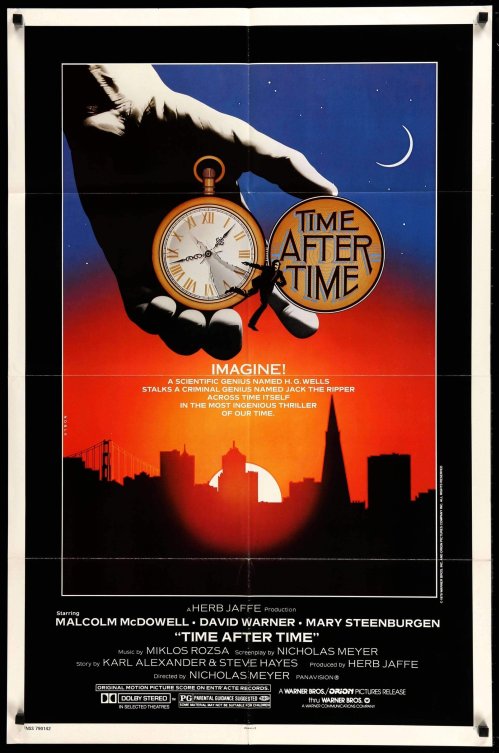
Time After Time (1979)

By Richard Winters

My Rating: 3 out of 10

4-Word Review: From 1893 to 1979.

In 1893  writer H.G. Wells (Malcolm McDowell) constructs a time machine and introduces it to his skeptical guests at a dinner party that he is hosting unaware that Dr. Stevenson (David Warner) who is also attending the party is the notorious Jack the Ripper. When the police surround the home looking for Ripper he jumps into the time machine and escapes to the year 1979. Wells then quickly follows him to modern day San Francisco and tries chasing him down, but along the way he meets Amy Robbins (Mary Steenburgen) who he fall in love with.

Initially I enjoyed seeing Wells’ confusion at dealing with modern society and the technology and had the film stayed at this level the whole way it could’ve been quite entertaining, but Wells ends up adapting too quickly. I was willing to accept that he was just a smart guy who could figure things out by being very observant, but Jack ends being the same way. Jack even attends a discotheque wearing a John Travolta-like white leisure suit, until it seemed like he was always a part of the modern world, and the original time traveling spin gets unfortunately phased out.

The romantic relationship that forms between Wells and Mary comes off as forced. Having her ask him out on a date while she’s working at her job and after only talking to him for a few minutes seemed too forward and unprofessional. Does she do this to all of her customers and if so how can she hold down a job if she’s coming on to all the men that she meets and if not then why would she ask out Wells so quickly after having just met him? Having the two end up going to bed together makes Wells seem too contemporary and not like a person from the Victorian era from which he came where sexual relations outside of marriage were much more taboo.

The script is full of a lot of loose ends too. For example: Wells goes to a jeweler to trade in his jewels for US currency, but the jeweler won’t accept them unless Wells shows a valid driver’s license, which he doesn’t have. The next day he goes to a different jeweler who gives him the money without asking for the ID, but why? In between Wells goes to a church where he speaks out loud in an awkward prayer, so are we then to presume that the second jeweler gave Wells the money without requesting the ID because of divine intervention?

There’s also a moment when Jack runs out into the street and gets struck by a car and is sent away to a nearby hospital, but then returns later showing no visible bruises or scratches. There’s also no explanation for how he was able to fool the nursing staff into thinking he had died as when Wells goes to the hospital that’s the explanation he’s given.

Spoiler Alert!

The ending is equally screwy. It has Wells and Mary going a few days into the future only to read a newspaper article reporting Mary getting killed inside her apartment by Jack, so they return to the present and then back to the apartment where Mary then takes a nap, which seemed hard to believe knowing that Jack was coming to kill her there and she’d be too tense and nervous to ever relax enough to go to sleep. Why even go anywhere near the apartment anyways and instead just find a room at a nearby hotel? There isn’t much tension to her potential death either since all Wells would need to do is go back a few days in his time machine and she’d be as good as new.

The explanation that Mary never got killed, but instead it was really her friend, who she had invited over to dinner is problematic too because even though there wasn’t DNA testing at that time they could still identify the victim through their dental records.

The story, which was based on a 55-page treatment written by Karl Alexander, who later expanded it to a novel, which was released at the same time as the movie, has a lot of potentially interesting ideas, but it ends up taking on too much. A decision should’ve been made to focus on either the romance or Wells’s pursuit of Jack, but not both. Trying to cram two plot-lines together results in a script that’s too rushed and poorly thought out.

My Rating: 3 out of 10

Released: September 28, 1979

Runtime: 1 Hour 52 Minutes

Rated PG

Director: Nicholas Meyer

Studio: Warner Brothers

Available: DVD, Blu-ray, Amazon Video, YouTube

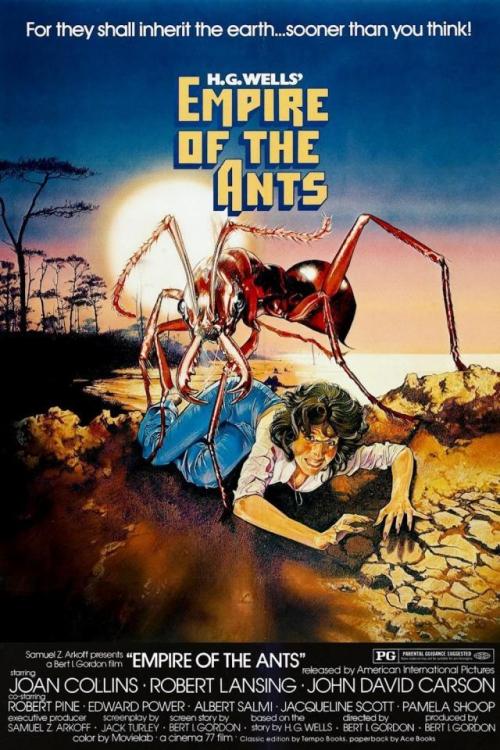
Empire of the Ants (1977)

By Richard Winters

My Rating: 3 out of 10

4-Word Review: Giant ants terrorize island.

A group of prospective home buyers are taken on a tour of a small island off the coast of Florida that supposedly has ‘prime beach front property’, but in reality it’s worthless. Marilyn (Joan Collins) is the realtor touring the others around, which quickly gets cut short when ants, who have feed off of toxic chemicals that were illegally dumped there and have now grown to giant size, begin attacking the people.

This film marks yet another tacky production by director Bert I. Gordon who enjoyed making movies filled with special effects dealing with giant animal life much like he did just two years earlier in Food of the Gods. The effects are predictably laughable where process shots showing close-ups of ants get combined with shots of the actors on the set, but you can tell that the quality of the film stock is different making the ants look completely out-of-place in the setting. When the actors get directly attacked by the ants large rubber mock-ups were used, but this gets combined with a shaking camera and quick edits making the action hard to follow.

It might’ve worked a bit better had it not given away right up front the cause for why the ants got so big and thus allowed for some mystery. Having the toxic waste be the cause just adds more questions than answers anyways. For instance: why were these chemicals being dumped to begin with and why did they choose this island? How were the ants able to get so big so fast? Did they just feed on the chemicals and then ‘poof’ they were big, or how fast or slow did the process work? Why were just the ants the ones that got big? Supposedly other insects, spiders and birds might’ve ingested the chemicals too, so why don’t they grow to a giant size as well?

The cast of characters are predictably stale and taking a full 30-minutes introducing them to the audience before the action even kicks-in just makes the movie even more boring. Having more eccentric characters would’ve helped like having the ants attack a clown convention that was meeting there, which would’ve given the film a humorous/offbeat edge that is otherwise lacking.

For the record I did enjoy Robert Pine who plays this coward who makes no attempt to save his wife when she’s attacked and then obsesses afterwards that everyone believe his story that he ‘couldn’t find her’ and there was ‘nothing he could do’. Collins is quite attractive, most will remember her for her appearance on the TV-show ‘Dynasty’, which was her career peak, but done when she was already well into her 50’s and no longer had a youthful appeal, but here she looks youngish and easy-on-the-eyes, which helps during the film’s slow moments.

The film states during the opening credits that it’s ‘inspired’ by the H.G.Wells story, but that short story, which was published in 1905, was way different. For one thing it didn’t involve ants growing to a giant size, so trying to connect the two as the producers here do, is outrageous. Had the filmmakers stuck more closely to that story, the film would’ve been much more interesting.

My Rating: 3 out of 10

Released: July 29, 1977

Runtime: 1 Hour 29 Minutes

Rated PG

Director: Bert I. Gordon

Studio: American International Pictures

Available: DVD, Amazon Video

Phase IV (1974)

By Richard Winters

My Rating: 7 out of 10

4-Word Review: The ants take over.

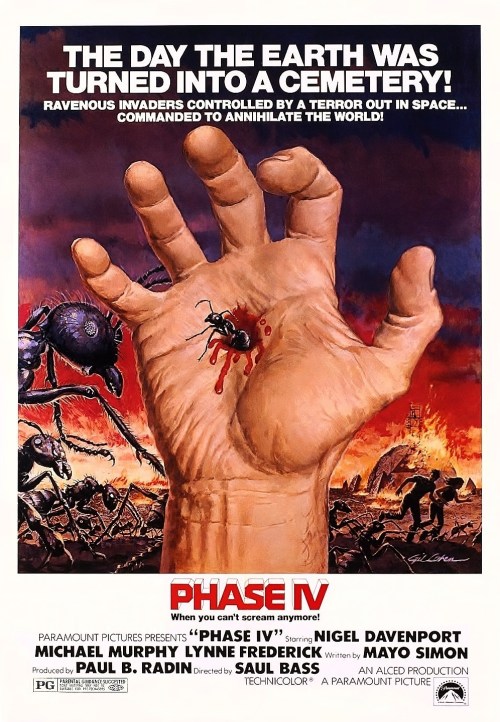
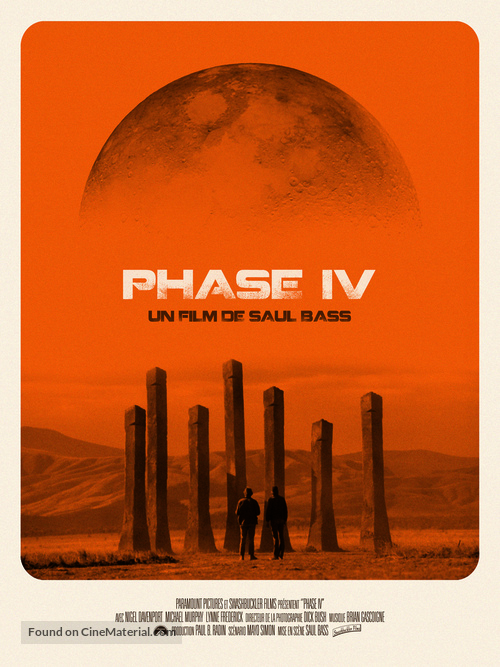
Ants in a small isolated community in Arizona begin to behave strangely by building large towers and geometric designs in the crops. Dr. Hubbs (Nigel Davenport) and James Lesko (Michael Murphy) are two scientists hired to come-in and find out why the ants are behaving the way they are and try to put a stop to it. They construct a computerized lab in the middle of the desert and begin they’re research only to find that they’ve walked into the ant’s trap.

This was the first feature length movie directed by Saul Bass who was an award winning graphic designer who did title sequences and film posters for many famous movies from the 1950’s through the 1980’s. His great attention to detail pays off here in a film that is full of many intricate and stunning imagery including incredible micro photography of the insect life, but unfortunately the movie bombed badly at the box office, which never allowed him to direct another film again.

On the surface it’s easy to see why it didn’t go over well as a large amount of the runtime focuses on the ants and while this photography is impressive it also makes it seem more like a nature film, but without any voice-over narration explaining what the ants are doing. It’s not like you can’t figure it out, but it does require close attention and could still be confusing to some and not something mainstream audiences are used to, or expected to sit through.

When the humans are onscreen the acting isn’t bad and surprisingly there is some character development, which a lot of other high concept Sci-fi flicks sometimes don’t have. I enjoyed Davenport and his very matter-of-fact approach to the situation in which nothing ever gets to him emotionally no matter how grisly and his never ending obsession to usurp the ants no matter how ultimately bleak it gets.

Lynne Frederick is good too as a teen-aged girl who gets taken in by the scientists when the rest of her family are killed. Initially I didn’t like her presence as I was afraid it was going to lead to some annoying, manufactured side romance, but fortunately that didn’t occur and instead becomes more of the emotional, human side of the trio especially with the way her eyes gaze at the evil ants. I also really liked the segment that shows in close-up of an ant climbing on her foot and then up through her body, even going in and out of her bellybutton until finally arriving at her head all while she sleeps.

The ending though is a disappointment as it never explains the reason for the ant’s behavior. I actually did find the story intriguing for awhile and even kind of scary, but you can’t expect a viewer to sit through a near 90-minute film and not supply them with some answers. No conclusion is given either as to who ultimately wins the battle, man or ant, which was something better explained in the original director’s cut, which had a surreal, image-laden montage showing what life on the ‘new earth’ was like, but this got cut by Paramount and never shown in the film released to theaters. In 2012 a faded print of the original ending was found and after being digitally scanned was added to a new 35mm print that was played at several select art house theaters, but this version has never been released onto DVD/Blu-ray, which is a shame as the movie comes off as incomplete without it.

For those who are interested here is a faded print of the original ending:

My Rating: 7 out of 10

Released: September 6, 1974

Runtime: 1 Hour 24 Minutes (Studio version)

Rated PG

Director: Saul Bass

Studio: Paramount

Available: DVD, Blu-ray, Amazon Video, YouTube

Le Sex Shop (1972)

By Richard Winters

My Rating: 6 out of 10

4-Word Review: Bookseller turns to pornography.

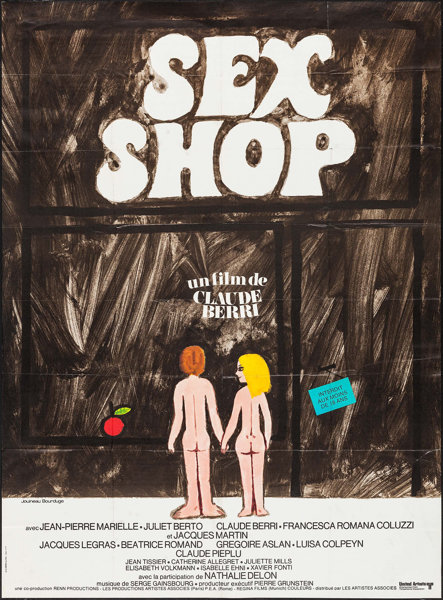
Claude (Claude Berri) runs a Paris bookstore, but finds his business slumping. In an attempt to make a profit he decides to start selling pornographic materials, which soon makes his place a popular hangout. It also attracts a different type of clientele including Lucien (Jean-Pierre Marielle) a local dentist who along with his beautiful wife Jacqueline (Nathalie Delon) are swingers who try to get Claude and his wife Isabelle (Juliet Berto) into their lifestyle, which ultimately begins to put a strain on their marriage.

Although billed as an X-rated movie it is really more of a satire of the public’s zest for sexual fantasy and the extremes they will go to enliven their sex lives only to in some ways end up needlessly complicating it. The film is full of a lot of keen moments that are both insightful and funny including both Claude and his wife lying in bed next to each other while each simultaneously having fantasies about sex with someone else. The part where Claude’s two kids, who are both under 10, sneak into the shop and start playing with the sex toys is a hoot too as is the scene where Claude lies in bed between two naked women and spends the whole time talking about his kids and sharing family photos.

I also liked how the sex shop itself gets captured. In real-life these places are usually quite dark and dingy giving off the idea that there’s something ‘sinister’ or ‘shameful’ about sexual fantasy while here the shop is bright, colorful and inviting with clientele not just made up of men either, but with equal amounts of women too.

Director Berri casts himself in the lead and while this can sometimes come-off seeming narcissistic I felt in this case it was a perfect touch as he looks very much like Rowan Atkinson’s Mr. Bean character and watching some of his shocked expressions as he gets himself more and more immersed into the seamier side of things is quite funny. I also enjoyed Beatrice Romand, as a young lady looking like she’s no older than 16, getting hired as a sales clerk at the shop and who shows great familiarity to all the sexual paraphernalia and expounds on how to use them to the older male customers like a teacher lecturing to her class.

The two women who play prostitutes (Francesca Romana Coluzzi, Catherine Allegret) are a lot of fun too and become the symbols of the old way of life as they fear that their services will no longer be needed. The scene where they challenge a topless author at a book signing in regards to the authenticity of her sexual conquests and how she, in their eyes, is not a ‘real whore’ is quite amusing.

The film though could’ve used a better buildup. The couple move into the sex business too quickly and thus watching their transition into swingers isn’t as impactful or interesting. The ending is too ambiguous and outside of the sex shop the film fails to have any type of visual flair. There is an abundance of nudity, but none of it is erotic or arousing. Maybe this was the intention, but a film about sex should have at least a few spicy moments while this thing, despite its very adult rating, falls completely flat in that area.

My Rating: 6 out of 10

Released: October 25, 1972

Runtime: 1 Hour 32 Minutes

Rated X

Director: Claude Berri

Studio: United Artists

Available: DVD (Out-of-Print)

Posse (1975)

By Richard Winters

My Rating: 7 out of 10

4-Word Review: Everyone has their price.

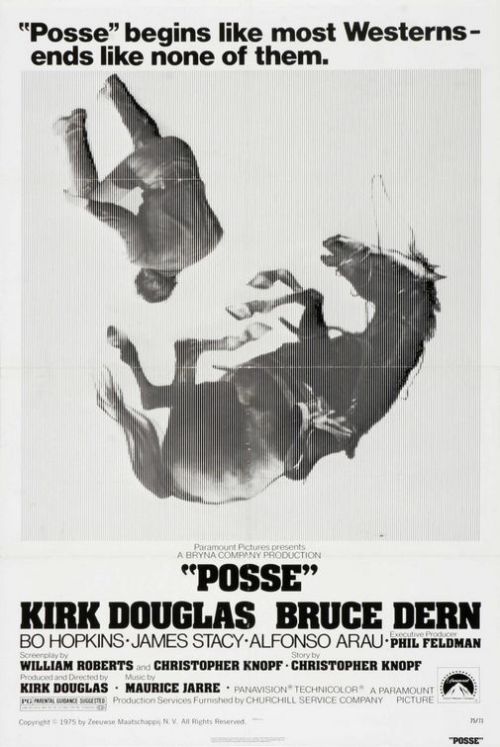
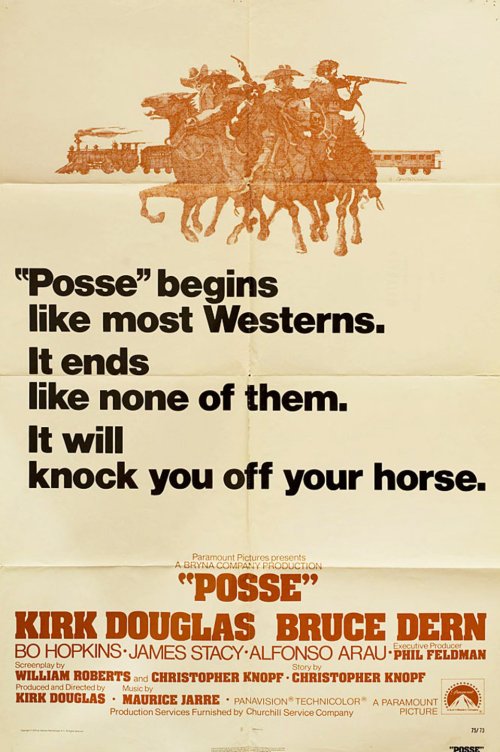
Howard Nightingale (Kirk Douglas) is an ambitious Marshall looking to run for U.S. Senate and realizes his best bet of winning the seat is by bringing in the notorious train robbing gang led by Jack Strawhorn (Bruce Dern). Howard manages to kill off the gang by having his posse set fire to the hideout that they were in, but Jack escapes only to be captured later and brought to jail. While on the train ride to Austin where he’ll be hanged Jack comes up with an elaborate escape and turns-the-tables by handcuffing Howard and returning him to the town where they came from and holding him prisoner inside the local hotel. When the posse returns to the town everyone is convinced they’ll free Howard, or will they?

In an era where revisionist westerns were all the rage it’s confusing, at least initially, not to understand why this one, which story-wise goes completely against-the-grain of the conventional western, isn’t propped up there with the best of them and a lot of the blame could possibly be put on the direction. There’s nothing really wrong with the way it’s presented and there are some exciting moments including a realistic shootout as well as a running train being set on fire while also exploding from dynamite, but the rest of it does have a certain static feel. There’s too much reliance on music and not enough on mood or atmosphere as well as actors looking more like modern day people in period costume.

The script though, which is based on a 1971 short story called ‘The Train’ by Larry Cohen is full of many offbeat twists that keeps the viewer intrigued. Of course in an attempt to stretch out the short story into feature length there are some slow spots, particularly in the middle and the emphasis is more on concept than character development, but Jack’s crafty way at escaping is quite entertaining and the surprise ending is one of the best not because it’s a gimmick, which it isn’t, but more because it’s quite believable and yet something that’s never been done in any other western.

Douglas gives his conniving character just the right amount of pompous camp to make him enjoyable and it’s great to see James Stacy in his first movie role after his tragic motorcycle accident where he lost both his left arm and leg. In any other film this handicap would have to become a major issue, but here it doesn’t even get mentioned. The character doesn’t use it to feel sorry for himself nor is he treated any differently than anyone else, which I found to be quite refreshing.

A minor drawback though it that it’s supposed to take place in Texas and my hometown of Austin even gets mentioned a few times, which is kind of cool, but it was actually filmed in the state of Arizona. To some this might not be a big deal, but Arizona’s landscape is much sandier and has more mountains. Their cacti is of the upright kind while in Texas the cactus is of the bushy variety known as the prickly pear. All of which helps to ruin the film’s authenticity. If they didn’t have the funding to film it in Texas then have the story’s setting take place in California or Arizona, but trying to compromise it and hoping that astute viewers won’t know the difference doesn’t work.

My Rating: 7 out of 10

Released: June 4, 1975

Runtime: 1 Hour 32 Minutes

Rated PG

Director: Kirk Douglas

Studio: Paramount Pictures

Available: DVD, Amazon Video, YouTube