Category Archives: 70’s Movies

Phase IV (1974)

By Richard Winters

My Rating: 7 out of 10

4-Word Review: The ants take over.

Ants in a small isolated community in Arizona begin to behave strangely by building large towers and geometric designs in the crops. Dr. Hubbs (Nigel Davenport) and James Lesko (Michael Murphy) are two scientists hired to come-in and find out why the ants are behaving the way they are and try to put a stop to it. They construct a computerized lab in the middle of the desert and begin they’re research only to find that they’ve walked into the ant’s trap.

This was the first feature length movie directed by Saul Bass who was an award winning graphic designer who did title sequences and film posters for many famous movies from the 1950’s through the 1980’s. His great attention to detail pays off here in a film that is full of many intricate and stunning imagery including incredible micro photography of the insect life, but unfortunately the movie bombed badly at the box office, which never allowed him to direct another film again.

On the surface it’s easy to see why it didn’t go over well as a large amount of the runtime focuses on the ants and while this photography is impressive it also makes it seem more like a nature film, but without any voice-over narration explaining what the ants are doing. It’s not like you can’t figure it out, but it does require close attention and could still be confusing to some and not something mainstream audiences are used to, or expected to sit through.

When the humans are onscreen the acting isn’t bad and surprisingly there is some character development, which a lot of other high concept Sci-fi flicks sometimes don’t have. I enjoyed Davenport and his very matter-of-fact approach to the situation in which nothing ever gets to him emotionally no matter how grisly and his never ending obsession to usurp the ants no matter how ultimately bleak it gets.

Lynne Frederick is good too as a teen-aged girl who gets taken in by the scientists when the rest of her family are killed. Initially I didn’t like her presence as I was afraid it was going to lead to some annoying, manufactured side romance, but fortunately that didn’t occur and instead becomes more of the emotional, human side of the trio especially with the way her eyes gaze at the evil ants. I also really liked the segment that shows in close-up of an ant climbing on her foot and then up through her body, even going in and out of her bellybutton until finally arriving at her head all while she sleeps.

The ending though is a disappointment as it never explains the reason for the ant’s behavior. I actually did find the story intriguing for awhile and even kind of scary, but you can’t expect a viewer to sit through a near 90-minute film and not supply them with some answers. No conclusion is given either as to who ultimately wins the battle, man or ant, which was something better explained in the original director’s cut, which had a surreal, image-laden montage showing what life on the ‘new earth’ was like, but this got cut by Paramount and never shown in the film released to theaters. In 2012 a faded print of the original ending was found and after being digitally scanned was added to a new 35mm print that was played at several select art house theaters, but this version has never been released onto DVD/Blu-ray, which is a shame as the movie comes off as incomplete without it.

For those who are interested here is a faded print of the original ending:

My Rating: 7 out of 10

Released: September 6, 1974

Runtime: 1 Hour 24 Minutes (Studio version)

Rated PG

Director: Saul Bass

Studio: Paramount

Available: DVD, Blu-ray, Amazon Video, YouTube

Le Sex Shop (1972)

By Richard Winters

My Rating: 6 out of 10

4-Word Review: Bookseller turns to pornography.

Claude (Claude Berri) runs a Paris bookstore, but finds his business slumping. In an attempt to make a profit he decides to start selling pornographic materials, which soon makes his place a popular hangout. It also attracts a different type of clientele including Lucien (Jean-Pierre Marielle) a local dentist who along with his beautiful wife Jacqueline (Nathalie Delon) are swingers who try to get Claude and his wife Isabelle (Juliet Berto) into their lifestyle, which ultimately begins to put a strain on their marriage.

Although billed as an X-rated movie it is really more of a satire of the public’s zest for sexual fantasy and the extremes they will go to enliven their sex lives only to in some ways end up needlessly complicating it. The film is full of a lot of keen moments that are both insightful and funny including both Claude and his wife lying in bed next to each other while each simultaneously having fantasies about sex with someone else. The part where Claude’s two kids, who are both under 10, sneak into the shop and start playing with the sex toys is a hoot too as is the scene where Claude lies in bed between two naked women and spends the whole time talking about his kids and sharing family photos.

I also liked how the sex shop itself gets captured. In real-life these places are usually quite dark and dingy giving off the idea that there’s something ‘sinister’ or ‘shameful’ about sexual fantasy while here the shop is bright, colorful and inviting with clientele not just made up of men either, but with equal amounts of women too.

Director Berri casts himself in the lead and while this can sometimes come-off seeming narcissistic I felt in this case it was a perfect touch as he looks very much like Rowan Atkinson’s Mr. Bean character and watching some of his shocked expressions as he gets himself more and more immersed into the seamier side of things is quite funny. I also enjoyed Beatrice Romand, as a young lady looking like she’s no older than 16, getting hired as a sales clerk at the shop and who shows great familiarity to all the sexual paraphernalia and expounds on how to use them to the older male customers like a teacher lecturing to her class.

The two women who play prostitutes (Francesca Romana Coluzzi, Catherine Allegret) are a lot of fun too and become the symbols of the old way of life as they fear that their services will no longer be needed. The scene where they challenge a topless author at a book signing in regards to the authenticity of her sexual conquests and how she, in their eyes, is not a ‘real whore’ is quite amusing.

The film though could’ve used a better buildup. The couple move into the sex business too quickly and thus watching their transition into swingers isn’t as impactful or interesting. The ending is too ambiguous and outside of the sex shop the film fails to have any type of visual flair. There is an abundance of nudity, but none of it is erotic or arousing. Maybe this was the intention, but a film about sex should have at least a few spicy moments while this thing, despite its very adult rating, falls completely flat in that area.

My Rating: 6 out of 10

Released: October 25, 1972

Runtime: 1 Hour 32 Minutes

Rated X

Director: Claude Berri

Studio: United Artists

Available: DVD (Out-of-Print)

Posse (1975)

By Richard Winters

My Rating: 7 out of 10

4-Word Review: Everyone has their price.

Howard Nightingale (Kirk Douglas) is an ambitious Marshall looking to run for U.S. Senate and realizes his best bet of winning the seat is by bringing in the notorious train robbing gang led by Jack Strawhorn (Bruce Dern). Howard manages to kill off the gang by having his posse set fire to the hideout that they were in, but Jack escapes only to be captured later and brought to jail. While on the train ride to Austin where he’ll be hanged Jack comes up with an elaborate escape and turns-the-tables by handcuffing Howard and returning him to the town where they came from and holding him prisoner inside the local hotel. When the posse returns to the town everyone is convinced they’ll free Howard, or will they?

In an era where revisionist westerns were all the rage it’s confusing, at least initially, not to understand why this one, which story-wise goes completely against-the-grain of the conventional western, isn’t propped up there with the best of them and a lot of the blame could possibly be put on the direction. There’s nothing really wrong with the way it’s presented and there are some exciting moments including a realistic shootout as well as a running train being set on fire while also exploding from dynamite, but the rest of it does have a certain static feel. There’s too much reliance on music and not enough on mood or atmosphere as well as actors looking more like modern day people in period costume.

The script though, which is based on a 1971 short story called ‘The Train’ by Larry Cohen is full of many offbeat twists that keeps the viewer intrigued. Of course in an attempt to stretch out the short story into feature length there are some slow spots, particularly in the middle and the emphasis is more on concept than character development, but Jack’s crafty way at escaping is quite entertaining and the surprise ending is one of the best not because it’s a gimmick, which it isn’t, but more because it’s quite believable and yet something that’s never been done in any other western.

Douglas gives his conniving character just the right amount of pompous camp to make him enjoyable and it’s great to see James Stacy in his first movie role after his tragic motorcycle accident where he lost both his left arm and leg. In any other film this handicap would have to become a major issue, but here it doesn’t even get mentioned. The character doesn’t use it to feel sorry for himself nor is he treated any differently than anyone else, which I found to be quite refreshing.

A minor drawback though it that it’s supposed to take place in Texas and my hometown of Austin even gets mentioned a few times, which is kind of cool, but it was actually filmed in the state of Arizona. To some this might not be a big deal, but Arizona’s landscape is much sandier and has more mountains. Their cacti is of the upright kind while in Texas the cactus is of the bushy variety known as the prickly pear. All of which helps to ruin the film’s authenticity. If they didn’t have the funding to film it in Texas then have the story’s setting take place in California or Arizona, but trying to compromise it and hoping that astute viewers won’t know the difference doesn’t work.

My Rating: 7 out of 10

Released: June 4, 1975

Runtime: 1 Hour 32 Minutes

Rated PG

Director: Kirk Douglas

Studio: Paramount Pictures

Available: DVD, Amazon Video, YouTube

Andy Warhol’s Bad (1977)

By Richard Winters

My Rating: 7 out of 10

4-Word Review: Paying women to kill.

Hazel (Carroll Baker) runs a beauty parlor out of her home that specializes in unwanted hair removal, but secretly on the side she hires beautiful women to carry out contract killings of which she gets a part of the take. L.T. (Perry King) is a vagabond in desperate need of money who’s looking to get into the business, but Hazel prefers her killers to be women and is reluctant to take him, but eventually decides to hire him on a trial basis, but then everything starts to go wrong.

One of the best things about this movie is how truly dark it gets. Too many movies that proclaim to be dark comedies always pull back and never get as deliriously twisted as they initially convince you they will, but this film proudly takes things to the darkest extremes becoming a measurement to what true underground filmmaking once was where pushing the envelope was the only goal.

For the most part, depending on one’s sense of humor, it’s outrageously funny. Some of the more wicked moments feature twin sisters (Geraldine and Maria Smith) setting a movie theater on fire and then going home to watch the coverage of it on the TV. There’s also Warhol alum Brigid Berlin as an overweight woman with flatulence issues who’s obsessed at getting brutal revenge on anyone that she perceives as making fun of her weight.

The film also takes satirical jabs at the American obsession of making money and how one’s social standing hinges on how much they have without any concern with what exactly they had to do to get it. This come to a perfect hilt when Hazel throws L.T. out of the house when he refuses to go through with a hit but still somehow feels she’s the morally superior one by taunting him with “At least I pay my own way”.

Due to this being the biggest budgeted film that Andy Warhol produced they  were able to hire some well-known faces into the roles. Baker though was not their first choice as they originally wanted Vivian Vance, whose presence would’ve made this even more of a gem than it already is, but she turned it down fearing it would ruin her reputation with her fans. Shelley Winters, who was their second choice, also rejected the offer, which was rare as she usually accepted anything that came along and she would’ve been brilliant, but I’ll give props to Baker, who took the role simply in an attempt to resuscitate her career, for not holding anything back here and giving it her all.

King is also superb and I enjoyed seeing his character arch as he’s the only in the film that has one, but was disappointed that there was never a final, fiery confrontation between him and Hazel as the film spends the whole time priming you into believing that there will be. Tyrrell is also memorable in a rare sympathetic part where she becomes the only one with a conscious although I have no idea where they got the baby that she is seen constantly carrying around as he’s one of the stranger looking tykes I’ve ever seen.

The cinematic quality though is lacking with almost all of the action taking place inside the drab house. The basic concept isn’t completely well thought out either. While I appreciated the bad cop character, played by Charles McGregor, who gets paid to look the other way, which helps to explain how Hazel is able to get away with these killings for as long as she does, I was still confused with how she was able to bully people. Everyone adheres to her authority, which is never challenged, but you’d think someone running a dicey operation would have some sort of backup plan and weapon on hand should someone get out-of-line, which she doesn’t and for me this seemed questionable.

The film is notorious as well for a scene showing a young mother throwing her baby out of a high story building and watching it go splat on the ground. Supposedly Baker, King, and Tyrrell refused to do the film unless they were promised that this scene be taken out of the script and director Jed Johnson complied only to end up filming it once the rest of the production had wrapped. Years ago when  I first saw this I thought it was pretty funny especially as another mother walks by and says to her young child “that’s what’s going to happen to you if you don’t behave”. It’s clearly a doll anyways and no real baby was harmed, but when I viewed it this time around I found it unsettling, so like with a lot of things in this movie, it’s up to a person’s age and perspective on how much of it they may or may not enjoy.

My Rating: 7 out of 10

Release: May 4, 1977

Runtime: 1 Hour 45 Minutes

Rated X

Director: Jed Johnson

Studio: New World Pictures

Available: DVD

Avalanche (1978)

By Richard Winters

My Rating: 3 out of 10

4-Word Review: Sliding snow destroys resort.

David Selby (Rock Hudson) is a driven businessman determined to build a ski resort in an area that’s vulnerable to avalanches and despite the many warnings is able to get the building constructed and even have it host a ski tournament to kick-off its grand opening, but as the festivities get under way the snowfall continues. Eventually the weight of the snow on the nearby mountaintop becomes too much causing a massive avalanche forcing the guests at the resort into a fight for survival.

The film starts out with a lot of boring, poorly written soap opera-like drama that will put most viewers to sleep before the avalanche ever even takes place. The storyline concerning Mia Farrow’s and Rock Hudson’s marriage and his desperate attempts to ‘rekindle the old magic’ between them is particularly contrived as the vast age difference between the two, a whole 18 years, makes it look like the type of union that would have no chance of it working right from the start, so why even bother making it a part of the plot? The first 40 minutes are so draggy that you start hoping for the avalanche to happen and wipe out all the cardboard characters simply to provide some excitement.

The glossy cast if filled with some well known faces, but their parts offer them little to work with and in the case of Robert Forster, who acts as this environmentalist warning of the avalanche danger, is completely wasted. Only Cathey Paine, a lesser known actress, offers some diversion as a possessive girlfriend who becomes unhinged when she catches her boyfriend (Rick Moses) in bed with another woman and watching her try to kill herself by swallowing a bottle of pills only to be crushed by the snow a few seconds later is darkly funny. I also got a kick out of Jeannette Nolan sporting white hair, which you can tell is a wig because you can see her brown hair underneath it along the edges, and I felt this should’ve been shown falling off her head when the avalanches occurs, but of course it doesn’t.

The special effects, which would be the only reason to watch this thing anyways, gets highly compromised mainly because producer Roger Corman, in his patented stingy way, cut the budget in half just before production began and it definitely shows. The avalanche looks like nothing more than having the actors shot on a screen and then having styrofoam made snow blown in front of it. I also found the howling wind noise, which permeates every outdoor scene, to be irritating and unnecessary especially when all the trees in the background are completely still.

The third act, which deals with rescue efforts, offers some minor tension and is an improvement from the rest of the movie, which made me think they should’ve started it with this and then shown scenes of the avalanche happening, and some of the background ‘drama’, intermittently via flashback. The setting, which was filmed on-location at the Lodge of Tamarron in Durango, Colorado, is quite scenic. I even liked the snowmobile race, which has a Death Race 2000 feel to it especially the ugly wipe-outs.

Spoiler Alert!

Unfortunately everything else falls predictably flat, which includes the dopey ending where Hudson humbly admits that he allowed his greed to get in the way  and that the resort should never have been built, but this isn’t satisfying enough. He should’ve been handcuffed and thrown into prison, which is not shown nor any confirmation if this ever ultimately happened.

My Rating: 3 out of 10

Released: September 29, 1978

Runtime: 1 Hour 31 Minutes

Rated PG

Director: Corey Allen

Studio: New World Pictures

Available: DVD, Blu-ray, Amazon Video
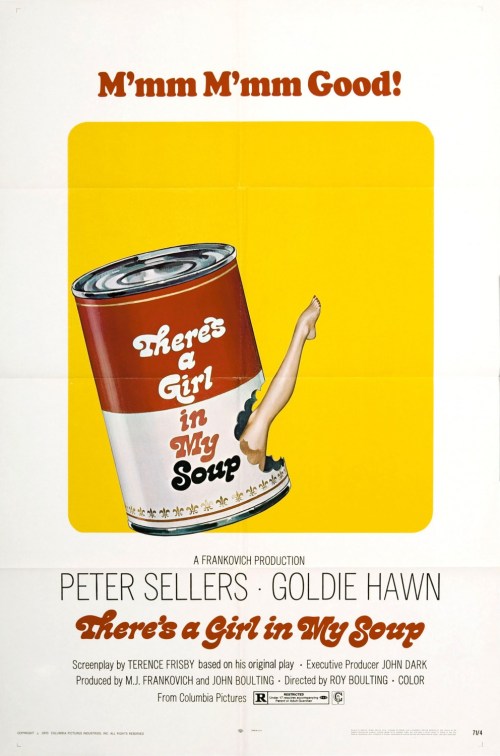
Loving (1970)

By Richard Winters

My Rating: 8 out of 10

4-Word Review: Commercial artist fools around.

Brooks (George Segal) is a commercial artist who spends most of his time chasing after clients, which he finds exhausting and takes away from the creative process. Although married to the beautiful Selma (Eva Marie Saint) he still sees  Grace (Janis Young) on the side, but she’s tired of being the other woman and wants him to divorce his wife and commit to her, which he resists. Despite all of these issues Brooks manages to keep his philandering hidden until one night when they attend a party at a friend’s house where his fooling around unexpectedly comes out into the open for all to see.

So many films have tried to capture that perfect day-in-the-life feel, but usually end up failing by either jazzing-up the drama, or becoming boring by  not having enough happening. Director Irvin Kerschner manages to find the right balance by having the characters continue to do things as they speak. For instance showing Brooks’ boss (Keenan Wynn) converse with him over the phone while folding up his hideaway bed. Why was he sleeping on the couch? Was he having marital problems of his own? Could be, but this visual approach allows the scenes to remain active while also conveying how everyone has issues and not just our protagonist. It also remains realistic as most people are usually doing other things while talking on the phone and never just sitting motionless like it gets portrayed in many other movies.

I enjoyed too how the film explores the job duties that Brooks has including the way he takes photos of models, sometimes he even using himself, and then traces their outlines from the picture to create a different artistic rendering, which I found fascinating. Much of the reason for these intricate details has much to do with the fact that the script is based on the novel ‘Brooks Wilson Ltd.’ by John McDermott under the pen name of J.M. Ryan, who was an illustrator in real-life, for Disney studios, and parlayed his experience of the craft to the main character. I also found it interesting how Brooks’ clients would sometimes have minor, subjective complaints about his work forcing him, for the sake of pleasing them and making money, to begrudgingly change what he had originally created and thus showing how the business side can squelch the artistic inspirations of creative people and take away the enjoyment they once had for their craft.

Even the children characters get handled much better than in most films. Granted their parts have very little to do with the plot, but still like in every parent’s life they’re always around causing disruptions and noise even when you have your mind occupied with other things. They’re also not portrayed as sickingly sweet or excessively bratty, but like with most kids an equal combination of both. The oldest girl, who looked to be about 8, also has one of the film’s funniest moments as she’s shown reading a book on the sofa while a nude model, who her father is sketching, stands right in front of her, which she finds to be no big deal.

Spoiler Alert!

The film’s best moment though is still the ending where Brooks goes to a party and makes love to his best friend’s wife (Nancie Phillips) in a child’s empty playroom to the amusement of the the other guests who watch them in another room, unbeknownst to Brooks, on closed circuit TV. Not only is this scene hilarious, but dramatically powerful as Will (David Doyle), whose wife is caught fooling around with Brooks, physically attacks Brooks outside afterwards and the look of anger and betrayal on his face reveals, despite the funny set-up, how emotionally devastating philandering can be to the other spouse.

The film though fails to offer any conclusion. We sit through 90-minutes of seeing the marriage slowly disintegrate, but then are left watching the couple staring at each with no idea whether they were able to patch things up, or divorce. The viewer feels cheated that no clear answer is given and a brief denouncement showing where the main character ultimately ends up, whether it be with a new love, his same wife, or all alone, should’ve been added.

My Rating: 8 out of 10

Released: March 4, 1970

Runtime: 1 Hour 29 Minutes

Rated R

Director: Irvin Kerschner

Studio: Columbia Pictures

Available: DVD, Amazon Video, YouTube

Massacre at Central High (1976)

By Richard Winters

My Rating: 6 out of 10

4-Word Review: Destroy the social hierarchy.

David (Derrel Maury) is the new kid in school whose only friend is Mark (Andrew Stevens) because years earlier David helped protect Mark from a group of bullies. Now Mark has befriended a group of elitist friends who pick on the other students at the school and instructs David that he better do the same, but David resists, so the clique turns on him. This causes David to kill  the members of the clique off one-by-one in creative ways, but finds that the students who were once the meek victims of these bullies now become the new ones.

This film is a definite step above the usual horror flick and has managed to create, despite it’s limited availability, a strong cult following. Yet with that said it does have some major drawbacks. One is cinematic quality, which is quite grainy, faded, and dated with every shot reeking of a mid-70’s look. The music score is horrendous especially the opening song sung by Tommy Leonitti. In fact it’s so bad that director Rene Daalder, who had written a different score that better fit the mood of the film, but was rejected by the producer, refused to watch this movie for several decades because of it.

There’s also the issue, like in so many of these high school flicks, were the students look older than they should and in fact all of them were already in their early 20’s when this was filmed. Fortunately the setting was the senior high level, so the more mature body types aren’t quite as glaring as it could’ve been.

I felt though that despite being a bit too old for his part this was Andrew Stevens best performance to date. His career and the quality of the projects he’s been in have been quite erratic, but here he fits the role quite well and I enjoyed seeing his character’s arch go from passive middle-man to a reluctant hero although the scene where he confronts David begging him not to kill him even though David had no weapons at the time, was physically smaller and crippled by a bum leg, seemed a bit too wimpy. Stevens could’ve and should’ve beat up David at that point, or threatened to unless there was some reason why he never wanted to fight, which is never made clear.

I did like the killings particularly the hang glider death, which has a point-of-view shot where the viewer feels like they’re riding on the gliders alongside the characters. The transformation of the students from wimps to oppressors is what I enjoyed the most as it exposes the thin line between good guy and bad and how the circumstances of the situation dictate how people respond to either. It also reveals how behavior is greatly affected by one’s immediate environment and if that environment were to suddenly change different aspects of a person’s personality that have long been dormant, or repressed could suddenly come to the forefront. The fact that no adults are ever seen, at least not until the very end, was a cool touch too as it accentuates how in the adolescent world the adults are completely meaningless and it’s their peer group that’s the only thing that’s important, which makes this quite similar to Heathers of which this is considered a close cousin and even an inspiration to.

When the film was first released it got very little attention and was in and out of the theaters quite quickly and I believe a part of the reason for this is its title, which coneys too much of a mindless teen exploitation flick tone, which this really isn’t. While the film was being shot in went under the working title of ‘Incident at Foxdale High’, which to me was more subtle and intriguing. Whether this is also the reason why it has yet to get a well-deserved DVD/Blu-ray release I don’t know, but at some point one should be coming.

My Rating: 6 out of 10

Released: November 10, 1976

Runtime: 1 Hour 27 Minutes

Rated R

Director: Rene Daalder

Studio: Brian Distributing

Available: VHS

When a Stranger Calls (1979)

By Richard Winters

My Rating: 5 out of 10

4-Word Review: Babysitter receives harassing calls.

Jill Johnson (Carol Kane) gets asked by the Mandrakis (Rutayna Alda, Carmen Argenziano) to babysit their two children, who are already asleep, while they go out for the evening. While Jill is there she starts receiving harassing calls from an anonymous man asking about the children. Jill eventually calls the police who find out that the call is coming from inside the house, but fortunately the police arrive in time before the killer (Tony Beckley) can get to her. She recovers from the incident and moves on with her life by getting married and having two kids of her own only to find that the man has escaped from the mental hospital and coming after her again.

This is an extension to director Fred Walton’s 1977 short film The Sitter with the first 22-minutes almost the same as that one, but not quite. The opening bit is much better handled here with close-ups of a pendulum on a clock swinging back and forth and Jill hearing noises in the house only to find that it’s the ice dispenser in the refrigerator, which are all the scenes that were not in the first film. Kane is also a better actress and her ability to convey fear elicits more tension from the viewer, but I still found it annoying that she reiterates the same line that the babysitter in the first film did where she states to the police that she’s ‘all alone in the house’ when technically there’s supposedly two sleeping kids upstairs.

The second act is where this thing goes off on a wild tangent by focusing almost exclusively on the killer, whose name is Curt Duncan, as he attempts to survive on the streets in the most seedy part of the city while a police investigator named John Clifford (Charles Durning), who worked on the earlier case and is now a private investigator, is determined to kill Duncan for what he did to the two children. To some degree this is a refreshing change of pace as most horror films like to demonize the killer making him seem like a soulless monster who kills people robotically while here the psychopath is portrayed as a vulnerable and confused human tormented by inner demons that he cannot control.

Watching him try to form a bond with a woman (Colleen Dewhurst) that he meets at a bar simply for human contact is interesting because most psychos don’t just murder everyone they meet even though in a conventional horror flicks you’d get the impression that they do. In reality many of them can be married, hold down regular jobs and have what appears to be a normal life only to do their killings on the side and the film scores definite points by examining this aspect that we’re not used to seeing, but it also makes him less scary, which ultimately hurts the tension.

The biggest problem is that Jill the main character completely disappears for a whole hour only to reappear again at the very end, which is too long. If this is a person that the viewer is supposed to care about then she needs to be in the film a lot more possibly cutting back and forth between her recovering from the incident and meeting someone that she will marry while also going back to Duncan and what he’s doing instead of just exclusively concentrating on Duncan as it does.

Spoiler Alert!

The ending in which Duncan tracks Jill down and tries to kill her makes no sense at all. How did the killer, who has no money and is basically homeless, find out where she lived? She has gotten married and most likely a new last name, so just saying he found her address listed in a phone book doesn’t work. How did he know the phone number to the place where she was attending a dinner party and for that matter how was he able to break into her house undetected while squad cars were patrolling it? Better yet how was Charles Durning, who ends up shooting the guy, able to get into the house as just a few minutes earlier he was shown inside a hotel room? Why was the killer so obsessed with tormenting Jill anyways, which are all good questions that never get answered and leaves open too many plot holes to be fully effective.

My Rating: 5 out of 10

Released: October 26, 1979

Runtime: 1 Hour 37 Minutes

Rated R

Director: Fred Walton

Studio: Columbia Pictures

Available: DVD, Blu-ray

The Sitter (1977)

By Richard Winters

My Rating: 5 out of 10

4-Word Review: Please check the children.

This small budget, short film, which was made for $12,000 much of it coming  from the donations of director Fred Walton’s and producer Steve Feke’s friends deals with the urban legend of a babysitter (Lucia Stralser) coming to the home of the Mandrakis (Bill Striglos, Karen Kondazian) to watch over their two children who are asleep upstairs while they go out. Soon after the couple leaves the sitter starts to receive harassing phone calls from a mysterious man asking if she’s ‘checked the children’. At first she dismisses them, but eventually when they continue she notifies the police who decide to trace where the calls are coming from.

The urban legend known as ‘The Babysitter and the Man Upstairs’ has been around since the early 60’s and the story was first filmed in 1971 in the 14-minute short entitled Foster’s Release, but this film was the one that caught the attention of mainstream audiences when it got screened at the Mann’s Theater in Westwood, California before a showing of Looking for Mr. Goodbar and the positive response it got convinced Walton that he should expand it into a feature length film, which he did two years later.

This film is alright, but gets hampered by having a weak actress in the role of the babysitter, who has an androgynous look about her and unable to convey emotions effectively.  Not only does she not check on the children, even though you’d think after repeated calls she would get the inkling to do so, but she then states to the police on the phone that she’s ‘all alone’, which isn’t true and makes you wonder if she completely forgot why she was at that home to begin with.

I did like the part where she raids the refrigerator and starts eating a piece of cake from it as I think a lot of babysitters do this. I also found the catty conversation that she has with one of her friends on the phone, before the harassing calls start, to be rather amusing and very teenage girl-like. I even liked the fact that she pours herself a glass of hard liquor and starts to drink it, but this also made me think that the alcohol should’ve had some effect on her, especially with such a thin body, causing her to slur her speech, or possibly emboldening her in her dealings with the caller, which never occurs.

Spoiler Alert!

The ending of course if you’re familiar with the legend has the police tracing the calls to a man who is upstairs in the same house that the sitter is, which forces the girl to run outside before the killer gets her, but the way it ends is not very satisfying. For one thing the girl’s welfare only gets eluded to by the cops even though she is the main character, so the viewer should see that she is alright and not just be told this. It also leaves open way too many questions like: Why did the killer choose this house? How did he know the phone number to the home? How did he get into the house without being detected? and if the children were already killed several hours earlier as the police stated then were they actually killed while the parents were still there and why didn’t anybody hear anything?

End of Spoiler Alert!

These questions get a little better answered in When a Stranger Calls, which was Walton’s follow-up film to this one that expands the story by analyzing the killer and giving him more of a backstory, which will be reviewed next.

My Rating: 5 out of 10

Released: October 19, 1977

Runtime: 22 minutes

Not Rated

Director: Fred Walton

Eyes of Laura Mars (1978)

By Richard Winters

My Rating: 1 out of 10

4-Word Review: Photographer sees killer’s perspective.

Laura Mars (Faye Dunaway) is a successful fashion photographer who enjoys putting a level of stylized violence into her photos, which makes her work controversial to some, but evocatively edgy to others. One day she starts seeing visions of people that she knows being murdered from the killer’s perspective. Later, when she finds out that her friends are being killed she goes to the police where the lead investigator John Neville (Tommy Lee Jones) tries to work with her in unmasking the killer’s identity.

Despite having John Carpenter’s name in the credits he never actually wrote the screenplay, but instead did an 11-page treatment that got rewritten by the studio with a completely different ending, which helps to explain why it gets so stupid from the very beginning. What annoyed me most were the segments showing the killings, which aren’t fully the killer’s perspective since they have cutaways showing a hand in the air with a knife in it, which is technically the point-of-view of the victim.

I also thought it was goofy that she sees these visions of the killings as they occur with one happening to her friend Elaine (Rose Gregorio) when Laura is just a few blocks away. When Laura arrives at the scene of the crime, which takes her less than a minute to do, the police are already there investigating, which has to be the fastest response time by any police force in the history of the universe.

Dunaway’s presence unfortunately just makes it worse. I’ve been a big fan of hers for years and in a good dramatic role with competent direction she can be fabulous, but here she overacts making her performance come-off as affected and even laughable. Many believe it was her starring role in Mommie Dearest, which came out three years after this one, that ushered in the downfall of her career, but I actually believe it started with this one.

Critic Leonard Maltin, in his review of the film, complained about Dunaway’s ‘kinky colleagues and their lifestyles’, which he deemed as being ‘ a real turn-off’, but I failed to see anything that was all that shocking or outrageous unless he was referring to the lesbian relationship between the two sexy models (Lisa Taylor, Darlanne Fluegel) that I quite frankly wouldn’t have minded seeing more of. As for the provocative artwork it is by today’s standards quite tame and certainly not something that I or most other people would pay good money to see, which made it hard to believe how Ms. Mars was able to afford such a snazzy luxury apartment, which looks like a place more suitable for a corporate businesswoman than a pad for an artist anyways.

The relationship between Dunaway and Jones is equally ridiculous especially since he gets into a relationship with her while the investigation is still ongoing, which breaks all professional and ethical boundaries. A more intelligent script would’ve had the police dismiss Ms. Mars’s claims upfront and consider her to be total loon, or investigate her as the prime suspect. The film also fails to answer the most pressing question, which is what great cosmic force caused her to have these visions in the first place?

My Rating: 1 out of 10

Released: August 2, 1978

Runtime: 1 Hour 43 Minutes

Rated R

Director: Irvin Kershner

Studio: Columbia Pictures

Available: DVD, Amazon Video, YouTube