Monthly Archives: December 2012

How to Succeed in Business Without Really Trying (1967)

how to succeed in business without really trying

By Richard Winters

My Rating: 8 out of 10

4-Word Review: Up the corporate ladder.

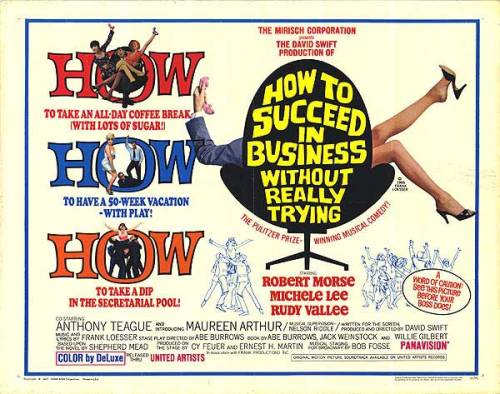
J. Pierpont Finch (Robert Morse) is a window washer looking to get ahead in the business world. By pure chance he finds a book entitled ‘How to Get Ahead in Business without Really Trying’. He reads it and follows the advice. He quickly gets a job at a large company and within days he moves all the way up from the mailroom to the head of advertising and eventually chairman of the board all without doing much work in this adaptation of the hit Broadway play, which in turn was an adaptation of the Abe Burrows novel.

This delightful film is lively and fresh even after all these years. The humor of course exaggerates life in the business world, but remains on target nonetheless. It accurately pinpoints all the universal problems and politics one goes through when working at a large company and dealing with the inside politics of getting ahead. Nothing is dated because it sticks with exposing the human foibles that come about in any generation when in a competitive and uncompromising environment, which is why I found it funny and interesting.

David Swift’s direction is top-notch. The pace is fast and furious balancing the humor and songs nicely. The sets are colorful and garish enough to accentuate the story’s farcical nature, but still bring out an office atmosphere feeling as well as the bigness of the company with large and imposing doorways including the amusing cathedral-like one that opens up to Finch’s office at the very end. At no times does the film suffer from the static staginess like most stage plays do when adapted to the screen.

The songs by Frank Loesser are upbeat and melodic and sound distinctive. My favorite one was the toe-tapping ‘A Secretary is Not a Toy’, but the showstopper ‘Brotherhood of Man’ had the best dance routines and was rousing enough to almost get me out of my seat. Rudy Vallee and Morse are also great in their rendition of ‘The Old Ivy’ fight song.

Morse recreates his role from the Broadway production. His voice isn’t necessarily the best and some of his singing seems a bit off-key, but his very boyish looks, gap-toothed grin, and bowl haircut is perfect for the part. A fun moment involving him is the scene where he prances down a busy New York sidewalk that was done with hidden cameras and the reactions from the other people on the street are genuine and real.

Michele Lee is terrific in her film debut. Her energy and perky smile are perfect as is her voice in the rendition of ‘I Believe in You’. She is probably best known to most for her starring role in the long running TV-series ‘Knots Landing’. What I can’t get over is how she continues to look like she hasn’t ever aged. A video on YouTube from her appearance at a 2011 AARP event has her looking almost the same as she does in this film. The interviewer tells her she is looking good and Lee replies ‘I always do’, which may seem conceited to some, but when one continues to look as great as she does then I suppose it is deserved.

Vallee best known as a crooner from the 1920’s is fun as Jasper Biggley the pompous head of the corporation. Anthony Teague with his devilish grin is great as the nefarious Bud Frump. I also liked the cute Kay Reynolds as Smitty and found it a shame that neither of these two talented young performers went on to do much else film-wise after this.

The only one I really didn’t like was Maureen Arthur as the ditzy and dumb Hedy Larue. Her high pitched voice and body gyrations were clichéd, over-the-top, and more annoying than funny. However, the incompetent way she takes down a dictated letter as well her reluctance to put her hand on a giant Bible during the film’s hilarious treasure hunt scene did manage to elicit some chuckles.

In 2011 the play was brought back to Broadway with Harry Potter’s Daniel Radcliffe in the lead. I wouldn’t be surprised if a remake of the film version comes out at some near point although nothing has been announced. Either way this film stands fine on its own and although never mentioned amongst the classic musicals I think it should be.

My Rating: 8 out of 10

Released: March 9, 1967

Runtime: 2Hours 1Minute

Rated NR (Not Rated)

Director: David Swift

Studio: United Artists

Available: VHS, DVD, Amazon Instant Video, Netflix streaming
Private Parts (1972)

private parts 3

By Richard Winters

My Rating: 7 out of 10

4-Word Review: He likes to watch.

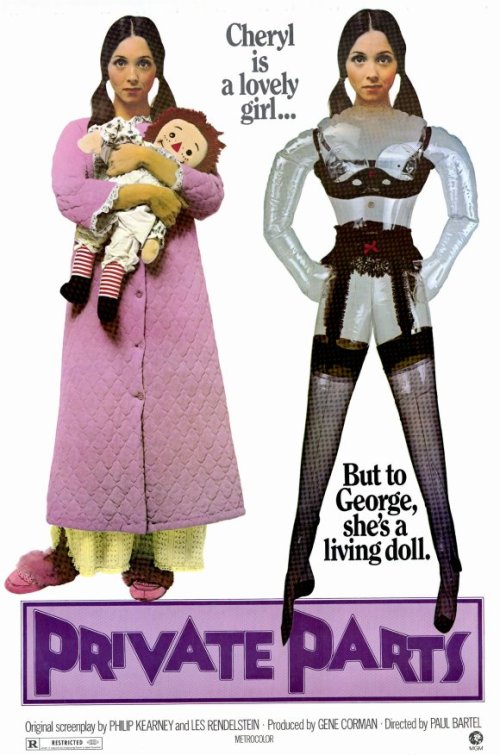
Cheryl (Ayn Ruymen) is a teen who cannot get along with her sister and boyfriend and decides to move out of their apartment and into a seedy hotel run by Martha (Lucille Benson) a very strange old lady. Here she lives next to voyeuristic photographer George (John Ventantonio) who has a big sex doll fetish. Cheryl secretly spies on George having sex with his doll and starts to get off on it. George becomes aware of Cheryl spying on him and likes it, which causes them to form an odd relationship and that is when things really get weird.

The film’s intrigue comes from the way it see-saws between being a perverted character study, horror film, and dark comedy. Director Paul Bartel makes great use of lighting, setting, and camera angles. There is also one truly odd and memorable sequence involving Ventantonio filling up his sex doll with water and then pumping it full of his own blood. The story is subtle enough to keep you involved and guessing and may even take a couple of viewings before you truly ‘get it’.

Much like with his later and better known film Eating Raoul Bartel examines the psychological complexities that make up people’s sexual nature and how perversions and fetishes are a normal part of it. The mindset is that everyone probably has a weird fetish of some kind and the open minded approach is what ultimately makes it refreshing and intriguing.

Although the film teases you with some sex and violence it never really goes all out. By dancing the line between being a horror film and a sex flick it fails to make a lasting impression despite a few good moments.

This is an interesting curio for sure and for its time was really pushing the envelope, but suffers from a low budget and isn’t scary or gory enough. However, George’s sex doll is unforgettable and watching it fill up with his blood is one of the damnedest looking sights ever put on film.

My Rating: 7 out of 10

Released: September 17, 1972

Runtime: 1Hour 27Minutes

Rated R

Director: Paul Bartel

Studio: MGM

Available: VHS, DVD, Amazon Instant Video

The Apostle (1997)

apostle

By Richard Winters

My Rating: 8 out of 10

4-Word Review: Preacher on the run.

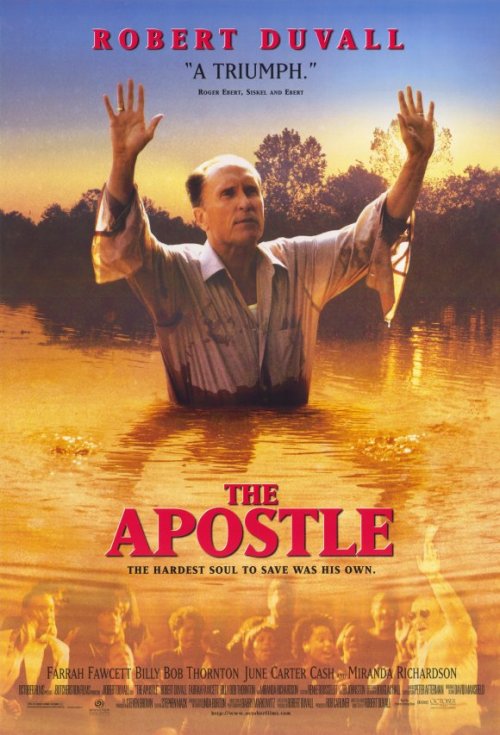
As a would-be screenwriter I find it heartening knowing how many great screenplays there are out there that struggle to find a home no matter who has written or pitched it.  Actor Robert Duvall wrote the solid screenplay for this film in the 80’s only to have it rejected by every major studio and only got made when he decided to put up 4 million dollars of his own money.

The story involves a fiery evangelical minister by the name of Sonny (Duvall) whose volatile ways gets the better of him and he ends up killing his wife’s lover. He then goes on the run to Louisiana where he starts up a new church. There he begins to turn his life around and become loved and admired by the community only to have the police close in on him.

In many ways this is similar to a 1962 episode of the old ‘Alfred Hitchcock Hour’ series that was entitled ‘Bonfire’ and starred Peter Falk as the minister.  Both characters were loud and dramatic preachers.  Both men went on the run after committing homicide while continuing to start up new congregations along the way and both ended up being surrounded by the police as they gave one last fiery sermon. However, the difference comes with the fact that the Falk character was clearly a self-serving fraud while with Sonny that is not so clear, which is what makes this film and character so fascinating.

Sonny has a temper as well as other underlying issues, but he makes a genuine effort to rectify things with his new congregation.  He even brings boxes of groceries to the doorsteps of poor families. It is never clear whether he is simply trying to make personal amends for past transgressions, or just a flawed man with a good heart. The viewer is never allowed to feel sure either way, but ends up empathizing with him nonetheless. Every scene and line of utterance becomes more revealing.

Duvall gives a strong performance. I felt this may be his signature role and that comes after a long line of already brilliant performances.  I enjoyed his running ‘conversations with the Lord’ that he has when he is alone or just walking down the street.  The conversation that he has with the police is amusing as is the final scene that is shown over the closing credits.

The casting is unique.  June Carter Cash plays his mother, which is interesting by the fact that in real-life she was only two years older than Duvall.  Farrah Fawcett plays his wife, and although she was much younger than him, I felt she did a good job and made a perfect fit.  Billy Bob Thornton gets a memorable cameo as a man who initially wants to destroy the church with a bulldozer, but then with Sonny’s help becomes spiritually awakened.  I also very much liked James Beasley in the supporting role as the minister who helps Sonny start up his new church.  His calm and collected manner helped balance Duvall’s intensity.

The supporting players were all amateur actors, some of which had never performed in front of the camera before.  Director Duvall was known during filming to keep the atmosphere loose.  He allowed his cast to ad-lib, which gives the film a more authentic feel.  Just like with other actors who turned to directing, like Paul Newman and Marlon Brando, Duvall has scenes that stretch out much longer than most films.  This is done to give the actors more control over their characters and allow their performances alone to carry the scene.  I also liked the fact that the supporting cast was almost all African-American and the story centered on a white minister preaching to a black congregation.

Duvall has long been known to be an admirer of the south, so it is no surprise that the story takes place there or that the shooting was on-location.  He captures the ambience of the region and people quite well, including the sound of the heat bugs buzzing at night.

The only issue I had with the film involves the scene where Sonny kills his wife’s lover. He does this by hitting him over the head with a baseball bat during a little league game while in front of many onlookers.  In most real-life accounts when something similar to this happens people will usually gang up on the culprit and physically subdue him, or chase after him until the police arrive while here the onlookers allow Sonny to peacefully walk away.  Other than that I thought this was a great character study and I would highly recommend it.

My Rating: 8 out of 10 

Released: October 9, 1997 

Runtime: 2Hours 14Minutes 

Rated PG-13 

Director: Robert Duvall 

Studio: Butcher Run Films 

Available: VHS, DVD, Amazon Instant Video

Agnes of God (1985)

Agnes of God 2

By Richard Winters

My Rating: 7 out of 10

4-Word Review: Meg Tilly is marvelos.

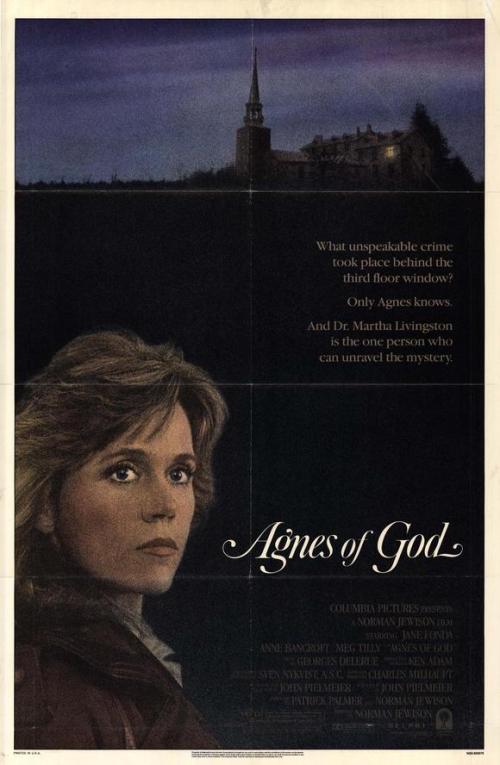
Sister Agnes (Meg Tilly) is a young nun found in a convent to have given birth to a baby who then dies. Martha Livingston (Jane Fonda) is the court appointed psychiatrist brought in to investigate the case, but as the investigation ensues it only seems to unearth more and more perplexing twists.

The theology is slight and the film, which is based on the Broadway play by John Pielmeier, approaches the subject matter in a very matter of fact way. It has the mindset that the majority of the viewers are non- religious or disgruntled ex-Catholics and portrays the church as a stubborn, age old institution that is slowly losing touch with our more modern sensibilities.

Yet, refreshingly, it also doesn’t try to tear down the church with every chance it gets. There is a certain level of respect and objectivity. The mother superior (Anne Bancroft) is shown to be very human and multi-faceted. She and Fonda make interesting adversaries. Their love-hate relationship is both interesting and enlightening. There is even a rare scene showing an excited young woman being inducted into the sisterhood as her proud family looks on.

Fonda, with her liberated modern woman persona, seems a very obvious choice to play the no-nonsense psychiatrist. She approaches the role with conviction, but her constant chain smoking seems affected and her emotionalism overwrought. I still say she is better suited for comedy like in Cat Ballou and Nine to Five.

Bancroft is solid as usual. Yet it’s Tilly that is really impressive. She portrays the innocence of her character with an incredible clarity and it’s almost astounding.

The mystery unravels well and keeps you intrigued. Yet the ambiguous conclusion is a bit disappointing. The drama side fares better. It poses a few good insights and ends with an interesting perspective. The film is well done on all levels even though outside of Tilly’s compelling performance there is really nothing that memorable or distinctive about it.

My Rating: 7 out of 10

Released: September 13, 1985

Runtime: 1Hour 38Minutes

Rated PG-13

Director: Norman Jewison

Studio: Columbia

Available: VHS, DVD, Amazon Instant Video

The Anniversary (1968)

anniversary 2

By Richard Winters

My Rating: 6 out of 10

4-Word Review: Bette eats them up.

Since tomorrow will mark the 1st anniversary of when this blog started I wanted to choose a movie that had a similar theme in its title. The anniversary here deals with Mrs. Taggart (Bette Davis) celebrating the date of when her and her now deceased husband where married. Taggart is a bully who enjoys manipulating her grown sons and having her way. On this occasion all three of her sons carries a secret, which will all slowly come out as the evening progresses. Terry (Jack Hedley) is the oldest and is married to Karen (Sheila Hancock) their secret is that they plan on moving to Canada much to his mother’s dismay as she likes having her children close by. Henry (James Cossins) harbors a secret fetish to dress in women’s underwear. Tom (Christian Roberts) brings his fiancée Shirley (Elaine Taylor) to visit with their secret being that she is already pregnant.

If you’re a Bette Davis fan then this is required viewing as she is at her bitchy best. Although Mona Washbourne played the role when it was on stage it was revised by Jimmy Sangster for the screen with Davis’s personality very much in mind. It has all of her famous caricatures and she revels in it. Her insults are like arrows that slice through the other characters until they are mush. She gives her part just the right amount of camp and her infatuation with a statue of a little boy that is hooked up with a hose that when squeezed spurts water out of its front end like he is peeing is priceless.

Hancock makes for a good adversary and in fact out of all the other performers she is the only that seems to be able to stay toe-to-toe with Davis. Apparently Davis did not like Hancock and tried to get her replaced with Jill Bennett. Hancock was aware of this and I think that animosity comes out perfectly on the screen.

Taylor is young and gorgeous and she has one good moment when she tells off Davis, but that is about it. The three male actors are just not as effective as the females. Part of it could be the characters that they play, but on the most part they are rather blah.

Director Roy Ward Baker, who replaced Alvin Rakoff one week into the shooting at Miss Davis’s request, does his best to avoid the filmed stage play look. He opens the movie at an outdoor construction site, which is unusual. He also has a dazzling fireworks display in the middle, but my favorite is when Henry steals women’s bras and panties from an outside clothesline and replaces them with dollar bills in an attempt to ‘pay’ for what he is stealing. Yet despite all this the movie eventually gets stagy and becomes a bit draggy for it.

My biggest complaint is the fact that this type of thing has been done before. There is no new angle or perspective to any of it. Davis rants on and on with the other characters too cowardly to fight back. The little that they do is not enough. This is the type of film that screams for a big payoff, but it never happens. Taggart, as mean as she is, comes through it pretty much unscathed and for most viewers that will probably not be satisfying.

My Rating: 6 out of 10

Released: February 7, 1968

Runtime: 1Hour 35Minutes

Rated NR (Not Rated)

Director: Roy Ward Baker

Studio: 20th Century Fox

Available: DVD

Arnold (1973)

arnold 2

By Richard Winters

My Rating: 2 out of 10

4-Word Review: Dead body is lethal.

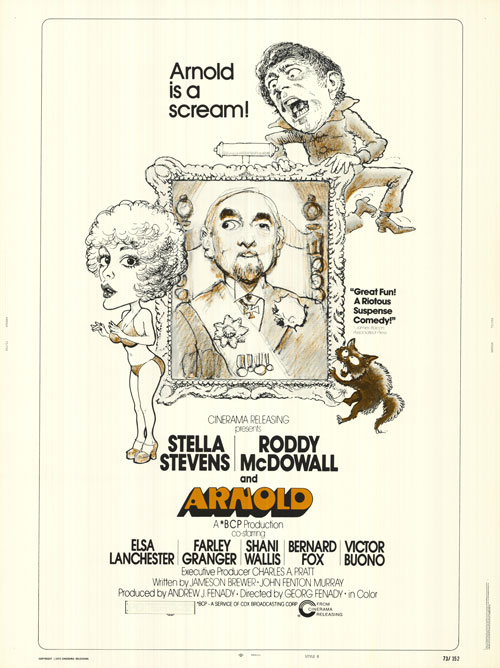
Arnold (Norman Stuart) is a dead corpse who at his funeral marries the ravishing Karen (Stella Stevens). She gets all of his wealth and to live in his mansion as long as she never leaves the side of his coffin and takes it everywhere she goes. His other greedy relatives aren’t happy with this arrangement, but they all end up being killed off in weird and mysterious ways, which makes Karen feel that Arnold may not actually be dead and that she may be his next victim.

Although this is an obscure film it has managed develop a small cult following, but I was not impressed with it. It has too much of the contrived old-fashioned horror movie elements without adding anything new to it. Even done in the spirit of parody it is too clichéd. The sets are unimaginative and cheap. All the outdoor scenes where clearly done inside on a soundstage, which is always annoying. The humor is sparse and relies mainly on corny one-liners. The story is devoid of any scares, gore, or special effects. The plot is cheesy and the whole thing looks like it would be better suited for a 70’s TV-sitcom than the movie screen. It was filmed simultaneously by the same director and writer as Terror in the Wax Museum and the whole thing has a very rushed and sloppy quality about it.

There are a plethora of B-actors making up the cast many of whom look to be phoning in their parts simply to collect a quick paycheck. Jamie Farr, in a heavy disguise, never even utters a word of dialogue, which is actually for the best. The only performance I liked was Bernard Fox as the incompetent police inspector. Some of his lines are amusing especially his last one and he is the one thing that saves this from being otherwise a complete waste of time.

I did like the theme song sung by Shani Wallis who also appears as Arnold’s widow Jocelyn. It has a certain toe-tapping quality to it and Shani gives it energy and verve. The complete rendition is sung over the closing credits.

My Rating: 2 out of 10

Released: November 16, 1973

Runtime: 1Hour 34Minutes

Rated PG

Director: Georg Fenady

Studio: Cinerama

Available: None

Sixteen Candles (1984)

sixteen candles

By Richard Winters

My Rating: 7 out of 10

4-Word Review: He has her panties

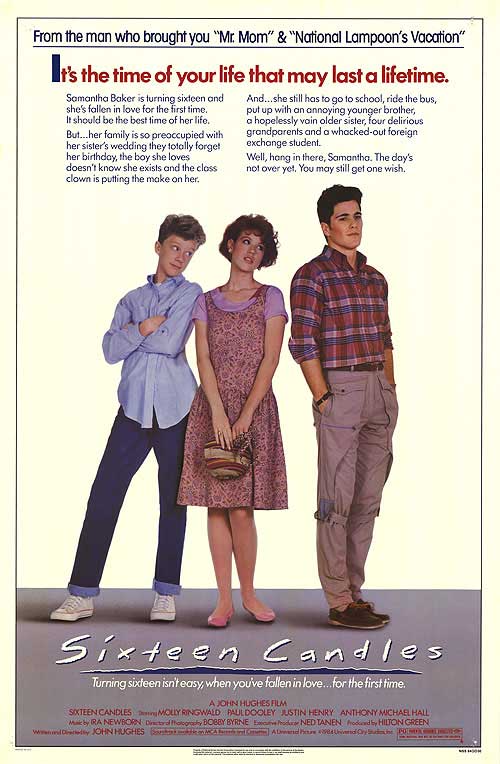
The 80’s may eventually become known as decade of the teen movie. There were so many and 98% of them were crude, moronic, and forgettable. However this disarming film, a product of John Hughes, is a winner. It’s a simple story that manages to bring out the universal truths of that age in a seamless manner. Its best asset is its ability to show how all those things that are considered insignificant to others is a big deal to teens. The film may be best suited for adults who can look back on that period with a mature perspective and a wry sense of wit as well as nostalgic to those who were adolescents when the film came out.

The film stands out from the rest in other ways too. First is the fact that the majority of the cast actually look the age they are playing and resemble the physical awkwardness. Other teen movies always seem to have pretty models and chiseled faced guys who look older than they should. The kids here also don’t have that annoying smugness. The filmmakers approach it with the idea that behind all that crudeness it is still an innocent time. It’s also nice to see parents and teens getting along and not constantly at odds. The late night talk between Ringwald and her father (Paul Dooley) is quite touching.

The film has some really funny moments. The destruction of a nice suburban home during a wild teen party is fun. Hall’s ‘official’ unveiling of Ringwald’s panties to a group of awed freshman is also memorable.

Ringwald is perfect in the starring role as she was sixteen at the time and seems to embody the character. You hardly see the acting. Hall was also a good choice as the male geek. He certainly has the scrawny physique of a typical freshman as well as the outrageous persona that he creates to help compensate for it. It is also interesting that at times he shows some mature sensibilities, which is a good example of how adolescence can be a mixture of different traits. The adult cast is great as well especially the veteran character actors who play the grandparents.

This film borders on being a minor classic even though there are a few drawbacks. One is the ending sequence where Ringwald’s older sister, who is also the bride, starts to behave erratically, which becomes comic overkill. The picture worked better when it stuck with Ringwald and her high school experiences exclusively. The film also has a few too many neat wrap-ups. The worst being when the hottest girl in the senior class falls in love with Hall, which was too much of a stretch. The music score gets heavy-handed at times especially when it’s used to accentuate a comic moment. There are also a few too many unnecessary sound effects.

John and Joan Cusack can be seen in small roles with John looking very young. Jami Gertz can be seen quickly as a drunken party guest. Also Blanche Baker, who plays Ringwald’s older sister, is the real life daughter of actress Carroll Baker.

My Rating: 7 out of 10

Released: May 4, 1984

Runtime: 1Hour 33Minutes

Rated: PG

Director: John Hughes

Studio: Universal

Available: VHS, DVD, Blu-ray, Amazon Instant Video

Dead Heat on a Merry-Go-Round (1966)

dead heat on a merry go round

By Richard Winters

My Rating: 6 out of 10

4-Word Review: Robbery at an airport.

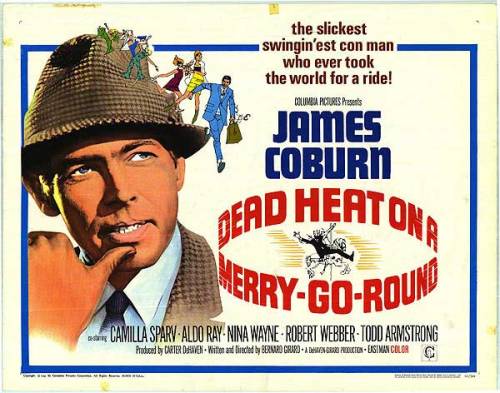
Eli Kotch (James Coburn) manages to con his way out of jail by playing on the affections of his pretty jailhouse psychiatrist (Marian McCargo). His plans are to rob the bank at the Los Angeles International Airport while they are hosting the arrival of a Soviet Premier, which he figures will sufficiently keep the security personal distracted. The blueprint for the bank will cost him a hefty sum, so to help finance it he travels across the country seducing rich women and making off with their expensive possessions and money. Once the blueprint is purchased he assembles his men and executes the daring and elaborate scheme.

The film, which was written and directed by Bernard Girard, is by all means slick although it goes a bit overboard. The first hour is hard to get into. The filmmakers seem intent to keep the viewer guessing about the Kotch’s motives and intricate plans as the rest of the characters. There is so much cutting back and forth between scenes in L.A. and Boston as well as all the lady victims that Kotch finds that it becomes confusing and off-putting. Everything comes off too easily for our protagonist. I suppose that is the intended charm, but a few hiccups here and there to their plans might have offered more tension and reality.

He also beds too many women almost like he is some sort of modern day Don Juan. Having even just one of them slap him across the face when he makes his advances instead of just robotically disrobing and hopping between the sheets with him would’ve been funny. If this film were to be remade the women characters would have to be updated as here they are simply caricatures of a bygone era.

Camilla Sparv’s character and the way Eli treats here was a particular problem with me. Sparv looks drop-dead gorgeous to the point of being breathtaking. Most men would feel blessed at having such a beautiful woman fall in-love with them, but Eli takes it all for granted. He callously lies to her and uses the genuine feelings she has for him to take advantage of her and use it for his own gain. It gets to the point where Eli starts to come off as a real cad and makes the viewer dislike him. There is a twist at the end involving the Sparv character, but it is not enough. I was really hoping that she would somehow manage to screw-up his plans whether intentional or not, but that doesn’t happen even though it should’ve.

Coburn’s toothy grin and deep laugh manages to carry it and probably no other leading man would’ve been able to pull off this type of part as well. The supporting cast is equally good. Rose Marie is fun in a brief part as an older woman that Eli cons. Severn Darden is effective as the nerdy and smart, but very nervous member of Eli’s group. Nina Wayne is funny as one of Eli’s first female victims, a ditzy blonde filled with very quirky philosophies on just about everything. Yet it is Robert Webber, a very under-rated character actor, who steals the show as the high-strung head of the airport security. You can also spot a young Harrison Ford in a brief bit as a bellhop.

The excellent on-location shooting gives the film an added flair. The shots of the Los Angeles International Airport are good especially the way it captures the iconic and modernistic Theme Building. Images of a wintry Boston during Eli’s jaunts to that city are quite scenic particularly all the tree branches covered with snow.

The film’s final half-hour is captivating and even intense. The editing is excellent and the sheer brazenness of the crime is amusing. There are certain things though that seemed implausible and whether such a plan could be pulled off in real-life is doubtful. Still, if you’re a fan of heist films this should offer two hours of suitably fluffy entertainment, but just don’t think about it too hard.

My Rating: 6 out of 10

Released: October 12, 1966

Runtime: 1Hour 44Minutes

Rated NR (Not Rated)

Director: Bernard Girard

Studio: Columbia Pictures

Available: VHS, DVD, Amazon Instant Video