Tag Archives: Susan Clark

Porky’s (1981)

By Richard Winters

My Rating: 6 out of 10

4-Word Review: Revenge on nightclub owner.

Pee Wee (Dan Monahan) is a teen living in the Florida everglades during the 1950’s who suffers from a small penis size, which has prevented him from losing his virginity. He and his high school pals have hatched a plan of pooling their money together and then hiring a prostitute, which they can then all have sex with. Their first attempt doesn’t work out, so they decide to go to a nightclub that sits in a lagoon on stilts and is called Porky’s, which is the nickname of the owner of the establishment, ‘Porky’ Wallace (Chuck Mitchell) that he attained for being overweight. The boys feel they’ll be able to hire one of the strippers at the club to have sex with and Porky agrees to ‘set it up’ and takes their money only to then have the teens fall through a trap door and into the water below. This enrages Mickey (Roger Wilson) who set-up the deal and he becomes consumed with getting revenge on Porky, but when he goes there to ‘settle things’ he gets badly beaten-up, which sends him to the hospital and convinces his friends that even sterner justice is needed in order to get the proper payback.

I remember when this movie came out and there were TV ads capturing people as they left the theaters and getting their first reaction. At the time this was considered ‘outrageous’ and many of the folks in the ad seemed either shocked or embarrassed. Nowadays though it’s unlikely most will consider it extreme, and some might even call it boring particularly in between the moments when it’s raunchy. The idea for it was conceived in 1972 by writer/director Bob Clark who based the story on his own experiences as a teen going to school in rural Florida during the 50’s. The studios though didn’t like the script, and it got shopped around for years before finally getting modest funding out of Canada where it could be used as a tax write-off and thus even though it was filmed in the U.S. by an American director it still gets labeled as one of the highest grossing films in Canadian movie history.

The critics like with the studio heads, didn’t care for it with both Siskel and Ebert naming it one of the worst movies to come out of the 80’s though when compared to the other teen sex comedies from that decade this one doesn’t seem all that bad. The characters have distinct personalities and much of the dialogue while raunchy seemed realistic for that age group and not all that different from what got talked about during my own high school days. The film also manages to tackle some serious topics like antisemitism, which was also a part of that era, so it has an adequate balance and doesn’t just stay hyper-focused on the sex.

On the negative end Nancy Parsons as the female coach version of Nurse Ratched is one-dimensional and Kim Catrall, playing a cheerleader nicknamed ‘Lassie’, plays too much of the bimbo caricature to be even remotely interesting. Neither is the fault of the actresses, who are okay, but more the writer. On the other hand, I loved the bit part of Susan Clark playing a prostitute. She had been in a few Disney movies just before this and later the TV-show ‘Webster’, so seeing her playing against the family image is fun.

I also loved Kaki Hunter who seems just as dirty minded as the guys and how she’s very average looking as I’ve found those types tended to be a little more ‘easy’, as evidenced by her doing it with Pee Wee, in order to get the guys’ attention and make up for not being as attractive versus in other teen flicks where it’s only the super-hot ones that sleep around. In that vein too I enjoyed the fact that during the shower scene when the boys are peeping at the girls there’s an overweight one impacting Pee Wee’s ability to see the thin ones, which is realistic too as in most high schools there’s a mix of body types and not all skinny like most other teen comedies would make you believe.

I did have some problems though with the nicknames mainly with Pee Wee and ‘Meat’ the name for Tony Ganios’ role. Supposedly this is for their penis size, but how would anyone know what their penises looked like? Normally one gets nicknames for physically attributes that everyone can see for instance if they’re a short height they could be called ‘shorty’. Yes, there is a scene where all the boys strip naked together, but their nicknames had already come about long before then. One could argue that maybe it started while they took showers after gym class, but in my high school if some guy was caught looking at another’s genitals, they’d be accused of being ‘gay’, which during that time period would be considered a stigma.

While the plot is lean and there are a few lulls there are enough comical moments to keep it afloat. The segment dealing with Nancy Parsons character going to the principal to ‘report’ seeing a penis in the girl’s shower and advocating for all the boys to undress so she could spot which one had a dick with a mole on it, is a gem especially with the way the camera zooms in on a hanging portrait of a smiling Dwight Eisenhower like even he too is in on the humor. The demolishing of Porky’s bar, which comes near the end, isn’t bad either and helps to make this thing a minor cult classic.

My Rating: 6 out of 10

Released: November 13, 1981

Runtime: 1 Hour 38 Minutes

Rated R

Director: Bob Clark

Studio: 20th Century Fox

Available: DVD, Blu-ray
Double Negative (1980)

By Richard Winters

My Rating: 4 out of 10

4-Word Review: Who killed his wife?

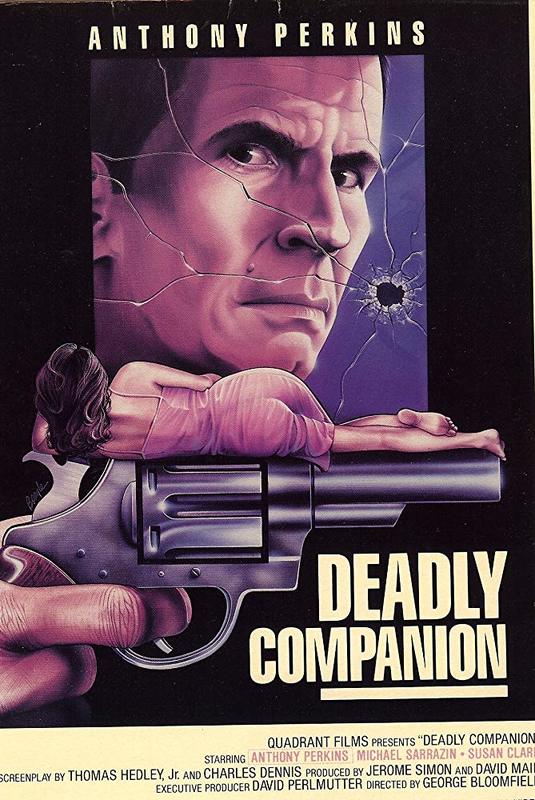
Michael (Michael Sarrazin) is a photojournalist tormented by fragmented memories of his wife’s murder. Paula (Susan Clark) is his girlfriend who’s trying to help him sort through these flashbacks, so he can find some answers. However, she too has things to hide as she’s busily paying off a man named Lawrence Miles (Anthony Perkins) who threatens to go to the police about what he knows about the killing. There’s also Lester (Howard Duff) a private investigator who sticks his nose too deeply into the case and finds himself at deadly odds with both Lawrence and Paula.

The film is based on the 1948 novel ‘The Three Roads’ written by Ross Macdonald under his real name Kenneth Millar. Macdonald later went on to have a stellar career writing novels about private investigator character Lew Archer and this story has plenty of potential but gets mishandled and ultimately becomes a misfire. A lot of the problem stems from the production employing three different writers who all had different perspectives on where they wanted the story to go and then relying on director George Bloomfield to cram it all together, which he doesn’t succeed at. The result is a fragmented mishmash that takes a long while to become intriguing and even then, remains interesting only sporadically. Lots of extended scenes particularly at the beginning that should’ve been trimmed and a poor pacing that barely manages to create any momentum.

It doesn’t help that the main characters are wholly unlikable and uninteresting. Clark especially comes off as arrogant right from the beginning when we see her drive by what appears to be Amish people in a horse and buggy fighting through the snow and cold while she enjoys things in her warm ritzy car, which makes her seem detached and uncaring. The scene where she’s trying to procure an important real estate deal and then gets hampered by Michael playing loud music in the other room, so she then excuses herself and promises to be right back. I was fully expecting her to yell at Michael for his misbehavior, but instead she strips off her clothes and the two make love, but it seemed like sex should be the last thing on her mind during such an serious business meeting and what would happen if the clients, who were just a door away and waiting for her return, would walk in on them? 

Sarrazin doesn’t cut it either. I know he’s been lambasted by critics in his other film appearances for being too transparent and forgettable and yet I’ve usually defended him as I feel he can sometimes be effective even given the right material. Here though he falls precariously flat. Some of it is the fault of the writing which doesn’t lend him to create a character with any nuance, or likability, but in either case he’s a complete bore and the viewer isn’t emotionally invested in his predicament. His flashback moments where he sees himself in some sort of prisoner of war camp doesn’t make a lot of sense, or have much to do with the main plot, and seems like something for a whole different movie. 

On the other hand, Perkins is fantastic and the only thing that livens it up to the extent that he should’ve been given much more screen time as the film sinks whenever he’s not on. It’s great too at seeing SCTV alums like John Candy, Eugene Levy, Joe Flaherty, Dave Thomas, and Catherine O’Hara in small parts where with the exception of Candy they’re not comical but instead make a rare turn at being dramatic. Duff is kind of fun and has one great moment, really the only good one in the movie, where he gets trapped in an elevator and must escape being shot by Perkins, who has his arm lodged in the otherwise closed doors, by desperately running back and forth in the closed space that he’s given. Michael Ironside has a memorable bit too as a bar patron who becomes incensed at Sarrazin when he refuses to allow him to buy him a drink. 

Spoiler Alert!

The denouement just leaves more questions and fails to tie up the loose ends as intended. For one thing it shows Sarrazin as being the one who strangled his wife, which I had started to suspect a long while earlier, so it’s not a ‘shocking surprise’ like I think the filmmakers thought it would. It also has Perkins leaving the scene, as he was having an affair with the woman, and even briefly speaking to Clark who witnesses him going, so why he’d insist Clark needs to pay him hush money didn’t make much sense. Sure, he could still go to the police and say that it was Sarrazin that did it, but Perkins fingerprints were at the scene of the crime, so I’d think either way he’d get implicated, and Clark could come forward saying she was a witness who saw him leaving. If anything, Clark should’ve been pushing him to go to the cops versus bribing him to stay away.  

Also, the way it gets shown, Clark comes into the bedroom after Sarrazin has already strangled his wife, so all she sees is him weeping over his wife’s dead body. For all she knew, from that perspective, is that Perkins really did kill the woman and Sarrazin was simply the first to come upon her dead body and thus for it to be crystal clear Clark should’ve entered while he was still in the middle of the act versus when he was already done.

Beyond that is that question of why would Clark want to stay with someone she knew had such violent tendencies? Wouldn’t she be afraid he could get upset at some point and do that to her? Sarrazin even asks her at the very end if she is afraid and her only response is: ‘aren’t you’? This though only muddles things further cementing it as a botched effort. 

Alternate Title: Deadly Companion

My Rating: 4 out of 10

Released: May 12, 1980

Runtime: 1 Hour 36 Minutes

Director: George Bloomfield

Studio: Quadrant Films

Available: Amazon Video

North Avenue Irregulars (1979)

By Richard Winters

My Rating: 7 out of 10

4-Word Review: Church ladies battle mobsters.

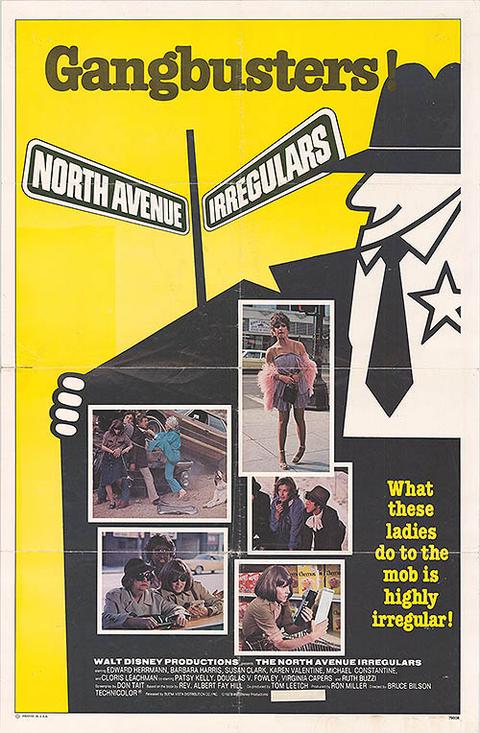
Reverend Michael Hill (Edward Herrmann) becomes the new pastor at the North Avenue Presbyterian Church, but right away things get off to a rocky start when the church’s funds get gambled away on a horse race. When Hill tries to retrieve the money he finds out that it is an illegal gambling joint run behind a dry cleaning business, who are always able to skillfully remove their presence before the police arrive. Hill goes on TV to lambaste organized crime in their town, which catches the attention of two treasury agents (Michael Constantine, Steve Franken) who want Hill to help them close down the gambling joints by having him hire men from his church to place bets at the parlors, but all of the men refuse. Hill then asks for the help of the church women who agree to do it and after some initial setbacks begin to make headway in taking down the area mobsters.

Usually I always say it’s important for films that are aimed for a young audience to have children playing the protagonist, but in this case the children characters have only small supporting roles and yet the film still manages to deliver the laughs. The main reason is the talented female cast who have distinctive personalities and convey comic form in different ways. Cloris Leachman is amusing as the middle-aged cougar with long finger nails, Virginia Capers is quite funny too as a heavy-set woman who doesn’t allow her big build to stop her from running several blocks in order to tail the bad guys and the variety of vehicles she drives with funny phrases painted on their windshields, which are all from her husband’s used car dealership, are humorous too. Barbara Harris as a suburban mother who chases the mobsters while driving in a station wagon packed full of kids in it is great too.

What may be surprising to many is that it’s all based on true events that occurred to Revenrend Albert Fay Hill when he took over as the minister at the North Avenue Presbyterian Church in New Rochelle, NY in 1961. It was there that he became a crusader against organized crime after the murder of a young man for not repaying his gambling debts. Like in the movie his fight gained the attention of US Treasury agents who wanted him to get his male parishioners to place bets with the mobsters, but the men all refused so he recruited their wives whose efforts managed to shut down several gambling houses, which lead to a front page write-up in The New York Times as well as Look magazine.

Of course the movie exaggerates things for comic effect, but it’s forgiven because the stunts are quite funny, which culminates in a massive car pile-up consisting of the demolition of 14 cars at the cost of $155,000. The scene involving the church getting blown up is amusing too because behind-the-scenes when it was first done the cinematographer forgot to put film in the camera forcing the crew to painstakingly rebuild the church just so they could try to do it all over again.

The film’s only weak element is Herrmann whose performance is certainly sincere and likable, but he’s never funny while Constantine is hilarious as the exasperated agent who has a virtual nervous breakdown dealing with the women and for that reason the film would’ve been more engaging had he been the lead character. I was also confused why the Reverend was  a single parent as there’s no explanation I could remember for what happened to the wife. In the book that this film is based, and in the true-life incident, the minster was married, so why was it decided that he should be single here? I got the idea it was because they wanted to create a romance between he and his secretary played by Susan Clark, but since nothing much comes from that it seemed unnecessary.

My Rating: 7 out of 10

Released: February 9, 1979

Runtime: 1 Hour 40 Minutes

Rated G

Director: Bruce Bilson

Studio: Buena Vista

Available: DVD, Amazon Video, YouTube

Showdown (1973)

By Richard Winters

My Rating: 2 out of 10

4-Word Review: Friends go separate ways.

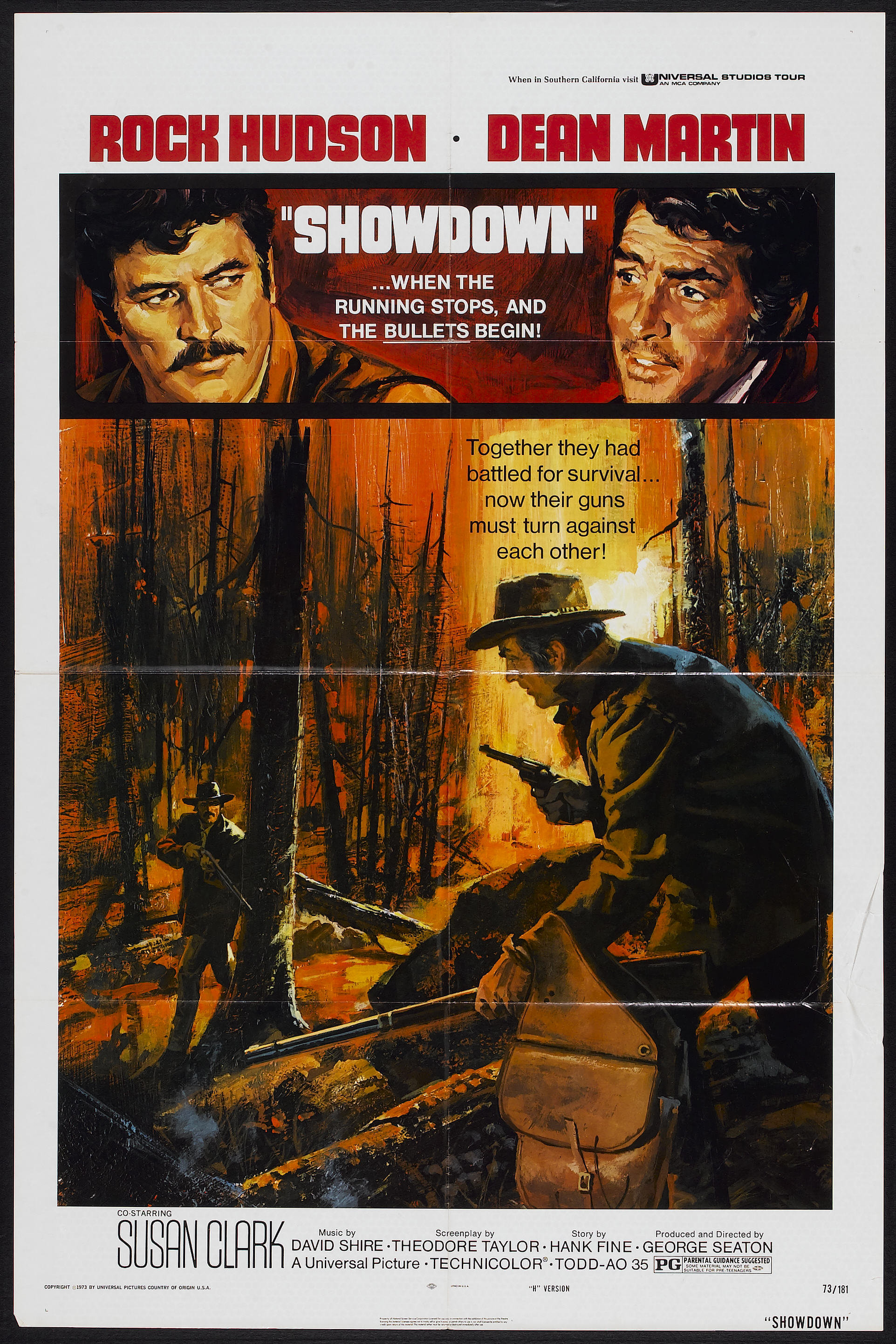
Chuck (Rock Hudson) and Billy (Dean Martin) were once close childhood friends, but as they grew older their lives drifted apart. Now Chuck is a sheriff while Billy has become a bank robber. When he and his gang rob a train it is up to Chuck to track him down and bring him to justice.

This flat and lifeless concoction was the last film directed by George Seaton who seemed to be slumming when he did this one as it’s derivative and formulaic to the extreme with nothing in it that is diverting or memorable. Part of the problem is the tone. It starts out as a potential western comedy with Billy riding on a train and pretending to be a sheriff. When the train gets attacked by the bandits he convinces everyone to put their valuables into a sack, so he can ‘protect’ them only to shock the people by absconding with them instead, which is kind of funny and had the film stayed at this level it still wouldn’t have been all that great, but at least more entertaining.

Unfortunately the rest of the story turns into one long, drawn-out drama that is both slow and pointless. The flashbacks showing the men when they were children are neither amusing nor insightful and could’ve easily been scrapped. I was also under the impression initially that the two men were brothers and the story might’ve had more impact had they been.

The film’s title seems to imply some big, climactic finish, which doesn’t really occur. Instead of waiting until the end for the two men to meet up with each other it actually occurs during the second act and when they do there’s no big confrontation or fireworks, which makes their interactions as flat and boring as the rest of the film. There is some mild tension involving Billy’s former gang members who want to track him down in order to inflict revenge on him for shooting another member of the gang, but this story angle doesn’t get played up enough and they’re given only moderate screen time.

Martin is engaging despite coming off looking washed-up and far older than the 57 years that he was with his hair looks dyed and buffed up by some Hollywood stylist. Hudson though is unable to match Martin’s charm making it seem like it would’ve been better had he not been in it at all and instead just solely focused on Martin trying to escape the clutches of the other gang members. Even Susan Clark, who is a great actress, gets wasted and miscast as Hudson’s wife as she looks too young to have been married to him and was in reality 18 years his junior making it more appropriate had she played his daughter.

My Rating: 2 out of 10

Released: June 20, 1973

Runtime: 1 Hour 39 Minutes

Rated PG

Director: George Seaton

Studio: Universal

Available: DVD-R (Universal Vault Series), Amazon Video, YouTube

The Apple Dumpling Gang (1975)

By Richard Winters

My Rating: 6 out of 10

4-Word Review: Orphaned kids strike gold.

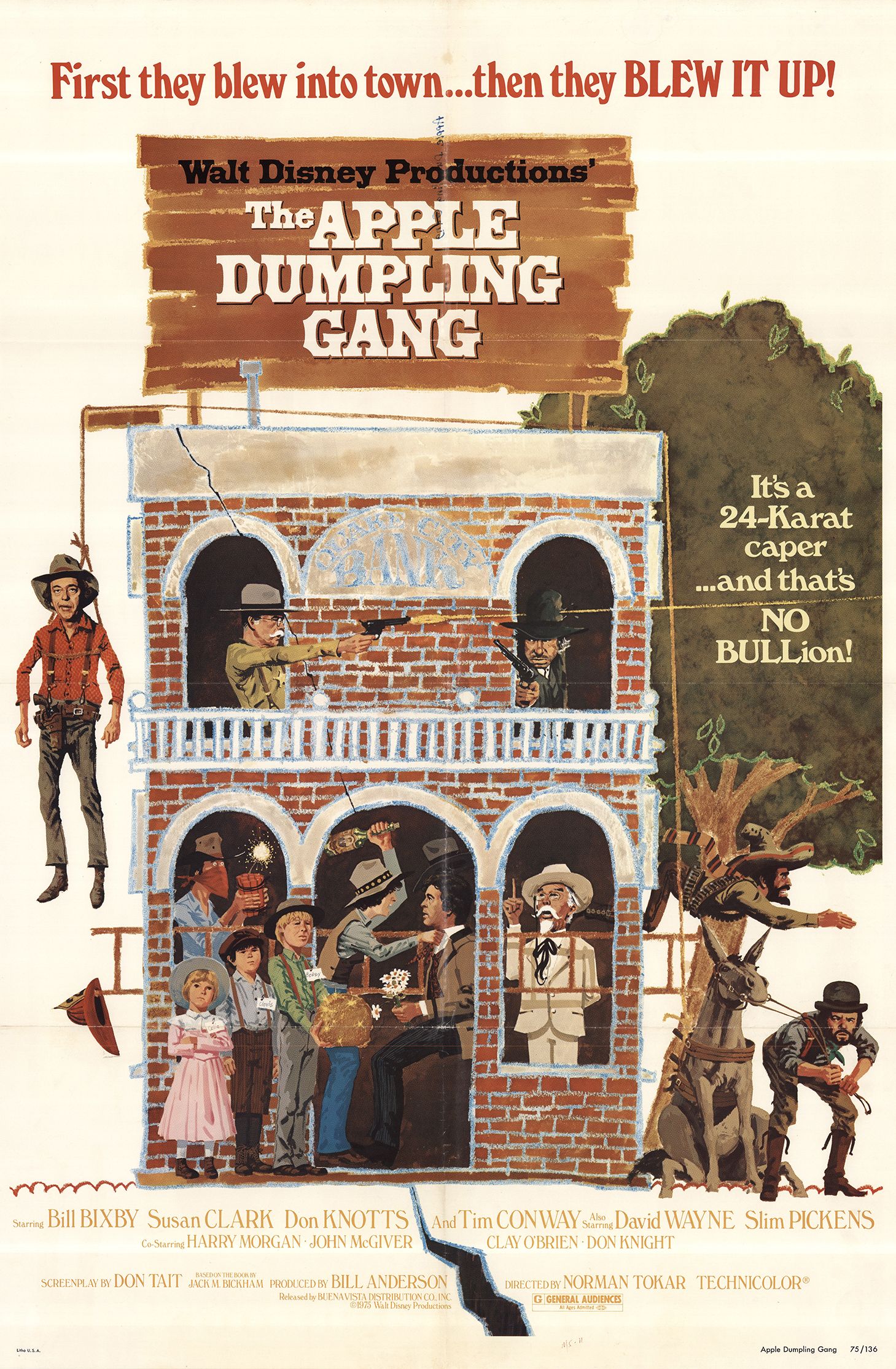
Russell (Bill Bixby) is a slick gambler living in the old West who finds that he has unwittingly become the guardian to three orphaned children ( Clay O’Brien, Brad Savage, Stacy Manning). Initially he tries to pawn them off on other people, but eventually he takes a liking to them when he realizes that they’ve inherited a mine that has gold in it, which soon makes everyone else in town want to adopt them.

This Disney film, which was based on the 1971 Jack Bickham novel of the same name, fares better than most of their other films and in fact became its biggest money maker from the 70’s. It helps that the main character of Russell isn’t as squeaky clean as the typical Disney leading man as it’s strongly implied that he cheats at the poker games that he wins and the fact that he gradually softens towards the kids through time creates a nice character arch. Susan Clark, who’s the love interest, is good here too as she plays against type for a Disney leading lady by being more tom boyish and masculine despite the fact that apparently behind-the-scenes she was scared to death of horses and every scene that required her to ride one had her instead on a mechanical one although you could never tell.

The typical Disney comical trappings are given a unique spin here too, which also helps. Instead of having another boring barroom brawl, which is so common in many western comedies, we are treated to a funny lovers spat between Clark and Bixby inside the bar where props get thrown around between the two while everyone else sits frozen and unsure of what to do. There’s no cartoonish car chase at the end either, but instead a genuinely hair-raising battle between Bixby and Slim Pickens, who plays one of the bad guys, down the white rapids of a river. The shooting was also done on-location at Deschutes National Forest in Oregon, which improves the setting from the usual studio back lot.

Even the kids are tolerable without having their cuteness or innocence get overdone even though the running joke dealing with the young girl constantly having to go pee isn’t as funny as it seems when you think about it and most likely in reality would’ve been a warning sign of a very serious medical condition instead. Also, the scene showing the kids getting trapped in the mine after an earthquake should’ve also shown how they were able to get out instead of simply cutting to the next scene with them back in town of it without any explanation as to how they got there.

The real stars of the film though are Don Knotts and Tim Conway as the comically bumbling would-be crooks. This marked the first of five film appearances that the two did together and in many ways this is probably their best effort. I always liked seeing them together because it was a rare chance for Knotts to play the smarter of the two instead of always being the dope himself although some may find Conway’s extreme ineptness more annoying than funny. In either event they help enliven the proceedings and became the stars of the sequel The Apple Dumpling Gang Rides Again, which will be reviewed next week.

My Rating: 6 out of 10

Released: July 1, 1975

Runtime: 1 Hour 40 Minutes

Rated G

Director: Norman Tokar

Studio: Buena Vista

Available: DVD, Amazon Video, YouTube

Promises in the Dark (1979)

By Richard Winters

My Rating: 3 out of 10

4-Word Review: Caring for cancer patient.

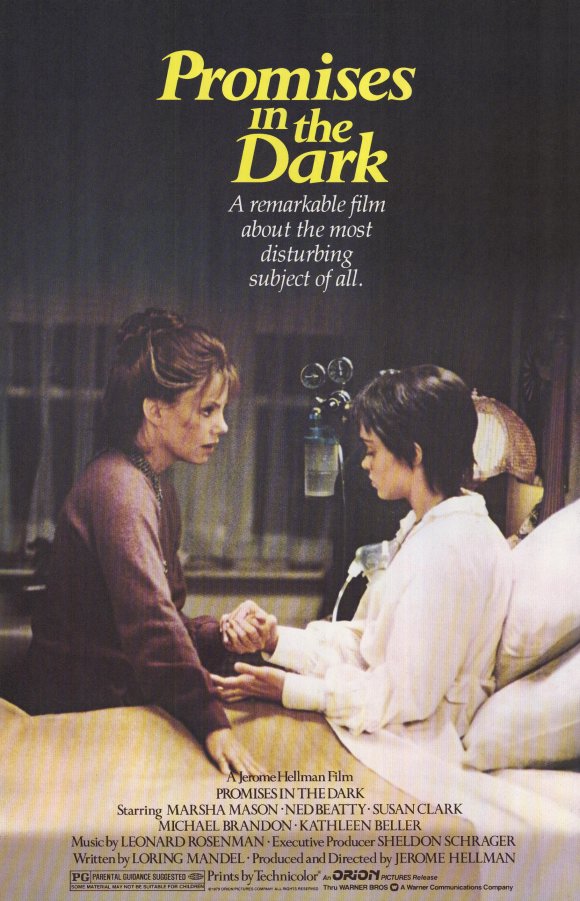
Elizabeth ‘Buffy’ (Kathleen Beller) is a 17-year-old high school senior who breaks her leg while kicking a soccer ball. Alexandra (Marsha Mason) is the attending physician who feels that a beak of that magnitude should not have occurred simply by kicking a ball, so after doing more x-rays they find a cancerous tumor, which necessitates having the leg amputated. While Buffy recovers from that further tests reveal that the cancer has spread and this causes Alexandra to lose her cold, defensive exterior as she tries to comfort Buffy through the remaining time that she has.

This film nicely keeps everything at an earnest level and avoids jazzing things up for dramatic purposes, which is refreshing. The acting from Ned Beatty as Buffy’s father and Susan Clark as the mother is outstanding with Clark’s character being particularly interesting especially when she doesn’t run to her sick daughter’s aid when she hears her cry for help, but instead remains frozen at the bottom of the stairs, which was something I wanted to have explored more.

Mason’s excellent dramatic talents seemed ripe for this type of material, but strangely she doesn’t come-off as well as I would’ve expected. I liked that she is portrayed as being strong and in control and the fact that she just happens to be female, in a time when doctors was still a male dominated profession,  and it’s never used against her is great, but the character’s arch, in which she learns to open-up more after her divorce, is not half as compelling as Buffy’s struggles, which should’ve made her the main character while the Dr. role thrown in as a minor secondary one.

Alexandra’s romantic relationship with another Dr., played by Michael Brandon, wasn’t necessary either. To some degree I liked how the film keeps this at a realistic level, by having the relationship full of a lot of ups-and-downs as opposed to having their eyes magically lock on each other and then in the next shot showing them in bed together like a lot of other movies do, but supposedly the element of this story was Alexandra’s friendship with Buffy and that in many ways becomes secondary to the romance.

Beller is the best thing as her sensitive portrayal connects strongly with the viewer making what she goes through quite upsetting. Having to watch a likable person learn to adjust to life with only one leg, which she does quite commendably, is one thing, but having her then go through more cancer treatments until she is left a virtual vegetable is just too much to bear and it makes the second hour downright tortuous to have to sit through.

Spoiler Alert!

Some may argue that having Buffy die was just keeping things real, but then why throw in a whole secondary story-line that doesn’t get introduced until the third act, which has a Karen Ann Quinlan-like quality to it as it deals with Buffy being kept alive long after her brain activity has ceased and Alexandra’s fight with Buffy’s parents to have the machine shut off. The fact that Alexandra eventually succeeds in turning it off only brings up more questions like did this get her into trouble with her job/reputation, or sued in court by Buffy’s parents? None of this gets answered or even touched on, but should’ve and in essence seems like a plot for a whole other movie.

Films from the 70’s were notorious for having sad endings, which in many ways made them more sincere. Yet this movie is so unrelentingly with it that I failed to see how anyone could enjoy it. Certainly it’s not something you’d ever want to watch more than once, or one that you’d ever want to invite a friend or date to as it would put a damper to any evening. This may be too maudlin for even fans of tearjerkers, which are the only people that could possibly like it.

My Rating: 3 out of 10

Released: November 2, 1979

Runtime: 1 Hour 58 Minutes

Rated PG

Director: Jerome Hellman

Studio: Orion Pictures

Available: DVD (Warner Archive), Amazon Video

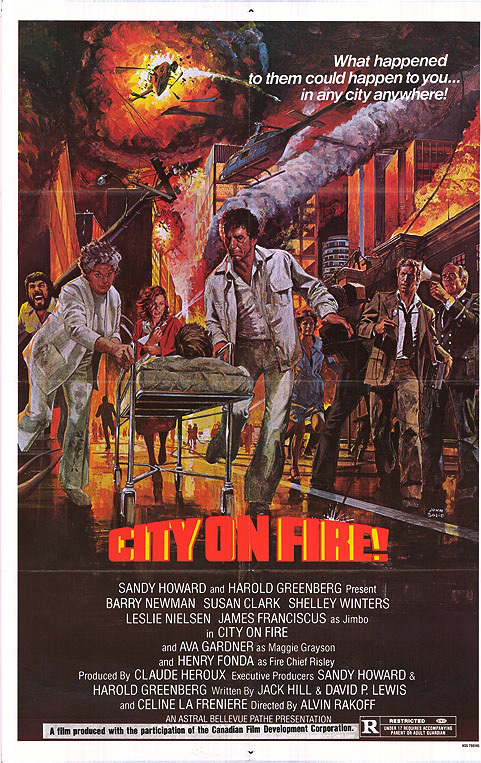
City on Fire (1979)

By Richard Winters

My Rating: 3 out of 10

4-Word Review: Title says it all.

When Herman Stover (Jonathan Welsh) gets fired from his job at an oil refinery he decides to get his revenge by opening the valves on the storage vats, which sends gasoline spewing out into the water system that soon sets the entire city on fire. Dr. Frank Whitman (Barry Newman) realizes that his hospital is in line of the approaching blaze and tries desperately to get the place evacuated.

Despite the American cast the film was financed by a Canadian production company and filmed on-location in Montreal with a few shots done in Toronto. While the movie bombed at the box office and later got mocked in an episode of ‘Mystery Science Theater 3000’ it’s actually decent on the special effects end.

In fact I found the effects to be quite impressive particularly at the beginning where two firefighters find themselves trapped in an apartment building in an actual blaze where the flames literally leap towards the camera and make the viewer feel like they are being engulfed by it. Most movies will show people set on fire, but only while wearing a protective body suit, but this one has them set ablaze while wearing regular clothes and with flames not only shooting out from their clothing, but their hair as well, which looked dangerous to film. It also graphically captures the charred burned skin of the victims.

The eclectic cast of old Hollywood veterans is fun for the most part with Ava Gardner hamming it up as an alcoholic newswoman trying to cover the disaster. It’s also nice seeing Shelley Winters playing a ‘normal’ person for once instead of a kooky, eccentric and she does it so well that she ends up not standing out at all, which never happens in any of her other movies.

Watching Susan Clark play a wealthy socialite who suddenly becomes a Florence Nightingale incarnate after the victims start piling up is too much of a dramatic arch and the film should’ve just had her as a regular nurse from the start. The part though where she helps with a delivery at least has the baby coming out of the womb with an umbilical cord as too many other movie births never show this.

Outside of the effects there’s little else to recommend. The scenes dealing with the culprit, played by Welsh, are dumb. For one thing he doesn’t seem unhinged enough to do what he does and in fact comes off as quite bland and even tries helping the victims later on. Also, when an employee gets fired they are usually escorted out of the building by security especially in a refinery and not allowed to just run around the facility freely and unmonitored like here.

It would’ve worked better had the number of characters been cut down to just a few and the story focused solely on their efforts to survive instead of coming off more like a news report trying to capture the chaos as a whole.  The idea of mixing pyrotechnic special effects with a lame storyline and hallow characters doesn’t work and becomes just a poor excuse for a movie.

My Rating: 3 out of 10

Released: August 29, 1979

Runtime: 1 Hour 46 Minutes

Rated R

Director: Alvin Rakoff

Studio: AVCO Embassy Pictures

Available: DVD, Blu-ray

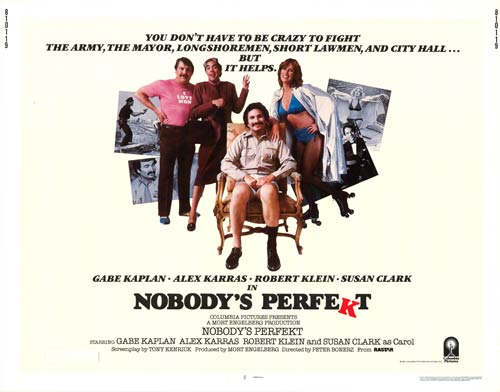
Nobody’s Perfekt (1981)

nobodys perfekt 1

By Richard Winters

My Rating: 0 out of 10

4-Word Review: Crazies fight city hall.

Dibley (Gabe Kaplan) who suffers from unpredictable memory loss, Swaboda (Alex Karras) who thinks his mother is still alive and with him at all times even when she really isn’t and Walter (Robert Klein) who has a split personality that can turn him from a gangster to Bette Davis at any given moment decide to steal an army tank and use it to force the mayor (Arthur Rosenberg) to pay for a new car when their old one gets damaged after driving through one of the city’s potholes. They get Dibley’s girlfriend Carol (Susan Clark) to go along with the scheme and in the process get caught up with a robbery of an armed bankroll truck.

If it was possible to give this thing a negative number rating I would and I seriously considered it, but decided to be generous and give it a 0 even though this thing has to be one of the dumbest comedies ever made. I’ve seen a lot of them, but at least they usually had one or two funny gags even if the rest fell flat, but this one has none. The humor is at a 6-year-old’s level and is painfully stupid from beginning to end without a shred of believability. It also features what has to be one of the slowest, most drawn out and boring car chases ever to be put on film

Mental illness is no laughing matter and the way it gets portrayed here could be considered offensive. Screenwriter Tony Kenrick, who also wrote the novel from which this film is based as well as director Peter Bonerz have clearly not done any research on the topic and portray those afflicted with it in the most sophomoric and benign way possible. In reality these characters would not have been able to hold down regular jobs like they do here and even if they did they would have been quickly fired once their mental problems became easily apparent. They would also most likely be on medications and even institutionalized instead of freely gallivanting around and only seeing an inept shrink (portrayed by Paul Stewart in a very clichéd send-up of Sigmund Freud) once a week who seems to have no insight on how to help them.

The ‘normal’ characters are just as annoyingly stupid. When the trio decide they want to steal a tank from a local plant that makes them they have Kaplan pretend to be from a ‘top secret’ government organization that tricks one of the employees, which is played here by director Bonerz, into believing that his company is secretly selling the tanks to the Soviets without him ever demanding any evidence or proof.

Kaplan may have been a great stand-up comedian and in recent years a good poker player, but as an actor he is one of the worst. In fact I always felt he was  the weakest link in the Welcome Back Kotter show as he always said his lines like he was reading them off of cue cards while constantly conveying a sheepish grin and here he is no better. Former football player Karras and fellow comedian Klein are equally weak. Only Clark is good, but why she would choose to do this after appearing in so much critical acclaimed stuff during the 70’s is a mystery, but she most likely did it to stay close to her then husband Karras and still manages to look great in a bikini.

If the filmmakers really thought that the American public would find this funny then they are the ones suffering from mental illness as only a mentally ill person could possibly find it amusing and if you watch it all the way through you more than likely will become one.

My Rating: 0 out of 10

Released: August 7, 1981

Runtime: 1Hour 36Minutes

Rated PG

Director: Peter Bonerz

Studio: Columbia Pictures

Available: VHS, DVD-R, Amazon Instant Video