Tag Archives: Review

Xanadu (1980)

By Richard Winters

My Rating: 2 out of 10

4-Word Review: Artist falls for muse.

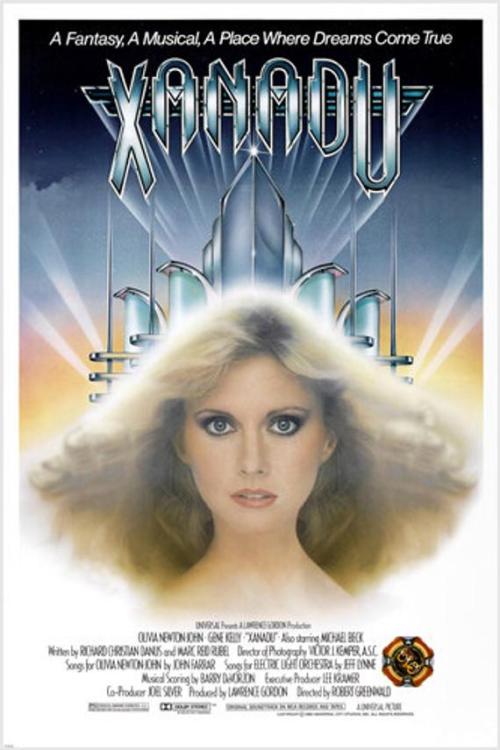
Sonny (Michael Beck) is a struggling artist finding it impossible to make a living on his own forcing him to go back to working for Airflow records where his creative aspirations are squelched by business demands. He then starts bumping into Kira (Olivia Newton-John) and begins falling for her hard unaware that she isn’t human but instead a muse sent from another galaxy to help achieve his true artistic vision. She sets it up where he meets Danny (Gene Kelly) a former big band musician. Together he and Sonny work out a plan to turn an old empty building into a live music venue.

One of the bigger problems of this flamboyant concoction is that it doesn’t seem like hardly a movie at all as the story is threadbare and features a lot of banal dialogue and sterile characterizations between the musical numbers. The chief reason for this, at least according to Olivia on the DVD commentary, is that the script was written on the fly as the filming took place almost like something a bunch of amateurs would do. There is a rumor though that producer Joel Silver early on did lock one of the writers into a room for a couple of days and refusing to let him out until he ‘delivered’ a ‘great script’, which if that were the case then the writer should still be stuck there because that great script clearly never came about.

Fans of the movie will admit that the acting and plot are poor, but insist that the songs and set pieces make up for it, but it really doesn’t. A few of them were okay like the battle of the bands segment where at one end of the warehouse a 40’s band plays while at the end there’s a hard rock 80’s band only to eventually have them both merge. Overall though I found a lot the musical numbers to be surprisingly bland and uninspired with the best ones, which include Kelly dancing alongside Olivia and an animated segment, all getting added in after the primary filming had already completed.

Olivia is quite beautiful and I love her effervescent smile, but she’s no leading lady. Her singing is excellent, but has an actress her talent seems limited to playing only perky characters, so while this film was meant to jettison her career it instead only stifled it. Kelly, whose last film role this was, is engaging in support even though he pretty much just spends most of the time smiling and not much else.

The real surprise is seeing Beck. He had just come off his strong portrayal of Swan in the mega cult hit The Warriors and was at that point a hot commodity poised to be a Hollywood leading man for years to come, but instead pissed it all away by choosing this stinker as his follow-up. Since this thing bombed badly at the box office the subsequent offers he got were of the TV-movie and low budget variety.  I’m just not sure what he was thinking. It couldn’t have been the script that attracted him since there really wasn’t any. I can only presume he thought with Olivia on board and with the success she had with Grease that this would be a big hit like that one, so he took a calculate gamble and jumped-in, but it was clearly a big mistake.

The great actor Jack Lemmon once said only take movie roles if you’ve read the script and like it never just because you think it will be a hit because you’ll usually be proven wrong and I guess Beck had to learn that the hard way. He now makes a living solely by attending fan conventions where he signs autographs, but he never talks or promotes his appearance here just his work on The Warriors. I can only presume he’s embarrassed by it and he should be. It’s one thing to be in a lousy movie, but still give a strong performance, but his acting here is just as bad as the film and was enough to get him nominated for the Golden Raspberry Award as worst actor of 1980 though he ended up losing out to Neil Diamond in The Jazz Singer. 

My Rating: 2 out of 10

Released: August 8, 1980

Runtime: 1 Hour 36 Minutes

Rated PG

Director: Robert Greenwald

Studio: Universal

Available: DVD, Blu-ray, Amazon Video, YouTube
Jesus Christ Superstar (1973)

By Richard Winters

My Rating: 5 out of 10

4-Word Review: Messiah in the desert.

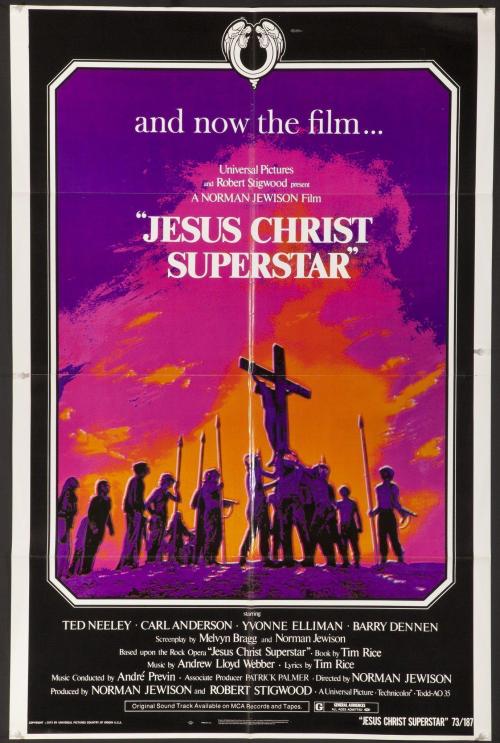
Based on the rock opera of the same name by Andrew Lloyd Weber and Tim Rice, the story centers on the last days of Christ (Ted Neeley) and his interactions with one of his disciples named Judas (Carl Anderson).  Judas does not agree with the direction that Jesus is taking the group and the two share a falling out. The next day in Jerusalem Judas visits the Priests (Bob Bingham, Kurt Yaghjian), who have already made the decision that Jesus must die for the sake of the nation. Using money to bribe him they get Judas to reveal where Jesus will be staying. Then on the next night Judas arrives with guards who arrest Jesus where he’s then taken to the Priests home and sentenced to death.

This film is very similar to Godspell, which came out the same year and was also based off of a Broadway musical. In my opinion they should’ve combined the two into one as there’s not that much of a difference between them. Probably the biggest contrast is that one was filmed in New York City while this one was shot on-location in Beit Guvrin National Park in Israel.  While the extreme heat of the desert forced the cast to take breaks from filming every 20 minutes to hydrate it’s a definite plus cinematically since this was the location where the biblical stories took place and because few people from the US have ever been there, so the landscape holds a distinctive appeal.  Director Norman Jewison takes full advantage of the unique caves that were dug there centuries ago to create many interesting shots.

The cast of characters show a little more distinction and aren’t all dressed like free-spirited vagabonds from the early 70’s like in Godspell although they still act like hippies. Jesus in this film looks more like the accepted artist’s rendition of him as opposed to a clown, but he gets seriously overshadowed by Anderson’s flamboyant performance as Judas to the point that the whole movie would’ve been better served, and more interesting, had he been made the main character.

I enjoyed Yvonne Elliman’s ‘I Don’t Know How to Love Him’, which later became a chart topper, and ‘King Herod’s Song’, which gets performed with campy gusto by Josh Mostel. The film though makes the same mistake as the other one in that there’s no dialogue in-between songs it just goes from one musical number to the next, which gives it a dizzying quality. If you’re really into musicals, or its spiritual message, then you may enjoy it, but anyone looking for conventional type of storytelling will be put off from the very beginning.

I didn’t get why all the anachronisms that get thrown-in either. It starts out with everyone arriving to the scene on a bus like they’re present-day performance artists putting on a show, but then shifts into them becoming the parts that they’re playing until you can’t tell the difference. Several scenes feature army tanks and even airplanes, which were never a part of the actual time period, so why have them? If this was all done to make it ‘hip’ for modern audiences then it doesn’t work and for many will come-off as ridiculously kitschy, which it is.

The one thing it does do well (since I presume everyone, believer or non, knows the story I feel I don’t need to put a ‘Spoiler Alert’ on this one) is the crucifixion, which gets played-out in a far more intense way than in Godspell where he died on an electrical fence that lasted for less than a minute. Here it gets dark and genuinely disturbing and during the ’39 Lashes’ moment forced Neeley’s mother, who had attended the film’s world premiere, to walk out of the theater as she found it too intense.

From my vantage point it’s well produced, but shallow though Jewison did show the film to Pope Paul VI who proudly proclaimed “I believe it will bring more people around the world to Christianity than anything ever has before.” However, it was not without it’s share of controversy including from religious groups who accused it of being both blasphemous and anti-Semitic. Jewison even admitted, in response to the criticisms, that it was never meant to be anything authentic or deeply theological.

My Rating: 5 out of 10

Released: August 7, 1973

Runtime: 1 Hour 47 Minutes

Rated G

Director: Norman Jewison

Studio: Universal

Available: DVD, Blu-ray, Amazon Video, YouTube
Cops and Robbers (1973)

By Richard Winters

My Rating: 8 out of 10

4-Word Review: Cops become the robbers.

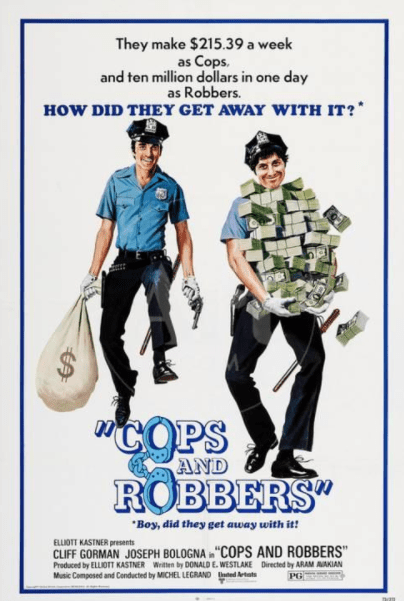
Tom (Cliff Gorman) and Joe (Joseph Bologna) are two New York City policemen who are tired of their jobs and want to retire from the working world, but can’t because they need to support their families. They decide the only solution is to commit a heist by working with a local mob boss (John P. Ryan) to rob a Wall Street brokerage firm out of  bonds that cannot be traced. The two come up with an elaborate scheme  to pull it off during the day while the place is still open and they’re still in uniform. At first things go smoothly, but then two other cops show up forcing Tom and Joe to destroy the bonds they’ve just gotten their hands onto in order to avoid getting caught. While this helps them out of their immediate jam it still gets reported to the press that the place was robbed making the crime boss believe he has been taken advantage of and compelled to get revenge.

What stands out is how different this is from the conventional cop flick. Instead of having a loud, pounding score the music here is soft and tranquil like the breezy, warm climate of a tropical island, which is where both Tom and Joe wish they were. The cops aren’t portrayed as being authority figures either or compromised victims of a corrupt system, but just regular suburbanites trapped in a dead-end job like many people and looking for a way out.

The crime is done differently too. Usually, in most other cop flicks, once the robbery gets going you’ll see the pace speed up with fast edits, but here it gets played-out in real time, which actually makes it more intense. I enjoyed the camera cutting back and forth from showing things from Tom and Joe’s point-of-view as well as from the black-and-white monitor seen by the security guards. The authentic office atmosphere has many of the employees not even knowing a robbery is going on while the two main people who do realize what Tom and Joe are up to, well played by the elderly Shepperd Strudwick and a much younger African American actress named Ellen Holly, display odd reactions and facial expressions that doesn’t conform to the situation, but eventually gets explained by the big twist that comes later.

Gorman gives an awesome performance, which is made all the more impressive when you realize just 4 years earlier he was the highly effeminate gay character in The Boys in the Band, but here he’s a macho heterosexual. I kept waiting for him to reveal mannerisms of his past role, but instead he successfully pulls off being two diametrically different people with no connection to the other a feat not every actor, even some of the good ones, are able to do.

Bologna goes against type too. Usually he’s loud and brash, but here more quiet and nervous. In the Kino Lorber DVD bonus section he recounts a funny incident that happened to him during the production when he was forced to make a call home to his wife (actress Renee Taylor) in real-life. Since there were no such things as cellphones at the time he had to go to a nearby phone booth while still wearing the cop uniform of his character. It was there that he noticed a thug beating up a victim on the sidewalk and he shouted at the man to stop it. Since the man presumed Bologna was a cop it was enough to get him to run away, but then the other pedestrians started to harass Bologna for not chasing after the bad guy and arresting him. He tried to explain that he was just playing a policemen in a movie, but no one believed him.

The film’s final segment, which takes place in Central Park, is well choreographed and features a unique car chase.  It’s just a shame that Aram Avakian who burst onto the film scene with the provocative, ahead-of-its-time cult favorite End of the Roaddidn’t go on to direct more movies as he did only one more, 11 Harrowhouse, after this one before retiring to become the head of the film department at the State University of New York where he worked until his death in 1987. His approach here makes all the difference as he relies not on the typical cop formula action, but instead on the nuance.

My Rating: 8 out of 10

Released: August 15, 1973

Runtime: 1 Hour 29 Minutes

Rated PG

Director: Aram Avakian

Studio: United Artists

Available: DVD

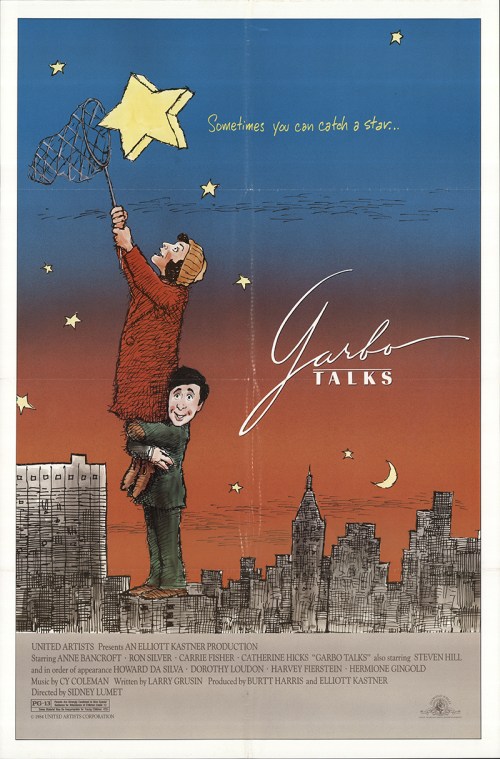
Garbo Talks (1984)

By Richard Winters

My Rating: 4 out of 10

4-Word Review: A dying mother’s wish.

Gilbert Rolfe (Ron Silver) is a grown man trying to hold down a full-time job, maintaining a marriage with Lisa (Carrie Fisher), and also keeping his social activist mother Estelle (Anne Bancroft) out of trouble. He soon learns though that his mother is dying of a brain tumor and her last wish is being able to meet Greta Garbo, the elusive movie star, in person. Gilbert doesn’t know how he’ll be able to find her, but spends most of his time diligently trying, which causes problems with both his job and marriage.

For the first hour the concept of trying to mix-in fable-like storyline with the bleak realities of day-to-day living actually works. Silver deserves top credit for making what could’ve been a very bland part as a schmuck that wasn’t too interesting or funny into an engaging character that the viewer feels more and more empathetic towards as the movie progresses. The sub-storyline though dealing with the breakup of his marriage and his subsequent relationship with his co-worker Catherine Hicks, who came across as being too kooky to be believable, I didn’t find necessary.

Bancroft gives a compelling performance as well and is particularly funny in the scene where she lectures a group of male construction workers in regards to the catcalls they give to the women walking past them. I found it disappointing though that the side-story dealing with her motivating one of the nurses, played by Antonia Rey, to demand that her union give them a higher pay rate at their next bargaining session was never played-out to its full conclusion. Having her ex-husband, played by Steven Hill, arrive at the hospital for a visit, but then not hearing them get into any type of conversation I found frustrating as well. There’s also a discussion that she has with Gilbert about how the cancer treatment will cause her hair to full out, but then that never happens, so why bring up something if it doesn’t ultimately connect with the plot?

Spoiler Alert!

The film’s biggest downfall though occurs at the end when a half-hearted attempt to use a double, played by Betty Comden, in place of the real Garbo. Apparently some efforts where made by the producers to see if Garbo would be willing to make a cameo appearance, but they were never able to make direct contact with her, so if a multi-million dollar film studio can’t adequately locate her how is some ordinary schmuck going to do it?

The way Gilbert is finally able to meet her, which ends up being at an outdoor flea market no less, is rather cheesy. He’s also only able to ‘recognize’ her from the back of her head, which is all the viewer pretty much ever gets to see too, so how would anyone know that was the right person just from that? The excuse he gives her to get her to come along with him to the hospital to see his dying mother would’ve been considered by most people in the same situation as just an excuse from a stalking fan to get her into his car, so he could kidnap her . Many celebrities must deal with obsessive fans all the time so how could anyone blame her for flatly turning him down, which is what she should’ve done and most likely would’ve occurred in reality.

Once Garbo does arrive at the hospital it’s Bancroft that does all of the talking making Garbo seem like a transparent ghost and not a real person. The film would’ve worked better had Gilbert given up on his attempts to find her and just hired an actress to pretend to be her, just like the movie itself ended up doing. This might not have satisfied everybody, but it at least it would’ve avoided becoming as hokey as it does.

My Rating: 4 out of 10

Released: October 12, 1984

Runtime: 1 Hour 43 Minutes

Rated PG-13

Director: Sidney Lumet

Studio: MGM

Available: DVD, Amazon Video

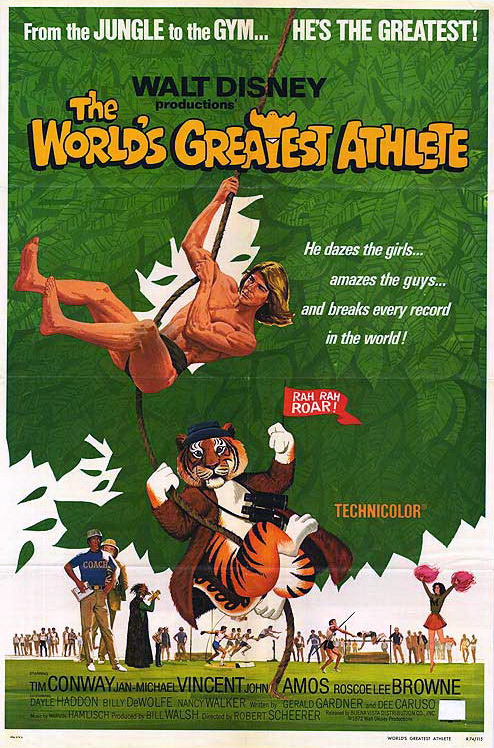
The World’s Greatest Athlete (1973)

By Richard Winters

My Rating: 3 out of 10

4-Word Review: Better than Jim Thorpe.

Sam Archer (John Amos) is the hapless head coach of the sports teams at Merrivale College where none of them have managed to win a single game in the 4 years that he he’s been there. He blames the problem on the inept student athletes and travels to Zambia with his assistant coach Milo (Tim Conway) to get back to his African roots. It is there that he comes upon Nanu (Jan-Michael Vincent) who possesses an amazing athletic ability. Sam is able to get Nanu to travel back with him to the US where he hopes he can place him on his many teams to get them to win, but finds an obstacle in the form of Gazenga (Roscoe Lee Browne) an African witch doctor who raised Nanu and has different ideas about what he thinks Nanu should become.

This film lost me right from the start with its inane and completely unbelievable plot. While I realize this was aimed at kids I still think it’s important to get a child to build a good logical foundation even in their early years and in that respect this film fails pathetically. The idea that all the sports teams at one school would be unable to win one single game in 4 years defies all laws of probability. Yes, there are many bad teams out there in both the pros and amateur level, but they can usually win a couple of games per season and the fact that none of them could here seems almost impossible.

Besides, isn’t it the coach’s responsibility to get the players to perform better and if he couldn’t shouldn’t he be blamed and not the players? Coaches are also in charge of recruiting prospects to come to the school, so if all he can bring in are inept stooges then that should be on him too. Most teams would’ve fired a coach with such a dismal record and yet in this film John Amos resigns when a school administrator puts ‘pressure’ on him to start winning even though 4 years should’ve been enough time to turn things around and anyone else in the same situation would’ve been given the boot long before.

The comic segments involving the athletes exaggerates their ineptness in an extreme way. One bit has a football players (played by David Manzy who later went on to star in the title role in the cult hit The Baby) hand the ball off to a player wearing the opposing team’s jersey and not realizing this was a stupid thing to do even though any first grader would know it was. For the comedy to be funny it has to have some bearing in reality and the ‘hilarious’ moments of sports bloopers that take up the film’s first several minutes don’t come even close.

On the plus side I did enjoy seeing Dayle Haddon in her film debut. While her character doesn’t have all that much to do or say I still found her youthful beauty nice to look at. Jan-Michael Vincent is at his attractive peak here too as this was fortunately filmed years before his self-destructive tendencies got the better of him. However, the character he plays, which is a lame parody of Tarzan, is incredibly dull. It would’ve been more interesting had he had some weakness that he had to overcome instead of just being super great at everything, which gets boring real fast.

Amos is quite amusing for his funny facial expressions alone and Conway has some engaging moments as well. I particularly liked him in the scene where Amos gives a televised interview and the camera zooms into him while Conway  desperately tries to get his face into the picture. The segment where Conway is shrunk to miniature size features some impressive special effects.

Some may enjoy Howard Cosell essentially playing himself as an obnoxious sportscaster who won’t allow his on-air partner, played by Joe Kapp, to say anything. However, this same bit was redone just 3 years later in the movie Gus where Bob Crane played the same type of egotistical announcer, but he was much funnier at it.

My Rating: 3 out of 10

Released: February 4, 1973

Runtime: 1 Hour 32 Minutes

Rated G

Director: Robert Scheerer

Studio: Buena Vista Distribution Company

Available: DVD, Amazon Video, YouTube

Kiss Me Goodbye (1982)

By Richard Winters

My Rating: 5 out of 10

4-Word Review: Her dead husband returns.

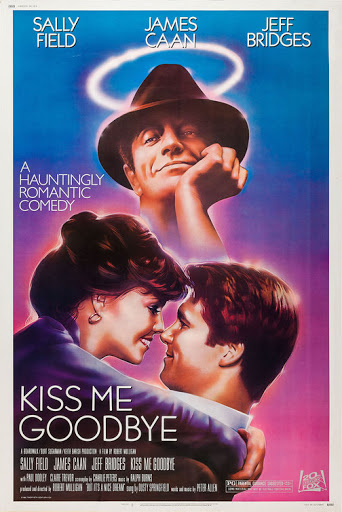
Three years after the death of her husband Jolly (James Caan) Kay (Sally Field) decides to move back into the house where her husband met his untimely fate when he fell down the home’s marble staircase. As she and her mother (Claire Trevor) get the home prepared for the arrival of her fiance Rupert (Jeff Bridges) she suddenly sees the vision of Jolly’s ghost in front of her. Only she can see, or hear it, which causes a great deal of confusion to those around her who all think she’s gone completely crazy.

The film is a loose remake of the Brazilian hit Dona Flor and Her Two Husbands, which in itself was based on the 1966 novel of the same name by Jorge Amado although this one does not have the erotic edge that made that film so famous. The comedy takes too long to get going, is a bit heavy-handed at times, and puts no new interesting spin on the ghost theme making it seem like just another modern updating of The Ghost and Mrs. Muir.

The introduction of the ghost should’ve occurred after the couple was already married instead of before as it offers both Rupert and Kay too much of an easy out and the stakes needed to be higher. Kay still seemed very much in love with Jolly as she had a complete shrine of him in one of their rooms, so it would seem once the ghost of him arrived she’d have second thoughts of going through with the marriage even though that’s not what happens. As for Rupert it would’ve made more sense had he just walked out of the situation altogether since all the red-flags where there even before the ghost came about that she wasn’t completely over her first marriage and unable to give Rupert the full attention that he  wanted.

The cast is game for the most part although I felt Bridges looked much too boyish here almost like he was still in high school. Caan though is quite engaging and the one element that holds it all together even though he apparently disliked doing it. It’s also great seeing Claire Trevor in her first film appearance in 15 years and the outfits and hats that she wears look quite chic. Paul Dooley has a good funny bit at the end playing a former priest who tries to exorcise the ghost out of the home, which he mistakenly thinks possesses Kay’s dog (Shakespeare).

Much to my surprise I ended up laughing much more than I thought I would. Two of my favorite moments occurs when Rupert and Kay go traveling to a country lodge and stop off at a cafe where Rupert pretends to have a conversation with the ghost much to the confusion of a young boy (Barret Oliver) sitting at the table next to him. The fight that the two have later on while at the lodge, which causes the break-up of another couple (Alan Haufrect, Maryedith Burrell), who start to take sides, is quite good too.

Spoiler Alert!

I was laughing so hard at points I was ready to give this a 7 or 8 rating, but then it gets ruined by the stupid ending. The idea that the ghost would agree to just leave and never come back again was too convenient. Why would he have bothered to come back to this life at all, if he was going to be gotten rid of so easily?

Having Rupert slip down the same staircase that took Jolly’s life looks cheesy and unintentional funny. Jolly’s death was cheesy enough, but to do it a second time with someone else was dumb and what’s worse is that Rupert, even when he smashes his head onto the hard ground, comes back to life with no injuries. Why even have this scene at all if there was no point to it?

A better ending would’ve had Rupert killed the same way as Jolly and then come back as a ghost just like Jolly and then Kay could’ve enjoyed the two men at the same time. Possibly even have the menage a trois that had been tapped into in the first film, but nixed here because it was deemed American audiences would’ve been too prudish to accept.

I also thought it was a bit unbelievable that Jolly had all these affairs behind Kay’s back while he was alive and she seemed to have no clue it was going on. Most married people usually have a sense something isn’t right even if they can’t prove it. Having Kay’s friend Emily (Dorothy Fielding) admit to fooling around with Jolly and Kay not be bothered by it and just go on being friends with her didn’t jibe with me either.

My Rating: 5 out of 10

Released: December 22, 1982

Runtime: 1 Hour 41 Minutes

Rated PG

Director: Robert Mulligan

Studio: 20th Century Fox

Available: DVD

The Mirror Crack’d (1980)

By Richard Winters

My Rating: 7 out of 10

4-Word Review: Poison in her drink.

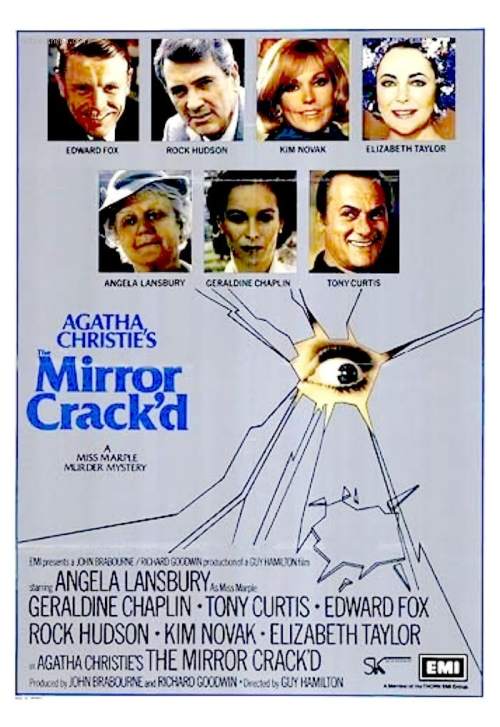
A Hollywood production company arrives in a small English village, where Miss Jane Marple (Angela Lansbury) resides, to film a costume drama. The film will star two actresses, Marina Rudd (Elizabeth Taylor) and Lola Brewster (Kim Novak), who are also bitter rivals. A reception is held to allow the villagers to meet the celebrities. During the reception Marina speaks with Heather Babcock (Maureen Bennett) a devoted fan who tells Marina about having met her years earlier backstage.  While she bores Marina with the details she also drinks a daiquiri cocktail that was laced with poison causing her to die and propelling Miss Marple, who is bedridden with an injured foot, and Inspector Craddock (Edward Fox) to investigate the case.

If there is one reason to checkout this otherwise so-so film it’s to see Taylor and Novak go at it as rival actresses. This was Taylor’s first feature film appearance in 4-years and, if you don’t count her cameo appearance in The Flintstones as well as 1987’s The Young Toscanini, which was never released in the US, the last one of her career. Her standout performance, which amounts to being a mixture of camp and poignant drama, more than makes it worth it and Novak is in top form as well playing-up the comic wickedness to a delicious level. Even Rock Hudson, who was reunited with Taylor 25 years after having done Giant together, does quite well as Marina’s exasperated husband.

Unfortunately Lansbury gets miscast as she was only in her mid-50’s while Marple was considered an elderly woman in her 70’s or 80’s. They dye her hair white in an attempt to make her appear older, but it still doesn’t quite work. It’s also a letdown not to have her in the majority of scenes like you’d expect. While I never read this Agatha Christie novel I have read some others as well as the movies that have been made from her works and all of them had the head detective taking an integral part in the investigation and not shackled up in her home doing nothing to propel the potentially engaging banter that she could have had with the suspects as she interviewed them. Ultimately the supporting cast gets more screen time than she, which was a waste.

The glossy cinematic element that was so apparent in other Agatha Christie movies like Murder on the Orient Express and Death on the Nile is totally lacking here. Some of the on-location shooting does take place in what would be considered large mansions, but the interiors resemble rooms seen in any old building and convey no flair or distinction. Director Guy Hamilton admitted to not liking Agatha Christie’s books nor thinking much of the script, which he openly stated to the producers during the interview and yet they decided to hire him anyways,  but the result, with the exception of the kitschy film-noir opening bit, is mechanical while relying solely on the veteran cast to keep it interesting.

My Rating: 7 out of 10

Released: December 19, 1980

Runtime: 1 Hour 45 Minutes

Rated PG

Director: Guy Hamilton

Studio: Associated Film Distribution (AFD)

Available: DVD, Blu-ray, Amazon Video, YouTube
Annie Hall (1977)

By Richard Winters

My Rating: 10 out of 10

4-Word Review: The perfect date movie.

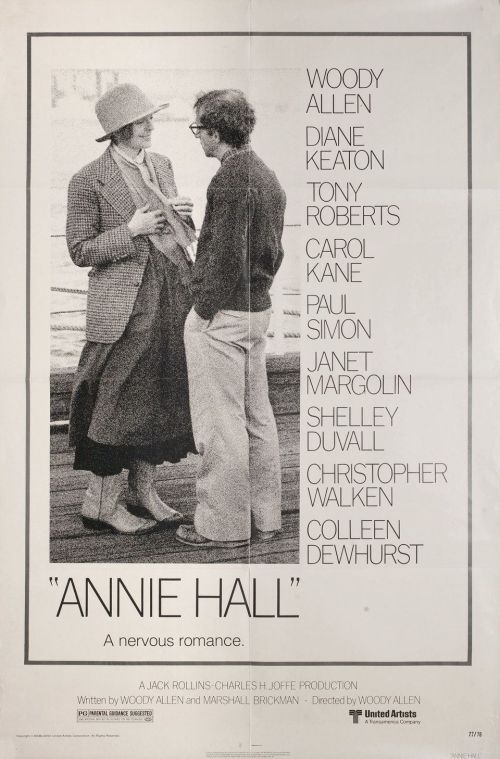
Alvy Singer (Woody Allen) is a professional stand-up comic going through a mid-life crises. Now in his 40’s he’s already been twice divorced and feeling like he may be unable to get into a solid, satisfying relationship. Then he meets Annie (Diane Keaton).  The two forge ahead into a relationship and things work well for awhile, but then the insecurities from both partners begin creating issues.

This film, which won the Academy Award for Best Picture, as well as Best Screenplay and Best Director (Academy Award for Best Actress too) has all the trappings of what I consider to be the perfect date movie. Some may disagree as the relationship between these two characters remains rocky throughout, but that’s why I think it’s so good. Other romance movies gloss over the different stages that a relationship goes through. They either rush past the start making it seem like the two people fall-in-love at first glance and immediately become a couple, or focus too heavily on the ups-and-downs of the dating phase, but then once they get married act like it’s ‘happily-ever-after’.

Here we’re given the whole shebang. We see the awkward start, which forms into an equally awkward relationship that eventually unravels once both partners realize they have different needs, much like in reality. I enjoyed how each person plays the same role, but at different times. Sometimes it’s Annie that wants to rekindle the romance while at other points she wants to break free and then at times its reversed with Alvy being the one trying to leave, or wanting to get back together. This is why I consider this to be a good date movie, especially for young couples, as they need to see that a relationship is a work in progress that constantly needs nourishing. The dynamics can evolve and both partners must be willing to adjust to the every changing needs of the other in order to keep it going.

The film is also filled with a lot of funny highly original bits that I haven’t seen done before or since. I loved the segment where subtitles get added to a scene revealing what Annie and Alvy are really thinking about each other while they have a psuedo intellectual conversation. The scene where the spirit/soul of Annie steps out of her body and then sits and watches Alvy and Annie making love in bed is funny too as is the dueling analysts bit (where the screen is split and  we see/hear Alvy and Annie talking about their romantic difficulties to their respective therapists at the same time.) This same approach occurs again with Alvy and Annie’s ‘dueling families’. Honorable mention must also go to animated bit with Woody and the Evil Queen from Snow White.

The only sad aspect is that the movie’s original cut ran 2 Hours and 4 Minutes, but the studio wanted it whittled down to a 90 minute runtime forcing many other potentially engaging bits to end up on the cutting room floor. Some of the bits that sound interesting featured Alvy’s grade school classmates in the present day, a junk food restaurant segment with Danny Aiello, as well as a fantasy segment where the New York Knicks basketball team competes against a team of 5 philosophers. Another scene had Alvy and Annie visiting hell that was reworked 20 years later and put into the film Deconstructing Harry.

Spoiler Alert!

Some of my film friends consider the ending to be an unhappy one, but I disagree. Yes, their relationship ultimately doesn’t work out and they decide to just remain friends instead, but for some couples this is actually the best option. The two were still on speaking terms and weren’t stalking or jealous of each other. Both had adjusted to the breakup and were ready to move-on. Not every relationship your in, even the ones that were fun for awhile, are meant to last and that’s okay.

My Rating: 10 out of 10

Released: March 27, 1977

Runtime: 1 Hour 33 Minutes

Rated PG

Director: Woody Allen

Studio: United Artists

Available: DVD, Blu-ray, Amazon Video, YouTube
Fast Charlie…….the Moonbeam Rider (1979)

By Richard Winters

My Rating: 4 out of 10

4-Word Review: Cross country motorcycle race.

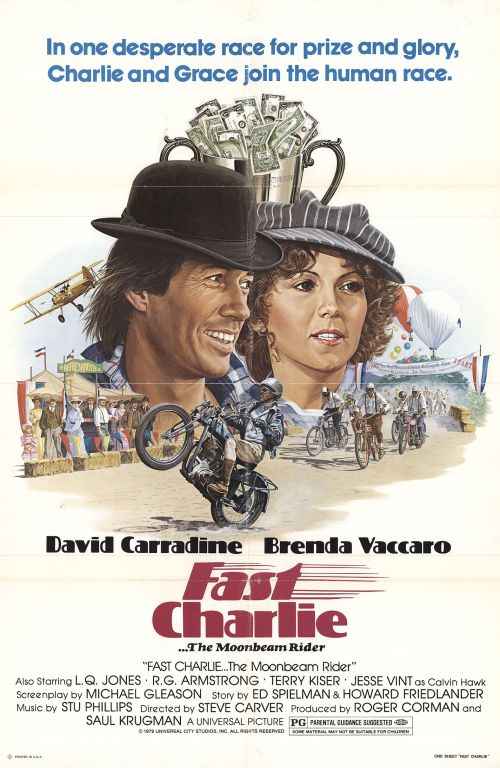
Charlie Swattle (David Carradine) is a WWI veteran and full-time conman who decides to enter into a transnational motorbike race that goes from St. Louis to San Francisco and will offer a big money payout to the winner. He tries to get his army buddies to help him, but they’re reluctant due to the belief that he’s a deserter. He then meets up with a sassy waitress (Brenda Vaccaro) who agrees to offer assistance, but only under stringent conditions.

The film is adequately entertaining but hurt by an uninspired, modest budget look. While efforts were made to make it appear like it were the 1920’s there’s no style to the direction nor any atmosphere. Too much emphasis gets placed on the cutesy comedy, which further erodes any semblance that this is an authentic period piece, which it clearly isn’t.

It takes a full hour before the race even gets going with the whole first half spent on the comic interpersonal relationships/banter that Charlie has with those around him. The race does have a few exciting moments including the point-of-view shots shown from the rider’s perspective as the motorbike careens down the bumpy backwoods dirt roads, but having the entire film shot in Oklahoma is a letdown. This is a race that is supposed to go across many different states and landscapes, but instead we’re given only one type of topography, which was obviously done for budget considerations, but ultimately comes-off like a cop-out.

Things do improve with the presence of Vaccaro, who only did the film due to contractual obligations with the studio. Leonard Maltin, in his review of the movie (or whoever wrote the review for him), incorrectly states that she plays an “early-day biker groupie” , which couldn’t be further from the truth. A groupie as defined by a dictionary search is someone who is: ‘An enthusiastic uncritical follower’ which Vaccaro clearly isn’t. The two instead share a very combative, contentious relationship where she is constantly putting him down and not trusting him, which certainly does not conform to the idol worship of the conventional groupie.

Carradine’s performance is okay. Some of his appearances in other films make it seem like he was sleepwalking through the part, but here he manages to show some oomph. He at least does better in this one than in the other similarly themed movie Death Race 2000where his face was hidden by a mask and he seemed almost like a robot. L.Q. Jones offers good support as his one-legged war buddy, who initially wants to kill Charlie, but then reluctantly agrees to be a part of his team. There’s also a good moment where the two try to desperately outrun a train while on a bridge, which is similar to the famous scene in Stand by Me, but this one was shot five year earlier.

My biggest complaint is that it follows the Rocky formula too closely. Despite being in a different time period it still has all the corny cliches of a feel-good sports movie. The ending is in no way ‘exhilarating’ as intended, but instead painfully predictable. Nothing is more frustrating than watching a movie where you know exactly how it’s going to end right from the start.

My Rating: 4 out of 10

Released: May 4, 1979

Runtime: 1 Hour 39 Minutes

Rated PG

Director: Steve Carver

Studio: Universal

Available: None at this time.

The Bell Jar (1979)

By Richard Winters

My Rating: 3 out of 10

4-Word Review: She suffers from depression.

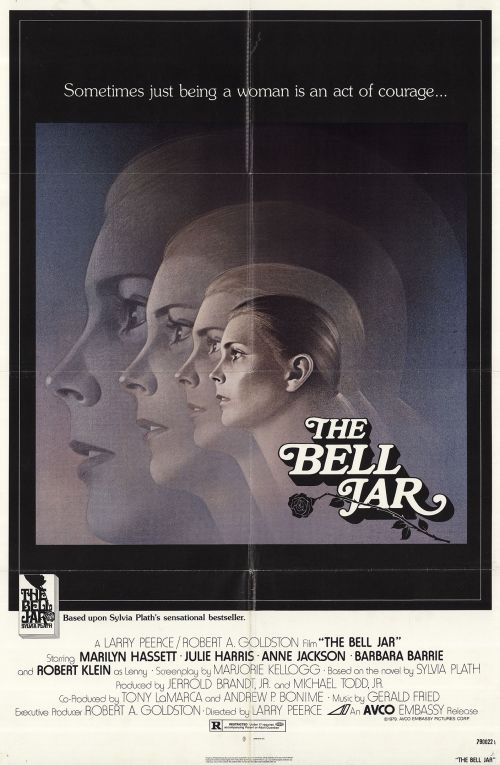
Based on the semi autobiographical novel of the same name by Sylvia Plath, the story centers around Esther (Marilyn Hassett) who suffers from various mental health issues and can’t seem to relate to the world around her. After graduating from college she goes off to work at a women’s magazine in New York, but finds that the demands and inevitable compromises of being a writer for a big city publication are not for her. She returns home to her mother (Julie Harris) only to find her emotional situation deteriorating even more. She’s eventually sent to a mental hospital where she goes through treatment.

In 1975 Hassett was picked from over 500 other actresses to play the part of paralyzed skier Jill Kinmont in the film The Other Side of the Mountain. The movie became a big hit and lead to her marrying the film’s director Larry Peerce.  While that film was a decent heartfelt story their attempts to bring Plath’s complex, multi-faceted novel to the big screen was clearly an overreach.

The major reason this doesn’t work is because of Hassett. During the early 70’s she had a youthful appeal, but by the time this was filmed she had hit 30 and no longer looked like a recent college grad in any way. For the story to work it hinges on the viewer seeing this person as someone who is young, innocent and vulnerable and unable to deal with the harsh realities of the young adult world that she’s experiencing for the very first time, but Hassett looks and in many ways behaves like a world-weary middle-aged person, which then loses the intended effect.

The portrayal of the central character is a weak point as well. In the similar themed film I Never Promised You a Rose Gardenwhich came out around the same time, the director of that flick did a good job of getting inside that character’s head and allowing the viewer to see the thoughts and fears that she had, but here we get none of that. We are left with no understanding about what’s really bugging Esther and why she behaves the way she does. Instead of us feeling for her we end up finding her off-putting, confusing and at times just downright selfish and bizarre.

The film does still manage to have a few interesting moments. I liked the scene with Jameson Parker, in his film debut who later went onto fame in the TV-show ‘Simon & Simon’, playing Esther’s fiance who strips in front of her so she can see what a naked man looks like upfront for the very first time. The erotic threesome between Hassett, Robert Klein, and Mary Louise Weller is interesting too as is the segment where Hassett is sitting alone at a late night diner and comes into contact with a disturbed, homeless man (Nicholas Guest) who comes in off the street and begins shouting nonsensical things for no reason, which can be a common, frightening reality living in the big city and not tackled enough in most movies.

While the movie stays pretty much faithful to the book it approaches the material in a shallow, mechanical way that offers no insight into the characters or situations and elicits no emotions from the viewer. It also takes some liberties with the material entering in elements that were never in the novel, or only vaguely touched on like the character of Joan, played by Donna Mitchell, being explicitly portrayed as a lesbian while in the book it had been only implied. She’s also shown making a suicide pack with Esther that was never in the original story. This was enough to get Dr. Jane Anderson, a Boston psychiatrist, to sue the film stating that she had been the Jane character in Plath’s novel, but because the movie distorted the truth it had harmed her reputation and career and she ended up winning a $150,000 settlement.

My Rating: 3 out of 10

Released: March 21, 1979

Runtime: 1 Hour 53 Minutes

Rated R

Director: Larry Peerce

Studio: AVCO Embassy Pictures

Available: VHS