Tag Archives: Blake Edwards

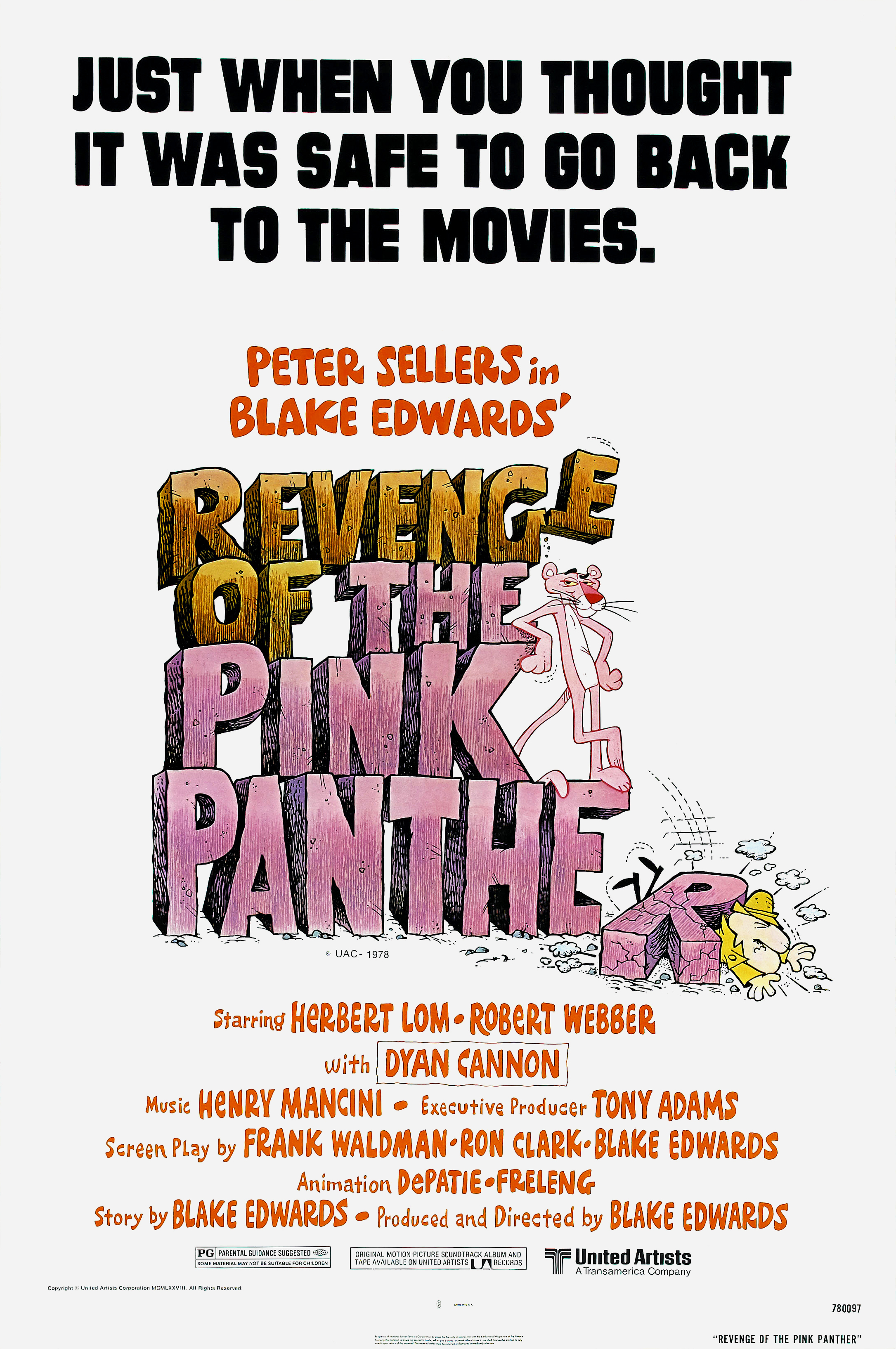
Revenge of the Pink Panther (1978)

By Richard Winters

My Rating: 6 out of 10

4-Word Review: Out to get Clouseau.

Philippe (Robert Webber) is a successful businessman who’s secretly the head of the French criminal underground. Some though are questioning his leadership considering him to be too weak to remain in that position. In order to squash the impending threat, he decides to make a bold move by having Inspector Clouseau (Peter Sellers) killed. Clouseau was considered a master detective by the outside world and only known to be an incompetent by those who worked with him, so by having him out of the way the drug dealers would feel relieved and thus Philippe would remain in power. However, things don’t get as planned as Clouseau manages to miraculously evade all attempts on his life. The media though mistakenly announces that he has died, which allows Clouseau to go undercover along with his manservant Cato (Burt Kwouk) to find out who’s after him.

This marked the fifth entry in the series and is probably the funniest. Initially director Blake Edwards had wanted to reuse footage that had been cut from the previous entry and then film new scenes around those, but star Sellers insisted he wanted an all-new story and that was probably for the best. Sellers by far gets the most laughs whereas in the one that came before this, The Pink Panther Strikes Againit was Herbert Lom as the unhinged Dreyfus, that was the most memorable, but here his part becomes much more benign, though he still gets one good scene where he tries not to breakout laughing while giving a eulogy at Clouseau’s funeral. Sellers though comes out on top here especially in his disguises like when he pretends to be a sea captain with an inflatable parrot on his shoulder, or in a hilarious send-up as a Mafia Don.

It’s great to see Kwouk, who was usually relegated to the ‘fight’ scene between him and his boss Clouseau, become more involved in the story, as the two go to Hong Kong in disguise to track down the bad guys. Dyan Cannon is a refreshing change of pace. Usually, the women in these films were young models whose sole purpose was to allude sex appeal, but here she’s middle-aged, but still attractive, and shows much more of a feisty personality. She helps build a strong secondary character and is better interwoven into the plot versus simply appearing as a potential romantic interest.

Webber though as the main villain is a detriment. I have no doubt that the notoriously insecure Sellers didn’t like the way Lom stole the film as the nemesis in their last outing and wanted to make sure that didn’t happen again. Not only is the Dreyfuss character far more neutered, but so is Webber making him seem like he’s almost sleepwalking through his role. It would’ve been more interesting had his character has some personal vendetta against Clouseau, possibly because it was Clouseau who had sent him, or one of his men to jail, and now he wanted revenge. Just having him out to get Clousau because it might bolster his own image didn’t seem to be enough of an incentive and the two, outside of one comic moment where Clouseau’s is in one of disguises, never have any ultimate confrontation. Watching him get chased around his desk and cower from Dyan Cannon may have been intended as funny, but it just further erodes his villainy making him seem even more impotent than he already is. Even a comedy still needs a bad guy that can elicit some tension and this one doesn’t.

The implementation of Mr. Chong, played by martial arts instructor Ed Parker, has potential. Supposedly he’s an ‘invincible’ fighter that can beat-up anyone and not be stopped as proven when he takes down several other men while in Webber’s office but then he gets comically defeated once he comes into contact with Clouseau. While watching him go through the floor/ceiling of several apartments below as he crash lands is visually funny it would’ve been more engaging if he had come back at some point and continued his relentless attack on Clouseau albeit with injuries in order to reclaim his reputation that he couldn’t be defeated, but in the process just became more hurt and ineffective.

Spoiler Alert!

The climactic sequence that occurs in Hong Kong is a cop-out and comes-off like they’d run out of ideas, so they tried to save it with a calamity filled chase that plays more like a cartoon, or something better suited for a live action Disney movie. Introducing yet another Mafia boss, this one played by Paul Stewart, makes things too cluttered and there should’ve been just one main bad guy that was the boss of everyone. The finale inside a firecracker factory should’ve proven dangerous and in fact we do see the entire place explode from a distance and yet everyone comes out of it unscathed, which doesn’t exactly make a lot of sense.

My Rating: 6 out of 10

Released: July 20, 1978

Runtime: 1 Hour 39 Minutes

Rated PG

Director: Blake Edwards

Studio: United Artists

Available: DVD, Amazon Video, YouTube
The Pink Panther Strikes Again (1976)

By Richard Winters

My Rating: 7 out of 10

4-Word Review: Clouseau battles doomsday weapon.

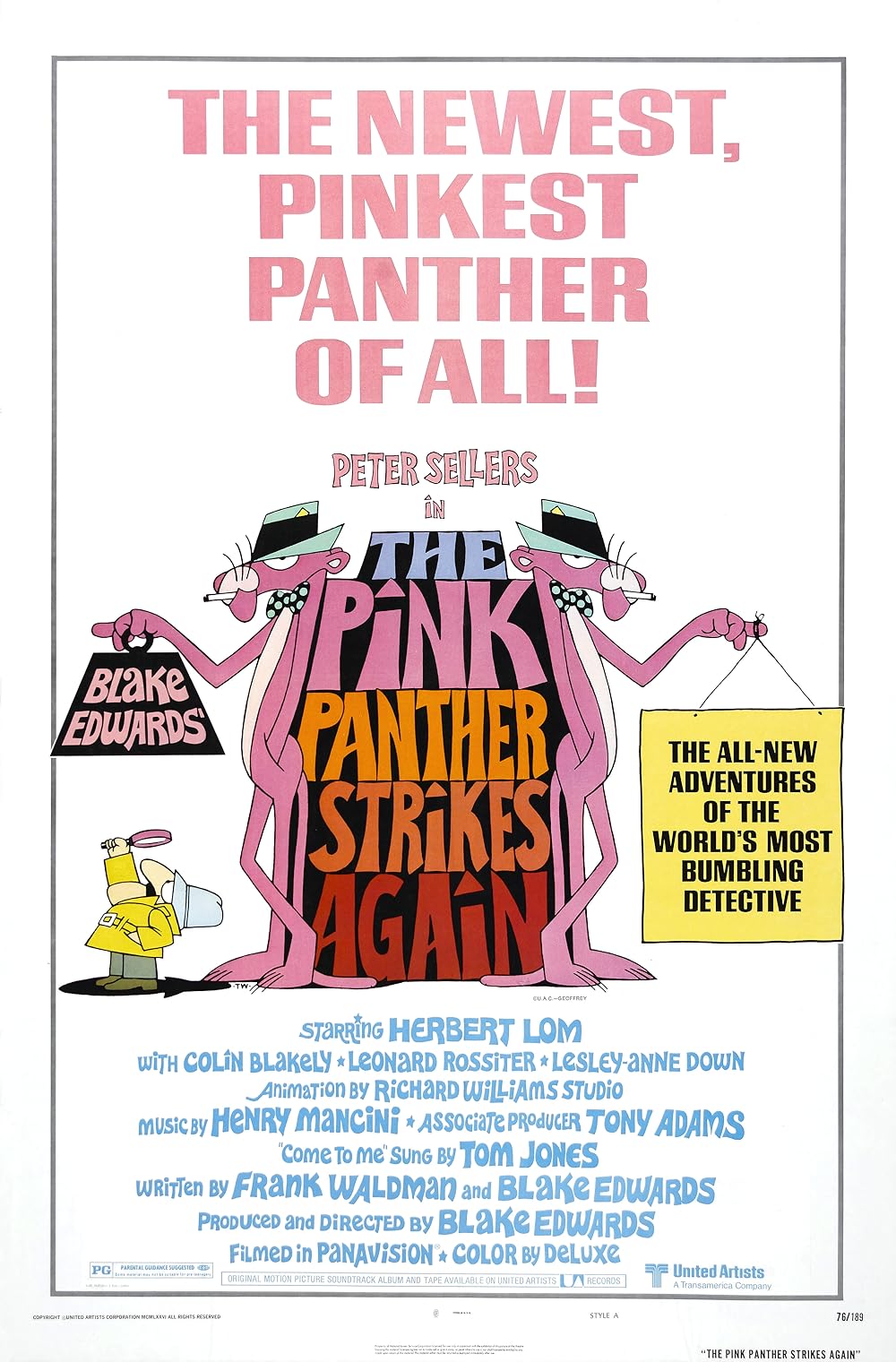
Dreyfuss (Herbert Lom) has been informed by his psychiatrist (Geoffrey Bayldon) that he has been cured of his obsession with Clouseau (Peter Sellers) and now deemed sane. He’ll be recommending his release from the mental institution he’s been in later that day at the sanity board of which Dreyfuss is elated. However, Clouseau shows up unannounced planning on speaking to the sanity board on behalf of Dreyfuss, but when he gets there the two meet and after several mishaps, all inadvertently caused by Clouseau, occur it sends Dreyfuss spiraling back into insanity. He then though is able to escape and goes on a mission to kill Clouseau, first on his own and then with the help of several worldwide assassins. When this doesn’t go as planned, he kidnaps a nuclear physicist (Richard Vernon) and blackmails him to create a doomsday weapon that can take out entire buildings with its laser beam and which Dreyfuss has no problem using against the world unless he’s given Clouseau in return.

After the unexpected success of The Return of the Pink Panther, director Blake Edwards was given an immediate green light to write and direct a follow-up. Since he had originally intended for this to be a TV-series he used one of the scripts he had written for that one and expanded it for feature film length. The original cut came out to 126 minutes, but the studio insisted it be trimmed to 95-minute runtime with the excised scenes being used as material for the Curse of the Pink Panther, which released 6 years later after the passing of star Sellers.

Despite constant behind-the-scenes struggles between Edwards and Sellers this film is widely considered their best output second only to The Party, which they collaborated on 8 years earlier. A lot of the reason why it works is the excellent pacing with an almost rapid-fire collage of jokes and mishaps, the scenic European locations and the pleasing yet still bouncy Henry Mancini score.

The humor hits the target in almost all cases, unlike most comedies where there’s usually a few misses, with some of the best moments coming from the supporting players like stuntman Dick Crokett who plays a perfect parody of then President Gerald Ford and Lesley Ann-Down, who replaced Maude Adams who was originally cast, but then fired after she refused to appear nude, as a Russian spy whose attempts to get Clouseau in bed with her proves quite funny. The ongoing confrontations between Lom and Sellers though are still the highlights and the two really work well together with Lom’s angry abrasiveness a nice contrast to Seller’s benign ineptness and in fact this is a rare instance where Sellers gets upstaged as it’s Lom’s performance with his over-the-top villainy that you come away remembering the most after it’s over.

Yet with all of its successes the script is still full of logical loopholes and missing key moments. For instance, Dreyfuss escapes from the mental hospital, but it’s never shown, which I felt since it’s so integral to the storyline needed to be seen and explaining how he was able to do it. What he did to gain access to the apartment downstairs from Clouseau’s should’ve been inserted as well and some sort of answers for how he was able to avoid injury from the bomb going off as it destroyed Clouseau’s apartment and the fallout from it would’ve most assuredly affected the apartment beneath it as well. Clouseau’s ongoing physical confrontations with his house servant Kato (Burt Kwouk) becomes problematic too as they’re constantly damaging the furniture during their fights and if this happens every time he comes home then the furniture should already be in disarray from their last battle as there wouldn’t have been time to have cleaned it up and replaced it with new stuff.

Spoiler Alert!

While the film does at least have Dreyfuss masterminding a major bank heist, which helps to explain how he got funding to build the giant laser and purchase the castle that he and his crew move into, it still makes it seem that they’re able to build the elaborate weapon and all the computers that go along with it, almost overnight, which of course isn’t believable. It also at one point has the laser beam striking Lom making his legs disappear, but he’s still able to somehow walk around anyways as well as maintain his same height, making it seem that his legs are still there and simply invisible.

There’s also the issue of Dreyfuss disappearing at the end, due to the effects of the laser, but in the following installment, Revenge of the Pink Panther, he’s fully intact and no mention of his previous madness to destroy the world. Fans of the series say this is because this whole film was meant to be a dream that Dreyfuss had, which would’ve made a lot of sense. He was already obsessed with Clouseau, so having nightmares about things one is constantly focused on would be logical and the film should’ve had at the very end Dryefuss waking up and still in a strait-jacket, but it doesn’t making it an oversight and not properly thought through.

My Rating: 7 out of 10

Released: December 15, 1976

Runtime: 1 Hour 43 Minutes

Rated PG

Director: Blake Edwards

Studio: United Artists

Available: DVD, Amazon Video, YouTube
The Return of the Pink Panther (1975)

By Richard Winters

My Rating: 7 out of 10

4-Word Review: Tracking down stolen diamond.

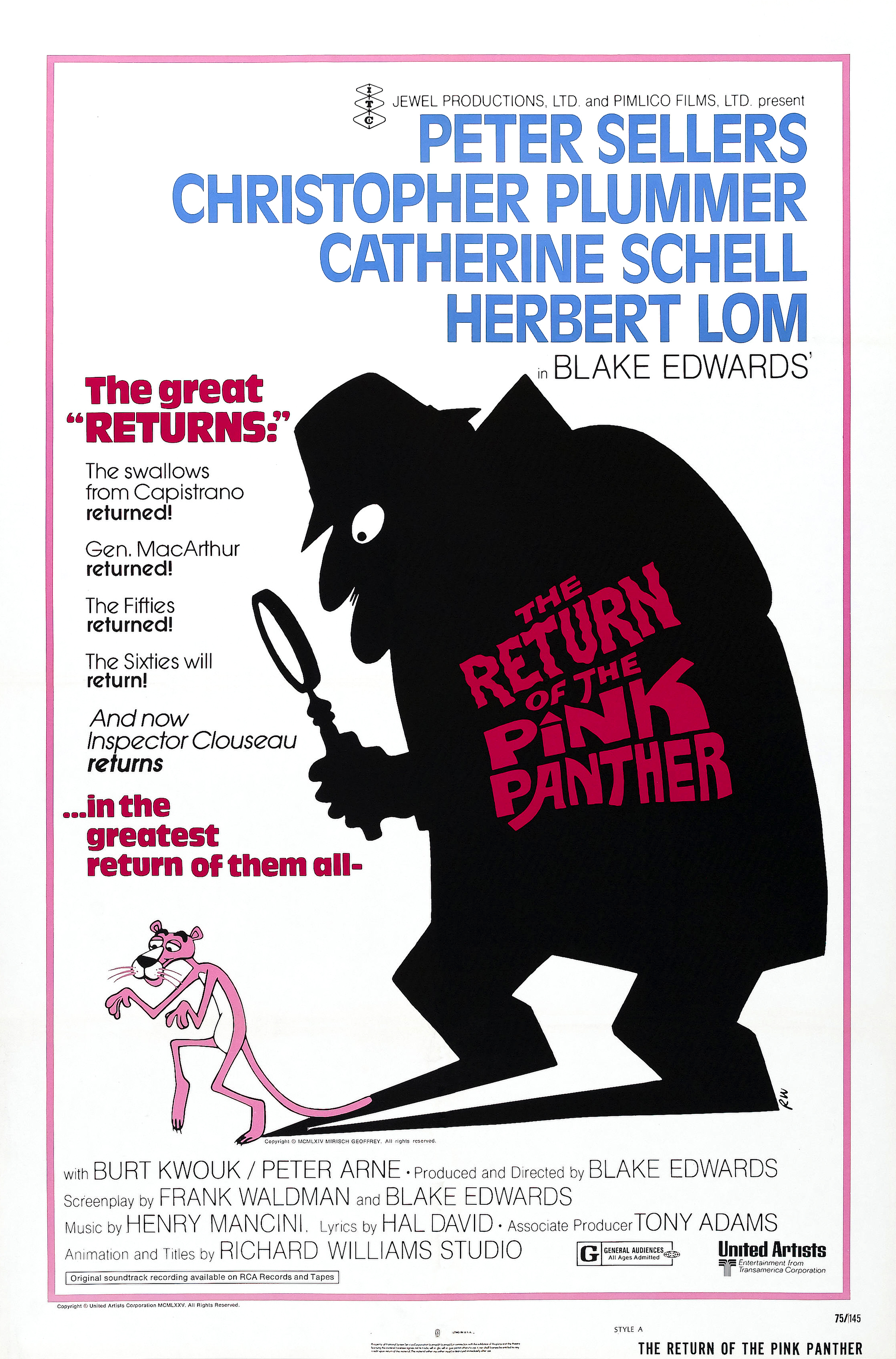
Inspector Clouseau (Peter Sellers) has been demoted to street cop by Chief Inspector Dreyfuss (Herbert Lom) due to Clouseau’s continual incompetence, which is starting to drive Dreyfuss completely mad. However, inside the country of Lugash a prized diamond known as the Pink Panther is stolen and since Clouseau had success retrieving it the first time it went missing during a heist he is put on the case to find it again much to Dreyfuss annoyance. Clouseau suspects that the culprit is Charles Litton (Christopher Plummer), who is a notorious thief. Clouseau attempts to use several different disguises in order to infiltrate Litton’s home that he shares with his wife Claudine (Catherin Schell) in order to find incriminating evidence against Litton so that he can turn him in, but his attempts to try and a take Litton down prove to be comically inept. 

This marked the fourth installment of the Pink Panther series and the first in 10-years that reunited writer/director Blake Edwards with Sellers. Both had said after doing the second film A Shot in the Dark, that they never wanted to work with the other again due to much infighting during the production, but both had since then fallen on hard times. Edwards was by the early 70’s considered box office poison after the colossal failure of Darling Lilli which managed to recoup a measly $3 million from a $25 million budget and his other films from that era Wild Rovers and The Carey Treatment hadn’t done much better. Since Pink Panther had been his last success, he was interested in reviving it and even wrote up a 14-page treatment but found no takers amongst the major studios. Then producer Lew Grade agreed to finance it in exchange for Edward’s wife Julie Andrews agreeing to star in a British TV-special that he wanted to produce. Since Sellers career had also bottomed out, he came onboard to most everyone’s surprise without much hassle.

The film was shot in many scenic locations including Morrocco giving the optics an exotic flair and the proceedings a sophisticated European vibe making it seem like a step-up from just a silly comedy. In the first two installments all the characters were written to be funny and goofy particularly the second film, which had been based on a stage play. Here though the comedy is wisely given over to Sellers while the couple he’s after remain savvy, which makes it more intriguing as you want to see how this inept idiot takes them down, or is able to trip them up at their own game. I also liked how funny bits are interspliced with some legitimate action, especially the opening scene that features the heist, which could’ve easily fit into a realistic film dealing with a robbery. These moments help add a bit of relief from all the laughs, a sort of chance to catch your breath, while making the plot seem like it’s not just all about being a farce.

Lom adds terrific support as Clouseau’s exasperated supervisor, and his assertive acting style works nicely off of Sellers clownish one making the interplay between the two a highlight. It’s good too that Plummer replaced David Niven, who played the character in the first one, but wasn’t able to do it here due to scheduling conflicts, as Niven would’ve been too old and not plausible to have outrun the bad guys like Plummer does. 

My only issue is that Claudine is shown attempting to hold in her laughter at Clouseau right from the start like she knows he’s an idiot before she even met him, but this goes against the premise. Clouseau is considered an accomplished detective by the outside world hence why he was selected to head the case and it’s only the people that work with him and know him who are aware of his ineptness. This is the whole reason why Dreyfuss gets driven mad by him because the rest of the world celebrates the man that he knows is really a fool, so Claudine should’ve initially thought of him as being sharp and only came to the conclusion he was incompetent by the end after having dealt with him. It actually would’ve been funnier had she and Charles feared Clouseau upfront having believed his celebrated reputation and misreading his bumbling as being ‘genius’ ploys and remained that way throughout. In either case seeing her covering her mouth and shielding her giggles makes almost seem like she’s falling out of character and a blooper, similar to how Harvey Korman would unintentionally crack-up during Tim Conway’s antics on the ‘The Carol Burnett Show’ and for that reason it should’ve been avoided. 

My Rating: 7 out of 10

Released: May 21, 1975

Runtime: 1 Hour 54 Minutes

Rated PG

Director: Blake Edwards

Studio: United Artists

Available: DVD, Blu-ray, Amazon Video, YouTube

Blind Date (1987)

blind1

By Richard Winters

My Rating: 0 out of 10

4-Word Review: Don’t get her drunk!

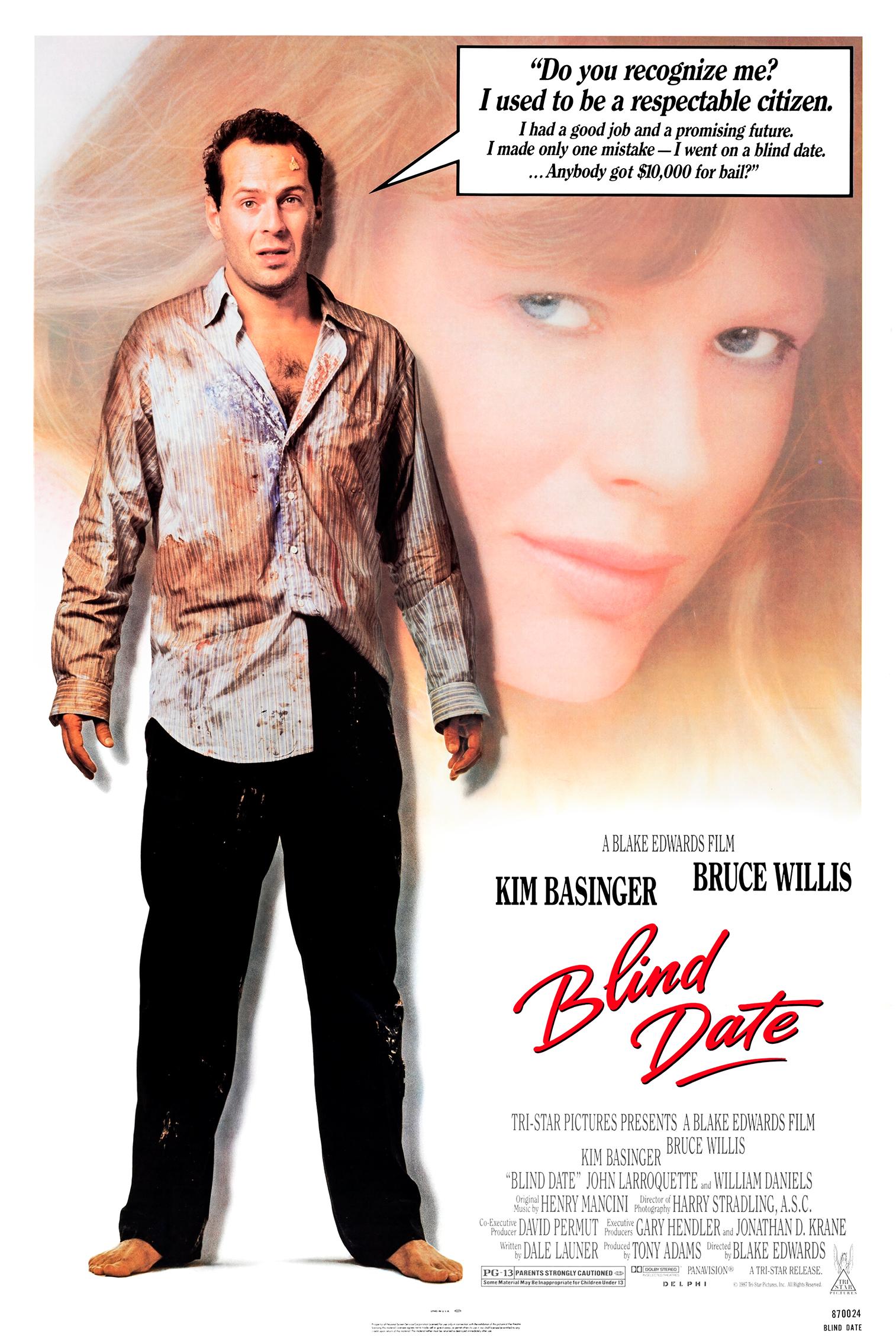
Walter (Bruce Willis) needs a date as he’s having dinner with a very important client that he has to impress in order to get a business deal to go through. Walter’s brother Ted (Phil Hartman) sets him up with his wife’s cousin Nadia (Kim Basinger). She’s a very beautiful lady who’s just getting over a bad break-up with her possessive boyfriend David (John Larroquette). There’s only one hitch: Walter must make sure that she doesn’t drink any alcohol because if she does she’ll go ‘wild’. Walter though dismisses the warning and offers her a glass of champagne, which soon leads to a night of massive calamity.

Blake Edwards directed a lot of duds in the 80’s and I thought That’s Life and Skin Deep were two of his worst, but this one clearly beats those by a mile.  It has shades of After Hours and had this thing kept the story revolving over the happenings of one night it might’ve worked a bit better, but the second-half goes way off-kilter, which really kills the whole thing and turns it into a complete catastrophe. Screenwriter Dale Launer shouldn’t be blamed either as while his name is still on the credits the script was rewritten so may times that it shared nothing with his originally concept and he ultimately disowned it.

The problem starts right away with the whole alcohol thing as Basinger acts overly drunk after having only a few sips. Her transformation into this crazy lady is more creepy than funny like she has a split personality, or some sort of mental condition. Most guys would be running from her almost immediately and never look back and how someone could ‘fall-in-love’ with her after such obnoxious and erratic behavior defies explanation. If there was ever a bad date night this would be one. The fact that she puts up $10,000 for his bail the next day shouldn’t make-up for it like it does here and where exactly is this lady getting her hands on such quick cash anyways since she can’t afford a place of her own and must reside with others?

Willis is great when he’s the one making wise-cracks like he did in the classic TV-show ‘Moonlighting’, but playing the straight-man who simply responds to all the nuttiness happening around him doesn’t work at all. Having Basinger sober up and then Willis be the one to act zany at a later party they go doesn’t make any sense and seems more like it’s some ‘crazy personality virus’ going around or a possession of some kind that like with the cold or flu can easily transfer from one person to another.

Larroquette as the psycho boyfriend pops-in way too conveniently and becomes a bit hard to imagine how he’s able to constantly track the two down no matter where the go and the fact that his car crashes into the three different storefronts, but the front end of the vehicle remains completely intact, defies logic. His character gets neutered by adding in his parents (William Daniels, Alice Hirson) during the second act whose presence doesn’t really help propel the plot along, but instead seems to take the story in an entirely different direction. Having Larroquette defend Willis in court even though he had a lot to do with why he was in trouble and whose name was mostly likely on the police report and then to have the judge turn-out to be his own father is so outlandish that it’s beyond stupid.

This movie also has somewhat of a personal connection as I was living in L.A. in June of 1986 when it was being filmed and stood around with other pedestrians for a day to watch one of the outdoor scenes that was being shot in a nearby neighborhood. The scene that I saw being filmed comes around the 1-hour mark and entails Willis throwing a beer bottle at the rear window of Hartman’s car and smashing it. The scene took several hours to film as Edwards, who sat under the shade of an umbrella while the cast and crew and had to stand under the hot sun, seemed to be dissatisfied with every take and kept making the actors do the same bit over and over that I found it to be really boring and didn’t think there could be anything duller until of course I finally watched the finished movie, which I found to be even worse.

My Rating: 0 out of 10

Released: March 24, 1987

Runtime: 1 Hour 35 Minutes

Rated PG-13

Director: Blake Edwards

Studio: Tri Star Pictures

Available: DVD, Amazon Video, YouTube
That’s Life! (1986)

thats1

By Richard Winters

My Rating: 2 out of 10

4-Word Review: Wife frets over biopsy.

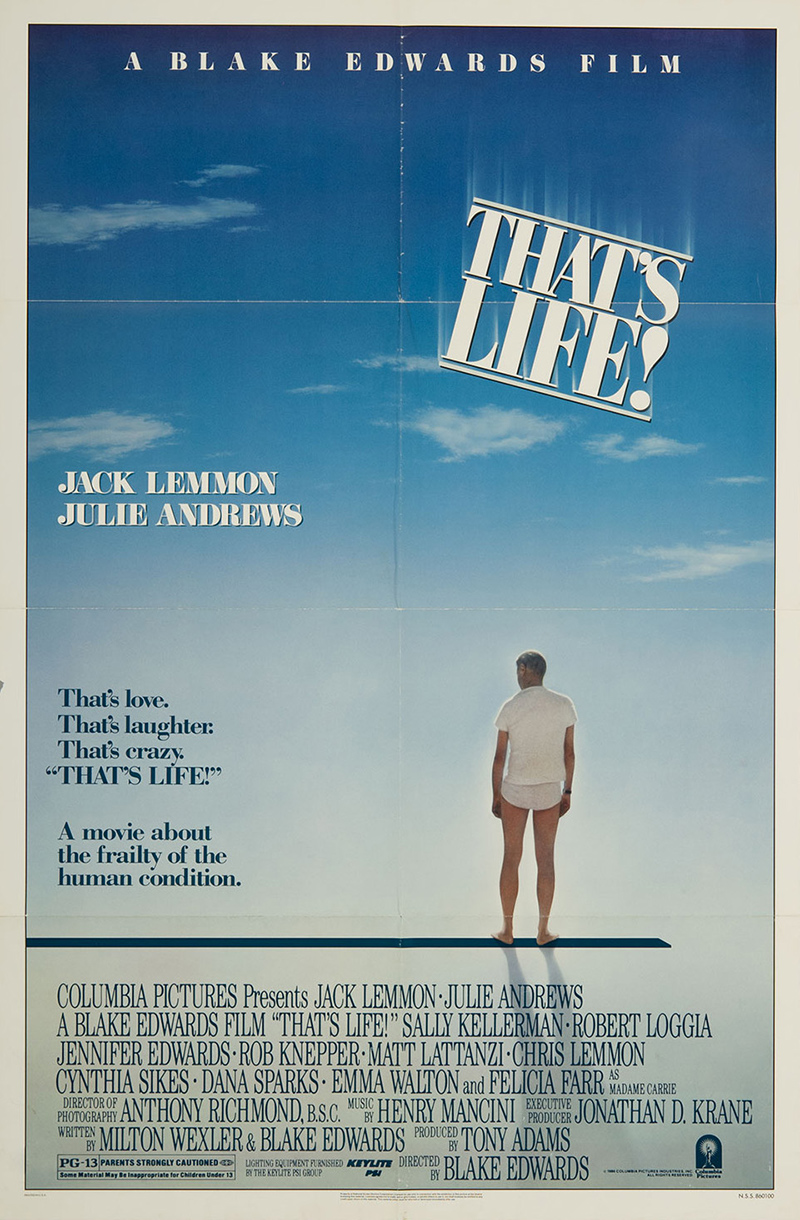
Gillian (Julie Andrews) is a singer who detects a lesion in her throat and goes to the doctors to have a biopsy done to see if it’s cancerous. The results of it won’t be ready until Monday forcing her to have to worry about it over the weekend. In an effort not to ruin things for the rest of her family she doesn’t tell them about it and puts on a facade like everything is fine. Meanwhile the other family members have their own problems. Harvey (Jack Lemmon), her husband, is depressed about turning 60, and not excited about the impending birthday celebration, or even being reminded of it. Her oldest daughter Megan (Jennifer Edwards) is going through the stresses of being pregnant while her younger daughter Kate (Emma Walton) fears that her boyfriend is cheating on her.

This was writer/director Blake Edwards first attempt at drama since the Days of Wine and Roses, which had also starred Lemmon. It was independently produced and thus requiring both the cast and crew to agree to work below scale, which caused controversy with the cinematographer’s union and created picketing at theaters in Hollywood when the movie was first released. The story was inspired by real-life events and problems that Edwards and his wife Julie were going through at the time as well as things that were happening with their grown children and the whole thing was shot on-location at the family home in Malibu.

Lemmon, the movie’s promotional poster is a play-on the one for Save the Tigerthe movie he won the Oscar for as Best Actor, is the only fun thing about it. His constant bitching about everything is amusing without being forced and his presence helps give it some needed energy and it’s great seeing him do a few scenes with his real-life son Chris Lemmon, this was the only project they did together unless you count Airport ’77 though they never shared any scenes in that one, who also plays his actor son here. The only drawback is that he completely overshadows Andrews to the point that you start to forget about her even though technically she’s the protagonist that we’re supposed to be the most concerned about.

While the movie is meant to analyze the day-to-day realities of the human condition it does throw in some ‘comical’ side-stories that are really lame and end up dragging the whole film down. The first is Harvey’s relationship with Janice (Cynthia Sikes) a woman who has hired Harvey, who works as an architect, to design her dream house though her demands are constantly changing and many times unrealistic. Had this segment stopped there then it would’ve been insightful and humorous as many clients can make unreasonable requests, but since it’s ‘their money’ the person working for them feels the need not to speak up and go along with the crazy demands for fear they’ll lose out on the deal, which happens more than you think. However, the scene also has her coming on to him sexually, which made no sense. Harvey was significantly older than her, looking more like he was 70, with no guarantee that he could perform, which he ultimately can’t, so unless she had some sort of grandpa complex why would this highly attractive young woman, who could easily find a good-looking guy her age, even think about getting it on with this old duffer that virtually any other woman her age would consider ‘gross’?

The second ‘comical’ scenario is equally stupid as it features Lemmon’s actual wife Felicia Farr playing a psychic who has a sexual encounter with him at her place of business all for the measly price of $20 for a ‘reading’, but how often does this type of thing occur. I mean I’ve gone to a psychic a few times in my life, but it never turned hot-n-heavy; am I just missing out? She later has sex with one of Harvey’s friends making it seem like sex was all that she was into, but how long could she realistically retain the psychic facade before it all came crashing down and she was known simply as being the cheap neighborhood hooker? Why does she even bother with the phony psychic act at all? Why not just become a high-paid escort where she could be making a hell of a lot more money.

The third side-story deals with Harvey finding that the priest, played by Robert Loggia, whom he is confessing his infidelities to is actually his former college roommate that he hasn’t seen in decades, which again is pushing long odds not very likely to happen. The old friend angle doesn’t add much and actually would’ve been funnier had the priest remained someone he didn’t know and Harvey could feel that his confessions were completely confidential only to then get called up to the pulpit during a church service, like he does here, to read a Bible passage about infidelity, and thus getting the shock of his life that this supposedly benign man of the cloth may be on to him and his divulged sins not so safely protected.

Spoiler Alert!

The film’s wrap-up has all the problems getting neatly resolved, which gives it a sitcom quality. I was okay with Andrews learning that the lesion was not cancerous, but some of the other dramatic tangents that the family members went through should’ve not all worked out so nicely, because in real-life, which this film is attempting to be, things don’t always have happy endings. In fact this is what works against it as it’s too sterile for its own good. Nothing stands out making it a shallow, flat drama without much depth. Much like Gillian’s lesion it ultimately becomes benign.

My Rating: 2 out of 10

Released: October 10, 1986

Runtime: 1 Hour 42 Minutes

Rated PG-13

Director: Blake Edwards

Studio: Columbia Pictures

Available: DVD-R, VHS

Skin Deep (1989)

skin3

By Richard Winters

My Rating: 3 out of 10

4-Word Review: Womanizer tries to rehabilitate.

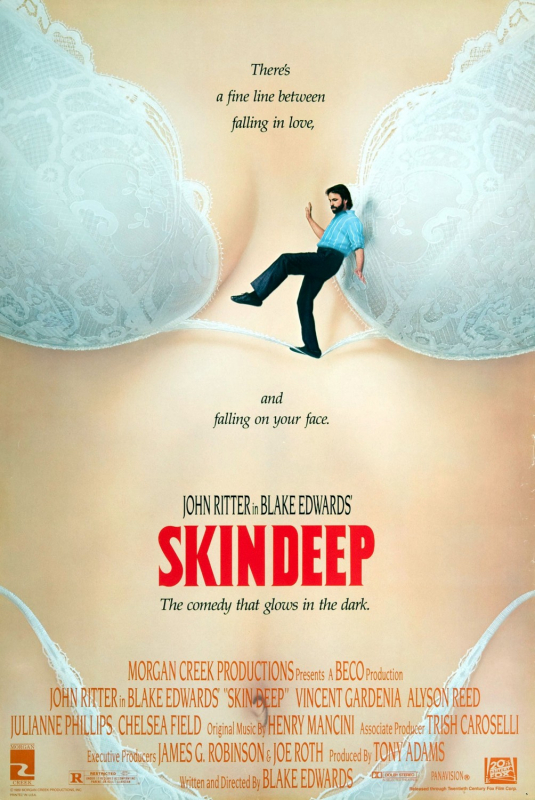
Zach (John Ritter) is a successful, best-selling author, but hasn’t written a novel in quite awhile and his constant philandering has gotten his wife Alex (Alyson Reed) to leave him. Depressed about his circumstances he becomes an alcoholic, but uses the advice of his kindly bartender (Vincent Gardenia) to try and win her back, but finds fighting his hedonistic urges to be challenging.

This marked Blake Edwards fourth film dealing with the mid-life crisis issue that started with 10 in 1979 and was followed up with S.O.Bin 1981 and then That’s Life in 1986. All four had a similar setting (Malibu/Hollywood) and involved middle-aged men at a crossroads in their career/marriages. When 10 came out it was considered ‘fresh’, but by 1989 the storyline was becoming quite redundant and came-off looking like Blake’s creative well had run dry. Edwards also exposes himself as being too entrenched in the Hollywood scene and out-of-touch with the middle-class lifestyle as Zach is never in any type of financial distress despite a career lull and having his mansion burn down (he wasn’t able to collect on the insurance money due to it being caused by arson) and yet still able to stay at posh beach houses and luxury hotels. In the end his only concern is his insatiable appetite for hot women, which ultimately comes-off as plastic problems for plastic people.

The women look too much alike, including Chelsea Field, who plays Amy and Jean Marie McKee who is Rebecca. Both of these women were brunettes, the same age, and with similar hairstyles and when seeing them from behind I thought they were the same person. Zach also states that he loves ‘all women’, but only beds the hot ones. The film tries to make-up for this by having him have a sexual encounter with a female bodybuilder (Raye Hollitt), but overall they still end up looking too much like the caricature of a Hollywood Hooker.

Even Ritter, as engaging as he usually is, flops here. A lot of it has to do with his beard, which I hated. I suppose they wanted him to look different from his more famous Jack Tripper character, but turning him into an image resembling the guy on the packages of Brawny paper towels wasn’t it. Since his character does go through a transition they should’ve had him start-out clean-shaven and then as his life goes into turmoil gotten the beard only to shave it off once things returned to normal.

Zach’s incessant whining at trying to win his wife back is what really got on my nerves the most. She was right to walk out on him and he didn’t deserve a ‘do-over’. Besides not everyone is going to find happiness in a committed relationship and, even though this might’ve been ahead-of-its-time for 80’s audiences, an alternative lifestyle would’ve been a better fit like having him get into polyamory, or sex workers. As mentioned the women all looked like hookers anyways and since he seemed to have a boundless cache of cash he could’ve easily afforded them.

I did like the glow-in-the-dark condom scene, which is the film’s only funny moment and happens at the 50-minute mark. Gardenia as the intuitive bartender is amusing too and I didn’t think there was any need for Zach to see an actual therapist as the bartender’s advice was just as good and much less costly.

There are a few bits that have not aged well including Zach’s penchant for kissing a bar maids without her consent and with him sitting on a small dog and seemingly killing it. Overall, I found it superficial and trite and the only successful thing about it is that it lives up to its title.

My Rating: 3 out of 10

Release: February 28, 1989

Runtime: 1 Hour 41 Minutes

Rated R

Director: Blake Edwards

Studio: 20th Century Fox

Available: DVD, Blu-ray, Amazon Video, YouTube

The Carey Treatment (1972)

By Richard Winters

My Rating: 6 out of 10

4-Word Review: A Pathologist solves mystery.

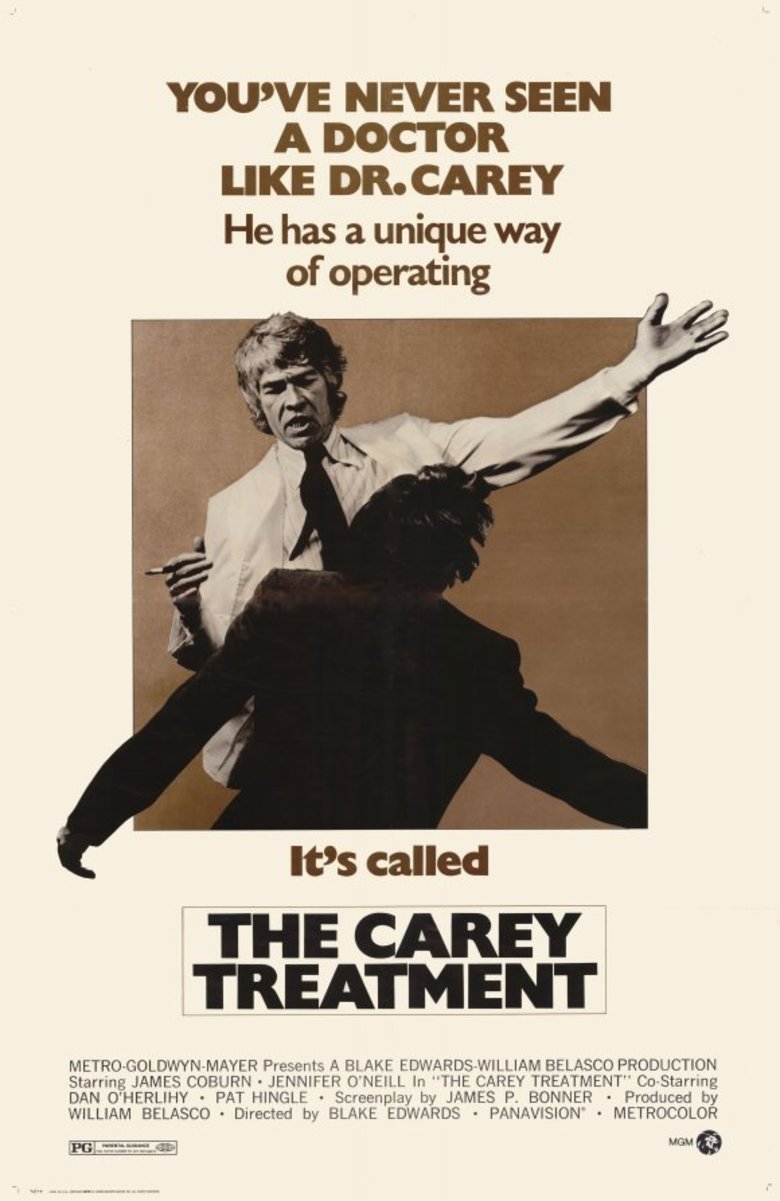
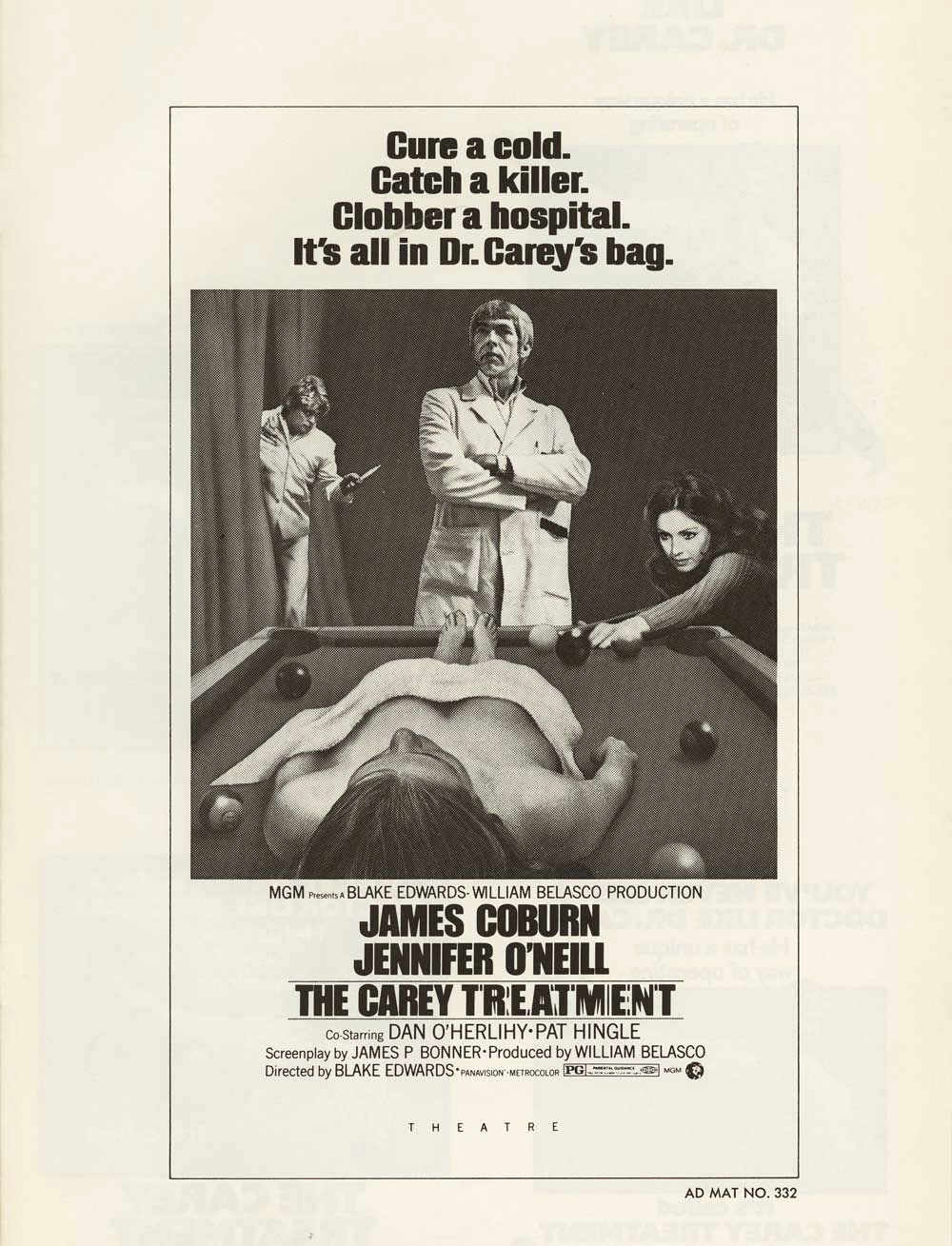
Based on an early Michael Crichton novel, the story centers around Dr. Peter Carey (James Coburn), who starts a new job as a pathologist at a local Boston hospital and soon finds himself embroiled in a mystery when his good friend Dr. David Tao (James Hong) gets accused of performing an illegal abortion on the daughter of the hospital’s chief surgeon (Dan O’Herlihy), which later kills her. Carey is not convinced that his friend performed the procedure and sets out to prove his innocence when the police are of no help.

This film was noted for its behind-the-scenes turmoil including accusations from director Blake Edwards that he was belittled by the film’s producer William Belasco in front of the crew and told that he would never work in Hollywood again and afterwards having the film edited without his permission. Edwards later sued and his experiences working on this project became the basis for his 1980’s film S.O.B., which savagely satirized the movie making business and the people who ran it.

The plot isn’t bad and attempts are made to give the viewer an authentic feel of the medical profession. One of the better moments is when the doctors perform an autopsy on the victim although I wished they would’ve shown more of the actual corpse on the examining table instead of cutting away from it in an attempt to be ‘tasteful’ as I felt the procedure and what the men discussed during it to be genuinely educational.

Having a hip doctor suddenly turn into an amateur sleuth is the film’s biggest drawback. Coburn plays the part well, but a guy who’s never investigated a case before wouldn’t be so seasoned with the way he handles suspects and tackles clues. He comes off too much like a professional detective who’s spent years in the business and not just a regular person who stumbles into the situation without knowing what he’s doing. The slick way that he solves the case and gets the necessary information is impressive, but not believable. Most people would’ve simply hired a private detective to investigate it and not spent hours away from their job trying to do it themselves, or if they take on the task they would most assuredly have make some mistakes, which this guy never does.

The mystery has enough intriguing elements to remain engaging, but the ultimate reveal is dull and makes one feel like they sat through a big buildup to nothing.

My Rating: 6 out of 10

Released: March 29, 1972

Runtime: 1 Hour 41 Minutes

Rated PG

Director: Blake Edwards

Studio: MGM

Available: DVD (Warner Archive), Amazon Video, Youtube

S.O.B. (1981)

By Richard Winters

My Rating: 6 out of 10

4-Word Review: His wife goes topless.

Movie producer Felix Farmer (Richard Mulligan) is suffering from what they call in Hollywood as Standard Operating Bullshit. His recent film, a family oriented musical that starred his wife Sally (Julie Andrews) and was titled ‘Night Wind’ is a box office flop. Now no one wants to work with him and the studio tries to reedit the film in an attempt to ‘save it’. All of which sends Felix on verge of suicide until he gets the idea of turning the movie into a soft core porn flick and having  Sally bare her breasts in it.

The film is loosely based on experiences that writer/director Blake Edwards had along with his real-life wife actress Julie Andrews during the early ‘70s when their project Darling Lilli did not do well financially and his next several films after that met with lots of studio interference before he was finally able to rebound by resurrecting the Pink Panther franchise.

The satirical jabs are obvious but amusing and the real problems come more with the shallow/jaded characters. Even the wholesome Sally comes off as cold with her rather ambivalent reaction to her husband’s depression/suicide attempt. There is also a running gag dealing with a man (Herb Tanney) who has heart attack at the beach while jogging and his loyal dog stays by his side even though no one else pays attention to it, which starts out as darkly amusing, but eventually gets cruelly overplayed.

Mulligan makes a flat impression as the star to the point of being almost transparent. For the first half he doesn’t say a single word while behaving in an overly exaggerated despondent way. When he finally snaps out of this he then eagerly tries to sell-out on his own film vision simply so it can make a buck, which makes him no better than the rest of the scummy Hollywood elites that he is supposedly trying to fight. Andrews is boring too and her brief topless scene comes off as exploitive and ill-advised.

The best bits come from its supporting cast. Robert Preston as the perpetually inebriated doctor has a few great lines and Robert Webber does well as a very nervous, high-strung press agent. Loretta Swit is hilarious as a bitchy, cantankerous gossip columnist who gets cooped up in a hospital after an accident and an almost unrecognizable Larry Storch hams it up under heavy make-up as a spiritual guru. There is also Robert Vaughn wearing high heels and women’s clothing.

I enjoyed the film within a film approach and the tawdry dream-like sequence scene, but the story suffers from adding in too much slapstick including a drawn-out car chase that seems suited for a completely different type of movie. For mild comedy it is okay, but as satire it fails to make any strong or impactful statement.

My Rating: 6 out of 10

Released: July 1, 1981

Runtime: 2Hours 1Minute

Rated R

Director: Blake Edwards

Studio: Paramount

Available: DVD, Blu-ray, Amazon Video, Youtube

A Fine Mess (1986)

fine-mess-2

By Richard Winters

My Rating: 4 out of 10

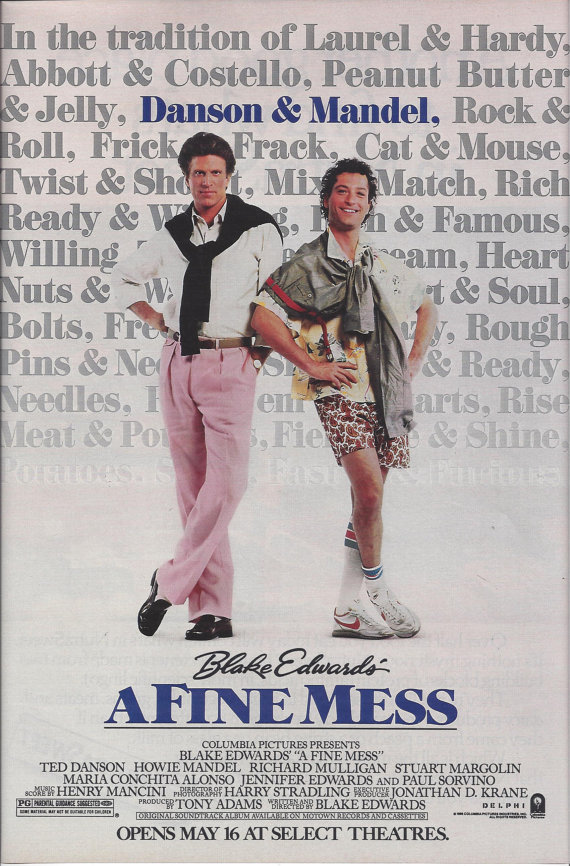
4-Word Review: They buy a piano.

Spence (Ted Danson) works as an actor and during a break in shooting, which is being done at a local horse track, decides to take a rest in a nearby horse stall. While he is there he overhears a conversation between two men (Stuart Margolin, Richard Mulligan) in the next stall discussing how they are going to inject a horse with a drug that will cause him to run faster and therefore make him a ‘sure thing’ in the his next scheduled race. Spence decides to use this information to bet on the horse and make a killing at the track with the help of his friend Dennis (Howie Mandel), but the bad guys realize that they’ve been found out and try to nab Spence and Dennis before they are able to place the bet. Spence and Dennis try to hide from their pursuers by attending an auction where they inadvertently purchase a piano, which they must later deliver to a rich customer (Maria Conchita Alonso) who is dating a mobster (Paul Sorvino).

I was genuinely shocked at how limp and threadbare this script was and how it routinely resorted to some of the most empty-headed humor I’ve ever seen. Much of it consists of long and extended chase sequences that aren’t particularly exciting or imaginative and rely on gags that we’ve all seen a million times before.

The casting is also off. Margolin can be a great character actor, but not in this type of role and Mulligan’s dumb guy routine and facial muggings is to me the epitome of lame. Danson doesn’t seem particularly adept at physical humor and shows no real chemistry with his co-star. Sorvino, who walks around with a limp, gets a few chuckles, but believe it or not I came away liking Mandel the best and actually found him to my surprise to be the most normal person in the movie.

The intention was to make this a completely improvisational exercise, which would give the actors free rein to come up with lines and scenarios as they went while relying on the broadest of story blue prints as their foundation, but the studio wanted more of an actual script and forced director Blake Edwards, who later disowned this project, to approach the thing in a more conventional way. The result is a mish-mash of nonsense that doesn’t go anywhere and makes the viewer feel like they’ve done nothing but waste their time in watching it.

All could’ve been forgiven had they at least played up the piano moving bit, which is what I was fully expecting. The inspiration was to make this a remake of the classic Laurel and Hardy short The Music Box with a scene, like in that one, where the two stars must somehow move an upright piano up a long flight of stairs. However, instead of showing this it cuts away to the next scene where the two have somehow without any moving experience gotten the piano up the stairs with apparently no hassle, but what’s the use of introducing a potentially funny comic bit if you’re not going to take advantage of it?

I still came away somewhat impressed with the way that it managed on a very placid level to at least hold my interest. I suppose in this era where scripts with a plethora of winding twists tend to be the norm one could almost deem this a ‘refreshing’ change-of-pace in its simplicity. Those that set their entertainment bar very low may enjoy it more.

My Rating: 4 out of 10

Released: August 8, 1986

Runtime: 1Hour 30Minutes

Rated PG

Director: Blake Edwards

Studio: Columbia Pictures

Available: DVD, Amazon Video

City Heat (1984)

city heat

By Richard Winters

My Rating: 5 out of 10

4-Word Review: Clint and Burt together.

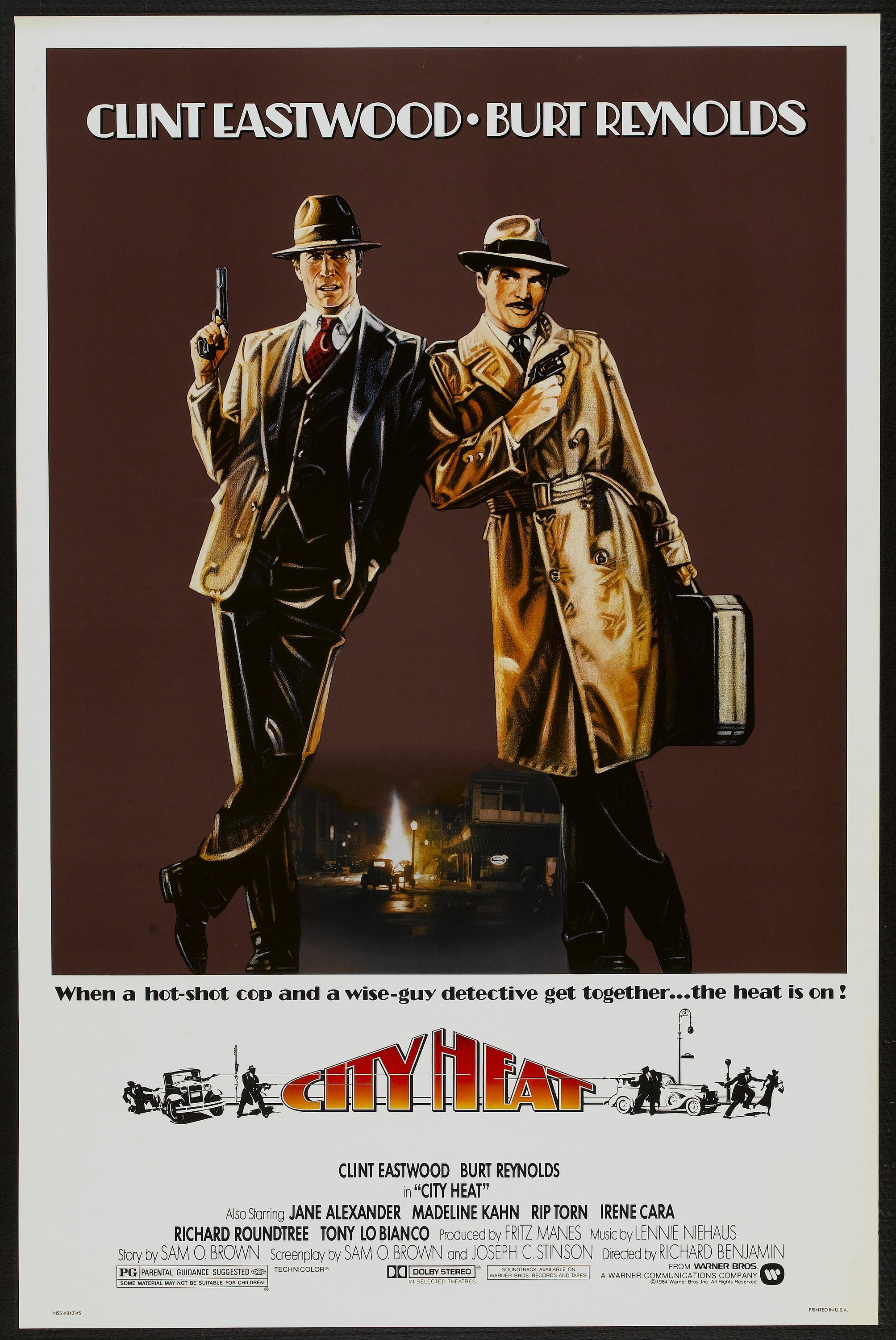
Mike Murphy (Burt Reynolds) is a private eye living in 1930’s Kansas City who at one time worked as a cop. When his friend Dehl (Richard Roundtree) gets murdered after obtaining the secret accounting records of a local mobster and then trying to blackmail him with it Mike goes on a mission to find the culprit, but soon finds himself in over his head. His former police partner Speer (Clint Eastwood) gets involved and the two reluctantly work together to solve the case despite the many clashes with their personalities and methods.

The script was written by Blake Edwards who gets credited under the pseudonym Sam O. Brown. He was originally slated to direct, but Burt didn’t want to work with Edward’s wife Julie Andrews who was cast in the role that later went to Madeline Kahn because the two had clashed just a year earlier while starring in The Man Who Loved Woman. Clint desired a less intense director at the helm, so the two used their star status to have Edwards yanked from the project and replaced with actor-turned-director Richard Benjamin. The result is a strange mish-mash of a movie that at times seems like a pedestrian action flick and at other moments becomes a campy comedy.

The film starts off well. I enjoyed the fight Reynolds with has with two men inside a café while Eastwood sits back and does nothing, but things deteriorate quickly after that. Part of the problem is Eastwood and Reynolds are only funny when they are seen together and working off of each other’s contrasting styles. Alone there are boring at least here with Eastwood playing too much of a caricature of himself while Reynolds is unconvincing as a tough guy. The film would’ve worked much better had the two been partners from the very beginning instead of throwing in this contrived bitterness between the two, which is never funny or interesting.

Outside of Rip Torn’s performance as a rival gang boss the supporting cast is wasted especially Jane Alexander in a thankless throwaway role as Reynold’s secretary. Kahn manages to have some redeeming moments when she gets kidnapped by the mob and then beats her captors at poker, but it is not enough. Irene Cara sings a few good tunes, but proves to be weak as an actress.

The shootouts are great and the best thing in the movie as unlike the rest of the film they manage to have a nice balance between being exciting and funny. Unfortunately the plot itself is overblown, confusing and formulaic and a prime example of a Hollywood production relying too much on the charisma of its two stars while failing to supply them with material that is fresh or original.

My Rating: 5 out of 10

Released: December 7, 1984

Runtime: 1Hour 33Minutes

Rated PG

Director: Richard Benjamin

Studio: Warner Brothers

Available: VHS, DVD, Amazon Instant Video, YouTube