Category Archives: Movies with Nudity

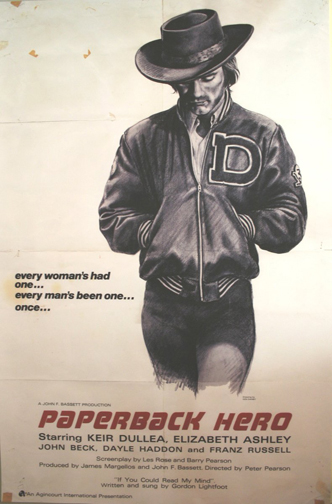
Paperback Hero (1973)

paperback hero

By Richard Winters

My Rating: 5 out of 10

4-Word Review: Big fish small pond.

Rick (Keir Dullea) is a hockey player living in a small town on the western plains of Canada. To pass his time he imagines he is a gunslinger in the old west and makes himself the self-imposed marshal of the community.  Outside of Sheriff Burdock (George R. Robertson) the other townsfolk considered it an amusing and otherwise harmless quirk. Then Rick learns that his hockey team will be disbanded and he will be without a job. He is given an opportunity for employment in nearby Saskatoon, but he refuses it feeling that he will lose his ‘mystique’ in the bigger city. Slowly the strains and pressures of his situation start to get to him and eventually it culminates in an old fashioned gunfight right in the center of town between him and the sheriff.

If the film gets one thing right it is in the recreation of small town life. Filmed on-location in Delisle, Saskatchewan director Peter Pearson gives the viewer a wonderful and vivid feel of the town. Just about all the sections of the hamlet are captured including the inside of abandoned buildings, trailer homes and farms as well as a couple of nice bird’s eye shots. The remoteness and flat wheat laden terrain brings to life the region in an almost stunning clarity. Having grown up in a small town not too terribly far from the Canadian border I can say that this film hits-the-mark in its portrayal of people in the Nordic region. All the little dramas that can go on between people locked in a remote local as well as the scenes done inside a dark and dingy bar that many times can constitute as the place to go for a ‘night-on-the-town’ is amusingly well played-out.

However, despite having the right flavor the film lacks direction. It was hard for me to get into this because all the scenes were random and not connected together by all that much. The plot is thin and made up if anything by a series of vignettes.  The main character is brass, egotistical, deluded and arrogant. He treats women like they are his property. He beats up one and considers it minor because her bruises are only the ‘size of a quarter’. He talks about getting turned on by one woman while making love to another and then is surprised when she gets upset with him. Having a film built around such an unlikable character is not entertaining or interesting especially when we are given no history to why he became the way he is.

Dullea does well in the lead and shows a lot more emotion and panache than one might expect from him especially when compared to his most famous role as the rather robotic Dave Bowman in 2001: A Space Odyssey. It is always fun to see Elizabeth Ashley and here she plays one of Rick’s love interests, but her role is small and rather thankless though she does get shown in a long and explicit nude scene.

My favorite was Dayle Haddon as the alluring Joanna. Haddon has retired from the acting profession years ago, but was at one time a fashion model and she looks gorgeous here. The scene that takes place in an abandoned house where she tells Rick off and shreds his deluded ego while doing it in a quiet whispery tone is the movie’s best moment.

The segment showing a big hockey brawl where fans jump out of the stands to get involved and even the ref gets bloodied is fun. I also liked the part where Rick takes Joanna on car ride through the wheat fields. The camera is hooked up to the bumper of the car so the viewer gets an up close experience of watching the wheat thrash before them at high speeds. The standoff at the very end in the center of town is also interesting, but the film takes too long to gel and the main character is such a turn-off that it hurts the good points and ultimately makes this a misfire.

The movie also features the Gordon Lightfoot’s song ‘If You Could Read My Mind’, which is a great a song, but it has been played so much on lite-rock stations that instead of getting the viewer more engrossed in the movie it instead takes them out of it. The film works hard to create a gritty appeal and for the most part succeeds, which is why having a long segment with the song played over it doesn’t work and I would have left it out.

My Rating: 5 out of 10

Released: September 21, 1973

Runtime: 1Hour 33Minutes

Rated R

Director: Peter Pearson

Studio: Alliance Film Distribution

Available: VHS, YouTube

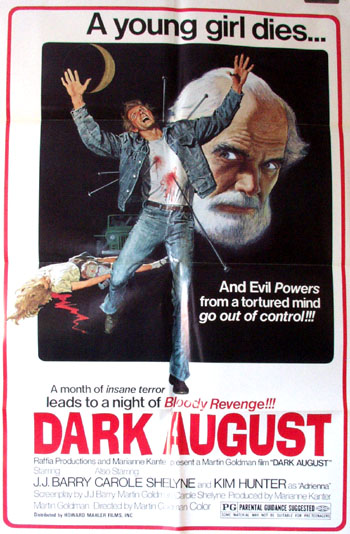
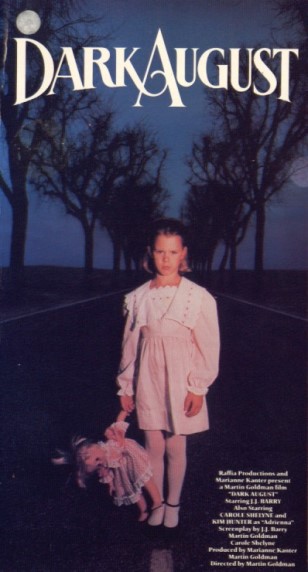
Dark August (1976)

dark august

By Richard Winters

My Rating: 3 out of 10

4-Word Review: Plagued by a curse.

            Sal DeVito (J.J. Barry) moves from New York City to a peaceful small town in Vermont in order to further his career as an illustrator and escape the stresses of big city life. Unfortunately he hits and kills a young girl (Karen Lewis) with his car when she runs out onto the street. Although he ends up being exonerated the girl’s grandfather (William Robertson) still holds him accountable and places a curse on him. The curse makes Sal see a strange hooded figure in the distance as well as suffering from mysterious blackouts. To help rid him of it he goes to see a popular psychic in town named Adrianna (Kim Hunter), but her services prove to not be the solution he thought.

Like with most low-budget 70’s horror films this one has a lot of slow parts and extended scenes with extraneous dialogue that goes nowhere. The scares are at a minimum and the few that it does have aren’t real frightening. The hooded figure that Sal keeps seeing in the distance has a creepy quality to it, but the film should have done more with it. There needed to be more action, more confrontations, and just plain more horror. Even a child could watch this and not be upset by it. There are no special effects and although the production is technically competent despite its low budget I found it hard even calling it a thriller or horror film since the suspense is light.

I loved the on-location shooting done in Stowe, Vermont. The woodsy landscapes and green countryside is gorgeous and I liked the scenery better than anything else in the picture, which is another problem. Filming scenes in the bright sunny daytime doesn’t help create a spooky feeling and there needed to be more done at nighttime. There is a very dark ominous cloud overhead during the scene involving the accident, but that is about it.

Barry whose acting career was brief and minor plays a stressed-out character effectively, but I could have done without seeing him lying nude in bed. There is also an extended scene showing the couple sleeping in bed from different angles, which seemed inane and unnecessary. Kim Hunter appears very late in the picture and really can’t do much to save it.

This is a film that deserves its place in obscurity and unfortunately has nothing to distinguish it or make it worth seeking out.

dark august 2

My Rating: 3 out of 10

Released: August 8, 1976

Runtime: 1Hour 27Minutes

Rated PG

Director: Martin Goldman

Studio: Howard Mahler Films

Available: VHS

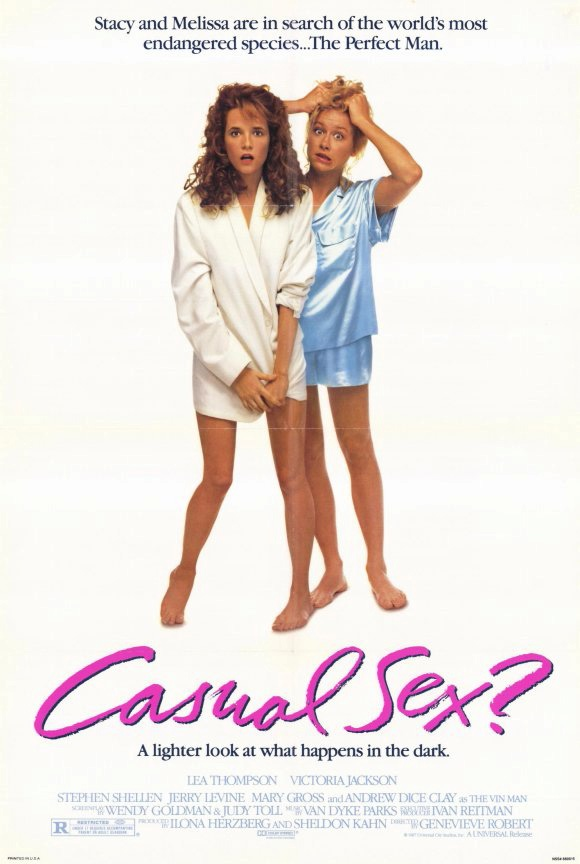
Casual Sex? (1988)

casual sex

By Richard Winters

My Rating: 3 out of 10

4-Word Review: Sex in the 80’s

Stacy (Lea Thompson) and Melissa (Victoria Jackson) are lifelong friends with very different sexual pasts. Stacy has slept with a lot of guys including some one-night-stands while Melissa has had sex with only a few and never achieved an orgasm at least ‘not when someone else was in the room’.  Because of the AIDS epidemic they decide to reanalyze their sexual mores and join a singles resort where they hope to meet their Mr. Right and settle down.

The film is based on the stage play that was originally produced for The Groundlings Theater in Los Angeles. You can tell this right away at the start where the two women stand on an empty stage and talk about some of their past sexual encounters. This proves to be the funniest part of the film with a lot of keen observations on human behavior. Unfortunately after the first five minutes of this the film digresses into a more conventional narrative by having the girls go to a single’s resort and the attempts at satire get either over-played or not played up enough. What is even worse is that it throws in a romance angle by having Stacy fall for an irritatingly perfect looking heartthrob named Nick (Stephen Shellen) who is an aspiring rock star. The two quickly move in together and then all of sudden he becomes completely clueless and harbors a lot of annoying habits that leads to a drawn-out, boring break-up session.

There are still a few funny moments including an amusing dream sequence where Stacy imagines making love to Nick while her boyfriends from the past start to pop up all around her, but overall the film fails to gain any traction, is filled with clumsy characterizations and falls flat. A much better approach would have been to structure it around a collection of vignettes with a sexual theme much like Woody Allen’s Everything You Always Wanted to Know about Sex, but Were Afraid to Ask, which is far more original and funnier than anything you will see here.

Lea is really cute and gives a good performance. Normally ditzy blondes get on my nerves, but somehow I have always found Victoria’s cute-as-a-button face and squeaky voice appealing. Her acting skills aren’t up to Lea’s level, but her more natural delivery makes for a nice contrast. Skin hounds will be happy to know that both women appear nude from the backside.

However, it’s Andrew ‘Dice’ Clay who steals the film with an engaging performance as the proverbial lounge lizard. Every scene he is in is funny and he tells a lot of lame jokes, but the way he says them is hilarious ‘they can’t all be golden’. In his attempt to get more connected to women he reads a book entitled ‘How to Pretend Your Sensitive’, which is amusing as well. My only complaint is that in the end Lea marries him and he becomes more ‘normal’, which takes away from the goofy caricature.

My Rating: 3 out of 10

Released: April 22, 1988

Runtime: 1Hour 37Minutes

Rated R

Director: Genevieve Robert

Studio: Universal

Available: VHS, DVD, Amazon Instant Video

A Little Sex (1982)

a little sex 1

By Richard Winters

My Rating: 2 out of 10

4-Word Review: He can’t stay faithful.

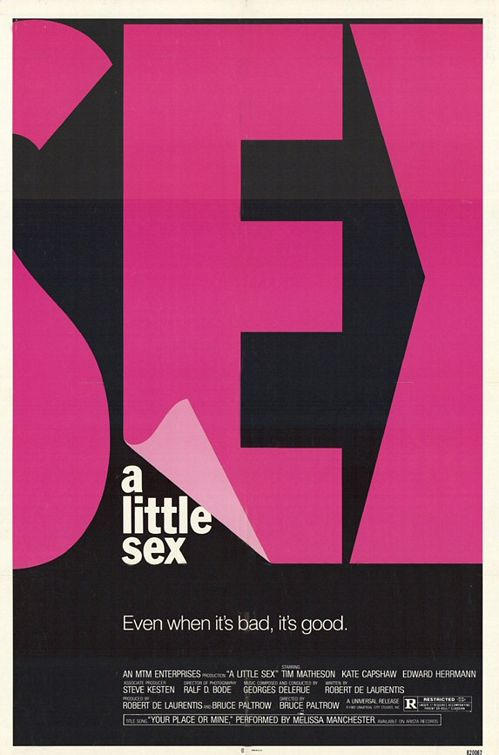
Michael (Tim Matheson) gets married to Katherine (Kate Capshaw) after living with her for a year. He had a habit of sleeping around and having a lot of one-night-stands, but makes a pledge to change. However, the temptations are too strong and he ends up cheating on her and getting caught and then spends the rest of the film trying desperately to win her back.

Bruce Paltrow, who was the father of Gwenyth and the husband of Blythe Danner directs this very minor production that is generic and predictable throughout. The story and production values seem better suited for television and this doesn’t even seem like an 80’s movie, but more a remnant from the touchy, feely 70’s. The plot is empty and fails to gain any momentum with dialogue that is stale and boring.

Although billed as a comedy there really isn’t much that is funny and few moments that become heavy-handed and melodramatic. One scene has the couple pretending to make love while under the covers of a bed that is in the middle of a storeroom with the other customers and a very nervous saleslady looking on that had potential, but doesn’t go on long enough. Another segment has some first grade school girls that Katherine teaches intently listening to a video tape of Michael telling them a story. I was amazed at how enraptured the children were because I found the tale to be dull and vapid, but then having all the girls become teary-eyed at the end of it goes overboard.

Capshaw, who has been married to Steven Spielberg for over twenty years and has five children with him, is vivacious in her film debut. She looks beautiful and far better looking than any of the other women that Michael fools around with. Matheson is liable enough, but his character is bland and no ability to carry the film.

The supporting cast comes off better although John Glover and Wallace Shawn are essentially wasted. Edward Herrmann is a delight as Michael’s friend Tommy and has the best lines in the whole movie. Joan Copland is amusing as Katherine’s mother especially when she compares marriage to death in one conversation and then later compares it to war. It is also great to see Wendie Malick playing a sultry clarinetist who is now starring in the ‘Hot in Cleveland’ TV-show and looks like she hasn’t aged a day since appearing in this.

I am a big fan of Melissa Manchester and she has done a lot of great songs, but her opening song here ‘Your Place or Mine’ has to be one of her worst although I did like the extreme close-up of a cigarette being lit and then watching it slowly burn, which is the film’s one and only interesting cinematic moment.

My Rating: 2 out of 10

Released: April 2, 1982

Runtime: 1Hour 35Minutes

Rated R

Director: Bruce Paltrow

Studio: Universal

Available: DVD, Amazon Instant Video, Netflix streaming

Medium Cool (1969)

medium cool 1

By Richard Winters

My Rating: 9 out of 10

4-Word Review: The 60’s up close.

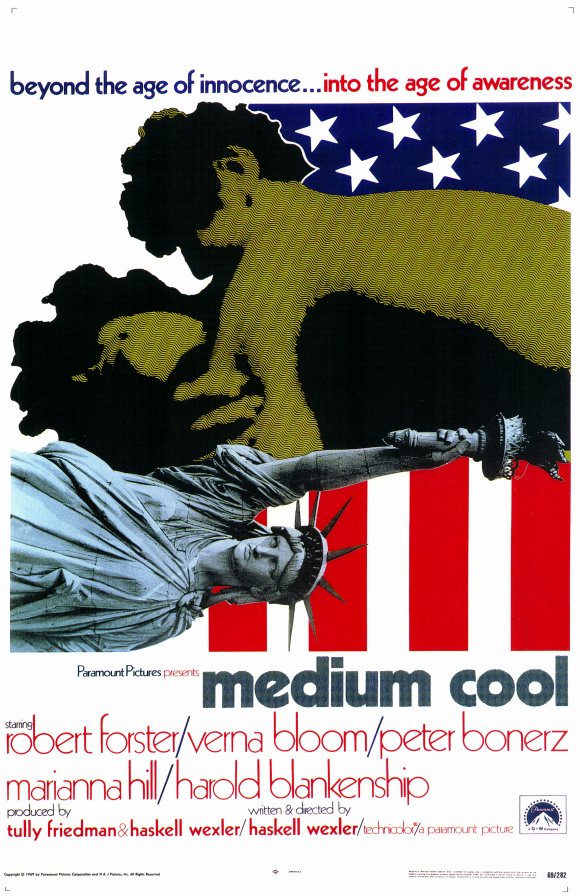
If you ever wanted to travel back in time and take part in the events of the tumultuous 60’s this film comes about as close to that as you can get. Watching this isn’t like viewing a movie, but more like an experience in itself. Acclaimed cinematographer Haskell Wexler who had previously worked in the documentary field heard that demonstrators were going to march at the 1968 Democratic convention in Chicago so he decided to hire a few actors and throw them into the fray while building a thin plot around it and creating a pseudo-reality effect. The story deals with news cameraman John Cassellis (Robert Forster) who meets and starts to date Eileen (Verna Bloom) who has just moved to Chicago from West Virginia with her 11-year-old son Harold (Harold Blankenship). As the convention and protests begin and John begins to cover it Harold runs away from home and Eileen goes into all the chaos to find him.

The scenes from the riots leave a major impact and even though I had already seen this film several times before I was amazed at how compelling it still was. Everything still seemed fresh with a clarity that makes you feel you are right there and a vividness that seems like it was filmed just yesterday. Watching the National Guard with their rifles raised marching down the streets of Chicago threatening crowds of people is incredible as is the sight of army tanks rolling down Michigan Avenue.  The people in the crowds are not actors and you see them getting clubbed by the police only a few feet from the camera. Watching them take the park benches in Grant Park and use them to build a shield from the police is exciting as are actual sound bites of reporters describing the action and at certain points being roughed up by the patrol as well. The look of fear and confusion on Bloom’s face at what she finds herself in the middle of it is authentic and helps build the tension.

Of course these scenes only make up the final fifteen minutes of the film, but the movie is filled with a variety of other unique moments that are all captured with the same vivid style and are equally memorable. The part where John and Eileen go to a roller derby and watch actual female players beat each other up with some even using their fists gets quite vicious. The scene showing hundreds of caged pigeons being set free and flying off in a giant flock that fills the sky is eloquent. There is even some effective erotica as a naked John chases his naked girlfriend Ruth (Marianna Hill) around his apartment before lifting her up by her legs and spinning her around in a circle.

The film also takes a great critical look at television news and the people who cover it. It shows how reporters and cameramen are very detached from the events and people that they are covering and how their need to capture that ‘great’ image or sound bite supersedes the human element.

Forster is perfect for the lead role. I loved his aggressive, blue collar, tough-guy attitude that perfectly reflects the Windy City. Peter Bonerz who plays Gus his sound man is great, but in the opposite way. His character is much more timid and wants to avoid confrontation at every turn and finds it difficult dealing with some black people who make him feel uncomfortable when he visits their apartment and even some young children when they start to climb on his car.

The only negative is that the song ‘Merry-Go-Round’ by Wild Man Fischer is not included in the most recent Criterion Collection DVD/Blu-ray release. The song was in the original release shown in theaters as well as the film’s first VHS version, which I saw. Unfortunately the song’s copyright holders sued Paramount stating that a VHS/DVD release is not the same as a theatrical/television broadcast, which they were under contract for to use and therefore could not include it in any later reissues, which is a real shame. The song has to be one of the strangest things you will ever hear and done by an eccentric one-of-a-kind artist. It has a weird alluring quality to it that gives personality and an extra edge to the film and in later versions gets replaced with ‘Sweet Georgia Brown’ better known as the theme for The Harlem Globetrotters, which is just not as effective.

My Rating: 9 out of 10

Released: August 27, 1969

Runtime: 1Hour 11Minutes

Rated R

Director: Haskell Wexler

Studio: Paramount

Available: VHS, DVD, Blu-ray (The Criterion Collection)

A Return to Salem’s Lot (1987)

return to salems lot

By Richard Winters

My Rating: 3 out of 10

4-Word Review: Town full of vampires

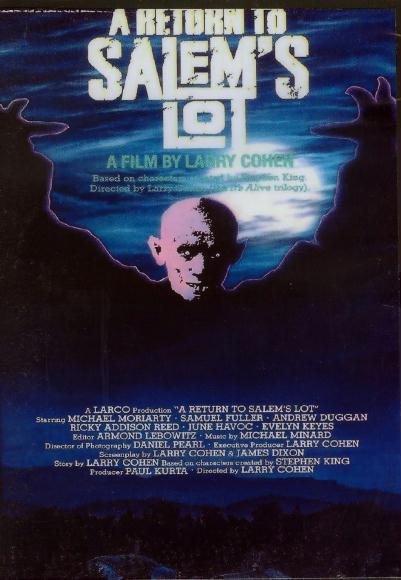
Joe Webber (Michael Moriarty) is a documentary filmmaker who is always looking to tackle the next shocking topic if it will help advance him and his film career. While vacationing in a small New England town of Jerusalem’s Lot with his teenage son Jeremy (Ricky Addison Reed) he becomes aware that the entire town is made up of a population of vampires led by elderly Judge Axel (Andrew Duggan). They are aware of Joe’s film career and give him an offer to film a documentary on them so as to give future generations a better understanding of the vampire lifestyle. Initially Joe is intrigued with the idea, but when he finds out that they want to turn his son into one of them he refuses and spends the rest of the time trying to escape and with the help of elderly but tenacious vampire hunter Van Meer (Samuel Fuller) save his son.

This flick is complete disaster from the beginning. It opens with Joe filming a documentary on a jungle cannibal tribe that looks like a real tacky rip-off of Cannibal Holocaust. The gore and special effects are abysmal and the story and characters have nothing to do with the Stephan King novel to which it is based nor the 1979 TV-Movie. Had the plot gone more with Joe filming a documentary on the populace it might have been interesting in an offbeat way, but the script brings up the idea and then never follows through with it.  There are shades of dry humor here and there and had it been more consistent with it the film could have been viewed and possibly enjoyed as a parody, but as it is it is nothing more than cheap straight-to-video fare.

The characters are poorly defined and at times even contradictory. Joe starts out as this callus man who puts his directing career first and has no concern for his son and hasn’t seen him for years, or even mentioned him to his friends. Then suddenly they get to this town and he will stop at nothing to save him. The son also does not like the father when he first sees him and yet magically and quickly bonds with him the minute they get to town. He is also described to be deeply troubled psychologically, but shows no sign of it during the course of the movie.

There is also the issue of Van Meer shooting Judge Axel in the head twice with a gun, but even as bullet holes spew out blood from his forehead he still goes on walking and talking like nothing happened. Supposedly this is to signify that the only way to kill a vampire is to stick a wooden stake through their heart and if you try to kill them any other way it won’t work, but this still doesn’t make sense. For instance if you break a vampires kneecap wouldn’t that effect the way they walk? If so then the same logic should hold true if you put two bullet holes into their brain. It would more than likely turn them into a complete vegetable a vegetable that may go on living forever until you drive a wooden stake through its heart, but a vegetable nonetheless.

Moriarty gives another great performance that completely exceeds the quality of the material. This one is even more impressive because he actually plays a normal person here and does so effectively, which is interesting given the nature of his sometimes offbeat behavior off-camera. The person though that really steals it is famed film director Fuller as the elderly vampire hunter. The guy shows an amazing amount of charisma and energy and plays up the character to an amazingly amusing degree and helps save what is otherwise a disaster.

Veteran actresses June Havoc and Evelyn Keyes appear as two of the elderly women vampires. Keyes really plays-it-up and the way she sucks the blood from one of the victims off her fingers looks down right erotic. The scene where Havoc, Keyes and writer/director Larry Cohen’s then real-life wife Janelle Webb chew on the dead body of Cohen’s real-life daughter Jill Gatsby gets a few points for audaciousness. This is also a great chance to see Tara Reid in her film debut as one of the vampire children.

The final thirty minutes is an improvement namely because of Fuller’s presence, but it does nothing to hide the film’s many other flaws, which is a perfect example of bad 80’s horror.

My Rating: 3 out of 10

Released: May 18, 1987

Runtime: 1Hour 41Minutes

Rated R

Director: Larry Cohen

Studio: Warner Brothers

Available: VHS, DVD (Warner Archive), Amazon Instant Video

The Fool Killer (1965)

fool killer

By Richard Winters

My Rating: 6 out of 10

4-Word Review: Kid roams the countryside.

George Mellish (Edward Albert) is a 12-year-old boy who runs away from home after a particularly harsh beating at the hands of his foster parents. As he roams the Tennessee countryside he meets Dirty Jim (Henry Hull) an old man who takes him into his rundown home and fills his head with all sorts of stories about an eight foot ax-wielding man who kills people he deems to be foolish. After a bout of illness George runs away from Jim and late one night meets Milo (Anthony Perkins) a loner who carries an ax and acts strangely. Initially George thinks that he is ‘the fool killer’ Jim described, but the two soon become friends even though strange ax murders begin to occur everywhere they go.

Servando Gonzalez’s direction is excellent and the one thing that keeps this otherwise thin story intriguing. This was his only English language film and he uses a variety of different camera angles and editing styles to create a sort of hypnotic effect. The on-location shooting is vivid and their ability to recreate the look and feel of the late 1800’s is solid including having the characters occasionally speak with poor grammar, which helps with the authenticity.

The only thing about Gonzalez’s direction that I did not like is where they have a nighttime scene that was clearly filmed in the daytime, but done with a darkened lens to ‘fool’ the viewer into thinking it is night. This process has been done many times in the past, but it never works. Even with the dark lens the sky is too bright and you are unable to see any stars. I remember this done a few times on the old ‘Brady Bunch’ TV-show and I always found it disconcerting. The reason is usually because by law child performers are not allowed to work past a certain late hour, so if the script calls for a nighttime scene they try to compensate using this trick, but it always looks tacky. My solution would be to get the parent’s permission to allow the young performer to work late for one night or alter the script to have the scene done in the daytime.

Despite some good production values and an interesting narrative the story itself, based on a novel by Helen Eustis, is limp and doesn’t have enough action. The middle section, which features a lot of conversations between Milo and George, gets boring and the pace comes to a screeching halt. The George character also gets a bit annoying. I realize he is a young and the story takes place in a more innocent era, but the kid falls too easily for anything and everything he is told and seems to have no center, which eventually becomes off-putting.

For what it is worth Albert is good in the lead in what was his film debut and so is Perkins although with this he was risking getting typecast. I thought Henry Hull in one of his last roles was highly engaging and I also really liked Arnold Moss as a bombastic preacher giving a fiery sermon under a tent during a religious revival. Since the movie otherwise does not have much happening this scene tends to be pretty electrifying and vivid particularly the looks on the people’s faces as he preaches to them.

There is a sort-of surprise ending, but it is not that big of a deal and most viewers will probably see it coming long before it happens and they might also say to themselves ‘I sat through two hours of this just for that!’ as well. If the story had been a little richer with more twists or a subplot this might have been memorable, but as it is the final result is empty.

My Rating: 6 out of 10

Released: April 28, 1965

Runtime: 1Hour 39Minutes

Not Rated

Director: Servando Gonzalez

Studio: Allied Artists Pictures

Available: VHS

Going Places (1974)

going places

By Richard Winters

My Rating: 9 out of 10

4-Word Review: Guys with no morals.

Two small time hoods (Gerard Depardieu, Patrick Dewaere) spend their days roaming the streets, robbing stores, and molesting women. In some ways this is truly an amazing film in what it is able to get away with. The two main characters are immoral, ignorant, insensitive, and brutal and the women are demeaned and degraded. The overall content is vulgar and perverse and yet somehow this thing comes off as a lyrical, offbeat delight that is pure entertainment.

It’s a definite original with every scene being an ingenious comic set-up. The scenario structure and use of locations is perfect. The pacing is fluid and director Bertrand Blier’s eye for detail near brilliant. The two hours move along like a breeze. It never gets boring and I actually almost wished it could have been longer.

The comic threads are hilarious and they get funnier and funnier as they go along. The guys’ constant, futile and very explicit attempts at getting a frigid woman (Miou-Miou) excited are a particular standout.

This is the type of black comedy that should be used as an example for all others. It’s consistently unique and manages to balance the ugly elements with the lighthearted without going overboard on either. It even throws in a surreal angle without a hitch.

Veteran French actress Jeanne Moreau has one of her finest latter career roles playing a lonely lady in desperate need of male attention. Her scene is well played out and even has a shocking conclusion. Depardieus ‘friendly’ conversation with a shopping mall security guard is another standout. The ultimate joke though may be in the film’s title as these guys are truly going nowhere.

My Rating: 9 out of 10

Released: March 20, 1974

Runtime: 1Hour 57Minutes

Rated R

Director: Bertrand Blier

Studio: Universal Pictures France

Available: VHS, DVD (Region 1 & 2), Amazon Instant Video

Perfect Strangers (1984)

perfect strangers

By Richard Winters

My Rating: 6 out of 10

4-Word Review: Kid witnesses a murder.

Johnny (Brad Rijn) is a local hit-man who knifes someone to death in a back alley. Little does he know that behind a nearby fence is a 2-year-old toddler peeking out through a small opening and witnessing the whole thing.  As Johnny is about to leave he suddenly becomes aware of the child, but as the police are coming he runs. He is connected to the mob and when he tells them of the incident they advise him that he must kill the child simply to be extra cautious. Johnny then decides to get in a relationship with the boy’s attractive single mother Sally (Anne Carlisle) with the idea that he will get close enough to her that she will trust him to be alone with the kid where he will then off him and make it look like an accident.

The child who is played by a very young actor named Matthew Stockley is extremely cute to the point of being adorable. The idea of any harm coming to him is almost unthinkable, which helps create some tension and the climatic sequence where he is chased by Johnny though an abandoned, shadowy warehouse is well done.

However, the film’s biggest weakness is the Johnny character who is too damn nice to the point that I even started to like him as the film progressed. The guy is great with the kid and shows a definite sensitive side and is reluctant to harm the child and only considers it because the rest of the mob pushes him to. This then pretty much mutes the tension and the film would have been more exciting had the character been portrayed as a cold-hearted psycho. I also found it a bit contradicting that this otherwise nice guy could so easily kill other people. The extremes in the personality didn’t connect although at one point he does at least say ‘sorry’ to one of his victims as he drags the dead body away after viciously killing him.

Carlisle is excellent. She is probably best known for starring in as well as writing the screenplay for the cult hit Liquid Sky. There she played a teenage punk, but here filmed only 2 years later she comes off as a mature full-grown woman and her effective performance helps carry the film. Otto von Wernherr who was also in that movie appears as a private eye hired to follow Johnny around.

Stephan Lack who was in Scanners and just about ruined the film with his terrible performance is surprisingly good here as an aggressive police detective who hounds Sally for answers and won’t leave her alone. Ann Magnuson is somewhat amusing as a man-hating feminist Nazi.

If writer/director Larry Cohen scores anywhere it is in his ability to vividly show the street culture and eclectic, busy atmosphere of New York City life. One bit has hundreds of woman marching down the street in an anti-rape parade and when Johnny tries to get involved in it the woman aggressively pushes him back out. Things flow enough to make it mildly entertaining, but the film lacks distinction and is ultimately forgettable.

My Rating: 6 out of 10

Released: November 24, 1984

Runtime: 1Hour 31Minutes

Rated R

Director: Larry Cohen

Studio: Larco Productions

Available: DVD

Where’s Poppa? (1970)

wheres poppa 2

By Richard Winters

My Rating: 9 out of 10

4-Word Review: Mother has to go.

A beleaguered Gordon (George Segal) is a man who must take care of his invalid mother (Ruth Gordon). Despite being a handsome young lawyer he has literally become trapped by this very difficult woman. The majority of the film takes place in a 1940’s styled apartment. It’s gray, dusty bleakness permeates every shot and shows just how lodged Gordon is in his mother’s world. He is a normal man that is slowly being sucked into madness. He is becoming mad because the world he lives in and life in general is driving him to it. The wall between what he really wants to do in life and his obligations have become so thick that going crazy may be the only real answer.

In fact madness maybe pretty much is what this film is really about. It seems to be saying that there is a certain functioning normality to it and at times even a necessity for it. Everyone in this film conveys their own unique form of madness. There’s the overzealous war general (hilariously played by Barnard Hughes) There’s also the henpecked brother/husband Sidney (Ron Leibman) who goes to almost absurd lengths to make sure everyone is happy. Even innocent, conservative Louise (Trish Van Devere) opens into the crazy world when explaining her rather unique honeymoon experience. The film delves so deeply and consistently into the world of the absurd that at times the senile Mother really doesn’t seem so nutty.

This is the film’s genius. It takes everything we have always accepted and turns it inside out. It takes some of life’s most depressing things and then makes it into an inspired and creative masterpiece. A trip to the old folk’s home has never been considered by many to be funny or memorable, yet a trip to Paul Sorvino’s old folk’s home is. In fact it maybe one of the funniest scenes you’ll ever see.

Writer Robert Klane and director Carl Reiner show an amazing grasp of their material, which is crucial for its success. Everything is fluid and consistent in tone. It shows how you can indeed have an offbeat idea, do it in an offbeat way, and still succeed without compromising.

My Rating: 9 out of 10

Released: July 9, 1970

Runtime: 1Hour 22minutes

Rated R

Director: Carl Reiner

Studio: United Artists

Available: VHS, DVD