Category Archives: Movies with Nudity

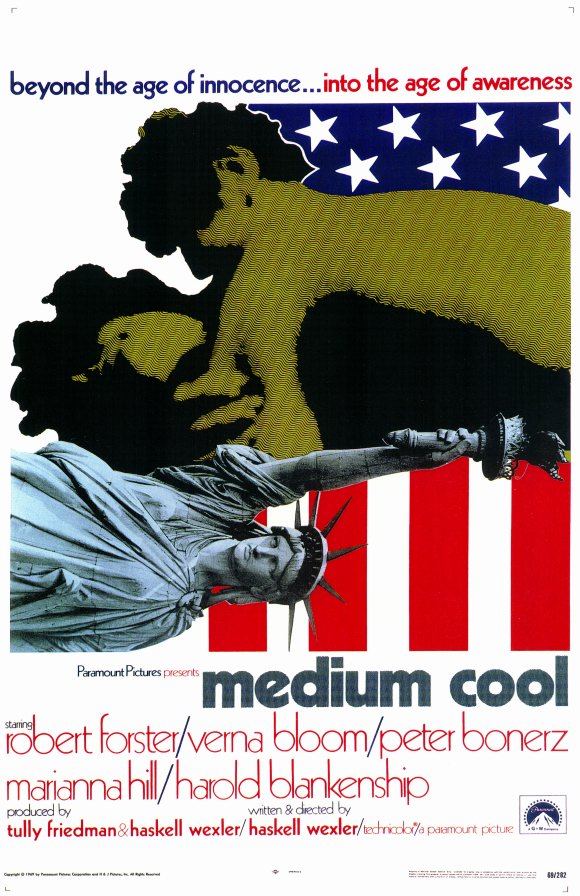
Medium Cool (1969)

medium cool 1

By Richard Winters

My Rating: 9 out of 10

4-Word Review: The 60’s up close.

If you ever wanted to travel back in time and take part in the events of the tumultuous 60’s this film comes about as close to that as you can get. Watching this isn’t like viewing a movie, but more like an experience in itself. Acclaimed cinematographer Haskell Wexler who had previously worked in the documentary field heard that demonstrators were going to march at the 1968 Democratic convention in Chicago so he decided to hire a few actors and throw them into the fray while building a thin plot around it and creating a pseudo-reality effect. The story deals with news cameraman John Cassellis (Robert Forster) who meets and starts to date Eileen (Verna Bloom) who has just moved to Chicago from West Virginia with her 11-year-old son Harold (Harold Blankenship). As the convention and protests begin and John begins to cover it Harold runs away from home and Eileen goes into all the chaos to find him.

The scenes from the riots leave a major impact and even though I had already seen this film several times before I was amazed at how compelling it still was. Everything still seemed fresh with a clarity that makes you feel you are right there and a vividness that seems like it was filmed just yesterday. Watching the National Guard with their rifles raised marching down the streets of Chicago threatening crowds of people is incredible as is the sight of army tanks rolling down Michigan Avenue.  The people in the crowds are not actors and you see them getting clubbed by the police only a few feet from the camera. Watching them take the park benches in Grant Park and use them to build a shield from the police is exciting as are actual sound bites of reporters describing the action and at certain points being roughed up by the patrol as well. The look of fear and confusion on Bloom’s face at what she finds herself in the middle of it is authentic and helps build the tension.

Of course these scenes only make up the final fifteen minutes of the film, but the movie is filled with a variety of other unique moments that are all captured with the same vivid style and are equally memorable. The part where John and Eileen go to a roller derby and watch actual female players beat each other up with some even using their fists gets quite vicious. The scene showing hundreds of caged pigeons being set free and flying off in a giant flock that fills the sky is eloquent. There is even some effective erotica as a naked John chases his naked girlfriend Ruth (Marianna Hill) around his apartment before lifting her up by her legs and spinning her around in a circle.

The film also takes a great critical look at television news and the people who cover it. It shows how reporters and cameramen are very detached from the events and people that they are covering and how their need to capture that ‘great’ image or sound bite supersedes the human element.

Forster is perfect for the lead role. I loved his aggressive, blue collar, tough-guy attitude that perfectly reflects the Windy City. Peter Bonerz who plays Gus his sound man is great, but in the opposite way. His character is much more timid and wants to avoid confrontation at every turn and finds it difficult dealing with some black people who make him feel uncomfortable when he visits their apartment and even some young children when they start to climb on his car.

The only negative is that the song ‘Merry-Go-Round’ by Wild Man Fischer is not included in the most recent Criterion Collection DVD/Blu-ray release. The song was in the original release shown in theaters as well as the film’s first VHS version, which I saw. Unfortunately the song’s copyright holders sued Paramount stating that a VHS/DVD release is not the same as a theatrical/television broadcast, which they were under contract for to use and therefore could not include it in any later reissues, which is a real shame. The song has to be one of the strangest things you will ever hear and done by an eccentric one-of-a-kind artist. It has a weird alluring quality to it that gives personality and an extra edge to the film and in later versions gets replaced with ‘Sweet Georgia Brown’ better known as the theme for The Harlem Globetrotters, which is just not as effective.

My Rating: 9 out of 10

Released: August 27, 1969

Runtime: 1Hour 11Minutes

Rated R

Director: Haskell Wexler

Studio: Paramount

Available: VHS, DVD, Blu-ray (The Criterion Collection)
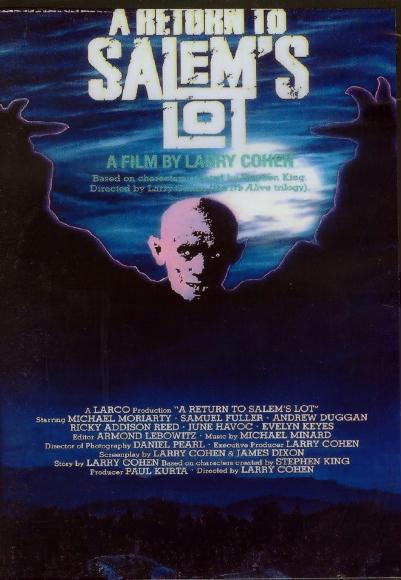
A Return to Salem’s Lot (1987)

return to salems lot

By Richard Winters

My Rating: 3 out of 10

4-Word Review: Town full of vampires

Joe Webber (Michael Moriarty) is a documentary filmmaker who is always looking to tackle the next shocking topic if it will help advance him and his film career. While vacationing in a small New England town of Jerusalem’s Lot with his teenage son Jeremy (Ricky Addison Reed) he becomes aware that the entire town is made up of a population of vampires led by elderly Judge Axel (Andrew Duggan). They are aware of Joe’s film career and give him an offer to film a documentary on them so as to give future generations a better understanding of the vampire lifestyle. Initially Joe is intrigued with the idea, but when he finds out that they want to turn his son into one of them he refuses and spends the rest of the time trying to escape and with the help of elderly but tenacious vampire hunter Van Meer (Samuel Fuller) save his son.

This flick is complete disaster from the beginning. It opens with Joe filming a documentary on a jungle cannibal tribe that looks like a real tacky rip-off of Cannibal Holocaust. The gore and special effects are abysmal and the story and characters have nothing to do with the Stephan King novel to which it is based nor the 1979 TV-Movie. Had the plot gone more with Joe filming a documentary on the populace it might have been interesting in an offbeat way, but the script brings up the idea and then never follows through with it.  There are shades of dry humor here and there and had it been more consistent with it the film could have been viewed and possibly enjoyed as a parody, but as it is it is nothing more than cheap straight-to-video fare.

The characters are poorly defined and at times even contradictory. Joe starts out as this callus man who puts his directing career first and has no concern for his son and hasn’t seen him for years, or even mentioned him to his friends. Then suddenly they get to this town and he will stop at nothing to save him. The son also does not like the father when he first sees him and yet magically and quickly bonds with him the minute they get to town. He is also described to be deeply troubled psychologically, but shows no sign of it during the course of the movie.

There is also the issue of Van Meer shooting Judge Axel in the head twice with a gun, but even as bullet holes spew out blood from his forehead he still goes on walking and talking like nothing happened. Supposedly this is to signify that the only way to kill a vampire is to stick a wooden stake through their heart and if you try to kill them any other way it won’t work, but this still doesn’t make sense. For instance if you break a vampires kneecap wouldn’t that effect the way they walk? If so then the same logic should hold true if you put two bullet holes into their brain. It would more than likely turn them into a complete vegetable a vegetable that may go on living forever until you drive a wooden stake through its heart, but a vegetable nonetheless.

Moriarty gives another great performance that completely exceeds the quality of the material. This one is even more impressive because he actually plays a normal person here and does so effectively, which is interesting given the nature of his sometimes offbeat behavior off-camera. The person though that really steals it is famed film director Fuller as the elderly vampire hunter. The guy shows an amazing amount of charisma and energy and plays up the character to an amazingly amusing degree and helps save what is otherwise a disaster.

Veteran actresses June Havoc and Evelyn Keyes appear as two of the elderly women vampires. Keyes really plays-it-up and the way she sucks the blood from one of the victims off her fingers looks down right erotic. The scene where Havoc, Keyes and writer/director Larry Cohen’s then real-life wife Janelle Webb chew on the dead body of Cohen’s real-life daughter Jill Gatsby gets a few points for audaciousness. This is also a great chance to see Tara Reid in her film debut as one of the vampire children.

The final thirty minutes is an improvement namely because of Fuller’s presence, but it does nothing to hide the film’s many other flaws, which is a perfect example of bad 80’s horror.

My Rating: 3 out of 10

Released: May 18, 1987

Runtime: 1Hour 41Minutes

Rated R

Director: Larry Cohen

Studio: Warner Brothers

Available: VHS, DVD (Warner Archive), Amazon Instant Video

The Fool Killer (1965)

fool killer

By Richard Winters

My Rating: 6 out of 10

4-Word Review: Kid roams the countryside.

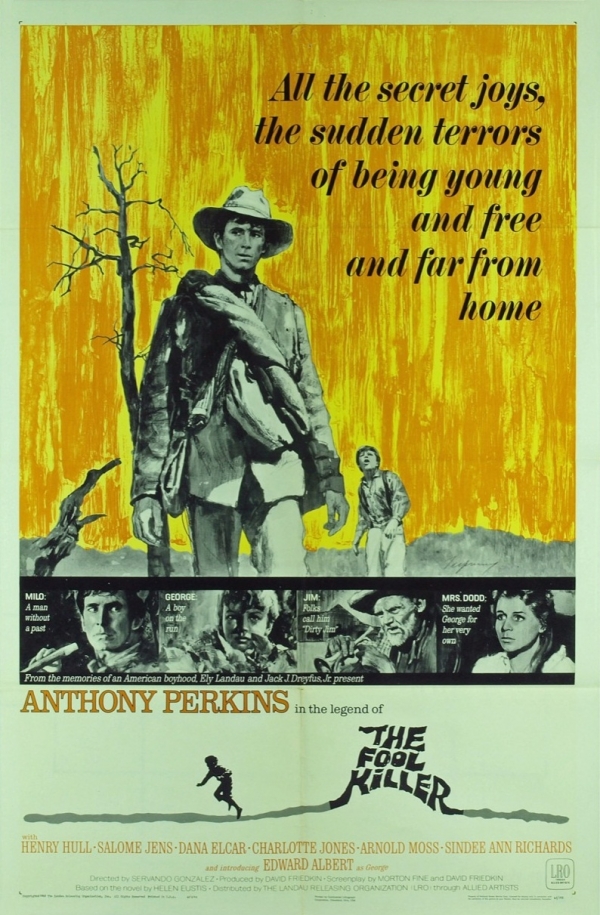
George Mellish (Edward Albert) is a 12-year-old boy who runs away from home after a particularly harsh beating at the hands of his foster parents. As he roams the Tennessee countryside he meets Dirty Jim (Henry Hull) an old man who takes him into his rundown home and fills his head with all sorts of stories about an eight foot ax-wielding man who kills people he deems to be foolish. After a bout of illness George runs away from Jim and late one night meets Milo (Anthony Perkins) a loner who carries an ax and acts strangely. Initially George thinks that he is ‘the fool killer’ Jim described, but the two soon become friends even though strange ax murders begin to occur everywhere they go.

Servando Gonzalez’s direction is excellent and the one thing that keeps this otherwise thin story intriguing. This was his only English language film and he uses a variety of different camera angles and editing styles to create a sort of hypnotic effect. The on-location shooting is vivid and their ability to recreate the look and feel of the late 1800’s is solid including having the characters occasionally speak with poor grammar, which helps with the authenticity.

The only thing about Gonzalez’s direction that I did not like is where they have a nighttime scene that was clearly filmed in the daytime, but done with a darkened lens to ‘fool’ the viewer into thinking it is night. This process has been done many times in the past, but it never works. Even with the dark lens the sky is too bright and you are unable to see any stars. I remember this done a few times on the old ‘Brady Bunch’ TV-show and I always found it disconcerting. The reason is usually because by law child performers are not allowed to work past a certain late hour, so if the script calls for a nighttime scene they try to compensate using this trick, but it always looks tacky. My solution would be to get the parent’s permission to allow the young performer to work late for one night or alter the script to have the scene done in the daytime.

Despite some good production values and an interesting narrative the story itself, based on a novel by Helen Eustis, is limp and doesn’t have enough action. The middle section, which features a lot of conversations between Milo and George, gets boring and the pace comes to a screeching halt. The George character also gets a bit annoying. I realize he is a young and the story takes place in a more innocent era, but the kid falls too easily for anything and everything he is told and seems to have no center, which eventually becomes off-putting.

For what it is worth Albert is good in the lead in what was his film debut and so is Perkins although with this he was risking getting typecast. I thought Henry Hull in one of his last roles was highly engaging and I also really liked Arnold Moss as a bombastic preacher giving a fiery sermon under a tent during a religious revival. Since the movie otherwise does not have much happening this scene tends to be pretty electrifying and vivid particularly the looks on the people’s faces as he preaches to them.

There is a sort-of surprise ending, but it is not that big of a deal and most viewers will probably see it coming long before it happens and they might also say to themselves ‘I sat through two hours of this just for that!’ as well. If the story had been a little richer with more twists or a subplot this might have been memorable, but as it is the final result is empty.

My Rating: 6 out of 10

Released: April 28, 1965

Runtime: 1Hour 39Minutes

Not Rated

Director: Servando Gonzalez

Studio: Allied Artists Pictures

Available: VHS

Going Places (1974)

going places

By Richard Winters

My Rating: 9 out of 10

4-Word Review: Guys with no morals.

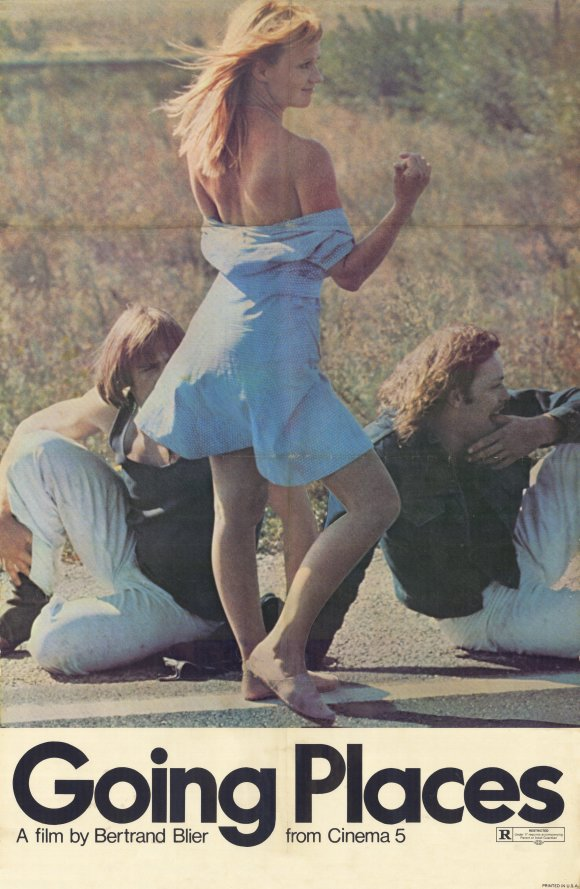
Two small time hoods (Gerard Depardieu, Patrick Dewaere) spend their days roaming the streets, robbing stores, and molesting women. In some ways this is truly an amazing film in what it is able to get away with. The two main characters are immoral, ignorant, insensitive, and brutal and the women are demeaned and degraded. The overall content is vulgar and perverse and yet somehow this thing comes off as a lyrical, offbeat delight that is pure entertainment.

It’s a definite original with every scene being an ingenious comic set-up. The scenario structure and use of locations is perfect. The pacing is fluid and director Bertrand Blier’s eye for detail near brilliant. The two hours move along like a breeze. It never gets boring and I actually almost wished it could have been longer.

The comic threads are hilarious and they get funnier and funnier as they go along. The guys’ constant, futile and very explicit attempts at getting a frigid woman (Miou-Miou) excited are a particular standout.

This is the type of black comedy that should be used as an example for all others. It’s consistently unique and manages to balance the ugly elements with the lighthearted without going overboard on either. It even throws in a surreal angle without a hitch.

Veteran French actress Jeanne Moreau has one of her finest latter career roles playing a lonely lady in desperate need of male attention. Her scene is well played out and even has a shocking conclusion. Depardieus ‘friendly’ conversation with a shopping mall security guard is another standout. The ultimate joke though may be in the film’s title as these guys are truly going nowhere.

My Rating: 9 out of 10

Released: March 20, 1974

Runtime: 1Hour 57Minutes

Rated R

Director: Bertrand Blier

Studio: Universal Pictures France

Available: VHS, DVD (Region 1 & 2), Amazon Instant Video

Perfect Strangers (1984)

perfect strangers

By Richard Winters

My Rating: 6 out of 10

4-Word Review: Kid witnesses a murder.

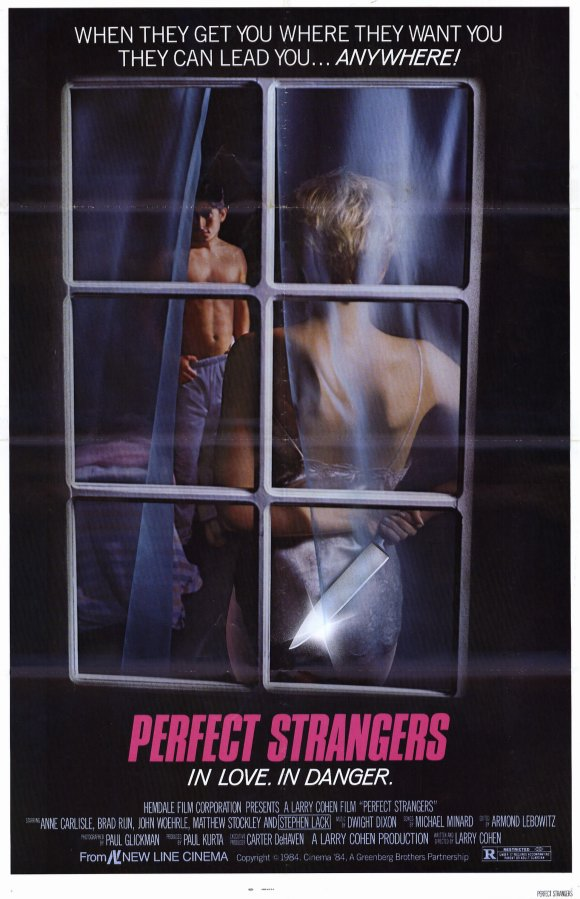
Johnny (Brad Rijn) is a local hit-man who knifes someone to death in a back alley. Little does he know that behind a nearby fence is a 2-year-old toddler peeking out through a small opening and witnessing the whole thing.  As Johnny is about to leave he suddenly becomes aware of the child, but as the police are coming he runs. He is connected to the mob and when he tells them of the incident they advise him that he must kill the child simply to be extra cautious. Johnny then decides to get in a relationship with the boy’s attractive single mother Sally (Anne Carlisle) with the idea that he will get close enough to her that she will trust him to be alone with the kid where he will then off him and make it look like an accident.

The child who is played by a very young actor named Matthew Stockley is extremely cute to the point of being adorable. The idea of any harm coming to him is almost unthinkable, which helps create some tension and the climatic sequence where he is chased by Johnny though an abandoned, shadowy warehouse is well done.

However, the film’s biggest weakness is the Johnny character who is too damn nice to the point that I even started to like him as the film progressed. The guy is great with the kid and shows a definite sensitive side and is reluctant to harm the child and only considers it because the rest of the mob pushes him to. This then pretty much mutes the tension and the film would have been more exciting had the character been portrayed as a cold-hearted psycho. I also found it a bit contradicting that this otherwise nice guy could so easily kill other people. The extremes in the personality didn’t connect although at one point he does at least say ‘sorry’ to one of his victims as he drags the dead body away after viciously killing him.

Carlisle is excellent. She is probably best known for starring in as well as writing the screenplay for the cult hit Liquid Sky. There she played a teenage punk, but here filmed only 2 years later she comes off as a mature full-grown woman and her effective performance helps carry the film. Otto von Wernherr who was also in that movie appears as a private eye hired to follow Johnny around.

Stephan Lack who was in Scanners and just about ruined the film with his terrible performance is surprisingly good here as an aggressive police detective who hounds Sally for answers and won’t leave her alone. Ann Magnuson is somewhat amusing as a man-hating feminist Nazi.

If writer/director Larry Cohen scores anywhere it is in his ability to vividly show the street culture and eclectic, busy atmosphere of New York City life. One bit has hundreds of woman marching down the street in an anti-rape parade and when Johnny tries to get involved in it the woman aggressively pushes him back out. Things flow enough to make it mildly entertaining, but the film lacks distinction and is ultimately forgettable.

My Rating: 6 out of 10

Released: November 24, 1984

Runtime: 1Hour 31Minutes

Rated R

Director: Larry Cohen

Studio: Larco Productions

Available: DVD

Where’s Poppa? (1970)

wheres poppa 2

By Richard Winters

My Rating: 9 out of 10

4-Word Review: Mother has to go.

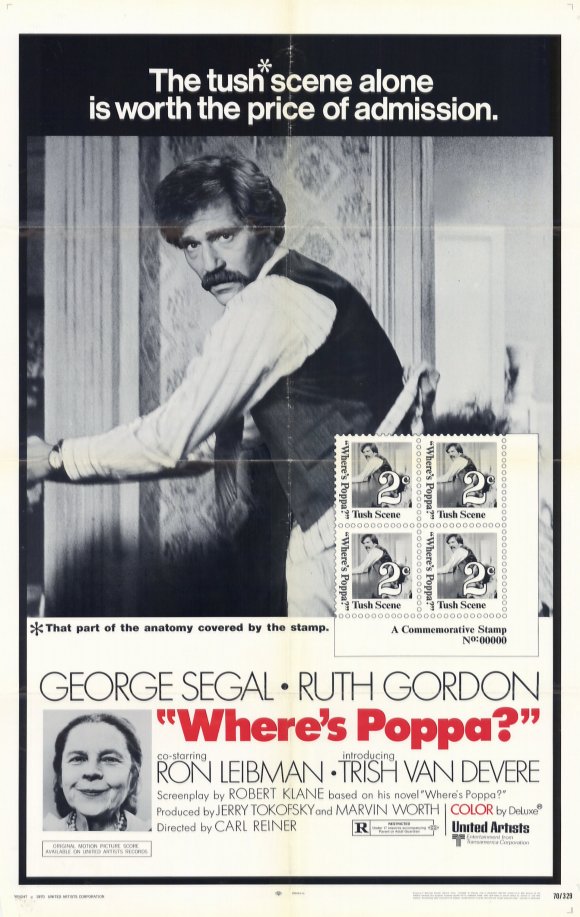
A beleaguered Gordon (George Segal) is a man who must take care of his invalid mother (Ruth Gordon). Despite being a handsome young lawyer he has literally become trapped by this very difficult woman. The majority of the film takes place in a 1940’s styled apartment. It’s gray, dusty bleakness permeates every shot and shows just how lodged Gordon is in his mother’s world. He is a normal man that is slowly being sucked into madness. He is becoming mad because the world he lives in and life in general is driving him to it. The wall between what he really wants to do in life and his obligations have become so thick that going crazy may be the only real answer.

In fact madness maybe pretty much is what this film is really about. It seems to be saying that there is a certain functioning normality to it and at times even a necessity for it. Everyone in this film conveys their own unique form of madness. There’s the overzealous war general (hilariously played by Barnard Hughes) There’s also the henpecked brother/husband Sidney (Ron Leibman) who goes to almost absurd lengths to make sure everyone is happy. Even innocent, conservative Louise (Trish Van Devere) opens into the crazy world when explaining her rather unique honeymoon experience. The film delves so deeply and consistently into the world of the absurd that at times the senile Mother really doesn’t seem so nutty.

This is the film’s genius. It takes everything we have always accepted and turns it inside out. It takes some of life’s most depressing things and then makes it into an inspired and creative masterpiece. A trip to the old folk’s home has never been considered by many to be funny or memorable, yet a trip to Paul Sorvino’s old folk’s home is. In fact it maybe one of the funniest scenes you’ll ever see.

Writer Robert Klane and director Carl Reiner show an amazing grasp of their material, which is crucial for its success. Everything is fluid and consistent in tone. It shows how you can indeed have an offbeat idea, do it in an offbeat way, and still succeed without compromising.

My Rating: 9 out of 10

Released: July 9, 1970

Runtime: 1Hour 22minutes

Rated R

Director: Carl Reiner

Studio: United Artists

Available: VHS, DVD

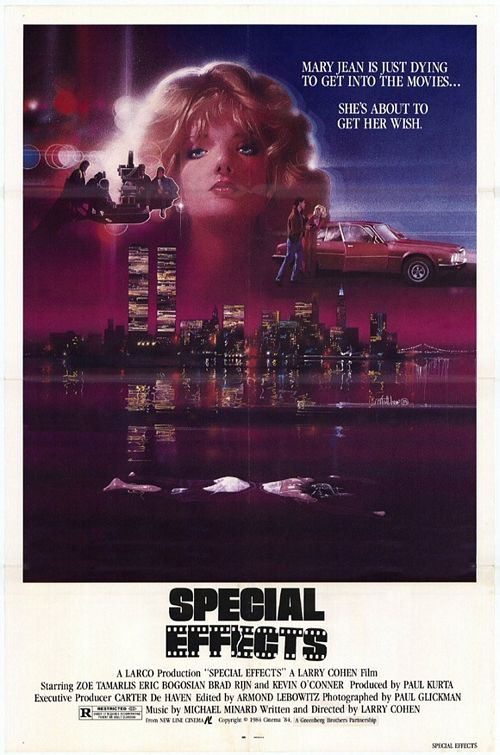
Special Effects (1984)

special effects

By Richard Winters

My Rating: 5 out of 10

4-Word Review: Murder her on film.

Snuff movies have become the thing of urban legends and apparently tapped into society’s morbid curiosity. It is really surprising how many movies and TV-shows have dealt with the topic especially recently. It all started in 1971 with the film Snuff that purportedly dealt with an actual murder of an actress done in front of the camera even though it was faked and not very good, but the film’s tagline ‘Filmed in South America where life is CHEAP’ is at least amusing. There have been films that have tried to make it look very convincing particularly the disturbing ‘Guinea Pig’ series from Japan as well as Cannibal Holocaust that got director Rogero Deodato taken to court to prove that he didn’t actually kill his cast. Although there have been executions, assassinations and suicides that have been recorded and sometimes put into documentaries there has yet to be a performer murdered in front of the camera for commercial purposes.

In today’s movie writer/director Larry Cohen takes this concept and gives it an intriguing spin. Neville (Eric Bogosian) is a down-and-out filmmaker. His last picture bombed at the box office and he is looking to make a buzz with his next project. He is fascinated with the capturing of the killing of Lee Harvey Oswald and how movies can never quite recreate death in the same way. Struggling actress Andrea (Zoe Tamerlis) answers an ad and shows up in his apartment/studio for an audition. Neville uses the allure of potential fame to get the women into bed with him, which he usually films with a camera hidden behind a two-way mirror. During the sex Andrea begins to belittle him, which angers him enough that he strangles her. Realizing that he has the murder captured on film he decides to use it to his advantage. He disposes of the dead body and then hires another woman named Elaine (also played by Tamerlis) who looks just like Andrea to star in his next film. He will then incorporate the scene of the murder into the movie. Audiences will think it was done with special effects and be so impressed with how realistic it looks that it will give Neville numerous accolades for his film making skill and bring him back to the top of the directing world.

Cohen uses the story as an excuse to expose the seedy, unglamorous side of low budget filmmaking many of which based on his own observations from working in the business. One of the more startling revelations that he shows is how the movie world is such an allure to some people that they will completely sell-out to get into it even if it means losing their dignity. This comes to a head in what is probably the film’s strongest scene when Neville is very rude and brash with Elaine when he first meets her. He shouts at her like she is sub-human and simply a piece of property, but the prospect of starring in a movie is so strong that she doesn’t walk out of there like most people would probably want to do. What is worse is the fact that Neville is aware of this and realizes he can get away with it.

The movie also looks how demeaning it can sometimes be being a filmmaker as well. Having to work and deal with various personalities and egos as well as fighting to remain in control of the project and vision. He also shows how exhausting the research phase of a production can be and how breakthroughs and inspirations usually come about by complete accident. The extended scene dealing with them trying to find an actress who resembles Andrea and auditioning hundreds of different women without any luck only to come upon Elaine by complete accident when they go to a Salvation Army store is a good example of this.

Cohen also infuses some creative camera work and directorial flair. The opening sequence showing Andrea prancing around topless in what looks to be the Oval Office of The White House has panache. The shot showing rows upon rows of hundreds of headshots of young and aspiring actresses, which includes an amusing one of Dustin Hoffman in his Tootsie character, lining the floor is impressive. I also liked the way Neville’s apartment is captured when Andrea first walks into it as well as extreme close-ups of circuit breakers being put back into a circuit box, which is really cool.

Tamerlis is fantastic in the lead. She shows a great awareness and natural acting ability in front of the camera. She plays the dual roles with two very distinct personalities and accents both of which are good. Her presence makes the film more interesting and the scenes that she is not in lack the same energy.

Bogosian easily conveys the obnoxious sarcastic personality of his character, but at times his facial expressions seem to be either lacking or over-exaggerated. Brad Rijn who plays Andrea’s husband who later gets involved in Neville’s project is weak and annoying. In some ways he seems to be the right pick for someone playing a country hick, but he has no charisma and looks too scrawny especially with his clothes off.

For a low budget 80’s flick the film has enough twists and a good enough pace to be marginally entertaining. The only thing that I really didn’t like was the synthesized electronic music score that drones on endlessly like in one of those 80’s porn flicks. I think the reason I liked the scene where Andrea’s dead body is shown inside a parked car in a lonely area of Coney Island is because it didn’t have any music and instead used the natural ambience of the location, which helped make it distinct and should’ve been done with the rest of the movie.

My Rating: 5 out of 10

Released: November 16, 1984

Runtime: 1Hour 33Minutes

Rated R

Director: Larry Cohen

Studio: New Line Cinema

Available: VHS, DVD

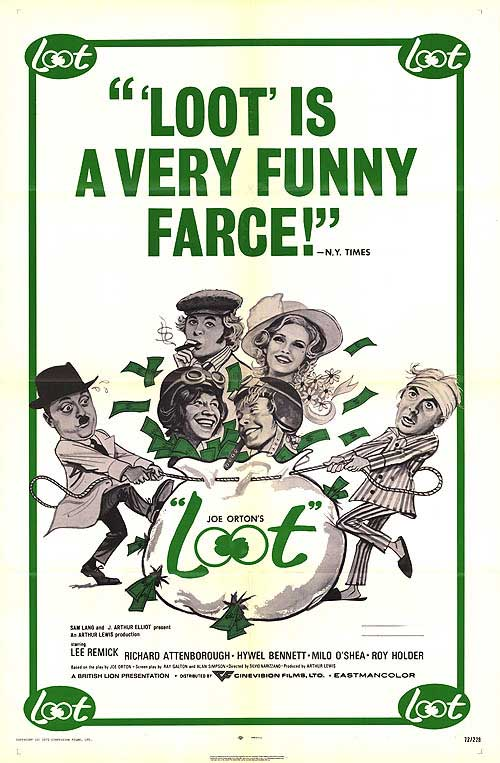
Loot (1970)

loot 3

By Richard Winters

My Rating: 8 out of 10

4-Word Review: They are all greedy.

Every Friday this month I will review the Top 5 best and most outrageous black/dark comedies from the 70’s. There were many to choose from, but these five have stood the test of time and remain as potent and hilarious as they were when first released. Today’s film was written by Joe Orton who died before ever seeing his play made into a movie and despite being top-notch in every aspect remains unjustly overlooked and hard-to-find.

The story deals with Dennis and Hal (Hywell Bennett, Ray Holder) two friends who decide to rob a bank next to a funeral home and hide the stolen money inside the coffin of Hal’s late mother. Problems ensue when Inspector Truscott (Richard Attenborough) starts to suspect the boys have something to do with it and incorporates brutal interrogation tactics to get the truth out of them. Then there is Nurse Fay (Lee Remick) who may have had something to do with Hal’s mother’s death and is inclined to want a piece of the action. All of this occurs inside Hal’s house, which is also a bed and breakfast run by Hal’s Father McLeavy (Milo O’Shea) who remains oblivious to all of the shenanigans and only worried about getting a decent burial for his departed wife.

The film is fast and funny and retains all of Orton’s dark and acidic wit. It is full of one-liners, sight gags, odd characters, and bizarre, unexpected comical twists, with ninety-eight percent of it being clever and funny. The best is the funeral procession when Dennis, who is driving a hearse that is carrying the deceased, finds out that the vehicle has lost its brakes and careens down the streets at high speeds with all the other cars in the procession try to keep up with it while driving equally fast.

Director Silvio Narizzano shows a terrific grasp on the material. Unlike Entertaining Mr. Sloane the only other film adaption of Orton’s work this film has a terrific pace that starts with a bang and never lets up. Narizzano also infuses a lot of imaginative camera angles, edits, and set design to give the thing a nice edgy, off-color feel. Outdoor action is nicely balanced with the indoor scenes to create a good cinematic feel and it never seems like a filmed stage play. There are some interesting homoerotic overtones as well including having Dennis and Hal blow a hole in the bank wall, crawl through it and take the money, then crawl back out and stuff it into the coffin while being completely naked.

Remick has one of her most interesting and unique performances in her already illustrious career as she is quite amusing looking almost like Marilyn Monroe with her dyed platinum blonde hair and authentic sounding British accent. Attenborough is memorable playing against type. Usually he is best at meek and passive types, but here he almost steals the film as the aggressive Inspector with a Hitler mustache. His best moment comes when he picks up a glass eye from the floor and in one brief second sticks out his tongue and licks it, which is done in vivid close-up.

The bouncy, psychedelic score by Steve Ellis helps give the proceedings attitude and personality. Why this film has never been released on DVD or Blu-ray is a mystery. The humor remains sharp and a whole new throng of fans could be acquired if they were just able to see it.

My Rating: 8 out of 10

Released: May 1, 1970

Runtime: 1Hour 41Minutes

Rated R

Director: Silvio Narizzano

Studio: British Lion Film Corporation

Available: VHS

Q (1982)

Q

By Richard Winters

My Rating: 5 out of 10

4-Word Review: Giant bird eats humans

In celebration of cult writer/director Larry Cohen turning 72 on July 15th all this month on Mondays I will review five of his films that he did during the 80’s. Now Cohen will probably never win an Academy Award and may never be mentioned in the same context as Spielberg, Kubrik, or Hitchcock, but the man has had one hell of a career nonetheless. He has been writing for either television or movies since the late 50’s and continues to churn out creative, innovative stories and scripts. Not all of them are completely successful and some of them do misfire, but his ability to survive in the difficult, competitive Hollywood landscape and make his movies on his terms with virtually no studio interference is an amazing achievement in itself and therefore deserves recognition.

larry cohen 3

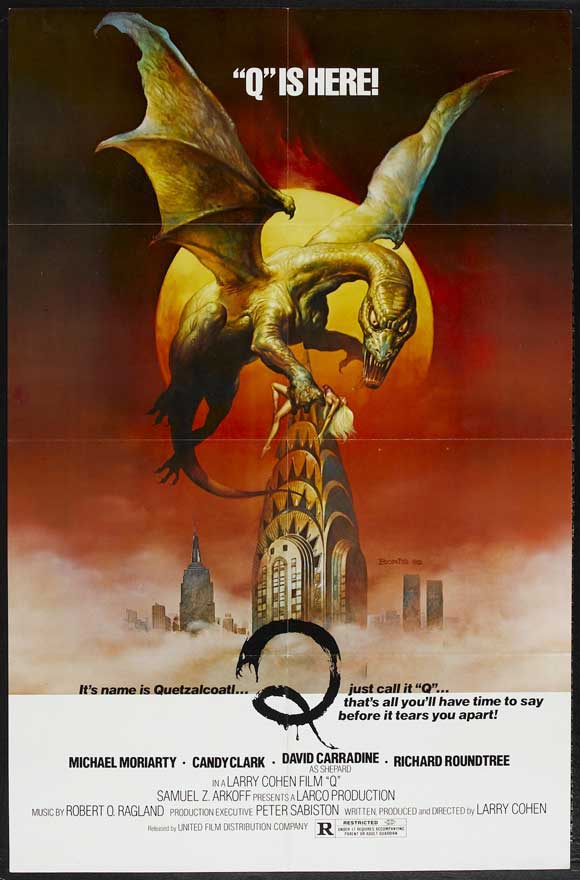
This film like most of his others has a completely outlandish plot this time involving a giant lizard-like bird that is actually the Aztec god Quetzalcoatl brought back to life and nesting inside the top crown of the Crysler Building in downtown Manhattan. The bird lays a giant egg and feeds itself on unsuspecting people.  Jimmy Quinn (Michael Moriarty) is an out-of-work lounge singer who comes upon the bird’s nest accidently while running from the cops after a botched jewelry store robbery. He decides to use his knowledge of the whereabouts of the bird to his advantage and demands that the city pay him a million dollars before he leads them to it.

Despite the crazy plot the execution is rather conventional. There are long periods of seemingly unending dialogue that is not interesting and does not propel the movie along. The bird attacks are too brief and needed to be strung out more. The movie would have worked much better and had it had a consistent tongue-in-cheek approach and editing that was more kinetic and lucid-like.

Moriarty saves the film with entertaining, edgy performance. This is a man who is known for his erratic behavior off-screen, which pretty much killed his career. In 1971 while performing on stage in a play in Houston he suddenly broke from character and told the audience as well as his fellow cast members that he felt tired and didn’t want to continue and then promptly walked off stage and went home. He was also fired from his most famous role as Ben Stone in the hit series ‘Law and Order’ for similar types of odd incidents and yet that is exactly why he is so perfect here. He gives the thing a much needed boost of weird energy and I especially liked the part when he leads two of his partners in crime up to the bird’s nest and when the bird starts feeding on them he climbs down the ladder shouting:

“Eat them! Eat them! Crunch! Crunch! Eat them! Eat Them!”

I also enjoyed when he is sitting at the bargaining table with the city and police officials demanding a million dollars before he tells them the whereabouts of the bird and insisting that it all must be tax free because:

“I’ve never paid taxes before in my life and I don’t intend to start now.”

His character is lazy, conniving, cowardly, bombastic, self-centered, egotistical, talentless, and deluded and yet strangely endearing and I even felt a bit sorry for him at the end. Candy Clark as Joan his more grounded and conscientious girlfriend makes for a good contrast.

I wasn’t as crazy about David Carradine as the tough New York cop who deals with Jimmy during his investigation. Carradine seems too aloof and detached and this doesn’t help to create any tension. Richard Roundtree as his partner is much better and I would have had him the sole investigator and cut Carradine out completely.

The special effects are a little bit better than what I had initially feared for a low budget 80’s flick, but they are not real great either. The bird when shown flying through the air just doesn’t seem gigantic or frightening enough and ends up looking like a poor man’s Ray Harryhausen creation. The final shootout with the bird was clearly done on a matted screen and looks very tacky. I actually thought the baby bird that comes out of the egg was the only halfway scary and effective moment in the whole film.

What Cohen does get right is reflecting the ambience and culture of the New York neighborhoods and crowded street culture. The aerial footage of New York’s skyline is also spectacular.

My Rating: 5 out of 10

Released: October 29, 1982

Runtime: 1Hour 33Minutes

Rated R

Director: Larry Cohen

Studio: Larco Productions

Available: VHS, DVD, Blu-ray

The Sidehackers (1969)

sidehackers

By Richard Winters

My Rating: 2 out of 10

4-Word Review: Rape, murder and mayhem

This low budget flick is probably best known as having aired on an episode of the old ‘Mystery Science Theater 3000’ TV-show. At the time the writers had not watched the movie all the way through before deciding to use it for the show and when they came upon a rape sequence half-way through it they had to edit it out and have Crow  simply explain that the character was now dead. It is also famous for being directed by Goldie Hawn’s then husband Gus Trikonis. In fact Goldie auditioned for one of the parts in the film, but since she wasn’t well known at the time she got turned down.

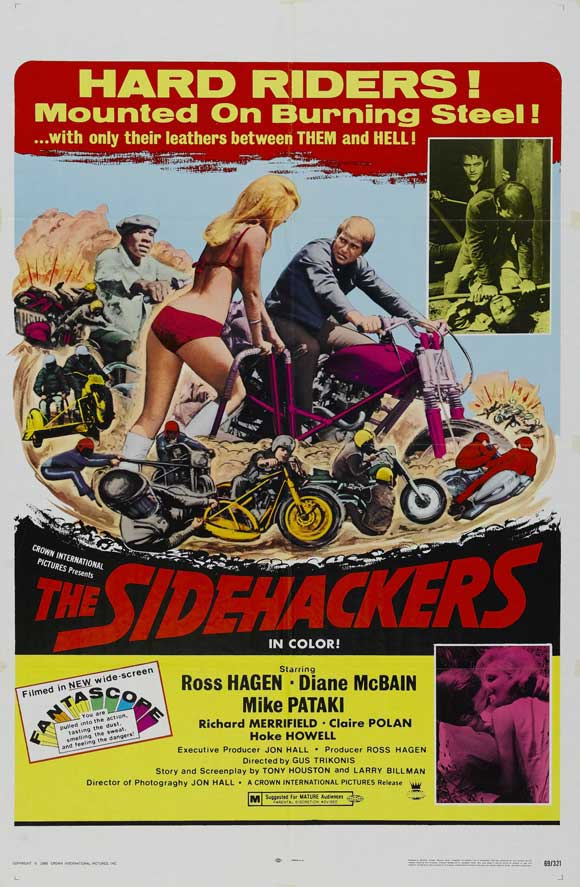
The story centers around Vince (Ross Hagen) a motorcycle racer involved in the sport of sidehacking where a passenger rides along in a sidecar connected to the motorcycle and uses his body weight to help steer the bike around curves and turns.  The psychotic J.C. (Michael Pataki) watches the sport and wants to work with Vince, but Vince becomes aware of J.C.’s volatile personality and turns him down. This angers J.C. and later when his girlfriend Paisley (Claire Polan) falsely accuses Vince of having tried to rape her J.C. flies into a rage. He and his men attack and beat up Vince and then rape and murder Vince’s girlfriend Rita (Diane McBain). Vince then spends the rest of the film trying to track down J.C. and getting his revenge.

The only diversion of this otherwise run-of-the-mill drive-in drama is the scenes involving the racing, which is better known as sidecarcross. Trikonis captures the racing in vivid style giving the viewer a good feel of the sport. Personally I thought it would be excessively dangerous for the passenger who puts himself into a very vulnerable position as he tries to steer the bike from the side and could easily fall off, or be hit by the other bikes that zoom around him. The shots of the crowd seem to show them as really being into it, but I felt that after watching it for a few minutes it would get monotonous.

With that said it is still the most interesting aspect of the film and I felt the story should have revolved around it. For instance having J.C. try and sabotage one of Vince’s races, but instead the racing scenes are shown only at the beginning before devolving into just another stale and redundant revenge drama. The dialogue is stilted, the characters bland, and the direction lifeless. Boredom quickly sets in and never goes away.

The music score is particularly horrendous. With the exception of the final fight scene when it does have a nifty psychedelic quality it is very sappy and terribly harmonized. Hearing it played over shots of Vince and Rita frolicking merrily through some open fields may be enough to make some viewers gag.

Pataki gives a good intense performance as the psycho and at times goes a bit over-the-top, but with this type of production that can only help it. The rest of the acting like everything else seems amateurish. If you want to seek this film out simply to catch the scene that was cut from the TV broadcast I would say it isn’t worth it. The sequence is not all that graphic and it is shown only as a flashback, which takes less than a minute.

My Rating: 2 out of 10

Released: May 12, 1969

Runtime: 1Hour 22Minutes

Alternate Title: Five the Hard Way

Rated M

Director: Gus Trikonis

Studio: Crown International Pictures

Available: DVD (The Savage Cinema Collection)