Category Archives: Movies with Nudity

My Beautiful Laundrette (1985)

my-beautiful-laundrette-1

By Richard Winters

My Rating: 6 out of 10

4-Word Review: Gay couple manage laundromat.

Genghis (Richard Graham) is a young Pakistani immigrant living in London and feeling frustrated by being trapped in his humble surroundings while living with his father (Roshan Seth) who due to his left leaning politics and alcoholism is unable to bring in any meaningful income. His Uncle Nasser (Saeed Jaffrey) is doing quite well even though some of his methods are unscrupulous. Nasser gets Genghis a job at his car washing facility, but Genghis has loftier goals. He wants to take over the rundown laundromat that Nasser owns and turn it into a thriving business with the help of his gay lover Johnny (Daniel Day-Lewis). Nasser agrees and is surprised to see what a success it becomes, but is unaware that Genghis and Johnny are funding it with the help of illegal drug money and Salim (Derrick Blanche) is onto their scheme and wants a part of the take.

The film’s screenplay was written by Hanif Kureishi who liked the title character came to Britain from Pakistan and has become a much celebrated playwright despite starting his career writing pornographic novels. The story brings out many complex issues that could prove fascinating to those unfamiliar with the political landscape of Great Britain during the Margaret Thatcher era. The problems and racism that those from Pakistan had to face in the U.K. are vividly brought to the forefront, but what is even more interesting is the pressures and loyalties that they were expected to follow amongst their own culture and families and how these could end up being just as conflicting and confining as those placed on them by the outside world.

I enjoyed many of the scenarios that the film brings out, but was frustrated that the story offers no conclusion to any of them. I was interested in seeing how Nasser would react to Genghis and Johnny’s relationship, but we never get to find out even though the film teases us with a scene where he begins to suspect it. There is also no conclusion as to what ultimately happens to their laundromat business, or whether they were successfully able to expand it, which again gets touched upon. We aren’t even able to find out if Salim was able to survive a vicious beating by some street punks or whether these same punks were ever brought to justice. Why bother bringing up all these story threads if they are just going to be left open and why should the viewer be sucked into the quandaries of these characters if it is all just leads to one big ambiguous ending?

Daniel Day-Lewis shot to stardom with his role here, but I didn’t really feel he had the body type to be considered a ‘tough guy’ or even a bouncer type. Sure he’s tall, but still pretty skinny and not exactly muscular. I also thought the trendy pseudo-hip getups and hairstyles that he and his gang have look tacky and I first saw this film back when it was released and I felt the same way about the outfits then that I do now.

The direction by an up-and-coming Stephen Frears is okay, but his use of a soundtrack that resembles the noise of a washing machine takes away from the gritty drama element that this story supposedly wants to be as does the onscreen opening and closing titles that spin around like clothes in a dryer.

my-beautiful-laundrette-2

My Rating: 6 out of 10

Released: August 18, 1985

Runtime: 1Hour 37Minutes

Rated R

Director: Stephen Frears

Studio: Working Title Films

Available: DVD, Blu-ray (Criterion Collection), Amazon Video

The Man with One Red Shoe (1985)

man-red-1

By Richard Winters

My Rating: 6 out of 10

4-Word Review: He’s not a spy.

Cooper (Dabney Coleman) wants to remove Ross (Charles Durning) from his position as director of the CIA so he can occupy it himself. To do this he tries to make it appear that Ross is corrupt and so as a defensive strategy Ross comes up with a scheme of his own. Since he knows that Cooper has his place bugged he has a mock conversation with Brown (Edward Herrmann) telling him that there’s a spy with important information and which he should meet at the airport in order to retrieve. However, there really is no spy it’s all just made up, so that Cooper and his entourage will waste time following around the wrong person, which they do in the case of Richard (Tom Hanks) a man spotted wearing only one red shoe and who now finds his life turned upside down for no apparent reason.

This is a remake of the French classic The Tall Blonde Man with One Black Shoe and surprisingly it manages to stay very close to the original. To some extent it becomes almost a shot-for-shot retelling with very little that gets changed. Most American films have a much broader sense of humor than European ones and so I was a bit amazed how subtle the comedy stays, but this could also explain why this did so poorly at the box office.

For me this biggest transgression is that this version loses the satirical edge that was so apparent and funny in the first one. The CIA agents aren’t funny at all and don’t come off like real spies just a bunch of incompetent buffoons. None of them have any discernable personalities and it somehow manages to make even Dabney Coleman seem boring and I was really surprised that he even took the part.

Hanks is equally dull and not half as funny as Pierre Richard who played the same part in the original. Richard was of a goofy eccentric while Hanks’ character is a blah ordinary guy who plays off the comedy instead of being a part of it. I also didn’t like that he eventually becomes aware of what is going as I thought it was more amusing that the character remains permanently oblivious to it all like in the French film.

The one improvement that I did like was the presence of Lori Singer as the female agent who is very attractive and has a low, low cut dress that I really digged. However, in the original the female spy, which was played by Mireille Darc, didn’t fall-in-love with the main character until after she got to know him while here Singer appears to be attracted to Hanks right from the beginning for no reason.

There are indeed a few funny moments particularly Hanks visit to his dentist and the scene where he must flush his toilet several times in order to get the water to come out of his sink faucet. Jim Belushi gets a few laughs as his friend who thinks he’s seeing things that really aren’t there, but overall the original is still superior although by not as wide of a margin as with most other American remakes. I was also frustrated that there is never any explanation for why the Hanks character is wearing only one red shoe. In the French film it at least gets explained, but here they don’t even do that.

My Rating: 6 out of 10

Released: July 19, 1985

Runtime: 1Hour 32Minutes

Rated PG

Director: Stan Dragoti

Studio: 20th Century Fox

Available: DVD, Amazon Video, YouTube

Looker (1981)

looker-2

By Richard Winters

My Rating: 3 out of 10

4-Word Review: Models can be replaced.

Dr. Larry Roberts (Albert Finney) who is a plastic surgeon finds himself embroiled in a mystery when three of his past patients turn up dead. He soon becomes a prime suspect when he is caught inside the apartment of one of them just after they were killed, which forces him to become his own detective in order to clear his name. He learns that all three of them were linked to an advertising agency run by John Reston (James Coburn) and Jennifer Long (Leigh Taylor-Young) who scan the model’s body in order to use a 3D generated computer image of them in their commercials.

The concept is intriguing, but the execution gets horribly botched. It’s like a screenplay that’s still in the early draft stage with a plethora of poorly thought out story lines that leave open a wide range of loopholes, unanswered questions and inconsistencies.

For one there is the fact that Dr. Roberts gets caught in the apartment of the latest victim just after she was pushed over her balcony and yet the police only question him for a couple of minutes and then let him go. In reality he would be brought into the station for hours of interrogation especially since there were already clues implicating him at the death scene of the victim before this one and if they did possibly let him go after all that they would most likely be tailing him quite closely, which they don’t do here.

When he enters the ad agency he secretly steals one of their access cards, which they become aware of and should be no big deal because they could simply disable it electronically and yet they don’t and he is able to use it later on to get inside. There is also no explanation for what happens to his many patients while he goes wildly cavorting around chasing after nebulous clues that should really be done by the police. Also, the scene where Roberts gets beaten up in the lab by a guard, which sends him crashing against a hard wall several times and even going through a glass window would be enough to break several bones with any other person and not something that could simply be shaken off like here.

Why such a highly regarded actor such as Finney would feel the need to accept something this pedestrian is a mystery. Her services at the time were in high demand so why not pick a project that offered a wide acting range or interesting character instead? Coburn as the villain is equally wasted and barely has any screen time at all.  Susan Dey comes off best and should’ve been given the lead as she is not only beautiful, both with and without her clothes, but quite likable and the only character in the film that seems discernably human.

There is one cool scene involving a victim falling onto the hood of a car that shatters all of its windows before the body then bounces off onto the ground, which gets done in slow-motion, which is cool, but everything else is boring and unimaginative. However, the L.O.O.K.E.R. gun that is able to put people into a trance is worth mentioning and I liked actor Tim Rossovich’s glazed over expression every time he gets put into one, which makes his appearance here quite memorable despite the fact that he utters no line of dialogue.

looker-1

My Rating: 3 out of 10

Released: October 30, 1981

Runtime: 1Hour 33Minutes

Rated PG

Director: Michael Crichton

Studio: Warner Brothers

Available: DVD, Amazon Video, YouTube

The Tall Blonde Man with One Black Shoe (1972)

tall-blonde-2

By Richard Winters

My Rating: 7 out of 10

4-Word Review: Following the wrong man.

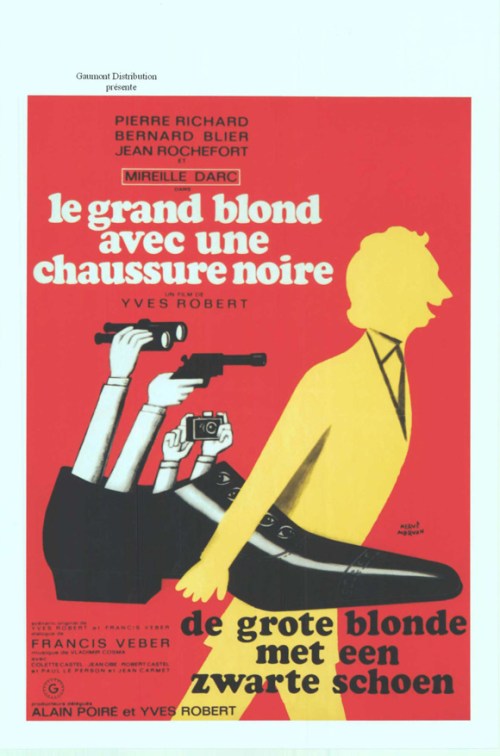
Bernard Milan (Bernard Blier) and Louise Toulouse (Jean Rochefort) are two rivals within the French Intelligence agency with each looking to unseat the other from their position of power. To counterattack his rival’s ambitions Louise decides to trick the other side into wasting their time by getting them to believe that a man chosen at random is a spy and having them follow him around even though in reality he has no connections to the spy game at all. Violinist Francois (Pierre Richard) gets chosen when he is spotted at the airport wearing only one black shoe. Bernard and his men fall for the bait and follow around Francois wherever he goes and eavesdrop on his conversations like there is some hidden meaning in whatever he says and does, which leads to many amusing results.

The film’s main charm is its satirical jab at governmental bureaucracy and the way they spend so much time and money on wasteful elements that lead nowhere while blithely ignoring the bigger problems. It also playfully taps into the foibles of human nature and how people, once they are convinced of something, will continue to believe it to the point of willfully rejecting or rationalizing evidence that may point elsewhere.

The best bit comes with the overly serious facial expressions that Blier and his subordinates show as they intently listen into Francois’ lovemaking with a woman (Colette Castel).  The slapstick during one of Francois concerts and the side-story dealing with Francois’ friend Maurice (Jean Carmet) who thinks he may be going nuts as he spots the spies at various times when no else does are equally side-splitting.

Pierre Richard, who was not the original choice for the part, is perfect in the lead with his flaming, curly, disheveled hair the perfect look for a man that’s just a bit out-of-touch with world around him. The fact that he continues about his daily life while oblivious to all the spying going on around him makes it even funnier and I liked that despite the character being on the goofy side he still ends up coming off like a real person albeit on the eccentric end.

The script by Francis Veber manages to sustain its comical edge throughout, but like with many of his other plots it borders on stretching its one-joke too thin and seeming more like a collection of gags than an actual plot. The humor is funny enough that it works, but the story still lacks a second or third act and could’ve ended sooner than it does. The film also fails to show the most crucial moment of the story, which is why Francois was wearing one black shoe to begin with. It gets briefly explained later, but this is a scene that should’ve been shown right up front before any of the rest of it got played-out.

In 1985 20th Century Fox did an American remake of this film that starred Tom Hanks and was called The Man with One Red Shoe, which will be reviewed tomorrow.

My Rating: 7 out of 10

Released: December 6, 1972

Runtime: 1Hour 30Minutes

Rated PG

Director: Yves Robert

Studio: Gaumont

Available: DVD, Blu-ray, Amazon Video, YouTube

A Fan’s Notes (1972)

fan-notes

By Richard Winters

My Rating: 4 out of 10

4-Word Review: He writes about himself.

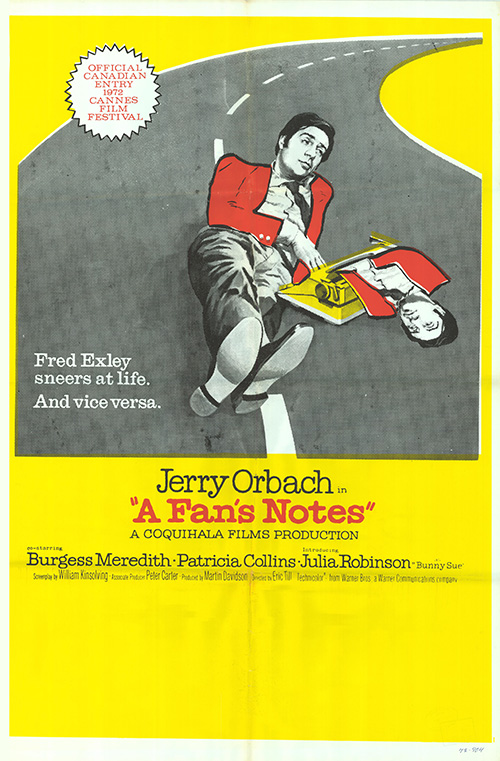
Exley (Jerry Orbach) is a loner residing in and out of mental institutions. He imagines having conversations with beautiful women, but is rarely able to approach them in real-life. He also obsesses over New York Giants running back Frank Gifford and wishes one day to achieve that same type of success, but fears that he’ll be a spectator in life just like he is in sports. He decides to begin writing about his nomadic existence in hopes that it will be a cathartic effort only to find that too harbors its own share of frustrations.

The film is based on the Frederick Exley novel of the same name, but despite the filmmaker’s best efforts it’s not able to achieve the book’s cult potential and in fact Exley himself stated that the movie “bore no relation to anything that I had written”. The idea of trying to somehow visualize a story that was never meant for the big screen is the film’s biggest issue and one that it cannot overcome no matter how hard it tries. The pacing is poor and tries awkwardly to make profound statements while at other points being zany and absurd, which is off-putting.

Orbach does well in the lead and helps hold it together. This also marks the official film debut of Julia Anne Robinson who appeared in only one other movie King of the Marvin Gardens before she tragically died in a house fire at the young age of 24. Like in that movie her acting is poor, but here it works in the positive because it makes her character seem transparent and accentuates the dream-like theme. The segment where she dresses up like a nun and then later as a street hooker, as part of Exley’s sexual fantasy, is fun as is his visit with her quirky parents (Conrad Bain, Rosemary Murphy).

Burgess Meredith appears only briefly, but practically steals it with his outrageousness. Watching him lie down on the floor in an effort to look up a blind woman’s skirt is a real hoot as is his ability to walk on his hands across the edge of a sofa.

Had the film stuck solely with the goofy comedy it might’ve worked and there are indeed a few memorable bits. The part where Exley punches an obnoxious woman (Elsa Raven) in slow motion is arresting and the segment where he imagines himself inside a scene of a his favorite soap opera where he directs the cast to strip off their clothes and have sex right in front of the camera is pretty funny too, but the best moment is the telephone conversation he has with a couple where he pretends to be a lawyer pleading with them to take-in the husband’s mentally unstable brother.

My Rating: 4 out of 10

Released: July 21, 1972

Runtime: 1Hour 32Minutes

Rated R

Director: Eric Till

Studio: Warner Brothers

Available: YouTube

Buddy Buddy (1981)

buddy-buddy-2

By Richard Winters

My Rating: 7 out of 10

4-Word Review: Suicidal man hampers hit.

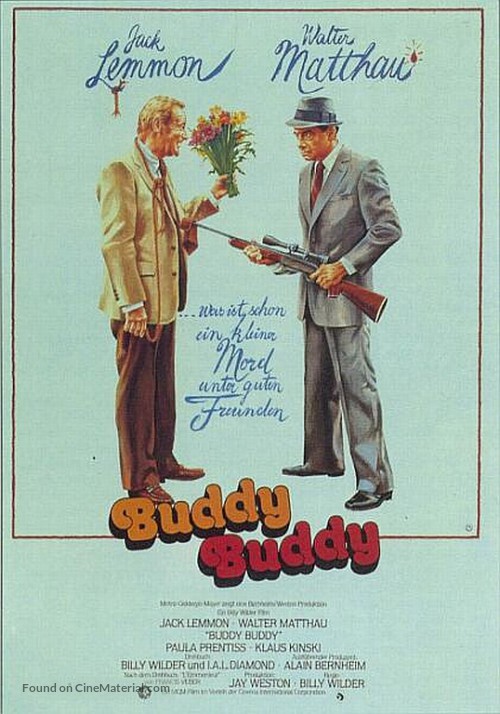
Trabucco (Walter Matthau) checks into a hotel intent on completing a hit by shooting a mob informant before he can testify at trial. He’s already killed the two other informants with relative ease, but now finds this one to be much more complicated due to having to deal with Victor (Jack Lemmon) who resides in the adjoining room. Victor is upset that his wife Celia (Paula Prentiss) has left him for a sex therapist (Klaus Kinski) and proceeds to try to hang himself by tying the noose around the water pipes in the bathroom, but all he succeeds at doing is busting the pipes and creating a flood. Trabucco decides to ‘befriend’ the man in order to keep an eye on him and prevent him from trying to kill himself again, which he feels will only lead to unwanted attention from the authorities. However, Jack causes more problems for him than the police ever could.

This was the last film directed by Billy Wilder who stated in more than a few interviews that he considers this movie to be his poorest effort and his least favorite. Matthau and Lemmon have pretty much said the same thing as well. The film was a critical flop and lost 3.5 million at the box office, which helped to prevent Wilder from ever helming another movie again.

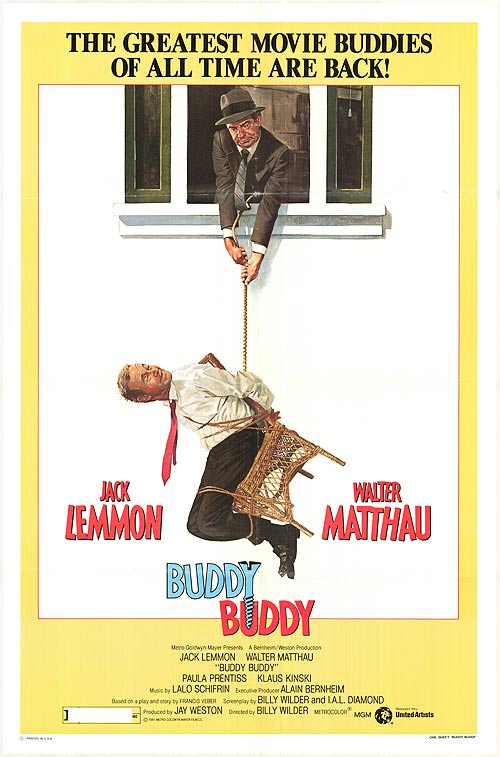
However, I was delightfully surprised at how funny I found this movie to be. It’s not exactly laugh-out-loud hilarity, but on a low-key level it works. The part where Lemmon gets tied to a chair and his mouth gagged while he screams at an ambivalent housekeeper (Bette Raya) to free him is quite good and the part where the two men going gliding down a clothes chute is fun too.

The whole thing is a remake of the French film A Pain in the A__, but it implements changes to the plot that improves it from the original. For one thing the dialogue is funnier, the two men have more genuine conversations and they even develop a bit of a bonding. The film adds more characters too like the beleaguered Captain Hubris played by Dana Elcar who tries in vain to protect the witnesses from Trubacco, but with little success. The distinctive musical score by Lalo Shifrin is also big improvement.

Lemmon is quite funny as he plays a sort-of hyped-up version of his Felix Unger character. Matthau seems a bit stymied in a role that allows for very little expression, but he still manages to make the most of it. My favorite performance though was that of Kinski who takes a rare comic turn and utters the movies best line: “Pre-ejaculation means always having to say you’re sorry.”

Having the two actually work together to complete the hit and then make an escape from the cops is good and something that did not occur in the original. The resolution, which takes place on a tropical island, is a bit of an improvement over the first one though it’s still not perfect. In either event it’s a relatively solid comedy that offers a few good laughs and deserves more attention especially for fans of Lemmon/Matthau.

buddy-buddy-1

buddy-buddy-3

My Rating: 7 out of 10

Released: December 11, 1981

Runtime: 1Hour 36Minutes

Rated R

Director: Billy Wilder

Studio: MGM

Available: VHS

A Pain in the A__ (1973)

pain-in-the-ass-1

By Richard Winters

My Rating: 6 out of 10

4-Word Review: Loser irritates hit man.

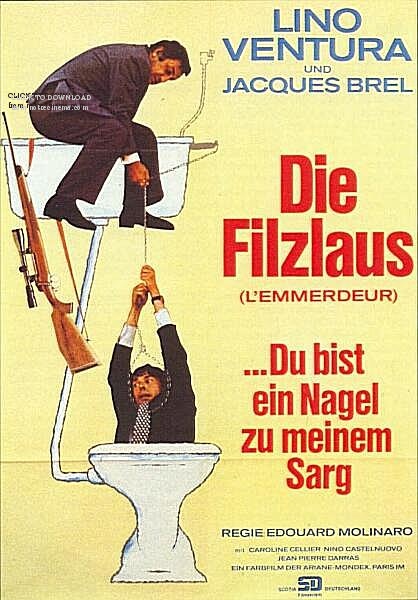
Ralf (Lino Ventura) works as a hit man and is hired to assassinate Louis Randoni (Xavier Depraz) who plans to testify against the mob. Ralf checks into a hotel room and plans to shoot Louis as he tries to enter the courthouse from his hotel window, which sits across the street from the court building. As he prepares for the hit he becomes distracted by Francois (Jacques Brel) in the neighboring room who attempts to kill himself after his wife leaves him. Ralf is concerned that Francois’s actions will elicit unwanted attention, so in an attempt to quiet him he ‘befriends’ him, which leads to many ironic scenarios.

The film was written by the prolific Francis Veber and based on his play. Ultimately it’s just a one-joke premise, but what makes it work are the two characters particularly the hit man who is portrayed in a serious way and never once betrays the essence of who he truly is, which is that of a cold blooded killer intent on doing his job and then moving on to his next. The comedy comes from his perturbed reactions at having to deal with a loser that despite his best intentions he can’t seem to ever get rid of.

Famous singer Brel does quite well as the clingy pest who is so wrapped up in his own personal quandaries that he fails to notice that his new ‘friend’ really isn’t his friend at all. Brel’s boyish looks plays well off of Ventura’s constantly stern expression and the plot becomes almost a constant play on errors as each one misreads the other.

The overall set design though is boring and the majority of action takes place solely inside the two hotel rooms, which eventually makes the proceedings quite static. It would’ve been nice to have had more of a conversation between the two as Brel does almost all of the talking while Ventura simply remains quiet while looking bored and angered, which is fun for a while, but more of a character arc could’ve been implemented.

The ending is a cop-out and not satisfying at all. I also felt Ventura was a bit too old and the character would’ve been more intimidating had it played by someone younger and more rugged although for the record Ventura plays the role perfectly especially when he gets injected with a drug that makes him tired and reluctantly  dependent on Brel’s guidance.

In 2008 Veber directed a remake of this film, which met with some success. Also in 1981 director Billy Wilder did an American version of this with Jack Lemmon and Walter Matthau playing the two leads. That film ended up adding a few changes and will be reviewed tomorrow.

pain-in-the-ass-2

My Rating: 6 out of 10

Released: September 20, 1973

Runtime: 1Hour 31Minutes

Rated PG

Director: Edouard Molinaro

Studio: Mondex Films

Available: VHS

Scarface (1983)

scarface

By Richard Winters

My Rating: 6 out of 10

4-Word Review: Refugee becomes drug lord.

Tony Montana (Al Pacino) is a Cuban refugee arriving in Miami hoping to make it big in the land of opportunity. At first he is forced to do low paying jobs, but finally gets his break when he is hired to do a job for a rich drug dealer named Frank Garcia (Robert Loggia). Soon Tony becomes infatuated with Frank’s girlfriend Elvira (Michelle Pfeiffer) and the two begin a torrid affair. When Frank tries to assassinate Tony by ordering a hit on him at a nightclub Tony gets his revenge by killing Frank and becoming the top drug lord, which makes him quite wealthy, but the strain of constantly having to watch his back for whoever may be out to get him eventually wears on his personality.

This is a remake of the 1932 Howard Hawk’s classic that came about when Pacino watched the original film in a theater and felt compelled to make a modern day update with the drugs being the source of the criminal activity instead of alcohol. The result is only so-so, but it gets helped immensely by an incredible set design. Tony’s all-black office and a luxurious hot tub placed in the middle of his already kitschy living room are eye-popping as are the chic and lively interiors of the nightclubs, posh restaurants and exotic resorts. The graphic shootouts are equally arresting and keenly shot and edited for ultimate excitement.

Director Brian De Palma again digs into his bag of borrowed Hitchcock shots in order to tell his story, but here it works pretty well. My favorite one is when he uses the camera to track outside of a room where the action is occurring and onto a quiet street below. Hitchcock did the same thing in Frenzy where the bad guy strangles a woman inside her apartment, but instead of showing the violent act the camera moves out of the apartment and onto a busy street outside. Here the camera takes an equally fascinating journey from a man getting chopped up by a chainsaw to an idyllic afternoon day just a few feet away.

The supporting cast is strong particularly Pfeiffer as Tony’s bitchy girlfriend whose ongoing acerbic responses act as a good barometer to Tony’s ever changing social standing. I also enjoyed the transformation of Loggia’s character from intimidating kingpin to wilting coward. Harris Yulin is also memorable as a corrupt cop who ends up playing things a little too cool for his own good.

The thing I hated about the movie was Pacino’s over-the-top performance. Normally I’ve found him to be a great actor, but here the character comes off as too cartoonish and one-dimensional. He possesses no interesting character arch and is creepy and unlikable from the beginning and proceeds to only get worse as it goes along, which makes following his rise and fall quite boring and predictable.

The runtime is too long and encompasses a lot of lulls in between the action bits in a story that seems to telegraph where it’s going right from the start. The Cubans are also portrayed in a negative and stereotypical way with only a slight attempt to balance it. Had it not been for the excellent production values this thing would’ve been a real bore.

I was also confused as to why Charles Durning’s voice gets dubbed in during a scene involving Tony’s conversation with an immigration officer. If De Palma was unhappy with the original actor’s performance as the immigration officer then he should have re-filmed it with Durning present instead of just using his voice because his style of speaking is quite distinctive and I was thrown out of the scene completely due to wondering why I was hearing Durning’s voice, but not seeing him.

My Rating: 6 out of 10

Released: December 9, 1983

Runtime: 2Hours 50Minutes

Rated R

Director: Brian De Palma

Studio: Universal

Available: DVD, Blu-ray, Amazon Instant Video, YouTube

Please Don’t Eat My Mother! (1973)

please-dont-eat-my-mother

By Richard Winters

My Rating: 2 out of 10

4-Word Review: His flower eats people.

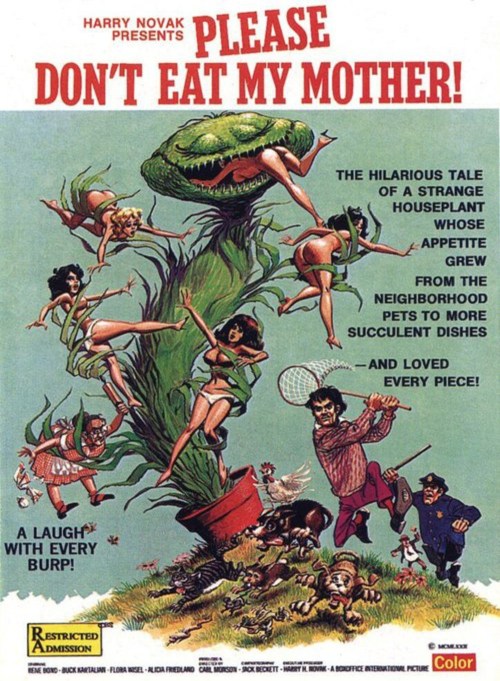
Henry Fudd (Buck Kartalian) is a man in his 40’s whose still living at home with his mother (Lynn Lundgren) and very down on life. One day while walking down the sidewalk he passes by an outdoor florist shop and becomes intrigued by a small plant that he is convinced spoke to him. He buys it and brings it home. As the weeks go on he realizes that the plant really can talk, but it also has an insatiable appetite and forces Henry to feed it. First it begins with insects, then dogs and then finally…people.

This is a low budget remake of Little Shop of Horrors, but it fails to have the same sense of fun and imagination. The biggest problem here is the plant itself. In the first film is was created in a way that made it seem kind of real, but here it looks quite tacky. The flower’s lips do not match the way it speaks making it look like very bad puppetry. Supposedly it can also see and hear, but nowhere on the thing are eyes and ears present. It grows to gargantuan heights and when it does so does the pot that it sits in, but how does that happen? Some may argue that Henry replants the flower into bigger pots as it grows, but this should’ve been either shown or inferred and it isn’t. The plant’s voice has a banal speaking quality like that of an airline stewardess with no interesting inflection. The way it eats people is equally boring. You never actually see it happen as the camera conveniently cuts away as the person moves in closer to it and then later cuts back with the plant burping and having acid indigestion.

The plot is threadbare and the majority of time has nothing to do with the central story. Instead the viewer gets treated to long, drawn out segments of couples making out in a car while our protagonist and a few other peeping toms look on. The sex by today’s standards is quite sterile and the innuendos that get bounced about wouldn’t elicit a chuckle from even a 7th grader.

The only thing that saves it to a degree is the performances by its cast. Kartalian, who at one time was a professional wrestler, is surprisingly engaging and I found his skipping down the city’s sidewalk after he buys the plant to be quite amusing. Lundgren as his meddling and snoopy mother is also funny even though she doesn’t look much older than him and in some ways could easily have been his same age. The film’s director Carl Monson is fun as well as he appears in a hammy bit as a police detective.

Unfortunately despite the noble efforts by its cast this thing is a cheesy mess and in no way worth seeking out while also being a complete embarrassment to all those involved.

My Rating: 2 out of 10

Released: March 3, 1973

Runtime: 1Hour 38Minutes

Not Rated

Director: Carl Monson

Studio: Box Office International Pictures

Available: DVD (Something Weird Video)

Down and Out in Beverly Hills (1986)

down-and-out-in-beverly-hills

By Richard Winters

My Rating: 7 out of 10

4-Word Review: Bum befriends rich family.

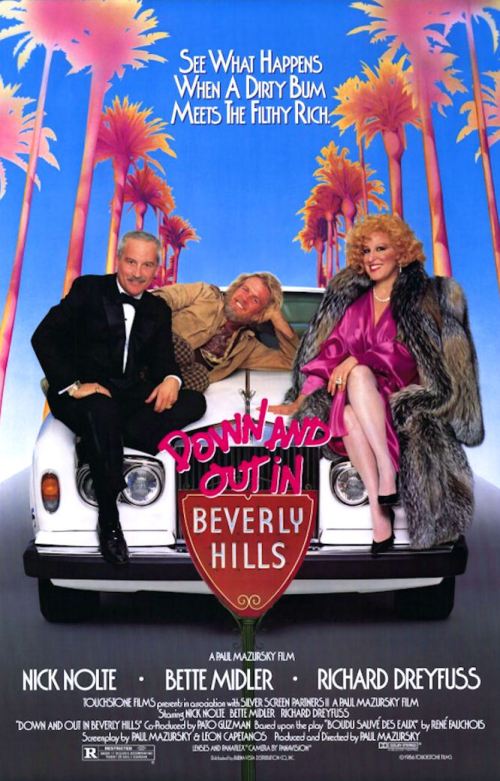
Jerry (Nick Nolte) has been living on the streets for years to the point that he has become used to it. One day his dog that is starving runs away from him and befriends a lady on the sidewalk who gives him food and eventually takes him home with her. When Jerry realizes that his pet is gone he panics and goes throughout Beverly Hills on a mad search. When he can’t find him he decides to drown himself in a pool of a posh household. Dave (Richard Dreyfuss) is the owner of the home who saves Jerry before he can kill himself and the two begin an awkward friendship. Jerry is even invited to move in with the rest of Dave’s family, which quickly sends the household out-of-control.

This film is a remake of the 1934 French classic Boudu Saved from Drowning and director Paul Mazursky nicely weaves the theme of the rich befriending the poor into the tapestry of Reagan’s ‘80s capitalism. The pace is breezy and non-confrontational and shows the wealthy as actually being the weaker of the two as they are much less able to adjust to harsh elements while trapped in their sterile surroundings and boring livelihoods simply so they can keep up the challenging pace of staying in tandem to the standards of society’s upper crust.

Midler has some funny moments as the snotty wife who doesn’t at all enjoy Jerry’s presence until he is able to give her a type of orgasm that she never had. Nolte is excellent as the bum in one of his best all-around performances. The scene where he eats dog food straight out of the bowl alongside the family’s pet Matisse (Mike the Dog) is an absolute keeper.

There are also some great supporting performances including ‘50’s rock icon Little Richard who plays Dave’s rich African American neighbor and is just as wealthy as the rest of the people in the neighborhood, but still feels badly discriminated against and doesn’t mind letting anyone he meets know about it. I also enjoyed that Mazursky stays with his ongoing theme of employing his own real-life therapist (Donald F. Muhich) into many of his movies. Muhich had already appeared as a psychiatrist in three of Mazursky’s earlier efforts and here appears again as a mental health counselor, but this time for the family’s dog.

The film gets a bit too serene and seems to blithely ignore many of the more serious elements of homelessness. Many scenes make it seem almost like they want to be on the streets and even enjoy it. It also would’ve been funnier had Dave been more a rich snob and his personality contrasted more severely with Jerry’s only for him to eventually come down to his level at the end, but overall I still found the whole thing to be amiably entertaining.

My Rating: 7 out of 10

Released: January 31, 1986

Runtime: 1Hour 43Minutes

Rated R

Director: Paul Mazursky

Studio: Buena Vista Pictures

Available: DVD, Amazon Instant Video, YouTube