Category Archives: Movies with Nudity

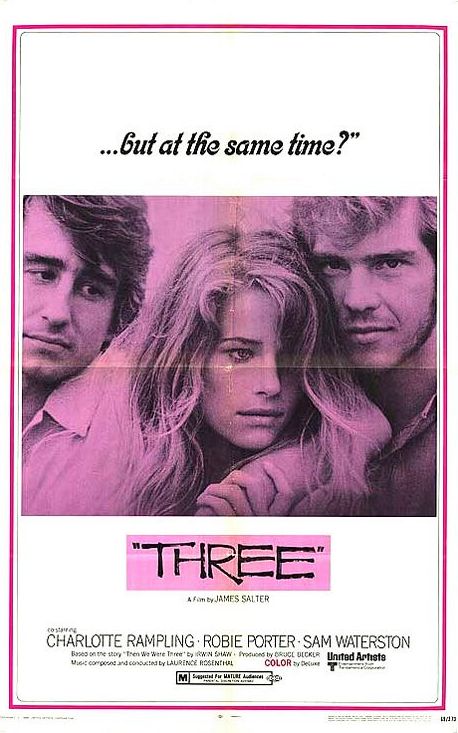
Three (1969)

By Richard Winters

My Rating: 3 out of 10

4-Word Review: Two guys one chick.

Taylor (Sam Waterston) and Bert (Robbie Porter) are two college chums spending their summer traveling through Europe. When they get to Italy they come upon a free-spirited young woman named Marty (Charlotte Rampling) who agrees to become their traveling companion, but underlying sexual tensions soon rise to the surface. Both men want to make a play for her, but resist because they fear it will ruin their friendship yet as the trip progresses the temptations get too strong to ignore.

Normally I enjoy a film with a laid back pace as I feel American movies tend to be too rushed and leave the viewer no time to allow the characters, story, or imagery to sink in. However, here it’s too slow with plot and character development at a minimum. The extraneous dialogue is not interesting and too much footage is given to capturing the Italian countryside, which makes this seem more like a travelogue.

Waterston is transparent as usual, which makes me wonder how he has managed to have the long career that he has had. Porter, who is better known as a composer, is better looking and much more dynamic and I was surprised that Rampling’s character doesn’t just gravitate towards him immediately as Waterston is dull and wimpy and not what most attractive women would want to consider.

Rampling is great and gives each scene an extra kick, which makes sitting through this meandering production slightly worth it, but the sexual tension is lacking. Supposedly this is what it’s all about, but for the most part it shies away from examining it even though it should’ve been constantly reinforced either through imagery, flashback or dialogue instead of being largely forgotten until the very, very end when it no longer mattered.

This was writer James Salter’s one-and-only foray behind the camera and it’s no surprise he never directed another one as he clearly shows no ability or understanding for pacing.  The characters are not unique enough to be captivating and one eventually begins to wonder why they’re bothering to watch it or what point the filmmakers had for even making it.

My Rating: 3 out of 10

Released: December 23, 1969

Runtime: 1 Hour 46 Minutes

Rated M

Director: James Salter

Studio: United Artists

Available: None at this time.

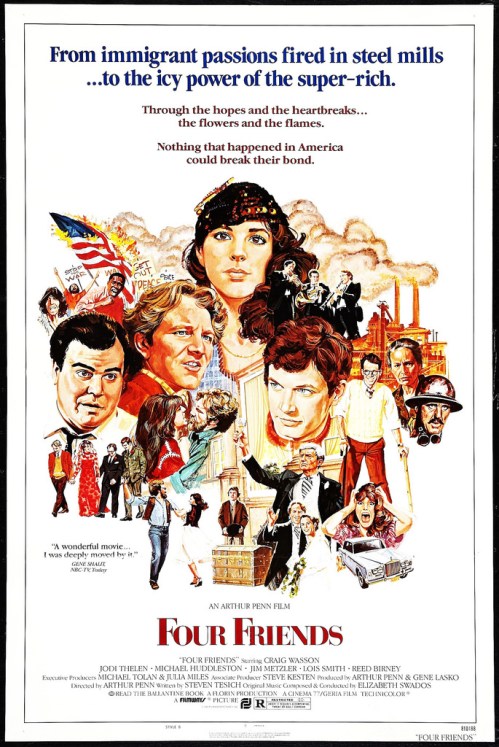
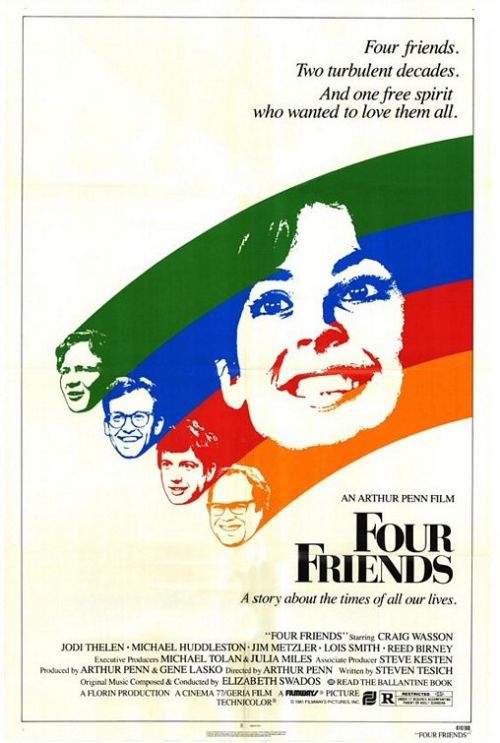
Four Friends (1981)

By Richard Winters

My Rating: 3 out of 10

4-Word Review: Living through the ‘60s.

Four male friends from Indiana go from high school to college and then on into young adulthood while remaining close and supportive. All of them have a passion for Georgia (Jodi Thelen) a very independent woman who enjoys playing-the-field when it comes to men and at various points has jumped into relationships with the four of them individually and at different times. Yet it is Danilo (Craig Wasson) who seems to be the most infatuated with her and he spends his life chasing after her, but finds that when they are together all they do is fight.

The story is apparently very loosely based on the experiences of screenwriter Steve Tesich who immigrated to this country from Yugoslavia at a very young age. The film starts out realistically enough, but quickly devolves into a whimsical tale that introduces interesting plotlines only to resolve them in cutesy ways that ends up making this sprawling tale quite shallow.

One of the biggest detriments is the casting of Craig Wasson who is a horrible actor as he can convey only one type of emotion, which is that of anxiousness and only one type of facial expression, which is that of nervousness. If he dares to try to expand his limited acting abilities away from these two things it comes off as unconvincing. Hs character like all the rest have no appeal as they never grow or evolve and seem put in simply as props to help carry the transparent tale.

I did like Thelen who plays the part of a spacey, free-spirited woman quite well, but even here it ends up getting clichéd. The other male characters have no distinguishable qualities and she sleeps around with them like they are toys on her own personal roulette wheel. Wasson’s character was her exact opposite and the two share no real chemistry making their eventual romance come off as being quite forced.

The film also contains some campy over-the-top dramatic elements that are unintentionally laughable and ridiculous. One takes place during a wedding party where while in front of hundreds of guests the bride’s father goes inexplicably crazy and shoots his daughter, then groom and eventually himself. Later on during a performance art show one of Thelen’s friends, in an apparent drugged stupor, accidently puts her foot on the accelerator while sitting in a car that’s parked inside a building, which sends it crashing through the wall and spiraling several stories to the ground.

The one aspect that I did like is that it didn’t resort to the Forrest Gump formula where the main characters get involved directly into all the famous historical events of the era, but instead view them from afar, which is more realistic. However, the film doesn’t show enough ‘60s nostalgia and half the time you forget the setting is even in that time period.

I admire the ambitious concept, but it takes on too much and would’ve been better had the script been more focused and less sprawling. Nothing here is compelling or memorable and the viewer is left with a genuinely flat feeling when it is over.

My Rating: 3 out of 10

Released: December 11, 1981

Runtime: 1 Hour 54 Minutes

Rated R

Director: Arthur Penn

Studio: Filmways Pictures

Available: DVD

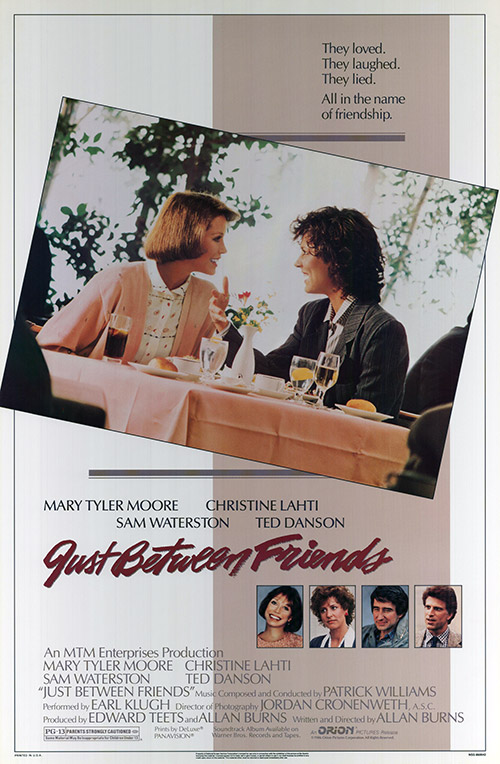
Just Between Friends (1986)

By Richard Winters

My Rating: 0 out of 10

4-Word Review: Friends share same guy.

Holly (Mary Tyler Moore) and Sandy (Christine Lahti) become friends while attending an aerobics class. Holly then invites Sandy over to her home for dinner unaware that Sandy is having an affair with her husband Chip (Ted Danson). Sandy is equally unaware that the man she is seeing is her new best friend’s mate. After the awkward experience is over Sandy decides to call off her relationship with Chip only to have him die unexpectedly a little bit later. Sandy then tries to help Holly get back on her feet, but without ever confiding with her that she was at one time ‘the other woman’. When Holly is cleaning out her husband’s office she comes across incriminating photographs of Sandy and Chip together and decides to angrily confront her with it.

One of the biggest drawbacks to the film is the casting of Moore in the lead. She’s an actress I’ve always liked, but here she is too old for the part. She was already pushing 50 at the time and Danson, who was 11 years younger, comes off more like an older son than a husband. In fact the opening shot has an extreme close-up of her where you can clearly see the age lines etched on her face making her later conversation where she asks her hubby if they should have another child seem utterly absurd. The intended idea of showing how completely opposite Holly and Sandy are seems more like a generation gap than contrasting personalities and watching Moore in an exercise outfit is genuinely disturbing as she is too thin and her ribs jut right through her shirt.

Lahti’s character is crass and snarky and not at all likable. The idea that she would know nothing about the personal life of the man she was seeing isn’t believable. Now I’ve never been involved in an affair, but I would think if someone is really into someone else, even if it is as the other woman, they’d want to know as much about him as they could including having some knowledge about who he was married to instead of being completely in the dark with what they were up against.

The affair angle gets introduced too suddenly and then right away she gets invited over to Holly’s for dinner and the awkwardness ensues, which isn’t half as funny or compelling as it could’ve been. The film should’ve shown how the affair began as well as to why Chip was unhappy with Holly, which never gets thoroughly explained, and then had the dinner scene played out later on when the viewer was more engrossed with the situation and characters.

There is also a lot of embarrassing comedy that gets mixed into the already cringy drama and only helps to unnecessarily prolong the scenes. The satirical jabs at the on-air news talent are particularly poor as it exaggerates how dumb they are in a film that is supposedly trying to be realistic otherwise. I don’t exactly know what writer/director Allan Burns has against newscasters, but both he and James L. Brooks produced the ‘Mary Tyler Moore Show’, which portrayed Ted Baxter, the newscaster on that series, as being a complete imbecile and here the news anchors are shown in much the same way, but by this time it comes off like an old, overplayed joke.

Having Danson die in the middle was a big mistake as his character was the only thing that brought in any interesting dramatic tension and the film flat lines the rest of the way without him. Allan Burns had some success producing TV-series despite the dubious distinction of having created ‘My Mother the Car’, but clearly making movies was beyond his capabilities and it’s no surprise that he never directed another film after this one.

My Rating: 0 out of 10

Released: March 21, 1986

Runtime: 1 Hour 50 Minutes

Rated PG-13

Director: Allan Burns

Studio: Orion Pictures

Available: DVD (MGM Limited Edition Collection), Amazon Video, YouTube

Circle of Power (1981)

By Richard Winters

My Rating: 4 out of 10

4-Word Review: Weekend retreat becomes brutal.

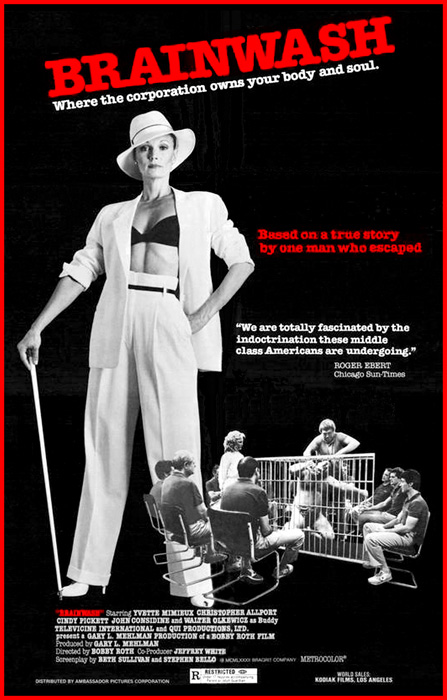
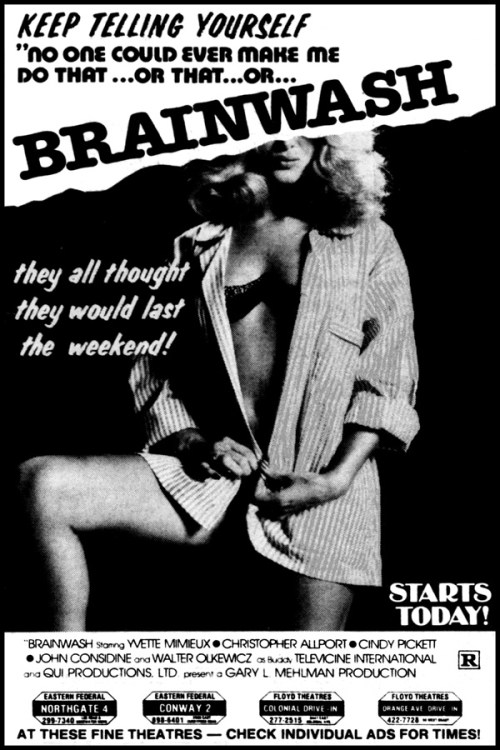
Executives of a company spend a weekend at a hotel where they’re a part of a large group awareness training that will better prepare them to achieve their full potential in both their business and personal lives. The encounter group is headed by Bianca Ray (Yvette Mimieux) who implements disturbing activities for the participants to go through that become increasingly more abusive and degrading.

This film is based off of the non-fiction novel ‘The Pit: A Group Encounter Defiled’ by Gene Church which documented a 1972 four day encounter group of top executives from the Holiday Magic company and many of the outrageous activities they were required to go through all under the cloak of learning to ‘bring out their inner dynamic’. Many of the activities that the characters in the film are forced to perform are similar to the ones depicted in the book, but amped up for the sake of drama. Some definitely get disturbing including having one participant, played by Walter Olkewicz, forced to strip naked in front of the group and then told to stand on a chair while the others mock his overweight body before having him locked into a cage and feed scraps of food that he must eat up directly from the floor.

Unfortunately the shock value gets muted by having characters that are too cardboard.  The viewer ultimately has no emotional bond to any of them and therefore the increasingly degrading circumstances that they go through achieve no profound impact. It also happens much too quickly as right from the start they are asked to do crazy things. I have no doubt that these encounter groups can sometimes go too far and there have been documented evidence of some even resulting in deaths, but it occurs gradually. A level of trust needs to be achieved to the point that the participants let down their guard and then the darker and twisted stuff gets introduced instead of just having it from the beginning like it gets played here, before any of the people have been psychologically ‘neutered’.

There is also no background given, or at least not a sufficient one, to the people who run the encounter group who are portrayed in a very one dimensional, creepy way that quickly becomes boring.  The issues of how did they decide to get into this line of work and what makes them so brazen to think they can get people to do these outrageous acts and get away with it is never addressed.

The ending is limp. What happens to the employees once they return to work is never captured nor the fate of the people running the retreat and whether they were ever sued or arrested. The idea is an intriguing one and there’s a potential for a really interesting movie to be had, but the plot needed more context and the characters to be better fleshed out.

Alternate Titles: Brainwash, Mystique, Naked Weekend

My Rating: 4 out of 10

Released: November 19, 1981

Runtime: 1Hour 37 Minutes

Rated R

Director: Bobby Roth

Studio: Ambassador Film Distributors

Available: VHS

Mind Trap (1989)

By Richard Winters

My Rating: 2 out of 10

4-Word Review: Avenging her father’s murder.

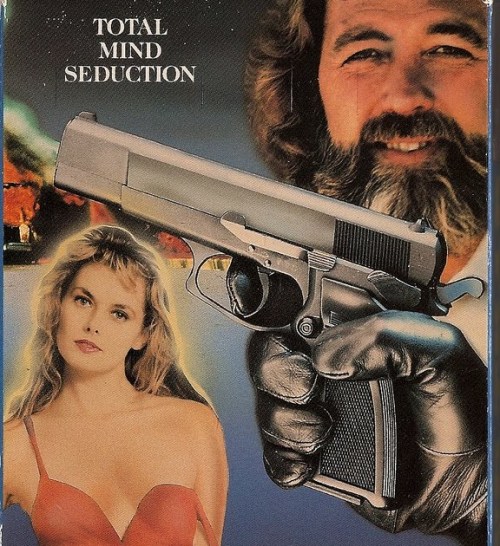
Shana (Martha Kincare) is an actress who stars in low budget action flicks. Her father works at a secret lab where they do experiments in areas of holograms and mind control, which elicits the attention of dangerous foreign agents who want to use these experiments for their own nefarious gain. They end up killing not only Shana’s father, but her sister and mother too and forcing Shana to pledge a vendetta on all those who murdered them while using what she has learned from being in action films to take them down.

Even though this is nothing more than a mindless actioner it does manage to have a few unique scenes, which is the film’s only saving grace. The opening one features a woman getting attacked while inside a trailer home that is set onto a moving truck. The bit featuring a room equipped with the old clapper light switch in which simply clapping one’s hands will force the lights to turn on or off and then having a ‘battle’ where one person claps for them to go on and another immediately claps to have them shut off, which continues on for a couple of minutes, is amusing.

Another segment has a woman (Jacquie Banan) getting gang raped by the bad guy, but then Shana mocks the man’s ability to ‘get-it-up’ and makes him so self-conscious that he is unable to achieve an erection and thus unable to complete the intended assault.

Overall though the film is flat and forgettable and the star Martha Kincare, who depending on the camera angle resembles a young Justine Bateman, is not believable at all. Just because one may perform in action movies does not mean that person knows the first thing about handling a real gun or taking on real-life secret agents, which makes the already flimsy plot completely absurd.

Dan Haggerty and Lyle Waggoner are given top billing, but seen only briefly while playing characters that have little to do with the main story. Maureen LaVette, who portrays the Russian agent, but was born in Iowa puts on such an over-the-top Russian accent that it becomes annoying and enough to force some viewers to watch the film with the sound turned down, which really wouldn’t be a problem since the banal dialogue sucks anyways.

My Rating: 2 out of 10

Released: August, 1989

Runtime: 1Hour 30Minutes

Not Rated

Director: Eames Demetrious

Studio: AMI Video

Available: VHS

Irreconcilable Differences (1984)

By Richard Winters

My Rating: 6 out of 10

4-Word Review: Girl divorces her parents.

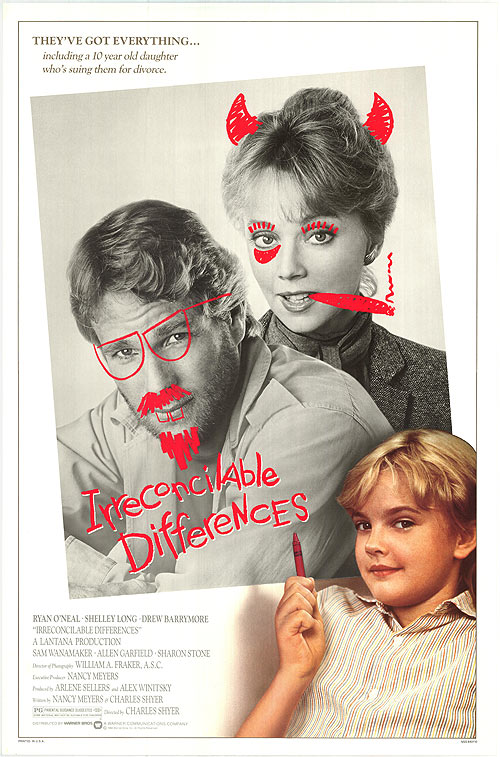
Nine-year-old Casey (Drew Barrymore) has decided she’s had enough of her parents (Shelley Long, Ryan O’Neal) and wants to get a divorce from them by using the emancipation law, which states that a minor can be freed of their parents if it is found that they have not meet their legal or equitable duty. Her mother and father fight this in court, but in the process are forced to expose all their skeletons including the awkward way they first meet, their affairs and eventual disdain for the other.

What surprised me most is O’Neal’s presence. His career has become so tarnished by his own real-life accusations of poor parenting that I would’ve thought this material would hit too close-to-home and he’d avoid it, but at the time this was considered a career resuscitator for him even though it ended up being only a brief one. His performance is actually quite funny making this his best work since What’s Up Doc?

I was equally impressed with Long who plays completely against type. Normally she’s best as snotty, prissy types, but here she reveals a much more vulnerable side and does quite well. At one point I even felt some genuine sympathy for her, which is something I’ve never felt at any other time with any of the other parts that she has played.

Sharon Stone, who gets listed in the opening credits as being ‘introduced’ even though she had already had a part in another theatrical feature Deadly Blessing that came out three years earlier, lends strong support. The way her character transitions from a wide-eyed free-spirit to bitchy Hollywood diva is quite entertaining and she looks great especially when topless. However, the bit where she exposes her excessively hairy armpits is gross and kind of tainted my image of her the rest of the way.

The script, which is based loosely on the relationship between Peter Bogdanovich and his wife Polly Platt with the Sharon Stone character representing Cybill Shephard who became the other woman, is sharp and filled with a lot of Hollywood in-jokes. The two funniest bits are the conversations between the guests at a chic Hollywood party as well as a glimpse of O’Neal’s disastrous attempt to direct a big budget rip-off of Gone With the Wind by trying to turn it into a musical.

The film though spends too much time on the parents while almost forgetting about Barrymore who’s only seen sporadically. The story also takes too long to play out with a final reconciliation segment that is overdone and sappy and helps to lose the wonderfully cynical tone that the film had earlier.

The only truly interesting aspect about the film is that Barrymore later used this same emancipation law to divorce herself from her real parents when she turned 15 and stated in interviews that she did it based off of the idea that she got from doing this movie.

My Rating: 6 out of 10

Released: September 28, 1984

Runtime: 1Hour 53Minutes

Rated PG

Director: Charles Shyer

Studio: Warner Brothers

Available: DVD

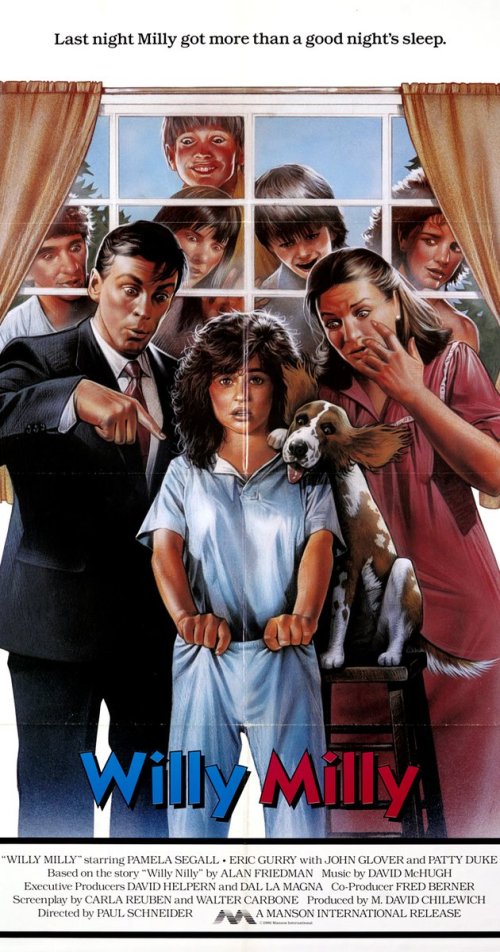
Willy Milly (1986)

By Richard Winters

My Rating: 2 out of 10

4-Word Review: Girl turns into boy.

Milly (Pamela Adlon) is a teen who dreams of one day becoming a boy. One day she purchases a magical potion from a kid named Malcolm (Seth Green), which promises to make her wish come true as long as she takes it during the next solar eclipse, which she does. Now as a boy she changes her name to Willy, but finds mixed reactions from those around her. Her father (John Glover) likes the change, as he always wanted a son, but her mother (Patty Duke) doesn’t. He/she starts going to a different school, but finds that both genders have their equal share of problems.

Although the storyline may sound novel it really isn’t and this thing suffers from being just another generic ‘80s teen movie. The humor of having Milly suddenly waking up with a penis and the shocked reactions of her family and friends is not played-up enough while the myriad of issues that this sort of change would produce gets woefully underexplored. Instead it devolves into the typical teen dramas that we’ve seen done before and no need in seeing again.

The most annoying aspect deals with the proverbial bully storyline. I realize every school has got one, but it would be refreshing to have a high school movie that didn’t feel the need to always have to take this redundant route. This one, which gets played by an actor named Jeb Ellis-Brown, is particularly dull and what’s worse is that he looks scrawny and could be easily be beat-up by the kids he is supposedly intimidating.

Adlon’s performance, who gets billed under the last name of Segall, is irritating and a major detriment. For one thing she looks a bit androgynous from the start and then when she does turn into a boy all she does his cut hair short and that’s it even though her voice stays high pitched and her mannerisms remain girly making it seem more like just another female with short hair. There are a few good moments with Glover as the father as he tries to ‘train’ her to be more like a ‘man’, but Duke is horribly wasted in a small and forgettable supporting part.

The material is dated and these days this same storyline could be used minus the magical potion and instead tackled as a storyline dealing with a transgender teen. I also had problems with the Eric Gurry character who plays a teen friend to Willy that is stricken to a wheel chair. Initially I thought it was great that they introduced a character who had a handicap, but then it gets treated as being nothing more than a psychosomatic condition, which demeans all those victims of spinal cord injuries who are permanently paralyzed and unable to walk ever even if they wanted to.

There’s a film called Just One of the Guys that came out around the same time as this one and had a similar theme, but in that one the teen character only pretended to be a guy and it was much funnier and more perceptive.

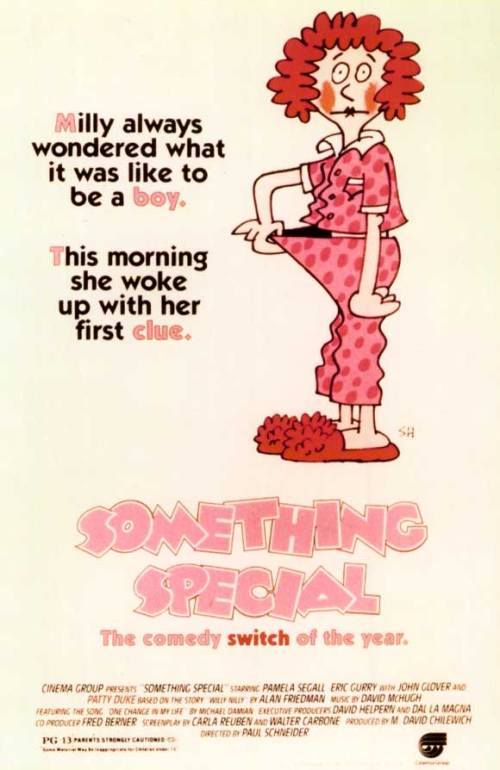
Alternate Title: Something Special

My Rating: 2 out of 10

Released: November 14, 1986

Runtime: 1Hour 23Minutes

Rated PG-13

Director: Paul Schneider

Studio: Concorde Pictures

Available: VHS

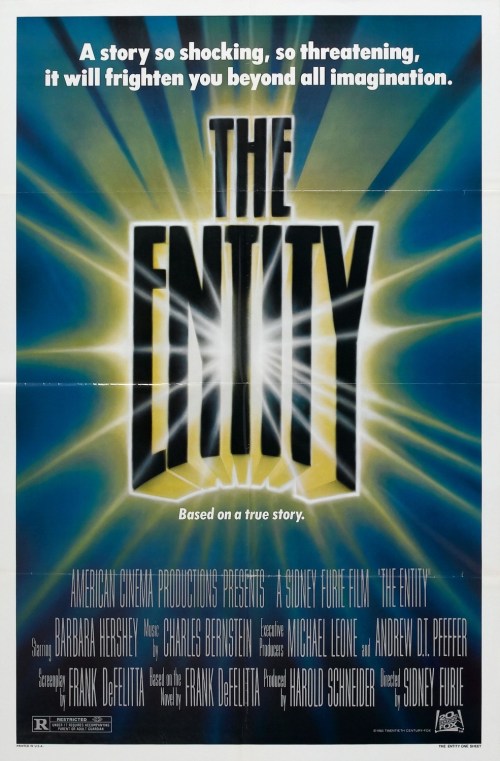
The Entity (1983)

By Richard Winters

My Rating: 4 out of 10

4-Word Review: Invisible mass attacks mother.

Carla Moran (Barbara Hershey) is a single mother living with her three children who finds herself attacked one night in her home by an invisible being who proceeds to viciously rape her. When she tells this to her psychiatrist (Ron Silver) he initially doesn’t believe her, so she employs the help of two parapsychologists (Raymond Singer, Richard Brestoff) who come to her home and record the paranormal activity. With the help of Dr. Cooley (Jacqueline Brookes) who heads their department, they build a life-sized replica of Carla’s home in a gymnasium complete with liquid helium, which they hope to use on the mysterious entity in order to trap it.

The ghostly attacks aren’t impressive and consist mainly of seeing close-ups of Hershey’s face being rammed against the wall, or bedsheets, flying glass, shaking furniture and a musical sound effect reminiscent of a hammer rhythmically pounding against a sheet of metal. The attack scenes quickly become redundant and the ghostly presence is never seen, which eventually makes them yawn inducing whenever they occur. There are also many long dramatic interludes between the attempted scares that try to put a psychological spin on the proceedings, but come off more like pop psychology instead.

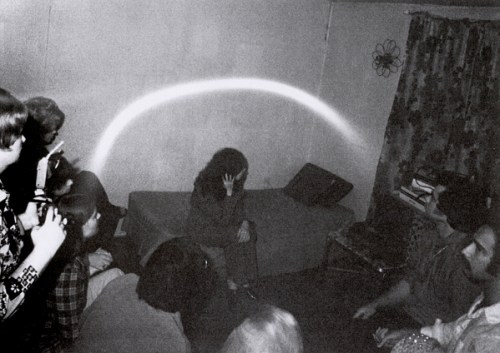
The whole thing is inspired by an actual incident which occurred on August 22, 1974, but incorrectly stated as happening in October, 1976 during the film’s denouncement. In the real-life case a woman by the name of Doris Bither (1942-1999) met two parapsychologists named Barry Taff and Kerry Gaynor while visiting a local library and told them of her repeated rapes inside her home by three ghosts who she considered to be of an Asian descent. She invited the men to her small Culver City, California home, which they found to be extremely cramped and dirty. During the event the men felt some unusual sensations and saw colorful orbs fly through the air, which was enough to inspire Frank De Felitta to write a novel about it, which later lead to this movie.

The film though would’ve worked better had the initial setting been Carla’s visit to her psychiatrist and then everything else played out in small segments as a flashback while she described her encounter. There was much speculation that these things were all just inside Bither’s head since she had suffered from substance abuse and a traumatic upbringing, but none of that gets touched upon in the movie. Instead we are left to believe that these strange occurrences are actually happening, but the film would’ve been more multi-dimensional had the viewer been allowed to question whether it was real, or simply an effect of mental illness.

Hershey gives a fine performance and shows what a great actress she is by playing a character that was completely opposite from the carefree/hippie-like ones that she played during her film appearances of the ‘70s. Silver though is annoying as the psychiatrist as his character unwisely gets too involved with his patient even though most other doctors in his position would be convinced that the woman was bat-shit crazy and keep themselves at an emotional distance from her. His attempts at trying to talk her out of going through with the experiment done at the gymnasium is irritating as it does nothing but hold up the story while failing to add an interesting dramatic tension.

The film’s freakiest aspect are the moments where Hershey’s bare breasts, in an attempt to show them being molested by the invisible hand of the ghost, start to ripple and show indentations seemingly on their own. How they were able to pull this off since this was well before visual computerized effects I’m not sure, but it is impressive and some may find it even strangely erotic.

On the whole though the film is frustrating as never explains why any of this occurs. The cause of the actual incident remains murky even though most would say that the woman was just looney, but since this film has already taken liberties with the real-life event why not at least throw in some sort of halfway plausible theory as nothing is worse than sitting through an overlong film that puts out many intriguing questions, but fails to supply them with any tangible answers.

(The Culver City, California home where the events that inspired this movie purportedly took place.)

(An actual photograph taken during the August 22, 1974 encounter.)

My Rating: 4 out of 10

Released: February 4, 1983

Runtime: 2Hours 5Minutes

Rated R

Director: Sidney J. Furie

Studio: American Cinema Productions

Available: DVD, Blu-ray

Hot Stuff (1979)

By Richard Winters

My Rating: 3 out of 10

4-Word Review: A phony pawn shop.

Tired of seeing the criminals they apprehend getting off on legal technicalities three cops (Dom DeLuise, Jerry Reed, Suzanne Pleshette) decide to turn-the-tables by opening up their own pawn shop, which will work as a front to reel in the crooks that try to resell stolen items. They use the magic of a hidden camera and video tape, which was a new thing at the time, to record the criminals as they bring in the stolen loot and therefore leave no question as to their guilt, but their plan gets off to a rocky start and only gets more convoluted as they proceed with it.

The film, which was directed by DeLuise, starts out fast and includes a car chase before the opening credits even occur, but once the premise is established it bogs down. Supposedly much of what occurs is based on real-life accounts taken from various police cases, but it lacks cohesion. There are gun battles and a wide array of criminal characters that pop up out of nowhere with the pawn shop setting being the only thing that loosely ties it together. Any element of reality gets lost during its farcical ending, which involves all the criminals attending a party that quickly turns into a long drawn slapstick-like battle that resembles something found in a cartoon and is really inane particularly the pathetic ‘fights’ that occur between the various characters where it is clear the actors are pulling their punches and not doing a very good job of disguising it.

The film does make an effort, at least at the beginning, to show the private side of a cop’s life and many of the frustrations that go along with doing the job, but by the end the characters seem too comically inept to be believable. I also found it amusing that DeLuise uses his own children to play the kids of his character even though with their blonde hair they looked more like they should be Reed’s offspring instead.

The one funny moment comes when DeLuise smokes some weed and goes off on a long laughing binge that is genuinely memorable, but otherwise this thing, which was shockingly co-written by the normally reliable Donald E. Westlake, suffers from an uneven focus that is more content at showing slapdash comedy than conveying something that is original, interesting or multi-dimensional.

My Rating: 3 out of 10

Released: August 10, 1979

Runtime: 1Hour 31Minutes

Rated PG

Director: Dom DeLuise

Studio: Columbia Pictures

Available: DVD

Casualties of War (1989)

By Richard Winters

My Rating: 4 out of 10

4-Word Review: He witnesses a rape.

Based on an actual incident that occurred on November 19, 1966 the story centers around five members of an American squadron during the Vietnam War where the pressures and ugliness of battle send their leader, Sergeant Tony Meserve (Sean Penn) over-the-edge. When his squad gets denied leave he decides to have his men kidnap a Vietnamese girl named Oanh (Thuy Thu Le) who is then raped by the four of them while one, Eriksson (Michael J. Fox) refuses.  The young woman is eventually killed and her lifeless body left in a field. When the men return to their base Eriksson tries to report the crime, but finds stiff resistance.

This same incident was used as the basis for another film called The Visitors, which came out 17 years earlier. That movie took a different approach as it hypothesized what would’ve happened once the men returned from doing prison time and came for a ‘visit’ to the man’s home who had turned them in. That film suffered from a lack of a budget, but still managed to have a little more tension and impact than this one. This version takes way too long to play itself out. The audience knows where it’s headed right from the start and thus makes it almost excruciating to have to sit through.

The film would’ve worked better had the story been told in a fragmented style. The horror of the situation gets lost by the plodding narrative that overplays the story’s shock element and seems to take an almost sick delight in dragging out the whole kidnap/rape sequence until it gets agonizing and even tedious.

The idea that Eriksson would mentally be going back through this whole situation while he dreams it during a nap on a bus isn’t believable. The story is supposedly told as a flashback, but people dream in a more surreal, nonlinear way that wouldn’t painstakingly go back through every detail that had occurred to them in real-life. Also, people tend to repress unpleasant experiences that they’ve had. At times certain bits and pieces of it may come to the surface, but most of it would be locked away in the person’s subconscious, which is why the fragmented approach would’ve made more sense because we would’ve seen things in the exact same way that they were being played out in Eriksson’s head.

Fox is miscast and looks more like Marty McFly stuck in a time warp and involved in a situation he has no business being in. His character’s upbeat disposition makes him seem like he’s in some sort of invisible bubble that allows him not to be affected by the horrors of war even though it has clearly taken its toll on everyone else around him.  The character is also a bit too passive and does little to prevent the rape from occurring, which will make some viewers feel that he is cowardly.

Although his character is a bit over-the-top Penn gives a strong and effective performance and the main reason if any to watch the film. John Leguizamo is also good as a shy, quiet type that initially refrains from wanting to take part in the crime only to ultimately cave to peer pressure.

The on-location shooting done in Thailand is good and I liked the way director Brian De Palma uses the point-of-view effect particularly when the men go around the sleeping village looking for a victim to choose, but ultimately the film fails to elicit much of an emotional effect. The quasi, tacked-on ‘uplifting’ ending in which a stranger tells Eriksson to simply ‘let go’ of his horrible memories and in essence ‘move on’ from it is terribly contrived as there are certain experiences one can’t simply leave behind, which only helps to solidify how shallow this potentially penetrating drama really is.

My Rating: 4 out of 10

Released: August 18, 1989

Runtime: 1Hour 59Minutes (Director’s Cut)

Rated R

Director: Brian De Palma

Studio: Columbia Pictures

Available: DVD, Blu-ray, Amazon Video, YouTube