Category Archives: Movies with Nudity

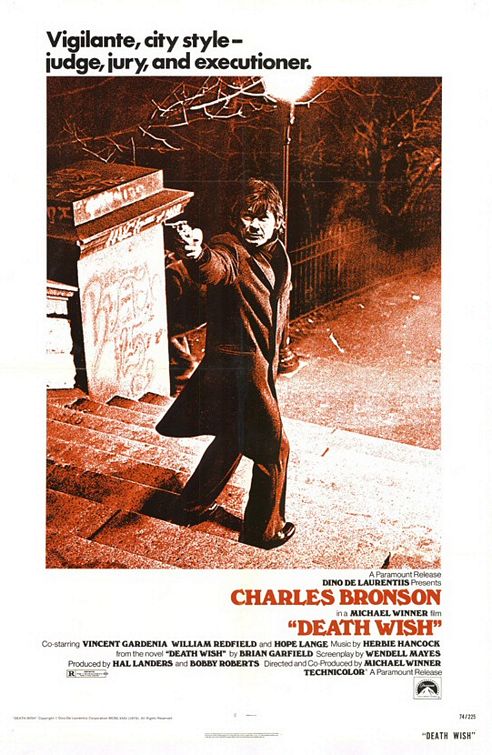
Death Wish (1974)

By Richard Winters

My Rating: 7 out of 10

4-Word Review: Architect becomes a vigilante.

In connection with the Eli Roth/Bruce Willis reboot that is set to be released to theaters this Friday I thought now would be a good time to go back and take a look at the original. The story centers on Paul Kersey (Charles Bronson) who works as an architect and lives a comfortable life with his wife Joanna (Hope Lange) and adult daughter Carol (Kathleen Tolan). One day while he is at work his New York apartment gets invaded by three thugs (Jeff Goldblum, Christopher Logan, Gregory Rozakis) who kill his wife and rape his daughter. Paul becomes outraged that the police can’t seem to make any headway on the case and decides to take matters into his own hands by becoming a self-styled vigilante shooting random thugs on the street late at night, which in turn has him becoming a cult hero to the many residents of the crime ridden city.

The film is based on the novel of the same name by Brian Garfield. Garfield was inspired to write the story after his car got vandalized. He initially fantasized about tracking down the criminals and killing them before eventually speculating what would happen if someone actually went through with these feelings and decided to take the law into their own hands. The main difference between the novel and film is that in the book the vigilantism becomes more of the problem while in the movie it’s considered the solution.

Many critics at the time gave the film unfavorable reviews as they felt it advocated violence, but I found the movie to have a certain uplifting quality. While the message is certainly simplistic and one-sided it still nicely conveys the idea that ordinary citizens can make a difference and it is up to us, the American public, to foster change and not to simply leave it up to someone else. The film doesn’t completely promote violence as the solution either as there is one scene where an old lady (Helen Martin) scares off her attacker simply by using her hat pin.

The problem that I had with it was why does Bronson constantly get harassed by these thugs in the first place? Whether he is at a restaurant or on the subway the bad guys constantly hone in on him for no apparent reason even when there’s plenty of other people around. In the book it made more sense because the title character would intentionally set traps for the thugs like abandoning his car and putting an ‘out of gas’ sign on it, so the criminals would try to rob the vehicle and then when they did he’d shoot them. Of course this would make the character’s motives more questionable, which the film wanted to avoid, but in the process it becomes less believable.

While this has become Bronson’s signature role it still would’ve worked better had a less brawny actor played the part. In the book the character is a meek accountant and someone like Jack Lemmon, who was originally considered for the role, would’ve been a more authentic fit. Bronson’s image is so entrenched as a ‘tough guy’ that his presence here seems like just another of his action themed vehicles. Chuck should’ve also not known how to use a gun right away either and maybe even been initially clumsy with it as it would’ve made the character arch from peaceful novice to sharp shooting vigilante stronger.

I liked Michael Winner’s directing particularly the way he shot the interiors of the apartments and his grimy portrayal of the urban New York setting that perfectly played-up the city’s crime ridden paranoia at the time. This is also a great chance to see some young performers before they were famous including Christopher Guest as a patrolman. I also found it amusing that Paul Dooley and Vincent Gardenia share a brief scene together as they both went on to play the dad character in Breaking Away. Dooley portrayed him in the movie version while Gardenia played the part in the short live TV-series.

My Rating: 7 out of 10

Released: July 24, 1974

Runtime: 1Hour 33Minutes

Rated R

Director: Michael Winner

Studio: Paramount

Available: DVD, Blu-ray, Amazon Video, YouTube
Saturn 3 (1980)

By Richard Winters

My Rating: 4 out of 10

4-Word Review: Space couple battles robot.

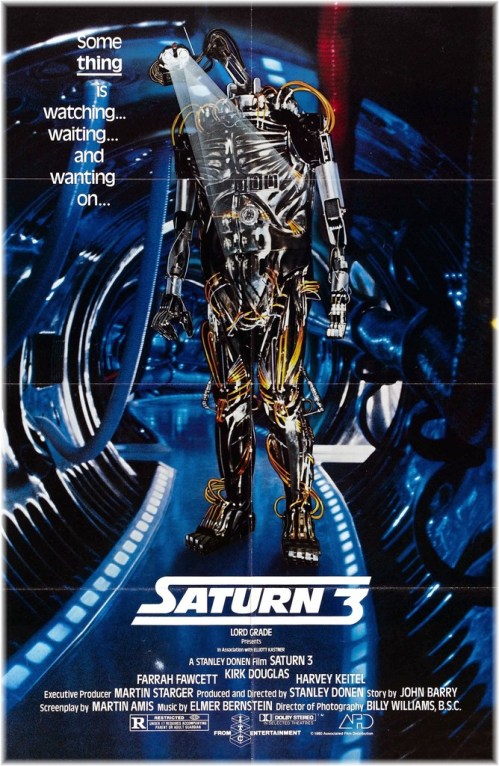
Mentally unhinged Captain Benson (Harvey Keitel) arrives on a space station that is located on Saturn’s 3rd moon along with a robot named Hector that has brain tissue made up of human fetuses. On the space station resides Adam (Kirk Douglas) and Alex (Farrah Fawcett) who are a couple researching on how to grow plants without soil. Captain Benson is assigned to assemble the robot, which will supposedly help the couple in their research, but instead it goes on a rampage killing Benson and then threatening to do the same to the other two.

The film was the brainchild of award winning set designer John Barry best known for his production design in the movies Star Wars and A Clockwork Orange. Unfortunately most of his work was done inside an office and his ability to actually direct actors was limited leading to constant conflicts between he and star Douglas, which eventually forced the film’s producer Stanley Donen to step in and takeover. Barry then left to work on The Empire Strikes Back only to collapse suddenly and die just a few months later from meningitis at the young age of 43 while never seeing the completed version of his original vision.

The sets are dazzling and clearly the film’s best element. In fact one could watch the movie for its visual quality alone with no sound and be better entertained. The robot is amazing too because he comes off looking like a genuine mechanical concoction and not just some stunt guy in a body suit. The thing doesn’t even have a head, but simply a protruding wire coming out the top with two lights on the end of it representing its eyes. Watching him being put together is mesmerizing as he looks very much like modern robots seen today at science shows making the film, at least in this area, seem astutely ahead-of-its-time.

The story though comes-off like an afterthought. Never once did I feel any tension even as the robot chases the couple all around. The characters are bland and the cast needed to be larger as the production lacks energy or liveliness. The dark, isolated space station is gloomy and depressing, which eventually crosses over to the film as a whole.

This was supposed to be a sci-fi/horror hybrid in the realm of Alien, but unlike that movie this one lacks any shocks or scares. There were two scenes that were filmed but later deleted one involved a dream sequence where Adam and Alex kill Benson while another had the robot ripping apart Benson’s dead body. These scenes sounded like they had exact edginess that the film lacked and it’s a head-scratcher why they were cut. When you’re trying to attract the same audience of another sci-fi flick that had its share of gore then you need to go for the gusto and not hold back.

The casting is cockeyed. Why is a 65-year-old codger banging a hot 30-year-old? Not only does it look like a father/daughter thing but even more like a grandfather/granddaughter situation. Kirk’s a fine actor, but not for this and his son Michael would’ve been a far better choice especially since there’s no chemistry between the two stars anyways.

Farrah’s acting skills have improved slightly from her first two films, but she still comes off as transparent and in-over-her-head, hired solely for her looks and nothing else.  Male viewers will enjoy her brief topless scene, but most likely no one, male or female, will be excited about seeing Kirk’s bare wrinkled old ass, which you’ll unfortunately also get a glimpse of.

I was most perplexed by the fact that Keitel’s voice was dubbed over by actor Roy Dotrice apparently because Donen didn’t like Keitel’s Brooklyn accent, but why hire the guy in the first place if you don’t like the way he speaks? The dubbing is obvious from the moment he utters his first word and will be a definite distraction to Keitel fans.

Ultimately the film becomes victim to what happens to a lot of big budget sci-fi productions where too much emphasis is put into one element while almost no thought is given to anything else. The result is a flimsy entry into the sci-fi genre that barely deserves any attention at all.

My Rating: 4 out of 10

Released: February 15, 1980

Runtime: 1Hour 27Minutes

Rated R

Director Stanley Donen (John Barry uncredited)

Studio: ITC Films

Available: DVD, Blu-ray, Amazon Video

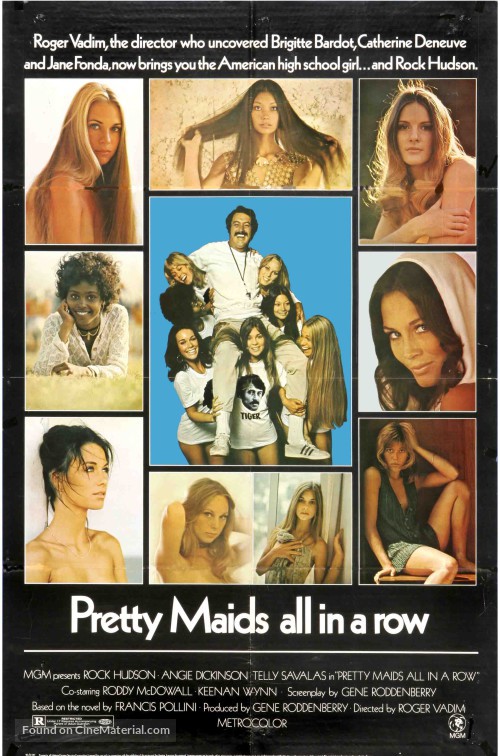
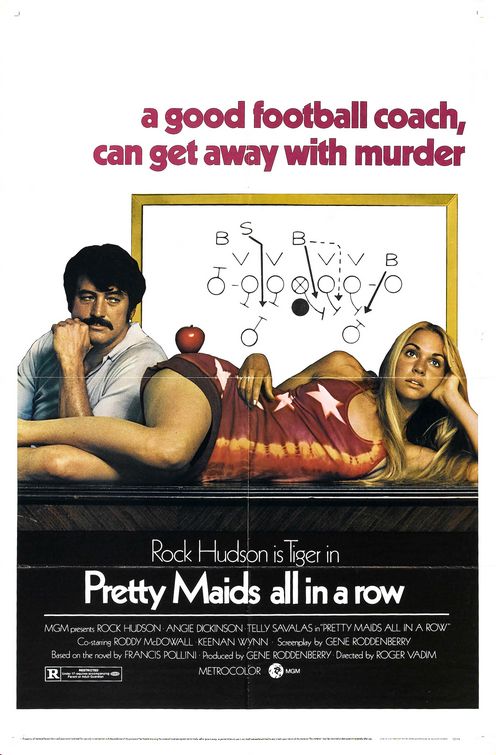
Pretty Maids All in a Row (1971)

By Richard Winters

My Rating: 4 out of 10

4-Word Review: Coach kills pretty students.

Ponce (John David Carson) is an awkward teen in his senior year of high school that still hasn’t been out on a date. He suffers from having erections at the most inopportune times and too shy to ask out one of the many beautiful female students that populate his school. He also finds himself dealing with a series of murders of pretty coeds who turn up dead with funny little notes attached to them and he starts to suspect that the killer may be the school’s beloved football coach (Rock Hudson).

The film, which is based on a novel by Francis Pollini with a screenplay written by Gene Roddenberry starts out well with sharp, satirical dialogue and funny situations dealing with the police investigation, but then deteriorates into smarmy sex jokes and becomes nothing more than a teasing T&A flick. The script makes it obvious early on that the coach is the killer and had it not revealed this so quickly it could’ve made the film more of a mystery and given the ending an impactful twist.

My main beef though is that it takes place in a high school instead of a college even though all the students look to be well into their 20’s. The fact that the coach has sex with the female students makes the thing seem off-kilter as does Angie Dickinson who plays a teacher who brings Ponce into her home to help him with his erection problem. If the setting was a college with the student characters over 18 than all this tawdriness would at least be legal and less outrageous.

The female students come off as being too free-spirited and reflect the counter-culture movement that occurred mainly on the college campuses of that era and not the high schools. They also all look too much like models. A realistic portrait of a high school class will have a variety of body types not just those of women ready to become cover-girls. I enjoy beautiful women as much as anybody, but the film should’ve had at least one average or overweight female in the cast simply to give it balance and avoid it from seeming too much like a tacky male fantasy, which is all this thing ends up being anyways.

Hudson, with his monotone delivery, is a weak actor and gave only one good performance in his career, which was in the film Giant. Yet here his discombobulated acting skills successfully reflect his character’s confused personality. Carson is a bland protagonist and his presence doesn’t have much to do with how the plot progresses. His character is put in solely for a dull side-story dealing with his attempts to get-it-on with his teacher in her home, which amounts to being just a dumb comic variation of Tea and Sympathy that is neither funny nor sexy.

The supporting cast is far better. Telly Savalas owns the screen as a relentless investigator. Keenan Wynn is hilarious as a dim-witted policeman in one of the funniest roles of his prolific career and he’s the best thing in the movie.

My Rating: 4 out of 10

Released: February 26, 1971

Runtime: 1Hour 31Minutes

Rated R

Director: Roger Vadim

Studio: MGM

Available: DVD, YouTube

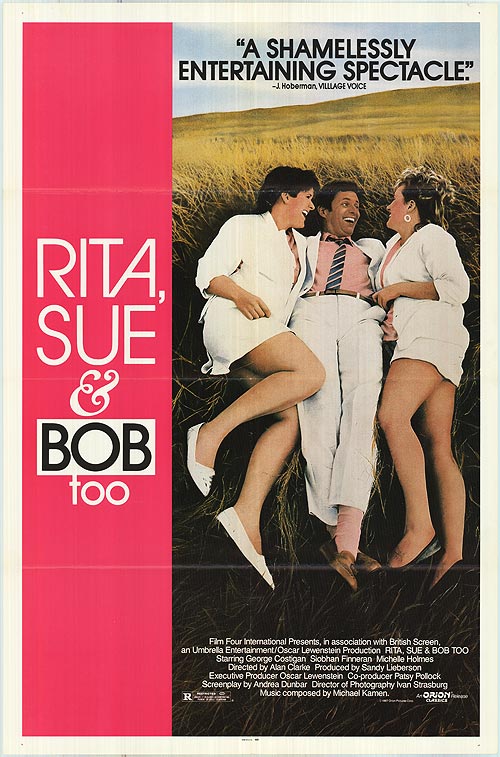
Rita, Sue and Bob Too (1987)

By Richard Winters

My Rating: 5 out of 10

4-Word Review: Dad fucks the babysitters.

Rita (Siobhan Finneran) and Sue (Michelle Holmes) are two friends from high school who babysit for Bob (George Costigan) and his wife Michelle (Lesley Sharp). One night while Bob is taking the two babysitters home in his car he decides to make a sexual overture to them and they both enthusiastically reciprocate, which ends up turning into a mini sex orgy. Soon the three are routinely getting together for sexual trysts until Michelle eventually catches on and leaves Bob while taking the kids with her. Sue’s parents find out too, which causes a great deal of stress and infighting amongst the three.

This offbeat comedy unexpectedly became a worldwide cult hit that made stars of the three leads particularly the two women whose first film this was. Unfortunately the same cannot be said for the film’s director Alan Clarke or its writer Andrea Dunbar who both tragically died just 3 years after the film’s release. Clarke from cancer while Dunbar, who was living on welfare and an alcoholic, passed away at her local pub at only 29 years of age.

The film comes off as an odd mix of lighthearted comedy and gritty drama that doesn’t completely work. The story jumps from the upscale middle class neighborhood of Bob’s house to the abject poverty of Sue and Rita’s family life with their apartments so vividly rundown that it’s almost horrifying to imagine anyone could live in such squalor. Part of the reason for this shift is that the film was based on two of Dunbar’s plays, the first being ‘The Arbor’, which was an autobiographical story of her growing up in the slums and at the hands of an abusive father, which she wrote at the age of 15 as a class project, and the other on a later play that she wrote with the same title as the film.

I’m not sure why director Clarke choose to mix the two plays together. Maybe he thought it would give the story more substance, but it really doesn’t. The antics that go on here could’ve happened in any neighborhood and the income bracket issues showing the stark scenes of the girl’s sad home life seem inconsequential and meandering.

I didn’t like the film’s abrupt start either as it jumps almost immediately to the three getting-it-on inside the car without any backstory. I kept wondering when did Bob get the idea to make a pass at the two girls and why are the girls so unsurprised when he does? I would think most young women would be shocked when an older man that they babysat for would suddenly make an aggressive sexual come-on and yet here these two aren’t, but why? What sort of signals were the two sending out to Bob to make him feel that he could behave the way he does? Was he already getting ideas when they first came to babysit for him, or did it evolve later? These questions and scenarios never get shown or answered, but should’ve.

We also never see Rita and Sue interacting with the children. The scenes involving their babysitting shows them either sitting watching TV or stuffing their faces with snacks after raiding Bob’s refrigerator while the two children remain complete afterthoughts that are only shown briefly for a few seconds at the 54-minute mark and that’s it, which then brings me to another crucial question. Why is it necessary to hire two babysitters to watch over two kids? When I was younger and babysat I could easily watch my neighbor’s two kids without any help. When I was a child only one babysitter was hired to look after me and my two siblings. Hiring two teen girls to look after two kids is highly impractical and quite unusual to the point that it makes no sense.

The ending leaves open a lot of questions making the film seem almost like an incomplete treatment to a wider story. For instance the three end up moving in together without showing whether this unusual living arrangement would be able to sustain itself long term. I was also curious to see how Bob would explain this arrangement to his children when they came to visit. There is also a side-story dealing with Sue’s relationship with a Pakistani boyfriend (Kulvinder Ghir) that seemed better suited for another movie altogether.

The scenes involving the three inside the car are the funniest, but otherwise I’m not sure why this movie became the hit that it did.  There’s also too many tracking shots almost like director Clarke found himself a new toy that he couldn’t help playing with. Initially the constantly moving camera comes off as innovative and gives the film added energy, but it ends up getting overused.

My Rating: 5 out of 10

Released: May 12, 1987

Runtime: 1 Hour 33 Minutes

Rated R

Director: Alan Clarke

Studio: Film Four International

Available: DVD, Blu-ray

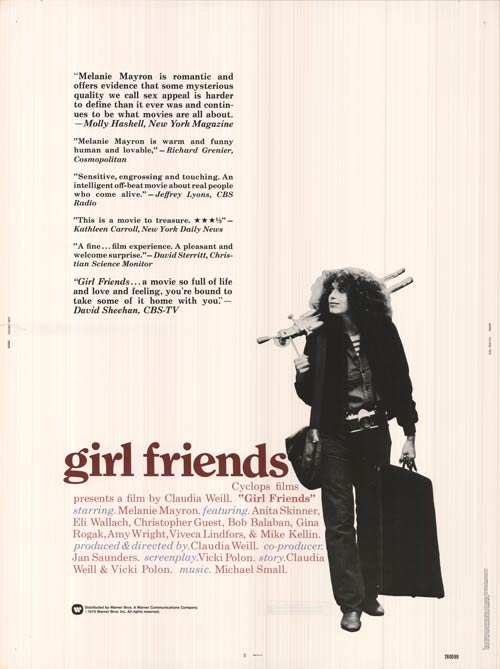
Girlfriends (1978)

By Richard Winters

My Rating: 6 out of 10

4-Word Review: She misses her friend.

Susan (Melanie Mayron) and Anne (Anita Skinner) are best friends and roommates, but when Anne decides to get married to Martin (Bob Balaban) and move out Susan can’t handle the solitude. She picks-up a hitch-hiker named Ceil (Amy Wright) who moves in for a bit, but it doesn’t work out. She then gets into a relationship with Eric (Christopher Guest) and even a 60-year-old married rabbi (Eli Wallach), but both of these end in heartache. The more Susan tries to ‘move-on’ the more she longs for the old days with Anne and Anne starts to feel the same way.

This was Claudia Weill’s feature film debut that met with high accolades including director Stanley Kubrick who considered it his favorite film of 1978. There’s a nice understated quality here that not only brings out a vivid late ‘70s feel, but also the very real day-to-day struggles of a young adult trying to swim through the quagmire of relationship and career obstacles. Melanie Mayron is certainly not a beauty by the conventional standard, but her plain appearance helps accentuate the challenges of the regular person trying to break-out and get noticed.

Susan’s struggles at trying to become a full-time photographer had me hooked the most as it portrays the universal challenges anyone can have in trying to get ‘their foot-in-the-door’ no matter what the profession, but I was a bit stunned when she forgets about the exhibition of her work at an art show. If someone is truly excited about getting their first big break then there is simply no way that would happen. It’s also hard for the viewer to completely empathize with someone’s career struggles if they themselves aren’t doing all they can to achieve it.

Another misguided wrinkle to the story was Susan’s relationship with a married rabbi who was almost 40 years older than her. These types of relationships suffer from extraordinarily long odds  and just about anyone would realize that from the get-go, which makes Susan’s ‘shocked’ reaction when the rabbi is unable to get together for a date due to family obligations seem almost  irrational. How a relationship like this could even begin to blossom is a whole other issue that never even gets addressed.

The film suffers from a few awkward scenes too. One has Wallach sitting down to play a game of chess with Melanie only for him to get up a minute later and leave for no reason. Why does he bother to show up for a chess game if he isn’t even going to make a single move on the board? Later Viveca Lindfors appears wearing a neck brace and yet no explanation is ever given for why she has it on. Later she’s shown without it, so why did she have it in one scene and not the other? Maybe it was for a minor accident, which can happen, but film is a visual medium and when something slightly askew gets shown it needs to get addressed even if it’s just in passing otherwise the viewer will key in on that and not the story.

Even more amazingly, and I can’t believe I’m saying this as I’ve never seen it in any other movie that I’ve ever watched before, but there’s an actual scratch on the camera lens that can be spotted in just about every scene. It appears on the top right hand side as a small white mark. If the sun is shining through a window it will reflect the light and be more pronounced. If a character walks in front of the window it fades a bit, but you can still see it and this continues throughout the entire run of the film. I can only presume that cinematographer Fred Murphy was aware of this, but due to the budget constraints they didn’t have enough money to replace the lens and decided to simply chug along with the scratch in place and hope no else would notice.

Ultimately though I found the story, in its simple way, to be touching and poignant this is particularly evident at the end where the viewer can see firsthand how friendships help add insight and support to a person’s life and are an important dimension to the human experience.

My Rating: 6 out of 10

Released: August 4, 1978

Runtime: 1 Hour 26 Minutes

Rated PG

Director: Claudia Weill

Studio: Warner Brothers

Available: DVD-R (Warner Archive), YouTube

Polyester (1981)

By Richard Winters

My Rating: 4 out of 10

4-Word Review: Suburban housewife has problems.

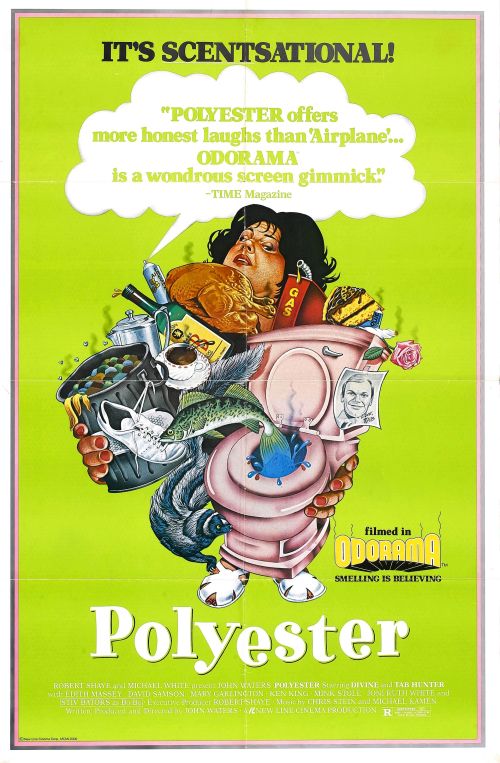
Francine Fishpaw’s (Divine) world is crumbling. Not only must she endure constant protests in front of her suburban Baltimore home dealing with people upset with her husband (David Samson) running an adult theater, but she must also deal with his affair with his sexy secretary (Mink Stole) as well. Her teenage son (Ken King) is terrorizing the city by intentionally stomping on the feet of every woman he sees and her daughter Lu-Lu (Mary Garlington) wants an abortion. She then meets the dashing Todd Tomorrow (Tab Hunter) and the two immediately fall-in-love only to find that he too has a dark-side.

This was John Waters’ first studio backed film and the first to garner an R-rating while the others had been X. While the budget is an improvement and its technicallys more polished the edginess is lost. The humor and satirical potshots don’t have the same zing and are lacking in originality and outrageousness. The gimmick of passing out a scratch-and-sniff cards where audiences could sniff the scents being smelled by the film’s main character seems excessively juvenile and the film begins with a campy scientist (Rick Breitenfeld) talking about it, which sets the tone too much on a silly/cartoonish level.

Divine’s presence helps, but she isn’t as made-up or as flashy as she was in her past films and looking much more like just some fat guy wearing a lady’s wig. I liked that her character was consistently normal for the most part as in the other films she behaved more erratically although what she goes through here is so unrelentingly traumatic that it borders on being almost cruel to laugh at. It’s also not completely easy to sympathize with her quandary as her kid’s behavior is so outrageous you have to question her parenting skills and whether she’s partially to blame for the bad things that they do.

Edith Massey is funny as a poor woman who wins the lottery and now acts a bit nouveau riche about it. It’s also fun seeing the two teens go through a Jekyll and Hyde transformation, but Tab’s appearance adds little although he does sing a decent opening title tune.

The broad humor for the most part is dumb, but I still found myself laughing-out-loud at some of it, which I suppose is a part of Waters’ ‘charm’ at getting you to laugh at things you otherwise wouldn’t. Some of the moments that had me chuckling were: a ‘nice’ picnic that gets ruined by ants and a skunk. Pregnant young women forced to go on a ‘happy hayride’ in the cold rain by two fascist nuns and the pet dog who commits suicide by hanging himself along with leaving a note saying ‘Goodbye cruel world’.  The part where overweight Jean Hill hijacks a bus and chases down a group of teens who assaulted her on the street and then bites into their car tires to disable their vehicle is pretty wacked-out too.

My Rating: 4 out of 10

Released: May 29, 1981

Runtime: 1 Hour 26 Minutes

Rated R

Director: John Waters

Studio: New Line Cinema

Available: DVD, Amazon Video, YouTube

Who is Killing the Great Chefs of Europe? (1978)

By Richard Winters

My Rating: 7 out of 10

4-Word Review: He eats too much.

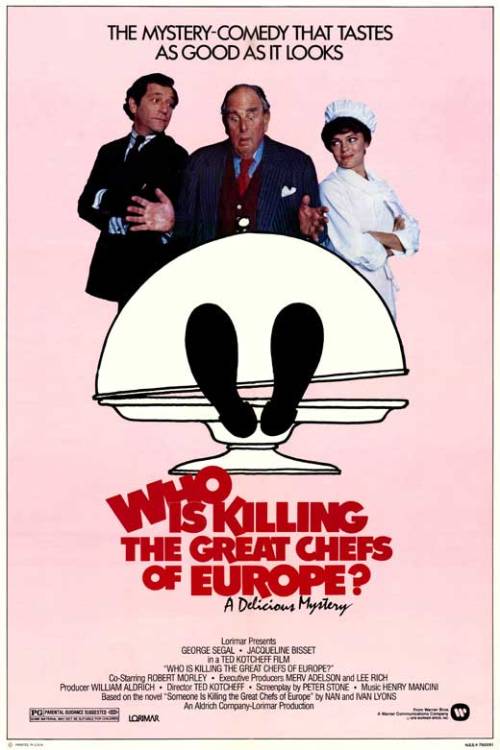
Max (Robert Morley) is a famous food critic who writes an article for the food magazine The Epicurist titled ‘The World’s Most Fabulous Meal’, which described four dishes cooked by four of the world’s top chefs. The problem is those chefs are now turning up dead. Natasha (Jacqueline Bisset) was the chef famous for creating the dessert called the bombe, which was also written about in that same article. Since the other chefs have already been murdered Natasha fears she may be next, so she works with the police to find the killer while also being a suspect since she was with each victim just before they died.

The film is based on the novel ‘Someone is Killing the Great Chefs of Europe’ by husband and wife writers Nan and Ivan Lyons, which came out two years earlier and had more erotic overtones while also detailing the specific recipes of each gourmet dish described in the story. Ted Kotchef’s excellent direction focuses strongly on the food element and each exotic meal is nicely captured and crafted by an actual cuisine chef named Paul Bocuse. Not only do you see the cast eating the stuff, especially Morley’s character, but preparing it as well including a detailed, drawn out segment showing Natasha creating her world famous desert.

The on-location shooting, done in three different European countries, is vivid and the dialogue is quite amusing. The denouncement is interesting because you think for sure it’s one person only to genuinely get surprised when it turns out to be someone completely unexpected. The plot though is too leisurely paced and the side-story dealing with Natasha’s ex-husband (George Segal) trying to rekindle their relationship is unnecessary and could’ve been cut, which would’ve helped shorten the runtime, which is overlong for such otherwise trite material.

Morley is a scene-stealer with everything he utters being hilarious. Bisset is great too and should’ve received top-billing as she’s seen the most while Segal’s presence comes off as downright intrusive. It was nice having a beautiful woman in a lead that was not sexualized and it would’ve made the film a bit ahead-of-its-time had she carried it alone, which she easily could’ve without Segal as a sort of male sidekick.

For light entertainment it’s enjoyable, but I was surprised at seeing how things have changed as there are several throwaway bits that at the time I’m sure were considered innocuous but would be deemed quite controversial by today’s standards. One scene has Bisset speaking with an Italian chef (Stefano Satta Flores) who openly pinches her twice on the rear without her permission. She protests it the first time, but he boldly does it again later and she lets it go, continues to casually talk to him and even agrees to meet him later for dinner. The film seems to play the whole thing off as a ‘boy-will-be-boys’ scenario coupled with the Italian male stereotype that this is simply ‘a part of their nature’.

In another part she refers to a French chef (Jean-Pierre Cassel) as a ‘fag’ and she visits a processing plant where thousands of chickens are housed in tight little cages and barely able to even move which doesn’t seem to bother her at all. I’m sure these scenes back in 1978 went completely over-the-heads of the viewers and most likely were quickly forgotten even though now these same moments would most likely elicit outrage, protest and headlines.

My Rating: 7 out of 10

Released: October 5, 1978

Runtime: 1 Hour 52 Minutes

Rated PG

Director: Ted Kotcheff

Studio: Warner Brothers

Available: DVD (Warner Archive)

Just Tell Me What You Want (1980)

By Richard Winters

My Rating: 6 out of 10

4-Word Review: Rich tycoon gets dumped.

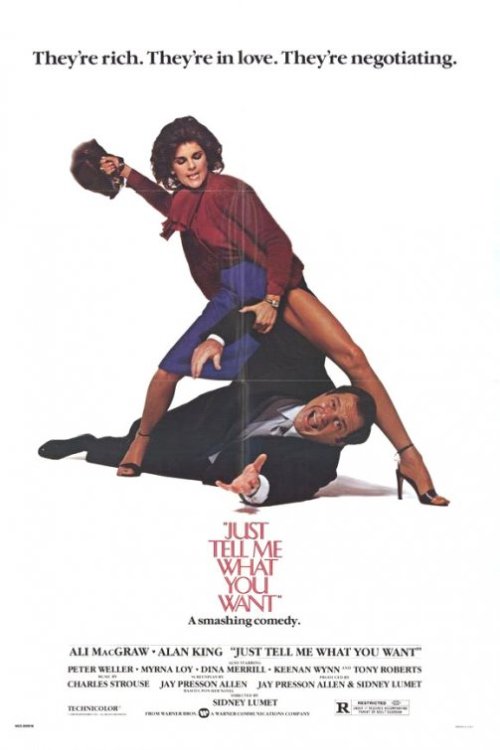
Max Herschel (Alan King) is a rich and successful businessman who’s used to getting what he wants. He’s rude and crude and doesn’t mind displaying his anger or contempt for others at a moment’s notice. After 14 years Bones (Ali MacGraw), his mistress, has decided she’s had enough. She leaves him for a much younger man (Peter Weller). This enrages Max who does whatever he can to win her back, or at the very least ‘punish’ her for leaving him.

The film, which is based on a novel by Jay Presson Allen has a delicious New York flavor with the majority of the action taking place at the Old Westbury Gardens estate that fronts as Max’s home. The interiors of the stately mansion are at times more interesting than the conversations and the exteriors coincidently were also used in Love Story, which was another MacGraw vehicle. Director Sidney Lumet gives the dark comedy a classy air with a rousing, distinctively jazzy score by Charles Strouse, which I wanted to hear more of and wouldn’t have minded if it had been played all the way through the movie.

The story has sharp dialogue and a deliciously acerbic edge, but becomes preoccupied with Max’s business dealings, which most viewers may find too complex to follow and aren’t that integral to the story. The first hour is spent focused on Max, whose obnoxious ways quickly become off-putting and tiring. The catalyst is his love-hate relationship with Bones and more scenes should’ve been shown with them together while having her break-up with him come much sooner.

King was a comedian known for angry monologues and that emotion gets channeled into his character. I’ll give them props for creating an unlikable lead and not holding anything back as too many times films create abrasive people only to soften them too soon or not go all-the-way with it. Here it gets pushed to the limit, but I was still hoping for Max to have more of an arch and was disappointed that he remains for the most part a callous jerk to the very end.

MacGraw’s restrained approach works well off of King’s flamboyance and the highlight is when she corners him at a luxury department store, which was filmed on-location at the Bergdorf Goodman, and tackles him while destroying everything in sight. However the character’s nickname of ‘Bones’ I did not care for especially with no explanation for why she was given it. Was she called this because she was thin, or was it for some other reason? An attractive female should be given a pleasant name not something that sounds demeaning.

Legendary actress Myrna Loy, who had been around since the silent film era, plays Max’s long suffering secretary and earns her pay here. Loved the scene where King cries right into her bosom while she holds his head and acts like his mother, but also the part where he shouts directly into her face even throws out the C-word and she doesn’t flinch. Keenan Wynn is likable and speaks with an accent in a sympathetic role as a Russian businessman and Dina Merrill’s emotional breakdowns as Max’s mentally fragile wife are impressive and could’ve been extended.

Spoiler Alert!

Overall though it fizzles and it’s not because it’s filled with a lot of extraneous dialogue and scenes that should’ve been cut, but more because it plays itself as this sort-of anti-romance only to sell-out at the end. There is simply no way anyone could truly fall-in-love with Max because there was nothing about him to love. Having him do one nice thing shouldn’t erase all the other bad things he did before. Bones had already spent 14 years with him which should be more than enough time to realize things won’t be any different moving forward. Having them reconcile by working together as business partners maybe, but a marriage is simply a disaster waiting to happen. Just because audiences long for the ‘happy ending’ doesn’t mean that’s what you give especially by having two people magically find love for each when none had ever existed before.

End of Spoiler Alert!

My Rating: 6 out of 10

Released: January 18, 1980

Runtime: 1 Hour 53 Minutes

Rated R

Director: Sidney Lumet

Studio: Warner Brothers

Available: DVD (Warner Archive), Amazon Video, YouTube

Carny (1980)

By Richard Winters

My Rating: 6 out of 10

4-Word Review: Runaway joins the carnival.

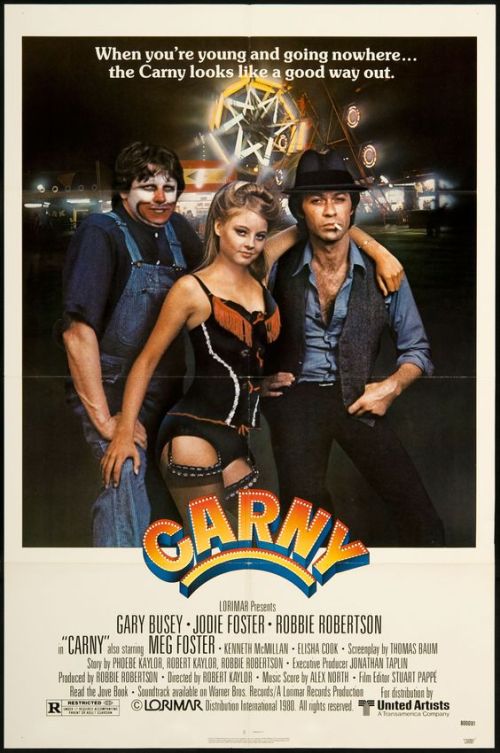
Bored with small town life and an overly-protective boyfriend (Craig Wasson) Donna decides at the age of 18 to break-free of her restraints and travel the countryside by working in a carnival. She befriends Frankie (Gary Busey) who works as a clown and she gets a job as one of the strippers before eventually working the string joint booth while slowly adapting to the shady ways of the gypsy-like lifestyle.

The carnival atmosphere is well-recreated and was directed by Robert Kaylor who years earlier helmed the documentary Derby, which was a behind-the-scenes look at life on the roller derby circuit and this film works much the same by fully immersing the viewer into the dark aspects of a tough environment while also exposing the personalities of the people who work in it. The revealing story manages to be both hard-hitting and intriguing.

The tone though stays too much on the negative side until the viewer feels almost bombarded with one unpleasant situation after another. There’s never anything redeeming and you’re made to feel tense waiting for the next uncomfortable twist to come about, which gets overdone. Certainly there had to be some good times and bonding that occurs and the film lightly touches on this at the very, very end, but I felt more of that should’ve been sprinkled in throughout.

There’s also too many con-games and underhanded shenanigans making me wonder if all carnivals were really this bad , or is it simply playing-it-up for dramatic purposes. The ending in which everyone works together to pull off an elaborate con on a meddling crime boss (Bill McKinney) comes off too much like a poor rendition of The Sting. Some potentially intriguing storylines get dropped; like what happened to Donna’s psycho boyfriend when he finds out that she has left him? I was fully expecting him to come back into the picture at some later point once he tracked her down, but instead he gets forgotten.

Robertson is a famous songwriter and musician whose been around since the ‘60s, but he grew up working in the carnival circuit and helped put his real-life experiences and insights into the script. His performance is okay, but the soundtrack he composed for the film is too upbeat and does not jive with the dark, moodiness of the plot.

The performances are the best thing. Foster usually plays characters that are confident, but here she is someone who is unsure of herself only to acquire an edge as the story progresses. Kenneth McMillan is engaging as the nervous, stressed-out owner and Meg Foster is good as a woman who’s become hardened from being on the road too long. Gary Busey is a standout too even though he sometimes gets mocked today for his weird behavior off-screen, but this guy was at one time considered a serious up-and-coming star and his presence here shows why.

My Rating: 6 out of 10

Released: June 13, 1980

Runtime: 1 Hour 47 Minutes

Rated R

Director: Robert Kaylor

Studio: United Artists

Available: DVD (Warner Archive), Amazon Video, YouTube

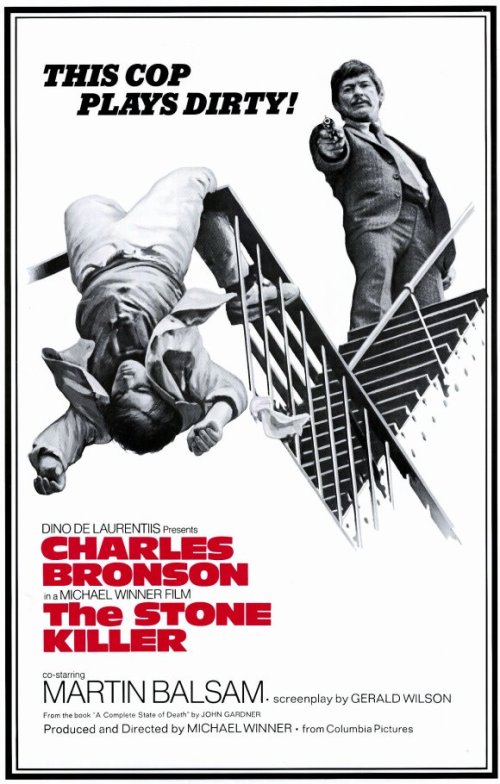
The Stone Killer (1973)

By Richard Winters

My Rating: 5 out of 10

4-Word Review: Tough cop is relentless.

Lou Torrey (Charles Bronson) is an old-school cop baffled by a rash of homicides that initially seem like random hits, but really aren’t. As Lou investigates further he uncovers a plot orchestrated by a Mafia Don (Martin Balsam) to use a group of Vietnam Vets to avenge the death of some Mafia families 42 years earlier.

Director Michael Winner, during his later directing projects, became synonymous with stale, cardboard B-pictures and after the year 2000 he dropped out of the movie business completely and became a celebrity food critic in the UK writing in a weekly newspaper column called Winner’s Dinners. Here though he shows signs of being a young talent on the rise looking to make his cinematic mark. He captures the lesser seen areas of L.A. with a flair and the shot selection has style that manages to seamlessly connect the film between its talky moments and action.

Bronson though can’t really act as his facial expressions rarely change and he says his lines in an unemotional way making him seem almost like a computer, but his hard-headed personality in real-life carries over to the big screen making him a perfect fit personality-wise to the character. John Ritter is good as a young cop caught making a lot of rookie mistakes. It’s also interesting seeing Stuart Margolin here as he has an important sequence in the desert, which connects with his appearance  in another Bronson hit Death Wish that also had him in the sandy landscape.

The story, which is based on a novel by John Gardner entitled ‘A Complete State of Death’ comes off as flimsy and just an excuse to tie-in a lot of loosely related action sequences. The plot is hard-to-believe and the villain is more like a caricature and barely seen.

There’s some enjoyable moments including Bronson’ relentless chase in a car of a police suspect, played by Paul Koslo, who tries to evade him by tearing through the city streets on a motorbike. Watching Chuck drive through park tables with people trying jump out of the way,  going into oncoming traffic and even storefront windows is impressive on the surface, but ultimately makes the character come-off badly. In real-life a cop barreling his vehicle through areas with so much foot traffic would make him irresponsible and a menace to society as he puts too many people in direct danger simply for his pursuit of one person.  In most cases there would’ve been casualties and Bronson’s character could’ve easily been fired or sued.

The mass assassination of all the Mafia Dons has pizazz, but ultimately it’s just one giant marketing ploy as it borrows many elements from other hit movies of that time including Dirty Harry and The Godfather then blends it together with over-the-top action and a farfetched plot.

My Rating: 5 out of 10

Released: August 8, 1973

Runtime: 1 Hour 35 Minutes

Rated R

Director: Michael Winner

Studio: Columbia Pictures

Available: DVD, Amazon Video, Blu-ray