Category Archives: Movies that take place in Texas

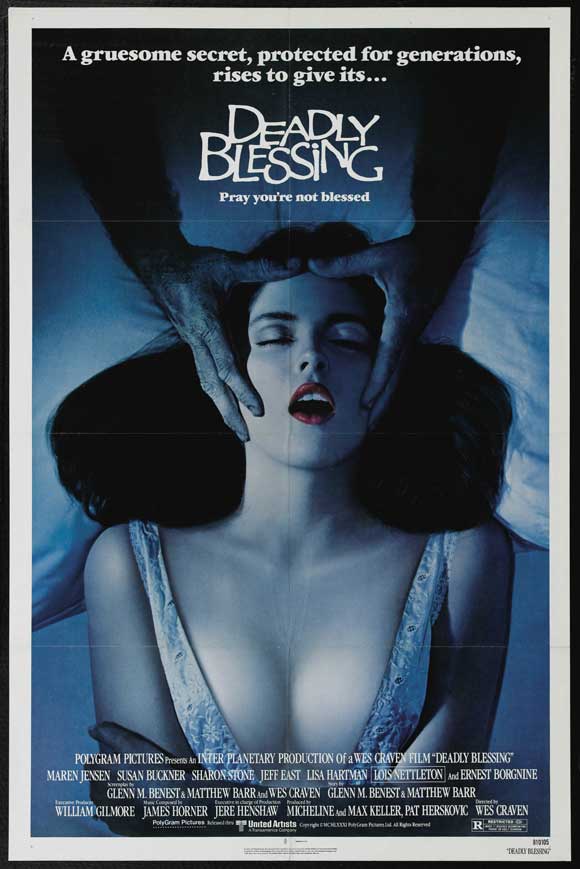
Deadly Blessing (1981)

deadly blessing

By Richard Winters

My Rating: 5 out of 10

4-Word Review: Murder in bible country.

When her husband is killed in a mysterious tractor accident Martha (Maren Jensen) must try to forge on alone while living on an isolated farm surrounded by a religious sect known as The Hittites who show great disdain towards her due to the fact that she is not one of them. Lana and Vicky (Sharon Stone, Susan Buckner) are two of her friends who come to visit and offer solace. Soon more deaths and strange events begin to occur convincing them that the feared incubus, which is a male demon who descends onto female victims as they sleep, may soon be approaching.

This low budget foray, which was filmed in both Ohio and Texas and directed by Wes Craven, is competent enough to hold the viewer’s attention despite a convoluted story that goes on longer than it should. The best part of the film is its female cast, which to date marks the last acting role for both Jensen and Buckner as well as the first speaking part for Stone. Jensen, whose nude scenes were done by a body double, is okay, but Stone is the better actress and looks just as beautiful today as she did back then. In case you thought that actors didn’t earn their pay she certainly does here by allowing a live spider, albeit with its teeth removed, to fall into her mouth during a creepy nightmare segment that I’m not sure I would’ve been up to myself. The film also features Lisa Hartman and the ageless Lois Nettleton as her mother.

The shocks are trite and the creepiness at only a minimum. However, the segment where a large snake crawls into the bathtub while Jensen is in it had me creeped out and the scene involving Buckner having her car set on fire while she is still inside is good too, but both of these segments are similar to ones that Craven used in his later films making me believe that his horror concepts had a definite limit.

The Hittites, which are presumably so strict that they make the Amish look like ‘swingers’, are too one-dimensional and their leader, which gets played stoically by Ernest Borgnine, seems unusually hateful.  I can’t say that there aren’t religious sect leaders that are like him, but I don’t believe they would be so outwardly hostile to people from outside his group and would try to put on more of a kindly façade. I also thought the idea of the Buckner character starting a relationship with one of the Hittite boys, which is played by Jeff East, was unrealistic as they came from such vastly different backgrounds that trying to form any lasting bond or connection would be expectedly slim.

Michael Berryman as one of the more aggressive sect members gives an energetic performance and the fact that Craven advertises another one of his other projects, the TV-Movie Summer of Fear, on a theater marquee during a segment shot in the town, deserves a few merits, but what I really liked was the completely unexpected surprise ending that helps the film rise above the usual ‘80s horror and was something that was forced onto Craven by the producers and not actually of his own devising.
deadly blessing 2

My Rating: 5 out of 10

Released: August 14, 1981

Runtime: 1Hour 42Minutes

Rated R

Director: Wes Craven

Studio: United Artists

Available: VHS, DVD, Blu-ray, Amazon Instant Video

Lovin’ Molly (1974)

lovin molly

By Richard Winters

My Rating: 4 out of 10

4-Word Review: Two men one woman.

Molly (Blythe Danner) is a free-spirited woman living in a small Texas town during the 1920’s. Gid (Anthony Perkins) and Johnny (Beau Bridges) are best friends who also both like her. Molly likes them as well, but can’t seem to decide which of the two she loves better, so to solve things she gets married to Eddie (Conard Fowkes). This doesn’t go over well with the other two, but as time goes by she continues to see them and even has children from both of them, which causes a stir in her small community. Not only does she become the product of the local gossip, but virtually ostracized as well. However, Molly is undeterred about what everyone else thinks and sticks to her independent ways.

Based on the Larry McMurtry novel the film was directed by the legendary Sidney Lumet, but you would hardly know it. The production looks cheap and rushed and lacks atmosphere or period detail. The scenes are flatly shot with very little visual design or imagination. The whole thing comes off as something that did not get any major studio backing and was forced to look to private investors for funding, which unfortunately was just not enough.

Filming it on location in Bastrop, Texas which is also the setting of the story helps a little as the town has many historical buildings, which heightens to some extent the period atmosphere, but I would’ve liked to have seen more of it. The dry Texas landscape is also nicely captured and makes the viewer feel like they are living in the state themselves with each and every shot. The one thing though that really impressed me was how realistically the characters aged as the story, which spans 40 years, progresses. In most films the actors are forced to wear a ton of makeup, which gets overdone, but here very little of it was used and it looked far better.

Danner, who these days is best known as the mother of Gwyneth Paltrow, is excellent in a rare turn as a leading lady and even appears fully nude from the front and back. Perkins is solid in support and I enjoyed seeing Bridges with a bowl haircut. The star though that really steals it is Edward Binns as Perkins’ father whose caustic and to-the-point remarks are gems.

Fred Hellerman’s flavorful bluegrass score is pleasing, but the film itself fails to elicit much emotion. The only times that it does become mildly interesting is when the characters do a voice-over narration by reading off of passages lifted directly from its source material making me believe that this should never have been filmed in the first place and left simply in its novel format.

My Rating: 4 out of 10

Released: April 14, 1974

Runtime: 1Hour 38Minutes

Rated R

Director: Sidney Lumet

Studio: Columbia Pictures

Available: DVD (Region 2), Amazon Instant Video
Manos: The Hands of Fate (1966)

manos 2

By Richard Winters

My Rating: 1 out of 10

4-Word Review: Worst movie ever made.

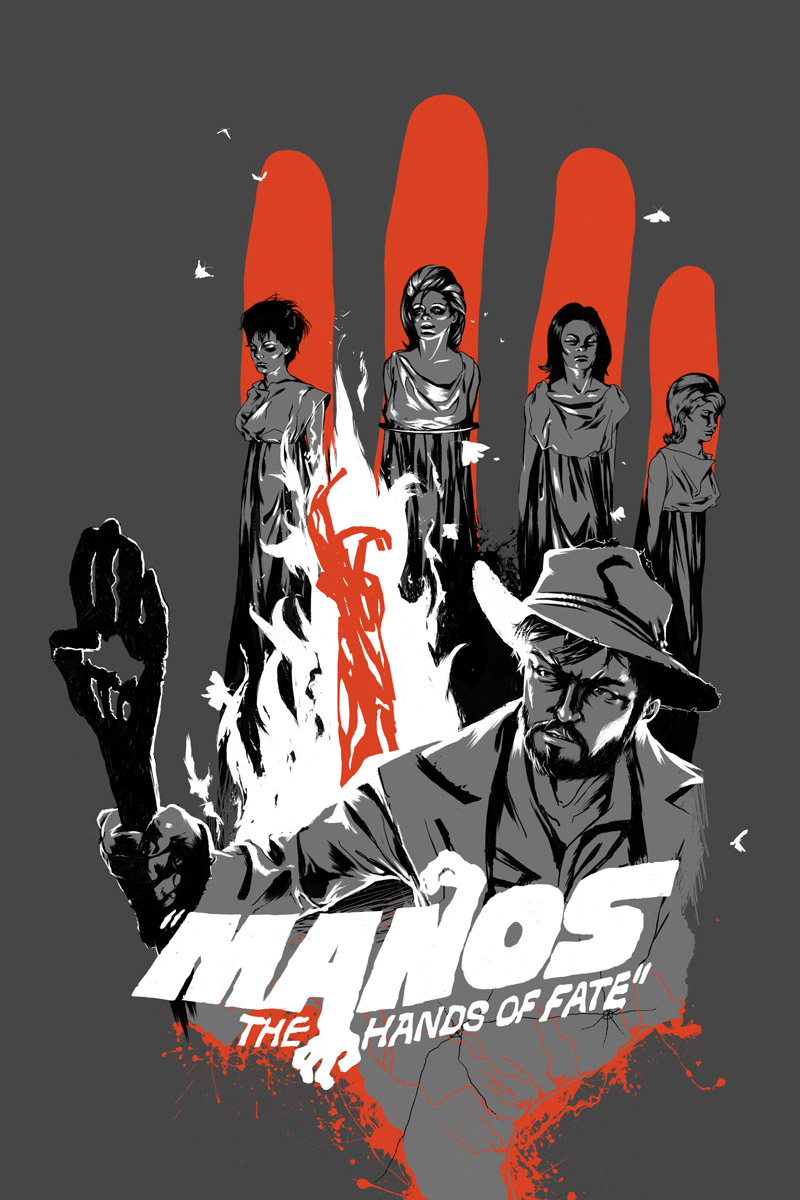
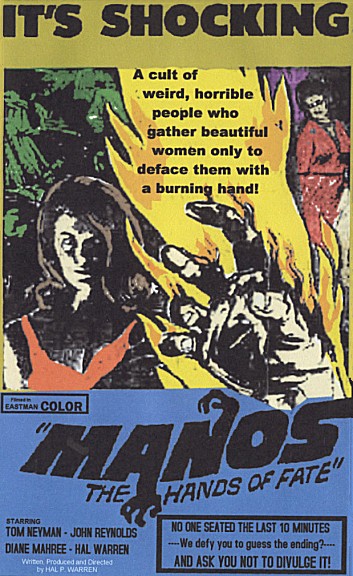
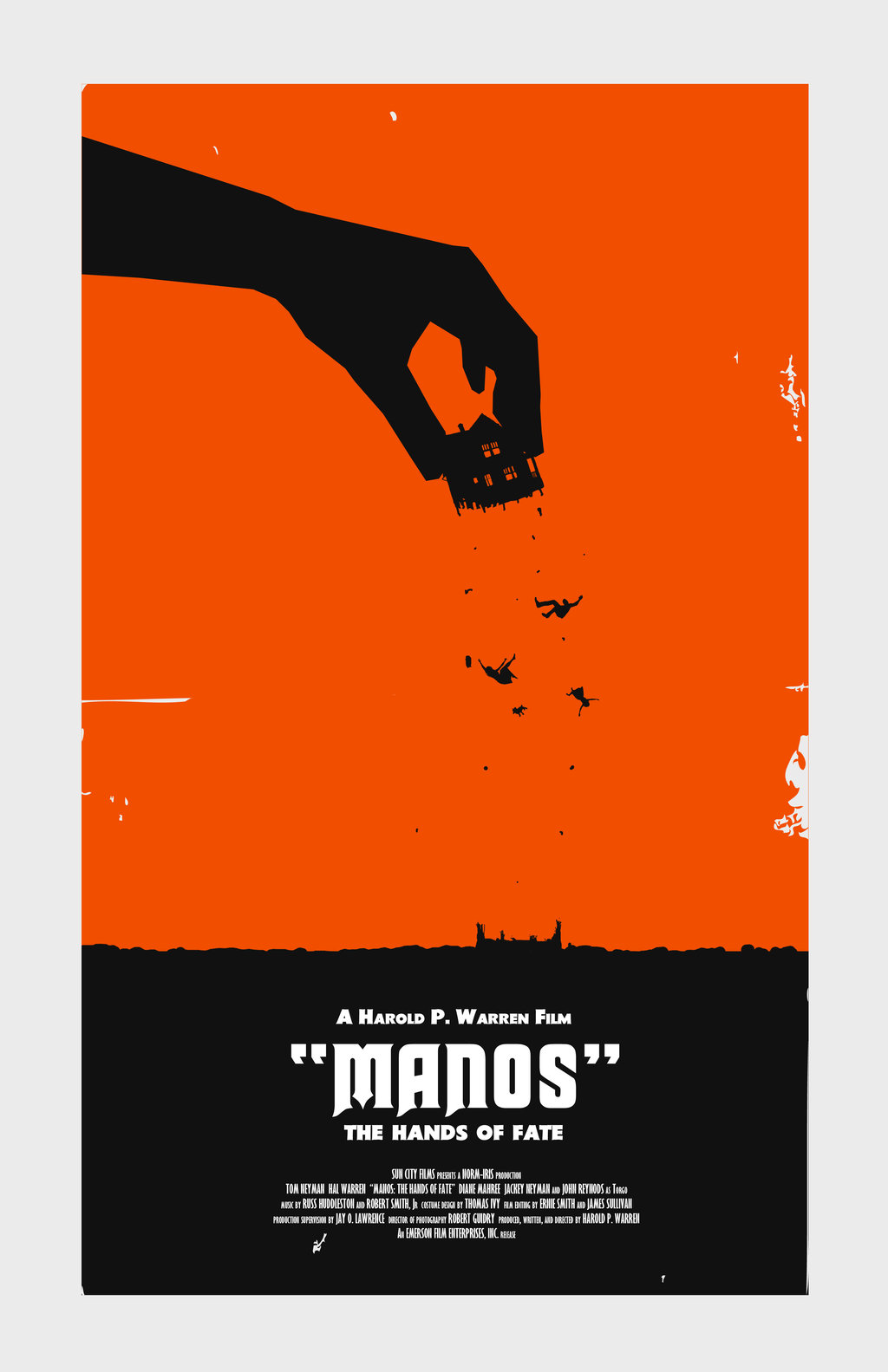
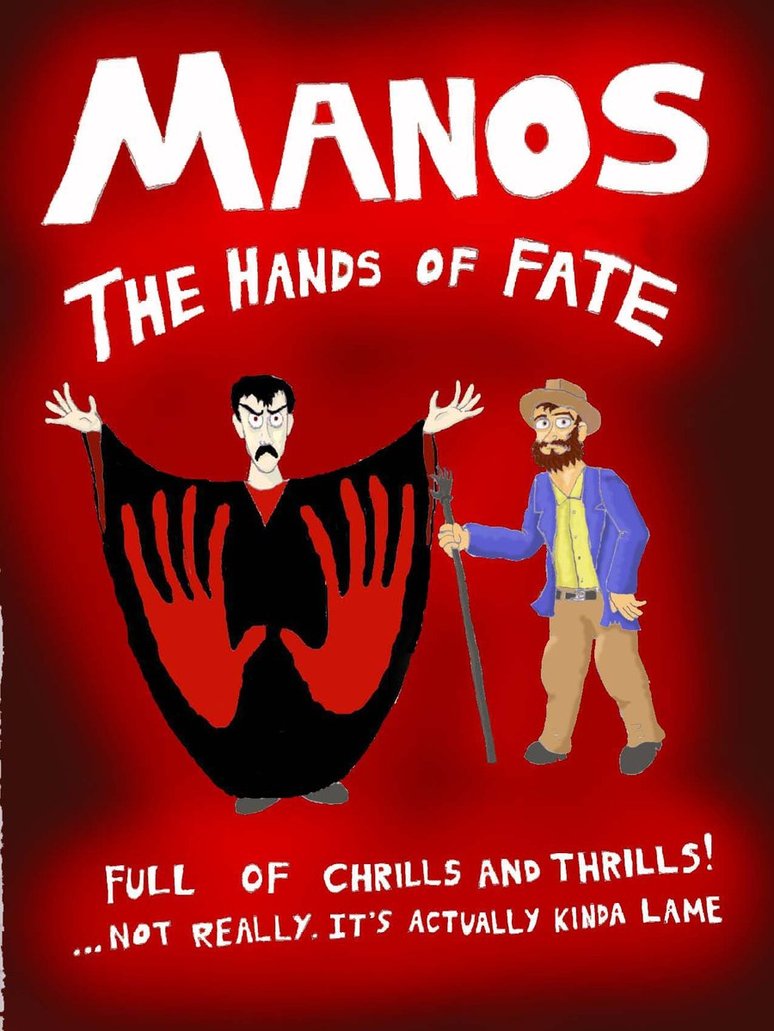
Husband and father Michael (played by the film’s writer/director Harold P. Warren) takes his wife Margaret (Diane Adelson) and their young daughter Debbie (Jackey Neyman) on a trip. Along the way they become lost in the middle of the west Texas desert and after driving around for hours finally come upon an isolated building in the middle of nowhere. Standing guard outside is a strange man named Torgo (John Reynolds) who invites them inside. Feeling they have no choice the family agrees to go in unbeknownst that the place is managed by an evil devil worshipping man known as The Master (Tom Neyman) who is already married to six wives and looking to add another to his ‘flock’.

This film came about as a bet between insurance salesman Warren and award winning screenwriter Stirling Silliphant who was in the El Paso, Texas area scouting locations for his next movie. Warren met him by chance at a local café and then proceeded to tell him that ‘anyone’ could make a movie and bet him that he could successfully do one without having any prior experience or budget. Warren even wrote the majority of the film’s screenplay on his napkin at the restaurant before the two had even left. He was then able to secure $19,000, which even for the time period wasn’t very much as well as a hand-held camera that could only shoot 32 seconds worth of film at a time. He rounded up some actors from a local theater for the cast and unable to pay them upfront promised that they would receive reimbursement for their efforts once the film was released and made a profit, which never happened.

manos 1

The result of all of this is a film that many critics and viewers consider to be the worst ever made. The film’s biggest problem is that there was no sound recorded during the filming and it all had to be dubbed in later causing it to come off like a silent movie with music used throughout the whole thing in order to help ‘narrate’ the mood and scene much of which is jazz sounding that doesn’t really connect with the horror genre to begin with. The takes go on waaaay longer than they should including a long stretch at the beginning where we see nothing but passing scenery of a barren Texas landscape that goes on endlessly.

manos 4

The filmed bombed upon its initial release and was only seen at a few theaters in the El Paso area before being forgotten completely. When Jackey Neyman attended collage during the early 80’s and told friends that she had at one point been in a film as a child her friends set out to find a copy and were unable to. It wasn’t until 1993 when this film was shown on an episode of ‘Mystery Science Theater 3000’ that it garnered the cult following that is has now including a Blu-ray release that is set to come out on October 13th of the this year that will have as a bonus not one, but three featurettes included, which I guess proves that these days bad is now the new good.

For my part I liked the general premise, which if put in more competent hands and with a better budget might’ve been interesting. I also enjoyed Adelson as the wife who is beautiful and went on to have a career as a model. The twist ending is also kind of neat, but without some sort of rifftax attached this otherwise boring thing is not worth catching.

manos 5

manos 6

My Rating: 1 out of 10

Released: November 5, 1966

Runtime: 1Hour 14Minutes

Not Rated

Director: Harold P. Warren

Studio: Emerson Film Enterprises

Available: DVD, Blu-ray (Release date October 13, 2015)

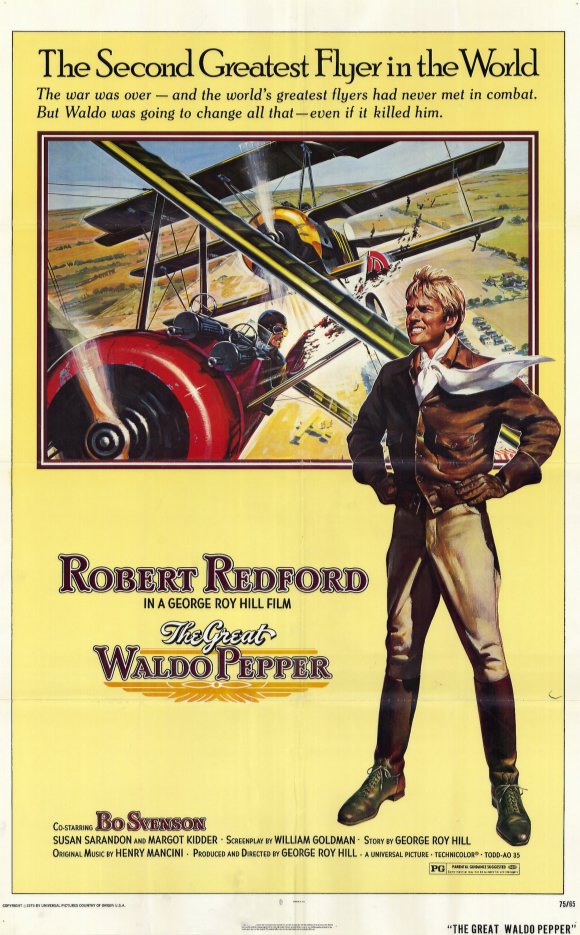
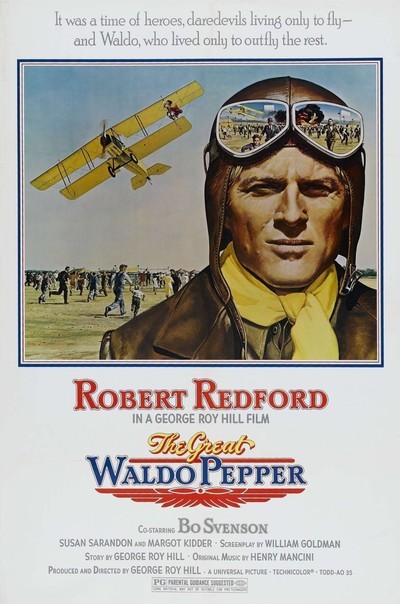
The Great Waldo Pepper (1975)

great waldo pepper 1

By Richard Winters

My Rating: 7 out of 10

4-Word Review: Flying the unfriendly skies.

Waldo Pepper (Robert Redford) makes a living traveling the Midwest during the 1920’s and giving rides on his biplane to the eager public of the small towns that he goes through as well as doing airplane stunts at aerial shows. He misses his years during WWI when he was a fighter pilot trying to take on the German flying ace Ernest Kessler (Bo Brundin). Later when Pepper is grounded and can no longer fly legally he gets a job as a stunt man in Hollywood. It is there that he meets Kessler who is now working as a consultant on a movie about his flying days and the two agree to relive their war battle by having a duel to the death in the skies.

The aerial footage is the film’s greatest asset and it is amazing particularly since the actors did all their own stunt work and without any type of protection. When we see actor Bo Svenson walk out onto the wing of the plane while in midair and even fall through it it’s all real and it makes you hold your breath. The scene where Redford flies his plane underneath another one in an attempt to save Susan Sarandon who has walked out onto the wing and then unable to come back is equally nerve-wracking.

great waldo pepper 3

The film’s biggest fault and probably the reason why this big budgeted picture became an unexpected box office flop is because its unable to retain the breezy fun loving atmosphere of Redford’s and Hill’s two earlier collaborations. The film starts out amusingly enough, but then becomes quite serious when it features two deaths. The first one is good because it is completely unexpected and hits home the fact that stunt flying can have a dangerous side, but then the film has another death occur just 10 minutes later and it’s far more gruesome and drawn out while sucking all the lightheartedness out, which it’s never able to recover from.

I’ve never been overly impressed with Redford as an actor. Sure he’s great looking and competent at times, but he always has too much of a laid back persona and unable to ever show any intensity even though he did manage to grow on me more as the film progressed. The supporting cast of Svenson, Philip Bruns and a young Susan Sarandon fare better and help keep the film afloat.

The third act where Waldo meets his idol only to find that the man isn’t quite as successful or exciting when he is on the ground as he was in the air is where the film gels as it makes some strong points about our culture’s need for hero worship and their climactic aerial duel is both thrilling and amusing.

great waldo pepper 2

My Rating: 7 out of 10

Released: March 13, 1975

Runtime: 1Hour 47Minutes

Rated PG

Director: George Roy Hill

Studio: Universal

Available: VHS, DVD, Amazon Instant Video, YouTube

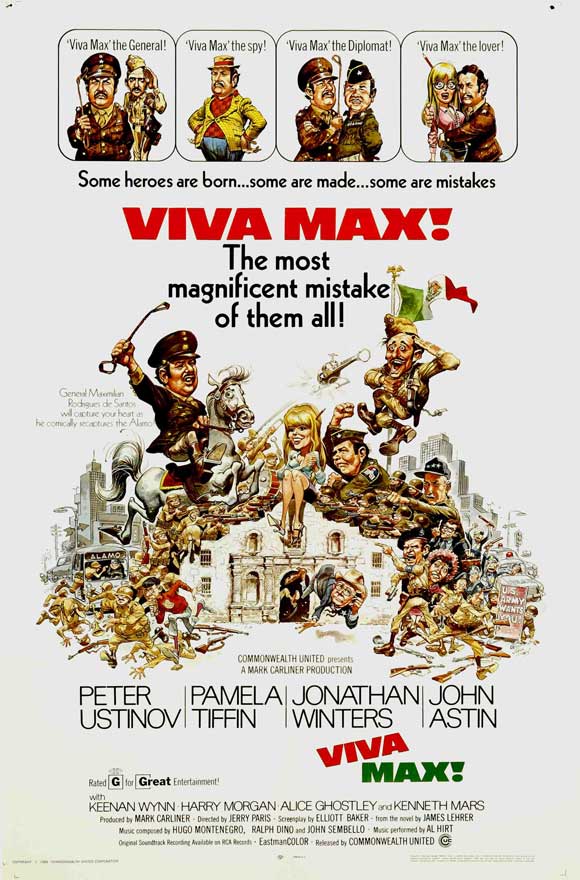
Viva Max! (1969)

viva max 2

By Richard Winters

My Rating: 3 out of 10

4-Word Review: Taking back the Alamo.

A small ragtag Mexican army led by the affable, but incompetent General De Santo (Peter Ustinov) decides to cross the border and recapture the Alamo. The process goes much easier than expected despite the fact that the army used no bullets in their guns. The National Guard is then sent in to weed them out, but they too decide not to load their guns with bullets leading to some unusual results.

The film is based on the novel written by PBS newsman Jim Lehrer and the movie’s behind-the-scenes politics ends up being much more interesting than the plot itself. Filmed in April of 1969 the production initially had permission from the state to film right on the actual site of the Alamo and a major portion was done there before various citizen groups became aware of it and began protesting the crew’s presence in what they considered to be sacred ground. Some of their protests was captured on film and incorporated into the story, but their loud presence eventually disrupted the production forcing some scenes to be done on an indoor studio soundstage while still others were completed in Italy.

The commotion and ‘controversy’ was not worth the effort as the film is an overall bore. The first 15-minutes are amusing and even mildly engaging, but once it gets inside to the actual Alamo the action and pace come to a screeching halt and kill any possible potential that the film may have had.

The script also has some illogical loopholes one of them being the army deciding to invade a place, but without using any ammunition, which is never explained and highly improbably. What is even more ridiculous is that the National Guard would decide not to use bullets in their guns either since this is the U.S. of A. where guns and force are considered a national birthright and thus makes this ill-conceived plot twist to be unbelievable to the extreme. The fact that De Santos and his men and able to freely leave at the end and go back to their country without dealing with any type of consequence for their actions is equally absurd.

Ustinov is funny and speaks in an authentic Mexican accent, but he’s unfortunately limited by the broad caricature of his role. John Astin comes off best as the Sergeant that’s second in command and does most of the actual disciplining and leading and Jonathan Winters is good as a clueless American general. Alice Ghostley lends some energy as an innocent bystander that becomes one of the army’s prisoners and Pamela Tiffin looks great wearing glasses and having her hair tinged in blonde.  Gino Conforti, Paul Sand, Jack Colvin, Anne Morgan Guilbert and Kenneth Mars can also be spotted in small roles, but even with their competent performances it fails to mask the film’s otherwise glaring inadequacies.

My Rating: 3 out of 10

Released: December 16, 1969

Runtime: 1Hour 34Minutes

Rated G

Director: Jerry Paris

Studio: Commonwealth United Entertainment

Available: VHS

The Deadly Tower (1975)

deadly tower

By Richard Winters

My Rating: 7 out of 10

4-Word Review: Sniper in the tower.

This made-for-TV movie chronicles the events of August 1, 1966 when 25-year-old ex-Marine Charles Whitman (Kurt Russell) climbed to the top of the University of Texas campus tower and shot and killed 16 people while wounding a total of 32. The story intercuts between scenes showing Whitman preparing for the shooting while also looking at the private life of Officer Ramiro Martinez (Richard Yniguez) who eventually climbed up the tower to stop Whitman’s slaughter.

For the most part the film is taut and methodical and well above average for a TV film although Gilbert Roland’s voice over narration was unnecessary and a bit cheesy. The only time there is any music is during the scenes showing Whitman killing his mother and wife with a knife, which gets a bit too overly dramatic, but otherwise it comes off almost like a documentary making the viewer feel that they are right there as it is happening. It was filmed at the Louisiana State Capitol, which looks a bit different than the actual clock tower, but still similar enough that it works.

Russell who had just come off starring in a long line of Disney films is perfect in the role and even closely resembles the real Whitman. The fact that he has very few lines of dialogue is an asset and helps to make the character more foreboding and threatening. The rest of the all-star cast does pretty well although Forsythe’s character seems added simply to promote the gun control issue. Clifton James appearance as one of the police sergeants was misguided because he had already done a comic caricature of a redneck sheriff in the James Bond film Live and Let Die, so it was hard to take him seriously here and it took me out of the movie a bit because it kept reminding me of that one as well as his goofy policeman role in Bank Shot.

The film also takes liberties with the actual events in strange ways that makes no sense. For instance in the film when Whitman comes upon the tower receptionist he simply guides her to the elevator and tells her to leave, but in real-life he knocked her to the ground and split her head open before later shooting her. Also, in the film the first victim that he hits from the tower is a male, but in the actual incident it was an 18-year-old female who was eight months pregnant. The story also erroneously credits Martinez with the one who killed Whitman when the later autopsy found that all four shots that Martinez fired at Whitman missed him and it was actually the two shots fired by Officer Houston McCoy who stepped in after Martinez had emptied his rounds that proved to be the lethal hit. In fact Officer McCoy’s name gets changed here and is listed as C.J. Foss and is played by actor Paul Carr as a minor throwaway part that is barely seen at all.

Both McCoy and Martinez sued the producers for the inaccuracies. Martinez was upset because his wife was portrayed as being pregnant and Hispanic when in reality she had been German-American. The sidelight drama of some marital discord between the two was also apparently untrue and should’ve been left out completely as it adds nothing and bogs the thing down as a needless Hollywood-like soap opera.

My Rating: 7 out of 10

Released: October 18, 1975

Runtime: 1Hour 40Minutes

Director: Jerry Jameson

Studio: MGM

Available: DVD (Warner Archive)

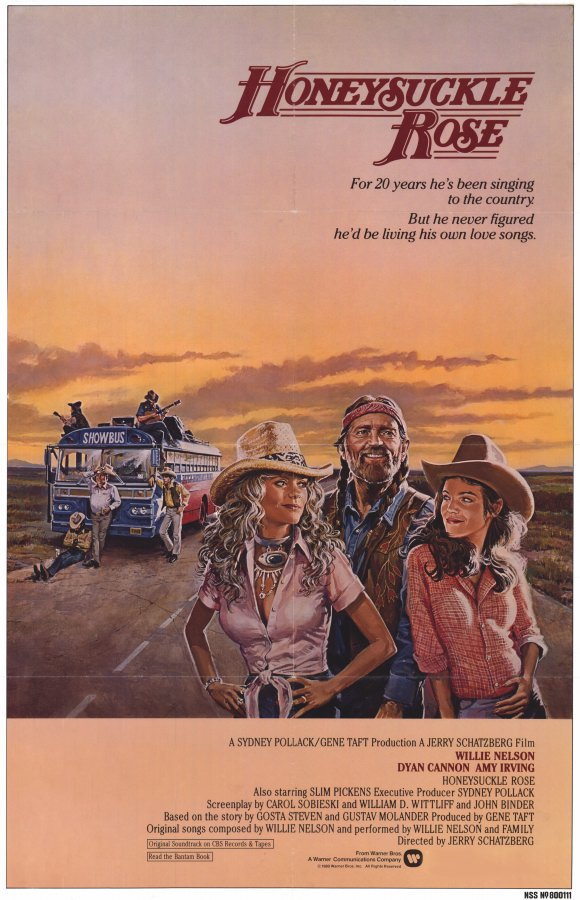
Honeysuckle Rose (1980)

honeysuckle rose

By Richard Winters

My Rating: 4 out of 10

4-Word Review: On the road again.

Buck Bonham (Willie Nelson) is a country music singer who enjoys life on the road traveling to different concert venues with his band much to the consternation of his wife Viv (Dyan Cannon) who wants him to stay home more and help raise their child. When his longtime guitarist Garland (Slim Pickens) decides to retire they bring in Garland’s daughter Lily (Amy Irving) as a temporary replacement. Then Buck starts fooling around with Lily, which creates turmoil both with Buck’s relationship with his wife as well as Lily’s relationship with her father.

After his successful stint in Electric Horseman this film was supposed to send Nelson to the next level as a leading man, but fails miserably because the guy just can’t act. In fact he conveys his lines in such a laid back manner it’s almost like he’s half-asleep and not even there. His screen presence is nil and he ends up being badly upstaged by both Cannon and Pickens. I realize he is considered a country music legend and has many adoring fans, but personally his trembling voice type of singing is not for me. Out of the many, MANY songs that he sings during the course of this picture the only one I even remotely liked was ‘A Song for You’ and even then I consider the Leon Russell version to be far superior.

The film like its star is too laid back. It takes a full 30 minutes before we get anything even resembling a plot going. There’s lots of concert footage and scenes taken on their traveling bus, which to some extent gives the viewer a good taste of what life on the road is like, but then it becomes excessive. It’s almost like a concert movie with the slightest of plots intermittingly mixed in for good measure. The story itself is too obvious and takes too long to play out and then when it finally gets going and we have some actual dramatic tension it then resolves too quickly.

Cannon is pretty good and even does her own singing. Irving on the other hand seems in-over-her-head and looks quite uncomfortable playing on stage. She got nominated for a Razzy award for worst supporting actress and I felt it was well deserved. Rodeo clown-turned-actor Pickens is super in one of his best roles that allows him to show both his comedic and dramatic side. Lane Smith is hilarious in a brief, but funny stint as an aggressive agent looking to get his client, a guitarist who wears some very loud suits, into the band while also trying to push some cheesy money making schemes on the side.

The part where Pickens attacks Nelson with a gun and chases him all around a lonely beach is amusing as is their drunken bus ride along an isolated Mexican highway. I also liked Irving meeting with her father after the secret of her affair has come out as well as her moment of apology to Cannon, but this all comes during the film’s final 20 minutes. Before then it’s just a lot of stock footage of Nelson on stage, which is nice if you enjoy his singing, but not if you’re looking for an actual movie, which at times this barely seems to be.

My Rating: 4 out of 10

Released: July 18, 1980

Runtime: 1Hour 59Minutes

Rated PG

Director: Jerry Schatzberg

Studio: Warner Brothers

Available: VHS, DVD, Amazon Instant Video
The Sugarland Express (1974)

sugarland express 4

By Richard Winters

My Rating: 7 out of 10

4-Word Review: She wants her baby!

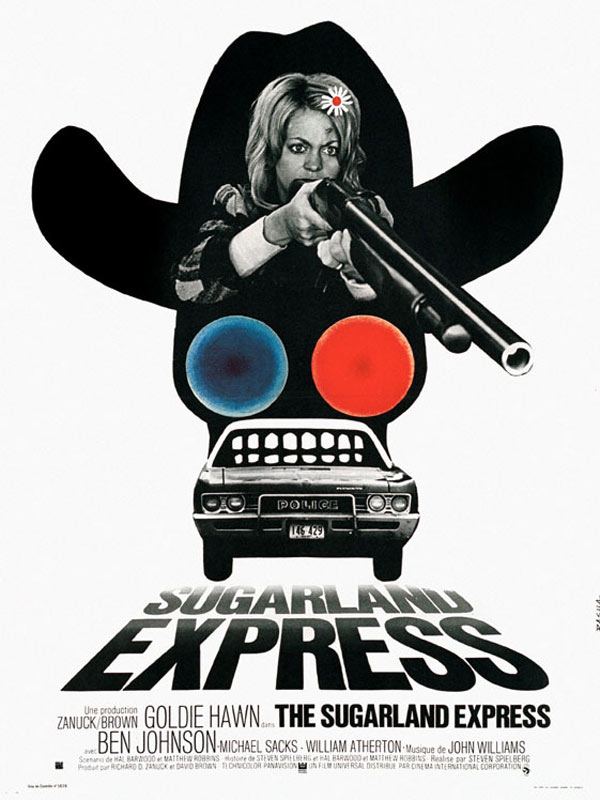
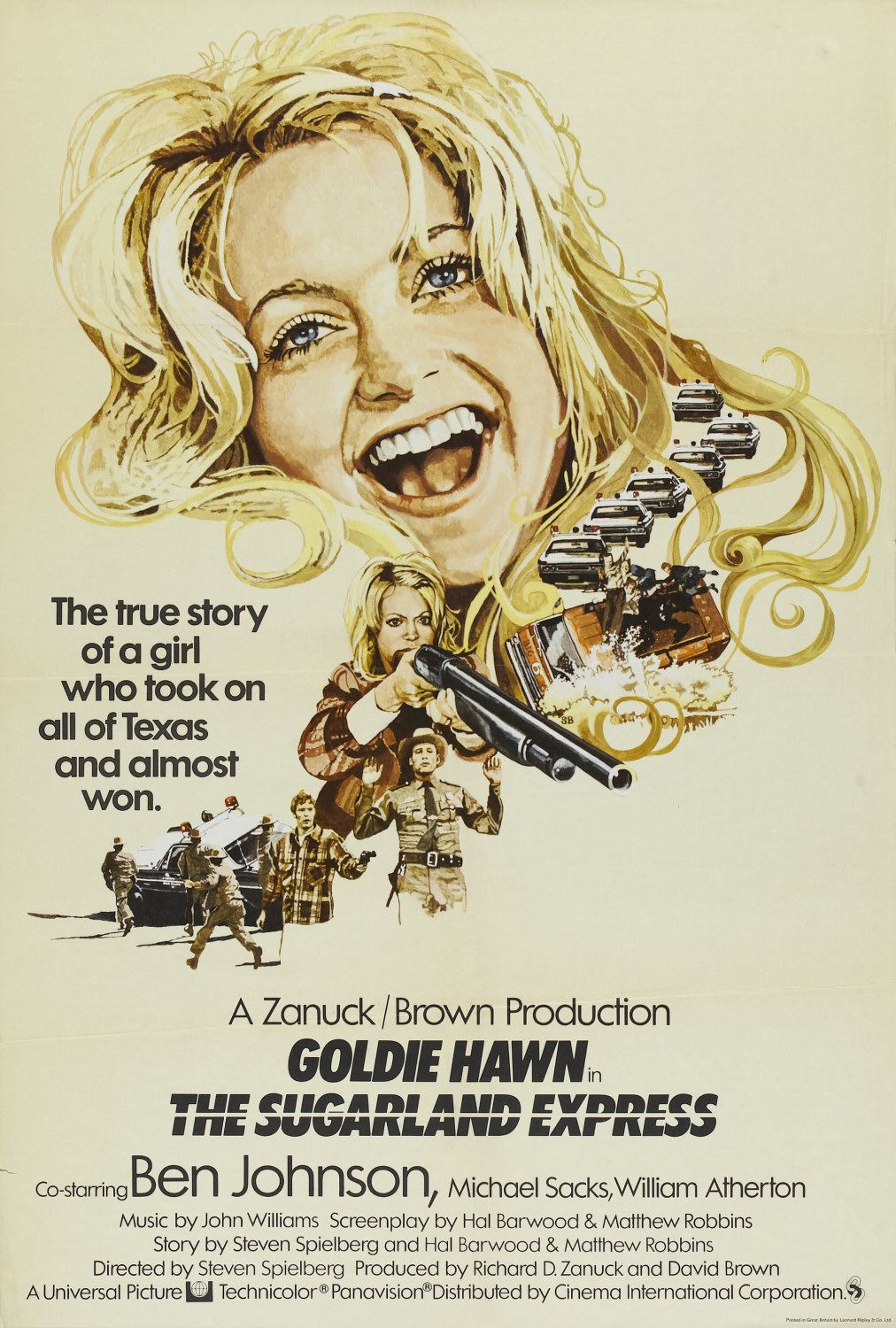
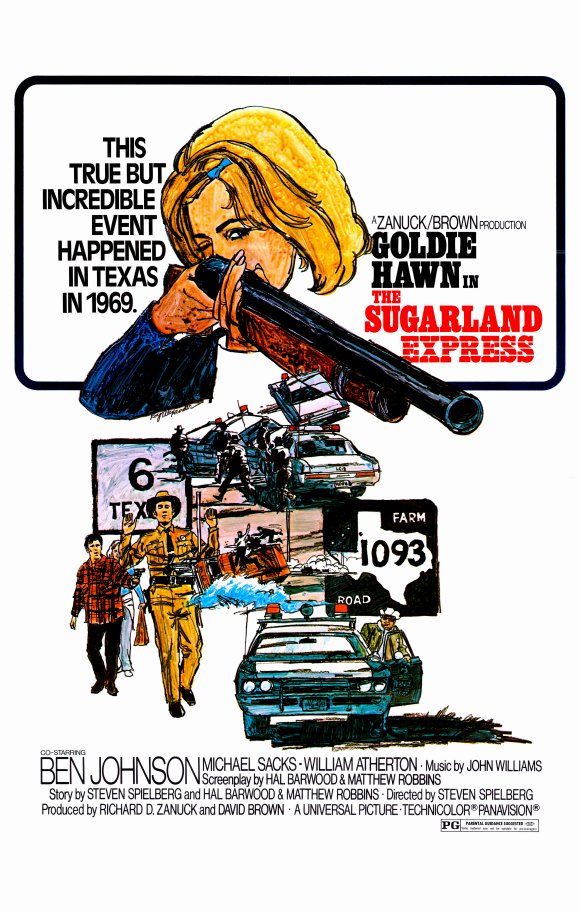
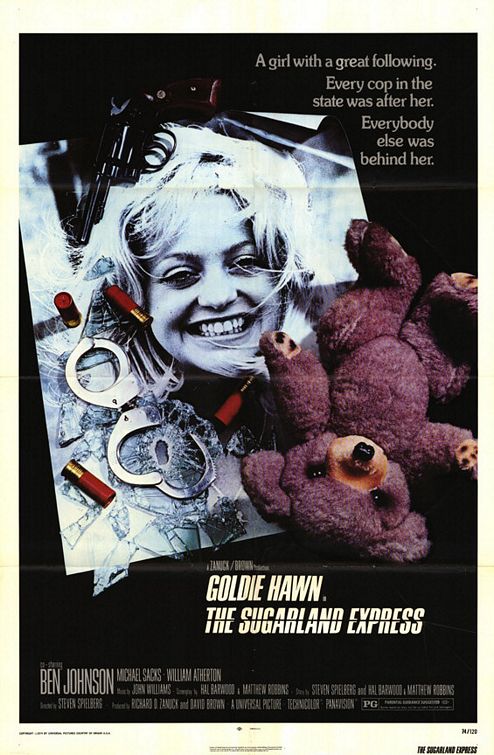
When her baby is put into a home with foster parents Lou Jean (Goldie Hawn) will have nothing of it and helps her husband Clovis (William Atherton) break out of pre-release prison in an attempt to steal the child back. The two hitch a ride with an older couple (A.L. Camp, Jessie Lee Fulton), but when the car gets pulled over by Officer Maxwell Slide (Michael Sacks) they panic and drive off. The officer is able to track them down when their car crashes, but when he goes to investigate the accident Clovis pulls the officer’s own gun on him and uses it to take him hostage. They speed off in his patrol car, which soon gets the entire Texas Highway Patrol after them as well as creating a media frenzy in a slow moving car chase that spans 2-days and 300 miles.

This film marks director Steven Spielberg’s full-length theatrical feature film debut and the result is highly entertaining. He takes an odd moment in history and helps infuse a playful quirkiness to the proceedings while also gently nudging the Texas stereotype. The music by John Williams and especially the harmonica solos by Toots Theilemans help cement the mood and tone. This is also the first film to use a panaflex camera and the first ever to feature a tracking shot from inside a car.

There are enough original and humorous scenes to make this well worth catching. The scene in which the police bring in a Porto potty so Lou Jean can stop and take a pee is hilarious as is the moment where their car runs out of gas and Captain Harlan Tanner (Ben Johnson) who is technically ‘chasing’ them must push their car with his to the nearest gas station. The impromptu TV interview done during the chase is great as is the first CB conversation that Tanner has with the three inside the patrol car. The best moment though is when they go through a small town where the main street is lined with onlookers and well-wishers who hand the three all sorts of gifts and encouragement through the car windows as they slowly drive through.

sugarland express 2

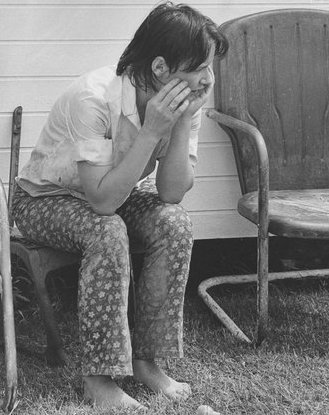
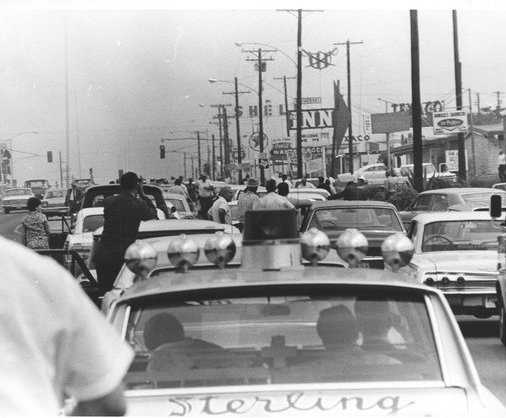
Of course as with any true story the movie takes many liberties and I researched the incident by reading actual newspapers reports from that era and found this to be the jest of what actually happened. It all started in the early morning hours of May 3, 1969 when Ila Faye Dent (1947-1992) and her husband Robert where chased by the Port Arthur police for speeding. The couple managed to evade them by abandoning their vehicle and fleeing on foot into a heavily wooded area. They eventually came upon a ranch whose owner called the police to say that he had been attacked by two hitch-hikers. Patrolman Kenneth Crone, whose character is played by Michael Sacks and who also appears briefly in the film as a sheriff’s deputy, answered the call. When he arrived on the scene Robert pulled a gun on him and forced him back into his patrol car where the three then took off in the vehicle that started the massive 200 mile slow speed chase that attracted hundreds of police cars as well as onlookers and media outlets. Their destination was Wheelock, Texas where Ila Faye wanted to visit her two children from her previous marriage that where now staying with her parents. They had no intention of kidnapping them like it is portrayed in the film only to visit them for 15 minutes, which Captain Jerry Millter (portrayed by Ben Johnson) initially agreed to allow, but then later reneged.

sugarland1


Ila Faye Dent portrayed by Gold Hawn in the film

sugarland2

The actual car chase as it occurred on May 3, 1969.

sugarland3

The changes that Spielberg and his team of two writers made to the story doesn’t help and I wish they had been more accurate with it. The biggest issue is the fact that the actual chase lasted for only about 5 hours while in the film it gets extended for 2 days, which doesn’t work because the part where they sleep overnight inside a car lot kills the momentum and makes for a draggy middle. The use of foreshadowing becomes too obvious and heavy-handed. The child-like enthusiasm by the two main characters is initially fun, but their notion that they can somehow take the police on a wild car chase and snatch back their child without having any consequences seems too unrealistically naïve even for a pair of country bumpkins as they are portrayed.

Spoiler Alert!

The film’s biggest downfall though and the main reason it didn’t do well in the box office is with its downbeat ending. From a directorial stand point I liked it as Spielberg infuses all sorts of interesting elements into it including making the house in which the child supposedly is staying look very foreboding and ominous as well as a brief shot of a teddy bear being thrown out a car window and laying the road while the cars speed all around it. However, seeing Clovis get shot is jarring and takes away from the film’s otherwise lighthearted tone. In the real life incident the husband did indeed get shot and killed although it happened differently than the way it gets played out here, so I don’t really have anything against showing it, but film should’ve added in a brief moment showing Lou Jean being reunited with her child after her stint in prison, which also really happened. I realize the denouncement mentions this in text over the credits, but visually showing it would’ve made more of an impact and helped the audience leave the theater with an upbeat feeling.

End of Spoiler Alert!!

sugarland express 3


sugarland express 1

My Rating: 7 out of 10

Released: April 5, 1974

Runtime: 1Hour 52Minutes

Rated PG

Director: Steven Spielberg

Studio: Universal

Available: VHS, DVD, Blu-ray, Amazon Instant Video, YouTube

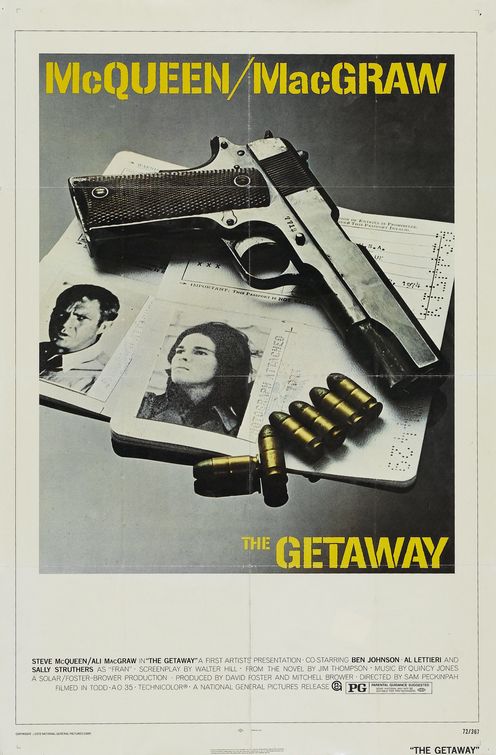
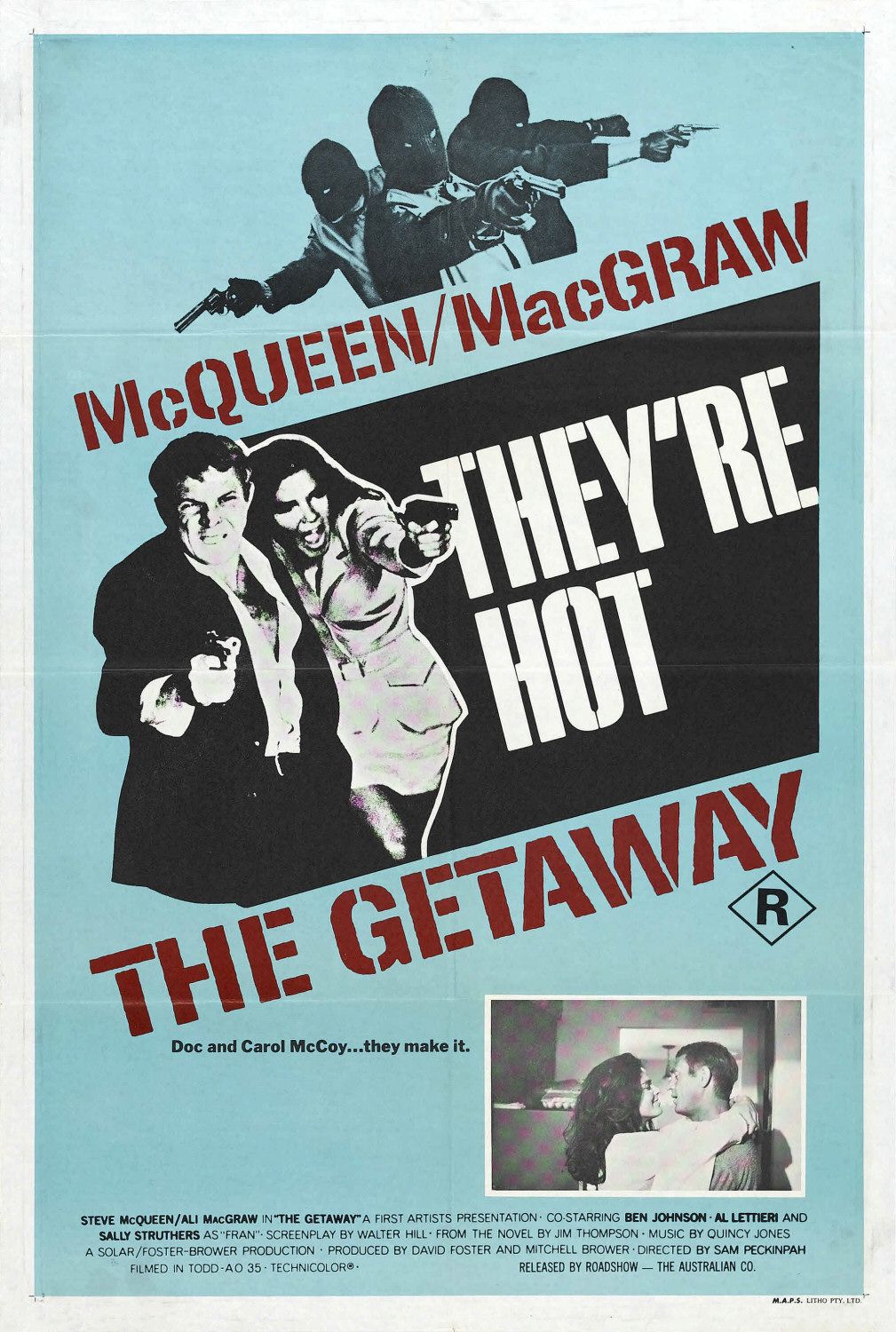
The Getaway (1972)

getaway 1

By Richard Winters

My Rating: 8 out of 10

4-Word Review: Bank robbery goes bad.

Based on pulp writer Jim Thompson’s novel the story centers on Doc McCoy (Steve McQueen) who is stuck in the Texas State Prison and itching to get out. He gets his wife Carol (Ali MacGraw) who is on the outside to strike a deal with Sheriff Jack Benyon (Ben Johnson) where he will get a release as long as he agrees to rob a bank using Benyon’s men. Doc is somewhat reluctant, but agrees to go along with it only to find that after the robbery he has been double-crossed and now along with his wife must make a dash for Mexico while being chased by the cops and going through a wide assortment of unexpected obstacles.

Action director guru Sam Peckinpah has done many classic films most notably The Wild Bunch and Straw Dogs, but this one has always been my favorite as it’s a nice mix of action, character study and comedy. In fact it’s the subtle humor that I like best. I get a kick out of the shot showing Benyon’s brother’s henchman riding in a convertible down a highway while having their hands on their cowboy hats in order to keep them from blowing off. I also chuckled at the book actor Dub Taylor has in his back pocket while cowering under a table during a shootout or what actor Al Lettieri immediately does after finding a dead man hanging in a bathroom.

Peckinpah also makes great use of sound particularly at the beginning where during the opening credits we hear no music, but instead the monotonous sounds of the machines inside the prison workshop, which helps convey Doc’s increasing frustration and this sound doesn’t stop until the exact second that the prison doors open up and allows him out. When there is music it’s effective and distinct particularly the harmonica solos by Toots Thielemans.

Of course Peckinpah’s trademark action sequences are excellent and maybe even superior to his other films because the situations are more unique including an exciting segment showing the couple trapped inside a garbage truck as well as an impromptu shootout along the main street of Fabens, Texas. The only complaint is the scene where Doc’s car goes crashing through someone’s front porch and yet the car shows no visible damage; one shot does show a crack in the corner of the windshield, but then in the next shot it has magically disappeared.

McQueen’s ability to show effortless cool and make an edgy character likable proves what a legendary actor he is and it’s a shame that he doesn’t get placed with the best of them amongst casual movie fans because he really should. MacGraw is at the peak of her beauty here and her moments of vulnerability are great. Struthers gives the best performance of her career as an unfaithful wife of a kindly veterinarian (Jack Dodson) and Lettieri, who unfortunately died at the young age of 47 just 3 years after this film’s release by a heart attack brought on by severe alcoholism, which was already painfully apparent to the cast and crew during the filming of this adds great tension as Doc’s double-crossing partner.

The film also makes great use of its Texas locations bringing out the ruggedness of the region without overdoing it. I particularly liked the scenes in the junkyard as well as footage shot on-location inside the Huntsville prison using actual prisoners and the longshot showing the flat, barren landscape that Doc first sees when he gets out.

I’ve watched this movie many times and never cease to grow tired of it. In fact it seems even more original after multiple viewings. It was unwisely remade in 1994 that starred Alec Baldwin, who doesn’t come close to McQueen’s stature. This version is by far the better one and the other should be avoided.

getaway 2

My Rating: 8 out of 10

Released: December 13, 1972

Runtime: 2Hours 2Minutes

Rated PG

Director: Sam Peckinpah

Studio: National General Pictures

Available: VHS, DVD, Blu-ray, Amazon Instant Video, YouTube

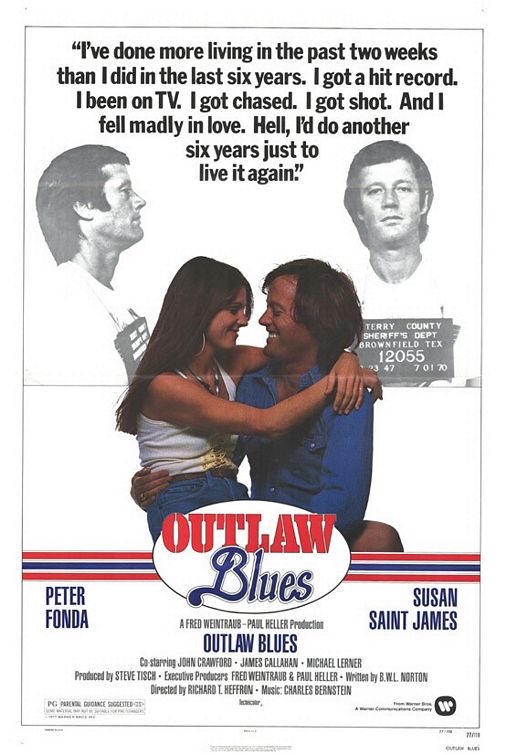
Outlaw Blues (1977)

outlaw blues

By Richard Winters

My Rating: 4 out of 10

4-Word Review: Singer on the run.

When country music giant Garland Dupree (James T. Callahan) visits a Texas prison in order to hold a Johnny Cash-like concert for the inmates he meets up with Bobby Ogden (Peter Fonda) a prisoner who while spending time in jail has written a song called ‘Outlaw Blues’. Garland likes the song so much that he decides to steal it and make it his own only to be confronted by Bobby who once out on parole will stop at nothing to get it back and expose Garland for the fraud he is. With the help of Tina (Susan Saint James) who acts as his manager he does just that, but finds himself again on the run from the cops after accidently shooting Garland during a confrontation inside a recording studio.

This film is notable for not only being filmed in Austin, Texas, but also being the first film to ever use Austin as a setting. The movie can be fun for people from the area especially those living in the city during the mid-‘70s. There are a lot of car chases that occur in the center of town making it entertaining to see all the old buildings some of which still stand today. The scene that takes place at what was then called Texas Memorial stadium during halftime of a Longhorn’s football game where Tina and Bobby take part as members of the marching band is pretty cool as is Tina’s serene houseboat that she lives in and has docked on the Colorado River.

Unfortunately the story itself evolves little and relies heavily on a lot of car chases and clichéd one-dimensional characters. Bobby’s hit song is too low key and melodic making it hard to imagine why so many people would get so crazy about it as a more up tempo country/rock sound would have worked better and given the soundtrack more of a kick.

The film also suffers from a few goofs and lapses of logic. The biggest one is when a lone cameraman films Bobby accidently shooting Garland and it gets replayed on the evening news. Yet when it gets shown it has several edits and footage of the incident from different viewpoints and angles, which if truly shot by just one camera wouldn’t have been possible. The idea of having Garland chasing Bobby down through the streets of Austin in broad daylight while shooting at him is utterly insane even for a deluded, egotistical character that he is as it would just get him thrown into jail. Since the Garland character is portrayed as having a lot of money then he should do what most rich people do when they want someone dead, which is hire someone else to do it while creatively covering up the paper trail.

Fonda too laid back in the lead and comes off as transparent and boring. Saint James, Callahan and John Crawford as an obsessed police chief lend some amusing support, but their presence as well as a nifty boat chase at the end cannot save a film that is otherwise generic and silly.

My Rating: 4 out of 10

Released: July 15, 1977

Runtime: 1Hour 40Minutes

Rated PG

Director: Richard T. Heffron

Studio: Warner Brothers

Available: VHS, DVD (Warner Archive)