Tag Archives: Clifton James

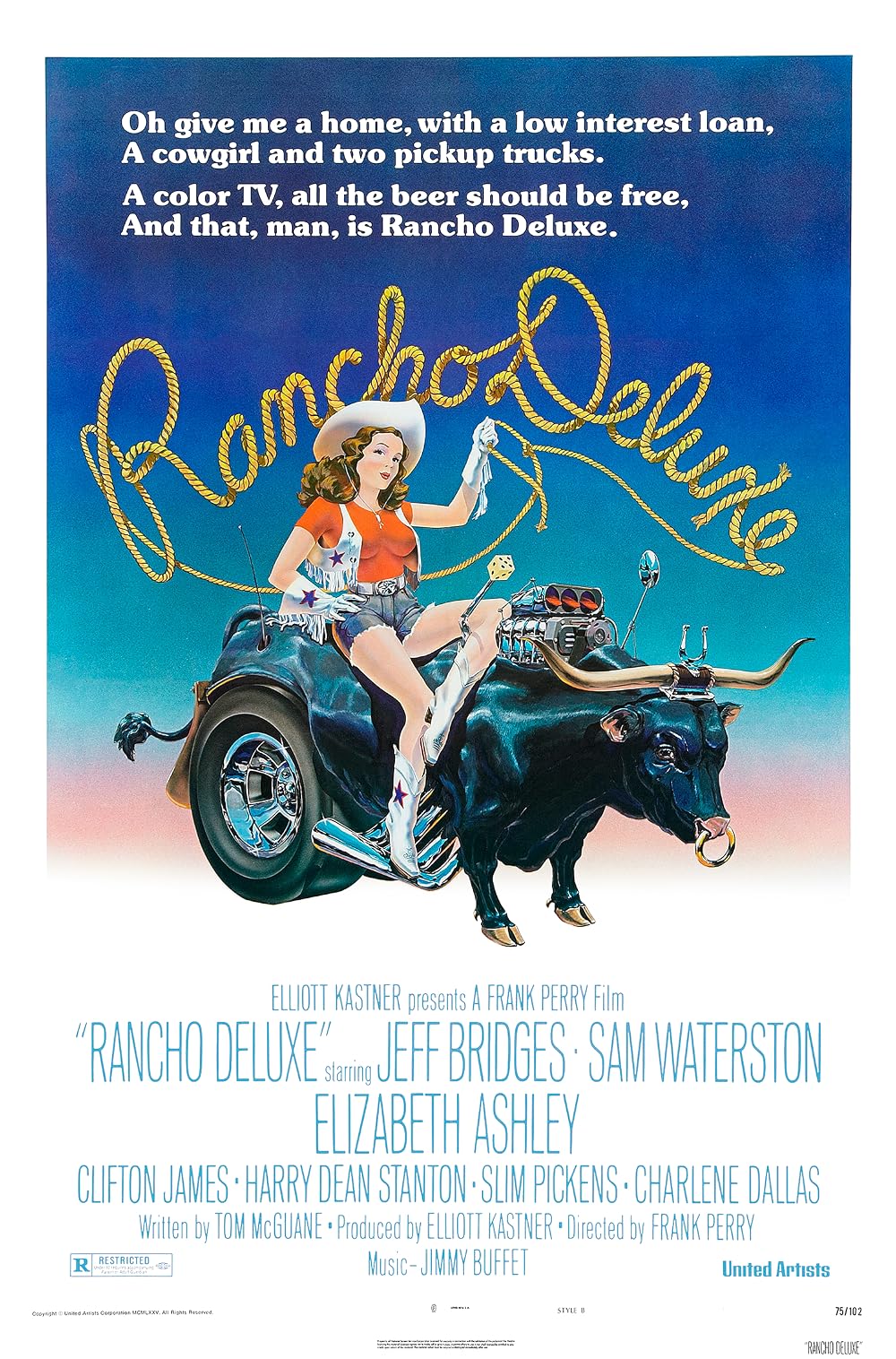
Rancho Deluxe (1975)

By Richard Winters

My Rating: 8 out of 10

4-Word Review: Modern day cattle rustlers.

Jack and Cecil (Jeff Bridges, Sam Waterston) are two drifters who don’t work an actual job and instead rustle cattle and use the meat that they take from that to help pay for the basic things that they need. John (Clifton James) is the ranch owner who’s tired of seeing his cattle routinely mutilated and determined to find those who are responsible. Curt and Burt (Harry Dean Stanton, Richard Bright) are his ranch hands who John puts in charge to find the culprits, but they end up being of no effect despite them knowing that Jack and Cecil are behind it. After his prize bull gets kidnapped and he’s forced to pay a large ransom to get him back, he hires Henry (Slim Pickens) a legendary detective in cattle rustling to finally solve the case, but Henry proves, at least initially, to be just as inept and oblivious about the crimes as everyone else, which further frustrates John.

This was the first screenplay written by the prolific and irreverent writher Thomas McGuane, his second script 92 in the Shade, was also shot in 1974 during the fall of that year while this one was done in the spring and early summer. McGuance directed the other one himself while Frank Perry helmed this one and having an established Hollywood director behind the chair makes all the difference here particularly the cinematography by William A. Fraker that captures the majestic, mountains landscape of the big sky country, which was done on location in Livingston, Montanna becoming the first of many movies that would be shot there.

Like with McGuane’s other works it’s his offbeat, wry humor that keeps it entertaining and helps it stand out. There’re some truly original comical moments that had never been done before or since making this film even after being around 50 years still come off as fresh and inventive. Some of the best moments are when Bridges and Stanton play a game of Pong while having a discussion, which was apparently something they both did of lot of during breaks in shooting, so Perry decided to work it into the story. The shot of the bull inside a hotel is funny too though there’s no explanation for how they were able to get him in there without being detected, which could’ve heightened the comedy had it been shown. There’s also the scene where Bridges and Waterston have a sex orgy with their girlfriends and then the next morning get caught while still naked in bed by the girl’s elderly relatives, which I consider the best moment in the movie.

The dialogue has a wonderfully quirky quality working off non sequiturs and weird tangents like when out-of-the-blue Waterston asks Bridges if he believes in the tooth fairy, or when John’s wife, played by Elizabeth Ashley, asks him if he regrets selling their beauty parlor business while he busily frets about tracking down the rustlers. The best though is when Slim Pickens goes off on a rant involving a dream, he had as a slave in ancient Egypt while John tries giving him the latest updates on the case.

The characters and their goofy contradictions help compliment the absurdity. Bridges and Waterston are especially fun, some may even say this is a precursor to the character he played in The Big Lebowski, as a happy-go-lucky drifter with no direction in life, which they equate as being ‘free’. Even after they get put into the prison, they still have the same carefree mentality proving that state-of-mind is everything. James is also quite fun as the cantankerous rancher who’s always quite confident despite being wrong on everything. Stanton and Bright good too as dimwits who think they’re in on the game only to end up getting played badly. I also enjoyed Patti D’Arbanville who plays Bridges girlfriend Betty. She shows a very wild side with her sexual nature and drug use, but in reality, she’s most likely going to be spending the rest of her life in this small inconsequential town and working the same mundane job we see her doing at the beginning. Having her provocatively dance around while getting drunk and just before she partakes in the orgy is in a lot of ways her final act of rebellion before the clutches of the conventional life, whose claws I suspect she senses are already on her horizon, fully traps her in.

Unlike other movies the residents of this small town aren’t portrayed as being sheltered or cut-off but instead shown as being just as jaded as any urbanite if even more so. It also examines how the ways of the old world have been completely taken over by the attitudes and mores of the modern era where even the rural folk, at least the younger ones like the two sisters, compete to see whose ‘hipper’ and more with the times while wanting to avoid any association of the bygone era of their elders.

My only two complaints are the interior segments done inside John’s ranch home as the rooms came off as cramped and echoey. John was supposedly a rich man, so I wanted to see a house that exuded this with high cathedral ceilings and gaudy decor. Also, having Bridges and Waterston able to retrieve the $50,000 ransom money after kidnapping John’s bull, was too easy. I don’t feel John, or anybody else for that matter, would be willing to let go of their money quite so graciously especially to a couple of crooks. He should’ve either gotten the police involved to set a trap or done it himself by lying in wait at a careful distance with binoculars and waiting to see who comes to retrieve the briefcase full of money and then chasing them down when he spots them, which doesn’t occur, but logically should’ve.

My Rating: 8 out of 10

Released: March 14, 1975

Runtime: 1 Hour 34 Minutes

Rated R

Director: Frank Perry

Studio: United Artists

Available: DVD, Blu-ray, Amazon Video, PlutoTV, Roku Channel, Tubi, YouTube
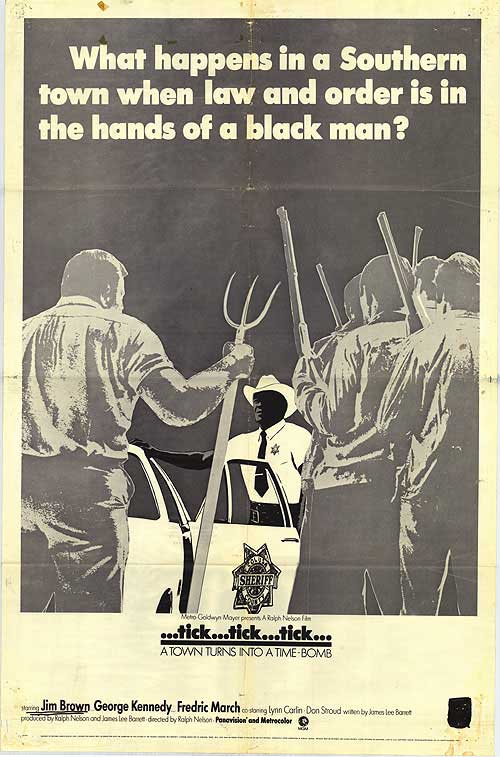
 

…tick…tick…tick (1970)

By Richard Winters

My Rating: 4 out of 10

4-Word Review: New sheriff faces racism.

Citizens of a small southern town get on edge when the current sheriff (George Kennedy) gets voted out and replaced by a black man (Jim Brown).  As the new sheriff Jim faces stiff resistance even from fellow members of the black community, but he forges on. When the son of a rich white man from a neighboring town runs over and kills a young white girl while he was driving drunk, Jim has him put into jail, but the young man’s father demands that he be released and when Jim refuses it creates the beginning of a potential race riot that forces the white citizens of the town to make a hard choice; do they continue with their racist behavior, or join the black sheriff in defending their town from corrupt outsiders?

The film starts out on the cheesy side by showing up close an egg frying on a sidewalk. The problem is that I tried this last year in Austin, Texas when the temp was 110 (actual temp and not a heat index figure), but I couldn’t get it to work even though I did it on asphalt and in direct sunlight. Some say that the egg has to be put in a frying pan and then have the pan put on the cement and maybe so, but that’s not how the film shows it and what’s worse is that it looks like the egg is already in a fried state even before it hits the pavement.

It’s also annoying that despite having the Deep South as the setting it was actually filmed in Colusa, California where the topography looks much different. I also had to wonder why everyone is constantly glazed over in sweat even when they were in bed at night and only small, little fans to cool them. The story’s time period is the present day (1970) and air conditioners were invented in 1902, so why the hell doesn’t anyone in this hot southern town own and use one?

The soundtrack features loud, poorly sung songs that not only get played over the opening and closing credits, but during a lot of the film as well, which gives the entire production a very B-level movie feel. I also got tired of hearing the sound of a clock ticking in the background that permeates just about every scene during the first 30 minutes and becomes heavy-handed and annoying.

The only thing that saves it is Jim Brown who’s really good here and looks better and younger without his trademark mustache. Kennedy on the other hand doesn’t seem up to the challenge with many of his scenes, particularly the one were he accosts a young man who was harassing him, coming off as unintentionally funny.

It’s sort-of fun seeing Frederic March playing a goofy mayor as well as Mills Watson, in his film debut, playing a racist deputy a decade before playing his most famous role as the bungling deputy Perkins in the ‘Misadventures of Sheriff Lobo’ TV-show.  I also liked how Clifton James and Anthony James (no relation) who had both played racist southern types in other films get roles here where they’re more level headed and help suppress the racist behavior of others instead of stoking it.

The film gets marginally better as it goes along and the ending is okay even a bit unique for this type of genre, but overall it’s just a cheap imitation of In the Heat of Night, which was much better. The only really surprising thing about the movie is that it received a G-rating despite having the N-word spoken throughout by several of the characters.

My Rating: 4 out of 10

Released: January 9, 1970

Runtime: 1 Hour 40 Minutes

Rated G

Director: Ralph Nelson

Studio: MGM

Available: DVD-R (Warner Archive), Amazon Video 

The Deadly Tower (1975)

deadly tower

By Richard Winters

My Rating: 7 out of 10

4-Word Review: Sniper in the tower.

This made-for-TV movie chronicles the events of August 1, 1966 when 25-year-old ex-Marine Charles Whitman (Kurt Russell) climbed to the top of the University of Texas campus tower and shot and killed 16 people while wounding a total of 32. The story intercuts between scenes showing Whitman preparing for the shooting while also looking at the private life of Officer Ramiro Martinez (Richard Yniguez) who eventually climbed up the tower to stop Whitman’s slaughter.

For the most part the film is taut and methodical and well above average for a TV film although Gilbert Roland’s voice over narration was unnecessary and a bit cheesy. The only time there is any music is during the scenes showing Whitman killing his mother and wife with a knife, which gets a bit too overly dramatic, but otherwise it comes off almost like a documentary making the viewer feel that they are right there as it is happening. It was filmed at the Louisiana State Capitol, which looks a bit different than the actual clock tower, but still similar enough that it works.

Russell who had just come off starring in a long line of Disney films is perfect in the role and even closely resembles the real Whitman. The fact that he has very few lines of dialogue is an asset and helps to make the character more foreboding and threatening. The rest of the all-star cast does pretty well although Forsythe’s character seems added simply to promote the gun control issue. Clifton James appearance as one of the police sergeants was misguided because he had already done a comic caricature of a redneck sheriff in the James Bond film Live and Let Die, so it was hard to take him seriously here and it took me out of the movie a bit because it kept reminding me of that one as well as his goofy policeman role in Bank Shot.

The film also takes liberties with the actual events in strange ways that makes no sense. For instance in the film when Whitman comes upon the tower receptionist he simply guides her to the elevator and tells her to leave, but in real-life he knocked her to the ground and split her head open before later shooting her. Also, in the film the first victim that he hits from the tower is a male, but in the actual incident it was an 18-year-old female who was eight months pregnant. The story also erroneously credits Martinez with the one who killed Whitman when the later autopsy found that all four shots that Martinez fired at Whitman missed him and it was actually the two shots fired by Officer Houston McCoy who stepped in after Martinez had emptied his rounds that proved to be the lethal hit. In fact Officer McCoy’s name gets changed here and is listed as C.J. Foss and is played by actor Paul Carr as a minor throwaway part that is barely seen at all.

Both McCoy and Martinez sued the producers for the inaccuracies. Martinez was upset because his wife was portrayed as being pregnant and Hispanic when in reality she had been German-American. The sidelight drama of some marital discord between the two was also apparently untrue and should’ve been left out completely as it adds nothing and bogs the thing down as a needless Hollywood-like soap opera.

My Rating: 7 out of 10

Released: October 18, 1975

Runtime: 1Hour 40Minutes

Director: Jerry Jameson

Studio: MGM

Available: DVD (Warner Archive)