Category Archives: Movies Based on Stageplays

Little Murders (1971)

little murders

By Richard Winters

My Rating: 7 out of 10

4-Word Review:  They shoot at people.

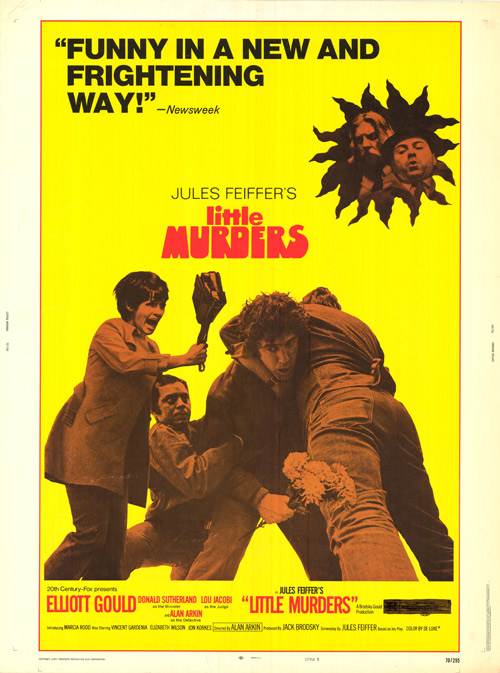
Patsy (Marcia Rodd) is a woman who practices the art of positive thinking despite her dismal urban surroundings. She meets Alfred (Elliot Gould) who is very detached and dropped out of society and no longer shares any hope in humanity, but she decides to marry him anyways and ‘reform’ him.

For a black comedy this one has got to be tops. It stays on a grimly humorous level from the beginning and doesn’t let up especially with its wicked ending. Everything gets the offbeat treatment and if it starts out conventional it is soon turned upside down until it is absurd. The funniest scenes involve Patsy taking Alfred home to meet her parents where things become very odd until they are absolutely hilarious. The wedding scene is also a classic where Donald Sutherland plays a hippie minister and gives a speech about masturbation that is as outrageously funny today as it was back then. Yet it is the surreal scene of seeing Alfred riding a subway car while dripping with blood and nobody saying anything that leaves the strongest impact. The targets that this film satirizes are just as potent today as they were back then. The film also manages to dig a bit deeper than most and successfully analyzes the myriad of societal complexities while not siding with any particular social movement or philosophy.

Rodd is terrific in her film debut and Gould is good in a surprisingly restrained performance. Jon Korkes is also excellent as an infantile adult son in an over-the-top send-up of grown children still living at home. However, it is Vincent Gardenia that ultimately steals it playing a hard-liner conservative father who finds himself becoming literally imprisoned by the increasingly insane world around him.

Although still potent this outrageous story seems to have lost some of its zing through the years and doesn’t seem to be as offbeat or ‘out there’ as it once did. It also lacks any type of cinematic flair and at times seems to be nothing more than a filmed stage play.

However, for fans of black comedy and relics of a bygone era it doesn’t come much better than this. Although it has softened a bit there are still enough bizarre and funny moments to please those with an acquired taste.

My Rating: 7 out of 10

Released: February 9, 1971

Runtime: 1Hour 50Minutes

Rated R

Director: Alan Arkin

Studio: 20th Century Fox

Available: VHS, DVD
Loot (1970)

loot 3

By Richard Winters

My Rating: 8 out of 10

4-Word Review: They are all greedy.

Every Friday this month I will review the Top 5 best and most outrageous black/dark comedies from the 70’s. There were many to choose from, but these five have stood the test of time and remain as potent and hilarious as they were when first released. Today’s film was written by Joe Orton who died before ever seeing his play made into a movie and despite being top-notch in every aspect remains unjustly overlooked and hard-to-find.

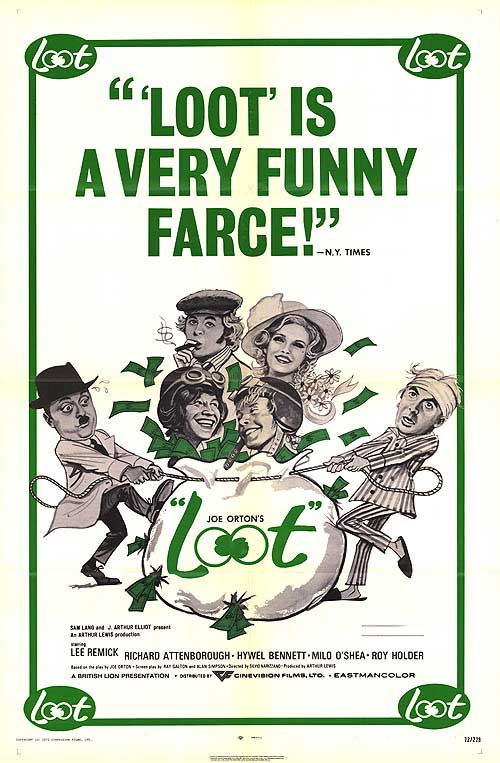
The story deals with Dennis and Hal (Hywell Bennett, Ray Holder) two friends who decide to rob a bank next to a funeral home and hide the stolen money inside the coffin of Hal’s late mother. Problems ensue when Inspector Truscott (Richard Attenborough) starts to suspect the boys have something to do with it and incorporates brutal interrogation tactics to get the truth out of them. Then there is Nurse Fay (Lee Remick) who may have had something to do with Hal’s mother’s death and is inclined to want a piece of the action. All of this occurs inside Hal’s house, which is also a bed and breakfast run by Hal’s Father McLeavy (Milo O’Shea) who remains oblivious to all of the shenanigans and only worried about getting a decent burial for his departed wife.

The film is fast and funny and retains all of Orton’s dark and acidic wit. It is full of one-liners, sight gags, odd characters, and bizarre, unexpected comical twists, with ninety-eight percent of it being clever and funny. The best is the funeral procession when Dennis, who is driving a hearse that is carrying the deceased, finds out that the vehicle has lost its brakes and careens down the streets at high speeds with all the other cars in the procession try to keep up with it while driving equally fast.

Director Silvio Narizzano shows a terrific grasp on the material. Unlike Entertaining Mr. Sloane the only other film adaption of Orton’s work this film has a terrific pace that starts with a bang and never lets up. Narizzano also infuses a lot of imaginative camera angles, edits, and set design to give the thing a nice edgy, off-color feel. Outdoor action is nicely balanced with the indoor scenes to create a good cinematic feel and it never seems like a filmed stage play. There are some interesting homoerotic overtones as well including having Dennis and Hal blow a hole in the bank wall, crawl through it and take the money, then crawl back out and stuff it into the coffin while being completely naked.

Remick has one of her most interesting and unique performances in her already illustrious career as she is quite amusing looking almost like Marilyn Monroe with her dyed platinum blonde hair and authentic sounding British accent. Attenborough is memorable playing against type. Usually he is best at meek and passive types, but here he almost steals the film as the aggressive Inspector with a Hitler mustache. His best moment comes when he picks up a glass eye from the floor and in one brief second sticks out his tongue and licks it, which is done in vivid close-up.

The bouncy, psychedelic score by Steve Ellis helps give the proceedings attitude and personality. Why this film has never been released on DVD or Blu-ray is a mystery. The humor remains sharp and a whole new throng of fans could be acquired if they were just able to see it.

My Rating: 8 out of 10

Released: May 1, 1970

Runtime: 1Hour 41Minutes

Rated R

Director: Silvio Narizzano

Studio: British Lion Film Corporation

Available: VHS

Anne of the Thousand Days (1969)

anne of a thousand days 2

By Richard Winters

My Rating: 7 out of 10

4-Word Review: Off with her head

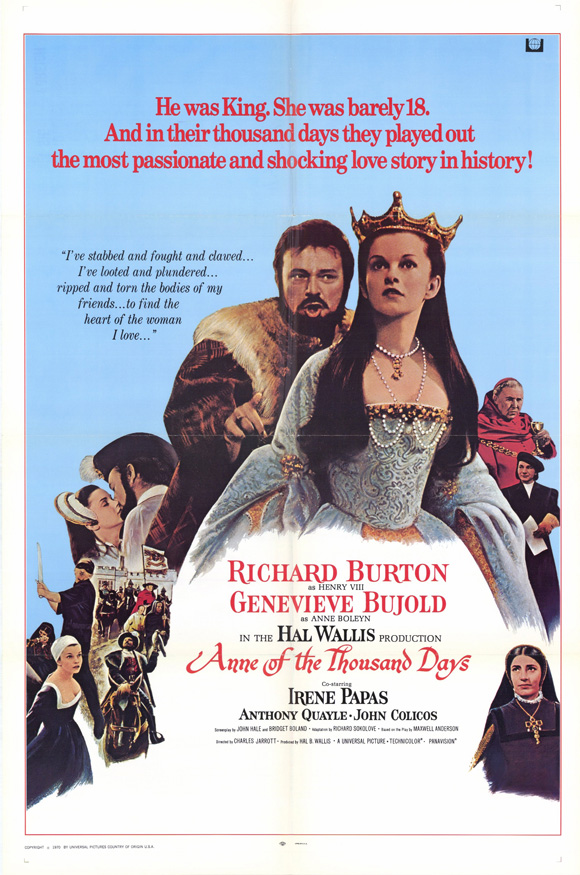
Based on historical fact the setting is 1527 King Henry VIII (Richard Burton) is bored with his current wife Catherine of Aragon (Irene Pappas) and becomes intoxicated by the beauty of 18-year-old Anne Boleyn (Genevieve Bujold). Initially she resists the advances of the King and finds him unappealing, but once she gets a whiff of all the power that being a Queen can give she falls in-love with him. The King wants her to bore him a son, but their first child turns out to be a girl, which causes their marriage to sour. Their acrimony is furthered when their second child turns out to be a stillborn son. Eventually the King grows tired of Anne and hires Thomas Cromwell (John Colicos) to find a way to get rid of her. Cromwell tortures some servants into saying they had sexual liaisons with Anne which gets her placed under arrest and awaiting trial and execution.

Bujold gives a powerful and mesmerizing performance and I am surprised that she didn’t win the Oscar. However, Burton, who is an actor that I admire, seems uncomfortable in his role and just walking through his part.

The story itself is compelling and because it is based on fact makes it all the more amazing. It moves along at a good pace and the viewer can’t help but get absorbed in it. This is no stuffy costume drama and it is probably tawdrier than any soap opera out there. However, Charles Jarrot’s direction is a bit stale. The sets and costumes are great, but the atmosphere and cinematic style is missing and the whole thing seems too much like a filmed stage play.

My biggest quibble with the film is that it doesn’t stay completely accurate. Historians insist that the King does not offer Anne any type of reprieve nor does he visit her after she is imprisoned like he does here. While this scene is nice because it does humanize him who in every other way is despicable it doesn’t help the viewer better understand the story or the people in it by inserting something that really didn’t happen.

My Rating: 7 out of 10

Released: December 18, 1969

Runtime: 2Hours 25Minutes

Rated M

Director: Charles Jarrott

Studio: Universal

Available: VHS, DVD, Amazon Instant Video, Hulu

All the Way Home (1963)

all the way home 2

By Richard Winters

My Rating: 8 out of 10

4-Word Review: Life must go on.

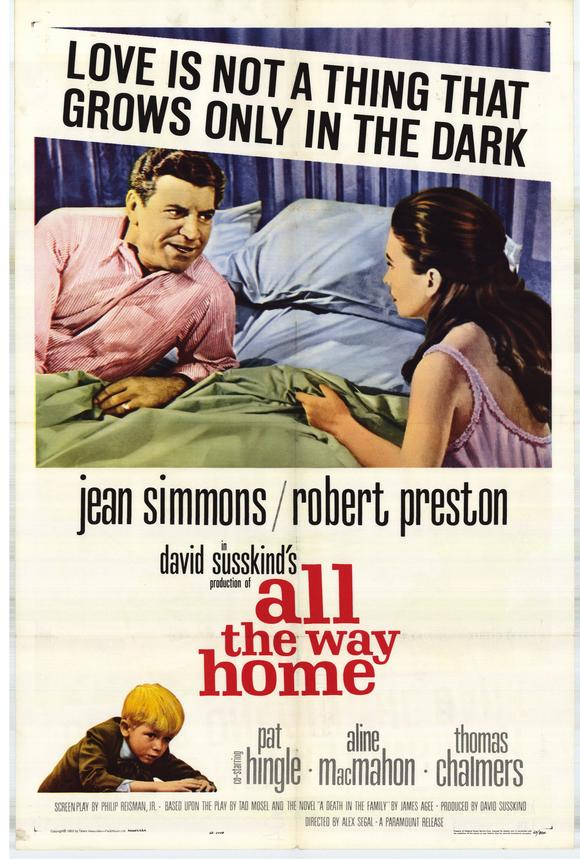
Based loosely on the childhood experiences of writer James Agee who is best known for penning the screenplay to the classic film Night of the Hunter.  The story here looks at how a southern family copes and in particular the young boy Rufus (Michael Kearney) after their father (Robert Preston) is tragically killed in a car accident.

Based on Agee’s unfinished novel ‘A Death in the Family’, which was also made into a stageplay the film makes loving tribute to the era. The sets and even the Model T car driven by the father are all authentic. In fact it was filmed near the exact neighborhood in Knoxville where Agee grew up. The mannerisms and dialogue are true to the period without any compromising for a more modern audience. The revisionism which has become so trendy in today’s period piece films is thankfully missing here. The slower and gentler pace seemed reflective of the era and I found it refreshing.

Preston gives one of his best roles second only to his signature one in The Music Man. He doesn’t get killed until the second half of the film, so the viewer gets to know and like the character and thus feels the pain of the loss along with the family members. We never see the actual accident nor given any explanation for what happened, which is just as well. Too many times filmmakers seemed compelled to have to give a reason for everything even though in life that is not always possible, so it is nice that here they did not fall into that trap. This emphasis instead is on how the family members cope and the emotional impact of the loss, which is something everyone must go through at some point and it ends up being quite compelling.

Kearney gives a terrific performance and one of the best from a child actor that I have seen. He is cute without ever being precocious. Watching him observe everyone else around him are some of the best moments in the film. It also brings up the great point that sometimes children are better at adapting to tragic events than their adult counterparts.

Durable character actor Pat Hingle gives one of his most interesting performances as Preston’s nervous and hyper brother. Preston has a great line in describing him when he says: “Talking to him is like putting socks on an octopus.”

Aline MacMahon is good as the kind, but stern aunt. I particularly liked the moment where Rufus falls to the ground in an emotional tantrum, but she restrains the others from helping him and insists that it is important that he learns to get himself up on his own. Jean Simmons as the mother and wife is also splendid, but seems to get better as the movie progresses particularly in her conversation with Rufus at the end, which is touching.

My Rating: 8 out of 10

Released: October 17, 1963

Runtime: 1Hour 37Minutes

Not Rated

Director: Alex Segal

Studio: Paramount

Available: Amazon Instant Video

Send Me No Flowers (1964)

send me no flowers 2

By Richard Winters

My Rating: 7 out of 10

4-Word Review: Hypochondriac thinks he’s dying.

Seriously funny story about hypochondriac George (Rock Hudson) overhearing a conversation from his Dr. (Edward Andrews) about one of his patients having only a short time to live and mistakenly thinking he was talking about him. He decides to set his beautiful wife Judy (Doris Day) up with another potential mate before he leaves, but she starts to get the idea that this is all just a cover-up for an affair that she thinks he is having, which creates all-out calamity.

Screenwriter Julius J. Epstein, who based this on the stageplay of the same name, hits all the right cylinders. The comedy shifts smoothly between engaging banter, parody, satire, and action. One of the best moments comes at the beginning with animated sequence of commercial parodies.

Hudson is great. Playing a dopey guy lost in his own little world works with his acting style. He and Day have a good chemistry and it is a shame that this was the third and last film that they did together.

The supporting cast is at the top of their game. Andrews is funny as the flippant Dr. Paul Lynde is also amusing as an aggressive cemetery plot salesman. Tony Randall is the funniest as George’s long-suffering friend Arnold. His new found fetish of ‘feeling tables’ is hilarious as is his frequent revisions of George’s eulogy, which he reads to him to ‘cheer him up’.  Although actor Clint Walker isn’t funny in his performance the shot showing this giant of a man getting out of one of the smallest cars you’ll ever see is a crazy sight.

Day is energetic and gorgeous as ever and I liked her opening title tune in which she sounds almost like Lesley Gore. However, the best moments go to the rest of the cast and she is left with slapstick segments that have nothing to do with the story. The scene where she takes all of George’s medications from the medicine cabinet and puts them into a bucket, which she then dumps onto his head while standing on a balcony is good, but the rest of her scenes don’t really gel.

One scene with her gets botched and involves her driving an out-of-control golf cart. The close-up shots make it obvious that she is in front of a blue screen and not really driving it to begin with. However, there is a moment where she drives through a bunch of sprinklers which makes her hair all wet and matted down, but then the camera cuts to some long shots showing her hair is still dry and fluffy, which exposes the fact that it was being driven by a stunt double wearing a wig.

There is another segment where she gets into a car and starts it up and even backs it out a little before she realizes that it is not her car. Another scene later on has George doing the same thing with another stranger’s car. Both times it is because the keys were conveniently left in the ignition, but how many times does this occur in real life? Since neither of these segment had anything really to do with the story and weren’t all that funny I would have left it out since both moments especially to happen twice are implausible.

The movie ends with a shot of the empty medicine cabinet while the credits scroll over it. Supposedly this was used to symbolize that George was now ‘cured’ of his hypochondria and no longer needed all of the medications, but mental illness is not something that just goes away and I thought it would have been funnier had medicines started to pop back into the cabinet until it became full again.

My Rating: 7 out of 10

Released: October 14, 1964

Runtime: 1Hour 39Minutes

Not Rated

Director: Norman Jewison

Studio: Universal

Available: VHS, DVD, Amazon Instant Video

Tall Story (1960)

tall story

By Richard Winters

My Rating: 6 out of 10

4-Word Review: The game is rigged.

June Ryder (Jane Fonda) is a boy-crazy college coed who has her sights set on Ray Blent (Anthony Perkins) the star of the school’s basketball team. Ray ends up being as infatuated with June as she is with him and the two decide to get married, but before they do they purchase a motor home from Ray’s friend Fred (Tom Laughlin). Unfortunately they don’t have enough of the required money until a mysterious stranger gives Ray $2,500 to blow the upcoming game his team has with the Russians, which puts Ray in a difficult quandary.

The film has a nice fluffy appeal and was based on the hit stage play, which in turn was based on the novel ‘The Homecoming Game’ by Howard Nemerov. The college campus atmosphere for its time period seems realistic. It is refreshing to have the adult faculty portrayed as normal human beings relating to the students on a relatively equal level and vice versa as opposed to the trend that started in the 70’s and went full-throttle in the 80’s where adults in these types of films were written as preachy, oppressive, out-of-touch, authoritative humorless pricks. In fact Marc Connelly as Professor Osman was my favorite character as he looked and spoke like a true professor and helped balance the silliness by being the most normal of the bunch. Anne Jackson as the wife of Professor Sullivan (Ray Walston) comes in a close second and has some amusing moments and a few good comeback lines particularly near the end.

Fonda is perfect as a character lost in her own little world and enthusiastically going by the beat of her own drummer while oblivious to the consternation she causes to those around her. Initially the character is written a little too aggressively making her too deluded and like a stalker, but fortunately that gets toned down and she becomes likable enough. Perkins is great as her boyish counterpart and the two even sing a duet together.

The pacing is a bit poor. Initially it is very zany and fast paced making the thing seem almost like a live action cartoon, which doesn’t work at all. The film then slows down and becomes a draggy only to rectify things with a funny conclusion. If you like things that are cute and undemanding then this should work although the sequence in which Ray comes into the game and singlehandedly wins the game after the team is far behind is just too contrived and over-blown for even Hollywood standards. The humor is light and comes in spurts with some of it managing to elicit a few chuckles. One of the few interchanges that I liked consisted of:

June: “Did you know that elephants only mate once every seven years?”

Ray: “There are some that do it every six years.”

June: “They’re nymphomaniacs”

Spoiler Alert!

One of the biggest problems with the film is the ending as Ray decides to play in the game and win it for his team despite keeping the money that he was paid in order to throw it. However, there is just no way a criminal organization would let anyone keep that money especially when the other party did not uphold their end of the bargain. Most likely they would track down Ray and June and exact a very unpleasant revenge. However, the film never even touches on this and instead shows Ray and June buying the motorhome and riding happily off into the sunset while leaving open a major loophole in the process.

My Rating: 6 out of 10

Released: April 6, 1960

Runtime: 1Hour 31Minutes

Not Rated

Director: Joshua Logan

Studio: Warner Brothers

Available: VHS, DVD (Warner Archive), Amazon Instant Video

The Subject Was Roses (1968)

subject was roses

By Richard Winters

My Rating: 7 out of 10

4-Word Review: This homecoming isn’t happy.

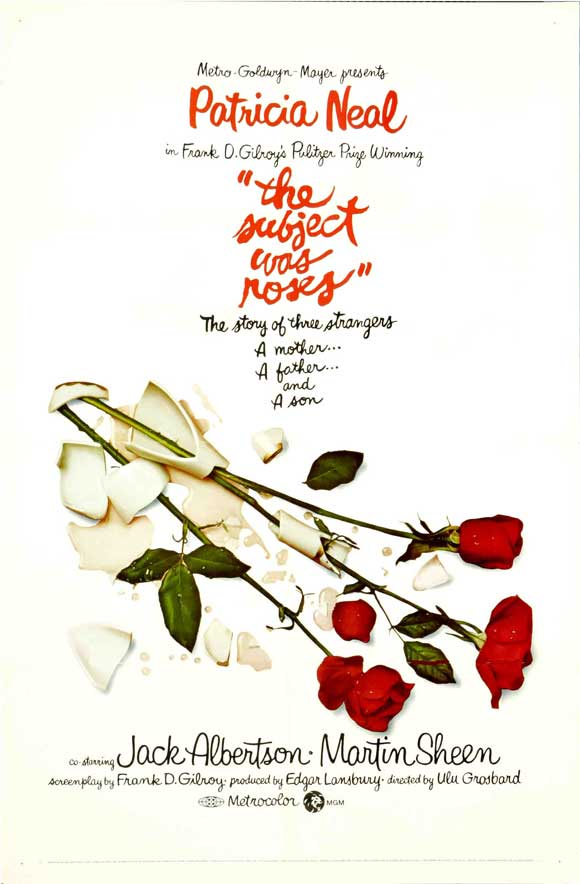
Tim (Martin Sheen) arrives home from the war to find that things aren’t going well with his parents John and Nettie (Jack Albertson, Patricia Neal). Their aloofness towards each other slowly becomes more apparent and seems to come to a head when Tim decides to buy his mother a bouquet of roses and his dad pretends it was his idea. When Nettie realizes it wasn’t John who bought them she leaves the house and doesn’t return, which causes John to panic and try to find her.

This movie has a compelling quality to it and is the old-fashioned type of drama that they don’t seem to make anymore. The characters are real and believable and will probably remind one of their own parents, or even themselves and their marriages. The dialogue has a great conversational style and the viewer feels like they are eavesdropping onto an actual household. The action happens slowly, but deliberately and is devoid of any neat and tidy wrap-ups.

However, the film is also a bit frustrating. We are never explicitly shown what it is that is troubling Nettie so terribly. We are given some definite hints of things bubbling just underneath the surface, but there is nothing that completely comes out into the open. The viewer becomes primed for some great revelation, but when it doesn’t come and the characters end up remaining in the same situation as when it began it makes the whole thing seem pointless.

Neal is outstanding and the main catalyst for why this works. This was her first film after she had suffered several near fatal strokes in 1965. Although she does very well one can still see some subtle effects of it like the way she walks and her speech being just a little bit slower, but in context with the role it makes her seem older than she really is and therefore better for her role. I was surprised at how physically demanding the part was including having her dance rigorously around the living room with Sheen as well as having to aggressively fight off Albertson’s unwanted advances. Her sad and pained facial expressions leave the most lasting impressions.

Although it was Neal who I felt should’ve won the Oscar it was actually Albertson who did. His performance, which he recreated from the Broadway play that also netted him the Tony, is solid especially for doing a character that at times is off-putting. He does get the film’s best line “The humping that I am getting isn’t worth the humping that I am getting.”

The story takes place in the 1940’s and is basically a loose autobiographical story of Frank D. Gilroy who wrote both the award winning play and screen version. For the most part it succeeds with its retro look, but the music by Judy Collins doesn’t fit. Personally, I love Collins as a vocalist, but her raw, moody folk music sound seems out of place for a 40’s setting and takes the viewer out of the story in the process.

Transferring a story done for the stage to the big screen is never easy, but director Ulu Grosbard manages to make it cinematic. None of it was done on a soundstage, but instead the apartment was built inside a warehouse in the same Bronx neighborhood where Gilroy grew up and painstaking detail was done to give it an authentic lived-in look. The scenes done at their lakeside cabin is also effective as it captures the blossoming spring time landscape and gives a nice soothing feeling. You also get to witness Sheen skipping stones across the lake several times something that I could never get the hang of myself.

My Rating: 7 out of 10

Released: October 13, 1968

Runtime: 1Hour 47Minutes

Not Rated

Director: Ulu Grosbard

Studio: MGM

Available: VHS, DVD (Warner Archive)

The Night of the Iguana (1964)

night of the iguana 2

By Richard Winters

My Rating: 6 out of 10

4-Word Review: Flawed clergyman loves women.

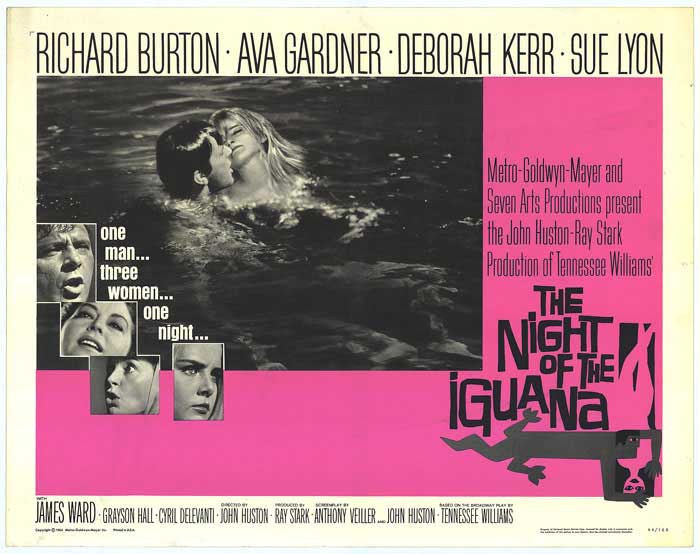
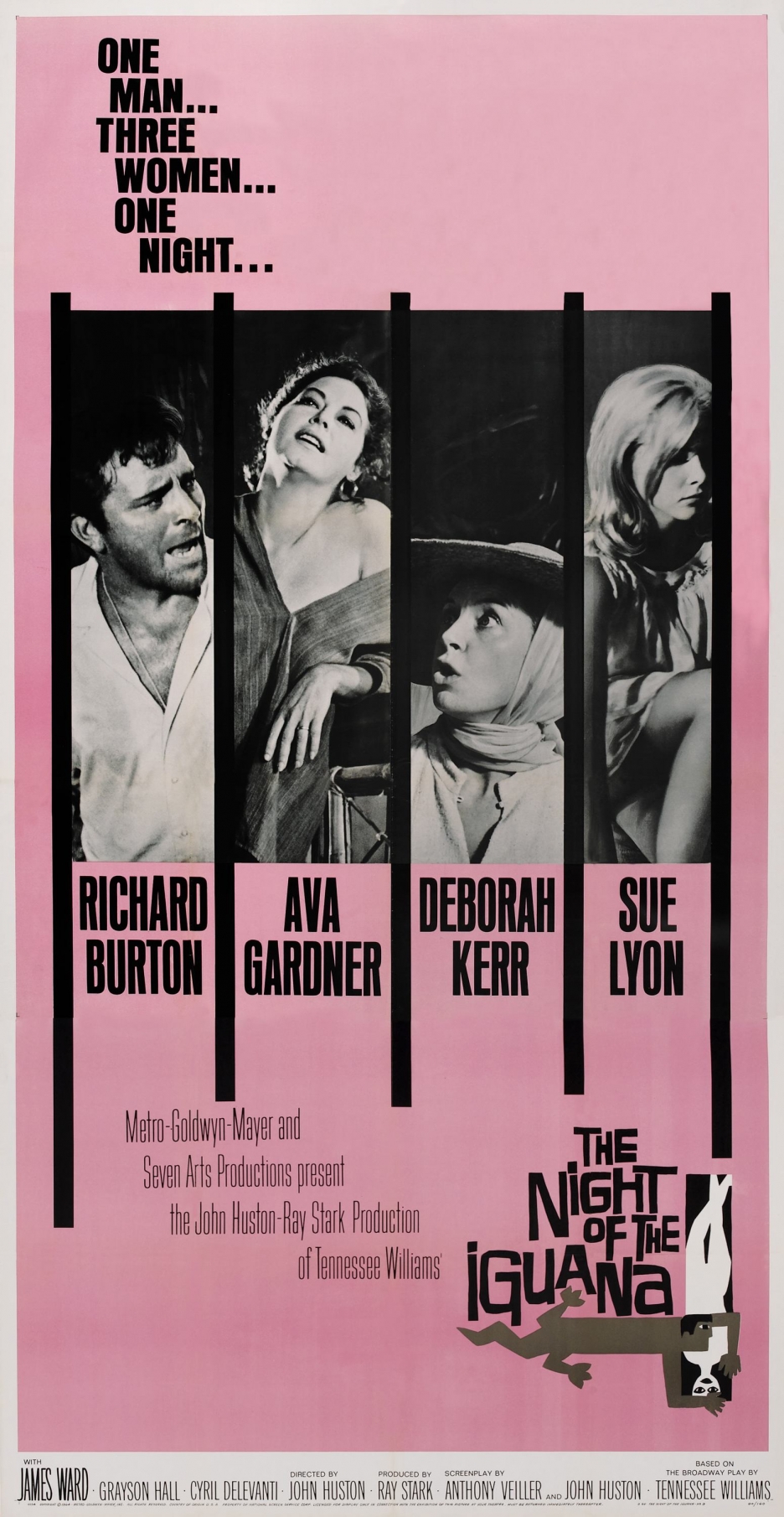
Lawrence Shannon (Richard Burton) loses his job as a clergyman when rumors surface of indiscretions he had with a young female parishioner, which pushes him to preach a ranting sermon at the pulpit that eventually drives all the members of the congregation out of the building. He then gets a job as a tour guide in Mexico and has the chore of leading a bus load of middle-aged women around the country. Charlotte (Sue Lyon) is a young nymph who takes a liking to Lawrence much to the chagrin of her over-protective chaperon Judith Fellowes (Grayson Hall). When Charlotte is caught in Lawrence’s bedroom late at night Ms. Fellowes promises that she will have it reported and get him fired. Unable to handle a another potential job loss Lawrence takes the bus load of women to an isolated seaside hotel run by Maxine (Ava Gardner) an old friend of his. He hopes that by somehow trapping them there he will be able to convince Ms. Fellowes to drop the charges, but along the way he meets Hannah (Deborah Kerr) who he starts to fall in-love with.

Unlike most of Tennesse William’s other plays this one, at least the first half, is full of energy and comical nuance. I found the group of ladies and Lawrence’s exasperated dealings with them to be quite amusing and the film moves along at an engaging pace. The second half though bogs down with more of William’s signature brooding drama that ends up hurting the flow. In many ways this film seems like two movies in one and the difference in tone and pace never gels. Despite a good nighttime conversation between Kerr and Burton I kept hoping the ladies and Ms. Fellowes would come back and felt the film was weaker without them.

Legendary director John Huston hits most of the right buttons here although it is not his best work. I was surprised and impressed to learn that Maxine’s hotel was built specifically for the production in an otherwise deserted region of the country. The building had an authentic old look and helped give the film added style and personality. I had mixed feelings with the black and white photography. On one had it helps bring out the dark recesses of its flawed characters and accentuate the moodiness of William’s script, but it also takes away from the exotic beauty of the locale.

Burton is good as usual and playing the part of an emotionally fractured, alcoholic character seems right up his alley. Gardner is great as the brassy Maxine and the scene of her making out with her two young, shirtless, maraca playing male assistants along the beach late at night is genuinely steamy. Kerr is in fine form as well and her more restrained demeanor makes a nice contrast to Gardner’s.

Lyon’s acting isn’t quite up to her costars and she seems particularly out of her league during her scene with Burton, but in the looks department she is unmatched. She is more filled-out and mature than in Lolita and in many ways even hotter. The scene of close-up shots of her moving her hips to a tune at a Mexican bar may excite some of the male viewers.

The under-rated Hall is excellent in her role as the heavy. Her craggy face and personality are perfect for the part and it rightly got her a supporting actress nomination.

In the final analysis this is not a bad version of Tennessee William’s material, but not a great one either.

night of the iguana 1

My Rating: 6 out of 10

Released: August 6, 1964

Runtime: 1Hour 58Minutes

Not Rated

Director: John Huston

Studio: MGM

Available: VHS, DVD, Amazon Instant Video

The Birthday Party (1968)

the birthday party 3

By Richard Winters

My Rating: 8 out of 10

4-Word Review: Tear up the newspaper.

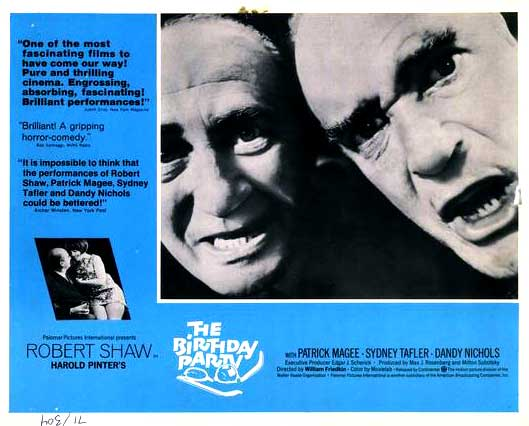
Since tomorrow will be my birthday I wanted to come up with a film that had birthdays as its theme and found this bizarre but fascinating obscurity. It is the story based on the play by Harold Pinter of Stanley Webber (Robert Shaw) a mysterious and private man who takes up lodging in a rundown British seaside house. He rents an upstairs room from Mr. and Mrs. Bowles (Moultrie Kelsall, Dandy Nichols) who are quite odd themselves. One day two men dressed in black suits (Patrick Magee, Sydney Tafler) come to pay Stanley a visit. They know something about Stanley’s past and their presence frightens him to the extent that it causes him to have a nervous breakdown.

On the surface this film shouldn’t work. There is an excessive amount of talking with dialogue that doesn’t say much and at times seems absurd. The set is drab and dirty with the camera seemingly locked down inside of it. There is never any explanation about Stanley’s past or what he is running from nor who the men are or what they know about him. The ending is elusive and the viewer will go away feeling more confused than they did at the start.

However, it is these ingredients that make the film so thoroughly intriguing. The seemingly banal dialogue is simply a façade for underlying thoughts and feelings. What Stanley is trying to run from is unimportant because it is really not about him at all and is instead more about ourselves, human nature and the quandary of our existence. It’s an examination of people’s futile attempts at trying to escape from who they are only to have society and life catch up with them. The set could be a metaphor for the inside of Stanley’s head. The grimy and decayed place symbolizes his decayed soul and the men in black suits are his conscience coming to haunt him.

Once you adjust to the eccentric narrative it then becomes a fantastic film for observing subtitles and nuance. Director William Friedkin shows a keenness for detail not only visually, but with the sound as well. The way the Magee character tears up a newspaper and the sound used for it could actually unnerve some viewers. Stanley’s meltdown scene is very unique and overall the direction is superb for such difficult material.

This movie was years ahead of its time, but for some it may be off-putting. However, it should be enjoyed by those who crave the avant-garde. It is also a rare chance to the see the normally strong-willed Shaw playing a very weak and vulnerable character. Nichols is also a stand-out playing an Edith Bunker type with a perverse streak lying just beneath the surface.

the birthday party 1

My Rating: 8 out of 10

Released: December 9, 1968

Runtime: 2Hours 3Minutes

Rated G

Director: William Friedkin

Studio: Palomar Pictures International

Available: VHS, DVD (Region 2)

Noises Off (1992)

noises off 2

By Richard Winters

My Rating: 3 out of 10

4-Word Review: Behind-the-scenes discord.

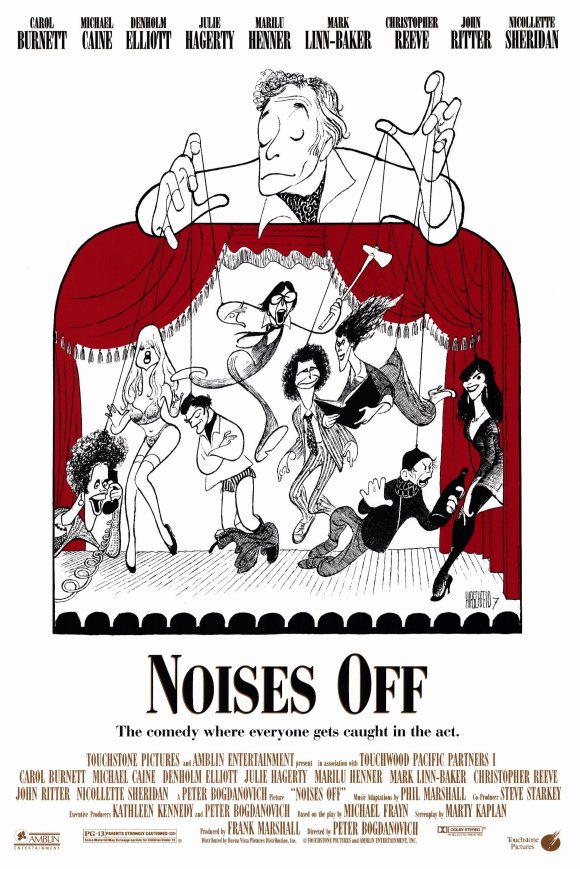
An eclectic group of actors put on a play that they take on tour. The play is a sort of door slamming British farce that is full of innuendos and misunderstandings and the film captures them during one particular scene of that play. It follows them as they rehearse that scene and then perform it live to an audience. It also shows the behind the scenes discord that develops between the cast and how this affects the performance of the scene, which culminates in a completely disastrous showing in Cleveland.

This should have been a really fun movie. It’s certainly an originally structured idea and it is slickly handled. It brings back the days of screwball comedy where things were funny just for the sake of being funny. Everything is contained and nothing is out of place or crude. In some ways it’s a refreshing change of pace.

The cast is certainly game and perfect for this type of comedy. Christopher Reeve and John Ritter come off best. Reeve seems to be playing his Clark Kent character only to a higher degree. Ritter does his Jack Tripper routine not only with the physical side, but also the nuance. His character tries very hard to be politically correct and it is amusing watching him never able to get to the point.

The film offers some light satire into the whole stage production process. Everything from the fragile temperaments of the actors to the high strung director is examined. It also takes some good shots at the plays themselves and how these stage comedies always seem to have such a high reliance on extreme coincidences.

There are some good laughs, but after a while it becomes a bit too much and exhausting to watch. The jokes and gags come so fast that if you blink you will miss some. There is also too much reliance on the frantic side of comedy, which eventually starts to lose its cuteness. The characters are placid and so are the situations. There is also the redundancy factor of having to see the same scene done over and over.

The end result is meticulously choreographed tripe and as silly as the play it seems to be mocking. It also has a glaring factual error. Michael Caine, the play’s director, talks about all the cities they have been too. He mentions Cairo, Missouri as one. There is a Cairo in Illinois but none in Missouri.

My Rating: 3 out of 10

Released: March 20, 1992

Runtime: 1Hour 41Minutes

Rated PG-13

Director: Peter Bogdanovich

Studio: Touchstone Pictures

Available: VHS, DVD