Category Archives: Movies Based on Novels

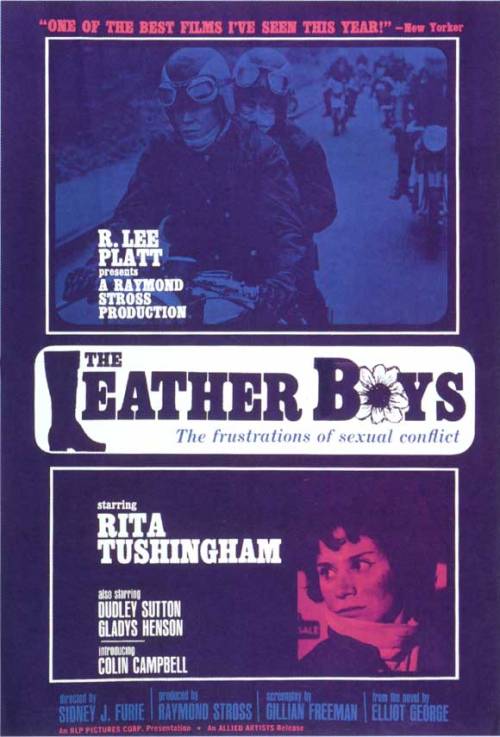
The Leather Boys (1964)

leather boys 1

By Richard Winters

My Rating: 6 out of 10

4-Word Review: Befriending a gay biker.

Reggie and Dot (Colin Campbell, Rita Tushingham) are young and in love, at least they think they are. They want to rush off and get married, but Reggie’s father (Lockwood West) feels that they ‘don’t know the meaning of the word’ and he gets proven right as immediately after they tie the knot they are at odds with each other. Reggie begins looking for companionship elsewhere and meets up with a fellow biker named Pete (Dudley Sutton). Pete and Reggie quickly become best friends and begin hanging out together, but Pete is secretly gay and has more of an interest in Reggie than just a friendship.

Director Sidney J. Furie, whose career has now spanned 6 decades, has done a lot of duds in his time, but this isn’t one of them. The stark black-and-white photography helps bring out the bleak working class existence of the characters and the variety of locales used including a nicely captured cross country motorbike race make the story captivating and believable.

The performances are outstanding. Tushingham is especially good at displaying a genuinely nasty side to her character at the most unexpected times. Gladys Henson, who plays the widowed grandmother, is also excellent and the scene where the others argue while right in front of her about how they consider her to be ‘an elderly inconvenience’ who needs to be sent away to a retirement home is downright heart wrenching. Sutton though is the most dynamic in a risky role that helped jettison him to stardom. His distinctive facial features galvanize the viewer’s attention and the ambivalent expressions that he makes particularly when in the presence of Dot are priceless.

Spoiler Alert!

The film though takes too long to get to its obvious conclusion as we have a pretty good idea from the beginning that Pete is gay, so having to wait until the very end for this to finally get revealed seems to be stretching the story out longer than necessary. Most likely Pete would’ve made some sort of pass at Reggie at some point earlier anyways especially since the men shared the same bed. The film also ends with Reggie walking away from Pete and essentially ‘abandoning’ him once he realizes that he is gay. The music that is played over the scene conveys the idea that this is the ‘right’ thing to do and parlays the conventional attitude of the time that there is something ‘wrong’ with Pete, which doesn’t make this as much of a landmark movie as it’s widely considered since its ultimate message is still entrenched with the biases and bigotry of that era.

End of Spoiler Alert!

My Rating: 6 out of 10

Released: March 8, 1964

Runtime: 1Hour 48Minutes

Not Rated

Director: Sidney J. Furie

Studio: Allied Artists

Available: DVD, Amazon Instant Video
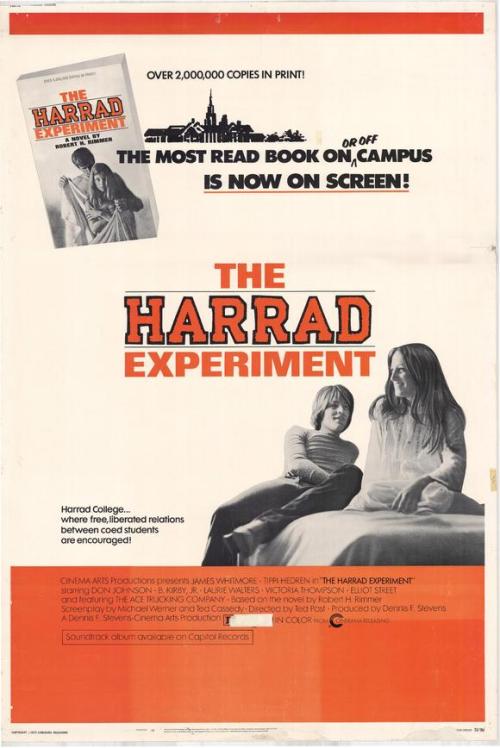
 

The Harrad Experiment (1973)

the harrad experiment

By Richard Winters

My Rating: 6 out of 10

4-Word Review: College promotes sexual freedom.

Based on the novel by Robert H. Rimmer the story centers on a group of students who attend a socially progressive college where sex between multiple partners is expected and promoted. The school is run by Phillip and Margaret (James Whitmore, Tippi Hedren) who feel conventional marriage is an unrealistic ideal that creates the idea of ‘ownership’ over someone else, which in turn causes jealousy. They hope to end these problems and change the cultural norms by having the next generation accept more of a group marriage mentality.

The film nicely avoids the smarmy T&A factor by portraying nudity in a natural non exploitative way while also having characters that are believable and a good representation of the young generation from that era. The different ways that the students respond to the unique environment and the realization that they aren’t quite as sexually liberated as they thought remains the story’s focal point of interest.

The film also allows for a great chance to see young stars in the making. Laurie Walters, who later went on to star in the TV-show ‘Eight is Enough’, gives a sensitive portrayal of a young woman who’s still shy about her body and not quite ready to enjoy sex outside of the bounds of romance as she had initially thought. Bruno Kirby is good as well playing a student who’s so filled with insecurities that it prevents him from having any sex at all. Don Johnson though gives the best performance as a cocky student who uses the program simply as a way to ‘score’ with women only to later learn that even he needs some emotional bonding too.

The always reliable Whitmore is solid as the stoic instructor and Hedren gets one of her best roles outside of her most famous one in The Birds with her titillating moment coming near the end when she strips off her clothes and tries to entice Johnson to make love to her right out in the open and in front of everyone. Actor Ted Cassidy, who co-wrote the script, can also be seen briefly sitting at the counter of the local café.

Although the film does manage to bring out a few provocative elements I still felt even without having read the novel that is was only skimming the surface. Having the story focus on only a few of the couples isn’t as captivating as it could’ve been had it instead taken a broader look at all of the students. The low budget gives the production a cheap look and a few too many sappy love songs get thrown in an attempt to turn it into a ‘70s romance instead of keeping it more of a psychological drama that it should’ve been.

A sequel called Harrad Summer, which follows these same students who take what they’ve learned and try to implement it into their adult lives, was released one year later and that will be reviewed later on this week.

My Rating: 6 out of 10

Released: May 11, 1973

Runtime: 1Hour 37Minutes

Rated R

Director: Ted Post

Studio: Cinerama Releasing Corporation

Available: VHS, DVD

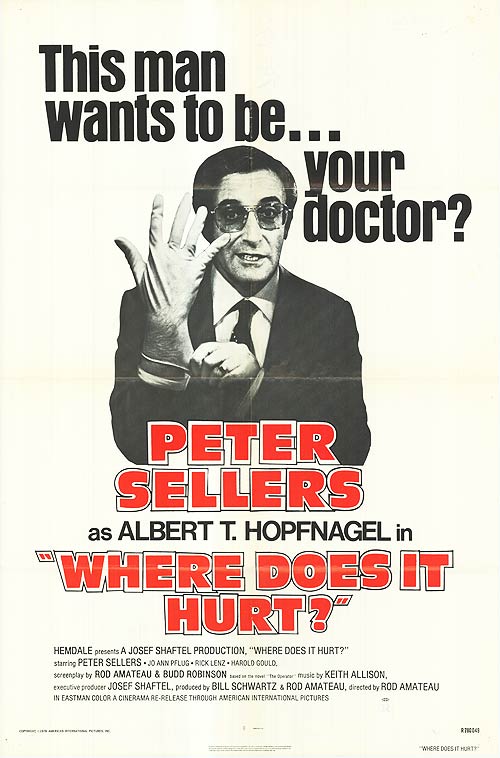
Where Does It Hurt? (1972)

where does it hurt 1

By Richard Winters

My Rating: 4 out of 10

4-Word Review: Corruption at a hospital.

It’s funny how names like Ed Wood Jr. or Tommy Wiseau get mentioned in just about anyone’s list of bad movie director’s, but Rod Amateau’s never does, but should. Not only did he produce ‘My Mother the Car’ and ‘Supertrain’, which are considered two of the worst TV-series ever to be broadcast, but he also directed the notorious Garbage Pail Kids as well as Son of Hitler and The Statue, which featured a jealous David Niven going around the bathrooms and gay bathhouses of London looking for a man whose penis matches the one that his wife created for a life-sized statue that she says replicates her lovers.

While this film isn’t quite as bad as those it comes close. It stars Peter Sellers who was at a career nadir due to financial mismanagement and willing to take on any low budget job offer he was given. Here he plays the corrupt head of a hospital that uses an array of schemes to bilk patients and insurance companies out of thousands of dollars. Rick Lenz plays a patient who becomes aware of the shenanigans going on and tries to bring Sellers and his staff down, but finds that they seem to have a trick up their proverbial sleeves at every turn.

The film manages to have a few amusing moments, but comes off more like a gag reel than a story. The characters are exaggerated and unlikable. We are supposed to side with Lenz and his predicament, but he so stupidly allows the doctors to take advantage of him at the beginning that it becomes hard to. The whole thing gets sillier by the second until by the end it’s completely inane. It also makes light of some serious issues that were handled better in Paddy Chayefsky’s The Hospital, which came out just 8 months before this one.

To some degree it’s fun seeing Sellers, who was noted for his wide range of dialects, taking a stab at an American accent and he almost pulls it off except for a few moments including the one where he pronounces orifice as AW-ifice.

The supporting cast made up of lesser known talents proves to be game here. Pat Morita, still years away from his breakout role in The Karate Kid, is genuinely amusing as a lab tech with an inferiority complex and at one point even speaks in a British accent. Harold Gould is good as an incompetent Dr. and J. Edward McKinley, best known for his many appearances on ‘Bewitched’ as one of McMahon and Tate’s primary clients, is funny as the Hospital commissioner who relentlessly tries to nab Sellers and eventually after repeated missed opportunities is able to.

In better hands this might’ve had a chance, but the low budget, irritating country music soundtrack and cheap jokes pretty much sink this thing before it even has a chance to get started.

My Rating: 4 out of 10

Released: September 29, 1972

Runtime: 1Hour 28Minutes

Rated R

Director: Rod Amateau

Studio: Cinerama Releasing Corporation

Available: None at this time.

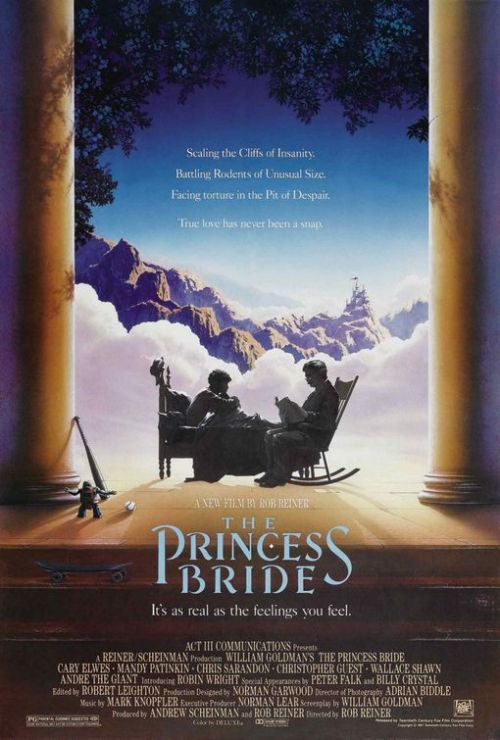
The Princess Bride (1987)

princess bride 1

By Richard Winters

My Rating: 7 out of 10

4-Word Review: Grandson likes bedtime story.

Based on the 1973 William Goldman novel, who also wrote the screenplay, a grandfather (Peter Falk) arrives to read to his sick grandson (Fred Savage) a fairytale. Initially the grandson is more interested in playing video games, but soon finds himself enraptured with the story despite his initial reluctance. The tale involves a country girl named Buttercup (Robin Wright) who falls in love with a farmhand named Westley (Cary Elwes). When Buttercup mistakenly thinks that Westley has been killed by some pirates she agrees to marry Prince Humperdinck (Chris Sarandon) only to end up getting kidnapped before her wedding and saved by Westley who was never dead to begin with. The two then must fight off the evil Prince who still insists on marry Buttercup and doing away with Westley.

The film, which was directed by Rob Reiner and produced by his former ‘All in the Family’ creator Norman Lear, is engaging from beginning to end and filled with endlessly funny dialogue and exciting adventures that remain pleasantly amusing throughout. My favorite moment is seeing a completely unrecognizable Billy Crystal hamming it up as an old man magician who tries to revive Westley while sounding like a comedian from vaudeville.

The special effects are impressive especially the shot showing Buttercup’s three kidnappers climbing a rope up a steep mountain while being followed close behind by Westley. To me though the best part is when Westley gets attacked by what appears to be a giant rodent that, with the exception of his fake looking fur, looks amazingly real and not like a stuntman in a body suit or a computerized image.

The performers are well cast with my favorite being former wrestler Andre the Giant who steals it despite having no acting experience and at times difficulty enunciating his words. The only negative is Christopher Guest as a six fingered man who supposedly attacked the Mandy Patinkin character when he was a child, but now that Patinkin has grown he faces Guest again even though Guest looks to be practically his same age and not someone who should be significantly older.

The story is basic and lacks the grandiose and dark quality that many of the classic Grimm fairytales possess. The banter between the grandson and Grandfather is fun and I wished it had cut back-and-forth between the two and the story more often than it does. The context is simple and straight forward and its ‘message’ of teaching kids to learn to enjoy reading is a bit too obvious, but overall as non-think escapism it scores a bullseye and through the years has managed to acquire a strong cult following.

My Rating: 7 out of 10

Released: September 25, 1987

Runtime: 1Hour 38Minutes

Rated PG

Director: Rob Reiner

Studio: 20th Century Fox

Available: VHS, DVD, Blu-ray, Amazon Instant Video, YouTube


Night of the Lepus (1972)

night of the lepus

By Richard Winters

My Rating: 1 out of 10

4-Word Review: Giant rabbits attack people.

Arizona rancher Cole Hillman (Rory Calhoun) has his property overrun with rabbits and looks to zoologist Roy Bennett (Stuart Whitman) for help. Roy along with his wife Gerry (Janet Leigh) decides to inject these rabbits with hormones that he hopes will throw off their breeding cycle, but instead one of them escapes from the testing lab and creates a whole new race of giant sized rabbits that begin terrorizing and destroying everyone and everything around.

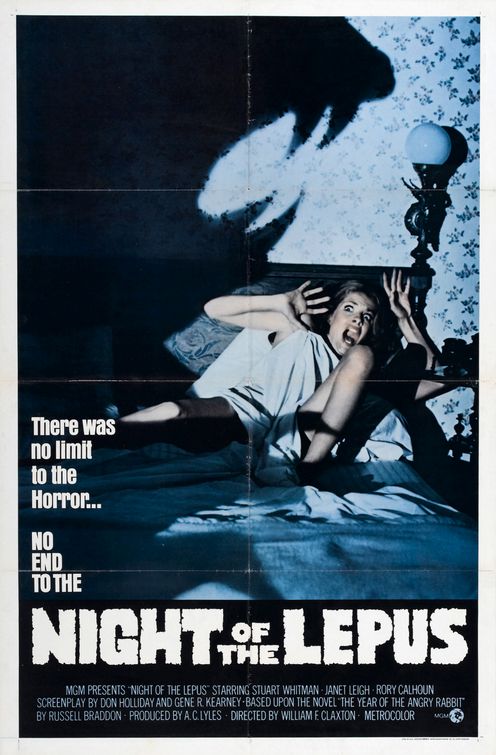
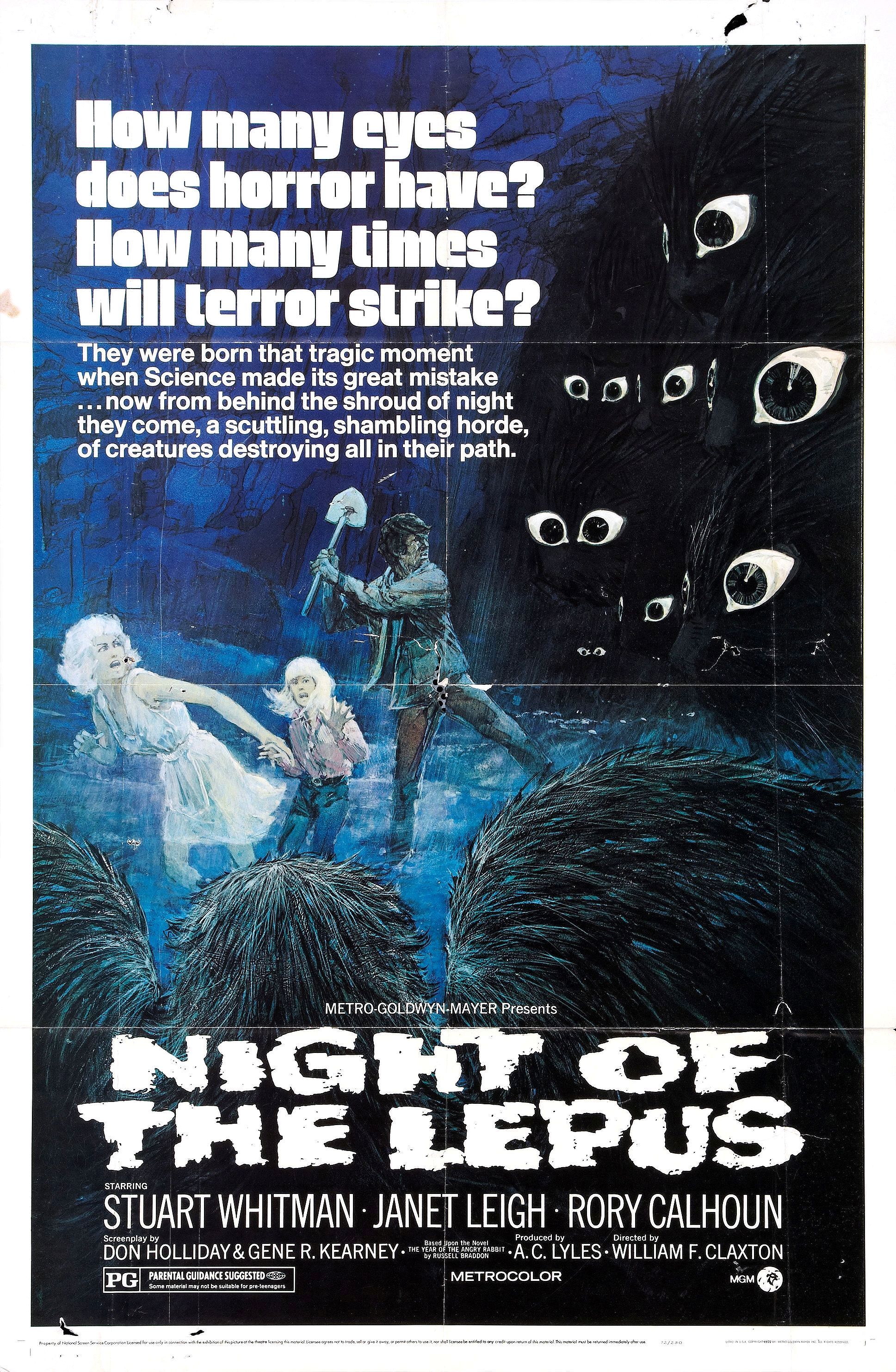
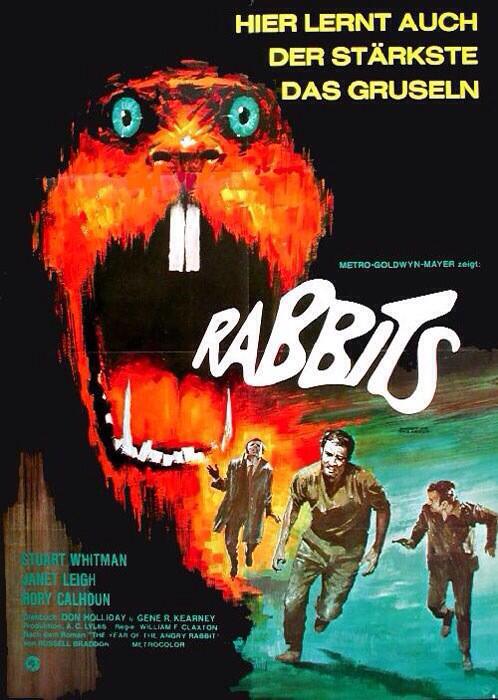
If your thought is ‘what were they thinking’ as you read that plot synopsis then you are not alone as that was the question I kept asking as I viewed the film. What’s even funnier is that the studio feared this concept would be met with ridicule from the beginning and therefore created movie posters that carefully avoided showing the rabbits or explaining what the threatening presence was. The original title for the film, which was ‘Rabbits’ was also changed to Lepus, which in Latin means hare as another way to avoid giving away the plotline, but it all proves futile because once people view the film the secret would be out and the laughter not the scares would begin.

The special effects are the biggest issue as the rabbits never seem giant-sized and are simply photographed in extreme close-up to give the clumsy impression that they are large or shown amongst a miniaturized set. However, even when shown next to a small building it doesn’t work as they appear no bigger than a horse, which may make it big for that species, but still not giant sized. The sound effects used to represent the noise that they make comes off more like ancient tribal music that becomes increasingly annoying and overplayed.

night of the lepus 2

The shots showing the victims after an attack looks more like people lying on the ground smeared with red paint and without any bite marks or chewed flesh that you would expect. The film also doesn’t explain why these rabbits that are normally a docile type of creature would suddenly become so aggressive simply because they became bigger.

It’s fun to see some familiar faces like DeForest Kelley in one of his last non-‘Star Trek’ roles, but I’m surprised that any of these actors took part in this as I’m sure from reading the script that they knew it was ludicrous, but to their credit they perform it earnestly. Melanie Fullerton as the young girl who sets the whole thing in motion by allowing one of the rabbits to escape is the only one that got on my nerves and may win the prize for most annoying child ever to be put on the big screen.

Based on the novel ‘The Year of the Angry Rabbit’ by Russell Braddon the film never gets off the ground and is straddled from the very beginning by its absurd plot and cheesy effects. Even if it had been done as a parody I don’t see it doing any better, which brings us back to the first question ‘what were they thinking’ and my answer to that is that they clearly weren’t.

night of the lepus 4

My Rating: 1 out of 10

Released: October 4, 1972

Runtime: 1Hour 28Minutes

Rated PG

Director: William F. Claxton

Studio: MGM

Available: DVD, Amazon Instant Video

To the Devil a Daughter (1976)

to the devil a daughter 1

By Richard Winters

My Rating: 6 out of 10

4-Word Review: He sacrifices his daughter.

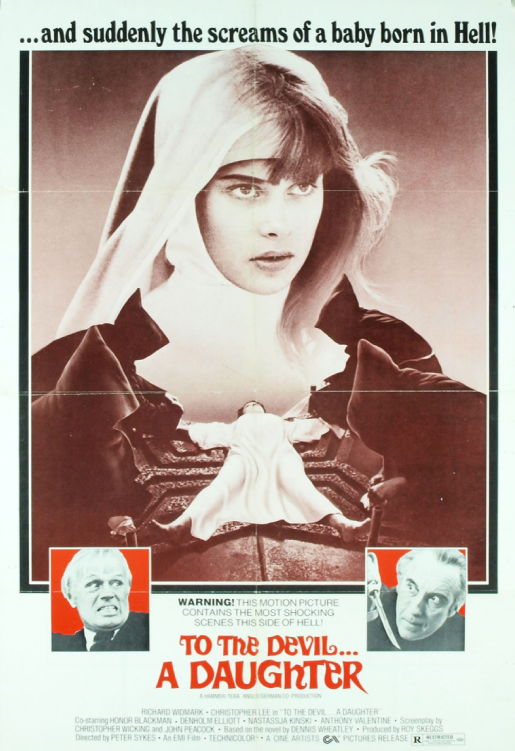
Father Michael (Christopher Lee) is an ex-communicated priest who runs an offshoot religion called Children of the Lord that seems connected to the Catholic Church on the outside, but underneath the façade it is actually a cover for a group of Satanists. Henry (Denholm Elliot) is the father who signs over his daughter Cathrine’s (Nastassja Kinski) soul at her birth which stipulates that on her 18th birthday she will become the devil’s representative here on earth. Yet as that date approaches Henry begins to have second thoughts and hires occult novelist John Verney (Richard Widmark) to steal Catherine away from her captors and take her away to his place to hide, but Father Michael uses the power of black magic to hypnotize Catherine and force her to return to him while John tries everything in his power to stop it.

One commenter on the IMDB message boards claims this is ‘one of the worst movie to come out in the 70’s’, which only proves that he must not have seen a lot of ‘70’s movies as there is far worse stuff from that decade than this. Although it is certainly no classic it’s still not bad on the technical end and even rather slick. I enjoyed the on-location shooting done in Europe particularly the scene showing a drawbridge that could be lowered and raised manually by one person. The gore and scares are skimpy, but the scene where Kinski dreams of having the devil fetus crawl up her body and she then proceeds to stuff it into her vagina is certainly worth a few points.

Kinski’s presence is the best thing about the movie and the film became notorious in its day for showing her in full frontal nudity even though she was only 14 at the time. However, what surprised me even more was how confident she looked when she did it without any of the expected nervousness or shyness. I felt that because she was the daughter of actor Klaus Kinski and had to learn to group up fast she had a higher level of maturity than most other teens her age and therefore the scene wasn’t as awkward for her as it might otherwise have been.

Lee’s great as always as the bad guy and I particularly enjoyed his facial expressions. However, Widmark  was miscast as he was too old and I didn’t understand why being only a friend of the family he would take such an invested interest in their daughter and such personal risks to get her out of the cult, which I felt would’ve been better suited to the role of the father and cutting out the Gurney character altogether.

This was the last horror film to be produced by Hammer and for the most part it plays like a cheesy rip-off of The Exorcist, but still has enough of a budget and a capable enough cast to keep it mildly enjoyable.

My Rating: 6 out of 10

Released: March 4, 1976

Runtime: 1Hour 28Minutes

Rated R

Director: Peter Sykes

Studio: Hammer Films

Available: DVD, Amazon Instant Video
Village of the Damned (1960)

village of the damned 2

By Richard Winters

My Rating: 6 out of 10

4-Word Review: The eyes have it.

Remade in 1995 and based on the John Wyndham novel ‘The Midwich Cuckoos’ the story centers on a small English village where one day everyone mysteriously falls asleep for several hours while under the spell of some invisible, odorless gas. When they awaken everything seems normal, but later on all the women become pregnant, even those that were not married or were still virgins. When the babies are born they are found to be different from their human counterparts as they have a higher intelligence, odd shaped heads and bright blonde hair. Later on these same children gain the ability to read other people’s minds and dispose of those that they don’t like penetrating them with the spell of their glowing eyes. As the rest of the village panics one man (George Sanders) feels that he may have the ability to stop them, but only if he can somehow control his own thoughts, so they won’t be able to tell what he is actually up to.

As a sci-fi thriller it’s not bad. The film’s short running time has a nice compact style to it with a story that evolves at a fast pace and continues to add new twists. The special effects for its day are realistic enough to be passable and the violence is surprisingly high. Sanders is effective in the lead and Martin Stephens as the leader of the children is quite creepy.

I found it a bit baffling though that the townspeople wouldn’t have quarantined the strange children from the start as it becomes quite obvious from the beginning that they aren’t normal. Instead they are allowed to roam freely even as they become increasingly more sinister. I would’ve also have thought that some of the mothers who gave birth to these strange beings would’ve disowned them and even refused to take care of them once their unnatural and frightening oddities became apparent.

The ending is frustrating as the film does not supply any answer as to who these kids where and what type of alien presence impregnated the women and why. The movie tells us that other places have been effected with these strange children as well, which leads one to believe that this is only a part of some other more sinister plot with far reaching consequences that never gets tackled. Instead we get left with a short film that acts like a small chapter to a fascinating idea with broad potential variables that unfortunately never gets followed through on.

My Rating: 6 out of 10

Released: July 5, 1960

Runtime: 1Hour 17Minutes

Not Rated

Director: Wolf Rilla

Studio: MGM

Available: DVD, Amazon Instant Video
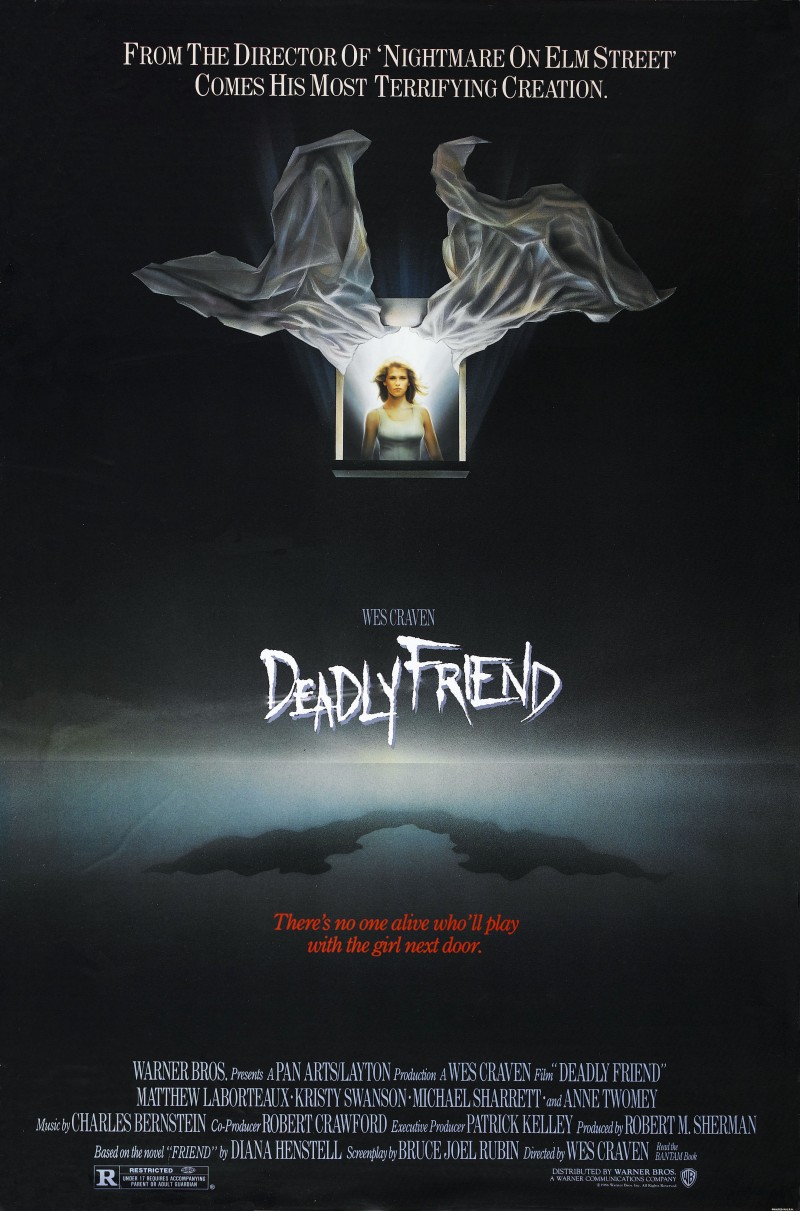
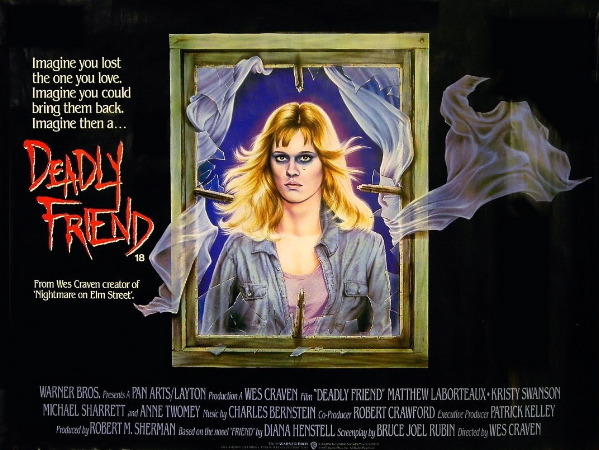
Deadly Friend (1986)

deadly friend 1

By Richard Winters

My Rating: 1 out of 10

4-Word Review: He resurrects his girlfriend.

Paul (Matthew Labyorteaux) is a teen with a genius I.Q. who teaches classes on robotics at a local university. His next-door neighbor is Samantha (Kristy Swanson) a beautiful teen girl who is tormented and abused by her alcoholic father (Richard Marcus). When she becomes brain dead after falling down the stairs during one of her father’s rages Paul tries to bring her back to life by implementing the microchip from his robot’s brain into hers. However, instead of the pretty, sweet girl that she once was she is now a killing machine getting back at anyone who ever wronged her and Paul becomes unable to stop her.

The film suffers severely as a result of the studio having a different idea on the direction they wanted to take it versus what director Wes Craven or its screenwriter Bruce Joel Rubin had. Craven and Rubin wanted an offbeat love story while the producers pushed for the conventional ‘80s horror. The result is a mishmash of different genres that throws in everything from blood and gore to silly robots that do cutesy things and look better suited for a kid-friendly Disney movie.

The plot has a logic loophole as well as the reincarnated Samantha somehow gains super human strength, which makes no sense. She may have the robot’s brain, but it’s still her same body, so whatever strength the robot had would not transition to her since he was made from mechanical parts. The part where she lifts a biker dude over her head would probably have broken her back and I wasn’t sure what the dark circles around her eyes was so supposed to mean. Was this to represent that she was slowly dying and decaying? If so then her skin should be rotting and peeling off and not just looking like someone who went a little overboard with the eye shadow.

The misguided nightmare segments are another issue. The scene where Samantha dreams that she stabs her father in the stomach with a broken glass vase that causes blood to rush out of him appears more like an erect penis pissing out blood. The moment where Paul sees Samantha’s dead and burned father’s head popping out of his bed is too reminiscent of A Nightmare on Elm Street and comes off looking like Craven was going to the same well too often.

The characters are dull and poorly fleshed out. Paul is too clean cut and the fact that he is super smart at everything becomes annoying. Samantha seems overly passive and sheltered and her loathsome father becomes nothing more than a walking, talking cliché trucked straight in from Redneckville.

Spoiler Alert!

The ending is by far the worst part as it features Paul coming into the morgue after Samantha has been killed and then having her inexplicable and without explanation turn into a robot. Whether this was simply a dream or a misguided attempt to turn the plotline into some sort of sequel is unclear, but it helps cement this as a complete catastrophe despite its good production values and a perfect testament to what happens when the producer and director are not on the same page.

End of Spoiler Alert!

deadly friend 2

My Rating: 1 out of 10

Released: October 10, 1986

Runtime: 1Hour 31Minutes

Rated R

Director: Wes Craven

Studio: Warner Brothers

Available: VHS, DVD, Amazon Instant Video, YouTube 

Lovin’ Molly (1974)

lovin molly

By Richard Winters

My Rating: 4 out of 10

4-Word Review: Two men one woman.

Molly (Blythe Danner) is a free-spirited woman living in a small Texas town during the 1920’s. Gid (Anthony Perkins) and Johnny (Beau Bridges) are best friends who also both like her. Molly likes them as well, but can’t seem to decide which of the two she loves better, so to solve things she gets married to Eddie (Conard Fowkes). This doesn’t go over well with the other two, but as time goes by she continues to see them and even has children from both of them, which causes a stir in her small community. Not only does she become the product of the local gossip, but virtually ostracized as well. However, Molly is undeterred about what everyone else thinks and sticks to her independent ways.

Based on the Larry McMurtry novel the film was directed by the legendary Sidney Lumet, but you would hardly know it. The production looks cheap and rushed and lacks atmosphere or period detail. The scenes are flatly shot with very little visual design or imagination. The whole thing comes off as something that did not get any major studio backing and was forced to look to private investors for funding, which unfortunately was just not enough.

Filming it on location in Bastrop, Texas which is also the setting of the story helps a little as the town has many historical buildings, which heightens to some extent the period atmosphere, but I would’ve liked to have seen more of it. The dry Texas landscape is also nicely captured and makes the viewer feel like they are living in the state themselves with each and every shot. The one thing though that really impressed me was how realistically the characters aged as the story, which spans 40 years, progresses. In most films the actors are forced to wear a ton of makeup, which gets overdone, but here very little of it was used and it looked far better.

Danner, who these days is best known as the mother of Gwyneth Paltrow, is excellent in a rare turn as a leading lady and even appears fully nude from the front and back. Perkins is solid in support and I enjoyed seeing Bridges with a bowl haircut. The star though that really steals it is Edward Binns as Perkins’ father whose caustic and to-the-point remarks are gems.

Fred Hellerman’s flavorful bluegrass score is pleasing, but the film itself fails to elicit much emotion. The only times that it does become mildly interesting is when the characters do a voice-over narration by reading off of passages lifted directly from its source material making me believe that this should never have been filmed in the first place and left simply in its novel format.

My Rating: 4 out of 10

Released: April 14, 1974

Runtime: 1Hour 38Minutes

Rated R

Director: Sidney Lumet

Studio: Columbia Pictures

Available: DVD (Region 2), Amazon Instant Video

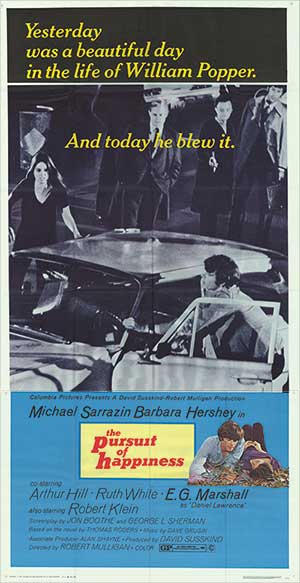
The Pursuit of Happiness (1971)


pursuit of happiness 2

By Richard Winters

My Rating: 5 out of 10

4-Word Review: Justice isn’t always fair.

Everything seems to be going William Popper’s (Michael Sarrazin) way. He is a young college student with a great looking girlfriend (Barbara Hershey) and from a rich family. One night he takes a trip to the grocery store. It is raining and he accidently hits and kills a woman who walks out onto the street between two parked cars. Since William has several unpaid traffic tickets, is part of the anti-establishment movement and seems to have a generally belligerent manner he gets arrested for her death. His rich father (Arthur Hill) hires a successful lawyer (E.G. Marshall), but William is a major idealist who doesn’t want to compromise on anything and the more he fights for his ideals the deeper it gets him into trouble.

The film, which is based on a novel by Thomas Rogers, certainly makes some great points about our modern day American justice system where everything seems more based on the image that the defendant tries to present than the actual facts. Unfortunately most viewers today are already quite jaded by this and the message comes off as old and redundant.

The biggest problem is with Sarrazin. He has always had a bit of a transparent quality and I’ve defended him in some of his other roles, but here he helps to bring the whole thing down. He conveys no anger or emotion of any kind even though it’s supposedly his passion for the truth that causes him to behave the way he does. His comes off as limp and lifeless making me wonder how such a bland guy could attract a girlfriend at all let alone a really beautiful one. His character is also a bit too stubborn and strangely naïve to the point that the viewer isn’t completely empathetic with his cause as it becomes painfully obvious that he is only hurting himself by refusing to back down at all while most rational people would’ve likely buckled under just enough to get themselves out of the jam.

The script unfortunately is more intent on making a statement than telling a story as we are given no conclusion to the character’s plight. He escapes from jail and takes a flight to Mexico, but then it just ends leaving open a wide array of unanswered questions and making the viewer feel like they’ve seen only half a movie.

Ruth White, in her last film appearance, gives a strong performance as Walter’s Archie Bunker-like grandmother. It’s also great to see Marshall playing a more hard-lined version of the defense attorney role that he was famous for from ‘The Defenders’ TV-show. Robert Klein is engaging as Walter ‘60s radical college friend and David Doyle is good as Walter’s cellmate. Charles Durning, Ralph Waite and Rue McClanahan can be seen in small roles and this also marks William Devane’s film debut.

pursuit of happiness 3

My Rating: 5 out of 10

Released: February 23, 1971

Runtime: 1Hour 33Minutes

Rated GP

Director: Robert Mulligan

Studio: Columbia Pictures

Available: DVD, Amazon Instant Video