Category Archives: Movies Based on Novels

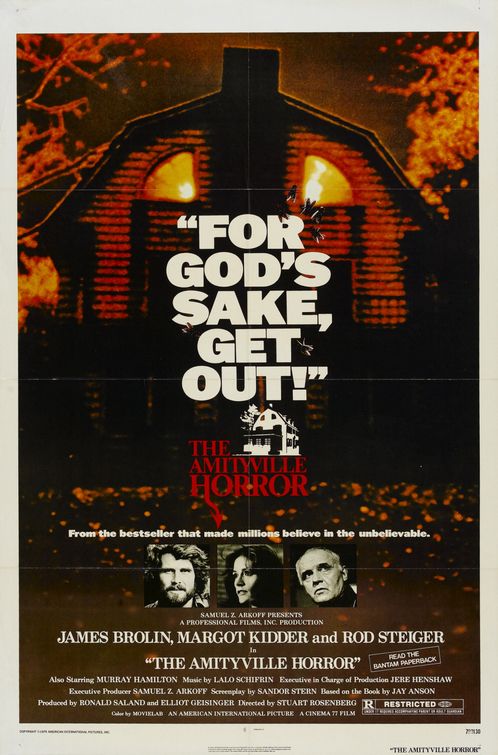
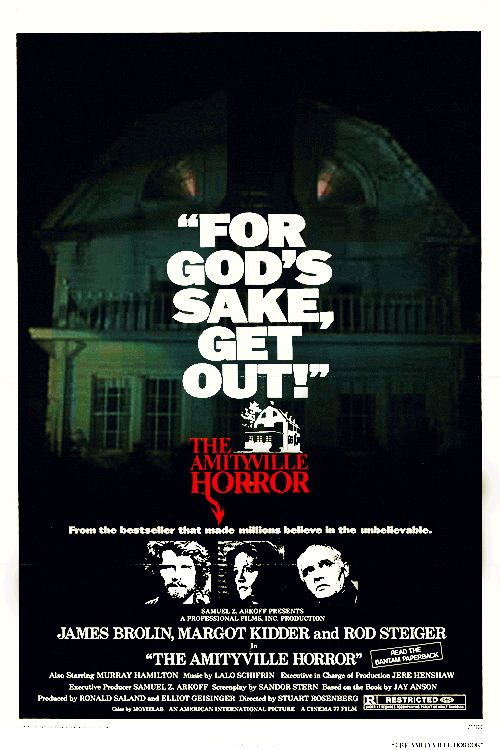
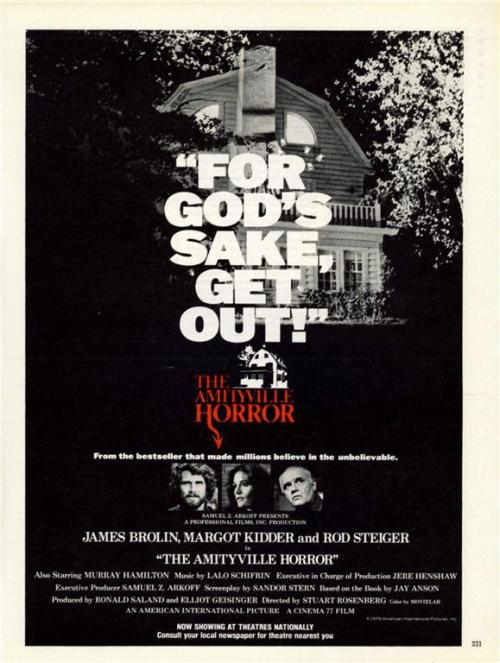
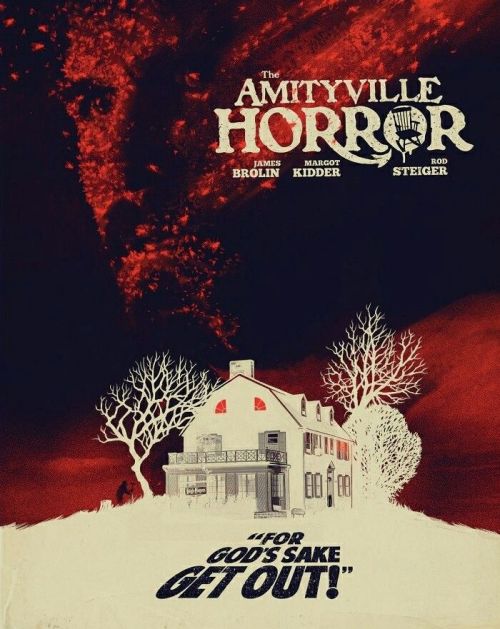
The Amityville Horror (1979)

By Richard Winters

My Rating: 1 out of 10

4-Word Review: Their house is haunted.

Kathy and George Lutz (Margot Kidder, James Brolin) move into a large home that just a year earlier was the place of a gruesome homicide of six people. Though the idea of living where these murders occurred is unsettling they cannot beat the home’s price, so they take the offer. Soon there are bizarre occurrences and George begins to behave like he is becoming possessed convincing the young family that the place is haunted and they need to move out before it is too late.

The film is based on the Jay Anson novel, which was centered on the supposedly true events of the Lutz family who moved into a home known as ‘High Hopes’ that had previously been occupied by the DeFeos who were slaughtered at the hands of their oldest son Ronald in November of 1974. The Lutzs lived in the home from December of 1975 until they ‘abandoned’ it in January of 1976. Since that time many other people have lived there and none have reported any paranormal activity. The home, which was built in 1924, had no unusual events occur in it for the 50 years previous to the DeFeo tragedy either making me and many others speculate that the Lutzs made it all up because why else would they be subjected to the hauntings and none of the others.

(The actual house as it appeared in 1974)

In either case the movie isn’t very good and at many points is quite laughable. The film would’ve worked better had it been structured as a pseudo-documentary where interviews with the characters could’ve be spliced into the reenactments, which would’ve avoided it from seeming so mechanical and coming off like a formulaic scare-a-minute like it does here. The so-called frights are over-the-top from the start and there’s such a barrage of them that by the time you get to the finale, which should be the scariest point of the film, it becomes almost anti-climactic.

The overblown facial reactions of the actors had me laughing out loud at many spots particularly Brolin’s feeble attempts to channel a Charles Manson-like persona and Amy Wright getting locked in a closet. She plays a teen babysitter who walks around wearing one of those garish dental headgears and made me believe that the spirits locked her in there simply because they felt she looked too stupid. Kiddor’s constant shocked expressions at Brolin’s increasingly edgy responses becomes tiring and the part where Brolin shouts at the evil spirts that “This is my house!” had me thinking the spirits should’ve responded with “No it isn’t, it’s the banks!”

Rod Steiger’s priest impression is the Achilles heel. I realize there was a priest in the book, but since then that same priest as disputed the events described in the story, so it should’ve gotten downplayed. I didn’t like the supernatural events occurring outside of the home like when Steiger and Don Stroud are driving in their car and having it mysteriously breakdown. The house is the centerpiece and all scares should take place there otherwise it ceases to be a haunted house film at all and instead just another pedestrian story dealing with evil spirits that can manifest anywhere.

How some could find this scary is a mystery. I first watched it 30 years ago and thought it was tacky then and consider it even more so now. Just because it has managed to spawn a lot of sequels doesn’t make it ‘a classic’ and I feel it would be better suited for rifftrax of Mystery Science Theater.

My Rating: 1 out of 10

Released: July 27, 1979

Runtime: 1 Hour 58 Minutes

Rated R

Director: Stuart Rosenberg

Studio: American International Pictures

Available: DVD, Blu-ray (Region A/1, B/2) Amazon Video, YouTube

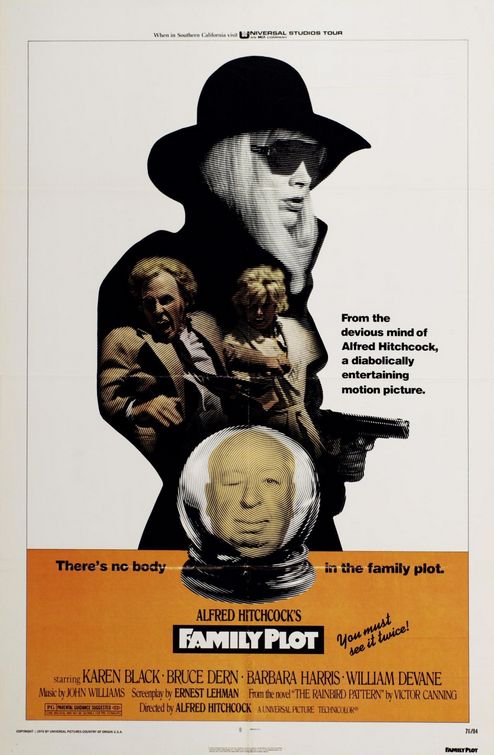
Family Plot (1976)

By Richard Winters

My Rating: 4 out of 10

4-Word Review: Alfred Hitchcock’s last movie.

Blanche Tyler (Barbara Harris) is a phony psychic whose client, the rich heiress Julia Rainbird (Cathleen Nesbitt) offers her a reward of $10,000 if she can use her ‘psychic abilities’ to find Julia’s long-lost nephew who was given up for adoption years earlier. Blanche employs her boyfriend George (Bruce Dern) who works as a cabbie in-between acting gigs, to find the man. George ends up stumbling upon someone who he thinks may be him, Arthur Adamnson (William Devane), but ends up getting in-over-his-head when Arthur proves to have ulterior motives.

The film’s claim-to-fame is that it was the last one directed by Alfred Hitchcock, which is probably the only good thing to say about it. Technically it’s not bad, but it’s not terribly interesting either. Everything that gets done here has been done before in other films with more interesting results. This includes a sequence where Blanche and George’s car goes careening down a mountain highway with no breaks, which isn’t exciting at all and looks clearly shot in front of a green screen.

After completing the far edgier Frenzy I was expecting Hitch to try and push the envelope even more, but instead he draws back with a pedestrian story that’s full-of-holes.  It was based on the novel ‘The Rainbird Pattern’ written by Victor Canning, which had a darker tone. Screenwriter Ernest Lehman wanted to capture that same tone here, but Hitch pushed him instead for a lighter quality that borders on camp, but ultimately comes off as gimmicky. The ending is particularly limp and for someone once dubbed the ‘Master of Suspense’ there is very little of it here.

The only moment that stuck out for me is where Blanche and George sit down to eat hamburgers. Normally actors in films rarely eat the food that they’re served and will usually either take small nibbles, or simply leave it on the plate without taking a single bite, but here both Dern and Harris take big bites from their burgers while continuing to talk. At one point a piece of burger spits out of Dern’s mouth as he speaks and he instinctually holds up his hand in front of his mouth in an embarrassment, which was strangely left in. Most directors would’ve quickly stopped the scene and reshot it, but instead Hitch decided to let it continue, which adds an odd realism probably not seen anywhere else.

The casting is the only real bright spot especially Devane, who normally played good guys, but takes a turn as a villain here and does quite well. In fact it’s the best performance of his career. Unfortunately the two women (Harris and Karen Black who plays Devane’s girlfriend) are wasted and for the most part have very little to do. Black’s role could’ve been cut out completely in a film that especially when compared to the director’s earlier works is a huge disappointment.

My Rating: 4 out of 10

Released: April 9, 1976

Runtime: 2 Hours 1 Minute

Rated PG

Director: Alfred Hitchcock

Studio: Universal

Available: DVD, Blu-ray, Amazon Video, YouTube

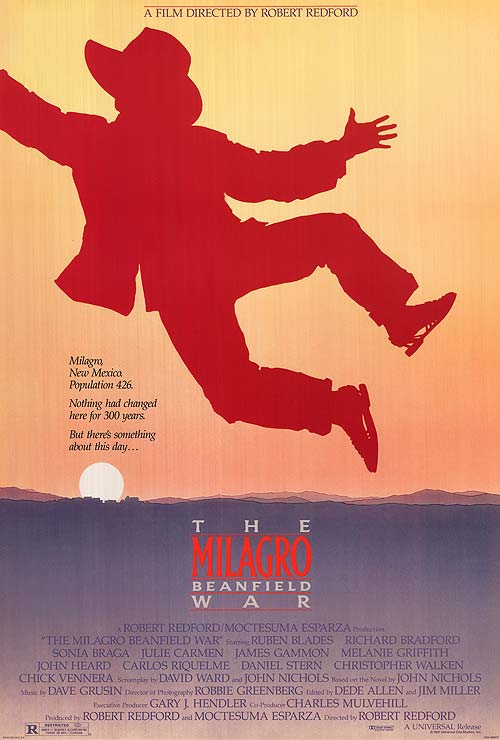
The Milagro Beanfield War (1988)

By Richard Winters

My Rating: 8 out of 10

4-Word Review: Small town fights developer.

Milagro, New Mexico becomes the centerpiece to controversy when a rich developer (Richard Bradford) decides to build a resort, which cuts off the water supply to the rest of the struggling inhabitants of the nearby town. Joe Mandragon (Chick Vennera) is one of those farmers who is frustrated with the current situation and in a fit of rage kicks a water valve, which allows water to flow into his field where he soon begins to grow beans. Kyril Montana (Christopher Walken) is then sent in by the rich tycoons to ‘settle-the-score’, which only helps to make the town’s resistance to the development even stronger.

The film is based on the 1974 novel by John Nichols and was directed by Robert Redford eight years after he helmed his first feature the very successful Ordinary People. From a completely technical standpoint the film shines in all areas as it delightfully mixes whimsical comedy with harsh real-world issues and manages to keep the tone consistent throughout. My favorite element was the difficulty the activists had in getting the townspeople  ‘on-the-same-page’ and organized to fight their mutual enemy, which illustrated one of the biggest challenges to fighting for social change where just trying to convince and mobilize others is sometimes the toughest part.

John Heard has the film’s best character arch playing a former political activist who dropped out of trying to change-the-world years ago, but after sufficient prodding finally gets back to his old form in one very fiery and memorable moment. Walken is quite good in reverse playing a man sent to initially squash the rebellion only to eventually soften a bit (just a bit) on his stance. Carlos Riquelme is delightful as the elderly Amarante who despite being weak with age fights-the-good-fight including a hilarious scene where he precariously tries to drive a bulldozer.

I wasn’t quite as crazy about Daniel Stern’s inclusion. He plays his part well and the character is likable, but I didn’t understand the need for him in the story. It almost seemed like the filmmakers didn’t trust that the Hispanic cast alone could carry it and a white guy needed to be added in in order to usher in a more mainstream demographic. Vennera is weak only because he constantly reminded me of Bruno Kirby Jr. and could’ve easily passed off as his twin in both his looks and voice.

The only argument I would have against the film, which is otherwise a charmer and does not in any way deserve the outrageous R-rating that it was given, is the addition of Robert Carricart as the Coyote Angel that only Riquelme’s character can see. To an extent this cheapens the struggles that the townspeople go through because it gives what is otherwise a serious problem too much of the fable-like treatment. I would’ve preferred a grittier approach focusing solely on the efforts of the people to create the change, which would’ve left a stronger emotional impact and avoided telegraphing the idea that it was all going to work-out due to this extra magical force.

My Rating: 8 out of 10

Released: March 18, 1988

Runtime: 1 Hour 57 Minutes

Rated R

Director: Robert Redford

Studio: Universal

Available: DVD, Amazon Video

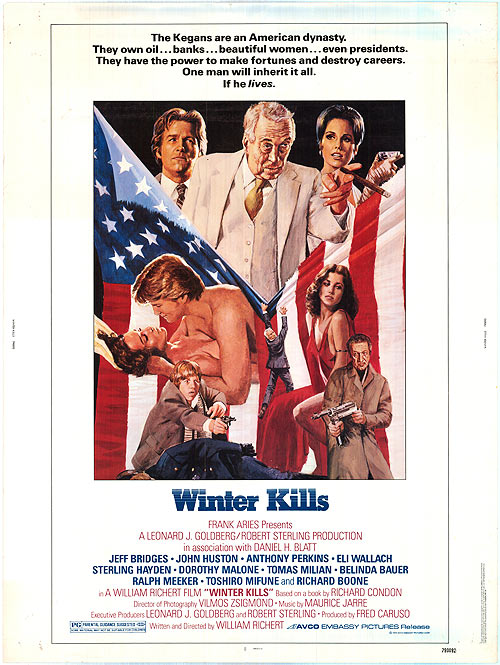
Winter Kills (1979)

By Richard Winters

My Rating: 6 out of 10

4-Word Review: Who assassinated his brother?

19 years after United States President Timothy Kegan is assassinated and an independent investigation concluded that it was the act of a lone gunman, his younger brother Nick (Jeff Bridges) gets a deathbed confession from a man (Joe Spinell) insisting he was the real killer hired by a secret underground organization. Nick goes to his rich father (John Huston) with the news and then decides to do an investigation of his own, but becomes entangled inside a web of lies and deceit that drives him further away from the truth instead of closer.

The film is based on the novel by Richard Condon and in many ways is a stunning filmmaking debut for director William Richert. The cinematography by Vilmos Zsigmond is richly textured with a colorful variety of backdrops, sets and atmosphere making it visually soar while the surreal tone helps give it an added edge.

Unfortunately the film suffered from many behind-the-scenes issues including running out of funding and forcing the cast and crew to put the production on hold while they went overseas to shoot The American Success Company in Germany and then used the proceeds from that one to finish this one. The final result is a fragmented narrative that at times gets too rushed. The story was significantly paired down from the novel, which leaves open a lot of loose ends and it should probably be remade as a miniseries.

The story is also permeated with a lot of dark humor which only makes the viewer even more confused. Some of it is genuinely funny, but it’s unclear what it’s trying to satirize. Certain absurd situations and oddball characters get thrown in for seemingly no reason and takes away from the otherwise compelling storyline while leaving the viewer baffled as to what the point of it was supposed to be and could easily explain why it bombed so badly at the box office during its initial run.

The casting is interesting. Jeff Bridges usually gets stuck in bland, transparent roles and that’s no different here, but he’s surrounded by so many eccentrics that his otherwise vanilla delivery seems refreshing and distinct. Huston is the real star in a bravura performance that steals the film and makes it memorable. There’s also a lot of recognizable supporting players that are on only briefly and if you blink you’ll miss them. This includes an uncredited appearance by Elizabeth Taylor who comes on near the end and has no lines of dialogue, but does clearly mouth the words ‘son-of-a-bitch’.

If you are looking for something that is offbeat, but still intriguing then this is well worth the effort. If it weren’t for its misguided humor this thing could’ve really had an impact although it does reveal its cards too soon and I was able to guess the twist ending long before it actually happened, but as a whole it has its moments and a potential cult following or sure.

My Rating: 6 out of 10

Released: May 11, 1979

Runtime: 1 Hour 26 Minutes

Rated R

Director: William Richert

Studio: AVCO Embassy Pictures

Available: DVD, Amazon Video

Russian Roulette (1975)

By Richard Winters

My Rating: 4 out of 10

4-Word Review: Trying to stop assassination.

When a Soviet leader decides to visit Vancouver the Russian Embassy puts the Canadian authorities on alert about Rudolf Henke (Val Avery) who moved to Canada many years back, but is reported to still hold grudges about the Soviet Union and could be a sniper threat. Timothy Shaver (George Segal) is then secretly hired to kidnap Henke while the Soviet leader is in town and then let him go once that leader has left. However, when Shaver gets to Henke’s apartment he finds out that he has already been abducted by somebody else, which leads him to believe that he is being made a pawn to an even bigger conspiracy and that he may become their next victim.

The story is based on the novel ‘Kosygin is Coming’ by Tom Ardies and the first 45 minutes of this are actually quite diverting. Director Lou Lombardo gave his actors the freedom to ad-lib and he instills some quirky humor, which made me believe this was going to be a new wave-like actioner that deftly mixes in the offbeat perspective with a story that had an intriguing mystery angle.

Unfortunately the second half devolves into cheesy action flick with all the usual formulaic trappings. The biggest problem is introducing the Russian bad guys who speak in inauthentic, corny accents that made them become like caricatures that lessens the tension instead of heightening it. The film would’ve been better served had it not shown the villains at all until the very end and kept things solely focused on Segal as he tries desperately to figure out what is going on while being chased by a mysterious group of people whose motives are unclear.

There are a couple of stupid moments as well.  One of them occurs when Segal and his girlfriend played by Cristina Rains return home. She immediately runs into the bathroom to take a pee, but then just as quickly comes back out wearing a strange expression. Segal then walks in to see a dead body of a murdered stranger sitting on the toilet. I know this may make me sound like a sexist to some, but the truth is women have a tendency to scream when they are startled and sometimes for a lot less than an unexpected sight of a corpse in their bathroom, so having her not instinctually scream here (hell even I would’ve probably let out a shrill yell at that point) is dumb.

Another part has Segal and Rains handcuffed and sitting in a backseat of a car that is being driven by one of the Russian bad guys. Segal, in an apparent attempt to escape, kicks the Russian guy in the back of his head, which sends the car reeling off the road and overturning into a ditch. However, this to me seemed dangerous because what guarantees that Segal and Rains wouldn’t be injured when that occurs. As it turns out the driver ends up conveniently dying in the crash, but miraculously the couple get out of the badly banged up car without even a single scratch, which is beating astronomical odds!

Segal wasn’t the best choice for the role. He spent the 70’s decade playing mostly in light comedies and romances, which he is more adept at, but presumably took the part to help stretch his acting resume and avoid being typecast. It doesn’t fully work and there were other actors who would’ve been better able to reflect the film’s gritty tone although watching Segal do mostly his own stunt work as he climbed out to the top of the roof of The Fairmont Hotel in downtown Vancouver does deserve kudos.

The supporting cast proves to be more interesting. I enjoyed seeing Louise Fletcher in her second movie after coming out of a 10-year hiatus. She has only a small role here, but she makes an impression nonetheless and it’s interesting seeing her play a person with such a sunny disposition when later that same year she portrayed the dour Nurse Ratched, which only proves what a talented actress she really is.

Val Avery is equally good in a part that has no lines of dialogue, by his own insistence, but still ends up being a scene stealer not only at the end when he stumbles into a scared crowd while wearing a bomb, but also in an earlier scene where he plays a cruel trick on a group of children playing roller blade hockey in the street.

Unfortunately the rest of the movie doesn’t have enough of a payoff. The action gets overplayed and the blaring music takes away the sophisticated feel and puts it more on the level of a bubblegum TV-show. Some good potential gets marred by an indecisive director who reportedly was suffering from drug addiction at the time and the effects show.

My Rating: 4 out of 10

Released: August 20, 1975

Runtime: 1 Hour 33 Minutes

Rated PG

Director: Lou Lombardo

Studio: AVCO Embassy Pictures

Available: DVD

The Comedians (1967)

By Richard Winters

My Rating: 5 out of 10

4-Word Review: Life under Papa Doc.

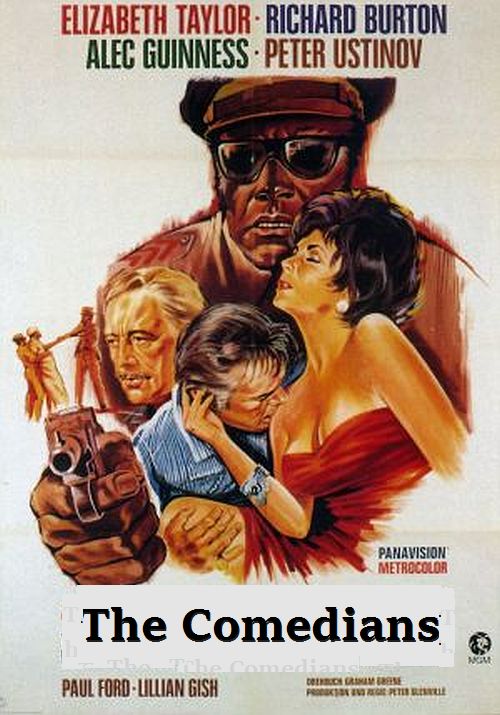
Based on the novel by Graham Greene the film centers on Brown (Richard Burton) an emotionally detached British hotel owner residing in Haiti. He has spent years avoiding the political turmoil of the region and the Francois ‘Papa Doc’ Duvalier regime, but finds now that the walls may finally be closing in. He must deal with the suicide of a government official that occurs on his grounds in his pool as well as a visiting American couple (Paul J. Ford, Lillian Gish) with strong political connections. His ongoing affair with the wife (Elizabeth Taylor) of a South American diplomat (Peter Ustinov) risks him further trouble as does his friendship with an illegal arms dealer (Alec Guinness).

The film ebbs-and-flows unevenly and isn’t compelling despite some strong moments here and there. What grabbed my attention was the vivid on-location shooting that gives the movie an interesting visual appeal. Because of the political environment going on in Haiti the producers were not allowed to film there and instead choose the small African country of Benin, which was still called the Republic of Dahomey at the time, as their substitute setting. The contrast of the serene tropical landscape juxtaposed with the abject poverty of its citizens is stunning with the most impactful moment coming when they visit Duvalierville a planned city with expensive buildings and homes being constructed with poor homeless people scurrying around begging for money as the structures go up.

The acting though by Richard Burton is atrocious and a major hindrance. I like Burton and consider him in most productions that he has been in to be a very strong actor, but here he doesn’t seem into the part at all. His presence is quite aloof and conveys little emotion to the point that he seems to be just walking through his role and mouthing his lines.

Taylor on the other hand is quite strong and manages to speak with an authentic sounding German accent. She made many bad film choices later her in career that ended up stigmatizes her acting reputation, but if given the right script and a competent director she could clearly convey an onscreen brilliance, which she does here. Unfortunately she is not seen enough and appears only sporadically throughout. If this is supposed to be a Taylor/Burton picture then the two needed equal screen time and prominent roles instead of one being relegated to what seems like only a minor part.

The supporting cast is excellent and this is a great chance to see up-and-coming African American actors when they were just starting out including: Raymond St. Jacques, James Earl Jones, Cicely Tyson, George Stanford Brown, and Zakes Mokae.  Gish and Ford offer a surprisingly profound moment when they follow a procession of singing happy young children into a forum for what they think will be a religious ceremony only to find to their shock that everyone is there to witness a firing squad execution instead.

The story has its moments, but I would’ve preferred if it had been a little more focused. At times it is compelling, but it drifts back and forth between too many different story threads and never comes together as a whole not to mention a limp ending that leaves no impact.

My Rating: 5 out of 10

Released: October 31, 1967

Runtime: 2 Hours 31 Minutes

Not Rated

Director: Peter Glenville

Studio: MGM

Available: DVD (Box Set), Amazon Video, YouTube

The Lady Vanishes (1979)

By Richard Winters

My Rating: 4 out of 10

4-Word Review: Where’s the old lady?

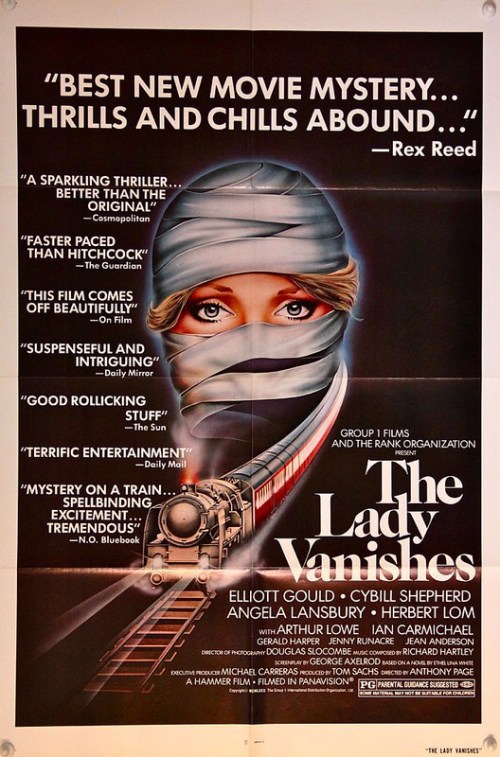
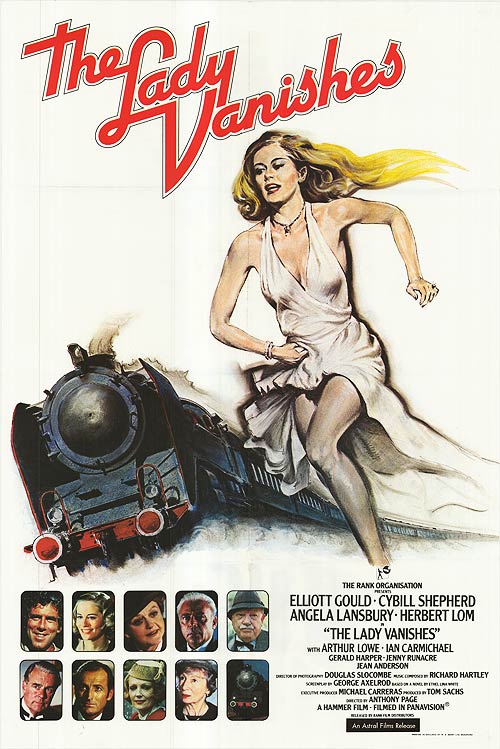
In 1939 while traveling by train from Bavaria to Switzerland American Heiress Amanda (Cybill Shepherd) befriends an English nanny named Miss Froy (Angela Lansbury). The two sit across from each other inside a train compartment. When Amanda awakens from a nap she notices that Miss Froy has disappeared and when she asks others where she went to everybody denies having even seen her. Amanda starts to question her own sanity and tries to use the assistance of American photographer Robert Condon (Elliot Gould) to help her figure out what is going on.

This film is a remake of the classic 1938 movie of the same name, which was directed by Alfred Hitchcock and based on the novel ‘The Wheel Spins’ by Ethel Lina White. I last saw the original over 30 years ago while attending college, so my memories of it are fuzzy and I’ll be unable to compare the two. However, I do remember enjoying it and feeling that this thing doesn’t quite reach the same level.

The biggest issue is the casting of Shepherd. I think she’s a gorgeous lady, I loved seeing her in the low cut white dress and at one point she even appears to bravely do her stunts by jumping off a moving train, but her acting is not up to par. She can be great as a bitchy, sarcastic woman or even as a kooky eccentric, but as someone we want to root for or sympathize with, no way. Some of her former co-stars including Bruce Willis and Christine Baranski have described her as being cold and competitive to deal with and that’s the exactly same vibe I get every time I see her. Her efforts to cover that up in an attempt to play a more likable character doesn’t work, so instead producers should cast her in parts that mesh with her personality while getting someone else more affable for this role.

Gould has the same problem. He looks bored and out-of-place and I don’t know why the nationalities of the two lead characters, which had been British in the original, were changed to American here, but it doesn’t help. Besides there is absolutely no chemistry between he and Shepherd, which makes the romantic angle come off as quite forced. He was also considerably older than her and they should’ve at the very least cast two people more in the same age range.

Even the great Angela Lansbury is all wrong here. She still gives the role a stellar performance with her best moment coming when her eyes well up with tears as the other passengers openly contemplate throwing her off the train and into the clutches of an SS officer standing outside, which proves that the truly great stars don’t need any speaking lines to convey just the right emotion.  However, she was only in her 50’s at the time and didn’t come off looking elderly. Dame May Whitty played the part in the original and was in her 70’s, which is what the age of the actress playing the part here should’ve been.

The basic premise is still entertaining enough to keep things passable, but I would’ve liked the mystery angle played up more by showing things only from Amanda’s perspective until the viewer started to question her sanity as well. The scene where Amanda sees the name Miss Froy written in the dust of a train window by the Lansbury character earlier and then having that name strangely disappear off the window after they go through a tunnel makes no sense. This was supposed to be a ‘realistic’ thriller and therefore surreal elements should not have been thrown in.

The climactic sequence is entertaining, Arthur Lowe is enjoyable in a supporting part, and the Austrian scenery is luscious, but the movie is marginal and only helps to make the viewer appreciate the original more than anything.

My Rating: 4 out of 10

Released: May 8, 1979

Runtime: 1 Hour 35 Minutes

Rated PG

Director: Anthony Page

Studio: Rank Film Distributors

Available: DVD, Amazon Video

Twilight’s Last Gleaming (1977)

By Richard Winters

My Rating: 6 out of 10

4-Word Review: Nuclear silo under siege.

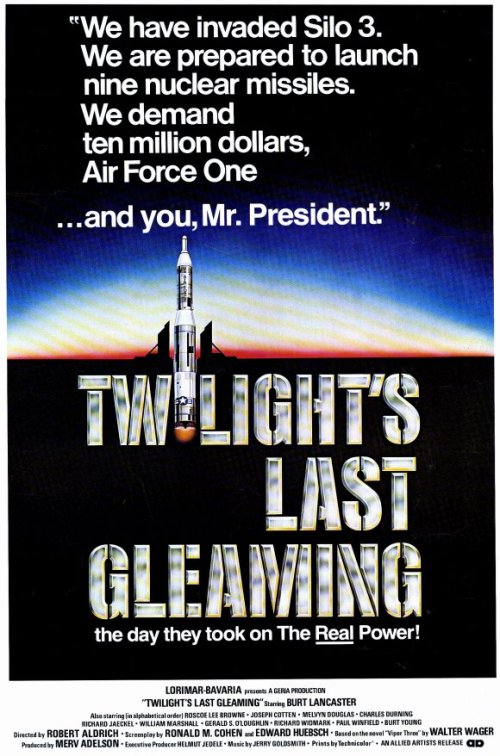
Loosely based on the novel ‘Viper Three’ by Walter Wager the story centers on Lawrence Dell (Burt Lancaster) a former military general who was sent to prison on trumped on murder charges, but manages to escape and is now out for revenge. With the help of three accomplices (Paul Winfield, William Smith, Burt Young) he breaks into a nuclear silo and threatens to launch it unless the President (Charles Durning) agrees to come clean on the government’s secret agenda in regards to the Vietnam War.

I’ve never read the film’s source novel, but have been told that this takes many liberties with it. The biggest problem is that it jumps ahead too quickly showing the four men right away breaking into the silo when it should’ve started back further to when they escaped from the prison and how they were able to get the access codes in order to break into the silo system to begin with. Winfield has a few great lines and Smith’s hair-trigger personality allows for interesting conflict, so these characters should’ve remained, but instead they are unwisely killed off leaving only Lancaster to pace around nervously, which quickly becomes boring.

Whenever someone escapes from prison the nearby area gets warned usually through the media. Certainly military personnel would’ve been put on high alert and thus making Dell’s ability to break into the silo, which was too easy to begin with, much less likely. The fact that a crazed general could break into a silo system and threaten to start WW III and have it never leaked to the media is highly unlikely as well, which along with various other loopholes makes this thing hard to fully get into.

Charles Durning is a great supporting actor, but here is badly miscast as the President. His facial expressions during his phone calls with the other Generals warning him of what is going on are unintentionally comical and too much time gets spent focusing on him contemplating on whether he’ll given into Dell’s demands until it seems like he is the star and Lancaster only a secondary player. Having him described as being an ‘honest politician’ and ‘a President who would never lie’ seems like an oxymoron as I don’t think a politician could even survive in Washington if they weren’t able to spin the truth sometimes and only helps to make the character seem too idealized.

Spoiler Alert!

This thing though really ‘jumps-the-shark’ at the end as I cannot imagine any circumstance where the secret service would allow the President of the United States to enter into a nuclear silo all alone and be used as a hostage. If they were real desperate they might try to pawn off an imposter in an attempt to fool them, but never the actual President as it would put him into too vulnerable a position. Also, the ‘shocking secret’ about why the U.S. got involved in the Vietnam War really isn’t all that earth shattering and certainly not worth sitting through simply to find out.

End of Spoiler Alert!

Director Robert Aldrich’s prolific use of the split screen is the one entertaining aspect and almost enough to overlook its other many faults, but at best it’s only a mindless programmer that manages to elicit minor tension only if you don’t think about it too hard.

My Rating: 6 out of 10

Released: February 9, 1977

Runtime: 2 Hours 26 Minutes

Rated R

Director: Robert Aldrich

Studio: Allied Artists

Available: DVD, Blu-ray

The Carey Treatment (1972)

By Richard Winters

My Rating: 6 out of 10

4-Word Review: A Pathologist solves mystery.

Based on an early Michael Crichton novel, the story centers around Dr. Peter Carey (James Coburn), who starts a new job as a pathologist at a local Boston hospital and soon finds himself embroiled in a mystery when his good friend Dr. David Tao (James Hong) gets accused of performing an illegal abortion on the daughter of the hospital’s chief surgeon (Dan O’Herlihy), which later kills her. Carey is not convinced that his friend performed the procedure and sets out to prove his innocence when the police are of no help.

This film was noted for its behind-the-scenes turmoil including accusations from director Blake Edwards that he was belittled by the film’s producer William Belasco in front of the crew and told that he would never work in Hollywood again and afterwards having the film edited without his permission. Edwards later sued and his experiences working on this project became the basis for his 1980’s film S.O.B., which savagely satirized the movie making business and the people who ran it.

The plot isn’t bad and attempts are made to give the viewer an authentic feel of the medical profession. One of the better moments is when the doctors perform an autopsy on the victim although I wished they would’ve shown more of the actual corpse on the examining table instead of cutting away from it in an attempt to be ‘tasteful’ as I felt the procedure and what the men discussed during it to be genuinely educational.

Having a hip doctor suddenly turn into an amateur sleuth is the film’s biggest drawback. Coburn plays the part well, but a guy who’s never investigated a case before wouldn’t be so seasoned with the way he handles suspects and tackles clues. He comes off too much like a professional detective who’s spent years in the business and not just a regular person who stumbles into the situation without knowing what he’s doing. The slick way that he solves the case and gets the necessary information is impressive, but not believable. Most people would’ve simply hired a private detective to investigate it and not spent hours away from their job trying to do it themselves, or if they take on the task they would most assuredly have make some mistakes, which this guy never does.

The mystery has enough intriguing elements to remain engaging, but the ultimate reveal is dull and makes one feel like they sat through a big buildup to nothing.

My Rating: 6 out of 10

Released: March 29, 1972

Runtime: 1 Hour 41 Minutes

Rated PG

Director: Blake Edwards

Studio: MGM

Available: DVD (Warner Archive), Amazon Video, Youtube

Circle of Power (1981)

By Richard Winters

My Rating: 4 out of 10

4-Word Review: Weekend retreat becomes brutal.

Executives of a company spend a weekend at a hotel where they’re a part of a large group awareness training that will better prepare them to achieve their full potential in both their business and personal lives. The encounter group is headed by Bianca Ray (Yvette Mimieux) who implements disturbing activities for the participants to go through that become increasingly more abusive and degrading.

This film is based off of the non-fiction novel ‘The Pit: A Group Encounter Defiled’ by Gene Church which documented a 1972 four day encounter group of top executives from the Holiday Magic company and many of the outrageous activities they were required to go through all under the cloak of learning to ‘bring out their inner dynamic’. Many of the activities that the characters in the film are forced to perform are similar to the ones depicted in the book, but amped up for the sake of drama. Some definitely get disturbing including having one participant, played by Walter Olkewicz, forced to strip naked in front of the group and then told to stand on a chair while the others mock his overweight body before having him locked into a cage and feed scraps of food that he must eat up directly from the floor.

Unfortunately the shock value gets muted by having characters that are too cardboard.  The viewer ultimately has no emotional bond to any of them and therefore the increasingly degrading circumstances that they go through achieve no profound impact. It also happens much too quickly as right from the start they are asked to do crazy things. I have no doubt that these encounter groups can sometimes go too far and there have been documented evidence of some even resulting in deaths, but it occurs gradually. A level of trust needs to be achieved to the point that the participants let down their guard and then the darker and twisted stuff gets introduced instead of just having it from the beginning like it gets played here, before any of the people have been psychologically ‘neutered’.

There is also no background given, or at least not a sufficient one, to the people who run the encounter group who are portrayed in a very one dimensional, creepy way that quickly becomes boring.  The issues of how did they decide to get into this line of work and what makes them so brazen to think they can get people to do these outrageous acts and get away with it is never addressed.

The ending is limp. What happens to the employees once they return to work is never captured nor the fate of the people running the retreat and whether they were ever sued or arrested. The idea is an intriguing one and there’s a potential for a really interesting movie to be had, but the plot needed more context and the characters to be better fleshed out.

Alternate Titles: Brainwash, Mystique, Naked Weekend

My Rating: 4 out of 10

Released: November 19, 1981

Runtime: 1Hour 37 Minutes

Rated R

Director: Bobby Roth

Studio: Ambassador Film Distributors

Available: VHS