Category Archives: Movies Based on Novels

The Incredible Shrinking Woman (1981)

By Richard Winters

My Rating: 4 out of 10

4-Word Review: Suburban housewife gets smaller.

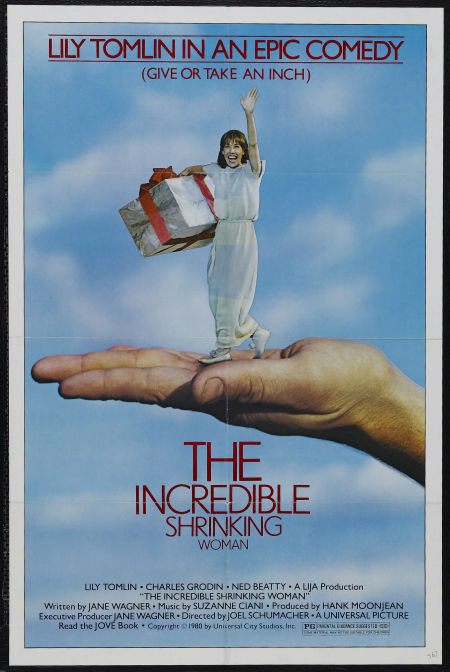
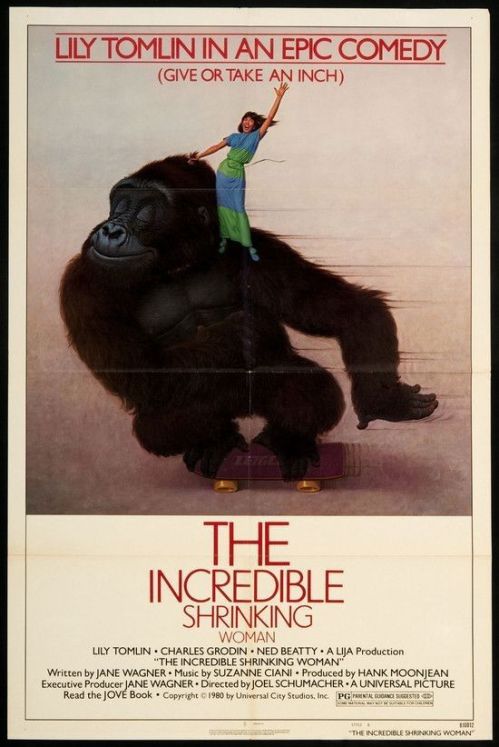
Pat Kramer (Lily Tomlin) is a housewife/mother raising two rambunctious kids (Shelby Balik, Justin Dana) while married to Vance (Charles Grodin) who works in advertising. After being exposed to some products from her husband’s company she begins to shrink until she becomes so small that she is forced to move into a dollhouse and drink out of thimble since a regular glass would be too big for her to hold.

The film is a modern remake of Richard Matheson’s The Incredible Shrinking Man and as much as I loved the original this version takes the storyline in a completely different direction, which for a while proves interesting. Director Joel Schumacher comes up with some wild color schemes and the knowing satire makes great points in its observations on modern suburbia as well as American consumerism. Screenwriter Jane Wagner manages to employ some well thought out scenarios and the special effects aren’t bad either.

Unfortunately by the second-half becomes muddled with scenarios that are no longer funny, but genuinely horrifying and sad instead. The satirical edge gets lost and replaced with an over-the-top mad-scientist-trying-to-conquer-the world angle that becomes cheesy.  I was also confused with how Pat was able to continue to find clothes to fit her especially after she gets smaller than even a toy doll. The film seemed to touch on every other possible problem, so they should’ve had at the very least had a throwaway scene analyzing this one.

Spoiler Alert!

The ending gets too cute for its own good as Pat shrinks to nothing and then has what’s left of the small outfit she was wearing fall into a puddle of spilled chemicals, which somehow makes her big again. This however ruins the poignancy that had been created from showing clips of bells being rung around the world from different countries in remembrance of Pat, which had a certain profound message that no matter how small you are you can still have an impact. Instead of giving the film some substance it goes for a last-second gimmick that cements it as being an empty-headed comedy and nothing more.

End of Spoiler Alert!

Tomlin’s performance is excellent as she creates empathy for her character, which helps make the story more engrossing as you genuinely build concern and sympathy for Pat’s welfare. Noted make-up specialist Rick Baker garnered a cult following for his convincing performance of an ape, although the shot of the animal giving some people in an elevator the finger is pushing it. The movie though as a whole works only in spurts with a message and tone that is too unfocused and inconsistent to be completely effective.

My Rating: 4 out of 10

Released: January 30, 1981

Runtime: 1 Hour 28 Minutes

Rated PG

Director: Joel Schumacher

Studio: Universal

Available: DVD-R (Universal Vault Series), Blu-ray, Amazon Video, YouTube

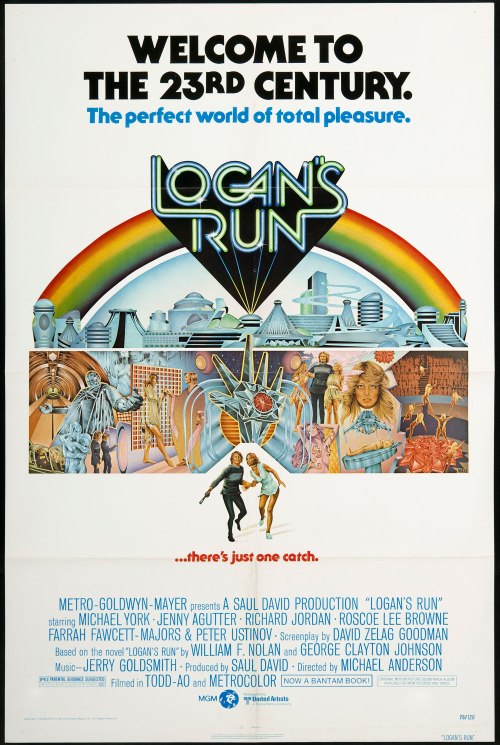
Logan’s Run (1976)

By Richard Winters

My Rating: 6 out of 10

4-Word Review: Life ends at 30.

In the year 2274 no one is required to work and all desires fulfilled with the only catch being that everyone must die at 30, or at least go through the so-called carrousel to see who can be ‘renewed’. Logan (Michael York) works as a sandman who is in charge of tracking down the ‘runners’, which are people who try to escape the fate of the carrousel and instead find refuge in a secret underground community known as the sanctuary, which is somewhere outside of the domed city where everyone lives. The computer, which runs the domed city where Logan resides, orders him to find the sanctuary and destroy it. To do so Logan must pretend that he is a runner and uses the help of fellow runner Jessica (Jenny Agutter) to guide him, but what they end up discovering shocks them both.

The film’s selling point is its special effects, which weren’t bad for its time period. The most impressive is the sequence dealing with the carrousel where actual holograms were used. The opening bit where the camera shows a bird’s-eye view of the domed city then zooms into it is impressive too due to all of the painstaking detail that must’ve been put in to create it, but it also becomes clear that it is simply a miniaturized reproduction that looks a bit hokey. The interiors resemble the lobby of a swanky hotel and isn’t visually interesting while the costumes show no imagination as everybody wears essentially the same outfit with the only difference being some are red and others green.

The film deviates quite a bit from the 1967 source novel, which was written by William F. Nolan and George Clayton Johnson with the biggest change being that in the book the age to die was 21. Supposedly the reason the age got upped was to allow for a broader range of actors to choose from, but even here they cheat because York was already 33 when he did this and Richard Jordan, who plays a fellow sandman was 38. Having the script stick to the original age of 21 and hired actors who were that exact age would’ve made a far stronger visual impact especially having them put to death when they barely looked ready for adulthood.

York’s character is annoyingly naïve as he never questions the authority while fully drinking into their propaganda and it takes Jessica to get him to see things differently, but it’s hard to empathize with a guy who can’t think for himself and kills others without question. Also, when they make it outside the dome they have no idea what the sun is, which seems almost absurd. Yes, they’ve been living in a doomed city all of their lives, but wouldn’t they at some point have some curiosity of what was outside of it, or learn in school about the outside? Maybe it was just me, but the character seemed too transparent and almost non-human.

Spoiler Alert!

The weakest point is the ending where they find out unlike the book that there really isn’t any sanctuary, which comes off as anti-climactic and then having them instead come upon a desolate grounds of Washington D.C., which seems too reminiscent to the ending in Planet of the Apes. It also doesn’t make sense. Although never fully explained one can surmise that apparently civilization was destroyed by some sort of nuclear holocaust, but if that were the case it would’ve caused a nuclear winter, which would’ve blotted out the sun and not allowed anything to grow for decades. Having all the green foliage everywhere would’ve been impossible and how exactly was the old man character played by Peter Ustinov that they come upon able to survive it?

The way Logan is able to destroy the computer, which then destroys the whole city when he returns to it by simply not giving it the answer it wants to hear is too convenient. A computer system that is able to run a city for so long would’ve had  some sort of back-up system installed in case something overloaded it otherwise the city would’ve blown many years earlier if it were really that easy to do. It also never explains who ultimately was behind the creation of the doomed city and secretly running things from behind-the-scenes as every computer must have some person, or group of people who initially made it and then programmed it, so who were they?

End of Spoiler Alert!

Farrah Fawcett has a good bit part as a girl working at a saloon that allows people through laser surgery to change their identities. Ustinov is also quite good as the old man who easily steals the film from the younger performers without much effort. The story it mildly compelling, but compared to classic sci-fi films it is pretty vapid.

My Rating: 6 out of 10

Released: June 23, 1976

Runtime: 1 Hour 58 Minutes

Rated PG

Director: Michael Anderson

Studio: MGM

Available: DVD, Blu-ray, Amazon Video, YouTube

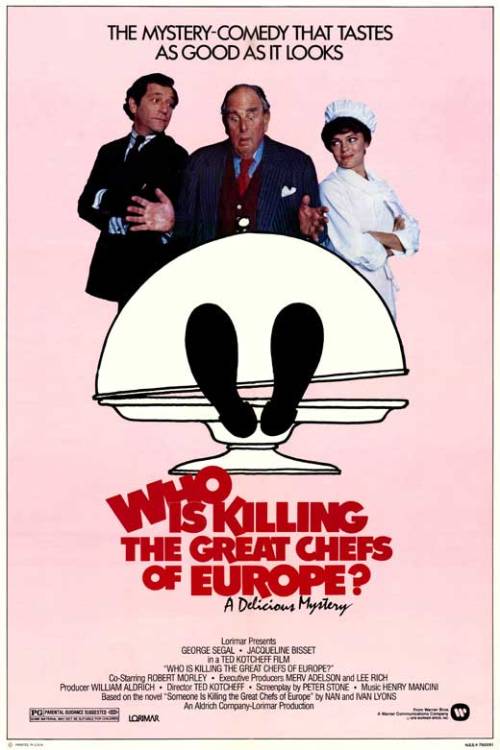
Who is Killing the Great Chefs of Europe? (1978)

By Richard Winters

My Rating: 7 out of 10

4-Word Review: He eats too much.

Max (Robert Morley) is a famous food critic who writes an article for the food magazine The Epicurist titled ‘The World’s Most Fabulous Meal’, which described four dishes cooked by four of the world’s top chefs. The problem is those chefs are now turning up dead. Natasha (Jacqueline Bisset) was the chef famous for creating the dessert called the bombe, which was also written about in that same article. Since the other chefs have already been murdered Natasha fears she may be next, so she works with the police to find the killer while also being a suspect since she was with each victim just before they died.

The film is based on the novel ‘Someone is Killing the Great Chefs of Europe’ by husband and wife writers Nan and Ivan Lyons, which came out two years earlier and had more erotic overtones while also detailing the specific recipes of each gourmet dish described in the story. Ted Kotchef’s excellent direction focuses strongly on the food element and each exotic meal is nicely captured and crafted by an actual cuisine chef named Paul Bocuse. Not only do you see the cast eating the stuff, especially Morley’s character, but preparing it as well including a detailed, drawn out segment showing Natasha creating her world famous desert.

The on-location shooting, done in three different European countries, is vivid and the dialogue is quite amusing. The denouncement is interesting because you think for sure it’s one person only to genuinely get surprised when it turns out to be someone completely unexpected. The plot though is too leisurely paced and the side-story dealing with Natasha’s ex-husband (George Segal) trying to rekindle their relationship is unnecessary and could’ve been cut, which would’ve helped shorten the runtime, which is overlong for such otherwise trite material.

Morley is a scene-stealer with everything he utters being hilarious. Bisset is great too and should’ve received top-billing as she’s seen the most while Segal’s presence comes off as downright intrusive. It was nice having a beautiful woman in a lead that was not sexualized and it would’ve made the film a bit ahead-of-its-time had she carried it alone, which she easily could’ve without Segal as a sort of male sidekick.

For light entertainment it’s enjoyable, but I was surprised at seeing how things have changed as there are several throwaway bits that at the time I’m sure were considered innocuous but would be deemed quite controversial by today’s standards. One scene has Bisset speaking with an Italian chef (Stefano Satta Flores) who openly pinches her twice on the rear without her permission. She protests it the first time, but he boldly does it again later and she lets it go, continues to casually talk to him and even agrees to meet him later for dinner. The film seems to play the whole thing off as a ‘boy-will-be-boys’ scenario coupled with the Italian male stereotype that this is simply ‘a part of their nature’.

In another part she refers to a French chef (Jean-Pierre Cassel) as a ‘fag’ and she visits a processing plant where thousands of chickens are housed in tight little cages and barely able to even move which doesn’t seem to bother her at all. I’m sure these scenes back in 1978 went completely over-the-heads of the viewers and most likely were quickly forgotten even though now these same moments would most likely elicit outrage, protest and headlines.

My Rating: 7 out of 10

Released: October 5, 1978

Runtime: 1 Hour 52 Minutes

Rated PG

Director: Ted Kotcheff

Studio: Warner Brothers

Available: DVD (Warner Archive)

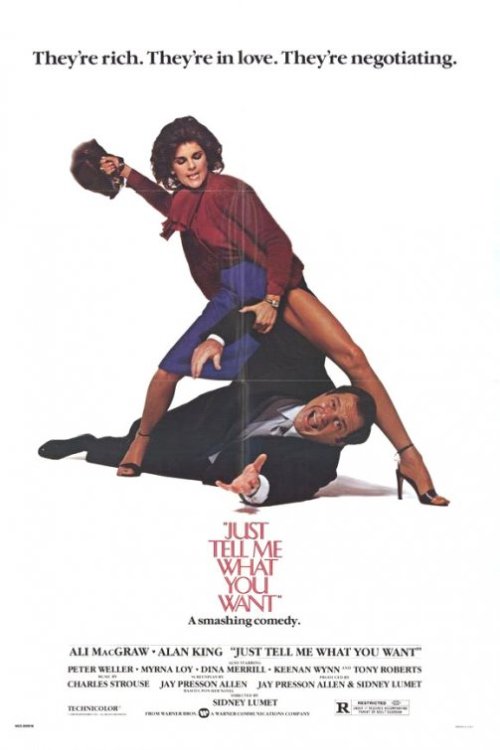
Just Tell Me What You Want (1980)

By Richard Winters

My Rating: 6 out of 10

4-Word Review: Rich tycoon gets dumped.

Max Herschel (Alan King) is a rich and successful businessman who’s used to getting what he wants. He’s rude and crude and doesn’t mind displaying his anger or contempt for others at a moment’s notice. After 14 years Bones (Ali MacGraw), his mistress, has decided she’s had enough. She leaves him for a much younger man (Peter Weller). This enrages Max who does whatever he can to win her back, or at the very least ‘punish’ her for leaving him.

The film, which is based on a novel by Jay Presson Allen has a delicious New York flavor with the majority of the action taking place at the Old Westbury Gardens estate that fronts as Max’s home. The interiors of the stately mansion are at times more interesting than the conversations and the exteriors coincidently were also used in Love Story, which was another MacGraw vehicle. Director Sidney Lumet gives the dark comedy a classy air with a rousing, distinctively jazzy score by Charles Strouse, which I wanted to hear more of and wouldn’t have minded if it had been played all the way through the movie.

The story has sharp dialogue and a deliciously acerbic edge, but becomes preoccupied with Max’s business dealings, which most viewers may find too complex to follow and aren’t that integral to the story. The first hour is spent focused on Max, whose obnoxious ways quickly become off-putting and tiring. The catalyst is his love-hate relationship with Bones and more scenes should’ve been shown with them together while having her break-up with him come much sooner.

King was a comedian known for angry monologues and that emotion gets channeled into his character. I’ll give them props for creating an unlikable lead and not holding anything back as too many times films create abrasive people only to soften them too soon or not go all-the-way with it. Here it gets pushed to the limit, but I was still hoping for Max to have more of an arch and was disappointed that he remains for the most part a callous jerk to the very end.

MacGraw’s restrained approach works well off of King’s flamboyance and the highlight is when she corners him at a luxury department store, which was filmed on-location at the Bergdorf Goodman, and tackles him while destroying everything in sight. However the character’s nickname of ‘Bones’ I did not care for especially with no explanation for why she was given it. Was she called this because she was thin, or was it for some other reason? An attractive female should be given a pleasant name not something that sounds demeaning.

Legendary actress Myrna Loy, who had been around since the silent film era, plays Max’s long suffering secretary and earns her pay here. Loved the scene where King cries right into her bosom while she holds his head and acts like his mother, but also the part where he shouts directly into her face even throws out the C-word and she doesn’t flinch. Keenan Wynn is likable and speaks with an accent in a sympathetic role as a Russian businessman and Dina Merrill’s emotional breakdowns as Max’s mentally fragile wife are impressive and could’ve been extended.

Spoiler Alert!

Overall though it fizzles and it’s not because it’s filled with a lot of extraneous dialogue and scenes that should’ve been cut, but more because it plays itself as this sort-of anti-romance only to sell-out at the end. There is simply no way anyone could truly fall-in-love with Max because there was nothing about him to love. Having him do one nice thing shouldn’t erase all the other bad things he did before. Bones had already spent 14 years with him which should be more than enough time to realize things won’t be any different moving forward. Having them reconcile by working together as business partners maybe, but a marriage is simply a disaster waiting to happen. Just because audiences long for the ‘happy ending’ doesn’t mean that’s what you give especially by having two people magically find love for each when none had ever existed before.

End of Spoiler Alert!

My Rating: 6 out of 10

Released: January 18, 1980

Runtime: 1 Hour 53 Minutes

Rated R

Director: Sidney Lumet

Studio: Warner Brothers

Available: DVD (Warner Archive), Amazon Video, YouTube

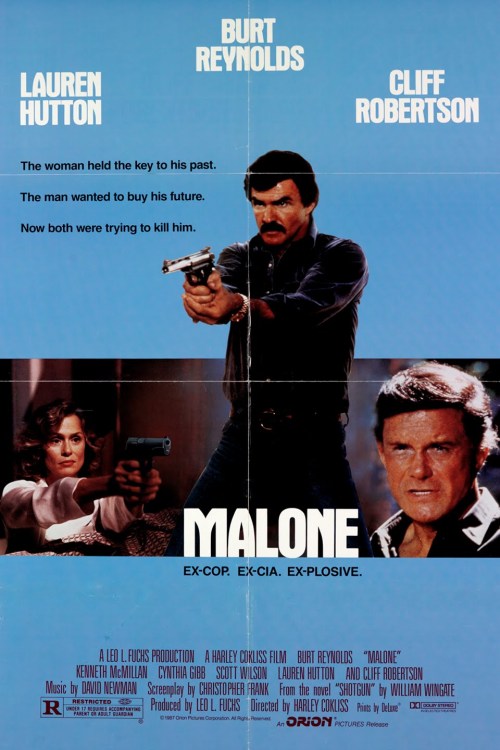
Malone (1987)

By Richard Winters

My Rating: 3 out of 10

4-Word Review: Hit-man saves town.

Richard Malone (Burt Reynolds) is a former CIA hit-man who decides that he’s had enough of the dirty business and wants to retire. He uses his savings to leave the profession and travel the countryside. On the way his car breaks down and he’s forced to push the vehicle to the nearest small town service station, which is run by Paul (Scott Wilson). Since the parts to repair the transmission will take several days to arrive he stays at the place and befriends Paul’s teen-age daughter Jo (Cynthia Gibb). He also becomes aware of a plot by billionaire Charles Delaney (Cliff Robertson) to buy up the town and force everyone to sell and if they don’t they end up dying. Despite his initial reluctance Malone ends up getting involved in the dispute and becomes Delaney’s number one target in the process.

The movie is based on the novel ‘Shotgun’ by William P. Wingate, which in turn was modeled after the formula from the western Shane. It reminded me more of High Noon particularly the way Malone single-handedly takes on not only Delaney, but all of his cohorts during a gun battle at the end, but without that film’s strong emotional impact. The story and characters are highly uninspired and this thing is aimed towards those that like their action flicks on a very simple and predictable level.

Reynold’s presence is the only interesting ingredient. This was during the downside period of his career where he was desperately trying to get back to the tough guy action roles that had made him famous. However, during the 70’s his action guy persona worked more in the humorous vein where his character would always approach the situation with a twinkle in his eye and funny side-quip, but here he’s all stiff and serious. To a degree this proves he’s a good actor in that he can play either type of role effectively, but the funny-Burt is far more entertaining than the serious one. Either way it’s doubtful that this middle-ager would’ve been able to run so vigorously and climb onto the rooftop of buildings as he does when he gets onto Delaney’s estate and I’m pretty sure a stunt double was used since we only see him doing this from a distance.

An element of the film that audiences today may take issue with is his relationship with the teen girl who starts to admire him to an emotional extreme. Clearly she represents the Brandon deWilde role from the Shane film, but the fact that she is underage and starts to have a romantic interest in the 50-year-old and he in her and even kisses him on the mouth may make certain viewers uncomfortable.

As for the villain he is as dull and transparent of a caricature as it gets and Robertson plays him very poorly by conveying no menace on the screen and creating zero tension. It would’ve worked better had Kenneth McMillan, who plays the sleazy sheriff would’ve been cast in the Delaney part as he’s an actor with genuine panache and owns whatever scene he’s in no matter how big or small the role.

The ironic thing about this otherwise mindless excursion is it’s all about this far-right nutty guy who wants to take over the government to ‘save the country’ and even requires all his followers to say a corny patriotic-like pledge and yet it wasn’t even filmed in the US, but instead British Columbia, Canada. Even more frighteningly is that given today’s political climate it doesn’t seem quite as farfetched and over-the-top as it once did.

My Rating: 3 out of 10

Released: May 1, 1987

Runtime: 1 Hour 32 Minutes

Rated R

Director: Harley Cokeless

Studio: Orion Pictures

Available: DVD, Blu-ray, Amazon Video

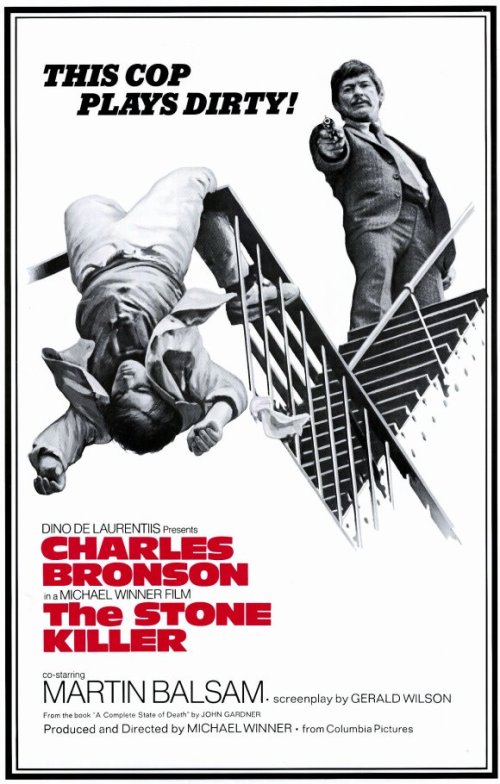
The Stone Killer (1973)

By Richard Winters

My Rating: 5 out of 10

4-Word Review: Tough cop is relentless.

Lou Torrey (Charles Bronson) is an old-school cop baffled by a rash of homicides that initially seem like random hits, but really aren’t. As Lou investigates further he uncovers a plot orchestrated by a Mafia Don (Martin Balsam) to use a group of Vietnam Vets to avenge the death of some Mafia families 42 years earlier.

Director Michael Winner, during his later directing projects, became synonymous with stale, cardboard B-pictures and after the year 2000 he dropped out of the movie business completely and became a celebrity food critic in the UK writing in a weekly newspaper column called Winner’s Dinners. Here though he shows signs of being a young talent on the rise looking to make his cinematic mark. He captures the lesser seen areas of L.A. with a flair and the shot selection has style that manages to seamlessly connect the film between its talky moments and action.

Bronson though can’t really act as his facial expressions rarely change and he says his lines in an unemotional way making him seem almost like a computer, but his hard-headed personality in real-life carries over to the big screen making him a perfect fit personality-wise to the character. John Ritter is good as a young cop caught making a lot of rookie mistakes. It’s also interesting seeing Stuart Margolin here as he has an important sequence in the desert, which connects with his appearance  in another Bronson hit Death Wish that also had him in the sandy landscape.

The story, which is based on a novel by John Gardner entitled ‘A Complete State of Death’ comes off as flimsy and just an excuse to tie-in a lot of loosely related action sequences. The plot is hard-to-believe and the villain is more like a caricature and barely seen.

There’s some enjoyable moments including Bronson’ relentless chase in a car of a police suspect, played by Paul Koslo, who tries to evade him by tearing through the city streets on a motorbike. Watching Chuck drive through park tables with people trying jump out of the way,  going into oncoming traffic and even storefront windows is impressive on the surface, but ultimately makes the character come-off badly. In real-life a cop barreling his vehicle through areas with so much foot traffic would make him irresponsible and a menace to society as he puts too many people in direct danger simply for his pursuit of one person.  In most cases there would’ve been casualties and Bronson’s character could’ve easily been fired or sued.

The mass assassination of all the Mafia Dons has pizazz, but ultimately it’s just one giant marketing ploy as it borrows many elements from other hit movies of that time including Dirty Harry and The Godfather then blends it together with over-the-top action and a farfetched plot.

My Rating: 5 out of 10

Released: August 8, 1973

Runtime: 1 Hour 35 Minutes

Rated R

Director: Michael Winner

Studio: Columbia Pictures

Available: DVD, Amazon Video, Blu-ray

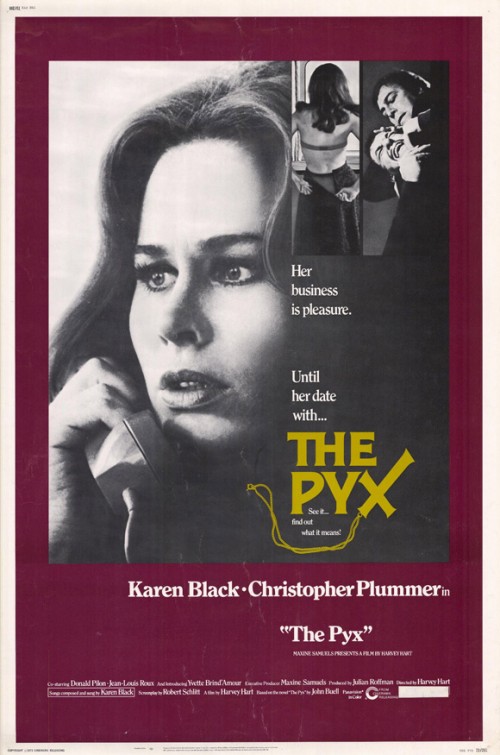
The Pyx (1973)

By Richard Winters

My Rating: 5 out of 10

4-Word Review: Religious cult wants prostitute.

A woman is seen falling from a high-rise tenant building to her death and Police Sergeant Jim Henderson (Christopher Plummer) is assigned to the case. When he inspects the body he finds that in her right hand she is holding a crucifix and in her left one is a small metal container known as a pyx. The victim is later identified as being Elizabeth Lucy (Karen Black) a heroin addict who works as a prostitute. The film then cuts back and forth between showing Elizabeth when she was still alive and the circumstances that lead to her death as well as Jim’s dogged search to find her killer, which may be connected to an underground religious cult.

The film, which is based on the novel of the same title by John Buell and shot entirely on-location in Montreal, has a nice eerie atmosphere.  The cutting back and forth between the two linear stories is interesting and this is the type of mystery that is complex, but not too much. There are just enough clues given to keep it intriguing without so much thrown in that it becomes convoluted. The slow pacing is okay because it keeps things on a realistic level and everything remains plausible and gritty.

Unfortunately the story has no payoff. The slow reveal of the religious cult offers nothing new or exciting and seems to be borrowing elements from other horror flicks that have dealt with the same theme. Except for a few brief moments the film is devoid of any action and the shootout on a yacht is edited in such a quick way that it’s hard to follow what happened. The overuse of nighttime shots gives the film a grainy appearance that looks more like it was a victim of a low budget and poor lighting.

The two leads give good performances and Plummer looks almost unrecognizable with a bowl haircut and appearing almost 20 years younger than he already was. The music was composed by Harry Freedman and star Black does the vocals, which is distinctive and gets the viewer into a spiritual mood, but there aren’t any frights and it’s hard to put this thing into any type of category as it’s really not a horror film at all.

Even as a standard mystery it’s only average and just enough to hold your interest. Ultimately it goes down a familiar path that we’ve seen too many times before and is devoid of any true shock or surprises.

My Rating: 5 out of 10

Released: September 13, 1973

Runtime: 1 Hour 47 Minutes

Rated R

Director: Harvey Hart

Studio: Cinerama Releasing Corporation

Available: DVD-R, Amazon Video

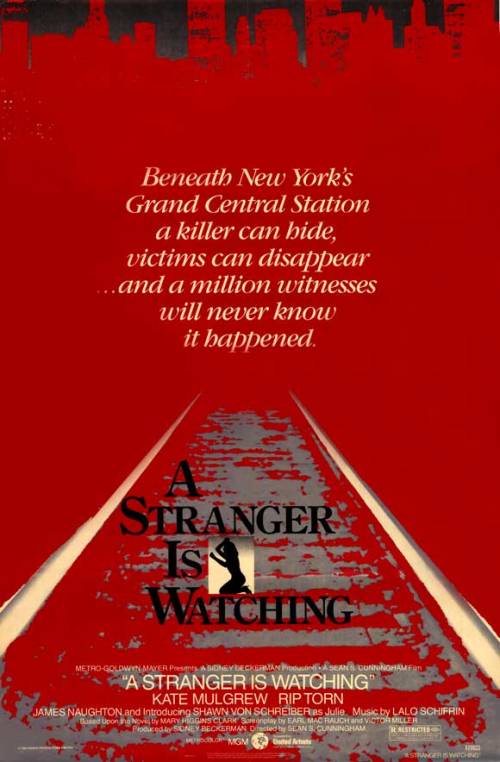
A Stranger is Watching (1982)

By Richard Winters

My Rating: 4 out of 10

4-Word Review: Her mother’s killer returns.

At the age of 6 young Julie (Shawn Von Schreiber) witnesses her mother’s rape and murder at the hands of Ronald Thompson (James Russo) at least she thinks that’s who it was when instead it was really Artie Taggart (Rip Torn). Now Ronald is slated to go to the electric chair and news reporter Sharon Martin (Kate Mulgrew) covers the controversy, but just before his execution Julie and Sharon are kidnapped by Artie. He takes them deep into the bowels of Grand Central Station where he holds them hostage while demanding a ransom of $182,000 from Julie’s Father (James Naughton).

The story is based on the Mary Higgins Clark novel of the same name and due to his success with Friday the 13th director Sean S. Cunningham is given a bigger budget to work with, which gives the production more of a visual style from the usual low budget horror flick. However, I was never convinced that Cunningham was all that great of a director and it was only through dumb luck that the Jason franchise became the big hit that it did and if anything this movie proves it. Even with more money put in and an interesting backdrop it still comes off as lackluster and uninspired.

The characters are boring particularly Torn’s psycho role where no backstory is given as to why he decides to come back to terrorize the same family when he was able to get away with the murder the first time and should feel lucky by allowing the other schmuck to take the fall and simply move on. Julie’s behavior is all wrong too. This is a child who witnessed her mother’s rape and murder, which would psychologically damage anyone else for life and yet she recovers from it like it was no big deal and acts overly angelic and gracious about everything.

The underground of Grand Central Station are the film’s best element as it captures the dank, dingy dankness quite well to the point that it almost becomes like a third character. However, when Torn kidnaps the two women he puts the girl into a sleeping bag and then carries her through the station in order to get to the spot where he hides her, but I kept wondering why she didn’t yell for help as they pass by many people in the process. He didn’t drug her, so she was free to yell out, so why doesn’t she?

I’ve read other novels written by Clark although not this one, but I was always impressed with the amount of twists that she had in them and was surprised how little that there are here. The film does feature one small surprise, but then treats it as a throwaway scene that soon gets forgotten. In the end the viewer gets treated to nothing more than a placid blueprint of the novel in a plot that gets more formulaic and pedestrian as it goes on.

My Rating: 4 out of 10

Released: January 22, 1982

Runtime: 1 Hour 31 Minutes

Rated R

Director: Sean S. Cunningham

Studio: MGM

Available: DVD, Amazon Video, YouTube
The Hand (1981)

By Richard Winters

My Rating: 5 out of 10

4-Word Review: He loses his hand.

Jon Lansdale (Michael Caine) is a gifted comic book illustrator who loses his hand in a freak car accident. They are unable to locate the missing limb at the scene and therefore unable to reattach, so he’s fitted with a prosthetic one made of metal. In the meantime the severed one goes on a murderous rampage killing all those that Jon has a problem with.

The film, which is based on the novel ‘The Lizard’s Tail’ by Marc Brandell, can best be described as an experimental horror and to some degree is quite intriguing. I liked the psychological subtext showing the hand as being a symbol to Jon’s subconscious and acting out the anger that he felt from others, but ordinarily too reluctant to do anything about. The story conveys a very universal message that we are in many ways two people, the one we choose to display to the world and the other more politically incorrect one that we try to hide from it.

Had it remained more on a subtle, intellectual side it might’ve worked, but showing the severed hand as much as it does is its biggest downfall. The scenes showing the hand strangling people looks quite tacky as instead of seeming like the victim is trying to pull the hand off of their throat it looks more like they are trying to hold it in place so it doesn’t fall off. It also brings up all sorts of unanswered questions like how is the hand able to move around so quickly and sneak inside buildings and cars and where does it get the strength to strangle people, or jump up to their throats when all the muscles connected to it have been severed away.

It would’ve worked better had the hand not been shown at all and kept a mystery as to what was causing the murders and then only at the end expose the hand as being the culprit, which would’ve made Jon’s final confrontation with it much more startling and impactful. An even better idea would’ve been to have the metal hand act as the one that does the killing since this one resembled Freddy Kruegar’s and looked far creepier.

Oliver Stone’s direction is interesting especially his technique of going from color to black and white and then back again, but the story drags on longer than it should and seems to give too much away. The twist at the end is great because it’s actually a logical one that makes perfect sense, but then at the last second Stone sells-out by throwing in tacky ‘second twist’ that is nothing but a gimmick that makes the whole thing seem too commercial.

On the acting side Caine is adequate, but I found his wavy hair far more fascinating than the hand and I especially enjoyed seeing how progressively disheveled it gets the more insane that he becomes. Andrea Marcovicci is standout as his wife. Initially I thought she was too young to play his spouse as there was a 16 year difference between the two, but her very expressive face particularly her blue eyes and the way it conveys fear helps heighten the suspense.

My Rating: 5 out of 10

Released: April 24, 1981

Runtime: 1 Hour 44 Minutes

Rated R

Director: Oliver Stone

Studio: Orion Pictures

Available: DVD, Amazon Video, YouTube
Amityville II: The Possession (1982)

By Richard Winters

My Rating: 1 out of 10

4-Word Review: Their son becomes possessed.

A family moves into the infamous home at 112 Ocean Avenue in Amityville, New York only to immediately start encountering paranormal events. Their eldest kid Sonny (Jack Magner) begins to display anti-social tendencies that eventually drive him to kill the entire family late one night. The family’s Priest Father Adamsky (James Olson) is convinced that Sonny did it because he was possessed from evil spirits that inhabit the home due to it being built on an ancient Indian burial ground and he takes it upon himself to perform an exorcism on the young man in order to free him of the demon.

The film is loosely based on the events of the DeFeo family, who lived at the residence, and was murdered by their eldest son on the night of November 13, 1974. However, the film deviates from what actually occurred including having the family just recently moved in when in reality the DeFeo’s had lived there for 9 years before they were killed. The film also portrays the family members as being awake and aware of what was going on when evidence had shown that most of them had been asleep when shot. There’s also a side-story dealing with a sexual relationship that Sonny had with his sister Patricia (Diane Franklin) that was only speculated never confirmed to have occurred with the real family.

This movie is only a slight improvement from the first one. Director Damiano Damiani manages to instill more of an atmosphere and uses fast moving tracking shots to create a point-of-view perspective of the demons. Also, James Olson plays the Priest role better than Steiger did in the first one by being less hammy and more understated, which is good.

Yet I still found the whole thing to be quite boring. The first half-hour is just a rehashing of many of the same scares that were done in the first one and we all know from the beginning how it’s all going to turn out, that the son will inevitably kill the family, so there’s no intrigue at all. The final half hour deals solely with the exorcism, which despite some decent special effects, is nothing more than a Grade B rip-off of The Exorcist.

There’s a lot of overacting too just like in the first one. Rutanya Alda, who plays the mother, is the biggest culprit in this area, which includes her death scene that deserves to be in the annals of all-time cheesiest death sequences ever put onto film. I was also confused why such an otherwise normal, well-adjust woman would want to marry a lout like Burt Young and having her show affection to him not more than a couple minutes after he had abused both her and the kids with a belt is misguided.

On the technical end the film seems to be done on a higher budget than the first, but the script is empty-headed and relies heavily on broad generalizations involving religion and ‘evil’. I also found it amusing that, like in the first installment, there’s a scene were the Priest tries to convince his church elders about the home being haunted and they scoff and insist that isn’t ‘rational’ when these same men have dedicated their lives to a profession steeped in supernatural, faith based claims.

My Rating: 1 out of 10

Released: September 24, 1982

Runtime: 1 Hour 44 Minutes

Rated R

Director: Damiano Damiani

Studio: Orion Pictures

Available: DVD, Blu-ray (Region B/2), Amazon Video