Category Archives: Foreign Films

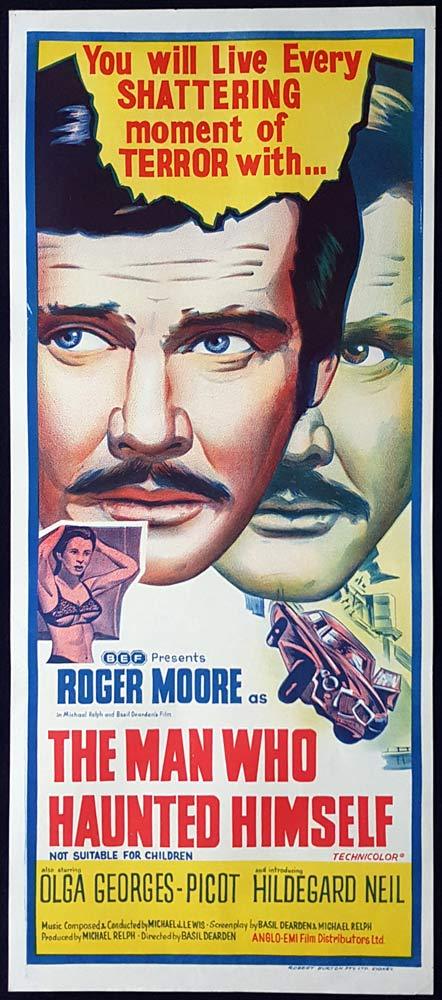
The Man Who Haunted Himself (1970)

man3

By Richard Winters

My Rating: 3 out of 10

4-Word Review: His doppelganger takes over.

Pelham (Roger Moore) is a conservative, staid businessman who is married with two kids and for all practical purposes leads a predictable life. One day he goes out driving and begins to pretend he’s a race driver in a sports car. He removes his seat belt and accelerates the vehicle before getting into an awful crash. The doctors at the hospital are able to save him, but as he returns to his normal way of doing things he keeps hearing about another man who looks just like him appearing all over town. The man associates with many of his same friends and eventually moves into his home and has relations with his wife while he’s not there. Pelham tries putting at stop to it only to find that his friends and family prefer the new Pelham over the old one.

While the concept has intriguing elements the way it gets handled is a letdown. Supposedly his doppelganger represents his more reckless side that he keeps oppressed, but then having him immediately give into his wild impulses through his driving doesn’t seem like dual personalities, but more like it’s all-in-one. His recovery, especially after such a life threatening accident, happens too quickly and the idea that he can just go back to normal and continue to drive the same car that he totaled (he buys a new one, but the same model) seemed dubious as I’d think in reality his license would’ve been suspended for causing a crash that put both him and others at extreme risk.

The movie makes clear through flashback that there really is a double versus keeping this aspect a mystery and allowing in the idea that it might be a person disguising himself as Pelham. There’s very little difference between the two, so having them both walking around adds nothing. If the twin is supposed to represent his wild side then this needs to be shown through his attire, hairstyle, and speech pattern. The only real difference is that one drives a flashy sports car, but that’s it. You’d also think that those around him, especially his family, would sense something was off instead of having the real one become the odd man.

Moore has stated in interviews that his was his favorite role, but I don’t know why because outside of having a perpetual confused look on his face his character has little else to do. The production values, for what it’s worth, are excellent, but the story is too thin for feature length. The second act gets especially boring as Pelham is constantly hearing from others about his double over and over again until it becomes redundant. It takes too long for the protagonist to become aware of something that the viewer catches onto early on. The ending is vague and offers no suitable conclusion or answers. Normally I’d say this is the type of story, which was based on the novel ‘The Case of Mr. Pelham’ by Anthony Armstrong, that would’ve been better as an episode for an anthology series, but in this instance that’s actually what occurred as 15 years earlier it was a first season episode of ‘Alfred Hitchcock Presents’. with Tom Ewell playing the part of Pelham and the compact 25-minute runtime did a far superior job with the concept than the 94-minutes does here.

My Rating: 3 out of 10

Released: July 18, 1970

Runtime: 1 Hour 34 Minutes

Rated GP

Director: Basil Dearden

Studio: EMI Films

Available: DVD
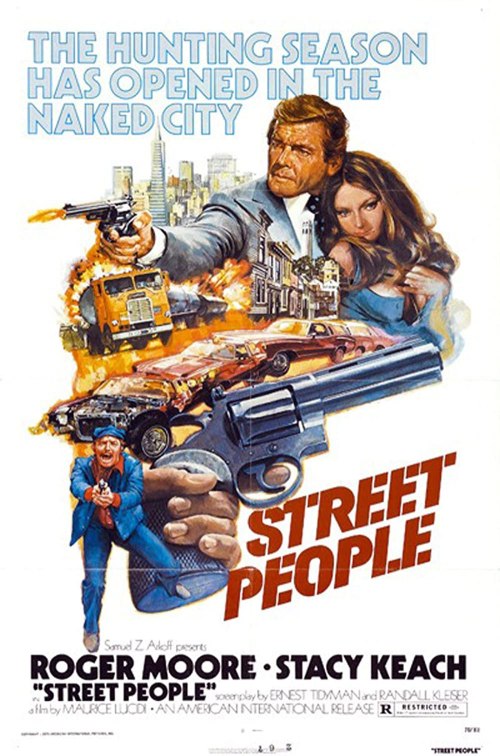
Street People (1976)

street1

By Richard Winters

My Rating: 5 out of 10

4-Word Review: Betrayed by his nephew.

Salvatore (Ivo Garrani) is a crime boss residing in San Francisco who orders a specially made cross to be shipped from Italy to his church as a gift. Inside it is a stash of pure heroin, which leads to a crime hit and several deaths. Padre Frank (Ettore Manni), the priest at the church that was to receive the cross, thinks Salvatore was aware of the hidden heroin and used the cross as a ruse to get the drugs passed customs and thus he ex-communicates him from the church. Salvatore insists he had no knowledge of the heroin and hires his nephew Ulisse (Roger Moore), who is half Sicilian, to investigate and find out who the real culprit is. Ulisse asks his Grand Prix racing driver friend Charlie (Stacy Keach) to help him out, but the deeper into the case they go the more it leads them to believe that Salvatore was the mastermind behind it.

This unusual endeavor was produced by an Italian production company, but filmed in the U.S. with a British star and American actor and yet the supporting cast is made-up entirely of Italian performers straight from Italy. The Italians have their voices dubbed and share a high number of scenes only amongst themselves, while Moore and Keach speak in their regular voices and appear the majority of their screen time together. The result is a haphazard effect that cuts back and forth between what seems like two completely different movies spliced together. Casting Moore as someone who is ‘half-sicilian’ despite his very thick British accent, and pale skin, is one of the more ludicrous casting decisions ever made and the script, which Moore stated both he and Keach couldn’t make any sense out of even after watching the final print, goes all over the place and will be confusing to most.

The film does have some good points. Moore plays his part in a terse,no-nonsense style and I wished this was how he had approached the Bond role instead of the detached, humorous way that he did. Keach is highly engaging and watching the two trying to work a case despite having such opposite personalities is enjoyable, but there’s no explanation for how they ever met, or would even want to work together as they don’t get along. There needed to be at least one scene showing a genuine friendship in order to make their buddy relationship make sense instead of just the constant bickering.

The special effects are decent if not exceptional and for those just looking for some action and don’t mind a flimsy storyline then this should do. The scene where Keach takes a member of the mob’s car for a ‘little drive’ and then proceeds to recklessly smash it up before their very eyes is a delight. The car chase sequence gets riveting and the look of sheer panic in Moore’s eyes, as he was the passenger with Keach driving, makes it seem authentic and it’s nice to see people wearing seat belts, or at least putting them on once the ride gets dangerous, as that’s something you don’t always see in other movies. The foot chase that takes place over the rooftops of San Francisco’s business buildings is good too.

It’s unclear though what the film, which had six writers and two directors, was hoping to achieve. Maybe they just wanted to make a cheap, mindless action flick and for that you could say it’s a success, but there are some weird moments. The cross that gets shipped-in is unusual looking particularly the Jesus figure making me wonder if they were trying to go for something more like spoof, but either way it ultimately ends-up being an inept drama with few car smash-ups for diversion.

My Rating: 5 out of 10

Released: March 30, 1976

Runtime: 1 Hour 32 Minutes

Rated R

Director: Maurizio Lucidi, Guglielmo Garroni

Studio: American International Pictures

Available: DVD, Blu-ray

That Lucky Touch (1975)

lucky

By Richard Winters

My Rating: 4 out of 10

4-Word Review: Journalist and arms dealer.

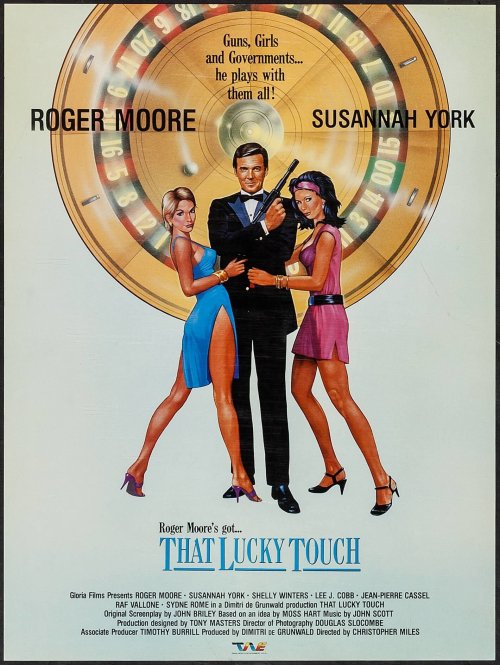
Michael (Roger Moore) is an arms dealer who travels the globe looking for state-of-the-art weapons that he can sell. Julia (Susannah York) is a journalist who writes articles that abhors men who are into guns. The two reside in the same building, but have never met. One night Julia holds a party and while she is seeing her guests out her front door accidentally closes causing her to become locked-out of her apartment. Michael, who is on the outs with his ditzy, live-in girlfriend Sophie (Sydne Rome), decides to use this opportunity to put the moves on Julia. He invites her into his place, so she can call the landlord, but then unplugs the phone, so she’ll think it’s out-of-order and be forced to spend the night. Julia though turns-the-tables by ordering him out on the ledge and into the rainy night while demanding he get into her apartment through an open window. This then begins their love-hate cycle where every time they start to bond one of them finds out something about the other that they hate and thus begin to fight.

While the premise has potential the scenario is poorly plotted and hard to get into though the middle part does have some funny moments. The scene where Lee J. Cobb, who plays an army general, thinks he’s getting an important call from the President, as his red phone is blinking, but instead it’s from his scatterbrained wife, delightfully played by Shelley Winters, is hilarious. The segment dealing with Moore and York trying to get into her apartment is quite good too, but doesn’t get played-out enough as they take a trip to her landlord’s to get the key, but this part is never shown. However, so much time is spent with them trying to find every other way to get inside that I felt we should’ve included this part instead of suddenly cutting away and only implying what happened later.

What I didn’t like was the beginning where the scenes cut back-and-forth between Moore testing out some guns and York typing away without having any idea what they were doing, or why. It’s not until 15-minutes in that it gets revealed that these two live across from each other, which should’ve been established right away. The ending gets botched too as the second-half is spent on the couple, but ends by focusing solely on the secondary characters in an ill-advised screwball finale.

Moore’s acting helps. The glib way that he conveys his acerbic lines are amusing and I came away thinking he was much better in comedy and missed his calling by not doing more of them. York though seems miscast. She’s great in drama, but her comic timing is missing and she’s too hostile to the extent that you start to wonder why Moore’s character would have any interest in her at all. The part was originally intended for Sophia Loren, who would’ve been better and more age appropriate since there was only a few years difference between her and Moore versus the over 10-year gap that he had with York.

The supporting cast is solid especially Winters and Rome, but Cobb is the surprise as he spent his whole career doing dramas, but manages to be the funniest one here and it’s just a shame that this marked his final film appearance, he actually suffered a heart attack during the production. The soundtrack is pleasing too, but the flat script needed better fleshing-out.

My Rating: 4 out of 10

Released: August 7, 1975

Runtime: 1 Hour 33 Minutes

Rated PG

Director: Christopher Miles

Studio: Allied Artists Pictures

Available: DVD (Region 2 Import) DVD-R (dvdlady)

Skip Tracer (1977)

skip1

By Richard Winters

My Rating: 7 out of 10

4-Word Review: Highly motivated debt collector.

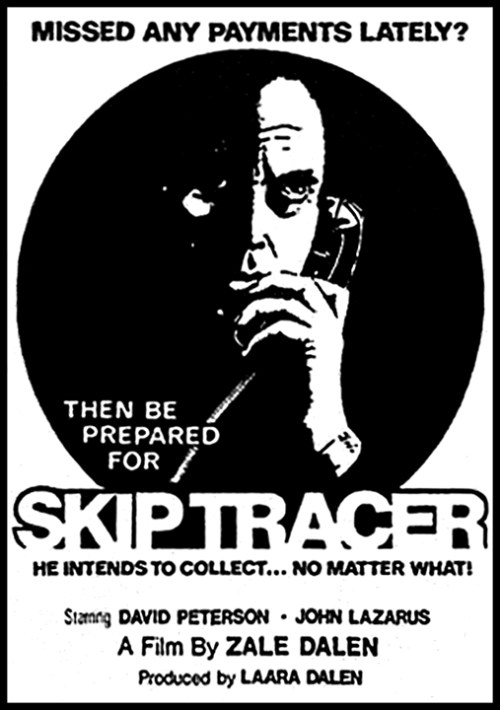
John (David Petersen) enjoys his job working for a collection agency and going after people who are delinquent with their loan repayments. He has achieved ‘Man of the Year’ honors at the company and is motivated on attaining that title again. Brent (John Lazarus) is a young trainee who’s having a hard time getting the hang of it. He asks John for guidance by following him around and observing how he gets things done. John is reluctant at first, but eventually agrees. However, as their partnership evolves John starts having second thoughts about the ugly side of the business.

I worked briefly in the bill collecting business and can say first-hand this film gets it right. Director Zale Dalen must’ve worked in it himself in order to recreate it so accurately and what makes this film so good is the way it reveals the business to those who aren’t familiar with it to the extent that it’s like you’re not viewing it, but instead visiting it. The script smartly stays away from jazzing-up the storyline for the sake of drama and keeps everything on a believable level, which makes the graphic ending all that more startling. Even though it was made 45 years ago it’s still quite accurate to what could easily occur in collections offices today with the only difference being that there would be computers on the desktops now versus typewriters.

Petersen, in his film debut, is excellent, I’ve personally known people just like his character and their obsession with rising up in the company overshadows everything else even if it means becoming a complete jerk. What I didn’t get, and the one element that hurts this otherwise strong film, is that he lives in a rundown apartment and drives a beat-up car. If money is his drive and he’s won Man of the Year honors then I’d think he be living in a far ritzier place. Having the company demote him by taking away his office didn’t jive either. This seems like the type of guy who’d be arrogant enough to walk out of a company that didn’t show him the respect he felt he deserved and with his debt collection skills he could easily find another position at another collection agency, so watching him put up with the abuse from his boss undermines the character.

Spoiler Alert!

The film’s shocking ending is strong and comes as a complete surprise, but I wanted to see more of a transition to the character. He essentially walks away from the job and down the street, but no idea where he ultimately ends-up. I would’ve preferred seeing him begin a new job, something that was much different than bill collecting, in order to make the transition complete because what’s to say he doesn’t just get another job, especially if his experience is in that area, that isn’t much different than the one he left? Keeping things as wide-open as it does isn’t as satisfying as seeing him working some lowly position even at lower pay, which would hit-home to the viewer that no matter how bad things were now we’d know he’d still never go back to his old ways.

End of Spoiler Alert!

This is one of the better films to come-out of Canada when it tried to jump-start its fledgling movie industry back in the 70’s. For his efforts Petersen won the Best Actor award at the 1977 Canadian Film Awards and Dalen won it for Most Promising Newcomer. The film also manages to achieve the amazing feat of making Vancouver, one of the rainiest and gloomiest cities in the world, look sunny and inviting.

My Rating: 7 out of 10

Released: August 17, 1977

Runtime: 1 Hour 35 Minutes

Rated PG

Director: Zale Dalen

Studio: International Film Distributors

Available: Blu-ray

ffolkes (1980)

ffolks2

By Richard Winters

My Rating: 5 out of 10

4-Word Review: Loves cats, hates women.

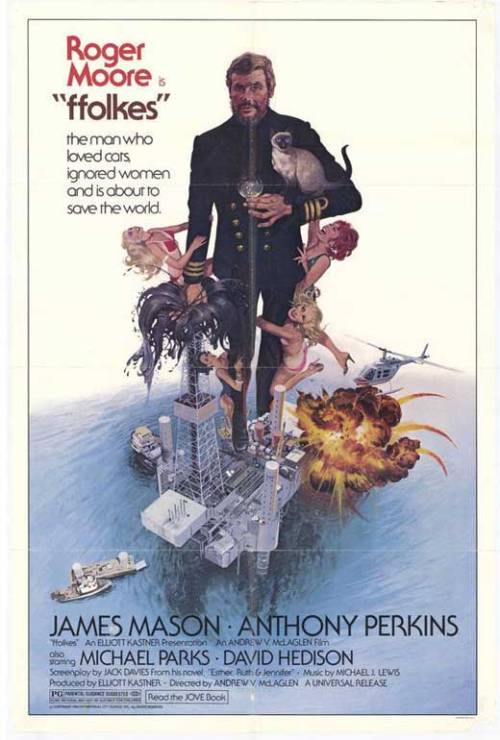
Rufus Excalibur ffolkes (Roger Moore) is a cat loving misogynist who dislikes women because he grew up the youngest of five sisters and forced to wear their hand-me-downs until he was age 10. As an adult he is a counter-terrorism expert and trains a team of men to go onto ships at sea that have been hijacked. When a North Sea oil production platform nicknamed Jennifer gets taken over by a group of men posing as reporters their leader (Anthony Perkins) demands an enormous ransom and it’s up to ffolkes and his team to board the platformed and kill the terrorists without allowing the ship, which has been booby-trapped with bombs by the criminals, to blow-up.

The film, which was based on the novel ‘Esther, Ruth & Jennifer’ by Jack Davies, who also wrote the screenplay, starts out well and has all the ingredients to being a compelling thriller. The on-location shooting done on an actual ship makes the viewer feel like they’re out at sea themselves and I found the foot chase done on the vessel during a raging rainstorm to be riveting. Perkins makes for a particularly slimy villain and Micheal Parks, as the mastermind who constructs and implements the bombs, was also impressive wearing glasses that make his eyes look like they’re bulging and it’s just a shame these two men had to co-star together as they’d be able to eat-up the scenes had they been allowed to do it alone without any henchmen.

The ffolkes character works against type playing a good-guy that tests the viewer’s assumption of what’s acceptable behavior for a protagonist. Too many movies create a hero-like caricature of someone who is overly noble, brave, and virtuous until it becomes boring and contrived. At least here the guy we’re supposed to cheering for is interestingly flawed therefore more human-like than super-heroes in most other films, especially those made today, who are just too-good-to-be-true.

ffolkes though does spend too much time sitting in the background working on a crochet of a cat while giving-off glib remarks and not being as active as he should. He’s also constantly drinking scotch at all hours of the day, straight out of the bottle, which should’ve made him inebriated and this most likely would’ve come into play at some later point where he wasn’t able to pull-off an intricate task because he was too drunk, but after introducing his drinking problem during the first half, it gets completely forgotten by the second.

While the character acts extraordinarily arrogant and cocky he’s not able to pull-off the assignment quite as easily as you’d think for someone with his amount of confidence. One scene has him stupidly walking right into a gunmen and it takes the sheer luck of someone hiding in a lifeboat to save him. Another scene has him almost killed by one of his own men making him seem like he’s not as good of an instructor as his reputation suggests and all leads to him unintentionally coming-off more like a deluded idiot than the crafty mastermind with a few personality quirks that he’s supposed to be.

The story, while having a solid set-up, ultimately becomes the biggest letdown. For one thing it never shows us how they’re able to pull-off the fake explosion of Ruth, another oil platform. They talk about rigging it to seem like it exploded to fool the bad guys, and we do see something exploding, but no explanation of what it was since the real Ruth secretly remains standing. Also, most ships have a radar system, which should’ve shown that the real Ruth never went away and that they had been duped, but for whatever reason they never catch-on.

The ending surprisingly lacks very little action, which is what was blamed for the film’s poor reception at the box office. People are expecting a movie that stars Moore to have a lot of stunt work and special effects and for the most part it never happens. The villains go down too easily making it not very satisfying to see them go. There needed to be more wrinkles to the scenario and more unexpected twists as the pay-off and climactic finish is weak making one feel, despite the excellent performances, like it wasn’t worth sitting through.

Alternate Title: North Sea Hijack

My Rating: 5 out of 10

Released: April 3, 1980

Runtime: 1 Hour 38 Minutes

Rated PG

Director: Andrew V. McLaglen

Studio: Universal

Available: DVD, Blu-ray

C.O.D. (1981)

cod1

By Richard Winters

My Rating: 1 out of 10

4-Word Review: Signing-up bra models.

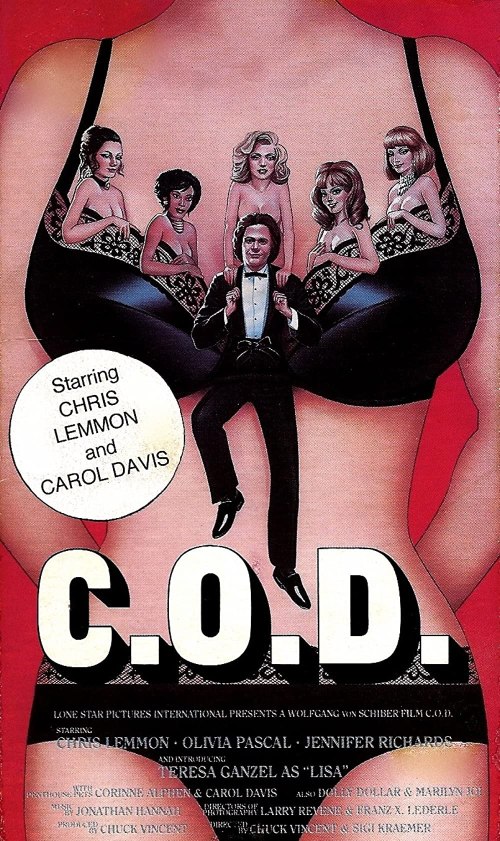
T. B. Dumore (Nicholas Saunders) is the aging owner of the Beaver Bra Company who’s finding that consumer interests in their product is waning, so he comes-up with what he feels is a ‘can’t-miss’ campaign, which entails them bringing-in 5 world famous women, including the President’s daughter (played by Teresa Ganzel in her film debut) to model their bras in their new ads. Albert Zack (Chris Lemmon), the company’s advertising salesmen, is commissioned to seek out the women and get them signed to a contract. Albert feels the task is monumental, but uses the help of Holly (Olivia Pascal), a beautiful German woman that he meets as he travels the globe to find the 5 women, to help him do it.

This film was directed by Chuck Vincent, who gained notoriety in the 70’s for directing a lot of X-rated fare, but decided to break into mainstream movies in an attempt to list a more ‘respectable’ product on his resume. His first stab at ‘legit’ filmmaking was American Tickler, a slap-dash, skit oriented parody of the current hit movies of the 70’s that was universally derided by both critics and audiences alike. This feature marked his second go at ‘legit’ that fared even worse and sent him pretty much back to porn making where he was slightly better until dying at the young age of 51 from AIDS in 1991.

At least with the porn flicks they had some redeeming value, namely helping those get-off while this movie offers nothing. To call the humor mind-numbingly lame would be an understatement, but the plot, which is incredibly stupid to begin with, goes nowhere and filled with a lot of cheap unimaginative gags that wouldn’t impress a 4-year-old. There isn’t even any nudity, a little bit, but not as much as you’d expect making you wonder what exactly was the audience that they were aiming for as the insipid comedy alone was clearly not going to cut-it.

Chris Lemmon, the son of the far more famous Jack Lemmon, is the one who should be really embarrassed. His father prodded him to become a professional pianist, of which he’s apparently quite good at, but Chris wanted to follow in his father’s foot steps and get into acting. Some children of famous stars, like Michael Douglas, the son of Kirk, can end up having a flourishing career of their own, but Chris’ was nothing to write-home-about mainly because of being in cheap-o stuff like this making me believe his dad knew what he was talking about when he prodded him to stick with the piano playing. It’s not like his acting is bad, he resembles his father with a fuller head of hair, but the material gives him little to work with.

Unbelievably there are a few scenes that had me chuckling a little. The best one is where a guest at an upscale dinner party is forced to fight with a live lobster on his plate because Lemmon, who was pretending to be a gourmet cook, didn’t have the heart to kill it, which had potential, but needed to be played-up more. Everything else though falls flat. Had they approached it in a satirical vein, or had a synopsis that people could actually relate to, then maybe, but playing it as an unrestrained farce that nobody asked for is a dismal failure that’s best left at the bottom of the forgotten movie vault shelf.

Alternate Title: SNAP! 

My Rating: 1 out of 10

Release: July 3, 1981

Runtime: 1 Hour 36 Minutes

Rated PG

Director: Chuck Vincent

Studio: Metro Film

Available: dvdlady

Figures in a Landscape (1970)

figures1

By Richard Winters

My Rating: 5 out of 10

4-Word Review: Chased by a helicopter.

Ansell (Malcolm McDowell) and MacConnachie (Robert Shaw) are two men on the run in the middle of a bleak, desolate desert. What they are escaping from is never clear, but they’re constantly hounded by a helicopter that seems intent at stopping them. They come upon a small village and steal food and supplies and then continue on their escape, but find trying to get along with each other is just as challenging as avoiding the copter.

I’m a big admirer of Joseph Losey’s films and I also enjoy movies that have an air of mystery and don’t feel the need to have to explain everything, but this attempt at avante garde doesn’t work. The Barry England novel or which this is based and received high critical praise when it came out in 1968 at least made it clear that these two were soldiers who were deserting for whatever reason, but the movie doesn’t even mention this. We’re simply left with a nothing-burger of seeing two guys we have no emotional connection with scurrying around the countryside, which gets old fast and has nothing to keep it compelling though the bird’s eye shots of them on the ground looking like dots as they run at least allows it to live up to its title.

Fans of the film will admit that the story is lacking, but the helicopter sequences and stunt work more than makes up for it, but I found this aspect to be underwhelming. The camerawork of showing the copter bearing down on them while splicing in shots from the pilot’s point-of-view is well handled, but it’s not as exciting as could’ve been because when the pilots have a chance to shoot the men they don’t. McDowell’s character explains that they (the helicopter pilots) are just ‘toying with them’, but the viewer can’t be expected to get wrapped-up in a silly cat-and-mouse contest that has no life or death consequence.

Much of the blame for why this comes-off more like a misguided experiment than an actual movie, can be attributed to Shaw, who was given permission to rewrite the script and promised to have it completed by the time shooting began, but didn’t. Apparently revisions were being made on a daily basis and no one knew where the plot was going, or how to end it, which ultimately makes for a flat and detached viewing experience.

The two leads do quite well with McDowell interesting as the younger of the two, but still more emotionally mature. Shaw is equally fine giving off a maniacal laugh that I’ve never heard him do before. Their bout with diarrhea at a most inopportune time is amusing. While some may find it gross it’s something that could happen to those who haven’t eaten in awhile and feeding off canned food, so in that way the movie tackles a realistic subject other escapees-on-the-run movies shy away from though the shaving aspect was a problem in reverse. I didn’t understand why Shaw would feel it’s so important for them to remain clean shaven when they’re just trying to survive and there’s no explanation for how they were able to remain without beards at the beginning when they were running around with their hands tied behind their backs.

In any case the movie desperately needed a conclusion as way too much is left open-ended. There should’ve been a final twist, like in an episode of the ‘Twilight Zone’ that makes sitting through it worth it. Ultimately it lacks focus with a concept better suited for a novel and never should’ve been made into a movie in the first place.

My Rating: 5 out of 10

Released: July 14, 1970

Runtime: 1 Hour 50 Minutes

Rated R

Director: Joseph Losey

Studio: 20th Century Fox

Available: DVD, Amazon Video

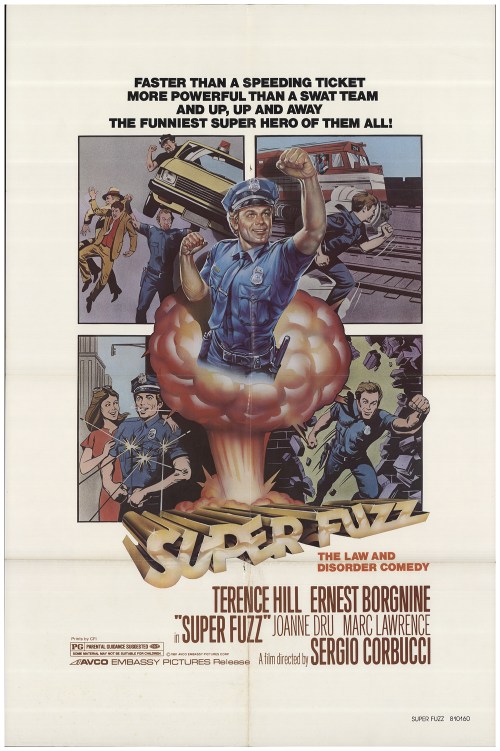
Super Fuzz (1980)

super fuzz1

By Richard Winters

My Rating: 2 out of 10

4-Word Review: Cop acquires super powers.

Dave (Terence Hill) is a newly hired policeman sent to do tasks non of the other officers want to do, which is why he’s given the assignment to deliver a speeding ticket to a remote Native American village deep within the Florida Everglades. Once he arrives he finds the place evacuated due to a secret nuclear missile test being done that he wasn’t aware of. When the bomb goes off and he becomes exposed to the radiation he begins to have various super powers including: super human strength, speed, telekinesis, psychic ability, and even hypnotism. He puts these new found abilities to use during his police work even though his partner, longtime cop Bill Dunlop (Ernest Borgnine), is skeptical about it at first. While the powers come in handy in their efforts to thwart a local counterfeit ring Dave soon realizes that there’s one hitch; if he sees the color red, which was the same color as the plutonium explosion, his powers will temporarily cease.

This was the third and final attempt to make Hill, who’s quite legendary in Italy especially in films where he teamed with Bud Spencer, into an American star. The first two attempts that he did here, Mr. Billion, March or Diewere flops and this effort, which was aimed solely at the kiddie crowd, wasn’t much better and its dismal failure both critically and financially sent Hill back to Europe permanently. Many adults who grow up in the 80’s will remember seeing it on Pay-TV where it was in heavy rotation. I recollect catching bits and pieces of it on Showtime, but the only thing that stood out for me was its cheesy soundtrack that had a chorus singing: ‘Super, Super, Sup-eee-rrr’ every time Dave did one of his tricks.

The film’s biggest downfall are the special effects that amounts to a lot of tacky, fast-action photography that can be seen in a wide assortment of other mindless low budget fare and is nothing special. There’s also just not enough trickery, too much dim witted dialogue, and lame humor in a plot that evolves too slowly to hold the interest of either a child or adult.

Having Dave acquire all these powers after being exposed to nuclear energy instead of getting terminal cancer like anyone else would makes no sense. The story would’ve been helped somewhat by reeling-in the powers aspect and giving him only one special ability instead of allowing him to do virtually anything making him almost like superman. Entering in more limitations than just the color red would’ve, if done right, brought in some tension and creativity, which is otherwise lacking.

While it’s sad in some ways to see a legendary, Academy Award winning star like Borgnine in such mindless tripe he is the best thing in it as he provides much needed energy, which help contrast Hill’s overly laid-back demeanor. Watching the tubby guy dance on top of a giant balloon, or try to dance with Joanne Dru is funny as are his overreactions, which would be considered cartoonish in any other movie, but here only helps to lift it up from its simplistic foundation. It’s also a great chance to see Dru, her first movie appearance in 15 years and also her last, ham it up as the villainous of which she’s pretty good.

The ending though, where Hill is somehow able from a tiny piece of gum to form this gigantic bubble is where the thing, which wasn’t floating too well to begin with, really sinks. How can Dave’s super powers get a piece of gum to expand far more than it should and since bubbles from bubble gum are very flimsy and can easily pop why doesn’t this one end up doing the same? You can also clearly see the seam of the sewn fabric on the bubble, which an actual bubble would never have.

While the movie was notoriously ridiculed by the critics at the time of its release, some critics today have taken more of a softer stance. Maybe it’s because they remember growing up watching it on TV, but feelings of nostalgia doesn’t make it any less stupid. This isn’t even good for kids who I believe are more discerning than adults think and will right away recognize the dated quality, tacky effects and won’t be impressed. 

Alternate Title: Super Snooper

My Rating: 2 out of 10

Released: September 18, 1980

Runtime: 1 Hour 37 Minutes

Rated PG

Director: Sergio Corbucci

Studio: AVCO Embassy Pictures

Available: DVD, Amazon Video

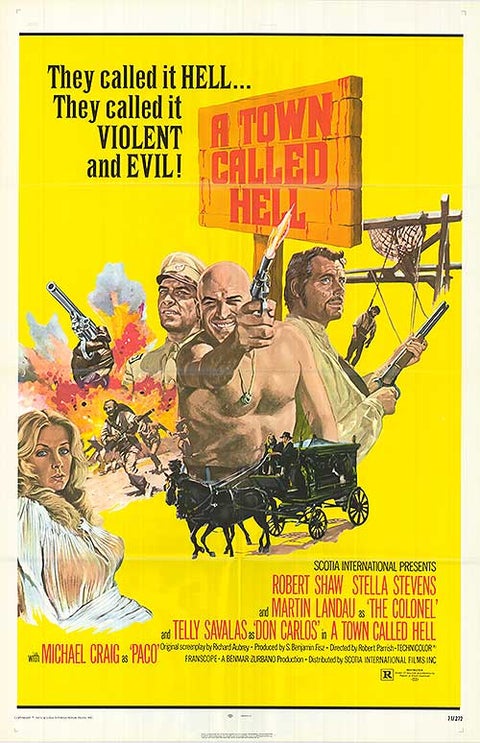
A Town Called Bastard (1971)

town

By Richard Winters

My Rating: 6 out of 10

4-Word Review: Where is rebel Aguila?

In 1895 a rebel leader named Aguila (Robert Shaw) massacres a small Mexican town. Ten years later he resides as a reformed priest in a town run by the corrupt Don Carlos (Telly Savalas). One day a beautiful widow named Alvira (Stella Stevens) arrives looking for the man who killed her husband during the massacre from 10 years earlier. Don Carlos agrees to help her despite having no idea who the killer is, or that it might have something to do with the priest. Things get more complicated when the army colonel also arrives determined to seek out justice by finding the elusive Aguila.

The film has many issues most of which is it comes off as a spaghetti western wannabe that has some of the entertaining elements of those films, but put together in a clumsy fashion. The town really doesn’t resemble an actual place, or a destination that people would live in since there only seems to be about 4 buildings, a church, a salon, and a couple of shops, making me wonder where all the townspeople that are seen milling about resided. There’s also an overuse of dubbing. Al Lettieri, who can be a spectacularly great villain especially in his unforgettable performance in The Gatewayand while he plays another bad guy here, but he gets wasted since his voice is dubbed with a high pitched one that takes away from his menacing quality. Even Robert Shaw has his voice dubbed from time-to-time, which is quite disconcerting.

The narrative is confusing as it jumps back and forth from the present to the past, but doesn’t make it clear that it is doing this, so you’ll see scenes with Shaw at the beginning as a rebel leader and then suddenly he’s a priest without explaining how the two are connected. The Fernando Rey character and the actor playing Alvira’s husband look too much alike making me think, especially since the story jumps between different time periods, that the characters were one and the same with one being slightly younger with the scenes done 10 years earlier though that ends up not being the case.

The cast does help particularly Savalas who seems to relish playing the bad guy and although he’s done this type of part a few too many times is still perfect, but his character gets killed-off too quickly and way too easily, which is a big letdown since his presence helps drive the movie. He gets replaced in essence with Landau, who plays a sociopath in the same over-the-top way, but a good film needs only one crazy not two men playing the same character in the same type of way until it becomes like a caricature.

Shaw is of course quite good though his character for the most part hangs back and doesn’t do much until near the end. The opening scene where he leads the attack on the village has energy, but the shot of a long line of spit oozing out of his mouth as he shouts orders left an icky lasting impression. Stevens is quite beautiful in a natural way without the help of make-up and this was the last film where she had a youthful look as she appeared increasingly more middle-aged after this one.

The nasty subtext was the one thing that makes it fun. There’s a lot of stuff shown here that they just couldn’t do today like the opening bit where the townspeople are viciously gunned down inside their church and the gunmen than laugh and celebrate while the dead, bloody bodies lay at their feet. The scene where a desperate man gleefully hangs his own, innocent wife in an attempt to save himself is memorable and it’s this type of element that keeps it interesting because you just don’t know what it’s going to show next and in the process reflects the ugly savagery of the true, old west.

Alternate Title: A Town Called Hell

Released: June 17, 1971

Runtime: 1 Hour 37 Minutes

Rated R

Director: Robert Parrish

Studio: Benmar Productions

Available: DVD, Blu-ray (Import Non-English), Amazon Video, Plex

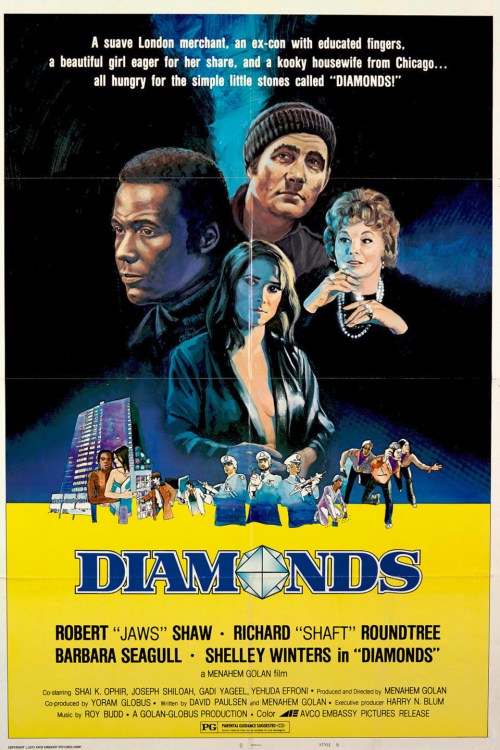
Diamonds (1975)

diamonds2

By Richard Winters

My Rating: 3 out of 10

4-Word Review: Testing a security system.

Charles and his twin brother Earl (both played by Robert Shaw) share an intense rivalry that comes-out during their judo karate contests. Charles wants to top his brother at everything including getting the better of him at his own expertise, which is that of security specialist who has created a vault in Tel Aviv that holds a cache of diamonds and is supposedly impenetrable. Charles is determined to rob it and uses the help of expert safe crackers Archie (Richard Roundtree) and Sally (Barbara Hershey).

While the film has some great location shooting of Israel making it seem almost like a travel log of the region and the final third where the three try to pull off the elaborate robbery does get a bit intense, though it’s nothing special, the movie on the whole falls flat. A major reason is that it was directed by Menahem Golan, who along with his cousin created the notorious film production company The Cannon Group, which produced a lot of cheesy, bubble gum action flicks during the 80’s. This film works very much like those with poor character development, in fact there’s really no development at all, and a plot that steals all sorts of elements from other and better heist movies.

Overall it’s pretty much the same storyline as $, Perfect Fridayand to a lesser extent Topkapibut all of the things that made those movies so much fun to watch goes missing here. The lack of interplay between the characters is the biggest issue. Shaw, Roundtree, and Hershey are all great actors, but they’re not given anything interesting to say. The twin brother concept does not get played-up enough and Charles’ twin is seen just a few times with the only difference being a shaggy wig that Earl wears as opposed to Charles crew-cut, but both brothers have the exact same mole on the left side of their mouths and while identical twins can have many similarities, skin blemishes isn’t one of them. Shelley Winters also pops-up sporadically as an American tourist, but her part is completely inconsequential and not needed at all.

The heist itself does involve some sophisticated maneuvers including having them walk on the ceiling by using a suction-cup type contraption, but the film fails to show any of the preparation. In the other heist films seeing how the crooks rehearsed the robbery and working through their disagreements and divergent personalities was half-the-fun, but that all goes missing here. How Shaw goes about meeting Roundtree and company is pretty flimsy too as he catches them during the middle of an attempted safe cracking and then hires them on-the-spot supposedly because he’s been monitoring them for 5 years and feels they’d be a perfect match for his scheme, but why should it take him so long to come to this conclusion and these safe crackers must not be as cunning as they seem if they’ve been watched closely for 5 years and not had any hint that it was going-on.

Spoiler Alert!

The crime itself gets pulled-off way too easily and there’s no moment where a crucial mistake gets made, or some sort of unexpected slip-up, so things never get as intense as it could’ve. There’s also an added character that gets thrown-in who kidnaps the son of the security guard in order to get the guard to give-out the combination to the safe, but no scenes are shown for how Shaw and company met this kidnapper, or what deal he made with him in order to get him to agree to along with their plans.

The finale has a very anti-climactic feel as Roundtree is able to retrieve the diamonds, but then Shaw forces him to put them all back, so they come away, after all that effort, empty-handed. Ultimately Shaw does hand him a $100,000 check, but this was paltry compared to the $10 million they would’ve gotten with the diamonds making the viewer feel like the film wasn’t worth sitting through if the characters just end up in the same situation that they were in when it began. While no movie that has Robert Shaw in it can be completely bad as his presence alone can elevate even the most inept material this one unfortunately does come close.

My Rating: 3 out of 10

Released: October 22, 1975

Runtime: 1 Hour 48 Minutes

Rated PG

Director: Menahem Golan

Studio: AVCO Embassy Pictures

Available: DVD-R