Category Archives: Foreign Films

The Track (1975)

track3

By Richard Winters

My Rating: 9 out of 10

4-Word Review: Hunters chase down woman.

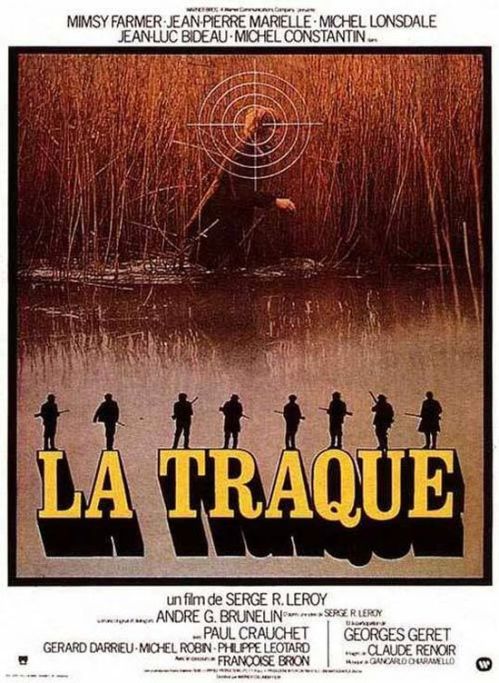
Helen (Mimsy Farmer) is an American who has traveled to rural France in order to teach at a local university. At the train station she meets Philippe (Jean-Luc Bideau) who agrees to take her to the isolated cottage where she is to stay. Along the way they come into contact with Philippe’s boisterous friends who drive them off the road. The men are going out for a wild pig hunt and a few of them particularly Paul (Philippe Leotard) shows a sexual interest in her, but Philippe assures her that they’re ‘harmless’. While Helen moves in to her new place the men go off on their hunt, but when she walks outside to check-out a nearby barn she again comes into contact with Paul along with his brother Albert (Jean-Pierre Marielle) and Chamond (Michel Robin). Paul uses the opportunity to rape her while Albert holds her down and Chamond acts as the lookout. As they are about to leave Helen shoots and critically injures Paul with Chamond’s gun, which he had inadvertently set down, before she goes on the run deep inside the forest. The rest of the group tries tracking her down in an attempt to negotiate some sort of deal, so she won’t go to the authorities, or silence her permanently if she still insists that she will.

Some have labeled this the French version of Straw Dogs, but I consider it much more like Deliverance. In that film you had middle-aged suburbanite males wanting to prove their ‘macho manhood’ by roughing it in the wilderness for a weekend only to find that they weren’t quite as prepared for the harsh elements as they thought. This film works in kind of the same way. The men go hunting to get in touch with their rugged side, but when forced to face tough issues, like helping a woman in distress, they succumb to group pressure and prove ultimately to be wimpy.

Unlike other films in the rape/revenge genre the main character here is shown the least. Farmer does well during the rape segment and screams and fights in a way that elicits genuine horror, but otherwise her facial expressions and mannerisms are quite one-dimensional though I was impressed with the way she did her own stunt work and forced to navigate her way through some difficult and inhospitable terrain.

The main focus is on the male characters who are fascinating and multi-faceted. The most interesting aspect is how they start-out seeming benign and domesticated only to slowly unravel into a aggressively threatening group. The segment where they kill a pig and the animal struggles after being shot will make some animal activists uncomfortable, but like with Jean Renoirs’ Rules of the Game, which had a hunting segment even more graphic than here, it does effectively illustrate that if people are willing to kill an animal for sport; how thin is the line for them to cross-over to a person?

The lack of a soundtrack is a plus. Many thrillers will have a pounding score and sometimes it works to accentuate the tension, but here the natural sounds particularly Helen’s heavy breathing as she runs through the underbrush is far more effective. There’s also no forewarning of what’s going to happen nor buildup. Everything occurs out of nowhere. Most victims who survive a crime will say the same thing that things were peaceful and normal one minute and then all hell broke loose the next.

Spoiler Alert!

The only two things I might’ve done differently had I directed was not showing the rape. As rape scenes go this one is rather mild, but my feeling was it would’ve been creepier had the viewer been in the dark about what occurred as were initially the other men. They’re told the story that the gun went off accidentally and the woman ran in a panic only for them to slowly learn the dark details later on. Having the viewer come to this realization along with the other men would’ve added an extra layer to the story versus it being spelled out.

While the ending is effectively unsettling I still wanted a denouement showing how the strains of this experience changed them, which would’ve added insight. Overall though it’s a brilliant especially for the way it reveals how some of the men considered themselves more ethical than the others only to end up being no better. Everyone likes to feel that they, or their friends, would do the right thing when put in a stressful situation and ‘be the hero’, but this movie expertly examines how that might not always be the case.

Alternate Title: La Traque

Released: May 14, 1975

Runtime: 1 Hour 32 Minutes

Not Rated

Director: Serge Leroy

Studio: Warner Brothers

Available: DVD-R (French with English Subtitles) (dvdlady.com, jfhi.com)

Rape of Love (1978)

rape1

By Richard Winters

My Rating: 7 out of 10

4-Word Review: Assault victim seeks justice.

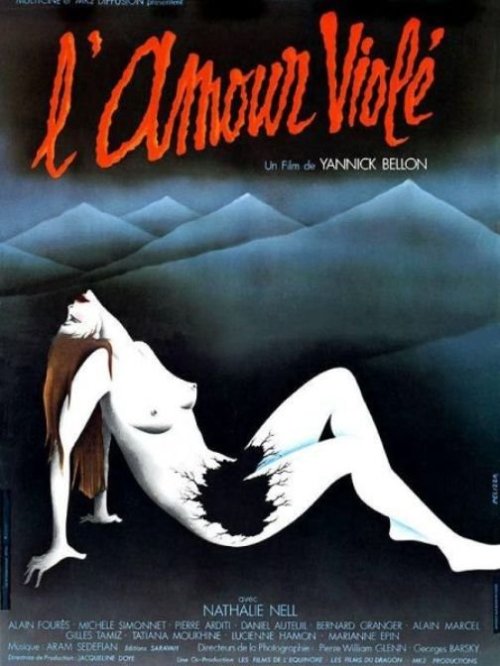
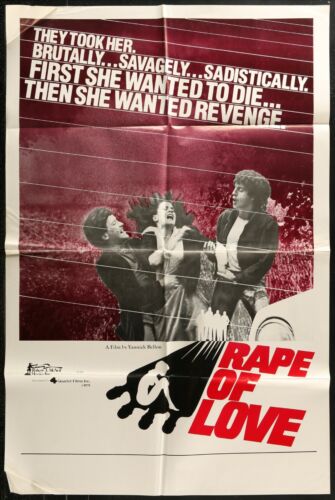
Nicole (Nathalie Nell), a young nurse, goes bike riding one day to a friend’s house. Four men (Marco Perrin, Gilles Tamiz, Bernard Granger, Daniel Auteuil) spot her at a cafe and begin following her in a van. Once she reaches a remote area they drive her off the road and force her into the back of the van where she’s taken to a remote shed and brutally raped and humiliated. Once it’s over she’s brought back to the dark road, thrown to the pavement, and warned not to tell anyone. Initially she feels ashamed and doesn’t want to talk about it, but then while making a house call to one of her patients (Marianne Epin) she sees a picture of one of the rapists on the wall, who’s apparently a married family man living a normal life. She’s enraged that these men can go on living like nothing happened while she remains emotionally and mentally shaken. She becomes motivated to bring them to justice despite both her mother (Tatiana Moukhine) and boyfriend (Alain Foures) advising her not to.

This film was written and directed by Yannick Bellon, a feminist who had  worked on documentaries before doing this one. It bears a striking resemblance to Meir Zarchi’s I Spit on Your Grave, both were filmed around the same time and neither production was aware of the other. Bellon had wanted to make a movie about rape that didn’t sanitize it and would capture it in the most explicit and violent way possible. While Zarchi’s movie has gone on to achieve cult status this one has fallen into obscurity even though despite some flaws it’s easily the better of the two.

The rape scene is quite graphic though I was actually expecting it to go on longer. It lasts for about 10-minutes, which is just enough time to give the viewer a very raw and uncomfortable taste of the crime’s viciousness without exploiting it and then unlike with the Zarchi movie the film shifts back into a drama instead of a revenge horror flick. I liked this transition better as it gives greater depth to the characters including the rapists who aren’t shown as being one-dimensional backwoods thugs like in the other movie, but instead regular citizens who you’d think were nice guys if you didn’t know better. One scene even has them discussing at a bar what they feel would be a suitable punishment for a criminal who had committed another crime, showing how these men, as terrible as they are, still have a warped idea of morality for others.

I also liked the way it focuses on Nicole’s psychological recovery though here I felt it got a bit botched. Having her examined after the incident by a male doctor I didn’t think worked as she’d not trust a male being in that emotional state and insist instead on a female physician. She also expresses later to a friend (Michele Simonnet) that she no longer likes people to touch her even as her friend touches her while she says it, which doesn’t make much sense. She also goes right back to riding her bike even though I’d think it would take her a long time if ever before she’d do that again.

rape2

Her relationship with her boyfriend and the way they no longer have sex, which frustrates him is interesting particularly the scene where he’s shown angrily walking down the street and comes upon a prostitute. I thought the film was going to have him take his frustrations out on her and thus showing how this ‘good guy’ could be, under certain circumstances, just a violent as the rapists he hates, which could’ve brought out an insightful irony, but the film only teases the idea and eventually doesn’t go there.

The reaction of the rapist’s wife who begs Nicole not to take the case to court as it would be stripping her of a ‘fine husband’ and her kids from a ‘wonderful father’ seemed absurd. I would presume most wives would be disgusted to find out what their husbands had done and would want to leave them, or at the very least refuse to believe that they had committed it. Then again I was not living in France during the 70’s, so I can’t say I know how that culture would view rape. I know they consider affairs in a much more liberal way where it’s not always the deal-breaker like it is here, but to frame rape as just being another of his ‘flings’ seemed a bit too open-minded.

Spoiler Alert!

The climactic court battle falls flat. Having the men immediately confess to what occurred once they were questioned by the authorities didn’t seem realistic. After all she didn’t decide to press charges until 6-months later, there was no semen sample, no DNA, and no other witnesses. The men could’ve denied everything and most likely gotten-off. The film ends without the viewer finding out the verdict and never knowing how stiff their penalties were, or weren’t.

I wasn’t so keen about the boyfriend, who left Nicole once she decided to go public about the rape, coming back at the end and rekindling the romance. I felt this sent the wrong message. Sometimes when a person decides to do what they think is right then that means sacrificing everything and learning to live with it including losing friendships with people that don’t agree with what they’re doing. It’s a bridge one crosses that you can’t go back on. Having her adjust to being an independent single woman, or finding a new boyfriend that wouldn’t bail on her during her time of need would’ve been a better resolution.

rape3

My Rating: 7 out of 10

Released: January 11, 1978

Runtime: 1 Hour 55 Minutes

Not Rated

Director: Yannick Bellon

Studio: Les Films de l’Equinoxe

Available: DVD-R (French with English Subtitles) (j4hi.com)
An Average Little Man (1977)

average1

By Richard Winters

My Rating: 9 out of 10

4-Word Review: Father avenges son’s death.

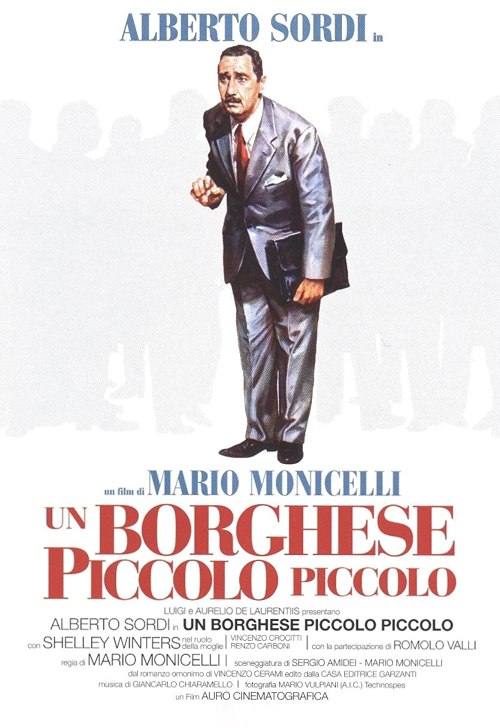
Giovanni (Alberto Sordi) is an accountant who’s ready for retirement. His son Mario (Vincenzo Crocitti) is following in his father’s footsteps by becoming an accountant as well. He has passed all of his exams and fully qualified, but competition is tough, so his father tries to use his leverage to get his son hired there, or at least have his name pushed to the top of the list. Unfortunately on the morning of the interview Mario is killed by a stray bullet from a bank robbery that was occurring across the street. Giovanni is devastated and the news is so shocking to his wife Amalia (Shelley Winters) that she has a stroke and is no longer able to speak, or walk, or even feed herself. Giovanni doesn’t trust the system to bring the killer (Renzo Carboni) to justice, so he decides he must do it himself by stalking the man and then eventually kidnapping him.

The film, which is based on the novel ‘A Very Normal Man’ by Vincenzo Cerami, who also wrote the screenplay, is filled with many memorable moments. I got a kick out of Giovanni’s tiny car that looked like something he could wear instead of ride and the way he gets around a traffic jam by driving it on the sidewalk. The mounds of paperwork in his office where no one can see each other because they’re literally swallowed up by them is a funny visual as is Giovanni’s supervisor (Romolo Valli) who cleans the dandruff off of his hair and onto his desk. There’s also a scene that is both darkly humorous and highly disturbing where because the cemeteries are filled to capacity the remaining dead bodies must be stored inside a warehouse with each casket put one on top of the other. Families and mourners crowd in to find which one has their loved one in it, but because of the gas coming out of the decomposing bodies that create sporadic explosions that cause the caskets to go tumbling.

The appearance of American actress Shelley Winters is another shocker in that she’s dubbed with an Italian speaking woman. Hearing her in a voice that is clearly not her own is at first disconcerting, but she gives a brilliant performance nonetheless. Normally she’s known for her talkative nature, both for the parts she plays in front of the camera, but also in her real-life interviews, yet she reflects a comatose woman quite convincingly and her facial expressions, particularly when she’s brought into the cabin to observe the killer’s torture, are excellent.

Sordi, a well known Italian film star and comedian, does well too and it’s interesting seeing his hair go from salt-and-pepper to fully gray as the movie progresses. His character though isn’t exactly likable. While he sees himself as being ‘selfless’ as he sacrifices everything, and potentially breaking the rules, for the love of his son, he seems more selfish because why should his son get a unearned break over all the other candidates? While he has his funny share of moments he’s also a bit unhinged even at the beginning with his almost naive belief that a system he knows is corrupt is now somehow ‘morally’ obligated to give him and his son a favor. Maybe this was the intended ironic point, but it would’ve played better had the son been less of a vapid, empty shell.

Spoiler Alert!

What makes this film stand-out from virtually any other is its extreme shift in tone where it starts as a satirical comedy, but ends as a grim thriller. Many script experts will insist this ‘can’t be done’ and in Hollywood would be considered forbidden. It also doesn’t have the inciting incident occur until an hour in even though books like ‘Save the Cat’, which is the ‘screenwriter’s bible’, will tell you it must happen within the first 5 pages of any script. There’s also no forewarning to the killing it’s just a completely random event with no connection to anything that came before, which again most people in the movie business will say is a ‘mistake’.

While I might’ve done it slightly differently by having Giovanni go insane when one of the supervisors refuses to hire his son after promising him they’d do it and then kidnapping that individual to make it seem a little more connected to the first half, I’m still impressed with how effectively it all works either way. It literally breaks every screenwriting rule and still succeeds and should be used as an example to anyone insisting that movie scripts that don’t stringently conform to the Hollywood formula will fail as this one clearly doesn’t.

average2

My Rating: 9 out of 10

Released: March 17, 1977

Runtime: 1 Hour 58 Minutes

Rated R

Director: Mario Monicelli

Studio: Cineriz

Available: DVD-R (Italian with English Subtitles) (Moviedetective.net)

Blackout (1978)

blackout

By Richard Winters

My Rating: 6 out of 10

4-Word Review: Criminals invade apartment complex.

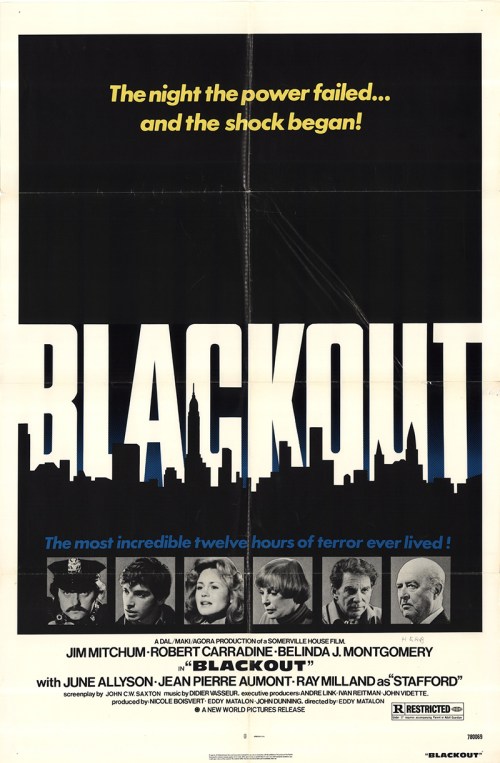
Inspired by the actual power blackout that occurred in New York City on July 13-14, 1977 the story centers on a group of felons lead by Christie (Robert Carradine) who are being transported to another prison. Along the way their police van crashes and the van drivers are killed instantly, but the felons survive. When they climb out they find that the city is without power. Using the police uniforms of the two dead drivers as well as their weapons they’re able to sneak their way into a nearby apartment complex under the pretext that they’re policemen and therefore the security guard allows them in only to be immediately killed once he does. The crooks then terrorize the residents by conning their way into each of the apartments the same way they did to get into the complex. Once they’re inside they rob the tenants and at certain points even kill them. Dan (James Mitchum) is an off-duty police officer who breaks into the complex to help save Annie (Belinda Montgomery) who’s being attacked and screaming for help from her balcony. He then single-handily goes about trying to track down the armed group despite being outnumbered.

This was yet another example where the entry in Leonard Maltin’s book does not accurately describe what occurs as whoever wrote the review states that it’s ‘balanced with black comedy’ though there’s really no comedy in it except for a brief exchange between a husband and wife attending a Greek wedding, which occurs at the beginning, but after that it’s all gritty drama.

The production was directed by Eddy Matalon who started his career doing music videos for Bridgette Bardot during the 60’s before graduating to soft-core porn in the 70’s under the pseudonym Jack Angel. He eventually, in 1977, tried his hand at horror with the universally derided Cathy’s Curse before following-up with this one, which fares better and as a grim thriller even succeeds though it’s not perfect.

My biggest complaint is that it cuts out too many pivotal moments. It shows how they enter into one apartment and even choose another because it has triple locks cluing them in that a rich person with a lot of expensive stuff must live there, but there’s other times when it does not show why they break into the apartments that they do. There’s hundreds of dwellings inside the complex and they weren’t going to be able to bust into all of them, so the reason for why they choose the ones that they do needed to be shown each time. There’s also a segment where Mitchum shoots and kills one of the perpetrators in the hallway, but it’s never documented where they take the body, or if they just leave it there for all to see.

Some of the stuff gets a bit over-the-top like when they kill the guard and then stage it to look like a suicide, but why would these desperate crooks care to take the time to do that? They’re in a rush to rob as many residents as they can before the power comes back on, who why not just put the dead guard’s body into a back room and be done with it? Tying Mitchum up into a contraption that would electrocute him once the power came back-on seemed too similar to the campy predicaments that would be the cliffhanger for each episode of the ‘Batman’ TV-show. These two-bit thieves wouldn’t have the care, or sophistication to do that. Either kill the guy, or tie him up the conventional way, but getting excessively overboard with it seemed too theatrical and predictably gives him just enough time to escape.

Mitchum is enjoyable. I liked how at the beginning he tries to chase down a purse snatcher, but fails, which shows that he’s not perfect and relatable, which makes you want to root for him even more to stop the bad guys. I did though have misgivings with Montgomery’s character who gets raped, but immediately after that she saves two people trapped in an elevator and even delivers a baby, which is too quick a recovery from such a traumatic event.

Aging stars from Hollywood’s gold era appear as the residents, but are given little to do especially June Allyson who’s seen for less than 5-minutes. Ray Milland’s segment had potential as he plays this rich, stuffy guy who refuses to give the intruders the combination to his safe even as they torture his wife. Eventually he gives in, but it would’ve been fun had he remained stubborn. They’d burn-up his place, which they do anyways, and kill his wife, but he’d still refuse to give it out. Then when the cops finally do arrive he could say in his last dying breath amidst the burned cinders “At least they never got the combination.”

My Rating: 6 out of 10

Released: August 25, 1978

Runtime: 1 Hour 32 Minutes

Rated R

Director: Eddy Matalon

Studio: Cinepix Film Properties

Available: DVD, Blu-ray

The Prime of Miss Jean Brodie (1969)

prime1

By Richard Winters

My Rating: 8 out of 10

4-Word Review: Teacher influences her students.

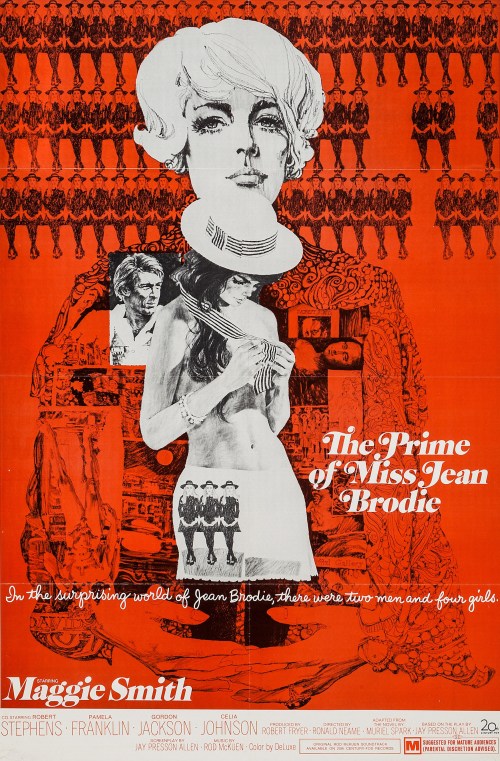
Jean Brodie (Maggie Smith) is a teacher at an all-girls school in Edinburgh, Scotland in 1932.  She routinely strays from the core curriculum and instead instills her own quirky value system, like her admiration for fascist dictators, onto her students. She views them as empty vessels there to be programmed to her liking as she routinely will say: “give me a girl at an impressionable age and she’s mine for life”. The school’s Headmistress, Miss Mackay (Celia Johnson) is aware of Brodie’s unorthodox teaching methods, but unable to do much about it, despite the repeated warnings that she gives to her, due to the fact that Brodie has tenure and been at the school longer than she. Sandy (Pamela Franklin) is one of Brodie’s students, who used to admire her teacher, but now has turned on her and comes up with a way to have her fired, which leads to a dramatic confrontation between the two.

One of the first things that struck me about the story, which is based on the play of the same name by Jay Presson Allen that was based on the novel by Muriel Spark that some feel was inspired by a teacher named Christina Kay who taught at James Gillispies School that Muriel went to as a child, is that it works against the grain of most films. In our individualistic culture the modern day movie centers around the rebel, or those that choose to work outside the system of an autocratic institution and the people that uphold those rules and enforce them are usually the villains. Here though it’s the stuffy authoritarians that ultimately become the makeshift heroes while the non-conformist gets exposed as a ‘loon’ that got too far off-base and needed a serious reeling-in.

It’s also the perfect study of someone who seeks control over others and cannot function in relationships were both sides are on equal footing. We see this not only with the way Jean openly humiliates her students by ridiculing them for even minor infractions like having their shirt sleeves rolled-up, but also in her maladjusted love life. Since she cannot have a healthy relationship with them as that would require selfless behavior from her, which she can’t give, so instead she emotionally manipulates two men (Robert Stephens, Gordon Jackson). She enjoys the attention they give her and gives them just enough incentive to keep on doing it, but never more than that. When the Jacskon character finally does get married to someone else, her sad expression isn’t about losing a person she loved, but more upset that she could no longer have this simp at her convenient disposal.

The recreation of the 1930’s girl school atmosphere was impeccable. Too many times I feel movies dealing with a bygone era don’t recreate it in an accurate way, or it gets viewed through a warped modern lens, but here I came away convinced it was accurate and this in large part could be credited to director Ronald Neame, who was alive when the story took place and therefore better able to feed-off his memory and experience. The scene where the girls all get up out of their seats and stand at attention the second the headmistress walks into the room is one of my favorite moments. To some degree it would be nice if kids today could show that kind of respect to an adult figure, but on the other hand it also reveals the dark side to extreme obedience to authority, which creates an atmosphere that allows someone like Jean to incorporate her will and beliefs onto the students without them ever questioning it.

In the end this is a terrific portrait of how teacher’s where viewed back in the day and the tremendous amount of influence they could hold over their pupils. There were no teen idols, singers, celebrities, or social media influencers back then, so the teacher was the center of most children’s lives sometimes even more so than their parents. While some things have changed the debate about what a teacher chooses to convey in the classroom and how far they should be allowed to stray from the core curriculum rages on today. No matter what side of that issue you may stand it just proves that this story is even more relevant now as it was back then.

My Rating: 8 out of 10

Released: February 24, 1969

Runtime: 1 Hour 56 Minutes

Rated M

Director: Ronald Neame

Studio: 20th Century Fox

Available: DVD/Blu-ray

The Rubber Gun (1977)

rubber1

By Richard Winters

My Rating: 6 out of 10

4-Word Review: Making cash dealing drugs.

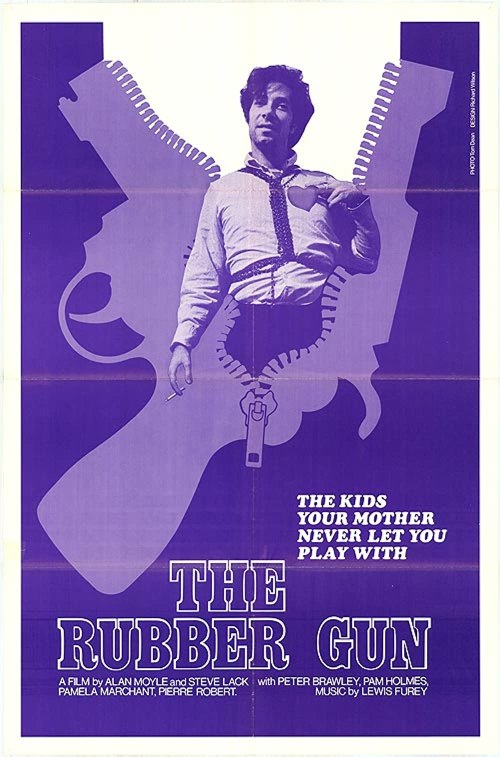
Steve (Stephen Lack) is a cash-strapped would-be artist who hasn’t made any money with his art exhibits in the past 5 years and has turned to drug dealing in order to bring in some income. He lives in a cramped, rundown studio apartment in Montreal with his makeshift ‘family’ who are also dealers as well as addicts. Bozo (Allan Moyle) is a student at nearby McGill University who is doing a thesis paper on drug use with the controversial position that it has positive effects and chooses Steve’s family as his subject, but without letting them know what he’s doing. Steve though is beginning to have second thoughts about being in the business as he sees what it does both on himself and those around him especially Pierre (Pierre Robert) a bi-sexual heroin addict who’s the father of a young daughter that he doesn’t seem able to take care of and whose addiction has caused him to become a narc with the police feeding him heroin in order to get info on Steve and the family.

Fascinating, experimental film that’s quite similar to Dealingbut with much more of an avante-garde flair. Director Allan Moyle, whose first film this was, takes the Paul Morrissey approach where he gives the actors a general idea of what the scene was about, but then lets the performers ad-lib the lines. The result is much more of a conversational quality where discussions ramble on a bit, much like in real-life, but remain revealing and amusing throughout.  Instead of feeling like you’re watching a movie it seems more like a documentary giving one a rare vivid view of the counterculture movement north of the border.

Probably the biggest surprise is Stephen Lack, who also co-wrote the screenplay and co-produced. I saw him in Scannerswhich he did 4 years after this one, and felt he gave one of the worst performances of a leading man I had ever seen and one of the main reasons that film didn’t succeed as well as it could’ve. Here though he’s amazingly engaging. Maybe it’s because he’s playing an extension of himself as I have no doubt that this is loosely based on his own experiences as a struggling artist, but the guy is quite funny in virtually everything that he says and does and I enjoyed how we see all different sides to his character from his partying one to more of a responsible one and by the end disillusioned with dealing. He even has a scene where he talks about regularly visiting his parents each week, who are quite conservative and unaware of his ‘occupation’, though it would’ve been even more fun to see the actual visit versus just discussing it.

My favorite character was Rainbow a small child, the daughter of Pierre and his girlfriend, who couldn’t have been more than 3 who goes on with her playing as the grown-ups in the room talk about drugs and other things. The image of innocence inside a room of jaded debauchery is darkly amusing. What’s better is that unlike most other movies she’s not given any cutesy lines to say and simply allowed to be herself, which makes her all the more engaging. Despite what’s initially perceived as ‘bad parenting’ you still get the feeling that these fringe adults do love the kid and in their dysfunctional way care for her, which ultimately makes the characters more appealing to the viewer instead of less.

The film has an obvious low budget look, with faded color, grainy stock, muffled sound, and choppy editing. Some may consider this a detraction, but it also helps accentuate the fringe realism with a kick-ass soundtrack to boot. In an era now where everyone his trying to make a movie on their phones with virtually no money this film should be used as a prime example on how to get it done by creating multi-dimensional characters and then allow the actors to fill-out the details through their improvisation, which helped lead writer/director/star Moyle to a Hollywood contract where he went on to make even more interesting movies on a bigger budget.

My Rating: 6 out of 10

Released: April 24, 1977

Runtime: 1 Hour 26 Minutes

Not Rated

Director: Allan Moyle

Studio: St. Lawrence Productions

Available: None

The High Country (1981)

high

By Richard Winters

My Rating: 2 out of 10

4-Word Review: Escaping into the mountains.

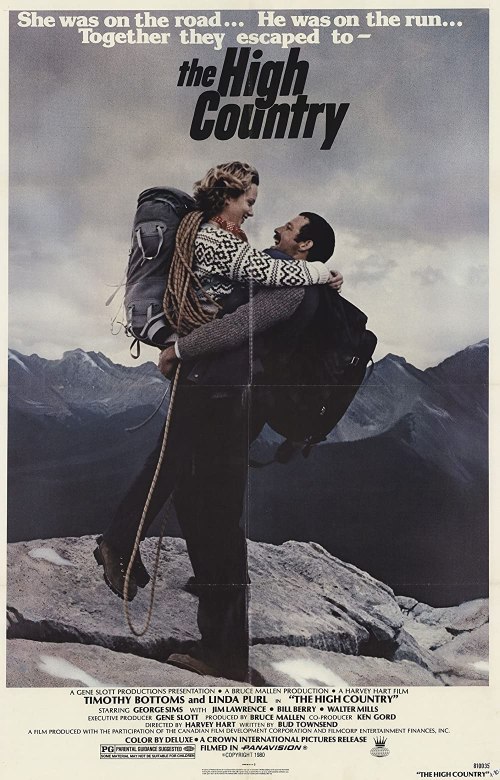
Jim (Timothy Bottoms) is arrested for dealing marijuana and taken by police car to jail when the brakes in the vehicle go out and the car overturns, which allows him to escape, but not before being shot in the arm by one of the officers. Kathy (Linda Purl) is an adult woman, who can’t read while also suffering from other learning disabilities. She leaves the family that she’s been staying with and goes hitch-hiking when she comes upon the injured Jim. Initially the two have nothing in common, but she’s able to help him with his injury and guide him over a rugged mountainous terrain, which will be out of reach to the authorities who are after him and in the process the two begin to form an unlikely bond.

While the film doesn’t have much to cheer about I did at least like the mountain scenery, filmed on-location at the Banff National Park in Alberta, Canada. There’s also a few marginally tense moments where the two scale the side of the mountain, where like in the movie Deliverance, it’s the actors doing the actual climbing and not stunt people. I also enjoyed the offbeat humor of having Jim attend a bar where a sign hangs that read’s ‘absolutely no profanity allowed’ (what sort-of self-respecting bar would have this rule. I guess only in ‘nice’ Canada) and a brawl breaks-out when one of the patrons decides to swear.

The performances are engaging especially Purl’s whose blue-eyes exude the perfect look of innocence. I was though frustrated that we never get to see these ‘cigarette trees’ that she mentions and says is somewhere in the mountain country as I was expecting the movie to have an answer since the script brings it up. The film also initially shows Kathy reading a story to some children making it look like she can read, but we’re told later that she was only ‘telling’ the story, but a good director would clue the viewer in right away that something isn’t right with her reading and those around her can sense it.

Bottoms is strong too though it’s surprising how far his career had tumbled where in the early 70’s he was getting starring roles in acclaimed Hollywood movies, but by the 80’s was relegated to low budget indie projects and foreign films. His character here is a bit snarky and he’s hard to warm-up to though the scene where he saves Kathy helps remedy this. The fact though that he has a bullet lodged in his body and is initially in great pain with a bad infection and yet this all magically gets healed without ever receiving proper medical care seemed dubious.

Spoiler Alert!

I was not so happy with the father character who arrives pretty much out of nowhere in the third act and is somehow able to track the two down when no one else can. It’s never clear whether this guy is meant to be a nemesis, or not and he should’ve been introduced earlier and made a stronger impression upfront. He also looks way too young to be Kathy’s father, who’s clearly in her 20’s and yet he doesn’t have any gray hair and with his big bushy mustache and muscular physique looked better suited for a 70’s gay porno.

The dumbest thing though is how at the end it implies that Jim and Kathy get into a romantic relationship, which defies all credibility. There’s too much of an extreme mental disparity between the two. It will always be a parent-child scenario versus that of two people on equal footing. In fact that’s one of the reasons I got bored with it as there’s clearly limits to how far this quasi friendship, with Kathy being stuck with the mind of a 10-year-old, can go and the fact that the film creates this idea of a wondrous romance is just too absurd to swallow. The start of a nice little friendship where they become pen-pals would be cute enough, but anything more than that; no!

My Rating: 2 out of 10

Released: March 20, 1981

Runtime: 1 Hour 38 Minutes

Rated PG

Director: Harvey Hart

Studio: Crown International Pictures

Available: None

By Design (1981)

by design

By Richard Winters

My Rating: 3 out of 10

4-Word Review: Gay couple wants baby.

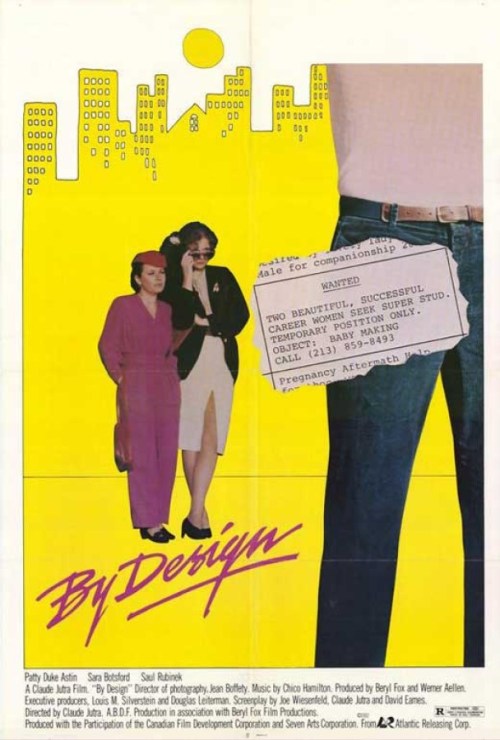
Helen (Patty Duke) is a fashion designer who’s in a relationship with Angie (Sara Botsford). Despite running a successful clothing business together Helen still longs to be a mother. Angie isn’t so excited about having a kid, but if it makes Helen happy she’ll go along with it. The coupe initially consider artificial insemination, but turn it down when they see the type of male clientele that are allowed in and the adoption agency rejects them outright due to being gay. They eventually set their sights on Terry (Saul Rubinek) an obnoxious and sleazy photographer who works for them and has been hitting-on Helen for years unaware that she’s a lesbian. Helen hopes to have a one-night-stand with him simply to get impregnated, but as the planned event draws near she begins to have second thoughts.

The story certainly has potential and was ahead-of-its-time, but the way director/writer Claude Jutra approaches the material by implementing ill-advised silly humor and trying to turn it into a basic sitcom is all wrong. The one thing that I did surprisingly like was Saul Rubinek. Normally he’s not a favorite of mine, but here he plays the scuzzy, lecherous male on the prowl perfectly. I found it interesting too at seeing how much things have changed. He gets reported for touching a woman in her private area on the job without her consent, which would mean immediate termination today, but the two protagonist women bosses don’t do that. Instead they brush-it-off with a boys-will-be-boys mindset inadvertently making the woman who brought it to their attention feel embarrassed and even humiliated for coming forward.

What I didn’t like was his extreme transformation at the end where he becomes this kind and caring soul that’s too much of a change that wasn’t earned and makes him seem like two different people. The fact that he was unaware that Helen was gay even though everyone else knew seemed a bit preposterous. In keeping with the character’s arrogance and conquest nature he should’ve been fully aware of her being lesbian, but convinced he could ‘cure’ her of it if she simply went to bed with him. His relationship with one of the models, Sonia Zimmer, who for whatever bizarre reason has romantic inclinations for him even though during one photo session he says some of the most degrading and demeaning things I’ve ever heard a guy say to a woman, so unless she’s a masochist there’s absolutely no reason why this beautiful woman should desire him and thus making this romantic side-story completely stupid and unnecessary.

The story starts out okay and had me hooked for a little bit, but it quickly goes downhill. The jump-the-shark moment is when Helen has sex with Terry and at the same time for some inexplicable reason Angie has random sex with some guy (Alan Duruisseau) that she meets in a parking lot, but she’s a confirmed lesbian, so why the sudden/extreme shift? If she’s pan-sexual, or bi-sexual or just has some latent desire to sometimes ‘swing-both-ways’ is fine, but that needs to be introduced earlier and not suddenly thrown-in, out-of-nowhere without warning. The scene also culminates with Angie and Helen calling each other on the phone and professing their love for the other as they continue to have sex with the other men, which I know the director thought would be a ‘hilarious’ moment but comes-off as incredibly dumb instead.

Had this been handled in an intelligent manner it could’ve been ground-breaking, but the director was clearly insecure with the material and thus decided to just give it the jokey treatment, which ruins it. Duke also seems miscast though shockingly you do get to see her nude in a couple of scenes of which she looks pretty damn good.

My Rating: 3 out of 10

Released: May 16, 1981

Runtime: 1 Hour 32 Minutes

Rated R

Director: Claude Jutra

Studio: Astral Films

Available: DVD-R

Dead Mountaineer’s Hotel (1979)

dead1

By Richard Winters

My Rating: 8 out of 10

4-Word Review: Bizarre occurrences at lodge.

Inspector Glebsky (Uldis Pucitis) is summoned to a remote winter lodge known as the Dead Mountaineers due to a climber who fell to his death off a nearby cliff and whose faithful St. Bernard sleeps underneath a portrait of him in the hotel’s lobby. Glebsky was informed from the anonymous call of some unusual activity that was occurring at the place, but once he gets there no one, including the innkeeper Alex (Juri Jarvet), know what he’s talking about. After he meets the strange collection of guests he becomes even more suspicious. Then he’s handed a note stating that Hinkus (Mikk Mikiver), a man supposedly weakened by tuberculosis, is planning to commit murder. When one of the guests, Olaf (Tiit Harm), does turn-up dead, but Hinkus is later found tied-up in his bed, so he couldn’t have done it. A avalanche blocks off all outside roads trapping Glebsky and the guests in the building where more and more weird things begin to occur until the inspector can no longer trust his senses, or even his logic.

Some people ask; what makes a great movie? And the answer is that a good movie needs a unique and distinctive image that impresses the viewer right from the start and which they can take away with them once it’s over. This film has just that image with a bird’s eye view of the hotel that’s so remote, as it’s nestled in the snowy, mountain landscape, and so small when glimpsed from high up, that at first I thought it was a prop, but it’s a real building, which makes it all the more impressive. I don’t know if I’ve ever seen such an isolated place, it doesn’t even seem to have roads leading into it. This shot alone, of which it goes back to it a few times, brilliantly sets the tone for the rest of the movie where everything is totally unique and like nothing you’ve ever seen before.

The fact that this was all shot in what was then the Soviet Union, in this case what is now Kazakhstan, makes it even more jaw-dropping as productions there didn’t receive the same type of budget as a studio driven Hollywood one and yet the visual design is impeccable. The inside of the place has a pronounced, surreal look with excellent shadowy lighting and the special effects, while sparse, come into strong play during the climactic surprise ending that like with the beginning leaves an equally lasting impression. The music by Sven Grunberg has a distinct futuristic tone that helps accentuate the outer worldly quality while the sun glistening off the bright white snow during the outdoor scenes makes it seem almost like another planet.

The story was written by Arkady and Boris Strugatsky and based on their book of the same name. They’re better known for their novel ‘Roadside Picnic’, which was turned into the acclaimed Stalker directed by Andrei Tarkovsky. Both brothers also wrote the screenplay and it pretty much stays faithful to the book though there’s a few missing characters and Glebsky’s motivation for going to the lodge is different. Here it was due a mysterious phone call while in the book it was for vacation. The plot at first gets played-up like it’s just another police/murder investigation complete with interviews with potential suspects and even Agatha Christie-like flashbacks showing what each guest was doing when the murder occurred, which had me getting bored as the movie starts out as something really different, so to have it devolve into the conventional murder mystery was disappointing, but by the second act this all changes and that’s when it gets really interesting.

The acting is solid and I enjoyed Pucitis in the lead, who despite having his voice dubbed, has the perfect chiseled features of a hardened police detective. My only complaint, and it’s a minor one and probably the only one in this potential cult classic that desperately needs more attention and a Blu-ray/dvd release, comes at the beginning during Glebsky’s voice-over narration where he speaks in the present about his time at the hotel and how during a ‘slow shift’ the events that he witnessed there comes back to haunt him. I found it hard to believe that he’d only think about this when there was nothing else to do, or in this case a ‘slow shift’, as I’d think it would be on his mind all the time to the extent that he may never be able to go back to police work again as the events would’ve been too traumatizing.

My Rating: 8 out of 10

Released: August 27, 1979

Runtime: 1 Hour 20 Minutes

Not Rated

Director: Grigori Kromanov

Studio: Tallinnfilm

Available: dvdlady

Honeymoon (1985)

honeymoon1

By Richard Winters

My Rating: 7 out of 10

4-Word Review: Married to a stranger.

Cecile (Nathalie Baye) is a French woman living in New York City who’s at risk of having her Visa revoked due to being in a relationship with a recently arrested drug offender (Richard Berry). In order to help her remain in the country she gets involved with a shady, underground firm run by Novak (Peter Donat) who can marry her off to a stranger. Cecile is reluctant at first, but desperate enough to play along especially after she’s assured she’ll never actually see the man she is marrying and both parties are simply doing it for their own personal benefit. However, after she agrees to it and then returns home the man that is her fake husband, Zack Freestamp (John Shea), shows up at her doorstep and demands to be let in. He then takes over her apartment and acting like he’s her real husband and she’s obligated to play the role of the dutiful wife. She resists, but becomes increasingly hounded. Where ever she goes he follows and she can’t seem to ever shake-him. Due to being involved in an illegal activity she’s unable to go to the police and therefore must use her wits to outsmart him, which won’t be easy as Zack’s killed before and is used to getting what he wants.

This is one of those obscure movies, which was filmed on-location in New York, but by a French production company and thus making it a foreign film, where you wonder how it could’ve fallen through the cracks. It’s possible, as evidenced by the film’s promotional poster as seen above, that it was marketed to the wrong audience as you’d get the impression from looking at it that this was a horror/slasher film, which it’s not, and those coming to the theater expecting that were disappointed and thus gave it bad word-of-mouth. In either case it’s deserving of another look though not by those looking for a conventional thriller.

What impressed me had nothing really to do with the stalking element, but more the excellent performance by Baye, an award-winning performer in her native country though not too well known here. Her portrayal of a person lost in a cold, lonely environment really hits-home and you get a genuine feel for her desperation and how others in her same situation would react and think. If anything this movie should’ve been promoted as a drama that gives viewers insight to how foreigners that live in this country, but aren’t yet citizens, see our world and deal with the alienation, which I believe would’ve made this a critically acclaimed film instead of a forgotten one.

Shea’s casting is interesting as he’s cursed with having a boyishly cute face like he was snatched directly from a modeling agency and only given onscreen work due to his appearance over any actual talent. He had just been in Windy City where he played a sickingly sweet nice guy, so I’m sure he was determined to prove his acting range, and possibly even advised to do so by his agent, by taking a part completely different from that one. Does he succeed? Well, for the most part he’s competent, but the character would’ve been even more frightening had he been ugly instead of a pretty-boy.

Spoiler Alert!

The story fortunately doesn’t have too many loopholes and manages enough twists to keep it interesting though it does wear itself out by the end. My main complaint is the part where Cecile is taken by a blind date in his car to a darkened alley where he plans to assault her and yet she’s rescued by Zach who appears out of nowhere. I thought it was because he had again been following her, but no car that he was in is seen making it seem like he had just been in that alley by himself when they got there, but what would be the chances that out of the thousands of alleys in New York City they’d conveniently park at random at the one he was in?

There’s another scene where Zach’s being chased by the cops who are in a squad car while he’s on foot. He turns and shoots at them from behind and manages to hit the driver squarely in the head, but the prospect of him having such great aim while running is extremely low. Later a nervous and shaking Cecile shoots at someone and manages to nail-him right in the heart, but since she was clearly not confident in using a gum her great aim seemed implausible. I also didn’t care the chase through a house of mirrors at an abandoned carnival side show, which came-off as a rip-off of a similar one done in the classic Lady of Shanghai. Overall though it still has its solid moments and in need of more attention than its unfortunately gotten.

My Rating: 7 out of 10

Released: November 20, 1985

Runtime: 1 Hour 38 Minutes

Rated R

Director: Patrick Jamain

Studio: Malofilm

Available: VHS