Category Archives: Adolescence/High School

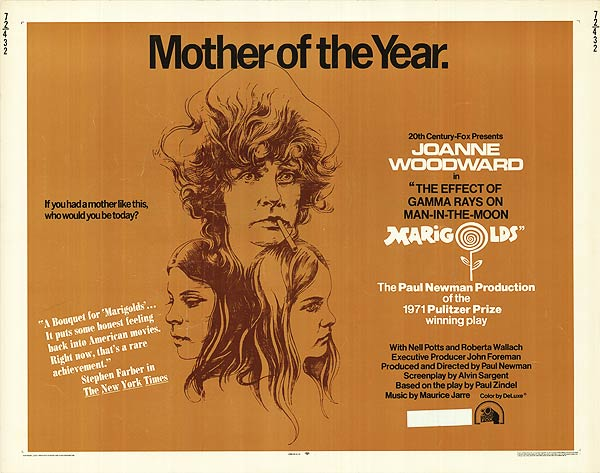
The Effect of Gamma Rays on Man-in-the-Moon Marigolds (1972)

effect of gamma rays 2

By Richard Winters

My Rating: 8 out of 10

4-Word Review: My heart is full.

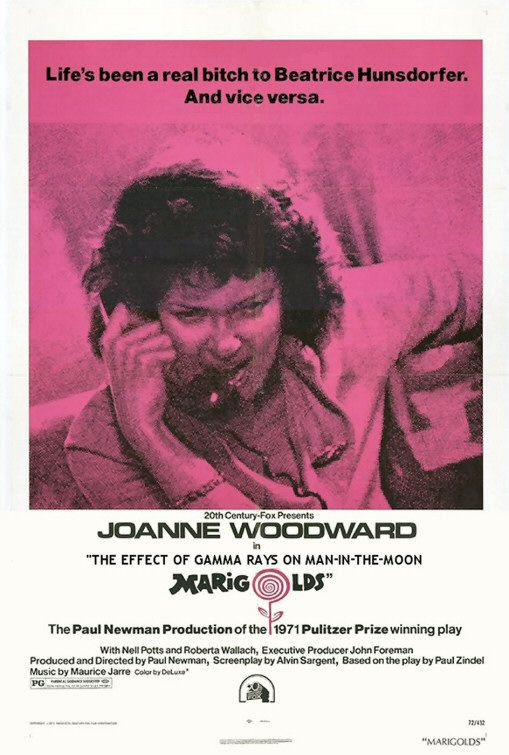
Beatrice Hunsdorfer (Joanne Woodward) is a single-mother raising two girls while living in the poor side of Staten Island. She is an extremely self-centered, emotionally frail woman who’s bitter about life and alienates everyone that she meets. Ruth (Roberta Wallach) is her rebellious teenage daughter who recognizes her mother’s flawed personality and tries to distance herself from her. Matilda (Nell Potts) is the quiet, introspective daughter who takes in all the chaos while escaping by concentrating on her school science projects particularly the one involving marigolds, but as things progress Beatrice’s mental state becomes more erratic and threatens to tear their lives completely apart.

Actor Paul Newman directs on a tour-de-force level. Absolutely everything comes together while still keeping it on a subtle, visual level. The opening sequences gives the viewer a clear picture of the family’s strife and divergent personalities without ever having to go into any type of verbal backstory, which is great filmmaking at its finest. Although filmed in Bridgeport, Connecticut one still gets a good feeling of a poor inner-city neighborhood with the house that was chosen for the setting looking authentically cluttered without appearing staged. The variety of settings has a cinema verite feel while also remaining true to Paul Zindel’s script. Yet Newman’s greatest achievement is the fact that he creates a wholly unlikable main character that the viewer ends up still feeling quite sorry for and the climactic scene inside the school’s auditorium becomes emotionally wrenching.

Woodward excels in a difficult role and creates a character that becomes permanently etched in the viewer’s mind. Her brilliance comes through from the very beginning with the way she chews her gum while trying on some wigs and her never ending stream of caustic remarks runs the gamut of being rude and insensitive to darkly humorous. Although she was nominated for best actress with the Golden Globes and won the award at the Cannes for her work here she really should have been given the Academy Award as well.

Wallach, who is the daughter of Eli Wallach and Anne Jackson, is terrific in her film debut and has some memorable moments not only when she has a seizure, but also later when she plays a caricature of her mother for a school play. Potts, who is Newman’s and Woodward’s daughter, is quite good too especially with her stunning clear blue eyes and facial expressions.

Judith Lowry, who made a name for herself in her later years playing cantankerous old ladies, is outstanding as an old woman who rents a room from Beatrice. Although she frustratingly never says a word her moments are still unforgettable especially with the way Newman focuses on her wrinkled face and toothless mouth as she sips drinks or even hobbles her way to the bathroom.

Zindel’s story was originally a stage play and in fact Carolyn Coates who is cast as Mrs. McKay here played the Beatrice role in one of the stage versions. Most teenagers from the 70’s and 80’s will recognize Paul Zindel’s name as the author of ‘Pigman’, which was required reading in many high schools during that era. Yet I liked this story, which is based loosely on his experiences while growing up, even better and it’s a real shock that it has never been released on an American DVD as it definitely should be!

effect of gama rays 1

My Rating: 8 out of 10

Released: December 20, 1972

Runtime: 1Hour 40Minutes

Rated PG

Director: Paul Newman

Studio: 20th Century Fox

Available: DVD (Region 2)

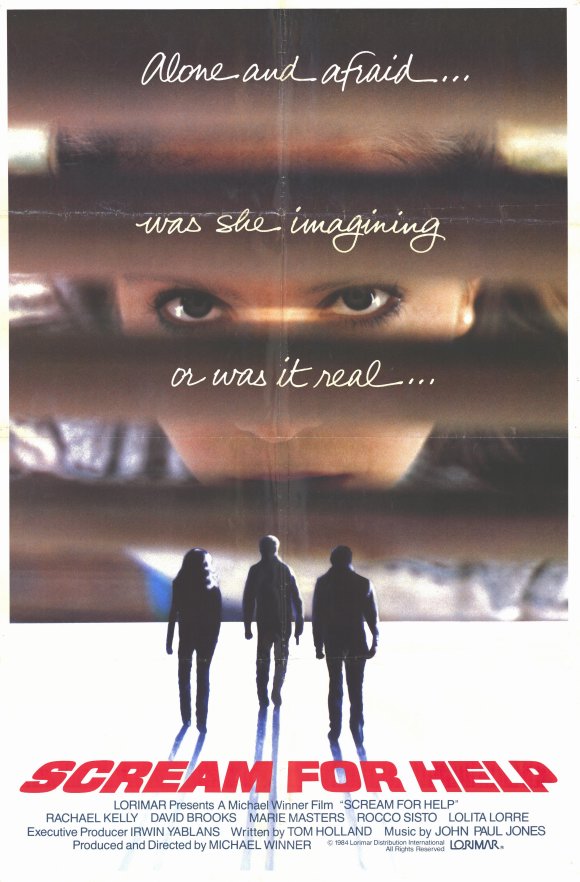
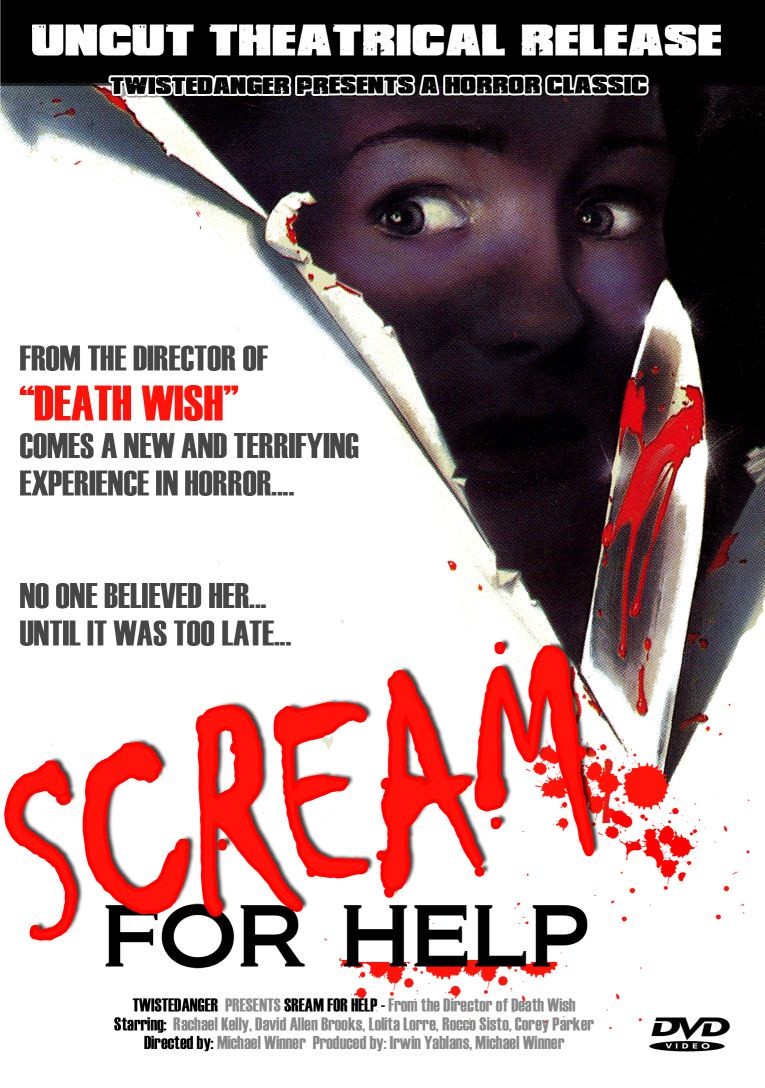
Scream for Help (1984)

scream for help 2

By Richard Winters

My Rating: 6 out of 10

4-Word Review: Her Stepfather plots murder.

Christie (Rachael Kelly) is a teen convinced that her new stepfather (Paul Fox) is out to kill her mother (Marie Masters). The problem is that no one believes her. Eventually she is able to take a picture of him having sex with another woman, which is enough to get her mother to throw him out of their house, but then he returns with two of his cohorts and traps Christie and her mother in the basement were they plan to kill them and make it look like a robbery.

This film, which was written by Tom Holland, might have been better received had it not been put into the hands of sub-par director Michael Winner. Winner who is probably best known for his close association to Charles Bronson of which he directed 7 films with him and then later when his film career waned became a famous restaurant critic, shows no feeling for the material and directs with such a sloppy style that it almost seemed like he was intentionally trying to make a bad movie. The sweeping orchestral score would have been better suited for a romance or epic adventure and is completely out of place here. The dialogue is corny and the overall acting by the supporting cast is wooden. The pace is awkward and at times becomes unintentionally funny.

However, the second half improves greatly particularly when the two find themselves trapped in the cellar and must use their ingenuity to get out. The twists are clever and unpredictable and the atmosphere becomes genuinely taut and exciting. The musical score also improves becoming much more intense and darker. I actually started to get really into it and afterwards felt like I had watched two different movies with the second part being good enough to overshadow its otherwise many flaws.

Brooks as the bad guy has a male model face, but his performance is as generic as the film’s title and it would have been better had a veteran character actor been cast in the part instead. The mother character with the way she refuses to believe the obvious until it is much too late seems unreasonably and annoyingly stupid. I did though like Kelly in the lead. Not only is she cute, but her acting is good enough to compel the viewer to keep watching when they otherwise might have turned it off and I was surprised to see that this was her only film as she showed enough promise to have had a solid career.

Filmed on-location in New Rochelle, New York this is the type of low budget flick that proves how a good script can sometimes overcome other production inadequacies. Had it been better directed this could have been a snappy thriller and it’s a shame that Hitchcock disciple Richard Franklin who was the original choice as director hadn’t helmed it although a film school dropout or even your local garbage man could have done a better job than Winner or certainly no worse.

scream for help 1

My Rating: 6 out of 10

Released: July 16, 1984

Runtime: 1Hour 29Minutes

Rated R

Director: Michael Winner

Studio: Lorimar

Available: VHS, DVD (Region 2)

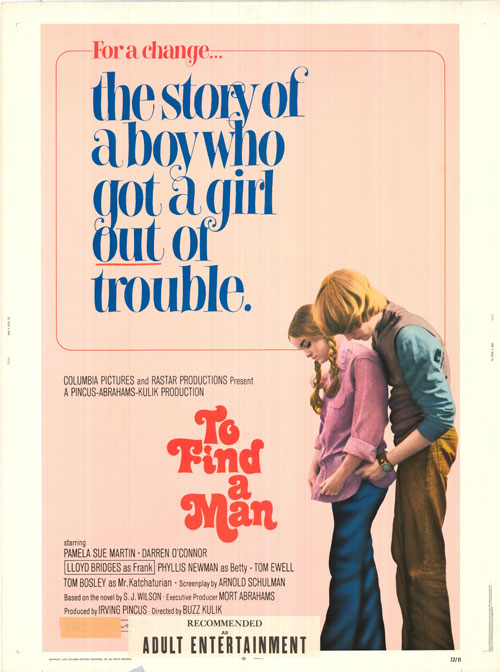
To Find a Man (1972)

to find a man 2

By Richard Winters

My Rating: 8 out of 10

4-Word Review: Teen wants an abortion.

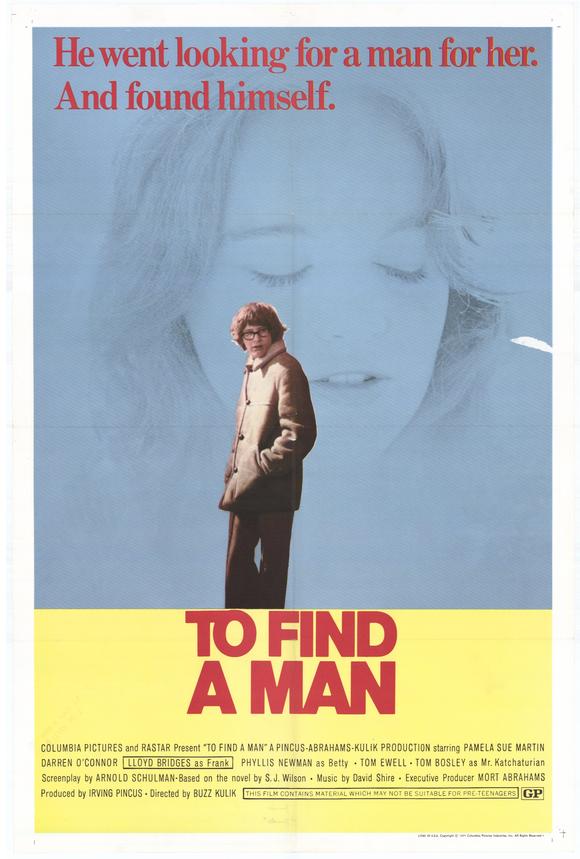
Rosalind (Pamela Sue Martin) is a teenager attending an all-girls Catholic school who finds out that she is pregnant. She can’t tell her parents (Lloyd Bridges, Phyllis Newman) and some of the advice that her girlfriends give prove to be useless. She decides she wants an abortion, but doesn’t know where to go so she turns to one of her guy friends named Andy (Darren O’Connor) who is a bright student and a little more sophisticated. After being scolded by his family’s live-in maid Modesta (Antonia Rey) as being too selfish he decides to go out of his way to help Rosalind with her problem even if at times she seems to have no appreciation for it.

I know the phrase ‘they don’t make movies like this anymore’ has become a modern-day axiom especially when reviewing films from this era, but in this case it fits, but not for the expected reasons. In a lot of ways this is far more open-minded about the controversial subject than anything you might see today. It manages to nicely avoid the political issues and instead tells a refreshingly realistic story about teenage friendship that respects the intelligence of its intended audience without ever getting preachy or overly-sanitized.

The film also manages to be surprisingly funny particularly at the beginning when Rosalind and her naïve friends come up with all sorts of insane ways to try to terminate the pregnancy on their own, which may sound potentially offensive to some, but somehow scriptwriter Arnold Schulman and director Buzz Kulick balance it well enough to keep it at an innocuous level. They also manage later on to shift it seamlessly towards the serious side as it shows in vivid detail the cold, ‘business-like’ attitude of those working at an abortion clinic and the impersonal way they treat people that come to it.

Martin in her film debut is excellent playing a character that is not necessarily likable, but still quite human and believable for that age. O’Connor in his one and only film appearance is equally good and it’s great to see a teen lead that is smart without being particularly fashionable, trendy or attractive.

Bridges is excellent as the girl’s father and the unique friendship that he has with O’Connor is quite interesting. Ewell is a standout as the abortionist in the final sequence that manages to be stark, compelling and strangely moving.

In a lot of ways this is more a story about the flawed human beings that we all are and how sometimes when it’s least expected they can do some amazingly selfless acts in this slice-of-life film that is surprisingly both touching and upbeat. It’s also quite similar to Our Time, which came out 2 years later and also starred Martin.

to find a man 1

My Rating: 8 out of 10

Released: January 20, 1972

Runtime: 1Hour 30Minutes

Rated GP

Director: Buzz Kulik

Studio: Columbia Pictures

Available: Amazon Instant Video

Making It (1971)

making it 2

By Richard Winters

My Rating: 5 out of 10

4-Word Review: Teen enjoys seducing women.

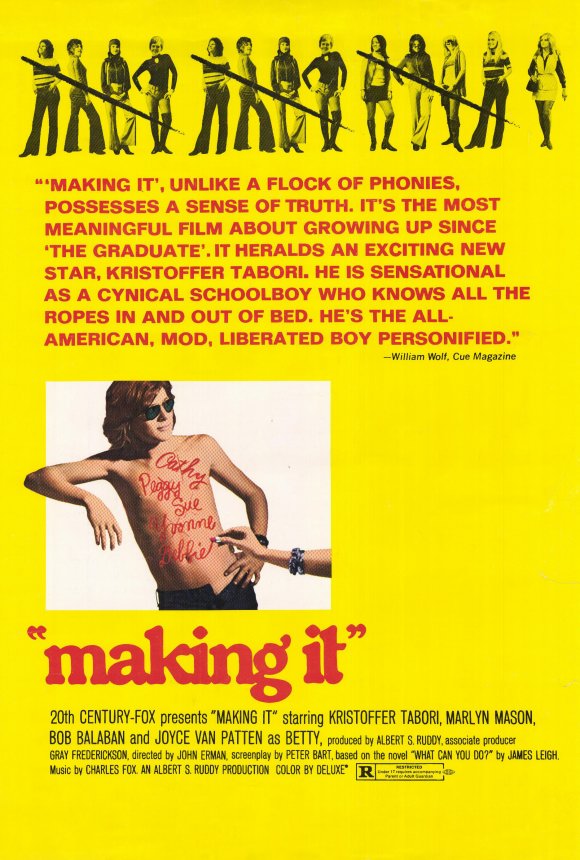
Phil (Kristoffer Tabori) is a cocky, self-centered teen who uses his good looks to get practically any girl he wants into bed with him. He even has a fling with the wife of his basketball coach, but when he thinks he has gotten one of them pregnant things begin to spiral out-of-control especially when his emotionally fragile mother (Joyce Van Patten) starts to have some ‘problems’ of her own.

Peter Bart’s script, which is based on James Leigh’s novel ‘What Can You Do?’ has some incisive comments, but surprisingly it’s more on being middle age than adolescence. It shows with a depressing clarity what a thankless, pain-in-the-ass the middle age years can be and how people at that stage secretly wish to go back to their teens if only to experience for a fleeting moment the carefreeness and idealism once again.

The on-location shooting done at West Mesa High School in Albuquerque, New Mexico nicely captures the gorgeous, crystal blue skies of that region. The students are made up of actual teens that look and behave very much like teens of today. However, John Erman’s direction is lackluster and flat. Everything is shot in a conventional, unimaginative way with a pace that is slow and only manages to improve towards the end when it becomes dramatic.

Phil’s spirited debate with his English teacher, played by Lawrence Pressman, is engaging as is a rebellious student played by Bob Balaban arguing with his beleaguered principal (David Doyle) about his right not to have to stand at attention during the pledge of allegiance. The film is also famous for the novelty of casting real-life siblings Dick and Joyce Van Patten as lovers and includes a sequence showing him kissing her on the mouth, which had to be awkward to perform let alone rehearse.

Tabori, who is the son of actress Viveca Lindfors and Dirty Harry director Don Siegel shows an impressive amount of composure and maturity for such a young age, but I wasn’t so sure I liked the sound of his voice. Louise Latham, who plays the mother of the girl Phil thinks he might have impregnated, is memorable and had her part been just a wee bit bigger she would have easily stolen the whole thing. She is also involved in the film’s funniest moment where she asks Phil for some weed and thinking she doesn’t know “grass from her ass” he decides to take a regular cigarette, roll it up like a joint, light it and then let her smoke it where she  ends up getting a ‘high’ anyways.

The film’s staple though is its twist ending that is genuinely shocking and most likely to leave even the most jaded viewer’s mouth agape. It could’ve been played out a little more, but remains nasty nonetheless and it’s something you’re guaranteed not to see in any other movie. It is also the one thing that gives this otherwise undistinguished teen flick a kick and probably explains why it has never been released on either VHS or DVD nor ever shown on broadcast network television.

making it 1

My Rating: 5 out of 10

Released: March 21, 1971

Runtime: 1Hour 31Minutes

Rated R

Director: John Erman

Studio: 20th Century Fox

Available: None at this time.

Wacko (1982)

wacko

By Richard Winters

My Rating: 3 out of 10

4-Word Review: Spoof of horror movies.

On Halloween night the infamous pumpkin head lawnmower killer murders Mary’s (Julia Duffy) older sister. Now, 13 years later, the killer has returned and this time he has his sights set on Mary, but who could he be? Is it her surgeon father (George Kennedy) who tries any chance he can to catch his own daughter disrobing, or maybe it’s her boyfriend Norman (Scott McGinnis) who makes lawnmower sounds every time he is aroused. Either way dogged detective Dick Harbinger (Joe Don Baker) is hot on the trail determined to end the mystery that has been haunting him and the town ever since it began.

This is one of several horror spoofs that came out around the same time and although it is far from excellent it still manages to rise above the rest. The main reason is Baker who’s overacting and mugging is perfect for the part. Just watching him roll out of bed and get ready for the day is a hoot. His funniest moments though are during the flashback sequence where he is seen wearing a dress while being tied up during bondage. The part where he arrives at Mary’s parent’s house to give them the sad news of their daughter’s death while dressed as a clown and then afterwards in an attempt to ‘lift their spirits’ makes a balloon dog for them is absolutely hilarious.

Stella Stevens, sporting a brunette wig and playing Mary’s mother has some amusing moments as well particularly when she recreates an obscene phone call for her daughter as well as when she and Kennedy sniff some laughing gas. Andrew Clay, who’s billed here without the ‘Dice’ is engaging in his film debut as a Fonzie-type high school student and his conversation at the dinner table of his girlfriend’s parents is good.

The segment involving a parody of Psycho with Norman Bates’ skeletal mother being used as a ventriloquist dummy was goofy enough to elicit a few chuckles, but overall there are more misses than hits. The production values are sloppy and the film, particularly during a car chase segment, veers too much into the cartoonish and nonsensical. They could’ve also had a more original soundtrack than simply playing or having a character hum the Alfred Hitchcock TV-show theme, which isn’t all that clever.

Some of the most successful horror parodies like Scream and Shaun of the Dead are ones that manage to have an interesting story of their own as well as a nice amount of gore and scares, but here there is no special effects or horror to speak of and the limp plot makes this whole thing seem more like one long, unending gag reel than a movie.

My Rating: 3 out of 10

Released: November 12, 1982

Runtime: 1Hour 34Minutes

Rated PG

Director: Greydon Clark

Studio: Jensen Farley Pictures

Available: VHS

September 30, 1955 (1977)

september 30 1955

By Richard Winters

My Rating: 4 out of 10

4-Word Review: Death of a legend.

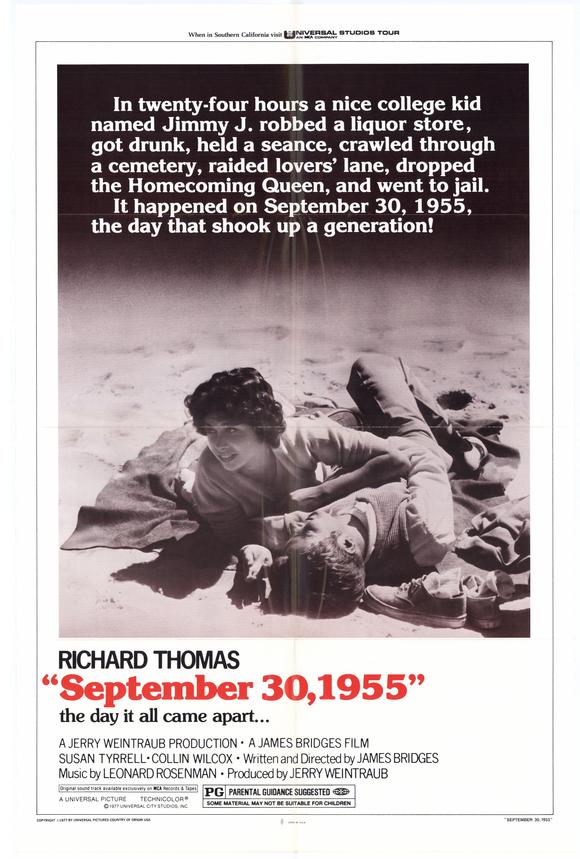
The title represents the date that the legendary actor James Dean died in a car crash and his death has an adverse effect on a group of teens in a small southern town.

Richard Thomas is the main character who, along with his girlfriend Billie Jean (Lisa Blount), seems to get the most upset. Although some of his actions may seem fanatical it is really not as extreme as you may think or could’ve been and at no time does he ever lose sight of reality. For the most part the story is more a look at lost young souls searching for an identity than it is on celebrity worship.

The plot itself is slow with scenes that become unnecessarily drawn out with heavy-handed drama. The ending is unsatisfying as it doesn’t even give us a hint as to whatever became of these characters that are all left hanging in unfinished scenarios making the whole thing seem like just another sappy 70’s teen romance/ tragedy.

Beyond the poor structure there are some good points. One is the chance of seeing budding young talents like Tom Hulce, Dennis Quaid and Dennis Christopher working together and carrying a film. The other is director James Bridges who shows strong insight into Dean’s mystic and why he made such a powerful connection with the youth giving one the feeling that Bridges himself was a big Dean fan at the time as well. He also makes an effective statement about how many lost, lonely souls there are out there and the stifling nature of small town life. His recreation of the period is excellent and the interactions between the characters seem real and authentic. The assessment of the era is honest without being condescending and you feel like you are a part of the 50’s experience, which is interesting and fun.

Unfortunately it becomes too labored and trapped by the sensibilities of a bygone era while also being completely humorless and too talky.

My Rating: 4 out of 10

Released: August 6, 1977

Runtime: 1Hour 41Minutes

Rated PG

Director: James Bridges

Studio: Universal

Available: DVD (Universal Vault), Amazon Instant Video

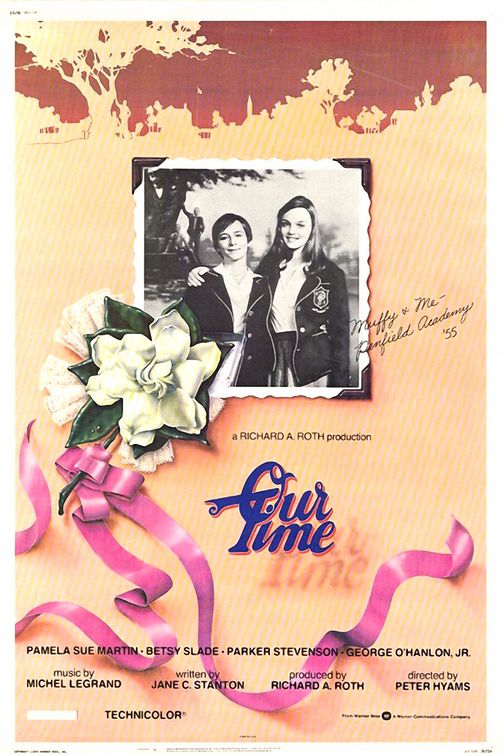
Our Time (1974)

our time 2

By Richard Winters

My Rating: 6 out of 10

4-Word Review: She gets an abortion.

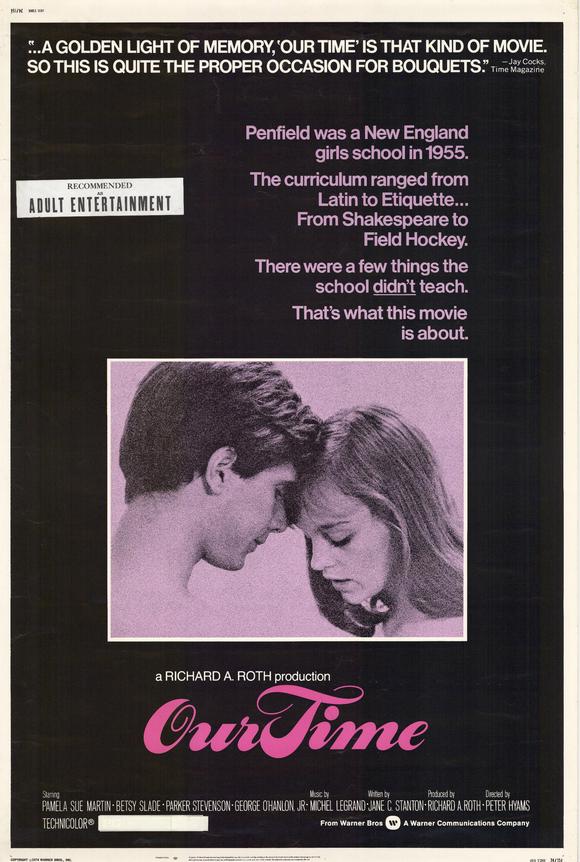
Abby (Pamela Sue Martin) and Muffy (Betsy Slade) are two teen girls and the best of friends that are attending a New England all-girls school during the 50’s. Abby is in love with Michael (Parker Stevenson) and the two sneak off one weekend and consummate their relationship, which makes Muffy jealous. She is not as pretty as Abby and has a hard time getting boyfriends, but decides one night during a Christmas party to have sex with Malcolm (George O’Hanlon Jr.) in the backseat of a car simply to feel what it is like. Their experience isn’t as enjoyable, but Muffy becomes pregnant anyways and the four then spend the rest of the time looking for an underground abortionist to terminate her pregnancy.

On the technical end the film is slick. I particularly liked the opening tracking shot that takes place in a church. The camera starts at the front of the church showing a close-up of the headmaster singing with the choir and then pulls back down the side aisle to show Abby sneaking in late and then goes back up the middle aisle as she looks for a seat. In fact just about every scene features some form of a tracking shot, which may get a little overdone, but helps give the film a certain visual liveliness. Unlike Leonard Maltin who in his book described the color photography as being ‘bad’, I found it to be quite vivid with a nice soft focus lens that gives it a nostalgic-like appeal.

The story itself is predictable, but I enjoyed the sometimes humorous takes of the sexual repressive, stifling attitude of the era and how the students were made to feel like they were being watched and monitored at every second. Abby’s and Michael’s sexual encounter inside a hotel room is quite amusing, but the one done later on between Muffy and Malcolm is painful to watch and not very realistic, looking more like two clothed bodies on top of each other without much effort to simulate the sexual motions.

Martin is excellent in the lead and ironically starred just two years earlier in a similar film about a young unwed woman looking for an abortionist entitled To Find a Man. Stevenson, who later co-starred with Martin in ‘The Hardy Boys/Nancy Drew Mysteries’ TV-show looks like he is barely past puberty. Jerry Hardin, Cliff Emmich, Robert Walden and Debralee Scott can all be seen in brief bits. This is also the only other film appearance of Karen Balkin, who played the bratty student in The Children’s Hour and plays a similar type of character here.

The only issue I had with the film is with the abortion segment. Overall, from a purely dramatic level I felt these scenes were compelling and the best moments in the movie, but it seemed unrealistic especially from a 1950’s perspective that none of the four would try to convince Muffy to keep the baby. It almost comes off like these are 70’s teens with more modern sensibilities that were transplanted into a different time period than actual characters from a bygone era. The plot also becomes more like a political statement than a story and seems to lean too heavily on a liberal point-of-view.

our time 3

My Rating: 6 out of 10

Released: April 10, 1974

Runtime: 1Hour 30Minutes

Rated PG

Director: Peter Hyams

Studio: Warner Brothers

Available: DVD (Warner Archive)

Splendor in the Grass (1961)

splendor in the grass 1

By Richard Winters

My Rating: 7 out of 10

4-Word Review: Learning to move on.

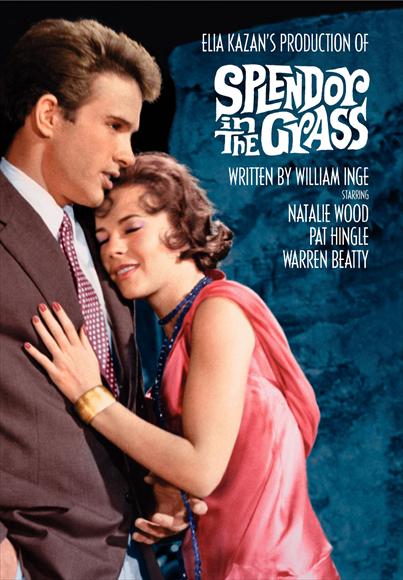
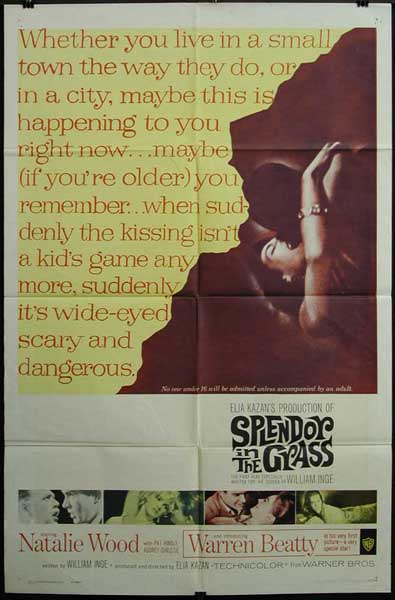
The year is 1928 and Wilma (Natalie Wood) is a high school girl living in a small Kansas town and madly in love with Bud (Warren Beatty). The two share a strong even obsessive relationship and Bud wants to marry her, but his domineering father (Pat Hingle) wants him to wait and go to college for 4 years first. Because Wilma is a ‘nice girl’ he cannot have intimate relations with her before marriage, so in order to alleviate his sexual tensions his father advises that he have sex with a ‘loose woman’ and thus has a fling with Juanita (Jan Norris) who is also one of Wilma’s classmates. When Wilma finds out about this she is devastated and it sends her into a mental breakdown and eventually committed to a psychiatric hospital.

Despite being set in a bygone period the film is hardly dated at all. The characters are real and going through much of the same dilemmas people today have including dealing with parents who push their children to go into fields of study that they aren’t interested in. The film is amazingly frank for its era and director Elia Kazan wisely pulls back by having long takes which allows his eclectic cast to propel the film forward with their performances alone.

Although the setting is Kansas it unfortunately wasn’t filmed there and thus fails to capture the majestic beauty of the plains like Picnic did which was based on another William Inge story. The intention was to shoot it there, but due to a drought it was instead done in northern New York near the Catskills, which has a far different climate and topography. The only exterior shot of the town is that of Wilma’s house, which doesn’t allow the viewer to get any idea of the town’s layout or atmosphere.

All around there are some great performances, but Hingle is a standout in what is quite possibly the best role of his career as he owns every scene that he is in. The only unfortunate thing is that it is never explained what caused the character’s very obvious limp.

Barbara Loden who later went on to marry Kazan in real-life is a scene-stealer as well playing Hingle’s rebellious, flapper daughter Ginny. Her meltdown at a New Year’s Eve party is memorable, but the character then disappears midway through and is never seen again. There is an eventual brief explanation of her whereabouts, but I felt a scene with her at the end was definitely needed.

Wood looks quite possibly at her most beautiful here both with long hair during the first half and then with a short cut during the second part. Beatty makes an outstanding film debut. Usually he is best playing detached characters, but here he plays an emotional one and does it surprisingly well.

The film features a high amount of first time performances from actors who all look very, very young. Phyllis Diller can be seen briefly as a nightclub comedienne. Ivor Francis makes his film debut as Wood’s psychiatrist and Sandy Dennis can be spotted as Wood’s classmate while Martine Bartlett makes her debut as an exasperated English teacher. There is also Zohra Lampert as a waitress explaining to Beatty what pizza is while he tells her about Kansas and you can very briefly spot Eugene Roche and even Godfrey Cambridge.

The film makes some great statements about learning to adjust to life’s twists and turns and living in situations that are not the most fulfilling. Inge, who based many of these characters on people he knew growing up, shows a keen understanding for human nature and his script won a much deserved Oscar.

splendor in the grass 2

My Rating: 7 out of 10

Released: October 10, 1961

Runtime: 2Hours 4Minutes

Not Rated

Director: Elia Kazan

Studio: Warner Brothers

Available: DVD, Amazon Instant Video, YouTube
Labyrinth (1986)

labyrinth 1

By Richard Winters

My Rating: 7 out of 10

4-Word Review: Lost in a maze.

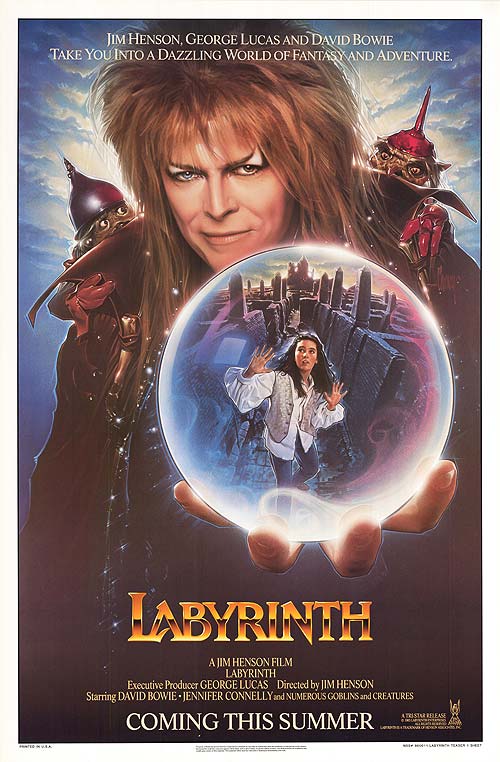
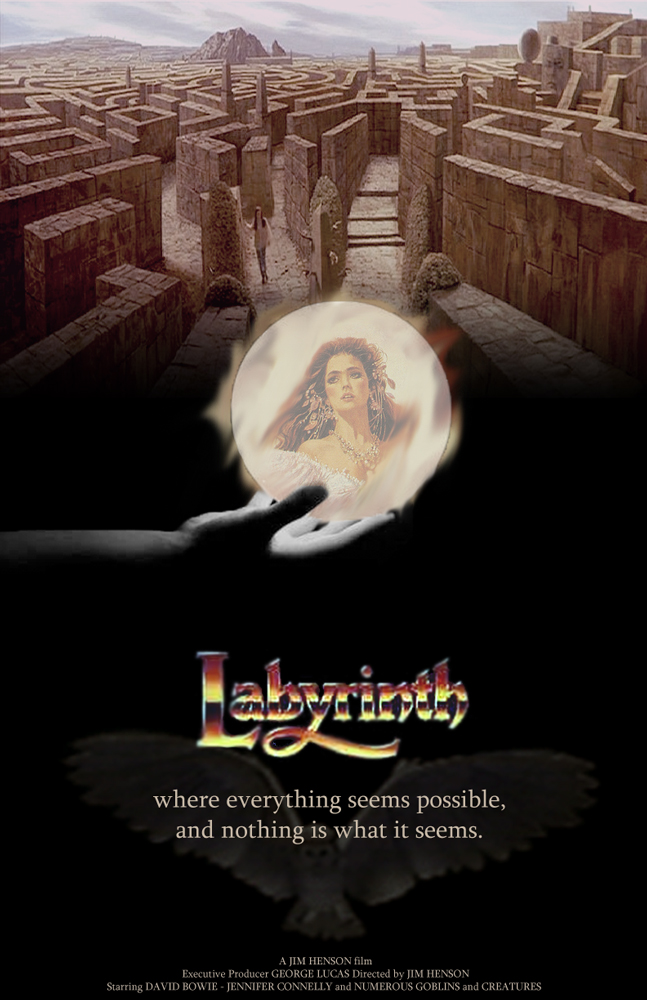
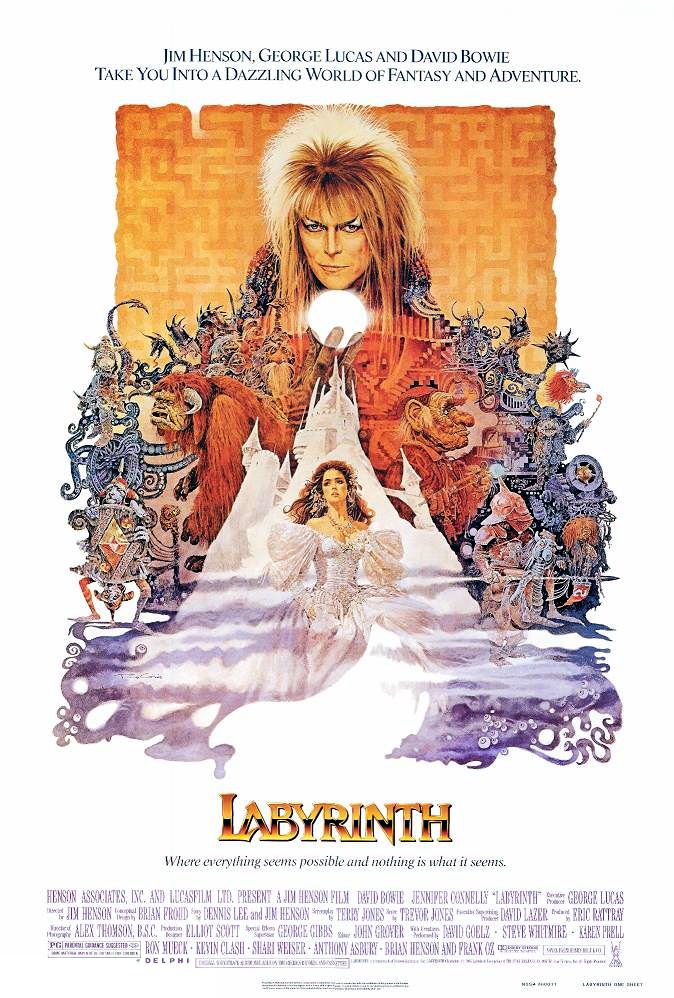
Sarah (Jennifer Connelly) is a fifteen-year-old girl forced to stay home and babysit her fussy baby brother Toby (Toby Froud). In order to try to get him to go to sleep she starts telling him a story, but conjures up Jareth, The Goblin King (David Bowie) who kidnaps Toby and threatens to turn him into a goblin unless Sarah can rescue him in thirteen hours by getting to a castle that is in the middle of a long and winding labyrinth.

Initially I wasn’t too excited to see this film as it was produced by George Lucas, directed by Jim Henson and starring Bowie, which is three big egos too many and in most cases usually amounts to a lot of creative clashes and a disjointed, mishmash of a  product that has a big budget, but no soul. However, I was pleasantly surprised to find that the film managed to be captivating with a good distinct atmosphere. The special effects are excellent and this is the first film to ever show a computer generated animal, which is in the form of an owl. I probably enjoyed the puppet characters the most. I was afraid they would resemble the muppets, but they are much more creative and varied than that and sometimes pop up in the most unlikely places and times.

Connelly is excellent in the lead. In fact without her presence this film wouldn’t have worked at all. Not only is she cute, but can hold her own amongst the crazy effects and weirdness while showing confidence and poise.

labyrinth 3

Bowie on the other hand seems quite stale. His songs do little to enliven anything and the film could have done just as well without them. The character has no flash or campiness. A kid’s movie always needs a memorable villain like Cruella De Ville, or the wicked queen in Snow White, but this guy doesn’t even come close to those and is never frightening or scary.

There are a couple of ill-advised song routines that do nothing, but bog the film down and take away what little tension there is. The song number that features a group of creatures with removable heads is the only time that the special effects look fake as it is clear that the characters are being digitally matted onto the backdrop. Bowie’s routine in which he dances around with a bunch of puppets and the baby look laughable and embarrassing. I also thought that the Swamp of the eternal stench, which featured noises quite similar to flatulence and formations resembling rectums, was much too explicit for a film aimed at children and preteens.

Overall though this is an imaginative variation of the ‘Alice in Wonderland’ theme, but the film could have gone a lot further with it. I would have liked a few darker elements, some genuine tension or scares (of which this film has none) and less formulaic to the kiddie crowd. The ending also leaves a lot to be desired, but for most children as well as those that are young-at-heart it is an agreeable time-filler.

labyrinth 2

My Rating: 7 out of 10

Released: June 27, 1986

Runtime: 1Hour 41Minutes

Rated PG

Director: Jim Henson

Studio: Tri-Star Pictures

Available: VHS, DVD, Blu-ray, Amazon Instant Video

Ferris Bueller’s Day Off (1986)

ferris buellers day off

By Richard Winters

My Rating: 5 out of 10

4-Word Review: Playing hooky from school.

Ferris (Matthew Broderick) is a high school senior who wakes up one nice sunny day in Chicago and decides that he doesn’t want to go to school. He fakes an illness, which his incredibly naïve parents (Lyman Ward, Cindy Pickett) buy into without question even though his sister Jeanie (Jennifer Grey) doesn’t and then gets together with his girlfriend Sloane (Mia Sara) and friend Cameron (Alan Ruck) in Cameron’s Dad’s Ferrari and spends an exciting day in the Windy City where they visit everything from the Chicago Museum to a Cubs ballgame. However, Ed Rooney (Jeffrey Jones) the school’s principal is suspicious about all of Ferris’s chronic absences and is determined to track him down.

On a comic level the film has some hilarious and even ingenious bits and in a lot of ways this is John Hughes finest directorial effort simply for the variety of camera angles and humor that is used. My favorite is the scene showing the lost and confused looks of the students faces who are sitting in an economics’ class run by actor Ben Stein lecturing in his patented monotone voice.

On the negative end I thought the parents were portrayed as being too stupid and gullible to the point that it became extreme and took away from the humor and Ferris’s perceived cleverness since the average 3-year-old would be able to dupe these morons. The symptoms he complains about clearly sound dubious and if anything they should have made an appointment for him to see a Dr. that day. You would also think that these idiot’s would get a hint that he was faking it since this was already the 9TH time this semester he had called in. How much more of a wake-up call do they need? Weren’t they teenagers once as well and didn’t they try to fake illness too to get out of school and shouldn’t they in the back of their minds presume that their kids might try to do the same?

The Ferris character is a bit too cocky and in some ways I sided with his sister as well as Rooney in giving this smug kid of bit of a comeuppance. The character borders on being one of these entitled teens who thinks he will be able to cheat the system his whole life and then when he gets out into the world and has to work a real job and play within the rules he and others like him can’t handle it or worse end up getting fired or sent to jail because they expect to still be able to cut-corners and get away with it.

The humor, especially during the second-half gets rather implausible. One scene has the Dad reading a newspaper with an article about a community rallying around a sick teenager (Ferris), but Ferris had only called in sick that morning, which was well after the paper had gone to press and there were no evening newspapers in Chicago at that time.

The scene where Ferris and Cameron hide in the backseat of a car when their cab gets parked right next to his Dad’s and all his dad sees is Sloane who he doesn’t recognize didn’t make sense either. I suppose it was possible that the Dad had never met her, but Ferris seemed to have been seeing her for quite a while and was even proposing marriage to her, which made me feel that he had most likely brought her home already for his Mom and Dad to meet. Also, why can’t Jeanie recognize Mr. Rooney when she comes upon him inside her house and karate kicks him straight in his face?

The scene where they put the Ferrari on a jack and then a cement block on the accelerator and drive it in reverse in an effort to take off the miles, so Cameron’s Dad wouldn’t find out they had driven it, seems implausible as well. This is mainly because it gets done inside a glass garage. I realize that the garage door was open, but the back of the car was facing the enclosed glass wall, which would have trapped the exhaust fumes and made it impossible for them to stand there and have the long conversation that they do without choking and having their eyes get all watery and itchy.

The side story involving Cameron’s issue with his father who seems to love his car more than his own son doesn’t work mainly because it’s hard to go from zany comedy to drama especially in this case when it’s all rather pseudo-psychological. It’s also frustrating to spend as much time talking about it as they do, but never actually see the father nor the final meeting that he has with Cameron, which could have been revealing and insightful.

The film still has its moments and I loved it as a teen, but now it seems lodged in a more innocent era were adolescent hijinks was considered ‘good innocent fun’ without even slightly balancing it with the darker and serious consequences that can come about from teenagers who think that they can get away with anything. The filmmakers themselves prove my own point and what a thin line this type of plot walked because originally there was a scene were Ferris steals some bonds from a shoebox in his father’s closet and then cashes it in a bank and uses the money to fund his day on the town, but the scene was later deleted because it was felt it made him seem too much like a thief instead of a ‘lovable rogue’.

My Rating: 5 out of 10

Released: June 11, 1986

Runtime: 1Hour 43Minutes

Rated PG-13

Director: John Hughes

Studio: Paramount

Available: VHS, DVD, Blu-ray, Amazon Instant Video