Category Archives: 80’s Movies

Beer (1985)

By Richard Winters

My Rating: 1 out of 10

4-Word Review: This beer is flat.

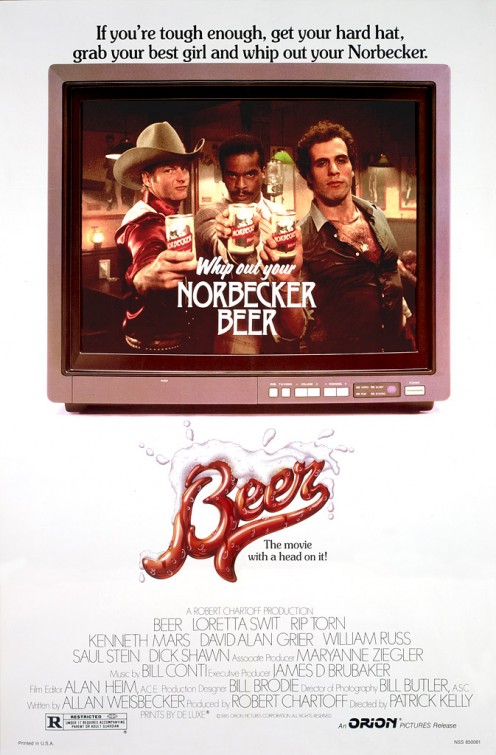
An ad agency goes on the offense when their top client Norbecker beer (Kenneth Mars) threatens to pull their account. B.D. Tucker (Loretta Swit) is put in charge of introducing a new ad campaign that will excite viewers. After she witnesses three men (Elliot Morrison, William Russ, Saul Stein) subdue a gunman at a bar she decides to hire them to star in her new commercial were they’re portrayed as macho men and chick magnets, which causes controversy when female viewers find the ads to be sexist.

Normally I love satire and find it sad that there are so few satirical movies out there and yet it’s films like these that have single-handedly killed the genre. The attempt at mixing the acerbic wit of Network with the work place politics of How to Succeed at Business without Really Trying and then throwing them into the rapid-fire joke structure of Airplane doesn’t work and only succeeds at producing more groans than laughs. The tone is inconsistent with too many dumb gags thrown in for the sake of a cheap laugh that many times has nothing to do with the main theme. Taking satirical jabs at the advertising business is too easy and been done before while portraying the industry and the people who work in it in too much of a generic way. You’ll find a more realistic portrait of the business and on-target satire from a weak episode of ‘Bewitched’ than anything you’ll see here.

The three male leads lack pizazz and are incredibly bland and transparent. The film might’ve had a better chance of working had it cut the three characters down to just one, hired an actor who had some actual presence and then geared the story completely from his point-of-view, so the viewer like the protagonist could see the ugly side of advertising biz first-hand from an outsider’s perspective.

The supporting cast fails to help. Mars does a softer version of the caricature that he portrayed in The Producers, but here it fails to elicit even a small chuckle. Swit, who was nearing 50 at the time, looks great, but her performance lacks verve. Sandra Bernhard, who was initially cast in the role and then later fired, would’ve been a better choice for this type of material.

Dick Shawn’s attempt to emulate Phil Donahue doesn’t work as he fails to share any of Donahue’s same mannerisms although seeing him prance around on stage as he goes from one audience member to the next is worth a few chuckles. The scene though, which involves female audience members shouting their disproval of the beer commercials at the three men who starred in them, would’ve been stronger had it been Swit a fellow female that was onstage taking the women’s heat instead of the men.

The biggest transgression though is that after bombarding us with one silly comedic idea after another it then decides to suddenly at the end make a ‘serious statement’, which is utterly hackneyed. You can’t spend the majority of time being inane only to get ‘profound’ at the last minute, which makes this production seem even more amateurish and misguided than it already is.

My Rating: 1 out of 10

Released: August 30, 1985

Runtime: 1 Hour 22 Minutes

Rated PG

Director: Patrick Kelly

Studio: Orion Pictures

Available: DVD-R (MGM Limited Edition Collection), Amazon Video
Electric Dreams (1984)

By Richard Winters

My Rating: 2 out of 10

4-Word Review: His computer becomes jealous.

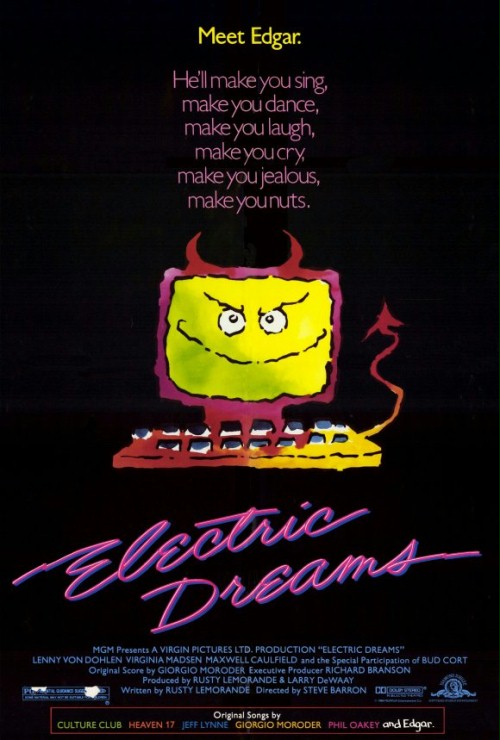
Miles (Lenny Von Dohlen) is a young architect seeking to get his life more organized, so he buys a personal computer (voice of Bud Cort) and sets it up in his apartment. A beautiful young cellist named Madeline (Virginia Madsen) moves in next door to him and practices her cello each day while at home. Miles’s computer, which goes by the name of Edgar, overhears her playing and falls in love with the sound and her in the process. When Miles becomes attracted to her the jealous computer tries everything it can to thwart their relationship.

I enjoyed the imaginative visual style implemented by Steve Barron in directorial debut. In fact it’s the film’s only selling point as the bland script offers little that is funny or interesting and drags on at a snail’s pace with hardly anything actually happening.

Sometimes it’s fun watching films from a bygone era and seeing how much technology has changed, but this thing gets so fanciful with it that it becomes illogical instead. Clearly the filmmakers had no understanding at how a computer actually works as this machine is able to do things that no normal PC could. For instance it’s able to make the knob on Miles’ door turn hot, so he can’t leave his apartment. It’s also able to connect to the servers of Miles’s credit card company even though this is before the advent of the internet and somehow shut off his credit. There’s also a scene where Miles pours champagne on the computer’s keyboard, which doesn’t permanently disable it even though we all know that in reality it would’ve.

It takes too long for the computer to become evil and then when it does it ends pretty quickly. The machine lacks a distinctive look and should’ve been made more ‘evil’ appearing, which would’ve helped coincide with the film’s otherwise flashy visual look. Bud Cort’s voice talents go to waste as it gets electronically altered until it’s unrecognizable and therefore could’ve been anyone’s.

Madsen is good, but the story is geared too much towards the preteens. The trite, overly innocuous script needed more bite, or an added edge to make it interesting to adults who will most assuredly be bored.

My Rating: 2 out of 10

Released: July 20, 1984

Runtime: 1Hour 32Minutes

Rated PG

Director: Steve Barron

Studio: MGM

Available: DVD (Region 2 and 0)

Polyester (1981)

By Richard Winters

My Rating: 4 out of 10

4-Word Review: Suburban housewife has problems.

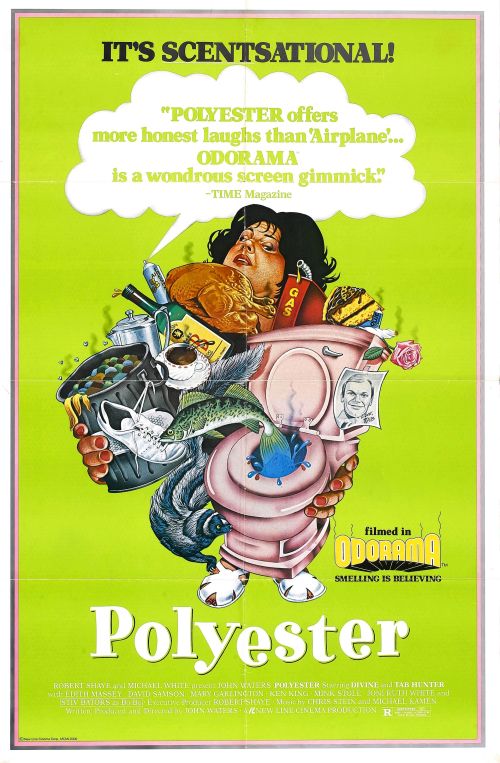
Francine Fishpaw’s (Divine) world is crumbling. Not only must she endure constant protests in front of her suburban Baltimore home dealing with people upset with her husband (David Samson) running an adult theater, but she must also deal with his affair with his sexy secretary (Mink Stole) as well. Her teenage son (Ken King) is terrorizing the city by intentionally stomping on the feet of every woman he sees and her daughter Lu-Lu (Mary Garlington) wants an abortion. She then meets the dashing Todd Tomorrow (Tab Hunter) and the two immediately fall-in-love only to find that he too has a dark-side.

This was John Waters’ first studio backed film and the first to garner an R-rating while the others had been X. While the budget is an improvement and its technicallys more polished the edginess is lost. The humor and satirical potshots don’t have the same zing and are lacking in originality and outrageousness. The gimmick of passing out a scratch-and-sniff cards where audiences could sniff the scents being smelled by the film’s main character seems excessively juvenile and the film begins with a campy scientist (Rick Breitenfeld) talking about it, which sets the tone too much on a silly/cartoonish level.

Divine’s presence helps, but she isn’t as made-up or as flashy as she was in her past films and looking much more like just some fat guy wearing a lady’s wig. I liked that her character was consistently normal for the most part as in the other films she behaved more erratically although what she goes through here is so unrelentingly traumatic that it borders on being almost cruel to laugh at. It’s also not completely easy to sympathize with her quandary as her kid’s behavior is so outrageous you have to question her parenting skills and whether she’s partially to blame for the bad things that they do.

Edith Massey is funny as a poor woman who wins the lottery and now acts a bit nouveau riche about it. It’s also fun seeing the two teens go through a Jekyll and Hyde transformation, but Tab’s appearance adds little although he does sing a decent opening title tune.

The broad humor for the most part is dumb, but I still found myself laughing-out-loud at some of it, which I suppose is a part of Waters’ ‘charm’ at getting you to laugh at things you otherwise wouldn’t. Some of the moments that had me chuckling were: a ‘nice’ picnic that gets ruined by ants and a skunk. Pregnant young women forced to go on a ‘happy hayride’ in the cold rain by two fascist nuns and the pet dog who commits suicide by hanging himself along with leaving a note saying ‘Goodbye cruel world’.  The part where overweight Jean Hill hijacks a bus and chases down a group of teens who assaulted her on the street and then bites into their car tires to disable their vehicle is pretty wacked-out too.

My Rating: 4 out of 10

Released: May 29, 1981

Runtime: 1 Hour 26 Minutes

Rated R

Director: John Waters

Studio: New Line Cinema

Available: DVD, Amazon Video, YouTube

Reds (1981)

By Richard Winters

My Rating: 7 out of 10

4-Word Review: He fights for socialism.

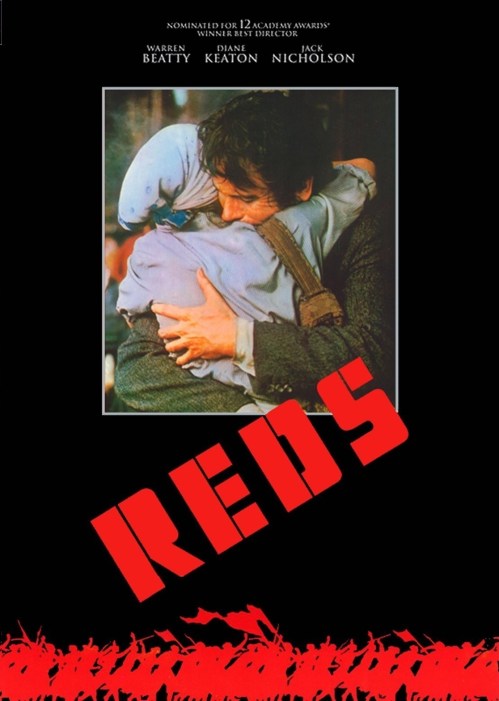
The film centers on the life of John Reed (Warren Beatty) who was a socialist activist that covered the 1917 Bolshevik Revolution in Russia and later published his account in ‘The Ten Days That Shook the World’.  He became instrumental in forming the Communist Labor Party of America and marrying noted feminist Louise Bryant (Diane Keaton) before returning to Russia and eventually dying there becoming only one of three Americans buried at the Kremlin Wall Necropolis.

The project was a labor of love for writer/star/director/producer Warren Beatty who first became inspired by Reed’s story in the mid-‘60s and spent over15 years battling to get it produced. Unlike most actors-turned-directors Beatty was notoriously disliked by his cast and crew for demanding many different takes for even the simplest of scenes forcing his friend Gene Hackman, who agreed to appear in the film for free, to do 100 takes to convey only a few brief lines. Beatty also strangely decided to keep the camera running continuously even between takes resulting in three million feet of footage that weighed five tons to ship and if played continuously on the screen would’ve resulted in taking two and a half weeks to complete.

The story is okay and moderately compelling, but I felt too much emphasis was placed on Reed’s and Bryant’s relationship. Supposedly this was a biography on a famous historical figure, but the story gets lodged more on the rocky, unconventional marriage aspect and seemed at times to be more focused on Keaton’s character than Beatty’s.

I was also confused as to what exactly had Reed done that was so special, or elicit us to sit through such a long movie about him. In a normal epic the main character is instrumental in causing the events that we see, but here the protagonist is nothing more than a sideline observer with no direct control on what goes on. Technically he doesn’t change anything and the film is just one long look at how whatever he strived either fizzled or got corrupted before he eventually dies in virtual obscurity, which hardly seems inspiring or worth the time to watch.

The supporting cast helps significantly particularly Jack Nicholson as Eugene O’Neill who has an affair with Bryant. It’s always interesting to seeing Nicholson play a subdued character since he’s usually so flamboyant and Jack makes the most of it, which helps give the story a little extra edge. Maureen Stapleton won the Academy Award for supporting actress even though her character is only seen sporadically, but she probably deserved the Award either way since she became a victim of Beatty’s overzealous need for multiple takes, which so infuriated her that she apparently screamed ‘Are you out of your fucking mind?” when Beatty demanded that she redo her scene for the 80th  time which got the rest of the crew to cheer their approval.

It’s also fun to see Jerzy Kosinski as the communist politician Grigory Zinoviev. Kosinski was best known for having written the novel ‘Being There’, which inspired the film of the same name, but later he was accused of having plagiarized the story from an earlier Polish novel and it was revealed that many of his other stories were ghost written by assistant editors, which is ironic since his character in the film gets accused by Beatty of having tampered and re-written his speeches and writings.

As a whole it’s adequately done, but the pace ebbs and flows. The interviews with people who actually knew Reed, or were connected to his life in some way are a highlight as is the scene where Reed tries to escape Russia by riding on a hand cart along a train track in the dead of winter, but everything else gets overblown.

My Rating: 7 out of 10

Released: December 3, 1981

Runtime: 3 Hours 15 Minutes

Rated PG

Director: Warren Beatty

Studio: Paramount

Available: DVD, Blu-ray, Amazon Video, YouTube

Nighthawks (1981)

By Richard Winters

My Rating: 6 out of 10

4-Word Review: Street cop versus terrorist.

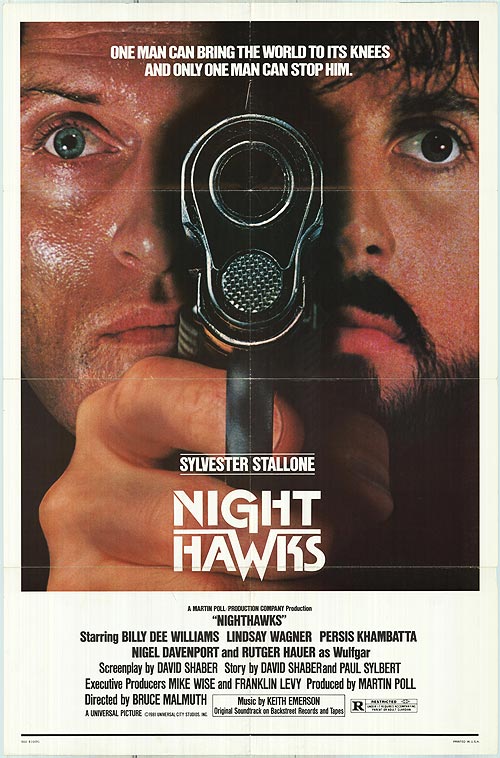
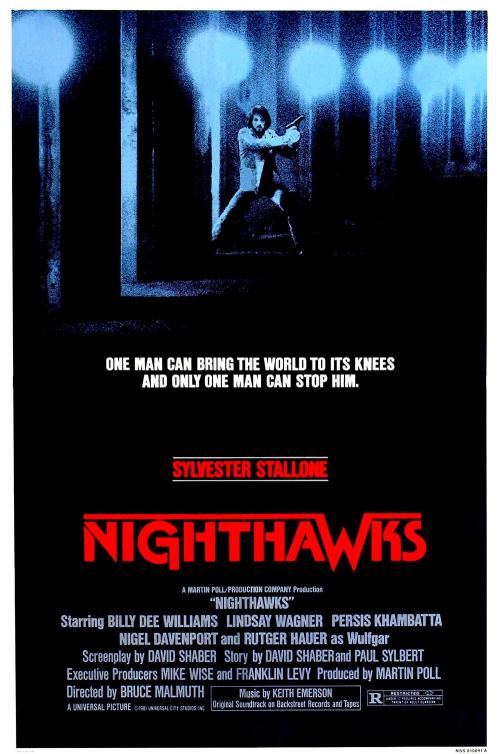
Deke DaSilva (Sylvester Stallone) and Matthew Fox (Billy Dee Williams) work as New York Street cops only to be suddenly pulled off of their beat and put into an elite anti-terrorism division. At first DaSilva resists the tactics taught during the training, which puts him at odds with the instructor (Nigel Davenport). However, once he gets past his initial reluctance he begins to use the methods that were taught to him by getting inside the mind of the international terrorist (Rutger Hauer) that they are after, which eventually helps him beat the man at his own game.

The film’s biggest achievement is that it was shot on-location in three major cities across two continents. Normally it’s nice when a film can just get out of a studio backlot and into a vibrant setting, but this film manages to get in three simultaneously and creates an almost head-spinning, globe-trotting visual show, which helps heighten the international intrigue. My favorite spot was where DaSilva and Fox go into the ghetto to do a drug bust. Normally film crews avoid the bad areas and try to compensate by dressing up a soundstage to look like one, but it always fails while this scene comes off as the real deal with the garbage strewn decrepit buildings being more prominent than the action.

The story succeeds to a degree as it nicely details the psychological aspect of police work as well as showing the many dead-ends investigators must go through before they are finally able to catch a break, but then the gritty reality unfortunately gets erased.

The main issue occurs when Stallone thinks he has spotted Hauer at a nightclub and wants to get nearer to him to get a ‘closer look’ only to proceed to just stand and stare at him in the most obvious way imaginable until it becomes achingly clear to Hauer that the guy is a cop, which causes him to panic and taking out a gun and running while killing a club patron in the process. It made me wonder if the Stallone character was a seasoned cop at all because why bother being undercover if you’re going to just stupidly give your identity away at the most inopportune moment?

Later Stallone gets blamed by Dee Williams for not shooting Hauer when he ‘had the chance’, but the truth is that Hauer had draped himself with a woman hostage and giving Stallone no clear view of him. Aren’t police trained not to shoot unless they do have a clear view? If anything Stallone’s character should’ve been commended for showing restraint. Being goaded into taking a risky shot would not have been ‘macho’ or ‘brave’ but seriously reckless and in no way was a sign of weakness despite the film portraying it like it was.

The film also fails to make much use of the buddy formula and in fact Dee Williams gets boxed out and becomes almost transparent. Stallone is excellent and Hauer is the epitome of a creepy villain, but the film could’ve been stronger had it not devolved into the formulaic tormented-cop-struggling-with-his-inner-demons thing and instead kept the two leads on equal footing as there are a few moments at the beginning where they share some engaging banter.

Lindsay Wagner is equally wasted with only two scenes and less than 10 minutes of total screen time. Davenport though is strong as the aging British instructor and quite engaging in his own right while Persis Khambatta, best known for playing the bald women in Star Trek: The Motion Picture, is effective as Hauer’s partner in crime.

The scene where a group of people are held hostage inside a cable car is intense and well shot. There is also an exciting foot chase inside the New York subway, which has traces to the one done in The French Connection, but the story itself doesn’t amount to much and seems more clichéd than original.

My Rating: 6 out of 10

Released: April 10, 1981

Runtime: 1 Hour 39 Minutes

Rated R

Director: Bruce Malmuth

Studio: Universal

Available: DVD, Blu-ray, Amazon Video, YouTube

The Incredible Shrinking Woman (1981)

By Richard Winters

My Rating: 4 out of 10

4-Word Review: Suburban housewife gets smaller.

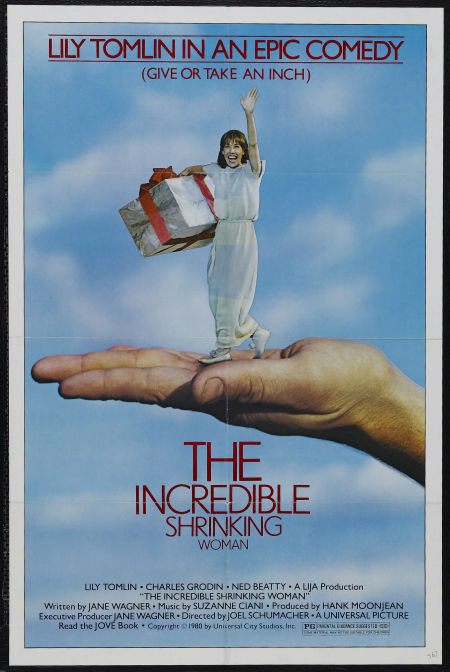
Pat Kramer (Lily Tomlin) is a housewife/mother raising two rambunctious kids (Shelby Balik, Justin Dana) while married to Vance (Charles Grodin) who works in advertising. After being exposed to some products from her husband’s company she begins to shrink until she becomes so small that she is forced to move into a dollhouse and drink out of thimble since a regular glass would be too big for her to hold.

The film is a modern remake of Richard Matheson’s The Incredible Shrinking Man and as much as I loved the original this version takes the storyline in a completely different direction, which for a while proves interesting. Director Joel Schumacher comes up with some wild color schemes and the knowing satire makes great points in its observations on modern suburbia as well as American consumerism. Screenwriter Jane Wagner manages to employ some well thought out scenarios and the special effects aren’t bad either.

Unfortunately by the second-half becomes muddled with scenarios that are no longer funny, but genuinely horrifying and sad instead. The satirical edge gets lost and replaced with an over-the-top mad-scientist-trying-to-conquer-the world angle that becomes cheesy.  I was also confused with how Pat was able to continue to find clothes to fit her especially after she gets smaller than even a toy doll. The film seemed to touch on every other possible problem, so they should’ve had at the very least had a throwaway scene analyzing this one.

Spoiler Alert!

The ending gets too cute for its own good as Pat shrinks to nothing and then has what’s left of the small outfit she was wearing fall into a puddle of spilled chemicals, which somehow makes her big again. This however ruins the poignancy that had been created from showing clips of bells being rung around the world from different countries in remembrance of Pat, which had a certain profound message that no matter how small you are you can still have an impact. Instead of giving the film some substance it goes for a last-second gimmick that cements it as being an empty-headed comedy and nothing more.

End of Spoiler Alert!

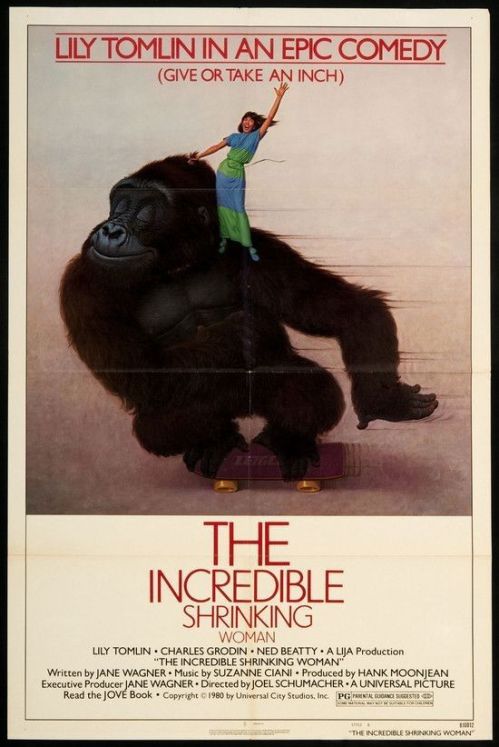
Tomlin’s performance is excellent as she creates empathy for her character, which helps make the story more engrossing as you genuinely build concern and sympathy for Pat’s welfare. Noted make-up specialist Rick Baker garnered a cult following for his convincing performance of an ape, although the shot of the animal giving some people in an elevator the finger is pushing it. The movie though as a whole works only in spurts with a message and tone that is too unfocused and inconsistent to be completely effective.

My Rating: 4 out of 10

Released: January 30, 1981

Runtime: 1 Hour 28 Minutes

Rated PG

Director: Joel Schumacher

Studio: Universal

Available: DVD-R (Universal Vault Series), Blu-ray, Amazon Video, YouTube

The Little Dragons (1980)

By Richard Winters

My Rating: 1 out of 10

4-Word Review: Karate kids save girl.

Zack and Woody (Chris and Pat Petersen) are two young brothers taking a class in karate. While on a weekend camping trip with their Grandfather (Charles Lane) they meet and befriend a cute young girl named Carol (Sally Boyden) as well as her parents (Rick Lenz, Sharon Weber). Unfortunately Carol also catches the eye of two backwoods hillbilly brothers (Joe Spinell, John Davis Chandler) who along with their hick mother (Ann Sothern) concoct a scheme to kidnap her and hold her for ransom. Zack and Woody then use their newfound karate skills to save their new friend when the local law enforcement proves to be inept.

For a film directed by Curtis Hanson, who gained a cult following for the many horror films that he directed, I was really hoping for something a bit more than just the bland family entertainment stuff, but this couldn’t even come up to that humble level. This stale, B-level movie is devoid of much action and as an adult I was quite bored and could only imagine that children of today would be even more so. Despite the title not much karate action is seen and it’s questionable, with the little that does get shown, whether kids could really pull of the stunts that they do with me feeling that in real-life they probably couldn’t.

Films aimed for kids should then have kids as the main attraction and yet we mainly see the boring adults who are clueless while uttering a corny (supposedly funny) lines here and there. The Petersen brothers have photogenic faces, but not enough acting talent to propel it. The bad guys are just broad caricatures from Deliverance that are neither scary nor humorous. Even in a family film there still needs to be a villain that conveys menace and tension, which goes completely missing here.

To some extent it was fun seeing veteran character actor Charles Lane as a kindly old man as he was usually of the crotchety variety in most of his other roles. Spinell hams it up as a backwoods yokel and earns his acting medal by playing a part outside of his normal realm, but the otherwise limp story and technical approach is a waste of talent and time.

Alternate Title: Karate Kids USA

My Rating: 1 out of 10

Released: July 18, 1980

Runtime: 1 Hour 29 Minutes

Rated PG

Director: Curtis Hanson

Studio: Eastwind

Available: DVD-R, Amazon Video

Blue Thunder (1983)

By Richard Winters

My Rating: 7 out of 10

4-Word Review: A technologically advanced helicopter.

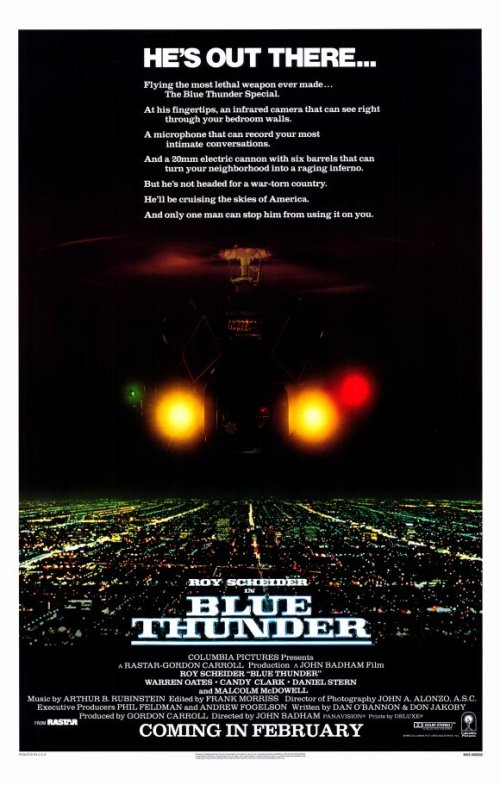
Frank Murphy (Roy Scheider) is a LAPD officer still suffering from flashbacks from his time in Vietnam while working now as part of the air patrol division where he mans a helicopter at night and gives assistance to the cops on the ground.  Due to his expertise he is given the chance to helm the first advanced helicopter called Blue Thunder, which has abilities to fight crime like no other machine before it. As he tests out the new product with his partner Richard (Daniel Stern) he overhears a conversation, through using the machines built-in microphones that can pick up voices from inside buildings, talking about using Blue Thunder for nefarious means. Frank records the conversation and then gets hounded by the bad guys who are led by his lifelong rival from his army days F.E. Cochrane (Malcolm McDowell). To escape their clutches Frank boards the helicopter and flies all over the city of L.A. while waiting for his wife Kate (Candy Clark) to get the incriminating tape to a TV-station where it will be broadcast for the public to hear, but Cochrane, who is an expert pilot as well, gets into another helicopter and tries to shoot Blue Thunder down.

The script was written by the prolific Dan O’Bannon who also wrote the scripts for Alien and Total Recall. He got the idea for this one while living in L.A. and constantly having a police helicopters routinely fly over his neighborhood at night. The original script was darker in tone and portrayed Frank as a psychotic who steals the helicopter and terrorizes the city until he is finally shot down, but that idea got nixed and like with most big-budgeted Hollywood projects got toned down to help appeal to a wider audience.

Personally I would’ve found the original idea more interesting as it also contained political overtones that get completely washed over here. The story here is pretty generic with one-dimensional villains and situations simply thrown in to create cheap conflict and nothing more.

What impressed me though was the modern visual style and effects. It hardly seems like a mid-80s movie at all let alone one that was actually filmed in late ’79 and early ’80. The overriding sentiment has a trendy feel and the cinematography is vivid and colorful. The helicopter action is the film’s biggest selling point and no matter how dippy the story gets the exciting aerial footage more than makes up for it. I loved the way director John Badham captures all sides of Los Angeles from its glitzy skyline to its more grimy and rundown working class areas. It’s also nice to have a REAL helicopter REALLY flying in the air over the city instead of computer generated effects, which makes many of today’s movies look fake and cheapens them while still keeping many of the ‘80s action flicks superior.

Scheider has never been a leading man that I’ve found particularly impressive as his presence seems transparent. However here his laid-back demeanor nicely contrasts with McDowell’s hyper one and makes the bad guy seem even more vindictive. Stern is engaging as Scheider’s partner and it’s too bad this wasn’t made into a buddy movie with Stern’s character staying on for the whole time. Clark is also enjoyable particularly with the wild look that she elicits with her eyes and the car chase that she has with the cops in an abandoned lot of a drive-In theater.

This also sadly marks Warren Oates last project. It was filmed in 1980 and he did a few other films after this one, but this was released last. Oates is one of the most distinctive character actors to ever grace the screen and even in a bland supporting role like the one here he still finds a way to enliven it.

My Rating: 7 out of 10

Released: May 13, 1983

Runtime: 1 Hour 49 Minutes

Rated R

Director: John Badham

Studio: Columbia Pictures

Available: DVD, Blu-ray, Amazon Video

Just Tell Me What You Want (1980)

By Richard Winters

My Rating: 6 out of 10

4-Word Review: Rich tycoon gets dumped.

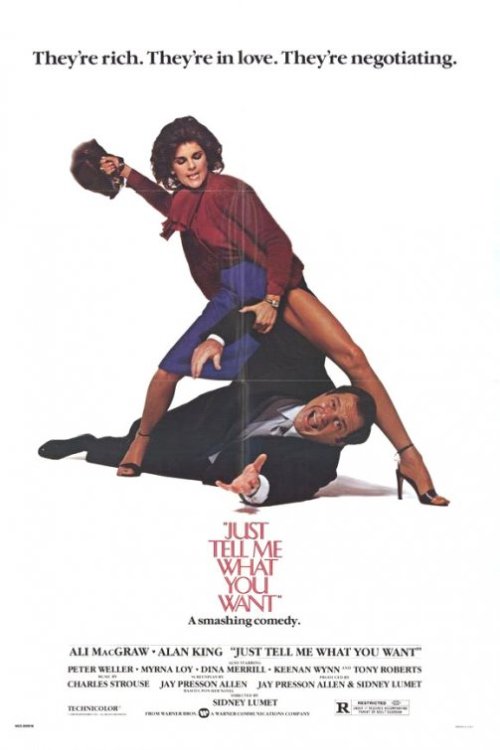
Max Herschel (Alan King) is a rich and successful businessman who’s used to getting what he wants. He’s rude and crude and doesn’t mind displaying his anger or contempt for others at a moment’s notice. After 14 years Bones (Ali MacGraw), his mistress, has decided she’s had enough. She leaves him for a much younger man (Peter Weller). This enrages Max who does whatever he can to win her back, or at the very least ‘punish’ her for leaving him.

The film, which is based on a novel by Jay Presson Allen has a delicious New York flavor with the majority of the action taking place at the Old Westbury Gardens estate that fronts as Max’s home. The interiors of the stately mansion are at times more interesting than the conversations and the exteriors coincidently were also used in Love Story, which was another MacGraw vehicle. Director Sidney Lumet gives the dark comedy a classy air with a rousing, distinctively jazzy score by Charles Strouse, which I wanted to hear more of and wouldn’t have minded if it had been played all the way through the movie.

The story has sharp dialogue and a deliciously acerbic edge, but becomes preoccupied with Max’s business dealings, which most viewers may find too complex to follow and aren’t that integral to the story. The first hour is spent focused on Max, whose obnoxious ways quickly become off-putting and tiring. The catalyst is his love-hate relationship with Bones and more scenes should’ve been shown with them together while having her break-up with him come much sooner.

King was a comedian known for angry monologues and that emotion gets channeled into his character. I’ll give them props for creating an unlikable lead and not holding anything back as too many times films create abrasive people only to soften them too soon or not go all-the-way with it. Here it gets pushed to the limit, but I was still hoping for Max to have more of an arch and was disappointed that he remains for the most part a callous jerk to the very end.

MacGraw’s restrained approach works well off of King’s flamboyance and the highlight is when she corners him at a luxury department store, which was filmed on-location at the Bergdorf Goodman, and tackles him while destroying everything in sight. However the character’s nickname of ‘Bones’ I did not care for especially with no explanation for why she was given it. Was she called this because she was thin, or was it for some other reason? An attractive female should be given a pleasant name not something that sounds demeaning.

Legendary actress Myrna Loy, who had been around since the silent film era, plays Max’s long suffering secretary and earns her pay here. Loved the scene where King cries right into her bosom while she holds his head and acts like his mother, but also the part where he shouts directly into her face even throws out the C-word and she doesn’t flinch. Keenan Wynn is likable and speaks with an accent in a sympathetic role as a Russian businessman and Dina Merrill’s emotional breakdowns as Max’s mentally fragile wife are impressive and could’ve been extended.

Spoiler Alert!

Overall though it fizzles and it’s not because it’s filled with a lot of extraneous dialogue and scenes that should’ve been cut, but more because it plays itself as this sort-of anti-romance only to sell-out at the end. There is simply no way anyone could truly fall-in-love with Max because there was nothing about him to love. Having him do one nice thing shouldn’t erase all the other bad things he did before. Bones had already spent 14 years with him which should be more than enough time to realize things won’t be any different moving forward. Having them reconcile by working together as business partners maybe, but a marriage is simply a disaster waiting to happen. Just because audiences long for the ‘happy ending’ doesn’t mean that’s what you give especially by having two people magically find love for each when none had ever existed before.

End of Spoiler Alert!

My Rating: 6 out of 10

Released: January 18, 1980

Runtime: 1 Hour 53 Minutes

Rated R

Director: Sidney Lumet

Studio: Warner Brothers

Available: DVD (Warner Archive), Amazon Video, YouTube

Malone (1987)

By Richard Winters

My Rating: 3 out of 10

4-Word Review: Hit-man saves town.

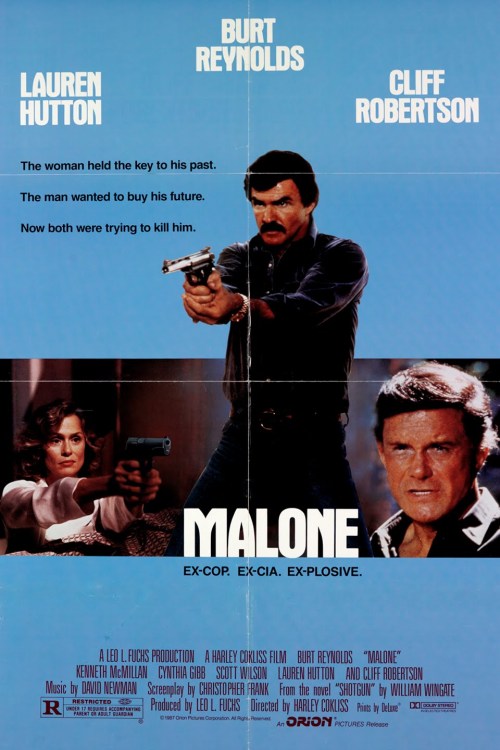
Richard Malone (Burt Reynolds) is a former CIA hit-man who decides that he’s had enough of the dirty business and wants to retire. He uses his savings to leave the profession and travel the countryside. On the way his car breaks down and he’s forced to push the vehicle to the nearest small town service station, which is run by Paul (Scott Wilson). Since the parts to repair the transmission will take several days to arrive he stays at the place and befriends Paul’s teen-age daughter Jo (Cynthia Gibb). He also becomes aware of a plot by billionaire Charles Delaney (Cliff Robertson) to buy up the town and force everyone to sell and if they don’t they end up dying. Despite his initial reluctance Malone ends up getting involved in the dispute and becomes Delaney’s number one target in the process.

The movie is based on the novel ‘Shotgun’ by William P. Wingate, which in turn was modeled after the formula from the western Shane. It reminded me more of High Noon particularly the way Malone single-handedly takes on not only Delaney, but all of his cohorts during a gun battle at the end, but without that film’s strong emotional impact. The story and characters are highly uninspired and this thing is aimed towards those that like their action flicks on a very simple and predictable level.

Reynold’s presence is the only interesting ingredient. This was during the downside period of his career where he was desperately trying to get back to the tough guy action roles that had made him famous. However, during the 70’s his action guy persona worked more in the humorous vein where his character would always approach the situation with a twinkle in his eye and funny side-quip, but here he’s all stiff and serious. To a degree this proves he’s a good actor in that he can play either type of role effectively, but the funny-Burt is far more entertaining than the serious one. Either way it’s doubtful that this middle-ager would’ve been able to run so vigorously and climb onto the rooftop of buildings as he does when he gets onto Delaney’s estate and I’m pretty sure a stunt double was used since we only see him doing this from a distance.

An element of the film that audiences today may take issue with is his relationship with the teen girl who starts to admire him to an emotional extreme. Clearly she represents the Brandon deWilde role from the Shane film, but the fact that she is underage and starts to have a romantic interest in the 50-year-old and he in her and even kisses him on the mouth may make certain viewers uncomfortable.

As for the villain he is as dull and transparent of a caricature as it gets and Robertson plays him very poorly by conveying no menace on the screen and creating zero tension. It would’ve worked better had Kenneth McMillan, who plays the sleazy sheriff would’ve been cast in the Delaney part as he’s an actor with genuine panache and owns whatever scene he’s in no matter how big or small the role.

The ironic thing about this otherwise mindless excursion is it’s all about this far-right nutty guy who wants to take over the government to ‘save the country’ and even requires all his followers to say a corny patriotic-like pledge and yet it wasn’t even filmed in the US, but instead British Columbia, Canada. Even more frighteningly is that given today’s political climate it doesn’t seem quite as farfetched and over-the-top as it once did.

My Rating: 3 out of 10

Released: May 1, 1987

Runtime: 1 Hour 32 Minutes

Rated R

Director: Harley Cokeless

Studio: Orion Pictures

Available: DVD, Blu-ray, Amazon Video