Category Archives: 80’s Movies

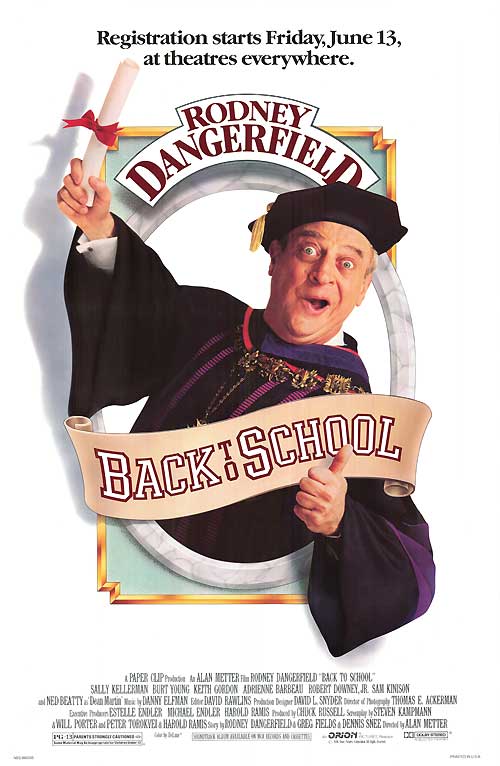
Back to School (1986)

By Richard Winters

My Rating: 3 out of 10

4-Word Review: Rodney goes to college.

Thornton Melon (Rodney Dangerfield) is a successful businessman who runs a national chain of clothing stores despite having never attained a degree. Now his son Jason (Keith Gordon) is attending a university, but he feels like dropping out. Thornton though doesn’t want to let him, so he decides to attend college with him in order to inspire him to remain in school.

The film would’ve been far more interesting had Rodney been poor and struggling to better himself by finally going back to school, which is much more relatable since many adults do this all the time. Making him already wealthy saps the potential drama and reality right out of the story making it more like a game that he is playing with no real consequence. He doesn’t even take any of his studying seriously, so the idea that he is at least broadening his intellect fails here too. The side-story dealing with him being a world class diver is equally ridiculous as this out-of-shape, beer guzzling, 65-year-old man looks like someone who would barely be able to run half a block before dropping dead of a heart attack let alone achieving any sort of complex dive that no one else could do.

Casting Adrienne Barbeau as his shrewish wife was a mistake as she lacks comic ability making the barbs that she trades with him unfunny and what’s a young and beautiful woman doing married to a homely dope like Rodney anyways? Okay, so Rodney’s character here has money and that’s why she married him, but that plays completely against his stand-up persona where he portrayed himself as being this loser that got no respect. The wife should’ve been a female version of Rodney looks-wise while also a nag and thus heightening the stakes for the character to go back to school and succeed. Having him later fall in love with his beautiful English professor played by Sally Kellerman makes even less sense as the two had intellectually nothing in common.

Keith Gordon is boring as Rodney’s son and having the story go off on a tangent dealing with his romance with a pretty coed (Terry Farrell) is derivative and should’ve been avoided as the film is only amusing when Rodney is in it and dull otherwise. Gordon also looks nothing like Rodney and it’s confusing why exactly he’s not ‘fitting-in’. Casting some fat, bulging eyed guy to play a young version of Rodney would’ve been funnier while also making his social ostracism more understandable.

Burt Young’s character adds to the already weird quasi-surreal atmosphere by playing Rodney’s chauffer who despite being out-of-shape, short and middle-aged just like Rodney he somehow also possess super human strength and able to beat-up and even intimidate much younger, more muscular guys. It was like there was no motivation at all by the writers to actually tell a story that made sense and they were simply throwing in any gag that they thought up and hoping some would stick.

Robert Downey Jr. as an eccentric socialist student was the only supporting character I liked, but he is not in it enough. The script should’ve had him rooming with Rodney and examining how these two very different personalities could get along while getting rid of the son character completely. Then we might’ve had a character driven comedy that was worth watching. The film though as it gets done here is too transparent and despite being filmed on-location at the University of Wisconsin in Madison poorly reflects the actual college experience and will remind no one that has attended college of what college life is really like.

My Rating: 3 out of 10

Released: June 13, 1986

Runtime: 1Hour 37Minutes

Rated PG-13

Director: Alan Metter

Studio: Orion Pictures

Available: DVD, Blu-ray, Amazon Video, YouTube.
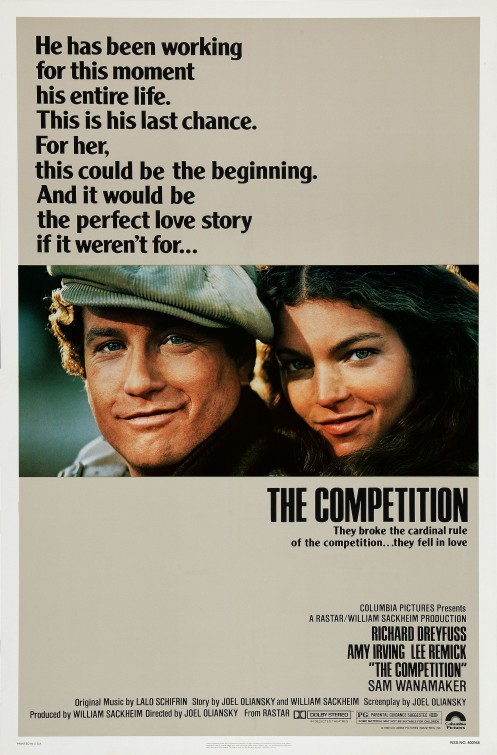
The Competition (1980)

By Richard Winters

My Rating: 7 out of 10

4-Word Review: Pianists fall-in-love.

Paul (Richard Dreyfuss) is a gifted, but frustrated pianist. He has entered many classical piano competitions, but has always come just short of winning first prize. He wants to take one last stab at it, but his parents (Philip Sterling, Gloria Stroock) push him to settle down with a regular job and consistent pay. Paul though decides to forge on with his hopes at receiving a medal by entering a contest that will allow for a financial grant and 2 years of concert engagements for the winner. It is there that he meets Heidi (Amy Irving) who is also competing for the same prize. She immediately becomes smitten with him having met him a couple of years earlier at a music festival. She tries to get into a relationship with him despite warnings from her piano teacher (Lee Remick) who feels it might soften ‘her edge’ and allow him to attain the award instead of her.

The film does a masterful job at recreating a realistic atmosphere of a piano competition including showing the judges meticulously following each note on the sheet music they have at hand as the contestant performs while also taking studious notes of each performer afterwards before finally settling on a winner. The viewer is given a broad understanding of all six contestants involved helping to give the movie a fuller context on the human drama that goes on behind-the-scenes in these types of competitions while also showing how parents and instructors can at times be great motivators, but also crippling nags.

Watching the actors mimic the playing of a pianist is another major asset. Usually films dealing with pianists will never show the actor’s hands on the keys, but instead shoot them from behind the piano while editing in close-ups of a professional pianist’s hands later. Here though the actors, with the help and training of music consultant Jean Evensen Shaw, convincingly move their fingers along the keys in tandem with the music. How they were able to later effectively edit in the sound to stay on track with the finger movements and vice-versa is an amazing thing in itself, but watching the actors literally ‘play the piano’  helps to heighten the film’s realism and make watching the concert footage, which gets amazingly drawn out, quite fascinating.

The film has a terrific supporting cast as well including Lee Remick as Heidi’s no-nonsense instructor who looks at Heidi’s budding relationship with Paul with immediate cynicism and isn’t afraid to bluntly speak out about it either. Sam Wanamaker has the perfect look and demeanor of an orchestra conductor and the scene where Paul decides to ‘show him how it’s done’ by taking a stab at conducting is the film’s highlight.

The weakest element though is the romance and the movie would’ve worked better had this been only a side-story instead of the main focus. The idea that Heidi has to do all the sacrificing and at one point even considers dropping out of the competition because it’s ‘more important to him that he wins it’ is sexist. Woman can be just as competitive as men and sometimes even more so. The story would’ve been better served had they both been portrayed as fierce competitors who deep down have mutual feelings for the other, but remain guarded and slowly shows a softer side as the contest progresses and then only when it is finally over does the romance really blossom.

Having Heidi constantly chase after Paul, who is extraordinarily arrogant, is ridiculous. After his initial rebuff she should’ve quickly moved-on as she was pretty and there were plenty of other men for her choose from instead of having her literally throw herself at him like she were some dimwitted groupie. It was bizarre as well that when Paul finds out that is father is dying that Heidi is the first person he decides to turn to for comfort and solace. This is well before a relationship was established and the two had only spoken to each other in passing, so why does Paul consider her a trusted emotional confidant and shouldn’t he most likely have other friends that he would’ve known longer that he could go to instead?

The film has a side-story dealing with a Kazakh performer (Vicki Kriegler) whose instructor (Bea Silvern) decides to defect to the U.S. during the competition, which takes the film in too much of a different direction that distracts from the main theme and should’ve been cut out completely. I also thought it was odd that the music played over the closing credits is a disco sounding song. We’ve just spent 2 hours listening to classical piano music, so shouldn’t the music at the end have been kept with the same theme/sound?  Otherwise this is still a terrific study showing the emotional and mental sacrifices that go in to achieving success and how staying too focused on a central goal can sometimes affect a person’s relationships with their friends, family and lovers.

My Rating: 7 out of 10

Released: December 3, 1980

Runtime: 2Hours 6Minutes

Rated PG

Director: Joel Oliansky

Studio: Columbia Pictures

Available: DVD, Amazon Video, YouTube

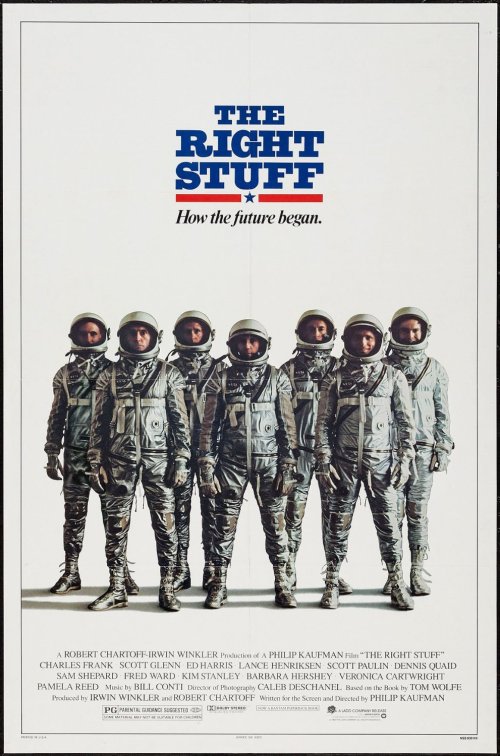
The Right Stuff (1983)


By Richard Winters

My Rating: 6 out of 10

4-Word Review: The American space program.

Based on the 1979 best-selling novel by Tom Wolfe, the film explores the history of the American space program starting in 1947 when test pilot Chuck Yeager (Sam Shepherd) successfully broke the sound barrier and then moving into the selection and training of the men who would lead the exploration into space culminating with John Glenn’s historic orbiting flight of the earth on February 20, 1962.

The film was a darling of the critics, but did poorly at the box office and I suspect this is due mainly to over reliance on comedy that eventually becomes off-putting. When doing a film dealing with historical events I don’t mind some comedy as real-life can always have its fair share of funny moments, but writer/director Philip Kaufman becomes obsessed with squeezing every ounce of humor that he can from each and every scene, sometimes even going off on tangents with it, until it seems like that’s more of the film’s focus. At the start there’s an okay blend, but then it gets out-of-control wacky, which creates a surreal world that seems to mock the events instead of tell them. The viewer also has to question whether the filmmaker’s, in their zeal to get a laugh in any way that they can, are really showing us something that is accurate or whether that was even a concern.

There’s also too many characters and they all possess the same clichéd all-American-fearless-good-ole’-boy charm that makes them indistinguishable from the other. The film should’ve had only one central character that the rest of the story revolved around. Supposedly the Chuck Yeager character (the actual Chuck Yeager appears briefly as a bartender) was supposed to do this by having him reappear throughout, but he is gone for so much of the time that you essentially forget about him.

This also becomes a problem when dealing with the story thread of Gus Grissom (Fred Ward) who supposedly ‘panics’ when his spacecraft splashes down. Because we never really get to know any of these characters on any deep level we have no clue why he behaves the way that he does. The scene where he supposedly explodes the hatch’s bolts, which in turn sinks the craft is disputed in its accuracy anyways, but it hurts the film’s pace either way. Spending virtually three hours being comical and then throwing in a highly dramatic element almost out of nowhere is jarring and then just as frustratingly it drops it without any suitable conclusion or exploration as to what might’ve really happened or why.

The production values are excellent, which is why I couldn’t hate it, but the movie also has tendency to one-up itself with each and every progressing scene and thus making John Glenn’s orbiting flight, which should’ve been the film’s highpoint, get lost in the shuffle. There’s also too much of a flag-waiving mentality that almost resembles a government produced propaganda film and helps give the movie an overblown, overreaching feeling when it’s over.

My Rating: 6 out of 10

Released: October 21, 1983

Runtime: 3Hours 13Minutes

Rated PG

Director: Philip Kaufman

Studio: Warner Brothers

Available: DVD, Blu-ray, Amazon Video, YouTube

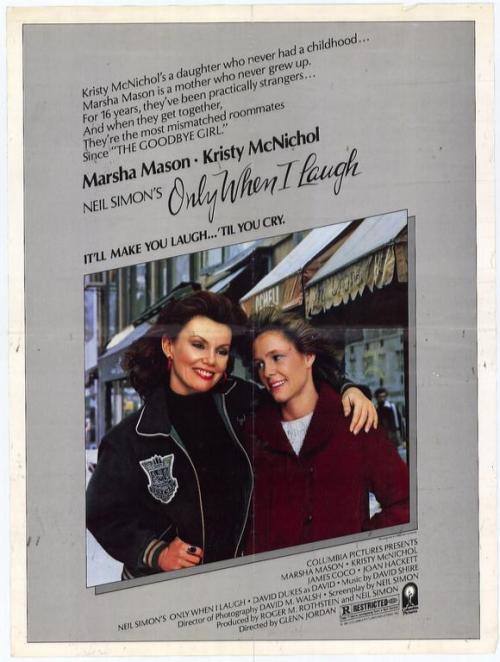
Only When I Laugh (1981)

By Richard Winters

My Rating: 7 out of 10

4-Word Review: Actress is an alcoholic.

Georgia Hines (Marsha Mason) has just been released from a 12-week alcohol rehab program and returns to her Manhattan apartment looking to readjust to civilian life with the help of her two friends; Jimmy (James Coco) a gay unemployed actor and Toby (Joan Hackett) a woman unhappy at turning middle-aged. To Georgia’s surprise Polly (Kristy McNichol) her 17 year-old-daughter shows up wanting to move in with her and ‘patch things up’ from their tumultuous past. Georgia isn’t sure she’s emotionally ready, but forges ahead and things start out okay, but then the demons from the past rear their ugly head forcing mother and daughter to face some harsh realities both about themselves and each other.

The film is based on Neil Simon’s Broadway play ‘The Gingerbread Lady’ that starred Maureen Stapleton and ran for 193 performances. It was not considered a success and when adapted to a film Simon made changes to the story, but to me it all seemed like every other Neil Simon dramedy that he’s done before. Both this film and The Goodbye Girl that also starred Mason featured male characters that were struggling to become professional actors. Both this film and Chapter Two, which again starred Mason, had characters who were playwrights going through writer’s block. His films always take place in New York and have characters who see analysts, and can apparently make enough to afford them. I realize there’s the old adage ‘write what you know’ and that’s exactly what Simon is doing, but it would be nice if he’d get a little bit out of his comfort zone as nothing that gets shown here seems fresh or original.

The first hour is way too serene and I would’ve expected much more of a frosty relationship between mother and daughter, but instead for the most part they get along great, at least initially. There are some passing references to previous drama, but I felt this should’ve been shown and not just talked about. The second half improves significantly with some strong scenes, but I’m afraid that with such a lifeless beginning most viewers will have fallen asleep before it even gets there.

McNichol is excellent and every bit Mason’s equal, but this exposes another of Simon’s weaknesses, which is that although he’s good at writing character parts for adults he seems unable to do so for anyone younger. In The Goodbye Girl the Quinn Cummings character seemed too infantile for a 10-year-old and here McNichol is more like a 20-something and the intended mother-daughter drama more like just two girlfriends rooming together.

Coco and Hackett are excellent and help hold things together and the movie does manage to deliver, at least in the second-half, but I couldn’t help but feel that Simon had gone to this well too often and was starting to lose his edge. You can also spot young Kevin Bacon as a college dude trying to pick and Mason and McNichol as they eat at a café.

My Rating: 7 out of 10

Released: September 25, 1981

Runtime: 2Hours

Rated R

Director: Glenn Jordan

Studio: Columbia Pictures

Available:  DVD-R, Amazon Video, YouTube

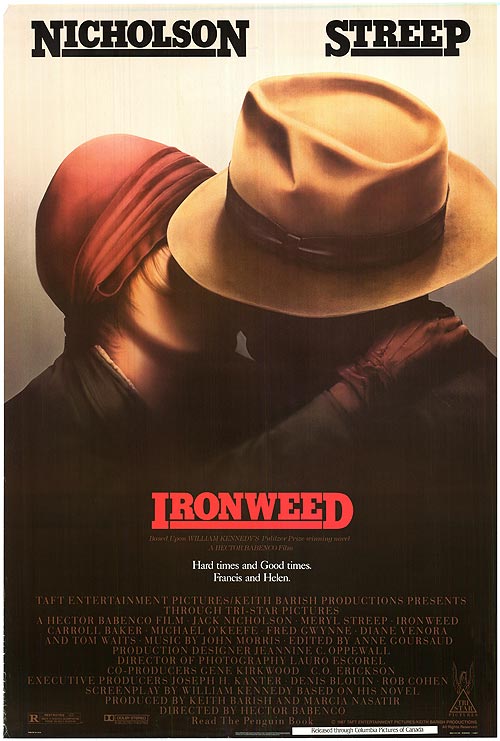
Ironweed (1987)

By Richard Winters

My Rating: 8 out of 10

4-Word Review: Life on the streets.

It’s the 1930’s and Francis Phelan (Jack Nicholson) has been living on the streets for over two decades. At one time he was a promising baseball player with a bright future, but then he accidently dropped his infant son and killed him. Dealing with the guilt and shame of it turned him into an alcoholic who roams the cold streets of Albany, New York looking for odds jobs and handouts when he can. He seeks out his lover Helen (Meryl Streep) for companionship and the two share a bottle of booze and their bitterness at the world that is ambivalent to their desperate situation.

The film is based on the novel of the same name by William Kennedy, who also wrote the screenplay and is directed by Hector Babenco who received wide claim for directing Pixote a film that dealt with homelessness in Brazil. This film is without question one of the best to tackle the lives of street people. Most films tend to treat the subject rather timidly and only analyze the topic from a distance (i.e. having a side character who is homeless, or maybe a main character who is temporarily on the streets), but this film engrosses the viewer completely into the homeless lifestyle while supplying absolutely no letup to their bleak existence. The result is a fascinating and revealing journey that shows how complex and multi-dimensional these people actually are while exposing every facet of the homeless experience including the indignities and dehumanization that they must face on a daily basis.

The casting is interesting particularly for the fact that both Nicholson and Streep had just starred together in Heartburn a year earlier playing a couple on the completely opposite side of the socio-economic scale. I commend Nicholson for tackling a challenging role that goes completely against his persona as normally he plays flamboyant types with over-the-top personalities, so it’s great seeing him take on a humble one who feels and acts like a complete miniscule to the world around him. However, the scenes where he interacts with the ghostly visions of people he has murdered in the past does not come off as successfully as it could’ve. The imagery is interesting, but the fact that he had played a character already that dealt with similar types of ghostly visions in The Shining causes the viewer to think back too much to that film and takes them out of this one.

Streep is outstanding and her constant ability to completely submerse herself into her characters and take on different accents with an amazing authenticity never ceases to amaze me. She really looks the part too by not only wearing no make-up, but having her teeth stained and darkened to effectively give off that decayed look. I’m genuinely floored at how many times most films neglect to do this. Actors portraying characters in destitute environments, or from the old west, may convey the down-and-out or rugged look physically, but their teeth still always look great when in reality they should’ve been in as bad of shape or worse as the rest of their bodies.

The supporting cast is good but they have little to do, which includes Fred Gwynne who appears briefly as a bartender. Carroll Baker though is excellent as Nicholson’s ex-wife. She was a blonde beauty that burst onto the scene in the ‘50s and was billed as the next Marilyn Monroe, but her acting ability quickly became suspect and by the ‘60s she was relegated to low budget B-movies and European productions, but in the ‘80s she made a Hollywood comeback in supporting roles and her appearance here was clearly her best performance and proves that she really could act. Margaret Whitton is also a standout as she takes part in one of the film’s few lighthearted moments as an eccentric woman who is prone to histrionic fainting spells and walking outside without any clothes.

The film though does suffer from a few too many dramatic peaks, which includes having two of Nicholson’s homeless friends die almost simultaneously, which only helps to lessen the effect by squeezing out more drama than it needs to, but overall this is a top notch effort where every scene and utterance rings true.

My Rating: 8 out of 10

Released: December 18, 1987

Runtime: 2Hours 23Minutes

Rated R

Director: Hector Babenco

Studio: TriStar Pictures

Available: DVD, Blu-ray, Amazon Video, YouTube

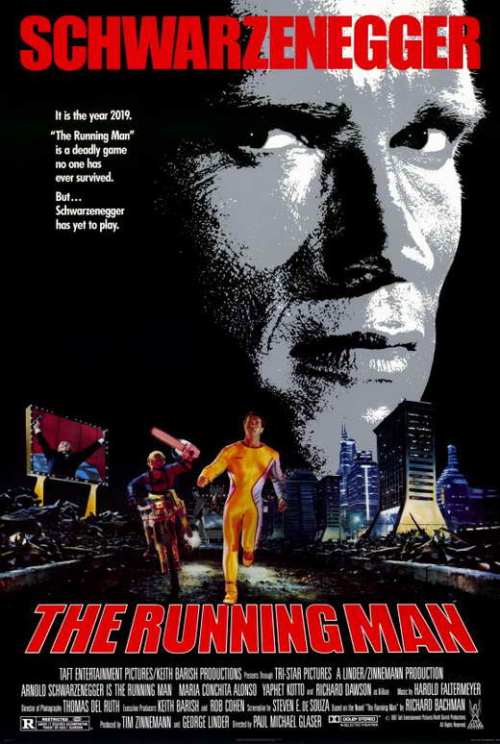
The Running Man (1987)

By Richard Winters

My Rating: 5 out of 10

4-Word Review: A deadly game show.

The year is 2019 and the United States has turned into a militarized police state. In an effort to keep people’s minds off of their bleak existence the government broadcasts game shows in which the contestants are convicted felons who fight for their lives against well-trained and well-equipped assassins called ‘stalkers’. When Ben Richards (Arnold Schwarzenegger) gets convicted of a crime he didn’t commit he is put onto one of these shows called ‘The Running Man’ as a contestant, which is hosted by Damion Killian (Richard Dawson). They then try everything they can to kill Ben, but to their surprise Ben proves to be far more resilient than they ever expected.

The film is based on a novel of the same name written by Stephen King under the pseudonym of Richard Bachman. However, the novel is far different than the movie, which had the main character traveling to different towns in the northeast while here the game show action gets confined to a dark, dingy studio. The main character was also thin and meek-looking, which would’ve been more interesting had he been that way in the movie as it would’ve made him seem even more like an underdog.

The film’s comic book look is fun for a while and the shots showing the audiences stunned reactions as Ben continually takes down these supposedly unbeatable stalkers is funny. It also makes some good points regarding media manipulation and the hypnotic power of television although it’s too generalized and could’ve gone further with it.

The casting though is particularly good including Ricard Dawson as the egotistical game show host. He did some acting during the ‘60s, but was mainly known for his work as a panelist on ‘Match Game’ and hosting ‘Family Feud’ and yet here he falls into his role with complete ease and easily steals the film. It’s also fun seeing Jesse Ventura, who later became the governor of Minnesota wearing a tacky looking wig. Former football player Jim Brown gets one of the best roles of his film career as a stalker whose punk hairdo resembles that of a skunks and Barbara Lux is amusing as an old lady who swears liberally.

While the dark humor is engaging the story does get quite derivative. Watching Ben defeat the stalkers one-by-one becomes mechanical and redundant. The film also fails to display any type of futuristic vision as the characters use phones that are still connected by a cord, have computers with big, clunky keyboards, and watch TVs that are still of the boxy variety.

Spoiler Alert!

The most disappointing element though is the ending, which differs greatly from the one in the book and is far too neat and tidy. The idea that one determined individual can single-handedly take down a deeply corrupt system is the stuff of romanticized fiction. Having the brain-washed masses suddenly become ‘de-converted’ by showing them actual news coverage wouldn’t really work. If people have been feed a lie for so long they’re not necessarily going to know what the truth is when it hits them and may actually just consider it to be a ‘lie’. Throwing in a ‘feel-good’ ending diminishes the dystopian theme and dark humor that came before it making the film nothing more than a marketing gimmick with no real bite.

End of Spoiler Alert!

My Rating: 5 out of 10

Released: November 13, 1987

Runtime: 1Hour 41Minutes

Rated R

Director: Paul Michael Glaser

Studio: Tri-Star Pictures

Available: DVD, Blu-ray, Amazon Video, YouTube

Hot to Trot (1988)

By Richard Winters

My Rating: 2 out of 10

4-Word Review: A horse that talks.

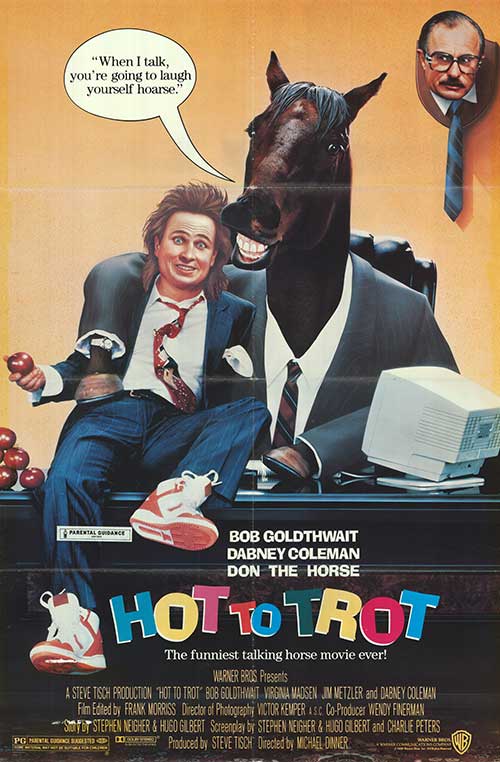
Fred (Bobcat Goldthwait) inherits one half of a brokerage firm from his deceased mother much to the consternation of his step father Walter (Dabney Coleman) who owns the other half. Fred also receives a horse named Don (John Candy) from his inheritance that has the amazing ability to talk and he even gives Fred some inside stock tips that makes Fred very rich. Fred then rents a slick-looking penthouse with his newfound money and let’s Don move in with him while Walter schemes to find out how Fred is able to make such savvy stock market picks.

I sat dumbfounded the whole time I watched this wondering how such a stupid script like this could get the greenlight when there are so many other better ones that are never even given a chance.  Had it tried a more surreal approach similar to the one used in Pee Wee’s Big Adventure then it might’ve worked, but instead it’s just a sterile comedy without any focus or atmosphere that has weirdness thrown in haphazardly, but too caustic for even the kids to enjoy. Apparently some poor misguided soul thought that because the ‘Mister Ed’ TV-series was so successful in reruns that there was an audience begging to see a talking horse movie even though there really wasn’t. For the record that show, which ran for six seasons, was never too good anyways, but still far funnier than anything you’ll see here.

The effects for the horse aren’t impressive. All he does his move his lip, but his teeth remain clenched making it look like he isn’t really talking. Candy’s voice-over work, which he apparently ad-libbed, allows for a few chuckles, but I felt the horse character wasn’t really needed. Simply have the part played by Candy in human form and it wouldn’t have made all that much of a difference and might’ve improved things by at least making more sense.

Goldthwait’s ability to quickly change the pitch of his voice is not amusing and comes-off like someone who’s suffered brain damage. Outside of his ‘vocal talents’ he has nothing else to add making his presence here boring and transparent. Coleman wears some false teeth that make him speak with a lisp. I’m not sure if his career was in a decline and that’s why he took the part, or he just wanted to try something different, but it doesn’t work and wastes his overall talents.

A party scene inside Fred’s apartment that is attended by other animals is kind of cute and there’s a mildly amusing horse race. I also liked the segment at the end involving Gilbert Gottfried as the horse’s dentist where we see a shot from inside the horse’s mouth. It’s not a real mouth, but the rather garish way that they try to make it look like a real one is kind of interesting. Otherwise the best thing about the movie is its short runtime.

My Rating: 2 out of 10

Released: August 23, 1988

Runtime: 1Hour 23Minutes

Rated PG

Director: Michael Dinner

Studio: Warner Brothers

Available: DVD (Warner Archive Collection), Amazon Video, YouTube

Switching Channels (1988)

By Richard Winters

My Rating: 4 out of 10

4-Word Review: Reporter shields convicted killer.

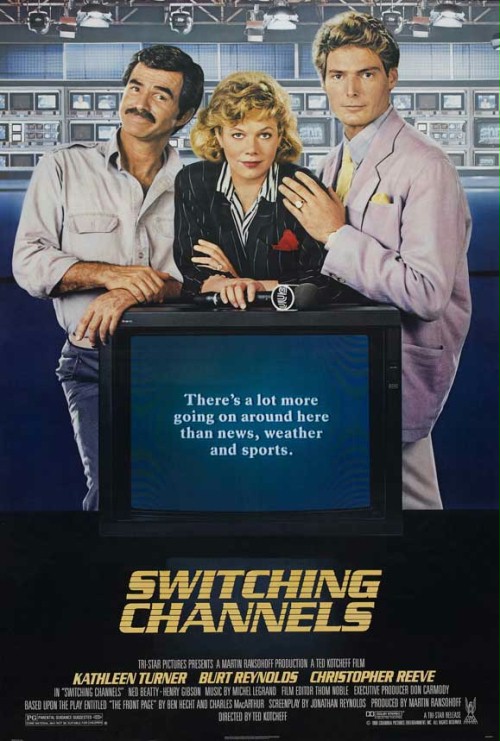
Christy Colleran (Kathleen Turner) is a dedicated news reporter working at a satellite news network who decides to take a much needed vacation. On her trip she meets the dashing and very rich Blane Bingham (Christopher Reeve). The two hit-it-off and decide to get married, but when she informs her ex-husband John (Burt Reynolds), who just so happens to also be here employer, he does everything he can to prevent the marriage from happening. Part of his scheme is to get her so involved in covering the impending execution of Ike Roscoe (Henry Gibson) that she won’t have time for Blaine, but when the execution goes awry and allows Ike to escape Christy agrees to shield him from the authorities.

The story is based off of the very famous Broadway play ‘The Front Page’ that was first performed in 1928 and has been remade into a cinematic film (not including the TV-movie versions) three different times before this one. The first was in 1931 and the second in 1942 with His Girl Friday starring Cary Grant and Rosalind Russell, which was probably the best version, and then in 1974 director Billy Wilder took a stab at the story that starred Walter Matthau and Jack Lemmon.

Why it was felt that this story needed to be done again is a mystery as this version is by far the weakest and hardly funny at all. The premise itself is solid, but structured in a way that makes it come off as an unfocused mess. It starts out as this sort of romantic love triangle scenario then jarringly shifts into the execution until it seems like two entirely different movies crammed into one. None of the original dialogue from the play was retained making the attempted banter here benign and uninteresting.

Although it’s been a while since I’ve seen the three other versions, which I found to be highly entertaining and funny, but this one is dizzying and confusing instead. As I remember the other versions kept the focus solely on the three leads and had them remain in the same setting with the action basically coming to them. Here it gets diluted with the characters prancing around to too many different places with their presence getting minimized by gargantuan, overly colorful sets that swallow up both the actors and story.

Reeve is excellent in what I consider his best role outside of Superman. Reynolds though looks uncomfortable in an ensemble-type comedy structure and he shares absolutely no chemistry with Turner with behind-the-scene reports saying that the two couldn’t get along at all. It’s almost like they cast the parts based solely on the name recognition of the stars over whether they were truly right for the parts.

Turner had already lost her youthful appeal here that had made her so sexy in Body Heat that had just been done 7 years earlier.  She comes off as more middle-aged and frumpy and not at all the type of woman two guys would fight over. I admire her attempts at expanding her acting range by taking a stab at frantic comedy, but her constant breathless delivery becomes tiresome and redundant.

The entire production gets overblown. Director Ted Kotcheff’s attempts to make the story more cinematic ends up draining it of the amusing subtle nuances that made it so special when it was done onstage. Switching channels is indeed an appropriate title for this because if it were shown on TV I would be pressing the remote to a different station.

My Rating: 4 out of 10

Release: March 4, 1988

Runtime: 1hour 45Minutes

Rated PG

Director: Ted Kotcheff

Studio: TriStar Pictures

Available: DVD, Amazon Video, YouTube

Broadcast News (1987)

By Richard Winters

My Rating: 7 out of 10

4-Word Review: Life in a newsroom.

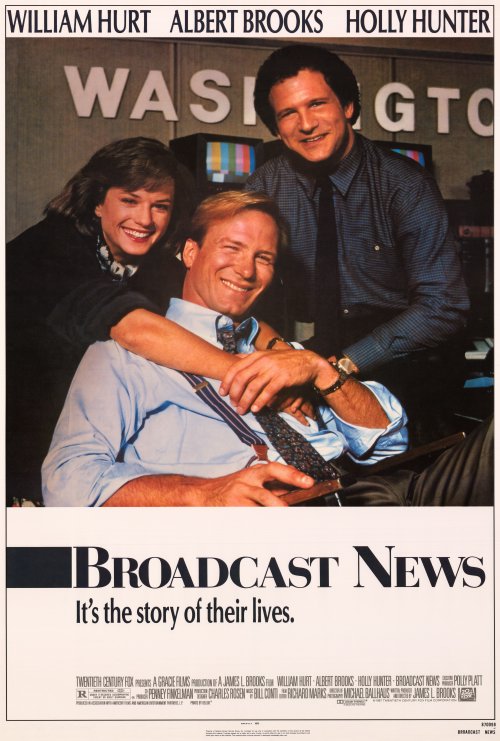
Jane (Holly Hunter) is a television news producer married to her work who breaks down crying when nobody is around. She starts falling for Tom (William Hurt) the good looking new anchorman even though he does not share her same drive or integrity. Aaron (Albert Brooks) is a behind-the-scenes news writer who wishes to get more exposure in front of the camera. Secretly he is in love with Jane and envies the budding relationship that he sees starting between her and Tom, but feels virtually powerless to do anything about it.

The film marks another tour-de-force effort by writer/director James L. Brooks who hits the nail-on-the-head in just about every scene when it comes to revealing the inner workings of a local TV newsroom. I found some of the procedures that are shown including how a producer can continue to feed the anchorman things to say through an earpiece even as he is live on the air and interviewing someone to be quite fascinating. From dealing with a harsh layoff of the news division to the extremes people are willing to go to get promoted prove to be quite insightful. Even the little things are interesting like watching two musicians (Glen Roven, Marc Shaiman) trying to plug their song as the new theme to the news show, which is probably the funniest moment in the movie.

Initially I was turned off by Hunter’s strong southern twang, you would think someone who wanted to make it big in Hollywood would’ve worked harder to soften that, but she gives such a strong all-around performance that eventually I was able to overlook it. I felt though that her character was more compelling when she was fretting about her work, which seemed almost like an obsession to her. Having her chase after a guy, who she really didn’t have much in common with anyways, was far less interesting. She seemed like someone who immersed herself in her job simply to avoid social contact and the film would’ve worked better had Tom been the one doing all the chasing.

Brooks was an odd casting choice. He’s a funny comedian and has done some great satires, but not someone who is warm and likable. The movie wants us to feel sorry for his character because he is always getting passed over both professionally and romantically, but I felt the opposite way about him.  His many sarcastic lines makes him seem bitter and vindictive and the way he screams at Jane to ‘get out’ when she confides with him about her feelings for Tom made him seem downright psychotic.

Director Brooks seems to have a personal vendetta against anchormen as his productions always portray then as being dumb and shallow most notably the Ted Baxter character in the ‘70s TV-series ‘Mary Tyler Moore Show’, which he also produced. In that show the character’s stupidity was clearly over exaggerated, but here Tom gets played with a believable balance as he’s is savvy enough to make up for his lack of intelligence by overcompensating on his image.

I loved how the film starts off with vignettes of the characters when they were kids and then ending it by revealing where they end up 7 years after the main story ends, but overall the plot lacks any major impact. The whole thing is just too gentile and needed another dramatic arch to give it more verve. Jack Nicholson appears unbilled as the station’s top anchor and I would’ve loved seeing him become a major player in the story as he owns every scene he is in especially the part where he enters the newsroom to offer his condolences to those who were laid-off.

My Rating: 7 out of 10

Released: December 16, 1987

Runtime: 2Hours 12Minutes

Rated R

Director: James L. Brooks

Studio: 20th Century Fox

Available: DVD, Blu-ray, Amazon Video, YouTube

Death Wish 4: The Crackdown (1987)

By Richard Winters

My Rating: 1 out of 10

4-Word Review: Vigilante battles drug dealers.

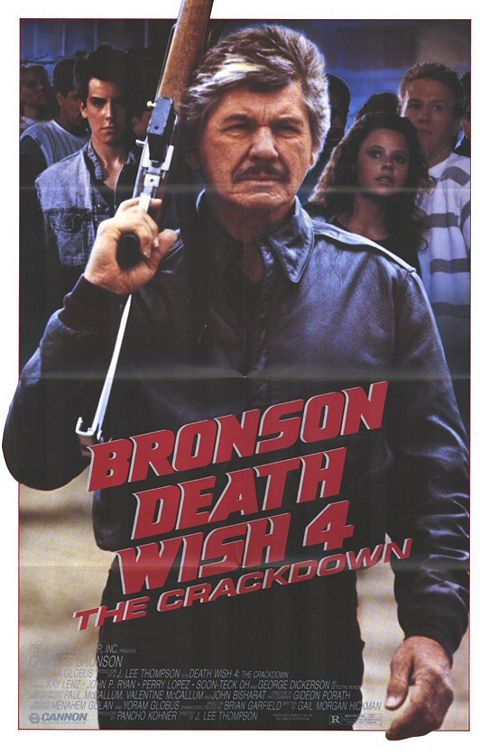
Paul Kersey (Charles Bronson) is now living in L.A. and in a relationship with Karen (Kay Lenz) who has a teen daughter Erica (Dana Barron). Erica wants to become an architect like Paul and interns at his office, but she is also dating a boyfriend (Jesse Dabson) who is into drugs. His friendship with a drug dealer gets Erica to experiment with crack cocaine, which ends up killing her. In a rage Paul returns to his vigilante ways by killing the dealer, which then gets the attention of billionaire Nathan White (John P. Ryan) whose own daughter also died from a drug overdose. He recruits Paul into tracking down the biggest dealers in L.A. and killing them, but Paul eventually realizes that Nathan has ulterior motives.

This was the first film in the series not to be directed by Michael Winner and instead the duties were handed over to J. Lee Thompson who had worked with Bronson on several other projects previously. The script by Gail Morgan Hickman tries to take the vigilante theme in a new direction and starts out with a diverting dream sequence in which Paul sees himself as one of the victims that he shoots, which brought up a potentially intriguing subplot involving the psychological pressures one must assuredly develop when they’re constantly killing people even if it’s for ‘justice’, but the film then never goes back to it, which was disappointing.

The overall scenario, which transports Paul from dealing with ordinary street gangs to sophisticated crime families, does not work and fails to give the already tired series a new breath of life. It no longer even resembles a vigilant theme at all, but instead becomes more like an episode of ‘Miami Vice’ but without the trendy attire.

Paul is no longer just an ordinary guy with a gun either, but instead has become a sort-of James Bond incarnate who uses with all sorts of elaborate weaponry and gadgets better made for a seasoned CIA agent. He’s also able to get himself out of just about any nerve-wracking jam like when he miraculously fights off over 20 men in warehouse who are shooting at him, or magically getting himself out of a car that he is driving just seconds before it’s riddled with bullets.

Bronson looks more like he’s 45 instead of 67 and matching him up with a young girlfriend makes him appear more virile, but you know right from the start that it’s only a matter of time before she ends up dying violently. It starts to seem like Paul Kersey is a walking, talking curse as anyone who befriends him turns up dead or like the cinematic version of Jessica Fletcher.

I kept wondering when it would all start catching up with him. How can he continue to work a regular job while still spending so much time tracking down the bad guys? When does he sleep? And exactly how many people does he have to kill before the police eventually nab him, or quit allowing him to walk away from it without consequence?

Unlike the first three films this one fails to elicit any type of message or statement. It seems simply intent at being a profit making venture to cash in on those who like mindless shootouts and car explosions and nothing more.

My Rating: 1 out of 10

Released: November 6, 1987

Runtime: 1Hour 39Minutes

Rated R

Director: J. Lee Thompson

Studio: Cannon Film Distributors

Available: DVD, Blu-ray, Amazon Video, YouTube