Category Archives: 80’s Movies

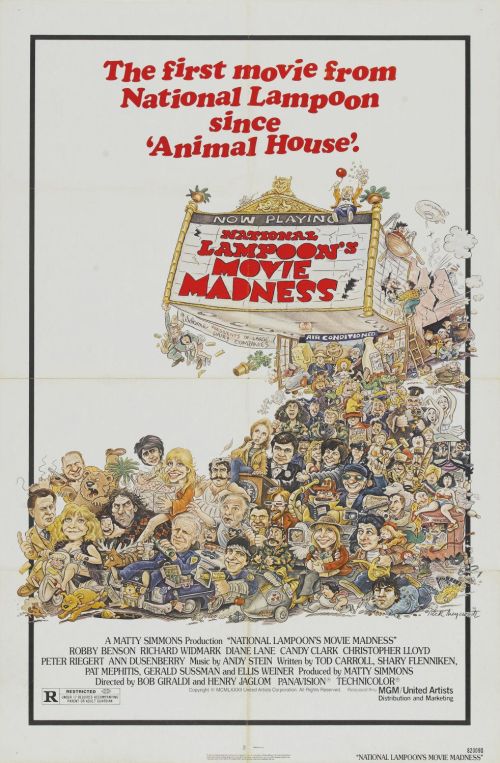
Movie Madness (1982)

moviemadness2

By Richard Winters

My Rating: 1 out of 10

4-Word Review: Three very unfunny stories.

If you’re ever needing to show someone why drugs aren’t a good idea there’s no reason to go back to that old TV ad with an egg frying in a pan that said ‘This is your brain on drugs’ instead you could simply show them this movie. Not that it pertains to drugs, or even mentions them, but it was done by people heavily on cocaine, the top drug of choice in Hollywood at that time, who were apparently so coked-up that they thought this movie was ‘hilarious’ even though no one else that saw it thought so.

With the success of Animal House National Lampoon’s was considered the big comic venue, so much so that United Artists gave them top-dollar, a whopping $15 million, to make another feature. In response National Lampoon brought together 5 writers, all of whom had written for their humor magazine, but had no screenplay experience, to compose the movie. The idea was to create 10 short vignettes that would make fun of a different movie genre, but this was ultimately too difficult, so it got pared down to just 4, with only three of them ultimately making it to the big screen. What’s perplexing is that the production values are good (I actually liked the opening song sung by Dr. John and the opening animation), there’s even some big name stars, but the material itself is unbelievably lame to the extent that it purportedly caused a test audience in Rhode Island to tear up their theater seats to show their disgust.

The first story, which is entitled ‘Growing Yourself’ stars Peter Riegert as a suburban father/husband who packs up his wife’s (Candy Clark) bags and tells her to leave so he can ‘grow’ as a person. Though confused with the reasoning she immediately obliges, but ultimately the husband finds raising the kids and finding a new more interesting career to be far more of a challenge then he expected.

The problem with this story, like with the other two, is that the characters and their motivations are unrelatable to real everyday people. For a story to work, even as satire, there still needs to be a connection to reality and this thing is too daffy. Even on a surreal level it goes nowhere and becomes simply a glimpse to weird individuals saying and doing stupid things with no intrinsic point at to it at all.

The second segment, entitled ‘Success Wanters’, suffers the same fate. It has to do with recent college grad Dominique (Ann Dusenberry) getting a job as a stripper, which almost immediately leads to her becoming heiress to a massive fortune of a margarine company when the owner (Robert Culp), who she was fooling around with, dies. This then leads to more affairs, and more money and ultimately even a relationship with the President of the United States (Fred Willard).

Again nothing that happens here has any bearing in reality, never in the history of the world has this happened to any college grad out there, especially in only a few days time. To be funny it still needs to make sense, but like with the first story you’re left scratching your head wondering what the point of it was although Dusenberry does look fabulous naked, both topless and bottomless, making catching it for that reason almost worth it.

The third and final segment, entitled ‘Municipalians’ has rookie cop Brent (Robby Benson) paired with jaded, crabby veteran Stan (Richard Widmark) as they go out to find a bizarre serial killer (Christopher Lloyd). Supposedly this was meant as a parody of the cop buddy movies, but too silly and over-the-top to be even slightly amusing. I will admit it’s fun seeing veteran star Widmark in such an odd project and his cantankerous ways is slightly engaging, including one moment when he’s caught reading Hustler magazine, but the story structure is faulty. It might’ve gotten a few more points from me had the scene where Benson and Lloyd start singing a duet of ‘Feelings’ and then had Widmark barge in to form a trio, but since that doesn’t happen this one like the other two fails miserably. It also ends with the camera focusing on Benson struggling to get up after he’s been shot several times, which comes-off as cruel like it’s making fun of someone who’s in pain, which I found disturbing.

There was a fourth segment entitled ‘The Bomb’ that starred Kenneth Mars and Marcia Strassman and was a parody of disaster movies, but when screened United Artists’ vice president of production found this segment to be ‘of an awfulness that made the whole picture look unreleasable’. so it got taken out. However, he did also find the first three stories to be ‘good, funny segments with high commercial promise’ making you wonder if he was coked-up on the white stuff too.

Alternate Title: National Lampoon’s Goes to the Movies

My Rating: 1 out of 10

Released: April 23, 1982

Runtime: 1 Hour 29 Minutes

Rated R

Directors: Bob Giraldi, Henry Jaglom

Studio: MGM/UA

Available: DVD-R (MGM Limited Edition Collection), Amazon Video, Tubi
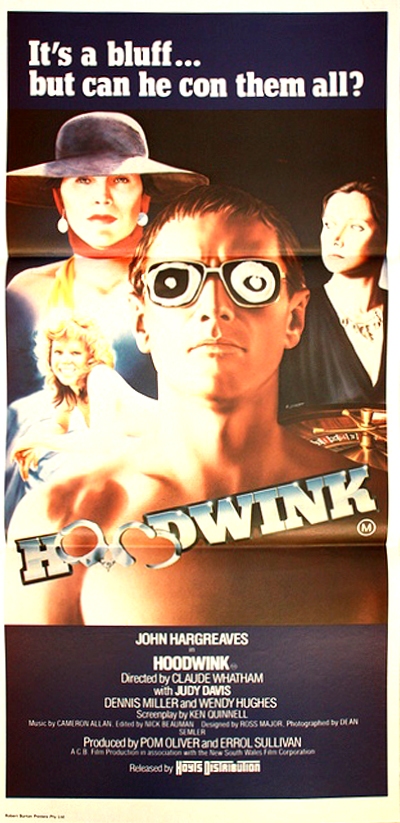
Hoodwink (1981)

hoodwink4

By Richard Winters

My Rating: 5 out of 10

4-Word Review: Pretending to be blind.

Martin (John Hargreaves) is in jail for bank robbery and with very little chance for escape he comes up with the idea of pretending to be blind, which he hopes will gain sympathy from the court and ultimately a lighter sentence. The con eventually pays off as he’s transferred to a minimum security prison with only a 3-year sentence to serve even though the Dr.’s who examine him are unable to determine if he’s faking or not and the guards within the prison believe he’s making it up and routinely set traps for him to fall into hoping it will will expose the lie. Things though get complicated when Sarah (Judy Davis), a minister’s wife, takes a liking to him, which allows him to leave the prison grounds during the day, so that he can, under her tutelage, learn to become self-sufficient with his handicap so that he’ll be prepared to live on his own in the real-world once he’s formally released. The two though fall-in-love causing her jealous husband (Dennis Miller) to threaten to come forward with Martin’s charade, which could put him in terrible jeopardy.

To some extent it’s hard to believe this could’ve happened, but it’s all based on the true story of Carl Synnerdahl, who was able to fool everyone that he couldn’t see for over 18 months while inside the Australian penal system and it allowed him, like with Martin, to be given special privileges that he wouldn’t have gotten otherwise. What perplexed me though was that testing someone’s so-called blindness should’ve been easy as you could act like you’re going to poke you’re finger into his eye real quickly and if he’d blink, or recoil his head, then you’d know he was able to see it and was a faker, and yet no one in this movie thinks to do that.

If you’re able to get past this issue, then it’s a fun movie most of the way. I liked the scenes shot at Bathurst Jail, the same prison that Synnderdahl was in, that has a very old-time jailhouse look and quality. I also enjoyed the sumptuous, sprawling countryside view from Sarah’s living room window that could beat or rival any one else’s. That acting is great too with Hargreaves able to create, despite all of his shenanigans, a sympathetic character. Davis though is the scene-stealer, she won the Australian Film Institute Award for Best Supporting Actress, as the sexually repressed wife who’s in constant flux about whether she wants to leave her situation, or stay faithful.

The drama though becomes less compelling when Martin almost immediately admits his ruse to Sarah, who then goes forward with it to her husband even though I thought him trying to pretend he was still blind with them in their house could’ve created some interesting dynamics that unfortunately never get played-out. The affair and her husband’s jealous rage is toned down instead of ramped-up causing the third act, which should’ve had a lot of fireworks, to fizzle. The couple had vast potential to being key players, but instead get treated more like ornaments that don’t throw as much of a monkey wrench into the proceedings as they should’ve, or that you’re expecting.

Spoiler Alert!

The conclusion, which is far different than what occurred in the real-life incident, has Martin stealing a car and escaping, but this leaves too many questions unanswered. Will he eventually get caught, which is most likely, and what happens to him then when the prison system finds out that they had been duped? These issues should’ve been examined and leaving it wide-open isn’t satisfying and I suspect the reason that lead to it doing poorly at the box office.

My Rating: 5 out of 10

Released: November 5, 1981

Runtime: 1 Hour 29 Minutes

Not Rated

Director: Claude Whatham

Studio: New South Wales Film Corporation

Available: DVD (Import Region 2)

Skin Deep (1989)

skin3

By Richard Winters

My Rating: 3 out of 10

4-Word Review: Womanizer tries to rehabilitate.

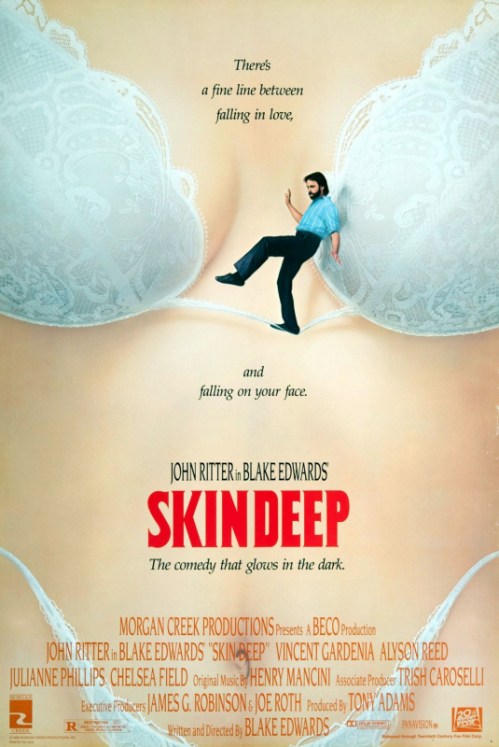
Zach (John Ritter) is a successful, best-selling author, but hasn’t written a novel in quite awhile and his constant philandering has gotten his wife Alex (Alyson Reed) to leave him. Depressed about his circumstances he becomes an alcoholic, but uses the advice of his kindly bartender (Vincent Gardenia) to try and win her back, but finds fighting his hedonistic urges to be challenging.

This marked Blake Edwards fourth film dealing with the mid-life crisis issue that started with 10 in 1979 and was followed up with S.O.Bin 1981 and then That’s Life in 1986. All four had a similar setting (Malibu/Hollywood) and involved middle-aged men at a crossroads in their career/marriages. When 10 came out it was considered ‘fresh’, but by 1989 the storyline was becoming quite redundant and came-off looking like Blake’s creative well had run dry. Edwards also exposes himself as being too entrenched in the Hollywood scene and out-of-touch with the middle-class lifestyle as Zach is never in any type of financial distress despite a career lull and having his mansion burn down (he wasn’t able to collect on the insurance money due to it being caused by arson) and yet still able to stay at posh beach houses and luxury hotels. In the end his only concern is his insatiable appetite for hot women, which ultimately comes-off as plastic problems for plastic people.

The women look too much alike, including Chelsea Field, who plays Amy and Jean Marie McKee who is Rebecca. Both of these women were brunettes, the same age, and with similar hairstyles and when seeing them from behind I thought they were the same person. Zach also states that he loves ‘all women’, but only beds the hot ones. The film tries to make-up for this by having him have a sexual encounter with a female bodybuilder (Raye Hollitt), but overall they still end up looking too much like the caricature of a Hollywood Hooker.

Even Ritter, as engaging as he usually is, flops here. A lot of it has to do with his beard, which I hated. I suppose they wanted him to look different from his more famous Jack Tripper character, but turning him into an image resembling the guy on the packages of Brawny paper towels wasn’t it. Since his character does go through a transition they should’ve had him start-out clean-shaven and then as his life goes into turmoil gotten the beard only to shave it off once things returned to normal.

Zach’s incessant whining at trying to win his wife back is what really got on my nerves the most. She was right to walk out on him and he didn’t deserve a ‘do-over’. Besides not everyone is going to find happiness in a committed relationship and, even though this might’ve been ahead-of-its-time for 80’s audiences, an alternative lifestyle would’ve been a better fit like having him get into polyamory, or sex workers. As mentioned the women all looked like hookers anyways and since he seemed to have a boundless cache of cash he could’ve easily afforded them.

I did like the glow-in-the-dark condom scene, which is the film’s only funny moment and happens at the 50-minute mark. Gardenia as the intuitive bartender is amusing too and I didn’t think there was any need for Zach to see an actual therapist as the bartender’s advice was just as good and much less costly.

There are a few bits that have not aged well including Zach’s penchant for kissing a bar maids without her consent and with him sitting on a small dog and seemingly killing it. Overall, I found it superficial and trite and the only successful thing about it is that it lives up to its title.

My Rating: 3 out of 10

Release: February 28, 1989

Runtime: 1 Hour 41 Minutes

Rated R

Director: Blake Edwards

Studio: 20th Century Fox

Available: DVD, Blu-ray, Amazon Video, YouTube

White Dog (1982)

white dog1

By Richard Winters

My Rating: 6 out of 10

4-Word Review: Dog attacks black people.

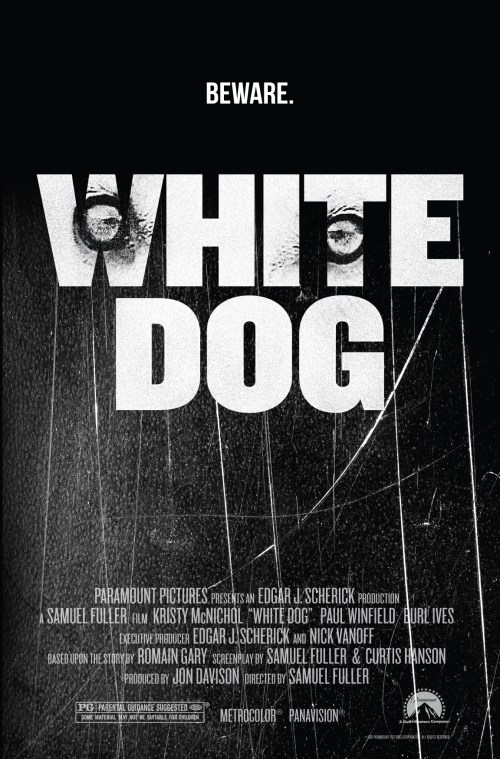
Late one night while driving home aspiring actress Julie (Kristy McNichol) hits a stray dog, which she takes immediately to an emergency vet. They find that his injuries were minimal and she’s allowed to take him home until his owner can be found. She soon starts to bond with the White Shepherd dog, who at one point saves her from a would-be rapist. She also becomes aware that he attacks black people when he goes after one of her African American friends unprovoked. She takes him to an elderly dog trainer named Carruthers (Burl Ives) who advised that the dog should be put to sleep, but another trainer named Keyes (Paul Winfield), who is black, wants to rehabilitate the animal, but finds this undertaking far more challenging than he initially expected.

The story is based on a real-life incident of novelist Romain Gary and his actress wife Jean Seberg, who during the early 60’s took in a stray dog that had previously been an Alabama Police dog, who they later learned, was trained to attack black people. Gary wrote about this experience in a short story that was published in Life Magazine in 1970 and this was eventually turned into a novel. The novel though incorporated many things that had not occurred in real-life, nor in the movie, including having the dog trainer being an angry black Muslim who gets the dog to start attacking white people including Gary himself.

The story rights were purchased by Paramount in 1975 with Roman Polanski set to direct, but when he was forced to flee the country due to statutory rape chargers the projects was put on hold. Then after the success of Jaws producers decided to turn it into a ‘jaws with paws’ storyline with the racism angle taken out, but when director Samuel Fuller was signed on he returned the plot to its original theme, which caused controversy when the NAACP, without ever having seen the film, accused it of being ‘racist’, which frightened Paramount executives enough that they gave the movie a very limited engagement with no promotion, which led to it recouping only $46, 509 out of its original $7 million budget. Despite eventually getting released on VHS and shown sporadically on cable outlets such as Lifetime, it languished in obscurity until finally getting a DVD/Blu-ray issue in 2008 where it’s now seen in a totally different light.

For me the biggest problem is the hackneyed drama starting with the dopey way the dog gets hit by a car and yet miraculously healed enough to go home that very same night and never showing any lingering injuries. The potential rape scene is too manufactured as well as it has the rapist magically appearing in the apartment without showing how he broke-in and later having one of the cops state that he had just arrested the same guy earlier that year for another rape attempt, so if that’s the case then why wasn’t he still in jail? It also has the dog sleeping as the bad guy sneaks in, but I’ve found dogs have a keen sense of awareness and would’ve heard the guy trying to bust in and growling or barking long before he actually made it into the apartment. Having Kristy go on a late night jog with the dog and then being chased by a masked assailant, which the dog would scare away, would’ve been a better way to have done it.

I also didn’t like the part where Kristy meets the dog’s owner and he openly admits to training him to attack black people, which to me didn’t seem believable. I liked the idea of having the owner being this seemingly kindly old man, played by Parley Baer best known for voicing the Keebler Elf, that you’d never expect as being someone who’d train an animal to do such a thing. However, freely admitting this to a stranger is like a murderer admitting to their crime. Most won’t fess up because they know it would get them into a lot of trouble if they did. Movies should also not be obligated to explain everything and like in real-life should leave a few things open-ended. When Kristy accuses him of this he could reveal a funny look on his face, giving the viewer insight that he most likely was guilty, but then have him verbally deny it like most people would.

While I could’ve done without the slow motion and booming music I did find the dog’s retraining sessions with Keys to be the film’s best moments and Winfield’s strong presence is excellent. However, trying to use a dog as a metaphor to racism doesn’t really work, nor hold-up to logic. Winfield explains that the dog was most likely beaten by a black person hired by a white man to get the dog to become the way he does, but I don’t think this could be achieved as the dog would just hate that one individual and not connect it to the man’s skin color unless he was abused by a whole group of black people. We’re also told that the dog does not hate black people he just fears them, but if that’s the case then why does he go out of his way to attack and kill them. Animals will only go on the attack if they feel threatened, but if the perceived threat keeps their distance then the dog shouldn’t feel the need to be aggressive making the blood splattering attacks that the dog does come off as quite over-the-top.

white dog2

My Rating: 6 out of 10

Released: November 12, 1982

Runtime: 1 Hour 30 Minutes

Rated PG

Director: Samuel Fuller

Studio: Paramount

Available: DVD/Blu-ray (Criterion Collection)

The Pirate Movie (1982)

pirate2

By Richard Winters

My Rating: 1 out of 10

4-Word Review: Nerd dreams of pirates.

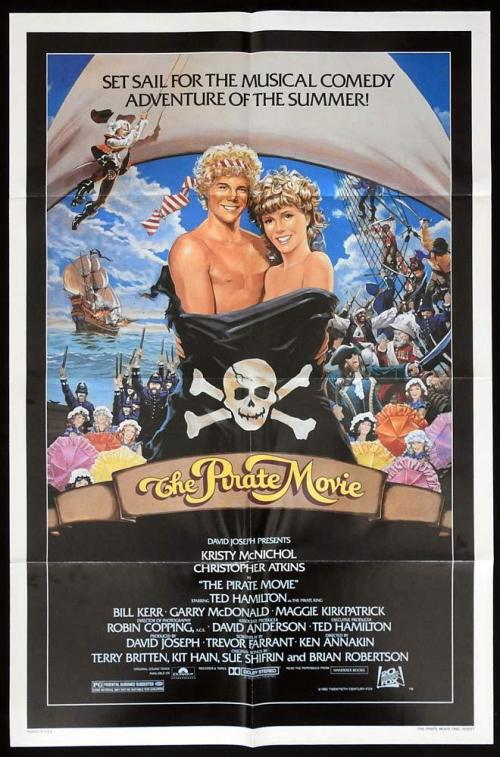
Mabel (Kristy McNichol) is a nerdy girl living in Australia as an American exchange student who does not fit-in with the three sisters (Kate Ferguson, Rhonda Burchmore, Catherine Lynch) of her host family. One day the four visit a sword play demonstration being put on at a local festival. All four immediately become infatuated with Frederic (Christopher Atkins) the handsome swordplay instructor who later on invites them on a boat ride except the sisters don’t want Mabel to come along, so they untie the boat from the dock before she can board. Mabel then rents another boat to catch-up to them, but gets caught in a storm and washed up to shore in an unconscious state where she has a dream about a crew of 18th century pirates lead by The Pirate King (Ted Hamilton) who cast Frederic off their ship when he refuses to become a pirate like them. Frederic then washes up to shore where he meets Mabel and her sisters, but this time the sisters are all nerdy while Mable is the beautiful maiden that he immediately falls in love with. However, they must also avoid the clutches of The Pirate King and his men who also come to the island looking for women to kidnap.

The story is loosely based the the Gilbert and Sullivan operetta from 1880 called The Pirates of Penzance, but jacked-up with a lot of campy comedy and modern day, teeny-bopper songs that, unless you’re really into 80’s cheese, makes it an almost excruciating experience to sit through. I don’t mind some campiness, but there still needs to be an exciting plot and a story that has a sense of adventure and even a few moments of tension for balance, but all this thing has is one lame gag after another. There’s also a ton of anachronisms including an Inspector Clouseau-type character and even light sabers that have absolutely no place in a movie set in the 18th Century.

The dream concept gets poorly played-out as this is supposedly Mabel’s, but when a person is having a dream then everything is from their perspective and they’re involved in someway with everything that goes on in it and yet here there’s a great number of scenes where Mabel isn’t even present. She also mentions at one point that since this is ‘her dream’ she wants a ‘happy ending’, but people don’t usually know they’re dreaming while they’re having it and only become aware after they’ve awaken.

Kristy is much more entertaining in the nerd role (she looks literally like Peter Billingsley from A Christmas Story) and she should’ve remained in that character and then earned her way into becoming a beautiful, confident women at the end instead of having her change over to one in a split second like here. Atkins is amusing simply because he has a big-brawny body with the high-pitched voice of an 8th grader though his poor acting, which at first works since the movie itself is bad, eventually got on my nerves.

The only funny bits are the behind-the-scenes outtakes that get shown during the closing credits although Ted Hamilton, who also served as the executive producer, does have a few amusing moments even though as the villain he’s too hammy.

Spoiler Alert!

The romance I didn’t like because it happens too quickly as romances are more interesting when there’s a challenge to overcome and since Frederic had no experience with women many funny awkward scenarios could’ve been incorporated, but aren’t. What really annoyed me is that when Mabel does finally wake up Frederic is right there, almost like magic, and kisses her, so they fall in love just like in the dream, but what’s the use of having a dream concept if the reality is going to play-out in exactly the same way? Could’ve been funnier had they gotten together only to eventually realize they couldn’t stand each other, which would’ve added a smidgen of reality that this otherwise vapid thing is sorely missing.

My Rating: 1 out of 10

Released: August 6, 1982

Runtime: 1 Hour 38 Minutes

Rated PG

Director: Ken Annakin

Studio: 20th Century Fox

Available: DVD

Tulips (1981)

tulips1

By Richard Winters

My Rating: 1 out of 10

4-Word Review: Choosing love over suicide.

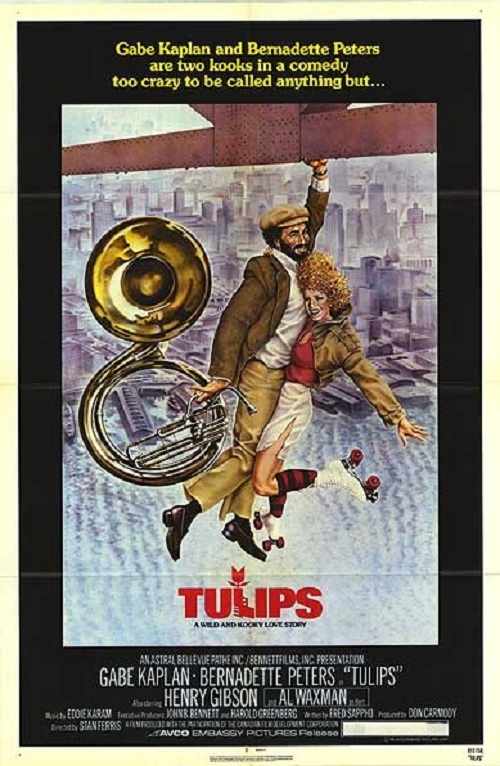
Leland (Gabe Kaplan) is a depressed man who has tried to kill himself several times, but been unsuccessful at it. He hires a hitman named Avocado (Henry Gibson) to shoot him, but Avocado isn’t so sure he wants to do it and advises him that once he decides he’ll leave an ad in the personals section of the newspaper with the word ‘tulips’ in it, which will be the code word for ‘yes’. While Leland awaits his fate he meets Rutanya (Bernadette Peters) who he saves from a burning car after she too tries to kill herself. Eventually they form a relationship, which blossoms into a romance and then marriage only to realize that Avocado has decided to go through with the hit forcing Leland and Rutanya to desperately try to stop him.

While I’ve never been a fan of Kaplan’s acting ability in the past I thought his performance here was alright although the combination of his thick beard and mustache makes him resemble a rabbi and a clean shaven look would’ve been preferred. It’s also a bit perplexing with his extremely bushy head of hair why he would require hair transplants as his character does here.

Peters is delightful, at least at the beginning, but when the two get together the whole thing bogs down into one long  talkfest with nothing much being said that’s funny. The way the two first meet gets botched as initially she bumps into him while roller skating down the road, while also grabbing onto her psychiatrist’s car, which knocks Leland over a bridge wall and he then clings desperately to it in order to avoid falling into the river, but the film then cuts away and we never see how he got out this predicament making it on par with a mindless Road Runner/Wiley E. Coyote cartoon where crazy antics occur without any after effect.

The hit man angle where the intended victim changes his mind had already been done in movies 6 times before this one and therefore wasn’t an original concept nor does it get played-out in a way that’s interesting. Gibson is a good character actor, but here his one-dimensional performance, due mainly to the poor writing, lacks amusement or charisma. There’s also never any action just endless talking, first with an extended bit where Leland contemplates whether he should or shouldn’t look in the newspaper to see if ‘tulips’ is in it, then more discussions about how they can try to stop him and eventually Rutanya sitting down with Acocado directly to try and talk him out of it, which cinematically is not entertaining especially with dialogue that lacks any bite.  The music score is bad too with a silly cartoon-like sound effects that you’d hear on a kiddie show.

Spoiler Alert!

However, it’s the twist ending that I found to be the most annoying as it features a bomb placed by Leland into a car with Avocado and Rutanya inside. First there’s no explanation for how Leland was able to build this bomb as it’s not something just anyone can do, so one has to wonder where he acquired the expertise, but no answer is given. The dumbest thing though is that Leland chases after the vehicle screaming at Rutanya to get out before it goes off and then watches as it explodes convinced she died only to have her reappear later telling him that both she and Avocado where able to get out ‘just in time’, but if that were the case then wouldn’t Leland have noticed since he was looking right at it when it blew up? Also, when the bomb goes off the car doors are shut though it’s hard to believe that Avocado and Rutanya, in their desperation to get out, would’ve made sure to close them when they jumped out.

My Rating: 1 out of 10

Released: September 25, 1981

Runtime: 1 Hour 32 Minutes

Rated PG

Director: Rex Bromfield, Al Waxman, Mark Warren

Studio: AVCO Embassy Pictures

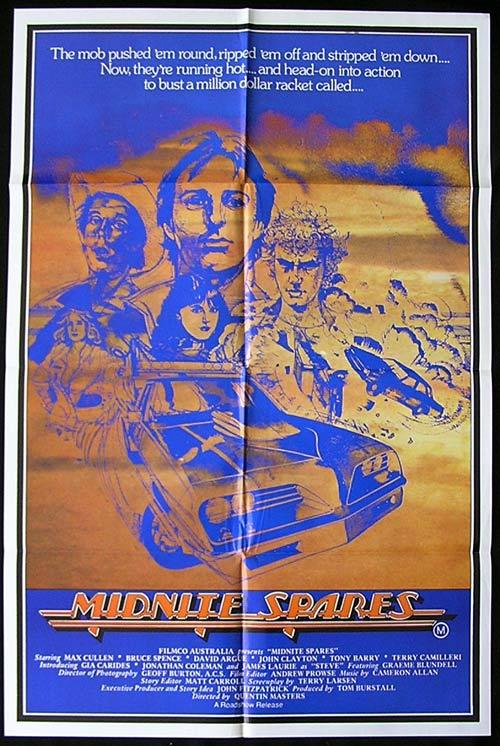
Midnite Spares (1983)

midnite2

By Richard Winters

My Rating: 6 out of 10

4-Word Review: Searching for his father.

Steve (James Laurie) returns to his hometown of Sydney to team up with his dad to be a part of a sprintcar racing team. However, when he visits the towing company that his dad owned along with his business partner Tomas (Max Cullen) he cannot find him and is told that he mysteriously disappeared weeks ago without a trace. After further investigation he becomes convinced that it has something to do with a local car thief ring headed by corrupt cop Howard (Tony Barry) and uses the help of tow truck drivers Wimpy (Bruce Spence) and Rabbit (David Argue) to reel them in while also falling for a local girl named Ruth (Gia Carides) much to the chagrin of her conservative mother ( Tessa Mallos).

On the one hand this is a well set-up comedy with all the necessary ingredients to have been a top-notched funny movie. I really enjoyed the character actors who are in top form especially Bruce Spence, probably best known for his starring role in the cult film Storkwho plays a happy-go-lucky mechanic who always has greased caked-on his face no matter where he goes even when off the job and out in public. Tony Barry gives an interesting performance as well. Just a year before this film was shot he in starred in the New Zealand cult classic Goodbye Pork Pie that’s one of the best road movies ever made. In that film he played the nonconformist running from the cops while here plays the obnoxious oppressive authority figure and he’s able to play both types of roles quite convincingly. I also enjoyed the set pieces, which resembles very much the dingy, grimy look of a car repair shop as well as the distinctive score that has a creepy tone to it, which helps accentuate the late-night, underground vibe of the story.

There’s also a few very engaging moments as well including a segment where a guy hijacks a mobile hot dog stand and drives it around the track with the perplexed staff still inside while the sprintcar race is delayed due to an accident, which is pretty funny. I also loved the scene where the thieves steal a car, bring it into their shop and in a matter of literally seconds are able to completely dismantle it piece-by-piece until only its bare shell is left much like the famous scene in The French Connection where a car gets taken a part in the search for drugs, but here it’s done even more quickly and thoroughly.

What I didn’t like was the editing, which is done in too much of a choppy style. It’s very hard to get into the characters when their scenes and conversations are limited to only a couple of minutes and a few lines of dialogue before it quickly cuts away to another scene somewhere else. It would’ve worked better had it slowed the pace down a bit and allowed the elements to percolate instead of having this rushed feel. There’s also a some storylines that had potential, but aren’t followed through enough including the conservative mother of James’s girlfriend, which could’ve been ripe with far more confrontation than it ultimately does.

The action gets captured in too fleeting of a way and there isn’t as much of it as you’d expect despite its reputation as being an action movie. The climactic car chase showdown is too brief though it does feature some good camera angles that makes the viewer feel like their a part of it, but this also ended up taking the life of one of the cameramen, David Brostoff, who got too close to one of the cars and ended up getting run over. (The footage that he shot was left in while the movie is dedicated to his memory)

As crazy as it sounds it also would’ve been nice had it come with an English subtitle option. While the language is in English the Aussie accents are strong and it’s not always completely clear what they’re saying. I felt like I was missing a few words here and there especially with its quick pace where an actor would say a short line and then there’d be an immediate cut to something else.

My Rating: 6 out of 10

Released: February 17, 1983

Runtime: 1 Hour 27 Minutes

Not Rated

Director: Quentin Masters

Studio: Roadshow Films

Available: DVD-R (Domestic Import Region 0)

The Seduction (1982)

seduction1

By Richard Winters

My Rating: 2 out of 10

4-Word Review: Anchorwoman stalked by photographer.

Jamie Douglas (Morgan Fairchild) is a successful Los Angeles news anchor in a long-term relationship with her boyfriend Brandon (Michael Sarrazin). Living close-by is Derek (Andrew Stevens) a photographer who has become obsessed with her after viewing her from afar through his binoculars. He begins giving her unwanted phone calls that soon turn into menacing fan letters. He follows her where ever she goes and even breaks into her home, but nothing seems to scare him away and the police are unable to do anything about it. When his behavior becomes even more threatening Brandon buys Jamie a rifle and advises her to use it, but Jamie is initially not thrilled with the idea.

This is writer/director David Schmoeller’s second feature film after doing the highly overrated Tourist Trapwith this thing, despite a much bigger budget, being not much better than that one. Casting Fairchild in the lead is one of the bigger problems as she has too much of a cold, bitchy persona about her, even when she’s not trying to, that just doesn’t make her the type of person a viewer can warm-up to, or want to root for.

Derek, as the psycho, is a poorly fleshed-out character where it’s never clear why he’s propelled to stalk Jamie in the first place. Why is this good-looking guy, who seems to be making good money, and owns a nice house, so obsessed with a blonde news lady when there’s already a good-looking blonde named Julie (Wendy Smith Howard) whose shown an interest in him? Some may argue, as it gets alluded to near the end, that Derek is impotent, but if he can’t get it up for other women then why would he be able to do it with Jamie? If the answer is that he can only achieve erection through violence and control then there needs to be an explanation for what traumatic experiences in his life, or personality quirk, have brought him to become that way.

It’s also really annoying how Derek is able to constantly break-in to Jamie’s house and into her place of work without ever being impeded, or caught. You’d think with the amount of harassment he’s given her she’d make sure to bolt every door and lock every window and yet he’s able to somehow continually pop-in all the time without any hassle. It’s like he’s Barbra Eden from ‘I Dream of Jeannie’ and can just blink his way in as that’s pretty much what it comes-off looking like.

Schmoeller’s inept direction ruins any suspense. Case-in-point is when Jamie is inside her home reading a letter and the camera zooms into a broken trinket sitting on her beauty stand that had been clearly placed there by Derek earlier. Instead of allowing the tension to simmer, by leaving the viewer in the dark as to whether Derek was still in the house or not, Schmoeller instead cuts right away to show Derek hiding in the closet, so when he does finally jump out and frighten Jamie the viewer is not startled at all because we’re already expecting it. Same thing happens when Jamie is live on-the-air and reads a creepy message written by Derek on her teleprompter. It would’ve been far more of a shock to the viewer had we not seen Derek sneak in to write the message earlier and instead shared Jamie’s point-of-view and seeing it for the first time as she reads it.

Spoiler Alert!

The ending is where it jump-the-shark when Derek somehow stabs Brandon, who is in a hot tub, in the back with a kitchen knife used to cut apples. Hard to believe that type of knife would be sharp enough to stab someone with and even harder to imagine that Derek was able to do it by standing on the edge of the tub and throwing it through the air towards Brandon with such perfect aim and impact that it penetrated his back and kills him instantly.

He then allows Jamie to get out of the tub, she was in it when Brandon got knifed, and get dressed while Derek goes off to bury Brandon’s body, but why does he feel the need to bury the body and why isn’t he afraid that while he’s away she’ll use this time to either call the police, or escape to a neighbor’s house? Having Jamie finally use the rifle and attempt to shoot Derek with it leaves open a few plot holes as well as she made clear earlier that she didn’t like the idea of the gun making it seem that she had never used one, so when she finally does you’d think she’d be unable to correctly work-it.

The original ending had the police chief, played by Vince Edwards, coming in at the last second and blowing Derek away, but the studio didn’t like this version so it got changed to where Julie kills Derek instead, but I didn’t like this either. Derek is Jamie’s problem, so it’s up to her to finish him off. My version would’ve had Jamie immediately run into the house and grab the rifle after Derek kills Brandon and then while still nude chase Derek, with rifle in hand, back to his house where she would finally riddle him with bullets. The final shot would’ve had her sitting nude on Derek’s sofa smoking a cigarette while Derek’s dead body lay at her feet. A voice-over of her reading the news story as an anchorwoman of what had occurred would then be heard.

My Rating: 2 out of 10

Released: January 22, 1982

Runtime: 1 Hour 44 Minutes

Rated R

Director: David Schmoeller

Studio: AVCO Embassy Pictures

Available: DVD, Blu-ray, Amazon Video, YouTube

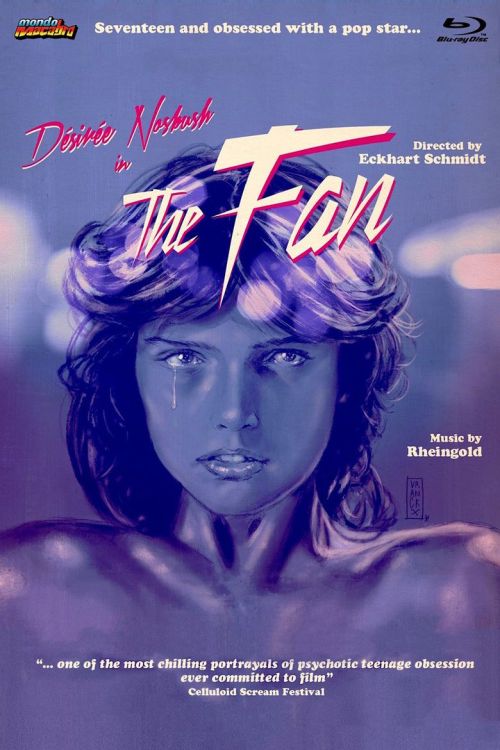
Der Fan (1982)

derfan4

By Richard Winters

My Rating: 8 out of 10

4-Word Review: Rock idol infatuates teen.

Simone (Desiree Nosbusch) is a beautiful teen who harbors an unhealthy infatuation for a rock singer known only as ‘R’ (Bodo Steiger). Even though the two have never met Simone is convinced that they share a deep bond and she writes him fan letters all the time, but never receives a response. She travels to a TV-station where he’s expected to film a music video in hopes of meeting him and starting a romance. During an autograph session R spots Simone and immediately becomes riveted to her beauty and later takes her to an excluded country home, so that he can make love to her. Once the sex is over he proceeds to leave to visit with other friends, which enrages Simone and leads to a psychotic outburst.

The film, to a certain extent, is a refreshing change-of-pace to the usual stalker formula in that the beautiful woman is not the victim here, but instead the perpetrator. The part gets wonderfully portrayed by Nosbusch whose icy cold gaze, which she exudes the whole time, burns right through the screen making her creepy from start to finish. While it’s nice not having her fit into the mold of someone who is fat, lonely, and homely like the Kathy Bates’ character in Misery statistics have shown female stalkers of celebrities predominantly reflect the characteristics Bates has more than Simone’s, which is why they’re having romantic delusions over celebrities to begin with because they’re unable to attain these types of relationships in real-life.

This then brings out the film’s fatal flaw, which is that there’s no explanation for why Simone is this way. If she had an abusive home-life you could reason she turned to a fantasy world in order to cope with her harsh surroundings, but there’s no sign that this was the case. It’s not like she can’t find any boyfriends either as there are people around her who make attempts to be friendly, but she coldly rebuffs them. So, why is she so crazy? What is there about this particular rock singer that gets her so infatuated with him and what is missing in her life that she flies so far off the deep-end? None of these questions get answered. It’s almost like writer/director Eckhart Schmidt didn’t bother to think any of this through, or even care to. He simply came up with a bland prototype of a teen psycho to help propel the plot along without ever bothering to fill-in any of the necessary details.

Spoiler Alert!

While the film is quite weak in that area, saved only by Nosbusch’s excellent performance, it does make-up for it with its incredible, over-the-top ending, which had even me, a seasoned cinephile who’s essentially seen it all by now, in shock. It’s not that it’s particularly gory, even as she cuts the guy up into pieces and then proceeds to eat him limb for limb before grinding up his bones, but more for its sheer audaciousness. If anything the gore could actually have been played-up more as the blood is lacking, you only see a couple streaks of it on the floor while it should’ve been sprayed all over the place. Seeing the room drenched in it would’ve made the horror all the more shocking though her licking the bloody blade does lend a twisted erotic touch.

What I admired though was how it clearly wasn’t concerned if it achieved mainstream acceptance, or not. There is simply no way a film like this could’ve been made in Hollywood whether it was 1982 or today, as the studios wouldn’t touch it. Too many producers would fear potential backlash, which in turn would hurt profits, but for me this is what true movie making should be all about. Challenging mainstream viewers out of their comfort zone and taking them to a place they thought they’d never go and doing it in such a fluid way that they don’t know what’s coming until it’s too late, which is what really makes this one memorable.

My Rating: 8 out of 10

Released: June 4, 1982

Runtime: 1 Hour 32 Minutes

Not Rated

Director: Eckhart Schmidt

Studio: Scotia International

Available: DVD, Blu-ray

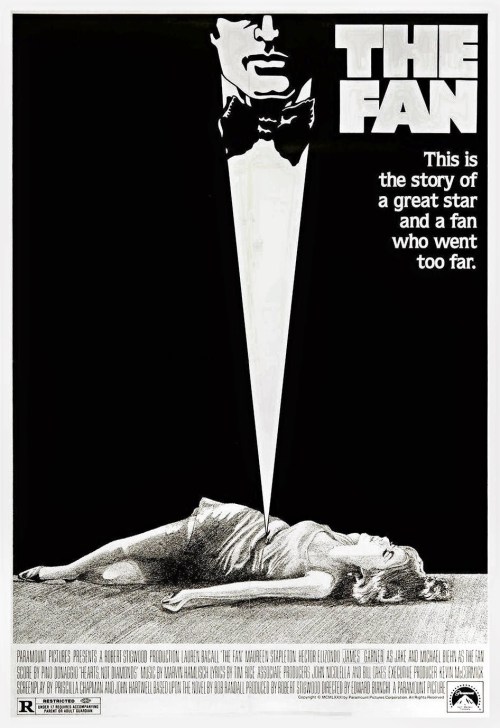
The Fan (1981)

By Richard Winters

My Rating: 6 out of 10

4-Word Review: Obsessed fan stalks actress.

Douglas Breen (Michael Biehn) has become obsessed with aging film actress Sally Rose (Lauren Bacall) and wants to meet her. He begins by writing her fan letters, but Sally’s secretary Belle (Maureen Stapleton) intercepts them and sends an autographed picture of Sally in return, which gets Michael seething as he wanted a personal response from Sally instead. His letters become more frequent and threatening. Eventually he decides to injure Belle in order to get her out of the way as well as kill anyone else in Sally’s life, so that he can meet with Sally unimpeded and have her all to himself.

One of the quandaries that I had was the casting of Bacall who I felt was too old for the part. I realize that in the Bob Randall novel of the same name, which this film is based, the actress character was also an aging Hollywood star, but as stalking has become more prevalent since this film was released, it’s been shown that stalkers prefer younger, more attractive women with a ‘virginal’ appeal and who they feel they can better control or ‘possess’. With Bacall, and her very feisty personality, you don’t get any of that. She’s also supposedly playing someone who is 49, but looks more like 60 and was actually 56 when it was filmed. While I got more used to her as the film progressed, the script doesn’t take enough advantage of her patented bitchy side, and except for one brief spat with her secretary, her presence is too benign.

The real waste though came from James Garner, who’s given a bland part that doesn’t help propel the story in any way. Originally when the film was first released and I saw his name in the credits I thought he was the stalker, which would’ve been interesting as he’s rarely ever played a bad guy, so it would’ve been intriguing seeing him thrown out of his comfort zone, but unfortunately that ends up not being the case.

Biehn is certainly a good actor although his psycho character in the TV-Movie ‘Deadly Intentions’ is far more interesting than the one he plays here. His weapon of choice, a shaving razor, is not visually intimidating enough and the victims die too easily by slumping over dead after just one quick cut across the chest. The scene where he stabs and kills a guy by swimming underneath him in a public pool is well shot, but implausible as there were so many other people around, including in the pool that it seemed hard to believe that Biehn would’ve been able to escape undetected.

Director Ed Bianchi, who directed a lot of award-winning commercials before doing this, reveals a stylish flair and I enjoyed the way he captures New York particularly the urban cafes and city streets, but the plot itself offers few surprises. Ultimately it would’ve worked better had the identity of the killer been left a mystery until the very end. This way the tension would’ve mounted as the viewer would remain in the dark as much as Sally as to who actually was after her.

Spoiler Alert!

The climactic sequence has Bacall confronting Biehn all by herself while trapped inside an otherwise empty theater. Bacall doesn’t respond to things the same way a conventional female might by screaming, which is great, and she also literally tells the guy off right to his face just as he’s about to stab her, which is great too, but the way she props up his dead body into a theater seat seemed bizarre. Why would she bother doing this? Just leave the dead body lying on the floor and run for help. Seeing the bird’s-eye shot of the killer lying there would’ve looked creepier and instead of a voice over of him reading the first letter he sent her have another letter written by another obsessive fan read and thus creating the double-ending famous in a lot of 80’s slasher flicks where you think the threat had been defeated, but was actually still out there in another form.

My Rating: 6 out of 10

Released: May 15, 1981

Runtime: 1 Hour 35 Minutes

Rated R

Director: Ed Bianchi

Studio: Paramount

Available: DVD, Blu-ray, Amazon Video, YouTube