Category Archives: 70’s Movies

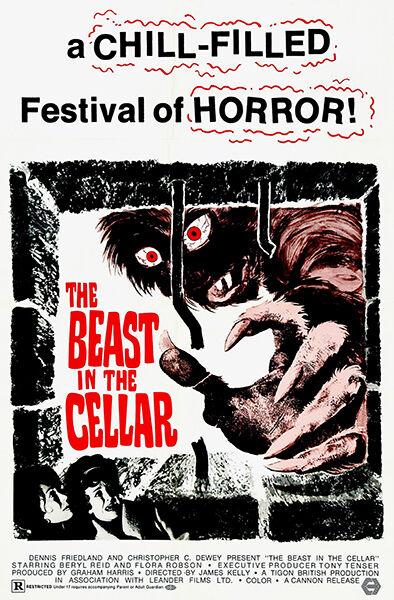
The Beast in the Cellar (1971)

By Richard Winters

My Rating: 4 out of 10

4-Word Review: Elderly sisters harbor prisoner.

Soldiers throughout the English countryside are being gruesomely murdered by what seems to be some wild beast, but the authorities have no idea what type of creature it is, or where it came from. Ellie (Beryl Reid) and Joyce (Flora Robson) are two elderly sisters living together in an isolated rural home, who fear they may know the answer and it has something to do with a dark family secret that lies imprisoned in their basement.

The film’s perceived charm revolves around the casting of two legendary actresses in offbeat roles where they at times come-off both as antagonists and the anti-heroes. Reid is especially interesting because here she’s a child-like individual while just a few years earlier she was a controlling, domineering woman to Susannah York’s child-like one in The Killing of Sister George, so seeing her able to play both parts effectively is fun and impressive.

The banter between the two though needed to be played-up more and I was expecting, given the storyline, more of a campy, dark humored tone, which really never manifests. The dialogue gets too extended, as the women do nothing, but pretty much talk, talk, talk until it seemed to be almost a filmed stageplay with the camera locked in the house and nothing visually stimulating to captivate the viewer.

The scares consist mainly of a handheld camera swinging back and forth  in an apparent attempt to replicate the beast attacking the victim, which ends up being more dizzying and amateurish looking than frightening and the fact that this technique gets done with each attack makes it quite derivative. It would’ve been better had the attacks not been played-out at all, but instead simply revealed the mangled. bloody body afterwards. The film also makes the tacky error of portraying the eyeball, which gets gouged out on one victim, as being shaped like a ping pong ball, which is probably what was used, when in reality it is more oval shaped.

A good horror film should have a frightening image to latch onto, but here that’s lacking despite a few prime opportunities where one could’ve been implemented. Reid’s retelling to the police inspector about the backstory dealing with their basement prisoner has some interesting cutaways making it the best part of the movie, but no shot of the shell-shocked, war weary father even though he’s an integral component to the plot. The ultimate reveal of the beast is highly disappointing in a climactic finish that completely fizzles, which makes sitting through this not worth your time.

My Rating: 4 out of 10

Released: April 14, 1971

Runtime: 1 Hour 28 Minutes

Rated R

Director: James Kelly

Studio: Tigon Film Distributors

Available: DVD, Amazon Video

Happy Mother’s Day, Love George (1973)

By Richard Winters

My Rating: 3 out of 10

4-Word Review: Searching for his father.

Johnny (Ron Howard) is a young man who arrives in a small seaside town searching for the identity of his parents. After speaking with the various eccentric personalities that live there he come to the determination that a waitress at a local cafe named Ronda (Cloris Leachman) is his mother, but she refuses to divulge who the father is and he begins to suspect that the secret may lie in the strained relationship that she has with her sister Cara (Patricia Neal).

It’s hard to tell what motivates people to take on certain projects. Darren McGavin had a great career in front of the camera, but this remains outside of a few TV episodes that he did, his only foray as a director. Yet it means little as the story is quite pedestrian and moves at a slow pace making it seem more like a drama and it takes until the third act before there are any chills at all.

The on-location shooting, which was done in the seaside towns of Mahone Bay and Lunenburg that are both situated in the Canadian province of Nova Scotia, is quite scenic and it almost seemed like McGavin and his crew had access to the entire town as the camera follows Howard walking up and down the residential streets while homeowners stare out their windows at him at each house that he passes. If this was a film specializing in the New England vibe it would be a success, but as a horror film the plot progresses too slowly and by the time the mystery finally gets answered you really don’t care  anymore.

The eclectic cast is interesting and really the only reason to watch it. Bobby Darin, in his last film, shows great potential as a feisty short-order cook, but his screen time is painfully limited. Neal gets in a few snarky remarks, but not much else and Leachman essentially channels the same character that she played in The Last Picture Show.

The one that gets the showiest part is Tessa Dahl who was Neal’s daughter in real-life and looks almost exactly like her to the point that I initially thought she was Neal at first. Her British accent helps add some flair as does her knife-wielding finish. Even more ironic is the fact that she has grown in recent years to suffer serious mental health issues much like her character.

As a novelty this film, which was reissued as Run Stranger Run, might be worth checking out just to see Opie with dark brown hair instead of his trademark red, but as a horror flick it lacks punch and has very little scares.

Alternate Title: Run Stranger Run

Released: August 17, 1973

Runtime: 1 Hour 30 Minutes

Rated PG

Director: Darren McGavin

Studio: Cinema 5 Distributing

Available: VHS

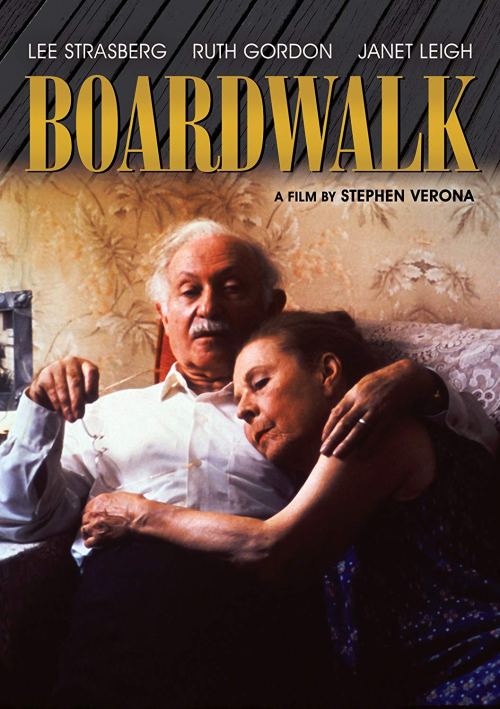
Boardwalk (1979)

By Richard Winters

My Rating: 4 out of 10

4-Word Review: Gang terrorizes elderly couple.

David and Becky (Lee Strasberg, Ruth Gordon) are an elderly couple who spent their entire lives living on Coney Island, but find that their once nice neighborhood has been overtaken by a street gang lead by Strut (Kim Delgado) who demands money from David for ‘protection’. When David refuses to comply it causes Strut and his gang to go on an unrelenting terror campaign where they not only evade David’s home and scare Becky, but also destroy the synagogue where he worships.

The film has a nice independent feel to it and I enjoyed the way the neighborhood’s of Coney Island, many of them with old and picturesque homes gets captured, but this also proves problematic because the area comes off looking too nice to be marred by gangs. In order for the plot to make more sense the couple should’ve been living in a rundown tenet building in an extremely bad part of town instead something looking straight out of a Norman Rockwell painting.

The gang itself is laughable and outside of their campy looking leader seem to be made up of children no older than the fifth or fourth grade. The kids behave threateningly one minute and then get quickly scared off the next. The way they scurry off like a flock of frightened birds makes them seem not very street tough at all, but instead like a bunch of hellions with too much time on their hands and not enough adult supervision. I was also confused why they never get caught and thrown into juvenile detention since they commit most of their crimes in broad daylight for everyone to see.

The story doesn’t focus that much on their activities either as there are long segments in between the gang activities that deal instead with Becky’s cancer and David’s grandson Peter’s (Michael Ayr) rocky love-life, which is actually more interesting and made me believe that the gang storyline could’ve been cut out completely and the movie would’ve been better off for it.

Strasberg, gives a good performance though he’s a bit too serious and probably unable to play a comedic role, or be funny even if he wanted to. Gordon is okay too, despite the fact that her delivery always makes her sound like she’s drunk, but having her collapse and die quite literally in the middle of their 50th wedding anniversary party was over-the-top.

I enjoyed Joe Silver’s supporting performance as David’s grown son especially when he chases a kid who refuses to pay for his food out onto the street and then physically drags him back inside. The scene where David and Becky look through an issue of Playboy before going to sleep is amusing too, but overall the amateurish way it portrays the young gang and the violence that they commit ends up sinking it especially with its  laughable ending.

My Rating: 4 out of 10

Released: November 14, 1979

Runtime: 1 Hour 38 Minutes

Rated PG

Director: Stephen Verona

Studio: Atlantic Releasing Corporation

Available: YouTube

The Owl and the Pussycat (1970)

By Richard Winters

My Rating: 4 out of 10

4-Word Review: Sometimes opposites do attract.

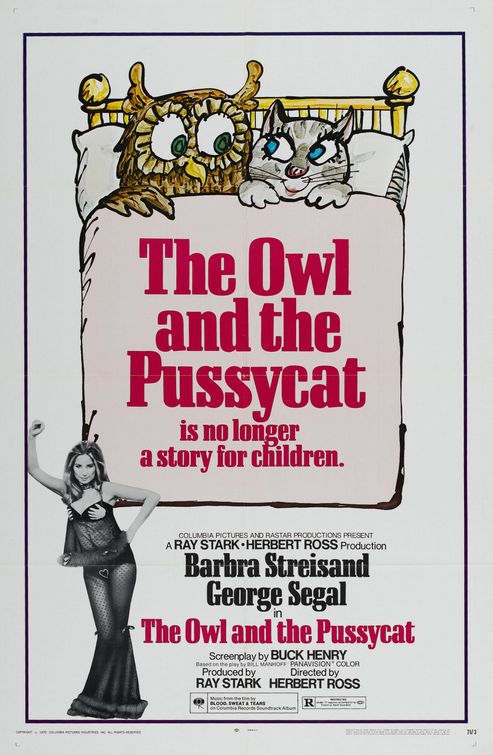
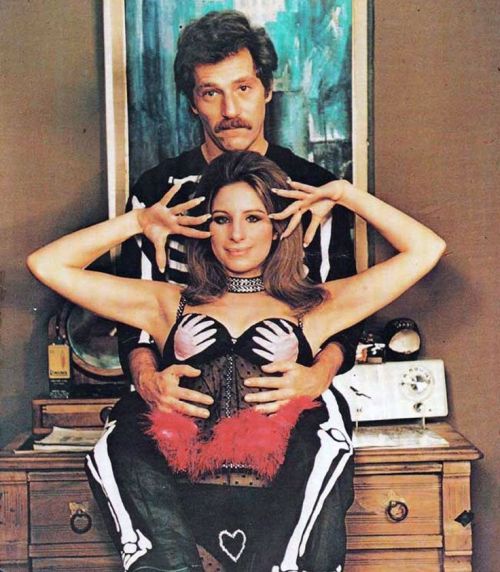
Felix (George Segal) works at a bookstore, but dreams of becoming a successful novelist only to receive rejection letters every time he sends a manuscript out. One night while residing in his cramped New York apartment he spots, through his binoculars, his neighbor Doris (Barbra Streisand) accepting payment for sex and he immediately calls his landlord (Jacques Sandulescu) to report this and it gets her evicted. In anger she goes to Felix’s apartment at 3 in the morning to argue with him about what he did. The two share little in common, but eventually after hours of bickering they form a bond.

The film was originally written as a Broadway play, which in-turn was inspired by a poem of the same name written by Edward Lear in 1871. The play, which ran during the 1964-65 season, starred Alan Alda and Diana Sands and differed considerably from the film in that it had only two characters and one setting. The biggest change though was that in the play the Doris character was a black women, but the studio feared mainstream audiences weren’t ready for that, which is a shame. Streisand is amusing, but she’s unable to convey a tough street-smart attitude. Having an African American woman and a white man come together with vastly different socio-economic backgrounds would’ve made the polar opposites theme even more pronounced and their eventual bonding far more profound.

In an attempt to make the story more cinematic director Herbert Ross had the couple kicked out of Segal’s apartment and then forced to go to his friend Barney’s (Robert Klein) apartment. Initially this seemed fun as Segal and Streisand are allowed to sleep in the living room while Klein and his girlfriend (Marilyn Chambers) remain in the bedroom, but Segal and Streisand continue with their bickering, which forces Klein and Chambers to leave their own apartment, which made no sense. If the guests are the ones causing the racket then they’re the ones asked to leave not the people paying the rent. This also becomes a missed opportunity because it could’ve heightened the comedy by having the couple forced to move to seedier locations each time they’re kicked-out of the previous one.

During the second half Segal and Streisand enter a large home, which was apparently the residence of his fiance’s family, but this is jarring since there had been no mention of the fiancee earlier. It also works against the theme as these characters were portrayed as being lonely and forced to deal with each other despite their many differences because they had no where else to go, but then throwing in Segal’s connection to affluence ends up diminishing the desperation angle.

I also didn’t like that Doris got portrayed as being so painfully uneducated that she couldn’t understand some of the words Felix said, which was heavy-handed since his language wasn’t all that elaborate. I’ve found that most sex workers are quite defensive when it comes to the ‘they must be dumb’ stereotype and make concerted efforts to play against this. Most people, especially with someone they’ve just met, would never admit to not understanding some words spoken by the other because it would make that other person believe that they were intellectually superior and therefore given unfair leverage.

There are few funny moments but it mainly comes during the first half while the second and third act drone on.  The only real distinction are the opening credits, where a jazzy score by Blood, Sweat & Tears gets played while a greenish moon sets behind a cropped cutout of the New York skyline, which is pretty cool.

My Rating: 4 out of 10

Released: November 3, 1970

Runtime: 1 Hour 36 Minutes

Rated PG

Director: Herbert Ross

Studio: Columbia Pictures

Available: DVD

Bloodline (1979)

By Richard Winters

My Rating: 2 out of 10

4-Word Review: Killer stalks rich heiress.

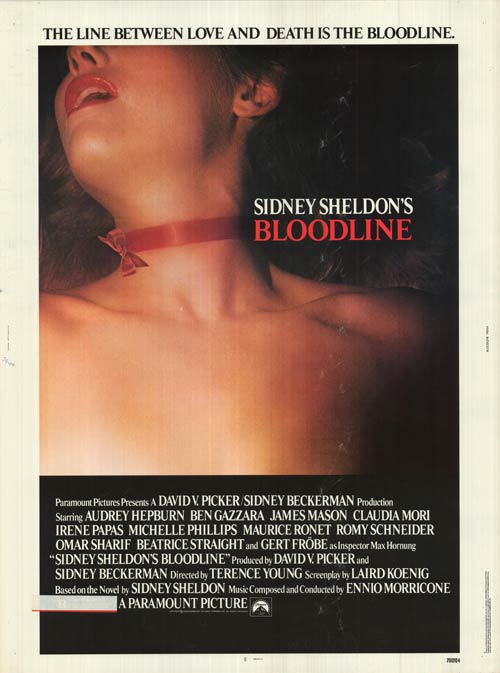
When her father dies under mysterious circumstances Elizabeth (Audrey Hepburn) is given full control of the company he founded, Roffe Pharmaceuticals, a billion dollar empire. Elizabeth soon learns that there’s a power struggle going on amongst the board members and when she refuses to allow the company’s stock to go public she finds that her life is now the target of a mysterious killer who stages ‘accidents’ to occur where ever she goes.

This film marked Hepburn’s last starring vehicle in a theatrical feature and if it weren’t for her presence this thing really wouldn’t be worth seeking out and barely is anyways. The story is based on the best-selling novel by Sidney Sheldon, but comes off more like a hackneyed whodunnit featuring many derivative elements that you’ve seen hundreds of times before in other mystery films that were better done.

Some of the more annoying aspects include the loud, overplayed orchestral score that would be better suited for a sappy romance. There are also segments dealing with Gert Frobe, who plays the lead investigator on Elizabeth’s father’s case, who does most of his detective work sitting in a lab and interacting with a computer whose over-the-top robotic voice turns the whole thing into unintentional camp. I also thought it was dumb that Elizabeth listens to a audio tape recorded by her father just before he died in which he states that he thinks he knows which board member is trying to kill him, but then doesn’t reveal his name, but wouldn’t it have been wise to state that on the tape, so if he ended up getting killed there would be recorded evidence to help the investigators nab the right person? The film also features a recreation of the backstory showing how the father founded the company, which is corny as hell as well as a kinky subplot dealing with snuff movies, something that was added into the script after production had already begun, but wasn’t needed.

The accidents, which should’ve been the film’s highlight become boring throwaways instead. Hepburn’s car crash, which occurs when the killer fiddles with the brakes, is poorly edited and the injuries that she sustains are too superficial, a few bruises and scratches on the side of her face that immediately go away the next day. Her close call in a rigged elevator gets equally botched. We see a split second visual of an elevator speeding down a shaft and only later told that it killed her best friend (Beatrice Straight) who was inside it, but Hepburn decided at the last minute to step out of it to get something that she forgot inside the office, but this is something that the viewers should’ve seen as movies are a visual art and not just explained by Hepburn afterwards.

The variety of exotic locations, which was shot throughout Europe, adds some zest and the eclectic cast is interesting although most are wasted. With that said I still found Romy Schneider, who plays a female race car driver, to own every scene she is in, which proves what a great actress she was as she’s able to make her part flashy despite the weak material. Omar Sharif is also fun as a henpecked husband who finds himself not only dominated by his demanding wife (Irene Papas) but his lady lover as well.

Ultimately though it’s too hokey to take seriously and offers no intrigue. Even Hepburn becomes a problem by playing a character who doesn’t make any sense. She tries to get Ben Gazzara to marry her by admitting it’s for convenience only and that he’d still have his ‘freedoms’ to do ‘other things’ on the side and she’d agree to look the other way. Then when they finally do get married and he meets some of his other lovers at a restaurant she becomes enraged and runs out. This causes him to call her a ‘neurotic bitch’ which given the circumstances I would have to agree with.

Alternate Title: Sidney Sheldon’s Bloodline

My Rating: 2 out of 10

Released: June 29, 1979

Runtime: 1 Hour 57 Minutes

Rated R

Director: Terence Young

Studio: Paramount

Available: VHS, Amazon Video, YouTube

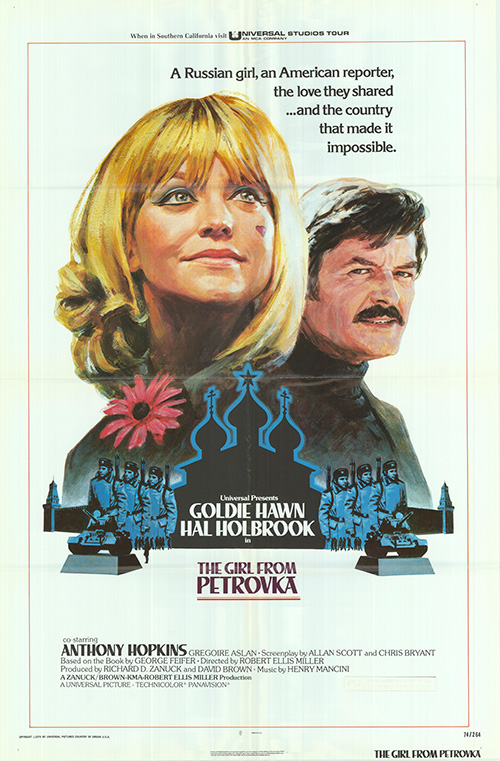
The Girl from Petrovka (1974)

By Richard Winters

My Rating: 2 out of 10

4-Word Review: An American/Russian romance.

Oktabrina (Goldie Hawn) is a young Russian ballet dancer living in the country without proper documentation. Joe (Hal Holbrook) is an American journalist staying in Moscow as a foreign correspondent for the Chicago Herald. Joe becomes attracted to her youthful beauty while she likes the fact that compared to her impoverished lifestyle he has a lot of money and lives in an apartment that seems ‘like a palace’. The two begin going out, which attracts the attention of the KGB who raid her apartment while she’s not there. This forces her to stay at Joe’s for awhile and allows their relationship to blossom only to have a misunderstanding cause her to move out. Joe then tries desperately to win her back, but finds it may be too late as the authorities close in.

The film has a nice casual pace to it that’s more like a European movie and the on-location shooting, which was originally intended to be shot in Yugoslavia, but eventually done in Austria, nicely brings out the gray, dismal life in the Soviet Union at the time. I even enjoyed the snowy late night scene where Joe and a friend are seen walking outside with a visual of the Red Square matted in the backdrop.

Unfortunately the film’s romantic angle becomes its weakest point, which ultimately pulls the production down to a painfully boring level. I just couldn’t understand why these two fell in love so fast. I got the fact that Joe found her attractive, any man would, but that’s lust not love and Oktyabrina’s interest centered mainly on the fact that he had money, which is equally shallow and nothing that would create this deep emotional bond after only two days together. There’s also a huge age difference between the two, a full 19 years, which makes the romance come off looking even more absurd.

Hawn’s a great actress, and she does okay here even though I found the heart shaped tattoo that she has underneath her left eye to be annoying, but it still would’ve worked better had the part been played by an actual Russian woman who could’ve given the character more authenticity. Holbrook has proven to be a fine actor in many other productions, but here comes off as too detached and glib and adds very little life or emotion to the proceedings. Anthony Hopkins as Oktyabrina’s Russian friend shows more energy, and speaks with an excellent Russian accent to boot, and would’ve been a far better choice for the lead.

In typical 70’s fashion the ending is a downer, which was completely different from the one in the film’s source novel of the same name that was written by George Feifer, and only helps to cement this as a complete waste of efforts by all those involved. This was just one of the many bad movie choices that Goldie made during the 70’s that put her career on life support that managed to be revived in 1980 when she did Private Benjamin.

My Rating: 2 out of 10

Released: August 22, 1974

Runtime: 1 Hour 43 Minutes

Rated PG

Director: Robert Ellis Miller

Studio: Universal

Available: DVD-R (Universal Vault Series), Amazon Video

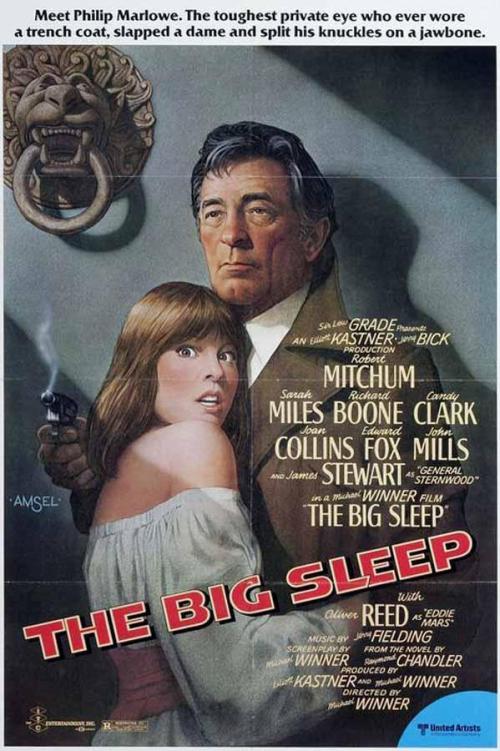
The Big Sleep (1978)

By Richard Winters

My Rating: 4 out of 10

4-Word Review: Hired to find blackmailer.

Philip Marlowe (Robert Mitchum) is an American detective living in London who gets hired by a aging, retired general named Sternwood (James Stewart) to locate the person who has been blackmailing him for money. He thinks it may have something to do with his colorful daughters: the gambling addicted Charlotte (Sarah Miles) and the promiscuous Camilla (Candy Clark) who enjoys posing for nude photographs.

The film is based on the 1939 novel of the same name by Raymond Chandler and a remake of the 1946 film that starred Humphrey Bogart. Here though the setting has been updated from the 1940’s to the 1970’s and the venue changed from New York to London. The movie was also able to tackle many of the more kinkier aspects of the story that the 40’s version was only able to allude to.

Personally I felt the changes worked and made the premise more interesting. Why an American detective would be working in England is never properly answered, but the new setting does allow for some interesting on-location shooting like having the Knebworth House used as the Sternwood Mansion, which is breathtaking to look at both inside and out. The erotic undertones get used to their full potential especially with Candy Clark’s nude scenes who looks fabulous naked and she plays the part with such spunk that every scene she is in is highly amusing and the whole film could’ve easily been built around her alone.

Mitchum’s presence isn’t as distracting as it was in Farewell, My Lovely where he played the same part, but in a 1940’s setting. Having it upgraded to the modern-day actually makes him come-off as younger and a lot of the reason could be the snazzy suits he wears as opposed to the drab hat and trench coat. He also isn’t forced to get into any physical confrontations with anyone, which would make him look foolish as he’d be too old to kick any young guy’s ass, nor is there any romantic overtures with a younger woman, only Camilla who immediately throws herself at him the second she meets him, but since she does that with every man it doesn’t matter, which all helps to make his advanced age, which was 60 at the time and far older than the intended character, a non-issue.

The main problem is the story, which I found to be just too damn confusing. I like mysteries, but more in the Agatha Christie realm where we have actual clues to follow and an interesting array of suspects as opposed to something with a dizzying pace where every line of dialogue creates a new twist and potential suspects popping up out of nowhere only to quickly get killed off or just disappear completely. It’s possible in the novel, which I never read, this all got laid out better, but here it became convoluted to the extent that after the first 30 minutes I became lost and didn’t care what happened next, or for that matter who got killed and who didn’t.

Having a side-story thrown-in like Marlowe taking up some sort of quirky hobby that had nothing to do with the mystery that the film could cut back to every once in awhile in order to allow the viewer to catch their breath would’ve helped. The film still manages to be watchable mainly from the high production values and the eclectic cast. I also enjoyed the beginning and end segments where the camera takes the driver’s point-of-view as we see the car drive through the winding roads as it enters the Sternwood Mansion property and then at the end while it leaves the property as the credits roll past.

My Rating: 4 out of 10

Released: March 13, 1978

Runtime: 1 Hour 40 Minutes

Rated R

Director: Michael Winner

Studio: United Artists

Available: DVD, Amazon Video, YouTube

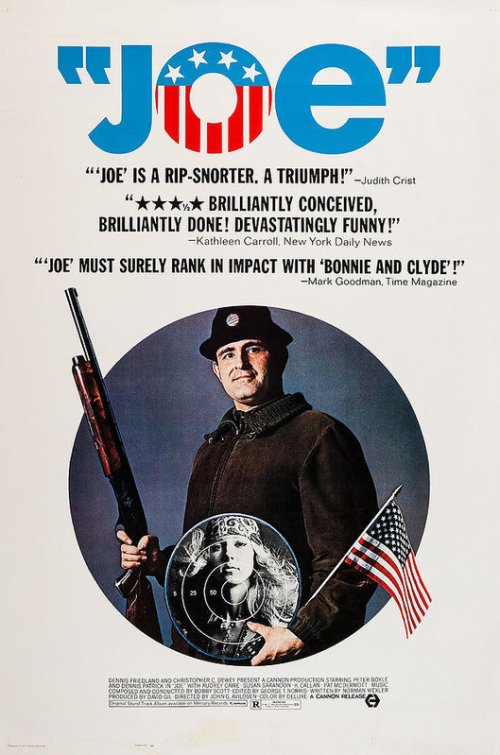
Joe (1970)

By Richard Winters

My Rating: 6 out of 10

4-Word Review: Bigot befriends successful businessman.

Joe Curran (Peter Boyle) is an unhappy factory worker who feels the blacks, liberals, and hippies are ruining the country and doesn’t mind telling all the patrons at his local bar exactly what he thinks. One night while going on another one of his racist rants he meets Bill (Dennis Patrick) a successful businessman who’s the father of Melissa (Susan Sarandon) who was put into the hospital for a heroin overdose. Earlier that day in a fit of rage Bill had killed her live-in boyfriend Frank ( Patrick McDermott) who was the one that got Melissa hooked on the drug. Now, as he sits at the bar in a drunken state he admits to Joe what he did and Joe uses this newfound knowledge to become friends with Bill and find out how the other half lives. Bill initially dislikes Joe and only stays friends with him because he’s afraid Joe will go to the police otherwise, but after awhile the two men start to share a weird bond, which eventually leads them both to the dark side.

Norman Wexler’s script manages to bring out the paradox of the American social hierarchy quite well and in many ways far better than most other better known dramas of the same subject. While the role was originally intended for Lawrence Tierney, who would’ve been a better choice due to being more age appropriate, Boyle, in his first starring role, shines as a younger version of Archie Bunker and manages to do it in a way that still keeps him human and dryly humorous.

The film’s major defect though is with Dennis Patrick’s character who is too bland and one-dimensional and walks around with the same nervous look on his face throughout. Having him become the main character and receive the biggest story arch does not help since he’s too transparent causing his personality change to be uninteresting and there needed to be a backstory in order to give him more depth. I also felt his relationship with his wife (Audrey Caire) needed fleshing-out and the scene where he admits to the murder to her and her reaction to this news needed to be shown.

While John G. Avildsen’s direction has some flair his selection of music for the soundtrack, which includes a droning, melodic piece by Jerry Butler during the opening credits, was too low key and doesn’t reflect the edgy, angry tone of the story. The scene where several people get shot inside an isolated home is poorly handled because no special effects get used. The victims just immediately collapse to the ground after being shot, almost like children pretending to get killed while playing cops-and-robbers, with no blood splatter or gun smoke, which makes it too fake looking and weakens the overall emotional effect.

Having Patrick able to kill the boyfriend so easily is unconvincing too. The boyfriend was far younger and bigger than Patrick, so having him die by simply getting the back of his head hit against a wall without putting up any fight comes off as pathetic and the struggle should’ve been much more prolonged and played-out. I also didn’t like the editing effects were the film repeats the shot of the head hitting the wall, which is too stylized in a film that otherwise was trying to be gritty and realistic.

The twist ending though is nifty and almost makes it worth sitting through. It’s also a great to see Susan Sarandon in her film debut. She looks pretty much the same as she does now, but her eyes for some reason look bigger here and more pronounced on her face. She gives a good performance as always and even jumps fully naked into a bathtub with her boyfriend to start things off.

My Rating: 6 out of 10

Released: July 15, 1970

Runtime: 1 Hour 47 Minutes

Rated R

Director: John G. Avildsen

Studio: Cannon Film Distributors

Available: DVD, Blu-ray, Amazon Video

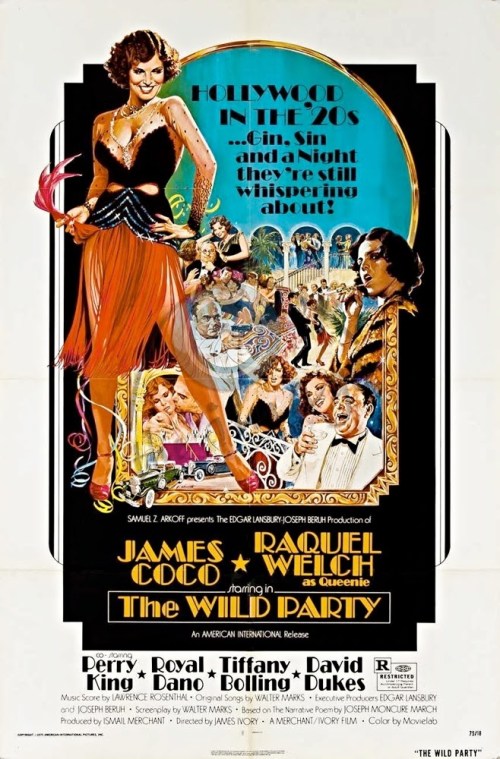
The Wild Party (1975)

By Richard Winters

My Rating: 3 out of 10

4-Word Review: Slumming actor stages comeback.

The year is 1929 and Jolly Grimm (James Coco) the once successful silent film star now finds himself, with the advent of talking pictures, to be in low demand. Although his movies once made a killing his style of humor is now considered cliched and with no studio willing to fund his latest pic he’s forced to use his own money to get it made. He holds a lavish party in his mansion inviting many Hollywood elites who he hopes will show an interest in his movie once he screens it to everyone, but instead his guests are more into each other as the party quickly devolves into a wild sex orgy with even Jolly’s faithful girlfriend Queenie (Raquel Welch) cheating on him with a much younger and better looking actor (Perry King).

The story is loosely based on the 1926 poem of the same name by Joseph Moncure March while the Jolly character was inspired by Fatty Arbuckle a famous silent film comic who was accused and the later acquitted of the rape and manslaughter of actress Virginia Rappe in 1921. The script though by Walter Marks doesn’t seem to know what tone it wants to take as at times it seems like a trenchant drama while at other moments it comes off as a surreal comedy. The original intent was to turn it into a musical, which would’ve been a better idea as the lack of cohesion causes the pacing to be completely off and never allows the film to build any tension or momentum.

The party scenes are not interesting or provocative and in many ways it’s a poorman’s version of Day of the Locust which came out at the same time and had a similar theme, but a far stronger impact. The sex is stagy and mechanical and seeing all the guests sprawled in a symmetric way on the floor the next day throughout the mansion looks too surreal-like to be even remotely believable. The party’s only interesting moment is when Jolly has a meltdown by going on a long angry rant that reveals his ugly side to his guests, but the filmmakers botch this sequence by focusing solely on Coco instead of cutting away to show the shocked reactions of the party-goers.

Coco, in his only starring vehicle, does quite well in a role I didn’t think he was equipped for. Welch gives an equally strong performance, possibly the best of her career, but the relationship of their two characters made no sense. Director James Ivory tries to flesh them out by having the two at different moments go on long soliloquys explaining what attracted them to the other, but in both cases it rings hollow. So what if Coco treated Welch with respect and asked her ‘deep questions’ when they first meet, which is apparently why she fell for him, he’s no longer doing that now, so why stick with him? Coco’s statement, that he couldn’t ‘live without her’ comes off as equally absurd since every time he talks to her he’s abusive.

The relationship angle should’ve been scrapped as it’s Jolly’s mental deterioration that is more interesting.  A far better and more realistic scenario would’ve had Coco coming onto a young starlet such as Queenie at the party but she would reject his advances and then later when he saw her with a younger actor it would set off his already shaky ego, which would then precipitate the violence.

Spoiler Alert!

The shooting that occurs at the end isn’t effective. The film is filled with so many lulls that by the time it finally gets to it you really don’t care who dies and who doesn’t. Having it occur the next morning after the party is already over seems anti-climactic and something that should’ve been witnessed by all the guests. It’s also a bit frustrating to have it end so abruptly without any aftermath or denouncement given.

End of Spoiler Alert!

Tiffany Bolling and Perry King add some zest in support especially with their facial expressions and the sultry dance done by Chris Gilmore (who gets billed here as Annette Ferra) adds a weird sensual vibe. However, having David Dukes’ character break the fourth wall and begin speaking directly to the camera as he describes the party guests is a distraction, which only  further cements this as a misguided misfire that needed better focus.

My Rating: 3 out of 10

Released: March 4, 1975

Runtime: 1 Hour 47 Minutes (Director’s Cut)

Director: James Ivory

Studio: American International Pictures

Available: DVD, Amazon Video
Z.P.G. (1972)

By Richard Winters

My Rating: 5 out of 10

4-Word Review: Having babies is forbidden.

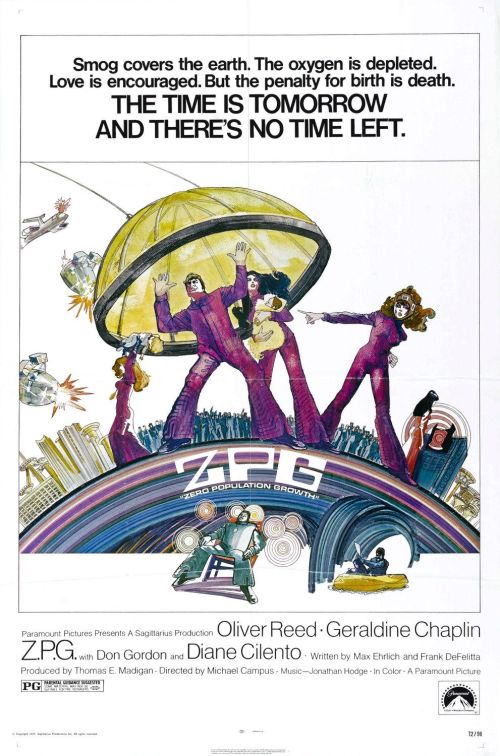
In the future the earth has become overrun with smog that blankets everything and has killed off all plant and animal life and forces everyone to wear breathing masks when outside. In effort to control the population growth the government orders that no one can have babies and instead must visit ‘Babyland’ where childless couples will be given life-sized robotic dolls to take care of instead. Russ (Oliver Reed) and Carol (Geraldine Chaplin) are a young couple who defy this order and secretly have a baby, but when their neighbors (Don Gordon, Diane Cilento) find out and threaten to go to the authorities the couple is forced to go on the run.

This film was both a critical and commercial failure when first released, but was later turned into a novel called ‘The Edict’ that was a success and helped gain the film a bit of a cult following. The special effects though aren’t too great with an opening shot showing this flying vehicle that looks like it was connected to a crane flying over a city’s skyline that resemble miniature toy models, which to me should make it prime fodder for an episode of ‘Mystery Science Theater’. Blanketing everything with smog doesn’t help as part of the fun of watching a Sci-fi film is seeing the elaborate set design and this film has none.

I didn’t like that everyone wears the exact same black uniform either. This is not the first sci-fi film to do this, but it always comes off as phony to me. Do style and fashion trends just go out the window in the future? Every society in every time period has always had individuality and those that break away from the mainstream, so expecting that every single person in the future conforms to the norm and agrees to wear the exact same outfit as everyone else is just not believable.

The plot is skeletal and not well thought out.  The first half plods along too slowly as it’s obvious from the start that Carol wants to have a baby and watching her come to this foregone decision is too draggy and the story should’ve started out right away with her having the child and then going from there to trying to hide it. Also, if the government really wanted to prevent people from having children why didn’t they just force every female to have a tubal ligation instead of trusting that after having sex they would go to their bathroom and press a button on an ‘abortion machine’ on the wall that would apparently send radiation, via a red glowing light, into the woman’s uterus.

The acting is good and Chaplin’s performance comes off as quite sincere. It’s also good to see Oliver Reed in a rare good-guy role although the script really doesn’t give him much to do. Cilento as the intrusive neighbor is by far the scene-stealer. The segment where she must be coached via a government official talking to her on a television monitor to show love for her robot child is one of the film’s best moments as is the later scene where she eventually destroys the doll by bashing its head onto a cement sidewalk.

Spoiler Alert!

The ending was the only time that I found myself slightly intrigued. Watching the couple get trapped inside a dome where after 12-hours they were set to be gassed to death and then having them dig their way out of it and into an underground cavern where via a inflatable raft they were able to escape was mildly interesting, but having them end up on an island where old nuclear weapons were buried was not satisfying. Did they end up dying of cancer? How could they survive without any plant or animal life and was anyone else on the island besides them? The ending like the rest of the film leaves far more questions than answers.

My Rating: 5 out of 10

Released: May 25, 1972

Runtime: 1 Hour 37 Minutes

Rated PG

Director: Michael Campus

Studio: Paramount

Available: DVD, Blu-ray, Amazon Video, YouTube