Category Archives: 70’s Movies

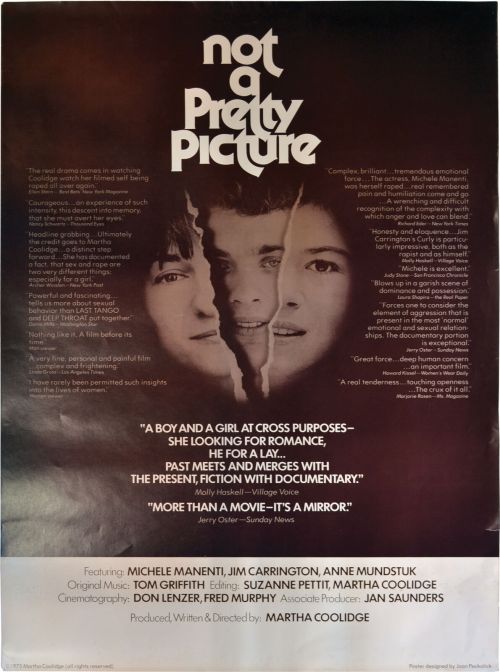
Not a Pretty Picture (1976)

not

By Richard Winters

My Rating: 5 out of 10

4-Word Review: Reenacting a rape incident.

While Martha Coolidge is known today for having directed such 80’s classics as Valley Girl and Joy of Sex she started her career in the 70’s doing documentaries mainly about high school students. After having done three of those she decided to do one that was more personal and dealt with a real-life incident that occurred to her when she was 16 when she got raped on a date with a college student who was 20. While she went about casting the actress to play her as a teen she was shocked to learn that the actress, Michele Manenti, had a similar experience. The film then weaves between reenactments of the date rape and the situations that lead up to it as well as the aftermath. There’s also interviews with the cast members who talk about the emotions they go through while playing the characters including Jim Carrington, who plays the rapist named Curly, who confesses that he thought women secretly wanted to be raped due to his belief that they fantasize about it.

What I got out of the film and enjoyed the most was looking at the acting process and how the performers used elements of their own experiences to help shape the characters that they play. I was genuinely surprised that only one of the cast members, Amy Wright who has a small role as Cindy, ever went on to do another movie. The two stars, who I felt were both outstanding, never acted in anything at least film or TV wise even though I felt they should’ve had long careers. I realize that the acting profession is a very competitive business and what may seem like the cream-of-the-crop in college may not be able to rise to the top in the real-world, but it still seemed sad that they weren’t able to do more, or at least more in front of the camera. It’s also surprising how non-dated this is. The conversations they have both about dating and acting is something that could’ve easily been shot today and just as topical. If it weren’t for them openly smoking indoors in a public setting, which is a major no-no now, you would never have known this was done in the 70’s.

While the conversations that Coolidge has with the cast proves to be insightful the reenactments aren’t as compelling. The scene involving the conversations that the four friends have inside a car has some interesting points, but it goes on too long and gets static. The aftermath where Martha is ridiculed by the other girls at her school and called a ‘whore’ because of the rumors that Curly spreads stating that she was a ‘willing participant’ and the stressful moments she has when she doesn’t get her period and fears she may be pregnant are quite dramatic, but the most important scene, the rape itself, gets botched. All the other recreated scenes where done as if in real-time and with sets that replicated the era, which was 1962, but with the rape it’s staged as a rehearsal with Martha and the other stagehands clearly in view as it occurs and Coolidge constantly stops the action to have them redo the scene several times in order to get it right, but this takes the viewer out of the moment and mutes the emotional impact. In hindsight I think they should’ve done the entire recreation, both the rape and what lead up to it as well as the aftermath, first and then went to the behind-the-scenes footage afterwards instead of inter-cutting it, which may have been novel for the time, but eventually gets off-putting.

The film’s focus was apparently intended to be on Martha and her reactions at seeing her own rape get played-out as the camera keeps panning back to her face as she watches the actors perform it and then at the end she describes her feelings in a emotional way. While I’m sure this was a tough thing for her to do I still felt it would’ve been more encompassing to have it about all the other women, including the actress in this film, that this has happened to and how men in that time period were able to get away with it and never had to be accountable. That to me was more disturbing and the film ends up missing that point, or not hitting-it-home hard enough, and thus isn’t as strong, or ground-breaking as it could’ve been.

My Rating: 5 out of 10

Released: March 31, 1976

Runtime: 1 Hour 23 Minutes

Not Rated

Director: Martha Coolidge

Studio: Coolidge Productions

Available: Vimeo
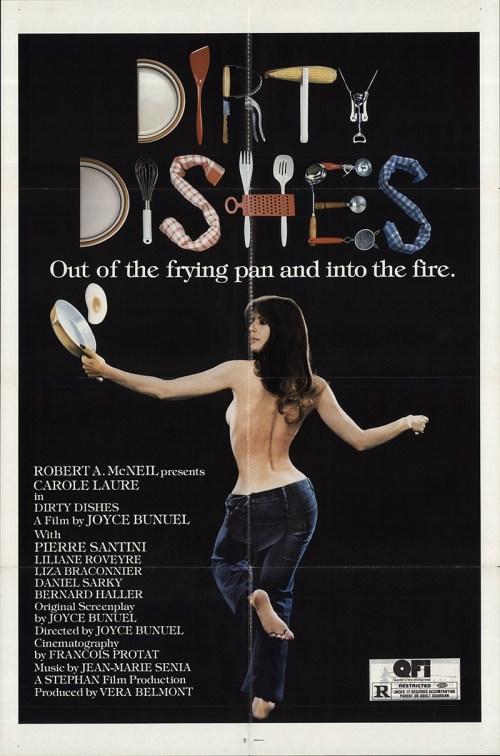
Dirty Dishes (1978)

dirty1

By Richard Winters

My Rating: 5 out of 10

4-Word Review: Housewife has nervous breakdown.

Armelle (Carole Laure) is a full-time housewife taking care of 2 young boys while her husband Marc (Pierre Santini) works a job designing car tires. Armelle is bored with the mundane chores that she must do day after day and looks forward to Thursday evenings, which is the one night that her and husband can go out, but since Marc’s job has become very demanding he can no longer do that, which makes her feel even more shut-in. She occasionally goes out with her two friends (Liliane Rovere, Liza Braconnier), but they’re trapped in the same thankless domestic routine as she is. One day she snaps and has a sexual tryst on her cluttered kitchen floor with an architect (Daniel Sarky) who works across the street, but this doesn’t subside her feelings of rebellion, so she steals a car, which almost gets her in an accident. Eventually her husband realizes her frustrations and promises that things will be different, but will this really bring the change that she wants?

Written and directed by the daughter-in-law of the legendary filmmaker Luis Bunuel, the film is a mixture of Diary of a Mad Housewife that came out 8 years earlier and Women on the Verge of a Nervous Breakdown, which was released 10 years after this one. There’s even a bit of Jeanne Dielman mixed in for good measure. The one thing that this film does do well is focusing on the mundane tasks that she does each day, which gives the viewer a clear impression of her trapped feeling. Unfortunately it doesn’t go deeper than that and ends up just being another feminist comedy that fails to have anything unique to say from the other films from that era with the same theme.

There are a some amusing lines uttered here and there, but the laughs are sporadic and there should’ve been tighter editing, which would’ve given it a frenetic pace and made the absurd moments seem less out-of-place. There’s also a few really weird tangents that come out of nowhere including a psychotic man that invades the families picnic at a park and tries running them down with his car that has no connection to the main story and wasn’t needed as was the segment at a grocery store where Arnelle breaks up a fist-fight between two men only to find that she’s been a victim of a candid camera-like prank.

There are a couple of good poignant moments particularly the scene where the couple is lying in bed and Armelle states to her husband that she feels scared and he replies: “Why, are you afraid something is going to happen to you?” and she responds: “No, I’m afraid nothing will happen and everything will remain the same.”, which hits home the characters quandary perfectly.

Laure’s is radiant and soaking in her beauty helps smooth over the slow spots. The scene where she gets rejected as a model of a dish detergent ad because she’s ‘too beautiful and no one would ever believe she does her own dishes’ is quite funny as that’s all we’ve seen her do since the film began.

The ending however offers no conclusion or answers. The character remains stuck in the same situation that she was at the start with only vague promises from the spouse that things ‘would be different’, but in cases like these that usually means things will eventually just go back to the way things were. The viewer needs to see the change for themselves, or how the character learns to adapt to the problem by finding ways to make the monotony seem more interesting, but the film shows none of this making it feel ultimately like a waste of time as both a satire and character study.

My Rating: 5 out of 10

Released: April 19, 1978

Runtime: 1 Hour 35 Minutes

Rated R

Director: Joyce Bunuel

Studio: Planfilm

Available: VHS

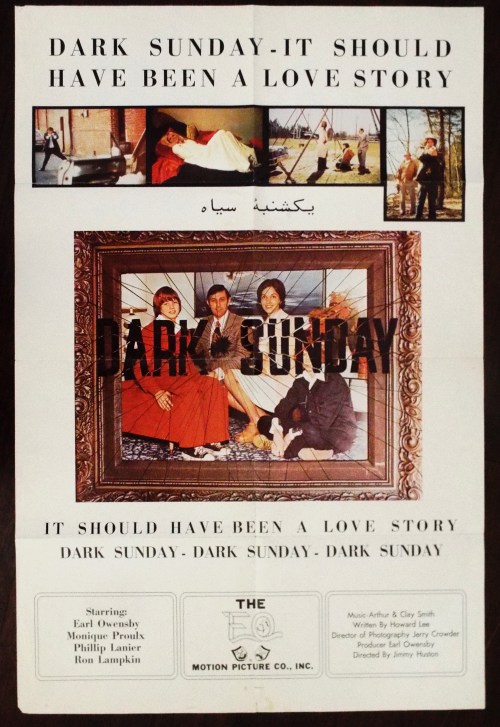
Dark Sunday (1976)

dark1

By Richard Winters

My Rating: 6 out of 10

4-Word Review: Preacher versus drug dealers.

Reverend Lowery (Earl Owensby) works to get teens hooked-on drugs off the city streets and sober, which annoys local drug dealers who order a hit on him. When his family are on a camping trip two hit men (Ron Lampkin, Jac Cashin) shoot both of Lowery’s sons (Todd Reep, Jeff Reep) and his wife (Maggie Lauterer). When Lowery tries coming to their aid he gets shot several times, but manages to survive though with a severe limp and inability to speak. Once out of the hospital he goes on a silent mission to get revenge on those that killed his family while also stopping the dealers from selling anymore drugs and getting them off the streets once and for all.

This is third film of Earl Owensby who in 1973 decided to take a stab at filmmaking by building a studio near Shelby, North Carolina and making movies that he deemed to have ‘old-fashioned values’ and away from the sex and violence of Hollywood. While his movies didn’t have any nudity they did have its fair share of violence, which his critics considered to be hypocritical, but in any event they made money especially on the grindhouse circuit and enough of a profit that it allowed him to continue making movies up to 1991. While other regional directors like John Waters and Charles B. Pierce where able to gain enough attention with their movies to ultimately get a Hollywood contract Owensby never did. Some say it was because he labeled himself a conservative, which automatically made him an outsider with Tinseltown.

Whatever the reason this movie really wasn’t all that different from the Hollywood revenge dramas like Dirty Harry and Walking Tall and I was surprised how watchable it was. It does go on longer than it should and the opening features several jump cuts, which gives it an extreme amateur feel. There’s also way too many scenes that take place in back alleys. Granted it works with the plot, but I still got the feeling it was shot at these locations because it was less likely to get noticed by the authorities for shooting without a permit.

The film was controversial for the amount of violence and was banned from several countries. The shootings could be considered extreme when you see little kids shot directly in the chest and then violently thrown backwards. There’s also a nifty death where one of the drug dealers known as Candyman (Chuck Mines) drowns by having his face shoved into a toilet bowl though this would’ve had better effect had it been shot from above versus to the side. In either case the shootings get redundant and there should’ve been more creative deaths instead of just at the hands of a rifle.

What I did like was that the protagonist suffers lasting injuries and doesn’t just miraculously recover like heroes in a Hollywood movie do. However, with that said, the limp that he gets stuck with, which forces him to walk with a cane, completely disappears during the final foot chase where he’s able to climb ladders connected to buildings even better than the able bodied detective who’s chasing after him.

You would’ve also thought that since he was such a well-loved preacher in his community and lead a big  congregation that they would’ve come to his aid after he was injured by finding him some housing and maybe even a job instead of him becoming this lonely homeless person that no one seemed to know. If he had grown bitter and lost his faith due to what happened to his family and thus rejected their offers of help that’s fine, but a scene showing this needed to be inserted.

It might’ve worked better too had it started from the perspective of the prostitute (Monique Prouix) who takes the homeless Lowery into her apartment because she feels sorry for him and considers him harmless. Then the violent deaths of the drug dealers would force the viewer to connect the dots to Lowery and ultimately through flashback show what happened to his family at the end, which then would’ve given the film an element of mystery and more layers. I was also taken off-guard by the very downbeat ending, which I hadn’t expected and didn’t feel was necessary, but does conform to the ‘everything is terrible’ theme, which was a prevalent in most 70’s movies.

My Rating: 6 out of 10

Released: August 17, 1976

Runtime: 1 Hour 42 Minutes

Rated R

Director: Jimmy Huston

Studio: Intercontinental Releasing Corporation

Available: DVD-R (dvdlady.com)

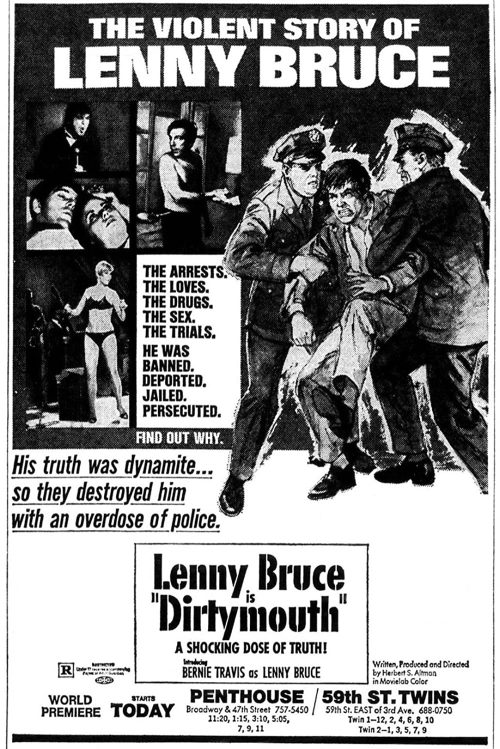
Dirtymouth (1970)

dirtymouth1

By Richard Winters

My Rating: 7 out of 10

4-Word Review: Comedian arrested for obscenity.

Lenny Bruce (Bernie Travis) is a struggling nightclub comedian looking to try to differentiate himself from the others. Tired of doing stand-up at rundown bars where he pretty much is nothing more than a MC introducing the next act he decides to start telling jokes each time he gets onstage and then when that gets a few laughs he begins making them edgier by sprinkling in elements of sex, politics, and religion. This gets him the much desired attention and gigs in bigger venues. However, not everyone likes his brand of humor and when he offends a group of elites at a show in Philadelphia they go on the offense. First they try having him arrested for illegal drug possession and when that fails they go after him for his controversial material where he gets arrested onstage by the police in San Francisco for using profanity during his act. Lenny fights the case in court, but finds that his once blossoming career has dried up as no one will hire him for fear of controversy and with everyone turning against him, even his own agent (Wynn Irwin) and girlfriend (Courtney Simon) he falls into a deep depression.

This obscure, low budget film does start-out rocky featuring vaudeville-like court proceeding skit that attempts to make fun of the trial, but only succeeds at looking dumb and amateurish. The opening credits are shown over a toilet bowl before being ‘flushed’ away, which some may find innovative and creative while others will consider it tacky. There’s also a lot of extraneous footage, particularly at the start, showing Lenny aimlessly walking down the street. While this helps to give a good visual ambiance of the period it certainly does not progress the story.

What I did like was the way we see Lenny go from the bottom up to the top versus already starting it with him famous and in trouble. While it’s been many years, more like a few decades, since I’ve seen Bob Fosse’s better known Lenny, which starred Dustin Hoffman, I did find that element, where Lenny’s humble beginnings weren’t shown, to be a detraction. This film sticks you inside the seedy clubs that he played at and keeps you there. You connect with Lenny and his feelings of being trapped in these places and his urgency to doing whatever he could to stand-out and move-up. You also come to understand his dark humor as anyone who would have to work at these places, and deal with the many drunks that he did, would turn edgy and sarcastic as well.

Bernie Travis, who was a stand-up comedian in his own right, and died at a young age that wasn’t much older than Bruce’s when he died, gives an interesting performance. Some say Cliff Gorman, who played Bruce in the Broadway version, did the best, but Travis comes close. You definitely sense the comedian’s ambition and his annoyance with others. The fact that he’s abrasive and not entirely likable is a good thing as I’ve heard many comedians, even the famous and well-liked ones, can be jerks offstage as there’s so much pressure to be funny that in order to release the tension they can sometimes be unpleasant in private and this film successfully brings out that dynamic particularly when Lenny goes onstage and angrily lashes out at the obscenity charges in a rage-filled rant that’s genuinely electrifying and leaves those in the audience with their mouths agape.

Producer Marvin Worth, who owned the rights to two books that Bruce had written, sued this film upon its release for copyright infringement, which limited its exposure and kept it out of most theaters. When the Bob Fosse movie, which was produced by Worth, came out four years later, this film got totally eclipsed and largely forgotten, which is a shame. Not everything works, but it does have a few memorable moments including what looks to be unscripted, filmed interviews of actual potential jurors, some of whom are quite elderly, who get asked what words they deem to be ‘obscene’ and their responses are priceless.

My Rating: 7 out of 10

Released: September 10, 1970

Runtime: 1 Hour 42 Minutes

Rated R

Director: Herbert S. Altman

Studio: Superior Pictures

Available: None

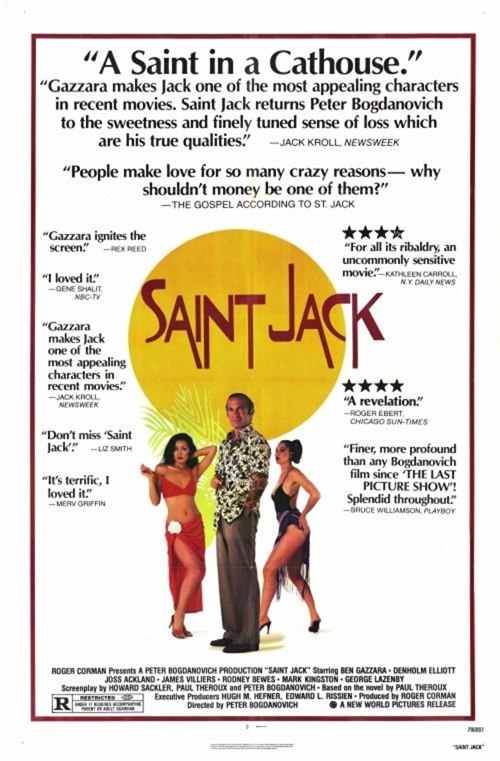
Saint Jack (1979)

saint1

By Richard Winters

My Rating: 7 out of 10

4-Word Review: American pimp in Singapore.

Based on the 1971 novel by Paul Theroux the story centers on Jack Flowers, an American who comes to Singapore in hopes of starting-up a profitable brothel and then moving back to the states a rich man. He finds the challenges more staggering than he initially thought and is constantly looking over his shoulder for the syndicate who would like to crush his business so it won’t compete with the other more established brothel’s in the region. In order to cover what he’s doing he works with a Chinese executive as a liaison for his clients. One such person is William (Denholm Elliot) a timid British accountant with a heart condition who has traveled to the area on an assignment. Jack enjoys William’s quiet demeanor and grows fond of him only to be heart-broken when he dies suddenly, which eventually changes Jack’s perspective on things specifically when he’s asked to take part in the blackmail scheme of a U.S. Senator (George Lazenby).

By the late 70’s director Peter Bogdanovich had fallen on hard times. He began the decade doing the acclaimed and award winning The Last Picture Show and followed it up with the equally impressive Paper Moon However, after the critically panned musical At Long Last Love his career began to tumble. He tried following this up with Daisy Miller, but it appealed to only a small audience. Nickelodeon was his attempt at returning to slapstick comedy that had won him success with What’s Up Doc, but it dived at the box office too making this once promising young talent feel fully washed-up. In an attempt for a revival he decided to go in a completely different direction by doing something with a gritty realism.

Cybill Shephard, whom Peter was in a relationship with at the time, had read the Theroux novel when it was given to her by Orson Welles in 1973. She had suggested he make it into a movie, but he had initially resisted. Then in 1978 when she sued Playboy for publishing unauthorized nude photos of her she got rights to turn the book into a movie as part of the settlement and Bogdanovich decided at that point he would do the project. Since Singapore officials were aware of the book, which had not portrayed their country in a positive light, he was forced to create a mock synopsis called ‘Jack of Hearts’, a benign love story that he used to convince the government that was the movie he was making so he could get the permission to film there, which was worth the effort as the unique ambiance of the setting is the main thing that propels the movie and could not have effectively been recreated had it been done inside a Hollywood studio lot.

Gazzara’s performance is another chief asset as he’s never at a loss for quick quips, or sarcastic replies. I loved the way he’s shown constantly moving, never sitting still in one place for too long, which nicely accentuated his situation of needing to ‘on the move’ in order to stay one-step ahead of the bad guys. Elliot is excellent as well in an atypical role. Usually he does well playing stern, jaded, and detached types, but here conveys a genuinely sensitive person who seems cut-off from the worldly ways. Lazenby, best known as the one-and-done James Bond from Her Majesty’s Secret Service, gets a small, but pivotal role as a closeted gay politician who takes a stroll in the middle of the night to hook-up with a male prostitute while Jack secretly follows him that has a great voyeuristic quality and the film’s most memorable moment.

Out of all of his movies Bogdanovich has stated that this one and They All Laughed were his two favorites. Some may not agree as the story has a fragmented style where things happen all of sudden and without forewarning. Yet for me this helped emphasize the reality of Jack’s shaky environment. While hailed by many as a great director’s least known work it deserves to be seen more and when compared to his other output clearly unique and original.

My Rating: 7 out of 10

Released: April 27, 1979

Runtime: 1 Hour 52 Minutes

Rated R

Director: Peter Bogdanovich

Studio: New World Pictures

Studio: DVD, Blu-ray, Fandor, Plex, Tubi, Amazon Video

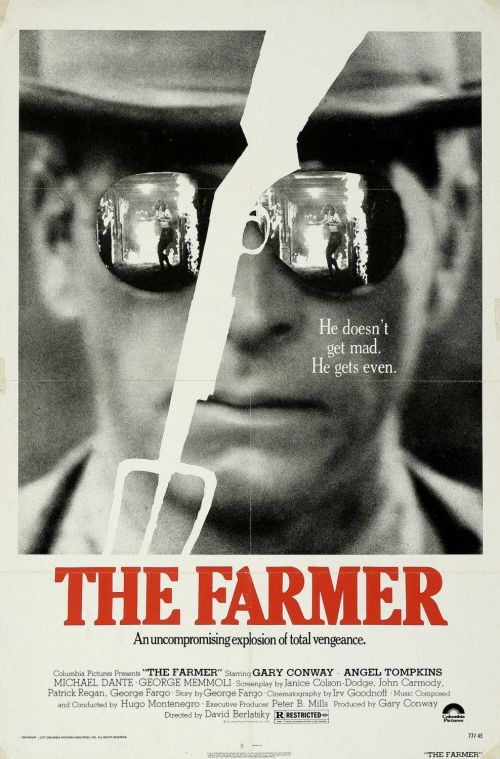
The Farmer (1977)

farmer1

By Richard Winters

My Rating: 7 out of 10

4-Word Review: Country man seeks vengeance.

Kyle (Gary Conway) returns from fighting in WWII a decorated hero, but finds when he gets back home that trying to run a profitable farm to be tough going and risks having it foreclosed on by the bank. One night while swerving to avoid an animal on the road professional gambler Johnny (Michael Dante) gets injured in a car accident near were Kyle lives. Kyle and his friend Gumshoe (Ken Renard) nurse Johnny back to health and for repayment Johnny gives Kyle $1,500, which is enough to help his farmstead survive for a little while longer. Johnny though soon gets into trouble with racketeer Passini (George Memmoli) who permanently blinds him by dumping acid on his face. Johnny wants revenge and hires Kyle, who’s farm continues to struggle, to do it by having him use his superior shooting skills to kill-off Passini and his men while using Johnny’s inside knowledge to track them down. At first Kyle resists, even after Johnny offers him $50,000, but when one of Passini’s men (Timothy Scott) burns down Kyle’s barn, kills Gumshoe, and rapes his new girlfriend (Angel Tompkins) he then decides to go on the warpath.

This has become, especially in the past decade, known as a ‘lost film’. It had never been shown on broadcast TV nor cable and had never received a DVD release, or Blu-ray, or even VHS. It became impossible to find even a bootleg copy and many had become convinced this was the obscure of the obscure. Code Red promised 10 years ago, much to the excitement of rare film collectors, to release it on DVD, but after some promotion the deal fell through, which frustrated many and gave this film even more of a cult status. Some had come to believe that maybe the movie was simply a ‘myth’ and really didn’t exist at all. Just when everything looked bleak Scorpion Rising gave it a Blu-ray release in February of this year and the print is excellent and the film itself isn’t bad either.

It’s noted for its graphic violence, which may have been the chief reason it never got shown on TV or cable. Some of it is quite cruel, particularly the acid scene and the rape is quite intense too. This tough does effectively get the viewer emotionally riled-up making them want to see Kyle get revenge and relishing the third act when he does. The revenge scenes are just as bloody, but I was disappointed that, as graphic as the movie is, the segment where Kyle shoves one of Passini’s men out a high-story window is not shown. The camera cuts away when Kyle pushes him instead of seeing the body drop down which might’ve been hard to film since a parade was going on below, but an effort should’ve been made.

Conway’s acting is only adequate though he does at least convey a stoic quality. Angel Tompkins does better and while some of her other B-movie roles weren’t so great this one is clearly her best and proves she could act versus just looking pretty. Memmoli is memorable as the slimy villain and he should’ve been in it more, but he got injured on the set while riding in a stunt car and was cooped-up in a hospital during most of the production, which also ultimately lead to his career downfall and death. The former comic who graduated into character actor roles had always struggled with weight, but had gotten himself down to 190 pounds when he was in this movie, but when the accident occurred and he was laid-up his weight ballooned out to as high as 490 and causing him to have to turn down subsequent film parts due to his physical limitations.

The review in Maltin’s book claims that there’s a lot of ‘anachronistic errors’ in the movie and having read the review beforehand I kept my eagle-eye out looking for them, but I really didn’t see any. Again I never lived in the 40’s and technically Maltin, who was born in 1950, didn’t either, but to me I felt it came-off okay. I liked the way it approaches the era in a gritty way versus a nostalgic one and the frequent use of the hand-held camera, which was ahead-of-its-time. The surprise twist at the end isn’t bad either.

My Rating: 7 out of 10

Released: March 9, 1977

Runtime: 1 Hour 37 Minutes

Rated R

Director: David Berlatsky

Studio: Columbia Pictures

Available: Blu-ray

Sonny and Jed (1972)

sonny1

By Richard Winters

My Rating: 5 out of 10

4-Word Review: Couple steal from rich.

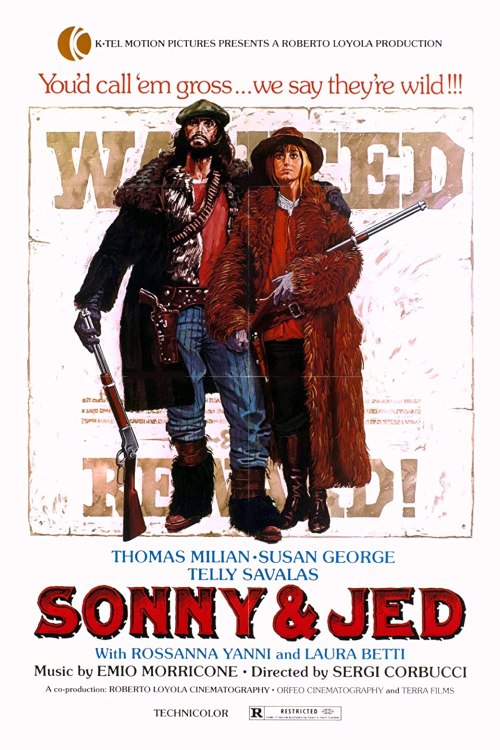
Jed (Thomas Milian) is an outlaw bank robber who sees himself as a modern day Robin Hood. Franciscus (Telly Savalas) is the sheriff determined to bring him in. When Francisus gets hot on Jed’s trail Jed uses the aid of beautiful young Sonny (Susan George) to evade capture. Sonny immediately becomes smitten with Jed despite the fact that he’s a very vocal misogynist. Sonny though ignores this as she’s so deeply wants to be in a loving relationship that she puts up with the abuse and even asks him to marry her, which he does, but his abuse continues. Jed then sets his sights on Linda (Rosanna Yanni) the wife of rich land baron Don Garcia (Eduardo Fajardo). Jed likes the fact that she has big breasts, which Sonny doesn’t, but when he puts the moves on her Sonny fights back by turning the tables on him and treating him in the same way that he did her.

After watching only a few minutes it’s easy to see why the spaghetti westerns went out of style as this lacks the lyrical quality of a Sergio Leone film, which put this unique genre on the map. Leone had that special knack that could mesh violence with subtle humor and make every scene, even one as insignificant as seeing flies fly around a person’t face, interesting. Sergio Corbucci, who directed this one, lacks that same ability and while he helmed some westerns in the 60’s this one doesn’t have a good balance. The action is bereft of any excitement while the humor is heavy-handed. The musical score by the always reliable Ennio Morricone is excellent, but everything else falls flat.

The storyline is the most annoying as Jed is too unlikable for anyone to want to fall in love with. His caustic comments on women are quite outlandish by today’s standards, which may offend some though others may get a kick out of it simply for the outrageousness. I have no doubt men back then may have been very much like his character, so on that end you could say it’s realistic, but having Sonny grow attached to him was off-putting. If he had reformed and then gotten married it might’ve made more sense, but to have the marriage occur in the middle when he’s still treating her like crap including one scene where he rapes her, just doesn’t work. His character does change a little at the very end, but it’s not enough to justify all she goes through and there’s no resolution as it shows them continuing to bicker without answering whether they were ever able to work things out, or ultimately broke-up.

Having Sonny so desperate to be loved, even at one point spying on another couple who are kissing and feeling envious, isn’t a sufficient enough reason for her to put up with the awful way he treats her. If she had been homely then maybe, but she’s actually quite attractive and could easily hold-out for something better making the way she throws herself at him too precipitous. Her character also needed more of an arc. The film teases this concept, but ultimately pulls-back when it should’ve pushed forward.

Milian’s performance is an acquired taste. Besides being vulgar and crude he also at one point scarfs up his spaghetti in such a slobbering manner that it’s genuinely disgusting and in another scene he gets under a cow and puts his lips directly over its teat and sucks the milk right out. Savalas, who is usually quite good in villainous roles, is only okay here. He’s supposed to be a relentless pursuer, but then allows Jed to escape while on a water raft instead of shooting him making him seem less threatening than he should.

Overall, this was George’s vehicle as she’s thoroughly engaging even able to mask her accent, which not all British performers can do, and at her most beautiful. I can only presume it was because of Milian’s star power that his character wasn’t downplayed because the movie would’ve worked better had it been solely centered around her and it’s just a shame she wasn’t given the keys.

My Rating: 5 out of 10

Released: August 11, 1972

Runtime: 1 Hour 32 Minutes

Rated R

Director: Sergio Corbucci

Studio: Titanus

Available: DVD-R

Junior Bonner (1972)

junior 1

By Richard Winters

My Rating: 7 out of 10

4-Word Review: An aging bull rider.

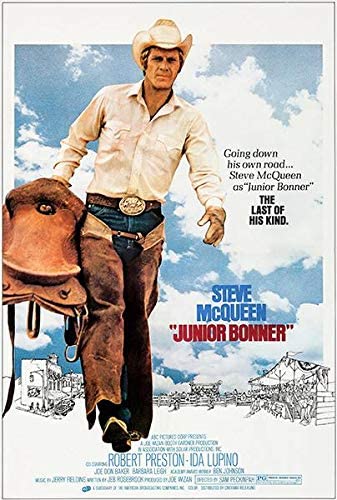
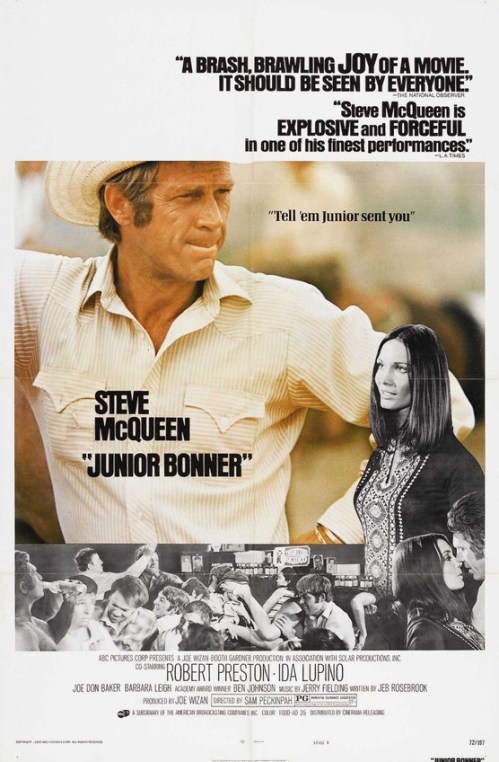
Junior (Steve McQueen) is a rodeo star whose better days are behind him. As he enters his 40’s, he needs to find other ways to make a living and returns to his boyhood home of Prescott, Arizona where the rest of his family including his father Ace (Robert Preston), his mother Elvira (Ida Lupino), and brother Curly (Joe Don Baker) reside. When he gets there he finds that his father’s home is being bulldozed by his brother’s company in order to make way for a track of newer homes. Junior decides that the only way to make ends meet for both himself and his father is to win the prize money by riding the ornery bull Sunshine during the rodeo competition. He had attempted to ride Sunshine at another rodeo, but was quickly bucked-off and injured, but this time he feels it will be different and convinces the rodeo owner Buck Roan (Ben Johnson) to give him one last shot.

This film is different from any other Sam Peckinpah movie you’ll see and many viewers/critics at the time didn’t know what to make of it. Peckinpah was known and even stigmatized for his violent movies including The Wild Bunch and Straw Dogs, which were deemed, especially the latter one, quite controversial and to an extent even glorifying violence. To help find a balance he decided to do something opposite from those by making a movie that was laid-back and didn’t feature any fighting except for one moment during a bar fight, which is done with a delightfully comic flair where everyone in the place gets punched except for Junior who goes off to a corner to makes-out with Charmagne (Barbara Leigh) even though he was the catalyst for why it began in the first place.

Unfortunately audiences and critics could not adjust to the extreme change in tone. They came to the theater expecting, based on Peckinpah’s reputation, bloody shoot-outs and got none and the end result is it doing quite poorly at the box recouping only $2.8 million from the original $3.2 million budget, which poisoned Peckinpah’s career as he was now deemed a financial risk and seriously affected the choice of projects he could do afterwards and how much control he’d have over them. Even normally friendly critics like Roger Ebert, who had been a fan of the director’s earlier works, bailed on this one calling it a “flat-out disappointment” and describing the material as being “terribly thin”. Another critic, Gary Arnold, described it as a film that “drifts across the screen and fades from your mind an instant later” and that there was “no compelling reason to see or remember it.”

I’ll admit the way it starts out had me a baffled. The story doesn’t go anywhere even after 30-minutes in and McQueen, normally this energetic, rugged action hero, looks like he’s in his 60’s and appearing perpetually tired. I started wondering whether this was just footage caught from a closed circuit camera that examined the slow way of life of small towns.

Things though do improve by the second act. The rodeo riding is captured in a vivid way making you feel like you’re riding the bull itself. Peckinpah’s uses his patented slow motion, but this time in a humorous vein like when Junior and Ace go riding away from a 4th of July parade and through the backyards of some houses where they inadvertently get caught up in some clothes lines. There’s even a couple of touching moments like Junior’s conversation with his father at a train station as well as Ace’s reconciliation with his wife. I was impressed with Joe Don Baker’s performance as well. I know some film-goers have mocked his acting in other movies, but I believe if given the right material he can be quite good though he wasn’t the director’s first choice as it was originally intended for Gene Hackman, but when his salary demands proved too high it was given to Baker much to Peckinpah’s regret as the two had many arguments during the production, which almost came to blows and only prevented when McQueen would get in the middle and calm both sides down.

For a modern day western this is one of the better ones and precipitated a boon of rodeo style movies  during the early 70’s. While its initial reception was not kind its been viewed in a better light today and even revered as being one of Peckinpah’s better works.

junior2

My Rating: 7 out of 10

Released: June 20, 1972

Runtime: 1 Hour 40 Minutes

Rated PG

Director: Sam Peckinpah

Studio: Cinerama Releasing Corporation

Available: DVD, Blu-ray

Stigma (1972)

stigma1

By Richard Winters

My Rating: 4 out of 10

4-Word Review: Venereal disease on island.

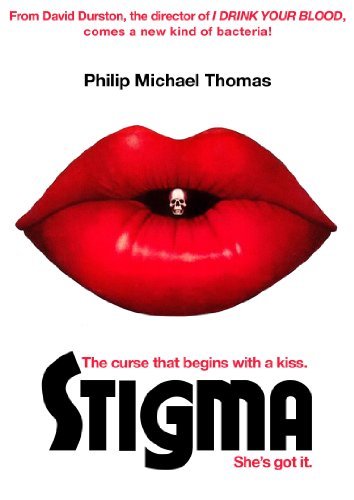
Calvin (Phillip Michael Thomas) is a doctor recently released from prison who gets a job assisting Dr. Thor (David E. Durston) at his island clinic. When Calvin gets there he’s given a cold greeting by the islanders who do not like a man of color, nor does the town’s racist sheriff (Peter Clune). When he arrives at the clinic he finds that the doctor has already passed-away as well as a tape he left behind warning of an epidemic on the island, but not saying specifically what it is. While staying at the clinic he’s met late one night by Jeremy (William Magerman) an old man residing at the nearby lighthouse. He complains about being in a great deal of pain and upon further testing is found to have syphilis. Calvin tries to go on a crusade to warn the others while also searching for who else may have it, which ultimately leads him to the sheriff’s rebellious daughter D.D. (Josie Johnson).

It’s always interesting seeing how low budget films from a bygone era before the advent of computerized special effects could succeed or fail on the merit of story alone. This one, which was done by David E. Durston who had previously directed the cult-hit I Drink Your Blood just a year earlier, manages to for the most part, blemishes and all, to hold it together. The difficulties though of filming on a shoestring is still widely apparent especially at the beginning where there’s a lot of shaking camera movement and jump cuts. Where Calvin goes to hitch a ride is particularly amusing. Since they didn’t have money to get a permit, or hold-up traffic on a legitimate highway, the scene had to be done on an isolated dirt road that looked like it hadn’t been traveled on in 10 years and normally Calvin would’ve had to have stood there that long with his thumb out before he ever saw a car and yet here this non-descript road gets quite busy by using the film’s crew members driving by with their own vehicles in order to give it a well-trafficked look.

This is also one of those films were the genre is unclear. Some have listed it as a horror film while others label it a drama, or even a comedy. My guess is that it was intended as a drama with some side comedy thrown-in as ill-advised ‘comic relief’. The story though never gets tense enough to need a lighthearted moment and the funny bits are eye-rolling making the production seem even more amateurish than it already is. There’s also a surprisingly graphic moment where pictures of actual syphilis patients are shown including close-ups of their sores and deformed noses, which some could find genuinely stomach-churning.

Thomas is best known for his co-starring role in the 80’s cop drama ‘Miami Vice’, but I found him far more engaging here. Magerman is memorable playing a mute with no teeth, who never says a word, but does have an amusing giggle. Johnson is certainly beautiful, which makes up for her lack of acting, but Clune as the villainous sheriff is all-wrong. He may have looked the part of an aging bigot, but he never gives the role the necessary energy or panache. Lawrence Tierny was original choice for the part, but due this drinking problems was eventually passed over, which was ashame.

In recent years this film has gained notoriety due to it being directed by David E. Durston (1921-2010) and some movie podcasts connecting him to the mysterious deaths of both Diane Linkletter (Art Linkletter’s daughter) and actress Carol Wayne. Durston was with Diane the night she jumped to her death from her apartment window in 1969, which authorities deemed a suicide though some wondered if Durston may have pushed her out. Durston was also dating Carol Wayne in 1985 when the two had an argument while vacationing in Mexico and she left their hotel room only to be found drowned in a lake later on. Further research though has concluded that the man in question in both of these events was Edward Dale Durston, a Los Angeles car salesman born in 1942, and no connection with the film director.

My Rating: 4 out of 10

Released: August 18, 1972

Runtime: 1 Hour 33 Minutes

Rated R

Director: David E. Durston

Studio: Cinerama Releasing

Available: DVD-R (Code Red)

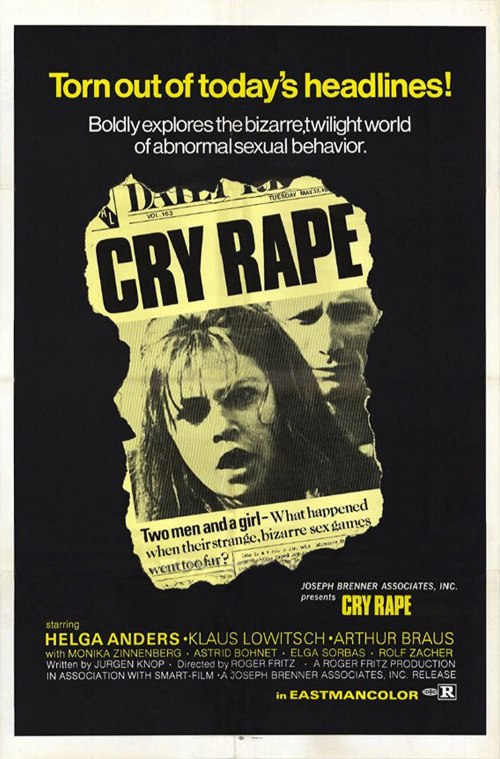
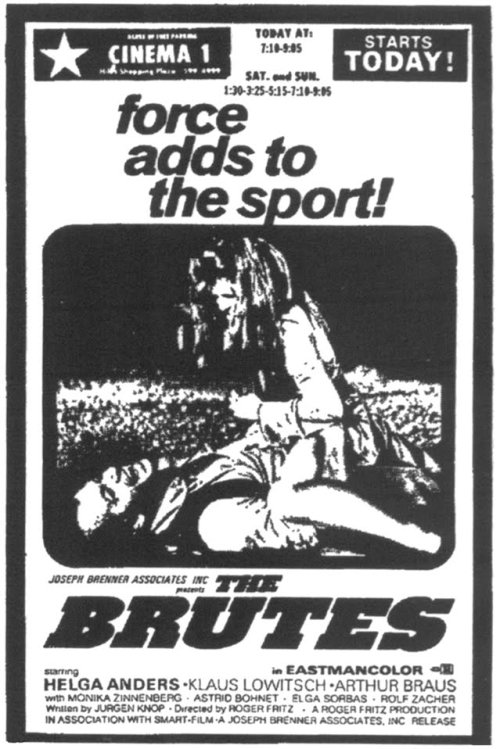
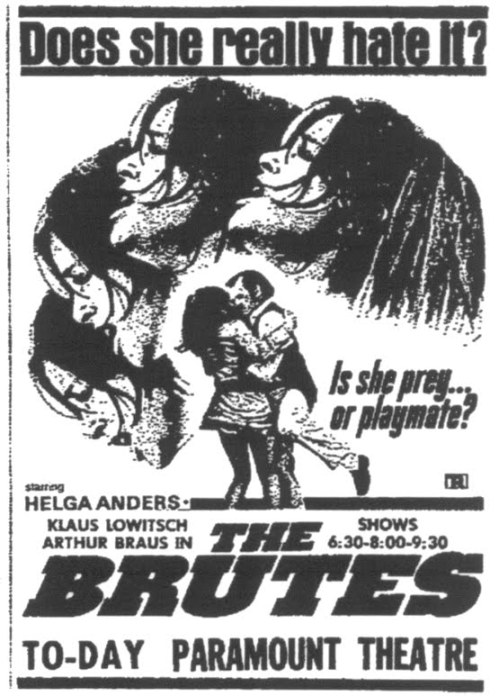
The Brutes (1970)

brutes1

By Richard Winters

My Rating: 6 out of 10

4-Word Review: Two men accost woman.

Werner (Klaus Lowitsch) and Michael (Arthur Brauss) are two friends from work who enjoy spending their weekends ‘cruising-for-chicks’. Their modus operandi is picking up prostitutes, or women at bars, and bringing them to one of their apartments where they either ‘share’ the woman, or partake in a threesome. One weekend they go go-cart racing and set their sights on attractive, young Alice (Helga Anders). They invite her into their car telling her that they want to take her for a swim at an isolated gravel pit. Once there Werner sexually assaults her. The next morning she threatens to go to the police, but the men talk her out of it only for the two to become adversaries when Michael wants to have sex with Alice, which Werner won’t allow.

While Savage Weekend is considered the very first slasher movie this film, which was shot in 1968, could be deemed the first rape/revenge movie. Like with that other film it was produced long before the ‘rules’ of the genre were established, so it takes many unique forays some of which are interesting and other ones aren’t.

It was the third of three films that actor-turned-director Roger Fritz directed with his wife Anders as the star. Anders was a model before she got int acting and he used her pretty looks for stories where her characters would engage in provocative lifestyles like group sex, or incest. This was the last in a trilogy meant to show the dark side of sexually liberated activities, but it doesn’t start to get interesting until they arrive at the gravel pit, which is more than 30-minutes in.

The two men are one dimensional and a turn-off. From the very first frame to the last they’re leering predators-at-large even in the presence of Michael’s mother. Had there been one random moment where they showed some surprising sensitivity towards something, or didn’t act in a predictable stalker way it might’ve had potential, but watching creeps behaving like non-stop creeps becomes boring and redundant.

The scenes at the gravel pit fare better simply because it’s atmospheric and the location becomes like a third character. There’s a few tense moments and the rape scene is surprisingly more graphic than I expected. The physical fight between the two is well choreographed and genuinely bloody though Michael gets hit on the head so much I thought he would’ve suffered serious head trauma and never able to get back-up like he does.

The three characters shift from being the victim at one point and the aggressor the next, which is intriguing. Michael’s long speech detailing the potentially degrading process that a female rape victim goes through when she decides to file a police report is on-target and ground-breaking since these same issues weren’t brought to the forefront until 1972 with the TV-Movies Cry Rape starring Andrea Marcovicci and two years later in A Case of Rape with Elizabeth Montgomery.

Spoiler Alert!

Ultimately though the ending stinks. The mod quality is cool especially its alternative soundtrack, but the scenario writes itself into a hole that it can’t get out of. Having the three go back to their normal lives and acting like what occurred was just a dark diversion, or even a lark with no long term ramifications doesn’t click. We needed to see how this experience changed them, which isn’t addressed and thus makes the whole concept placid and forgettable.

brutes2

brutes4

Alternative Title: Cry Rape

My Rating: 6 out of 10

Released: February 19, 1970

Runtime: 1 Hour 38 Minutes

Rated R

Director: Roger Fritz

Studio: Roger Fritz Film Productions

Available: DVD-R (German with English Subtitles) (j4hi.com)