Tag Archives: Review

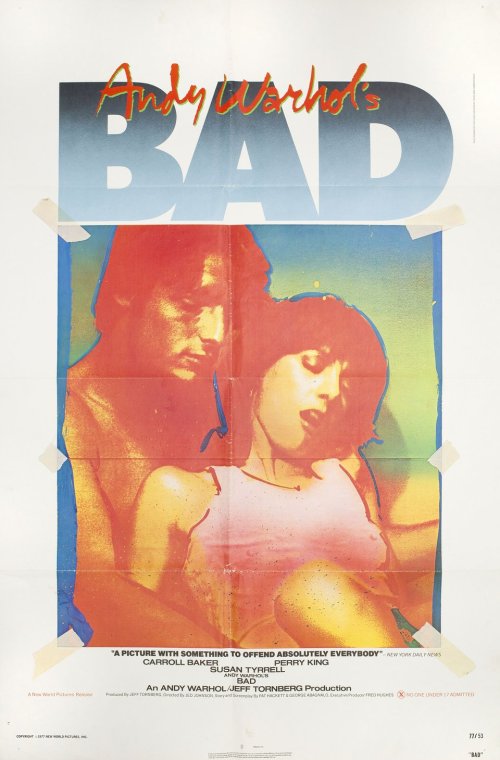
Andy Warhol’s Bad (1977)

By Richard Winters

My Rating: 7 out of 10

4-Word Review: Paying women to kill.

Hazel (Carroll Baker) runs a beauty parlor out of her home that specializes in unwanted hair removal, but secretly on the side she hires beautiful women to carry out contract killings of which she gets a part of the take. L.T. (Perry King) is a vagabond in desperate need of money who’s looking to get into the business, but Hazel prefers her killers to be women and is reluctant to take him, but eventually decides to hire him on a trial basis, but then everything starts to go wrong.

One of the best things about this movie is how truly dark it gets. Too many movies that proclaim to be dark comedies always pull back and never get as deliriously twisted as they initially convince you they will, but this film proudly takes things to the darkest extremes becoming a measurement to what true underground filmmaking once was where pushing the envelope was the only goal.

For the most part, depending on one’s sense of humor, it’s outrageously funny. Some of the more wicked moments feature twin sisters (Geraldine and Maria Smith) setting a movie theater on fire and then going home to watch the coverage of it on the TV. There’s also Warhol alum Brigid Berlin as an overweight woman with flatulence issues who’s obsessed at getting brutal revenge on anyone that she perceives as making fun of her weight.

The film also takes satirical jabs at the American obsession of making money and how one’s social standing hinges on how much they have without any concern with what exactly they had to do to get it. This come to a perfect hilt when Hazel throws L.T. out of the house when he refuses to go through with a hit but still somehow feels she’s the morally superior one by taunting him with “At least I pay my own way”.

Due to this being the biggest budgeted film that Andy Warhol produced they  were able to hire some well-known faces into the roles. Baker though was not their first choice as they originally wanted Vivian Vance, whose presence would’ve made this even more of a gem than it already is, but she turned it down fearing it would ruin her reputation with her fans. Shelley Winters, who was their second choice, also rejected the offer, which was rare as she usually accepted anything that came along and she would’ve been brilliant, but I’ll give props to Baker, who took the role simply in an attempt to resuscitate her career, for not holding anything back here and giving it her all.

King is also superb and I enjoyed seeing his character arch as he’s the only in the film that has one, but was disappointed that there was never a final, fiery confrontation between him and Hazel as the film spends the whole time priming you into believing that there will be. Tyrrell is also memorable in a rare sympathetic part where she becomes the only one with a conscious although I have no idea where they got the baby that she is seen constantly carrying around as he’s one of the stranger looking tykes I’ve ever seen.

The cinematic quality though is lacking with almost all of the action taking place inside the drab house. The basic concept isn’t completely well thought out either. While I appreciated the bad cop character, played by Charles McGregor, who gets paid to look the other way, which helps to explain how Hazel is able to get away with these killings for as long as she does, I was still confused with how she was able to bully people. Everyone adheres to her authority, which is never challenged, but you’d think someone running a dicey operation would have some sort of backup plan and weapon on hand should someone get out-of-line, which she doesn’t and for me this seemed questionable.

The film is notorious as well for a scene showing a young mother throwing her baby out of a high story building and watching it go splat on the ground. Supposedly Baker, King, and Tyrrell refused to do the film unless they were promised that this scene be taken out of the script and director Jed Johnson complied only to end up filming it once the rest of the production had wrapped. Years ago when  I first saw this I thought it was pretty funny especially as another mother walks by and says to her young child “that’s what’s going to happen to you if you don’t behave”. It’s clearly a doll anyways and no real baby was harmed, but when I viewed it this time around I found it unsettling, so like with a lot of things in this movie, it’s up to a person’s age and perspective on how much of it they may or may not enjoy.

My Rating: 7 out of 10

Release: May 4, 1977

Runtime: 1 Hour 45 Minutes

Rated X

Director: Jed Johnson

Studio: New World Pictures

Available: DVD

Best Friends (1982)

By Richard Winters

My Rating: 3 out of 10

4-Word Review: Writing partners get married.

Richard (Burt Reynolds) and Paula (Goldie Hawn) have been working together as a screenwriting team for many years and have fallen in love in the process. Richard would like to take the next step and get married, but Paula resists afraid that this will ruin their friendship, but eventually she caves to his pressure and they tie-the-knot. Things though get rocky when they visit both of their relatives and when they return to L.A. seem destined for a break-up only to be forced to acclimate when they’re locked in a room and not allowed out until they revise the ending of their latest screenplay.

This film is similar to Romantic Comedy as both dealt with two people of the opposite sex working together as a writing team while romance blossomed in the process. Yet both films missed the mark by not focusing enough on the writing craft and the teamwork needed to get a script written. Only at the very end do we see the two working together, but because it waits so long to get to this point it’s not really worth it. In between we get immersed with drawn out segments dealing with each partner learning to deal with their kooky in-laws, which has been done in many other romances before and is neither fresh nor insightful.

I also didn’t like that it begins right away with them already in-love, which deprives the viewer the chance of seeing how the relationship began, which is usually half the fun. The couple are a bit too lovey-dovey and there’s never any fiery argument between them, which could’ve offered some tension in what is otherwise a flat story with very little that actually happens.

The script was written by Valerie Curtain and Barry Levinson, who based their own real-life experiences of working together and then ultimately marrying on the two characters and it would’ve been nice had they simply been cast as themselves. Hawn and Reynolds are okay but there’s a big age difference between the two and their presence also gives it too much of the glossy, big-star Hollywood treatment where as with Curtain and Levinson playing the roles would’ve made it seem more genuine and original.

My favorite part though is when they travel to Buffalo, New York in the dead-of-winter where they must deal with actual snow and cold and not the fake studio kind. However, Goldie’s parents, played by Barnard Hughes and Jessica Tandy, come-off too much like caricatures playing off the stereotype that everyone that gets old automatically become senile and eccentric. The things that they say and do are more cringe worthy than amusing and nothing that a real senior citizen would ever do.

Their visit with Burt’s parents, played by Keenan Wynn and Audra Lindley, improves a little as they act more normal, but it’s just as unfunny. The film also misses out on a prime comic opportunity as the two are informed that they need to revise their latest screenplay in a hurry and I thought it would’ve been quite amusing seeing them trying to work on it while cooped up in the home of Burt’s parents and trying to block out all the noise and chaos around them, but the film only teases with this idea, but eventually whiffs on it.

The story is unfocused and throws in all sorts of dumb things like Goldie’s sudden addiction to Valium pills that have nothing to do with the main plot. Having the film begin where it ends with the two locked in a room for days and forced to reassess their relationship while going back through certain highlights that the two had through flashback including showing how they first met would’ve given it more of a fragmented narrative and made it seem less drawn-out and mechanical.

My Rating: 3 out of 10

Released: December 17, 1982

Runtime: 1 Hour 56 Minutes

Rated PG

Director: Norman Jewison

Studio: Warner Brothers

Available: DVD, Amazon Video, YouTube

The Believers (1987)

By Richard Winters

My Rating: 6 out of 10

4-Word Review: Cult requires child sacrifice.

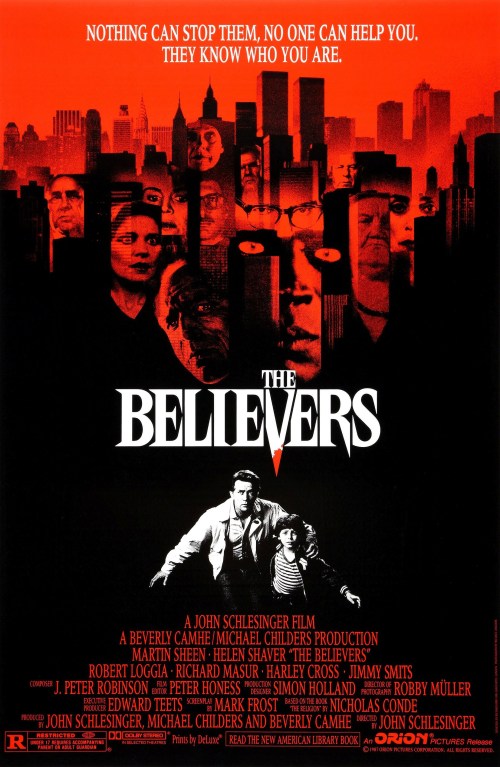
After the death of his wife (Janet-Laine Green) Cal (Martin Sheen) decides to move with his young son Chris (Harley Cross) from Minneapolis to New York City where he gets a job as a police psychologist. It is there that he councils officer Tom Lopez (Jimmy Smits) who worked undercover to infiltrate a cult that performed child sacrifices and is now paranoid that these same cult members are after him when it’s really Cal’s son that they want.

On the directing end I found this to be mildly engrossing and I enjoyed the way John Schlesinger vividly captured both surburbia as well as the inner city. Working into the false sense of security that the suburbanites have making them believe that they’re ‘immune’ to what goes on in the poorer areas, but here it shows how evil can seep into even the most affluent of areas and revealing just how vulnerable everyone is.

However, if you focus solely on the script, which is based on the Nicholas Conde novel ‘The Religion’, then there are a myriad amount of problems. The biggest one being the opening sequence that features the mother getting electrocuted in a freakish accident, which doesn’t really have all that much to do with the rest of the story. Some may argue that this was the catalyst to get Cal and Chris to move from Minneapolis to New York where the real meat of the plot begins, but why not just have them already in New York to begin with?

Having Helen Shaver enter in as Cal’s love interest is equally pointless. Their relationship happens too quickly and comes off as forced while Chris’ dismay at having a new mother figure in his life seems like an issue for an entirely different type of movie. I admit having a tumor grow on her face that eventually spawns spiders is my favorite part of the movie, but why not just have this occur to the mother instead of killing her off so quickly at the beginning?

Richard Masur’ character, who appears during the first act only to then disappear until the end is problematic as well. A good script has important characters appear throughout the story and not just vanishing until you’ve completely forgotten about them, which I did, and then conveniently reappearing and suddenly becoming an integral part of the plot.

Cal’s character arc is too extreme too. He’s portrayed as being a rationalist who does not believe in superstition, but then later on is shown taking part in a ritual requiring him to squeeze out blood of a decapitated chicken, which is too Jekyll and Hyde-like. Sure people can sometimes change their opinions on things, but not so quickly or so severely. Portraying him as initially being superstitious, instead of so adamantly against it, might’ve made this scene a little less jarring.

There are only an estimated 22,000 people who practice the Santeria religion in the United States, which has a population of 327 million, so the odds that a person such as Cal would come into contact with not only a police officer that dealt with the religion, but also relatives is astronomically low and hurts the plausibility. It’s equally hard to believe that a large group of educated, upwardly mobile yuppies would get caught up into a cult that required child sacrifice and that they would all be able to keep it a secret without any of them getting a guilty conscience and going to the police. This is a religion that’s prevalent in the Spanish-speaking parts of the Caribbean, so why a large group of white people would suddenly get so into it is never explained.

Spoiler Alert!

The twist at the end in which Helen Shaver’s character creates a shrine to the spirits composed of dead animals inside her barn makes no sense as there is never any hint earlier that she had a propensity for the ritual, so why all of sudden did she start embracing it? I’m not an animal expert either, but I don’t think a dog would behave so aggressively as he’s shown doing by jumping up and down and barking loudly at the barn door where the shrine of the dead animal is. I would think for him to act that way it would have to be the smell of a live creature and he’d know the difference, but again that’s just speculation.

End of Spoiler Alert!

A lot of these problems could’ve been avoided had the producers went with their original idea of portraying it as a satanic religion feeding off the hysteria of the satanic ritual abuse that was a prevalent headline catching conspiracy theory during the 80’s. Having some outcast teens and desperate poor people immersing themselves in a fringe ritual because they had nowhere else to turn would’ve made a heck of a lot more sense than a bunch of yuppies gleefully standing around and watching the killing of someone else’s child simply because they felt it would give them ‘good luck’ in their quest up the corporate ladder.

My Rating: 6 out of 10

Released: June 10, 1987

Runtime: 1 Hour 54 Minutes

Rated R

Director: John Schlesinger

Studio: Orion Pictures

Available: DVD, Blu-ray, Amazon Video

Avalanche (1978)

By Richard Winters

My Rating: 3 out of 10

4-Word Review: Sliding snow destroys resort.

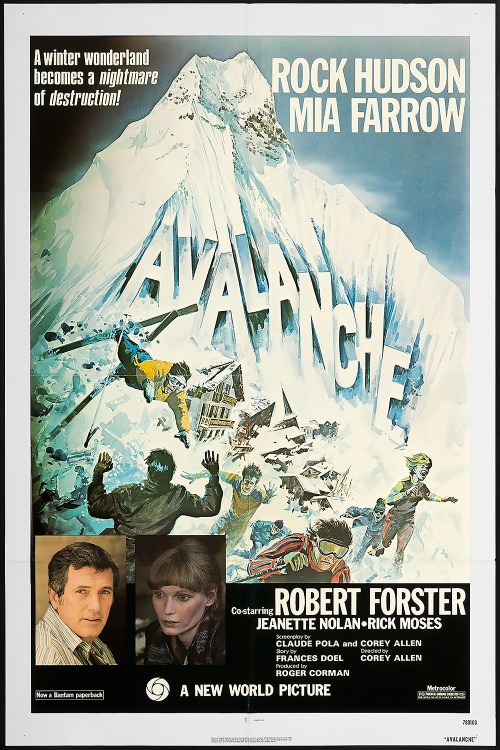
David Selby (Rock Hudson) is a driven businessman determined to build a ski resort in an area that’s vulnerable to avalanches and despite the many warnings is able to get the building constructed and even have it host a ski tournament to kick-off its grand opening, but as the festivities get under way the snowfall continues. Eventually the weight of the snow on the nearby mountaintop becomes too much causing a massive avalanche forcing the guests at the resort into a fight for survival.

The film starts out with a lot of boring, poorly written soap opera-like drama that will put most viewers to sleep before the avalanche ever even takes place. The storyline concerning Mia Farrow’s and Rock Hudson’s marriage and his desperate attempts to ‘rekindle the old magic’ between them is particularly contrived as the vast age difference between the two, a whole 18 years, makes it look like the type of union that would have no chance of it working right from the start, so why even bother making it a part of the plot? The first 40 minutes are so draggy that you start hoping for the avalanche to happen and wipe out all the cardboard characters simply to provide some excitement.

The glossy cast if filled with some well known faces, but their parts offer them little to work with and in the case of Robert Forster, who acts as this environmentalist warning of the avalanche danger, is completely wasted. Only Cathey Paine, a lesser known actress, offers some diversion as a possessive girlfriend who becomes unhinged when she catches her boyfriend (Rick Moses) in bed with another woman and watching her try to kill herself by swallowing a bottle of pills only to be crushed by the snow a few seconds later is darkly funny. I also got a kick out of Jeannette Nolan sporting white hair, which you can tell is a wig because you can see her brown hair underneath it along the edges, and I felt this should’ve been shown falling off her head when the avalanches occurs, but of course it doesn’t.

The special effects, which would be the only reason to watch this thing anyways, gets highly compromised mainly because producer Roger Corman, in his patented stingy way, cut the budget in half just before production began and it definitely shows. The avalanche looks like nothing more than having the actors shot on a screen and then having styrofoam made snow blown in front of it. I also found the howling wind noise, which permeates every outdoor scene, to be irritating and unnecessary especially when all the trees in the background are completely still.

The third act, which deals with rescue efforts, offers some minor tension and is an improvement from the rest of the movie, which made me think they should’ve started it with this and then shown scenes of the avalanche happening, and some of the background ‘drama’, intermittently via flashback. The setting, which was filmed on-location at the Lodge of Tamarron in Durango, Colorado, is quite scenic. I even liked the snowmobile race, which has a Death Race 2000 feel to it especially the ugly wipe-outs.

Spoiler Alert!

Unfortunately everything else falls predictably flat, which includes the dopey ending where Hudson humbly admits that he allowed his greed to get in the way  and that the resort should never have been built, but this isn’t satisfying enough. He should’ve been handcuffed and thrown into prison, which is not shown nor any confirmation if this ever ultimately happened.

My Rating: 3 out of 10

Released: September 29, 1978

Runtime: 1 Hour 31 Minutes

Rated PG

Director: Corey Allen

Studio: New World Pictures

Available: DVD, Blu-ray, Amazon Video

Romantic Comedy (1983)

By Richard Winters

My Rating: 2 out of 10

4-Word Review: Playwrights fall in love.

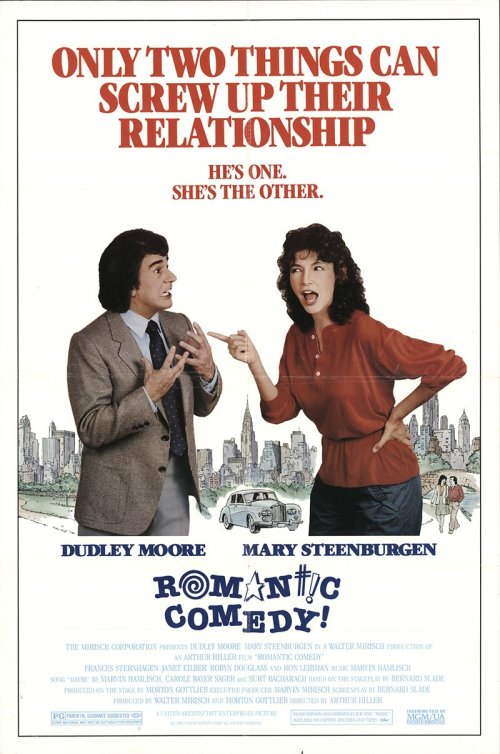
Just as Jason (Dudley Moore), a popular playwright, is getting ready to tie-the-knot with the beautiful Allison (Janet Eilber) he meets Phoebe (Mary Steenburgen). Phoebe is a school teacher aspiring to be a playwright and hoping to team up with Jason, who has had some success in the past, but looking for new inspiration. The two soon become a successful writing team, but begin to fall-in-love in the process, which creates a strain on Jason’s marriage.

The film is based on the play of the same name that was written by Bernard Slade, who also wrote the screenplay. Slade was at one time a television producer whose most noted creation was Th Partridge Family’, but by the late 70’s had moved into writing plays with his biggest hit being Same Tim Next Year about two married people who get together once a year to have an affair, which became a runaway international hit and inspired Slade to then write this one, which is basically just a minor reworking of the same theme. While his first play was hailed as being fresh and original this thing is much more mechanical and ultimately as generic as its title.

The story’s biggest failing is that we never get to see the relationship blossom and grow. Instead it starts out with their awkward meeting that exposes their contrasting personalities and temperaments and then jumps ahead several months later to where they’ve already become lovey-dovey to each other, but with no insight as to how that came about. Part of the fun of watching a romance is seeing how it flourishes between two very unlikely people, but here that gets glossed away making everything that comes after it seem very forced and contrived.

The film also offers no insight into the collaboration process and how two people can work together to create a play, which could’ve been both interesting and amusing. It also could’ve been revealing seeing what kind of plots their plays had and why some of them are flops while others are hits. Having a story within a story concept where the two write about the secret emotions that they have for the other into their characters could’ve added a unique angle, but like with a lot of other things here becomes another missed opportunity.

Moore and Steenburgen have no chemistry and there was a big 18 year age difference between them. Moore is too acerbic and having him go from being sarcastic and abrasive to suddenly loving and tender is unconvincing. Steenburgen’s young girl voice makes her seem empty-headed and not the sophisticated, witty type who would be able to write the type of plays that she supposedly does. Why Mia Farrow and Anthony Perkins, who played the parts in the original Broadway play, weren’t cast in the same parts here is a mystery, but they would’ve been far more effective choices.

The expected drama and conflicts involving the wife never culminates into anything making her presence virtually pointless. The laughs are non-existent as well. In fact the only time it ever gets even mildly amusing is when Moore and Steenburgen would argue and it would’ve been funnier had they been portrayed as hating each other, but teamed up anyways simply because they somehow managed to write hit plays when they worked together.

My Rating: 2 out of 10

Released: October 7, 1983

Runtime: 1 Hour 43 Minutes

Rated PG

Director: Arthur Hiller

Studio: MGM/UA

Available: DVD, Amazon Video

Loving (1970)

By Richard Winters

My Rating: 8 out of 10

4-Word Review: Commercial artist fools around.

Brooks (George Segal) is a commercial artist who spends most of his time chasing after clients, which he finds exhausting and takes away from the creative process. Although married to the beautiful Selma (Eva Marie Saint) he still sees  Grace (Janis Young) on the side, but she’s tired of being the other woman and wants him to divorce his wife and commit to her, which he resists. Despite all of these issues Brooks manages to keep his philandering hidden until one night when they attend a party at a friend’s house where his fooling around unexpectedly comes out into the open for all to see.

So many films have tried to capture that perfect day-in-the-life feel, but usually end up failing by either jazzing-up the drama, or becoming boring by  not having enough happening. Director Irvin Kerschner manages to find the right balance by having the characters continue to do things as they speak. For instance showing Brooks’ boss (Keenan Wynn) converse with him over the phone while folding up his hideaway bed. Why was he sleeping on the couch? Was he having marital problems of his own? Could be, but this visual approach allows the scenes to remain active while also conveying how everyone has issues and not just our protagonist. It also remains realistic as most people are usually doing other things while talking on the phone and never just sitting motionless like it gets portrayed in many other movies.

I enjoyed too how the film explores the job duties that Brooks has including the way he takes photos of models, sometimes he even using himself, and then traces their outlines from the picture to create a different artistic rendering, which I found fascinating. Much of the reason for these intricate details has much to do with the fact that the script is based on the novel ‘Brooks Wilson Ltd.’ by John McDermott under the pen name of J.M. Ryan, who was an illustrator in real-life, for Disney studios, and parlayed his experience of the craft to the main character. I also found it interesting how Brooks’ clients would sometimes have minor, subjective complaints about his work forcing him, for the sake of pleasing them and making money, to begrudgingly change what he had originally created and thus showing how the business side can squelch the artistic inspirations of creative people and take away the enjoyment they once had for their craft.

Even the children characters get handled much better than in most films. Granted their parts have very little to do with the plot, but still like in every parent’s life they’re always around causing disruptions and noise even when you have your mind occupied with other things. They’re also not portrayed as sickingly sweet or excessively bratty, but like with most kids an equal combination of both. The oldest girl, who looked to be about 8, also has one of the film’s funniest moments as she’s shown reading a book on the sofa while a nude model, who her father is sketching, stands right in front of her, which she finds to be no big deal.

Spoiler Alert!

The film’s best moment though is still the ending where Brooks goes to a party and makes love to his best friend’s wife (Nancie Phillips) in a child’s empty playroom to the amusement of the the other guests who watch them in another room, unbeknownst to Brooks, on closed circuit TV. Not only is this scene hilarious, but dramatically powerful as Will (David Doyle), whose wife is caught fooling around with Brooks, physically attacks Brooks outside afterwards and the look of anger and betrayal on his face reveals, despite the funny set-up, how emotionally devastating philandering can be to the other spouse.

The film though fails to offer any conclusion. We sit through 90-minutes of seeing the marriage slowly disintegrate, but then are left watching the couple staring at each with no idea whether they were able to patch things up, or divorce. The viewer feels cheated that no clear answer is given and a brief denouncement showing where the main character ultimately ends up, whether it be with a new love, his same wife, or all alone, should’ve been added.

My Rating: 8 out of 10

Released: March 4, 1970

Runtime: 1 Hour 29 Minutes

Rated R

Director: Irvin Kerschner

Studio: Columbia Pictures

Available: DVD, Amazon Video, YouTube

Gotcha! (1985)

By Richard Winters

My Rating: 6 out of 10

4-Word Review: Spy game turns real.

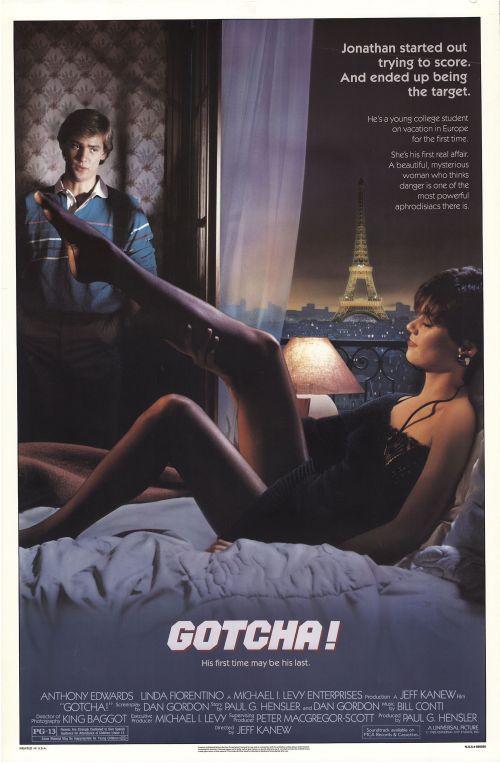
Jonathan (Anthony Edwards) enjoys playing the make-believe spy game of Gotcha on his college campus by shooting his fellow students with paint darts of which he is quite good at. For a vacation he goes to Paris, France and meets Sasha (Linda Fiorentino) who is a real-life spy transporting undercover documents from behind the iron curtain. She gets Jonathan to travel with her to East Berlin where he reluctantly finds himself caught-up in the spy action and having bad guys shoot at him with bullets instead of paint balls.

The film has its engaging moments, but the plot gets played-out in a haphazard way. The beginning comes off too much like just another banal coming-of-age comedy with guys using all sorts of corny lines to get women to go to bed with them and a lot inane dialogue and comedy bits are used to help string it along.

Things do improve once he meets up with Fiorentino who puts on an effective foreign accent and adds much needed chemistry. The vivid on-location shooting avoids the well known landmarks and instead focuses more on the hotels and restaurants, which makes the viewer feel like they’re traveling alongside the characters.  Jonathan’s transition from cocky college student to scared kid in way over-his-head is interesting too, but something that I wished had been played up more.

Edwards’ performance helps the viewer remain sympathetic to his quandary despite the fact that it was his own naivety that got him into his jam. I didn’t like his hairstyle though, which to me looked more like a wig and, since he’s shown to be openly bald in his later years, it probably was. He was also older than his character and looking very much like the 23 years of age that he was, which is what Fiorentino guesses when she first meets him and not like 18, which is what his character supposedly is making the opening conversation that the two have unintentionally ironic.

The third act in which Jonathan returns to the states, but the Russian spies continue to chase after him, is when this thing really goes south. It would’ve worked better, and been more believable, had the entire spy scenario remained in Europe instead culminating on the same college campus where it began making the intended irony too forced and too cute for its own good.

There were times when I did get caught-up in the intrigue, but film ruins the tension by always answering it with a comical twist that makes it come-off as too gimmicky. There’s also no explanation as to what was on the film role that Jonathan and Sasha were trying to smuggle out and the Russians were so eager to get back, which makes the plot transparent instead of exciting.

The one moment though that I really did like and even found quite memorable is when a caged tiger is brought into a classroom to show the veterinarian students how to shoot a sick animal with a sleep dart. The animal seems to be in very real pain and with genuine moans of discomfort and the part where he gets hit with the dart forces him to leap up in his cage in a very startled manner. I’m not sure how they were able to pull off getting a legitimately hurt tiger into the scene, but it’s the one segment where the movie isn’t silly and it’s too bad the rest of the script couldn’t have fallen in-line with that same type of approach.

My Rating: 6 out of 10

Released: May 3, 1985

Runtime: 1 Hour 41 Minutes

Rated PG-13

Director: Jeff Kanew

Studio: Universal Pictures

Available: DVD

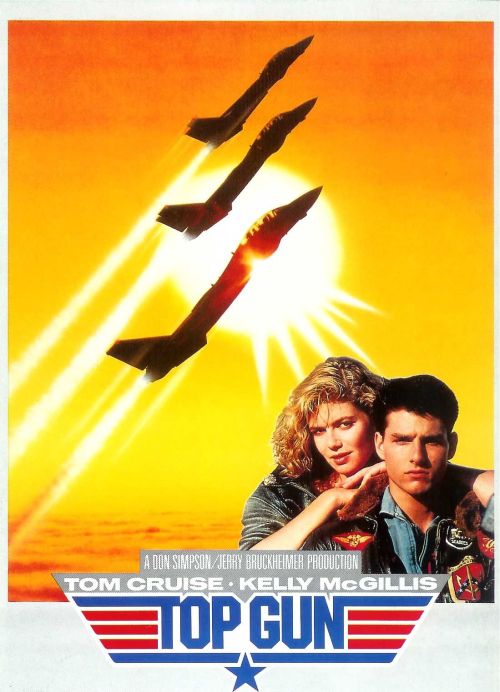
Top Gun (1986)

By Richard Winters

My Rating: 5 out of 10

4-Word Review: Student pilot proves himself.

Pete Mitchell (Tom Cruise), who goes by the nickname Maverick, gets accepted into an elite fighter school for Navy pilots known as ‘Top Gun’. It is here where his flying skills impress his instructors, but his daredevils ways also get him into trouble. He starts dating one of his instructors (Kelly McGillis) and everything seem to be going fine until during a flight training exercise that he is piloting his partner Goose (Anthony Edwards) tragically dies, which shatters his confidence and makes him believe that maybe he is not cut out to be a pilot after all.

This film was a giant hit at the box office, but mostly ravaged by the critics and with good reason. The story is shallow, but Cruise’s performance manages to hold it together. Some have criticized his acting ability by saying he can play only one type of character namely the cocky type, but here he mixes in a lot of hidden vulnerabilities with it making you feel for him during his dark times of self doubt and cheer when he finally overcomes them.

I also enjoyed the romantic angle at least initially. In a lot of movies the side romance can get in the way of the story, but here it helps keep the plot intriguing especially when you factor in their contrasting personalities and temperaments. I liked the fact that she was also one of his instructors and therefore had to keep a professional distance and how this caused tensions in their potential relationship, which I wanted explored much more and was disappointed when this plot point fizzles out already in the first act and they become instead a generic ‘happy couple’ the rest of the way.

The mysterious death of Maverick’s father years early was another subplot that gets poorly handled. I was expecting this to work into being a heightened mystery complete with a big reveal at the end, perhaps coupled with a flashback, but instead it gets treated almost like a throwaway bit where the Tom Skerrit character explains what occurred in passing and then by the time the ending finally comes it’s pretty much forgotten. The same goes for Val Kilmer who is excellent as Maverick’s rival, but his part is woefully underwritten and like with a lot of other things not pushed to its full dramatic potential.

Director Tony Scott hurts the realism by implementing too much of a music video approach with literally every scene smothered with a loud, booming rock tune, which cheapens the story by making it more about mood and image than a character study. There’s even issues with the sky color, which outside of the aerial footage, looks to have a bright golden color that does not replicate any sky I’ve ever seen on this planet.

The stunt work involving the flying jets is certainly impressive making this a movie you definitely need to see on the big screen in order to get its full effect, but eventually it gets redundant and for a layperson not familiar with piloting technique even a bit confusing. The ending in which Maverick and his fellow pilots are ordered to provide air support to a stricken ship that has drifted into hostile waters really jumps the shark when jet planes from a foreign country attacks theirs, which would be considered an act of war and a major international incident, but instead after the skirmish is over it all gets written off saying that the other country simply ‘denied that they did it’, which only in the movie world is good enough to make everyone else forgive and forget about it too.

My Rating: 5 out of 10

Released: May 12, 1986

Runtime: 1 Hour 49 Minutes

Rated PG

Director: Tony Scott

Studio: Paramount

Available: DVD, Blu-ray, Amazon Video, YouTube

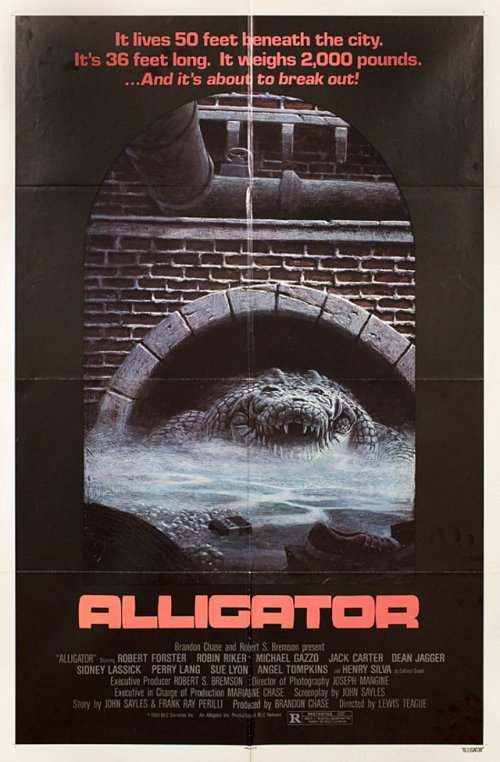
Alligator (1980)

By Richard Winters

My Rating: 6 out of 10

4-Word Review: Reptile in the sewer.

In 1968 a young girl (Leslie Brown) brings home a baby alligator, which she stores in her small aquarium, but her father decides to flush the thing down the toilet where in the sewer it feeds off the carcasses of dead animals which were given an experimental growth formula from a nearby clinic. 12 years later the alligator having ingested this formula for years has grown to massive lengths and escapes from the sewer where he now terrorizes the citizens of the city.

The screenplay was written by John Sayles and has a nice blend of comedy and scares. In most other horror films there are usually some long boring segments in between the shocks that get filled with awkward drama or banal dialogue, but here these same segments convey a playful sense of the absurd and are some of the best moments in the movie including showing all the street vendors who come out and try to cash in on the alligator scare by selling alligator related merchandise at the river where the police are searching for the beast. I also enjoyed the ad-libbed lines by the supporting characters mentioning Robert Forster’s receding hairline, which become the movie’s running joke.

The scares are still present and for the most part effective although the scenes inside the sewer work best. I liked the way the beams from the flashlights reflected off of the tunnel walls and created a surreal look as well as how quiet it would get when the police and S.W.A.T. went into the underground caverns, which helped accentuate the tension.

When the gator breaks out of the sewer is when the thing starts to go south especially when it attacks guests at a dinner party, which is too graphic and ghoulish and destroys the film’s otherwise playful tone. I also didn’t like when the alligator breaks through sidewalk having the camera shake, which is something directors would do in old movies to create an earthquake-like visual effect, but comes-off as quite tacky looking. Having the gator roam the city for as long as it does and not get caught seemed implausible as something that big would attract lots of attention no matter where it went and most likely would get cornered by the authorities a hell of a lot sooner than it does.

The film also suffers by not effectively conveying the size of the beast visually. We see a lot of quick shots involving its open mouth, but not much else. An animatronic one was built, but it malfunctioned and was little used and then later donated to the Florida Gators as their mascot. An actual gator got used in some shots, which they superimposed onto a miniature set to make it look bigger, but the final result of this looks awkward.

The truth is alligators are by nature very timid towards humans and will usually swim away if approached by one and only attack if they feel threatened. They prefer much smaller prey that they can eat with one gulp and thus avoid people altogether. It’s actually the crocodile that  is much more dangerous and in fact the saltwater and nile crocodile kills hundreds of people each year, which for the sake of accuracy should’ve been the species that got used.

I also thought it was a bit bizarre that someone could keep an alligator as a pet like the young girl does at the beginning. Now don’t get me wrong watching them flush the baby gator down a toilet is one of the best parts of the movie, but what would’ve happened had the gator been allowed to grow into an adult? How would they be able to house or control him, which only makes the father, who gets portrayed here as being obnoxious, look smart by getting rid of it when it was small and he still could.

The cast though still makes it worth watching. Forster is great in the lead as he plays against his stoic tough guy image by conveying vulnerabilities with his finest moment being the horrified expression on his face when his partner gets attacked and he’s unable to save him. I also liked Jack Carter as the corrupt Mayor and Dean Jagger, in his last film role, as the nefarious animal clinic owner. Angel Tompkins can be seen briefly as a news reporter as well as Sue Lyon in her last film appearance to date.

My Rating: 6 out of 10

Released: November 14, 1980

Runtime: 1 Hour 31 Minutes

Rated R

Director: Lewis Teague

Studio: Group 1 International

Available: DVD

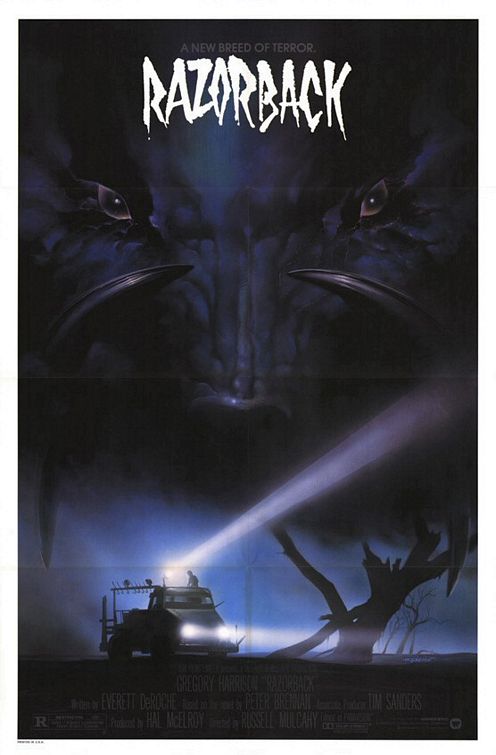
Razorback (1984)

By Richard Winters

My Rating: 6 out of 10

4-Word Review: Giant boar terrorizes outback.

Jake (Bill Kerr), who lives in the Australian outback, gets attacked one night by a giant razorback who takes off with his infant grandson. Jake is later accused as having made up the story as no one can believe that there could be a razorback of such mammoth proportions and yet Jake spends the rest of his life hunting after it and determined to get his revenge for what it did to his grandson. During his quest he meets up with Carl (Gregory Harrison) whose wife Beth (Judy Morris) was also killed by the same wild boar.

The film was directed by Russell Mulcahy, who rose to fame by directing many influential music videos and his unique visual style is what sets this film apart. The way he captures the vast, flat outback is stylish and the dream sequence out in the desert is both creepy and surreal. I also really enjoyed the part where the razorback tears apart a man’s house forcing him to helplessly watch as the part of the home with the TV, which he was watching, goes literally gliding away in front of him, which  may not be realistic, but a very funny image nonetheless.

The story though, which is based on the novel by Peter Brennan, is too indicative of other better known movies. It starts out with Jake going to trial over the death of his grandson and no one believing his account, which is loosely based on the Azaria Chamberlin incident who was an infant that got taken away by a dingo in 1980, but the public didn’t believe the story and accused the parents of killing the child instead. However, in this instance the razorback creates a giant hole in Jake’s house, which should be enough for most people to think that there might be something to what Jake was saying and makes the opening court room bit seem both protracted and unnecessary especially since he quickly gets acquitted anyways.

The second act resembles the film Wake in Fright as Carl and two other men go on a nighttime kangaroo hunt. It also examines the poor way Carl adapts to the rough nature of the outback men, which again seems too similar to the plot of the other film and really wasn’t needed since it slows up the pace, which needed more scares and appearances of the giant razorback that are completely missing during the middle part.

The third act comes off too much like Jaws, with Jake channeling Quint, which might’ve been alright as I found Jake’s rugged individualistic ways to be both endearing and amusing to the point that he could’ve been made the main character. However, is untimely demise is both graphic and cruel and gives the film an unnecessarily mean tone.

Having Carl single-handidly take on the razorback at the end while inside an abandoned warehouse is boring as it rehashes the man vs beast theme that’s been done many times before. I was actually more interested in seeing the townspeople work together to hunt down the boar, which is an idea that the film teases, but then ultimately sells-out on.

My biggest grievance though is the way the beast gets photographed. Supposedly a  giant animatronic model of the razorback was built at a cost of $250,000, but you never really see it. Shots of the beast are edited so quickly that you only get brief glimpses of the animal and never its whole body and no true idea of how big it really is. There’s also no explanation offered for  how it grew so big.

My Rating: 6 out of 10

Released: April 19, 1984

Runtime: 1 Hour 34 Minutes

Rated R

Director: Russell Mulcahy

Studio: Warner Brothers

Available: DVD-R (Warner Archive), Blu-ray (Region B/2, A/1), Amazon Video, YouTube