Tag Archives: Review

Last of the Red Hot Lovers (1972)

last1

By Richard Winters

My Rating: 4 out of 10

4-Word Review: Married man wants fling.

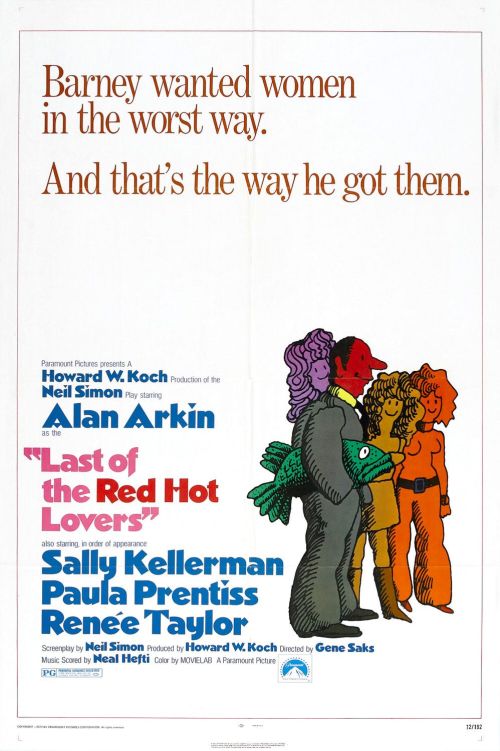
Barney (Alan Arkin) is a middle-aged man, who after 22-years of marriage, has decided he’d like to fool-around for the first time. He doesn’t want an actual affair, just a quickie sex fling with indiscriminate women while inside his elderly mother’s apartment, which he has access to during the day while she’s away. The problem is that while he’s able to get attractive women into the place he can’t quite get any action leaving him feeling more sexually frustrated than when it began.

The film is based on the Neil Simon play that opened on Broadway in 1969 and ran for 706 performances. The play starred James Coco in the pivotal role who I felt was much better suited for the part than Arkin. Arkin is okay, but his comedic style can be quite frantic in tone that can sometimes border on creepy. He also had a full head of hair at the time even though the role called for a balding man, so he shaved the top of his head to appear semi-bald, but it looks tacky. Coco on the other-hand had a lovable loser quality that made you want to like him even when he did naughty things and he was naturally bald, so his appearance wouldn’t have looked as fake as Arkin’s. I can only presume that because Arkin was at the time an established film star and Coco was still just considered a fledgling character actor that’s why he got the offer while Coco didn’t, but it’s one of the main reasons the story doesn’t translate as well on film as it did onstage.

The directing by Gene Saks isn’t bad particularly the opening sequence where we things entirely from the point-of-view of Barney as he wakes-up and gets out of bed and starts his daily routine, which I found rather inventive cinematically. In fact it’s these moments where we hear the thoughts going on inside Barney’s head as he tries to get the nerve to break-the-ice with other women that he meets, which are the funniest. Unfortunately the scenes done inside the apartment don’t work as well as the place is too cramped and appearing more like a jail cell, which becomes visually static.

The three rendezvous that Barney has with three different women aren’t as clever or creative as they could’ve been. The first segment has Sally Kellermen, who is excellent, playing an Italian women, who comes up to his place, but then just proceeds to argue with him before leaving. My main problem with this scene was the motivation as she spots Barney working inside his restaurant, which precipitates the meet-up, but why would this incredibly hot woman get turned-on by this dopey looking guy to the point that she’d want to have casual sex with him? There were plenty of other men in the place, so why does Barney excite her over the others? The conversation that the two have inside the restaurant is never shown, which I found to be a cop-out and hurt the character development. Had she been portrayed as being a prostitute then it would’ve made more sense, but this is never confirmed, which makes this whole first segment quite weak.

The second segment deals with Paula Prentis as a struggling actress who Barney meets in a park. She borrows some money from him and then agrees to pay him back later at the apartment. However, when she arrives she seems like a completely different person. At the park she came-off as quiet and shy, but at the apartment she’s a babbling idiot that seems to be on acid. The dialogue during this sequence in which the characters basically talk-over each other the whole time quickly becomes annoying. The scene fades-out with the two getting high off of marijuana, but it never shows her leaving the place, so we don’t know for sure if they ended-up having sex or not.

The third and final segment has Renee Taylor playing a middle-aged woman, who is also married, coming-up to Barney’s mother’s place, but immediately getting cold-feet, which kills the intrigue as we know right from the start how it’s going to go. This scene also has a rapey vibe to it as Barney, now feeling frustrated at having struck out twice before, behaves in a much more aggressive manner by blocking her from leaving and then while half-naked jumping on top of her and pinning her to the bed while she yells for him to get off, which is cringy and not funny.

Having a film deal with all the strike-outs a person may face when it comes to having sex with others is an interesting idea. Too many other movies just show the ones that work-out, but in reality, especially with average looking people, there can be more misses than hits, so I appreciated the story in that regard. However, random sex with strangers where the women goes to a strange man’s place without worry or concern has become a thing of the past in this day and age of stalkers and self-protection making the theme here quite dated and out-of-touch.

My Rating: 4 out of 10

Released: August 17, 1972

Runtime: 1 Hour 38 Minutes

Rated PG

Director: Gene Saks

Studio: Paramount

Available: DVD, Amazon Video, PlutoTV, YouTube
Another Woman (1988)

another

By Richard Winters

My Rating: 6 out of 10

4-Word Review: She reanalyzes her life.

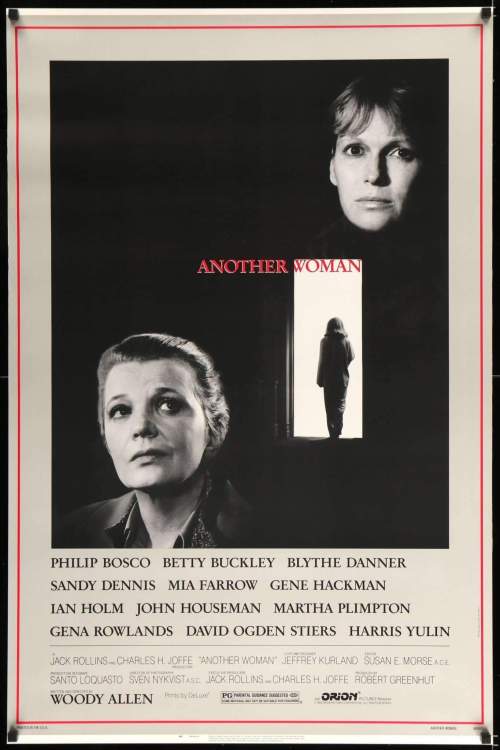
Marion (Gena Rowlands) is a college professor over 50, whose taken a leave of absence in order to write a book. Due to the construction at her place she sublets another apartment in order to have it quiet for her writing, but finds that it’s next to a psychiatrist’s office and through the vent can hear everything that the patients talk about. She becomes especially intrigued with a young pregnant woman named Hope (Mia Farrow) who talks about how empty her life is and this touches a cord with Marion, who despite being much older, feels the same way about her own life. This then forces her to reanalyze how she’s treated her family and friends through the years and causing her to face some harsh realities about herself.

While writer/director Woody Allen has the reputation of a being an intellectual as well as a perfectionist, the film’s opening shot had to be rewritten several times before he was happy with it, it’s surprising how dumb he is with basic physics. The idea that Marion could put a couple of couch cushions over the vent and this would be enough to blot out all of the noise coming from the neighboring apartment just doesn’t ring true. Sure it might muffle the voices a bit, but not a complete block of sound to where she’d hear no noise at all and having the vent be in another room in the apartment, which would’ve allowed her the convenience of simply closing that room’s door in order to cut-off the noise, would’ve worked better.

I was also surprised how later on in the film, Marion tells the psychiatrist about the ‘acoustical irregularities’ that allows her to hear everything that’s said in his office and the Dr. admits to being aware of this, but says he’ll ‘correct it’. What kind of psychiatrist though would knowingly allow his patient’s most personal thoughts to get out for others to hear? This made me think the plot would’ve worked better as one of Allen’s comedies where a writer puts the stories overheard from the patients into their book and when it becomes a best-seller, both the author and Dr. get sued and tormented by the angry patients sending them to a psychiatrists of their own.

Like with all of Allen’s dramas the cast of characters are entirely made-up of upper middle-class intellectuals, which gives the film an elitist, snobby vibe by implying that these types of people are the only ones sophisticated enough to have complex problems that people in the lower socio-economic classes supposedly don’t. They seem too much like caricatures as well who have the exact same interests (writing, the arts, and going to operas) and it would’ve been nice had there been one working class person who wasn’t into all of these things thrown into the mix simply to give it a better balance.

The fact that just about all of the characters are having affairs, many times with each other, makes it too soap opera-like. The scene where Gena bumps into Sandy Dennis and her husband and the three go to a pub for drinks gets particularly over-the-top when Dennis bluntly accuses her husband of paying too much attention to Gena. In most cases if a wife has a problem with her husband’s behavior she’ll keep it to herself and then bring it up later when the two are alone and not out in public for everyone to hear especially to a friend that she hasn’t seen in awhile and is only an acquaintance.

I didn’t like Marion as she’s too cold and while I realize this was intentional she’s not the type of person that the viewer can warm-up to, or care that much about. Mia Farrow’s character is far more appealing and I wanted more of her and was shocked how little screen time she ultimately gets. The part wasn’t even meant for her as she was set to play Marion before she got pregnant and then when Dianne Weist, who was originally cast as Hope, had to leave the production due to illness and her replacement, Jane Alexander, didn’t approach the character the way Woody wanted, so it was eventually given to Farrow, who does quite well despite the fact that she was already in her 40’s at the time even though the person she was playing was supposed to be in their 20’s.

The film does end on a strong note, but it does take awhile before it gets there and comes-off as clunky and unintentionally funny at other points. The scenes with John Houseman, who plays Marion’s father, are particularly hammy as he sits at the dinner table conveying his lines like he still thinks he’s Professor Kingfish speaking to an auditorium full of students. However, David Ogden Stiers impression of Houseman (he plays a younger version of him during a flashback scene) is spot-on and the movie is almost worth catching just for that.

My Rating: 6 out of 10

Released: October 14, 1988

Runtime: 1 Hour 21 Minutes

Rated PG

Director: Woody Allen

Studio: Orion Pictures

Available: DVD, Amazon Video, Blu-ray (Region 0), YouTube

Weekend of Shadows (1978)

weekend1

By Richard Winters

My Rating: 6 out of 10

4-Word Review: Manhunt for murder suspect.

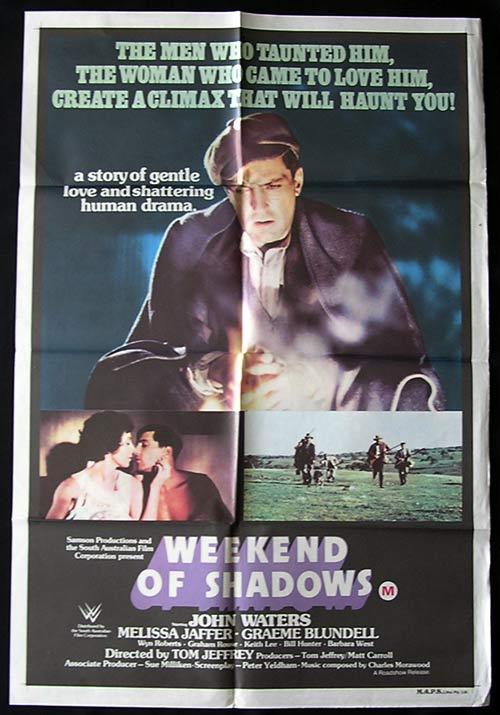
In rural Australia during the 1930’s a farmer’s wife is found murdered inside her home. Suspicions immediately fall on a Polish laborer who had always been deemed ‘peculiar’ by the locals and while there’s no other evidence pointing to his guilt it’s enough to get the men in the community together to form a posse. Sergeant Caxton (Wyn Roberts) hopes that if he can capture the suspect it will help mend his reputation, which had been tarnished while working in Sydney and got him demoted to the small town that both he and his wife (Barbara West) don’t like. Vi (Melissa Jaffer) feels this will be a perfect opportunity for her shy husband, Rabbit (John Waters) to bond with the other men by going along on the hunt, but he resists thinking that the whole thing is just a knee-jerk, mob reaction and wants nothing to do with it, but at the behest of his constantly prodding wife he eventually joins, but learns to regret it.

Out of all of the manhunt movies that are out there this one may be the most unusual in that it doesn’t focus on the suspect at all, in fact you barely ever see him, but instead on the various men in the group. Surprisingly though this manages to be quite effective and I found myself wrapped-up in the various personalities of the participants and how all of them clash with each other at various times. The budget though is quite low, screenwriter Peter Yeldham and director Tom Jeffrey were forced to make many concessions on the script just to get the necessary funding, and while the stark production values will initially be a turn-off, the overall drama, which is based on the novel ‘The Reckoning’ by Hugh Atkinson, will eventually compensate.

I didn’t though like the flashbacks showing Vi and Rabbit’s courtship, which I felt wasn’t necessary and bogged down the tension. The relationship between them is intriguing on a certain level as it shows how wives can have a strong influence over their husbands and get them to do things they wouldn’t otherwise, this same scenario also gets played-out between the constable and his wife, but the scenes showing their dating period offers no further insights and no effort is made to make the actors appear younger even though the courtship had been many years prior.

Spoiler Alert!

While the film was a hit with the critics it sank at the box office recouping only $61,000 of the $495,000 that had been put into it, which soured Jeffrey from directing movies and he helmed only one other, The Last of the Knucklemenafter this one. Ironically Hugh Atkinson was quite impressed with the finished product, which was odd since most of the time author’s of the book which the movie is based are usually not happy with the director’s interpretation of their work, but Atkinon felt Jeffrey ‘got it’ particularly with the ending, which he stated represented the crucifixion. Personally I didn’t see this connection, and neither did Jeffrey, who felt like I did that the story was more about how group dynamics can get out of hand, but Atkinson insisted the crucifixion element was the centerpiece. The ending will be a surprise to many and leaves open many questions, but what you ultimately make of it will be up to your own personal perspective.

My Rating: 6 out of 10

Released: April 12, 1978

Runtime: 1 Hour 25 Minutes

Not Rated

Director: Tom Jeffrey

Studio: The South Australian Film Commission

Available: VHS

Goodbye Paradise (1983)

goodbye1

By Richard Winters

My Rating: 6 out of 10

4-Word Review: Searching for Senator’s daughter.

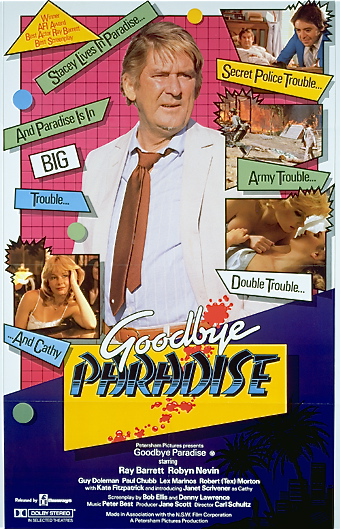
Michael Stacey (Ray Barrett) is a retired cop whose written a scathing exposé on the corruption of his former profession, which has gotten him many enemies and, along with his alcoholism, pushed to the very fringes of society. He now lives in a tiny, rundown apartment while playing chess with himself as his only means of companionship. One day he gets a call from a high-ranking Senator (Don Pascoe) who wants Michael to find his runaway daughter as he’s concerned that she’s gotten involved with an underground cult movement, which he fears could be detrimental to both her safety and to his own political career. Have no other means of income Michael takes-up the offer and soon gets immersed with an array of odd people and many twists that ultimately finds him in the middle of a military coup.

This offbeat movie starts out strong, but eventually goes overboard. The original idea by screenwriter Denny Lawrence was to have an ex-cop working as a private investigator who takes on a case of a runaway daughter who joined a religious cult run by a charismatic charlatan that eventually lead to the deaths of many of its members. However, after the Jonestown massacre, which was led by religious cult leader Jim Jones, this idea got nixed and the plot, with the help of co-scripter Bob Ellis who wanted a more political bent, got turned into a completely different direction, which doesn’t work as well.

The whole idea of a parent hiring a down-and-out, aging guy to find his long lost daughter doesn’t make much sense. The father’s a rich senator with lots of connections, so why not use the resources of the police, or a more polished detective to do the searching instead of an old bum more focused on when his next drink will be? Had Michael’s actual job, like in the original script, been as an private investigator then maybe, but in this version Michael was a struggling writer, so why pay someone to do something that they had no practice in doing, or if they did it had been a seriously long time and someone else could’ve been found to do it better?

The protagonist is a lovable loser, a sort of anti-hero who was meant to be a modern-day Philip Marlowe, and the main reason that get me hooked into the movie right away especially with Barrett’s perfect portrayal that is both raw and funny at the same time. However, the supporting characters are dull. The is especially evident with the Senator’s daughter, which due to a case of mistaken identity, he ends up dealing with two different young women, but both of them are stereotyped and cliched to the extreme. The dialogue and conversational exchanges that they have with Michael are flat making these scenes the most boring part of the movie. Nothing is worse than a film that does a excellent job of creating a multi-faceted person in one area, but then cuts-corners with the rest making the viewer like they’ve gotten stuck with only half a movie.

Spoiler Alert!

The climactic sequence, which involves an all-out military coup and lots of warfare-like action, is just too extreme and surreal especially for a story that starts out in a realistic vein. Much of the fault could be blamed on the two script writers with Lawrence wanting it to be a genre piece while Ellis preferring a more political take. The result is an imbalance that gets increasingly more wacky and implausible as it goes on until it becomes too cluttered to make much sense. Whatever statements the writers hoped to make here gets lost in the insanity and leaves the viewer feeling overwhelmed with all of the absurdity.

My Rating: 6 out of 10

Released: July 21, 1983

Runtime: 1 Hour 59 Minutes

Not Rated

Director: Carl Schultz

Studio: New South Wales Film Corporation

Available: DVD (Region 0 Import)

Swing Shift (1984)

swing1

By Richard Winters

My Rating: 3 out of 10

4-Word Review: Women help build aircrafts.

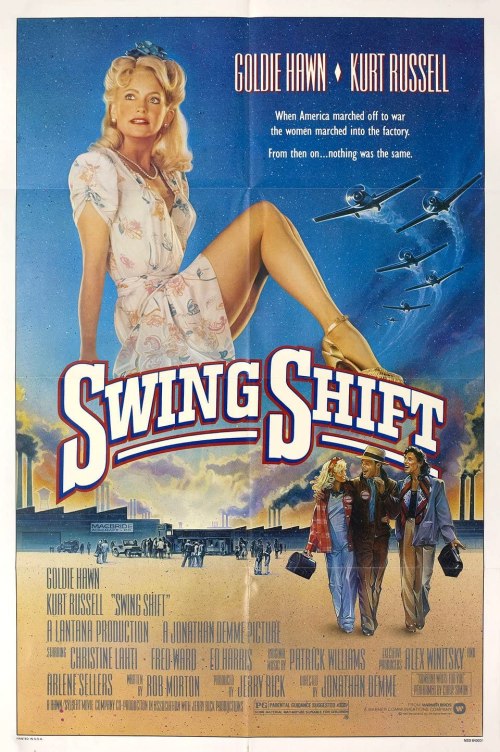
Kay (Goldie Hawn) lives with her husband Jack (Ed Harris) in a housing complex in Los Angeles and have a happy marriage until December 7, 1941 when the Japanese bomb Pearl Harbor, which causes Jack to immediately enlist into the Navy and go off to war. Kay now must learn to manage for herself and with the shortage of men many companies begin recruiting area housewives to apply to help fill-in. Kay, along with the other women in her neighborhood, get a job at a factory that builds aircrafts. It’s here that she becomes friends with Hazel (Christine Lahti) who lived next door to her, but she never got to know since her husband considered Hazel to be ‘white trash’. She also meets a fellow co-worker named Lucky (Kurt Russell) who was not drafted due to a heart condition. Lucky takes an immediate liking to her and asks her out even though he knows that she’s married. Kay at first resists his advances, but eventually gives in and starts an affair with him just as Jack returns home.

The film does a good job of recreating the 40’s period atmosphere and there’s an opening catchy tune sung by Carly Simon, but everything else is dull and boring. Many people blame this on Hawn who did not get along with director Jonathan Demme and insisted on many scenes being reshot with another director. Demme was so incensed about the changes that he tried to have his name removed from the credits, but was talked out of it while Nancy Dowd, who had written the screenplay, got listed under the pseudonym of Rob Morton. Hawn’s defense for going against the objections of the director was that she was simply trying to ‘make the movie work’, but in 2017 the magazine Sight and Sound compared Demme’s director’s cut to Hawn’s version and the article’s authors felt that Demme’s was far superior.

This is also where Russell and Hawn first met and precipitated their long relationship that they’re still in today, which is great, but Russell’s character was one of the biggest problems. He continually pesters Kay for a date even after she makes clear several times that she’s married and isn’t interested, which makes him come-off like a potential stalker. I also didn’t understand why he was so obsessed with her, sure she was good-looking, but so was he and he moonlight as a trumpeter at a dance club where he was the center of attention and could easily attract other women, so why get so hyper-focused with Kay when he could easily find many other pretty ladies to date in her place? I also didn’t like that Kay eventually goes to bed with him, which ends up rewarding his bad behavior.

Kay’s relationship with Hazel doesn’t work either. Initially they come-off as having wildly divergent personalities and lifestyles, Hazel is even quite snarky with Kay at the start, but then overnight they become best chums, which isn’t interesting, or authentic. The odd couple-like love/hate approach would’ve offered more zing in a movie that’s too tranquil to begin with. Much of this may be blamed on Hawn as well, as she felt Lahti had become too much of a ‘scene stealer’ and had many of her scenes either rewritten or cut-out completely.

It would’ve worked better had it focused more on the job and women trying to make-it in what was at the time a predominantly man’s world. There are some moments of sexism shown particularly with the character played by Charles Napier, but it gets quickly resolved, which is too convenient and misses out on being a character building drama that this movie was in desperate need of.

My Rating: 3 out of 10

Released: April 13, 1984

Runtime: 1 Hour 40 Minutes

Rated PG

Director: Jonathan Demme

Studio: Warner Brothers

Available: DVD-R (Warner Archive), Amazon Video, YouTube

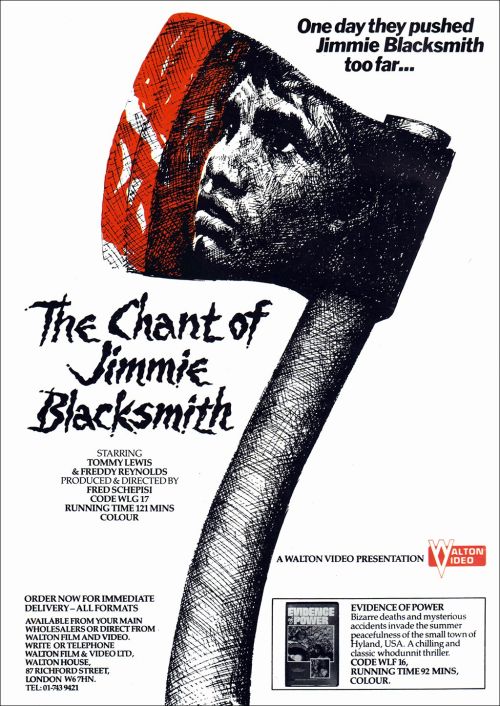
The Chant of Jimmie Blacksmith (1978)

chant1

By Richard Winters

My Rating: 9 out of 10

4-Word Review: Aborigine driven to murder.

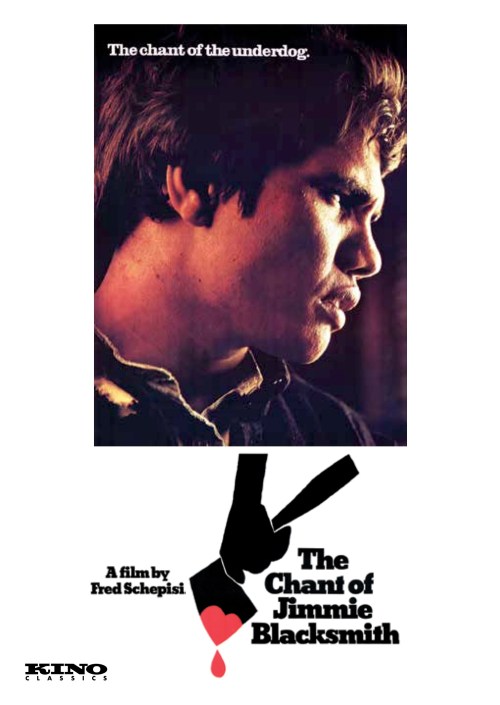
Jimmy Blacksmith (Tommy Lewis) is an aborigine living in Australia during the turn of the century while being raised by the Reverend Neville (Jack Thompson) and his wife Martha (Julie Dawson) as his foster parents. Once he reaches adulthood he goes out into the world looking for a job, but finds racism at every turn, which affects his ability to make an honest living as he’s continually cheated out of wages by his white employers. While doing work for the Newby family he meets Gilda (Angela Punch McGregor) a white woman whom he marries after he thinks he got her pregnant only to later learn that the child was not his. Once the baby is born the Newby’s try to convince Gilda to leave Jimmy and refuse to pay him his salary or provisions for the work that he’s done. Furious at his mistreatment Jimmy enlists the help of his uncle Tabidghi (Steve Dodd) to threaten the Newby women with axes while the Newby men are away in hopes that this will scare them enough to pay Jimmy what he’s owed, but instead things get quickly out-of-control leading to the brutal slaughter of the women and forcing Jimmy and his family to go on the run.

The film is based on the 1972 novel of the same name by Thomas Keneally, which in turn was inspired by the life of Jimmy Governor an Indigenous Australian who was involved in the killings of nine people that precipitated him going on the run for 14-weeks and created one of the largest manhunts in Australian history. While the film did well internationally and was highly acclaimed it was received poorly at the box office in its native country where films dealing with Australia’s troubled history are generally avoided by the public causing director Fred Schepisi to lose his entire investment of the $250,000 that he put into the production.

The film though on its own terms is excellent particularly with its revisionist history approach where the gloss and romanticism of the past get stripped away leaving the viewer with a stark sense of the desperation and cruelty that existed back then. The terrific acting also helps including Lewis, who at the time was working as a bricklayer before being spotted by Schepisi’s wife at the Melbourne airport while he walked by her and this lead to him being given the starring role. Ray Barrett, as a corrupt constable and Punch McGregor, whose lost and forlorn facial expressions allow you to perfectly read her character without much dialogue being needed, are stand-outs as well. My favorite part though, or what resonated with me long afterwards, were the scenes filmed inside the Bundarra Dorrigo State Forest in New South Wales during the manhunt where the unique foliage and large boulders give off an almost surreal vibe.

Some of the issues that I had with the movie, which overall is quite good, centered mainly around its music. For the most part the score is subtle and nonobtrusive, but during the murder sequence it gets loud and obnoxious like it’s warning us something bad is happening, which we really don’t need since we can easily see this with our own eyes. The killings are recreated in a very vivid way and quiet horrifying, so the heavy-handed music hurts the graphic moment instead of accentuating it like it was intended. I also noticed while researching the real Jimmy Governor that he had a beard especially in the photo of him after his capture and yet here Jimmy has no beard even after being on the run, which seemed implausible.

The fact that we have a main character who commits several heinous acts, but we still emotionally side with him is what helps this movie stand-out from Hollywood films that feel compelled to makes protagonists likable to the point that they sanitize history. Here we’re shown that the ‘good-guy’ can do, even if they feel it’s justified, some ugly things and in the real-world the line between right and wrong can sometimes be merged and subjective. This is a message that Australian movies do a great job of conveying while Hollywood, in their zest to create ‘audience pleasers’ tend to modify the facts to conform to what they feel are the accepted pre-conceived narrative/tastes of the audience they’re trying to attract, which ends up creating a weaker product that doesn’t reflect reality.

chant2

My Rating: 9 out of 10

Released: June 22, 1978

Runtime: 1 Hour 48 Minutes

Rated R

Director: Fred Schepisi

Studio: Hoyts Distribution

Available: DVD, Blu-ray, Amazon Video, Tubi

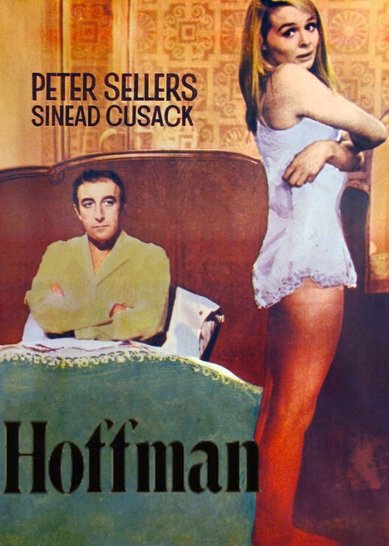
Hoffman (1970)

hoffman3

By Richard Winters

My Rating: 6 out of 10

4-Word Review: Executive blackmails a secretary.

Janet (Sinead Cusack) is engaged to be married to Tom (Jeremy Bulloch), but tells him that she must spend a week away while visiting her sick grandmother in another city. Yet what she really does is go to the residence of Benjamin Hoffman (Peter Sellers). She has no love for him and there’s a wide age difference between the two, but Hoffman is blackmailing her in hopes that, if given enough time, that she’ll fall for him and leave her fiancée, but she resists his advances and when she threatens to leave he comes up with another plan to keep her there.

This unusual movie was based on a TV-play broadcast in 1967 in the UK that starred Donald Pleasance and Judy Cornwell. It had been written by Ernest Gebler and titled ‘Call Me Daddy’. When it received much acclaim it convinced Gebler to turn it into a novel, which was called ‘Shall I Eat You Now?’ and published a year later. When the response to that was positive Alvin Rakoff, who had directed the TV version, then decided to turn it into a feature film.

Having a movie centered around only two characters and take place almost entirely in one setting is usually a recipe for a static disaster and I felt this would’ve worked better as a stageplay, which Gebler eventually did turn it into in 1975. However, the initial mystery involving what Hoffman is blackmailing Janet about, who otherwise comes off as this innocent wide-eyed young woman who you can’t imagine could’ve ever done anything that wrong to be blackmailed in the first place, is what held my interest and kept me watching.

A lot of the credit to what keeps this movie watchable also goes to the two stars. Cusack, who is the wife of actor Jeremy Irons and the daughter of legendary performer Cyril Cusack, is fantastic especially with her constant shocked and perplexed expressions, which makes the movie consistently amusing. Sellers is excellent as well in his one and only serious turn. Initially he had wanted to give it his patented comical touch and using an Austrian accent, but Rakoff convinced him to play it straight and the result is a surprisingly dark, creepy performance, which made me believe he had untapped potential to being a memorable film villain had he wanted to be.

Spoiler Alert!

My grievances involve the character motivations which are poorly fleshed-out. Initially I thought Hoffman was blackmailing Janet over some wrongdoing she had done and was desperately trying to cover-up, but instead it was a crime committed by her fiancée Tom that Hoffman became aware of. If this was the case then why didn’t she alert Tom about what Hoffman knew? If she’s going to be marrying him then she should want to let him know if someone like Hoffman has it in for him. The two could’ve conspired a defensive strategy against Hoffman in an effort to turn-the-tables, but in any case there was no rational reason why she should keep it a secret. Again, if it was something she personally did that could’ve made her look bad in Tom’s eyes I could understand, but this other scenario just doesn’t make much sense.

Having her end up rejecting Tom and going back to Hoffman and becoming his girlfriend was equally ridiculous. It becomes quite obvious that Tom was not right for her, so dumping him was fine, but she didn’t have much in common with Hoffman either. The way he manipulated her should’ve been a red flag and unless there’s some weird quirk with her character that never gets explained the eventual love angle twist is pretty stupid and ultimately makes this film, despite the great acting, a rather pointless experience.

My Rating: 6 out of 10

Released: July 16, 1970

Runtime: 1 Hour 53 Minutes

Rated GP

Director: Alvin Rakoff

Studio: Anglo-EMI Distributors

Available: DVD, Amazon Video

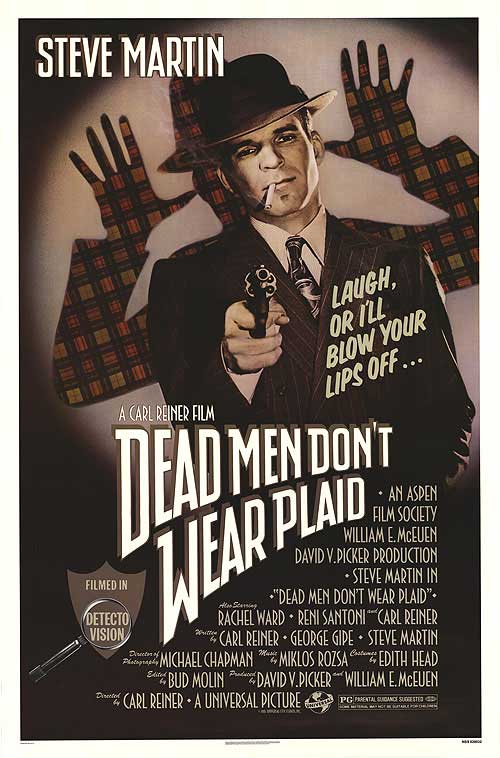
Dead Men Don’t Wear Plaid (1982)

dead1

By Richard Winters

My Rating: 3 out of 10

4-Word Review: Don’t say ‘cleaning woman’.

It’s the 1940’s and private investigator Rigby Reardon (Steve Martin) gets a visit from Juliet Forrest (Rachel Ward) who wants him to investigate the mysterious death of her father, which she believes to have been murder. Rigby’s investigation turns up two lists both showing names of people who were either friends or enemies of a person named Carlotta. As Rigby continues his research he becomes menaced by a man who shoots him and steals the lists forcing Rigby to interview a wide array of different people in order to get to the truth.

In the spring of 1980 Martin got together with Carl Reiner and screenwriter George Gipe to go over his next movie project idea. He had just gotten done starring in Pennies from Heavena 1930’s period musical, and wanted to do another film from that era, a comedy that was entitled ‘Depression’. While going over the plot he mentioned using a clip from an old movie and splicing it into his film and making it a part of the story. This gave Reiner the idea of doing an entire movie centered around old movie clips ultimately leading to them using footage from 19 vintage films from Hollywood’s golden era with most of them being dramas that were meant to be taken seriously, but with Martin’s character responding to the lines mentioned by the actors in the clips in such a way that it becomes funny.

Incorporating a plot completely around old movies is certainly an inspired idea, but the result is only so-so. On the technical end you can clearly tell when an old film is spliced into the scene because it’s footage is much grainier than when it shows Martin or Ward. Having it all filmed in black-and-white helps a little but the new footage is too pristine and intentional scratches should’ve been added to make it better match the old stuff.

As for the story, well, it works for awhile, but then starts to get downright boring by the third act. There are definitely some laugh-out-loud moments, but the concept wears itself out. Some have called this a one-joke movie, but I would describe it more as a joke that gets told over-and-over again until it’s predictable and redundant. Having old film clips put in during a certain part of the movie, but then focusing on other comedy angles during the rest of it would’ve worked better. Had it spliced-in only 1 or 2 other movies and with a smaller character count would’ve created less of a diluted effect as ultimately there’s just too many people to keep track of and the plot itself is too fabricated to hold much interest.

Martin is excellent and the fact that he didn’t watch any movies from the 40’s in order to prepare for the role as most other actors would’ve done, was a wise decision as he ends up creating his own style instead of coming-off like he’s imitating somebody else. Ward is good too and while she isn’t particularly funny she does make for a excellent straight-man, which is what a solid comedy needs by having a normal person play-off the other wackiness around them. Carl Reiner is engaging in a send-up of Erich Von Stroheim and it’s interesting seeing Reni Santoni appear here as he played a young Reiner 15 years earlier in the movie Enter LaughingThe characters though are flat and never evolve, which like with the other issues described above, make this movie a novelty experiment that never fully gels.

My Rating: 3 out of 10

Released: May 12, 1982

Runtime: 1 Hour 28 Minutes

Rated PG

Director: Carl Reiner

Studio: Universal

Available: DVD, Blu-ray, Amazon Video, YouTube

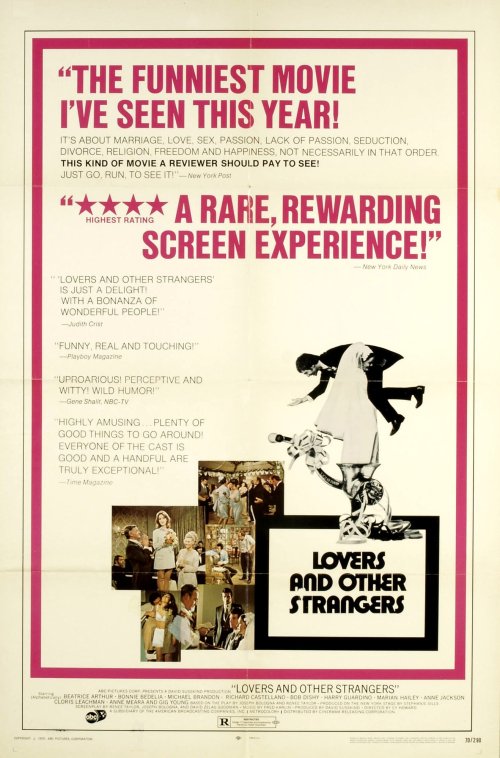
Lovers and Other Strangers (1970)

lovers1

By Richard Winters

My Rating: 6 out of 10

4-Word Review: Marriage: Pros and Cons.

Mike and Susan (Michael Brandon, Bonnie Bedelia), who have been living together for a year and a half, have decided to get married, but as the wedding draws near Mike begins to have second thoughts. Meanwhile Susan’s parents, Hal and Bernice ( Gig Young, Cloris Leachman) have issues of their own as Hal is having an affair with Kathy (Anne Jackson) who is Bernice’s sister. Their other daughter, Wilma (Anne Meara), who is already married, but starting to regret it since her husband (Harry Guardino) seems more interested in watching old movies on TV than having sex. Mike’s parents, Frank and Bea (Richard S. Castellano, Beatrice Arthur) also have problems as they try to convince Mike’s older brother Richie (Joseph Hindy) to stay married to Joan (Diane Keaton) even though they’ve grown incompatible. Then there’s wedding usher Jerry (Bob Dishy) who spends his time trying to ‘score’ with nervous, nebbish bridesmaid Brenda (Marian Hailey) who can’t seem to decide whether she’s into Jerry or not.

While the film, which was based on the hit Broadway play of the same name written by real-life couple Joseph Bologna and Renee Taylor, who adapted it to the screen, was a major success at the box office and received high critical praise it does in retrospect come-off like just another episode of ‘Love American Style’ or even ‘The Love Boat’. There are certainly some funny lines of dialogue and interesting insights at how the younger generations view marriage differently from the older one, but besides the very brief wedding scene, we never see the cast come together and interact as a whole making the movie and characters seem more like a collection of non-related vignettes than a cohesive story. It’s also quite talky with no action to speak of, so unless you’re really into conversational comedy you may get bored.

Mike and Sue, who act as the main characters, get overshadowed by the supporting players and become almost like an after thought the more the movie progresses. The opening sequence with them in bed together and contemplating marriage, which at the time was meant for shock effect since it was still considered taboo to have sex before marriage, will be lost on today’s audiences where living together is now by far the norm. I also found it hard to believe that they’d be able to fool both sets of parents for a whole year by pretending they were rooming with same sex roommates, Sue told her parents she had a roommate named ‘Phyllis’ and Mike told his folks he lived with ‘Nick’, but after awhile I’d think the parents would get suspicious especially when they’d never meet or speak to these other roommates even after a year’s time.

The segment where Mike tells Sue he doesn’t want to get married because he still likes hitting-on other women and then proceeds to pinch the ass of some lady on the street, all while in front of Sue, won’t go over to well with today’s viewers and for that matter shouldn’t have gone over well with Sue either even though she takes it all in stride like it’s no big deal while most other wives/girlfriends would’ve been highly upset. Having Mike inform Sue that he she has ‘fat arms’ could really upset a lot of women as many can be insecure about their bodies and dwell on these types of comments for a long time and not take it so casually like Sue does here. I thought she should’ve brought it back up later, out-of-the-blue in a non-related scene with something like ‘do you really think my arm’s are fat?’, which could’ve been funny.

There’s problems with the casting too especially Anne Meara playing Cloris Leachman’s daughter even though in reality she was only three years younger than her and looked it. I was also baffled why Meara’s real-life husband and longtime comic partner Jerry Stiller, who does appear very briefly in a minor role, wasn’t cast as her husband here. Harry Guardino does a fine job in the hubby role, but Stiller and Meara had a special chemistry and that would’ve shined through with the two onscreen. I also felt that Anne Jackson and Cloris should’ve switched roles. Having the very dynamic Cloris stymied in a boring bit of a clueless housewife was a waste of her immense talents and she would’ve been better able to display the anxiety of Anne’s character in a funnier way.

Bea Arthur and Diane Keaton, who both make their film debuts here, are quite good as is Richard S. Castellano whose repeated line of “So what’s the story’ became a popular catchphrase though the numerous close-ups of his face does make his fat bottom lip too pronounced. Marian Hailey, who left the acting profession in the 80’s and became children’s book author who now goes by Marian Hailey-Moss, is excellent too and perfectly conveys the persona of a single woman who is quite intelligent and well read, but also painfully insecure and indecisive. My favorite though is Gig Young as a philandering husband who tries to make everyone happy, but ultimately fails. This was his last great performance before alcoholism killed his career and his conversation with Jackson at end as they sit in two adjoining toilet stalls in a public bathroom is the film’s funniest moment though the house that his character owns, which is supposed to nestled in the rich swanky suburbs looks like a shambles, at the least exterior, as it’s painted with a watery white color that has spots where it completely exposes the red brick underneath looking like a rundown place that has been poorly maintained, which I don’t think was the intention.

My Rating: 6 out of 10

Released: August 12, 1970

Runtime: 1 Hour 44 Minutes

Rated GP

Director: Cy Howard

Studio: Cinerama Releasing Corporation

Available: DVD, Blu-ray

A Hero Ain’t Nothing but a Sandwich (1978)

hero2

By Richard Winters

My Rating: 6 out of 10

4-Word Review: Getting hooked on heroin.

Benjie (Larry B. Scott) is an African American teen living with his single mother (Cicely Tyson), her boyfriend Butler (Paul Winfield) and her mother (Helen Martin) in a rundown area of Los Angeles. Benjie harbors a low self-esteem at being abandoned by his biological father years earlier and has not adjusted to Butler acting as his surrogate father and the two have many fights. To deal with his alienation he gets into drugs after befriending a local dealer named Tiger (Kevin Hooks). At first he dabbles in marijuana and likes the high it gives him, so he tries heroin, which eventually gets him hooked and it starts a downward spiral. His family tries to help him as best they can, but when he gets suspended from school they feel they have no other choice but to send him to a drug rehabilitation hospital where they hope he’ll recover.

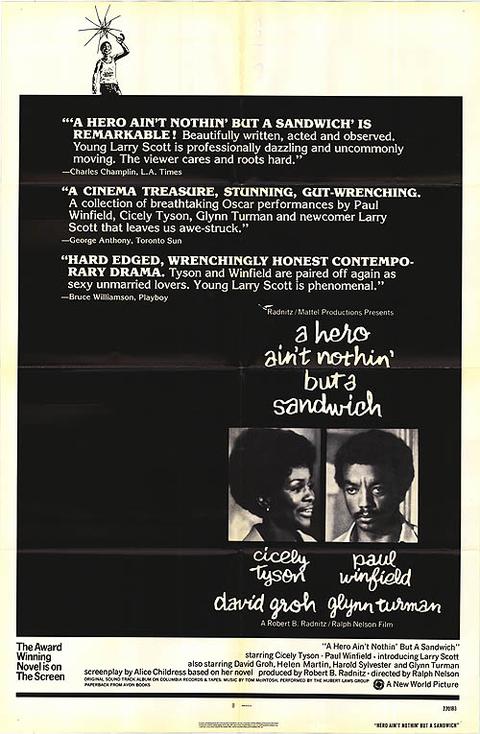
While there were some critics, as evidenced by the film poster above, that did like the film there were also others at the time that labeled it as ‘preachy’ and coming off more like an after school special than a movie. Despite being based on the novel of the same name, which had been highly praised, and with a screenplay written by Alice Childress, who had also been the author of the book, I still came into it a bit leery wondering if the negative reviews had merit and I’d be spending the 2-hours bored, but I came away impressed with how captivating and sincere it overall was.

A lot of the credit goes to Scott, who although was 15 when it was filmed, but effectively looks only 13 like his character, which makes the scenes where he shoots-up all the more shocking. Winfield is also excellent playing someone who’s bitter about life due to a failed music career and reluctant to take on a fatherly role particularly when the kid lashes out at him at seemingly every turn. Glynn Turman is solid too as Benjie’s African studies teacher as well as David Groh, better know as Joe in the TV-series ‘Rhoda’, playing the only white teacher in an all-black school who feels like an outsider himself. Helen Martin though steals it as the elderly grandmother who gets violently mugged by two kids on the street at the beginning and then later on does a provocative dance for the family in remembrance to her days as a young dance hall girl.

What I did have a problem with were the scenes inside the drug rehabilitation clinic that get shown through a series of black-and-white photographs. I don’t mind directors throwing in artistic elements into the narrative, but when the film had been working as a straight forward drama for the entire first hour then it kind of needs to stay that way and suddenly changing the approach becomes distracting. I’m not sure why these hospital scenes get glossed over the way they do, but it makes the viewer feel more distant from the character and what he’s going through.

Winfield’s bonding with the kid ends-up being problematic as well. I didn’t have an issue with it at the start as I kind of liked seeing this guy, who clearly had no blueprint on parenting, being forced into a situation that he really didn’t ask for, or know how to navigate. However, he becomes a little too emotionally bonded with Benjie by the end that just didn’t seem genuine. After all this really wasn’t his biological child and he hadn’t even married the mother, so to take on all of this extra responsibility, that should’ve been the mother’s, didn’t seen realistic. Tyson needed to play a stronger role here having her stand side-by-side with Winfield as they help her son through the withdrawal process. Having her instead getting written-off as this kook who’s into voodoo and at one point strips her teenage son naked and throws him into a bathtub filled with potions that she feels will ‘cure’ him and eventually jumps into the tub with him is a definite cringe moment, particularly by today’s standards, and a low point in a movie that otherwise is adequately done most of the way.

My Rating: 6 out of 10

Released: February 3, 1978

Runtime: 1 Hour 47 Minutes

Rated PG

Director: Ralph Nelson

Studio: New World Pictures

Available: DVD, Amazon Video, Tubi, Plex