Tag Archives: Peter Sellers

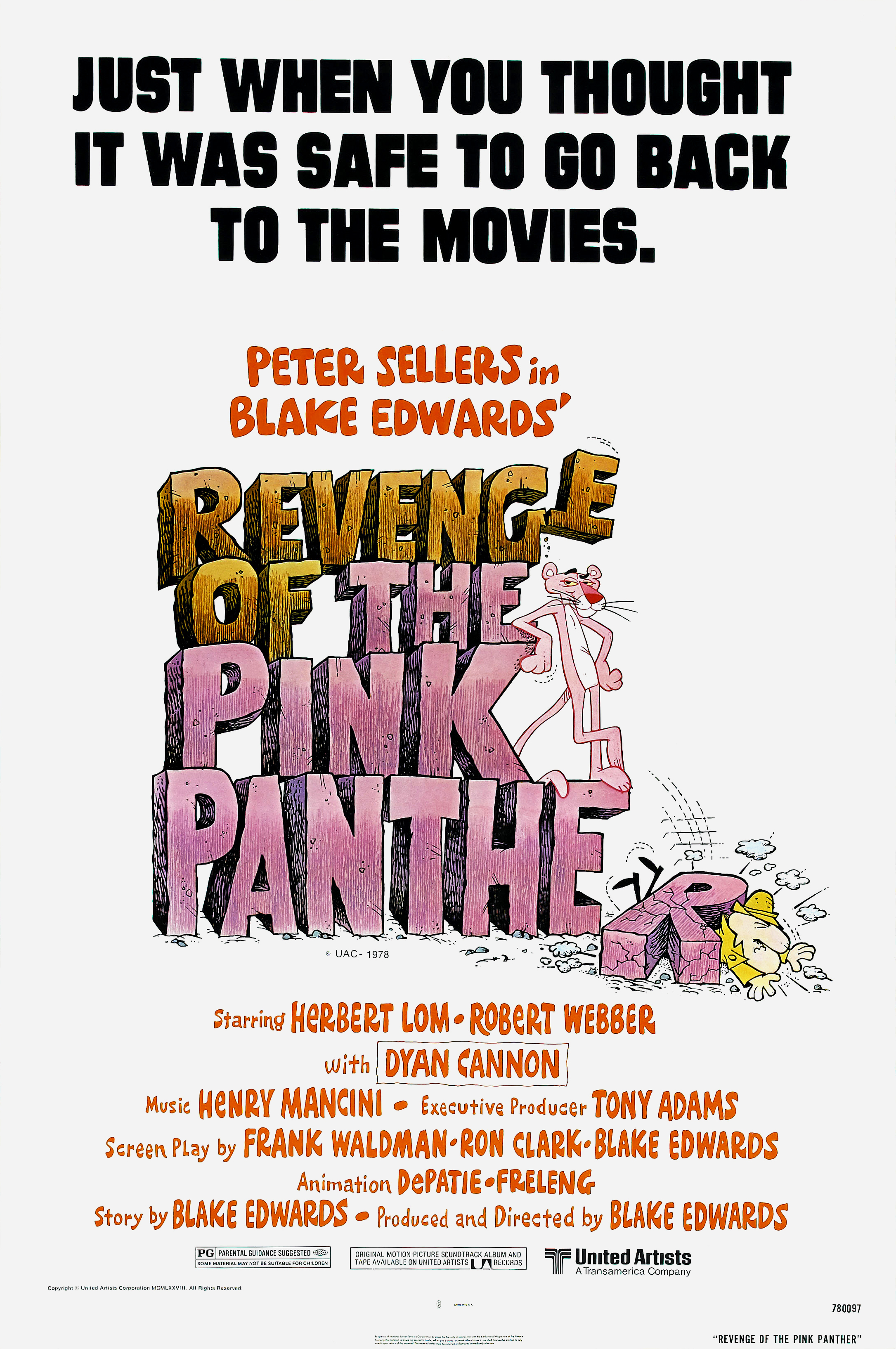
Revenge of the Pink Panther (1978)

By Richard Winters

My Rating: 6 out of 10

4-Word Review: Out to get Clouseau.

Philippe (Robert Webber) is a successful businessman who’s secretly the head of the French criminal underground. Some though are questioning his leadership considering him to be too weak to remain in that position. In order to squash the impending threat, he decides to make a bold move by having Inspector Clouseau (Peter Sellers) killed. Clouseau was considered a master detective by the outside world and only known to be an incompetent by those who worked with him, so by having him out of the way the drug dealers would feel relieved and thus Philippe would remain in power. However, things don’t get as planned as Clouseau manages to miraculously evade all attempts on his life. The media though mistakenly announces that he has died, which allows Clouseau to go undercover along with his manservant Cato (Burt Kwouk) to find out who’s after him.

This marked the fifth entry in the series and is probably the funniest. Initially director Blake Edwards had wanted to reuse footage that had been cut from the previous entry and then film new scenes around those, but star Sellers insisted he wanted an all-new story and that was probably for the best. Sellers by far gets the most laughs whereas in the one that came before this, The Pink Panther Strikes Againit was Herbert Lom as the unhinged Dreyfus, that was the most memorable, but here his part becomes much more benign, though he still gets one good scene where he tries not to breakout laughing while giving a eulogy at Clouseau’s funeral. Sellers though comes out on top here especially in his disguises like when he pretends to be a sea captain with an inflatable parrot on his shoulder, or in a hilarious send-up as a Mafia Don.

It’s great to see Kwouk, who was usually relegated to the ‘fight’ scene between him and his boss Clouseau, become more involved in the story, as the two go to Hong Kong in disguise to track down the bad guys. Dyan Cannon is a refreshing change of pace. Usually, the women in these films were young models whose sole purpose was to allude sex appeal, but here she’s middle-aged, but still attractive, and shows much more of a feisty personality. She helps build a strong secondary character and is better interwoven into the plot versus simply appearing as a potential romantic interest.

Webber though as the main villain is a detriment. I have no doubt that the notoriously insecure Sellers didn’t like the way Lom stole the film as the nemesis in their last outing and wanted to make sure that didn’t happen again. Not only is the Dreyfuss character far more neutered, but so is Webber making him seem like he’s almost sleepwalking through his role. It would’ve been more interesting had his character has some personal vendetta against Clouseau, possibly because it was Clouseau who had sent him, or one of his men to jail, and now he wanted revenge. Just having him out to get Clousau because it might bolster his own image didn’t seem to be enough of an incentive and the two, outside of one comic moment where Clouseau’s is in one of disguises, never have any ultimate confrontation. Watching him get chased around his desk and cower from Dyan Cannon may have been intended as funny, but it just further erodes his villainy making him seem even more impotent than he already is. Even a comedy still needs a bad guy that can elicit some tension and this one doesn’t.

The implementation of Mr. Chong, played by martial arts instructor Ed Parker, has potential. Supposedly he’s an ‘invincible’ fighter that can beat-up anyone and not be stopped as proven when he takes down several other men while in Webber’s office but then he gets comically defeated once he comes into contact with Clouseau. While watching him go through the floor/ceiling of several apartments below as he crash lands is visually funny it would’ve been more engaging if he had come back at some point and continued his relentless attack on Clouseau albeit with injuries in order to reclaim his reputation that he couldn’t be defeated, but in the process just became more hurt and ineffective.

Spoiler Alert!

The climactic sequence that occurs in Hong Kong is a cop-out and comes-off like they’d run out of ideas, so they tried to save it with a calamity filled chase that plays more like a cartoon, or something better suited for a live action Disney movie. Introducing yet another Mafia boss, this one played by Paul Stewart, makes things too cluttered and there should’ve been just one main bad guy that was the boss of everyone. The finale inside a firecracker factory should’ve proven dangerous and in fact we do see the entire place explode from a distance and yet everyone comes out of it unscathed, which doesn’t exactly make a lot of sense.

My Rating: 6 out of 10

Released: July 20, 1978

Runtime: 1 Hour 39 Minutes

Rated PG

Director: Blake Edwards

Studio: United Artists

Available: DVD, Amazon Video, YouTube
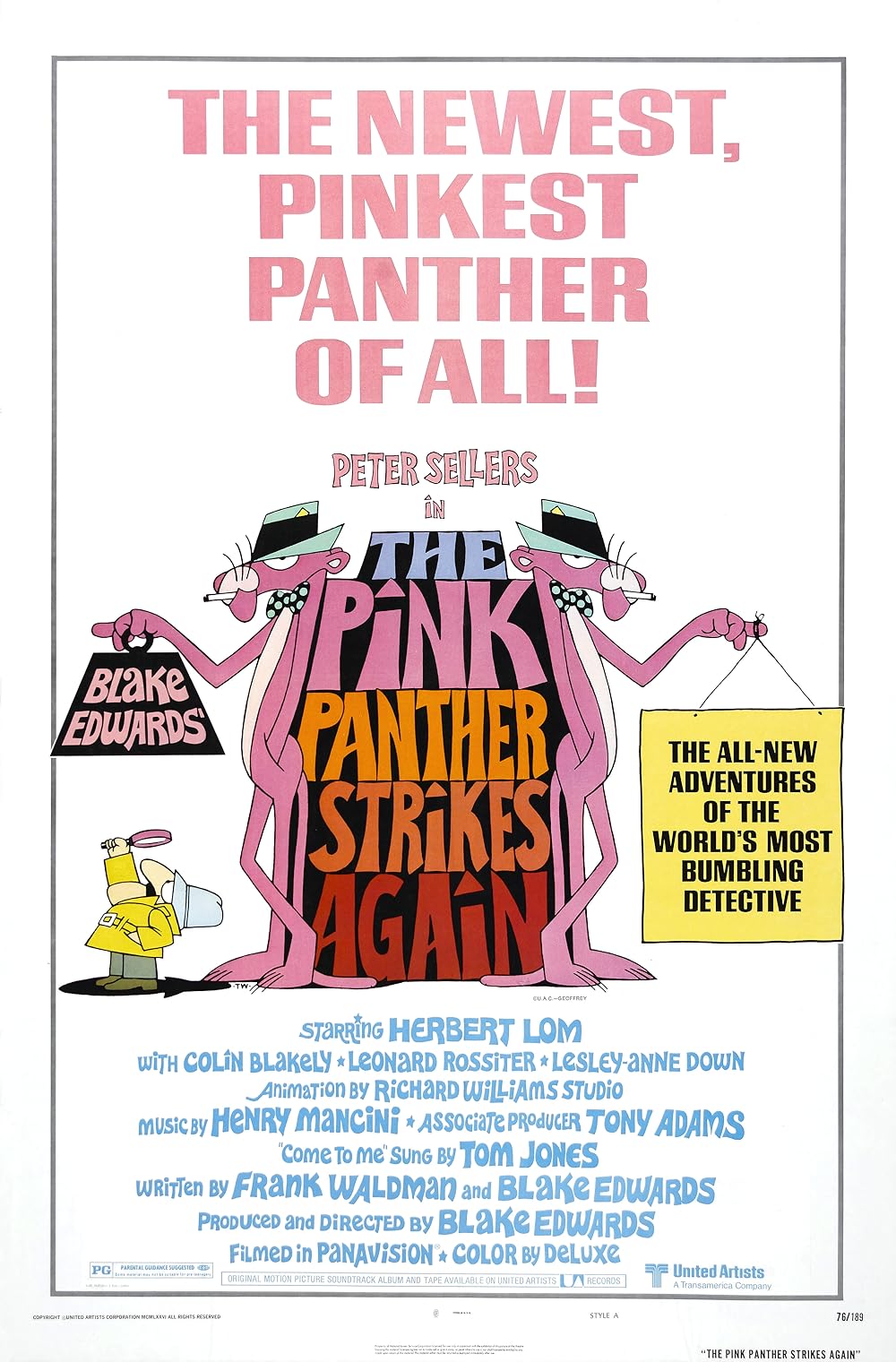
The Pink Panther Strikes Again (1976)

By Richard Winters

My Rating: 7 out of 10

4-Word Review: Clouseau battles doomsday weapon.

Dreyfuss (Herbert Lom) has been informed by his psychiatrist (Geoffrey Bayldon) that he has been cured of his obsession with Clouseau (Peter Sellers) and now deemed sane. He’ll be recommending his release from the mental institution he’s been in later that day at the sanity board of which Dreyfuss is elated. However, Clouseau shows up unannounced planning on speaking to the sanity board on behalf of Dreyfuss, but when he gets there the two meet and after several mishaps, all inadvertently caused by Clouseau, occur it sends Dreyfuss spiraling back into insanity. He then though is able to escape and goes on a mission to kill Clouseau, first on his own and then with the help of several worldwide assassins. When this doesn’t go as planned, he kidnaps a nuclear physicist (Richard Vernon) and blackmails him to create a doomsday weapon that can take out entire buildings with its laser beam and which Dreyfuss has no problem using against the world unless he’s given Clouseau in return.

After the unexpected success of The Return of the Pink Panther, director Blake Edwards was given an immediate green light to write and direct a follow-up. Since he had originally intended for this to be a TV-series he used one of the scripts he had written for that one and expanded it for feature film length. The original cut came out to 126 minutes, but the studio insisted it be trimmed to 95-minute runtime with the excised scenes being used as material for the Curse of the Pink Panther, which released 6 years later after the passing of star Sellers.

Despite constant behind-the-scenes struggles between Edwards and Sellers this film is widely considered their best output second only to The Party, which they collaborated on 8 years earlier. A lot of the reason why it works is the excellent pacing with an almost rapid-fire collage of jokes and mishaps, the scenic European locations and the pleasing yet still bouncy Henry Mancini score.

The humor hits the target in almost all cases, unlike most comedies where there’s usually a few misses, with some of the best moments coming from the supporting players like stuntman Dick Crokett who plays a perfect parody of then President Gerald Ford and Lesley Ann-Down, who replaced Maude Adams who was originally cast, but then fired after she refused to appear nude, as a Russian spy whose attempts to get Clouseau in bed with her proves quite funny. The ongoing confrontations between Lom and Sellers though are still the highlights and the two really work well together with Lom’s angry abrasiveness a nice contrast to Seller’s benign ineptness and in fact this is a rare instance where Sellers gets upstaged as it’s Lom’s performance with his over-the-top villainy that you come away remembering the most after it’s over.

Yet with all of its successes the script is still full of logical loopholes and missing key moments. For instance, Dreyfuss escapes from the mental hospital, but it’s never shown, which I felt since it’s so integral to the storyline needed to be seen and explaining how he was able to do it. What he did to gain access to the apartment downstairs from Clouseau’s should’ve been inserted as well and some sort of answers for how he was able to avoid injury from the bomb going off as it destroyed Clouseau’s apartment and the fallout from it would’ve most assuredly affected the apartment beneath it as well. Clouseau’s ongoing physical confrontations with his house servant Kato (Burt Kwouk) becomes problematic too as they’re constantly damaging the furniture during their fights and if this happens every time he comes home then the furniture should already be in disarray from their last battle as there wouldn’t have been time to have cleaned it up and replaced it with new stuff.

Spoiler Alert!

While the film does at least have Dreyfuss masterminding a major bank heist, which helps to explain how he got funding to build the giant laser and purchase the castle that he and his crew move into, it still makes it seem that they’re able to build the elaborate weapon and all the computers that go along with it, almost overnight, which of course isn’t believable. It also at one point has the laser beam striking Lom making his legs disappear, but he’s still able to somehow walk around anyways as well as maintain his same height, making it seem that his legs are still there and simply invisible.

There’s also the issue of Dreyfuss disappearing at the end, due to the effects of the laser, but in the following installment, Revenge of the Pink Panther, he’s fully intact and no mention of his previous madness to destroy the world. Fans of the series say this is because this whole film was meant to be a dream that Dreyfuss had, which would’ve made a lot of sense. He was already obsessed with Clouseau, so having nightmares about things one is constantly focused on would be logical and the film should’ve had at the very end Dryefuss waking up and still in a strait-jacket, but it doesn’t making it an oversight and not properly thought through.

My Rating: 7 out of 10

Released: December 15, 1976

Runtime: 1 Hour 43 Minutes

Rated PG

Director: Blake Edwards

Studio: United Artists

Available: DVD, Amazon Video, YouTube
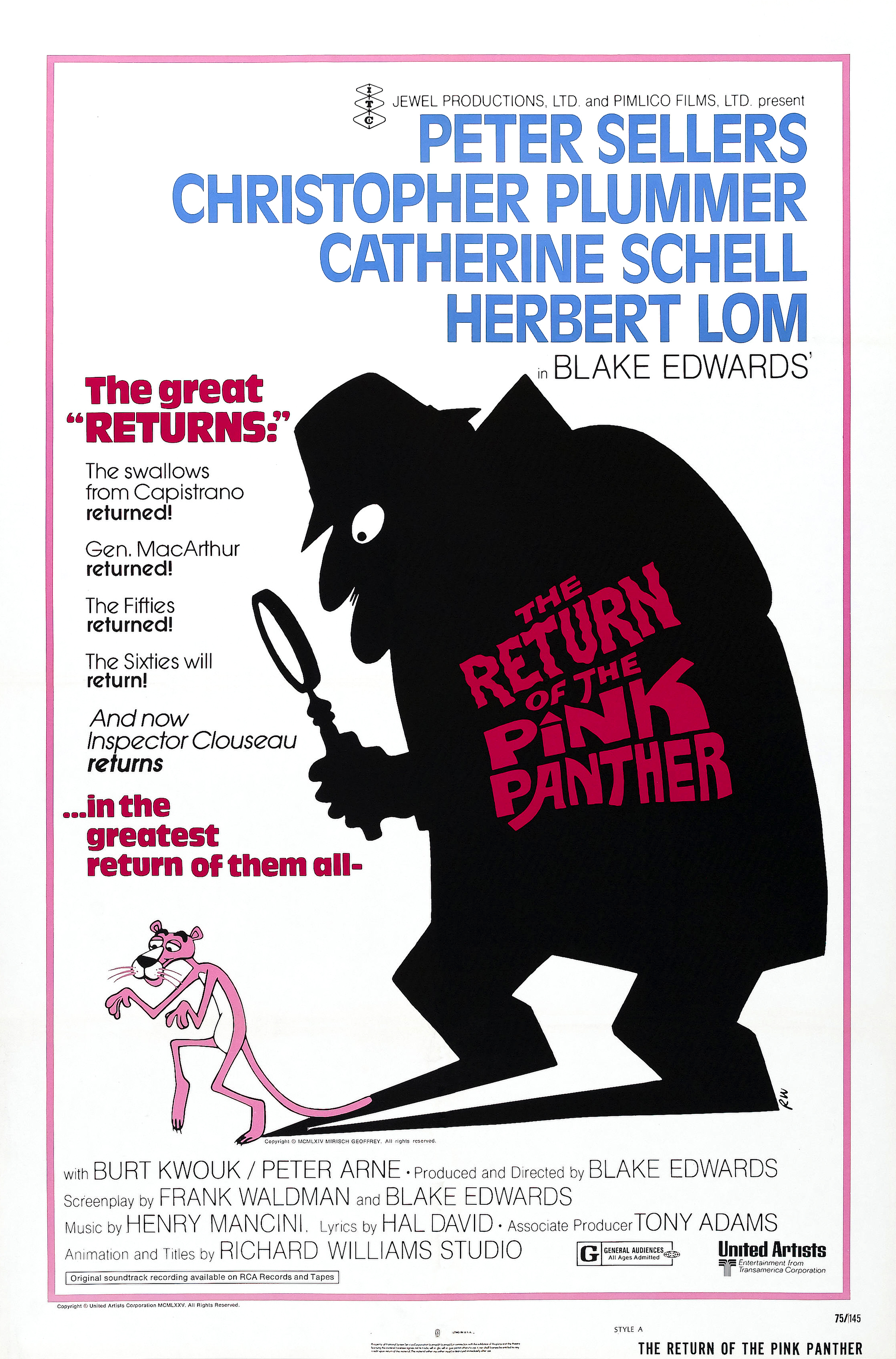
The Return of the Pink Panther (1975)

By Richard Winters

My Rating: 7 out of 10

4-Word Review: Tracking down stolen diamond.

Inspector Clouseau (Peter Sellers) has been demoted to street cop by Chief Inspector Dreyfuss (Herbert Lom) due to Clouseau’s continual incompetence, which is starting to drive Dreyfuss completely mad. However, inside the country of Lugash a prized diamond known as the Pink Panther is stolen and since Clouseau had success retrieving it the first time it went missing during a heist he is put on the case to find it again much to Dreyfuss annoyance. Clouseau suspects that the culprit is Charles Litton (Christopher Plummer), who is a notorious thief. Clouseau attempts to use several different disguises in order to infiltrate Litton’s home that he shares with his wife Claudine (Catherin Schell) in order to find incriminating evidence against Litton so that he can turn him in, but his attempts to try and a take Litton down prove to be comically inept. 

This marked the fourth installment of the Pink Panther series and the first in 10-years that reunited writer/director Blake Edwards with Sellers. Both had said after doing the second film A Shot in the Dark, that they never wanted to work with the other again due to much infighting during the production, but both had since then fallen on hard times. Edwards was by the early 70’s considered box office poison after the colossal failure of Darling Lilli which managed to recoup a measly $3 million from a $25 million budget and his other films from that era Wild Rovers and The Carey Treatment hadn’t done much better. Since Pink Panther had been his last success, he was interested in reviving it and even wrote up a 14-page treatment but found no takers amongst the major studios. Then producer Lew Grade agreed to finance it in exchange for Edward’s wife Julie Andrews agreeing to star in a British TV-special that he wanted to produce. Since Sellers career had also bottomed out, he came onboard to most everyone’s surprise without much hassle.

The film was shot in many scenic locations including Morrocco giving the optics an exotic flair and the proceedings a sophisticated European vibe making it seem like a step-up from just a silly comedy. In the first two installments all the characters were written to be funny and goofy particularly the second film, which had been based on a stage play. Here though the comedy is wisely given over to Sellers while the couple he’s after remain savvy, which makes it more intriguing as you want to see how this inept idiot takes them down, or is able to trip them up at their own game. I also liked how funny bits are interspliced with some legitimate action, especially the opening scene that features the heist, which could’ve easily fit into a realistic film dealing with a robbery. These moments help add a bit of relief from all the laughs, a sort of chance to catch your breath, while making the plot seem like it’s not just all about being a farce.

Lom adds terrific support as Clouseau’s exasperated supervisor, and his assertive acting style works nicely off of Sellers clownish one making the interplay between the two a highlight. It’s good too that Plummer replaced David Niven, who played the character in the first one, but wasn’t able to do it here due to scheduling conflicts, as Niven would’ve been too old and not plausible to have outrun the bad guys like Plummer does. 

My only issue is that Claudine is shown attempting to hold in her laughter at Clouseau right from the start like she knows he’s an idiot before she even met him, but this goes against the premise. Clouseau is considered an accomplished detective by the outside world hence why he was selected to head the case and it’s only the people that work with him and know him who are aware of his ineptness. This is the whole reason why Dreyfuss gets driven mad by him because the rest of the world celebrates the man that he knows is really a fool, so Claudine should’ve initially thought of him as being sharp and only came to the conclusion he was incompetent by the end after having dealt with him. It actually would’ve been funnier had she and Charles feared Clouseau upfront having believed his celebrated reputation and misreading his bumbling as being ‘genius’ ploys and remained that way throughout. In either case seeing her covering her mouth and shielding her giggles makes almost seem like she’s falling out of character and a blooper, similar to how Harvey Korman would unintentionally crack-up during Tim Conway’s antics on the ‘The Carol Burnett Show’ and for that reason it should’ve been avoided. 

My Rating: 7 out of 10

Released: May 21, 1975

Runtime: 1 Hour 54 Minutes

Rated PG

Director: Blake Edwards

Studio: United Artists

Available: DVD, Blu-ray, Amazon Video, YouTube

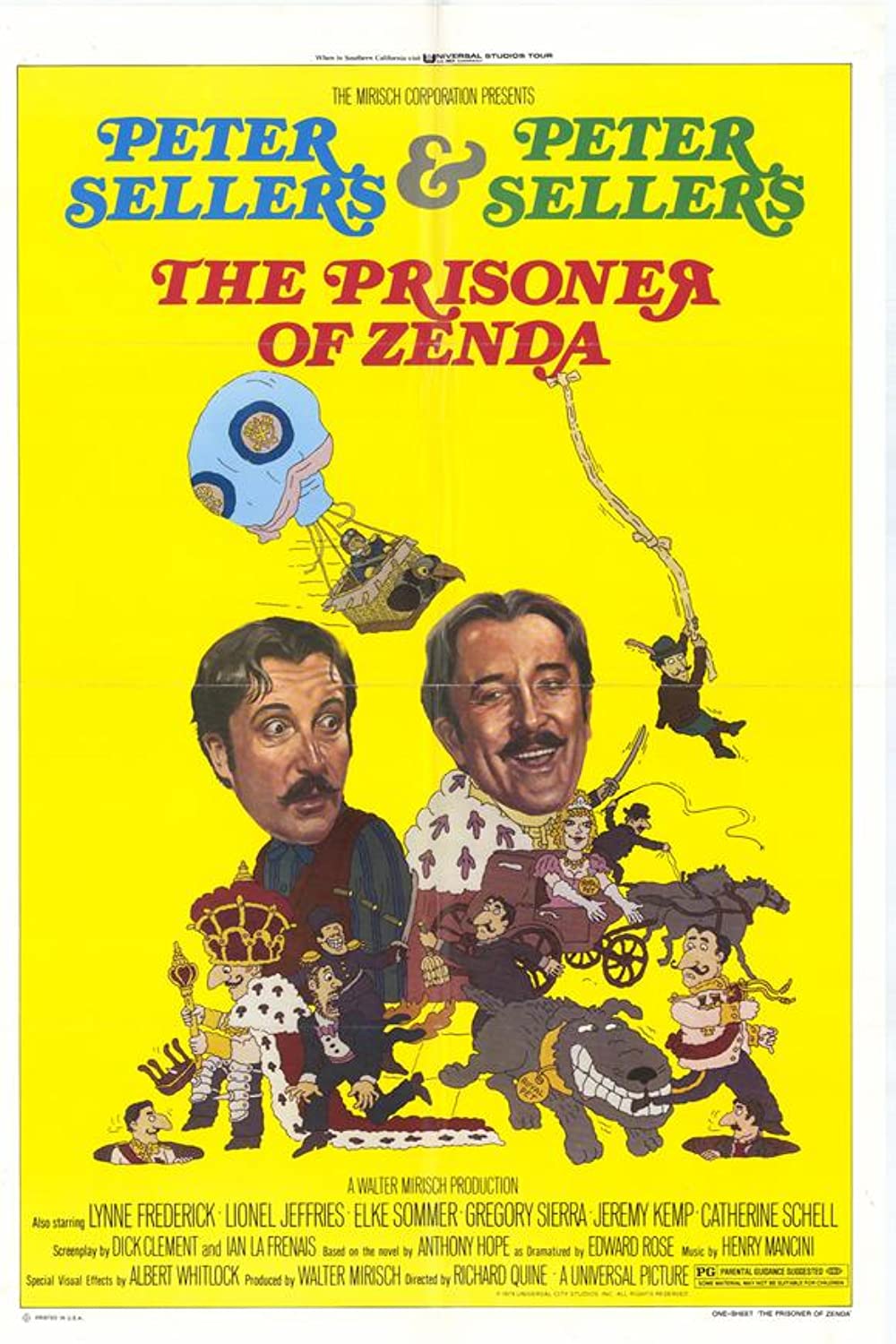
The Prisoner of Zenda (1979)

prisoner

By Richard Winters

My Rating: 4 out of 10

4-Word Review: A king look-alike.

When King Rudolph IV (Peter Sellers) dies in a hot air ballooning accident his heir apparent, Rudolph (Peter Sellers), who spends his days in casinos gambling and carousing, gets summoned to be the next King. His half-brother, Prince Michael (Jeremy Kemp), feels he’d be more suitable for the throne. He sends out an assassin to kill Rudolph in order to allow Michael to become King. While the assassin tries to carry-out the mission his attempt fails due in large part to the quick thinking of Sydney (Peter Sellers) a local carriage driver. Sydney is actually Rudolph’s half-brother due to an affair that the King had with a British actress years earlier, but he is unaware of this and yet due to his striking resemblance to the new would-be King he gets hired as decoy in order to help prevent any more assassination attempts on Rudolph’s life.

While the film, which is loosely based on the classic Anthony Harvey novel of the same name, was met with a lot of criticism upon its release I did come away impressed with the look of it. This was the last film directed by actor-turned-director Richard Quine whose creative output in the early part of his career fared far better than his films towards the end, which were pretty much all box office bombs and critical duds. This one though has some great looking sets and excellent period piece costumes as well as impressive on-location shooting done at historical castles throughout Austria, which almost makes up for its other inadequacies.

Sellers for his part isn’t bad either at least on the acting end. While the reports were that his health was declining he certainly didn’t look it and his use of accents, particularly Sydney’s Welsh-Scottish one, is excellent. However, on a comic level his presence is quite bland. It’s almost like he put in so much effort into the characterizations that he forgot to be funny. Some may find Rudolph speaking with a lisp and unable to say the ‘R’ sound somewhat amusing though this gets overplayed and ultimately old, but outside of that he has nothing else that he says or does that’s humorous. The audiences are coming in expecting him to be the comic catalyst when instead it’s Gregory Sierra, in a very energetic Wily E. Coyote type role as a vengeful count, and Graham Stark as a prison guard who manage to get any genuine laughs.

Incorporating Sellers’ then wife Lynn Frederick into the proceedings doesn’t help. Frederick was fielding leading role offers for two TV-movies at the time including that of The Torn Birds, but Sellers convinced here that cinema work, even if the role was small, was superior to that of doing something for TV and thus she rejected those and took this one. Their marriage though was already in a rocky stage and their therapist advised them not to work together which resulted in Sellers routinely berating his wife in-between takes to the point that she’d sometimes break down into tears. The coldness between the two really shows onscreen as they share no chemistry and thus making their character’s romantic moments come-off as quite flat. If anything the scenes between Sellers and Elke Sommer, whom he co-starred with years early in A Shot in the Dark, works better.

While the production is polished and even has a nice action moment where the carriage that Sydney is in gets attacked the comedy is completely lacking and the film has a poor pace. You keep waiting for the humor to gel, but it never does. The attempts that you do get are corny and lame, or just too subtle to elicit even a chuckle resulting in yet another Sellers’ misfire.

My Rating: 4 out of 10

Released: May 25, 1979

Runtime: 1 Hour 48 Minutes

Rated PG

Director: Richard Quine

Studio: Universal

Available: DVD-R

The Fiendish Plot of Dr. Fu Manchu (1980)

fiendish

By Richard Winters

My Rating: 1 out of 10

4-Word Review: Peter Sellers’ last movie.

Fu Manchu (Peter Sellers) is a 168-year-old man, who on his birthday must drink a elixir vitae in order to remain youthful and alive. When one of his servants (Burt Kwouk) brings in the formula his shirt sleeve catches fire from all of Fu’s birthday candles and it causes the servant to use the elixir to put the flames on his sleeve out. This forces Fu to have his henchmen go on a international crime spree to find the necessary ingredients to create a new youthful formula for him to drink. After one of Fu’s men steals a diamond in an exhibit it catches the attention of Scotland Yard Chief Inspector Roger Avery (David Tomlinson) who then calls in two F.B.I. agents (Sid Caesar, Steve Franken) to help him on the case. They also visit the aging Nyland Smith (Peter Sellers) who is a former adversary to Fu and knows his traits well, but Nyland has become senile and eccentric. They also use the services of Alice (Helen Mirren) an undercover police detective who masquerades as the Queen, which they feel Fu’s men will try to kidnap, but when Alice gets kidnapped she falls-in-love with Fu and agrees to help him in his crimes.

This marked Peter Sellers last film and for all purposes it may well be the worst one he was in. He was just coming off high praise for his performance in the critically acclaimed Being There, but instead of using his career resurgence to find more highbrow fare he instead reverted back to his old ways of campy comedy. During the early 70’s, when he was in a lot of duds, his excuse was that he was doing it only for the money, but in this case I’m not sure of his reasoning. In any event it’s a train wreck from the first frame to the last.

Initially he was going to team-up with director Richard Quine as the two had worked together two years earlier in The Prisoner of Zenda, but they had a falling-out before production even began. Piers Haggard was then brought in to take Quine’s place, but he became horrified to learn that Sellers had taken it upon himself to rewrite the script turning it from a plot driven story into a cheap gag-a-minute stuff that didn’t seem to go anywhere. Haggard, despite Sellers objections, tried to turn the screenplay back to what it was, or at least in Haggard’s words, ‘give it something that resembled a beginning-middle-and-end’, but his attempts were futile and the whole thing becomes one, long misguided farce that goes nowhere and lacks any interesting elements.

A lot of the humor is lame and includes Nyland having falling-in-love with his lawn mower, which he takes with him everywhere even when he’s inside people’s homes. One segment has him ‘mowing’ the carpet of the inspector’s office, which is kind of funny, but then it cuts to a long shot where we see no damage to the carpet, so what’s the point of doing the gag if there’s no visual payoff? The bit where Nyland turns his country home into a flying machine had potential, but the abysmal special effects ruin it.

Helen Mirren almost saves it with her excellent performance and I enjoyed David Tomlinson in his last film, who shows more energy than the rest of the cast. Sellers though seems tired and worn-out and his acting lacks the required energy. In some ways he looks quite healthy here including showing a nice tan when he’s in the Nyland role, but this actually hurts the characterization as Nyland is supposed to be old and elderly, but despite his gray hair he really doesn’t look it. Peter’s two good moments comes when he’s in the Fu role and breathing heavily as he watches Helen strip, the bit at the end where he becomes a rock star is impressive and he seems to be singing in a completely different voice. If it was dubbed then it takes away from it, but if he was using his real voice then he deserves credit as it certainly didn’t sound like any of the other accents he had ever used in his career.

My Rating: 1 out of 10

Released: August 8, 1980

Runtime: 1 Hour 40 Minutes

Rated PG

Director: Piers Haggard (Peter Sellers uncredited)

Studio: Orion Pictures

Available: DVD-R (Warner Archive), Amazon Video, YouTube

The Blockhouse (1973)

blockhouse2

By Richard Winters

My Rating: 6 out of 10

4-Word Review: There’s no way out.

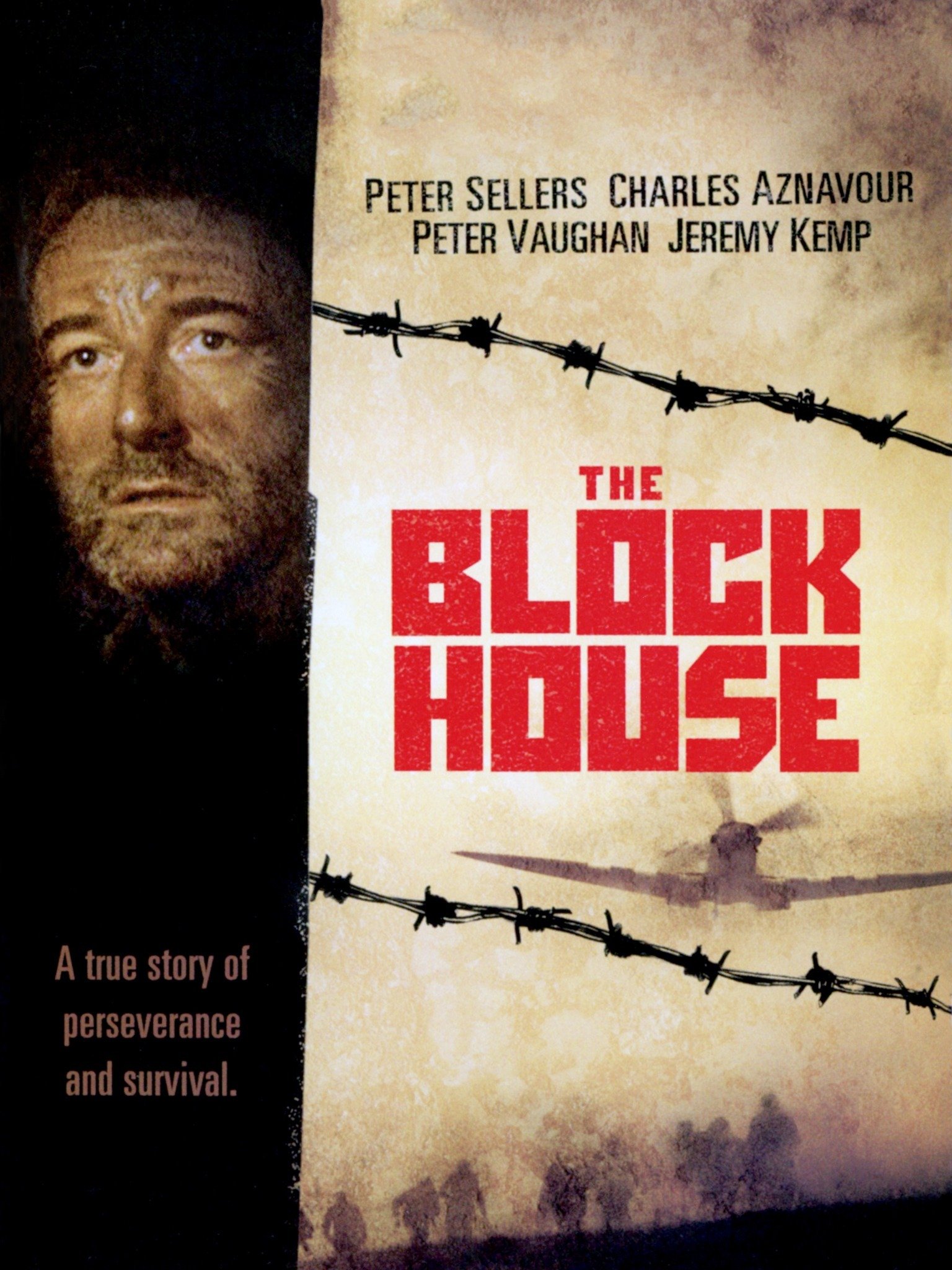
On D-Day a group of war prisoners on an island that’s run by German soldiers seek shelter from an allied air attack by finding refuge in an underground German bunker, but once inside, they realize to their horror that the shelling outside has blocked-off both the entrance and exit, which essentially traps them in permanently. They are fortunate enough to find a supply room full of enough food and wine to keep them fed for a long time, but as the days wear into weeks and then months and even years they grow tired and despondent about their situation. They try to find ways to break through the cement walls, but their attempts prove futile, which leads all of them into a mental and emotional breakdown.

The film is best known as being one of Peter Seller’s rare dramatic turns where he plays a character that is not funny or colorful. Normally his performances are quite flamboyant and over-the-top and he tends to dominate the spotlight, but here he blends in with the rest of the performers with a rare low-key portrayal that is quite impressive when given how he normally acts. This was yet another project he got involved in during the early 70’s when his career was on the down side and he was desperately taking just about any offer that came along, no matter what the quality, in an effort to bring in money. While some of those movies that he starred in during that period were truly awful (i.e. Where Does it Hurt?) this one, despite its grim theme, is unique and worth checking out particularly for those who enjoy experimental cinema.

The film was directed by Clive Rees, whose only other cinematic directorial effort was When the Wales Came, which had a similar theme about an eccentric man living an isolated existence on an island. While Rees is not as well known as Stanley Kubrick, Sellers insisted in interviews, that he was ‘every bit as good’.  While this statement may seem like an exaggeration I was quite taken aback by the gritty realism and the way the viewer feels just as trapped as the victims. The actors give all-around great performances and you see their character’s ultimate mental decline happen right before your eyes, which is both vivid and gut-wrenching. The story also looks at all aspects of their deterioration where they start to do things they had never done before including conveying certain homo-erotic elements. While none of this gets shown I was still impressed that it at least got lightly touched-on as I feared due to the period and heavy UK censorship, where this film was made, that would be one facet that couldn’t get introduced, but ultimately in a soft way it does.

If you’re looking for an entertaining crowd pleaser than this movie won’t be it. As Sellers rightly stated in his interview it’s meant for serious ‘connoisseur’s of cinema’ only. TV Guide complained that the film in their review ‘goes nowhere’ and it doesn’t reveal a ‘metaphysical reason’ for the character’s predicament, but I really didn’t think one was needed. Sometimes shit just happens and people must learn to adapt to their new harsh reality, or fall apart and in that vein I felt the movie does an excellent job and goes much further into this dark, murky psychological realm than most others would dare.

Spoiler Alert!

The story is based on the 1955 novel of the same name by Jean-Paul Clebert, who also coincidentally lived an isolated existence for many years in an abandoned village. The novel is loosely based on the actual incident that occurred on June 25, 1951 when two German soldiers in Poland were rescued from an underground shelter that they had been trapped in for 6 years. The difference is that in the movie we never see the rescue as it ends with the remaining two survivors stuck in total darkness when the last of their candles goes out. I felt it would’ve worked better had the rescue been shown as well as a better build-up where we would’ve gotten to the know the men better in the prison camp before they were forced underground, which would’ve made their mental declines even more interesting.

My Rating: 6 out of 10

Released: June 1, 1973

Runtime: 1 Hour 33 Minutes

Rated R

Director: Clive Rees

Studio: MGM

Available: DVD, Amazon Video, Tubi

The Magic Christian (1969)

magic2

By Richard Winters

My Rating: 8 out of 10

4-Word Review: Everybody has a price.

Sir Guy Grand (Peter Sellers) is a billionaire with an eccentric side, who wants to prove the powerful influence money has over other people. He meets Youngman (Ringo Starr),a homeless man in a park, and decides to adopt him as his son. Together they proceed to play elaborate pranks on the public by watching how far they can push their theory and what humiliating lengths people will go to get their hands on some money.

The film is based on the 1959 novel of the same name written by Terry Southern, who also wrote the screenplay, and while the novel was considered a success the movie, at least when it was first released, wasn’t. My critics complained of the film’s heavy-handed satirical nature and unrelenting jabs at capitalism even though all the same pranks done in the movie were also in the book. The film also has the exact same satirical theme as O Lucky Man, which starred Malcom McDowell and came out just a few years later that also took numerous potshots at capitalism and yet many of the same critics adored that one, but came down hard on this one.

Fortunately through the years the film has managed to find a cult following. I supposed if one has more of a socialist bent they may enjoy it more, but it has such a surreal, creative vibe to it that it’s fun to watch no matter if you agree with it’s message, which is kind of muddled anyways, or not. Some of my favorite bits included snotty, rich aristocrats boarding a ship cruise that puts them in increasingly more humorously challenging and bizarre situations. The final segment, which has the classic song ‘Something in the Air’ by Thunderclap Newman playing during it, features a giant outdoor vat filled with urine, blood, and animal feces and then having Grand throw money into it and challenging onlookers to jump into the mess in order to get at the money, which despite the awful stench they readily do.

There’s many cameo appearances by famous stars who agreed to take small roles as a favor to Sellers who at the time was a top star and friends with many of the big headliners of the day. Some of the best bits here include Laurence Harvey who does a striptease while onstage and in front of a packed house of onlookers while reciting ‘Hamlet’. Yul Bryner, looking almost unrecognizable in a female wig, is great as a transvestite who comes-onto a shy Roman Polanski while at a bar. Spike Milligan is hilarious as a traffic cop who agrees to eat his own traffic ticket for the right price as well as Raquel Welch as a slave commander with a whip, Wilfred Hyde-White as a drunken ship captain, and John Cleese as a perplexed auctioneer.

The problems that I had with the film dealt mainly with the relationship between Sellers and Starr. Sellers meets Starr one day in a park by chance and then begins to have a conversation with him, but there’s music playing over this, so we never hear what they’re saying, which is frustrating as the having a rich man suddenly offer a poor man the chance to be his adopted son seemed like dialogue that should be heard. Starr is also not given much to do and it seemed almost pointless for having even in the movie. In the novel there was only the Grand character creating the pranks, but it was decided for the movie to make it a two man show, but Ringo has so little to do that it didn’t seem worth it and this reportedly was due to Sellers’ insecurity of being upstaged and thus insisting that all the best lines had to go to him.

It’s also never clear why the Sellers’ character does what he does. What’s the motivation for why this rich man feels the need to expose other people’s foibles and vanities? Does he feel guilty about being so rich and therefore has decided to ‘take-it-to’ the others in his own social circle? None of this gets explained or analyzed at all, which on the character end makes the film quite superficial and confusing.

My Rating: 8 out of 10

Released: December 12, 1969

Runtime: 1 Hour 32 Minutes

Rated M

Director: Joseph McGrath

Studio: Commonwealth United Entertainment

Available: DVD, Blu-ray, Amazon Video

Hoffman (1970)

hoffman3

By Richard Winters

My Rating: 6 out of 10

4-Word Review: Executive blackmails a secretary.

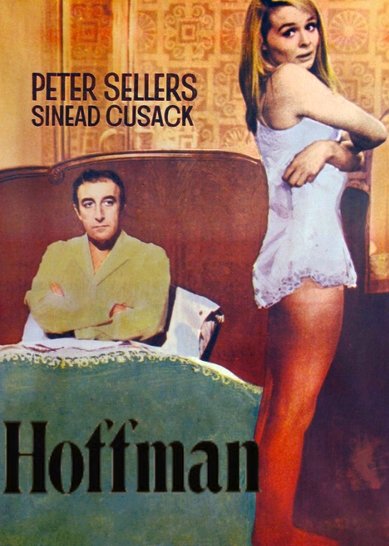
Janet (Sinead Cusack) is engaged to be married to Tom (Jeremy Bulloch), but tells him that she must spend a week away while visiting her sick grandmother in another city. Yet what she really does is go to the residence of Benjamin Hoffman (Peter Sellers). She has no love for him and there’s a wide age difference between the two, but Hoffman is blackmailing her in hopes that, if given enough time, that she’ll fall for him and leave her fiancée, but she resists his advances and when she threatens to leave he comes up with another plan to keep her there.

This unusual movie was based on a TV-play broadcast in 1967 in the UK that starred Donald Pleasance and Judy Cornwell. It had been written by Ernest Gebler and titled ‘Call Me Daddy’. When it received much acclaim it convinced Gebler to turn it into a novel, which was called ‘Shall I Eat You Now?’ and published a year later. When the response to that was positive Alvin Rakoff, who had directed the TV version, then decided to turn it into a feature film.

Having a movie centered around only two characters and take place almost entirely in one setting is usually a recipe for a static disaster and I felt this would’ve worked better as a stageplay, which Gebler eventually did turn it into in 1975. However, the initial mystery involving what Hoffman is blackmailing Janet about, who otherwise comes off as this innocent wide-eyed young woman who you can’t imagine could’ve ever done anything that wrong to be blackmailed in the first place, is what held my interest and kept me watching.

A lot of the credit to what keeps this movie watchable also goes to the two stars. Cusack, who is the wife of actor Jeremy Irons and the daughter of legendary performer Cyril Cusack, is fantastic especially with her constant shocked and perplexed expressions, which makes the movie consistently amusing. Sellers is excellent as well in his one and only serious turn. Initially he had wanted to give it his patented comical touch and using an Austrian accent, but Rakoff convinced him to play it straight and the result is a surprisingly dark, creepy performance, which made me believe he had untapped potential to being a memorable film villain had he wanted to be.

Spoiler Alert!

My grievances involve the character motivations which are poorly fleshed-out. Initially I thought Hoffman was blackmailing Janet over some wrongdoing she had done and was desperately trying to cover-up, but instead it was a crime committed by her fiancée Tom that Hoffman became aware of. If this was the case then why didn’t she alert Tom about what Hoffman knew? If she’s going to be marrying him then she should want to let him know if someone like Hoffman has it in for him. The two could’ve conspired a defensive strategy against Hoffman in an effort to turn-the-tables, but in any case there was no rational reason why she should keep it a secret. Again, if it was something she personally did that could’ve made her look bad in Tom’s eyes I could understand, but this other scenario just doesn’t make much sense.

Having her end up rejecting Tom and going back to Hoffman and becoming his girlfriend was equally ridiculous. It becomes quite obvious that Tom was not right for her, so dumping him was fine, but she didn’t have much in common with Hoffman either. The way he manipulated her should’ve been a red flag and unless there’s some weird quirk with her character that never gets explained the eventual love angle twist is pretty stupid and ultimately makes this film, despite the great acting, a rather pointless experience.

My Rating: 6 out of 10

Released: July 16, 1970

Runtime: 1 Hour 53 Minutes

Rated GP

Director: Alvin Rakoff

Studio: Anglo-EMI Distributors

Available: DVD, Amazon Video

There’s a Girl in My Soup (1970)

By Richard Winters

My Rating: 3 out of 10

4-Word Review: Playboy falls for hippie.

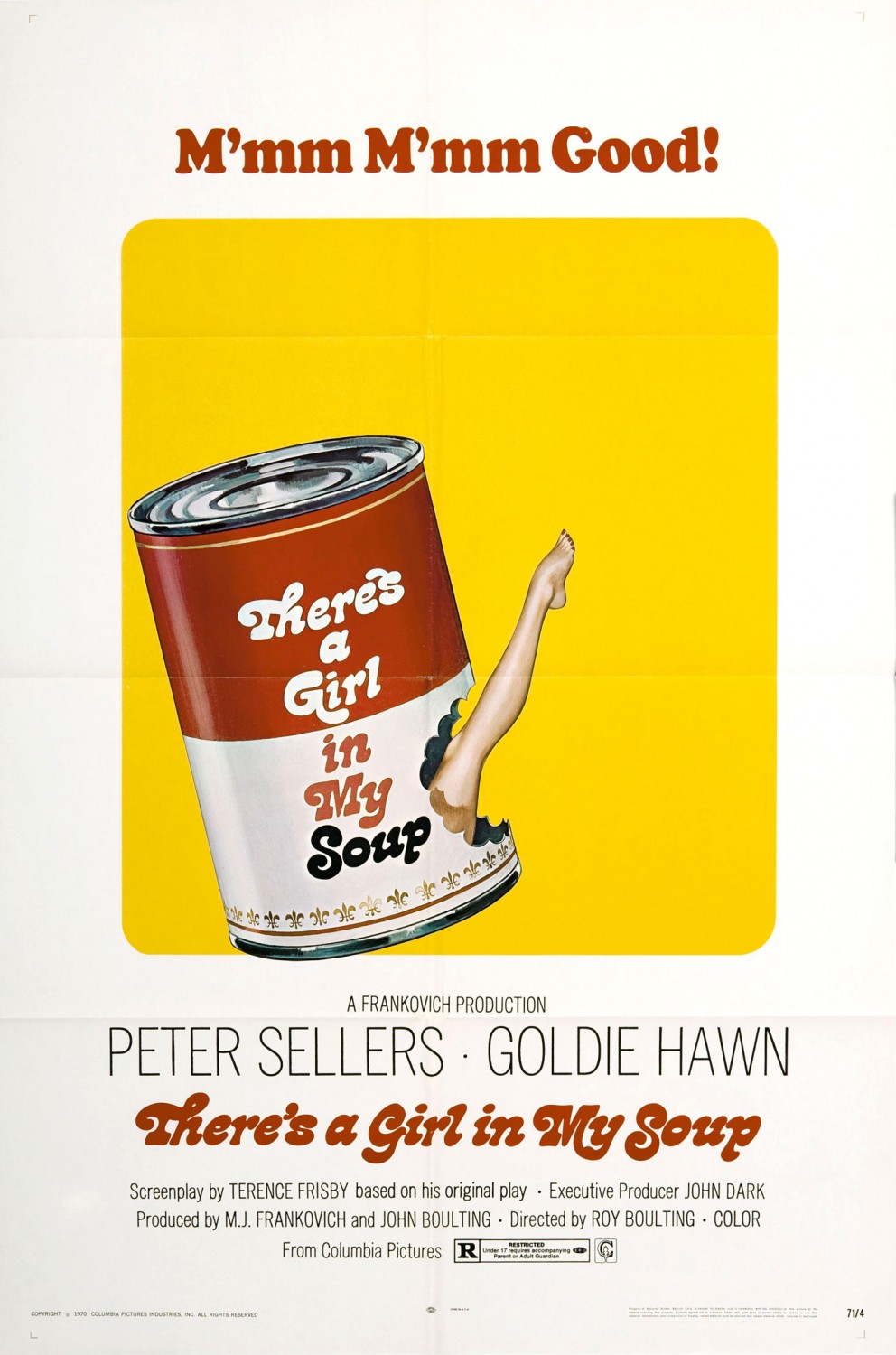
Robert (Peter Sellers) is a dashing playboy who enjoys having random sexual encounters with women, even having sex with a bride on her wedding day. Despite being in his 40’s he shows no signs of wanting to settle down and get married. Then he meets Marion (Goldie Hawn) a groupie for a rock band who finds out that its lead singer Jimmy (Nicky Henson) has been unfaithful to her. With nowhere else to go she lets Robert pick her up and take her back to his pad where he tries to seduce her, but without much luck.

Although the stageplay for which this film is based did quite well its translation to the screen leaves much to be desired.  Despite director Ray Boulting’s efforts to liven up the scenery by placing several scenes in exotic locales while also sprucing up Robert’s place by inserting his bathroom to have all mirrors in it that cover both the walls and ceiling, the film still ends up coming off like a filmed stageplay that lacks both energy and action. Even the dialogue, that usually helps  keep other plays that have evolved onto the big screen, lacks bite and becomes as stale as the rest of the proceedings.

The relationship is only funny when Marion rebuffs Robert’s advances and openly tells him how unsexy he really is, but when she foolishly ignores her better judgement and starts falling for the cad is when the whole thing goes downhill. There’s also confusion for why Robert, who openly enjoyed his single life and sleeping around with various beautiful women, which he seemed to have no trouble getting, would suddenly fall for a young woman that he didn’t have much in common with. For a relationship to begin both sides have to initially be looking for one and there is absolutely no hint that is what Robert wanted, so what about Marion got him to suddenly change his mind?

Sellers is okay although critics at the time complained that his performance was ‘lifeless’, which it is, but he makes up for it with his Cheshire cat grin. The role though doesn’t allow him to be inventive, or put on many of his different accents or personas, which he is so well known for. The character and situation are also too similar to the one that he played  in I Love You Alice B. Toklas, which he did just two years earlier.

Hawn is great and I enjoyed seeing her playing a snarky woman instead of the spacey blonde that she usually does, you even get a nice shot of her naked backside, but her character is too similar to one that she did in Butterflies are Free. In fact the two people that come-off best here are not the stars at all, but instead John Comer and Diana Dors as a middle-aged, bickering couple who should’ve been given more screen time.

Overall there’s just not enough laughs here to make sitting through it worth it. The plot has no point and the characters don’t grow or evolve making it a waste of time for its two leads whose talents are above this type of material.

My Rating: 3 out of 10

Released: December 15, 1970

Runtime: 1 Hour 36 Minutes

Rated R

Director: Ray Boulting

Studio: Columbia Pictures

Available: DVD, Amazon Video, YouTube
Where Does It Hurt? (1972)

where does it hurt 1

By Richard Winters

My Rating: 4 out of 10

4-Word Review: Corruption at a hospital.

It’s funny how names like Ed Wood Jr. or Tommy Wiseau get mentioned in just about anyone’s list of bad movie director’s, but Rod Amateau’s never does, but should. Not only did he produce ‘My Mother the Car’ and ‘Supertrain’, which are considered two of the worst TV-series ever to be broadcast, but he also directed the notorious Garbage Pail Kids as well as Son of Hitler and The Statue, which featured a jealous David Niven going around the bathrooms and gay bathhouses of London looking for a man whose penis matches the one that his wife created for a life-sized statue that she says replicates her lovers.

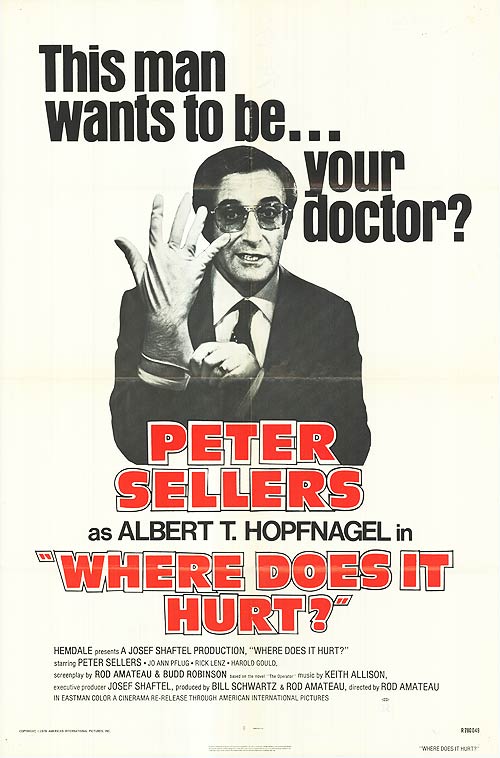
While this film isn’t quite as bad as those it comes close. It stars Peter Sellers who was at a career nadir due to financial mismanagement and willing to take on any low budget job offer he was given. Here he plays the corrupt head of a hospital that uses an array of schemes to bilk patients and insurance companies out of thousands of dollars. Rick Lenz plays a patient who becomes aware of the shenanigans going on and tries to bring Sellers and his staff down, but finds that they seem to have a trick up their proverbial sleeves at every turn.

The film manages to have a few amusing moments, but comes off more like a gag reel than a story. The characters are exaggerated and unlikable. We are supposed to side with Lenz and his predicament, but he so stupidly allows the doctors to take advantage of him at the beginning that it becomes hard to. The whole thing gets sillier by the second until by the end it’s completely inane. It also makes light of some serious issues that were handled better in Paddy Chayefsky’s The Hospital, which came out just 8 months before this one.

To some degree it’s fun seeing Sellers, who was noted for his wide range of dialects, taking a stab at an American accent and he almost pulls it off except for a few moments including the one where he pronounces orifice as AW-ifice.

The supporting cast made up of lesser known talents proves to be game here. Pat Morita, still years away from his breakout role in The Karate Kid, is genuinely amusing as a lab tech with an inferiority complex and at one point even speaks in a British accent. Harold Gould is good as an incompetent Dr. and J. Edward McKinley, best known for his many appearances on ‘Bewitched’ as one of McMahon and Tate’s primary clients, is funny as the Hospital commissioner who relentlessly tries to nab Sellers and eventually after repeated missed opportunities is able to.

In better hands this might’ve had a chance, but the low budget, irritating country music soundtrack and cheap jokes pretty much sink this thing before it even has a chance to get started.

My Rating: 4 out of 10

Released: September 29, 1972

Runtime: 1Hour 28Minutes

Rated R

Director: Rod Amateau

Studio: Cinerama Releasing Corporation

Available: None at this time.