Tag Archives: Orson Welles

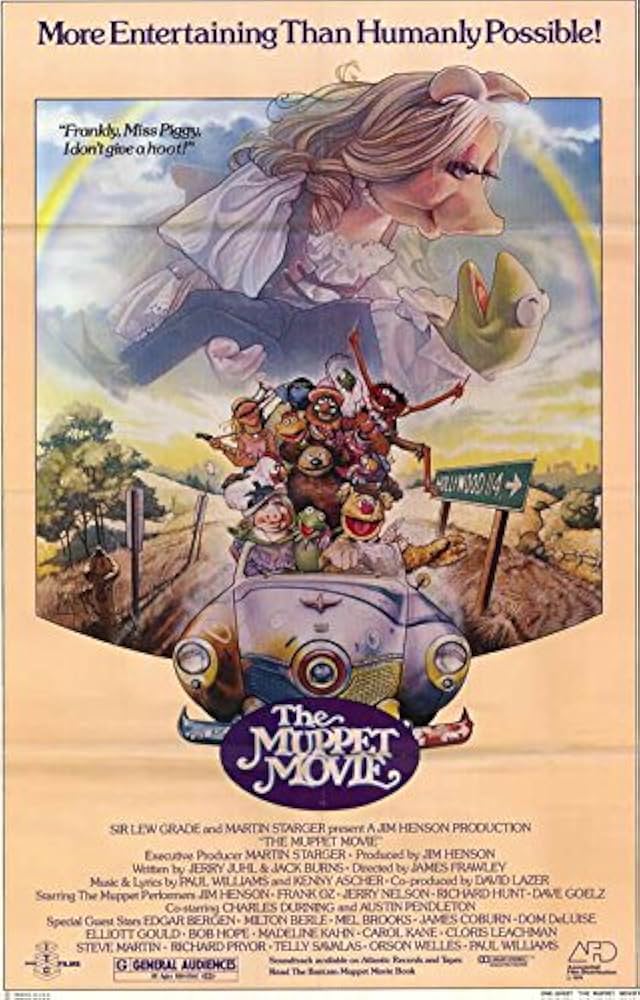
The Muppet Movie (1979)

By Richard Winters

My Rating: 7 out of 10

4-Word Review: How they became famous.

Kermit (Jim Henson) is a lonely frog living in a Florida swamp who dreams of one day making it to Hollywood and becoming famous. He then meets talent agent Bernie (Dom Deluise) who hears Kermit singing a song with a banjo and becomes convinced that the frog has what it takes to become a star. He hands him his card and tells him to give him a visit when it makes it to California. Kermit then sets-off on a cross-country trip and along the way meets several other characters all looking for their big-break including Fozzie Bear, a struggling comedian, and Miss Piggy (Frank Oz) who wants to become a fashion model. They tag along on the trip with Kermit while pilling into Fozzie’s Studebaker as he drives them to the west coast, but then they meet up with Doc Hopper (Charles Durning), an owner of restaurants who specializes in frog legs, who wants Kermit to be his new spokesmen in some commercials that he’s producing, but Kermit declines. However, Doc refuses to take no for answer and chases after the gang and using increasingly more sinister methods in order to get the frog to change his mind. 

Due to the success of ‘The Muppet Show’ creator Jim Henson was given financing to produce his own movie featuring the same puppet characters audiences had grown to love from the program. Since this would be a large-scale production great effort had to be put into making the muppets appear real and able to blend into an actual outdoor setting versus having everything done on a sound stage like it was in the TV-show. Henson refused to compromise on anything and insisted that money would not be a limitation, and this included the segment where Animal, one of the muppet characters, grows to giant proportions. Initially the idea was to keep the puppet the same size and place him on a miniaturized set, which would’ve cut down on costs, but Henson felt this didn’t look convincing enough, so instead they constructed Animal’s head to gigantic proportions that measured over sixty feet, which called for way more money and was very time consuming, but ultimately worth the effort. 

The story itself is pedestrian and relies, similar to the TV-show, with rapid fire quips and comebacks much like in old vaudeville. On the surface the humor is corny, and some could find the whole thing silly, but enjoyment comes with the puppet characters that are made to be like caricatures of humans, and their amusing responses and reactions. It’s also filled with a lot of great songs all written by the talented Paul Williams, who appears briefly. Normally in movie musicals the songs end up sounding the same and it starts to feel like we’re just listening to the same loop done over and over, but here each music bit has a distinct beat and a good toe-tapping quality, which not only adds to the fun, but actually helps move the story along versus holding it up. 

The only drawback is the massive amount of guest star appearances. There are many familiar faces, but most of them are only in it for a half-minute, or so and few of them have anything that’s actually funny to say, or even moderately clever. Performers like Bob Hope, Richard Pryor, Madeline Kahn, and Edgar Bergen, in his last screen appearance before dying just a couple weeks later, are essentially wasted in bits that add nothing and could easily have been excised and not missed. However, there’s a few cameos that do work including Steve Martin as an annoyed waiter, Cloris Leachman as a receptionist allergic to animal hair and Orson Welles who comes on near the end and has the film’s best line. Mel Brooks also quite memorable in an over-the-top send-up of a German mad scientist. 

Durning though is the one exception as he is more like a main cast member and in it quite a bit. Of course, he’s an outstanding character actor and a personal favorite and he shines here as well particularly with his attempt at a Cajun accent, but it seemed a bit ridiculous for a guy to go to such extreme measures just to get Kermit to be in his commercials. A better storyline would’ve had Kermit witness Durning turning one of his family members, perhaps one of his distant frog cousins, into a frog legs meal and thus threaten to turn Durning into the authorities and this would cause him to chase after him in order to try and keep him from squealing.  It also would’ve been nice had he shown a change-of-heart at the end and come around to being a friend to the muppets versus remaining an adversary. It comes close at one point when Durning realizes he doesn’t have any real friends like Kermit does, but I would’ve liked to have seen him come to grips with his aggressive personality and make amends to do better moving forward. 

My Rating: 7 out of 10

Released: June 22, 1979

Runtime: 1 Hour 35 Minutes

Rated G

Director: James Frawley

Studio: Associated Film Distribution

Available: DVD, Blu-ray, Amazon Video, YouTube
Butterfly (1982)

butterfly

By Richard Winters

My Rating: 0 out of 10

4-Word Review: Family has genetic birthmark.

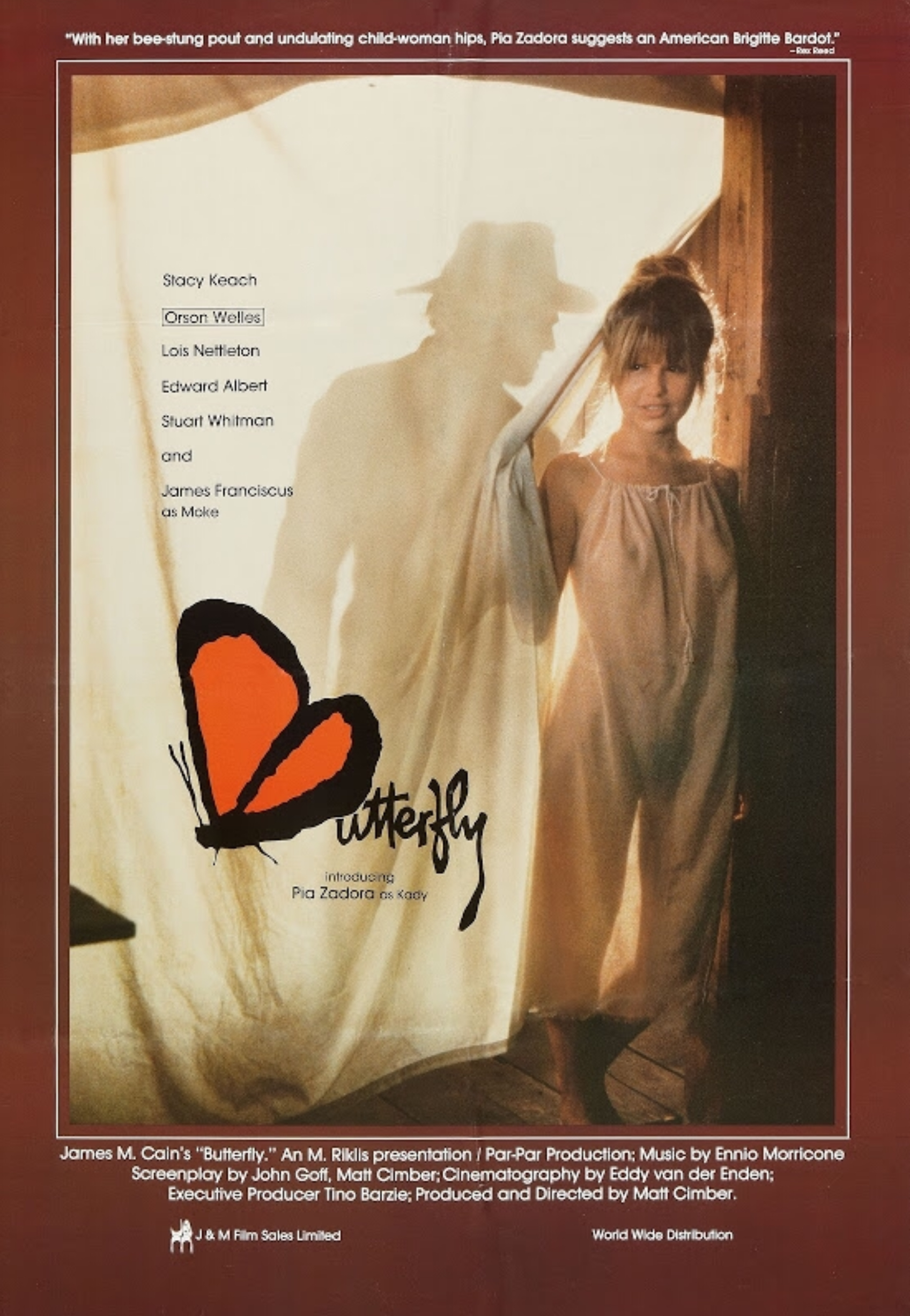
Jess (Stacy Keach) takes care of an unused mine outside of a small Arizona desert town. One day Kady (Pia Zadora) shows up at his doorstep. Jess doesn’t recognize her at first, but then realizes she’s his 17 year-old daughter the product of his marriage to Belle (Lois Nettleton) who abandoned him 10 years earlier for another man named Moke (James Franciscus). She is pregnant by a man who refuses to marry her, so she  wants to steal silver from the mine that Jess protects in order to help her financially with the child who’s on the way. At first Jess disapproves, but Kady uses her provocative body and looks to essentially seduce him and get him to relent. However, a local man named Ed (George Buck Flower) witnesses their stealing from the mine as well as their lovemaking later on, which gets them arrested for incest.

The story is based on the 1947 novel ‘The Butterfly’ by James M. Cain, who at the time was an immensely popular author, who had many of his books made into movies, but due to the controversial nature of this one it had to wait 35 years until it finally went to the big screen. He was inspired to write the story when years earlier, in 1922, he got a flat tire while driving through a mountainous area in California and a farm family that had moved there from West Virginia helped him fix it, but at the time he speculated that the young daughter they had with them was a product of incest.  The movie makes several deviations from the book. In the book Jess was the overseer of a coal mine and the plot took place in West Virginia while the Kady character was 19 instead of 17.

While the plot has some tantalizing elements, and on the production end it’s well financed, the whole thing comes crashing down due to the really bad performance of its lead actress. Zadora at the time had done only one other film before this one, Santa Claus Conquers the Martians, which was universally lambasted. It probably should’ve killed anyone’s career who had been in that, but she continued to struggle on in the business. Then in 1972 while performing in a small role in a traveling musical show, she caught the eye of a rich businessman named Meshulam Riklis, who was 29 years her senior. The two began dating and eventually married in 1977. Her new husband was determined to make her a star even if it meant buying her way in. He put up the entire $3.5 million budget for the film while demanding that she be placed as the star forcing director Matt Cimber to cast all the other parts around her. Riklis even put up big money to help get her promoted to winning the Golden Globes Newcommer of the Year Award, but all of this didn’t get past the critics, or audiences who rightly saw her as undeserving of all the attention and while she did a few other movies after this, which were equally panned, and even a few music videos and singing ventures, she is overall largely forgotten today and hasn’t been in a movie in 30 years.

To some extent her performance isn’t completely her fault as her character is poorly fleshed-out, which is my main gripe. I just couldn’t buy in that this chick on the verge of adulthood would be so extraordinarily naive that she’d come-on to her own father and not see anything wrong with it. First of all why is she sexually into her dad anyways as majority of girls tend to want to go for guys their own age and if not there has to be a reason for it, which this doesn’t give. In either case she should have some understanding that the rest of society doesn’t condone this behavior nor having her aggressively flirt with literally any guy she meets. The fact that she’s so blissfully ignorant to the effects of her behavior made her not only horribly one-dimensional, but downright mentally ill. Sure there’s people walking this planet that harbor some sick, perverse desires, but virtually all of them know they’re taboo and not dumb enough to be so open about, or if they do they learn real fast. Having her unable to understand this, or never able to pick-up on even the slightest of social cues is by far the most annoying/dumbest thing about it.

Keach, who gives a good performance and the only thing that holds this flimsy thing together, has the same issue with his character though not quite as bad. The fact that he doesn’t even recognize his daughter at first is a bit hard to believe. Sure he left the family 10 years earlier, but that would’ve made her 7 at the time and although she has clearly grown I think she’d still have the same face. He gives into his temptations too quickly as at one point he massages her breasts while she’s in the tub. Now if he weren’t religious then you could say he didn’t care about the taboos and had been living so long alone that he’d be happy to jump at any action he could irregardless if they were related, but the fact that he goes to church regularly should make him feel guilty and reluctant to follow through. In the book he’s portrayed as fighting these internal feelings by turning to alcohol, which is the way it should’ve been done here as well.

The eclectic supporting cast does make it more interesting than it should. Orson Welles caught my attention not so much for his role as a judge, but more because of his wacky combover. James Franciscus, who usually played sterile good guys is surprisingly snarly as the heavy and Stuart Whitman has a few good moments as a fiery preacher though even here there’s some logic loopholes that aren’t explained like how did he know Kady was Jess’ daughter, which he mentions while at the pulpit much to the surprise of Jess as he hadn’t introduced her to anybody.

My Rating: 0 out of 10

Released: February 5, 1982

Runtime: 1 Hour 48 Minutes

Rated R

Director: Matt Cimber

Studio: Analysis Film Releasing Corporation

Available: DVD-R

Get to Know Your Rabbit (1972)

By Richard Winters

My Rating: 6 out of 10

4-Word Review: Businessman becomes a magician.

Donald (Tom Smothers) is tired of the rat-race and decides one day to impulsively walk off of his job  and become a trained tap dancing magician under the tutelage of Mr. Delasandro (Orson Welles). While the pay isn’t good he enjoys the freedom of being on the open-road and avoiding the stress of climbing up the corporate ladder despite the efforts of his former boss (John Astin) who tries anything he can to get Donald to come back and work for him.

This was Brian De Palma’s first studio made venture and he borrows heavily from the same type of surreal comedy that he used in his two earlier independent films Hi Mom! and Greetings. While not all of the gags hit there’s enough inventive camera work and editing to keep it interesting making the fact that the studio ultimately hated the final product and fired De Palma from the project all the more perplexing. This film follows the exact same blue print of De Palma’s earlier work. Had they not watched those films and just hired him based on recommendation? If so then they have no one else to blame but themselves.

While I enjoyed the eclectic energy there are too many comic bits that veer way off from the main storyline and have absolutely no connection to the main plot. The script, by Jordan Crittenden, would’ve been stronger had all the humor been focused around a main theme as it ultimately comes-off as too much of a hodgepodge with no connecting message to it at all. What’s even worse is that some of the gags have a lot of comic potential that aren’t played-out to the fullest, which makes it even more frustrating.

Smothers is quite boring and seems unable to convey any other expression except for a smiling deer-in-headlights look. Apparently behind-the-scenes he didn’t get along with De Palma and refused to show-up for necessary retakes making me think he should’ve been the one fired as he could’ve been easily replaced by a wide array of other comic actors who would’ve done a far better job. Even Bob Einstein, who appears very briefly as a brash fireman, gets far more laughs than anything Smothers does throughout the entire movie.

Fortunately the supporting cast is excellent and one of the reasons that helps keep the film afloat. Welles is especially good as the washed-magician with the scene where Smothers and he get stuck inside their escape sack while trying to perform the trick being the funniest moment in the movie. Astin is amusing too as Smother’s former boss who slowly turns his room inside a seedy hotel into a thriving office. Katharine Ross is also a delight in a perfect send-up of a starry-eyed groupie.

Spoiler Alert!

The ending though in which Smothers finds himself back working inside the same type of corporate office job that he had tried to escape from at the beginning is a disappointment. Sometimes cyclical endings can be clever and ironic, but here it’s more of a cop-out. We never get any sense of how the experiences that the character goes through changes him making it all seem quite shallow and pointless. It also completely forgets about the Orson Welles character, who gets written-out after the second act even though his presence was one of the most entertaining aspects of the movie.

My Rating: 6 out of 10

Released: June 7, 1972

Runtime: 1 Hour 31 Minutes

Rated R

Director: Brian De Palma

Studio: Warner Brothers

Available: DVD-R (Warner Archive), Amazon Video, YouTube

Voyage of the Damned (1976)

By Richard Winters

My Rating: 4 out of 10

4-Word Review: This ship goes nowhere.

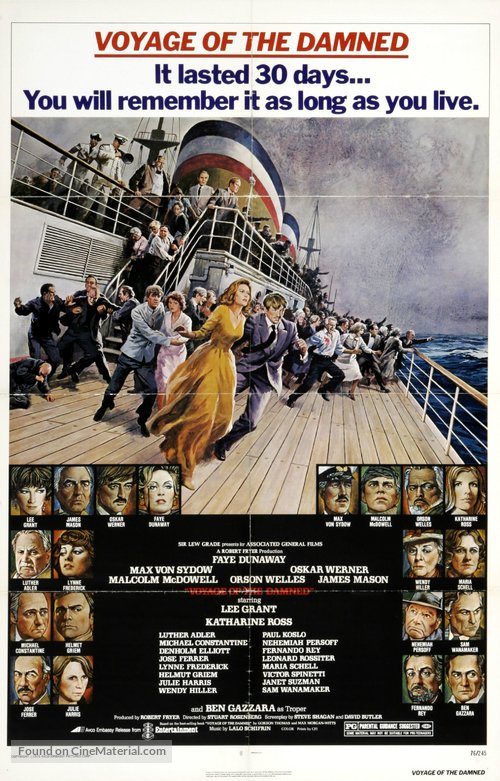
Based on the true story of the ill-fated voyage of 937 Jewish refugees who left the port of Hamburg, Germany in 1939 on the ocean liner St.Louis, which was supposed to arrive in Havana, Cuba where they hoped to start a new life free of the rising antisemitism that had plagued them in Europe. However, when the ship reaches Cuba they are not allowed to dock and when the ship’s Captain (Max Von Sydow) tries to take them to the US and Canada they are refused entry as well forcing them to return to Germany.

Given the high production values and riveting story-line I was expecting it to be far more compelling than it ends up being. It’s not like Stuart Rosenberg’s direction is poor either because it isn’t, but it never gains any dramatic traction and the more it goes on the more boring it gets. This is definitely one instance where cutting the runtime would’ve been advantageous. I know we live in an era where the ‘director’s cut’ is considered the gold standard, but sometimes there’s good reasons for why studios edit it and usually it’s because some of the footage just isn’t necessary. I watched the 158 version, but the theatrical cut was trimmed to 134 minutes and after watching this one I can only presume that version would’ve been an improvement and if anything could’ve gained a better pace, which is something that is seriously lacking here.

There also too many characters and it’s hard to keep track of all them or get emotionally invested in their quandary especially when by-and-large their all suffering from the same dilemma. The time span between when they show a character to when they return is so long that by the time you see them again you’ve pretty much forgotten all about them.

The large cast is full big names and familiar faces and a few of them do a terrific job. I felt Von Sydow’s performance as the beleaguered but stoic captain was right on-target and I also enjoyed Orson Welles as the glib Cuban politician. Kudos also should go to Lee Grant, who ended up getting nominated for a Best Supporting Oscar here, for her one shocking scene where she cuts her hair down to its scalp, but overall most of the talent gets wasted. This includes Denholm Elliot and Jose Ferrer who appear onscreen for only a few minutes and Katherine Ross who has only two scenes that come near the end, but still managed to somehow get a Golden Globe nomination for her efforts anyways.

Spoiler Alert!

The film ends on a supposed happy note when the ship’s captain informs the passengers that Belgium and France will accept them, but then the denouncement states that 600 of them ended up dying anyways during the German Occupation making the viewer feel much like the passengers that they’ve just spent almost 3-hours going in circles. Maybe that’s the point, but as an insightful drama it fails. I was almost hoping that the Captain would’ve gone through with his plan to have the ship crash off the shore of England and allowing the passengers to disembark as a safety precaution, but still trying to make it look like it was an accident and not intentional. Although this would’ve swayed from what really happened it could’ve been an interesting thing to see and brought some genuine action into the mix, which was otherwise missing.

My Rating: 4 out of 10

Released: December 22, 1976

Runtime: 2 Hours 38 Minutes

Rated PG

Director: Stuart Rosenberg

Studio: Embassy Pictures

Available: DVD, Blu-ray, Amazon Video

Daisy Miller (1974)

By Richard Winters

My Rating: 7 out of 10

4-Word Review: She’s a real tease.

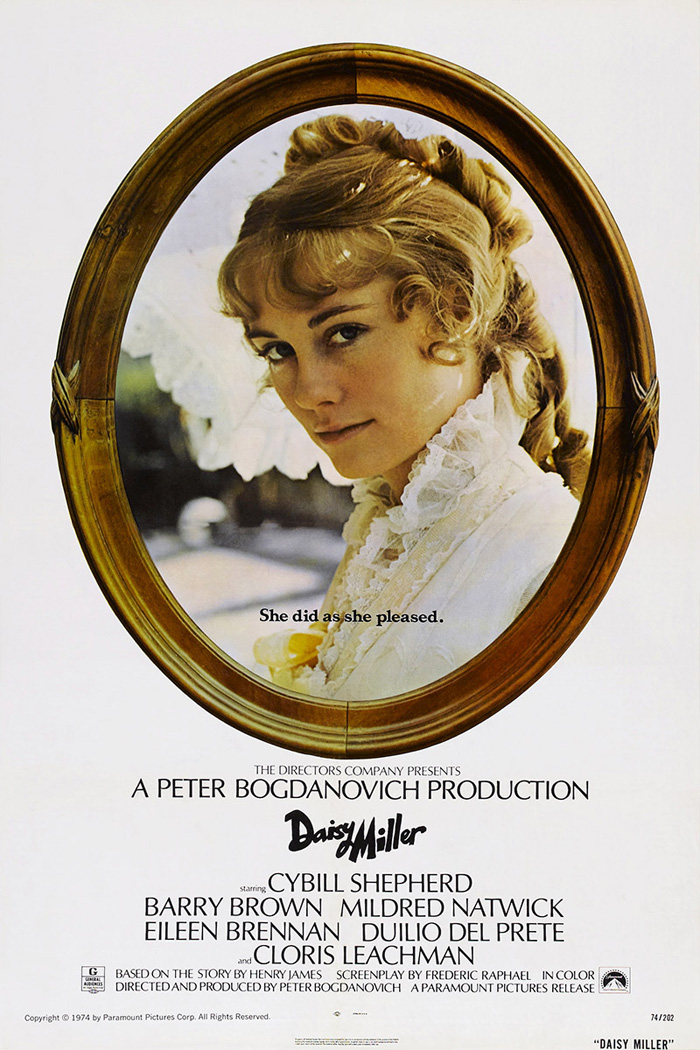
While studying in turn-of-the-century Switzerland Frederick (Barry Brown) comes upon the beautiful Daisy Miller (Cybill Shepherd) who’s touring Europe along with her nervous and talkative mother (Cloris Leachman) and precocious younger brother Randolph (James McMurty). Frederick is smitten with her beauty, but unable to handle her free-thinking ways. Nonetheless he follows her around Europe where he continually becomes confounded with whether she likes him or not, or whether he’ll ever be able to convey his true feelings towards her.

This film, which is based on a short story by Henry James, was originally conceived by Peter Bogdanovich as being a vehicle for both him and his then girlfriend Shepherd to star in with Peter playing the part of Frederick and Orson Welles directing it. Peter had become mesmerized with Cybill while directing her in The Last Picture Show and left his then wife and children to move in with her in a situation that was later satirized in Irreconcilable DifferencesFortunately Welles realized that Peter’s obsession with making Cybill a big screen star had sapped him from all common sense and bowed out of the film project considering the material to be weak and lightweight, which it is, but this only then helped to convince the determined Peter to direct it himself.

The result isn’t as bad as I had initially presumed and in a lot ways it’s strangely engaging and certainly  far better than At Long Last Love another Bogdanovich/Shepherd concoction that was rejected by both audiences and critics alike. This one though takes advantage of Cybill’s conniving, flirtatious nature, which is something I feel she’s been doing her whole life and therefore makes this character a reflection of who she truly is. Leonard Maltin described her performance as “hollow”, which I agree as we only see one side to her personality, but when she plays that one side as well as she does then it becomes entertaining nonetheless.

Brown is excellent too and far better in the role than Peter ever would’ve been as Brown manages to retain the necessary modicum of self-respect even as he chases her around like a lovesick mope. Instead of this becoming off-putting we sympathize with his internal quandary and this then helps to propel the story forward even as it seems to be going nowhere.

The film’s other big asset is its on-location shooting. Some viewers have described the period costumes and set-pieces as being great, but for me this was only so-so. What I really liked though was the scene done inside the Coliseum at night under the moonlight, which gives off both a surreal and creepy feeling and adds an extra ambiance making me wish the segment had been extended as well as adding a trip to Rome on my own personal bucket list.

Spoiler Alert!

The film’s biggest failing though comes at the end where Daisy catches malaria and promptly dies, but we never see her sick and only gets told this after she’s already dead. Having a scene showing her ill and vulnerable as opposed to always being free-spirited and in control would’ve helped give the character an added dimension especially if it had been done with Frederick at her bedside.

The idea that if Frederick had just been less ‘stiff’ towards her that the relationship might’ve blossomed is ridiculous as I think this was the type of woman who enjoyed manipulating men and even if she got married to one she’d continually toy with them until she got bored and moved on to the next. Having her die isn’t ‘sad’ as the film suggests, but instead a happy one for Frederick as now he’s ultimately out of her grip and able to free himself to find someone who would really care for him.

My Rating: 7 out of 10

Released: May 22, 1974

Runtime: 1 Hour 31 Minutes

Rated G

Director: Peter Bogdanovich

Studio: Paramount Pictures

Available: DVD, Amazon Video, YouTube

12 + 1 (1969)

twelve plus one 2

By Richard Winters

My Rating: 2 out of 10

4-Word Review: Money in the chair.

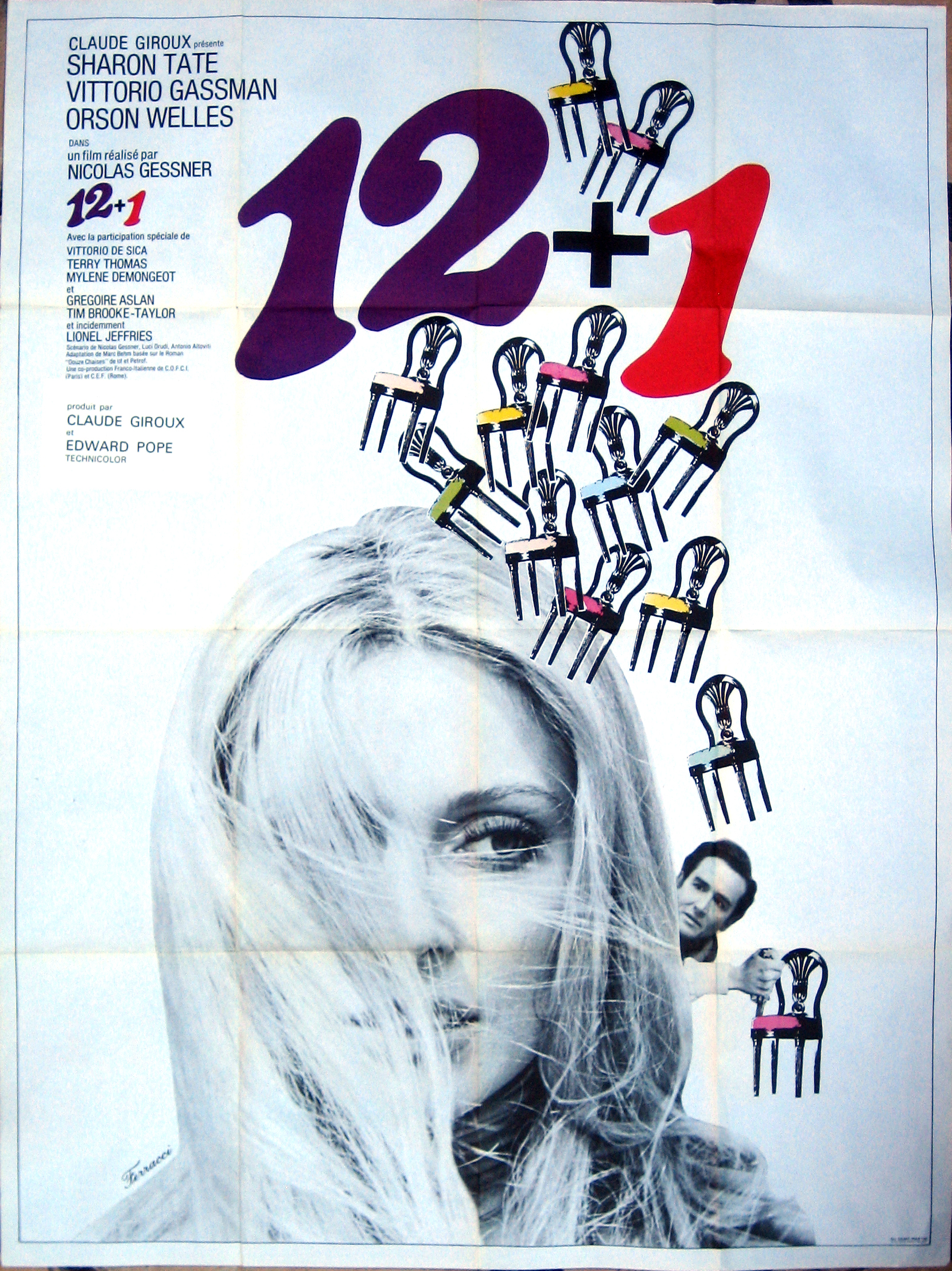
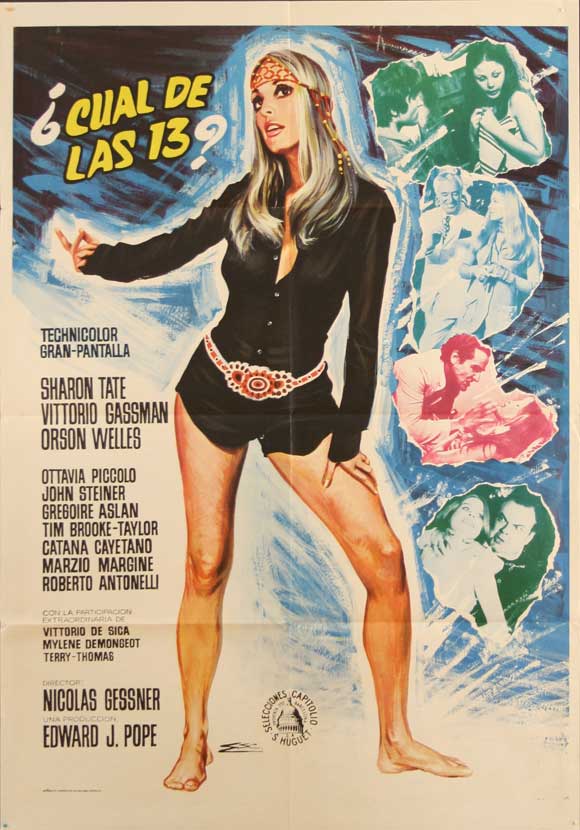
Mario (Vittorio Gassman) is a struggling barber who gets word that his rich aunt has left him a large inheritance. When he gets to her estate he finds the place nearly empty except for some old chairs piled up into a corner. Angered he decides to sell the chairs to a local antique dealer so he can at least make some money off of them. After he sells them he finds a note from his deceased aunt stating that there was a large amount of money sewn up inside one of them. In a panic he goes running back to the shop, but finds that they have already been sold off to various customers, so he along with Pat (Sharon Tate) who worked at the shop and wants to help him as long as she gets a part of the take go on a mad dash to seek out the chairs and retrieve them one-by-one until they can find the money.

The film is based on the classic 1928 Russian novel that has been made into several film versions including one by Mel Brooks that came out a couple of years after this one. I’ve never read the novel, but this film clearly does not do it any justice. The humor is lame and cartoonish and barely able to equal a weak Tom and Jerry cartoon or uninspired Disney flick. The budget is low and the scenes all have a perpetually cheesy, schlocky feel. The Herb Alpert-like music sounds like it was edited in off of an audio cassette recording. The whole thing is quite derivative and dull despite the wide variety of characters and locales.

The film’s biggest claim to fame is being Tate’s only starring vehicle and this didn’t get released until well after her death. She is very beautiful and surprisingly engaging and comical and her presence is the best thing about the movie. She even does a nude scene along with the equally tantalizing Ottavia Piccolo when they both go topless and then get into bed on either side of Gassman, which is the film’s one and only provocative moment.

The supporting cast is full of some old pros that get badly wasted. Terry-Thomas is one of the funniest character actors of all-time, but here he is shockingly boring and forgettable. Orson Welles hams it up in make-up as a pretentious stage actor whose play he is performing in becomes a catastrophe in the film’s only slightly amusing moment.

The color is faded and shot with no imagination or flair. Although there is some nudity the filmmaker’s would have been better served had they cut it out and aimed it solely for the kids as the humor is so broad and silly that only a three-year-old could possibly find it entertaining and even that is no guarantee.

twelve plus one 1

My Rating: 2 out of 10

Released: October 7, 1969

Runtime: 1Hour 34Minutes

Rated R

Director: Nicholas Gessmer

Studio: AVCO Embassy Pictures

Available: VHS