Tag Archives: Joseph Bologna

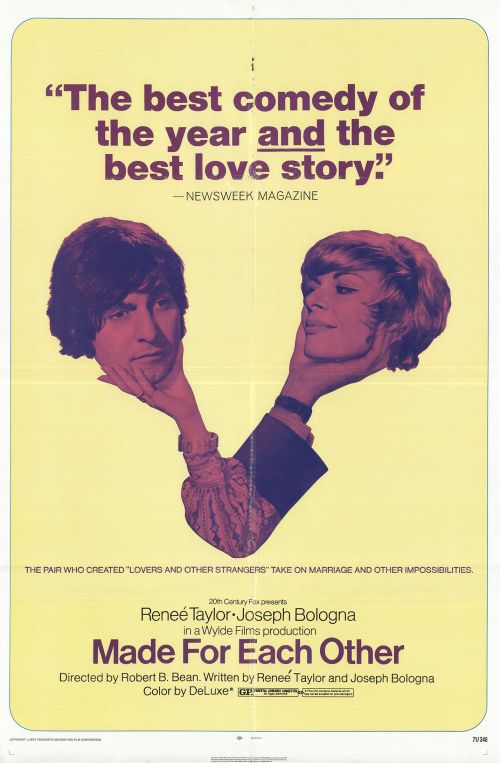
Made for Each Other (1971)

made

By Richard Winters

My Rating: 7 out of 10

4-Word Review: Couple argues a lot.

Pandora (Renee Taylor) is an out-of-work actress still clinging to her dreams that she’ll one day become famous something she has hoped for since she was a child. Gig (Joseph Bologna) suffers from not being able to find a stable relationship and guilt-ridden over sending the last one into attempted suicide. Both Pandora and Gig attend a group therapy session and this is where they meet. Initially though things are rocky. Gig does not like Pandora’s stand-up act, something she’s been working on for years, and openly tells her it’s awful. They then break-up, but Pandora eventually returns telling him that he was right and she’s worked out the ‘kinks’ from her act, so it’s now improved. To celebrate Gig takes her to his parents (Paul Sorvino, Olympia Dukakis) for Thanksgiving. The parents though don’t approve of Pandora since she’s Jewish and they’re Catholic and they eventually drive her out of their apartment. Gig and Pandora continue to argue once they’re back in the car, but find, strangely, that no matter how the other one annoys them they still like each other’s company.

After the runaway success of Lovers and Other Strangerswhich Bologna and Taylor wrote initially as a play, but then turned it into a movie, Hollywood studios were interested in them trying another script and gave them upfront money to do so. The first film had been based on their real-life experiences of dealing with all of their in-laws during their wedding, which occurred in 1965, and so they decided to base this one on their lives as well, namely what brought them together. Like with their first project the script is quite broad and focuses in on many different people including the parents of each character who have quite a bit of screentime, particularly Sorvino and Dukakis, and who are quite funny. The film also shows the leads when they were infants and many of their childhood experiences, which gets shot in black-and-white, that is also both insightful and amusing.

Unlike with most movies the scenes are quite extended and seemed better primed for a stageplay. The elusive Robert B. Bean gets credited as director, but he never did anything else, which seems a bit curious and there’s been rumors that he was just a pseudonym for Bologna who took over as the actual director. The long takes though are effective and enhance the comedy. The scene inside Gig’s parents house where the tension builds when they slowly realize that Pandora is ‘not their kind’ is quite good and not unlike what could happen in many families homes of that era who closely identified with their particularly religions and not privy to having their kids marry outside of it. Gig’s inability to appreciate Pandora’s stage act and his blunt assessment of it while at a late night cafe is comically on-targe too as any fledgling artist will tell you sometimes family members, friends, and even those really close to them won’t always connect with their artistic endeavors and regrettably become their biggest critics.

Sorvino scores as the abrasive no-nonsense father though ironically he was actually 5-years younger than Bologna who plays his son and for that reason his hair should’ve been made more gray. Dukakis is equally on-target as the super religious mother whose strong faith amounts to a lot of rituals and ends up inadvertently harming her child psychologically like when she catches him masturbating and informs him that if he continues his ‘little thing will fall off’. Helen Verbit as Pandora’s mother is equally amusing playing the over-protective type who wants so hard to shield her daughter from harsh reality that she tells her that her stage act is ‘brilliant’ when it really isn’t and that because she’s her mother that somehow makes her opinion ‘objective’.

The film’s one drawback is the yelling, which there is a lot of. Sometimes confrontational comedy can be quite amusing and this one works most of the way, but how much the viewer will enjoy is up to each individual. Bologna’s shouting is particularly loud and abrasive. It’s meant to funny and done only out of aggravation, but it does tend to get extended especially by the end. Had Taylor shouted back then it would’ve seemed like a ‘fair fight’, but having her run away and cry takes humor out of it and may ultimately ingrate on the audience. The intent is for there to be an offbeat charm, but not everyone may see it that way and thus this thing won’t be for all tastes.

My Rating: 7 out of 10

Released: December 12, 1971

Runtime: 1 Hour 41 Minutes

Rated GP

Director: Robert B. Bean

Studio: 20th Century Fox

Available: DVD-R (Fox Cinema Archives)
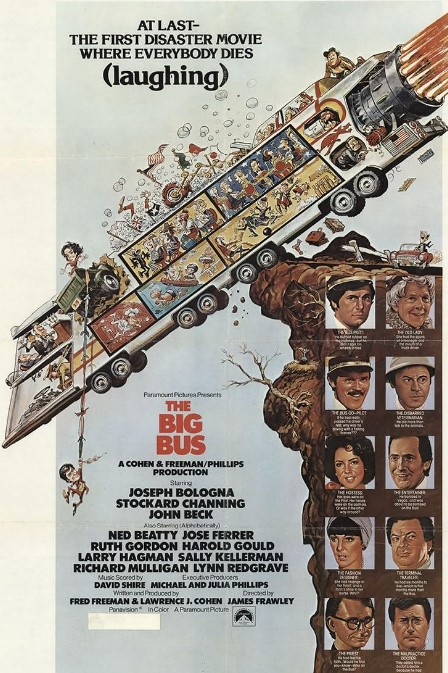
The Big Bus (1976)

bigbus1

By Richard Winters

My Rating: 6 out of 10

4-Word Review: Bomb planted on bus.

Cyclops is the new revolutionary designed double-decker bus that because it’s powered by nuclear fuel will allow it to travel non-stop between New York and Denver. Just before it’s set to make its maiden voyage a bomb goes off within the facility it’s been housed in, which seriously injures the bus’s designer Professor Baxter (Harold Gould). The vehicle itself remains unscathed, so the Professor’s daughter, Kitty (Stockard Channing), takes control of the project and hires a new driver named Dan (Joseph Bologna) whom she had a relationship with in the past. Dan though is still fighting-off the stigma of having crashed another bus into the mountains, and after being stranded for many days ended up reverting to cannibalism by eating all the rest of the passengers. The trip faces further obstacles when unscrupulous billionaire Iron Lung (Joes Ferrer), who resides inside a iron lung due to having polio as a child, orders his henchmen Alex (Stuart Margolin) to plant a bomb on the bus, so that it will be destroyed and prevent nuclear fuel from overtaking gasoline of which he owns much stock. Will Dan be able to overcome both his past and personal problems to both find and prevent the bomb from going off, or will this become yet another disaster on his already checkered past?

While Airplane! is widely thought-of as being the original parody of 70’s disaster flicks it’s really this one that came out a full 4 years earlier that deserves the credit. While it didn’t do well at the box office, which essentially pushed it off into obscurity it still upon second look has a lot of funny moments and deserves much more attention than it has gotten.  Not every gag works and some do fizzle, but the script by writing team Fred Freeman and Lawrence J. Cohen has far more hits than misses. Some of the best bits are the indoor swimming pool on the bus as well as the bowling alley and disco and the radiation suit to put on in times of emergency including the reaction of the passengers when it gets hung down from the ceiling compartment during the flight instructions. The attempt to treat the bus like it’s a metaphor for an airplane, which was the mode of transportation used in most disaster flicks, is quite funny especially the scene where crews in a small town try to halt the bus, or essentially ‘force it to land’ by spraying the main street with foam in order to slow the vehicle down.

The acting is in top form with many familiar faces from both television and the big screen. Stockard was probably my favorite she pretty much plays her part straight, but still manages to be quite amusing especially during the segment when she gets stuck inside a room that fills up with soda, which she stated in later interviews she almost drowned in.  Richard Mulligan and Sally Kellerman are equally amusing as a soon-to-be-divorced couple who share a rather unusual love-hate relationship. Larry Hagman as a dubious doctor, Ned Beatty as a moody technician and Murphy Dunne as a caustic pianist all help to top-it-off. Even Bologna, whose normally brash persona doesn’t make him a likely hero, scores comedic points though John Beck as his co-driver with a tendency to pass-out the second he gets nervous steals away most of the scenes they share.

Spoiler Alert!

The actual disaster, where the bus precariously balances over a cliff, is nicely photographed in a way that makes it seem real with some good stunt work, but I was disappointed that this ends up being the only real exciting moment. I didn’t like either that at the very end, just before the final credits begin to roll, the bus splits apart, which creates screams from the passengers. This was the type of movie where despite their oddball nature I had grown kind of fond of the daffy bunch and wanted to see them arrive safely, which with the ending here doesn’t occur. Instead the viewer is left (no pun intended) hanging, which is a giant cop-out. Just about every disaster flick made offers a conclusion where we see if the people ultimately make it out alive, or not and doing it the way they do here makes the viewer feel like they’ve seen only half a movie, which could explain why this did poorly at the box office.

A  good way to have prevented this would’ve been to chop up the beginning, which has a lot of unnecessary back-story. The bombing of the facility wasn’t needed as all of the calamity should’ve been saved for the bus ride itself. Dan’s visit to a bar in which the patrons harass him about his notorious past gets cheesy, particularly the cartoonish barroom brawl. This should’ve been cut- out too. The rumors of Dan’s supposed cannibalism could’ve been brought up at the press conference announcing the bus’s initial trip and seeing Dan’s uncomfortable response would’ve been enough to make the audience realize he had personal demons to overcome. The rest of the time could then be spent on the various problems that the bus runs into as it travels on road, which would’ve allowed for more excitement versus having the disaster portion seem like a side-story to the barrage of jokes that don’t always work.

My Rating: 6 out of 10

Released: July 23, 1976

Runtime: 1 Hour 28 Minutes

Rated PG

Director: William Frawley

Studio: Paramount

Available: DVD, Blu-ray, Amazon Video, YouTube

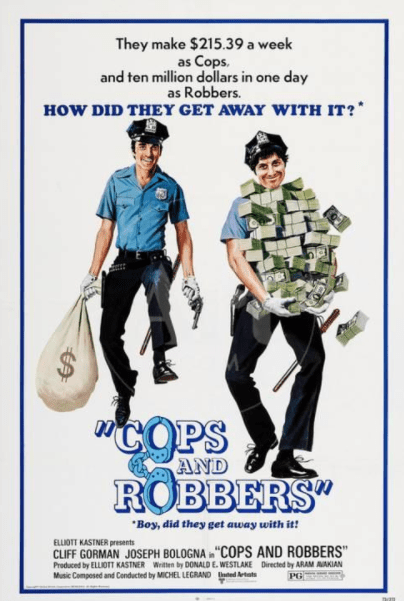
Cops and Robbers (1973)

By Richard Winters

My Rating: 8 out of 10

4-Word Review: Cops become the robbers.

Tom (Cliff Gorman) and Joe (Joseph Bologna) are two New York City policemen who are tired of their jobs and want to retire from the working world, but can’t because they need to support their families. They decide the only solution is to commit a heist by working with a local mob boss (John P. Ryan) to rob a Wall Street brokerage firm out of  bonds that cannot be traced. The two come up with an elaborate scheme  to pull it off during the day while the place is still open and they’re still in uniform. At first things go smoothly, but then two other cops show up forcing Tom and Joe to destroy the bonds they’ve just gotten their hands onto in order to avoid getting caught. While this helps them out of their immediate jam it still gets reported to the press that the place was robbed making the crime boss believe he has been taken advantage of and compelled to get revenge.

What stands out is how different this is from the conventional cop flick. Instead of having a loud, pounding score the music here is soft and tranquil like the breezy, warm climate of a tropical island, which is where both Tom and Joe wish they were. The cops aren’t portrayed as being authority figures either or compromised victims of a corrupt system, but just regular suburbanites trapped in a dead-end job like many people and looking for a way out.

The crime is done differently too. Usually, in most other cop flicks, once the robbery gets going you’ll see the pace speed up with fast edits, but here it gets played-out in real time, which actually makes it more intense. I enjoyed the camera cutting back and forth from showing things from Tom and Joe’s point-of-view as well as from the black-and-white monitor seen by the security guards. The authentic office atmosphere has many of the employees not even knowing a robbery is going on while the two main people who do realize what Tom and Joe are up to, well played by the elderly Shepperd Strudwick and a much younger African American actress named Ellen Holly, display odd reactions and facial expressions that doesn’t conform to the situation, but eventually gets explained by the big twist that comes later.

Gorman gives an awesome performance, which is made all the more impressive when you realize just 4 years earlier he was the highly effeminate gay character in The Boys in the Band, but here he’s a macho heterosexual. I kept waiting for him to reveal mannerisms of his past role, but instead he successfully pulls off being two diametrically different people with no connection to the other a feat not every actor, even some of the good ones, are able to do.

Bologna goes against type too. Usually he’s loud and brash, but here more quiet and nervous. In the Kino Lorber DVD bonus section he recounts a funny incident that happened to him during the production when he was forced to make a call home to his wife (actress Renee Taylor) in real-life. Since there were no such things as cellphones at the time he had to go to a nearby phone booth while still wearing the cop uniform of his character. It was there that he noticed a thug beating up a victim on the sidewalk and he shouted at the man to stop it. Since the man presumed Bologna was a cop it was enough to get him to run away, but then the other pedestrians started to harass Bologna for not chasing after the bad guy and arresting him. He tried to explain that he was just playing a policemen in a movie, but no one believed him.

The film’s final segment, which takes place in Central Park, is well choreographed and features a unique car chase.  It’s just a shame that Aram Avakian who burst onto the film scene with the provocative, ahead-of-its-time cult favorite End of the Roaddidn’t go on to direct more movies as he did only one more, 11 Harrowhouse, after this one before retiring to become the head of the film department at the State University of New York where he worked until his death in 1987. His approach here makes all the difference as he relies not on the typical cop formula action, but instead on the nuance.

My Rating: 8 out of 10

Released: August 15, 1973

Runtime: 1 Hour 29 Minutes

Rated PG

Director: Aram Avakian

Studio: United Artists

Available: DVD

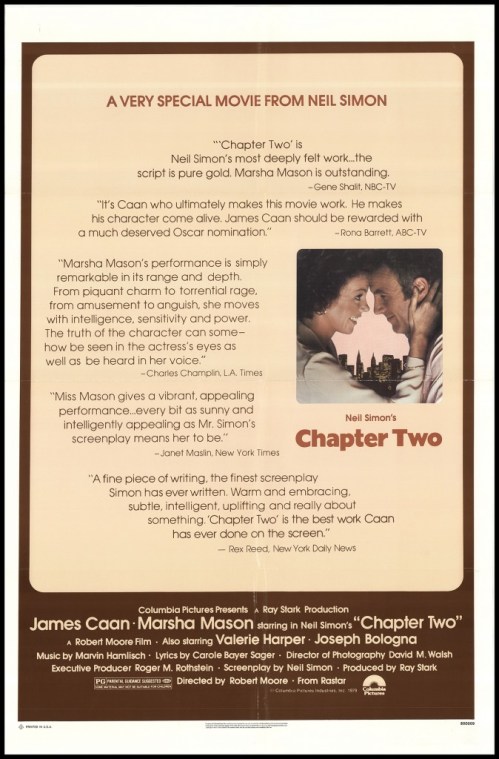
Chapter Two (1979)

By Richard Winters

My Rating: 7 out of 10

4-Word Review: Trying to start over.

George (James Caan) is a famous author who has just lost his first wife. His brother Leo (Joseph Bologna) gives him the phone number to Jennie (Marsha Mason) who has recently gone through a divorce. After an initially awkward first encounter the two form an attachment and quickly decide to get married. Then on their honeymoon the memories of George’s recently deceased wife comes back to haunt him, which jeopardizes his new marriage.

The film, which is based on the hit Broadway play that ran for 857 performances and was written by Neil Simon, is largely inspired by the events of his own life as he lost his first wife, Joan Baim, on July 17, 1973 and then quickly married actress Marsha Mason on October 25th of that same year. Mason is essentially playing herself and her performance here is one of the movie’s stronger points.

An aspect of the film though that I found even more interesting is the fact that it reteams Mason and Caan just 6 years after they had starred in Cinderella Liberty. The romantic angle here though is much more realistic as both people are on a more equal footing as a relationship cannot work if one person is too severely dependent on the other. I also enjoyed seeing how Mason, a highly underrated actress, could effectively play both an emotionally weak person as she did in the 1973 film and a very strong one as she does here. My only quibble is that her character is again portrayed as being an actress just like she was in The Goodbye Girl, but there she was wracked with anxiety and struggling financially as most artists do while here she seemed too financially secure and more like a woman working in the corporate business world.

The film has a nice breezy pace and the romance is allowed to blossom naturally without ever feeling forced, which along with the excellent on-location shooting I really liked. The problem though comes with the fact that the leads are quite bland when compared to their supporting counterparts, which are played by Bologna and Valerie Harper. Bologna seems to steal any film he is in and he really should be given more starring vehicles. Harper is equally strong and nothing like her more famous Rhoda Morgenstern persona. Their characters have engaging flaws and the banter between them is far more comical. The film shifts uneasily between scenes featuring Caan/Mason to those with Bologna/Harper until it seems like two completely different movies going in opposite directions.

Having Caan’s character go from being really crazy about Mason to suddenly and quite literally overnight becoming aloof towards her is too severe and comes off like he is afflicted with a Jekyll and Hyde disorder. Likewise Mason is too forgiving with it when most people would simply get a quickie divorce since they had known each other for only 10 days. Yet even with all of these weaknesses I still found it a soothing and easy-to-take movie that should please romance aficionados everywhere.

My Rating: 7 out of 10

Released: December 14, 1979

Runtime: 2Hours 4Minutes

Rated PG

Director: Robert Moore

Studio: Columbia Pictures

Available: DVD (Sony Choice Collection)

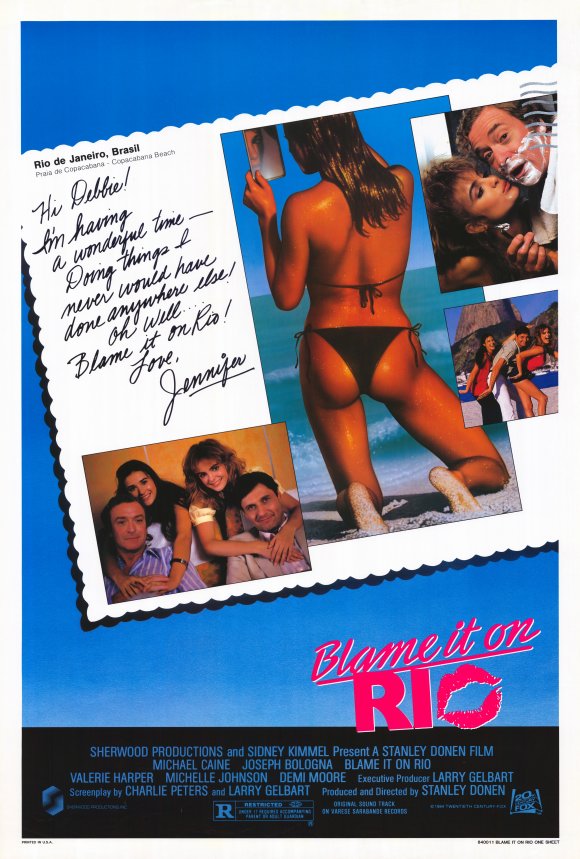
Blame it on Rio (1984)

blame it on rio 1

By Richard Winters

My Rating: 4 out of 10

4-Word Review: Sex with friend’s daughter.

Victor (Joseph Bologna) is going through a messy divorce and in order to escape from the stress he invites his friend Matthew (Michael Caine) to join him and his daughter Jennifer (Michelle Johnson) on a trip to Rio de Janeiro. Initially Matthew was to bring along his wife Karen (Valerie Harper), but at the last minute she bails out, so instead he takes his daughter Nicole (Demi Moore) who is also Jennifer’s best friend. During the trip Jennifer’s long dormant feelings for Matthew come to a head and the two end up having a fling. Matthew sees this as a secret one-night-stand as he doesn’t want it to jeopardize his long friendship with Victor, but Jennifer wishes for it to blossom into a love affair and even considers, much to Matthew’s reluctance, informing her father about it.

The film, which has been the last theatrical feature to date to be directed by the legendary Stanley Donen, has a zesty start that features soothing music, luscious scenery and sharp dialogue. Unfortunately it goes downhill from there with the third act being the real problem. Instead of becoming an interesting character study and analyzing whether this otherwise strong friendship could survive such a shocking event it instead veers off into silliness by entering in a crazy twist of Mathew’s wife having a secret affair with Victor, which didn’t seem realistic or believable and cements the whole thing as being nothing more than a dumb, shallow lightweight comedy.

The usually reliable Caine is miscast and his big Harry Caray-like glasses become almost a distraction. His costar Bologna is the one who steals it in a role nicely attuned to his brash, hothead persona.

The weakest link though is Johnson who despite looking great topless clearly has very little acting talent. Her character is poorly defined and written by two middle-aged men who were out-of-touch with the younger generation and had no idea how they ticked.  At the beginning she behaves too much like a child and then suddenly when she gets it on with Matthew she is like an out-of-control sensuous vamp, which made the character come off like two different people altogether. The fact that she shows no apprehension at all in having sex with Matthew who is much older made little sense as I would think that any normal person  would feel nervous and despite the attraction even some reluctance. She also shows no concern for how stressed the whole thing made Matthew feel, which unintentionally made her appear quite selfish.

Moore would’ve been much better in Johnson’s role and in many ways sexier. I had to chuckle a bit because in Leonard Maltin’s review of this film he mentions that Demi seemed ‘intimidated’ during her topless scene at the beach, which is actually an understatement as she looks downright uncomfortable, which in turn makes the viewer feel the same way.

This film is the American remake of the French comedy One Wild Moment, which came out six years earlier and will be reviewed later this week.

My Rating: 4 out of 10

Released: February 17, 1984

Runtime: 1Hour 40Minutes

Rated R

Director: Stanley Donen

Studio: 20th Century Fox

Available: VHS, DVD, Amazon Instant Video, YouTube

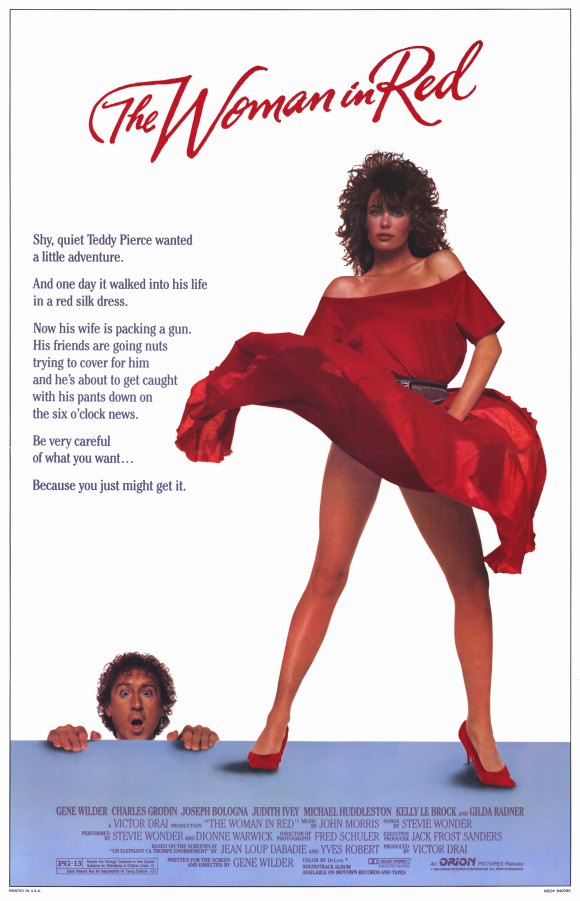
The Woman in Red (1984)

woman in red 1

By Richard Winters

My Rating: 5 out of 10

4-Word Review: Lusting after a model.

Teddy (Gene Wilder) seems to have it all. A great wife (Judith Ivey) a good home in the suburbs and stable job, but then one day that all changes when he inexplicably meets Charlotte (Kelly LeBrock) a beautiful model who turns him on so much he can no longer think straight and jeopardizes his marriage in the process. He gets his friends Buddy and Joey (Charles Grodin, Joseph Bologna) to cover for him while he makes any excuse he can to get away and see her. Unfortunately through a misunderstanding the homely Ms. Milner (Gilda Radner) thinks she is the source of Teddy’s affections, so as Teddy tries to get with Charlotte he must also avoid Ms. Milner who is just as relentless.

The film starts off with lots of potential, but is unable to fully deliver. Part of the problem is that it introduces this amusing side-story involving Radner’s character and then abruptly drops it during the second half. Radner makes for a perfect comic foil and her scenes should’ve been played up much more. However, her attempts to get back at Teddy by vandalizing his car is amusing, but you would think that Teddy would want to know why she is so angry at him as he is unaware that he has mistakenly asked her out or at the very least sued her for the damages that she has done and yet the film doesn’t tackle any of this, but realistically should’ve.

Wilder, who also wrote and directed the film, is okay, but it doesn’t take enough advantage of his signature comic rants and high strung persona. Bologna is good as Teddy’s brash, womanizing friend, but I didn’t understand why he got so upset when his wife left him as he had openly fooled around on her with a lot of different women and most men in his situation would rejoice that they were now ‘free’.

The usually reliable Grodin is ineffective and the segment where he pretends to play a blind man that inadvertently tears up a bar is dumb and unfunny. I did however enjoy LeBrock who looks gorgeous throughout.

There are a few amusing moments including Teddy’s attempts at riding a horse despite having no experience, but overall the comedy is spotty. The pacing is poor and the story is disjointed coming off more like a bunch of vignettes strung around a one-joke plot. The only thing that saves it is the ending where Teddy attempts at ‘hiding out’ while standing on the ledge of a tall building that quickly attracts a lot of onlookers who think that his ready to jump, which is the movie’s best moment.

This film is actually a remake of the 1976 classic French film Pardon Mon Affaire, which I will review for next week.

My Rating: 5 out of 10

Released: August 15, 1984

Runtime: 1Hour 27Minutes

Rated PG-13

Director: Gene Wilder

Studio: Orion Pictures

Available: VHS, DVD, Amazon Instant Video, YouTube