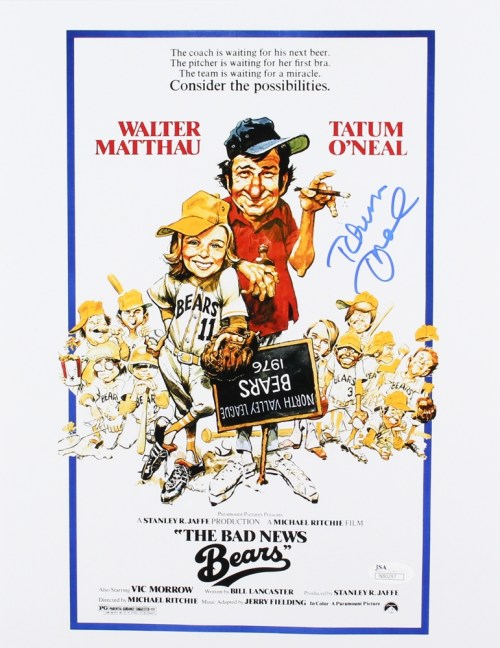
The Bad News Bears (1976)

By Richard Winters

My Rating: 8 out of 10

4-Word Review: From losers to winners.

Ex-minor league baseball player and now full-time pool cleaner Morris Buttermaker (Walter Matthau) gets hired to coach a bunch of unskilled, untalented kids in a competitive baseball Little League. At first Buttermaker is only interested in collecting a paycheck and has no drive in teaching the kids the fundamentals or even in winning, but things change after the season opener when his team gets drubbed by the far superior Yankees. Buttermaker takes offence at their arrogant manager (Vic Morrow) and feels compelled to ‘show-him-up’. To do this he brings in the talented Amanda (Tatum O’Neal) to be the team’s new pitcher as well as Kelly Leak (Jackie Earle Haley) who is an excellent fielder and hitter, but as his competitive juices flow, so does his surly side making the game no longer fun to play for the kids.

Don’t be fooled because this is anything but a simple kid’s flick. Sure the kids can watch it and enjoy it, but the multi-layered story brings out many issues that the adults will be more than able to relate to. Director Michael Ritchie deftly picks-up on the many nuances of Little League culture and if one played in it or was involved in any capacity then this movie will tap into those memories and bring back a flood of nostalgia.

My only complaint is a missing side-story dealing with the parents attending the games. It is mentioned in passing how the adults are able to be friendly with each other as the season begins, but by the end they are usually no longer on speaking terms, but it would’ve been much more revealing had this been shown instead of just discussed.

The script was written by Bill Lancaster who was the son of legendary actor Burt Lancaster. He based the story of his own experiences of playing Little League ball and the Buttermaker character is supposedly a composite of his famous dad.

This also marks the fifth film that Ritchie directed dealing with the theme of competition. His first was Downhill Racer, which dealt with the sport of skiing, The Candidate dealing with a senatorial race, Prime Cut, which was about rival crime syndicates, and Smile about the ugly side of beauty pageants and while all those flicks were good this one is his best.

Spoiler Alert!

The film’s climactic game, which has the Bears taking on the mighty Yankees for the championship features many of baseball’s intricate tactics that will appeal to the seasoned fan, but still be straight forward enough for the novice to grasp. It also has the film’s most famous scene where the Yankees’ manager smacks his own son (Brandon Cruz), who was the team’s pitcher, when he doesn’t obey his father’s instructions. Then on the very next play, and in order to get back at his dad, the kid fields a grounder, but refuses to throw it to first base, which allows the opposing team to score an easy run.

It is intended that the viewer should side with kid, but I didn’t. For one thing the dad’s advice was good, since this hitter had already gotten some runs off of him earlier it made sense to pitch low and outside. Just because he kid wants to ‘strike him out’ doesn’t mean that he will or that it’s a good idea. Strategy is a part of the game and that’s what a manger is there for. What happens if this kid grows up and plays in the big leagues and then decides he doesn’t want to do what the manager tells him. How’s that going to go over?

The kid also seemed like an incredibly self-centered little brat. Supposedly he lives with his dad 24/7, so couldn’t he have picked some other time to get back at his old man instead of jeopardizing the game for the rest of his teammates who are counting on him to help win?

This also brings up the issue of who’s really the ‘mean manager’.  It’s supposed to be Morrow, but Matthau in a lot of ways gets just as bad if not worse especially with the way he ends up treating Amanda making me almost surprised that she showed up the next day to play. To me it would’ve been more satisfying having one of the Bears players do to Matthau what the son did to his father and in my opinion Matthau would’ve deserved it more.

This then brings up the third issue which is the fact that Matthau has this extraordinary epiphany in the middle of the big game where he realizes in his zest to win he might’ve pushed things too far and decides to pull back. I realize this is the film’s central theme, which is that becoming overly competitive is not good and can turn otherwise nice people into assholes if they aren’t careful, but the shift comes off like a Jekyll and Hyde. Most of these types of games last for only an hour, so having a guy at the start of the hour come off as this relentless warrior willing to do whatever it takes to win only to end the game being this high minded idealist lecturing the other parents on how it’s important that all the children get a chance to play even if it means blowing the game seems too severe for such a short period of time.

I wasn’t completely happy about the Bears losing the big final game either. Normally I’d consider this a good thing because it works against the formula. It’s also beneficial for kids to realize that not everyone ends up with the big trophy or that ‘the good guys always win’, but more important to hold your head high and be proud of your accomplishments, yet I still remained a bit frustrated. You become so emotionally invested in them winning that it’s deflating when it doesn’t happen, but it’s still one of the best sports movies ever made either way!

End of Spoiler Alert!

My Rating: 8 out of 10

Released: April 7, 1976

Runtime: 1Hour 42Minutes

Rated PG

Director: Michael Ritchie

Studio: Paramount

Available: DVD, Amazon Video, YouTube
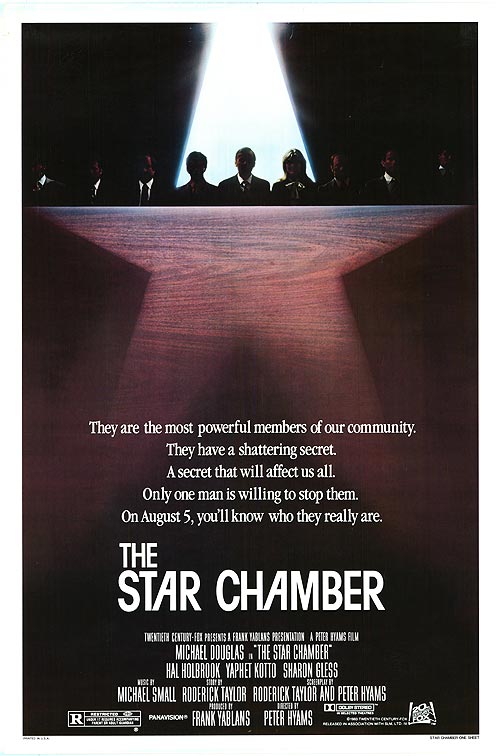
The Star Chamber (1983)

By Richard Winters

My Rating: 5 out of 10

4-Word Review:  Judges form vigilante group.

Idealistic young judge Steven Hardin (Michael Douglas) is sickened by the fact that so many known criminals are able to avoid jail time through legal technicalities. His friend and fellow judge Ben (Hal Holbrook) tells him of a secret underground group consisting of nine judges who have a hit-man sent out to kill the criminals who were otherwise able to get off through legal loopholes by the regular courts. Steven initially likes the idea and even sits in as one of the judges, but then he tries to stop a hit when it is later determined that the criminals set for vigilante execution were actually innocent, but finds to his horror that once the ball is set in motion there is no way it can be stopped.

The film is nicely directed by Peter Hyams who makes great use of mood lighting particularly in the scenes showing the nine judge tribunal as well as Steven’s visit to an abandoned warehouse. There is also a terrific foot chase at the beginning that is as exciting and intense as any car chase out there and it reminded me of a similar foot chase done in Busting, which was also helmed by Hyams.

The story by Roderick Taylor is an intriguing one, but it takes too long to get to the second act. The whole first hour is spent dwelling on Steven’s quandary of letting known criminals off-the-hook, which becomes quite derivative and could’ve easily been addressed in only 5 minutes. The story would’ve worked better had it started with Steven already involved in the underground organization and then through a brief flashback shown how he came to be there.

The scenes involving the vigilante tribunal are good, but I ended up having a lot of questions that never got answered or even touched on. For instance only one assassin (Keith Buckley) carries out all of the hits, but who is this guy and how did he come to work for them? Who’s the middle-man who gives him the assignments and how much does he know about the organization and what happens if he gets caught and starts talking to the police? How widespread is this movement and does it cover cases from the entire nation or only a certain area and are there other organizations like this one in other parts of the country and around the world?

I liked the wrinkle that gets thrown in, in which two criminals (Don Calfa, Joe Regalbuto) who Steven thinks are deserving of punishment, but later found to be innocent. Too many times Hollywood films dealing with this theme portray it in too much of a one-dimensional way that fails to bring out how vigilantism can sometimes be just as dangerous as the criminals it hopes to punish. Unfortunately the film fails to tackle the full complexity of the issue and instead just barely touches the surface.

The film also avoids making any clear statement or taking any position, which makes the whole thing come off as quite transparent when it’s over. The ending has no conclusion and leaves everything wide-open, which is a real cop-out. The concept is a good, but it needs to be redone by people who are willing to delve deeper as the effort here is too shallow to be considered satisfying.

My Rating: 5 out of 10

Released: August 5, 1983

Runtime: 1Hour 49Minutes

Rated R

Director: Peter Hyams

Studio: 20th Century Fox

Available: DVD, Blu-ray

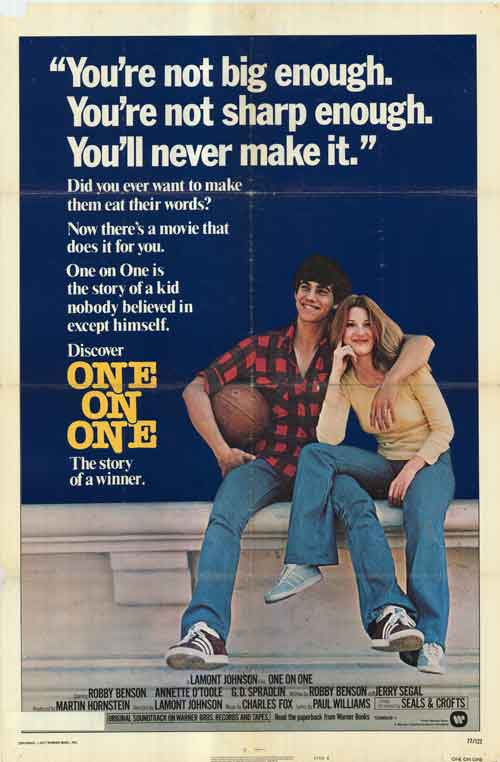
One on One (1977)

By Richard Winters

My Rating: 6 out of 10

4-Word Review: A college basketball star.

Henry Steele (Robby Benson) becomes the star of his small town high school basketball team, which is enough to get him a scholarship to a university in California on their team. Once there he becomes overwhelmed by the demands of his coach (G.D. Spradlin) as well as the under-the-table ‘business side’ of college athletics. The disappointed coach eventually asks him to rescind his scholarship, but Henry refuses leading to many brutal practices where the coach tries to make life a living hell for him, which he hopes will get Henry to finally quit, but to everyone’s surprise Henry perseveres and shows more grit in him than anyone ever imagined.

The script, which was co-written by Benson and his father Jerry Segal shows a revealing look of the underside of college sports making it quite compelling to watch particularly the first half-hour where Henry gets introduced to many things he hadn’t come into contact before including getting involved with ‘payouts’ to college benefactors, drugs, wild parties, amorous secretaries (Gail Strickland) and even romance with his tutor Janet (Annette O’Toole). The film has a nice year-in-the-life approach where the viewer feels like they are following Henry around by his side and experiencing the same first-hand situations as he does. It also examines the discrimination that athletes go through, which is rarely tackled in other films, dealing with Janet’s boyfriend Malcolm (James G. Richardson) who mocks Henry and other athletes like him for being ‘unintellectual’ and trained to passively obey all rules handed to them by their coaches while unable to think for themselves.

Benson’s performance of a wide-eyed, naïve small town lad works and the viewer can’t help but chuckle at his initial inability to handle the many new challenges he’s faced with while also remaining sympathetic to his ongoing quandary. Many actors may not be able to pull off such a feat, but Benson, who’s a far better performer than people may realize, does so flawlessly particularly the times when his character fights back and grows from a hayseed kid to a full grown man.

Spradlin has the perfect look and voice for a college coach and he coincidentally played a coach in North Dallas Forty, which came out that same year. However, his facial expressions reveal too much of his inner feelings particularly that of concern and worry where an actual coach would try to mask these vulnerable feelings from their players in order to prevent them from ‘reading’ what they are thinking and maintain more control.

Henry’s relationship with Janet comes off as forced. The two clearly were on opposite ends of the intellectual plain and I didn’t see what if anything that they actually had in common. Having Henry read ‘Moby Dick’ one of her favorite novels didn’t seem to be enough of a catalyst to have her suddenly fall-in-love with him. She brought in other athletes into her apartment to tutor and since she was paid $265 an hour I’d doubt she’d give that up, which most likely could cause tensions with their relationship, but this never gets addressed.

The songs by Seals and Croft don’t help and the film would’ve been better had they not been involved. They had some great chart toppers during the ‘70s, but slowing up the film by having a montage with their songs played over it takes the viewer out of the drama and unwisely reminds them that they’re just watching a movie instead. The Seals and Croft sound doesn’t coincide with a spots theme at all and it’s too bad that the Hall and Oates hit of ‘One on One’ hadn’t been released earlier  because that song would’ve been a better fit.

Spoiler Alert!

The ending has a dreamy/sports clichéd feel particularly the way Henry comes off the bench and scores all the points as the team scratches and claws their way from behind, which could be enough to make some viewer’s eyes roll, but the fact that all the fans run onto the court afterwards is what had me. This was only an early season game and usually fans only do this during a crucial late season contest or championship. Henry’s team was expected to go undefeated and they were losing to a team that they were favored to beat, so if anything the fans would’ve been annoyed that the game was so close and not inclined to rush the court, but more thankful that they had avoided a potential loss and then critical that the squad was not living up to expectations.

Having Henry stand-up to the coach at the end and leave the team may have been emotionally satisfying for a few seconds, but in the long run he’d be better off had he stayed. If he joined a new team he’d have to start all over again proving himself to the new coach and teammates while here he had finally gotten that out of the way. He’d also have to move to a new school, which would’ve hurt his relationship with Janet.

End of Spoiler Alert!

Overall though as sports movies go this isn’t bad and pretty realistic most of the way. Fans of college basketball should enjoy it as it gives one a sort-of behind-the-scenes view of the inner workings of college athletics.

My Rating: 6 out of 10

Released: June 28, 1977

Runtime: 1Hour 38Minutes

Rated PG

Director: Lamont Johnson

Studio: Warner Brothers

Available: DVD-R (Warner Archive), YouTube

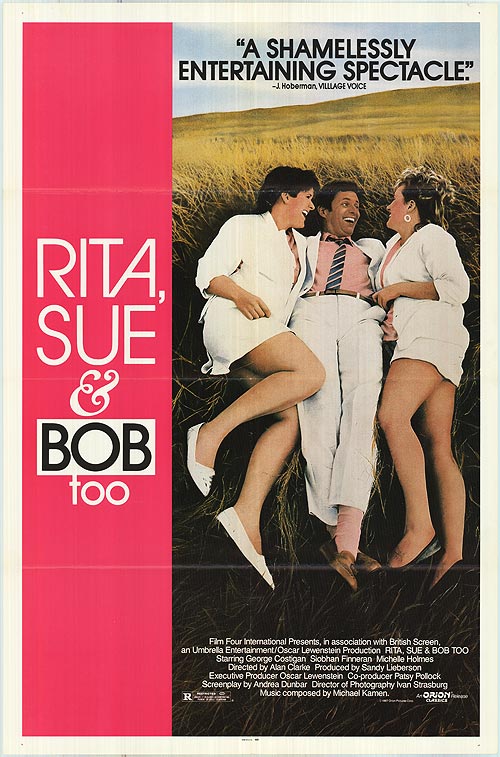
Rita, Sue and Bob Too (1987)

By Richard Winters

My Rating: 5 out of 10

4-Word Review: Dad fucks the babysitters.

Rita (Siobhan Finneran) and Sue (Michelle Holmes) are two friends from high school who babysit for Bob (George Costigan) and his wife Michelle (Lesley Sharp). One night while Bob is taking the two babysitters home in his car he decides to make a sexual overture to them and they both enthusiastically reciprocate, which ends up turning into a mini sex orgy. Soon the three are routinely getting together for sexual trysts until Michelle eventually catches on and leaves Bob while taking the kids with her. Sue’s parents find out too, which causes a great deal of stress and infighting amongst the three.

This offbeat comedy unexpectedly became a worldwide cult hit that made stars of the three leads particularly the two women whose first film this was. Unfortunately the same cannot be said for the film’s director Alan Clarke or its writer Andrea Dunbar who both tragically died just 3 years after the film’s release. Clarke from cancer while Dunbar, who was living on welfare and an alcoholic, passed away at her local pub at only 29 years of age.

The film comes off as an odd mix of lighthearted comedy and gritty drama that doesn’t completely work. The story jumps from the upscale middle class neighborhood of Bob’s house to the abject poverty of Sue and Rita’s family life with their apartments so vividly rundown that it’s almost horrifying to imagine anyone could live in such squalor. Part of the reason for this shift is that the film was based on two of Dunbar’s plays, the first being ‘The Arbor’, which was an autobiographical story of her growing up in the slums and at the hands of an abusive father, which she wrote at the age of 15 as a class project, and the other on a later play that she wrote with the same title as the film.

I’m not sure why director Clarke choose to mix the two plays together. Maybe he thought it would give the story more substance, but it really doesn’t. The antics that go on here could’ve happened in any neighborhood and the income bracket issues showing the stark scenes of the girl’s sad home life seem inconsequential and meandering.

I didn’t like the film’s abrupt start either as it jumps almost immediately to the three getting-it-on inside the car without any backstory. I kept wondering when did Bob get the idea to make a pass at the two girls and why are the girls so unsurprised when he does? I would think most young women would be shocked when an older man that they babysat for would suddenly make an aggressive sexual come-on and yet here these two aren’t, but why? What sort of signals were the two sending out to Bob to make him feel that he could behave the way he does? Was he already getting ideas when they first came to babysit for him, or did it evolve later? These questions and scenarios never get shown or answered, but should’ve.

We also never see Rita and Sue interacting with the children. The scenes involving their babysitting shows them either sitting watching TV or stuffing their faces with snacks after raiding Bob’s refrigerator while the two children remain complete afterthoughts that are only shown briefly for a few seconds at the 54-minute mark and that’s it, which then brings me to another crucial question. Why is it necessary to hire two babysitters to watch over two kids? When I was younger and babysat I could easily watch my neighbor’s two kids without any help. When I was a child only one babysitter was hired to look after me and my two siblings. Hiring two teen girls to look after two kids is highly impractical and quite unusual to the point that it makes no sense.

The ending leaves open a lot of questions making the film seem almost like an incomplete treatment to a wider story. For instance the three end up moving in together without showing whether this unusual living arrangement would be able to sustain itself long term. I was also curious to see how Bob would explain this arrangement to his children when they came to visit. There is also a side-story dealing with Sue’s relationship with a Pakistani boyfriend (Kulvinder Ghir) that seemed better suited for another movie altogether.

The scenes involving the three inside the car are the funniest, but otherwise I’m not sure why this movie became the hit that it did.  There’s also too many tracking shots almost like director Clarke found himself a new toy that he couldn’t help playing with. Initially the constantly moving camera comes off as innovative and gives the film added energy, but it ends up getting overused.

My Rating: 5 out of 10

Released: May 12, 1987

Runtime: 1 Hour 33 Minutes

Rated R

Director: Alan Clarke

Studio: Film Four International

Available: DVD, Blu-ray

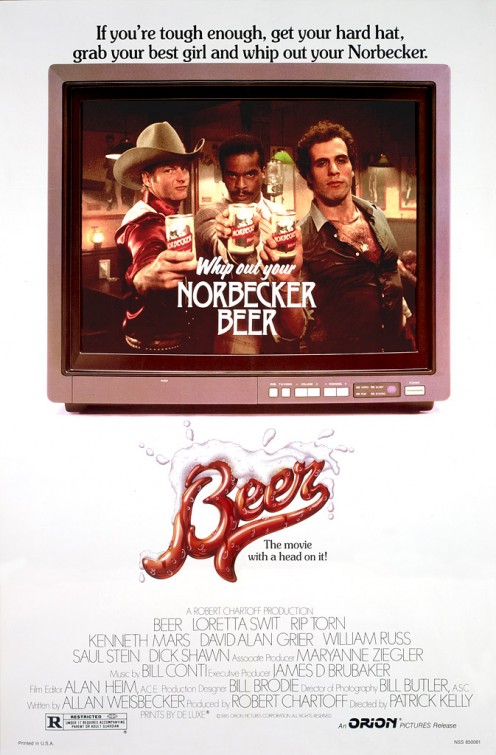
Beer (1985)

By Richard Winters

My Rating: 1 out of 10

4-Word Review: This beer is flat.

An ad agency goes on the offense when their top client Norbecker beer (Kenneth Mars) threatens to pull their account. B.D. Tucker (Loretta Swit) is put in charge of introducing a new ad campaign that will excite viewers. After she witnesses three men (Elliot Morrison, William Russ, Saul Stein) subdue a gunman at a bar she decides to hire them to star in her new commercial were they’re portrayed as macho men and chick magnets, which causes controversy when female viewers find the ads to be sexist.

Normally I love satire and find it sad that there are so few satirical movies out there and yet it’s films like these that have single-handedly killed the genre. The attempt at mixing the acerbic wit of Network with the work place politics of How to Succeed at Business without Really Trying and then throwing them into the rapid-fire joke structure of Airplane doesn’t work and only succeeds at producing more groans than laughs. The tone is inconsistent with too many dumb gags thrown in for the sake of a cheap laugh that many times has nothing to do with the main theme. Taking satirical jabs at the advertising business is too easy and been done before while portraying the industry and the people who work in it in too much of a generic way. You’ll find a more realistic portrait of the business and on-target satire from a weak episode of ‘Bewitched’ than anything you’ll see here.

The three male leads lack pizazz and are incredibly bland and transparent. The film might’ve had a better chance of working had it cut the three characters down to just one, hired an actor who had some actual presence and then geared the story completely from his point-of-view, so the viewer like the protagonist could see the ugly side of advertising biz first-hand from an outsider’s perspective.

The supporting cast fails to help. Mars does a softer version of the caricature that he portrayed in The Producers, but here it fails to elicit even a small chuckle. Swit, who was nearing 50 at the time, looks great, but her performance lacks verve. Sandra Bernhard, who was initially cast in the role and then later fired, would’ve been a better choice for this type of material.

Dick Shawn’s attempt to emulate Phil Donahue doesn’t work as he fails to share any of Donahue’s same mannerisms although seeing him prance around on stage as he goes from one audience member to the next is worth a few chuckles. The scene though, which involves female audience members shouting their disproval of the beer commercials at the three men who starred in them, would’ve been stronger had it been Swit a fellow female that was onstage taking the women’s heat instead of the men.

The biggest transgression though is that after bombarding us with one silly comedic idea after another it then decides to suddenly at the end make a ‘serious statement’, which is utterly hackneyed. You can’t spend the majority of time being inane only to get ‘profound’ at the last minute, which makes this production seem even more amateurish and misguided than it already is.

My Rating: 1 out of 10

Released: August 30, 1985

Runtime: 1 Hour 22 Minutes

Rated PG

Director: Patrick Kelly

Studio: Orion Pictures

Available: DVD-R (MGM Limited Edition Collection), Amazon Video

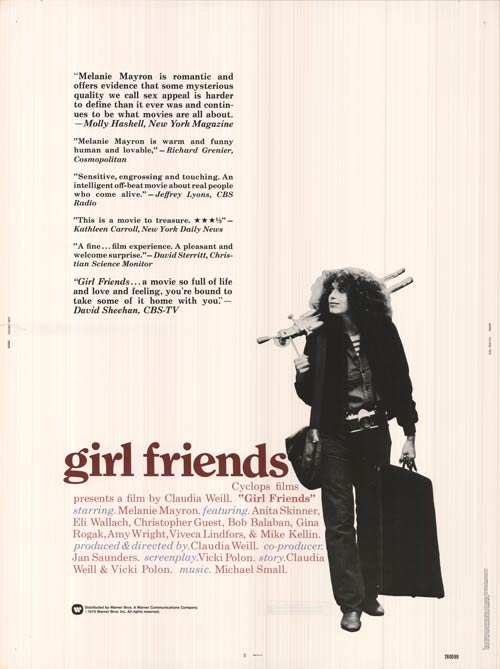
Girlfriends (1978)

By Richard Winters

My Rating: 6 out of 10

4-Word Review: She misses her friend.

Susan (Melanie Mayron) and Anne (Anita Skinner) are best friends and roommates, but when Anne decides to get married to Martin (Bob Balaban) and move out Susan can’t handle the solitude. She picks-up a hitch-hiker named Ceil (Amy Wright) who moves in for a bit, but it doesn’t work out. She then gets into a relationship with Eric (Christopher Guest) and even a 60-year-old married rabbi (Eli Wallach), but both of these end in heartache. The more Susan tries to ‘move-on’ the more she longs for the old days with Anne and Anne starts to feel the same way.

This was Claudia Weill’s feature film debut that met with high accolades including director Stanley Kubrick who considered it his favorite film of 1978. There’s a nice understated quality here that not only brings out a vivid late ‘70s feel, but also the very real day-to-day struggles of a young adult trying to swim through the quagmire of relationship and career obstacles. Melanie Mayron is certainly not a beauty by the conventional standard, but her plain appearance helps accentuate the challenges of the regular person trying to break-out and get noticed.

Susan’s struggles at trying to become a full-time photographer had me hooked the most as it portrays the universal challenges anyone can have in trying to get ‘their foot-in-the-door’ no matter what the profession, but I was a bit stunned when she forgets about the exhibition of her work at an art show. If someone is truly excited about getting their first big break then there is simply no way that would happen. It’s also hard for the viewer to completely empathize with someone’s career struggles if they themselves aren’t doing all they can to achieve it.

Another misguided wrinkle to the story was Susan’s relationship with a married rabbi who was almost 40 years older than her. These types of relationships suffer from extraordinarily long odds  and just about anyone would realize that from the get-go, which makes Susan’s ‘shocked’ reaction when the rabbi is unable to get together for a date due to family obligations seem almost  irrational. How a relationship like this could even begin to blossom is a whole other issue that never even gets addressed.

The film suffers from a few awkward scenes too. One has Wallach sitting down to play a game of chess with Melanie only for him to get up a minute later and leave for no reason. Why does he bother to show up for a chess game if he isn’t even going to make a single move on the board? Later Viveca Lindfors appears wearing a neck brace and yet no explanation is ever given for why she has it on. Later she’s shown without it, so why did she have it in one scene and not the other? Maybe it was for a minor accident, which can happen, but film is a visual medium and when something slightly askew gets shown it needs to get addressed even if it’s just in passing otherwise the viewer will key in on that and not the story.

Even more amazingly, and I can’t believe I’m saying this as I’ve never seen it in any other movie that I’ve ever watched before, but there’s an actual scratch on the camera lens that can be spotted in just about every scene. It appears on the top right hand side as a small white mark. If the sun is shining through a window it will reflect the light and be more pronounced. If a character walks in front of the window it fades a bit, but you can still see it and this continues throughout the entire run of the film. I can only presume that cinematographer Fred Murphy was aware of this, but due to the budget constraints they didn’t have enough money to replace the lens and decided to simply chug along with the scratch in place and hope no else would notice.

Ultimately though I found the story, in its simple way, to be touching and poignant this is particularly evident at the end where the viewer can see firsthand how friendships help add insight and support to a person’s life and are an important dimension to the human experience.

My Rating: 6 out of 10

Released: August 4, 1978

Runtime: 1 Hour 26 Minutes

Rated PG

Director: Claudia Weill

Studio: Warner Brothers

Available: DVD-R (Warner Archive), YouTube

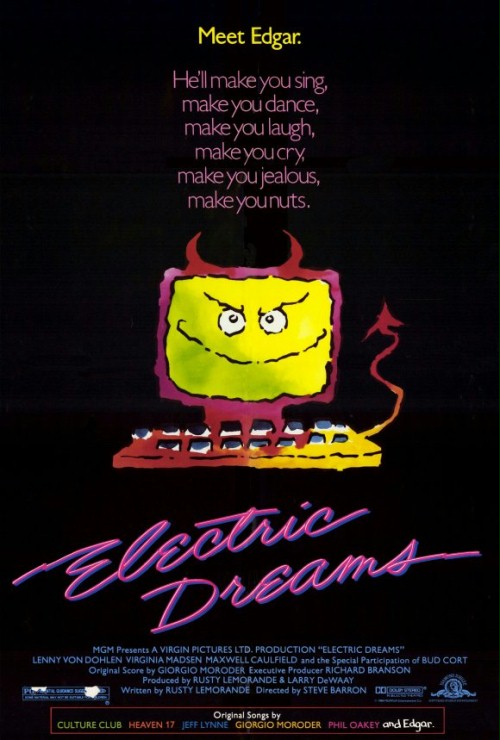
Electric Dreams (1984)

By Richard Winters

My Rating: 2 out of 10

4-Word Review: His computer becomes jealous.

Miles (Lenny Von Dohlen) is a young architect seeking to get his life more organized, so he buys a personal computer (voice of Bud Cort) and sets it up in his apartment. A beautiful young cellist named Madeline (Virginia Madsen) moves in next door to him and practices her cello each day while at home. Miles’s computer, which goes by the name of Edgar, overhears her playing and falls in love with the sound and her in the process. When Miles becomes attracted to her the jealous computer tries everything it can to thwart their relationship.

I enjoyed the imaginative visual style implemented by Steve Barron in directorial debut. In fact it’s the film’s only selling point as the bland script offers little that is funny or interesting and drags on at a snail’s pace with hardly anything actually happening.

Sometimes it’s fun watching films from a bygone era and seeing how much technology has changed, but this thing gets so fanciful with it that it becomes illogical instead. Clearly the filmmakers had no understanding at how a computer actually works as this machine is able to do things that no normal PC could. For instance it’s able to make the knob on Miles’ door turn hot, so he can’t leave his apartment. It’s also able to connect to the servers of Miles’s credit card company even though this is before the advent of the internet and somehow shut off his credit. There’s also a scene where Miles pours champagne on the computer’s keyboard, which doesn’t permanently disable it even though we all know that in reality it would’ve.

It takes too long for the computer to become evil and then when it does it ends pretty quickly. The machine lacks a distinctive look and should’ve been made more ‘evil’ appearing, which would’ve helped coincide with the film’s otherwise flashy visual look. Bud Cort’s voice talents go to waste as it gets electronically altered until it’s unrecognizable and therefore could’ve been anyone’s.

Madsen is good, but the story is geared too much towards the preteens. The trite, overly innocuous script needed more bite, or an added edge to make it interesting to adults who will most assuredly be bored.

My Rating: 2 out of 10

Released: July 20, 1984

Runtime: 1Hour 32Minutes

Rated PG

Director: Steve Barron

Studio: MGM

Available: DVD (Region 2 and 0)

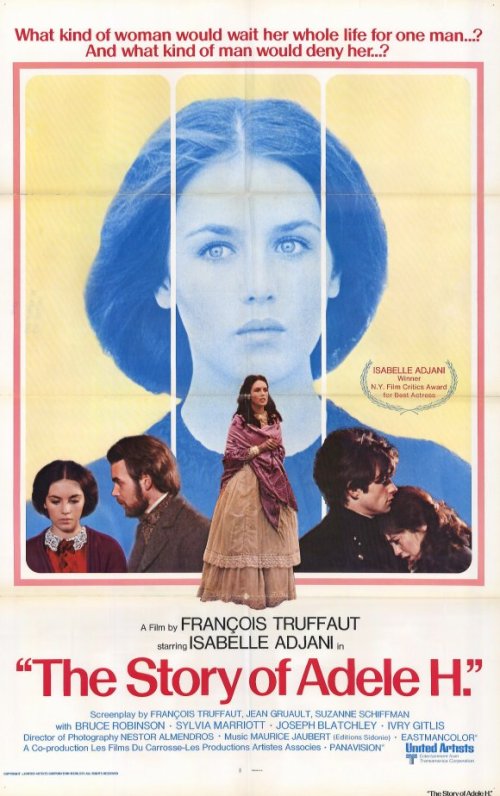
The Story of Adele H. (1975)

By Richard Winters

My Rating: 7 out of 10

4-Word Review: She obsesses over soldier.

Based on actual events the story centers around Adele Hugo (Isabelle Adjani), the second daughter of famous French writer Victor Hugo, who in 1863 travels across the Atlantic to Halifax, Nova Scotia where she tries to rekindle her relations with Albert Pinson (Bruce Robinson). Pinson is now an officer in the British army and no longer has any interest in Adele. Adele though refuses to accept his rejection and makes numerous attempts to get him to marry her. The more indifferent he becomes the harder she tries, which eventually drives her into a complete madness.

Director Francois Truffaut took the accounts from Adele’s actual handwritten diary to help recreate the story. Unlike most films nothing was altered from the documented facts and although the stalker /jilted lover theme may seem like an overused storyline by today’s standards it was still a fresh topic back in the ‘70s and one of the first documented cases in human history of what has now become known as erotomania where a person becomes convinced that the object of their desires is in love with them even when they really aren’t.

What helps this film to stand out is that the audience isn’t made to fear the woman and her actions are not portrayed as being menacing. Instead the viewer feels genuinely sorry for her as we witness firsthand how debilitating mental illness can truly be as it destroys this otherwise beautiful woman’s personality and leaves her only a shell of a person in the process.

Adjani is excellent and although the film remains compelling it still comes off as feeling incomplete. Part of the problem is that we only see the character at one stage of her life. Reportedly in real-life Adele only started to show signs of mental illness when she reached her mid-20’s, so it would’ve been interesting to have seen scenes from when she was younger and behaving more normally. Flashbacks of when Adele first met Pinson, who was initially interested in Adele and even proposed marriage to her, would’ve been intriguing to see as well.

We’re never shown Adele’s relationship to her father either, which could’ve been quite revealing. We hear voice-overs from when he sends her letters, but seeing the two interrelate in-person was needed. This may have been the result of Truffaut given the rights to film the story by Jean Hugo, but only if Victor Hugo did not appear onscreen, but in either event the film is lacking in budget and scope where a wider biopic of the woman’s life would’ve been more satisfying including showing her later years while inside a mental institution, which gets only glossed over here.

As in most cases what occurred behind-the-scenes while the film was being made is sometimes more interesting that what happened in front of the camera and this production proved to be no exception as the cast and crew went through many of the same scenarios as the characters. Truffaut tried to start up a relationship with Adjani, but was rebuffed and then she turned around and had an affair with the actor who plays the character that rebuffs her character in the movie. This caused Truffaut great jealousy as he was forced to deal with the two’s affair from afar much like Adele had to do in the story when Pinson eventually marries someone else. Truffaut later described making this movie and dealing with his unrequited love for Adjani as a ‘daily suffering’.

My Rating: 7 out of 10

Released: October 8, 1975

Runtime: 1 Hour 50 Minutes

Rated PG

Director: Francois Truffaut

Studio: United Artists

Available: DVD, Blu-ray, Amazon Video

Polyester (1981)

By Richard Winters

My Rating: 4 out of 10

4-Word Review: Suburban housewife has problems.

Francine Fishpaw’s (Divine) world is crumbling. Not only must she endure constant protests in front of her suburban Baltimore home dealing with people upset with her husband (David Samson) running an adult theater, but she must also deal with his affair with his sexy secretary (Mink Stole) as well. Her teenage son (Ken King) is terrorizing the city by intentionally stomping on the feet of every woman he sees and her daughter Lu-Lu (Mary Garlington) wants an abortion. She then meets the dashing Todd Tomorrow (Tab Hunter) and the two immediately fall-in-love only to find that he too has a dark-side.

This was John Waters’ first studio backed film and the first to garner an R-rating while the others had been X. While the budget is an improvement and its technicallys more polished the edginess is lost. The humor and satirical potshots don’t have the same zing and are lacking in originality and outrageousness. The gimmick of passing out a scratch-and-sniff cards where audiences could sniff the scents being smelled by the film’s main character seems excessively juvenile and the film begins with a campy scientist (Rick Breitenfeld) talking about it, which sets the tone too much on a silly/cartoonish level.

Divine’s presence helps, but she isn’t as made-up or as flashy as she was in her past films and looking much more like just some fat guy wearing a lady’s wig. I liked that her character was consistently normal for the most part as in the other films she behaved more erratically although what she goes through here is so unrelentingly traumatic that it borders on being almost cruel to laugh at. It’s also not completely easy to sympathize with her quandary as her kid’s behavior is so outrageous you have to question her parenting skills and whether she’s partially to blame for the bad things that they do.

Edith Massey is funny as a poor woman who wins the lottery and now acts a bit nouveau riche about it. It’s also fun seeing the two teens go through a Jekyll and Hyde transformation, but Tab’s appearance adds little although he does sing a decent opening title tune.

The broad humor for the most part is dumb, but I still found myself laughing-out-loud at some of it, which I suppose is a part of Waters’ ‘charm’ at getting you to laugh at things you otherwise wouldn’t. Some of the moments that had me chuckling were: a ‘nice’ picnic that gets ruined by ants and a skunk. Pregnant young women forced to go on a ‘happy hayride’ in the cold rain by two fascist nuns and the pet dog who commits suicide by hanging himself along with leaving a note saying ‘Goodbye cruel world’.  The part where overweight Jean Hill hijacks a bus and chases down a group of teens who assaulted her on the street and then bites into their car tires to disable their vehicle is pretty wacked-out too.

My Rating: 4 out of 10

Released: May 29, 1981

Runtime: 1 Hour 26 Minutes

Rated R

Director: John Waters

Studio: New Line Cinema

Available: DVD, Amazon Video, YouTube
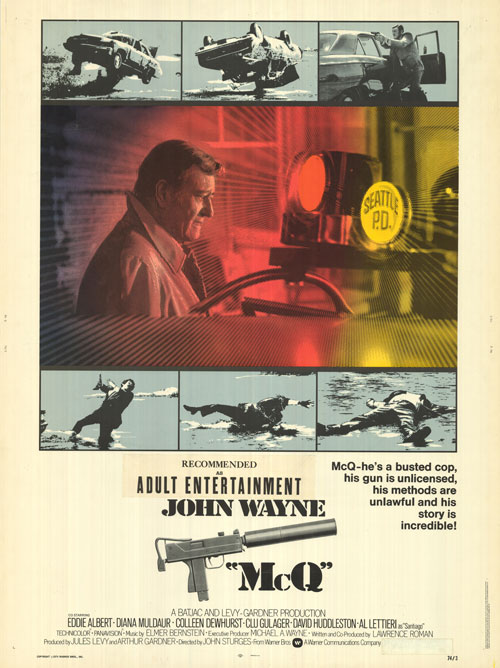
McQ (1974)

By Richard Winters

My Rating: 3 out of 10

4-Word Review: Old cop breaks rules.

Lon ‘McQ’ McHugh (John Wayne) is a retired cop lured back onto the force to investigate the death of his former partner Stan Boyle (William Bryant). Boyle was shot dead in a deserted alleyway and the head of the homicide division (Eddie Albert) thinks it’s the work of radical militants, but McQ has other ideas. He believes local narcotics dealer Manny Santiago (Al Lettieri) is behind it and he goes after him with a vengeance only to learn that the corruption lies far deeper and the bad guys may have infiltrated his own department.

Wayne’s ego was bruised when he had lost out in his bid to star in Dirty Harry as director Don Siegel felt he was just too old for the part, so he went on a mission to prove them wrong by not only playing a tough-guy cop here, but also a year later in Brannigan.

However, the aging Duke looks completely out-of-shape. Since a 1965 operation Wayne was unable to run due to having only one lung and could barely even walk long distances without needing oxygen. His acting style was by this time completely passé. The rest of the cast were consummate method actors genuinely trying to create a different character while Wayne simply plays himself for the hundredth time, but only without the cowboy outfit.

I was also not sure whether he was wearing a wig or it was just dyed, but it looks terrible either way. For my money it’s a rug, which I found amusing as this was a man who built his reputation on being tough and gritty and yet too vain to simply let himself age gracefully, which even if he was completely bald by that time would’ve looked infinitely better than the thing he had plopped on his head.

The run-of-the-mill plot offers few twists and no interesting characterizations or dramatic angles and is saved only by the Seattle scenery and some really cool car chases. One includes Wayne chasing a laundry truck while driving his vintage 1973 Pontiac Firebird Trans Am only to become confused about which truck he is after when a completely identical one suddenly comes onto the scene. There’s another thrilling chase at the end that was shot on the Olympic Peninsula and an equally exciting moment when Wayne’s Firebird gets crushed from both ends by two Big Mac trucks while it’s parked in an alleyway. You also get to hear Wayne deliver his immortal line: “I’m up to my butt in gas!”

My Rating: 3 out of 10

Released: January 4, 1974

Runtime: 1 Hour 51 Minutes

Rated PG

Director: John Sturges

Studio: Warner Brothers

Available: DVD, Amazon Video, YouTube